THE BILLIONAIRE FOUND HER JANITOR GIVING HIS LAST MEAL TO HIS DAUGHTER—THEN SHE LEARNED WHO HE REALLY WAS
The first thing Seraphina Vale noticed was that the janitor was lying to his daughter.
Not about something cruel.
About hunger.
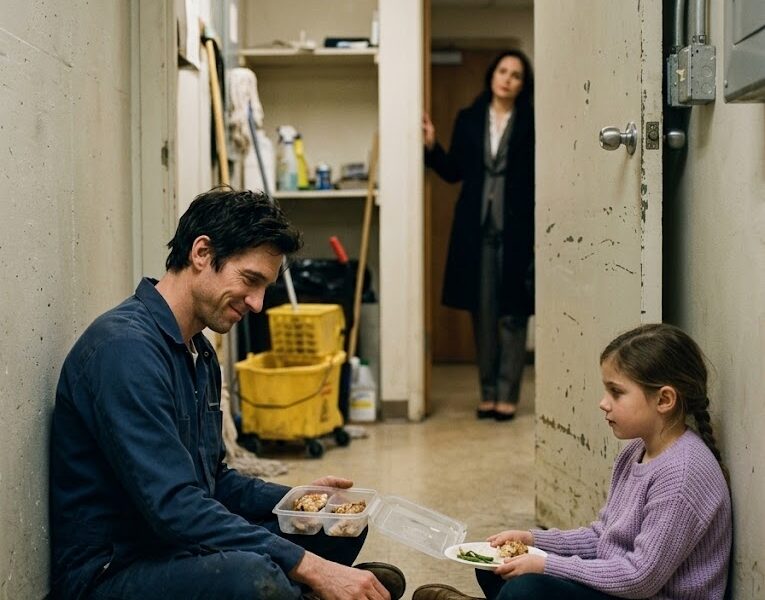
From the shadowed end of the twenty-third-floor service corridor, Seraphina stood behind a half-open utility-room door and watched Kellen Royce slide the last piece of chicken from his lunch container onto his seven-year-old daughter’s plate.
The little girl frowned.
“Dad.”
“I’m full.”
“You only ate three bites.”
“Big lunch earlier.”
She narrowed her eyes with the suspicious seriousness only children could manage. “You said you didn’t get lunch earlier.”
For the first time, Kellen seemed caught.
Then he smiled.
It was an exhausted smile. Gentle. Patient. The kind of smile a parent wore when life had already taken too much and he was determined not to let his child know.
“I had a snack.”
“What snack?”
Kellen glanced at the vending machine across the room.
“Very nutritious pretzels.”
“There aren’t any wrappers.”
“You’re getting too smart for me, kid.”
Meera Royce folded her arms.
Kellen quietly nudged the chicken closer to her.
“Eat.”
She didn’t.
Instead, she broke it in half and pushed one piece back.
“Half.”
“Meera.”
“Half, Dad.”
He looked at her for a long moment.
Then he surrendered.
“Half.”
She smiled triumphantly.
Seraphina should have walked away.
She had an acquisition call in nineteen minutes, a board waiting upstairs, and a private equity firm threatening to derail a transaction worth more than some countries produced in a year.
Instead, she remained frozen in a hallway that smelled faintly of industrial cleaner.
Because Kellen Royce did something strange.
Even while laughing softly with his daughter, he never stopped watching the door.
His back remained against the wall.
His chair had been positioned where he could see both hallway entrances and the reflection in the dark microwave door.
When an elevator bell sounded fifty feet away, Kellen’s eyes moved toward it before his head did.
When someone dropped a metal cart somewhere down the corridor, his right hand instinctively shifted toward his waist.
Then stopped.
That movement lasted less than a second.
Seraphina might have missed it if she hadn’t spent twenty years studying people across negotiating tables.
Kellen wasn’t merely alert.
He was trained.
She didn’t know for what.
Not yet.
“Dad?”
Kellen’s attention returned instantly to Meera.
“Yeah?”
“Can we get ice cream Friday?”
“We’ll see.”
“That means no.”
“That means we’ll see.”
“You always say that when money is tight.”
The smile left his face.
Only for a moment.
But Seraphina saw it.
Meera apparently did too, because she immediately looked down.
“Sorry.”
Kellen leaned closer.
“Hey.”
The girl raised her eyes.
“You never apologize for asking me for something.”
“But—”
“Never.”
He tapped the tip of her nose.
“My job is to worry about grown-up things. Your job is to be seven.”
“I’m almost eight.”
“Then you’ve got approximately four months to be irresponsible.”
Meera giggled.
And Kellen looked at her with such naked love that Seraphina suddenly felt like an intruder.
She stepped backward.
Quietly.
For the first time in years, a woman who controlled hotels, shipping contracts, technology companies, and nearly twenty thousand employees felt ashamed to be standing inside one of her own buildings.
She had seen Kellen Royce before.
Hundreds of times, probably.
Dark work uniform.
Cleaning cart.
Polite nod.
Invisible.
That was the uncomfortable word.
Invisible.
Not because he lacked presence.
Because people like Seraphina had trained themselves not to see men like him.
She reached the executive elevator and pressed the button.
Nothing happened.
Her own reflection stared back from the polished steel doors.
Custom ivory suit.
Diamond earrings she had forgotten she was wearing.
A watch that cost more than Kellen probably earned in two years.
And all Seraphina could think about was a piece of chicken being cut in half.
The elevator opened.
Her chief of staff, Vanessa Chen, was inside.
“There you are. Everyone’s waiting. Prescott moved the call up, and legal says—”
“How much do our night janitors make?”
Vanessa stopped.
“What?”
“Facilities. Cleaning staff. Hourly compensation.”
“I… don’t know.”
“Find out.”
Vanessa stared at her.
“Right now?”
“Yes.”
“Seraphina, Prescott is threatening to walk away from a nine-hundred-million-dollar—”
“Then he can threaten for another five minutes.”
The elevator doors closed.
Seraphina watched the floor numbers rise.
Twenty-four.
Twenty-five.
Twenty-six.
She should have let it go.
She almost did.
Then she remembered the way Kellen’s eyes had tracked every entrance while he fed his daughter.
And for reasons she couldn’t explain, Seraphina Vale decided to learn who her janitor really was.
That decision would nearly get them both killed.
Kellen Royce was thirty-eight years old and had worked at Vale Global headquarters in Seattle for eleven months.
According to his employee file, there was nothing remarkable about him.
His attendance was nearly perfect.
No disciplinary history.
No complaints.
No workplace disputes.
He volunteered for holiday shifts.
He refused overtime only on Wednesday evenings.
Supervisor evaluations described him with the same words repeatedly.
Quiet.
Reliable.
Private.
One line in his background check mentioned military service.
That was all.
Seraphina sat behind her desk after midnight, rereading the file while rain streaked the glass walls of her fifty-second-floor office.
No previous corporate employment.
No college listed.
No professional references beyond the hiring agency.
His residential history seemed to begin six years earlier.
Before that, almost nothing.
Which was impossible.
People left tracks.
Mortgages.
Court filings.
College registrations.
Social media.
Parking tickets.
Employment histories.
Kellen Royce appeared to have lived thirty-two years of his life before materializing in Washington State with a little girl and a clean criminal record.
Her security director, Marcus Bell, stood across from the desk.
Former federal agent. Sixty-one. Broad shoulders going soft with age, but eyes still sharp.
“You asked me to check him without alerting him.”
“And?”
Marcus dropped a thin folder onto her desk.
“That’s the problem.”
Seraphina opened it.
Three pages.
“Where’s the rest?”
“There isn’t any.”
“Everyone has a rest.”
“Not him.”
She looked up.
“What does that mean?”
“It means his military records are restricted beyond what a normal employment background service could access.”
“Special operations?”
Marcus hesitated.
“Probably.”
“Probably?”
“I called someone.”
“Who?”
“Someone who told me to stop calling.”
That finally got Seraphina’s full attention.
Marcus lowered his voice.
“Whatever Royce did before he became a janitor, it isn’t information the Department of Defense wants strangers digging into.”
Seraphina leaned back.
“And he passed our security review?”
“Easily. His identity is legitimate. Honorable discharge. No warrants. No known threat indicators.”
“Then why erase the rest?”
“I didn’t say erased.”
“What would you call it?”
“Protected.”
Rain ticked softly against the windows.
Seraphina looked back at Kellen’s employee photograph.
He wasn’t smiling.
Dark hair cut short.
Gray-blue eyes.
A face that might have been handsome if exhaustion hadn’t settled so permanently around it.
“What about his wife?”
“No wife.”
“The girl’s mother?”
“Elena Royce. Nurse. Died six years ago.”
“How?”
“Cancer.”
Something tightened unexpectedly inside Seraphina.
“And he’s been raising Meera alone?”
“As far as I can tell.”
She closed the file.
Marcus didn’t move.
“What?”
“You haven’t told me why you’re interested in him.”
“I saw something.”
“Something dangerous?”
“No.”
Marcus waited.
Seraphina glanced toward the folder again.
“He gave his daughter his lunch.”
Marcus blinked.
“That’s it?”
“No.”
“What else?”
She remembered the chair placement. The moving eyes. The almost invisible motion toward his waist.
“He watches rooms.”
Marcus’s expression changed.
“How?”
“Like you.”
Now Marcus went still.
“Show me.”
“I don’t understand.”
“The next time you see him, show me.”
It happened sooner than either expected.
Two mornings later, Seraphina entered the lobby at 6:17 a.m., earlier than usual.
Kellen was polishing fingerprints from a glass security partition.
Marcus walked beside her.
They deliberately changed direction.
Kellen noticed.
Not obviously.
His hand kept moving over the glass.
But his eyes flicked toward Marcus.
Then Seraphina.
Then the revolving entrance.
Then the security desk.
Then back to his work.
Marcus waited until they entered the private elevator.
“You’re right.”
“About?”
“He reads the room.”
“What does that mean?”
“It means he knew I was armed.”
Seraphina turned.
“You’re always armed.”
“Most employees don’t know that.”
“How did he?”
Marcus looked through the elevator’s glass wall as Kellen became smaller below them.
“Because Royce isn’t most employees.”
Seraphina’s curiosity should have ended there.
Instead, it deepened.
She began noticing him.
Not stalking him.
At least that was what she told herself.
She noticed he always entered rooms on the hinge side of a door.
He never stood directly in front of elevator doors while waiting.
If Meera visited after school, Kellen automatically placed himself between her and strangers.
He didn’t use headphones while working, even when other custodial employees did.
Once, a junior executive came around a blind corner carrying a stack of binders and nearly collided with him.
Kellen shifted aside before the man appeared.
As if he’d heard the footsteps.
As if he knew.
But she also noticed less mysterious things.
He helped an elderly receptionist carry groceries to her car without being asked.
He fixed the broken wheel on a mail cart because maintenance hadn’t gotten to it.
When someone spilled coffee in the lobby, three executives stepped around the puddle.
Kellen cleaned it.
When the CEO walked through, he didn’t suddenly straighten or pretend to work harder.
He simply nodded.
“Morning, Ms. Vale.”
“Good morning, Mr. Royce.”
He looked mildly surprised that she knew his name.
Then suspicious.
That amused her.
Until Friday.
Seraphina was leaving a shareholder dinner when she found him standing beside a vending machine in the underground employee garage.
Meera slept curled across three plastic waiting-room chairs nearby, wearing a purple coat over her school uniform.
Kellen was staring at his phone.
Not scrolling.
Calculating.
She knew that look.
It was the look people wore when money didn’t add up.
She almost walked away.
Instead, she said, “Everything okay?”
Kellen spun.
Not dramatically.
But fast enough to confirm Marcus’s theory.
“Ms. Vale.”
His phone disappeared into his pocket.
“Sorry. Didn’t mean to startle you.”
“You didn’t.”
“You moved like I did.”
That earned the smallest smile.
“Old habit.”
Seraphina looked at Meera.
“Long day?”
“Her after-school program closed early. Plumbing issue.”
“You bring her here often?”
“When I have to.”
“There’s childcare on the eighth floor.”
“For executives.”
“For all employees.”
Kellen shook his head.
“It’s subsidized, not free.”
There was no accusation in his voice.
That made it worse.
“I didn’t know.”
“Most people upstairs don’t.”
Seraphina absorbed the sentence.
“How much?”
His face closed.
“I’m sorry?”
“Childcare.”
“I don’t need—”
“I’m not offering to pay it personally, Mr. Royce. I’m asking what it costs.”
He studied her.
There was pride in his silence.
Not arrogance.
Pride.
“Eighty-four dollars a day.”
Seraphina did the math instantly.
For Kellen, it wasn’t a convenience.
It was a financial decision.
“I’m reviewing our employee support programs.”
“Because you saw me feeding my daughter?”
The directness shocked her.
Kellen watched her face.
“You knew?”
“I knew someone was standing outside the room.”
“How?”
“The light under the door changed.”
Seraphina almost laughed.
Instead she said, “Then why didn’t you say anything?”
“You were entitled to walk through your building.”
“And spy on people?”
“You didn’t come in.”
His gaze moved briefly toward sleeping Meera.
“And she was happy.”
Something about those four words silenced Seraphina.
Kellen returned his attention to his phone.
“You don’t owe us anything, Ms. Vale.”
“Maybe not.”
“No maybe.”
His voice remained respectful, but firmer now.
“My daughter and I are fine.”
“You were skipping dinner.”
“I’ve skipped dinners before.”
“You shouldn’t have to.”
His jaw tightened.
“That’s where people misunderstand.”
“What?”
“Having less doesn’t mean you’re waiting for someone with more to rescue you.”
The words landed harder than he intended.
Seraphina’s expression changed.
Kellen saw it immediately.
“I’m sorry.”
“No. You’re not.”
“No.”
That almost made her smile.
He glanced at Meera.
“My daughter has a roof, a school she likes, books, shoes, and a father who comes home. That’s more than a lot of kids have.”
“And what does her father have?”
Kellen looked at her.
For the first time, Seraphina saw something behind his eyes.
A grief so old it had hardened into architecture.
“I have her.”
Nothing more needed to be said.
He walked over, gently lifted Meera into his arms and carried her toward the garage elevator.
The girl woke just enough to mumble against his shoulder.
“Home?”
“Yeah, bug.”
“Ice cream?”
“It’s Friday.”
“So?”
“So I believe I made a terrible promise.”
Meera smiled without opening her eyes.
Kellen glanced back at Seraphina.
“Good night, Ms. Vale.”
She watched them disappear.
That night, she approved an emergency review of every hourly employee benefit in Vale Global’s Seattle operations.
But the question that kept her awake had nothing to do with compensation.
It was the way Kellen had said, “I’ve skipped dinners before.”
As if hunger was minor compared with things he had survived.
Three days later, Seraphina received an envelope.
No return address.
Inside was a photograph.
Kellen Royce, younger by perhaps ten years.
Beard.
Combat uniform.
Rifle slung across his chest.
Six other men beside him.
Every face had been scratched out with black ink except his.
On the back, someone had written four words.
YOU SHOULD HAVE STOPPED DIGGING.
Seraphina called Marcus immediately.
He locked down her office before reading it.
“Who knew?”
“About what?”
“That you asked me to investigate Royce.”
“You. Me. Two people in corporate security.”
Marcus cursed under his breath.
“Call them.”
“They’re clean.”
“You don’t know that.”
“I hired them.”
“Then call them anyway.”
Within thirty minutes, both security analysts were accounted for.
Neither admitted accessing military databases beyond authorized channels.
Marcus examined the envelope under bright light.
“This could be aimed at you.”
“Obviously.”
“No. I mean you personally.”
“Why?”
“Someone knows you asked questions.”
“About Kellen.”
“Which means whoever sent this may already be watching him.”
Seraphina felt cold.
“Meera.”
Marcus met her eyes.
“I’ll put someone near the school.”
“Without telling him?”
“You think Royce won’t notice surveillance?”
“No.”
“Neither do I.”
They told him that afternoon.
Kellen listened without interruption.
Marcus placed the photograph on the break-room table.
Something changed in Kellen’s face.
It wasn’t fear.
Fear would have reassured Seraphina.
This was recognition.
He stared at the photograph for three full seconds.
Then he reached for it.
“Where did you get this?”
“My office.”
“When?”
“This morning.”
“Who touched it?”
“Me, Marcus, two security employees.”
Kellen looked at Marcus.
“Bag it.”
Marcus’s eyebrows lifted.
“It’s already—”
“Bag it.”
There was no janitor in his voice now.
Marcus did it.
Seraphina watched Kellen study the handwritten message.
“Do you know who sent it?”
“No.”
“Do you know why?”
His silence answered before his mouth did.
“Kellen.”
He rubbed his thumb slowly over one scarred knuckle.
“You shouldn’t have looked into me.”
“I know that now.”
“No, you don’t.”
His voice was quiet.
Dangerously quiet.
“You have security at my daughter’s school?”
Marcus answered.
“Two plainclothes officers outside.”
“Remove them.”
Seraphina stared.
“Absolutely not.”
“They’re visible.”
“They’re supposed to be.”
“To you.”
Kellen turned to Marcus.
“Blue Ford Explorer across from the west entrance. Man in baseball cap pretending to read a paper. Gray Corolla at the north corner, woman using her phone without scrolling.”
Marcus’s expression hardened.
“You saw both?”
“When I dropped Meera off.”
“Why didn’t you say anything?”
“Because I assumed they were yours.”
“And if they weren’t?”
“Then I would’ve known before they reached her.”
Seraphina’s patience snapped.
“This isn’t normal.”
“No.”
“Then tell me what we’re dealing with.”
Kellen looked toward the small break-room window.
Rain dotted the glass.
“I can’t.”
“Can’t or won’t?”
“Both.”
She stepped closer.
“Someone put a threat in my office because I asked who cleans my building. Your child may be involved. The time for mysterious silence is over.”
He looked at her.
For a second, anger appeared.
Then disappeared under control.
“You want the truth?”
“Yes.”
“The truth is that there are parts of my service I am legally forbidden to discuss.”
“That’s not enough.”
“It’s what I can give you.”
“Why are they threatening me?”
“Because you opened a door someone wanted closed.”
“And what’s behind it?”
Kellen’s eyes held hers.
“People who don’t care how much money you have.”
That was the first moment Seraphina truly became afraid.
Not for herself.
For the sleeping child she’d watched divide a piece of chicken with her father.
Kellen took the photograph.
“This ends here.”
“What does?”
“You looking into me.”
“Fine.”
“You don’t ask questions. You don’t hire private investigators. You don’t contact military sources.”
“Fine.”
“And if anything unusual happens around Meera, you tell me immediately.”
Seraphina folded her arms.
“You don’t give me orders.”
“Today I do.”
Marcus almost intervened.
She stopped him with a glance.
Kellen wasn’t trying to dominate the room.
He was terrified.
He was simply too trained to look like it.
Seraphina finally nodded.
“All right.”
Kellen released a breath.
Then her phone rang.
Vanessa.
Seraphina answered.
“What?”
Her chief of staff sounded confused.
“There’s a man downstairs asking for Mr. Royce.”
Kellen went completely still.
“He says he’s an old friend from Virginia Beach.”
Kellen’s face lost all color.
“Name?” he asked.
Seraphina repeated the question.
Vanessa answered.
“Daniel Voss.”
Kellen whispered one word.
“No.”
Then he ran.
By the time Seraphina and Marcus reached the lobby, no visitor was there.
The receptionist insisted a tall man in a dark coat had arrived at 2:14 p.m., asked for Kellen, waited approximately ninety seconds, then left.
The security cameras had captured his face.
Kellen watched the footage once.
“Who is he?” Seraphina asked.
Kellen’s eyes stayed on the monitor.
“He died eleven years ago.”
No one spoke.
Marcus leaned closer.
“You’re sure?”
“I watched him die.”
The lobby seemed suddenly too large.
Too public.
Kellen grabbed his phone.
He called Meera’s school.
No answer.
Again.
Voicemail.
A third time.
This time someone answered.
Kellen’s shoulders relaxed half an inch.
“Yes. Kellen Royce. I’m Meera Royce’s father. I need you to put her on the phone.”
Pause.
His expression changed.
“What do you mean she was picked up?”
Seraphina’s stomach dropped.
Kellen’s voice became almost unnaturally calm.
“By whom?”
Another pause.
“No. There is nobody authorized except me.”
The receptionist at the security desk stopped typing.
Marcus was already reaching for his radio.
Kellen closed his eyes.
“When?”
He listened.
Then opened them.
“Eleven minutes ago.”
The building moved into emergency mode.
Seraphina had seen crises before.
Cyberattacks.
Shareholder revolts.
A hotel fire in Dallas.
A cargo vessel detained overseas.
Nothing resembled the transformation that overtook Kellen Royce.
The quiet man disappeared.
His grief disappeared.
Even panic disappeared.
In its place came calculation.
“School cameras,” he said.
Marcus nodded. “We’re pulling them.”
“Traffic cameras west and south.”
“I’ll call Seattle PD.”
“Do it.”
Kellen turned to Seraphina.
“Your corporate vehicles are GPS tracked?”
“Yes.”
“Anyone access the garage this morning using a temporary badge?”
“We can check.”
“Do it.”
She grabbed Vanessa.
“Now.”
Kellen’s phone vibrated.
Unknown number.
Everyone saw it.
He answered.
“Royce.”
Silence.
Then his face changed.
Not much.
Just enough.
“Let me hear her.”
Seraphina couldn’t hear the person speaking.
Then came a child’s voice.
“Dad?”
Kellen’s hand tightened around the phone.
“I’m here, bug.”
“Dad, I—”
The line cut.
Kellen closed his eyes.
A man’s distorted voice returned.
Marcus motioned to a technician to begin tracing.
“You still remember the names,” the caller said loudly enough for Seraphina to hear.
Kellen didn’t answer.
“You still remember where they went.”
“She has nothing to do with this.”
“Neither did Voss.”
Kellen’s breathing stopped.
The caller laughed.
“We’ll contact you again.”
“Wait.”
Click.
Kellen stared at the screen.
Marcus said, “We got six seconds of usable route data.”
“Not enough.”
“It’s something.”
“It’s a relay.”
“Probably.”
Kellen turned away.
Seraphina stepped after him.
“Who’s Voss?”
He didn’t answer.
“Kellen.”
“I need to think.”
“Then think with people who can help you.”
He spun.
“Help me?”
His voice finally broke through its restraint.
“You want to know how you help me? You stop making this about something money can fix.”
She flinched.
He instantly regretted it.
But he didn’t apologize.
“They don’t want a ransom.”
“What do they want?”
“Names.”
“Whose names?”
Kellen looked around at the people watching him.
Then toward Marcus.
“Clear the room.”
Minutes later, only Kellen, Seraphina and Marcus remained inside the security command center.
On one monitor was a frozen image of Meera leaving school beside a woman wearing a district employee badge.
The badge was fake.
The smile wasn’t.
Meera had gone willingly because she’d believed the woman.
Kellen stared at the image.
“Eleven years ago, my team was assigned to an operation overseas.”
Seraphina remained silent.
“The mission was compromised before we arrived. Someone knew our route, our objective and our extraction window.”
“Someone inside?”
“We believed so.”
His eyes never left Meera’s face.
“Daniel Voss was on my team.”
“The dead man?”
“The man from your lobby looked like him.”
Marcus said, “Could Voss have survived?”
Kellen shook his head.
“I carried him.”
Silence.
“Four men died that night. Three of us came home.”
“What happened after?” Seraphina asked.
“Investigation.”
“And?”
“Nothing anyone could prove.”
“Did you know something?”
“I remembered things.”
“What things?”
“Names. Faces. People who shouldn’t have been where they were. Contractors tied to intelligence logistics. Financial intermediaries.”
Marcus’s jaw tightened.
“You testified?”
“Classified debriefings.”
“Then whoever took Meera believes you can identify somebody.”
“They believe I remember enough to connect a chain that was never supposed to exist.”
“Do you?”
Kellen finally looked at him.
“Yes.”
Seraphina felt the room contract.
“Why now?”
“I don’t know.”
Marcus answered first.
“Maybe because you were investigated.”
Seraphina stared at him.
“You think I caused this?”
Kellen looked away.
That was worse than accusation.
“If I hadn’t—”
“Stop.”
He spoke firmly.
“This started before you.”
“You don’t know that.”
“The man using Voss’s face didn’t appear because you checked an employee file. Whoever is behind this already knew where I worked.”
Marcus nodded reluctantly.
“But Seraphina may have triggered movement.”
Kellen’s jaw hardened.
She took the blow without defending herself.
“Then I help finish it.”
“No.”
“Kellen—”
“No.”
“They used my company.”
“They used my daughter.”
“And I am not going to stand in an office while you handle this alone.”
His eyes sharpened.
“You have no idea what alone means in this situation.”
“Then tell me.”
For the first time, something passed between them that neither had expected.
Not attraction.
Not yet.
Recognition.
Two people accustomed to carrying everything without asking permission.
Kellen looked away first.
The next call came forty-three minutes later.
The kidnappers provided a location.
Not for Meera.
For proof.
An abandoned parking structure near the industrial waterfront.
Police wanted surveillance teams positioned around it.
Kellen refused to remain behind.
Detective Lena Ortiz, the Seattle officer now coordinating the case, argued with him for six minutes.
“You are the victim’s father.”
“I’m also the person they’re communicating with.”
“Which is why you are emotionally compromised.”
“I’m the least emotional person in this room.”
“That’s not the compliment you think it is.”
Kellen said nothing.
Ortiz stepped closer.
“Mr. Royce, if you go rogue, you could get your daughter killed.”
Something flashed across his face.
“I’m aware.”
“So let us do our jobs.”
“I am.”
He nodded toward the tactical map.
“I’m telling you your south approach is visible from the structure.”
Ortiz frowned.
“How?”
“Warehouse roof, southeast corner. Any observer watching traffic sees your entry team coming.”
The detective looked at Marcus.
Marcus quietly said, “He’s right.”
Ortiz cursed.
Seraphina stood off to one side, absorbing the surreal image.
A man who had been emptying trash bins two days earlier was correcting a police approach plan.
And everyone was listening.
The parking structure contained only Meera’s backpack.
Placed in the center of the third floor.
Inside was her math homework.
A stuffed rabbit.
One shoe.
And a phone.
It rang as Kellen approached.
He answered.
“You have twenty-four hours,” the distorted voice said.
“I need to know she’s alive.”
“You heard her.”
“I need to hear her again.”
“You’re negotiating?”
“I’m confirming you still have what you think gives you leverage.”
Pause.
Then Meera’s voice.
“Dad?”
Kellen shut his eyes.
“I’m here.”
“I’m scared.”
“I know.”
“There are two men and a lady.”
The line went silent for half a heartbeat.
Kellen immediately understood Meera had said something she wasn’t supposed to.
“So what are we going to do?” he asked quickly, voice warm now, almost casual.
Meera sniffed.
“Our breathing thing.”
“Exactly.”
Seraphina watched him.
“In through your nose,” Kellen said. “Slow.”
A faint inhale came over the speaker.
“Hold it.”
Silence.
“Out.”
Meera breathed.
“Good.”
“I’m trying.”
“I know you are.”
“Are you coming?”
The question broke something in every person listening.
Kellen’s answer was immediate.
“Always.”
The phone cut off.
He stood completely motionless.
Then said, “She’s indoors.”
Ortiz stared at him.
“How do you know?”
“Echo. Concrete or metal walls.”
Marcus nodded.
“No traffic noise.”
“Industrial area?”
“Maybe.”
Kellen looked toward the backpack.
“And she’s paying attention.”
Seraphina frowned.
“To what?”
He picked up Meera’s math worksheet.
At the bottom, written in purple pencil, was a string of apparently random numbers.
Ortiz crouched beside him.
“That hers?”
“Her handwriting.”
“What does it mean?”
Kellen’s mouth almost formed a smile.
“When she was five, we made a game for remembering places. Count doors. Windows. Stairs. Anything unusual.”
Seraphina stared at the numbers.
“You taught a five-year-old reconnaissance?”
“I taught a scared child how to feel in control.”
“And now?”
His finger touched the final number.
“Now she’s telling me about the building.”
Meera had left him a map.
The breakthrough came after midnight.
Fourteen possible industrial buildings matched enough of Meera’s clues to matter.
Seven were eliminated by traffic-camera timing.
Three had no active utilities.
Two belonged to legitimate businesses operating overnight.
That left two abandoned properties.
One warehouse in Tacoma.
One former marine-equipment fabrication plant south of Seattle.
Marcus pulled the ownership history.
Then froze.
“Seraphina.”
She walked over.
The building had been acquired eight months earlier through an anonymous limited liability company.
The LLC’s registered agent connected to another corporation.
That corporation had once contracted with a Vale Global shipping subsidiary.
Seraphina stared at the screen.
“No.”
Kellen read her face.
“What?”
“One of my companies touched them.”
“Touched who?”
She scrolled.
“Raven Crest Logistics.”
Marcus swore.
“You know them?”
“Government contractor. Private logistics. They bid on a shipping project four years ago. We rejected them after compliance concerns.”
Kellen went pale.
“What concerns?”
“Unexplained overseas payment structures.”
“Names.”
“I don’t remember.”
“Find them.”
Vanessa accessed archived due-diligence files.
Twenty minutes later, a scanned executive directory appeared.
Kellen saw the photograph before anyone said the name.
Daniel Voss.
Older.
Hair grayer.
But unmistakable.
Seraphina whispered, “He’s alive.”
Kellen’s chair scraped backward.
For eleven years, he had remembered Daniel Voss dying in his arms.
Remembered blood soaking through his gloves.
Remembered the helicopter disappearing because extraction had been compromised.
Remembered Voss looking at him and saying, Tell my brother I tried.
There had been no body recovered afterward.
Only Kellen’s testimony.
Only chaos.
Only a name added to a classified casualty list.
And now Voss was alive.
“You said you watched him die,” Seraphina said softly.
“I watched him stop breathing.”
“Could it have been staged?”
Kellen stared at the photograph.
“No.”
But his voice no longer carried certainty.
Marcus leaned toward the screen.
“Unless the entire operation was designed to make you believe certain people died.”
Kellen turned.
“Why?”
“So they could disappear.”
Every buried memory shifted.
Kellen remembered the ambush.
The impossible accuracy.
Voss separating from the group five minutes before the first shot.
A radio failure that had never made sense.
Coordinates changed at the last minute.
A medic declaring Voss dead during smoke and confusion.
He had never questioned it.
Grief didn’t ask elegant questions.
Grief only survived.
Kellen stood.
“He wasn’t betrayed with us.”
Marcus understood first.
“He betrayed you.”
The words hit harder than any gunshot memory.
Kellen put both hands against the desk.
Voss had eaten beside him.
Trained beside him.
Held Meera when she was an infant.
Come to Elena’s hospital room once before deployment.
He knew everything.
Which meant he hadn’t merely found Kellen years later.
He had always known where to look.
“Kellen,” Seraphina said.
He raised his head.
“Voss knows my daughter.”
No one spoke.
“He met her when she was a baby.”
Ortiz looked at the building map.
“Then assume he knows you too.”
“He does.”
“Which means you don’t go inside.”
Kellen’s eyes met hers.
“I have to.”
“No.”
“He’ll expect me.”
“Exactly.”
“He wants something only I can give.”
“Which makes you bait.”
Kellen’s voice dropped.
“My daughter is already bait.”
The operation began at 3:42 a.m.
Police established a perimeter beyond visible range.
Federal authorities had been alerted due to the military connection, but jurisdictional confusion threatened to delay action.
Kellen refused to wait.
Then Seraphina’s phone rang.
Unknown number.
She answered before anyone stopped her.
“Ms. Vale.”
Daniel Voss’s real voice was calm.
Pleasant, even.
“You should have stayed curious about acquisitions.”
Seraphina felt Kellen move beside her.
“What do you want?”
“Mr. Royce.”
“You called me.”
“Because he’ll listen if the message comes through you.”
Kellen took the phone.
“Daniel.”
Silence.
Then a quiet laugh.
“Hello, brother.”
Kellen’s eyes closed.
The room watched a ghost speak through a phone.
“You took my daughter.”
“You left me.”
“I carried you out.”
“You carried what I needed you to believe was me.”
Kellen’s face hardened.
“Let her go.”
“Come alone.”
“Where?”
“You already know.”
Kellen looked at the warehouse image on the monitor.
Voss laughed again.
“Still good.”
“If she’s hurt—”
“She isn’t. I don’t hurt children.”
“You kidnapped one.”
“We all compromise.”
“Why now?”
“Because eleven years ago, you remembered something you should have forgotten.”
“The names.”
“The ledger.”
Kellen frowned.
“I don’t have a ledger.”
“No. But you saw it.”
Memory struck.
A room overseas.
Documents spread across a metal desk minutes before the ambush.
A list of companies.
Bank-routing codes.
Contractors.
Names.
Kellen had glanced at it for perhaps thirty seconds.
He had never understood its significance.
But Kellen remembered things.
That was one reason his team had valued him.
Faces.
Numbers.
Routes.
Patterns.
Voss knew that.
“You want me to reconstruct it.”
“I want the names your government couldn’t get from you because you didn’t know you had them.”
Kellen’s silence confirmed enough.
“Come alone.”
“Proof Meera leaves.”
“You don’t set conditions.”
“Then you don’t get the ledger.”
Pause.
Seraphina watched Kellen’s face.
Whatever he was doing, it wasn’t bluffing.
It was something colder.
Voss finally said, “You enter. She exits.”
“Untouched.”
“Untouched.”
“If I see anyone near her—”
“Still threatening people, Kell?”
“No.”
Kellen stared toward the dark windows.
“Promising.”
The call ended.
Ortiz immediately said, “Absolutely not.”
Kellen handed back the phone.
“He’ll release her when I enter.”
“You believe him?”
“No.”
That answer frightened Seraphina more than if he’d said yes.
“So what are you going to do?”
Kellen looked at the warehouse plan.
“Make him believe I do.”
The next forty minutes passed in whispers, maps, arguments and silence.
Kellen refused a weapon.
Ortiz thought he was insane.
Marcus understood.
“If they search you, a gun changes the entire dynamic.”
Kellen nodded.
Seraphina stood beside him while officers prepared.
Up close, she noticed his hands.
Steady.
Perfectly steady.
“Are you afraid?” she asked.
“Yes.”
It surprised her.
“You don’t look afraid.”
“Fear isn’t always visible.”
“Then what does yours look like?”
He looked through the windshield toward distant warehouse lights.
“Like planning.”
She thought about boardrooms where men had praised her for being fearless.
How wrong they had been.
She had been afraid many times.
She had simply been rich enough to hide it behind glass walls.
“Kellen.”
He looked at her.
“I am sorry.”
“For what?”
“Looking into you.”
“Not now.”
“If you don’t come back—”
“Don’t.”
His tone sharpened.
“Don’t make this sound like goodbye.”
She swallowed.
“Fine.”
He opened the vehicle door.
Then stopped.
“If Meera comes out before I do, don’t let her look back.”
Seraphina felt her throat tighten.
“Why?”
“Just promise me.”
She understood.
“Okay.”
Kellen stepped into the rain.
He walked alone across three hundred yards of cracked pavement.
Every instinct told him where eyes might be watching.
Every sound separated itself in his mind.
Rain on corrugated steel.
Power transformer.
Distant highway.
Loose gutter.
Nothing else.
The warehouse door stood open.
Inside, one light burned.
“Keep walking,” Voss’s voice called.
Kellen entered.
Eleven years disappeared.
Daniel Voss stood forty feet away.
Older.
Heavier.
Alive.
For a moment, neither man spoke.
Then Voss smiled.
“You look terrible.”
Kellen stared at him.
“You were dead.”
“Occupational misunderstanding.”
“I carried you.”
“That part wasn’t fake.”
“What?”
“The wounds were real.”
“Then how—”
“People with money, doctors and extraction aircraft can accomplish remarkable things.”
“Four men died.”
Voss’s smile vanished.
“Three.”
Kellen understood.
“You counted yourself.”
“I did.”
“You murdered them.”
“I made a decision.”
“They trusted you.”
“So did I.”
“You sold us.”
Voss’s jaw tightened.
“I survived a machine that would’ve spent my life and forgotten my name.”
“They had wives.”
“Don’t.”
“Children.”
“I said don’t.”
“And you took mine.”
That landed.
Voss looked away.
“Meera leaves when you give me what I need.”
“Where is she?”
A door opened behind him.
Meera appeared beside a woman.
Her hands weren’t tied.
She saw Kellen.
“Dad!”
Every muscle in his body wanted to run to her.
He didn’t.
He looked at Voss.
“She walks out first.”
Voss nodded.
The woman guided Meera toward a side exit.
Kellen crouched as she passed.
Meera threw herself against him.
“I’m sorry.”
His composure nearly broke.
“For what?”
“I went with the lady.”
“You did nothing wrong.”
“I should’ve known.”
“No.”
He took her face between his hands.
“You hear me? Adults lied to you. That is not your fault.”
Tears filled her eyes.
“Are you coming?”
The most difficult lie of Kellen’s life waited behind his teeth.
“Right behind you.”
Meera hugged him.
He closed his eyes.
One second.
Two.
Then let her go.
Outside, Seraphina saw the small figure emerge.
She ran before officers could stop her.
“Meera!”
The girl recognized her.
“Ms. Vale?”
Seraphina dropped to her knees and caught her.
“Where’s my dad?”
“He’s coming.”
The lie tasted terrible.
Meera looked over her shoulder.
Seraphina remembered her promise.
She turned the child gently toward her.
“Look at me.”
“But Dad—”
“Look at me, sweetheart.”
Meera did.
And inside the warehouse, Daniel Voss locked the door.
Kellen listened to the dead bolt slide into place.
“So,” Voss said. “Let’s see what you remember.”
Kellen sat at a metal table.
Paper.
Pen.
No computer.
Smart.
Voss knew digital traces were dangerous.
“Start with Malta.”
Kellen looked at the blank page.
“I want the woman who took Meera released too.”
Voss laughed.
“Still trying to save everyone.”
“She doesn’t matter to me.”
“Then why ask?”
“Loose civilians make noise.”
Voss studied him.
“Nice try.”
Kellen shrugged.
“Eleven years, Daniel. Maybe I’m getting slow.”
“You were never slow.”
“No.”
Kellen looked at him.
“That’s your problem.”
Something shifted outside.
Too faint for anyone else.
Not for him.
Voss smiled.
“You hear something?”
“Rain.”
“Your people wouldn’t be foolish enough to move.”
“My people?”
“Police. Your billionaire. Whoever has decided you’re worth saving.”
Kellen almost smiled.
“You never understood me.”
“I understood you better than anyone.”
“No.”
Kellen placed the pen down.
“You understood the man I was before Elena died.”
Voss’s eyes narrowed.
“You think fatherhood made you softer?”
“Yes.”
“That’s supposed to frighten me?”
“It should.”
“Why?”
“Because soft things matter.”
Kellen leaned forward.
“You don’t understand what a man will endure when something matters more than he does.”
Voss stared.
Then laughed.
“Write.”
Kellen began.
Not names.
Patterns.
Enough truth to keep Voss interested.
Enough wrong information to create doubt.
Outside, federal officers discovered a second structure connected by an underground utility corridor.
Inside it were servers.
Records.
Financial archives.
Evidence connecting Raven Crest Logistics to illegal procurement networks, bribery and the old compromised mission.
Daniel Voss hadn’t merely kidnapped Meera.
He had kept the graveyard of his second life.
Marcus whispered into Ortiz’s ear.
“If we arrest him now, this becomes bigger than a kidnapping.”
Ortiz looked toward the warehouse.
“I care about the kid and her father.”
“So do I.”
“Then we extract him.”
Inside, Voss studied the paper.
“This account is wrong.”
“No.”
“I know the Zurich number.”
“So do I.”
“You reversed two digits.”
Kellen looked confused.
Deliberately.
Voss stepped closer.
“You don’t remember.”
“Eleven years.”
“You remember everything.”
“Not everything.”
“You remembered my daughter’s birthday after meeting her once.”
Kellen’s eyes lifted.
Voss realized his mistake.
A daughter.
Kellen had never known Voss had one.
“Where is she?” Kellen asked.
“Doesn’t matter.”
“It matters to you.”
“Write.”
“You built all this because you were protecting someone.”
“Write.”
“Was she threatened?”
Voss slammed both hands on the table.
“Write!”
And there it was.
The wound.
Kellen had found it.
Not greed.
Not ideology.
Fear.
Voss had betrayed the team because someone had leverage.
Maybe that leverage became money later.
Maybe corruption followed.
But it hadn’t started there.
“You could have told us.”
“Shut up.”
“We would have helped you.”
“You don’t know that.”
“I know exactly that.”
Voss drew a pistol.
The warehouse became silent.
Kellen looked at the gun.
Then back at his former friend.
“If you wanted me dead, you’d have killed Meera and shot me when I walked through the door.”
Voss’s hand shook.
Barely.
“You want me to forgive you.”
“I don’t need anything from you.”
“Then why keep explaining?”
Voss said nothing.
Kellen understood.
Eleven years of hatred collapsed into something sadder.
Daniel Voss had built an empire around one desperate choice and spent every year afterward proving to himself that there had never been another option.
Kellen spoke quietly.
“There was always another option.”
Voss’s eyes reddened.
“You don’t get to say that.”
“I do.”
“You weren’t there.”
“I was right beside you.”
“Not when they had Emily.”
Kellen stopped.
Emily.
Voss’s daughter.
“They had her?”
Voss looked away.
“They sent me photographs.”
“Daniel.”
“Don’t say my name like we’re brothers.”
“We were.”
“No.”
Voss lifted the weapon again.
“Brothers don’t leave brothers behind.”
“I thought you were dead.”
“You were supposed to come back.”
“You were declared dead.”
“You were supposed to question it!”
The scream echoed through the warehouse.
And suddenly Kellen understood that beneath the crimes, the money and the betrayal lived something irrational and human.
Voss had wanted to be found.
For eleven years.
Kellen stood slowly.
Daniel aimed at his chest.
“Sit down.”
“No.”
“Sit down!”
“You took my daughter because you wanted information.”
“Yes.”
“But you came to the lobby yourself.”
Voss froze.
“You wanted me to see you.”
“Sit down.”
“You could have hired anyone.”
“Stop.”
“You wanted me to know you survived.”
“Kellen.”
“You wanted me to ask why.”
Voss’s face twisted.
And that fraction of emotion was enough.
The warehouse lights went out.
Three seconds of darkness followed.
Shouts.
Movement.
A crash.
Kellen moved away from the table, not toward Voss.
Toward cover.
Gunfire cracked once into the ceiling.
“Federal agents!”
“Drop the weapon!”
Another shout.
Then silence.
When emergency lights flickered on, Daniel Voss was on the concrete floor.
Alive.
Disarmed.
Crying.
Kellen stood ten feet away.
He could have attacked him.
He didn’t.
He simply stared at the man who had haunted eleven years of his life.
Voss looked up.
“Do you hate me?”
Kellen thought about Meera waiting outside.
Elena’s hospital room.
Dead teammates.
Years spent checking doors.
Years of nightmares.
Years of believing some part of him had failed.
“I don’t know you anymore.”
Voss lowered his head.
For him, that answer was worse.
Kellen stepped into the rain at 5:19 a.m.
Seraphina saw him first.
His shirt was torn at the shoulder.
Blood ran from a cut near his temple.
But he was walking.
Meera screamed.
“Dad!”
He dropped to one knee.
She hit him so hard he nearly fell backward.
Kellen wrapped both arms around her.
The disciplined man disappeared again.
The soldier disappeared.
The employee.
The survivor.
Everything.
He pressed his face into his daughter’s hair and began to cry.
Not quietly.
Not elegantly.
Years of control simply gave way.
Meera clung to him.
“I’m sorry, Dad.”
“No.”
He kissed her forehead.
“No. Never say that.”
“I should’ve known.”
“You trusted an adult who lied.”
“I was scared.”
“So was I.”
She pulled back.
“You were?”
Kellen laughed through tears.
“Terrified.”
Children believed adults were fearless because adults hid the shaking.
Kellen decided not to hide it anymore.
Meera touched the cut on his forehead.
“Does it hurt?”
“A little.”
She looked serious.
“I think you need a Band-Aid.”
“Probably several.”
Seraphina stood ten feet away.
Kellen finally looked at her.
For a second, they said nothing.
Then she smiled through tears she hadn’t noticed falling.
“You came back.”
He nodded.
“Told you.”
Meera turned.
“Ms. Vale said you’d come.”
Kellen looked at Seraphina.
She shrugged.
“I wasn’t going to argue with your daughter.”
“Smart.”
Paramedics surrounded them.
Police moved across the property.
Dawn turned the eastern clouds pale gray.
And for the first time in years, Kellen watched sunrise without checking who might be behind him.
The story exploded nationally within forty-eight hours.
Not all of it.
Federal agencies sealed large portions of the investigation.
Daniel Voss faced a list of charges that stretched well beyond kidnapping.
Raven Crest collapsed almost overnight.
Reporters discovered enough of Kellen’s military history to turn him into a headline.
FORMER NAVY SEAL JANITOR SAVES KIDNAPPED DAUGHTER.
JANITOR WITH SECRET PAST EXPOSES INTERNATIONAL NETWORK.
WHO IS KELLEN ROYCE?
News vans parked outside his apartment.
Podcast hosts offered money.
Television programs requested exclusive interviews.
A publisher called.
Then another.
Kellen refused everyone.
“You could make enough to never work again,” Marcus told him.
They were sitting in Seraphina’s office one week after the rescue.
Kellen had a small bandage near his eyebrow.
Meera was downstairs in the executive conference room drawing dinosaurs on a whiteboard.
“I work better than I interview.”
Seraphina looked at him over her coffee.
“You answered questions for federal investigators for three days.”
“Different questions.”
“They offered money.”
“I don’t want my daughter seeing the worst week of her life advertised between commercials.”
Seraphina nodded.
That answer ended the discussion.
Then she slid an envelope across her desk.
Kellen didn’t touch it.
“What’s that?”
“An offer.”
“No.”
“You haven’t opened it.”
“I know you.”
“You absolutely do not.”
“I know billionaires don’t hand janitors envelopes containing normal things.”
She almost smiled.
“Open it.”
He did.
His eyes moved across the first page.
Then stopped.
“Director of Employee Safety and Family Resilience?”
“I dislike the title too.”
“I didn’t say—”
“It’s terrible. Vanessa named it.”
From the adjoining room, Vanessa called, “I can hear you.”
Seraphina raised her voice.
“It’s terrible.”
Kellen continued reading.
Emergency preparedness.
Employee family-support programs.
Crisis-response planning.
Safety education.
Coordination with facilities and security.
The salary was more than four times his janitorial pay.
He put the pages down.
“No.”
Seraphina had expected resistance.
Not immediate rejection.
“Why?”
“I spent years leaving this kind of work.”
“This isn’t tactical security.”
“It turns my past into my qualification.”
“Your past is one qualification.”
“What are the others?”
She answered without looking at the paper.
“You notice people.”
Kellen went quiet.
“You noticed every exit in my building before our security staff noticed you. You noticed employees who were vulnerable because you were one of them. You understand what hourly workers won’t tell executives because you’ve spent almost a year beside them.”
“That doesn’t make me a director.”
“No. This does.”
She tapped his employee file.
“You’ve missed three shifts in eleven months, all documented. Your supervisors describe you as the person they call when something goes wrong. Six employees submitted statements after Meera’s kidnapping. Every one described a time you helped them when no one was watching.”
Kellen looked uncomfortable.
Seraphina leaned back.
“I’m not offering you charity.”
“Feels close.”
“Then you’re insulting me.”
He raised an eyebrow.
“That’s a creative strategy.”
“I’m serious.”
“So am I.”
“Do you believe I would create an executive position out of pity?”
“Yes.”
She smiled despite herself.
“Fair.”
Then her expression softened.
“But I’m not.”
Kellen looked at the contract again.
“What changed?”
“In me?”
“Your company.”
“Nothing yet.”
“Then why this?”
Seraphina looked toward the windows.
“Because I spent fifteen years believing people were numbers only when I needed them to be.”
He said nothing.
“I could tell you our employee-retention rate. Labor cost by division. Productivity per hour. Average healthcare utilization.”
She paused.
“I didn’t know eighty-four dollars could determine whether a father ate dinner.”
Kellen’s expression shifted.
“I didn’t know the childcare subsidy excluded the people who needed it most.”
She gave a humorless laugh.
“I didn’t know because knowing wasn’t necessary for me to remain successful.”
“That’s honest.”
“I’ve been accused of worse.”
Kellen glanced at the compensation page.
“There is one condition.”
She braced herself.
“I’m not wearing a suit every day.”
Seraphina stared.
“That’s your condition?”
“I hate ties.”
“Done.”
“And Meera doesn’t receive special treatment.”
Seraphina’s expression became carefully innocent.
“What do you define as special treatment?”
“Kellen Royce.”
A small voice came from the door.
They turned.
Meera stood there.
Hands on hips.
Seven years old and furious.
“Did you say no to the job?”
Kellen looked betrayed.
“Who told you?”
“Miss Vanessa.”
Vanessa disappeared around the corner.
Kellen sighed.
“Meera—”
“It has health insurance.”
“My current job has—”
“Better health insurance.”
Seraphina covered her mouth to hide a smile.
“And,” Meera continued, “Miss Vale said I can still visit after school.”
“That was not part of the official offer.”
“It is now.”
Kellen looked between them.
“I’m being negotiated against by a billionaire and a second grader.”
“Almost third grader,” Meera corrected.
He rubbed both hands over his face.
“When did I lose control of my life?”
Seraphina said, “Approximately when your daughter learned math.”
Meera grinned.
Kellen eventually signed.
But before he did, he added one sentence in handwriting beneath the signature block.
This role is employment, not repayment.
Seraphina read it twice.
Then signed her name below his.
Agreed.
The changes began slowly.
That mattered to Kellen.
He distrusted grand gestures.
Grand gestures made headlines.
Quiet systems changed lives.
Vale Global expanded childcare assistance first.
Then emergency food benefits.
Then paid family crisis leave for hourly employees.
Seraphina ordered executives to spend one day every quarter shadowing non-management staff.
Several senior vice presidents hated it.
One resigned.
Seraphina considered that an unexpected benefit.
Kellen spent his first month visiting warehouses, hotels and shipping facilities.
Not inspecting employees.
Listening.
A hotel housekeeper in Portland told him she had skipped a medical appointment because she couldn’t lose a shift.
A warehouse worker in Tacoma admitted his family had spent two weeks living in a motel after an apartment fire.
A security guard in San Diego confessed he slept in his car between jobs.
Kellen brought the stories back to Seraphina.
Not names.
Patterns.
“What do you want me to do?” she asked.
“What you can.”
“That’s vague.”
“Because not everything gets fixed with a program.”
“Then why tell me?”
“So you stop believing programs mean you’re finished.”
That irritated her.
Which was precisely why she listened.
Their relationship settled into something neither had a name for.
Kellen was the only employee who told Seraphina when an idea was ridiculous before asking how attached she was to it.
Seraphina was the only billionaire Kellen knew who could receive a two-minute criticism and turn it into a forty-minute argument.
Meera approved of both developments.
One rainy afternoon, three months after the kidnapping, Seraphina entered the twenty-third-floor service room.
It had changed.
A small round table stood near the window.
Someone had added a bookshelf.
Employee families could use the room when children needed a quiet place after school.
Meera’s drawings covered one wall.
Dinosaurs.
A purple Seattle skyline.
A stick figure labeled DAD wearing an absurdly large cape.
Another figure labeled MS. VALE stood beside him holding what appeared to be a sword.
Seraphina frowned.
“Why do I have a sword?”
Meera looked up from her homework.
“Because you’re scary.”
Kellen nearly choked on his coffee.
Seraphina stared at him.
“Don’t.”
“I didn’t say anything.”
“Your face did.”
Meera continued coloring.
“My dad says you’re not scary.”
Seraphina’s eyebrows rose.
“Oh?”
Kellen froze.
Meera seemed unaware she had just launched a grenade.
“He says people think you’re scary because you’re lonely.”
Silence.
Kellen closed his eyes.
“Meera.”
“What?”
“We discussed privacy.”
“I didn’t say a secret.”
“You absolutely said a secret.”
Seraphina turned toward him.
“You think I’m lonely?”
He stood.
“I have a meeting.”
“No, you don’t.”
“I can create one.”
She smiled.
“Sit.”
Meera looked between them with fascination.
Kellen sat.
Slowly.
“You told your seven-year-old I’m lonely?”
“I did not use those words.”
“What words?”
He exhaled.
“She asked why you work so much.”
“And?”
“I said sometimes people stay busy because stopping gives them time to notice what’s missing.”
The teasing disappeared from Seraphina’s face.
Meera returned to coloring.
Children had a miraculous ability to detonate emotional explosives and then lose interest.
Seraphina looked toward the window.
Her reflection floated over Seattle.
“Smart janitor.”
“Former janitor.”
“I liked you better when you cleaned floors.”
“Most executives did.”
She laughed.
Then silence arrived.
Not uncomfortable.
Different.
“When my father died,” Seraphina said, “I was twenty-four.”
Kellen waited.
“He founded the company. Or what became the company. Thirty-seven employees. One hotel outside Spokane.”
“I didn’t know.”
“People assume I inherited all of this.”
“You inherited something.”
“Debt.”
Kellen smiled slightly.
“That sounds more American.”
She laughed again.
“My mother had already left. My father was sick for two years. When he died, every bank wanted payment and every competitor wanted the property.”
“So you fought.”
“Yes.”
“For how long?”
Seraphina considered.
“Apparently twenty years.”
“And you forgot the war ended.”
Her eyes moved to him.
The sentence was gentle.
That made it devastating.
“I suppose I did.”
Kellen understood better than most.
Sometimes survival outlived the danger.
Sometimes the body kept fighting battles the mind knew were over.
He glanced at Meera.
For years, he’d told himself he had left war behind.
But he had still sat facing doors.
Still woke at strange sounds.
Still scanned strangers near his daughter.
Peace wasn’t a location.
It was a skill he had never learned.
Maybe neither had Seraphina.
“How do you stop?” she asked.
Kellen knew she wasn’t talking about work.
“I don’t know.”
She gave him a disappointed look.
“Very useful.”
“I’m serious.”
“You told me I’d forgotten the war ended.”
“Recognizing it and knowing how to live afterward aren’t the same thing.”
Meera suddenly raised her hand.
Both adults looked at her.
“What?”
She pointed at the clock.
“It’s five.”
“So?”
“Ice cream.”
Kellen smiled.
Seraphina looked confused.
“What’s special about five?”
“Nothing,” Meera said. “But ice cream is special.”
Kellen stood.
“Powerful argument.”
Meera looked at Seraphina.
“You can come.”
Seraphina hesitated.
“I have a board dinner.”
Meera shrugged.
“Okay.”
She packed her crayons.
No pressure.
No disappointment designed to manipulate.
Just an invitation.
Seraphina watched father and daughter walk toward the door.
“Wait.”
They turned.
“What flavor?”
Meera grinned.
That Friday night, Seraphina Vale canceled a board dinner for the first time in seventeen years because a seven-year-old believed chocolate-chip ice cream mattered more.
She did not regret it.
Six months after the kidnapping, the federal case against Daniel Voss remained mostly sealed.
Kellen was asked to testify privately.
He did.
Voss pleaded guilty to multiple charges.
Before sentencing, he requested to speak with Kellen.
Kellen refused.
Then changed his mind.
Seraphina asked why.
“I don’t know.”
“Do you want closure?”
“I don’t think closure exists.”
“Then what?”
He looked out the window.
“Maybe I want to know if he’s still the man I remember.”
“He kidnapped your child.”
“I know.”
“That seems conclusive.”
Kellen almost smiled.
“You’ve become very judgmental for someone who once lectured me about context.”
“Context has limits.”
“So does hatred.”
She studied him.
“You forgive him?”
“No.”
“Could you?”
“I don’t know.”
The prison meeting lasted nineteen minutes.
Daniel Voss looked smaller without expensive clothes or armed men.
Kellen sat opposite him behind glass.
For several seconds, neither picked up the phone.
Voss finally did.
Kellen followed.
“You came.”
“Don’t make it meaningful.”
Voss almost smiled.
“Still you.”
“No.”
“No?”
Kellen looked at him calmly.
“I’m not the man you knew.”
“Because of Meera?”
“Because eleven years passed.”
Voss lowered his eyes.
“I never meant to hurt her.”
“You kidnapped her.”
“I know.”
“You let her believe a stranger from school was safe.”
“I know.”
“You put the same fear into her that someone once put into your daughter.”
That landed.
Voss looked physically struck.
“Emily is alive,” he whispered.
“Good.”
“She doesn’t speak to me.”
Kellen said nothing.
“I saved her.”
“Maybe.”
Voss looked up sharply.
“I did.”
“You kept her alive.”
“What’s the difference?”
Kellen thought of Meera dividing a piece of chicken because she knew her father was hungry.
Thought of all the ways children learned the weight carried by adults.
“Sometimes saving someone means making sure they don’t have to become part of what saved them.”
Voss stared through the glass.
“I didn’t know how to get out.”
“Neither did I.”
“You walked away.”
“Eventually.”
“How?”
Kellen’s eyes softened.
“My wife got sick.”
Voss remembered Elena.
“You chose her.”
“I chose what was left.”
Voss looked down.
“I was angry at you.”
“I know.”
“For not finding me.”
“I know.”
“For getting out.”
Kellen hadn’t expected that.
Voss’s eyes filled.
“You got the life we talked about.”
Kellen nearly laughed.
“I cleaned toilets at night and skipped meals.”
“You had your daughter.”
There it was.
The truth beneath envy, rage, betrayal and excuses.
Daniel Voss had not hated Kellen because Kellen was stronger.
He hated him because Kellen had somehow suffered without letting suffering decide what kind of man he became.
Voss had done the opposite.
“I’m sorry,” Daniel whispered.
Kellen watched him.
Eleven years earlier, those words might have changed something.
Now they simply existed.
“I believe you.”
Voss began crying.
“Does that mean you forgive me?”
“No.”
Daniel closed his eyes.
Kellen continued.
“But I hope someday you become someone who understands why.”
He hung up the phone.
He never visited again.
A year after the kidnapping, Meera Royce stood on a small elementary-school stage wearing a blue dress and shoes she had insisted were “fancy but fast.”
Kellen sat in the fourth row.
Seraphina beside him.
The school principal stepped to the microphone.
“Our final recognition today is the Community Courage Award.”
Meera immediately began swinging her feet.
She had no idea.
The principal smiled.
“This student was nominated not because she experienced something frightening, but because of what she did afterward.”
Kellen turned toward Seraphina.
She was suspiciously focused on the stage.
“What did you do?”
“Nothing.”
“You’re bad at lying.”
“I own a corporation. I’m excellent at lying.”
“That’s not reassuring.”
The principal continued.
“After experiencing a difficult event last year, this student asked whether other children who felt scared could have what she called ‘a brave box.'”
Kellen’s expression changed.
Meera stopped swinging her feet.
“A brave box includes a stuffed animal, a notebook, crayons, emergency contact information, and a card reminding children that being afraid does not make them weak.”
Meera looked toward her father.
Kellen’s eyes were already wet.
“Working with her father, her school counselor, and Vale Global’s family-support program, she helped distribute more than six hundred brave boxes to children entering emergency shelters across Washington.”
Applause filled the room.
“Meera Royce.”
Meera covered her mouth.
Then ran toward the stage.
Kellen stood with everyone else.
She accepted the award.
The principal lowered the microphone.
“Would you like to say anything?”
Meera nodded.
Then looked terrified.
The auditorium became quiet.
She found Kellen in the crowd.
Her father placed one hand over his heart.
Breathe.
The old signal.
Meera inhaled.
Held it.
Exhaled.
Then spoke.
“My dad taught me that being brave doesn’t mean you aren’t scared.”
Kellen’s throat tightened.
“It means you know what you’re scared for.”
Several parents wiped their eyes.
Meera continued.
“And he says sometimes people look okay when they’re actually having a hard time. So you should be nice before you know why.”
Seraphina looked down.
Because she knew exactly where Meera had learned that lesson.
“Also,” Meera added, “if somebody says they’re not hungry but gives you all their chicken, they’re probably lying.”
The auditorium laughed.
Kellen covered his face.
Seraphina laughed so hard she cried.
Meera raised her little trophy.
“Thank you.”
After the ceremony, children ran everywhere.
Parents took photographs.
Teachers stacked folding chairs.
Meera disappeared with friends toward the refreshment table.
Seraphina and Kellen remained near the back of the auditorium.
“Six hundred boxes?” he asked.
“You knew about the program.”
“Not that many.”
“You stopped checking every invoice.”
“I made a mistake.”
“You trusted people.”
“Terrible habit.”
She smiled.
They watched Meera laugh across the room.
“She’s remarkable,” Seraphina said.
“She gets it from Elena.”
“You always say that.”
“It’s true.”
“Maybe.”
He glanced at her.
“What?”
“Nothing.”
“Seraphina.”
She smiled.
It had taken almost a year before he stopped calling her Ms. Vale.
“She has your stubbornness.”
“That’s unfortunate.”
“Your ability to notice people.”
He looked toward his daughter.
“And your terrible sense of humor.”
“Now you’re insulting her.”
“I’m insulting you.”
“Better.”
They fell quiet.
Kellen’s hand rested against the back of a folding chair.
Seraphina looked at it.
A year earlier, she had noticed how his hand trembled from exhaustion.
It didn’t anymore.
Not because his life had become easy.
Life rarely offered transformations that clean.
There were still nights when Kellen woke from dreams he wouldn’t describe.
Meera still disliked unfamiliar adults approaching her school.
Seraphina still worked too much.
Kellen still kept canned soup stacked in his pantry because poverty had taught him to fear empty shelves.
Healing had not erased anything.
It had simply made the old wounds stop governing every decision.
“Do you remember the first day?” Seraphina asked.
“The first day of what?”
“When I saw you and Meera in the service room.”
Kellen smiled.
“I knew you were there.”
“You’ve mentioned that.”
“You were wearing heels on industrial flooring.”
“I thought it was the light under the door.”
“That too.”
She gave him an offended look.
“So my attempt at discretion was useless?”
“Completely.”
“Why didn’t you acknowledge me?”
He thought about it.
“Because Meera was talking.”
“About ice cream.”
“At seven, ice cream is important.”
“And at thirty-nine?”
“Still important.”
She smiled.
Then looked across the auditorium again.
“I thought you were poor.”
Kellen turned.
The bluntness surprised him.
Seraphina continued before he misunderstood.
“I saw your uniform. Your lunch. Your daughter. And I thought I understood the scene.”
“You weren’t exactly wrong.”
“Financially?”
“Very correct.”
She smiled faintly.
“But I was wrong about what I was seeing.”
“What were you seeing?”
Seraphina considered her answer.
“A man giving away the thing he had least of.”
“Food?”
“No.”
She looked at him.
“Himself.”
Kellen said nothing.
“You were exhausted. Grieving. Afraid. You had almost no money. And somehow you were still trying to make sure Meera felt like she had everything.”
He looked toward his daughter.
“That’s being a parent.”
“No.”
Seraphina shook her head.
“That’s being you.”
He had no answer for that.
Across the room, Meera waved wildly.
“Dad! Cake!”
Kellen raised a hand.
“Coming.”
Meera pointed at Seraphina.
“You too!”
Seraphina laughed.
“Apparently we’re summoned.”
They started walking.
At the refreshment table, Meera immediately divided one slice of chocolate cake onto three plates.
Kellen watched.
“That is not an equal distribution.”
“I’m a kid.”
“That’s not a legal defense.”
“It should be.”
Seraphina accepted the smallest piece.
“This company has lawyers. I’ll look into it.”
Meera grinned.
Kellen shook his head.
And for a brief, ordinary moment in a loud elementary-school auditorium, no one was a billionaire.
No one was a former Navy SEAL.
No one was a kidnapped child.
They were simply three people sharing cake.
Years later, Meera would ask her father a question he always knew was coming.
She was fifteen then.
Tall.
Bright.
Old enough to understand that childhood versions of parents were rarely complete.
They were in the kitchen after dinner when she found an old photograph inside Kellen’s battered backpack.
The backpack had survived everything.
Moves.
Night shifts.
Hospitals.
The kidnapping.
Promotions.
He still refused to replace it.
In the photograph, Kellen wore military gear.
His face was younger.
Harder.
Men stood beside him.
Some had died.
One had betrayed him.
Meera carried the photograph to the table.
“Dad?”
He looked up.
She placed it between them.
“You could have done anything after the military.”
Kellen leaned back.
“That’s optimistic.”
“You know what I mean.”
He did.
“You were trained for all this important stuff.”
“Cleaning buildings is important.”
“You cleaned toilets.”
“Extremely important toilets.”
“Dad.”
He smiled.
Then the smile faded.
“You’re asking why I became a janitor.”
“Yeah.”
He looked at the photograph.
For many years, he had believed the answer was failure.
He had left a career without a plan.
Elena got sick.
Savings vanished into medical expenses.
Then funeral expenses.
He rejected defense-contractor jobs because they required travel.
He turned down security work because it meant night calls.
He needed something predictable.
Something close to Meera’s school.
Something that allowed him to be home most evenings.
The janitorial opening had been available.
So he took it.
People called that falling.
Kellen no longer did.
“Because you needed me?” Meera asked quietly.
He looked at her.
“Yes.”
She swallowed.
“Did you give up your career because of me?”
“No.”
“But—”
“I chose a different career because of you.”
“That’s the same thing.”
“It isn’t.”
He reached across the table.
“Listen to me.”
She did.
“There are things the world teaches men to admire. Rank. Money. Titles. Being important.”
He glanced at the old photograph.
“I spent a long time believing courage meant going toward danger.”
Meera remained silent.
“Sometimes it does.”
He turned the photograph face down.
“But sometimes the bravest thing you can do is admit you don’t want another battle.”
Her eyes filled.
“Sometimes courage is coming home. Sometimes it’s taking the job people think is beneath you because it keeps food on the table. Sometimes it’s sitting next to a hospital bed when you know you can’t fix anything.”
He paused.
“And sometimes it’s giving your daughter the chicken and pretending you’re not hungry.”
Meera laughed through tears.
“I knew you were lying.”
“I know.”
“You were terrible at it.”
“I had other skills.”
She moved around the table and hugged him.
Kellen closed his eyes.
After everything he had done in his life, this remained the only form of success that mattered without explanation.
Seraphina Vale never forgot the service-room doorway either.
Her company grew larger.
Then smaller after she sold divisions she no longer believed it needed.
Financial magazines called the restructuring visionary.
It wasn’t.
Seraphina simply stopped believing bigger automatically meant better.
Vale Global became known in business schools for employee-retention programs that analysts initially called unnecessarily expensive.
Five years later, several competitors copied them.
Seraphina found that amusing.
She still appeared on magazine covers.
Still negotiated ruthlessly.
Still terrified underprepared executives.
But now she knew the names of the night security guards in headquarters.
Not because some consultant recommended it.
Because once, she had owned an entire skyscraper and failed to know the name of the man cleaning it.
Kellen had taught her something wealth had hidden remarkably well.
Power made it easy to believe the world beneath you was small.
It wasn’t.
It was enormous.
It contained fathers checking bank balances in parking garages.
Mothers working two shifts.
Children doing homework in service rooms.
People choosing between childcare and groceries.
Employees who could survive emergencies their executives had never imagined.
And sometimes it contained a former Navy SEAL quietly polishing glass.
There was no final miracle.
No perfect ending where trauma vanished and everyone lived without fear.
Kellen still carried scars.
Meera still remembered the warehouse.
Seraphina still sometimes stared at her calendar and realized she’d worked fourteen hours without eating.
But they learned to notice those things.
That mattered.
On the twentieth anniversary of Vale Global’s headquarters, Seraphina held a reception inside the building.
Hundreds attended.
Executives.
Employees.
Former employees.
Families.
The twenty-third-floor service room had long since been converted into a larger employee family center.
But one small section remained unchanged.
The old table.
The microwave.
The window.
And framed on the wall was a child’s faded drawing.
Three figures holding ice cream cones.
Kellen stood beneath it with Meera, now a college student.
Seraphina walked over.
“You kept this?”
Meera looked at her.
“You kept it.”
Seraphina shrugged.
“Historical artifact.”
Kellen smiled.
“Very expensive museum.”
“You work here. Show some respect.”
“I haven’t worked here in three years.”
“Technicality.”
Kellen had eventually left Vale Global to establish a nonprofit helping veterans transition into civilian family life.
He never allowed the organization to use his kidnapping story in fundraising materials.
Seraphina complained that he was impossible.
He considered that praise.
Meera studied the drawing.
“I made your head enormous.”
Seraphina squinted.
“I assumed it represented intelligence.”
“It was because I was bad at circles.”
Kellen laughed.
Music drifted through the corridor.
People called Seraphina back toward the reception.
She didn’t move immediately.
Instead she looked at the room.
“So this is where everything started.”
Kellen shook his head.
“No.”
She glanced at him.
“No?”
He looked at Meera.
“It started a long time before you walked past that door.”
Seraphina smiled.
“Of course you would ruin my dramatic moment.”
“Consistency matters.”
Meera rolled her eyes.
“You’re both old.”
“Twenty-one-year-olds are insufferable,” Seraphina said.
“Agreed,” Kellen replied.
Meera walked toward the reception.
“Come on.”
“In a minute,” Kellen said.
She disappeared around the corner.
Seraphina leaned against the old table.
“Do you ever think about what would’ve happened if I hadn’t stopped outside the door?”
“Probably.”
“Probably what?”
“You would’ve gone upstairs.”
“And?”
“I would’ve finished cleaning.”
“Meera?”
“Would’ve complained about the vegetables.”
Seraphina smiled.
“And Daniel?”
Kellen became quiet.
“He would’ve found us eventually.”
“You think so?”
“Yeah.”
“Then nothing I did changed that.”
Kellen looked at her.
“That’s not what I said.”
She waited.
“You didn’t save us from what happened.”
He spoke carefully.
“You changed what happened after.”
Seraphina looked down.
Perhaps that was a better definition of kindness than the one she’d spent years trying to invent for corporate speeches.
You couldn’t always prevent terrible things.
You couldn’t erase the years before you noticed someone struggling.
You couldn’t undo hunger already felt or grief already carried.
Sometimes all you could change was what happened next.
Kellen started toward the reception.
Seraphina followed.
At the doorway, he stopped.
“What?”
He pointed toward the old microwave.
Her reflection appeared beside his.
Years ago, he had used that same black glass to watch the hallway while feeding his daughter.
Seraphina understood.
“You still check reflections?”
“Sometimes.”
“Still sit facing doors?”
“Sometimes.”
“Still carry that horrible backpack?”
“Absolutely.”
She laughed.
“And are you finally going to admit you’re stubborn?”
“No.”
“Of course.”
They stepped into the corridor.
Behind them, the empty service room grew quiet again.
Once, a billionaire had stood outside that room and believed she was witnessing poverty.
A tired janitor dividing his lunch with his little girl.
A faded uniform.
A battered backpack.
An ordinary man doing an ordinary job.
She had been wrong about almost everything.
Kellen Royce had once survived places most people would never see.
He had carried wounded friends through darkness.
He had lost his wife and raised his daughter alone.
He had been betrayed by a man he trusted, dragged back toward a life he had fought to escape, and forced to confront the worst parts of his past.
Yet none of those things were what made him extraordinary.
It wasn’t the uniform he’d once worn.
It wasn’t the classified missions.
It wasn’t the rescue.
It wasn’t his ability to read a room before anyone else.
It was what he’d done when nobody was watching.
He had gone hungry so his daughter wouldn’t.
He had cleaned floors without believing the work made him small.
He had chosen fatherhood when the world might have rewarded him more for choosing danger.
He had carried fear without making it Meera’s burden.
And when life finally handed him power again, he used it to notice people who had once been as invisible as he was.
That was what Seraphina had discovered behind the half-open door.
Not a hero hiding inside a janitor.
That would have been too simple.
She had discovered that the janitor had never needed another identity to make him worthy of respect.
Kellen had been worthy when he wore the military uniform.
He had been worthy when he wore the cleaning uniform.
He had been worthy when he could afford dinner.
He had been worthy when he couldn’t.
The title had never been the measure.
Neither had the money.
Character was what remained after all of those things were stripped away.
And years later, whenever Meera remembered the afternoon her father pushed his last bite of chicken onto her plate, she no longer remembered how little they had.
She remembered how rich she had felt.
Because at seven years old, sitting inside a service room in a skyscraper owned by one of the wealthiest women in America, Meera Royce had possessed the one thing money could never guarantee.
She knew, without question, that she was the most important person in her father’s world.
And maybe that was why Kellen never regretted the life he had chosen.
He had already survived enough battles to know that victory did not always look like standing over an enemy.
Sometimes victory looked like coming home.
Sometimes it looked like a cheap lunchbox opened between a father and daughter.
Sometimes it looked like choosing peace even when you had been trained for war.
And sometimes the strongest person in the room was simply the one willing to give away his last bite and smile as though he had lost nothing at all.









