The Billionaire Laughed at His $400 Bid—Then the Auctioneer Revealed Who Really Owned the Factory

The first person to laugh when Nolan Mercer offered four hundred dollars for a factory worth millions was Vivienne Sterling.
The second was the man sitting beside her.
Then the laughter spread.
It rolled through the auction hall in soft, expensive waves—men in tailored suits leaning toward one another, attorneys hiding smiles behind their hands, investors turning in their chairs to get a better look at the fool who had apparently wandered into the wrong room.
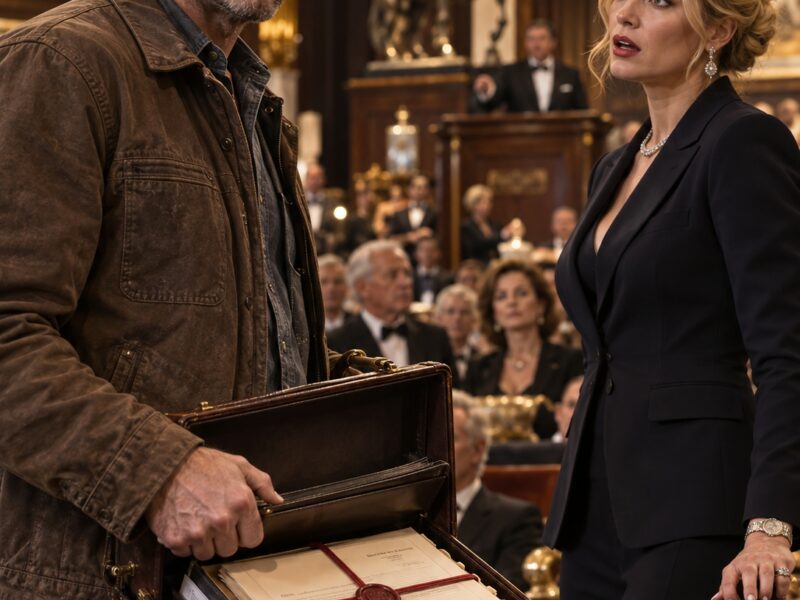
Nolan sat alone in the last row.
His brown jacket was faded at the elbows. His watch looked like something bought at a drugstore fifteen years earlier. There were pale lines of exhaustion beneath his eyes, the kind that came from years of getting up before sunrise because bills did not care how tired a man was.
An old leather case rested against his boot.
He did not look like a man who belonged in a room where bids were measured in millions.
That was precisely why everyone laughed.
Vivienne turned in her chair.
At thirty-seven, she had already spent nearly a decade running Sterling Industrial Group, an empire of manufacturing plants, logistics companies, fabrication facilities, and industrial patents inherited from her father and expanded under her leadership.
People rarely laughed before she did.
They usually waited to see what she thought first.
Now she studied Nolan with open amusement.
“Four hundred dollars?” she repeated.
Nolan met her eyes.
“Yes.”
Someone near the front chuckled.
Vivienne tilted her head.
“Sir, are you sure you’re in the right room?”
More laughter.
Nolan didn’t smile.
“I am.”
That answer irritated her more than embarrassment would have.
Men who were humiliated in front of Vivienne Sterling generally did one of two things. They became defensive, or they disappeared.
Nolan did neither.
He simply looked toward the stage.
The auctioneer, Harlon Voss, still held his gavel in the air.
A moment earlier, Sterling Industrial had been seconds away from acquiring the old Whitmore Steel Works, a sprawling industrial property outside Pittsburgh that had once supplied structural components for bridges, rail systems, and heavy machinery across several states.
The plant had been dying for years.
Its owners had died, retired, or lost interest.
Its equipment had aged.
Its debts had multiplied.
Its workforce had shrunk from more than twelve hundred people to fewer than eighty.
By that morning, most investors saw only land, scrap metal, tax advantages, and redevelopment potential.
Vivienne saw something more.
She intended to modernize it, integrate the property into Sterling Industrial’s manufacturing network, and prove once again that she could recognize value before anyone else did.
The bidding had crossed $2.8 million.
Everyone else had begun dropping out.
Then the man in the worn jacket had raised his hand.
Four hundred dollars.
Vivienne turned back toward the podium.
“Well?” she said. “Are we continuing?”
Harlon didn’t answer.
That was when she noticed his face.
The auctioneer was staring at Nolan.
Not with amusement.
Not with annoyance.
With recognition.
Harlon slowly lowered the gavel.
The room quieted.
Vivienne’s smile disappeared.
“Harlon?”
He looked down at a folder on the podium.
Then he looked at Nolan again.
“Mr. Mercer,” he said.
Nolan gave the smallest nod.
Something cold moved through Vivienne’s stomach.
Until that moment, no one had spoken Nolan’s name.
Harlon stepped away from the microphone.
“Ladies and gentlemen, please remain seated.”
The murmuring began immediately.
Vivienne stood.
“What is this?”
Harlon reached beneath the podium and removed a thick folder tied with a faded red cord.
He placed it carefully on the table.
Across its front, typed in black capital letters, were two words.
NOLAN MERCER.
Vivienne looked back at the man she had laughed at less than a minute earlier.
He hadn’t moved.
Her attorney, Priya Shah, was already walking toward the stage.
“Let me see that.”
Harlon hesitated.
Then handed her the folder.
Priya opened it.
The first page made her frown.
The second made her stop.
By the fourth, all the color had left her face.
Vivienne knew that expression.
Priya had worn it only twice in three years—once during a federal compliance investigation and once when a subsidiary acquisition had nearly exposed Sterling Industrial to a nine-figure liability.
“What?” Vivienne demanded.
Priya didn’t answer immediately.
“Vivienne…”
“What?”
Priya looked toward Nolan.
Then back at the documents.
“There is a restriction attached to the sale.”
Vivienne gave a humorless laugh.
“We reviewed the restrictions.”
“Not this one.”
“Then somebody didn’t do their job.”
“This isn’t in the modern title packet.”
“Where is it?”
“The original incorporation documents.”
The room had become so quiet that Vivienne could hear someone tapping a pen three rows behind her.
Harlon returned to the microphone.
“This auction is suspended.”
Voices erupted.
Vivienne stepped toward him.
“On whose authority?”
Harlon looked directly at her.
“The estate’s.”
“This factory is being sold.”
“No.”
One word.
Nothing dramatic about it.
Yet it changed the entire room.
Harlon placed both hands on the podium.
“This factory is not being sold.”
Vivienne stared at him.
“Then why,” she asked slowly, “are three dozen investors sitting in this room?”
Harlon glanced toward Nolan.
“Because the previous owner ordered an auction under a specific condition.”
“What condition?”
Nobody moved.
Harlon drew a breath.
“If Nolan Mercer appeared and submitted the designated bid, the auction was to terminate immediately.”
Vivienne’s eyes narrowed.
“What designated bid?”
Harlon looked at her.
“Four hundred dollars.”
The room exploded.
Chairs scraped against the floor.
Questions came from every direction.
Vivienne heard none of them clearly.
She was staring at Nolan.
Four hundred dollars.
Not a joke.
A key.
“What happens after the bid?” Priya asked.
Harlon turned another page.
“Certain ownership rights revert to Mr. Mercer.”
“Certain rights?”
Harlon looked uncomfortable.
“Possibly the facility itself.”
Vivienne actually laughed.
Not because anything was funny.
Because the alternative was believing him.
“You’re telling me that man walked in here, offered four hundred dollars, and now owns a multimillion-dollar industrial complex?”
“No.”
Nolan spoke for the first time since the laughter.
Everyone turned.
He rose slowly from his folding chair.
He picked up the old leather case.
Then he began walking toward the front.
The crowd parted for him.
Minutes earlier, people had barely noticed him.
Now they moved as though afraid to stand in his way.
Nolan stopped several feet from Vivienne.
Up close, she noticed things she had missed from across the room.
His jacket was worn, but clean.
His hands were rough, but steady.
And his eyes were not the eyes of a desperate man hoping for a miracle.
They were the eyes of someone who had been waiting for something.
Vivienne folded her arms.
“If you didn’t buy it,” she said, “what exactly did you do?”
Nolan looked toward the windows overlooking the abandoned factory.
“I proved I came back.”
And suddenly nobody was laughing.
Twenty-three years earlier, Nolan Mercer had entered that factory through the employee entrance carrying a lunchbox, a drafting tube, and more ambition than money.
He had been twenty-six.
Newly married.
Obsessed with machines.
The kind of engineer who could hear a production line from fifty feet away and know which bearing would fail next.
Within six years, he became chief engineer.
Within eight, he had redesigned the plant’s central assembly process.
His system reduced material waste, increased output, and cut mechanical downtime so dramatically that executives initially assumed the numbers were wrong.
They weren’t.
The factory saved millions.
Other Sterling-affiliated plants eventually adopted variations of Nolan’s designs.
He received a plaque.
A bonus.
A handshake.
Then his name slowly disappeared from the technology he had created.
At first, Nolan told himself that was simply corporate life.
Teams mattered more than individuals.
Companies owned what employees built.
He was not naïve.
But what happened next was different.
One Monday morning, security met him at his office.
His access badge had been disabled.
His files had been removed.
His employment was terminated by executive order.
No misconduct.
No failed performance review.
No explanation.
Just an envelope and twenty minutes to leave.
Nolan had stood in the parking lot holding a cardboard box while the machinery he had helped design continued running behind concrete walls.
He remembered thinking something absurd.
He had left his coffee mug inside.
For years afterward, that was the detail he remembered most.
Not the humiliation.
Not the anger.
The mug.
His daughter, Sophie, was four then.
His marriage had already been collapsing under medical bills, long hours, and the quiet exhaustion of two people who no longer knew how to help each other.
Within another year, Nolan was raising Sophie mostly alone.
There was no dramatic comeback.
No lawsuit.
No billionaire transformation.
Life became smaller.
Contract engineering.
Equipment repairs.
Consulting jobs for companies too small to ask why a man with his résumé was fixing conveyor motors at two in the morning.
He learned how to stretch groceries.
He learned which bills could be three days late without penalties.
He learned how to braid his daughter’s hair badly enough that she eventually taught herself.
He learned that survival could consume every ounce of anger a person might otherwise use for revenge.
The factory became something he stopped discussing.
Then, four months before the auction, an envelope arrived at his apartment.
Inside was a letter from the estate managing Whitmore Steel Works.
Nolan read it twice.
Then a third time.
A dormant clause attached to the plant’s original industrial charter had been triggered by its financial collapse.
The clause concerned technology rights, performance benchmarks, and ownership protections negotiated years earlier by one of the plant’s original owners after Nolan’s assembly redesign became central to its value.
If the factory entered a distressed sale after failing those benchmarks, and if Nolan appeared at the official auction and submitted a symbolic bid of exactly four hundred dollars, dormant rights would activate.
Nolan had stared at that number for a long time.
$400.
Sophie, now twenty-seven, had found him sitting at the kitchen table.
“What is it?”
He handed her the letter.
She read it.
Then looked at him.
“Dad…”
“I don’t know what it means yet.”
“It means you’re going.”
Nolan had folded the letter.
“I haven’t decided.”
Sophie laughed softly.
“You’ve spent twenty years pretending you don’t care.”
“I don’t.”
“Then why are your hands shaking?”
He looked down.
They were.
So he went.
Not to become rich.
Not to embarrass anyone.
He went because somewhere inside that dead factory was the only version of himself he had never fully buried.
Vivienne learned only pieces of that history inside the auction hall.
Enough to stop laughing.
Not enough to understand.
Her attention shifted when she noticed Marcus Vale standing near the exit.
Marcus was Sterling Industrial’s chief financial officer.
Fifty-one.
Polished.
Controlled.
Loyal—or so she had believed.
He had worked beside her father before working for her.
He had advised Vivienne through acquisitions, layoffs, restructurings, expansions, and crises.
There were few people she trusted more.
Yet Marcus looked frightened.
Not surprised.
Frightened.
His phone was pressed to his ear.
His eyes moved toward Nolan.
Then away.
Vivienne crossed the room.
“Marcus.”
He ended the call.
“We should leave.”
“Why?”
“This is becoming theater.”
“That’s not an answer.”
“Our attorneys can resolve it.”
Vivienne studied him.
“Did you know about the clause?”
“No.”
Too fast.
“Did you know Nolan Mercer worked here?”
Marcus looked toward the stage.
“Vivienne, this isn’t the place.”
Again.
Not an answer.
She lowered her voice.
“Look at me.”
He did.
“What aren’t you telling me?”
Before Marcus could respond, another voice came from behind them.
“You remember me.”
Marcus froze.
Nolan stood six feet away.
His expression hadn’t changed.
Marcus’ had.
The blood drained from his face.
Vivienne felt something inside her shift.
Nolan wasn’t asking.
He knew.
Marcus recovered quickly.
“I’ve worked with thousands of employees.”
Nolan nodded.
“You remember.”
“I don’t.”
Nolan’s gaze stayed on him.
“You still lie the same way.”
Marcus’ jaw tightened.
Vivienne looked from one man to the other.
“What does that mean?”
Neither answered.
That silence frightened her more than an accusation would have.
“Priya.”
Her attorney appeared beside her.
“I want the original personnel records.”
“Vivienne—”
“Everything on Nolan Mercer. Employment evaluations. Engineering credits. Patents. Termination documents. Executive correspondence.”
“That could take days.”
“Then make it take an hour.”
Marcus stepped forward.
“This is ridiculous.”
Vivienne turned.
“Then you have nothing to worry about.”
For the first time in nearly ten years, Marcus Vale looked at her as though she were not his CEO.
He looked at her as though she were becoming a problem.
And Vivienne noticed.
The first records arrived forty-seven minutes later.
Nolan Mercer.
Chief Engineer.
Performance rating: exceptional.
Production optimization: 31 percent.
Waste reduction: 18 percent.
Mechanical downtime: reduced by nearly half.
Patent contribution: multiple internal systems.
Disciplinary actions: none.
Complaints: none.
Termination reason:
EXECUTIVE ORDER.
Vivienne read those two words three times.
“Who signed it?”
Priya searched.
“The authorization page is missing.”
“Missing?”
“Not digitally archived.”
Marcus was gone.
Vivienne looked toward the exit.
“Where is he?”
Nobody knew.
She found Nolan near the windows.
He was staring across the parking lot toward the factory.
“Why didn’t you fight them?” she asked.
He didn’t turn.
“I had a four-year-old daughter.”
“That doesn’t answer the question.”
“It does if you’ve ever had to choose between being angry and paying rent.”
Vivienne said nothing.
Nolan looked at her then.
“I didn’t have money for a five-year lawsuit. They knew that.”
“Who is they?”
He hesitated.
That hesitation mattered.
“People who understood that ownership isn’t always about who invents something.”
Vivienne crossed her arms.
“What is it about?”
“Who can afford to prove it.”
The words landed somewhere she didn’t like.
She had spent her career sitting on the side that could afford proof.
She changed the subject.
“If you wanted this place back, why not tell everyone before the auction?”
“Would you have believed me?”
“Yes.”
Nolan raised an eyebrow.
She remembered laughing.
“No,” she admitted.
For the first time, something almost resembling amusement passed through his face.
Almost.
Vivienne looked toward the plant.
“What do you want?”
“What was taken.”
“Money?”
“No.”
“The factory?”
“Maybe.”
“Revenge?”
Nolan looked at her.
“No.”
She found that answer hardest to believe.
“Everybody wants something.”
“I want my name back.”
And there it was.
The first crack in everything Vivienne thought she understood.
Nolan asked to walk through the factory.
Vivienne went with him.
Priya objected.
Marcus, when finally reached by phone, objected more strongly.
That was why Vivienne decided to go.
The side entrance opened with a metallic groan.
Cold air moved through the corridor.
Dust coated the floor.
Old safety posters curled away from concrete walls.
The factory smelled of oil, iron, rust, and rainwater.
Nolan stopped inside.
For several seconds, he didn’t move.
Vivienne watched him.
“You okay?”
“Yes.”
He wasn’t.
She could see it.
His eyes moved toward an office above the production floor.
“My desk was up there.”
Vivienne followed his gaze.
“You remember after twenty years?”
“I remember where everything was.”
They continued.
The production floor stretched beneath broken skylights.
Machines sat silent beneath gray dust.
Vivienne had toured abandoned plants before.
This one felt different.
Nolan stopped beside an electrical cabinet.
He touched the handle.
Then crouched.
“What?”
He ran a finger across the lower edge.
“No dust.”
Vivienne stared.
“So?”
“This panel has been opened recently.”
“You can tell from that?”
“Yes.”
He moved to another junction box.
Fresh marks surrounded two screws.
“Someone’s been using this section.”
“The plant has been shut down for months.”
“Most of it has.”
Vivienne felt a chill.
They continued deeper.
Nolan found a stairwell behind a maintenance partition.
Vivienne pulled up the factory blueprints on her tablet.
“This isn’t here.”
“It used to be.”
“What is downstairs?”
“Archive storage.”
The door at the bottom was locked.
Nolan stared at it.
“The lock is new.”
Vivienne called security.
Twenty minutes later, the door opened.
Inside were shelves.
Blueprints.
Ledgers.
Boxes.
Contracts.
And an external hard drive.
Someone had placed it between two financial binders.
Not hidden well enough to be forgotten.
Hidden well enough not to be found casually.
Vivienne connected it to her tablet.
Folders appeared.
Production systems.
Patent transfers.
Internal licensing.
Nolan’s name.
Then his name disappearing.
Page after page documented technology he had developed being transferred into other corporate divisions.
Sterling Industrial had generated hundreds of millions in revenue from variations of systems originating with Nolan’s work.
Vivienne sat down on an overturned crate.
Nolan remained standing.
“You knew?”
“Some of it.”
“How much?”
“Enough.”
“Why didn’t you sue?”
He looked at her.
“Because I was busy surviving.”
She hated how simple the answer was.
Not because it accused her.
Because it didn’t.
She continued reading.
Then she saw another folder.
PROJECT MERCER — DELETE AFTER ACQUISITION.
Her breathing changed.
“Nolan.”
He came closer.
They opened it.
Recent emails.
Deletion schedules.
Archive destruction protocols.
Instructions to remove physical records after the acquisition.
Authorization chains.
Vivienne scrolled.
One name appeared repeatedly.
Marcus Vale.
Her stomach tightened.
Then another appeared beneath his.
Damian Crowe.
Vivienne stopped breathing for a second.
Damian was chairman of Sterling Industrial’s board.
Her father’s oldest business partner.
The man who had spoken at her father’s funeral.
The man who had put a hand on twenty-six-year-old Vivienne’s shoulder and promised:
Your father built this company for you. We’ll protect it together.
Nolan saw her expression.
“You know him.”
“Yes.”
“Trust him?”
Vivienne looked at the name.
“I did.”
That final word changed everything.
Damian Crowe didn’t deny knowing Nolan.
He denied wrongdoing.
They confronted him in the boardroom less than an hour later.
Damian sat beneath a portrait of Vivienne’s father.
He listened calmly.
Then leaned back.
“So this is what we’re doing?”
Vivienne placed the tablet before him.
“You tell me.”
Damian glanced at the evidence.
“A disgruntled former employee finds old files inside an abandoned factory, and suddenly we’re treating corporate history like a criminal conspiracy?”
“These aren’t old.”
Vivienne tapped the screen.
“This deletion authorization was signed eleven days ago.”
Damian looked at Nolan.
“You have any idea how many failed engineers believe corporations stole their ideas?”
Nolan said nothing.
Damian smiled faintly.
“Of course you do.”
Vivienne’s voice hardened.
“Answer the question.”
“I don’t answer accusations manufactured by strangers.”
“He isn’t a stranger.”
“No?”
Damian looked at her.
“He was terminated decades ago.”
“Why?”
“For reasons appropriate at the time.”
“Which were?”
Damian’s eyes changed.
Barely.
But Vivienne saw it.
“You’re allowing emotion to interfere with judgment.”
She almost smiled.
There it was.
Not a defense.
An attack.
On her.
Damian continued.
“You walked into that auction this morning prepared to complete one of the most strategically important acquisitions of the year. Now, because some man in a worn coat produced a sentimental story and a legal curiosity, you’re threatening the credibility of this company.”
Vivienne leaned forward.
“This company threatened its own credibility.”
Damian’s expression hardened.
“You should think very carefully about what you’re doing.”
“I am.”
“No. You’re reacting.”
“Is that a warning?”
“It’s advice.”
Nolan finally spoke.
“You gave me the same kind of advice once.”
Damian turned.
For the first time, the old man’s composure cracked.
Only for a second.
But Vivienne saw that too.
Nolan continued.
“You told me nobody remembers engineers.”
Damian’s face went still.
Nolan looked at the portrait behind him.
“You were wrong.”
By sunset, Vivienne’s phone was exploding.
Board members.
Investors.
Legal counsel.
Public relations.
Then Priya entered Vivienne’s office and closed the door.
“The board called an emergency session.”
“When?”
“Tomorrow morning.”
“About Damian?”
Priya didn’t answer.
Vivienne understood.
“About me.”
“Yes.”
A strange calm came over her.
“For what?”
“Failure of judgment. Mishandling acquisition procedures. Potential exposure of confidential corporate records.”
Vivienne laughed once.
“They’re removing me for finding evidence of fraud?”
“They’re considering it.”
“No.”
She stood.
“They’ve been preparing this.”
Priya said nothing.
That was answer enough.
Another discovery arrived before midnight.
Marcus Vale had transferred a substantial portion of his Sterling shares to an outside holding company four days before the auction.
The holding company was connected through three intermediaries to Damian.
Vivienne stared at the documents.
Marcus had known.
Maybe not everything.
But enough.
The man she had trusted beside her for a decade had positioned himself before the explosion.
She drove back to the factory.
Nolan was there.
Sitting on the loading dock.
Alone.
She stopped beside him.
“They’re going to remove me.”
Nolan looked at her.
“You sound surprised.”
“I am.”
“Why?”
“Because I own more of that company than half the board combined.”
“That’s not what I asked.”
Vivienne looked away.
Beyond the parking lot, Pittsburgh’s distant lights glowed against the clouds.
“I thought loyalty mattered.”
Nolan nodded.
“So did I.”
The answer cut deeper than she expected.
She sat beside him.
For a while, neither spoke.
Then Vivienne asked, “If we release the files, Damian falls.”
“Yes.”
“Marcus too.”
“Probably.”
“My company could lose hundreds of millions.”
“Yes.”
“And if we don’t?”
Nolan looked toward the dark factory.
“Then nothing changes.”
She rubbed her hands together against the cold.
“You could use this against us.”
“Yes.”
“You could demand money.”
“Yes.”
“Shares.”
“Yes.”
“The company itself.”
“Maybe.”
She turned.
“But you won’t.”
“No.”
“Why?”
Nolan’s voice was quiet.
“Because then I’d become another man using the truth only when it makes him richer.”
Vivienne stared at him.
“What do you need?”
“The truth.”
“That’s all?”
“No.”
She waited.
Nolan looked at the factory.
“After that, I need to know whether this place deserves to live.”
The answer nearly came that night.
At 11:42 p.m., Nolan received a call from a former electrician named Raymond Cole.
Raymond still lived three miles from the plant.
He had noticed an abnormal draw on the old industrial grid.
Sections of Whitmore Steel Works were pulling electricity.
Too much electricity.
Nolan stood immediately.
“What?”
Vivienne watched his face.
“Ray, call the fire department.”
He hung up.
“What’s happening?”
“Someone powered the old lines.”
“So?”
“The cooling system is offline.”
Vivienne understood only part of that sentence.
Nolan was already moving.
“Stay here.”
She followed.
“No.”
“Vivienne.”
“My evidence is inside that building.”
“Copies exist.”
“Not everything.”
“This isn’t a boardroom.”
“I noticed.”
He stopped.
For the first time, Nolan looked genuinely angry with her.
“You don’t know that building.”
“You do.”
“That doesn’t make it safe.”
“No. It makes you useful.”
He stared.
She grabbed a flashlight.
“And apparently I’m stupid enough to follow useful people into dangerous places.”
Nolan almost smiled.
Then a low mechanical groan rolled from inside the factory.
Neither smiled after that.
They ran.
Warning lights flickered in corridors that had been dark for months.
A motor screamed somewhere below.
Nolan reached a control panel.
“Someone disabled the safeties remotely.”
“Damian?”
“Doesn’t matter right now.”
“It matters to me.”
“Then survive long enough to ask him.”
They split.
Vivienne ran to the archive room.
She filled Nolan’s leather case with documents.
Smoke began crawling along the ceiling.
“Nolan!”
“Keep moving!”
Metal shrieked.
A transformer blew somewhere behind them.
The lights died.
Emergency lamps came on red.
Vivienne’s hands shook.
For the first time in her adult life, money could solve nothing.
Her title could solve nothing.
Her last name could solve nothing.
Only knowledge mattered.
And the man she had laughed at possessed it.
Nolan opened a manual panel and reached inside.
“What are you doing?”
“Rerouting.”
“Can you stop it?”
“Yes.”
“How long?”
He checked a gauge.
“Not long enough.”
She stared.
“That isn’t reassuring.”
“It wasn’t supposed to be.”
A pipe burst.
Steam filled the corridor.
“Go!” Nolan shouted.
Vivienne grabbed the case.
She ran.
Then stopped.
Turned.
Nolan was still inside.
“Nolan!”
“GO!”
She didn’t.
She returned.
Together they forced the final override.
The machinery groaned.
Shuddered.
Then began shutting down.
One system.
Then another.
Then another.
Until silence returned.
Vivienne leaned against the wall, breathing hard.
“You’re insane.”
Nolan wiped blood from a cut on his hand.
“You came back.”
“So did you.”
“I work here.”
“You own it.”
“Apparently.”
Despite everything, she laughed.
Then she opened the case.
The laughter died.
A folder had been soaked and partially burned.
Damian’s earliest authorization records.
The clearest direct evidence.
Destroyed.
“No.”
Vivienne sank to the floor.
“No, no, no.”
Nolan looked.
She held up the ruined pages.
“This was it.”
“No.”
She stared at him.
“What?”
“This wasn’t it.”
“What are you talking about?”
Nolan picked up his old leather case.
“The originals aren’t here.”
“Where are they?”
He hesitated.
“Somewhere I haven’t been in a long time.”
The safety-deposit box was registered under Nolan’s late mother’s name.
He had placed copies there before his termination because something about the executives’ behavior had frightened him.
Then life had happened.
Divorce.
Single parenthood.
Debt.
Survival.
He had forgotten the drive for years.
Until the auction.
By nine the next morning, Nolan placed it on Sterling Industrial’s boardroom table.
Damian was there.
Marcus was there.
So was the full board.
Vivienne connected the drive.
The first files proved Nolan’s intellectual property had been appropriated.
The next proved revenue had been hidden.
The next proved Marcus and Damian had manipulated the factory’s debt.
The next proved the distressed sale had been engineered.
Then came the records Vivienne wasn’t prepared for.
Her father’s emails.
She stopped scrolling.
One message was addressed to Damian.
NOLAN MERCER’S CLAIM IS VALID. WE WILL NOT ERASE HIS CONTRIBUTION TO PROTECT OUR MARGINS.
Another.
IF WE TAKE HIS WORK, WE PAY HIM.
Another.
THIS COMPANY CANNOT BECOME SOMETHING I WOULD BE ASHAMED TO LEAVE MY DAUGHTER.
Vivienne’s vision blurred.
Her father had known.
More importantly—
He had tried to stop it.
The final correspondence showed him becoming increasingly isolated.
Damian and allies had stripped away his voting control during the months when illness weakened him.
By the time he died, the machinery of the betrayal was already moving.
Vivienne closed her eyes.
For years, she had believed she inherited her father’s company.
Now she understood she had inherited his unfinished fight.
Damian spoke first.
“This proves nothing.”
Nolan looked at him.
“You wanted the factory.”
“It’s worthless.”
“Then why did you try to destroy it last night?”
Silence.
Damian stared at him.
Nolan didn’t raise his voice.
“Why?”
No answer.
Marcus broke first.
Perhaps fear did what conscience had failed to do.
He admitted the debt manipulation.
The document destruction.
The transfer of technology.
The plan to purchase the factory through a controlled entity after Sterling acquired and reorganized it.
Damian turned on him.
Marcus kept talking.
Thirty years of power began collapsing in less than thirty minutes.
By noon, Damian Crowe was removed from every position.
Marcus Vale resigned pending criminal and civil investigations.
Nolan Mercer’s name was formally restored to the company’s historical patent records.
Vivienne thought it was over.
Then the board chairman cleared his throat.
“There is one remaining matter.”
Vivienne looked around the table.
She understood before he said it.
The board voted.
Six to four.
Vivienne Sterling was removed as chief executive.
The official justification cited reputational damage, instability, disclosure failures, and loss of investor confidence.
She listened without interrupting.
When the vote ended, she removed her executive badge.
Placed it on the table.
Then stood.
Damian had lost because he lied.
She had lost because she finally refused to.
The irony would have destroyed the woman she had been a week earlier.
Instead, Vivienne felt strangely light.
Terrified.
Humiliated.
But light.
She walked out carrying one cardboard box.
Near the elevator, she stopped.
A coffee mug sat on top.
She stared at it.
Then laughed softly.
Twenty years earlier, Nolan Mercer had left a factory carrying a cardboard box.
Now she finally understood how little dignity a title could protect when someone else decided you no longer belonged.
The elevator doors opened.
Vivienne stepped inside.
For the first time since she was twenty-six, she had no company to run.
No assistant waiting.
No board agenda.
No corporate driver.
No idea what Monday morning would look like.
And somehow the person waiting for her downstairs was the last person she expected.
Nolan stood beside an old pickup truck.
Vivienne approached.
“You here to enjoy this?”
“No.”
“You should. I laughed at you.”
“I remember.”
“I called your bid ridiculous.”
“Yes.”
“I implied you didn’t belong in the room.”
“You did.”
She stared at him.
“You’re terrible at comforting people.”
“I wasn’t trying to.”
That made her laugh.
A real laugh.
Nolan handed her a folder.
“What is this?”
“A plan.”
She opened it.
New production lines.
Safety upgrades.
Cost projections.
Supplier contracts.
Hiring targets.
Modernized systems.
A five-year restructuring model.
She looked up.
“You want to reopen the factory?”
“Yes.”
“With what money?”
“The patents.”
Independent auditors had confirmed Nolan’s dormant rights extended beyond the physical factory.
He owned claims to foundational patents underlying technology Sterling Industrial had used for years.
The value was staggering.
Tens of millions.
Potentially more.
Vivienne stared at him.
“You’re rich.”
“Apparently.”
“And you’re still wearing that jacket.”
“It’s a good jacket.”
“It objectively isn’t.”
He ignored that.
She looked at the plan again.
“Why are you showing me?”
“I need someone to run the business side.”
“You have lawyers.”
“I don’t need another lawyer.”
“Hire a CEO.”
“I tried one.”
Vivienne looked up sharply.
Nolan’s mouth moved slightly.
Was that a joke?
“You’re enjoying this.”
“A little.”
She closed the folder.
“Why me?”
His expression became serious.
“Because you chose the truth after you knew what it would cost.”
Vivienne swallowed.
“I chose late.”
“You still chose.”
“I mocked you.”
“Yes.”
“I represented the company that stole from you.”
“Yes.”
“I may have spent years profiting from what happened to you.”
“Yes.”
“Could you stop agreeing with every terrible thing I say?”
“No.”
She laughed again.
Then looked down at the folder.
“What are you offering?”
“Half.”
Her head snapped up.
“What?”
“Equal partnership.”
“No.”
“Why?”
“Because that’s insane.”
“Probably.”
“You own the factory.”
“Yes.”
“You own the patents.”
“Yes.”
“You could hire anybody.”
“Probably.”
“And you want the woman who laughed at you for offering four hundred dollars?”
Nolan considered that.
“I’m hoping your judgment has improved.”
She stared at him.
Then, despite herself, smiled.
“You’re not nearly as quiet as you pretend.”
“No.”
Vivienne looked toward the factory.
Its windows reflected the afternoon sky.
For years she had entered buildings because her name gave her authority.
This would be different.
No inherited office.
No father’s reputation.
No board seat waiting.
She would have to earn everything.
Perhaps that was why she finally said yes.
The legal transfer took another eleven days.
The official recorded figure remained four hundred dollars.
News outlets seized on it.
MAN BUYS MULTIMILLION-DOLLAR FACTORY FOR $400.
ENGINEER’S $400 BID STUNS BILLIONAIRE.
THE CHEAPEST INDUSTRIAL ACQUISITION IN PENNSYLVANIA HISTORY.
Almost every headline was wrong.
Nolan had not bought the factory for four hundred dollars.
The money was simply the legal trigger proving he had returned to claim something that should never have been taken from him.
When a reporter asked whether he felt vindicated, Nolan said, “Ask me when people are working there again.”
So they went to work.
The first months were ugly.
The roof leaked.
Two production lines were beyond repair.
The electrical system needed replacement.
Former suppliers refused favorable terms.
Banks considered the project too risky.
Sterling Industrial’s new leadership fought Nolan’s patent claims in court.
Vivienne sold a vacation property in Aspen and invested the proceeds.
Nolan mortgaged nearly everything he could without touching the trust he had quietly created for Sophie.
They argued.
Constantly.
“You cannot hire seventy people before we secure the second contract,” Vivienne told him one evening.
“They need training.”
“They need salaries.”
“We’ll get the contract.”
“You don’t know that.”
“I know the machines.”
“Machines don’t sign purchase orders.”
“People do.”
“Exactly.”
Nolan looked at her.
“So talk to the people.”
She stared at him.
“I hate you.”
“No, you don’t.”
That was the first time the silence between them became something neither wanted to name.
Vivienne looked away first.
Months passed.
The first restored production line started at 6:12 on a Tuesday morning.
Nolan stood beside the control panel.
Vivienne stood several feet away.
Sophie Mercer had come from Cleveland to watch.
So had forty-three newly hired employees.
Nolan pressed the start button.
The motor turned.
A belt moved.
Metal entered the line.
For three seconds, nothing happened.
Then the entire system came alive.
The sound was enormous.
Nolan didn’t cheer.
He simply stood there.
Vivienne watched his face.
His eyes shone.
She walked closer.
“You okay?”
He nodded.
“You always say that when you’re clearly not.”
“I know.”
She looked around.
“What are you thinking?”
Nolan stared at the machines.
“My daughter used to ask what I did here.”
“What did you tell her?”
“That I fixed things.”
Vivienne smiled.
“That sounds like you.”
He looked at her.
“What did your father tell you?”
“That I would run Sterling Industrial someday.”
“And you did.”
“For a while.”
“No.”
Nolan shook his head.
“You inherited Sterling.”
She waited.
“This,” he said, looking around the factory, “you’re building.”
The words stayed with her.
By the end of the first year, Mercer Industrial Works employed 218 people.
By the second, it had secured three major contracts.
The old administration wing was renovated.
Safety systems were replaced.
The hidden basement archive was preserved rather than destroyed.
Nolan insisted on it.
Not as a shrine.
As a warning.
One framed document hung outside the engineering department.
It was Nolan’s original termination record.
EXECUTIVE ORDER.
Beneath it was a second document.
His restored patent attribution.
New engineers stopped to read them.
Nolan never explained unless someone asked.
Vivienne changed too.
At Sterling Industrial, she had learned to enter rooms last because power enjoyed being awaited.
At Mercer Industrial, she arrived before most employees.
She knew production supervisors by name.
She ate in the cafeteria.
She learned that leadership sounded different when nobody was required to laugh at your jokes.
And somewhere between midnight budget meetings, supplier crises, machinery failures, and quiet coffees before sunrise, Nolan stopped being the man she had misjudged.
He became the person whose silence she understood.
He knew when she was angry.
She knew when he was worried.
He could tell when she was about to make an expensive decision out of pride.
She could tell when he was about to sacrifice too much because he believed asking for help was weakness.
Neither called it love.
Not yet.
Perhaps because both had learned that names could be stolen, distorted, or used too easily.
Respect was enough.
Until it wasn’t.
Almost a year after the auction, Harlon Voss invited them back to the same hall.
An industrial redevelopment conference was being held there.
Nolan initially refused.
Vivienne convinced him.
“You enjoy making me revisit my worst moments.”
“You laughed at me.”
“You’ve mentioned that.”
“Several times.”
“Hundreds.”
“Not hundreds.”
“Seventy-three.”
“You counted?”
“No.”
She looked at him.
He smiled.
“Maybe.”
The hall looked smaller now.
Vivienne sat in the audience.
Nolan stood near the back.
Almost exactly where he had been that first morning.
During the question session, an investor raised his hand.
“I have to ask the question everyone asks. How does somebody buy a multimillion-dollar factory for four hundred dollars?”
Laughter moved through the room.
Different laughter this time.
Curious.
Warm.
Harlon smiled.
“He didn’t.”
The room quieted.
The old auctioneer looked toward Nolan.
“He simply proved it was already his.”
Applause began.
Nolan looked uncomfortable.
Vivienne loved that.
Afterward, she found him near the exit.
“You hate applause.”
“Yes.”
“You prefer being laughed at?”
“No.”
“You looked calmer then.”
“I knew what would happen.”
“And now?”
Nolan looked at her.
“Now I don’t.”
Something in his voice made her stop.
People passed around them.
Vivienne lowered her voice.
“Is that bad?”
“No.”
“Then what is it?”
He considered the question.
“New.”
For once, Vivienne Sterling had no clever answer.
They walked outside.
The afternoon sun stretched across the parking lot.
In the distance, the factory doors stood open.
Machinery hummed inside.
Workers crossed the loading area.
Trucks waited at the docks.
Above the main entrance hung the new sign.
MERCER INDUSTRIAL WORKS.
Vivienne had argued for something more sophisticated.
Nolan had refused.
Beneath the name was a smaller line.
FOUNDED BY NOLAN MERCER.
Vivienne had ordered that part without telling him.
He had stared at it for nearly a minute the first morning.
Then said only, “You didn’t need to do that.”
She had answered, “Yes, I did.”
Now they stood looking at it again.
“You know,” Vivienne said, “I still can’t believe I laughed at you.”
Nolan slipped his hands into his jacket pockets.
“You weren’t the first.”
“I assume I won’t be the last?”
“Probably not.”
She smiled.
“Doesn’t that bother you?”
He looked toward the factory.
“Not anymore.”
“Why?”
Nolan was silent for several seconds.
Then he said, “People usually laugh at what they think they understand.”
Vivienne followed his gaze.
“And then?”
“Sometimes they learn.”
She looked at him.
“Sometimes?”
He smiled.
“Sometimes.”
They began walking toward the factory.
Neither hurried.
Behind them stood the auction hall where a room full of powerful people had once decided Nolan Mercer was worthless before hearing his name.
Ahead of them stood the building that had erased that name, stolen his work, nearly destroyed the evidence, and somehow survived long enough to return to him.
Vivienne had once believed the most powerful person in a room was the one everyone recognized.
Nolan had taught her something different.
Sometimes power belonged to the person nobody noticed.
Sometimes the cheapest watch covered the wrist of the man who knew where every machine had been built.
Sometimes the worn jacket belonged to the only person in the room who understood the contract.
Sometimes the ridiculous bid wasn’t a bid at all.
And sometimes losing everything was simply the price of discovering what should never have belonged to you in the first place.
At the factory entrance, Nolan stopped.
Vivienne took two more steps before realizing he wasn’t beside her.
She turned.
“What?”
He was looking at the sign.
Not the company name.
The smaller line.
FOUNDED BY NOLAN MERCER.
For twenty years, people had used his designs without his name.
Executives had signed documents over his work.
Factories had made money from his ideas.
Boardrooms had decided his contribution was easier to erase than compensate.
He had spent years repairing machines for people who never knew the man holding the wrench had once designed systems worth millions.
Now four words sat above a doorway.
No courtroom speech.
No revenge.
No statue.
Just his name.
Where everyone could see it.
Vivienne walked back to him.
“You okay?”
Nolan exhaled.
This time, he didn’t say yes.
He looked through the open doors.
The afternoon shift was starting.
Machines turned.
Forklifts beeped.
Workers called to one another.
Somewhere deeper inside, metal struck metal with a steady rhythm.
The building sounded alive.
“My daughter is coming Sunday,” he said.
Vivienne smiled.
“I know.”
“She wants a tour.”
“You should give her one.”
“I will.”
He paused.
“She never saw this place when I worked here.”
Vivienne understood.
Twenty years disappeared from his voice.
For a moment, he was the young father standing in a parking lot with a cardboard box, wondering how he would explain to a four-year-old that the job he had built his life around was gone.
Vivienne touched his arm.
Nothing dramatic.
Nothing that required a name.
Just enough.
Nolan looked at her hand.
Then at her.
Neither moved away.
Behind them, the old auction hall doors closed.
Ahead of them, Mercer Industrial Works remained open.
And somewhere inside that factory, a machine Nolan had designed decades earlier continued its steady rhythm—not as evidence anymore, not as stolen property, not as a reminder of what had been done to him.
It was simply working.
The way he had always intended it to.
Nolan walked through the doors.
Vivienne walked beside him.
And above them, catching the last warm light of the afternoon, the name someone had once tried to erase remained exactly where it belonged.









