THE BILLIONAIRE LEFT A SINGLE FATHER AN ENVELOPE AFTER ONE BLURRED NIGHT—BUT THE NOTE BESIDE IT MADE HIM WALK AWAY
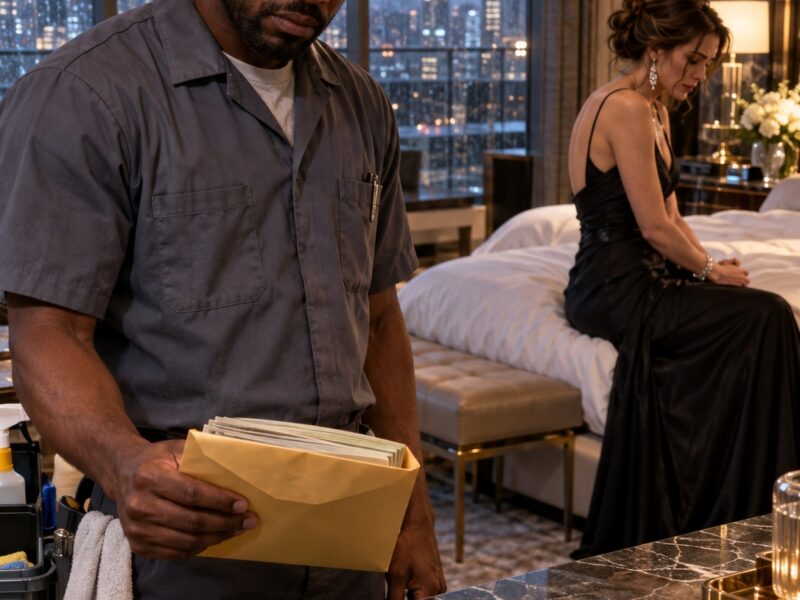
The envelope was thick enough to solve almost every problem Marcus Reed had.
The note beside it created a new one.
Forget last night. It never happened.
Marcus stood barefoot beside the marble table of Suite 4702 at the Meridian Hotel, staring at those six words while rain crawled down forty-seven floors of glass behind him.
His work shirt was wrinkled.
One sleeve was rolled higher than the other. His shoes sat near the sofa. His janitor’s badge—MARCUS REED, NIGHT SERVICES—lay facedown beside an empty water bottle.
Across the room, Victoria Hale sat on the edge of the bed in yesterday’s black evening dress.
She was one of the wealthiest women in Chicago.
Marcus cleaned rooms in a hotel where people like her spent in one night what he sometimes struggled to earn in a month.
Neither of them was looking at the other.
Neither of them seemed entirely certain how the night had ended.
Marcus picked up the note.
His jaw tightened.
“You wrote this?”
Victoria kept her eyes on the carpet.
“Yes.”
“And the envelope?”
“Yes.”
He touched it but did not open it.
“How much?”
Her answer came quietly.
“Enough.”
That finally made him look at her.
“Enough for what?”
Victoria lifted her eyes.
There was embarrassment in them.
And fear.
But there was something else Marcus recognized immediately because he had spent years seeing it in people who thought service workers were invisible.
Assumption.
The assumption that money could end an uncomfortable conversation.
Marcus slowly put the envelope back on the marble.
“My shift ended three hours ago.”
Victoria said nothing.
“My daughter wakes up at seven.”
Still nothing.
“I need to go home.”
“Marcus—”
He stopped at the door.
Victoria finally stood.
“I’m trying to make this easier.”
“For who?”
The question landed harder than he intended.
Victoria flinched.
Marcus immediately regretted his tone, but he didn’t take the words back.
Because there were fragments of the previous night moving through his head like photographs damaged by water.
Victoria crying in the private lounge.
A broken champagne glass.
Her hand gripping his sleeve.
The elevator doors closing.
Her suite.
Rain against the windows.
Her saying something about being tired of people wanting pieces of her.
Then darkness.
Not complete darkness.
Just missing pieces.
Marcus hated missing pieces.
Especially when a wealthy woman was standing ten feet away offering him an envelope full of money and asking him to pretend they didn’t exist.
He opened the door.
“Keep it.”
Victoria stared at him.
“You haven’t even looked inside.”
“That doesn’t change what it is.”
“You don’t know what it is.”
Marcus turned back.
“Then tell me.”
She couldn’t.
That silence followed him all the way down forty-seven floors.
And before that day was over, Marcus Reed would discover that the most dangerous thing inside Suite 4702 had never been the money.
It was what Victoria Hale remembered about the night he couldn’t.
At 6:18 that morning, the Meridian Hotel looked almost peaceful.
The chandeliers were dimmed. The marble lobby smelled faintly of lemon polish and expensive flowers. Outside, Chicago was gray beneath a cold spring rain.
Marcus slipped through the employees’ corridor instead of crossing the main lobby.
He had been working at the Meridian for three years.
Long enough to know which elevators executives used.
Long enough to know which guests tipped generously and which ones snapped their fingers.
Long enough to understand that luxury looked different from the service hallways.
Guests saw polished marble.
Marcus saw leaking pipes behind ballroom walls.
Guests saw white tablecloths.
Marcus saw dishwashers working until two in the morning with swollen hands.
Guests saw smiling concierges.
Marcus saw employees sitting on overturned buckets during ten-minute breaks because their feet hurt too badly to stand.
He wasn’t bitter about it.
Work was work.
And work paid rent.
Usually.
His phone vibrated as he entered the locker room.
Three missed calls.
All from Mrs. Alvarez.
His neighbor.
Marcus’s stomach tightened.
He called immediately.
She answered on the second ring.
“Marcus?”
“Is Lily okay?”
“She’s fine.”
He exhaled.
Mrs. Alvarez laughed softly.
“You always ask that before hello.”
“Because you never call me three times before six-thirty unless something happened.”
“Something happened.”
His chest tightened again.
“What?”
“Your daughter tried making pancakes.”
Marcus closed his eyes.
“How bad?”
“My smoke detector now knows her personally.”
Despite everything, he smiled.
“I’m leaving now.”
“She asked if you forgot.”
The smile disappeared.
“Forgot what?”
There was a pause.
“Marcus.”
Then he remembered.
Friday.
Lily’s school breakfast.
Parents were invited to arrive at eight.
She had reminded him four times.
He had promised.
“I didn’t forget.”
He looked at the clock.
6:23.
“I’ll be there.”
“You sound tired.”
“Long night.”
“You say that every morning.”
“I know.”
Marcus ended the call and opened his locker.
Inside was the life he actually understood.
A faded hoodie.
A photograph of Lily missing one front tooth.
A rent notice folded behind a box of painkillers.
FINAL REMINDER.
$1,842 due Monday.
Marcus stared at it.
Then he thought of the envelope upstairs.
Enough.
Victoria had called it enough.
Enough could mean rent.
Enough could mean groceries.
Enough could mean replacing Lily’s winter coat before the next cold spell.
Enough could mean he didn’t have to count the dollars in his wallet before buying strawberries because Lily loved them and strawberries had somehow become expensive.
He shut the locker.
Hard.
“No.”
He said it aloud because sometimes temptation needed to hear you.
Marcus changed clothes and left.
Lily Reed was seven years old and believed almost every problem in the world could be improved with cinnamon.
That morning, she had covered two burned pancakes with so much of it that Marcus sneezed when she set the plate in front of him.
“You’re supposed to eat them.”
“I’m trying to survive them.”
Lily put both hands on her hips.
“Mrs. Alvarez said they’re good.”
From the kitchen doorway, Mrs. Alvarez raised an eyebrow.
“I said they were brave.”
Lily frowned.
Marcus laughed.
For a few minutes, Suite 4702 disappeared.
There was only their small apartment on the northwest side.
A radiator clicking near the window.
A kitchen chair with one uneven leg.
Lily’s purple backpack hanging from the doorknob.
Her spelling words attached to the refrigerator with a magnet shaped like a pizza slice.
This was Marcus’s world.
Not marble tables.
Not billionaire businesswomen.
Not envelopes.
This.
Lily slid into the chair across from him.
“Are you coming today?”
Marcus looked at her.
“To school?”
She nodded.
“You promised.”
“I know.”
“You promised-promised.”
“That’s legally stronger.”
She smiled.
“So you’re coming?”
Marcus checked the time.
7:12.
His body begged for sleep.
His head still hurt.
And something about the previous night sat inside his chest like a stone.
But he looked at Lily.
“I’ll be there.”
Her smile made the exhaustion worth it.
Then she noticed something.
“Dad?”
“Yeah?”
“Why do you have a scratch?”
Marcus touched his neck.
His fingers found a thin mark below his collar.
He froze.
“I don’t know.”
Lily shrugged.
“Maybe hotel ghosts.”
“Probably.”
But Marcus didn’t smile this time.
Because another memory had surfaced.
Victoria grabbing his collar.
Not romantically.
Desperately.
Her face wet with tears.
Her voice shaking.
Please don’t leave me alone.
Then something else.
A man outside the suite.
An argument.
Marcus standing between Victoria and the door.
After that—
Nothing.
Marcus lowered his hand.
“Dad?”
He looked at Lily.
She was watching him carefully.
“You okay?”
Marcus forced a smile.
“Yeah, bug.”
But he wasn’t.
Twelve hours earlier, Victoria Hale had walked into the Meridian ballroom as a woman who appeared incapable of being humiliated.
Three hundred guests had watched her arrive.
Investors.
Executives.
Journalists.
Politicians.
People who described themselves as friends because friendship sounded better than networking.
At thirty-eight, Victoria controlled Hale Systems, a technology and logistics empire valued in the billions.
Business magazines called her disciplined.
Competitors called her ruthless.
Employees who knew her better called her fair but impossible to fool.
She wore a black evening dress and almost no jewelry except a thin diamond bracelet her fiancé, Julian Cross, had given her six months earlier.
By 10:14 p.m., that bracelet was lying inside a champagne glass.
And Julian was no longer her fiancé.
Marcus didn’t know any of that when he entered the private lounge after midnight carrying a trash bag and a spray bottle.
He only knew someone was still there.
He stopped.
A woman sat alone near the windows.
High heels on the floor.
One bare foot tucked beneath her.
A glass in her hand.
“Ma’am?”
No response.
Marcus hesitated.
The lounge was technically closed.
He could have called security.
Instead he noticed the broken glass near her chair.
“Careful. There’s glass beside you.”
Victoria looked down slowly.
Then up at him.
“You work here?”
Marcus glanced at his uniform.
“That was my first clue too.”
She stared at him.
Then, unexpectedly, laughed.
It wasn’t a happy laugh.
It cracked halfway through.
Marcus began collecting the broken pieces.
“You should wear gloves.”
“I am wearing gloves.”
“Oh.”
She looked at his hands as if surprised.
Marcus glanced at the bottle beside her.
Mostly empty.
“Do you want me to call someone?”
“No.”
“Friend?”
“No.”
“Family?”
Her expression changed.
“No.”
Marcus nodded.
“Hotel security?”
That made her laugh again.
“Do you have an option that doesn’t involve another person seeing me like this?”
Marcus tied the trash bag.
“I can pretend I didn’t.”
Victoria looked at him.
For the first time that night, someone had answered her without calculation.
“What’s your name?”
“Marcus.”
“Just Marcus?”
“Tonight, yeah.”
She leaned back.
“I’m Victoria.”
“I know.”
“Of course you do.”
There it was.
The bitterness.
Marcus understood then.
She wasn’t angry at him.
She was angry at being recognizable.
At being somebody when she desperately wanted five minutes to be nobody.
So Marcus did something people rarely did around Victoria Hale.
He stopped talking.
He cleaned.
For fifteen minutes, the only sounds were rain against glass and the soft movement of his cart.
Finally Victoria said, “He was sleeping with someone from my company.”
Marcus stopped wiping the bar.
He didn’t turn around.
“I’m sorry.”
“My board knew.”
That made him look.
“Some of them.”
She stared at her drink.
“They knew before I did.”
Marcus didn’t know what to say.
So he said the simplest thing.
“That sucks.”
Victoria blinked.
Then laughed.
A real laugh this time.
“Yes.”
She covered her face.
“It really does.”
Marcus smiled slightly.
“You should drink some water.”
“You’re very bossy for a janitor.”
“You’re very drunk for a billionaire.”
Silence.
Marcus wondered if he had just gotten himself fired.
Then Victoria started laughing again.
Ten minutes later, she tried to stand.
Her knees buckled.
Marcus caught her by the elbow.
“Okay.”
“I’m fine.”
“No, you’re wealthy. Different condition.”
She stared at him.
“Was that a joke?”
“Elevator’s this way.”
Victoria tried taking one step.
Almost fell again.
Marcus sighed.
This was how he ended up taking Victoria Hale upstairs.
Not because he wanted something.
Because leaving her alone felt wrong.
At Suite 4702, he used the key card she pressed into his hand.
The door opened.
Victoria stepped inside.
Marcus remained in the hallway.
“Good night.”
She turned.
Something changed in her face.
The humor disappeared.
“Wait.”
“I should get back downstairs.”
“Please.”
Marcus hesitated.
Victoria gripped the doorframe.
“There was a man following me earlier.”
Marcus straightened.
“What man?”
“I don’t know.”
“Did you tell security?”
“No.”
“Why not?”
“Because tonight I’ve already discovered that half the people paid to protect my interests knew my fiancé was betraying me.”
Marcus studied her.
“Stay here.”
He called hotel security.
No answer from the internal desk.
He tried again.
Nothing.
That was unusual.
Then the elevator at the end of the hall chimed.
Victoria went pale.
A man stepped out.
Marcus remembered that much.
He remembered Victoria grabbing his shirt.
He remembered moving in front of her.
The man walked toward them.
And that was where Marcus’s memory became fractured.
At 10:06 the next morning, Victoria Hale sat inside the rear seat of a black sedan and replayed the security footage on a tablet.
Once.
Twice.
Three times.
Her chief of staff, Rachel Monroe, sat beside her.
“You’re sure?”
Victoria didn’t answer.
The video showed Marcus standing outside Suite 4702.
The unidentified man approaching.
Marcus blocking the doorway.
There was no audio.
The man said something.
Marcus pointed toward the elevators.
The stranger became aggressive.
Marcus didn’t move.
Eventually hotel security appeared.
The stranger left.
Then Marcus entered the suite carrying water.
At 2:41 a.m., Marcus came back into the hallway and sat on the floor outside Victoria’s door.
He stayed there for almost two hours.
At 4:37, Victoria opened the door.
She said something.
Marcus followed her inside.
At 5:11, he left.
Alone.
Rachel paused the video.
Victoria stared at the screen.
“So nothing happened.”
“Apparently not what you feared.”
Victoria looked away.
She remembered waking confused.
Seeing his badge.
Seeing his shoes.
Seeing him in the room.
Then panic had filled the blanks.
She had assumed.
Worse, she had treated him according to that assumption.
“Where did the envelope come from?” Rachel asked.
“I had the concierge bring cash.”
Rachel closed her eyes.
“Victoria.”
“I panicked.”
“You offered a hotel employee cash after believing—”
“I know what it looks like.”
“It looks terrible.”
“I know.”
Victoria stared through the rain-streaked window.
“What happened between 4:37 and 5:11?”
Rachel tapped the tablet.
“We don’t have cameras inside the suite.”
“I remember asking him to stay.”
“Anything else?”
Victoria closed her eyes.
A fragment returned.
Marcus sitting in an armchair.
Her crying.
Her saying, Everyone wants something from me.
Marcus answering:
Then stop giving pieces of yourself to people who haven’t earned them.
Another fragment.
Victoria becoming sick.
Marcus holding her hair away from her face.
Another.
Marcus placing a blanket over her.
Then—
Nothing inappropriate.
Nothing romantic.
Nothing she had needed to buy silence for.
Shame rose into Victoria’s throat.
“I need to find him.”
Marcus had slept for fifty-three minutes when his phone rang.
He almost ignored it.
Then he saw the Meridian Hotel number.
His stomach dropped.
“Marcus Reed.”
“Mr. Reed, this is Gregory Walsh.”
Marcus sat up.
Gregory was the hotel general manager.
“Sir.”
“I need you to come in.”
“Is something wrong?”
A pause.
“I would prefer to discuss it in person.”
Marcus looked toward the bedroom.
Lily was at school.
Mrs. Alvarez had gone home.
“What time?”
“Now.”
The line disconnected.
Marcus sat motionless.
He knew exactly what this meant.
Victoria.
Suite 4702.
The envelope.
He rubbed both hands over his face.
Then he noticed the rent notice on the kitchen counter.
Monday.
He couldn’t lose this job.
Not now.
Not ever.
Forty minutes later, Marcus entered Gregory’s office.
Victoria was already there.
His heart sank.
She stood near the window wearing a cream suit, composed again, every trace of the broken woman from the night before hidden behind controlled posture.
Gregory gestured toward a chair.
“Marcus.”
“I’d rather stand.”
Victoria looked at him.
“Mr. Walsh, could you give us a moment?”
Gregory hesitated.
“This concerns one of my employees.”
“It concerns me.”
“And him.”
Victoria’s eyes hardened slightly.
“Five minutes.”
Gregory left.
The door closed.
Marcus folded his arms.
“If you’re here because I left the money—”
“I’m here because I owe you an apology.”
That stopped him.
Victoria placed the tablet on the desk.
“I reviewed the hallway footage.”
Marcus said nothing.
“You protected me.”
“Anyone would’ve.”
“No.”
Victoria’s answer came immediately.
“No, Marcus. They wouldn’t.”
She showed him the footage.
Marcus watched himself confront the stranger.
Then sit outside her door.
Slowly, pieces returned.
“That guy said he was your driver.”
“He wasn’t.”
“I figured.”
“How?”
“He didn’t know your room number until he saw you standing there.”
Victoria stared at him.
“You noticed that?”
“People don’t notice workers.”
Marcus shrugged.
“Workers notice everybody.”
The sentence stayed between them.
Victoria lowered her eyes.
“The envelope wasn’t meant as payment for… what I initially feared.”
“What was it meant as?”
“I don’t know.”
“That isn’t an answer.”
“It was guilt.”
Marcus watched her.
Victoria exhaled.
“And habit.”
“Habit?”
“When something becomes uncomfortable, I solve it financially.”
Marcus almost smiled.
“At least you’re honest.”
“I’m trying.”
She reached into her bag.
Another envelope appeared.
Marcus’s expression changed immediately.
Victoria saw it.
“No cash.”
“Good.”
She placed it on the desk.
“Open it.”
Marcus hesitated.
Inside was a business card and a typed page.
Hale Foundation Community Operations.
Operations Manager.
Marcus looked up.
“What is this?”
“An interview.”
“For what?”
“A position.”
“I can read.”
Victoria almost smiled.
“I need someone to manage facilities and staff operations at a community center we’re reopening on the South Side.”
Marcus stared at her.
“You know nothing about me.”
“I know you worked a fourteen-hour shift and still sat outside a stranger’s door for almost two hours because you thought she might be in danger.”
“That doesn’t qualify me to manage anything.”
“I checked your employment history.”
His expression hardened.
“You checked me?”
“Yes.”
“Without asking?”
Victoria realized her mistake immediately.
“Marcus—”
“You rich people really don’t hear yourselves sometimes.”
He put the paper down.
Victoria’s face flushed.
He headed for the door.
“Wait.”
Marcus stopped.
She spoke carefully now.
“You supervised maintenance crews for six years before the Meridian.”
He didn’t turn around.
“You left when your daughter was three.”
His hand tightened around the doorknob.
“Stop.”
“Your previous employer offered you a promotion.”
“I said stop.”
“You refused because the travel schedule would’ve kept you away from Lily.”
Marcus turned.
Anger flashed in his eyes.
“You don’t get to turn my life into a report.”
Victoria fell silent.
For several seconds, neither moved.
Then she nodded.
“You’re right.”
That surprised him more than an argument would have.
“I crossed a line.”
Marcus studied her.
Victoria took the paper from the desk.
“I’ll destroy it.”
She tore it once.
Then again.
Then placed the pieces in the trash.
Marcus’s anger softened slightly.
“Why are you doing this?”
Victoria looked at him.
“Because last night, when I was at my worst, you treated me like a person.”
Her voice lowered.
“This morning, I treated you like a problem.”
Marcus said nothing.
“I’d like the opportunity to correct that.”
“By giving me a job?”
“By offering you an interview.”
“That’s different?”
“Yes.”
“How?”
“Because you can fail.”
Marcus blinked.
Victoria almost smiled.
“You wanted dignity. Dignity includes the right to earn something.”
For the first time since entering the room, Marcus didn’t have an answer.
Victoria pulled another business card from her purse.
She placed it on the desk.
“No background report. No money. No favors.”
She walked toward the door.
“Call that number if you want the interview.”
She paused beside him.
“And Marcus?”
“Yeah?”
“The stranger from last night wasn’t random.”
His eyes narrowed.
“We identified him.”
“Who was he?”
Victoria looked back toward the rain-dark windows.
“Someone my former fiancé hired.”
Then she left.
Marcus stood alone in Gregory Walsh’s office.
And suddenly the blurred night in Suite 4702 wasn’t merely embarrassing.
It had been dangerous.
Marcus did not call.
Not that day.
Not Saturday.
Not Sunday.
He placed Victoria’s card on the refrigerator beneath Lily’s spelling test and tried not to look at it.
By Monday morning, the rent was still due.
At 7:40, Marcus stood in the apartment office across from a property manager named Dennis who had perfected the expression of a man professionally tired of other people’s problems.
“I can pay twelve hundred today.”
“The balance is eighteen forty-two.”
“I know.”
“Then you know twelve hundred isn’t eighteen forty-two.”
“I can get the rest Friday.”
Dennis leaned back.
“We’ve already extended twice.”
Marcus swallowed.
“I have a daughter.”
“So do half the tenants in this building.”
The words weren’t cruel.
That somehow made them worse.
Marcus looked through the office window.
Lily sat outside on a plastic chair, reading a library book.
She didn’t know why they were there.
Marcus had told her he needed to talk about “boring grown-up stuff.”
Dennis lowered his voice.
“I like you, Marcus. I do. But ownership isn’t giving me flexibility anymore.”
“How long?”
“Friday.”
Marcus nodded.
“And after Friday?”
Dennis didn’t answer.
He didn’t need to.
Marcus walked outside.
Lily closed her book.
“Everything okay?”
Marcus smiled.
“Yep.”
She studied him.
“You do the fake smile when things aren’t okay.”
“I have a fake smile?”
“It’s this one.”
She produced an exaggerated grin.
Marcus laughed despite himself.
“That looks nothing like me.”
“It does.”
She took his hand.
On the walk home, they passed a grocery store.
Lily stopped at the window.
Strawberries were stacked near the entrance.
“Can we get some?”
Marcus automatically reached for his wallet.
Twenty-three dollars.
Payday was four days away.
He looked at the strawberries.
Then at Lily.
“Friday?”
She nodded immediately.
“Friday.”
No complaint.
That hurt more.
At home, Marcus stared at Victoria’s business card for a long time.
Then he picked up the phone.
The interview lasted ninety minutes.
Victoria wasn’t there.
Marcus had expected her to be.
Instead he met Elaine Porter, executive director of the Hale Foundation, and two members of the community center board.
They asked difficult questions.
Budgets.
Scheduling.
Conflict resolution.
Staff retention.
Safety compliance.
Marcus answered what he knew.
Admitted what he didn’t.
At one point Elaine asked, “Why did you leave your last supervisory position?”
“My daughter.”
“Can you explain?”
“The promotion required travel.”
“You couldn’t arrange childcare?”
“I could.”
Marcus paused.
“But her mother had just left. Lily was three. She had already lost one parent from her everyday life. I wasn’t going to voluntarily disappear three nights a week too.”
Elaine studied him.
“You sacrificed your career.”
“No.”
Marcus shook his head.
“I chose which career mattered more.”
Nobody spoke for a moment.
Afterward, Marcus left convinced he had failed.
Victoria was waiting outside.
Not in a limousine.
Not surrounded by assistants.
She was sitting on a bench holding two coffees.
Marcus stopped.
“You stalking me now?”
She held one cup toward him.
“Background checks are apparently frowned upon.”
He accepted the coffee.
“Strongly.”
“How’d it go?”
“Bad.”
Victoria nodded.
“Good.”
Marcus looked at her.
“Good?”
“If you walked out thinking it was easy, Elaine probably didn’t take you seriously.”
They sat.
For a while, neither spoke.
People moved around them.
A mother pushed a stroller across the courtyard.
Two teenagers bounced a basketball near a chain-link fence.
Construction workers were repairing the community center entrance.
Marcus looked at the building.
“What happened here?”
“Funding disappeared three years ago.”
“You own a foundation worth hundreds of millions.”
“And we failed this neighborhood.”
Marcus looked at her.
Victoria didn’t defend herself.
That mattered.
“We wrote checks,” she continued. “We hired consultants. We measured outcomes.”
She looked toward the boarded side entrance.
“We forgot to ask people what they actually needed.”
“And what do they need?”
“That’s what I’m hoping someone like you can tell us.”
Marcus shook his head.
“You keep doing that.”
“Doing what?”
“Making me sound better than I am.”
Victoria looked at him.
“No.”
Her voice was quiet.
“I think you’ve spent so long surviving that you’ve confused being overlooked with being ordinary.”
Marcus looked away.
Nobody had ever said anything like that to him.
And he wasn’t sure he wanted to hear it.
His phone rang.
Lily’s school.
He answered immediately.
“Hello?”
His expression changed.
“What happened?”
Victoria watched him stand.
“I’ll be there.”
He ended the call.
“My daughter has a fever.”
“Go.”
“I took the bus.”
Victoria reached for her phone.
“My driver—”
“No.”
Marcus’s answer was automatic.
Victoria stopped.
Marcus rubbed his forehead.
“Sorry.”
“No. I understand.”
He started walking.
Then Victoria said, “Marcus.”
He turned.
“Let me help without turning it into a debt.”
He looked at her for a long moment.
That sentence changed something.
Not much.
But enough.
Twenty minutes later, Victoria Hale’s black sedan pulled in front of an elementary school where Marcus Reed ran through the rain to collect his sick daughter.
And for the first time, their worlds met somewhere neither wealth nor poverty mattered.
Because Lily came through those doors crying, saw her father, and ran straight into his arms.
Victoria watched from the car.
Marcus knelt.
“Hey, bug.”
“My stomach hurts.”
“I know.”
“I threw up.”
“That’s one way to get out of math.”
Lily gave a weak laugh.
Marcus lifted her.
Then Lily noticed the car.
And Victoria.
“Who’s that?”
Marcus hesitated.
“A friend.”
Victoria heard him.
The word startled her.
She opened the door.
Lily looked at her suspiciously.
“You’re fancy.”
Marcus closed his eyes.
“Lily.”
“What? She is.”
Victoria smiled.
“So I’ve been told.”
“You Dad’s boss?”
“No.”
Lily considered this.
“Good.”
“Why?”
“His bosses make him tired.”
Victoria looked at Marcus.
He looked away.
That one sentence from a seven-year-old told Victoria more about Marcus Reed’s life than any background report ever could.
Marcus got the job three days later.
Not because Victoria ordered it.
Elaine Porter told him that explicitly.
“You were not our most experienced candidate.”
Marcus nodded.
“But you were the only candidate who spent twenty minutes after the interview talking to our custodial staff.”
“I needed directions.”
Elaine smiled.
“You already had directions.”
Marcus said nothing.
“You start Monday.”
The salary was nearly twice what he made at the Meridian.
Benefits.
Daytime hours.
Paid leave.
A retirement plan.
Marcus read the offer three times.
Then he asked the question Elaine didn’t expect.
“What happens to the current maintenance crew?”
“They remain.”
“No layoffs?”
“No.”
“And the contracted cleaners?”
“We’re reviewing that.”
Marcus put the pen down.
“Review it before I sign.”
Elaine raised an eyebrow.
“Excuse me?”
“You want me to manage workers respectfully. Start by not asking me to take a job that might eliminate theirs.”
Elaine stared at him.
Then she smiled slowly.
“Victoria said you’d be difficult.”
Marcus almost laughed.
“She barely knows me.”
Elaine pushed the contract back.
“I suspect that’s changing.”
The community center reopened four months later.
It did not happen magically.
There were budget fights.
Permit delays.
A burst pipe three weeks before opening.
A contractor who tried billing twice for electrical work.
Two employees quit.
Marcus hired one back after discovering she’d left because her childcare schedule conflicted with her shift.
He rearranged the schedule.
Victoria questioned the cost.
Marcus questioned why a billionaire cared about twelve additional payroll hours.
They argued.
Often.
“You can’t solve every employee problem personally,” Victoria told him one evening.
Marcus stood across from her in the unfinished kitchen.
“And you can’t solve every spreadsheet problem by cutting the people at the bottom.”
“That’s not what I’m doing.”
“That’s exactly what your finance team recommended.”
“My finance team has responsibilities.”
“So do I.”
“To the organization.”
“To the people.”
Victoria stared at him.
“They’re the same thing.”
Marcus shook his head.
“No. That’s what people in offices tell themselves.”
Silence filled the kitchen.
Five months earlier, Victoria Hale might have fired someone for speaking to her that way.
Now she leaned against the counter.
“Then show me.”
Marcus did.
He showed her that the employee whose hours finance wanted cut was caring for an elderly father.
He showed her that extending the center’s evening hours by ninety minutes allowed working parents to attend free job-training classes.
He showed her that free meals were being thrown away because they were served before many families could arrive.
He moved dinner later.
Attendance doubled.
Tutoring enrollment tripled.
Within six months, the center had a waiting list.
And Victoria began showing up without photographers.
At first, people noticed.
Then they stopped.
That was when she started learning.
One afternoon, Marcus was repairing a loose cabinet hinge when Lily walked into his office carrying a construction-paper card.
“Daddy.”
Marcus turned.
“Hey, bug.”
She held it behind her back.
“What are you doing here?”
“Mrs. Alvarez brought me.”
Marcus looked toward the hallway.
Mrs. Alvarez waved.
Lily stepped forward.
“I made you something.”
She handed him the card.
On the front was a crooked drawing of Marcus standing in front of the community center.
Above him, in purple marker:
MY DAD HELPS PEOPLE.
Marcus stared at it.
His throat tightened.
“You like it?”
He crouched.
“I love it.”
“You don’t clean the hotel anymore.”
“No.”
“So now you help everybody?”
“I helped people there too.”
Lily frowned.
“How?”
Marcus smiled.
“People need clean floors.”
She considered that.
Then nodded.
“That’s true.”
Across the room, Victoria had stopped walking.
She stood near the doorway holding a folder.
Lily saw her.
“Fancy lady!”
Victoria laughed.
“I was wondering if that name would stick.”
Lily ran toward her.
Marcus stood.
“Lily, it’s Ms. Hale.”
“I know.”
Victoria crouched.
“What did you make?”
Lily showed her another card.
Victoria blinked.
“You made one for me?”
“Yes.”
Victoria opened it.
There were three figures.
Marcus.
Lily.
Victoria.
Behind them stood a building with enormous windows and flowers that looked like purple explosions.
Victoria read the words inside.
THANK YOU FOR GIVING MY DAD A CHANCE.
She stopped breathing for a moment.
Marcus saw her expression.
“Lily—”
“No.”
Victoria’s voice cracked slightly.
“It’s okay.”
She looked at the little girl.
“Can I tell you something?”
Lily nodded.
“Your dad gave me one too.”
Lily looked confused.
“A job?”
Victoria smiled through suddenly wet eyes.
“No.”
She looked at Marcus.
“A different kind.”
Marcus understood.
The private lounge.
The elevator.
Suite 4702.
A woman whose entire world had betrayed her discovering that a stranger earning an hourly wage could protect her without wanting anything in return.
The envelope.
The note.
Forget last night.
It never happened.
Except it had happened.
And forgetting it would have erased the moment that changed both of them.
Years later, Marcus still kept the first business card Victoria gave him.
It lived inside a small wooden box in his bedroom beside Lily’s baby bracelet and the photograph from her first day of kindergarten.
He never became a billionaire.
He didn’t become famous.
He didn’t suddenly stop worrying about money.
There were still months when the refrigerator broke unexpectedly.
There were still school expenses.
Still bills.
Still nights when he woke at three in the morning mentally calculating numbers.
But survival stopped being the only thing he could see.
The community center expanded.
One building became three.
Marcus eventually became regional director.
His first major proposal created an emergency employment fund for service workers facing eviction.
Victoria approved it without changing a single line.
“You didn’t even argue,” Marcus said.
“I’m evolving.”
“Terrifying.”
She smiled.
Lily grew older.
At thirteen, she volunteered in the tutoring program.
At sixteen, she ran a winter-coat drive without telling Marcus until boxes started appearing in their living room.
At eighteen, she received a college acceptance letter and cried before Marcus did.
He denied this.
Nobody believed him.
The night before she left for college, Lily found the old Meridian badge in the wooden box.
“Dad?”
Marcus looked up from packing the car.
She held it.
“You kept this?”
“Apparently.”
“Why?”
Marcus sat on the edge of the bed.
For a moment he saw himself again at thirty-six.
Exhausted.
Afraid.
Proud.
Standing in Suite 4702 beside an envelope that could have paid his rent.
Lily sat beside him.
“Was that really the worst job you ever had?”
Marcus smiled.
“No.”
“The hardest?”
“Sometimes.”
“Then why keep the badge?”
Marcus turned it over in his hand.
Because it reminded him of floors cleaned at three in the morning.
Of missed bedtimes.
Of burned pancakes.
Of twenty-three dollars in his wallet and strawberries he couldn’t buy until Friday.
Of an envelope he desperately needed and still refused.
But mostly it reminded him of something he wanted Lily to understand before she stepped into a world that would constantly try to calculate her value.
“Because I never want to be embarrassed by who I was when life was hard.”
Lily leaned against him.
“Were you?”
“For a while.”
“Why?”
Marcus thought about it.
“Because I confused struggling with failing.”
Lily was quiet.
Then she asked the question he had always known might come someday.
“Is Victoria the person who changed everything?”
Marcus looked toward the window.
The city lights shimmered beyond the glass.
“No.”
Lily frowned.
“But she gave you the job.”
“She gave me an interview.”
“Same thing.”
“No.”
Marcus smiled.
“That’s an important difference.”
He handed Lily the old badge.
“Victoria opened a door. I still had to walk through it.”
Lily turned the badge over.
“And then you opened doors for other people.”
Marcus looked at his daughter.
“That was the idea.”
She smiled.
Then she placed the badge back inside the box.
Years earlier, Victoria Hale had believed Marcus Reed needed money.
She had been wrong.
Marcus had believed Victoria Hale needed protection from a stranger in a hotel hallway.
He had been wrong too.
The real danger had been the life she had built around herself—a world where every favor had a price, every relationship carried leverage, and kindness without an invoice seemed suspicious.
Marcus didn’t save Victoria.
Victoria didn’t save Marcus.
That wasn’t what happened.
They simply saw something in each other at precisely the moment both had forgotten how to see it in themselves.
She saw a man whose uniform had hidden his ability from everyone except the people who depended on him.
He saw a woman whose fortune had hidden her loneliness from everyone except the stranger cleaning the room after the party ended.
And between them had once sat an envelope full of enough money to change a life.
Marcus never learned exactly how much had been inside.
Eventually, he stopped wondering.
Because the money would have paid a debt.
Maybe several.
It might have bought groceries, covered rent, replaced Lily’s coat, and allowed Marcus to sleep without calculating bills for a few months.
But money would eventually have run out.
The chance did not.
Years later, when Lily asked him to explain the moment his life changed, Marcus never mentioned the hotel suite.
He didn’t mention the billionaire.
He didn’t mention the stranger outside the door or the blurred memories or the cash sitting untouched on marble.
He simply told her:
“Someone finally saw what I could do.”
Then he smiled.
“And once somebody did that for me, I figured I had no excuse not to do it for somebody else.”
That became the lesson Marcus carried longer than any paycheck.
Sometimes the thing that changes your life isn’t rescue.
It isn’t luck.
It isn’t a rich stranger arriving with enough money to erase every problem.
Sometimes nothing gets erased.
The bills still existed.
The difficult years still happened.
The nights Marcus missed with Lily could never be returned to him.
Victoria’s betrayal could not be undone.
But one human being had looked past another person’s job title, bank account, clothes, exhaustion, mistakes, and fear.
And had finally seen the person underneath.
On the marble table of Suite 4702, Victoria Hale had once left Marcus Reed an envelope filled with money and a note asking him to erase one night from his life.
Marcus took neither.
Yet that night remained with him forever.
Not because of what might have happened between a billionaire and a struggling single father.
But because of what actually did.
When Victoria had nothing left to offer except vulnerability, Marcus gave her kindness.
When Marcus had almost nothing left except dignity, Victoria finally learned not to put a price on it.
And somewhere between those two moments, two people from opposite ends of the same city discovered something neither money nor poverty had taught them:
A person doesn’t always need to be saved.
Sometimes they just need someone to recognize their worth before life convinces them they have none.
And then give them a door worth walking through.









