THE BILLIONAIRE MADE A FOOD COURIER CEO FOR 30 DAYS—TWO WEEKS LATER, SHE WAS ACCUSED OF STEALING $240,000

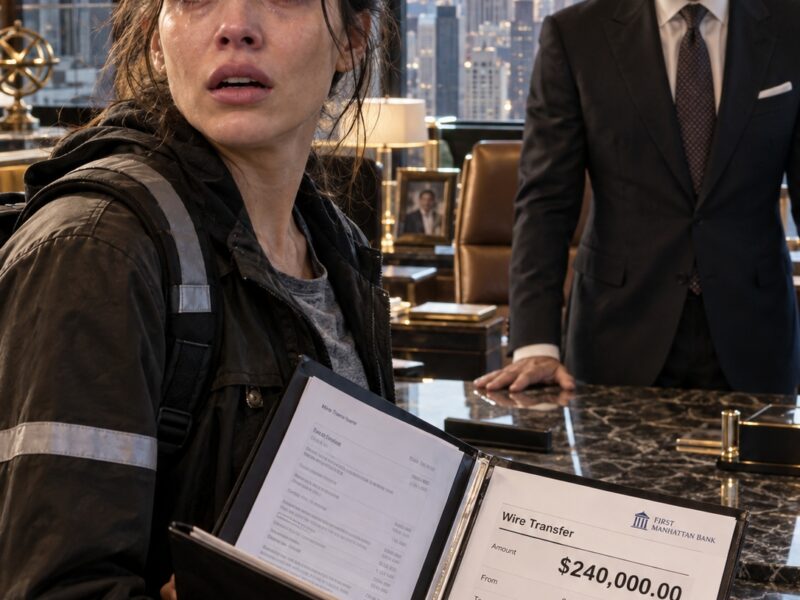
The coffee Brooke Mitchell carried into Benjamin Sterling’s office was still hot when she realized her life had just been destroyed.
Lauren Carter was already sitting across from Benjamin’s desk.
That was the first thing that felt wrong.
Lauren never came to the executive floor before nine unless she wanted someone frightened before breakfast.
The second thing was the folder.
It lay open between them, thick with bank records, authorization logs, copies of identification, and a transfer confirmation printed in sterile black ink.
The third thing was Benjamin’s face.
He wouldn’t look at Brooke.
She stopped three steps inside the office.
“What happened?”
Lauren folded her hands.
Her voice was almost gentle.
“We found the money.”
Brooke stared at her.
“What money?”
Lauren turned one of the documents around.
Brooke read the number once.
Then again.
$240,000.
Transferred from the employee emergency fund.
Approved with Brooke Mitchell’s executive credentials.
Sent to an account opened in the name of her seventeen-year-old brother, Dylan.
For several seconds, Brooke heard nothing.
Not the traffic thirty floors below.
Not the ventilation system.
Not the faint clink of the coffee cup trembling against its cardboard sleeve.
Just the number.
Two hundred forty thousand dollars.
Money she had fought to protect.
Money intended for drivers, warehouse workers, mechanics, dispatchers—the people who could lose everything because of one broken transmission, one emergency-room visit, one week without a paycheck.
And now the records said she had stolen it.
“I didn’t do this.”
Lauren’s expression didn’t change.
Benjamin finally raised his eyes.
Brooke looked at him.
Not Lauren.
Not the papers.
Him.
Because fourteen days earlier, Benjamin Sterling had looked at Brooke Mitchell—a bicycle courier wearing a rain-stained jacket in the marble lobby of his billion-dollar logistics company—and told an entire room of executives that character mattered more than credentials.
Now Brooke needed to know whether he had meant it.
“You know me,” she said quietly.
Something flickered across Benjamin’s face.
Pain.
Fear.
Maybe shame.
But then he looked back at the authorization record.
And Brooke understood before he spoke.
“I’ve known you for two weeks.”
The words landed harder than any accusation Lauren could have made.
Benjamin swallowed.
“I have to suspend you while this is investigated.”
Brooke stood completely still.
Two weeks earlier, she had been invisible in this building.
Then Benjamin Sterling had given her the keys to the company.
Now he was taking them away because a computer said she was a thief.
Brooke slowly set the untouched coffee on his desk.
Then she removed her executive badge.
“One of my conditions,” she said, “was that you would never undermine me in front of the people I was supposed to lead.”
Benjamin stood.
“Brooke—”
“You didn’t undermine me.”
She placed the badge beside the coffee.
“You did something worse.”
Lauren watched silently.
Brooke’s eyes stayed on Benjamin.
“You decided what kind of person I was before you even asked whether the story made sense.”
Then she turned and walked out.
By noon, a business website had the headline.
By one, Dylan’s name was online.
By two, strangers were calling Brooke a fraud.
And before sunset, the woman who had entered Sterling Logistics through the front doors as its interim CEO walked back into Queens wearing the same battered courier jacket she had worn before anyone important knew her name.
But none of them understood one thing.
Brooke had already found the numbers Lauren Carter was desperate to hide.
And the $240,000 transfer wasn’t the crime.
It was the smoke bomb meant to stop Brooke from finding the real one.
Two weeks earlier, the afternoon had begun with seventy-five dollars.
Brooke Mitchell knew the catering delivery would be blamed on her before she even reached Sterling Logistics.
That was how the city worked.
A restaurant could release an order twenty-eight minutes late.
A collision could choke Seventh Avenue.
An executive could schedule lunch with no margin for reality.
But when the trays arrived late, the person standing in front of them became the problem.
Brooke had learned that lesson over six years of delivering food across New York.
She pedaled harder anyway.
Her thighs burned as she cut east through Midtown, balancing nearly seven hundred dollars’ worth of catering in insulated bags strapped to the bicycle.
Her phone showed three missed messages from the customer.
WHERE ARE YOU?
THIS IS UNACCEPTABLE.
EXECUTIVE MEETING STARTED.
Brooke didn’t answer.
She needed oxygen more than she needed an argument.
Sterling Logistics occupied a glass tower near Times Square, the kind of building where the lobby smelled faintly of polished stone and money.
Brooke rolled her bicycle to the courier rack, locked it, lifted the bags, and entered through the side door.
She was twenty-seven.
Her dark hair had escaped its ponytail.
Rain had dried unevenly across her jacket.
One shoelace had been repaired with black electrical tape.
Nobody looking at her would have guessed she had once spent nights studying accounting equations until two in the morning.
Nobody would have guessed she had been two semesters from graduating.
Nobody would have guessed why she never went back.
That suited Brooke.
Explanations rarely changed rent.
She reached reception.
A man in a charcoal suit was waiting with several managers.
Ethan Vaughn.
Commercial director.
Brooke knew his name because it was printed on the order.
Ethan checked his polished watch dramatically.
Then he looked at the people around him.
Brooke recognized the move.
He wasn’t angry.
He was performing anger.
“You’re late.”
Brooke placed the first insulated bag carefully on the reception counter.
“The restaurant released the order twenty-eight minutes late, and there was an accident on Seventh. It’s all recorded in the app.”
“Everyone has been waiting.”
“I understand.”
“You understand?”
Ethan gave a short laugh.
“Apparently not.”
Several employees nearby became interested in their phones.
Brooke opened the delivery record.
“The restaurant delay is documented. Customer compensation is handled through the platform.”
Ethan barely looked.
He pulled out a stack of bills, counted them, and pressed the money into her hand.
“Then consider the missing amount your penalty.”
Brooke counted it.
Once.
That was enough.
The agreed total was $648.50.
She held $573.50.
“You’re short seventy-five dollars.”
A young manager behind Ethan smiled.
Not because it was funny.
Because he expected entertainment.
Brooke looked at Ethan.
He was probably used to people deciding seventy-five dollars wasn’t worth humiliating themselves over.
That was one advantage of being rich.
Small amounts became too embarrassing to defend.
But Brooke knew exactly what seventy-five dollars could become.
Three subway cards.
Groceries.
A utility bill.
Part of Dylan’s SAT fee.
Half a bicycle repair.
Medication.
A week in which the numbers almost worked.
“The order total is $648.50,” she said.
“I know what the order total is.”
“Then you know you still owe me seventy-five dollars.”
Ethan’s jaw tightened.
“I’m deducting it because you were late.”
“The restaurant was late.”
“You were the courier.”
“And the platform rules say restaurant delays are compensated by the platform. They do not come out of courier payment.”
“Do you really want to do this here?”
Brooke almost smiled.
He still thought the room belonged to him.
“I didn’t choose where you underpaid me.”
The young manager stopped smiling.
Ethan glanced around.
Now his own audience had become inconvenient.
He pulled out a hundred-dollar bill.
“Fine.”
Brooke accepted it.
Then reached into her jacket pocket, counted twenty-five dollars, and handed it back.
Ethan stared at the money.
“Keep it.”
“No, thank you.”
“It’s twenty-five dollars.”
“I know.”
Brooke put the bills into his hand.
“I only take what belongs to me.”
She unpacked the catering trays.
Straightened the receipt.
Wished the receptionist a good afternoon.
Then left through the courier entrance.
She never noticed the older man standing near the marble column.
Benjamin Sterling had watched everything.
At sixty-one, Benjamin had spent more than two decades building Sterling Logistics from one rented warehouse and a used truck into a multistate freight company.
He had sat across from governors, bankers, union representatives, investors, and executives who billed more for one hour than Brooke made in several days.
But something about the young courier had unsettled him.
It wasn’t that she had demanded the money.
Anyone could demand money.
It was the twenty-five dollars she gave back.
She had refused humiliation.
Then she had refused advantage.
Benjamin looked toward the side door after Brooke disappeared.
His assistant, Madison Irving, approached.
“Everything okay?”
Benjamin kept staring at the door.
“No.”
Madison followed his gaze.
“Who was she?”
“I don’t know.”
He turned toward Madison.
“Find out.”
That night, Brooke sat at a small kitchen table in Queens eating boxed macaroni with Dylan.
Their apartment had two bedrooms if one was generous with the word bedroom.
The radiator knocked.
A cabinet door didn’t close properly.
Brooke’s bicycle lay upside down on newspapers because the chain had begun slipping again.
Dylan watched her tighten the rear derailleur.
“You’re going to kill that bike.”
“That bike and I have an understanding.”
“What understanding?”
“It breaks. I threaten it. It works another week.”
Dylan grinned.
He was seventeen and had their mother’s eyes.
That still hurt sometimes.
“Did you eat today?”
“I’m eating now.”
“That wasn’t the question.”
Brooke pointed a wrench at him.
“Finish your homework.”
Dylan rolled his eyes.
Brooke returned to the bicycle.
She had no idea that in Manhattan, Madison Irving was assembling a file about her.
Excellent delivery record.
No serious customer complaints.
No criminal history.
No lawsuits.
Twenty-seven years old.
Queens resident.
Legal guardian of younger brother Dylan Mitchell.
And then Madison found the detail that made Benjamin sit forward.
Brooke Mitchell had attended City University on an accounting track.
Strong grades.
Two semesters remaining.
Then she had disappeared from the program.
“Why?” Benjamin asked.
“There’s no academic reason listed.”
Benjamin stared at the transcript.
“Find her tomorrow.”
Madison raised an eyebrow.
“For what?”
Benjamin looked toward the dark windows of his office.
Sterling Logistics had problems.
Real ones.
Major customers had left.
Supplier complaints were increasing.
Payments were delayed.
Employee turnover was climbing.
Every director had an explanation.
Every report had another report attached to it.
The company had become large enough to hide its failures inside vocabulary.
Benjamin was beginning to wonder whether the people with the most qualifications had become the people least capable of seeing what was directly in front of them.
“For an experiment,” he said.
Madison sighed.
“I hate when you say that.”
The next morning Benjamin found Brooke near Bryant Park.
She was outside a coffee shop checking her phone when a black sedan stopped at the curb.
Benjamin stepped out.
“Brooke Mitchell?”
She looked up.
“Yes?”
“I’m Benjamin Sterling.”
Nothing.
He was used to his name producing recognition.
Brooke glanced at the Sterling Logistics logo reflected faintly in the car window.
Then she remembered.
“The building.”
“I own the company.”
“Okay.”
Benjamin almost laughed.
“Could we talk?”
Brooke checked her phone.
“I have eleven minutes before my next pickup.”
“We can sit in the car.”
“No.”
Benjamin paused.
“No?”
“If you have something to say, say it here.”
It occurred to Benjamin that most people spent years trying to get into his car.
Brooke wouldn’t even open the door.
So he stood beside her on the sidewalk.
He told her about the company.
The lost customers.
The delayed invoices.
The growing distance between the executive floor and the people actually moving freight.
Brooke listened.
Then Benjamin said, “I want you to run Sterling Logistics for thirty days.”
A bus groaned away from the curb.
Brooke stared at him.
“I’m sorry?”
“Thirty days.”
“You want me to do what?”
“Serve as interim CEO.”
Brooke laughed.
Once.
There was no humor in it.
“You want a bicycle courier to become CEO of a logistics company?”
“I want someone who still understands what one dollar means.”
“That sounds good in a speech.”
“I’m not making a speech.”
“No. You’re making me into one.”
Benjamin frowned.
Brooke slipped her phone into her pocket.
“I know what this is.”
“Tell me.”
“You bring the delivery girl upstairs. Your executives hate it. You embarrass them for a month. Maybe some magazine writes about the billionaire who put a working-class woman in charge. Then everybody learns a lesson, you congratulate yourself, and I go back to delivering sandwiches.”
“That isn’t what I’m offering.”
“What are you offering?”
“Authority.”
Brooke’s expression changed slightly.
“Real authority?”
“Yes.”
“Hiring?”
“Yes.”
“Budgets?”
“Within board limits.”
“Personnel?”
“Yes.”
“Access to finance?”
“Yes.”
“Executive compensation?”
Benjamin nodded.
“Real salary. Real responsibility.”
Then he made his mistake.
“You studied accounting.”
Brooke’s face closed.
“How do you know that?”
“I investigated you.”
“Why?”
“Because I’m considering handing you a company.”
“You followed me?”
“No.”
“You pulled my records.”
“I asked questions.”
“You know about Dylan?”
Benjamin hesitated.
Brooke’s eyes hardened.
“That wasn’t permission.”
“You’re right.”
The answer surprised her.
Benjamin continued.
“You have every right to be angry. But if I’m asking thousands of people to trust my judgment, I need to know who I’m putting in charge.”
Brooke’s phone buzzed.
She checked it.
“My eleven minutes are over.”
Benjamin gave her a card with his private number.
“Decide by tonight.”
She took the card.
Not because she planned to call.
Because littering annoyed her.
At Sterling Logistics that morning, Benjamin called every director into the boardroom.
Ethan Vaughn sat three seats from the end.
Lauren Carter, finance director, sat opposite him.
Benjamin described the previous day’s confrontation.
Ethan leaned back.
“Are we seriously discussing a courier dispute?”
“Yes.”
“Over seventy-five dollars?”
Benjamin looked at him.
“That sentence is exactly why we’re discussing it.”
Ethan frowned.
“Excuse me?”
“Seventy-five dollars means nothing to you.”
Benjamin’s voice stayed calm.
“To someone else, it is groceries. Medication. Transportation. Rent.”
Lauren folded her arms.
“With respect, Benjamin, what exactly is the point?”
“The point is that this company has spent years learning how to think in millions and forgotten that millions are made of individual dollars.”
Silence.
Benjamin looked around the table.
“For thirty days, Sterling Logistics will have an interim CEO with full operational authority.”
Scott Turner from operations leaned forward.
“Who?”
Benjamin looked at Ethan.
“The courier you tried to underpay yesterday.”
The room exploded.
Lauren actually laughed.
Ethan did not.
“You cannot be serious.”
“I am.”
“She has no qualifications.”
“She has some.”
“Some?”
Lauren’s voice sharpened.
“We are responsible for tax compliance, insurance, contracts, federal transportation rules, audits, financing—”
“And yet,” Benjamin said, “our customers are leaving, vendors are waiting months for payment, drivers are complaining about missing overtime, and apparently none of our qualifications have prevented that.”
Ethan pushed his chair back.
“This is reckless.”
Benjamin looked around the room.
“If any of you cannot report to her, you are free to leave.”
Nobody moved.
That evening Brooke told Dylan.
Then she told him she was refusing.
Dylan put down his fork.
“Why?”
“Because it’s insane.”
“Probably.”
“Thank you.”
“So do it.”
Brooke stared at him.
“You’re seventeen.”
“Still smarter than you sometimes.”
“Dylan.”
He leaned forward.
“You know why you quit college?”
Her expression changed.
“Don’t.”
“Mom got sick.”
“I know.”
“You were twenty-one. I was eleven. You worked mornings, took care of her, made dinner, checked my homework, and still tried to study at night.”
Brooke looked away.
“You didn’t fail school,” Dylan said. “Life interrupted you.”
“That sounds like something a guidance counselor would put on a poster.”
“It’s true.”
He reached across the table.
“You didn’t stop being capable because nobody gave you a diploma.”
Brooke stared at Benjamin’s card beside her plate.
At 8:43 p.m., she called.
“I have conditions.”
Benjamin smiled at the phone.
“I assumed you would.”
“No one gets fired just so I can make a statement.”
“Agreed.”
“You do not overrule me publicly.”
“Agreed.”
“And half the executive salary goes into an emergency fund for drivers and hourly employees.”
Benjamin stopped smiling.
Not because he objected.
Because suddenly the experiment felt less like his idea.
“Agreed.”
The next morning, Brooke Mitchell entered Sterling Logistics through the main doors.
Her hands were shaking.
She hated that.
The lobby looked different when security knew her name.
Charlie, the morning guard, handed her an executive badge.
“Good luck, Ms. Mitchell.”
“Brooke.”
He smiled.
“Good luck, Brooke.”
Upstairs, Benjamin offered her the chair at the head of the boardroom table.
Brooke didn’t sit.
She placed her old hardbound college notebook in front of her.
Then she looked at the executives.
“I know what some of you are thinking.”
Ethan’s face remained expressionless.
Brooke continued.
“You’re right about one thing. I don’t know everything you know.”
Lauren gave the smallest nod.
“But I know how to ask questions.”
Brooke opened her notebook.
“So let’s begin.”
She looked at Scott Turner.
“What does it cost Sterling Logistics to move one mile of freight?”
Scott blinked.
“Depends on the route.”
“Average.”
He opened his laptop.
“Roughly—”
“I don’t want roughly.”
Scott stopped.
Brooke leaned forward.
“You operate thousands of vehicles. Fuel changes. Toll structures change. Overtime changes. Empty mileage changes. If your estimate is off by twenty cents per mile, what does that become across the fleet?”
Scott didn’t answer immediately.
Brooke looked around the table.
“That’s my first problem.”
Lauren sighed.
“With respect, this isn’t a delivery app.”
“You’re right.”
Brooke met her eyes.
“On a delivery app, if I don’t know my cost per mile, I might not eat next week.”
She tapped the table.
“Here, apparently, people can ignore it for months and still get bonuses.”
Two younger managers looked down to hide smiles.
Ethan did not.
Brooke spent the morning requesting customer-loss reports, supplier payment histories, overtime disputes, route utilization, executive bonuses, maintenance records, warehouse complaints, and unpaid invoices.
By lunch, she had learned something important.
Sterling Logistics did not lack data.
It was drowning in it.
Information had become camouflage.
So Brooke did something the executives didn’t expect.
She went downstairs.
Then farther downstairs.
Then out of Manhattan.
She spent afternoons at loading docks in Brooklyn and Queens.
She spoke to forklift operators.
Dispatchers.
Mechanics.
Drivers.
People who initially assumed she was from human resources and stopped talking whenever she approached.
Until Brooke sat on a loading pallet with a paper cup of vending-machine coffee and said, “Tell me what I’m not supposed to know.”
That changed things.
A mechanic told her trucks sometimes waited three days for cheap parts while emergency replacements were purchased at premium prices.
A dispatcher showed her routes where two half-empty trucks left within an hour of each other for neighboring destinations.
A warehouse worker said overtime corrections could take months.
Then Robert Mason, a driver with twenty-three years at Sterling, quietly mentioned an overnight emergency route he had never been paid for.
“How long?”
“Four months.”
“How much?”
“Eight hundred forty-six dollars.”
“Did you file it?”
“Three times.”
Brooke closed her notebook.
The next morning she walked into payroll at 8:07.
She stayed until Robert’s money was transferred.
By lunch, every warehouse seemed to know.
The new CEO followed up.
Soon notes began appearing on her desk.
Route suggestions.
Payment problems.
Equipment failures.
Customer complaints.
One driver drew three delivery routes on a napkin and demonstrated how combining them could eliminate almost forty miles a day.
Brooke taped the napkin into her notebook.
The executives had spreadsheets.
The drivers had reality.
Late one evening, Benjamin found Brooke sitting barefoot on the carpet of her office surrounded by invoices.
He leaned against the doorframe.
“Still here?”
Brooke didn’t look up.
“The numbers don’t match.”
“What numbers?”
She handed him a set of invoices.
“Parts supplier.”
Benjamin sat opposite her.
“The invoices change every month.”
“Yes.”
“Normal.”
“The inventory doesn’t.”
Benjamin looked again.
Brooke pointed.
“They’re buying parts that don’t appear in maintenance records.”
“Who approves payment?”
“Finance.”
They looked at each other.
Lauren Carter.
Benjamin lowered the invoice.
“Enough to investigate?”
“Yes.”
“Enough to accuse?”
“No.”
Benjamin nodded.
“Good.”
Brooke raised an eyebrow.
“Good?”
“You know the difference.”
They worked in silence.
After a while, Brooke asked, “Why do you care?”
Benjamin looked up.
“You could sell this company tomorrow.”
“I could.”
“You’re wealthy enough that none of this has to be your problem.”
Benjamin leaned back against the desk.
“My mother cleaned offices.”
Brooke stopped turning pages.
“When I was a boy, sometimes she couldn’t afford childcare, so I sat in corners while she worked.”
His smile was faint.
“I used to do homework under conference tables while executives walked past us.”
He looked around Brooke’s enormous office.
“When I started Sterling, I promised myself no one working for me would ever feel invisible.”
Brooke waited.
Benjamin looked at the invoices scattered between them.
“I think I broke that promise without noticing.”
Brooke closed her notebook.
“My mother cleaned offices too.”
Benjamin said nothing.
That was why she continued.
“She got sick when I had two semesters left.”
“You left school to care for her.”
“And Dylan.”
“You thought you’d go back?”
Brooke smiled without humor.
“Next semester.”
She looked toward the windows.
“Then next year.”
Silence.
“Then I stopped saying it.”
Two floors below them, Lauren Carter stared at a security alert showing Brooke’s finance-system access.
She called Ethan.
“She’s looking at the supplier.”
There was a long silence.
Then Ethan said, “So we make sure she looks somewhere else.”
At the beginning of Brooke’s second week, she walked into the executive meeting carrying one sheet of paper.
Scott Turner looked at it.
Then looked again.
“You did this?”
“The drivers did.”
The proposal reorganized dozens of routes, grouped geographically overlapping stops, and changed departure windows to reduce empty mileage.
Projected savings: several million dollars annually.
Ethan suddenly became cooperative.
Too cooperative.
Reports arrived early.
Emails were polite.
He stopped challenging Brooke in meetings.
That frightened her more than his hostility.
Then Avery Retail Group threatened to cancel Sterling’s largest commercial contract.
The account belonged to Ethan.
Brooke reviewed the failure history.
Drivers had been blamed repeatedly for late deliveries.
But the orders had been entered late by Ethan’s own commercial department.
The meeting with Edward Avery was scheduled for noon.
At 10:18, Madison burst into Brooke’s office.
“It’s at eleven.”
Brooke looked up.
“What?”
“Avery’s assistant confirmed. Eleven.”
Brooke checked the calendar invitation.
Noon.
“Who changed it?”
“I don’t know.”
Brooke grabbed her bag.
Midtown traffic was frozen.
Downstairs, she saw Tyler Nguyen, a courier she knew from her delivery days, unlocking his bicycle.
“Tyler.”
He turned.
Then stared at her suit.
“No way.”
“I need your bike.”
“You’re CEO.”
“I’m late.”
“That feels familiar.”
“Tyler.”
He tossed her the lock key.
“Bring it back in one piece, boss.”
Brooke stuffed her dress shoes into her bag.
Then rode.
She cut between stopped cars.
Crossed protected lanes.
Ignored three angry horns.
Arrived at Avery Retail windblown and breathing hard.
Edward Avery sat behind a conference table.
He glanced at the clock.
“You’re late.”
Brooke almost laughed.
“By four minutes.”
“Your company has been late by considerably more.”
“Yes.”
No excuse.
That got his attention.
Brooke sat.
“We failed your company.”
Edward leaned back.
“Most executives begin by explaining why they didn’t.”
“I can explain where it happened.”
She opened the records.
“But explanation isn’t absolution.”
She showed him how orders had been entered late internally.
How drivers had been dispatched with impossible schedules.
How complaints had been redirected instead of corrected.
Then she proposed a direct operations contact, automatic credits, and a new escalation system.
Edward studied her.
“Did you cause these failures?”
“No.”
“Then why are you talking as though you did?”
Brooke closed the folder.
“Because they may not have started with me.”
She held his gaze.
“But they belong to me while I’m responsible for fixing them.”
Avery kept the contract.
Back at Sterling, Brooke removed the account from Ethan’s control.
That evening Benjamin found her asleep at her desk.
Instead of taking her to some expensive restaurant, he took her to a food cart three blocks away.
They sat on metal stools beneath a plastic awning while taxis hissed through wet streets.
That was where Brooke finally told him the rest.
Her mother’s name was Rose Mitchell.
Rose cleaned offices at night.
One evening she developed severe chest pain during a shift.
She asked to leave.
Her supervisor warned her that her pay would be docked and her job could be at risk.
So Rose finished cleaning.
She came home near dawn.
Hours later, she was hospitalized.
She lived several more months.
But she never truly recovered.
Brooke stared at the steam rising from her coffee.
“That’s why I counted the money in your lobby.”
Benjamin looked at her.
“The seventy-five dollars.”
“It was never seventy-five dollars.”
Brooke’s voice tightened.
“I watched my mother spend her whole life accepting whatever powerful people decided she deserved.”
She rubbed her thumb across the paper cup.
“I promised myself nobody would take something I earned just because they thought I was too small to argue.”
Benjamin placed his hand over hers.
Neither spoke.
The next morning, Benjamin privately asked Madison to search Sterling’s old cleaning contracts.
He wanted to know where Rose Mitchell had worked.
At almost the same time, Lauren and Ethan began preparing something more dangerous than a fake meeting time.
Because Brooke was getting closer.
And if she followed the supplier invoices far enough, she would find seven million reasons they needed her gone.
Two mornings later, the trap snapped shut.
The $240,000 transfer appeared.
Brooke was suspended.
The story leaked.
And Benjamin Sterling discovered how quickly a man could betray his principles while telling himself he was merely following procedure.
At home, Dylan stared at the online article.
“They think I stole it?”
Brooke wrapped her arms around him.
“I know you didn’t.”
“You didn’t even ask me.”
“No.”
“Why?”
Brooke pulled back.
“Because I know you.”
The sentence silenced her.
That was when Benjamin’s hesitation hurt all over again.
Her phone buzzed.
Robert Mason.
Warehouse believes you.
Another message.
Tyler.
A photograph of his bicycle.
Anytime you need to get somewhere important.
Then Charlie from security.
Dispatchers.
Receptionists.
Mechanics.
Assistants.
People with almost no institutional power.
People whose names rarely appeared in annual reports.
They believed her.
The executive floor had demanded evidence.
The people downstairs offered trust.
Meanwhile, Madison Irving refused to accept the official story.
She checked the transaction logs.
The transfer had been created late at night.
From a finance-department workstation.
Specifically, a computer inside Lauren Carter’s office.
Security records showed Ethan Vaughn entering the building shortly before the transaction.
He told the night guard he had forgotten documents.
Camera footage showed him entering Lauren’s office.
Madison stared at the timestamp.
Then called Benjamin.
“Where were you Tuesday night at 10:42?”
Benjamin frowned.
“Driving Brooke home.”
Madison went silent.
Benjamin’s stomach dropped.
“At 10:42?”
“Yes.”
“Then she couldn’t have authorized the transfer.”
Benjamin closed his eyes.
He had been her alibi.
The entire time.
But Madison had found something else.
She placed an old employment file on his desk.
Rose Mitchell.
Night cleaning crew.
Sterling Tower.
Benjamin stared at the photograph.
A younger Rose looked back at him.
Then he read the final incident report.
Chest pain.
Request to leave early.
Permission denied.
Executive floor required complete preparation for morning board meeting.
Benjamin’s hands went cold.
He remembered that meeting.
Investors had been coming.
He had demanded perfection.
Fresh flowers.
Polished glass.
Spotless conference tables.
He remembered walking into the gleaming boardroom at dawn and feeling proud.
He had never asked who had stayed through the night to make it shine.
Lauren called an emergency board meeting.
She intended to use Brooke’s scandal to remove Brooke permanently—and weaken Benjamin’s authority for appointing her.
Ethan thought they had won.
Before sunrise, Benjamin had the transaction logs, security records, camera footage, and Rose Mitchell’s personnel file spread across his desk.
Brooke was innocent.
But that no longer felt like enough.
Because Benjamin understood the harder truth.
He had believed in Brooke when believing in her cost him nothing.
The moment believing in her became dangerous, he had chosen the computer screen.
The next morning, he found Brooke outside the same Bryant Park coffee shop.
She was wearing her courier jacket again.
Her bicycle stood beside her.
When she saw Benjamin, she didn’t smile.
“I don’t have the money,” she said.
“I never did.”
“I know.”
She looked away.
Benjamin stepped closer.
“The transfer came from Lauren’s office. Ethan entered the building. We have footage. And at the exact time it happened…”
He stopped.
“You were with me.”
Brooke looked at him.
“I drove you home.”
Benjamin’s voice broke slightly.
“I was your alibi.”
“That must be convenient.”
“I’m not asking you to forgive me because I found proof.”
Brooke’s jaw tightened.
“Good.”
“I should have known who you were before I had proof.”
Benjamin looked down.
“I let fear decide your character.”
Then he handed her Rose’s file.
Brooke saw the photograph.
Everything inside her stopped.
“Where did you get this?”
“She worked at Sterling.”
Brooke stared at him.
“My mother?”
“For years.”
She opened the file.
Read the final report.
Her hands began shaking.
“No.”
Benjamin said nothing.
“She never told me the building.”
Brooke sat in the back seat of Benjamin’s parked car because suddenly her legs wouldn’t hold her.
“She said they were all the same.”
Benjamin stared through the windshield.
“On the night she became sick, the executive floor had to be prepared for a board meeting.”
Brooke slowly raised her eyes.
“Your meeting?”
“Yes.”
“Did you tell them not to let her leave?”
“No.”
Benjamin swallowed.
“I didn’t even know her name.”
Brooke looked down at Rose’s photograph.
Benjamin continued.
“And that doesn’t make me innocent in the way I once would have thought it did.”
Brooke said nothing.
“I built a company and told myself I cared about workers because I remembered what poverty looked like.”
His voice grew quieter.
“Your mother suffered under my roof, inside a system I owned, and I never saw her.”
For years Brooke had imagined a villain.
Some cruel supervisor.
Some powerful man deliberately choosing money over her mother.
Now she saw something worse.
Something ordinary.
A chain of people doing their jobs.
A supervisor protecting a schedule.
A manager protecting appearances.
An executive protecting investors.
Nobody deciding Rose Mitchell should suffer.
Everybody deciding something else mattered more.
“You didn’t order her to stay,” Brooke finally said.
“No.”
“But you owned the system that allowed it.”
Benjamin nodded.
“Yes.”
Brooke closed the file.
“You can’t change what happened.”
“No.”
“But you can change what happens next.”
Benjamin looked at her.
“Lauren called a board meeting.”
Brooke gave a bitter smile.
“Of course she did.”
“I moved it forward.”
“Why?”
“Because I have the evidence.”
He paused.
“But I won’t present your case without you.”
Brooke looked through the car window.
Cyclists moved between buses.
People hurried toward offices.
A city full of invisible lives passing one another.
Benjamin said, “This fight belongs to you if you want it.”
Brooke thought of Dylan.
Robert.
Tyler.
Rose.
The badge sitting on Benjamin’s desk.
“Take me back.”
Benjamin reached for the ignition.
Brooke stopped him.
“But drop me at the corner.”
“Why?”
She looked at her bicycle.
“I want to arrive the way I did the first time.”
Near noon, Brooke locked her bicycle to the familiar post outside Sterling Logistics.
She wore her courier jacket.
Under one arm was the old college notebook she had carried for years.
Inside the boardroom, Lauren stood beside a screen displaying the scandal headline.
Ethan sat beside her.
Composed.
Confident.
Lauren was explaining why Benjamin Sterling had endangered the company by appointing an unqualified outsider when the glass doors opened.
Brooke walked in.
Madison followed.
Charlie from security came behind her.
Then Robert Mason.
Lauren’s face changed.
Brooke glanced down at her jacket.
“Sorry about this.”
Nobody spoke.
“I came from work.”
She placed her notebook on the table.
Then she did what she had done in the lobby.
She started with the numbers.
“Two hundred forty thousand dollars.”
Brooke displayed the transaction.
“My credentials were used to approve this transfer at 10:42 p.m.”
Next slide.
“The authorization originated from a computer inside Lauren Carter’s office.”
Lauren stood.
“This proves nothing.”
Brooke nodded.
“Correct.”
Another slide.
“Security records show Ethan Vaughn entered the building at 10:19.”
Ethan’s expression tightened.
Charlie stepped forward.
“He told me he forgot paperwork.”
Brooke continued.
“Camera footage shows him entering Lauren’s office.”
Ethan looked toward Benjamin.
Benjamin spoke.
“At 10:42, Brooke Mitchell was in my car across town.”
Silence.
Brooke looked at Lauren.
“But that transfer isn’t why we’re here.”
For the first time, Lauren looked afraid.
Brooke opened the supplier file.
“During my first week, I found recurring payments for vehicle parts that rarely appeared in inventory.”
She displayed two years of invoices.
“The supplier changed descriptions. Amounts varied. Approvals looked routine.”
Another screen.
“But inventory records didn’t support the purchases.”
Scott Turner leaned forward.
Brooke continued.
“The vendor is controlled through a holding company linked to a relative of Lauren Carter.”
Lauren’s face drained.
“And over two years, Sterling Logistics paid more than seven million dollars for inflated or nonexistent purchases.”
Someone whispered, “Jesus.”
Brooke looked at Ethan.
“Commercial documentation from Ethan’s division repeatedly supported those invoices.”
Ethan stood.
“This is circumstantial.”
His voice lacked conviction.
Brooke closed the folder.
“The transfer into my brother’s name wasn’t theft.”
She looked around the table.
“It was camouflage.”
Silence.
“They needed the board looking at me before I finished looking at them.”
No one defended Lauren.
No one defended Ethan.
The board voted.
Their employment was terminated.
The fraud evidence would be referred to investigators.
Supplier payments were frozen.
Every dollar removed from the emergency fund would be restored.
Security escorted Ethan toward the elevators.
When he passed Brooke, he stopped.
Two weeks earlier, he had looked at her in the lobby and seen someone too insignificant to challenge him.
Now he couldn’t quite meet her eyes.
Brooke did not smile.
“The first time we met,” she said, “you thought seventy-five dollars was too small to matter.”
Ethan said nothing.
Brooke lowered her voice.
“Small amounts reveal character long before large amounts reveal crimes.”
Ethan walked away.
Benjamin remained standing.
“There are two more proposals.”
The board turned toward him.
“The employee emergency fund will be renamed the Rose Mitchell Fund.”
Brooke froze.
Benjamin continued.
“Effective immediately, any employee or contract worker inside a Sterling facility may leave for urgent medical care without retaliation or automatic loss of wages while the situation is reviewed.”
Nobody spoke.
“Management evaluations will also include payment reliability, safety, and treatment of operational employees—not merely profitability.”
Benjamin looked at Brooke.
“And my second proposal is that Brooke Mitchell stop serving as interim CEO.”
Brooke stared at him.
The room became perfectly still.
Benjamin’s expression softened.
“And become permanent CEO, if she still wants the job.”
The oldest board member raised his hand first.
Then another.
Then another.
Brooke looked down at the battered notebook beneath her fingers.
For years she had believed that notebook belonged to another version of herself.
The college student.
The woman who might have been.
The woman whose life had supposedly gone off course.
Now she understood something.
She had never stopped becoming her.
“I’ll accept.”
Dylan would later claim he could hear the smile in her voice when she called him.
But Brooke wasn’t finished.
“On one condition.”
A few board members exchanged amused glances.
Benjamin laughed softly.
“Of course.”
“I finish the two semesters I left behind.”
The tension finally cracked.
Someone laughed.
Then several people applauded.
Brooke looked at Benjamin.
“Night classes if necessary.”
“Approved,” he said.
“Good.”
Later, after the boardroom emptied, Benjamin remained near the windows.
Brooke gathered her papers.
“I owe you more than an apology,” he said.
She stopped.
Benjamin took a breath.
“From the first day, I admired you.”
Brooke looked at him carefully.
“Somewhere between the warehouse reports, the food cart, and watching you fight for people nobody else listened to…”
He hesitated.
“It became something else.”
Brooke’s heart beat harder.
“I care about you.”
Benjamin didn’t move closer.
“If you don’t feel the same, I will accept that. And nothing about your position changes.”
Brooke stared at him.
“What hurt most when you suspended me wasn’t losing the job.”
Benjamin looked down.
“It was that your opinion mattered to me.”
He raised his eyes.
Brooke stepped closer.
The kiss was gentle.
No dramatic music.
No promise that trust would never break again.
They knew better than that now.
Trust could disappear in a sentence.
It returned through choices.
That afternoon Brooke went downstairs.
Her bicycle was still locked outside.
Charlie automatically moved toward the courier entrance.
Brooke shook her head.
Benjamin reached the main glass doors first.
He held one open.
Brooke wheeled her bicycle through the front entrance.
Receptionists looked up.
Drivers waiting for paperwork turned.
Office workers paused.
The marble was the same.
The building was not.
Months later, Sterling Logistics looked almost unchanged from the street.
Inside, everything important had begun shifting.
Small suppliers were paid faster.
Drivers could contact operations directly.
Missing wages were escalated automatically.
Employees facing medical emergencies no longer had to choose between a paycheck and getting help.
Brooke still visited loading docks.
Still carried the old notebook.
Still asked drivers what the reports were missing.
At night, she returned to class.
Sometimes she arrived wearing a suit.
Sometimes sneakers.
Dylan eventually earned his own place at college.
Benjamin stopped treating the executive floor as the center of Sterling Logistics.
And whatever grew between him and Brooke grew slowly.
Carefully.
Neither mistook affection for absolution.
One rainy evening after class, Brooke entered the Sterling lobby alone.
The building was quiet.
She stopped near the marble column where Benjamin had once watched Ethan Vaughn try to take seventy-five dollars from her.
She could almost see her younger self standing there.
Wet jacket.
Tired eyes.
Delivery bags.
Counting bills.
Back then she had believed leaving college meant she had stepped away from the life she was supposed to have.
She had been wrong.
Ability had not disappeared because she delivered food.
Intelligence had not vanished because she wore a courier jacket.
Worth had not waited inside some future office for her to earn it.
Benjamin had been wrong too.
He had believed remembering his mother’s poverty was enough to keep him compassionate.
It wasn’t.
People could remember hardship and still become insulated from it.
They could love the working class as an idea while failing to see the worker cleaning their conference room.
Caring wasn’t something a person accomplished once.
It was something they practiced.
Brooke looked toward the boardroom elevators.
Her mother had crossed this lobby.
Probably hundreds of times.
Rose Mitchell had worked nights in this building while powerful people slept.
She had polished glass, emptied trash, cleaned tables, and once stayed through chest pain because the room upstairs needed to look perfect.
For years, Brooke had wanted someone to blame.
She had imagined cruelty with a face.
But the truth was more unsettling.
Systems could hurt people without anyone waking up in the morning intending to be cruel.
A clean boardroom could become more important than a sick woman.
A deadline could become more important than a driver’s unpaid wages.
A corporate procedure could become more important than trust.
And seventy-five dollars could become too small to matter—until somebody refused to let it.
Brooke rested one hand on the bicycle beside her.
That seventy-five dollars had changed her life.
But not because of the money.
Because of the boundary.
She had defended what belonged to her without becoming cruel.
Later, when she received power, she had not used it to humiliate everyone who once looked down on her.
She listened.
She investigated.
She paid old debts.
She protected workers.
And even when she was framed, she returned with evidence instead of revenge.
That was the difference between having power and deserving it.
The elevator doors opened.
Brooke didn’t enter immediately.
For a moment she imagined Rose standing beside her.
Tired after a night shift.
Hands rough from cleaning chemicals.
Invisible to nearly everyone passing through the lobby.
Brooke wished her mother could see the fund bearing her name.
The new rules.
The office upstairs.
The college textbooks in Brooke’s bag.
But then she understood that none of those things were the real memorial.
The real memorial was quieter.
Somewhere in a Sterling warehouse, a mechanic could leave work because his chest hurt without wondering whether his children would lose grocery money.
Somewhere, a driver’s missing overtime would no longer disappear into a processing queue.
Somewhere, a young courier could walk through the front entrance without being treated as though the side door was the only one meant for people like her.
Rose Mitchell’s name might someday disappear from a plaque.
Policies could be rewritten.
Executives could change.
But Brooke wanted one idea to survive all of them.
No honest wage was too small to matter.
No worker was too unimportant to be heard.
And no title could make one human being more human than another.
Brooke stepped into the elevator.
The doors began closing.
Then she noticed a young delivery driver entering the lobby with three heavy bags.
He hesitated, looking toward the side entrance.
Brooke reached out and stopped the elevator doors.
“Hey.”
The courier looked up.
She pointed toward the main entrance.
“You can come through here.”
He looked uncertain.
“Are you sure?”
Brooke smiled.
“Yeah.”
The young man walked through the glass doors.
Nobody stopped him.
Brooke watched until the elevator doors finally closed.
Years earlier, her mother had crossed the same marble floor and disappeared into the building without anyone important learning her name.
Brooke had spent years believing success meant becoming important enough that nobody could overlook her again.
Now she understood the deeper victory.
She had become powerful enough to make sure fewer people were overlooked in the first place.
And somewhere beneath the polished floors, executive titles, millions of dollars, and thirty stories of glass, the lesson that had begun with seventy-five missing dollars remained astonishingly simple.
When power meets vulnerability, character is revealed by which one you protect.
Brooke looked down at the worn college notebook in her hand.
Then the elevator carried her upward.
This time, she did not need the front door, the executive badge, or the title beside her name to prove she belonged there.
She already knew.









