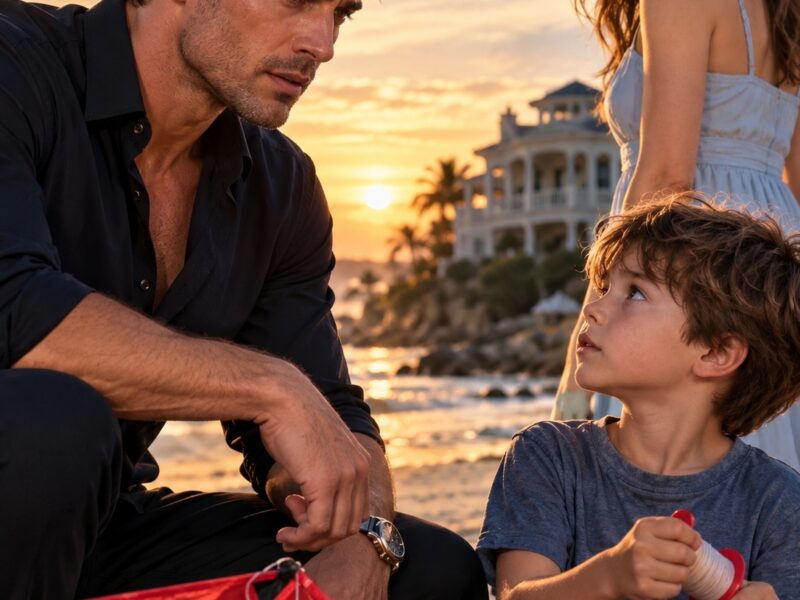
THE BILLIONAIRE MET A 6-YEAR-OLD BOY ON VACATION—THEN HIS MOTHER WALKED UP, AND ONE QUESTION CHANGED EVERYTHING

“You’re terrible at this.”
Daniel Whitaker turned toward the small voice and discovered a six-year-old boy staring at him as if he had just witnessed a grown man fail the easiest test in the world.
Daniel looked down at the bright red kite lying upside down in the sand.
Then he looked back at the boy.
“I’ve been doing this for approximately thirty seconds.”
The child folded his arms.
“And it’s still on the ground.”
Daniel almost laughed.
Almost.
At forty-three, Daniel was accustomed to rooms going quiet when he spoke. He was the founder and CEO of Whitaker Capital, a Boston investment firm powerful enough that a single decision from his office could move hundreds of millions of dollars before lunch.
People prepared for meetings with him weeks in advance.
Senior executives checked their numbers twice before entering his office.
Young analysts rehearsed answers in elevators.
Daniel Whitaker was not accustomed to being evaluated by a barefoot first-grader wearing orange swim trunks and holding a plastic kite reel.
Especially not on the fourth morning of a vacation he had never wanted to take.
“Okay,” Daniel said, narrowing his eyes. “What exactly am I doing wrong?”
“Everything.”
“That’s not very specific.”
“You’re not running fast enough.”
“I’m forty-three.”
“My mom is thirty-six and she can run.”
Daniel stared at him.
The boy stared back.
The Atlantic rolled onto Hilton Head Island behind them, sunlight flashing across the water beneath a cloudless South Carolina sky. Families had begun spreading towels along the wide beach. Children shrieked near the surf. Somewhere farther down the shore, someone was playing music from a portable speaker.
Daniel’s phone vibrated inside the pocket of his shorts.
He ignored it.
That alone felt unnatural.
“What’s your name?” he asked.
“Eli.”
“Eli what?”
The boy tilted his head suspiciously.
“My mom says not to tell strangers my last name.”
“Smart woman.”
“You’re a stranger.”
“Apparently.”
“And you’re bad at kites.”
“We’ve established that.”
Eli pointed toward the red kite.
“You have to run.”
“That sounds suspiciously like exercise.”
“Maybe you’re bad at vacation too.”
Daniel laughed then.
Really laughed.
It surprised him enough that he glanced around as if someone else might have made the sound.
He couldn’t remember the last time he had laughed before nine in the morning without somebody at a conference table trying very hard to be funny.
His executive team had practically forced him to take this trip.
Four years without a vacation longer than three days had apparently become, according to his chief operating officer, “an organizational risk.”
Daniel had responded that his vacation habits were not an organizational matter.
His board had disagreed.
So here he was.
Hilton Head.
Oceanfront rental.
No meetings supposedly requiring his physical presence for nine days.
And seventeen emails marked urgent before breakfast.
Daniel bent and picked up the kite.
“All right, Eli. Show me.”
Ten minutes became twenty.
Twenty became forty.
Daniel ran through warm sand while Eli shouted contradictory instructions.
“Faster!”
“I am running.”
“That’s jogging!”
“I own a company. I don’t sprint.”
“The kite doesn’t care!”
Daniel couldn’t argue with that.
On the sixth attempt, a gust caught the red fabric.
The kite jerked.
Daniel nearly lost the line.
Eli screamed, “Don’t let go!”
“I’m not letting go.”
“Run!”
Daniel ran.
The kite lifted.
For three seconds, it wobbled dangerously.
Then the wind caught beneath it and carried it upward.
Eli shouted so loudly that two people nearby turned around.
Daniel stopped, breathing harder than he wanted the child to notice, and watched the red kite climb into the enormous blue sky.
“See?” Eli said proudly. “You just needed practice.”
Daniel looked at him.
“You should charge for consulting.”
“What’s consulting?”
“Giving people advice they didn’t know they needed.”
“I already do that.”
“For free?”
“Yes.”
Daniel shook his head solemnly.
“Terrible business model.”
Eli laughed.
And for almost an hour, Daniel forgot his phone existed.
That should have been the strangest thing about the morning.
It wasn’t.
They took turns with the kite. Eli told Daniel he lived in Charlotte, loved blueberry pancakes, hated mushrooms, and believed astronauts had the best job in the world because “nobody can schedule meetings in space.”
Daniel decided the boy possessed unusually sound judgment.
Then a woman called from behind them.
“Eli!”
The boy turned immediately.
“That’s my mom.”
Daniel followed his gaze.
And the world changed.
She was walking barefoot across the sand in a light blue summer dress, sandals dangling from one hand. The ocean breeze pushed loose strands of dark hair across her face.
Seven years had changed her.
But not enough.
Daniel knew the slight lift of her chin when she was worried.
He knew the way her eyes searched a room before the rest of her face reacted.
He knew the small crease between her eyebrows.
He knew her.
The kite line slipped slightly through his fingers.
For one suspended second, Daniel forgot the ocean.
Forgot the child.
Forgot the phone vibrating again in his pocket.
Because seven years earlier, those same eyes had looked across his Boston apartment and asked him a question he had been too busy to answer.
Will there ever be room in your life for something that can’t be put on your calendar?
“Alyssa?”
She stopped.
Daniel watched recognition move through her face.
First surprise.
Then disbelief.
Then something else.
Something that looked frighteningly close to fear.
“Daniel.”
Eli ran toward her.
“Mom! I got it really high. Daniel was terrible at first, but I fixed him.”
Alyssa’s gaze moved from her son to Daniel.
Daniel.
Her son.
Daniel felt the first cold thread of something impossible move through his chest.
“Your son?” he asked quietly.
Alyssa held his eyes for one long second.
“Yes.”
Eli continued talking.
Daniel heard almost none of it.
He was looking at the boy differently now.
At the shape of his face.
The line of his eyebrows.
The serious expression that appeared whenever he was thinking.
There was nothing Daniel could call proof.
Nothing obvious enough to justify what his mind was doing.
But numbers had built Daniel Whitaker’s entire life.
Numbers did not care about hope.
They did not care about fear.
They simply existed.
Alyssa had left him nearly seven years ago.
Eli looked—
“How old are you?” Daniel asked.
Alyssa’s head snapped toward him.
Eli answered happily.
“Six. I turned six in February.”
The beach seemed to become strangely quiet.
Daniel remembered the last spring with Alyssa.
Remembered the breakup.
Remembered London.
Remembered a telephone call he had never thought about for more than a few seconds at a time.
Six.
February.
Nearly seven years.
Daniel didn’t need a calculator.
Alyssa saw the realization entering his face.
“Eli,” she said quickly, “why don’t you show Aunt Monica how high you got the kite?”
“But—”
“Go ahead.”
A woman beneath a nearby umbrella waved.
Eli ran toward her.
Daniel waited until the boy was beyond hearing distance.
Then he looked at Alyssa.
She spoke first.
“Not here.”
“I haven’t asked anything.”
“You don’t have to.”
Daniel glanced toward Eli.
The boy was demonstrating something with both arms, completely unaware that his mother and the stranger he had taught to fly a kite were standing thirty yards away with seven years between them.
“You know what I’m thinking?” Daniel asked.
“Yes.”
“Then answer me.”
Alyssa’s expression hardened.
“Not here.”
The old Daniel would have pushed.
He would have demanded facts, dates, explanations.
He had built an empire by refusing to leave important questions unanswered.
But something about the way Alyssa looked toward her son stopped him.
Eli was not a hostile acquisition.
Alyssa was not an employee withholding information.
This wasn’t a boardroom.
Daniel forced himself to breathe.
“All right.”
Surprise flickered across her face.
“Tomorrow,” she said. “Nine in the morning. There’s a coffee shop near Harbour Town. Monica can stay with Eli.”
Daniel nodded.
Alyssa started walking away.
“Alyssa.”
She stopped.
He wanted to ask.
God, he wanted to ask.
Instead he said, “I’ll be there.”
She looked at him for a long moment.
“I know.”
That night, Daniel’s oceanfront rental felt enormous.
Seventeen unread emails waited on his phone.
Two messages were marked urgent.
One came from New York.
Another from London.
Daniel ignored all of them.
He sat near the dark window listening to the distant Atlantic and replayed one number.
Six.
He remembered Alyssa leaving.
He remembered burying himself in work afterward because work had deadlines, formulas and measurable outcomes.
Heartbreak had none.
He remembered London.
A hotel room.
Negotiations.
Alyssa’s name appearing on his phone.
A voicemail.
Then another.
Daniel, call me. It’s important.
He remembered returning that call almost two days later.
He remembered being exhausted.
Impatient.
Defensive before she had even spoken.
And suddenly, for the first time in seven years, Daniel wondered what Alyssa had been trying to tell him.
At 8:45 the following morning, he was already seated in the coffee shop.
At precisely nine, Alyssa walked through the door.
She ordered coffee and sat across from him.
Neither pretended this was a reunion.
Daniel didn’t touch his drink.
“Is Eli my son?”
Alyssa met his eyes.
“Yes.”
One word.
That was all it took to divide Daniel Whitaker’s life into before and after.
He stared at her.
“My biological son?”
“Yes, Daniel.”
The sounds of the coffee shop continued around them.
Cups.
Conversation.
A chair scraping against tile.
A child laughing somewhere near the counter.
Daniel heard everything and nothing.
Six birthdays.
Six Christmas mornings.
First words.
First steps.
First day of kindergarten.
Fevers.
Nightmares.
Pancakes.
Drawings on refrigerators.
All of it had happened somewhere in the world while Daniel had been walking through airports believing he understood the shape of his own life.
His shock hardened.
“Why didn’t you tell me?”
Alyssa’s expression changed.
Not anger.
Something older.
“I tried.”
Daniel stared.
“What?”
“I tried once.”
“Once?”
“Before you judge everything I did afterward, you need to remember what happened when I tried.”
He did.
And suddenly he wished he didn’t.
Seven years earlier, Whitaker Capital had been expanding faster than anyone expected.
Daniel had been flying between Boston, New York, Chicago and London so frequently that his apartment had become a beautifully furnished hotel room.
Alyssa had been building her career in pediatric physical therapy.
She worked long clinical shifts.
Studied late.
Still somehow made room for Sunday breakfasts, walks along the Charles River and dinners after Daniel’s flights landed.
Daniel had mistaken her patience for permanence.
Then one night she had sat across from him and asked, “Where is this going?”
He knew what she meant.
Marriage.
Children.
A home that felt inhabited rather than professionally decorated.
But Whitaker Capital was negotiating its European expansion.
Daniel could see twelve months ahead in perfect detail.
He could not see ten years.
“I love you,” he had said. “But I can’t build a family right now.”
In his mind, right now meant not yet.
Alyssa had heard something else.
“How long am I supposed to wait for your life to have room for me?”
Daniel had no answer.
Their relationship didn’t end with screaming.
That almost made it worse.
Alyssa simply stopped asking him to choose a future.
And Daniel let her leave.
Five weeks later, she learned she was pregnant.
“I called you from the parking lot outside my doctor’s office,” Alyssa said now.
Daniel lowered his eyes.
“London.”
“Yes.”
“You left a voicemail.”
“Two.”
He remembered.
“I called back.”
“Two days later.”
Daniel winced.
“I was in negotiations.”
“I know exactly where you were, Daniel. I knew your schedule better than I knew my own.”
“What happened when I called?”
Alyssa stared at him.
“You really don’t remember?”
Then he did.
The memory arrived whole.
He had called from his hotel room after a fourteen-hour day.
Alyssa had answered.
She had barely said hello before Daniel, afraid she wanted to reopen their breakup, spoke first.
If this is about us, I don’t want to reopen something we already decided.
Silence.
He remembered that silence now.
He had even asked, “Are you still there?”
After several seconds, Alyssa answered with one word.
Understood.
Then she hung up.
Daniel looked across the table.
“You were going to tell me.”
“Yes.”
“That you were pregnant.”
“Yes.”
He pushed his chair back slightly, as though distance might make the realization easier to absorb.
“And I never let you say it.”
“No.”
“Alyssa—”
“You told me you couldn’t build a family. Five weeks later, I was carrying your child. When I finally gathered enough courage to call, you told me not to reopen the conversation.”
“I didn’t know.”
“I know.”
“If you had told me, everything would have changed.”
“Maybe.”
His jaw tightened.
“Maybe?”
Alyssa’s eyes flashed.
“You want me to tell you exactly who you would have become after hearing the news seven years ago? I can’t. Neither can you.”
“I would never have abandoned my child.”
“I didn’t say you would.”
“Then why?”
“Because I was hurt enough to believe your first answer was the truth.”
Daniel stared at her.
For years he had remembered that phone call as evidence that Alyssa had accepted their breakup.
Now he understood her silence had contained an entire human life.
But another truth remained.
“You tried once,” he said. “Eli is six.”
Alyssa’s fingers tightened around her coffee cup.
“I know.”
“Why didn’t you call again?”
She was silent.
“Why didn’t you contact my office? My mother? Anyone?”
“I could have.”
“You could have sent a letter.”
“Yes.”
“An email.”
“Yes.”
“Anything.”
“Yes, Daniel.”
Her agreement stopped him more effectively than an argument would have.
Alyssa looked directly at him.
“What you did explains why I stayed silent at first. It doesn’t excuse why I stayed silent for years.”
Daniel said nothing.
“At first I was angry,” she continued. “Then I was proud. Then Eli was born and I was exhausted and terrified and trying to finish my clinical requirements while learning how to keep a tiny person alive. Monica helped. My mother helped. I got through one week, then another.”
Her voice trembled slightly for the first time.
“And every week I waited made the next week harder.”
Daniel looked down.
“I told myself you had made your choice,” she said. “That was easier than admitting you never knew there was a choice to make.”
“Eli deserved to know me.”
“Yes.”
The immediate answer startled him.
“And you deserved to know him.”
“Then why—”
“Because I made a terrible decision and spent too long defending it to myself.”
Daniel had expected excuses.
Resistance.
Anything that would let him place all six missing years neatly on her side of the table.
Instead, Alyssa was handing him her guilt without asking him to carry it for her.
It made his own harder to avoid.
“I keep thinking about that call,” he whispered.
“So do I.”
“You said it was important.”
“Yes.”
“And I decided what you wanted before I let you speak.”
“That was your mistake.”
Daniel nodded.
“And staying silent afterward was yours.”
“Yes.”
No defense.
No escape.
Just two people staring at the ruins created by different failures.
Daniel had spent his adult life protecting his time with ruthless discipline.
He shortened meetings.
Ended calls.
Delegated everything possible.
Now six missing years stood behind a telephone conversation he had once been too impatient to finish.
“Does Eli know?” he asked.
“No.”
“What have you told him?”
“That his biological father has never been part of his life.”
Daniel looked sharply at her.
“I never told him you abandoned him,” Alyssa added. “Because that wouldn’t be true.”
“What does he think happened?”
“He’s six. Mostly he understands that families look different.”
Daniel stared through the window toward the harbor.
Then instinct took over.
“I want a paternity test.”
Alyssa nodded.
“Reasonable.”
“And after that, I want everything formalized. Legal recognition. Financial support. I’ll establish a trust. Education. Medical expenses. Whatever you need in Charlotte—”
“Daniel.”
He stopped.
Alyssa set down her cup.
“Eli does not need you to arrive with a financial plan.”
“He’s my son.”
“Then before you decide what your money can give him, figure out what you can give him.”
“I’m trying to take responsibility.”
“Then start with the part you can’t delegate.”
The words struck harder than anything she had said that morning.
Daniel stared at her.
“What exactly are you asking?”
“Know him.”
“I do want to know him.”
“Yesterday he thought you were a stranger who was bad at flying a kite.”
Daniel almost smiled.
Almost.
“That’s difficult to hear.”
“It’s still true.”
Alyssa leaned forward.
“I’m not saying financial responsibility doesn’t matter. It does. We’ll handle it appropriately after paternity is formally established. But money cannot be the first relationship you build with him.”
Daniel sat back.
For the first time in decades, his wealth was useless.
No check could purchase six Christmas mornings.
No trust fund could recreate a first step.
No lawyer could draft an agreement forcing a child to trust him.
“What are the rules?” he asked.
Alyssa nearly smiled.
“You really need everything organized, don’t you?”
“It helps.”
“Fine. While we’re here, you can spend time with Eli when Monica or I am present. You come when you say you’ll come. No expensive gifts. No promises about private schools, houses, vacations or anything else.”
Daniel nodded.
“And you do not ask him to call you Dad.”
Something tightened in his chest.
“Why?”
“Because that word belongs to Eli too.”
Daniel looked away.
Then nodded.
“All right.”
That afternoon he returned to the beach carrying only sunscreen and water.
No gifts.
No assistant.
No plan.
Eli sat beneath an umbrella sorting seashells into crooked rows.
“Where’s the kite?” Daniel asked.
“Mom says the wind is too strong.”
“So what’s today’s assignment?”
“Shell competition.”
“Rules?”
“Best shell wins.”
“Who decides?”
“Me.”
Daniel stared at him.
“That seems ethically questionable.”
Eli grinned.
For an hour they searched the shoreline.
Daniel found an almost perfect white shell.
Eli chose a small chipped brown one.
“This one looks like a spaceship.”
“That’s the winner?”
“Yes.”
“I’m beginning to understand your judging system.”
Later they ate ice cream at a crowded table beneath a ceiling fan.
Daniel ordered coffee.
No private room.
No reservations made under an assistant’s name.
Just noise and sticky tabletops and Eli explaining why Mars would be a terrible place to live but an excellent place to visit.
Daniel learned his son loved space documentaries.
Blueberry pancakes.
Cardboard construction projects.
He hated mushrooms.
He hated losing board games even more.
And he wanted to visit Kennedy Space Center someday.
“I can arrange—”
Daniel stopped.
Alyssa looked at him.
Eli waited.
Daniel corrected himself.
“That sounds like a great place to visit.”
Alyssa said nothing.
But on the walk home, when Eli ran ahead with Monica, she glanced at Daniel.
“You almost offered him a private tour.”
“Yes.”
“And you didn’t.”
“Progress?”
“Tiny progress.”
Daniel watched Eli hopping over cracks in the sidewalk.
“This feels painfully slow.”
“Good.”
He looked at her.
“Good?”
“You’ve spent years believing faster means better.”
Alyssa nodded toward Eli.
“He isn’t a company you’re acquiring.”
Daniel absorbed the sentence.
Ahead, Eli turned.
“Daniel! Hurry up!”
Daniel instinctively increased his pace.
Then stopped.
He matched Alyssa’s stride instead.
For once, arriving first was not the point.
The days that followed changed him in ways no dramatic revelation could have.
Miniature golf.
Bicycle rides.
Ice cream.
A rainy afternoon playing board games.
Daniel learned Eli became intensely competitive when keeping score.
“You’re doing the face again,” Eli told him after Daniel missed a miniature-golf putt.
“What face?”
“The face where you think the ball did something wrong.”
Behind them, Alyssa laughed.
“I’m losing by three,” Daniel protested.
“Four,” Eli corrected.
“Your math is suspicious.”
“Mom’s keeping score.”
Daniel looked at Alyssa.
“Then I withdraw my objection.”
The rhythm became dangerously easy.
That frightened Daniel more than the awkwardness had.
Because every ordinary moment showed him exactly what he had missed.
When Eli left crayons scattered across the table, Daniel imagined toddler fingerprints.
When Eli complained about brushing his teeth, Daniel imagined first teeth.
When a thunderstorm rolled over the island one evening and Eli admitted storms sounded scarier at night “because everybody else is asleep,” Daniel stored the information somewhere deeper than memory.
He was learning his child backward.
Starting at six and grieving everything before.
On their final afternoon before they planned to tell Eli the truth, the boy sat at the kitchen table drawing a suspension bridge.
Daniel sat opposite him.
Alyssa made lemonade.
“Did you know my mom before the beach?” Eli suddenly asked.
Daniel looked up.
Alyssa froze.
“Yes.”
“How?”
“A long time ago.”
“Were you friends?”
Daniel looked at Alyssa.
“Your mom was very important to me.”
“Like best friends?”
“Something like that.”
Eli continued coloring.
“Do you still like her?”
Daniel’s old instincts rushed forward.
Answer.
Control.
Simplify.
Instead, he looked at Alyssa.
Some truths belonged to more than one person.
“Some answers belong to two people,” he said.
Eli frowned.
“That sounds like a grown-up answer.”
“It probably is.”
“Grown-up answers are usually longer than they need to be.”
Alyssa covered her smile with her glass.
Later, when Eli and Monica walked out for dessert, Alyssa stood with Daniel on the porch.
“The old Daniel would’ve answered that question for both of us.”
“The old Daniel thought having an answer meant he had the right to give it.”
She studied him.
“You’re changing quickly.”
“I’m trying to learn the difference between being invited into someone’s life and assuming there’s a place waiting for me.”
Her expression softened.
“Eli likes you.”
Daniel looked toward the sidewalk.
“I like him too.”
“That makes tomorrow harder.”
“I know.”
Preliminary testing had already confirmed what neither of them truly doubted.
The formal process would follow.
Biology was no longer the difficult part.
The difficult part was telling a six-year-old that the funny stranger from the beach was his father.
“What do I say when he asks where I was?” Daniel asked.
“The truth.”
“He’s six.”
“Then give him six-year-old truth.”
Alyssa paused.
“And Daniel?”
“Yes?”
“Don’t give him an answer designed to make you feel better.”
That night, Daniel opened his laptop.
Closed it.
Picked up his phone.
Put it face down.
He had negotiated acquisitions worth billions.
He had addressed rooms containing hundreds of investors.
He had sat opposite men trying to destroy companies he had spent years building and never once allowed his voice to shake.
None of that prepared him for breakfast.
At nine the next morning, Eli sat at the kitchen table with cereal and a half-finished rocket drawing.
Daniel arrived exactly on time.
For once, punctuality provided no comfort.
Alyssa sat beside her son.
Daniel took the chair across from them.
Eli looked between the adults.
“Am I in trouble?”
“No,” Alyssa said immediately. “You didn’t do anything wrong.”
That sentence mattered.
Daniel could see it.
Alyssa continued gently.
“You remember how we’ve talked about families being different?”
Eli nodded.
“And you’ve asked questions about your biological father.”
Another nod.
Alyssa looked at Daniel.
Then back at her son.
“Daniel is your biological father.”
Eli stared at her.
Then at Daniel.
There was no cinematic burst of joy.
No child running across the table.
No instant recognition.
Only confusion.
“Daniel is my dad?”
“Biologically, yes.”
Eli looked at him.
“Did you know?”
There it was.
The question.
Daniel heard Alyssa’s warning.
No answer designed to make himself feel better.
“No,” he said. “I didn’t know about you.”
“Why?”
Daniel leaned forward.
“Before you were born, your mom tried to tell me something important. I didn’t listen long enough to understand what she needed to say.”
Alyssa spoke next.
“And after that, I should have tried again. I waited too long.”
Eli stared at both of them.
“So both of you messed up?”
Daniel almost laughed from the brutal simplicity.
But he didn’t hide behind humor.
“Yes.”
Alyssa nodded.
“Yes.”
Eli looked down at his cereal.
Then asked the question Daniel had feared most.
“Where were you?”
Three words.
Six missing years.
Daniel swallowed.
“I was working. Traveling. Living my life because I didn’t know you were here.”
“That’s a long time.”
“It is.”
Daniel did not mention London.
Investors.
Acquisitions.
The company carrying his name.
None of those things belonged inside a child’s question.
“If I had known about you, I would have wanted to know you,” Daniel said. “But I can’t change those six years.”
Eli was quiet.
“Are you going away when vacation ends?”
Daniel’s chest tightened.
“I have to go home to Boston. You and your mom have to go home to Charlotte.”
Eli’s shoulders dropped.
Daniel saw it.
And this time, he didn’t rush to make a giant promise.
“Going home doesn’t have to mean disappearing,” he said. “If your mom agrees, I can call. I can visit. And when I tell you I’m going to be somewhere, I’ll do everything I can to be there.”
Alyssa watched him.
No private jet promise.
No new house.
No declaration that nothing would ever interfere.
Only something small enough to prove.
Eli studied him.
“Do I have to call you Dad now?”
“No.”
Daniel’s answer came immediately.
“You can call me Daniel for as long as you want.”
“Even if you’re my dad?”
“Even then.”
Eli picked up his spoon.
Then stopped.
“Can we still fly the kite?”
Something inside Daniel loosened.
“Absolutely.”
That afternoon, the red kite climbed above the Atlantic again.
Eli held the reel.
Daniel stood beside him.
After several minutes, Eli looked up.
“Daniel?”
“Yes?”
“How will I know you won’t forget me when vacation is over?”
Every promise Daniel could make crowded into his mind.
Flights.
Weekends.
Holidays.
Schools.
Vacations.
Money.
A future.
He let all of them go.
“You won’t know because I say it.”
Eli frowned.
“Then how?”
Daniel looked at him.
“You’ll know because I keep showing you.”
When Daniel returned to Boston, those words followed him through the glass doors of Whitaker Capital.
His assistant began reviewing his calendar.
“Investor dinner Tuesday. New York Wednesday. Portfolio meeting Thursday. Site visit Friday—”
“Stop.”
She looked up.
“Which of those actually requires me?”
She blinked.
“Requires you?”
“In person.”
“Well… the investor dinner is important.”
“That wasn’t my question.”
She studied the schedule.
“The portfolio meeting can be remote.”
“Move it.”
“The site visit could probably shift to Monday.”
“Shift it.”
“The investor dinner—”
“Can someone else represent us?”
His assistant hesitated.
“Yes.”
Daniel sat back.
For years he had treated every important meeting as proof that his presence mattered.
Now he was beginning to ask a different question.
Where did his presence matter most?
Tuesday at exactly seven Eastern time, Daniel called Charlotte.
Eli appeared on the screen wearing pajamas covered in planets.
His eyes widened.
“You remembered.”
Daniel smiled.
“I said I would.”
That became the beginning.
Tuesday calls.
Thursday calls.
Sunday mornings when schedules allowed.
Daniel did not call whenever he felt like it and expect Alyssa to reorganize Eli’s life around him.
They chose times.
Daniel protected them.
When a delayed flight once threatened to make him ten minutes late, he sent a message before boarding.
A tiny act.
But Daniel was beginning to understand fatherhood might be built almost entirely from tiny acts repeated until a child stopped wondering whether they were temporary.
He flew to Charlotte twice during the first month.
No limousine.
No expensive surprises.
They visited a science museum.
Bought groceries.
Ate pizza.
Built a cardboard city across Alyssa’s living-room floor.
Formal paternity testing eventually confirmed what everyone already knew.
The paperwork established Daniel as Eli’s legal father.
But it did not make Eli call him Dad.
Daniel never asked.
Then October arrived.
One Friday on the calendar beside Daniel’s desk was circled.
ELI — SCIENCE NIGHT.
Two days before the event, Daniel’s team scheduled an investor dinner in Manhattan involving one of Whitaker Capital’s largest projects of the year.
His COO stood in Daniel’s office.
“Several partners would feel more comfortable if you were physically there.”
The old Daniel would have agreed before the sentence ended.
Instead he looked at the calendar.
“Does the dinner require me?”
His COO hesitated.
Daniel added, “Or does my ego require me?”
Silence.
Finally the man said, “I can handle dinner. You could join the financial review remotely tomorrow.”
“Do that.”
Friday evening, Alyssa entered an elementary-school gymnasium beside Eli.
He carried a model bridge constructed from cardboard, craft sticks and blue construction paper.
The gym was packed.
Volcanoes.
Solar systems.
Homemade machines.
Parents sitting in folding chairs.
Eli scanned the room.
For one second, Alyssa saw uncertainty cross his face.
Then he stopped.
Second row.
Navy suit.
No tie.
Paper coffee cup in both hands.
Daniel.
He had flown from Boston that afternoon.
Eli’s entire expression changed.
He didn’t scream.
He didn’t run.
He simply walked faster.
“You came.”
Daniel stood.
“I said I would.”
Later, Daniel sat in a folding chair that probably cost less than the lunch he had skipped and listened to Eli explain load distribution on a cardboard bridge as if no meeting in Manhattan had ever mattered.
Afterward, Alyssa found him near the gym wall.
“You missed your investor dinner.”
“I changed the part that could be changed.”
She smiled faintly.
“That sounds different from the man I knew.”
Daniel watched Eli laughing with a classmate.
“I used to think being important at work meant I had to be everywhere.”
He looked at Alyssa.
“Turns out being important there doesn’t require me to be absent everywhere else.”
Eli returned.
Without asking, he slipped his small hand into Daniel’s.
Daniel looked down.
He said nothing.
Months earlier, he had promised words would not be proof.
Standing in a crowded elementary-school gym hundreds of miles from Boston, he understood that sometimes the strongest answer in the world was simply an empty chair that was no longer empty.
By spring, Daniel no longer needed reminders for Eli’s calls.
The rhythm had entered his life.
Tuesday evenings meant homework stories and drawings held too close to the camera.
Thursday calls frequently became arguments about whether astronauts or engineers had better jobs.
Some weekends Daniel flew to Charlotte.
Other weekends Alyssa and Eli came to Boston.
Daniel discovered a six-year-old could dismantle the sterile perfection of a luxury home in approximately eleven minutes.
Sneakers appeared beneath expensive furniture.
Crayons covered the dining table.
Cardboard rockets occupied hallways.
Daniel loved all of it.
He learned Eli’s teacher’s name.
Remembered his favorite diner order.
Learned thunderstorms after bedtime required presence rather than explanations.
Sometimes Eli called him Daniel.
Sometimes, without noticing, he called him Dad.
Daniel never corrected either.
Alyssa noticed that.
She noticed other things too.
Daniel never asked her to move to Boston.
Never suggested her career mattered less.
Never treated Charlotte as an inconvenience to be eliminated.
She had built a life while he was absent.
He finally respected that loving someone did not grant him ownership of what they had built without him.
And slowly, something changed between them.
Not a return.
Something quieter.
More careful.
Something neither wanted to name too soon.
During spring break, the three of them returned to Hilton Head Island.
Eli insisted on bringing a red kite almost identical to the one that had started everything.
The afternoon was warm.
Wind rolled steadily off the Atlantic.
Daniel held the kite while Eli gripped the reel.
“Ready?” Daniel asked.
“You better be.”
“I’ve improved.”
“You were terrible last time.”
“I practiced.”
“That’s what I told you to do.”
Alyssa laughed behind them.
Daniel released the kite.
Eli ran.
The wind caught it almost immediately.
The red shape rose cleanly into the brilliant Carolina sky.
Eli turned around.
“You got better!”
“I practiced.”
“I told you!”
Later, Eli ran toward the water looking for shells.
Daniel and Alyssa walked behind him.
For several minutes, neither spoke.
Years earlier, silence between them had always meant something was being avoided.
Now it could simply mean there was nothing they needed to force.
Daniel finally spoke.
“I’ve been thinking about us.”
Alyssa raised an eyebrow.
“That sentence used to make me nervous.”
“It probably should have.”
She smiled.
Daniel didn’t.
“I don’t want what we had back.”
Alyssa stopped.
“Good.”
Daniel looked surprised.
“Good?”
“Neither do I.”
She turned toward the ocean.
“What we had was real, Daniel. But it taught both of us something ugly.”
“What?”
“How easily love can become whatever time is left after everything else.”
Daniel looked toward Eli.
“I thought I could postpone the important parts until life got easier.”
“And I thought being hurt gave me permission to stay silent longer than I should have.”
“I can’t change how we failed each other.”
“No.”
Daniel took a breath.
“But I’d like the chance to find out what we can build now.”
Alyssa studied him.
There was no diamond ring hidden in his pocket.
No prepared speech.
No contract.
No promise that Boston and Charlotte would magically become one perfect life.
Seven years earlier, Daniel would have demanded an answer.
Now he understood some answers had to be earned slowly.
Alyssa bent and picked up the second handle attached to the kite line.
She placed it in his hand.
“Then don’t let go when the wind changes.”
Daniel closed his fingers around it.
“I’ll keep practicing.”
Suddenly Eli came running toward them.
“Stop talking! The kite’s dropping!”
Daniel laughed and tightened the line.
Alyssa moved beside him.
Together they watched the red kite dip dangerously toward the water.
Then the wind changed.
Daniel adjusted.
Alyssa steadied the second line.
Eli shouted instructions as if he were managing a rescue operation.
And the kite rose again.
Higher this time.
Daniel watched it climb into the enormous blue sky and thought about the life he had spent building.
For decades, he had believed strength meant control.
Predict the market.
Control the risk.
Protect the calendar.
Eliminate uncertainty.
Build enough wealth that almost every problem could be solved by assigning the right person, the right amount of money or the right number of hours.
Then a six-year-old boy had walked across a beach and told him he was terrible at flying a kite.
And Daniel had discovered the most important things in life obeyed completely different rules.
Children could not be scheduled into whatever time remained.
Trust could not be purchased retroactively.
Love could not survive forever on promises of later.
And sometimes the greatest mistake of your life did not arrive like an explosion.
Sometimes it arrived quietly.
As a phone call you ended too soon.
A question you postponed.
A person you assumed would keep waiting.
An empty chair at a school event you never knew existed.
Daniel looked down when he felt something touch his free hand.
Eli had taken it.
“Dad?”
Daniel went completely still.
Eli didn’t seem to notice what he had called him.
“The line.”
Daniel looked at the kite.
It had begun drifting again.
“Right.”
He tightened his grip.
Alyssa had heard it.
Daniel knew because when he looked at her, her eyes were shining.
Neither of them said anything.
There were moments that became smaller when adults tried to explain them.
So Daniel simply held his son’s hand with one hand and the kite line with the other.
Above them, the red kite climbed higher.
The wind would change again.
Daniel knew that now.
There would be missed flights.
Arguments.
Distance between Boston and Charlotte.
Questions Eli would ask at ten that he could not understand at six.
Questions at sixteen that might reopen wounds everyone thought had healed.
There would be no perfect recovery of the six years Daniel had lost.
No ending could return them.
But perhaps redemption had never meant recovering the past.
Perhaps it meant becoming someone the future could trust.
Eli tugged his hand.
“Don’t let go.”
Daniel looked at his son.
Then at Alyssa.
Then at the red kite pulling against the Carolina wind.
“I won’t.”
And this time, it wasn’t a promise Daniel expected anyone to believe simply because he had spoken it.
It was only a promise he intended to keep proving.
One Tuesday call.
One school night.
One cardboard rocket.
One thunderstorm.
One ordinary day at a time.
Because the boy who had entered Daniel Whitaker’s life by accident had finally taught a billionaire the one thing money, power and success had never managed to teach him:
The people who matter should never have to live in the time you have left over.
You make time for them.
And when the wind changes—
you hold on.









