THE BILLIONAIRE MOCKED THE WAITRESS—THEN SHE FIXED THE $100 MILLION MACHINE HIS BEST ENGINEERS COULDN’T

“Fix it,” Daniel Sterling said, his voice carrying farther than he intended. “And I’ll give you one hundred million dollars the moment that machine starts.”
The last scrape of a fork against porcelain stopped.
A waiter froze beside a table with a bottle of Bordeaux tilted above a crystal glass. An investor halfway into his chair remained standing. Near the marble entrance of the Grand Meridian’s private dining room, a pianist lifted his hands from the keys and looked over.
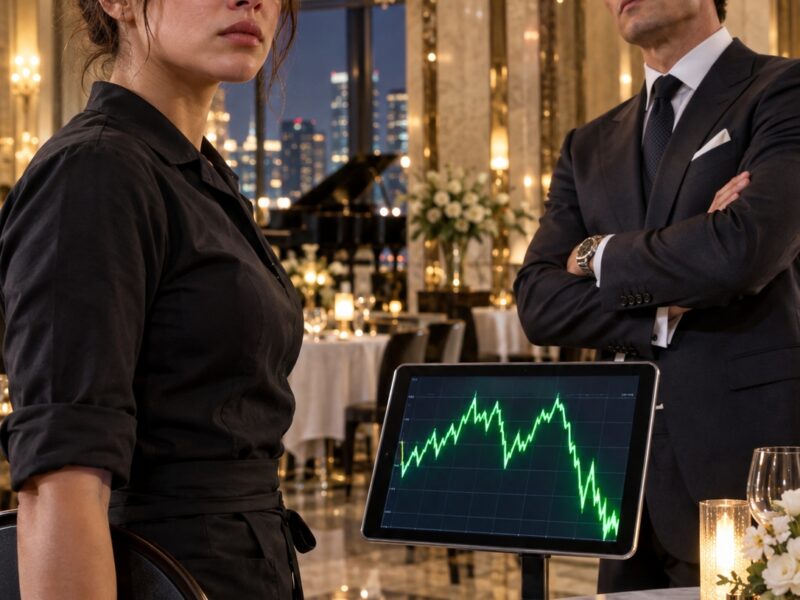
And in the middle of all that polished wealth stood Maya Carter, twenty-six years old, wearing a black waitress uniform with a faint coffee stain near one cuff and shoes she had repaired twice because replacing them would cost more than she could justify.
She was still holding a silver tray.
Daniel stood ten feet away from her, furious, humiliated, and reckless enough to mistake cruelty for confidence.
Twenty minutes earlier, the most important demonstration of his career had failed upstairs.
For six months, engineers from Sterling Advanced Systems had worked almost around the clock trying to stabilize the company’s new industrial energy-control platform. Consultants had flown in from Munich, Seoul, and Toronto. An outside engineering firm had billed nearly four million dollars. Daniel’s own research division had burned through weekends, vacations, and patience.
Tonight was supposed to end all of that.
Tonight, in a private conference suite overlooking downtown Chicago, Daniel was supposed to prove that Sterling Advanced Systems had built something nobody else could: an intelligent control network capable of reducing energy waste across massive commercial properties without sacrificing performance.
If the live demonstration succeeded, a consortium of international investors would sign an agreement worth hundreds of millions.
Instead, forty-three seconds after the prototype came online, the temperature-control loops began oscillating.
Then came the warnings.
Then the alarms.
Then the emergency shutdown.
Daniel could still hear the sound in his head.
Beep.
Beep.
Beep.
A sound more humiliating than an explosion because explosions could be blamed on catastrophe.
A warning tone suggested incompetence.
Now, downstairs at the dinner that had been intended as a celebration, Daniel’s investors were whispering among themselves while his chief engineer pretended not to notice.
And a waitress had just told him his team might be looking in the wrong place.
Maya’s fingers tightened around the edge of the tray.
She had not meant to embarrass him.
She had not meant to speak at all.
She had been walking past his table when she noticed the technical graph on the tablet beside his untouched steak. One green line rose and fell in a pattern that made something in her memory stir.
She slowed.
Then she stopped.
That had been her mistake.
Daniel noticed.
“Something wrong with my screen?” he asked.
Maya should have said no.
Instead, after three seconds of hesitation, she said, “Maybe.”
The chief engineer, Victor Hale, looked up sharply.
Daniel frowned.
“Maybe what?”
Maya shifted the tray to her other hand. “I’m sorry. I shouldn’t have interrupted.”
“But you did.”
His tone had drawn attention from the nearest tables.
Maya looked at the graph once more.
“It doesn’t look like processor failure.”
Victor actually laughed.
Not loudly.
That made it worse.
Daniel leaned back in his chair. “And what does it look like?”
Maya could feel heat rising into her face.
She had spent years learning when to make herself smaller.
Customers liked efficient waitresses, not curious ones. Managers liked employees who solved problems they were assigned, not people who stepped into rooms where they did not belong. Life had taught Maya that being right could still be expensive if the wrong person felt challenged by it.
She looked at Daniel’s tablet.
“The peaks are too regular,” she said quietly. “If the processor were failing randomly, I don’t think the correction pattern would repeat like that.”
Victor’s expression changed from amusement to annoyance.
“What exactly do you do here?” he asked.
Maya looked at him.
“I work evenings in the restaurant.”
“That wasn’t my question.”
Daniel raised one hand, though he looked more entertained than protective.
Victor continued. “Do you have a degree in systems engineering?”
“No.”
“Controls?”
“No.”
“Computer science?”
“No.”
Maya felt the eyes around her.
She could have stopped.
She almost did.
Then she remembered her mother, sitting at their tiny kitchen table twelve years earlier, helping Maya build a circuit from scavenged parts and telling her that intelligence was useless if fear decided when she was allowed to use it.
Maya looked back at the graph.
“I think one subsystem is correcting faster than another one can respond,” she said. “So each correction becomes the next error.”
Silence.
Daniel’s smile disappeared.
Because that was close.
Too close.
For the first time all evening, someone had described the one thing he himself had noticed but had been unable to explain—the strange rhythm buried in the failed data.
Victor folded his arms.
“That’s a very broad observation.”
“It probably is.”
“And you reached it by looking at a graph for what, ten seconds?”
“Maybe fifteen.”
Several investors exchanged glances.
Daniel should have asked her another question.
Years later, he would remember that moment more clearly than almost anything else that happened that night.
He would remember how close he came to choosing curiosity.
Instead, humiliation chose for him.
Daniel laughed.
The sound was sharp.
“Victor,” he said, looking around the dining room, “apparently we’ve wasted six months and several million dollars.”
A few nervous chuckles followed.
Maya’s face hardened.
Daniel turned toward her.
“Maybe we should’ve hired from the restaurant.”
She lowered her eyes.
“I was only trying to help.”
“And maybe you can.”
That was when he stood.
That was when his anger turned theatrical.
That was when he pointed toward the elevators and said the words he would spend years wishing he could take back.
“Fix it. And I’ll give you one hundred million dollars the moment that machine starts.”
The restaurant went silent.
Victor stared at him.
One investor raised his eyebrows.
Maya did not move.
Daniel expected embarrassment.
An apology.
Maybe tears.
Instead, she set the tray down carefully on an empty service table.
Then she looked directly at him.
“Can I see the prototype?”
Daniel’s expression changed.
Only slightly.
But Maya saw it.
So did everyone else.
The laughter was gone now.
“You’re serious?” he asked.
“You made the offer.”
“It wasn’t an offer.”
“Then what was it?”
Daniel opened his mouth.
Nothing came out.
Maya glanced toward the elevators.
“If you’re sure I can’t fix it, Mr. Sterling, there’s no risk in letting me look.”
Victor stepped forward.
“This is absurd.”
Maya turned to him.
“I agree.”
That answer caught him off guard.
She looked at Daniel again.
“But the machine is still broken.”
And suddenly, in a room filled with people who had spent their lives measuring status, everyone understood who had the most to lose.
Daniel stared at her for several seconds.
Then he reached for his jacket.
“Fine,” he said.
Victor’s jaw tightened.
“Daniel—”
“Let her look.”
The elevator ride upstairs lasted less than thirty seconds.
Nobody spoke.
Maya stood beside the mirrored wall with her hands clasped in front of her, painfully aware that she smelled faintly of espresso and lemon sanitizer.
Daniel watched her reflection.
She did not look like someone about to perform a miracle.
She looked tired.
There were shadows under her eyes. A tiny burn mark crossed the side of her right thumb. Her dark hair had been pinned into a simple knot for work, but several strands had come loose near her temple.
She looked, Daniel thought, like someone who needed sleep more than opportunity.
Victor stood near the doors with the expression of a man being forced to participate in his own insult.
When the elevator opened, Maya followed them into the conference suite.
The room looked like the aftermath of a failed surgery.
Cables ran across the carpet.
Two laptops sat open beside the main control cabinet. Empty coffee cups crowded one corner of the table. On the far wall, a seventy-inch display still showed the frozen diagnostic data from the aborted demonstration.
Five engineers remained inside.
Every one of them looked up when Maya entered.
Victor did not bother hiding his irritation.
“She wants to inspect the system.”
A younger engineer named Lucas Grant blinked.
“She?”
Daniel removed his jacket and threw it over a chair.
“Just let her see it.”
Lucas looked from Maya to Daniel.
Then to Victor.
Nobody laughed.
That made the room more uncomfortable.
Maya approached the prototype slowly.
It occupied nearly half the temporary test platform—a control server, sensor emulators, network modules, thermal-load simulation hardware, power-distribution interfaces, and monitoring equipment arranged with the obsessive neatness of people who had spent months believing order could prevent failure.
Maya did not touch anything.
She listened.
Daniel noticed that first.
Everyone else stared at screens.
Maya leaned slightly toward the cabinet.
A cooling fan spun down.
A relay clicked.
She crouched beside one of the sensor modules and studied the status lights.
Victor sighed.
“Are we seriously doing this?”
Maya stood.
“Can I see the diagnostic history from the last three runs?”
Lucas looked at Victor.
Victor did not move.
Daniel said, “Give it to her.”
Lucas rotated one laptop.
Maya stepped closer.
The first page showed thousands of timestamps.
She scanned them.
Scrolled.
Stopped.
Scrolled back.
“How often does the adaptive controller poll the temperature sensor group?”
Lucas answered automatically.
“Twenty milliseconds under nominal load.”
“And when thermal variance exceeds the threshold?”
Victor cut in.
“It switches to high-response mode.”
“How fast?”
“Five milliseconds.”
Maya looked at the screen.
“What about the downstream load balancer?”
Victor stared at her.
“What about it?”
“What’s its correction interval?”
“Ten.”
Maya looked up.
“Ten milliseconds?”
“Yes.”
She frowned.
Daniel stepped closer.
“What?”
Maya shook her head.
“Maybe nothing.”
Victor exhaled loudly.
“Wonderful.”
She ignored him.
“Can you show me when the oscillation begins?”
Lucas opened another file.
Maya leaned closer.
At first, Daniel saw nothing unusual.
Then she pointed.
“There.”
Victor shook his head.
“That’s the warning event.”
“No. Before it.”
She moved one finger six rows higher.
“This timestamp.”
Lucas enlarged the data.
Maya read aloud.
“Sensor group four moves into high-response mode at 21:14:32.118.”
She pointed to the next line.
“The controller corrects at 32.123.”
Another line.
“The load balancer responds at 32.128.”
Then another.
“Sensor group four corrects again at 32.128.”
Lucas stopped breathing for a second.
Victor leaned closer.
Maya continued.
“They’re landing on the same window.”
“That shouldn’t matter,” Victor said.
“Maybe.”
“Not maybe. The scheduler was tested.”
Maya looked at him.
“Under this exact thermal profile?”
Victor’s face changed.
Only for an instant.
But Daniel saw it.
Maya did too.
Lucas began typing.
“We simulated it.”
“That wasn’t what I asked.”
Victor turned toward Daniel.
“This has gone far enough.”
Daniel did not answer.
His eyes were fixed on the timestamps.
Maya pointed again.
“Every time the sensor controller reacts, the load balancer is still completing the previous correction. Then the sensor reads the temporary response as a new error.”
Lucas whispered, almost to himself, “Positive feedback.”
Maya nodded.
“Not exactly electrical feedback. More like control interaction. Each loop thinks it’s fixing the other one’s mistake.”
Daniel looked at Victor.
“Is that possible?”
Victor’s jaw tightened.
“Theoretically, many things are possible.”
“Is that one of them?”
“We’d need to model it.”
Maya looked at the prototype.
“Or slow one loop down.”
Victor turned on her immediately.
“No.”
She met his eyes.
“I didn’t say permanently.”
“You don’t touch production parameters without simulation.”
“It’s not in production.”
“That’s irrelevant.”
Daniel spoke quietly.
“Victor.”
“No, Daniel. This is our intellectual property. This platform has years of work behind it.”
“And right now it doesn’t work.”
The sentence landed hard.
Nobody moved.
Daniel looked at Maya.
“What would you change?”
She hesitated.
“Temporarily increase the high-response interval from five milliseconds to eight.”
Victor laughed once in disbelief.
“And that number came from where?”
Maya grabbed a notepad from the table.
She began writing.
Her handwriting was small and fast.
“If the downstream loop responds every ten milliseconds, and this correction cycle lands inside the same scheduling window, five can phase-lock with ten under the wrong conditions. Eight makes the interaction less likely to keep repeating at the same point.”
Victor shook his head.
“That’s not how synchronization analysis works.”
“I know.”
“Do you?”
Maya put down the pen.
“It’s a test.”
Victor stared at her.
Maya looked toward Daniel.
“You asked me to see if I could fix it.”
Daniel thought about the investors downstairs.
He thought about the contract.
He thought about the headline that could appear in every financial publication by morning.
STERLING’S FLAGSHIP SYSTEM FAILS DURING LIVE DEMONSTRATION.
Then he looked at the woman he had publicly mocked.
“Do it.”
Victor stepped forward.
“I strongly advise against this.”
Daniel’s voice hardened.
“Noted.”
Lucas entered the temporary parameter.
Maya watched the screen.
“Reset the thermal simulation to the same load profile.”
Lucas complied.
The system restarted.
Fans spun up.
Monitoring panels brightened.
The first numbers appeared.
Stable.
Twenty seconds.
Thirty.
Then the temperature load increased.
Maya folded her arms tightly across her stomach.
Forty seconds.
Daniel stared at the graph.
Fifty.
Victor leaned forward.
At fifty-eight seconds, a warning symbol flickered.
Victor almost smiled.
Then disappeared.
Sixty-five seconds.
Seventy.
Ninety.
The graph remained stable.
Nobody spoke.
At two minutes, Lucas whispered, “That’s past the failure point.”
Daniel looked at Maya.
She did not smile.
At three minutes, the load increased again.
The prototype hummed steadily.
No alarms.
No shutdown.
Nothing.
Daniel walked toward the main display as if approaching an animal he expected to wake and bite him.
“Run it harder.”
Victor turned.
“Daniel—”
“Run it.”
Lucas raised the simulated demand.
Seventy percent.
Eighty.
Ninety.
The readings shifted but did not oscillate.
The system compensated smoothly.
For the first time in months, under the exact thermal configuration that had repeatedly destroyed the test, the prototype remained stable.
Lucas pushed back from the keyboard.
“Oh my God.”
One of the senior engineers, Priya Desai, stepped closer to the screen.
“That can’t be it.”
Victor’s face had gone pale.
Daniel said nothing.
He simply stared.
Downstairs, he had promised a waitress one hundred million dollars because he wanted to humiliate her.
Upstairs, she had just stabilized the machine in less than fifteen minutes.
Then Maya said, “Turn it off.”
Every head turned.
Daniel blinked.
“What?”
“Shut it down.”
Lucas hesitated.
“Why?”
Maya was no longer looking at the oscillation graph.
She was staring at the thermal response from sensor group seven.
“There’s another problem.”
Victor closed his eyes.
“You cannot be serious.”
Maya pointed.
“This sensor is drifting.”
Priya came closer.
“It’s within tolerance.”
“Now.”
“What do you mean, now?”
Maya looked at Daniel.
“If this runs for hours instead of minutes, I think the original instability comes back.”
Daniel felt something cold move through his stomach.
“How sure are you?”
“I’m not.”
Victor spread his hands.
“Then there is no problem.”
Maya turned toward him.
“That’s exactly how people end up deploying problems.”
The room went quiet again.
Victor’s expression changed.
For the first time, the contempt was gone.
Something more defensive had replaced it.
Daniel noticed.
“So what do you need?” he asked.
Maya looked at the clock.
10:47 p.m.
“My shift ends at eleven.”
Daniel stared.
Lucas made a sound that might have been a laugh before swallowing it.
Maya continued, “I need to clock out.”
Victor looked offended by the normality of the sentence.
Daniel almost smiled.
“Clock out.”
“And I need someone to tell my manager I’m not stealing company time by being up here.”
“I’ll handle it.”
Maya nodded.
“Then I need the full sensor calibration history, hardware batch records for the thermal modules, and every failure log from the last six months.”
Victor stepped forward.
“No.”
Daniel turned toward him.
“Why not?”
“Because she is not an employee of Sterling Advanced Systems.”
“Neither were half the consultants we brought in.”
“They signed nondisclosure agreements.”
Maya looked between them.
“I’ll sign one.”
Victor’s jaw tightened.
Daniel pointed toward the legal folder near the conference table.
“Get her one.”
Nobody argued after that.
At 11:06 p.m., Maya Carter stopped being the Grand Meridian waitress who had interrupted a billionaire’s dinner.
She sat down at a conference table surrounded by engineers who did not want her there, signed her name at the bottom of a six-page confidentiality agreement she barely had time to read, and opened the records of a machine worth more money than she expected to earn in several lifetimes.
Daniel watched her.
For the first time that evening, embarrassment was no longer the strongest emotion inside him.
Curiosity was.
And beneath it, something more uncomfortable.
Shame.
Maya worked differently from his engineers.
She did not begin by trying to prove a theory.
She began by asking questions.
When had the failure first appeared?
What component had changed around that time?
Which environmental conditions made it worse?
Which team had signed off on the calibration?
Why had three separate fixes improved the problem temporarily but never eliminated it?
The answers came slowly.
Sometimes reluctantly.
Around midnight, hotel staff brought coffee and sandwiches.
Maya accepted black coffee.
Nothing else.
“You should eat,” Daniel said.
“I’m not hungry.”
“That’s usually when people need to eat.”
She looked at him.
“You sound like my brother.”
“How old is he?”
“Seventeen.”
Daniel glanced at her uniform.
“You support him?”
Maya turned back to the logs.
“That relevant to the sensor drift?”
“No.”
“Then later.”
Lucas hid a smile behind his coffee cup.
Daniel sat back.
Nobody spoke to him that way.
At least, almost nobody.
By 12:40 a.m., Maya had divided six months of failure logs into environmental categories.
By 1:15, Priya had stopped watching Maya skeptically and started helping her without being asked.
By 1:50, Lucas was rebuilding simulation tables based on Maya’s questions.
Victor remained near the windows.
Mostly silent.
Mostly irritated.
Daniel noticed something else.
Whenever Maya asked about manufacturing variations in the sensor modules, Victor answered too quickly.
At 2:07 a.m., Maya found the first anomaly.
“Who changed suppliers in March?”
Victor looked up.
“Nobody changed suppliers.”
Maya turned the laptop.
“These batch codes change after March eighteenth.”
Priya leaned over.
“She’s right.”
Victor walked closer.
“That was a secondary component supplier. Same specification.”
“What component?” Maya asked.
“The ceramic substrate in the thermal sensing assembly.”
“Different manufacturer?”
“Yes.”
“Different material composition?”
“Same specification.”
Maya shook her head.
“That’s not what I asked.”
Victor’s eyes hardened.
Daniel intervened.
“Was it chemically identical?”
“No manufactured material is chemically identical.”
“How different?”
Victor stared at him.
“Negligibly.”
Maya looked at the data.
“Maybe not under heat.”
Victor exhaled.
“We tested thermal drift.”
“At what duration?”
“Standard certification cycle.”
“How long?”
“Forty-five minutes.”
Maya looked at Daniel.
“How long is this system expected to run?”
“Continuously.”
“Years?”
“Yes.”
She looked at Victor again.
“And the qualification test was forty-five minutes?”
Victor’s voice sharpened.
“Under accelerated thermal load.”
Maya nodded slowly.
“But this drift doesn’t show up immediately.”
Priya began scrolling through records.
“What are you looking for?” Daniel asked.
“Long-duration bench tests.”
Victor said, “Those aren’t relevant.”
Priya froze.
Daniel turned.
“Why wouldn’t they be relevant?”
Victor’s eyes flickered.
“They were superseded by later validation.”
Maya said nothing.
She just watched him.
Daniel had negotiated against heads of state, venture funds, industrial families, regulators, and competitors.
He knew what people looked like when they were withholding something.
“Show us the long-duration tests.”
Victor did not move.
“Daniel—”
“Now.”
Priya searched the server.
One folder appeared.
Then another.
Most were empty.
Lucas frowned.
“Where are the raw files?”
Victor crossed his arms.
“Archived.”
“Where?”
“External storage.”
Daniel stared at him.
“At three in the morning?”
Victor’s face hardened.
“I don’t personally manage file retention.”
Maya leaned toward Lucas.
“Search by test ID, not folder name.”
Lucas did.
Seven files appeared.
Priya opened the first.
Forty minutes.
Normal.
Second.
Ninety minutes.
Normal.
Third.
Two hours.
A slight thermal drift.
Fourth.
Three hours.
Larger drift.
Fifth.
Three hours, twelve minutes.
Test aborted.
The room changed.
Daniel stepped closer.
“Why was it aborted?”
Lucas scrolled.
No reason listed.
Priya opened the sixth.
Another three-hour test.
The drift increased dramatically after two hours and forty minutes.
Then the file ended.
The seventh test showed the same thing.
Daniel looked slowly toward Victor.
“You knew.”
Victor’s face tightened.
“No.”
“You had data.”
“We had preliminary results.”
“Showing the same sensor behavior that nearly destroyed tonight’s demonstration.”
“That is not a fair characterization.”
Daniel’s voice dropped.
“Did you know?”
Victor’s silence answered before he did.
“We knew there was a potential long-duration calibration concern.”
Maya sat very still.
Daniel walked toward Victor.
“How long?”
“Daniel.”
“How long?”
Victor looked around the room.
“Four months.”
Lucas swore under his breath.
Priya stepped back as though she had been physically hit.
Daniel stared at his chief engineer.
Four months.
For four months, Sterling Advanced Systems had been paying consultants to investigate software architecture, processor load, network latency, and control algorithms.
For four months, Daniel had been told the failures were unpredictable.
For four months, his company had nearly redesigned an entire subsystem around bad assumptions.
And Victor had known there was a hardware drift concern.
“Why?” Daniel asked.
Victor lifted his chin.
“Because we had already committed to the architecture.”
“That isn’t an answer.”
“We were weeks away from investor validation when the drift surfaced. Changing the sensing assembly would have delayed the program at least six months.”
“So you buried it.”
“I evaluated it.”
“You buried it.”
Victor’s restraint cracked.
“I kept this company from panicking over a problem that could be corrected in software!”
Maya looked at him.
“Except it wasn’t.”
He turned on her.
“You have been here four hours.”
“And the problem has been here four months.”
Daniel stepped between them.
“Enough.”
Victor looked at him.
“You think she understands what’s at stake?”
Daniel’s face went cold.
“She understood enough to find what you didn’t tell me.”
Victor laughed bitterly.
“You want honesty? Fine. Investors were already nervous. The board was pressuring us. Your launch date was impossible. Procurement had signed volume commitments. Every department had tied next year’s revenue projections to this platform.”
“That still doesn’t explain hiding test results.”
“It explains everything.”
Victor stepped closer.
“You built a company where failure is treated like treason, Daniel.”
The words stopped him.
Victor continued.
“You say you want bad news early. What you actually want is bad news with a solution attached. Anyone who brings you a problem without fixing it first gets destroyed in the meeting.”
Daniel’s jaw tightened.
“That’s convenient.”
“It’s true.”
Priya looked down.
Lucas said nothing.
And that silence hurt more than Victor’s accusation.
Daniel looked around the room.
Nobody defended him.
For the first time that night, he saw himself not as the founder who demanded excellence, but as the man others had learned to fear.
Maya broke the silence.
“We can decide whose fault it is later.”
Victor stared at her.
She pointed toward the screen.
“Right now you have a sensor whose output changes with sustained heat, and software that believes every measurement is perfect.”
Daniel turned back.
“What do we do?”
Maya thought for several seconds.
“First, prove the material drift is real.”
Priya nodded.
“We have spare units from both suppliers downstairs.”
“Then heat both batches under identical load and compare them.”
Lucas stood.
“I’ll get the test rig.”
Maya looked at Daniel.
“And if I’m right, your software needs to account for actual sensor behavior, not ideal behavior.”
Victor gave a humorless laugh.
“You’re proposing compensation for manufacturing variance.”
“I’m proposing reality.”
The test began at 3:11 a.m.
At 3:52, nothing.
At 4:18, almost nothing.
By 4:47, one sensor from the newer supplier began to drift.
A fraction of a degree.
Then more.
At 5:03, the difference was undeniable.
Priya stared at the graph.
“There it is.”
Maya leaned back in her chair.
Her eyes burned.
Her shoulders ached.
But she smiled for the first time all night.
Not because she had been right.
Because now they could stop guessing.
Daniel stood behind her.
“How do we correct it?”
“Short term?”
“Yes.”
“Add dynamic calibration based on internal thermal history. If the sensor behaves differently after sustained heat, the controller has to know how long the component has been hot.”
“And long term?”
“Fix the hardware.”
Victor did not argue this time.
The next two hours passed in a blur of code changes, simulation runs, calculations, coffee, and increasingly quiet conversations.
Maya forgot that she was wearing a waitress uniform.
The engineers seemed to forget too.
At 6:14 a.m., they loaded the modified compensation model.
At 6:21, the first test began.
One hour.
Stable.
Two hours.
Stable.
The newer sensor drifted.
The software recognized it.
Corrected.
The feedback loop never formed.
At 8:37 a.m., Priya ran the full thermal stress profile again.
No instability.
At 8:44, Lucas looked at Maya.
“That’s twelve consecutive test cycles.”
Maya rubbed both hands over her face.
“Run thirteen.”
He smiled.
“Superstitious?”
“Poor.”
He laughed.
“What does that have to do with anything?”
“When you can’t afford to replace things, you learn not to trust them because they work twelve times.”
Daniel heard that from across the table.
Something about the sentence stayed with him.
They ran thirteen.
Then fourteen.
The system held.
At 9:18 a.m., Daniel called the investors.
He did not pretend the previous night had not happened.
He told them the demonstration had exposed a design weakness.
He told them the issue had been identified.
He told them they would receive complete engineering documentation before any agreement was signed.
Then he asked them to return at noon.
When he ended the call, Maya was standing near the window, looking down at Chicago traffic.
Her shift had technically ended more than ten hours earlier.
“You should go home,” Daniel said.
She looked over.
“You’re doing another demonstration.”
“You’ve been awake all night.”
“So have you.”
“I’m the CEO.”
“That doesn’t make sleep optional.”
He almost laughed.
Then he looked at her.
Really looked.
“You saved the company last night.”
Maya shook her head.
“No.”
“You did.”
“I found a timing problem and asked some questions.”
“That’s called engineering.”
Something passed through her expression.
Pain, maybe.
Or memory.
Daniel noticed.
“How did you know what to look for?”
She turned back toward the window.
For a moment, he thought she would dismiss him again.
Instead, she said, “I used to study electrical engineering.”
Victor, across the room, looked up.
Daniel said, “Where?”
“Northwestern.”
He stared.
“You went to Northwestern?”
“For three semesters.”
“What happened?”
Maya was quiet.
The city moved below them.
Buses.
Taxis.
People crossing intersections with coffee cups and umbrellas.
Ordinary lives beginning another day.
“My mother got sick.”
Daniel said nothing.
Maya continued.
“Ovarian cancer. Aggressive. My scholarship covered tuition, but it didn’t cover rent, groceries, hospital parking, the electricity bill, or taking care of Ethan.”
“How old was he?”
“Eleven.”
“And your father?”
“Gone before that.”
“I’m sorry.”
Maya shrugged, but the movement was too controlled to be casual.
“I told myself I was taking one semester off.”
She smiled faintly.
“Then one semester became a year. My mother got worse. I took a job at an electronics repair shop because I could work mornings and hospital nights.”
Daniel glanced at the tiny marks on her fingers.
Maya noticed.
“I still work there.”
“And the hotel?”
“Four nights a week.”
“You work two jobs?”
“Usually.”
“Why?”
She looked at him as if the question itself revealed how different their worlds were.
“Because rent is due every month.”
Daniel looked down.
Maya softened slightly.
“Ethan graduates high school this year. He’s good at math. Better than I was.”
“Do you plan to go back to school?”
She smiled.
Not happily.
“Plans are expensive.”
“What does that mean?”
“It means people with money call things plans. People without money call them hopes.”
The words hit him harder than Victor’s accusation had.
Daniel pulled out a chair.
“Sit.”
Maya raised an eyebrow.
“Is that an order?”
“No.”
“Good.”
She sat anyway.
Daniel took the chair across from her.
“When do you sleep?”
“Sometimes on the bus.”
“That wasn’t a joke?”
“No.”
“What do you study?”
“Control systems. Embedded systems. Signal processing. Whatever textbooks I can find cheap.”
“You taught yourself?”
“I had professors once.”
“For three semesters.”
“That was enough to learn what I didn’t know.”
Daniel leaned back.
He had interviewed candidates from MIT, Stanford, Carnegie Mellon, Georgia Tech, Caltech, Cambridge.
Some arrived with doctorates and five-page résumés.
Maya had arrived carrying coffee.
And she had seen something his organization had missed.
“What do you want?” he asked.
She looked confused.
“You said one hundred million dollars.”
Maya’s expression closed immediately.
“I don’t want your money.”
“You earned it.”
“No.”
“I made the promise publicly.”
“You made a joke publicly.”
Daniel’s face tightened.
“I shouldn’t have.”
“No.”
“I apologize.”
Maya studied him.
It was not the response he expected.
Most people rushed to rescue powerful men from uncomfortable apologies.
Maya did not.
Daniel continued.
“What I said downstairs was disrespectful.”
“Yes.”
“I judged you by your uniform.”
“Yes.”
“I tried to embarrass you because I was angry about something that had nothing to do with you.”
“Yes.”
He almost smiled.
“You could make this easier.”
“Why?”
That answer ended the smile.
Maya leaned forward.
“You don’t become a different person because you had one bad night, Mr. Sterling.”
His eyes narrowed slightly.
“And you don’t become a good person because you apologize the next morning.”
The room around them seemed quieter.
Maya’s voice softened.
“You want to know whether your apology means something? Ask me again in a year.”
Daniel stared at her.
No consultant had ever spoken to him like this.
No board member would.
No employee dared.
And strangely, he trusted her more for it.
“At least let me pay you for the work you did tonight.”
“That’s different.”
“How much?”
Maya thought.
“My repair-shop rate is thirty dollars an hour.”
Daniel blinked.
“You just saved a project worth hundreds of millions.”
“And you asked what I charge.”
He stared at her for several seconds.
Then he laughed.
A real laugh this time.
Maya smiled despite herself.
“Fine,” Daniel said. “We’re not paying you thirty dollars an hour.”
“I figured.”
He became serious again.
“There’s something else.”
Maya waited.
“I meant what I said.”
“About the hundred million?”
“Not anymore.”
“Good.”
“I mean about compensation.”
She shook her head.
“I told you what I want.”
“No, you told me what you don’t want.”
She looked toward the prototype.
Daniel followed her gaze.
Then Maya said quietly, “I want to finish school.”
He did not interrupt.
“I want Ethan to choose a college based on where he wants to go, not which one lets him keep a night job.”
Daniel listened.
“And if you’re asking what I really want…”
She stopped.
“What?”
Maya looked around the conference room.
At the expensive hardware.
At the exhausted engineers.
At a whiteboard covered in equations.
For the first time, longing broke through the careful composure she had worn all night.
“I want to work in rooms like this again.”
Daniel felt the answer before she finished saying it.
Not the money.
Not revenge.
Not recognition.
Belonging.
Maya had once believed she belonged in rooms where difficult things were built.
Then life had shown her the cost of believing that.
Daniel nodded slowly.
“What if I can give you that?”
Maya looked at him.
“You can’t give someone four lost years back.”
“No.”
“You can’t make my mother see me graduate.”
“No.”
“You can’t make those things disappear.”
“No.”
Daniel paused.
“But I can open a door.”
Maya’s face became guarded.
“For me?”
“For you first.”
She heard the second meaning.
“And after me?”
Daniel looked at the prototype.
“Maybe we build more doors.”
At noon, the investors returned.
This time, Daniel did not begin the presentation.
Maya expected him to hide the events of the night.
Instead, he stood at the front of the conference room and told the truth.
“We found two problems,” he said. “One in our control timing. One in long-duration sensor behavior.”
Several investors frowned.
Daniel continued.
“We also discovered that internal testing data regarding the second issue was not escalated appropriately.”
Victor stood near the back wall.
His face was unreadable.
Daniel did not humiliate him.
He did not protect him either.
“There will be an independent engineering review before deployment.”
Then he looked toward Maya.
“And the person who identified the control interaction was not one of our engineers.”
Everyone followed his gaze.
Maya wanted to disappear.
Daniel continued.
“Her name is Maya Carter.”
An investor from Singapore looked confused.
“The restaurant employee?”
“Yes.”
Maya felt every eye in the room.
Daniel said, “Last night I dismissed her because of the job she happened to be doing when she noticed our mistake.”
He paused.
“That was my failure.”
Victor looked away.
Maya looked at Daniel.
This was not the apology from earlier.
This one cost him something.
Reputation.
Authority.
Pride.
Maybe that was the difference.
Daniel gestured toward the prototype.
“We’ll demonstrate the revised control system now.”
The machine started.
Forty-three seconds passed.
Then one minute.
Five.
Ten.
The system remained stable.
At twenty minutes, Daniel increased the thermal load.
Still stable.
At forty-five minutes, the sensor drift appeared.
The adaptive calibration compensated exactly as designed.
One of the investors leaned forward.
“Was that the original failure condition?”
Priya answered.
“Yes.”
“And it’s corrected?”
“For this prototype configuration, yes. We still recommend hardware revision before commercial deployment.”
Daniel nodded.
“We will delay deployment if necessary.”
The room changed again.
The previous night, Daniel would have considered those words weakness.
Now they felt like oxygen.
The consortium did not sign the full agreement that afternoon.
But they did not walk away.
They approved a revised validation schedule contingent on the independent review.
It was not victory.
But it was survival.
And sometimes survival was more honest.
Maya left the Grand Meridian at 3:17 p.m.
She had been awake for thirty-two hours.
Outside, Chicago was bright and cold.
She took the bus home.
Not Daniel’s car.
Not a company vehicle.
The bus.
She sat beside the window in her black hotel uniform while downtown buildings passed behind streaked glass.
Her phone showed seventeen missed messages from Ethan.
The last one read:
ARE YOU ALIVE???
Maya smiled.
She called him.
He answered on the first ring.
“Where are you?”
“On the bus.”
“You disappeared.”
“I was working.”
“Your shift ended fourteen hours ago.”
“I got distracted.”
“With what?”
Maya leaned her head against the glass.
“How was your chemistry test?”
“Maya.”
“I’m tired.”
“What happened?”
She closed her eyes.
“A billionaire owes me money.”
Silence.
Then Ethan said, “What?”
She laughed for the first time in hours.
“I’ll tell you when I get home.”
But by the time she reached their apartment, she was too tired.
Ethan opened the door.
Tall, skinny, seventeen, wearing one of Maya’s old university sweatshirts even though it hung awkwardly on him.
He took one look at her.
“You look terrible.”
“Love you too.”
He grabbed her bag.
“What happened?”
“Later.”
“Maya—”
She kissed his forehead.
“Later.”
Then she walked into her bedroom, collapsed fully dressed across the blanket, and slept for eleven hours.
When she woke, there was a business card on the kitchen table.
Sterling Advanced Systems.
Daniel Sterling.
Chief Executive Officer.
On the back, written by hand:
Call me before you say no.
Maya stared at it.
“Some guy dropped that off,” Ethan said from the stove.
Maya looked up.
“What guy?”
“Tall. Suit. Serious. Made our hallway look underfunded.”
“That was Daniel?”
“No. Assistant.”
She exhaled.
Ethan turned.
“So.”
“No.”
“You haven’t heard my question.”
“No.”
He grinned.
“Did you really fix a billionaire’s machine?”
Maya looked at the card again.
“I helped.”
“And he offered you money?”
“Yes.”
“How much?”
She opened the refrigerator.
“Don’t worry about it.”
Ethan’s eyes narrowed.
“How much?”
Maya removed a carton of milk.
“Maya.”
She sighed.
“One hundred million dollars.”
The spatula fell from Ethan’s hand.
It hit the floor.
Neither of them moved.
Then he whispered, “We have three hundred and twelve dollars in checking.”
“I know.”
“Our car has tape holding the rear bumper.”
“I know.”
“You told me yesterday we had to wait until Friday to buy laundry detergent.”
“I know.”
“And someone offered you one hundred million dollars?”
“He was being sarcastic.”
“Did you fix it?”
“Yes.”
“Then take the money.”
“It doesn’t work like that.”
“It works exactly like that.”
Maya closed the refrigerator.
“Ethan.”
“I’m serious.”
“So am I.”
“Why would you say no?”
Because she knew what it meant to accept money from powerful people who wanted a story more than a person.
Because one hundred million dollars sounded less like compensation and more like ownership.
Because she wanted to know whether Daniel Sterling could respect her without turning her into a headline.
Because some part of her was afraid.
She did not say any of that.
Instead she said, “Because I don’t want my life to become a punchline he accidentally had to pay for.”
Ethan watched her.
Then he nodded slowly.
“So what do you want?”
Maya looked at the business card.
“A chance.”
Two days later, she walked into Sterling Advanced Systems headquarters.
This time, she was not wearing a waitress uniform.
She wore a navy blazer she had bought for a college scholarship interview seven years earlier.
The sleeves were slightly short now.
The receptionist stood when Maya gave her name.
“Oh.”
Maya noticed the reaction.
“Oh?”
“Mr. Sterling is expecting you.”
The executive floor looked exactly the way Maya imagined expensive confidence would look.
Glass walls.
Quiet carpets.
Artwork that probably cost more than her apartment building.
An assistant led her into Daniel’s office.
He was standing near the window.
No tie.
Sleeves rolled up.
For a moment, he looked less like the billionaire from magazine covers and more like the exhausted man from the conference room at four in the morning.
“Thank you for coming.”
“You wrote before you say no.”
“I did.”
“So I haven’t said it yet.”
Daniel smiled.
“Coffee?”
“Is that a joke?”
He laughed.
“Fair.”
They sat.
Daniel placed a folder on the table between them.
Maya did not touch it.
“What is that?”
“An offer.”
“For?”
“Three things.”
“That sounds dangerous.”
“First, tuition.”
Maya’s expression changed.
Daniel continued quickly.
“Full tuition, books, fees, living expenses through the Sterling Foundation. No employment requirement.”
She looked at him.
“You researched my academic record.”
“With your permission?”
“You didn’t have it.”
“No.”
“Then that’s a problem.”
Daniel nodded.
“You’re right.”
The answer disarmed her.
He continued.
“I had my office confirm whether reinstatement was possible. I should have asked first.”
Maya said nothing.
“Northwestern is willing to review a return application.”
Her eyes dropped to the folder.
She hated how badly she wanted to open it.
“Second?” she asked.
“A paid position in our research division.”
Maya looked up.
“Doing what?”
“Working under Priya on control-system validation.”
“I don’t have a degree.”
“You also found the defect.”
“That doesn’t make me qualified for everything.”
“No. Which is why you’d be a technical associate, not lead engineer.”
She considered that.
“And third?”
Daniel leaned back.
“This one isn’t finished yet.”
“Then why mention it?”
“Because it was your idea.”
“I gave you an idea?”
“You said you wanted other people who had to postpone their lives to have another chance.”
Maya remembered.
“I want the foundation to create a return-to-STEM scholarship.”
“For dropouts?”
“For people who left school because life interrupted them.”
Maya stared at him.
“Parents. Caregivers. People who got sick. People working full-time. Veterans. Anyone who can show ability and a path back.”
“Why?”
Daniel looked toward the window.
“Because my company spent years recruiting from places where talent had already been certified for us.”
Maya waited.
“And?”
“And I think we confused certification with potential.”
She looked at him carefully.
“Are you doing this because you feel guilty?”
“Partly.”
“That’s not a good reason.”
“No.”
“Are you doing it because it makes good publicity?”
“That’s what the communications team thinks.”
Maya almost smiled.
Daniel continued.
“I’m doing it because the next Maya Carter might not walk past my dinner table.”
The smile disappeared.
There was something painfully sincere in his face.
Maya opened the folder.
The first page showed tuition estimates.
The second showed a job description.
The third was a draft proposal for the scholarship program.
At the bottom of the last page was a blank line.
Program Advisor.
Maya looked up.
“What is this?”
“I want you to help design it.”
“I’m twenty-six.”
“So?”
“I serve coffee four nights a week.”
“Probably not for much longer.”
She closed the folder.
Daniel waited.
Maya asked, “What happened to Victor?”
Daniel’s expression changed.
“He’s on administrative leave pending the engineering review.”
“He told you the truth about something.”
“That I created a culture where people hid bad news?”
“Yes.”
Daniel nodded.
“I know.”
“You believe him?”
“I believe there was truth in it.”
Maya studied him.
“That doesn’t excuse what he did.”
“No.”
“But if you fire him and change nothing else…”
“I know.”
Daniel sounded tired.
Maya realized he had probably been thinking about that sentence since the night of the failure.
She looked at the folder again.
“What happens if I say no?”
“To all of this?”
“Yes.”
“I pay you for your consulting work. The scholarship program still happens. And I stop calling.”
Maya looked surprised.
“You’d really stop?”
“I’m trying something new called respecting boundaries.”
She laughed.
That was the moment the room changed.
Not dramatically.
Not magically.
But something softened.
Maya picked up the pen.
She did not sign.
Instead, she wrote three words on the margin.
No publicity clause.
Daniel read it.
“That’s your condition?”
“One.”
“What are the others?”
“I don’t become the face of your company’s inspirational redemption story.”
“Fair.”
“You don’t tell reporters I was a waitress who magically fixed something your engineers couldn’t.”
“That is technically what happened.”
“No.”
Maya leaned forward.
“I was a former engineering student who had relevant repair experience and recognized a control pattern. Your engineers had more knowledge of the overall system than I did. They were trapped by assumptions. I wasn’t.”
Daniel watched her.
“That distinction matters to you.”
“It should matter to you.”
“Why?”
“Because otherwise the lesson becomes ‘poor waitress turns out to be a secret genius.’”
She shook her head.
“That’s comforting. It means people only have to respect ordinary workers if they turn out to be extraordinary.”
Daniel said nothing.
Maya continued.
“Maybe the better lesson is that you shouldn’t humiliate people even if they never save your company.”
The silence that followed was long.
Then Daniel nodded.
“You’re right.”
Maya finally signed.
Three months later, she walked across Northwestern’s campus with a backpack on one shoulder and a Sterling Advanced Systems security badge clipped inside it.
The first week nearly broke her.
She had imagined returning to school would feel like recovering a piece of herself.
Instead, it felt like discovering how much she had forgotten.
Differential equations that once came easily now took hours.
Students younger than Ethan answered questions faster than she did.
Some professors remembered her.
Others did not.
One afternoon, she stood in a restroom stall and cried silently because she had received a sixty-eight on a quiz.
Then she washed her face, went to work at Sterling, and spent four hours helping Priya analyze actuator-response noise in a commercial test rig.
Life did not become easier because opportunity arrived.
It became fuller.
That was different.
Ethan noticed.
“You smile more,” he said one night.
“I’m failing signals.”
“You got a B-minus.”
“That is failing in emotional terms.”
“You used to come home smelling like fryer oil.”
“I worked in fine dining.”
“You came home smelling like expensive fryer oil.”
She threw a dish towel at him.
He laughed.
Maya kept two shifts a month at the Grand Meridian.
Daniel thought that was ridiculous.
She refused to quit.
“Why?” he asked one evening.
They were reviewing scholarship applications in a conference room.
“Because Maria has a baby and needs Sunday coverage sometimes.”
“You don’t need the money.”
“She needs the help.”
Daniel shook his head.
“You know you can say no.”
“So can you.”
“To what?”
“Eleven p.m. meetings.”
He looked at the clock.
10:58.
Then he closed his laptop.
“Meeting over.”
Maya smiled.
Daniel changed in other ways too.
At first, employees noticed small things.
He stopped asking who was responsible when a problem was first reported.
He started asking what they knew.
He changed engineering review meetings so junior employees spoke before senior managers.
He created anonymous escalation channels for safety concerns.
He stopped interrupting people halfway through bad news.
That last one was harder.
Once, Lucas actually stopped mid-sentence and said, “You’re doing the face.”
Daniel frowned.
“What face?”
“The one where we know we have twelve seconds before you interrupt.”
Daniel looked around.
Five engineers stared back at him.
He closed his mouth.
“Continue.”
They did.
Rumors about the failed hotel demonstration spread anyway.
Rumors always did.
But Maya’s name stayed out of the press.
Daniel kept his promise.
The independent engineering review eventually concluded that Victor Hale had intentionally withheld relevant test results but had not falsified them.
The report also concluded that Sterling Advanced Systems’ executive culture had created strong incentives to postpone escalation until teams had solutions.
Daniel did something his board hated.
He released the summary internally.
Not the flattering parts.
All of it.
Victor resigned.
Before leaving, he asked to speak with Maya.
They met in the company cafeteria.
He looked older than she remembered from that night.
Less dangerous too.
Maybe because he no longer had a title standing behind him.
“I owe you an apology,” he said.
Maya waited.
“I treated you badly.”
“Yes.”
Victor almost smiled.
“You still do that.”
“What?”
“Make people finish.”
“You started the sentence.”
He nodded.
“I was angry because you saw in minutes what I had spent months trying not to see.”
Maya looked at him.
“The sensor?”
“No.”
He shook his head.
“That I was protecting the deadline instead of the system.”
She was quiet.
Victor stared at his coffee.
“I told myself I was protecting the company.”
“Were you?”
“Partly.”
“And the other part?”
“My career.”
Maya appreciated the answer.
Victor looked at her.
“Daniel changing?”
“Trying.”
“He’ll relapse.”
“Probably.”
“You trust him?”
Maya thought.
“More than I did.”
“That wasn’t my question.”
“No.”
Victor waited.
Maya looked toward the windows.
“I trust what people repeatedly do.”
Victor nodded.
“Fair.”
He stood.
Then he paused.
“For what it’s worth, you belonged in that room before Daniel told you that.”
Maya looked at him.
Victor walked away before she could answer.
She remembered those words for years.
Not because she needed his permission.
Because for a long time, she had secretly believed the opposite.
A year after the Grand Meridian failure, Sterling Advanced Systems launched the revised energy platform.
Not on the original schedule.
Six months late.
The board complained.
Investors complained.
Daniel lost two major clients to a competitor.
Then the system entered commercial operation.
It worked.
Not perfectly.
Nothing did.
But reliably.
Buildings using the platform cut energy consumption significantly without sacrificing environmental control.
Orders followed.
Then contracts.
Then growth.
Business magazines called it a turnaround.
Daniel hated that phrase.
It made the success sound like one dramatic moment.
It had actually been thousands of less glamorous decisions made after the dramatic moment was over.
Maya understood that better than anyone.
She was still in school when her scholarship program accepted its first class.
Forty-two students.
A thirty-three-year-old single father who had left engineering school when his daughter was born.
A former Army mechanic studying robotics.
A woman who had paused college for six years to care for her father after a stroke.
A twenty-nine-year-old grocery supervisor who spent nights teaching herself Python.
A former nursing student moving into biomedical engineering after her own recovery from a serious accident.
Maya read every application.
Daniel tried to stop her.
“There are committees for this.”
“I know.”
“You have finals.”
“I know.”
“You have a job.”
“I know.”
“You haven’t slept.”
“I slept Tuesday.”
He stared at her.
“That was three days ago.”
“Exactly.”
Daniel closed the file in front of her.
“Go home.”
“You can’t make me.”
“I’m still technically your employer.”
“And I’m technically off the clock.”
He sighed.
“You are impossible.”
Maya smiled.
“You offered me a hundred million dollars. This is cheaper.”
Neither of them talked much about the hundred million anymore.
At some point, it became less an offer and more a private symbol of who Daniel had been that night.
Arrogant.
Cornered.
Performing power because he felt powerless.
Maya could have used the promise against him.
She never did.
Daniel could have tried to transform her into evidence of his generosity.
He never did.
Their relationship settled into something neither had expected.
Not romance.
Not exactly friendship at first.
More like accountability with coffee.
Maya was one of the few people who told Daniel when he was being unbearable.
Daniel became one of the few people who refused to let Maya confuse exhaustion with virtue.
“You don’t get a medal for doing everything alone,” he told her once.
“You have six assistants.”
“Exactly. Delegation.”
“That is not what six assistants means.”
“You’re avoiding the point.”
She rolled her eyes.
But she began accepting help.
Slowly.
Ethan graduated high school the following spring.
He received admission letters from four universities.
One night, Maya found him staring at tuition numbers.
She recognized the look.
It was the same calculation she had made at eighteen.
Not which future do I want?
Which future can I afford?
She sat beside him.
“Where do you want to go?”
He shrugged.
“Maya.”
“Where?”
He looked at an acceptance letter from the University of Illinois.
“Here.”
“Then go.”
He laughed nervously.
“You saw the cost.”
“Yes.”
“I can commute somewhere cheaper.”
“Ethan.”
He looked at her.
“You spent your whole childhood watching me make choices based on what we could survive.”
Her voice broke slightly.
“You are allowed to make one based on what you want.”
He stared at her.
“We can afford it?”
Maya smiled.
“Yes.”
Not because Daniel gave them a fortune.
Because Maya had a salary.
A scholarship.
Savings.
Stability.
A future that no longer had to be calculated week by week.
Ethan hugged her.
At first she laughed.
Then she cried into his shoulder.
For years, Maya had imagined that success would feel like walking across her own graduation stage.
Instead, one of the deepest moments came at their kitchen table when her brother realized poverty was no longer going to make his decision for him.
Daniel attended Maya’s graduation two years later.
He sat three rows behind Ethan.
No special stage seat.
No announcement.
No photographers.
Maya had insisted.
When her name was called, she crossed the stage in a black gown.
Underneath it, inside a small pocket she had sewn herself, she carried her old Grand Meridian name tag.
MAYA.
Nothing else.
No degree.
No title.
No explanation.
Just the name she had worn when hundreds of people had walked past her and assumed the uniform told them everything they needed to know.
After the ceremony, Ethan nearly crushed her in a hug.
Priya cried openly.
Lucas brought flowers and claimed they were from the engineering team even though the card clearly had his handwriting.
Daniel waited until the others moved away.
Then he handed Maya a small box.
She looked suspicious.
“If there is jewelry in this, I’m giving it back.”
“It isn’t jewelry.”
She opened it.
Inside was a cheap electronic temperature sensor.
Maya stared.
Daniel smiled.
“Same model family as the one from the prototype.”
“You kept one?”
“Legal let me have a retired unit.”
She picked it up.
On the base, a tiny brass plate had been attached.
It read:
ASSUMPTIONS FAIL BEFORE SYSTEMS DO.
Maya laughed.
“That is unbelievably dramatic.”
“I own a communications department.”
“You’re getting worse.”
Then she noticed something else inside the box.
A folded check.
She opened it.
Thirty dollars.
Maya looked at him.
Daniel said, “Your original consulting rate.”
“One hour?”
“One symbolic hour.”
“You still owe me about nine.”
“Take me to court.”
She laughed so hard she had to wipe tears from her face.
Then Daniel’s expression softened.
“Your mother would be proud.”
The laughter disappeared.
Maya looked down.
For a second, the campus blurred.
She thought about her mother’s hospital room.
The plastic chair where Maya studied circuits while chemotherapy drugs dripped through clear tubing.
The nights when her mother apologized for “ruining college.”
The way Maya always told her there would be time later.
There had been time.
Just not the kind either of them imagined.
“I wish she could see this,” Maya whispered.
Daniel stood beside her.
“I think some part of her did.”
Maya did not answer.
She slipped the temperature sensor into her graduation bag beside the waitress name tag.
Then she walked toward Ethan.
Life continued.
Not perfectly.
Not cinematically.
There were deadlines.
Failed prototypes.
Scholarship students who dropped out again.
Projects that lost funding.
Arguments.
Board meetings.
Bad quarters.
Daniel once reverted so badly during a product delay that three senior engineers left a meeting looking stunned.
Maya walked into his office afterward.
“You did the thing.”
Daniel looked up.
“What thing?”
“The old Daniel thing.”
He leaned back.
“That specific?”
“You humiliated Marcus in front of his team.”
“He missed a major milestone.”
“So tell him that.”
“I did.”
“No. You made sure everyone else knew you were angry.”
Daniel’s jaw tightened.
“He’s a director.”
“And?”
“He has responsibility.”
“So do you.”
Daniel looked away.
Maya waited.
After a moment he said, “I’ll talk to him.”
“No.”
Daniel frowned.
“No?”
“You’ll apologize to him.”
He stared at her.
“This is my company.”
“Exactly.”
She turned toward the door.
“Maya.”
She stopped.
Daniel rubbed his forehead.
“Fine.”
The next day, he apologized.
Publicly.
Not because Maya had transformed him into a saint.
Because change is usually less impressive than that.
It is repetition.
Failure.
Correction.
Repetition again.
The same principle that had nearly destroyed the machine.
Except people were harder to calibrate.
Five years after that night at the Grand Meridian, Sterling Advanced Systems opened a new technology and training center on Chicago’s South Side.
The building was designed for students who did not always look like traditional engineering candidates.
Night classes.
Childcare.
Equipment labs open on weekends.
Paid internships.
Return-to-college scholarships.
Technical certification programs connected directly to employers.
A forty-seven-year-old former warehouse supervisor could sit beside a nineteen-year-old community college student and both could be treated as people with futures worth investing in.
Maya had fought for that.
So had Daniel.
They disagreed over almost every budget.
She always asked for more.
He always told her money was not imaginary.
She always reminded him he once offered her one hundred million dollars because his ego was injured.
He always regretted giving her that argument.
At the opening ceremony, several hundred people filled the atrium.
Daniel stood near the stage.
Maya was beside him.
She was thirty-one now.
A systems engineer.
A program director.
The person employees called when a problem crossed too many boundaries for one department to understand.
She wore no uniform.
But inside her jacket pocket was the old Grand Meridian name tag.
She still carried it on important days.
The building had a name.
THE ELENA CARTER CENTER FOR SECOND CHANCE TECHNOLOGY.
Maya had argued against naming it after her mother.
Daniel ignored her.
For once, she forgave him.
Before the ceremony, Maya stood alone near the entrance where her mother’s name was engraved into stone.
Her fingers traced the letters.
Elena Carter.
She remembered a woman who worked double shifts in a pharmacy.
Who kept expired appliance manuals because Maya liked taking things apart.
Who bought a used soldering iron at a yard sale when Maya was thirteen.
Who became sick before she could see what her daughter might become.
Maya closed her eyes.
“I made it back,” she whispered.
Behind her, Daniel stopped.
He had approached without her hearing.
He did not interrupt.
Maya wiped one tear quickly and turned.
“You were spying.”
“I was walking.”
“Quietly.”
“It’s a building opening, Maya. People walk.”
She smiled.
Daniel looked toward Elena Carter’s name.
“You ready?”
“No.”
“Good.”
“That’s not comforting.”
“It’s what you told me before our first board presentation.”
“I was being sarcastic.”
“I found it inspirational.”
She shook her head.
They walked toward the stage.
Halfway there, they passed a young woman wearing a facilities uniform.
She was kneeling beside an access panel, speaking with one of the contractors.
The contractor looked impatient.
The young woman pointed toward a cable path.
Daniel slowed.
Five years earlier, he would not have noticed her.
Or perhaps he would have noticed the uniform first.
This time, he stopped.
“What did she find?” he asked.
The contractor turned.
“Nothing serious.”
The young woman looked uncertain.
Daniel glanced at her name badge.
“Rachel?”
“Yes, sir.”
“What did you find?”
She hesitated.
Then she explained that condensation from one HVAC line might eventually drip near a network junction during humid weather.
The contractor immediately said, “We’ve already inspected it.”
Daniel looked at Rachel.
“You disagree?”
“A little.”
He smiled.
“Then show me.”
Maya watched him crouch beside the access panel in his expensive suit while a facilities employee explained drainage and cable routing.
She said nothing.
She did not need to.
A few minutes later, Daniel stood.
Rachel had been right.
The opening ceremony started late because maintenance relocated part of the network junction.
Nobody outside the building ever knew why.
Maya did.
Daniel did.
And maybe that was enough.
That evening, long after the crowd left, the two of them stood on the second-floor balcony overlooking the empty atrium.
Daniel rested his hands on the railing.
“Do you ever think about the hundred million?”
Maya laughed softly.
“Every time you reject one of my program budgets.”
“I knew it.”
“You should’ve paid.”
“Absolutely not.”
“You made a verbal offer in front of witnesses.”
“You refused.”
“Temporarily.”
Daniel smiled.
Then they became quiet.
Below them, a cleaning crew moved chairs into neat rows.
One woman pushed a cart across the polished floor.
A security guard spoke with a student who had forgotten his backpack.
An electrician replaced a light in one hallway.
People doing ordinary jobs.
People with lives nobody could see by looking at them.
Daniel watched them.
“Do you know what bothers me most about that night?” he asked.
Maya looked at him.
“The machine almost failing?”
“No.”
“Victor?”
“No.”
“Losing the investors?”
“No.”
She waited.
Daniel looked down at the atrium.
“You were only valuable to me after you proved something.”
Maya’s expression softened.
He continued.
“I apologized after you fixed the machine. I listened after you solved the problem. I cared about your education after you demonstrated that you were useful to me.”
He shook his head.
“That still feels ugly.”
Maya did not rescue him from it.
Daniel looked at her.
“You were right.”
“About what?”
“The lesson shouldn’t be that the waitress was secretly extraordinary.”
Maya smiled faintly.
“It took you five years?”
“I’m slow.”
“Clearly.”
Daniel laughed quietly.
Then Maya looked over the atrium.
“The truth is, most people won’t walk into a room and save a hundred-million-dollar project.”
“I know.”
“Most cleaners aren’t hidden physicists. Most drivers aren’t undiscovered surgeons. Most waitresses aren’t engineers waiting for one graph to change their lives.”
Daniel nodded.
“And they still deserve respect.”
“Yes.”
The word hung between them.
Simple.
Obvious.
Difficult.
Maya touched the old name tag inside her pocket.
For years, people had wanted to tell her story as though the machine had been the miracle.
It wasn’t.
Machines did not care who touched them.
Numbers did not know what uniform someone wore.
Physics had no opinion about Maya’s bank account, education status, grief, or social class.
The machine responded because her idea worked.
People were the ones who had needed convincing.
And perhaps that was why the night stayed with Daniel Sterling long after the headlines faded and the product became ordinary technology.
He had once believed that success meant gathering the smartest people in the most impressive room and giving them enough money to solve any problem.
Maya taught him something harder.
Sometimes intelligence arrived without a résumé.
Sometimes courage sounded like a quiet voice saying, “I think you’re looking in the wrong place.”
Sometimes failure survived because powerful people had made honesty dangerous.
Sometimes the person carrying the coffee noticed what everyone at the table had missed.
But most of all, worth did not begin at the moment someone proved useful to you.
Years after the Grand Meridian, Maya visited the restaurant again.
Not for a conference.
Not for work.
Ethan was getting married.
He and his fiancée had chosen a small reception room overlooking the river.
When Maya arrived early, she walked through the main dining room.
It had changed.
New furniture.
Different artwork.
Different manager.
But near the far wall, she recognized the place where Daniel had stood when he made the promise.
Fix it and I’ll give you one hundred million dollars.
Maya stopped.
For a moment she could almost see her younger self standing there.
Twenty-six.
Exhausted.
Afraid.
Holding a tray.
Still grieving.
Still studying on buses.
Still telling herself she had made peace with a dream she had never actually stopped wanting.
A young waitress approached.
“Ma’am?”
Maya turned.
“You okay?”
“Yes.”
The waitress smiled politely.
“Can I get you anything?”
Maya almost said coffee.
Instead, she noticed a textbook partly hidden on the service station behind the woman.
Calculus.
“You’re studying?”
The waitress looked embarrassed.
“Community college.”
“What major?”
“Mechanical engineering. Hopefully.”
Maya smiled.
“Hopefully?”
The young woman shrugged.
“I’m taking it slow. Work gets in the way.”
Maya looked toward the old table.
For a second, time folded strangely.
She could hear her mother.
She could hear Daniel laughing.
She could hear warning alarms upstairs.
She could hear Lucas whispering, That’s past the failure point.
Maya looked back at the waitress.
“What’s your name?”
“Kayla.”
“Keep going, Kayla.”
The young woman smiled uncertainly.
“I’m trying.”
“I know.”
Maya did not tell her who she was.
She did not give her a speech.
She did not hand her a scholarship on the spot.
Real life rarely worked that neatly.
She simply asked what class she was taking and listened.
Later that night, after Ethan and his new wife left beneath a tunnel of sparklers, Maya stood alone for a moment near the hotel entrance.
Her phone buzzed.
A message from Daniel.
HEARD THE WEDDING WENT WELL.
Maya typed back.
HOW ARE YOU GETTING WEDDING INTELLIGENCE?
His reply came immediately.
I OWN PEOPLE.
Maya stared at the screen.
Three dots appeared.
Then another message.
BAD WORDING.
She laughed aloud.
A final message arrived.
CONGRATULATIONS TO ETHAN. YOUR MOM WOULD HAVE LOVED TODAY.
Maya stopped smiling.
Not because the message hurt.
Because some losses remained tender no matter how much life grew around them.
She looked through the glass doors at her brother laughing with friends beside the curb.
Years ago, she had left school because a family needed her.
She had spent a long time believing that sacrifice had closed one version of her life forever.
Maybe it had.
The girl who should have graduated at twenty-two was gone.
The mother who should have been in the audience was gone.
There were doors that second chances could reopen.
There were others they could not.
That was the part inspirational stories often left out.
A second chance did not erase the first loss.
It built something beside it.
Maya reached into her purse.
Her fingers found the old Grand Meridian name tag.
The edges were scratched now.
The black surface had faded.
She held it in her palm.
Once, it had told strangers what job she was doing.
They had mistaken that for who she was.
Sometimes she had made the same mistake.
Maya slipped the badge back into her purse and walked outside.
The night air was cool.
Chicago lights reflected across the river.
Ethan called her name from the waiting car.
She turned toward him.
And for one brief second, Maya imagined her mother walking beside her.
Not as a ghost.
Not as a miracle.
Just as memory.
A hand on her shoulder.
A voice from an old kitchen table.
Never let fear decide when you’re allowed to use what’s inside you.
Maya smiled.
Then she got into the car.
Behind her, the Grand Meridian’s doors closed quietly.
Upstairs, somewhere beyond the chandeliers and private conference rooms, machines continued to hum beneath ceilings most people never noticed.
Years earlier, one of those machines had almost failed because two parts kept reacting to each other too quickly, each correction creating another mistake.
Maya had slowed the cycle down long enough for the system to understand what was actually happening.
Sometimes she wondered whether people were much different.
Pride caused fear.
Fear caused silence.
Silence caused bigger failures.
Someone had to interrupt the loop.
That night, a tired waitress had done it with one observation.
A billionaire had done it later with an apology that finally became behavior.
And thousands of people who came after them would never know that an entire building full of second chances began because, for a few reckless seconds in a luxury restaurant, one powerful man made the cruelest joke of his life—
and the woman he was laughing at refused to walk away.
She simply looked him in the eye and asked:
“Can I see the machine?”









