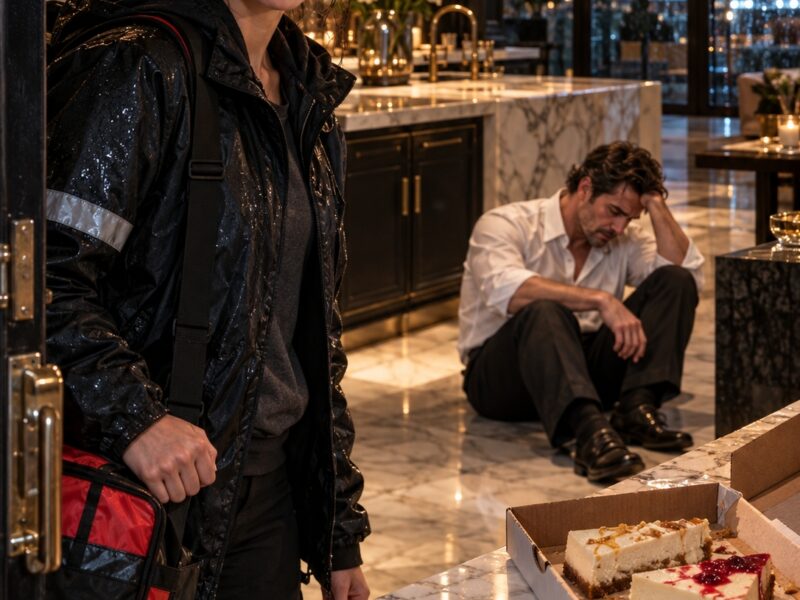
THE BILLIONAIRE ORDERED TWO SLICES OF CHEESECAKE FOR HIS DEAD WIFE—BUT WHEN THE DELIVERY GIRL STEPPED INSIDE, SHE HEARD THE SECRET HE’D HIDDEN FOR TWO YEARS

The first thing Mara Bennett noticed was that the front door of the mansion was open.
The second was the crying.
Not loud crying. Not the kind meant to summon sympathy.
It was the sound of a man trying so hard not to make a sound that every breath seemed to hurt.
Mara stood beneath the stone archway of the Hollowbrook Hill estate at 2:07 in the morning, rain dripping from the edge of her helmet, one hand holding a large pizza and the other gripping a paper bag containing two slices of cheesecake.
She rang the bell again.
Nothing.
“Hello?”
Only the rain answered.
She looked back toward the iron gates. They seemed impossibly far away, at the end of a driveway longer than the street where she lived.
Every rule she had learned during two years of late-night deliveries told her the same thing.
Leave the food.
Take the photo.
Go home.
Instead, Mara pushed the door open another inch.
“Delivery?”
The foyer beyond it was enormous, all pale stone and dark glass, the kind of place magazines described as breathtaking. At two in the morning, it felt less like a mansion than a museum after closing.
Then she heard the sound again.
A broken inhale.
A chair scraping somewhere deeper inside.
Mara set one wet sneaker across the threshold.
“Sir?”
No answer.
She followed the sound through a silent hallway, past paintings probably worth more than everything she had earned in her life, until she reached a kitchen larger than the entire apartment above the laundromat where she lived.
And there, on the marble floor, sat Adrien Cole.
Mara knew his face.
Everybody in Chicago knew his face.
Cole Logistics trucks crossed highways in forty states. His name appeared on business magazines, airport advertisements, charity galas and buildings downtown. Depending on which article you believed, he was worth somewhere between two and three billion dollars.
But the man sitting barefoot on the kitchen floor didn’t look like a billionaire.
His white dress shirt was open at the collar. A half-empty glass rested beside his knee. His eyes were red.
And he was staring at an empty place on the marble across from him as if someone were sitting there.
Mara stopped.
“Mr. Cole?”
His head turned sharply.
For half a second, embarrassment replaced grief.
Then anger replaced both.
“What are you doing in my house?”
Mara immediately stepped backward.
“I’m sorry. Your door was open. I rang three times and nobody answered. I heard—”
“Leave the food.”
“Okay.”
She placed the pizza on the counter.
Then the cheesecake.
Adrien saw the second bag and looked away.
Something about that tiny movement stopped her.
“You ordered two slices.”
His jaw tightened.
Mara should have left.
Instead she asked, “Is somebody else coming?”
Adrien stared at the floor.
“No.”
The answer was so quiet she almost missed it.
Mara glanced at the receipt.
One large cheese pizza.
Two slices of New York cheesecake.
No drinks.
No sides.
There was something strangely deliberate about the order.
“Then why two?”
His eyes lifted to hers.
“She isn’t coming.”
Mara felt the atmosphere in the room change.
“Who?”
For several seconds, Adrien said nothing.
Then he looked toward the empty space beside him.
“My wife.”
Mara’s eyes moved instinctively toward the hallway.
“Is she—”
“Dead.”
The word landed between them.
Adrien swallowed.
“Two years ago tonight.”
Rain tapped softly against the enormous windows.
Mara lowered her eyes.
“I’m sorry.”
“Don’t.”
His voice was sharper than she expected.
“Don’t say that.”
She looked at him again.
He rubbed both hands over his face.
“Everybody says that. They don’t know what else to say, so they say they’re sorry, and then they wait for me to make them comfortable.”
Mara understood that more than he could possibly know.
She had been eight years old when adults began saying those same words to her.
I’m so sorry about your mother.
So sorry.
So sorry.
Then they packed her clothes into black garbage bags and moved her into the first of six foster homes.
Mara picked up her delivery bag.
“I have a rule.”
Adrien looked at her.
“I never stay after a delivery.”
“Then you should go.”
She nodded.
“I should.”
She took two steps.
Stopped.
Turned around.
“But I’ve never been especially good at rules.”
Something flickered across his face.
Mara pulled off her wet jacket, folded it beside the counter, and sat on the marble floor opposite him.
Adrien stared at her.
“What are you doing?”
“You ordered dinner.”
“I don’t want dinner.”
“Good. Because it’s probably getting cold.”
That almost made him smile.
Almost.
Mara opened the pizza box.
“Tell me about her.”
And at 2:14 on a rainy Friday morning, in a mansion built for a life that no longer existed, Adrien Cole said his dead wife’s name aloud for the first time in months.
“Clare.”
He didn’t know it yet.
Neither did Mara.
But before that night was over, one of them would remember how to live.
And the other would finally discover what it felt like not to survive alone.
Mara Bennett had spent most of her life learning how not to need anyone.
Her mother, Elena Bennett, had been a waitress at a twenty-four-hour diner on the south side. She hummed old Motown songs while counting tips and could stretch twenty dollars so far Mara sometimes thought it was magic.
They never had much.
But Mara remembered being happy.
She remembered grilled-cheese sandwiches cut diagonally because her mother insisted they tasted better that way.
She remembered laundry drying over radiators.
She remembered sitting in a diner booth doing homework while Elena finished the midnight shift.
Most of all, she remembered what her mother told her every night.
“You’re going to be somebody, baby.”
At eight years old, Mara believed her.
Then one January, Elena got sick.
Three weeks later, she was dead.
Mara’s father had disappeared before she could remember his face.
There were no grandparents able to take her.
No wealthy aunt.
No miraculous family friend.
Just a social worker with tired eyes and a plastic folder.
Mara entered foster care carrying one suitcase.
Over the next ten years, she lived in six different homes.
Some people tried.
Some didn’t.
One foster mother bought her a birthday cake every year. Another kept a lock on the refrigerator.
One family called her “our girl” until they decided to move out of state without her.
By thirteen, Mara had developed a habit she never completely lost.
She didn’t unpack.
Not all the way.
There were always two shirts folded inside the suitcase.
Always one pair of jeans.
Always something ready to leave.
Because children learn strange survival skills when adults keep teaching them that permanence is temporary.
At eighteen, Mara aged out of the system with $417, a secondhand laptop and the same suitcase.
Nobody came to save her.
So she saved herself.
Eight years later, at twenty-six, her entire life occupied one narrow room above a laundromat.
The mattress sat directly on the floor.
There was a hot plate beside the sink, a secondhand kettle, three mismatched mugs and a shelf crowded with nursing textbooks borrowed from the public library.
Above the mattress, held to the wall with four pieces of yellowing tape, was the most valuable thing Mara owned.
An acceptance letter.
She had been admitted to a nursing program two years earlier.
She had cried in the library bathroom when she read the email.
Then she had seen the tuition.
Dreams, Mara discovered, could be expensive even after you earned them.
She deferred once.
Then again.
Now the school had given her a final deadline.
Four months.
Eleven thousand dollars.
That was what stood between Mara Bennett and the future her mother had imagined.
She had $6,240.
The money lived inside an old red coffee can on the top shelf of her closet.
Every dollar represented something she had refused herself.
New shoes.
Dinner with friends.
A better apartment.
A winter coat without a broken zipper.
Sleep.
Especially sleep.
Her alarm rang at 4:45 every morning.
For ten seconds, Mara stared at the ceiling.
Then she whispered the same sentence.
“Get up. You can sleep when you’re a nurse.”
By 5:30 she was working at Alvarez Bakery, shaping dough while the city was still dark.
Mrs. Rosa Alvarez had owned the bakery for thirty-one years and had spent the last two of them trying unsuccessfully to convince Mara that exhaustion was not a personality trait.
One morning she watched Mara carry a fifty-pound flour sack across the kitchen.
“Mara.”
“Hmm?”
“Sit down.”
“I am sitting down.”
“You are walking.”
“Emotionally, I’m sitting.”
Mrs. Alvarez stared at her.
Mara grinned.
The older woman didn’t.
“One day your body is going to send you a bill.”
“I’ll pay it next week.”
“You’ve been saying next week for two years.”
“And one day I’ll mean it.”
Mrs. Alvarez muttered something in Spanish and pushed a breakfast sandwich toward her.
Mara tried to refuse.
Mrs. Alvarez pointed a flour-covered finger.
“Eat.”
Mara ate.
At two in the afternoon, her bakery shift ended.
At five, her delivery shift began.
The three hours between belonged to the library.
She studied anatomy.
Pharmacology.
Patient assessment.
Anything that would keep the knowledge alive until she could finally walk into a classroom.
Then she changed into her delivery jacket and rode through Chicago until two in the morning.
Luxury condos.
Dorm rooms.
Office buildings.
Suburban houses.
People opened doors while laughing with families behind them.
Children ran past in pajamas.
Couples argued about television.
Dogs barked.
Mara saw hundreds of tiny lives from the outside.
Then the door closed.
She rode to the next one.
Every tip went into the coffee can.
$6,255.
$6,270.
$6,291.
Slowly.
Painfully.
Forward.
Then came Hollowbrook Hill.
And Adrien Cole.
Adrien had once believed money could solve almost anything.
That belief had made him rich.
Losing Clare had taught him its limits.
At twenty-four, Adrien had owned exactly one truck.
It was twelve years old, smelled like gasoline and failed to start whenever the temperature dropped below freezing.
He rented half a garage from a mechanic who accepted payment late because he liked him.
During the day Adrien drove deliveries.
At night he repaired the truck.
Then Clare Morrison walked into the garage carrying a box of colored paper.
She was a kindergarten teacher from the school around the corner. Their printer had broken before parent night, and somebody told her the garage office had one.
Adrien spent forty-five minutes helping her print twenty flyers.
The printer required approximately four.
He kept finding reasons to continue talking.
Clare knew exactly what he was doing.
She stayed anyway.
Their first date cost twenty-eight dollars.
One pizza.
Two slices of cheesecake.
They ate sitting on the floor of Adrien’s apartment because he owned one chair and was too embarrassed to let her use it while he stood.
“This is pathetic,” he apologized.
Clare took another bite.
“This is perfect.”
“You don’t have to lie.”
“I’m a kindergarten teacher. I spend six hours a day identifying lies.”
She pointed her fork at him.
“This is the best dinner I’ve had all year.”
She meant it.
Years passed.
The truck became three trucks.
Then twelve.
Then a warehouse.
Then Cole Logistics.
By the time Adrien was thirty-five, financial magazines called him a billionaire.
Clare still brought leftovers to school in the same plastic containers.
She still shopped with coupons.
And every anniversary, she demanded the same dinner.
Pizza.
Two slices of cheesecake.
On the kitchen floor.
“Why?” Adrien once asked after offering to fly her to Paris.
Clare touched his cheek.
“Because I married you, Adrien. Not your upgrade.”
Their third wedding anniversary arrived during a storm.
Adrien had a meeting.
A major acquisition.
He promised Clare he would cancel.
He didn’t.
At 7:12 that evening, she called.
“I’m getting the pizza myself.”
“No, stay home. I’ll be there.”
“You said that an hour ago.”
“I mean it this time.”
She laughed.
“Okay, billionaire. I’ll believe you when I see you.”
Those were the last words she ever said to him.
The police called forty-three minutes later.
Wet road.
A driver lost control.
Clare died before the ambulance reached the hospital.
Adrien arrived twelve minutes after that.
For two years, those twelve minutes lived inside him like a sentence.
He built more warehouses.
Signed larger contracts.
Worked until dawn.
The company celebrated its greatest expansion in history.
Adrien experienced none of it.
His house had thirty rooms.
He regularly used two.
His bedroom.
The kitchen.
Clare’s coat remained hanging beside the back door.
Her mug stayed in the cabinet.
He couldn’t move them.
Moving them felt like admitting she had stopped needing them.
On the first anniversary of her death, he stayed at the office until sunrise.
On the second, he flew to London.
On what would have been their fifth wedding anniversary, there was nowhere left to run.
At midnight he opened his phone.
His thumb moved almost independently.
One large pizza.
Two slices of cheesecake.
At 2:07, Mara Bennett arrived.
And by sunrise, the pizza was cold.
They had barely touched it.
Adrien had talked for nearly four hours.
About Clare’s terrible singing.
About how she rescued spiders instead of killing them.
About the yellow dress she wore on their courthouse wedding day.
About the last phone call.
Mara never told him to forgive himself.
That surprised him.
Everybody else had.
Instead she asked, “Would Clare blame you?”
Adrien stared at her.
“I blame me.”
“That wasn’t my question.”
He looked toward the windows.
Morning was beginning to gray the sky.
“No.”
“Then maybe you should stop putting words in a dead woman’s mouth.”
Adrien turned toward her.
“That was cruel.”
“I know.”
“Do you always talk like this to customers?”
“Only the ones who don’t tip.”
He laughed.
The sound startled both of them.
Mara stopped moving.
Adrien’s expression changed instantly, almost guilty.
“What?”
“Nothing.”
“You’re staring.”
“I’ve just never heard a billionaire laugh before.”
“We sound exactly like regular people.”
“I’ll alert the media.”
He laughed again.
This time he didn’t stop himself.
Before leaving, Mara finally opened one cheesecake container.
She cut the slice in half with a plastic fork.
She gave him half.
She ate the other.
The second slice remained untouched.
When Adrien walked her to the door, daylight had reached the driveway.
“Do you always stay four hours after deliveries?”
“Never.”
“So this was special?”
Mara zipped her jacket.
“This was a serious violation of company policy.”
He hesitated.
“Would you violate it again?”
She looked at him.
“Depends.”
“On?”
“The tip.”
That Friday at exactly 1:58 a.m., an order appeared on Mara’s phone.
One large pizza.
Two slices of cheesecake.
Hollowbrook Hill.
She stared at it for several seconds.
Then she smiled.
The next Friday, another appeared.
Then another.
Soon Fridays became something neither of them named.
Mara arrived after her shift.
Adrien sent his staff home early.
They sat on the kitchen floor.
Sometimes they ate pizza.
Sometimes they forgot.
They talked.
Not like a billionaire and a delivery driver.
Not like a grieving widower and a lonely woman.
Just two people who had become exhausted from pretending they were fine.
Mara told him about foster care.
Not everything.
Never everything.
She told him about the suitcase.
“How long did it take before you started unpacking?”
Adrien asked.
Mara picked at the edge of the pizza box.
“I still haven’t.”
He thought she was joking.
She wasn’t.
Adrien told her about the first delivery truck.
Mara laughed when he admitted he had once repaired the transmission using a borrowed manual and a flashlight held between his teeth.
“You?”
“Yes.”
“Mr. Private Jet?”
“I did not have a private jet.”
“Tragic.”
“I didn’t even have health insurance.”
“That actually is tragic.”
On the fourth Friday, Adrien put warm socks beside the door.
Mara stared at them.
“What are those?”
“Your feet are always freezing.”
“You noticed my feet?”
“That sounded worse than I intended.”
She laughed.
On the fifth Friday, Mara accidentally mentioned nursing school.
Adrien became still.
“What nursing school?”
She knew immediately she had made a mistake.
“Nothing.”
“Mara.”
“Don’t use your CEO voice.”
“I don’t have a CEO voice.”
“You absolutely have a CEO voice.”
She tried changing the subject.
He waited.
Eventually, she told him.
The acceptance.
The deferrals.
The deadline.
The coffee can.
“How much are you short?”
Adrien asked.
Mara looked at him.
“No.”
“I haven’t offered anything.”
“You’re about to.”
He paused.
“About seven thousand?”
“Six thousand nine hundred.”
“I’ll pay it.”
There it was.
Mara’s face changed.
Adrien saw it immediately.
Not greed.
Not relief.
Pain.
“No.”
“Mara, it’s seven thousand dollars.”
“To you.”
“I know.”
“No, you don’t.”
She stood.
Adrien followed.
“I’m not trying to insult you.”
“I know.”
“Then why are you angry?”
“Because you can solve in ten seconds the thing I’ve spent two years bleeding for.”
The sentence stopped him.
Mara pressed her palms against the counter.
“I know you’re trying to be kind. But every good thing I’ve ever had, I had to earn while somebody was telling me I didn’t belong there. Foster homes. Jobs. School. Everything.”
Her eyes shone.
“If you hand me the finish line, Adrien, I don’t know what happens to the part of me that ran all those miles.”
He said nothing.
“I need to know I could do it.”
“Mara—”
“Please.”
Her voice softened.
“You have enough money to buy almost anything. Don’t buy this from me.”
Adrien looked at her for a long time.
Then he nodded.
“Okay.”
“Okay?”
“I won’t offer again.”
She searched his face.
“Really?”
“Really.”
Then he added, “But I reserve the right to make you eat dinner.”
“That sounds controlling.”
“You had coffee for dinner yesterday.”
“That was a latte.”
“That is not food.”
“It had milk.”
He smiled.
She did too.
And something changed between them that night.
Not because he offered the money.
Because he accepted no.
For Mara, that mattered more.
Weeks passed.
Adrien began sleeping.
Not perfectly.
But enough.
He returned to the office without looking like a man trying to outrun something.
His mother noticed during a Sunday call.
“You sound different.”
“I sound the same.”
“You laughed.”
“No, I didn’t.”
“Adrien.”
He looked toward the warm socks beside the back door.
“There’s someone.”
His mother became silent.
Then, very gently, she said, “Good.”
Adrien felt guilty.
She heard it.
“Loving someone doesn’t erase Clare.”
“I know.”
“No. You know it intellectually. That’s different.”
Adrien closed his eyes.
His mother continued.
“Clare loved you alive.”
That sentence stayed with him.
Meanwhile Mara discovered something equally frightening.
She was becoming used to being expected.
Every Friday, someone waited for her.
Every Friday, a light was on.
Every Friday, someone noticed if she looked tired.
For a woman who had spent eighteen years keeping part of her life packed in a suitcase, being expected somewhere felt dangerously close to belonging.
Then someone took a photograph.
Richard Voss had been trying to weaken Cole Logistics for years.
He owned a competing freight company and understood something important about modern business.
A reputation could lose value faster than a stock.
One Saturday morning, Mara was shaping sourdough when her phone began vibrating.
Once.
Twice.
Then continuously.
Mrs. Alvarez looked over.
“Boyfriend?”
“I don’t have a boyfriend.”
“That’s not what your face says on Fridays.”
Mara reached for the phone.
The smile disappeared.
A photograph filled the screen.
Mara leaving Adrien’s mansion at dawn.
Her hair was messy from the rain.
Her jacket was half-zipped.
Adrien stood behind her in the doorway.
The angle made intimacy look like evidence.
The headline was worse.
BILLIONAIRE’S SECRET DELIVERY GIRL.
Another site had already reposted it.
WHO IS THE WOMAN REPLACING CLARE COLE?
Then came the headline that spread fastest.
GOLD DIGGER AT THE GATES.
Mara stopped breathing.
Mrs. Alvarez took the phone from her.
“Oh, sweetheart.”
Within three hours, strangers knew Mara’s full name.
By noon, they knew where she worked.
By afternoon, someone had posted a photograph of the laundromat beneath her apartment.
Comments multiplied faster than Mara could read them.
She’s obviously after his money.
She waited until the wife was dead.
Bet he’s paying her tuition.
Check her bank account.
One comment had half a million views.
SHE’S USING A GRIEVING MAN TO PAY FOR NURSING SCHOOL.
Mara stared at that sentence until the letters blurred.
That one found the exact wound.
Adrien had offered.
She had refused.
Nobody knew that.
Nobody cared.
To strangers, she was exactly what poverty had spent her entire life teaching her never to become.
Someone who took.
Adrien called.
She declined.
He called again.
And again.
By evening, thirty-one missed calls covered her screen.
Finally a message appeared.
Mara, please answer.
Another.
I’ll make a statement.
Then:
I’ll fix this.
Mara stared at those three words.
I’ll fix this.
She knew he meant love.
But all she could hear was money.
Power.
A billionaire rearranging reality because he could.
She typed:
If you defend me, they’ll say you paid me to keep quiet.
Three dots appeared.
She continued.
If you don’t, they’ll say you’re ashamed of me.
His reply came immediately.
I don’t care what they say.
Mara’s fingers trembled.
I do.
Why?
She looked around her tiny apartment.
The coffee can.
The mattress.
The acceptance letter.
The same old suitcase.
Then she typed:
Because my name is the only thing I’ve ever owned that nobody gave me.
Adrien didn’t answer for nearly a minute.
When he finally did, the message was only four words.
Tell me what you need.
Mara cried.
Because she knew the answer.
Distance.
On Sunday morning, before sunrise, Mara packed her life into one suitcase.
It took twelve minutes.
That fact hurt more than she expected.
Twenty-six years old.
One suitcase.
Still.
She removed the nursing acceptance letter from the wall.
Took the coffee can.
Folded her delivery jacket neatly on the mattress.
Then she wrote Adrien a note.
She quit the delivery company.
Mrs. Alvarez was sweeping when Mara entered the bakery.
One look at the suitcase and the older woman’s face crumpled.
“No.”
“I have to.”
“No.”
“People came here yesterday.”
“I threw one of them out.”
Mara almost smiled.
Mrs. Alvarez dropped the broom.
“You did nothing wrong.”
“I know.”
“Then don’t run like you did.”
Mara’s eyes filled.
“Knowing and feeling aren’t always the same thing.”
Mrs. Alvarez pulled her into an embrace.
For several seconds, Mara became eight years old again.
When they separated, Mrs. Alvarez held her face between both hands.
“Where will you go?”
“Maple Hollow.”
Mrs. Alvarez understood.
Mrs. Whitfield.
The one foster mother Mara still occasionally called.
The only home where she had once unpacked her suitcase.
“Does he know?”
“No.”
“Will you tell him?”
Mara shook her head.
“Why?”
“Because if he asks me to stay, I might.”
That was the truth she could barely survive saying.
By the time Adrien reached the laundromat, Mara was already three hours away.
He climbed the narrow stairs two at a time.
Knocked.
No answer.
Again.
Nothing.
Finally the laundromat owner appeared.
“Mr. Cole?”
“Mara Bennett.”
The woman’s expression told him everything.
“She left something for you.”
Adrien entered the room.
He had been inside warehouses worth hundreds of millions.
He had stood in penthouses overlooking Manhattan.
Nothing had ever made him feel poorer than Mara’s apartment.
The mattress was bare.
The shelves empty.
The acceptance letter gone.
On the mattress lay her delivery jacket.
A folded note rested on top.
Adrien opened it.
Thank you for the Fridays.
They were the best part of my life.
Please don’t look for me.
Protect your name.
Let me protect mine.
—Mara
He read it again.
Then again.
Then Adrien Cole, wearing a four-thousand-dollar coat in a room where the rent was less than that, lowered himself onto the mattress.
For the second time in his life, he cried on a floor because a woman he loved was gone.
That Friday at 2:00 a.m., he ordered the same dinner.
Pizza.
Two slices of cheesecake.
A different driver arrived.
Adrien tipped him.
Closed the door.
Sat in the kitchen.
One slice rested where Clare’s had once been.
The other rested where Mara’s had been.
He ate neither.
Three hundred miles away, Mara stood over a sink at the Sunrise Diner in Maple Hollow.
Mrs. Whitfield had offered her a bedroom.
Mara accepted only after insisting on paying rent.
During the day she worked at the diner.
At night she counted the coffee can.
$6,950.
The deadline was getting closer.
The dream was still too far away.
And sometimes, when plates stopped clattering and the kitchen became quiet, Mara heard Adrien’s laugh in her memory.
She told herself leaving had been right.
She told herself that every night.
Back in Chicago, Adrien’s lawyers recommended suing the publications.
His communications director had three statements prepared.
The board wanted him to appear on television.
Adrien read none of them.
“If I speak for Mara,” he said during Monday’s meeting, “I become another person deciding what her story is.”
His attorney frowned.
“So you’re doing nothing?”
“No.”
Adrien stood.
“I’m finally going to listen.”
At 4:45 the next morning, Mrs. Alvarez unlocked the bakery and found Adrien Cole waiting outside.
She almost shut the door in his face.
“You.”
“I know.”
“You’re the reason she’s gone.”
“I know.”
“Your people destroyed that girl’s life.”
“I know.”
Mrs. Alvarez glared at him.
“What do you want?”
Adrien looked through the glass toward the flour-covered worktables.
“I want to know what her mornings were like.”
The baker studied him.
Then she opened the door.
“Aprons are in the back.”
Adrien blinked.
“What?”
“If you’re going to stand there feeling sorry for yourself, do it while working.”
At 5:12, the billionaire who controlled one of America’s largest logistics networks destroyed twenty-four croissants.
Mrs. Alvarez looked at the tray.
“You’re terrible.”
“I run forty-state freight operations.”
“You cannot operate butter.”
On the second morning, he burned twelve.
On the third, only four.
He learned how Mara arrived half asleep and never complained.
How she quietly took the hardest jobs.
How she brought coffee to the dishwasher without being asked.
How she had worked sick because missing one shift meant losing money from the coffee can.
Adrien had known Mara was strong.
He hadn’t understood the daily architecture of that strength.
On the third morning, Mrs. Alvarez finally spoke.
“Maple Hollow.”
Adrien’s hands stopped in the dough.
“What?”
“She mentioned it once. A foster mother. Mrs. Whitfield.”
He looked at her.
“Why are you telling me?”
“I’m not telling you to bring her back.”
Mrs. Alvarez stepped closer.
“If you go there thinking money gives you the right to decide what happens next, I’ll personally break your nose.”
Adrien almost smiled.
“Understood.”
“Do you?”
“Yes.”
He removed the apron.
Folded it.
And drove to Maple Hollow.
Meanwhile, something unexpected was happening online.
The story was changing.
Not because Adrien’s PR department changed it.
They didn’t.
A woman posted that Mara once carried groceries four flights upstairs for her elderly mother after completing a delivery.
A college student wrote that Mara had returned his wallet containing six hundred dollars in cash.
An elderly couple shared a photograph of Mara sitting beside them in the rain after their car broke down.
Mrs. Alvarez wrote about the nursing acceptance letter.
Former customers began adding stories.
Small stories.
Unremarkable kindnesses.
The kind nobody photographs because they don’t know they’ll matter someday.
Within forty-eight hours, the word gold digger began disappearing beneath another phrase.
Ask Mara.
Ask the people she helped.
Ask the people who knew her before a billionaire ever knew her name.
For once, the internet did something it rarely does.
It corrected itself.
Not completely.
Not cleanly.
But enough.
Adrien arrived in Maple Hollow Thursday evening.
Mrs. Whitfield lived in a small blue house with white shutters.
She opened the door before he knocked.
“You’re Adrien.”
He stared.
“How—”
“I own a television.”
“Right.”
She studied him.
“You look tired.”
“So does everyone keep telling me.”
“Mara doesn’t need rescuing.”
Adrien felt the words hit exactly where they were intended.
“I know.”
Mrs. Whitfield’s expression softened slightly.
“Sunrise Diner. Main Street.”
Adrien turned.
Then stopped.
“Does she know I’m here?”
“No.”
“Don’t tell her.”
That surprised Mrs. Whitfield.
Adrien drove downtown.
Through the diner window he saw Mara.
Hair tied back.
Sleeves rolled above her elbows.
Hands submerged in dishwater.
For several seconds he simply watched.
His hand reached for the door.
Stopped.
Four days remained before the nursing-school deadline.
Adrien could have walked inside.
He could have written a check.
He could have ended Mara’s problem before she finished drying the next plate.
But standing outside that diner, he finally understood what she had been trying to tell him.
Love wasn’t solving someone.
Sometimes love was refusing to steal the struggle that belonged to them.
Adrien lowered his hand.
Then he walked away.
Mara never saw him.
The next morning, a white envelope arrived at Mrs. Whitfield’s house.
Official letterhead.
Nursing school.
Mara’s stomach dropped.
She assumed it was the final reminder.
Mrs. Whitfield stood across the kitchen.
“Open it.”
“I know what it says.”
“You don’t.”
Mara tore the envelope.
Read the first sentence.
Stopped.
Read it again.
Then she sat down.
“Mara?”
Her hands began shaking.
The nursing school’s scholarship committee had received dozens of letters during the previous week.
From customers.
Neighbors.
Mrs. Alvarez.
Former foster workers.
People who had followed the online story.
They weren’t letters asking the school to rescue Mara.
They were testimony.
About work ethic.
Integrity.
Compassion.
Service.
The committee had reviewed her academic record and original application again.
Mara Bennett had been awarded a full merit scholarship.
Tuition.
Books.
Fees.
Everything.
Mara pressed the letter against her mouth.
For a moment, no sound came.
Then she cried.
Not because somebody rich had saved her.
Not because somebody had handed her a dream.
Because years of invisible work had finally become visible.
For once, the world had looked at Mara Bennett and seen something other than what she lacked.
Mrs. Whitfield sat beside her on the porch steps.
Mara looked at the letter.
“My mother used to tell me I’d be somebody.”
Mrs. Whitfield squeezed her hand.
“You were somebody before the letter.”
Mara laughed through tears.
“I know.”
And for the first time, she believed it.
That night Mara volunteered to close the diner.
At 2:03 a.m., she turned the sign to CLOSED.
Rain had begun tapping against the windows.
She froze.
For one irrational second, she was back at Hollowbrook Hill.
Then she heard an engine outside.
Small.
Unfamiliar.
A delivery bike.
Mara frowned.
Nobody delivered food to the diner at two in the morning.
The bell above the front door rang.
She turned.
Adrien Cole stood in the doorway.
Soaked.
Breathing hard.
And wearing her old delivery jacket.
Mara stared.
He held a pizza box in both hands.
“Delivery for Mara Bennett.”
She couldn’t speak.
Adrien stepped inside.
“I know.”
Mara finally found her voice.
“You weren’t supposed to look for me.”
“I know.”
“You promised—”
“I never promised.”
“That’s worse.”
“Probably.”
She looked at the jacket.
“You stole my uniform.”
“I prefer borrowed.”
“You’re a billionaire.”
“I’m aware.”
“You rode a delivery bike three hundred miles?”
“No. I transported it most of the way.”
Mara laughed before she could stop herself.
The sound broke something open between them.
Adrien’s expression softened.
“I heard about the scholarship.”
Her smile faded.
Immediately, he raised a hand.
“I had nothing to do with it.”
“Adrien—”
“Nothing.”
She searched his face.
“Mrs. Alvarez?”
“She didn’t organize it either. People wrote because they wanted to.”
Mara looked down.
Adrien stepped closer.
“I came here once before.”
Her eyes snapped upward.
“When?”
“Yesterday.”
“You were here?”
“Outside.”
“Why didn’t you come in?”
“Because I finally understood something.”
He set the pizza on the counter.
“You didn’t need me to open the door.”
Mara’s throat tightened.
“You needed me to stop standing in front of it.”
Silence filled the diner.
Adrien opened the pizza box.
One large pizza.
Beside it sat one slice of cheesecake.
Mara frowned.
“One?”
Adrien nodded.
“For two years I ordered two.”
His voice became quieter.
“One for me. One for Clare.”
Mara didn’t move.
“I think part of me believed that if I kept setting her place, I wasn’t betraying her by surviving.”
He looked down.
“Then you sat in her place without knowing it.”
Mara’s eyes filled.
“I felt guilty for laughing with you.”
He swallowed.
“Then I felt guilty for waiting for Friday.”
He looked at her.
“And then I realized something worse.”
“What?”
“I wasn’t waiting for Friday.”
His voice cracked.
“I was waiting for you.”
Mara turned away.
Adrien didn’t touch her.
He let her choose the distance.
“I’ll always love Clare,” he said.
“You should.”
“I know.”
He breathed.
“But loving someone who’s gone doesn’t require me to become someone who’s gone too.”
Mara closed her eyes.
Adrien reached into his pocket.
When she turned back, he placed a small plate beside the cheesecake.
There was a ring on it.
Mara stared.
“Adrien.”
“I know this looks dramatic.”
“You rode into a diner at two in the morning wearing my delivery jacket.”
“Fair point.”
She almost laughed.
Then she saw his hands shaking.
Not billionaire hands.
Not CEO hands.
Just Adrien.
“I don’t want to rescue you, Mara.”
He stepped closer.
“I tried that once. You taught me better.”
Her tears slipped free.
“You never needed someone to save you.”
He looked at the ring, then back at her.
“You needed someone willing to sit on the floor beside you while you saved yourself.”
Mara covered her mouth.
“If you’ll let me,” he whispered, “I’d like to be that person.”
She shook her head slowly.
Adrien’s face fell.
Then Mara said, “You haven’t actually asked me anything.”
He blinked.
“Oh.”
She laughed through her tears.
“Terrible proposal.”
“I had a speech.”
“Clearly you lost it.”
“Probably somewhere around Milwaukee.”
Mara wiped her cheek.
Adrien picked up the ring.
“Mara Bennett.”
His voice steadied.
“Will you marry me?”
She stared at him.
At the man who had once sat on a marble floor ordering dinner for a ghost.
At the man who could have purchased her future but had eventually learned to respect her right to build it.
At the ridiculous delivery jacket.
At the single slice of cheesecake.
For most of Mara’s life, happiness had been something scheduled for later.
Next time.
Next month.
Next year.
When she had enough money.
When she was safe.
When she belonged somewhere.
Her mother had promised she would become somebody.
Mara had misunderstood that promise for eighteen years.
Becoming somebody wasn’t reaching a place where nobody could hurt you.
It was reaching a place where fear no longer made every decision.
Mara looked at Adrien.
“Next time.”
His expression collapsed.
“What?”
She let the silence torture him for exactly two seconds.
Then she smiled.
“I’ve spent my entire life saying next time.”
She held out her hand.
“So I think this time is now.”
Three years later, Mara Bennett walked across a graduation stage wearing a crisp white nursing uniform beneath her gown.
Mrs. Alvarez sat in the audience wearing a navy dress she had purchased specifically for the occasion.
Mrs. Whitfield held flowers.
Adrien sat between them.
When Mara’s name was announced, he stood before anyone else.
He clapped so loudly that Mara heard him from the stage.
She laughed.
The sound traveled through the auditorium.
Later that evening, they returned to Hollowbrook Hill.
The mansion had changed.
Not structurally.
Something more difficult than architecture had changed.
There were photographs now.
Not just of Clare.
Not just of Mara.
Of life.
Mrs. Alvarez covered in flour.
Mrs. Whitfield holding Christmas cookies.
Adrien attempting to bake.
Mara asleep over a textbook.
Clare’s photograph remained in the hallway.
Nobody moved it.
Nobody needed to.
Grief had stopped being a room they were forbidden to enter.
It had become part of the house.
Like memory.
Like love.
In the kitchen, Mara removed her shoes.
Adrien opened a pizza box.
She looked inside.
“One large cheese.”
“Tradition.”
Then she opened the smaller bag.
Two slices of cheesecake.
Mara looked at him.
Adrien smiled.
She carried them to the marble floor.
They sat in the same place where they had first met.
For a moment Mara looked toward the spot where Adrien had once imagined Clare sitting.
Then she rested her head against his shoulder.
“You okay?”
Adrien thought before answering.
There had been a time when he would have lied.
“Yeah.”
This time he meant it.
Outside, rain began softly against the windows.
Mara took one bite of cheesecake.
Adrien took another.
And somewhere inside the strange mathematics of grief, two slices no longer meant one was waiting for someone who would never return.
They meant there were two people here.
Two people still breathing.
Two people who had learned, painfully, that love was not always a rescue.
Sometimes it was a woman in a wet delivery jacket sitting down beside a stranger when every rule told her to leave.
Sometimes it was a grieving man learning that money could solve a problem and still destroy something precious if he used it at the wrong moment.
Sometimes it was allowing the dead to remain loved without asking the living to remain lonely.
And sometimes becoming somebody had nothing to do with money, success, headlines or the name printed beneath a photograph.
Sometimes it meant finally unpacking the suitcase.
Upstairs, in the bedroom she now shared with Adrien, Mara’s old suitcase rested inside the closet.
Empty.
Completely empty.
For the first time since she was eight years old, there was nothing inside it waiting for the day she might have to leave.
And downstairs, beneath the soft kitchen lights, two slices of cheesecake sat on the marble floor.
This time, both were for the living.









