THE BILLIONAIRE SURGEON FROZE WHEN HE SAW THE NEW RESIDENT—THEN SHE PULLED OUT THE NOTE HE WROTE 22 YEARS AGO
The moment Dr. Everett Vale saw the new resident step through the glass doors of Vale Memorial Medical Center, he stopped breathing.
Not metaphorically.
For three full seconds, the most controlled surgeon in Chicago simply stood beneath the thirty-foot atrium, one hand frozen around a cup of black coffee, while hundreds of people moved around him.
Residents hurried toward orientation. Nurses crossed the polished marble floor with medication carts. A transport team rolled a patient toward the elevators. Somewhere behind him, his executive assistant was talking about a meeting with the board.
Everett heard none of it.
Because the woman entering his hospital had the same eyes as a seven-year-old girl he had spent twenty-two years trying not to wonder about.
She was taller now, of course.
Twenty-nine, according to the badge clipped to her white coat.
Her dark hair was twisted into a hurried knot. Her shoes were inexpensive. One sleeve of her coat carried a faint crease, as if it had been folded inside a suitcase instead of hanging in a closet. In one hand she carried a paper orientation folder.
In the other was an old brown leather medical bag.
That bag made Everett’s heart lurch.
He had seen it before.
Not exactly like this. Back then it had been cleaner, the leather darker, the brass buckle brighter.
But he remembered it.
He remembered a woman clutching it as paramedics wheeled her into a crowded emergency department during a rainstorm.
And he remembered the little girl left outside beneath a broken streetlamp because there had been no one else to watch her.
“Dr. Vale?”
Everett’s assistant touched his arm.
He flinched.
“Are you all right?”
He didn’t answer.
Across the lobby, the young woman pushed a loose strand of hair behind her ear.
The gesture was so small that no one else would have noticed it.
Everett did.
Twenty-two years disappeared.
Rain struck pavement.
A child shivered beneath yellow streetlight.
And a twenty-four-year-old medical student with seven dollars in his wallet took off his only warm jacket.
Everett lowered his coffee.
“Who is she?”
His assistant followed his gaze.
“The new resident?”
“Yes.”
“Internal medicine rotating through cardiology. Bennett, I think.”
Everett turned so quickly that coffee splashed across the lid.
“What did you say?”
“Bennett. Dara Bennett.”
The noise of the hospital seemed to disappear.
Dara.
Everett had not spoken that name aloud in twenty-two years.
His assistant frowned. “Do you know her?”
Everett stared across the atrium.
Dara Bennett had reached the elevators.
For one impossible second, before the doors closed, she turned.
Their eyes met.
She gave him the polite, nervous smile of a young doctor who recognized the famous surgeon whose name was carved above the entrance.
Nothing more.
No shock.
No recognition.
No memory.
Then the elevator doors slid shut.
Everett remained motionless.
His assistant waited.
Finally, he whispered, “Get me her file.”
And for the first time in decades, Dr. Everett Vale was terrified of finding exactly what he was looking for.
Twenty-two years earlier, there had been no Vale Memorial Medical Center.
No marble atrium.
No private surgical wing.
No photographs of Everett beside governors, senators, hospital presidents, or grateful families.
There had been a neighborhood clinic on the west side of Chicago with flickering fluorescent lights, a broken vending machine, and two doctors trying to treat more people than the building could hold.
Everett Vale had been twenty-four.
He was finishing medical school on scholarship and working nights because scholarships paid tuition but did not pay rent.
He lived in a basement apartment where the radiator failed every winter.
He owned three dress shirts.
His car had died six months earlier.
Dinner was whatever remained in the clinic refrigerator after the nurses went home.
People who met Everett now assumed ambition had always been his defining trait.
They were wrong.
Fear had come first.
He knew what it felt like to count coins before entering a grocery store.
He knew what it was like to hear adults discuss bills in whispers.
He knew what hunger did to dignity.
After his father died and his mother followed two years later, Everett learned another lesson: poverty didn’t merely take comfort from people.
Sometimes it took choices.
That was why he noticed the little girl beneath the streetlamp.
It was close to eleven on a Thursday night.
Rain had turned the sidewalks silver.
Everett was walking from the clinic toward the train station when he saw her sitting on an overturned milk crate outside a closed grocery store.
Seven years old, maybe.
Her sneakers were soaked.
A torn school backpack rested against her knees.
She wore a sweater much too thin for the weather.
Everett almost kept walking.
Not because he didn’t care.
Because he had been awake for almost twenty hours and had an exam the next morning.
Then he saw her hands.
They were trembling.
He stopped.
“Hey.”
The girl looked up immediately.
Not frightened.
Suspicious.
That was worse.
Everett understood children who already knew adults could disappoint them.
“You waiting for somebody?”
“My mom.”
“Where is she?”
The child pointed across the street.
Cook County’s emergency annex glowed beyond the rain.
“She’s sick?”
The girl nodded.
Everett glanced around. “Who’s staying with you?”
“Me.”
He thought he had misheard her.
“You’re staying with yourself?”
Another nod.
“The nurse said I couldn’t sit inside because they’re too busy.”
Everett looked toward the hospital.
He believed her.
Emergency rooms were overwhelmed. Staff did what they could. Families fell between rules and reality every night.
“What’s your name?”
“Dara.”
“Dara what?”
She hesitated.
“Bennett.”
“I’m Everett.”
She looked down at his shoes.
“You a doctor?”
“Not yet.”
“You look like one.”
“That’s because I’m very good at pretending.”
For the first time, she smiled.
It lasted less than a second.
Everett crouched beneath the awning.
“When did you eat?”
“I’m not hungry.”
That answer told him everything.
Poor children learned early that hunger sounded less embarrassing when called something else.
Everett reached into his backpack.
He had one turkey sandwich.
His dinner.
He broke it in half.
Dara watched.
“Which half do you want?”
She shook her head.
“I said I’m not hungry.”
His own stomach tightened.
“So I’m supposed to eat both?”
“Yes.”
“That’s selfish of you.”
She looked up, offended.
Everett smiled.
“I’d have to carry twice as much sandwich. You’d really make a tired medical student do that?”
Dara stared at him.
Then at the sandwich.
Finally she took half.
She ate slowly for the first thirty seconds.
Then quickly.
Everett pretended not to notice.
When the wind shifted and rain blew beneath the awning, he removed his jacket.
“No.”
Dara immediately shook her head.
“You’ll get cold.”
“I’m twenty-four. We’re indestructible at twenty-four.”
“That’s not true.”
“It is in medical textbooks.”
“No, it isn’t.”
“Have you read them?”
“No.”
“Then technically, I win.”
She allowed him to put the jacket over her shoulders.
It nearly reached her ankles.
For the next forty minutes they talked.
Not about her mother’s illness.
Not much.
Dara wanted to discuss doctors.
She wanted to know whether they were ever scared.
Whether blood bothered him.
Whether medical school was difficult.
Whether doctors had to be rich.
That final question made Everett look at her.
“Why?”
She shrugged.
“My mom says I ask too many questions.”
“Your mom is probably right.”
Another tiny smile.
Then Dara said, “I want to be one.”
“A doctor?”
She nodded.
“When I grow up.”
Everett leaned back against the brick wall.
“Then be one.”
Her face changed.
Not dramatically.
Just enough.
A child retreating from hope before hope could embarrass her.
“We don’t have money.”
Everett had heard that sentence in his own voice.
Years earlier.
Spoken to a guidance counselor.
Spoken to a college admissions representative.
Spoken to anyone who suggested futures that seemed designed for richer people.
He looked at Dara carefully.
“Being poor can make things harder.”
She lowered her eyes.
“But harder isn’t the same as impossible.”
“My mom can’t pay for doctor school.”
“Maybe she won’t have to.”
Dara frowned.
“Scholarships. Grants. Work. People helping you. You find one door, then another.”
“What if they don’t let me in?”
Everett was quiet.
Rain drummed against the metal awning.
A bus hissed at the intersection.
Finally he reached into his pocket and found a receipt from a pharmacy.
On the back, using a pen that barely worked, he wrote eleven words.
He folded the receipt and held it out.
Dara looked suspicious again.
“What is it?”
“Medical advice.”
“You’re not a doctor.”
“Almost medical advice.”
She unfolded it.
Her lips moved as she read.
WHEN THE WORLD TELLS YOU THAT YOU DON’T BELONG, REMEMBER THAT SOMEONE ONCE BELIEVED YOU DID.
Dara stared at the words.
“Who’s the someone?”
Everett pointed at himself.
She looked at him as though she was trying to decide whether he was joking.
He wasn’t.
“You don’t know me.”
“I know enough.”
“What if I’m bad at school?”
“Are you?”
“No.”
“Then that problem solved itself.”
“What if I quit?”
“Don’t.”
“What if—”
“Dara.”
She stopped.
Everett tapped the paper.
“Keep this until you don’t need it anymore.”
The hospital doors across the street opened.
A nurse appeared, scanning the sidewalk.
“Dara Bennett?”
Dara jumped up.
Everett helped remove his jacket from her shoulders.
The nurse called again.
“Your mother is asking for you.”
Dara grabbed her backpack.
She ran two steps before turning.
“Everett?”
“Yeah?”
“When I become a doctor, I’ll give this back.”
He laughed.
“Deal.”
Then she crossed the street.
Everett watched until the doors closed behind her.
He never saw her again.
Until the Monday morning when she entered the hospital bearing his name.
Everett received Dara’s file seventeen minutes after asking for it.
He locked his office door before opening it.
That fact alone would have surprised anyone who knew him.
Everett did not lock doors.
He disliked secrecy.
But suddenly he needed silence.
DARA ELAINE BENNETT.
AGE: 29.
Born in Chicago.
Raised on the west side.
Scholarship undergraduate education.
Full academic scholarship for medical school.
Graduated near the top of her class.
Excellent recommendations.
Volunteer history longer than most physicians twice her age.
Everett turned the page.
Emergency contact history.
Mother: Lillian Bennett.
Deceased.
His fingers stopped.
Lillian.
That had been the mother’s name.
He remembered because the exhausted nurse had called it into the rain twenty-two years earlier.
Lillian Bennett.
Everett leaned back.
There was no longer any reasonable doubt.
The child beneath the streetlamp had grown up.
She had become a doctor.
And somehow, without either of them knowing it, her path had led directly into the institution he had built.
Everett closed the file.
He should have felt joy.
Instead, unease crawled beneath his ribs.
Vale Memorial had nearly twelve thousand employees. Residency placements were selected by committees. Everett had not seen Dara’s application, had not interviewed her, and had not influenced the decision.
But how would it look if people discovered their history?
More importantly, how would Dara feel?
She had earned every line on those pages.
He could not risk making her wonder whether some invisible hand had helped her.
He especially could not allow anyone else to wonder.
So he made a decision that felt responsible at the time.
He would say nothing.
He would watch from a distance.
He would let Dara Bennett become whatever kind of doctor she was going to become without the shadow of Everett Vale falling across her work.
It was a logical decision.
It lasted three weeks.
By the end of the first week, Everett had already noticed things about her that bothered him.
Not weaknesses.
Quite the opposite.
Dara worked as though she believed every mistake would expose her as someone who had slipped into the room without permission.
She arrived before everyone.
She left after everyone.
She reread charts.
Double-checked medication orders.
Volunteered for cases other residents avoided.
When a patient shouted at her, she apologized even if she had done nothing wrong.
When an attending praised her, she looked almost uncomfortable.
Everett recognized the pattern because he had once lived inside it.
Gratitude could become its own prison.
Poor students who fought their way into elite rooms often believed they had to repay the privilege of standing there.
They didn’t simply work.
They tried to justify their existence.
One Tuesday night, Everett passed the internal medicine station at 11:40 p.m.
Dara was there alone.
“You know your shift ended three hours ago.”
Her head snapped up.
Seeing the hospital’s founder standing in front of her made her straighten immediately.
“Dr. Vale.”
He hated that reaction.
“Is there another one?”
She blinked.
“Another what?”
“Dr. Vale. You looked behind me.”
A nervous smile touched her face.
“No, sir.”
“Everett is fine.”
Her expression made it clear that Everett was absolutely not fine.
He nodded toward the chart.
“Why are you still here?”
“Mrs. Alvarez’s potassium dropped again.”
“Is she your patient?”
“Not technically.”
“Then why are you monitoring her?”
Dara hesitated.
“Her daughter works nights. She’s afraid of hospitals.”
“Mrs. Alvarez?”
“The daughter.”
Everett studied her.
“You stay three hours late because someone’s daughter is afraid?”
Dara’s shoulders tightened.
“I was already here.”
“No, you weren’t. That’s how time works.”
She looked down.
He should have walked away.
Instead he heard himself ask, “Do you ever go home?”
“When people stop getting sick.”
“That’s not going to happen.”
“Then I guess you’ve answered your own question.”
Everett almost smiled.
Almost.
There it was.
A flash of the little girl who had argued with him beneath the awning.
Dara noticed something in his face.
“What?”
“Nothing.”
She waited.
Everett could have told her then.
He came dangerously close.
Do you remember a broken streetlamp?
Do you remember a sandwich?
Do you remember a young idiot who lied about being indestructible?
Instead he said, “Go home before midnight.”
She looked at Mrs. Alvarez’s chart.
“That’s an order?”
“Professional advice.”
“From a doctor this time?”
Everett froze.
Dara had already turned back to the computer.
She had no idea what she’d just said.
He walked away before his face betrayed him.
That night, he slept badly.
Two weeks later, he saw her paying for a stranger’s medication.
The patient was a sixty-three-year-old man named Walter Raines who had been sleeping inside his car for almost four months.
Walter had congestive heart failure, diabetes, and enough pride to turn poverty into anger.
He refused social services.
Refused transportation.
Refused assistance.
Then the pharmacy technician told him what his prescriptions would cost.
Walter’s face went blank.
Not angry.
Not embarrassed.
Blank.
Everett knew that look too.
It was the moment people began calculating which illness they could afford.
Before Walter could leave, Dara stepped toward the counter.
“I’ll cover it.”
The pharmacist shook his head.
“Dr. Bennett—”
“Put it on my card.”
Walter looked furious.
“I don’t need charity.”
Dara turned to him.
“It’s not charity.”
“Then what is it?”
She paused.
“A loan.”
“From you?”
“Yes.”
“When do you want it back?”
“When you’re rich.”
Walter stared at her.
Then, despite himself, laughed.
Dara paid.
Everett watched from the corridor.
After Walter left, the pharmacist lowered his voice.
“You can’t keep doing this.”
“I’ve done it twice.”
“In three weeks.”
“That’s not statistically significant.”
“You’re a resident.”
“I know.”
“Residents don’t have money.”
Dara collected the receipt.
“I had forty-three dollars more than he did.”
Then she walked away.
Everett stood behind the corner long after she disappeared.
Twenty-two years earlier, he had possessed one sandwich.
He had given half away.
Dara Bennett had remembered the lesson better than he had.
But someone else had been watching too.
Dr. Richard Hargrove, director of the residency program, stood several feet behind Everett.
Hargrove was an excellent physician.
He was also a man who believed emotional involvement made doctors weaker.
“She’s going to burn out,” he said.
Everett kept looking down the hallway.
“Maybe.”
“Residents like Bennett worry me.”
“Residents like Bennett?”
“The crusaders.”
Everett turned.
Hargrove shrugged.
“They arrive wanting to save everyone. They stay late. Break little rules. Get attached. Then one day they make a decision with their heart instead of their brain.”
“You think paying for medication predicts clinical incompetence?”
“No. I think believing every problem belongs to you eventually does.”
Everett said nothing.
Hargrove looked at him more closely.
“You know her?”
The question came too quickly.
Everett’s face remained still.
“No.”
Hargrove nodded.
Then he walked away.
Everett watched him go.
For the first time, keeping the past secret no longer felt responsible.
It felt dangerous.
The call about Noah Mercer came at 9:17 on a Thursday morning.
Seven years old.
Collapsed during a field trip to the Museum of Science and Industry.
No known cardiac diagnosis.
By 9:41, a pediatric transport team had him inside Vale Memorial.
By 10:03, three specialists understood the problem.
And none of them liked it.
Noah had a rare congenital coronary anomaly complicated by acute ischemia. His heart had survived seven years by compensating for anatomy that should have been corrected much earlier.
Now it was failing.
Fast.
His mother, Grace Mercer, stood beside the pediatric ICU bed in a navy supermarket uniform because she had come directly from work.
She kept apologizing.
For not knowing.
For not having insurance.
For asking questions.
For crying.
Dara hated every apology.
“You didn’t cause this,” she told Grace.
“I should’ve known.”
“How?”
“He got tired.”
“Seven-year-olds get tired.”
“He said his chest hurt twice.”
“Children say their chest hurts for dozens of reasons.”
Grace gripped the bed rail.
“I told him he was probably nervous about school.”
Dara covered the woman’s hand.
“You brought him here when he collapsed. He’s here now. That’s what matters.”
Behind the glass, Noah looked impossibly small.
A dinosaur sticker remained stuck to his shirt from the museum trip.
Dara noticed it every time she reviewed his scans.
A green triceratops.
Ordinary.
Absurd.
Terrifying.
By noon, the surgical conference had become tense.
Everett stood at the head of the table.
Pediatric cardiothoracic surgeon Dr. Amelia Chen presented the imaging.
Hargrove sat across from Dara.
“This anatomy is unstable,” Chen said. “Without intervention, I don’t think he survives another major event.”
“And with intervention?” Everett asked.
Chen exhaled.
“Significant operative mortality.”
“How significant?”
“High.”
Hargrove folded his arms.
“Then we stabilize and transfer.”
“To where?” Dara asked.
Everyone looked at her.
Residents were not supposed to interrupt.
Hargrove’s expression sharpened.
“Dr. Bennett.”
She knew she should stop.
She didn’t.
“Children’s Northwestern already declined transfer because they don’t have a team available until tomorrow.”
“We continue calling.”
“He may not have tomorrow.”
Hargrove leaned back.
“Are you now a pediatric cardiac surgeon?”
“No.”
“Then perhaps allow the surgeons to assess the surgical risk.”
Dara’s cheeks burned.
Everett remained silent.
He could not rescue her.
Not if he wanted her voice to matter.
Dara looked toward Chen instead.
“The CT shows the left coronary course is compressed here.”
She pointed.
Chen glanced at the scan.
“Yes.”
“The compression increases when the heart rate rises?”
“Yes.”
“So if he destabilizes again—”
“He could arrest.”
The room quieted.
Dara swallowed.
“Then waiting is also a decision.”
Hargrove stared at her.
“We understand that.”
“Do we?”
“Dr. Bennett.”
She stopped.
Everett finally spoke.
“Let her finish.”
Hargrove looked at him.
Dara did too.
Everett’s face revealed nothing.
Dara continued more carefully.
“I reviewed the published cases from Boston, Cleveland, and Stanford. The approach Dr. Chen described has been used successfully in pediatric patients with similar anatomy. It isn’t safe. But there is a difference between unsafe and impossible.”
Chen looked at her.
“You reviewed all three series?”
“Yes.”
“When?”
“Since ten fifteen.”
Hargrove frowned.
“That was less than two hours ago.”
Dara said, “I read quickly when I’m scared.”
Someone at the table almost laughed.
No one did.
Everett looked at the scans.
Then at Chen.
“If this were your son?”
Chen didn’t answer immediately.
Finally: “I operate.”
Hargrove rubbed his jaw.
“Insurance authorization isn’t complete.”
Everett’s eyes shifted toward him.
Hargrove immediately added, “I’m not suggesting we delay treatment because of money. I’m stating a fact.”
“Then let me state another one,” Everett said.
Everyone waited.
“No child dies in this building because a billing code moved too slowly.”
That ended the financial discussion.
But not the medical one.
Grace Mercer had to decide.
Everett and Chen explained the procedure.
Grace listened with both hands locked together so tightly her knuckles turned white.
When they finished, she asked the question doctors dreaded.
“What would you do?”
Chen glanced toward Everett.
Everett pulled a chair closer.
“I would be afraid.”
Grace’s mouth trembled.
“That’s not what I asked.”
“No. But it’s important. You don’t need us pretending this is easy.”
She nodded.
Everett continued.
“Without surgery, Noah is at serious risk of another cardiac event that he may not survive. Surgery is also dangerous. Dr. Chen believes there is a path to repair the problem. I agree.”
Grace looked through the glass.
Noah was sleeping.
“Will you operate?”
“Dr. Chen will lead. I’ll assist.”
Grace turned toward Dara.
The young resident stood near the door.
“You’ll be there?”
Dara was caught off guard.
“If the surgical team approves.”
Grace looked at Everett.
“I want her there.”
Hargrove immediately spoke.
“Ms. Mercer, Dr. Bennett is a first-year resident. There are more experienced—”
“She sat with us.”
Grace’s voice cracked.
“Everyone else comes in and talks about percentages. She sat next to Noah and asked what dinosaur he likes.”
Dara looked down.
Grace wiped her eyes.
“He likes the stupid horned one.”
“Triceratops,” Dara whispered.
“That one.”
Grace faced Everett.
“I know she won’t be doing the surgery. I’m not stupid. I just…”
Her breath caught.
“I want somebody in that room who remembers he’s seven.”
Nobody spoke.
Everett looked at Dara.
Then Chen.
Chen nodded once.
“She can observe and assist within scope.”
Hargrove’s jaw tightened.
The surgery was scheduled for 1:00 p.m.
At 12:26, everything became worse.
Noah crashed.
The monitor alarms began before Dara reached the room.
A nurse shouted for the crash cart.
Grace screamed her son’s name.
Dara watched Noah’s body disappear behind physicians and nurses.
His heart rhythm deteriorated.
Blood pressure collapsed.
For nineteen seconds, Dara stood frozen.
Not clinically.
Her training remained intact.
Inside, however, she was seven again.
Hospital lights.
Her mother’s frightened face.
Adults using words children could not understand.
The horrible realization that medicine did not always mean rescue.
Then Everett’s voice cut through the room.
“OR now.”
Everything moved.
The operation started early.
No dramatic speeches followed.
No heroic music.
No certainty.
There was only sterile light, the quiet machinery of cardiopulmonary bypass, clipped commands, numbers spoken aloud, and the oppressive awareness that one child’s entire future had been reduced to millimeters.
Dara stood where she had been assigned.
She watched.
Learned.
Responded.
For nearly two hours, the procedure progressed as expected.
Then it didn’t.
Noah’s pressure dropped.
Chen leaned closer.
“That’s not right.”
The anesthesiologist called another number.
Lower.
Everett studied the field.
“Check the repair.”
“It looks clean,” Chen said.
“Flow?”
“Reduced.”
Dara stared at the monitor.
Something bothered her.
She had seen a pattern before.
Not in Noah.
In one of the case reports.
She looked toward the transesophageal images.
Then toward the bypass record.
Her mouth went dry.
She was a resident.
Two world-class surgeons were operating.
Hargrove’s warning echoed in her head.
Know your place.
Then another sentence rose from somewhere much older.
When the world tells you that you don’t belong…
Dara leaned forward.
“Dr. Chen?”
No response.
“Dr. Chen, could the reconstructed segment be kinking under the new angle?”
Chen’s eyes lifted.
“What?”
“The Boston series. Case four. They thought the repair was patent until they changed filling pressure. The artery kinked because of rotation.”
For half a second, no one moved.
Everett looked at the monitor.
Then at Chen.
“Check it.”
Chen adjusted.
Her expression changed.
“She’s right.”
The operating room went silent except for the machines.
A tiny positional distortion was compromising flow.
They corrected it.
Twenty seconds passed.
Then Noah’s numbers began to rise.
The anesthesiologist spoke first.
“Pressure improving.”
Another pause.
“Rhythm stabilizing.”
Dara released a breath she did not know she had been holding.
Everett did not look at her.
Not yet.
There was still a child on the table.
Three hours later, Noah Mercer had a stable heartbeat.
He was alive.
Dara stepped into the hallway at 5:46 p.m.
The adrenaline vanished so quickly her knees nearly buckled.
She leaned against the wall.
The corridor was quiet.
Her surgical cap had left a red mark across her forehead. Damp strands of hair clung near her ears.
She closed her eyes.
Not because she wanted to sleep.
Because if she kept them open, she might cry in front of everyone.
“You were right.”
Dara opened them.
Everett stood several feet away.
His scrubs were wrinkled.
He looked older than he had that morning.
“About the kink?” she asked.
“Yes.”
“I got lucky.”
“No.”
“I remembered a paper.”
“That’s called knowing something.”
Dara looked away.
“You don’t have to make me feel better.”
“I’m not in the habit.”
That almost made her laugh.
Then Everett said, “You did well.”
Something in his voice unsettled her.
It was too personal.
Not inappropriate.
Familiar.
She looked at him.
“You’ve been watching me.”
The statement surprised them both.
Everett didn’t deny it.
Dara straightened.
“Why?”
He remained silent.
“Dr. Vale?”
Everett looked toward the window at the end of the hallway.
Chicago was turning gold beneath the late afternoon sun.
Twenty-two years.
He had imagined this moment.
In those fantasies, words came easily.
Reality was different.
“Do you remember a grocery store on Madison Street?”
Dara stopped moving.
Everett continued.
“It closed years ago.”
Her face had changed.
“There was a hospital annex across the street.”
She said nothing.
“A broken streetlamp.”
Dara’s fingers tightened around the edge of her scrub top.
Everett’s voice softened.
“It was raining.”
She stared at him.
He had gone too far to stop now.
“You were seven.”
Dara’s lips parted.
“How do you know that?”
Everett swallowed.
“Your mother was in the emergency department.”
The hallway seemed to narrow around them.
“You were sitting outside because there was no one available to stay with you.”
Dara’s face lost color.
Everett remembered every detail.
“A blue backpack with one strap torn.”
She whispered, “It was purple.”
Everett almost laughed.
“Maybe the rain made it look blue.”
Neither smiled.
Dara’s eyes were shining now.
Everett took one slow step closer.
“You told me you wanted to become a doctor.”
She backed against the wall.
“No.”
The word was barely audible.
Everett stopped.
Dara shook her head.
“No.”
He understood.
She wasn’t denying the memory.
She was denying the possibility.
“You gave me…”
Her voice failed.
Everett waited.
“A sandwich.”
His eyes burned.
“Half.”
Dara covered her mouth.
Everett had performed operations with less fear than he felt standing there.
“You gave me your jacket.”
“It was a terrible jacket.”
Dara let out a broken sound somewhere between a laugh and a sob.
“No.”
She stared at him.
“You’re not him.”
Everett said nothing.
“You can’t be.”
“I was twenty-four.”
“He had longer hair.”
“I made several mistakes at twenty-four.”
“He was skinny.”
“That’s cruel, Dr. Bennett.”
Tears spilled down her cheeks.
Dara reached for the old leather medical bag sitting on a chair beside the wall.
Everett watched her hands shake as she opened it.
She moved past a stethoscope.
Pens.
A notebook.
A bottle of hand sanitizer.
Then her fingers slipped beneath a small interior seam.
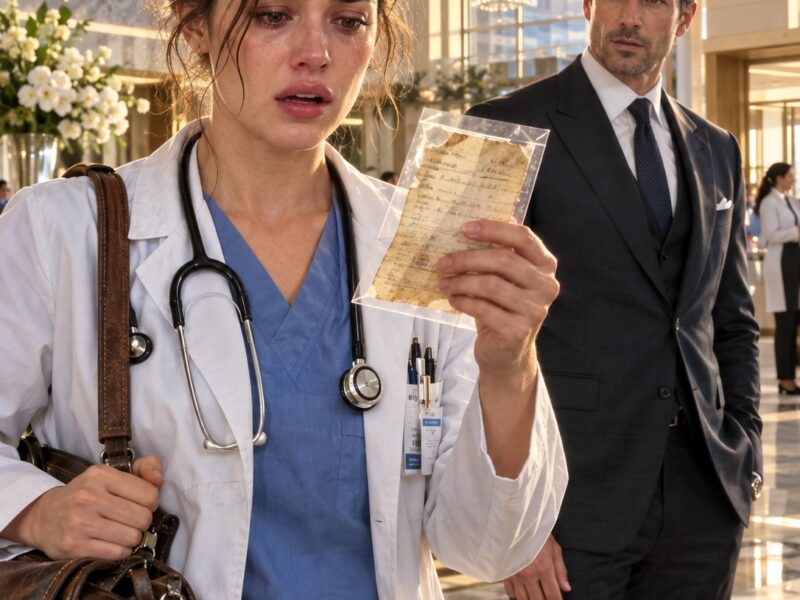
Dara pulled out a transparent plastic sleeve no larger than a credit card.
Inside was a yellowed rectangle of paper.
A pharmacy receipt.
Folded twice.
Everett’s chest tightened so sharply it hurt.
Dara opened the sleeve.
She unfolded the receipt.
The writing had faded.
But it was still legible.
His handwriting.
His twenty-four-year-old handwriting.
WHEN THE WORLD TELLS YOU THAT YOU DON’T BELONG, REMEMBER THAT SOMEONE ONCE BELIEVED YOU DID.
Everett stared.
Dara’s voice broke.
“You told me to keep it until I didn’t need it anymore.”
He could not speak.
“So I kept it.”
For twenty-two years, Everett had carried a memory.
Dara had carried proof.
He sat down.
Not elegantly.
Not like a billionaire hospital founder.
Like a man whose knees had stopped cooperating.
“You kept it all this time?”
Dara laughed through her tears.
“All this time?”
She looked almost angry now.
“You think this was just a piece of paper?”
Everett looked up.
Dara held the receipt against her chest.
“My mother got better that night.”
Everett closed his eyes briefly.
“For a while.”
His eyes opened.
Dara nodded.
“We had four more years.”
The answer hit him with unexpected force.
“She had lupus. Kidney complications later.”
“I’m sorry.”
“Don’t.”
Dara wiped her face.
“Please don’t say you’re sorry like you’re supposed to.”
Everett stayed quiet.
She looked toward the ICU.
“For four years after that night, Mom and I moved six times.”
Her voice had steadied, but only barely.
“We stayed with relatives. Friends. Once we lived in a motel for almost three months. There were weeks she couldn’t work. I did homework in laundromats because the motel room didn’t have a table.”
Everett listened.
“I applied to college and almost didn’t go because I thought working full time was more responsible. Mom found this.”
She lifted the receipt.
“She’d kept it in a jewelry box.”
Everett looked at the paper.
“She told me some stranger had believed in me before I’d done anything to deserve it. She asked why I was working so hard to prove him wrong.”
Everett lowered his head.
Dara smiled painfully.
“She could be manipulative when necessary.”
“What happened?”
“I went to college.”
“Scholarship?”
“Mostly.”
“Mostly?”
“Three jobs.”
Everett looked at her.
She shrugged.
“You said harder wasn’t impossible.”
He remembered saying it.
He had no idea she would build her life around it.
Dara continued.
“When Mom died, I almost dropped out.”
“I’m sorry.”
This time she let him say it.
“I had an anatomy exam four days after the funeral.”
Everett’s expression tightened.
“I sat in the library until two in the morning and couldn’t remember anything I’d read. I thought, that’s it. I’m done.”
Dara looked down at the note.
“I took this out.”
Everett said nothing.
“I hated you a little that night.”
That startled him.
She smiled.
“I thought, who gives a seven-year-old something like this? You had no right to make quitting feel like disappointing somebody.”
Everett laughed softly.
Then his eyes filled.
Dara’s did too.
“I passed the exam.”
“Of course you did.”
“By two points.”
“Still counts.”
For a moment, twenty-two years seemed to collapse.
Then Dara looked at him differently.
The wonder left her expression.
Something sharper replaced it.
“Did you know?”
Everett felt the question before he understood it.
“When I applied here.”
“No.”
“When I interviewed?”
“No.”
“When they offered me the residency?”
“No.”
“Then when?”
He hesitated.
Wrong choice.
Dara immediately saw it.
“When?”
“The morning you arrived.”
Her face changed.
“You knew on my first day?”
“I suspected.”
“And then?”
“I checked your file.”
“You checked my file?”
“I needed to be certain.”
Dara took a step backward.
Everett rose.
“Dara—”
“You’ve known for weeks.”
“Yes.”
“And you didn’t tell me.”
“I had reasons.”
“Of course you did.”
Her voice cooled.
Everett recognized that tone.
Fear disguised as anger.
“I didn’t want you questioning how you got here.”
She stared at him.
“I didn’t.”
“I know.”
“Do you?”
“Yes.”
“Because right now I’m standing in a hospital with your name on the building while the billionaire who owns it tells me he’s secretly been watching me because he knew me when I was seven.”
Everett flinched.
Dara saw it.
She didn’t stop.
“Do you understand how that sounds?”
“I don’t own the hospital.”
“That’s the part you’re correcting?”
“No.”
She looked away.
“I didn’t intervene in your selection.”
“Can you prove that?”
Everett went quiet.
Dara closed her eyes.
“That’s what I thought.”
“No. You misunderstand.”
“Then explain it.”
“Your residency application was reviewed by a committee I don’t sit on. I had never seen your file before you entered the hospital. I can show you every record.”
“Would everyone else believe that?”
Everett did not answer quickly enough.
Dara laughed once without humor.
“Exactly.”
He stepped closer.
“I kept quiet because I wanted your career to remain yours.”
“Then why watch me?”
The question landed.
Everett had no professional answer.
Because none existed.
“I wanted to know who you became.”
Dara’s anger faltered.
Everett continued.
“I spent twenty-two years wondering whether you became a doctor. Whether you went to college. Whether your mother recovered. Whether you kept asking too many questions.”
A tear slipped down Dara’s cheek.
“I didn’t intend to interfere.”
“But you did.”
“How?”
“You let me talk to you. Work around you. Make mistakes in front of you while you knew something about me I didn’t know about you.”
Everett absorbed that.
She was right.
“I should have told you sooner.”
“Yes.”
“I was afraid.”
That stopped her.
The word sounded strange coming from Everett Vale.
“Of what?”
He looked at the old receipt.
“That it mattered more to me than it did to you.”
Dara’s anger vanished for one second.
Everett continued before courage failed.
“I remembered that night for twenty-two years. I had no idea whether you remembered it for twenty-two minutes.”
She stared at him.
His voice lowered.
“I thought if I told you and you looked at me like I was just some man who once gave you a sandwich…”
He stopped.
Dara whispered, “You built a hospital.”
Everett frowned.
“What?”
“Your promise.”
“My what?”
“No patient turned away because they’re poor.”
He stared at her.
Dara had read the hospital’s mission statement.
Everyone had.
But suddenly she understood something.
“That night changed you too.”
Everett looked through the glass toward Noah’s room.
“Maybe more than I admitted.”
Neither spoke.
Then a voice came from behind them.
“Dr. Vale.”
Hargrove stood at the end of the hallway.
His face revealed almost nothing.
But his eyes were fixed on the yellow receipt in Dara’s hand.
And Everett knew immediately that their secret was no longer theirs.
By the next morning, rumors had started.
Hospitals were no different from high schools when given the correct combination of prestige, fear, competition, and coffee.
No one knew the entire story.
That made it worse.
Someone had seen Dara crying with Everett.
Someone else had heard Hargrove request records from the residency committee.
By lunch, one version claimed Dara was a family friend.
Another claimed Everett had personally arranged her position.
A third implied something romantic.
Dara heard that one inside an elevator.
Two nurses were whispering behind her.
Neither realized who she was until she turned around.
Silence filled the rest of the ride.
Dara exited on the sixth floor with her spine straight.
She made it to an empty supply room before her hands began shaking.
Twenty-two years of fighting not to be dismissed.
Reduced to a rumor in less than twenty-four hours.
She wanted to blame Everett.
Part of her did.
But another part knew something uncomfortable.
He had been right to worry.
Hargrove called her into his office at 2:00 p.m.
Everett was not present.
Dara almost appreciated that.
Almost.
Hargrove closed the door.
“Sit.”
She remained standing.
“I’d rather not.”
“Fine.”
He folded his hands.
“I asked the residency committee to confirm the timeline of your application.”
“I had nothing to do with Dr. Vale before arriving.”
“I didn’t say you did.”
“You were going to.”
Hargrove’s expression hardened.
“This defensiveness isn’t helping you.”
Dara laughed softly.
“Respectfully, I don’t think anything helps me right now.”
He watched her.
“The records confirm Dr. Vale had no involvement in your acceptance.”
Dara’s shoulders loosened slightly.
“But.”
There it was.
Hargrove leaned back.
“Your prior relationship with the hospital founder creates a perception issue.”
“We met once when I was seven.”
“A meeting memorable enough that you carried a note from him for twenty-two years.”
Dara stared.
So he had heard everything.
“That didn’t get me into medical school.”
“No.”
“It didn’t earn my grades.”
“No.”
“It didn’t get me this residency.”
“No.”
“Then what’s the issue?”
Hargrove’s voice softened.
“The issue is that medicine is full of people who will question you even when they have no reason. You should understand that better than most.”
Dara did.
That was why the sentence hurt.
He continued.
“Your work must be beyond question.”
“It always has been.”
“Not yesterday.”
Dara went still.
“The Mercer surgery?”
“You spoke beyond the usual scope of a first-year resident.”
“I identified a complication.”
“You were correct. Being correct doesn’t erase hierarchy.”
“So I should have stayed quiet?”
“If you had been wrong—”
“Noah might have died if I had stayed quiet.”
Hargrove’s jaw tightened.
“Do not turn this into heroism.”
“I’m not.”
“Then learn the difference between courage and impulse.”
Dara felt anger rise.
“Would you be saying this if Dr. Vale hadn’t recognized me?”
Hargrove did not answer.
That was answer enough.
Dara walked out.
That evening, she submitted a request to transfer out of cardiology.
Everett learned about it ten minutes later.
He found her in the physician locker room hallway.
“You’re transferring.”
Dara kept walking.
“That’s the plan.”
“Why?”
She stopped.
“Do you genuinely need me to explain?”
“I can stop the rumors.”
“How?”
“A formal statement.”
“From the billionaire whose influence I’m supposedly exploiting?”
Everett exhaled.
“Dara.”
“I can’t build my career inside a room where everyone wonders which door you opened.”
“I didn’t open any.”
“I know that.”
“Then why leave?”
“Because knowing isn’t the same as living with it.”
Everett looked at her.
For once he had no argument.
Dara’s expression softened.
“This isn’t punishment.”
“It feels like it.”
“That’s because not everything is about what you deserve.”
The words hit him harder than she intended.
She saw it.
Still, she continued.
“I spent my whole life wanting to find you.”
Everett looked up.
Dara’s voice trembled.
“I searched clinic records when I was seventeen. I went back to Madison Street. The grocery store was gone. I tried to find old staffing lists from the emergency department.”
“You searched for me?”
“For years.”
Everett’s eyes stung.
“So don’t think I wish you hadn’t recognized me.”
“Then stay.”
“I can’t.”
“Why?”
“Because I need to know who I am when you’re not watching.”
Everett stood very still.
Dara walked away.
For six weeks, they barely spoke.
Dara transferred temporarily to pulmonary medicine.
Everett buried himself in surgeries, meetings, philanthropy, and a hospital expansion plan he suddenly found meaningless.
Noah Mercer recovered.
Slowly at first.
Then astonishingly well.
On the morning he walked down the pediatric hallway for the first time, he wore dinosaur socks.
Dara happened to be passing the unit.
Noah saw her.
“Doctor D!”
Before she could respond, he threw both arms around her.
Dara froze.
Then hugged him.
Grace stood behind him crying.
“He asked if the heart doctors fixed him forever.”
Dara crouched.
“No guarantees, buddy.”
Noah frowned.
“That’s a bad doctor answer.”
“It’s the only kind we’re allowed.”
“Can I play soccer?”
“Someday, if your cardiologist says yes.”
“Can I have ice cream?”
Dara looked at Grace.
“That sounds outside my jurisdiction.”
Noah grinned.
Then his expression became serious.
“My mom said you saw something everybody missed.”
Dara glanced at Grace.
Grace looked apologetic.
Dara turned back to Noah.
“Everybody saw different things. That’s why medicine uses teams.”
“Did you save me?”
“No.”
“Who did?”
Dara looked through the window.
Everett was standing at the far end of the corridor talking to a nurse.
She watched him for a moment.
“Lots of people.”
Noah considered this.
Then said, “That’s better.”
Dara smiled.
“Yeah.”
It was.
Two days later, an envelope appeared in Dara’s hospital mailbox.
No name.
Inside was a photocopy of the residency selection record.
Her scores.
Interview notes.
Committee ranking.
Dates.
Everett’s name appeared nowhere.
Attached was a handwritten message.
You never needed my door. You built your own.
Dara knew the handwriting immediately.
For an hour, she kept the note beside her keyboard.
Then she placed it inside the plastic sleeve with the first one.
That evening she went to Everett’s office.
The door was open.
He looked up.
Neither spoke for a moment.
Dara held up the new note.
“You’ve gotten worse at inspirational writing.”
Everett leaned back.
“Twenty-two years of administrative meetings.”
“It shows.”
He smiled.
She entered.
“I don’t want special treatment.”
“You won’t get it.”
“I don’t want people thinking I’m your project.”
“Neither do I.”
“I’m serious.”
“So am I.”
Dara sat across from him.
“I’ve been thinking about Walter.”
Everett frowned.
“The patient whose medication you bought?”
“Yes.”
“Why?”
“Because I shouldn’t have had to buy it.”
Everett waited.
“Vale Memorial promises not to turn poor people away.”
“It doesn’t.”
“Treatment isn’t just what happens inside the building. We stabilize people, discharge them, and sometimes send them home with prescriptions they can’t afford.”
Everett’s expression changed.
Dara recognized it.
The surgeon had disappeared.
The builder had arrived.
“What are you proposing?”
“I don’t know yet.”
“That’s usually a terrible opening for a proposal.”
She ignored him.
“Medication support. Transportation. Maybe a residency fund for students who are working second jobs. Housing grants.”
Everett stared at her.
Dara continued.
“You know what’s almost impossible about becoming a doctor when you’re poor?”
“Everything?”
“Good answer.”
He smiled.
“Tuition is obvious. People donate toward tuition. But nobody thinks about moving costs for residency interviews. Licensing fees. Exam prep. Buying your first decent suit. Losing three days of hourly wages because you need to travel.”
Everett’s smile faded.
He remembered.
Every item.
Dara leaned forward.
“Someone can be talented enough to become a surgeon and still lose because their car breaks down at the wrong time.”
Everett looked toward the skyline.
“How much?”
Dara blinked.
“What?”
“How much money do you need?”
“I haven’t even designed anything.”
“Fine. Design it.”
“You’re not listening.”
“I’m listening very efficiently.”
“I don’t want you writing a check because you feel guilty about a sandwich.”
Everett looked at her.
“Dara.”
“What?”
“I have spent twenty-two years building a hospital because of a sandwich.”
She stopped.
Everett’s voice grew quieter.
“Maybe it’s time I admitted that.”
Together, they created what eventually became the Bennett-Vale Opportunity Initiative.
Dara objected to the name for three months.
Everett refused to change it.
Their arguments became an unofficial source of entertainment for hospital administrators.
The program did more than cover tuition.
It paid licensing fees.
Interview travel.
Emergency rent.
Childcare.
Books.
Professional clothing.
Counseling.
Mentorship.
Unexpected expenses that wealthier students absorbed without ever noticing.
Everett committed twenty-five million dollars.
Dara’s reaction was immediate.
“That’s ridiculous.”
“I’ve spent more on surgical equipment.”
“Equipment doesn’t argue with you.”
“Exactly. That’s why you’re more expensive.”
The initiative launched quietly.
No gala.
No press conference.
Dara insisted.
The first recipients arrived the following summer.
Twelve students.
Different ages.
Different backgrounds.
All brilliant.
All carrying some version of the fear Dara remembered.
One young woman named Camille Johnson arrived forty minutes early for orientation.
She stood outside the main entrance holding a worn backpack with both hands.
Dara noticed her from the lobby.
For several seconds she simply watched.
Camille stared at the marble floors, the massive staircase, the people in white coats.
She had the expression of someone waiting to be told there had been a mistake.
Dara walked outside.
“Camille?”
The woman startled.
“Yes.”
“I’m Dr. Bennett.”
“I know.”
Dara smiled.
“That’s slightly alarming.”
Camille flushed.
“I read about the program.”
“Good things, I hope.”
“Mostly.”
Dara laughed.
Camille looked toward the hospital.
“I think I’m too early.”
“You’re forty minutes early.”
“I’m sorry.”
“Why?”
“I didn’t want to be late.”
“Being early isn’t a criminal offense yet.”
Camille adjusted her backpack.
Dara noticed one strap had been repaired with black thread.
For one second, she couldn’t breathe.
Rain.
A broken streetlamp.
A sandwich.
A stranger with terrible hair.
Dara placed a hand gently on Camille’s shoulder.
“Come inside.”
Camille hesitated.
“I don’t know if I belong here.”
There it was.
Twenty-two years folding itself into a single sentence.
Dara looked through the glass.
Everett stood inside the atrium.
He had stopped walking.
He knew.
Of course he knew.
Dara turned back to Camille.
“You’re going to feel that way more than once.”
Camille looked frightened.
“That’s not very reassuring.”
“No.”
Dara smiled.
“But here’s what I learned.”
She reached into her old medical bag.
Her fingers touched the plastic sleeve.
For years she had obeyed Everett’s instruction.
Keep this until you don’t need it anymore.
Dara finally understood that he had been wrong about one thing.
There would never come a day when people stopped needing words like those.
You did not outgrow them.
You passed them forward.
Dara did not give Camille the original receipt.
That belonged to a rainy night between two people who had needed each other without understanding why.
Instead, she took out a blank piece of paper.
She wrote eleven words.
She folded it.
And handed it to Camille.
The young woman opened it.
WHEN THE WORLD TELLS YOU THAT YOU DON’T BELONG, REMEMBER THAT SOMEONE ONCE BELIEVED YOU DID.
Camille read the sentence twice.
Then looked at Dara.
“Who?”
Dara smiled.
“Me.”
Inside the lobby, Everett lowered his head.
He laughed quietly.
Maybe he cried too.
Dara never asked.
That evening, long after orientation ended, she found Everett standing beside the windows overlooking the city.
The hospital was quieter now.
Sunset painted the buildings in copper and pale gold.
Dara stood beside him.
Neither spoke for a while.
Finally Everett said, “You gave it away.”
She understood what he meant.
“Not the original.”
“Good.”
“You sound possessive.”
“I wrote it.”
“You wrote it on a pharmacy receipt.”
“History is often poorly funded.”
Dara smiled.
Then silence returned.
Below them, ambulances moved through the city streets.
People were being born.
People were dying.
Someone was receiving terrible news.
Someone else was surviving something they had been certain would destroy them.
Medicine had taught both of them that miracles were unreliable things.
Some were dramatic.
A heart restarting.
A tumor disappearing.
A child surviving an operation that should have been impossible.
Others were so small nobody recognized them when they happened.
Half a sandwich.
A cheap jacket.
A few words written by a tired medical student who barely had enough money to take care of himself.
Everett looked at Dara.
“I need to tell you something.”
Her eyebrows rose.
“That usually goes badly for us.”
“Probably.”
He took a breath.
“For years I thought I failed you.”
Dara turned toward him.
“Why?”
“Because I never found you.”
“You were supposed to?”
“I said I’d remember.”
“You did.”
“Remembering felt useless.”
Dara looked down at the city.
“My mother used to say people confuse love with control.”
Everett waited.
“She said sometimes loving someone means helping them. Sometimes it means letting them walk away. And sometimes it means accepting that you may never know what happened after you were kind.”
Everett swallowed.
“She sounds smarter than both of us.”
“She was.”
Dara pulled the plastic sleeve from her medical bag.
The old receipt rested inside beside Everett’s newer note.
She held it beneath the fading light.
The ink was pale now.
The paper fragile.
Everett stared at his younger handwriting.
“I barely remember writing it.”
“I remember reading it.”
“Every word?”
“Every word.”
Dara looked at him.
“You didn’t fail me, Everett.”
It was one of the few times she called him by his first name.
His eyes lifted.
“You weren’t supposed to carry me for twenty-two years.”
She smiled.
“You just had to get me through one night.”
The simplicity of the sentence broke something open inside him.
All those years.
All the wondering.
All the quiet guilt.
He had imagined kindness as a promise that demanded completion.
Dara understood it differently.
Sometimes you held the door.
Someone else walked through it.
You did not need to follow them forever to prove the moment mattered.
Everett looked toward the hallway.
Camille and the other scholarship recipients had left hours earlier.
But he could still picture them entering the atrium that morning.
Twelve people who might become physicians.
Twelve lives intersecting hundreds of thousands of others.
And somewhere inside that chain was a rainy night nobody had witnessed.
“I thought I was helping you,” Everett said.
Dara slid the receipt back into the plastic.
“You were.”
“No.”
He looked at her.
“I mean that night.”
Dara waited.
Everett’s voice dropped.
“I thought I was the one helping you.”
Understanding passed through her expression.
She smiled.
“You were hungry too, weren’t you?”
He laughed.
“Very.”
“And you gave me half your dinner.”
“It was a terrible sandwich.”
“It was turkey.”
“It was mostly mustard.”
“It was perfect.”
They stood beside the glass while the final sunlight disappeared over Chicago.
Twenty-two years earlier, a poor medical student had looked at a frightened child beneath a broken streetlamp and seen someone worth believing in.
He had never imagined she would remember.
He had never imagined she would become a doctor.
He had certainly never imagined she would someday stand beside him inside a hospital bearing his name, after helping save a seven-year-old boy whose mother could not afford the care that kept him alive.
But perhaps that was the strange mathematics of kindness.
You could never calculate where it ended.
One person gave a sandwich.
One child kept a receipt.
One frightened girl became a physician.
One physician spoke up inside an operating room.
One little boy went home with a repaired heart.
Twelve students entered a hospital believing there might finally be room for them.
And somewhere years from now, one of them might stop beneath another broken streetlamp, notice another person everyone else had passed, and make a choice that seemed too small to matter.
Dara looked once more at the yellowed paper.
The world had told her many times that she didn’t belong.
Poverty had said it.
Grief had said it.
Elite classrooms had said it without words.
Whispers inside elevators had said it all over again.
But one rainy night, before she had credentials, achievements, a white coat, or any proof of what she might become, a stranger had told her something louder.
Someone believed she did.
Twenty-two years later, she no longer needed the sentence to believe in herself.
That was not why she kept it.
She kept it because somewhere outside those hospital windows was another child who had not heard it yet.
And Dara Bennett knew exactly what a few handwritten words could become when they reached someone at the right moment.
Sometimes the greatest miracles inside a hospital were measured in heartbeats.
Sometimes they began decades earlier, in the rain, when no one was watching.









