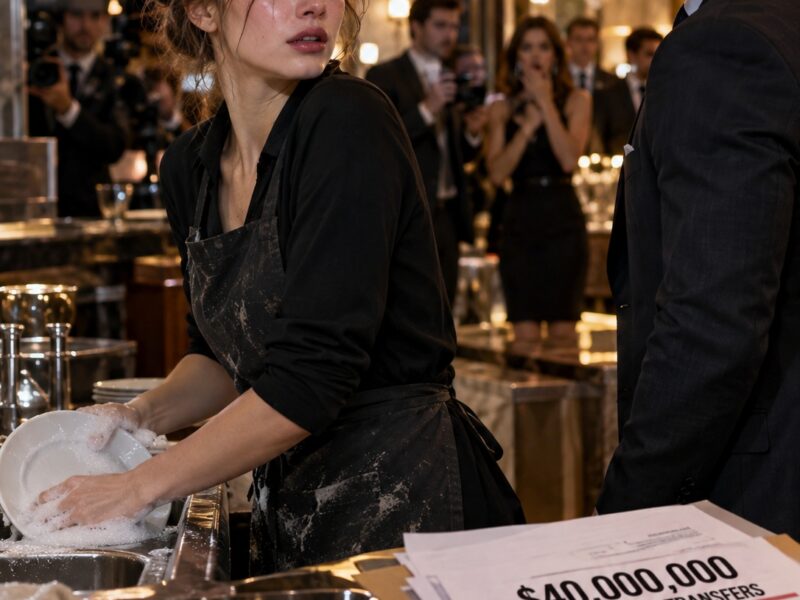
The Billionaire They Called a Thief Was Washing Dishes—Until the Man Who Framed Her Walked Into the Diner

The first time Caleb Carter saw Sophia Brooks cry, she was holding a declined credit card.
The second time, she was holding proof that could send her best friend to prison.
But six months before either of those moments, Sophia had been standing forty-two floors above Manhattan, inside a glass boardroom bearing her own last name, listening to twelve people decide whether she was a thief.
Forty million dollars.
That was the number printed across the first page of the folder.
Sophia stared at it.
Then at the chairman.
Then at Nathan Reed.
Her oldest friend.
Her chief financial officer.
The man who had helped her build Brooks Global Shipping from two borrowed desks and a secondhand laptop into one of the largest privately controlled logistics companies in America.
Nathan wouldn’t meet her eyes.
That frightened her more than the number.
“What is this?” Sophia asked.
Chairman Harold Whitmore folded his hands on the polished walnut table.
“Unauthorized transfers.”
“I can read, Harold.”
Her voice remained controlled, but she could hear her own pulse.
“What I’m asking is why my name is on them.”
No one answered immediately.
Rain crawled down the glass walls behind them, turning Manhattan into a gray blur.
Sophia opened the folder.
Wire authorizations.
Vendor payments.
Electronic approvals.
Her digital signature.
Her executive credentials.
Page after page after page.
Forty million dollars had vanished from the company she had spent fifteen years building, and every document in front of her said she had taken it.
Sophia slowly looked at Nathan.
“Tell them.”
Nathan finally raised his head.
There was pain on his face.
Perfectly measured pain.
“I don’t know what you want me to say.”
Her fingers tightened around the folder.
“Tell them I didn’t do this.”
Nathan exhaled.
“Sophia…”
“Tell them.”
The room became still.
He looked down.
“I wanted to believe there was an explanation.”
Something inside her went cold.
Not broken.
Not yet.
Cold.
“You wanted to believe?”
Nathan rubbed a hand over his jaw.
“The records are extensive.”
Sophia stared at him.
For fifteen years, Nathan Reed had been the person she called when something went wrong.
When their first warehouse deal nearly collapsed, Nathan had slept on the office floor beside her.
When the company almost missed payroll during their fourth year, they had sold their cars before they let a single employee go unpaid.
When Sophia’s mother died, Nathan had sat in the back row at the funeral and stayed until everyone else had gone home.
He knew where she kept emergency passwords.
He knew which contracts she feared.
He knew which investors she distrusted.
He knew her.
Or she had believed he did.
“Did you know about these transfers?” she asked.
Nathan hesitated.
Only for a fraction of a second.
But Sophia noticed.
“I became aware of irregularities several weeks ago.”
Several weeks.
The words landed strangely.
“You knew for weeks?”
“I wanted to verify everything before accusing you.”
“Accusing me?”
“Sophia—”
“You sat ten feet from my office every day.”
Her voice finally cracked.
“You drank coffee with me Friday.”
No one moved.
Nathan’s expression softened.
That almost made it worse.
“I was hoping I was wrong.”
Sophia looked around the table.
Men and women who had toasted her at company anniversaries.
People who had praised her leadership in interviews.
Directors who had once called her the soul of Brooks Global.
Not one of them looked at her now.
Harold pushed another document forward.
“Pending a full forensic investigation, the board has voted to suspend you as chief executive officer.”
Sophia did not touch the paper.
“You already voted?”
Silence.
“Before speaking to me?”
More silence.
Her eyes returned to Nathan.
And suddenly she understood something.
She was not in that room to explain herself.
She had been invited to witness a decision already made.
Sophia stood.
Her chair rolled backward across the floor.
Nathan rose halfway.
“Sophia—”
She looked at him.
He stopped.
For one terrible moment, she wanted to ask the question frightened people always asked when betrayal was too large to understand.
Why?
Instead, she picked up her blazer.
“If you find out who did this,” she said quietly, “I hope you remember what all of you looked like today.”
Then she walked out.
No one followed.
The elevator doors closed.
Sophia watched her reflection in the mirrored wall.
Thirty-four years old.
Tailored cream blouse.
Diamond earrings.
Hair pinned perfectly.
The face of a woman business magazines had once called America’s youngest self-made billionaire in logistics.
She looked exactly like herself.
That was the terrifying part.
Because her life had disappeared in less than twenty minutes, yet her reflection hadn’t changed at all.
When the elevator reached the lobby, her phone began vibrating.
Then again.
Then again.
By the time she reached the revolving doors, she had twenty-three missed calls.
Outside, cameras were already waiting.
“Sophia!”
“Ms. Brooks!”
“Did you steal company funds?”
“Are federal investigators involved?”
“Is the forty-million-dollar figure accurate?”
“How long have you been moving money offshore?”
She froze.
The board meeting had ended less than five minutes earlier.
The press already knew.
Someone had told them before she walked into the room.
Sophia turned toward the building.
Forty-two floors above her, behind mirrored glass, she could see nothing.
But for the first time, one question pushed through the shock.
Who had needed the world to believe she was guilty this quickly?
Her driver opened the rear door.
Sophia climbed inside.
“Home?”
She looked at the crowd surrounding the car.
“No.”
“Where would you like to go?”
She had no answer.
So the car simply drove.
By noon, the story was everywhere.
By two, commentators who had once praised her were discussing whether ambition had “corrupted” her.
By four, anonymous sources were describing her as controlling, secretive, obsessed with wealth.
At 5:17 p.m., her attorneys called.
At 5:42, two banks froze access to accounts connected to the investigation.
At 6:03, Sophia received a message from Richard Cole.
We need to talk.
Richard was supposed to become her husband in four months.
The invitations were printed.
The venue had been booked.
Sophia had spent three weeks choosing between two ridiculous shades of white for table linens because Richard insisted details mattered.
She called him.
Straight to voicemail.
Again.
Voicemail.
Then her phone lit up with a news alert.
RICHARD COLE ADDRESSES FIANCÉE’S FRAUD SCANDAL.
Sophia stopped breathing.
She opened the live feed.
Richard stood outside the Beaumont Hotel beneath a forest of microphones.
He wore the navy suit she had bought him for his birthday.
A reporter shouted, “Mr. Cole, do you still intend to marry Sophia Brooks?”
Richard lowered his eyes.
Sophia knew that expression.
He used it when he wanted cameras to believe he was suffering.
“I’m shocked by what’s happening.”
Sophia stared at the screen.
Richard continued.
“I honestly don’t know who Sophia really is anymore.”
Her driver glanced at her through the mirror.
She didn’t move.
“Under these circumstances,” Richard said, “I can no longer continue this relationship.”
Camera flashes exploded.
Someone shouted another question.
Sophia heard none of it.
She switched off the phone.
The company could be rebuilt.
Money could be earned again.
A reputation could be repaired if the truth survived long enough.
But there was something uniquely cruel about discovering that the man who had promised to stand beside you for life required less than one day of bad headlines to decide you were no longer worth standing beside.
Sophia turned toward the rain-covered window.
“Stop the car.”
“Ms. Brooks?”
“Stop.”
The driver pulled over.
Sophia got out.
“Take the car home.”
“But—”
“I said take it home.”
She walked away before he could argue.
For the first time in fifteen years, Sophia Brooks had no assistant waiting for instructions.
No security detail.
No board meeting tomorrow.
No fiancé.
No office.
And, increasingly, no access to the money everyone believed defined her.
She went home long enough to pack one bag.
Then she took another car from the garage and drove.
She did not know where.
That was the point.
For years, every hour of Sophia’s life had existed on a calendar.
Now there was nothing.
She drove north, then west.
The skyscrapers disappeared.
The interstate narrowed.
Rain became harder.
Her phone kept vibrating until she turned it off and threw it onto the passenger seat.
She drove through towns whose names she didn’t remember.
Gas stations.
Dark farms.
Closed hardware stores.
Church steeples.
Places where nobody cared about quarterly earnings.
Sometime after midnight, the engine warning light came on.
Sophia kept driving.
Ten miles later, the car shuddered.
“No.”
It lost power.
“No, no, no.”
She guided it onto the shoulder.
The engine died.
Sophia sat behind the wheel while rain hammered the windshield.
Then she laughed.
It came out wrong.
Half laugh.
Half sob.
Of course.
Of course the car had broken down.
Why shouldn’t it?
She had lost forty million dollars she never stole, a company she built, a fiancé who apparently loved public opinion more than her, and now even the car had decided it wanted no part of her.
She rested her forehead against the steering wheel.
For the first time since the boardroom, Sophia cried.
Not elegantly.
Not silently.
She cried until her chest hurt.
When it stopped, she noticed a weathered roadside sign through the rain.
HARTWELL — 2 MILES.
Sophia picked up her bag.
And walked.
Hartwell looked like a town time had forgotten on purpose.
Old brick storefronts.
A pharmacy with a hand-painted sign.
A gas station with two pumps.
A church whose clock was five minutes slow.
Nobody recognized her.
Nobody pointed.
Nobody whispered.
That alone felt like mercy.
Then she smelled coffee.
Across the street, warm yellow light spilled from the windows of a small diner.
The wooden sign above the entrance read:
MASON’S DINER.
Sophia pushed open the door.
A bell chimed.
Three truck drivers glanced up and immediately went back to their food.
A waitress carried two plates past her.
“Sit anywhere, honey.”
Sophia nearly cried again.
Not because the woman had been kind.
Because she had been ordinary.
Sophia chose a stool near the end of the counter.
Behind it stood a tall man in a black apron.
Dark hair.
Blue eyes.
Sleeves rolled to his elbows.
He looked somewhere around thirty-six, maybe thirty-seven.
He poured coffee into a mug and placed it in front of her.
“You look like you need that.”
Sophia wrapped both hands around it.
“You have no idea.”
“Bad day?”
She almost laughed.
“Bad few months.”
He nodded as if that answer required no explanation.
“Then drink slowly.”
She looked at him.
“Why?”
“Because whatever you’re running from can wait ten minutes.”
Something in her chest shifted.
She looked down before he could see it.
The coffee was cheap.
A little too strong.
It was the best thing she had tasted all week.
When she finished, she opened her wallet.
One card.
The machine beeped.
DECLINED.
Sophia frowned.
“That’s strange.”
She tried another.
DECLINED.
Heat rushed into her face.
The man said nothing.
She checked for cash.
Seven dollars.
Not enough for everything he had put in front of her after noticing she was hungry.
“I’m sorry.”
She hated how small her voice sounded.
“The banks froze some things. I thought this card still—”
“Eat.”
Sophia looked up.
“What?”
He slid the card back.
“Eat first.”
“I can pay you tomorrow.”
“You don’t owe me anything.”
“You don’t know me.”
“No.”
He leaned against the counter.
“But I know you’re hungry.”
Sophia stared at him.
The man shrugged.
“Around here, that’s enough.”
For months, people had wanted something from Sophia Brooks.
Contracts.
Introductions.
Investments.
Access.
Influence.
A photograph.
A favor.
This stranger wanted nothing.
That frightened her almost as much as kindness moved her.
“Why?”
“Why what?”
“Why would you do that?”
He smiled.
“Because someone did it for me once.”
He extended his hand.
“Caleb Carter.”
Sophia looked at it.
Then shook it.
“Sophia.”
“No last name?”
She stiffened.
Caleb saw it.
And immediately lifted both hands.
“None of my business.”
He turned away to refill a coffee pot.
That was the moment Sophia decided to stay until morning.
Morning became three days.
Three days became a week.
On the second morning, Caleb found her downstairs before sunrise.
He held out a faded black apron.
“My dishwasher quit.”
Sophia stared at it.
“You’re serious?”
“Mostly.”
“I have never washed dishes professionally in my life.”
“Can you hold a plate?”
“Yes.”
“Without dropping it?”
“Usually.”
“You’re overqualified.”
For the first time in weeks, Sophia laughed.
The first hour was humiliating.
The second was exhausting.
By the third, she had soap in her hair, a burn on two fingers and a growing suspicion that plates reproduced when nobody was looking.
An older waitress named Marlene watched her struggle.
“City girl?”
“Is it that obvious?”
“Honey, you tried to polish a skillet.”
Sophia looked at the skillet.
“I thought it had stains.”
“It has twenty-three years of personality.”
Sophia laughed so hard she had to lean against the sink.
Nobody was laughing at her.
They were laughing with her.
There was a difference.
And Sophia had forgotten what it felt like.
Caleb paid her at the end of the shift.
Cash.
She tried to refuse.
“You worked.”
“You fed me.”
“You worked.”
“Caleb—”
He pushed the money into her hand.
“Don’t make kindness into debt, Sophia.”
She looked at him.
He had no idea who she was.
That became precious to her.
At Mason’s Diner, Sophia was not the accused billionaire.
She was the woman who stacked coffee cups wrong.
The woman who still couldn’t flip an egg.
The woman Marlene yelled at when she forgot table six wanted extra syrup.
She learned the names of the regulars.
Walter and June had eaten breakfast in booth four every morning for nineteen years.
Tom Briggs complained about football no matter who won.
Two middle-school boys named Tyler and Noah came in on Fridays and counted coins before ordering fries.
One afternoon, Sophia watched Caleb slip two pieces of apple pie onto their table.
“We didn’t order this,” Tyler said.
Caleb frowned theatrically.
“Kitchen made a mistake.”
Sophia looked at the perfectly cut slices.
Later she asked, “Does your kitchen make that mistake every Friday?”
“Terrible staff.”
“You’re the cook.”
“Exactly.”
She smiled.
In New York, Sophia had donated millions.
She had attended charity galas beneath crystal chandeliers.
Her name had appeared on hospital wings.
But Caleb gave away two pieces of pie and somehow made generosity look more human than anything she had done in years.
The weeks passed.
Sophia stopped checking the news every hour.
Then every day.
She began sleeping.
Not well.
But enough.
One afternoon she found Caleb surrounded by invoices.
He looked miserable.
“Problem?”
“I have several.”
He pointed at the paperwork.
“They’re all printed on paper.”
Sophia sat opposite him.
“Let me see.”
Caleb pushed the stack toward her.
Five minutes later, Sophia frowned.
“Your produce supplier charged you twice on three invoices.”
“What?”
“And you’re ordering twelve percent more dairy than you use.”
He stared at her.
She continued.
“This maintenance contract is ridiculous. You’re paying for emergency coverage you don’t receive.”
“How can you tell?”
“Because they charged you separately for two emergency calls.”
Caleb leaned back.
“Who are you?”
Sophia stopped.
The question had been playful.
But it touched something dangerous.
“I used to work with numbers.”
“Apparently.”
She reorganized his expenses.
Renegotiated two vendor schedules.
Showed him how to track food waste.
Within a month, Mason’s was saving enough money that Caleb could breathe again.
He never pushed her about her past.
That made keeping it from him harder.
One night, after closing, they sat on the back steps eating leftover apple pie.
Caleb looked toward the stars.
“My dad used to say this place fixes broken people.”
Sophia smiled faintly.
“Did it fix you?”
“Eventually.”
“What broke you?”
“My dad dying.”
She turned toward him.
Caleb’s expression changed.
“He built this diner. Not literally alone, but close enough. When he got sick, I came home thinking I’d help for six months.”
“How long ago?”
“Seven years.”
“And you stayed.”
“Someone had to.”
Sophia looked through the kitchen window at the worn booths and old coffee machine.
“You love this place.”
“Some days.”
“Other days?”
“I’d sell it to the first idiot with cash.”
She laughed.
Caleb smiled.
“But then morning comes. Walter complains about his eggs. June steals half his bacon. Kids come in before school. And I remember why I’m here.”
Sophia lowered her eyes.
“What about you?”
She froze.
“What about me?”
“What are you running from?”
The night seemed to become quieter.
She could have told him.
She almost did.
About Nathan.
Richard.
The board.
Forty million dollars.
The headlines.
But if she said the name Sophia Brooks, something between them would change.
She was certain of it.
“I had a life,” she said finally.
Caleb waited.
“I thought it was permanent.”
“What happened?”
“I found out permanent is a word people use when things are going well.”
He studied her.
She looked away.
“It’s a long story.”
“Okay.”
“And not a good one.”
“Okay.”
Sophia frowned.
“You’re not going to ask?”
“No.”
“Why?”
“When you’re ready, you’ll tell me.”
That simple sentence hurt more than pressure would have.
She reached for his hand.
Caleb looked down at their fingers.
Then at her.
Neither moved away.
The kiss came quietly.
No dramatic confession.
No perfect line.
Caleb leaned closer.
Sophia closed the distance.
For a few seconds, the woman who had once negotiated billion-dollar deals forgot everything except the warmth of a man’s hand against her cheek.
When they separated, Caleb smiled.
“So…”
Sophia laughed softly.
“So.”
“You planning on disappearing tomorrow?”
“Not tomorrow.”
“Good.”
But the past had already started looking for her.
It arrived in a produce truck.
Hank Doyle had delivered vegetables to Mason’s for years.
That Thursday, he walked into the diner, accepted a coffee from Marlene, then glanced through the kitchen window.
Sophia was washing a skillet.
Hank froze.
She noticed.
“Everything okay?”
He stared.
“I know you.”
Sophia felt the blood leave her face.
Caleb looked over.
Hank stepped closer.
“No way.”
“Hank?”
He pointed at Sophia.
“You’re Sophia Brooks.”
The diner went silent.
Marlene stopped pouring coffee.
Caleb’s eyes moved slowly toward Sophia.
Hank’s voice grew louder.
“The billionaire. From television.”
Sophia closed her eyes.
There it was.
The name she had escaped.
Caleb said quietly, “What is he talking about?”
Sophia removed her gloves.
“My name is Sophia Brooks.”
Caleb stared.
“The Sophia Brooks?”
“Yes.”
“The woman accused of stealing forty million dollars?”
She swallowed.
“Yes.”
Caleb took half a step backward.
That hurt.
Not because he condemned her.
Because she saw confusion where trust had been.
“You knew this whole time,” he said.
“I wanted to tell you.”
“But you didn’t.”
“I was afraid.”
“Of what?”
“That you’d start looking at me the way you’re looking at me now.”
His face changed.
Sophia continued before she lost the courage.
“This was the first place where nobody wanted anything from me. Nobody cared what I owned. Nobody asked whether I was guilty. You gave me food when my card wouldn’t work without even knowing my last name.”
Caleb’s jaw tightened.
“So you thought lying was the way to protect that?”
“I didn’t lie about who I was with you.”
“You left out a fairly significant detail.”
“I know.”
Hank stepped back.
“I’m sorry. I didn’t mean—”
Sophia shook her head.
“It wasn’t going to stay hidden forever.”
She looked at Caleb.
“But I wish you’d heard it from me.”
“So do I.”
By sunset, Hartwell knew.
By morning, America knew where she was.
Television vans appeared outside Mason’s.
Reporters bought coffee they didn’t want.
Photographers waited across the street.
Sophia could have left.
Caleb suggested it.
She refused.
“I’ve spent months running.”
She tied on her apron.
“I’m done.”
At 2:13 that afternoon, the bell above the door rang.
Sophia looked up.
And saw Richard Cole.
Then Nathan Reed.
For a moment, she wondered whether she had imagined them.
Richard’s expensive coat looked absurd inside Mason’s.
Nathan looked exactly as he always had.
Perfect suit.
Perfect posture.
Perfect concern.
“Sophia.”
Nathan smiled.
“We’ve been worried.”
She almost laughed.
“Have you?”
Richard looked at her apron.
His expression contained something worse than pity.
Embarrassment.
“This is where you’ve been?”
Sophia dried a plate.
“Yes.”
“You’ve been washing dishes?”
“Yes.”
Richard lowered his voice.
“Sophia, look at yourself.”
She did.
Black apron.
Cheap shoes.
A small burn on her wrist.
Soap beneath one fingernail.
She had never felt less ashamed.
Nathan stepped forward.
“The board wants to resolve things.”
“Interesting.”
“You still hold significant voting shares.”
There it was.
Sophia became very still.
Richard continued.
“They want you to sign them over temporarily so the company can move forward.”
Sophia looked at Nathan.
Four hours.
Nathan Reed had driven four hours from Manhattan to a diner in Hartwell because he wanted her signature.
For months, Sophia had believed he had won.
Now she saw something else.
Fear.
Tiny.
Hidden.
But there.
“What exactly am I signing?”
Nathan’s smile tightened.
“Nothing complicated.”
“Then explain it.”
“Sophia—”
“Explain why you came personally.”
Richard sighed.
“Don’t make this difficult.”
Caleb stepped from behind the counter.
Richard looked at him.
“And you are?”
Caleb wiped his hands on a towel.
“The guy who fed her when her cards stopped working.”
Richard stared.
Caleb continued.
“The guy who watched her work twelve-hour days when she didn’t have to. The guy who watched her help this diner without asking for anything.”
Richard’s face hardened.
“You don’t know her.”
Caleb glanced at Sophia.
“Maybe not the way you did.”
Then he looked back at Richard.
“But I knew enough to believe she deserved a meal before I knew whether she was important.”
Silence.
Sophia felt tears threaten her eyes.
Nathan interrupted.
“This is irrelevant.”
“No,” Sophia said.
Everyone looked at her.
“I think it’s extremely relevant.”
She untied her apron.
Nathan’s gaze followed her hands.
Sophia reached into the pocket.
And removed a flash drive.
She placed it on the counter.
Nathan stopped breathing.
There.
That was the moment.
The first crack.
Sophia saw it.
Richard did not.
Caleb did.
“What is that?” Nathan asked.
Sophia smiled.
“You tell me.”
“I have no idea.”
“Two years of vendor records.”
Nathan’s face remained controlled.
“Wire transfers.”
His jaw tightened.
“Approval logs.”
Richard turned toward him.
“Nathan?”
Sophia continued.
“Shell companies. Duplicate invoices. Modified authentication records. Accounts routed through Delaware, Nevada and the Cayman Islands.”
Nathan’s skin turned pale.
“You’re bluffing.”
“No.”
“You don’t have access.”
“I had limited access.”
“Not enough.”
“That was your mistake.”
Nathan stared at her.
Sophia stepped closer.
“You thought because I disappeared, I stopped thinking.”
Nobody inside Mason’s moved.
“You thought I was broken.”
Her voice remained quiet.
“You were almost right.”
Nathan’s eyes flicked toward the flash drive.
Sophia saw it.
And suddenly the last six months rearranged themselves inside her mind.
“I spent fifteen years working beside you,” she said. “Do you know what that means?”
Nathan said nothing.
“It means I know how you organize information. I know which vendors you trusted. I know how you structure emergency transfers. I know you hate deleting records because you believe deleted records create suspicion.”
Richard looked from one to the other.
“What is she saying?”
Sophia didn’t look away from Nathan.
“He stole the money.”
Richard went still.
Nathan laughed once.
Too quickly.
“This is ridiculous.”
“You stole forty million dollars from Brooks Global.”
“Sophia—”
“And you made sure every trail pointed toward me.”
“You’re delusional.”
“Am I?”
She pushed the flash drive toward him.
“Then why are you afraid to touch that?”
Nathan stared at it.
Nobody spoke.
Sophia almost whispered the next words.
“I sent copies to two board members and an independent forensic accountant at 8:12 this morning.”
Nathan’s face collapsed.
Not completely.
Just enough.
Richard saw it.
“Nathan?”
Nathan turned.
“You don’t understand.”
Richard’s expression changed.
“What don’t I understand?”
Nathan backed away.
Sophia watched the man she had trusted for fifteen years search the room for an escape.
For once, there wasn’t one.
The following morning, Brooks Global’s board met before sunrise.
By 7:30, Nathan was suspended.
By 8:15, security escorted him from the executive floor.
By nine, federal investigators had requested records.
And by noon, the same networks that had spent months showing Sophia’s photograph beneath the word FRAUD had found a new headline.
SOPHIA BROOKS CLEARED AS EVIDENCE POINTS TO CFO NATHAN REED.
People who had called her greedy began calling her brave.
Commentators apologized.
Former friends sent messages.
Investors who had disappeared suddenly remembered her phone number.
Sophia ignored most of them.
She was washing coffee cups when Caleb showed her the headline.
“They cleared you.”
She looked at his phone.
Then returned to the sink.
“Aren’t you going to say something?”
Sophia rinsed the cup.
“I thought this would feel bigger.”
“What does it feel like?”
She considered the question.
“Quiet.”
Caleb leaned against the counter.
“Quiet can be good.”
She looked around Mason’s.
Marlene was arguing with a customer about pie.
Walter was stealing bacon from June’s plate while insisting he wasn’t.
Coffee was brewing.
Someone laughed.
Sophia smiled.
“Yes.”
Quiet could be very good.
But peace lasted less than twenty-four hours.
The next morning, a black sedan stopped outside.
Richard stepped out alone.
He entered Mason’s carrying a small velvet box.
Sophia recognized it immediately.
Her engagement ring.
The entire diner seemed to sense what was happening.
Richard approached the counter.
“I made a mistake.”
Sophia said nothing.
“I was scared.”
Still nothing.
“I believed what everyone was saying.”
“Yes.”
He flinched.
“I should have believed you.”
“Yes.”
“Sophia, please.”
His eyes filled with tears.
“I never stopped loving you.”
He placed the ring on the counter.
For several seconds, Sophia stared at it.
Months earlier, that ring had represented her future.
Now it looked strangely small.
She pushed it back.
Richard’s face broke.
“The man I loved,” Sophia said, “believed strangers before he believed me.”
“I know.”
“You didn’t ask me one question.”
“I know.”
“You didn’t come to my house.”
“I was confused.”
“You went on television.”
He closed his eyes.
Sophia’s voice softened.
“I don’t hate you.”
Richard looked up.
“That would probably be easier.”
She glanced toward Caleb.
He stood near the kitchen doorway.
He wasn’t interfering.
Wasn’t claiming her.
Wasn’t asking her to choose.
He was simply there.
Sophia looked back at Richard.
“When I had everything, you loved being beside me.”
Richard swallowed.
“When I had nothing, Caleb gave me dinner.”
Tears rolled down Richard’s face.
“Sophia…”
“I thought losing the company meant I had lost my life.”
She reached for Caleb’s hand.
“But losing everything showed me what was real.”
Richard stared at their hands.
Sophia squeezed Caleb’s fingers.
“My future isn’t behind me anymore.”
Richard picked up the ring.
At the door, he stopped.
“I lost the best thing that ever happened to me.”
Sophia’s eyes filled.
But she did not call him back.
The bell rang.
The door closed.
And sometimes, Sophia would remember that sound more clearly than the boardroom accusation.
Because one door closing could sound exactly like freedom.
Spring came slowly to Hartwell.
Nathan’s case expanded as investigators uncovered more transactions.
The board formally cleared Sophia and asked her to return as CEO.
She accepted.
On one condition.
Hartwell remained part of her life.
Three days a week, she returned to Manhattan.
The rest belonged to the town that had known her when she had nothing worth exploiting.
Mason’s Diner had problems of its own.
Caleb had hidden most of them.
The bank was closer to foreclosure than he admitted.
Sophia discovered it accidentally.
She paid the outstanding debt.
When Caleb found out, he was furious.
“You can’t solve everything with money.”
“I know.”
“Then why did you do this?”
“Because I’m not buying your diner.”
She placed the deed into his hands.
“I’m protecting the place that saved my life.”
Caleb looked down at the papers.
Then at her.
“You saved this place too.”
Sophia smiled.
“Then we’re even.”
“No.”
He stepped closer.
“I don’t think we’re ever going to be even.”
A few weeks later, Caleb asked her to stay after closing.
He led her behind the diner.
String lights glowed between the trees.
Sophia stopped.
“Caleb.”
“Don’t panic.”
“That sentence has never stopped anyone from panicking.”
He laughed.
Then reached into his jacket.
Sophia covered her mouth.
The ring was simple.
Nothing like Richard’s.
Smaller diamond.
Plain band.
Caleb looked almost embarrassed by it.
“I know you can buy something bigger.”
Sophia’s eyes filled.
“I know you’ve had rings that cost more than this diner.”
“Caleb—”
“But this one isn’t for cameras.”
He lowered himself onto one knee.
“It isn’t for magazines.”
Behind the kitchen door, Sophia heard something fall.
Caleb glanced toward it.
“Marlene, if you’re spying, at least be quiet.”
Muffled laughter erupted.
Sophia began crying.
Caleb looked up at her.
“This one is just for forever.”
She didn’t let him finish whatever speech he had planned.
“Yes.”
He blinked.
“I had another paragraph.”
“Yes.”
“You sure?”
Sophia dropped to her knees and wrapped her arms around him.
“Yes.”
The wedding happened behind Mason’s Diner.
No celebrity photographers.
No corporate sponsors.
No six-figure flower arrangements.
White folding chairs.
Food cooked by neighbors.
Children running through the grass.
Hank Doyle arrived in his delivery uniform.
Marlene cried harder than anyone.
Walter complained that the ceremony was interrupting dinner.
June told him to shut up.
Sophia laughed through most of her vows.
Then cried through the rest.
Months later, she was back in Manhattan negotiating an acquisition worth nearly a billion dollars.
She sat at the head of the same boardroom table where she had once been accused.
The directors listened differently now.
Sophia did too.
She trusted evidence before titles.
Character before reputation.
Actions before promises.
Nathan had taught her what betrayal looked like.
Richard had taught her how fragile conditional love could be.
But Hartwell had taught her something neither money nor humiliation could have taught her.
Being needed was not the same as being loved.
Being admired was not the same as being known.
And being surrounded by people did not mean any of them would remain when the room became dark.
One autumn morning, Sophia returned to Hartwell before sunrise.
Caleb found her inside the diner kitchen wearing the old black apron.
She stood at the sink washing a coffee cup.
He leaned against the doorway.
“You know we own a dishwasher.”
Sophia smiled.
“I know.”
“And you’re the CEO of a company with more than twenty thousand employees.”
“I know.”
“Some of them would probably be concerned if they saw you doing this.”
Sophia rinsed the cup.
“Then don’t tell them.”
Caleb walked over.
He slipped his arms around her waist.
“Why do you still wash dishes?”
Sophia looked down at her hands.
Once, those hands had signed billion-dollar contracts.
They had shaken beneath a boardroom table while people accused her of theft.
They had held a phone while the man she planned to marry abandoned her before millions of strangers.
They had scrubbed grease from pans for minimum wage.
They had sorted receipts late at night.
They had uncovered the evidence that destroyed Nathan’s lie.
They had held Caleb’s when she finally understood what loyalty actually felt like.
Sophia placed the cup on the drying rack.
“Because I don’t ever want to forget.”
“Forget what?”
She turned.
Caleb’s hair was messy.
His shirt was wrinkled.
Coffee stained one sleeve.
He looked nothing like the men who used to appear beside her at charity galas.
Sophia smiled.
“That when I had nothing left to offer, you still gave me something.”
“A plate of eggs?”
“They weren’t very good.”
Caleb looked offended.
“They were excellent.”
“They were cold.”
“You arrived at midnight.”
“Excuses.”
He kissed her forehead.
Outside, the sky above Hartwell was beginning to brighten.
The first customers crossed the parking lot.
Coffee brewed behind them.
The old bell above the front door rang.
For a moment, Sophia remained exactly where she was.
Years earlier, she had believed success meant building something nobody could take away.
She had been wrong.
Companies could be taken.
Money could disappear.
Reputations could collapse before dinner.
People could promise forever in the morning and abandon you before sunset.
Nothing external was untouchable.
But some things survived because they had never depended on wealth in the first place.
A meal given without questions.
A hand offered without conditions.
A man who believed a frightened stranger deserved kindness before he knew whether she was innocent, guilty, poor, powerful, famous or forgotten.
Sophia had once possessed everything the world told her to want.
And she had nearly lost herself protecting it.
Then she lost everything.
And somewhere beside a highway, in a town she had never intended to visit, she found a diner with faded paint, burnt coffee, unpaid bills and a man who looked at a broken woman and saw someone worth feeding.
Sophia glanced at the black apron around her waist.
Then at Caleb.
“Ready?”
He reached for her hand.
“Always.”
Together, they walked toward the front of Mason’s Diner as morning sunlight spilled across the old wooden floor.
Behind them, one clean coffee cup rested upside down on the drying rack.
Sophia Brooks no longer washed dishes because she had nowhere else to go.
She washed them because once, when the entire world knew her name and decided that name meant thief, this little diner had known nothing about her—
and welcomed her anyway.
And some mornings, when the coffee was brewing and Caleb was beside her and nobody in Hartwell cared how many billions she controlled, Sophia still thought about the woman who had walked through that door with two declined cards and a ruined reputation.
She no longer hated that woman.
She no longer pitied her.
Because Sophia finally understood what she couldn’t have known that night.
The worst day of her old life had not been the day everything ended.
It had been the day everything that wasn’t real finally fell away.
And beneath it, waiting quietly in a place she never would have chosen for herself, was the life she had been too successful to know she needed.









