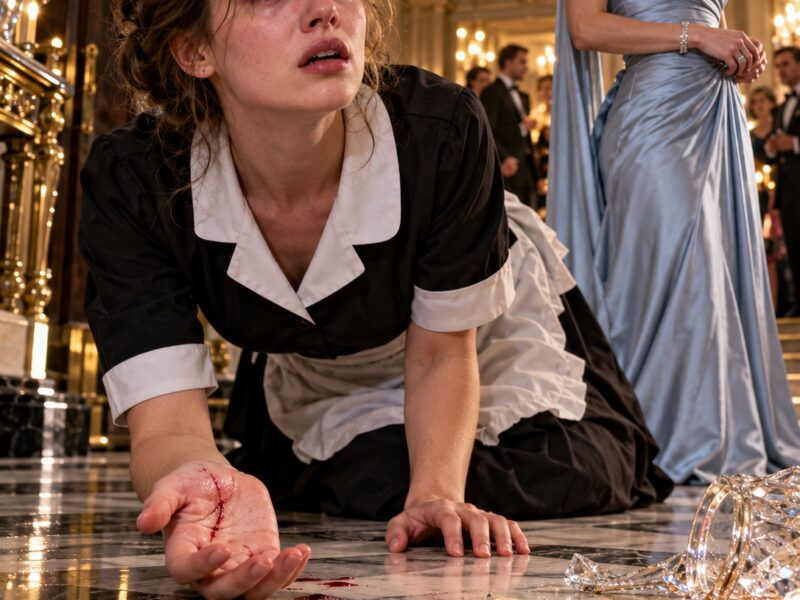
THE BILLIONAIRE’S FIANCÉE FRAMED A MAID FOR STEALING $2 MILLION IN DIAMONDS—BUT WHEN THE MAID WHISPERED HER REAL NAME, THE BRIDE TURNED DEATHLY PALE!

The first time Eleanor Bell realized Victoria Crane intended to destroy her, she was on her knees in a corridor full of broken crystal, staring at a diamond lily she had never seen before.
The second time, she was in handcuffs.
By the third, her ten-year-old brother had disappeared.
And yet the strangest thing about that winter was not that Eleanor nearly went to prison for a crime she had not committed.
It was that the woman trying to erase her had once saved her life.
The silver serving tray hit the marble floor of the Wickliffe estate with a sound sharp enough to cut through the music downstairs.
Four crystal glasses shattered.
Chamomile tea splashed across Eleanor’s black uniform.
A shard sliced the heel of her palm.
And something bright spun between the pieces.
A diamond brooch.
A lily.
Eleanor stared at it.
“What did you do?”
Victoria Crane’s voice cracked through the corridor.
Eleanor looked up.
Victoria stood above her in a pale-blue evening gown, one hand pressed dramatically against her chest. Her blonde hair had been arranged in soft, expensive waves. Diamonds glittered at her ears.
Downstairs, more than two hundred guests were celebrating her engagement to Sebastian Wickliffe, heir to one of the oldest private investment fortunes in New England.
Up here, there were no witnesses.
At least, there hadn’t been.
“I didn’t do anything,” Eleanor said.
Victoria’s expression changed.
Only for a second.
The fear vanished.
The polished society smile vanished.
Something colder looked out through her gray-green eyes.
Then she screamed.
“She stole it!”
Doors opened.
Footsteps sounded from the staircase.
Eleanor pushed herself upright, blood running over her wrist.
“What are you doing?”
Victoria dropped beside her.
To anyone coming down the hall, it might have looked as though she were helping Eleanor.
Instead, Victoria’s fingers closed around Eleanor’s apron.
Her perfume smelled of lilac and something bitter.
Then she whispered:
“You still remember me, don’t you?”
Eleanor froze.
Those eyes.
She knew those eyes.
Not from the Wickliffe estate.
Not from the six years she had worked there.
From somewhere colder.
Poorer.
Older.
A room filled with steam.
Metal beds.
Cheap soap.
A little girl rubbing the inside of her right wrist whenever she lied.
Eleanor’s breath stopped.
Before she could catch the memory, Sebastian appeared at the far end of the corridor.
“What happened?”
Victoria changed instantly.
Tears filled her eyes.
“Sebastian.”
She stumbled toward him.
“I caught her with my mother’s brooch. When I tried to stop her, she attacked me.”
Eleanor stared at her.
It was magnificent.
That was the terrible part.
The trembling voice.
The shaking fingers.
The wounded dignity.
Victoria Crane had learned how to perform innocence so perfectly that Eleanor almost questioned her own memory.
Sebastian did not.
His dark eyes moved from Victoria to Eleanor’s bleeding hand, then to the shattered tray.
“Eleanor?”
“I didn’t steal anything.”
“I saw her,” Victoria whispered.
“You saw me lighting the fireplace in your suite this afternoon. Mrs. Pratt sent me.”
“You were alone.”
“For ten minutes.”
“Long enough.”
Sebastian’s jaw tightened.
Eleanor had worked for his family since she was nineteen.
She had cleaned rooms containing jewelry worth more than she would earn in a lifetime.
She had once found a watch belonging to Sebastian’s father under a guest-room sofa and returned it before anyone knew it was missing.
She had handled Helena Wickliffe’s medication.
She knew the security codes to the east wing.
Six years.
Not one accusation.
Not one missing dollar.
Sebastian knew that.
Victoria knew he knew it.
Which was why she had planned something better than an accusation.
Helena Wickliffe arrived moments later.
Sebastian’s mother was seventy-two, silver-haired, elegant, and still capable of making hedge-fund managers twice her size lose their nerve with a glance.
She surveyed the corridor.
“What happened?”
Victoria repeated the story.
Helena listened.
Then asked one question.
“Where is the brooch?”
Everyone looked down.
It was gone.
Eleanor’s stomach dropped.
Victoria gasped.
“She took it.”
“No.”
“I saw her grab it when Sebastian arrived.”
“I didn’t.”
Helena looked at Eleanor.
“Empty your pockets.”
Eleanor hesitated.
Not because she had anything to hide.
Because suddenly she knew.
She reached into the right pocket of her apron.
Her fingers touched cold metal.
The diamond lily lay in her palm.
For the first time that night, Sebastian looked shaken.
Victoria covered her mouth.
Helena’s expression remained unreadable.
“Go to your room, Eleanor.”
“Mrs. Wickliffe—”
“Tonight.”
Eleanor looked at Sebastian.
He said nothing.
That hurt more than the cut in her hand.
She walked away while the orchestra downstairs began another song.
By midnight, champagne was being raised to Sebastian and Victoria’s future.
Eleanor sat alone in the staff wing wrapping gauze around her palm.
She tried not to cry.
Losing the job would be devastating.
But the job was not what frightened her.
Jaime was.
Her younger brother was ten.
Their mother had died when he was four, their father two years later.
Eleanor had been old enough to work.
Jaime had not.
He had ended up in St. Agnes Children’s Home outside Boston, an overcrowded privately contracted residential facility that Eleanor had spent years trying to get him out of.
Every month she visited.
Every month she brought something sweet.
Every month Jaime asked the same question.
“How much longer?”
“Soon.”
She had saved nearly eighteen thousand dollars.
Enough for a deposit on a small apartment.
Enough to pay the legal fees.
Enough, finally, to bring him home.
Eleanor dropped to her knees beside her bed and pulled out the wooden cashbox where she kept emergency documents and the money she had not yet deposited.
The lid was open.
The box was empty.
She stopped breathing.
Then she saw the envelope on her pillow.
No name.
No stamp.
Just seven handwritten words.
SAY ONE WORD AND JAIME PAYS FOR IT.
Eleanor sat down slowly.
Nobody at the Wickliffe estate knew about Jaime.
Nobody.
Or so she had believed.
At seven the next morning, Victoria entered without knocking.
She closed the door.
No makeup.
No jewelry.
No audience.
For the first time, Eleanor saw something almost honest in her face.
Fear.
“What did you do with my brother?”
“Nothing.”
“Where’s my money?”
“Safe.”
“Who are you?”
Victoria stared at her.
Then smiled faintly.
“You really don’t remember.”
That voice.
Beneath the polished vowels, Eleanor heard it.
A roughness on certain consonants.
A rhythm learned somewhere far from private schools and charity galas.
Then Victoria tilted her head slightly to the left.
And the past came back.
Steam.
A basement laundry room.
Eleanor was ten.
The institutional home where they lived then had industrial washing machines and old copper plumbing.
A boiler valve failed one February afternoon.
Eleanor slipped.
She remembered falling toward scalding water.
She remembered someone grabbing the back of her shirt.
They both crashed to the floor.
The other girl’s wrist struck an exposed steam pipe.
Skin burned.
The girl screamed.
Then laughed while crying because she was trying to make Eleanor stop panicking.
“You owe me forever, Nelly Bell.”
Eleanor whispered:
“Peg.”
Victoria’s face emptied.
“Peg Doyle.”
“Don’t.”
“Margaret Doyle.”
“We’ve never met.”
“You saved my life.”
“I said we’ve never met.”
Eleanor looked at her right hand.
Victoria always wore something over that wrist.
A glove at formal events.
A wide watch.
Bracelets.
Long sleeves.
Even in summer.
“You still have the scar.”
Victoria’s hand twitched.
That was enough.
The missing pieces began falling into place.
Margaret “Peg” Doyle had been twelve when she left the same residential home where Eleanor had grown up.
She had been hired as a companion for Victoria Crane, a chronically ill heiress whose parents were dead and whose guardian, Beatrice Hargrove, controlled a large trust.
The two girls had gone to Florence.
Only one had returned.
But the girl who returned called herself Victoria Crane.
Eleanor stared at the woman before her.
“What happened to the real Victoria?”
“Stop.”
“She died, didn’t she?”
Victoria stepped closer.
“You don’t understand anything.”
“Then tell me.”
“I can’t.”
“You’re marrying Sebastian under a dead woman’s name.”
Victoria’s eyes filled with something Eleanor had not expected.
Not guilt.
Not yet.
Exhaustion.
“You think people like us get second chances because we deserve them?”
Eleanor said nothing.
Victoria laughed once.
“You always were naive.”
“You stole someone’s life.”
“I survived.”
“Those aren’t the same thing.”
“They are when you’re hungry enough.”
Silence filled the tiny room.
Then Victoria’s expression hardened again.
“By noon you’ll be dismissed.”
“And Jaime?”
Victoria opened the door.
“That’s why you’re going to leave quietly.”
Eleanor did.
But not because Victoria had won.
She packed one bag.
Accepted her dismissal without defending herself.
Walked through the estate gates.
Then ran.
She caught the first bus toward Boston.
Changed twice.
Walked the last mile through dirty February snow.
By the time she reached St. Agnes, darkness had fallen.
The administrator barely looked up.
“Jaime Bell?”
He tapped on his computer.
“Transferred.”
Eleanor gripped the counter.
“Where?”
“Placement.”
“What placement?”
“Employment training program.”
“He’s ten.”
“Almost eleven.”
“Where is he?”
The administrator’s face closed.
“That’s confidential.”
Eleanor stared at him.
“When?”
“Two nights ago.”
The night of the engagement party.
Before Eleanor had even found the threatening note.
Victoria had not been warning her about what she might do.
She had already done it.
Eleanor walked around the building until she found one of Jaime’s friends taking trash to a dumpster.
The girl whispered that a contractor named Graves had taken him.
A man who used vulnerable children for illegal chimney and demolition work.
“He has a warehouse near the river.”
“Are you sure?”
The girl nodded.
“Boys go there.”
She hesitated.
“They don’t come back quickly.”
Eleanor reached the warehouse after midnight.
A green work van stood outside.
The building was locked.
Then she heard coughing.
“Jaime?”
Silence.
“Jaime!”
A tiny voice answered.
“Nell?”
Eleanor nearly collapsed.
She found a tire iron beside the van and attacked the padlock until it snapped.
Jaime was curled against sacks of insulation.
His face was gray with dust.
He was holding the wooden bird their father had carved him before he died.
One wing was crooked.
Their father had joked that imperfect things learned to fly harder.
Eleanor wrapped Jaime in her coat.
“I’m here.”
He clung to her.
“I knew you’d come.”
“Always.”
She led him outside.
Then stopped.
Seven flashlights appeared in the snow.
Police.
At their center stood Detective Dawson.
“Eleanor Bell?”
Her heart sank.
“You’re under arrest.”
“For what?”
“The theft of a diamond necklace belonging to Victoria Crane.”
“What necklace?”
“Two million dollars. Recovered beneath the floorboards of your room at the Wickliffe estate.”
Eleanor almost laughed.
Not because it was funny.
Because the trap was so complete.
Two officers grabbed her.
Another pulled Jaime away.
“No!”
Jaime screamed.
Eleanor fought hard enough that her injured palm reopened.
“Don’t touch him!”
“The boy is being returned to state custody.”
“He’s my brother!”
Jaime reached for her.
Their fingers met.
For one second.
Then slipped apart.
The wooden bird fell into the snow.
Jaime snatched it up before they dragged him away.
Eleanor was shoved into the police vehicle.
The door slammed.
And as the city lights slid across the barred window, one thought became impossible to ignore.
She had told nobody where she was going.
Yet the police had been waiting.
Victoria had known exactly what Eleanor would do.
Because Peg Doyle still knew her.
Even after fifteen years.
Eleanor spent the next four nights in county jail.
The prosecution’s case looked devastating.
The necklace had been found in her room.
The brooch had been found in her pocket.
She had fled immediately after being dismissed.
She had been arrested while allegedly removing a child from lawful custody.
The newspapers loved it.
MAID ROBBED BILLIONAIRE FAMILY.
ENGAGEMENT NIGHT THIEF CAUGHT.
Sebastian Wickliffe read every article.
And believed none of them.
Because he knew Eleanor.
Not romantically.
Not yet.
In quieter ways.
He remembered the night his father died and Eleanor had found him alone in the estate library at three in the morning.
She had not offered condolences.
She had simply placed a blanket beside him and left.
He remembered discovering that she repaired torn staff uniforms without charging anyone.
He remembered watching her return a hundred-dollar bill a guest had dropped beneath a dining table.
That woman might hide many things.
But greed was not one of them.
So Sebastian started asking questions.
Who had actually seen Eleanor steal the brooch?
Nobody.
Who saw her with the necklace?
Nobody.
Who had access to the staff rooms?
Dozens of people.
Who informed Dawson that Eleanor might run to Jaime?
Silence.
That question bothered him.
Another bothered him more.
How had Victoria known Eleanor had a brother?
Sebastian himself hadn’t known.
Then he began noticing details that had always been there.
Victoria avoided conversations about Florence.
She had surprisingly few childhood photographs.
She disliked anyone touching her right wrist.
Once, months earlier, a guest had casually mentioned a woman named Margaret.
Victoria had dropped her wineglass.
He had forgotten.
Now he remembered.
On the fourth day, Sebastian visited Eleanor.
She entered the interview room wearing handcuffs.
He had never seen her look so small.
Or himself feel so ashamed.
“Eleanor.”
She sat.
He remained across from her.
“That night, you asked Victoria whether you should tell me or she should.”
Eleanor’s pulse jumped.
“Tell me what?”
She pictured Jaime being dragged away.
Victoria’s warning returned.
One word.
Jaime pays.
“I can’t.”
Sebastian leaned forward.
“Do you trust me?”
That nearly destroyed her.
“Yes.”
“Then tell me.”
“I can’t.”
“Why?”
“I just can’t.”
He waited.
She lowered her eyes.
Finally he stood.
“Then I can’t help you.”
The door closed behind him.
Eleanor lasted five seconds.
Then she folded over her chained hands and cried.
She had just sent away the only powerful person who might believe her.
What Eleanor didn’t know was that Jaime had not been returned to St. Agnes.
Dawson delivered him back to Graves.
And Graves locked him in a basement.
Jaime survived because another boy remembered Eleanor.
Billy Hooper was eleven and had once tried to steal an apple outside St. Agnes.
Eleanor had paid the shopkeeper.
Then given Billy her scarf.
Nobody had ever done something like that for him.
Three nights after Jaime was locked up, Billy loosened a basement grate.
“Your sister’s the scarf lady?”
Jaime nodded.
“Then we’re leaving.”
The boys escaped through an alley.
Under an abandoned dock, Jaime told Billy something he had overheard.
A woman had visited Graves.
Expensive coat.
Blonde hair.
Graves had called her Miss Doyle.
She had snapped at him.
“Never call me that.”
Billy frowned.
“Doyle?”
Jaime knew that name.
Eleanor had told him stories about Peg.
The girl from the children’s home.
The girl with the scar.
The girl who saved Eleanor from the steam pipe.
“If she lived at St. Agnes,” Billy said, “there’ll be records.”
The boys looked at each other.
They were freezing.
Hungry.
Wanted.
And they had just decided to break into a government-contracted children’s facility.
At the Wickliffe estate, Helena was conducting her own investigation.
She remembered Eleanor once telling her about Peg Doyle.
The scar.
The laundry accident.
The childhood promise.
So Helena visited Eleanor.
“What do you know about Victoria Crane?”
Eleanor hesitated.
Then realized silence had protected nobody.
She told Helena everything.
When she finished, Helena asked only:
“Which wrist?”
“The right.”
Helena stood.
“Thank you.”
“Do you believe me?”
Helena paused.
“I believe evidence.”
Then she left.
That afternoon she called the family’s attorney.
Meanwhile, Jaime and Billy broke into the records office at St. Agnes.
They found the ledger.
MARGARET DOYLE.
Admitted age four.
Mother deceased.
Distinguishing mark: severe burn, right wrist.
Later transferred into private service as companion to Victoria Crane.
Destination: Florence, Italy.
Jaime tore the relevant photocopy from an archived file.
A security alarm sounded.
The boys ran.
Thirty-six hours later, exhausted and half-frozen, they arrived at the Wickliffe estate.
Sebastian met them in the service courtyard.
“You must be Jaime.”
Jaime held out the document.
“My sister didn’t steal anything.”
Sebastian read it.
Then read it again.
“I know.”
But Helena’s attorney had found something even more explosive.
A death certificate.
Victoria Crane had died in Florence four years earlier.
And there was a will.
Two days before her death, the real Victoria had left Margaret Doyle five hundred thousand dollars.
Not forty million.
Not the Crane fortune.
But enough to begin again.
Enough for college.
A home.
A future.
Margaret had never known.
Beatrice Hargrove had hidden the will.
She had been drowning in debt.
If Margaret returned to America as herself, Beatrice lost control of Victoria’s trust.
So she told a frightened young woman the one lie Margaret had been trained all her childhood to believe.
You’re nobody.
As Margaret, you’ll starve.
As Victoria, you’ll never be powerless again.
Beatrice created the new identity.
Margaret accepted it.
Then the lie grew.
Year after year.
Until she met Sebastian.
Marriage to the Wickliffe family would secure everything.
Then Eleanor recognized her.
So Beatrice and Margaret moved.
First the brooch.
Then Eleanor’s savings.
Then Jaime.
Then the necklace.
Dawson had planted it.
He had been taking payments from Beatrice for months.
Eleanor was never supposed merely to lose her job.
She was supposed to go to prison.
Possibly for decades.
And the only person alive who could expose Margaret would disappear behind concrete walls.
Sebastian stood beside the fireplace after hearing everything.
“I almost helped them.”
Helena said nothing.
“I doubted her.”
“You investigated.”
“After she was arrested.”
Helena’s gaze hardened.
“Guilt is useful only if it changes what you do next.”
Sebastian looked toward the window.
The wedding was scheduled for Saturday.
Eleanor’s arraignment was scheduled for the same morning.
Beatrice had arranged even that.
While Manhattan society watched Victoria Crane become Victoria Wickliffe, Eleanor Bell would be formally charged.
Helena asked:
“What do you intend to do?”
Sebastian’s answer was quiet.
“Nothing.”
His mother stared at him.
Then he continued.
“Not yet.”
Saturday morning arrived under heavy snow.
Eleanor was transported to court in shackles.
Reporters crowded the entrance.
Dawson sat near the prosecution table.
Beatrice Hargrove sat behind him.
She kept checking her watch.
Across the city, Margaret stood before a mirror in a white wedding gown.
A stylist pulled a satin glove over her right wrist.
Margaret rubbed the scar beneath it.
Once.
Twice.
At the courthouse, Eleanor was asked to enter her plea.
At St. Patrick’s Cathedral, the organ began.
At the courthouse, Dawson swore under oath that he had personally discovered the stolen necklace beneath Eleanor’s floorboards.
At the cathedral, Sebastian waited before hundreds of guests.
Eleanor stood.
“How do you plead?”
She opened her mouth.
Then a court officer approached.
“Ms. Bell?”
He handed her a folded note.
“A boy outside insisted you get this.”
Eleanor unfolded it.
The handwriting was crooked.
I’M SAFE.
TELL THEM EVERYTHING.
—JAIME
Her knees nearly failed.
She read it again.
And again.
Jaime was safe.
The weapon against her was gone.
Eleanor raised her head.
“Not guilty.”
The judge nodded.
Then Eleanor continued.
“And I know who planted the necklace.”
Dawson stopped smiling.
Beatrice’s hand tightened around her purse.
Eleanor looked directly at them.
“The woman calling herself Victoria Crane is not Victoria Crane.”
The courtroom exploded.
“Victoria Crane died in Florence four years ago.”
Beatrice stood.
Dawson moved toward the exit.
The doors opened.
Federal investigators entered.
Behind them walked Helena Wickliffe.
She placed the St. Agnes records, the death certificate, bank transfers, and Victoria’s will on the table.
“Your Honor,” Helena said, “I believe you’re going to want to see these.”
Less than an hour later, Eleanor walked out of the courthouse legally free.
But she wasn’t finished.
A Wickliffe car was waiting.
Helena opened the door.
“Get in.”
“Where are we going?”
Helena looked at the clock.
“To stop a wedding.”
The cathedral doors opened just as the officiant asked whether anyone knew of any lawful reason Sebastian and Victoria should not marry.
Cold air rushed inside.
Hundreds of heads turned.
Eleanor stood beneath the doorway.
No uniform.
No handcuffs.
Red marks still circled her wrists.
Margaret saw her.
And every drop of color disappeared from her face.
Eleanor walked down the aisle.
One step.
Then another.
Until she stood before the woman who had once been her friend.
The woman who had saved her.
The woman who had nearly destroyed her.
Eleanor looked directly into those familiar gray-green eyes.
“Shall I tell him, Peg?”
Her voice echoed through the cathedral.
“Or will you?”
Margaret’s lips parted.
Nothing came out.
Sebastian turned toward her.
He took her right hand.
Margaret tried to pull away.
He didn’t hurt her.
He simply held on.
Then he removed the satin glove.
The scar circled her wrist.
Silver.
Raised.
Unmistakable.
Margaret stared at Sebastian.
“You knew?”
“Since Thursday.”
“And you still came?”
“I needed Beatrice and Dawson to believe the plan was working.”
Her face crumpled.
“I needed them in one place. I needed the evidence preserved. And I needed Eleanor cleared publicly.”
Sebastian looked toward Eleanor.
“Not quietly released so people could spend the rest of her life wondering whether the maid actually did it.”
Margaret stood before hundreds of guests with her scar exposed.
Four years of performance seemed to collapse at once.
Her shoulders lowered.
The polished accent disappeared.
“I’m not Victoria.”
Nobody moved.
“My name is Margaret Doyle.”
Her voice broke.
“I’m Peg.”
She sank onto the marble step.
Eleanor stared at her.
She had imagined this moment in jail.
She had imagined screaming.
Slapping her.
Walking away.
Instead, she saw two girls again.
Steam everywhere.
A broken valve.
A terrified ten-year-old slipping toward death.
A twelve-year-old grabbing her.
Taking the burn herself.
Margaret looked up.
“Why didn’t you tell him that first night?”
Eleanor swallowed.
“You knew.”
“Yes.”
“You could have destroyed me.”
“Yes.”
“Why didn’t you?”
Eleanor’s eyes filled.
“Because you saved my life.”
Margaret stared at her.
“You remember?”
“I remember everything.”
The laundry room.
The scar.
The nights they shared a blanket because the heating failed.
The promise whispered in the dark.
Whatever happens, whoever we become, we look after each other.
“I didn’t forget you, Peg.”
Margaret began to cry.
Not elegantly.
Not quietly.
The sobs came from somewhere deeper than Victoria Crane had ever existed.
“After Jaime?”
Eleanor didn’t answer.
“After I framed you?”
Still nothing.
“After everything I did, you still remember that girl?”
Eleanor knelt.
Then took Margaret’s scarred hand.
Remembering was not forgiveness.
Love was not absolution.
And mercy did not erase consequences.
But Eleanor held her hand anyway.
The trials lasted months.
Beatrice Hargrove was convicted of fraud, identity conspiracy, obstruction, bribery, and financial crimes connected to the Crane estate.
Dawson lost his badge and was convicted for evidence tampering, perjury, kidnapping conspiracy, and corruption.
Graves’s warehouse was raided.
Seven children were recovered.
Margaret pleaded guilty.
She did not blame Beatrice.
She did not claim she had been helpless.
When the judge asked whether she understood the charges, Margaret uncovered her scar.
“Yes.”
“You participated in framing an innocent woman.”
“Yes.”
“You helped arrange the unlawful removal of her brother.”
“Yes.”
“You impersonated Victoria Crane for four years.”
“Yes.”
“Why?”
Margaret looked toward Eleanor.
“Because I spent my whole childhood believing being poor meant being disposable. Then someone offered me a life where nobody could throw me away.”
She swallowed.
“And eventually I became the person throwing everyone else away.”
Before sentencing, Eleanor asked to speak.
“Margaret did things I can’t forgive.”
Margaret lowered her eyes.
“My brother could have died. I could have lost decades of my life.”
Eleanor paused.
“But when we were children, she put herself between me and something that could have killed me.”
She looked at the judge.
“I’m not asking you to forget the woman she became.”
Her voice softened.
“I’m asking you to remember the child somebody taught to believe that honesty meant hunger and that survival required becoming somebody else.”
Margaret received seven years.
Eleanor’s record was expunged.
The newspapers that had called her a thief printed corrections on their front pages.
But Eleanor kept only one clipping.
Not the one declaring her innocent.
The photograph of Jaime running toward her outside the courthouse.
He wore a new navy coat.
Billy followed twenty feet behind, pretending he had not been crying.
Sebastian stood beside them.
Eleanor crouched.
Jaime crashed into her.
She held him so tightly he complained he couldn’t breathe.
She loosened her arms.
Then hugged him again.
Sebastian smiled.
“I assume he’s coming home with you.”
Eleanor looked at him.
“I don’t exactly have a home.”
“You do.”
She stiffened.
“Sebastian—”
“I’m not offering charity.”
“What are you offering?”
He glanced at Jaime and Billy.
“A job.”
Eleanor almost laughed.
“I was fired from your house.”
“My mother regrets that.”
Helena, standing nearby, said dryly:
“I regret nothing. I lacked evidence.”
For the first time in months, Eleanor laughed.
Really laughed.
Sebastian watched her.
Then quietly added:
“And maybe, eventually, something more.”
Eleanor looked away.
Not because she didn’t understand.
Because she did.
Months passed before either of them spoke about it again.
They needed that time.
Eleanor needed to learn what life felt like when she wasn’t constantly trying to rescue someone.
Sebastian needed to understand that loving someone was not the same as saving them.
Jaime started school.
Billy became Sebastian’s legal ward after refusing three times because he was convinced rich people returned children the way people returned defective appliances.
Helena solved the problem by putting a key to the house in his hand.
“If you have a key,” she told him, “you live here.”
Billy stared at it.
“That’s it?”
“That’s generally how doors work.”
He stayed.
The following winter, Eleanor and Sebastian married in the small chapel on the Wickliffe property.
No society photographers.
No thousand-person guest list.
No diamonds.
Eleanor wore a simple ivory dress.
At the chapel entrance, Helena offered her arm.
“You don’t have to do this,” Eleanor whispered.
“I know.”
Helena glanced at her.
“That’s the point.”
Together they walked down the aisle.
Jaime stood near Sebastian.
Billy stood beside him and looked deeply offended by his tie.
After the vows, Jaime approached Eleanor.
He placed the old wooden bird in her palm.
The crooked wing had been repaired twice.
“For luck.”
Eleanor smiled through tears.
“I thought this was yours.”
“It is.”
“Then why give it to me?”
Jaime shrugged.
“You need brave things too.”
Sebastian reached into his pocket.
He opened a small velvet box.
Inside was a silver brooch shaped like a bird in flight.
One wing tilted slightly lower than the other.
Eleanor laughed.
“You made it crooked.”
“I specifically asked them to.”
“Why?”
Sebastian looked at the wooden bird.
“Perfect things have never done much for this family.”
Eleanor pinned the brooch above her heart.
By spring, she had begun using part of the Crane settlement to build something she had dreamed about since she was nineteen.
Not a mansion.
Not a foundation carrying her name in gold letters.
A house.
Near the old St. Agnes property.
Warm bedrooms.
Real counselors.
A kitchen that smelled like food instead of disinfectant.
A legal clinic for siblings trying to stay together.
Books.
Windows that opened.
Doors that did not lock from the outside.
Jaime named it Wren House after the crooked wooden bird.
Billy learned to read there and immediately became unbearable about it, announcing every billboard and street sign from the back seat of Sebastian’s car.
An older woman Eleanor had befriended in jail became the kitchen manager after her conviction was overturned.
Helena personally interviewed every employee.
Children began arriving.
Then staying.
Then healing.
And Eleanor slowly understood that surviving the past was not the same as escaping it.
Sometimes the only way out was to build something different where the damage had been.
Almost a year after Margaret’s sentencing, a letter arrived.
The return address belonged to a prison education program.
Eleanor waited three days before opening it.
Peg wrote that she had begun training as a nursing assistant.
She no longer covered the scar.
She had learned about Victoria’s will.
That was the part she struggled with most.
Victoria had wanted Margaret to have a future.
Beatrice had convinced her she needed to steal one instead.
Near the bottom, Margaret had written:
I spent four years terrified someone would discover who I really was.
Now everyone knows.
Strangely, this is the first time I’ve been able to sleep.
Eleanor folded the letter.
Outside, snow had begun falling.
Sebastian found her beside the window.
“What are you thinking?”
Eleanor watched the flakes disappear against the dark lawn.
For years she had believed people were divided neatly into those who saved you and those who hurt you.
Peg had taught her otherwise.
The same hand could do both.
A person could once take a burn meant for you and years later arrange the lie that nearly buried you.
A frightened child could become a dangerous adult.
A guilty adult could still remember the child she had been.
And forgiveness, Eleanor finally understood, was not pretending the wound had never happened.
Sometimes forgiveness simply meant refusing to let the wound decide what happened next.
She touched the crooked silver wing pinned near her heart.
Then she looked toward the room where Jaime and Billy were arguing loudly over a board game.
Toward Sebastian.
Toward the life that had emerged from everything meant to destroy her.
“Do you think people really get to begin again?” she asked.
Sebastian thought about it.
“No.”
Eleanor turned toward him.
He smiled faintly.
“I think they have to build the beginning themselves.”
She looked again at Margaret’s letter.
Outside, the snow kept falling over the Wickliffe house.
Once, snow had meant cold corridors, police lights, locked doors, and Jaime’s fingers slipping from hers.
Tonight it covered the ground quietly.
Not erasing what had happened.
Nothing could.
Only softening its edges.
And somewhere far away, a woman named Margaret Doyle slept without a glove over her scar.
Eleanor placed the letter beside the crooked wooden bird.
Then she turned away from the window and went back to her family.









