THE BILLIONAIRE’S HEIR CHOSE A BROKE WAITRESS OVER HIS FAMILY—THEN SHE FOUND THE PAPERS THAT COULD DESTROY HIS FATHER

The brick came through Maya Bennett’s kitchen window at 2:13 in the morning.
It hit the tile hard enough to crack one of the faded blue squares her father had installed twenty-two years earlier, bounced once beneath the table, and rolled to a stop beside her bare foot.
For three seconds, Maya didn’t move.
Neither did her mother.
The only sound in the little Cleveland house was the rain blowing through the broken window and the soft hiss of the refrigerator.
Then Maya saw the paper wrapped around the brick.
Her stomach dropped.
“Maya,” her mother whispered.
“I see it.”
“Don’t touch it.”
But Maya was already crouching.
Her hands trembled as she pulled the rubber band loose.
Five words had been printed in thick black letters.
STAY AWAY FROM THE HARPERS.
Her mother made a small sound behind her.
Not surprise.
Recognition.
Maya turned.
“Mom?”
Diane Bennett had gone pale.
That frightened Maya more than the broken glass.
“What is it?”
“Nothing.”
“Don’t.”
“Maya—”
“Don’t tell me nothing when somebody just threw a brick through our window.”
Diane looked toward the hallway as though a dead man might suddenly walk out of it.
Her husband, Thomas Bennett, had been gone for six years.
But in that moment Maya knew with absolute certainty that whatever had just entered their house had begun long before she met Ethan Harper.
Maybe even before she was born.
She unfolded the paper completely.
There was something written on the back.
A number.
Parcel 17-B.
Maya stared at it.
“Mom,” she said quietly. “What is Parcel 17-B?”
Diane closed her eyes.
And that was when Maya understood that her mother knew exactly what it was.
Three weeks earlier, the biggest problem in Maya Bennett’s life had been finding enough money to keep the electricity on.
She worked mornings at Rosie’s Café on Detroit Avenue and four evenings a week at a downtown hotel restaurant where businessmen spent more on wine than Maya earned in a month.
Between shifts, she sketched.
Buildings.
Storefronts.
Old houses.
Restaurants she imagined owning someday.
Sometimes she drew people too, although she preferred architecture because buildings didn’t ask questions she couldn’t afford to answer.
At twenty-seven, Maya had become good at turning exhaustion into routine.
Wake at 5:10.
Coffee at 5:18.
Bus at 5:42.
Open Rosie’s at 6:15.
Pretend she wasn’t worried at 7:00.
Pretend harder at noon.
The Bennett house still carried the mortgage her father had left behind, along with medical bills from the last eighteen months of his life. Diane’s arthritis had gotten worse, limiting the hours she could work at the elementary school cafeteria.
Then there was Mr. Collins.
He wasn’t a gangster or a loan shark.
He was something far more ordinary and therefore harder to hate: a local contractor who had covered several urgent repairs on the Bennett house when the furnace failed two winters earlier.
The payment schedule had seemed manageable then.
Life had not cooperated.
On a gray Tuesday morning, Maya came home between shifts and found Mr. Collins’s truck parked outside.
Her mother was standing on the porch.
“Hey, Mom.”
Diane turned too quickly.
“Why are you home?”
“Forgot my black apron.”
She looked from Diane to the truck.
“Did you talk to Mr. Collins?”
“Not yet.”
“He came again?”
“I’ll take care of it.”
“Mom.”
“Maya.”
“We can’t keep pretending he’ll disappear.”
Diane rubbed her palms together.
“I know.”
“We can’t borrow any more money either.”
“I know.”
“You already work two jobs.”
Maya managed a tired smile.
“Then I’ll find a third.”
Diane’s face tightened.
“You shouldn’t have to do this alone.”
“I’m not alone.”
Maya stepped forward and kissed her mother’s cheek.
“I’ve got you.”
Diane smiled, but there were tears in her eyes.
Maya saw them.
She pretended she didn’t.
Ten minutes later she found her apron, ran back toward the bus stop, and almost collided with the man who would turn her life inside out.
He was standing at the corner of West 65th and Detroit, one hand holding a phone, the other carrying an expensive leather briefcase.
He wore a charcoal suit that looked custom-made and shoes so polished Maya could practically see the cloudy sky reflected in them.
He was also about to step directly in front of a delivery van.
Maya saw the van.
He didn’t.
“Hey!”
The driver laid on the horn.
The man looked up.
Too late.
Maya lunged, grabbed the back of his jacket, and pulled with both hands.
His body slammed into hers.
They stumbled onto the sidewalk just as the van shot past close enough for its side mirror to clip the briefcase from his hand.
It spun across the pavement.
The man stood frozen.
Maya was panting.
“You trying to die before lunch?”
He looked at the disappearing van.
Then at her.
“Did you just save me?”
“I think so.”
For some reason that made him laugh.
A real laugh.
Not the embarrassed chuckle Maya expected from some rich guy who had nearly been flattened because he couldn’t stop checking his phone.
“You okay?” she asked.
“Yeah.”
He looked at her uniform.
Then around the neighborhood.
Then back at her.
“You’re not going to ask if I’m okay?”
“I just did.”
“No, I mean really okay.”
“You’re standing.”
“That’s your medical assessment?”
“It’s free. Take it or leave it.”
He smiled.
It changed his face.
He was handsome—Maya had already noticed that despite herself—but when he smiled, he looked younger. Less polished.
More human.
She bent down and picked up his briefcase.
“That thing probably costs more than my car.”
“It was a gift.”
“Sure.”
He took it.
“What’s your name?”
“Why?”
“So I know who saved me.”
“Maya.”
“I’m Ethan.”
“Nice to meet you, Ethan.”
She started walking.
“That’s it?”
Maya glanced back.
“What were you expecting? A medal ceremony?”
He laughed again.
“No.”
“Good.”
Then she disappeared into Rosie’s Café.
Ethan Harper stood on the sidewalk for several seconds longer than necessary.
He had been interviewed by magazines, photographed at charity galas, profiled as one of Cleveland’s most eligible heirs and introduced so many times as Richard Harper’s son that sometimes he wondered whether people knew he had a first name.
That morning, a woman in a cheap café uniform had yanked him out of traffic, insulted his briefcase and walked away before learning his last name.
For the first time in months, Ethan forgot about the board meeting waiting for him downtown.
At Harper Industries headquarters, his father was furious.
Richard Harper occupied the top floor of a glass tower overlooking the Cuyahoga River.
At sixty-three, he still carried himself like a man who expected rooms to make space for him.
Harper Industries had started with one warehouse and eleven employees.
Now it owned distribution centers, commercial developments, logistics companies and industrial properties across four states.
Business magazines called Richard self-made.
Richard liked that description.
He repeated it often.
That morning reporters had gathered outside headquarters because Harper Industries had just announced its largest expansion in company history.
Victoria Ashford, daughter of Richard’s longtime business partner, was giving interviews.
“Your father has achieved a remarkable accomplishment,” a reporter told her. “What would you like to say?”
Victoria smiled with the precision of someone raised around cameras.
“I’m incredibly proud of him. Both our families have worked for years to build companies we can be proud of.”
Another reporter called out, “Victoria, are the wedding rumors true?”
Her smile barely shifted.
“You’ll have to ask Ethan.”
Ten minutes later Ethan entered the building through the side entrance.
His father was waiting upstairs.
“You’re late.”
“I know.”
“The press conference began at ten.”
“I know.”
“Then why are you late?”
Ethan thought of Maya pulling him backward as the van passed.
“Traffic.”
Richard stared at him.
“You look distracted.”
“I’m fine.”
Richard glanced at the scuff on Ethan’s sleeve.
“What happened?”
“Nothing.”
For reasons he couldn’t explain, Ethan didn’t want his father anywhere near the story.
That afternoon, he returned to Rosie’s.
Maya was carrying three mugs when she spotted him.
She stopped.
“You survived.”
“Barely.”
“Congratulations.”
“I came to thank you properly.”
“You already thanked me.”
“I said my name.”
“That’s not a thank-you.”
“Then coffee.”
She lifted the pot in her hand.
“I work in a coffee shop.”
“Right.”
Maya fought a smile.
He sat at the counter.
Five minutes later her coworker Jenny slid a cup toward him.
Then Maya arrived, picked up another cup and took a sip.
She froze.
“This isn’t mine.”
Jenny looked horrified.
“Oh. Maya, I’m sorry. I gave your coffee to him.”
Maya stared at Ethan.
“So that’s why mine tasted expensive.”
He lifted her mug.
“You want it back?”
She eyed the place where his mouth had touched the rim.
“No.”
“Fair.”
“Two coffees,” she told Jenny.
Ethan smiled.
“You learn quickly.”
“You nearly got killed by a van yesterday. Maybe caffeine isn’t what you need.”
He came back the next day.
And the day after that.
At first Maya assumed he was bored.
Then she began to realize Ethan seemed more relaxed in Rosie’s than anywhere else.
He would sit at the same corner table, loosen his tie and work on his laptop while Maya moved around him.
Sometimes they barely spoke.
Sometimes they talked for an hour after her shift.
She learned that he hated golf despite being forced to play it since childhood.
That he could negotiate a forty-million-dollar acquisition but had once ruined boxed macaroni and cheese.
That he knew exactly how much Harper Industries stock had moved that morning but had no idea what laundry detergent cost.
One evening he found Maya sketching during her break.
He leaned over her shoulder.
“What’s that?”
She snapped the notebook closed.
“Nothing.”
“You slammed it shut like it’s classified information.”
“They’re just sketches.”
“Can I see?”
“No.”
“Why?”
“Because they’re just sketches.”
“You always say that?”
She studied him.
“Say what?”
“That they’re just sketches.”
“That’s what they are.”
“Maybe you say that because you’re afraid they’re more than that.”
Maya looked away.
He had seen something in her she didn’t want inspected.
“Maybe you should show them to someone.”
“Maybe someday.”
“You should keep drawing.”
“Why?”
“Because you’re good.”
The simplicity of it hurt.
Her father used to say the same thing.
Maya closed the notebook gently.
“Thank you.”
She stood.
“I should get back to work.”
Ethan nodded.
“Right.”
“Thanks for stopping by.”
“Thanks for the coffee.”
“See you around.”
He smiled.
“Definitely.”
What neither of them noticed was the black sedan parked across the street.
Or the man inside it taking photographs.
By the end of the second week, Ethan no longer pretended he came to Rosie’s for coffee.
They walked along Edgewater Park after Maya’s evening shifts.
He helped Diane carry groceries into the Bennett house.
He tried to fix a leaking faucet and made it worse.
Maya laughed so hard she had to sit on the kitchen floor.
“You really don’t know how to do anything yourself, do you?”
“I know how to run a company.”
“Can you wash dishes?”
“Probably.”
“That is not a reassuring answer.”
The first time Ethan washed dishes at the Bennett house, Diane watched him like she expected him to request a board vote before turning on the faucet.
Later, after Ethan left, Diane said quietly, “He looks at you differently.”
Maya pretended not to understand.
“Different from what?”
“From the way men look when they’re trying to impress you.”
Maya dried a plate.
“How does he look?”
“Like he forgets to impress you.”
That scared Maya.
Because she had begun doing the same thing.
Ethan’s world was not built for forgetting.
Richard Harper noticed everything.
“You’ve been spending a lot of time away from the company.”
Ethan didn’t look up from the quarterly report.
“I’ve been busy.”
“With her.”
His eyes lifted.
“That’s none of your business.”
Richard leaned back.
“She isn’t right for you.”
“You don’t even know her.”
“I know enough.”
“You know where she lives. You know what she earns. You know her last name. That’s not the same as knowing her.”
“I know what’s best for this family.”
“I’m not asking you to decide for me.”
Richard’s jaw tightened.
“You have responsibilities greater than yourself.”
“I care about her.”
“Care is not enough.”
“It is for me.”
“You’re making a mistake.”
Ethan closed the report.
“Then I’ll make it myself.”
Richard’s voice went cold.
“If you choose that girl, you choose against this family.”
Ethan stood.
For most of his life, that sentence would have ended any argument.
Family meant legacy.
Legacy meant obligation.
Obligation meant obedience dressed in better clothing.
But something had changed.
Maybe it happened when Maya pulled him away from the van without knowing whether he was rich or poor.
Maybe when she laughed at him for destroying her faucet.
Maybe when she showed him her drawings and looked more frightened by praise than criticism.
Ethan faced his father.
“Then maybe this family needs to change.”
Richard’s eyes hardened.
“Choices have consequences.”
Ethan reached the door.
“So does control.”
That evening Richard called the Ashfords.
Two nights later Ethan arrived at his parents’ estate for what he had been told was a private dinner.
Victoria Ashford was there.
So were her parents.
Champagne had been opened.
Ethan stopped in the dining room doorway.
“What is this?”
His mother, Eleanor, gave Richard a nervous glance.
Richard raised his glass.
“Your mother and I have been discussing the wedding.”
Ethan stared at him.
“What wedding?”
Victoria’s expression changed.
Richard frowned.
“Don’t be childish.”
“What wedding?”
“Our wedding,” Victoria said softly.
Silence.
Ethan looked at her.
“Wait.”
He glanced around the table.
“You planned this without asking me?”
Richard set down his glass.
“It was always the plan.”
“No.”
“You knew this was coming.”
“No, I didn’t.”
“There was never any doubt.”
“For you.”
Ethan looked at Victoria.
“Did you want this too?”
She swallowed.
“I thought you wanted it.”
“You thought wrong.”
Richard’s hand struck the table.
“Watch your tone.”
Ethan turned on him.
“I’m telling the truth.”
“This marriage is important for the family.”
“My life is important too.”
Eleanor rose.
“Ethan, we’re trying to do what’s best for you.”
“Then let me decide what’s best for me.”
He walked out.
Victoria followed him onto the terrace.
“Ethan.”
He kept moving.
“Ethan, wait.”
He stopped.
She wrapped her arms around herself against the cold.
“I didn’t know.”
“That doesn’t make this better.”
“I know.”
“Did my father tell you I agreed?”
Victoria looked down.
“He said you understood your responsibilities.”
“That sounds like him.”
“I thought…”
She stopped.
“What?”
“I thought maybe love wasn’t necessary.”
Ethan stared at her.
Victoria gave a sad laugh.
“People like us aren’t raised to expect it.”
For the first time, Ethan’s anger softened.
“Victoria.”
“Is there someone else?”
He hesitated.
That was enough.
Her face fell.
“Her?”
“You know about Maya?”
“Everyone knows.”
That chilled him.
“What does that mean?”
“Your father had someone look into her.”
Ethan took a step closer.
“Look into her how?”
“I don’t know.”
“Victoria.”
“I really don’t.”
Inside, a door opened.
Richard appeared.
Victoria immediately stepped away.
Richard looked at Ethan.
“Don’t make a decision you’ll regret.”
Ethan met his eyes.
“That’s my decision to make.”
After he left, Eleanor turned on her husband.
“Why are you pushing him so hard?”
Richard’s gaze remained on the driveway.
“Because he doesn’t understand what’s at stake.”
“What is at stake, Richard?”
He didn’t answer.
Victoria heard the question.
More importantly, she saw something on Richard Harper’s face she had never seen before.
Fear.
At the Bennett house, Maya was having her own argument.
“You can’t keep doing this,” Diane said.
“I know.”
“You work until midnight and wake up before sunrise.”
“I’m happy with what I have.”
“No, sweetheart. You’re grateful for what you have. That’s not the same thing.”
Maya looked away.
Diane watched her.
“Is this about Ethan?”
“Maybe.”
“You really care about him.”
“More than I should.”
Diane reached across the kitchen table.
“Then don’t let anyone decide your future for you.”
Maya laughed without humor.
“His family will never accept me.”
“You don’t need their permission to be happy.”
“I don’t want to lose him.”
Diane squeezed her hand.
“Then don’t lose yourself trying to keep him.”
Maya’s eyes burned.
“I just want a chance.”
“Then fight for that chance.”
That night Maya called Ethan.
He answered on the first ring.
“Maya?”
“Can we talk?”
“Of course. What’s wrong?”
She stood at her bedroom window looking down at the wet street.
“I need to tell you something.”
“I’m listening.”
Her throat tightened.
“I think I’m falling in love with you.”
Silence.
Maya closed her eyes.
Then Ethan said, “Are you serious?”
“Unfortunately.”
He laughed softly.
“Yes.”
“Yes what?”
“Yes, I’m serious too.”
Maya opened her eyes.
“I’ve been feeling the same way.”
“You have?”
“For longer than I was willing to admit.”
She pressed her forehead to the glass.
“I was so afraid to tell you.”
“You never had to be afraid of me.”
“It wasn’t you.”
“Then what?”
“Your family.”
Ethan looked around the apartment he had gone to after walking out of his parents’ dinner.
“They’ll never accept me,” Maya said.
“Then I’ll deal with my family.”
“You make that sound simple.”
“It’s not.”
“Ethan—”
“I’m coming to see you tonight.”
“Tonight?”
“Yes.”
Maya smiled despite herself.
“Okay.”
“I’ll be there.”
After they hung up, Maya ran downstairs.
“Mom.”
Diane looked up.
“He’s coming.”
Diane studied her daughter.
“Then you know what you need to do.”
Maya’s smile faded.
There was something she had kept from Ethan.
Not because she wanted to deceive him.
Because she barely understood it herself.
Months before her father died, he had made Maya promise never to throw away several boxes in the basement.
Old receipts.
Deeds.
Correspondence.
Legal records.
He had called them “insurance.”
Maya thought they were remnants of some failed business dispute.
But after hearing Ethan’s last name for the first time, she had remembered something.
Her father used to curse that name.
Harper.
She had never told Ethan.
That night he arrived with rain on his shoulders.
Maya let him inside.
Diane stayed upstairs.
“You look terrified,” Ethan said.
“I am.”
He stepped closer.
“You don’t have to be afraid anymore.”
“I was scared you wouldn’t understand.”
“I understand more than you think.”
“Then I need you to trust me.”
“I do.”
“Promise you won’t walk away.”
He frowned.
“Maya.”
“Promise.”
“I promise.”
She breathed out.
“There’s something else you need to know.”
“What?”
“My father knew your father.”
Ethan went still.
“From where?”
“I don’t know exactly.”
“That’s not possible.”
“I found letters after Dad died. Richard Harper’s name was in them.”
“What kind of letters?”
“Legal ones.”
Ethan’s expression changed.
“Can I see them?”
“They’re in the basement.”
Before Maya could move, headlights washed across the front windows.
A car stopped outside.
Then another.
Ethan looked toward the street.
“Are you expecting someone?”
“No.”
Three men got out.
They wore dark jackets.
Maya’s heart began pounding.
One of them walked toward the porch.
Ethan took her wrist.
“Turn off the lights.”
“What?”
“Now.”
She did.
The knock came seconds later.
Three hard blows.
Diane appeared at the stairs.
“Maya?”
“Stay up there.”
Another knock.
Then a man’s voice.
“Ms. Bennett? We need to speak with you.”
Ethan whispered, “Do you know them?”
“No.”
The doorknob moved.
Someone was testing it.
Ethan pulled out his phone.
The men eventually left.
But before they did, one slid an envelope beneath the door.
Inside was a single line.
THOMAS BENNETT SHOULD HAVE LET THIS DIE WITH HIM.
Ethan read it twice.
Maya looked at him.
“Who would do this?”
His face had gone pale.
“Someone who wants to scare you.”
“Your father?”
“I don’t know.”
But the way Ethan said it told Maya he had already formed an answer.
He drove straight to the Harper estate.
Richard was in his study.
Ethan threw the note onto his desk.
“Did you do this?”
Richard looked at it.
“Do what?”
“Threaten Maya.”
“You are making a mistake.”
“Answer me.”
Richard rose.
“Walk away from her.”
“No.”
His father’s voice became almost quiet.
“Then you will learn what it costs to stand against me.”
Ethan stared at him.
There it was.
Not a confession.
Something worse.
A promise.
“Now I know,” Ethan said.
“You know nothing.”
“I know enough.”
He walked out.
Behind him Richard picked up the phone.
“Find out exactly what Bennett kept.”
The next morning, Victoria returned to the Harper estate.
She had come to end the engagement rumors publicly.
Instead she heard Richard speaking through the half-open study door.
“The daughter has the records?”
A pause.
“Then search the house.”
Victoria froze.
“You don’t hurt anyone,” Richard continued. “You understand me? I want the documents.”
Victoria pushed the door open.
Richard spun around.
“What are you doing here?”
She stared at the phone in his hand.
“You targeted her family.”
His face hardened.
“This is business.”
“No. This is revenge.”
“You don’t understand.”
“I thought you wanted Ethan to marry me.”
“I want Ethan where he belongs.”
“And where is that?”
“Beside us.”
Victoria laughed once.
It sounded broken.
“You don’t love him.”
Richard stared at her.
“You want to own him.”
“Get out.”
“What documents?”
“Victoria.”
“What did Maya’s father have?”
“Put that down.”
She realized she was holding a folder from his desk.
Richard moved toward her.
Victoria backed away.
“Put it down.”
Instead she ran.
Two hours later, Maya and Diane returned from buying plywood for the broken window and found their back door open.
Every cabinet had been emptied.
Mattresses overturned.
The basement torn apart.
Maya ran downstairs.
“Dad’s boxes.”
Papers were everywhere.
But the metal lockbox beneath Thomas Bennett’s old workbench remained wedged behind the wall panel where Maya had hidden it years earlier.
Diane sat on the basement steps.
“Oh my God.”
Ethan arrived twenty minutes later.
“What were they looking for?”
Maya pulled the box free.
“Something my family has.”
They carried it upstairs.
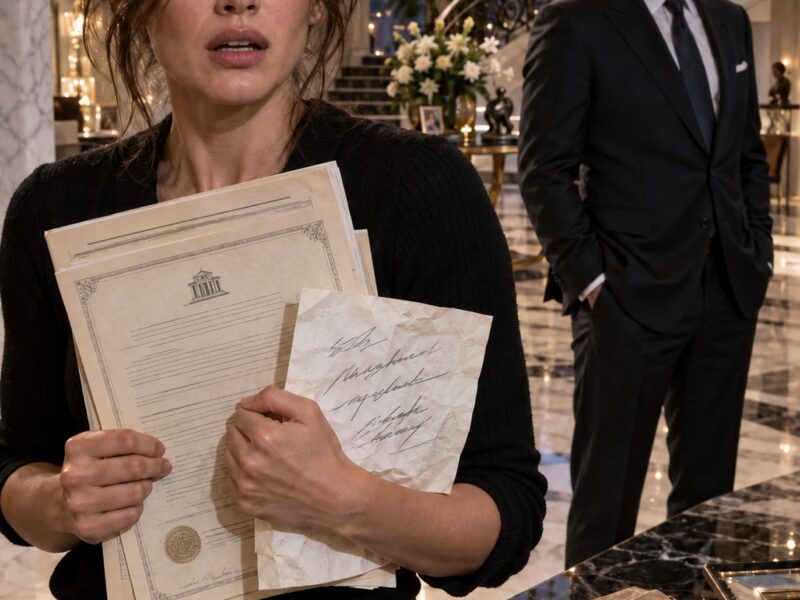
Inside were deeds, survey maps, tax records, certified letters and a property agreement dated thirty-one years earlier.
Ethan unfolded it.
His eyes moved down the page.
“This is a property agreement.”
“What does it mean?”
He studied the survey map.
Then his expression changed.
“Your father owned part of the land where Harper Industries built its first warehouse.”
Maya shook her head.
“That doesn’t make sense.”
Ethan pointed at the document.
“According to this, Thomas Bennett inherited a twenty-six percent interest in Parcel 17-B.”
Maya remembered the note wrapped around the brick.
Her skin went cold.
“So?”
“So this says he never sold it.”
Diane covered her mouth.
Maya stared at Ethan.
“Then how did your family build there?”
Ethan looked at the transfer document beneath it.
The signature belonged to Thomas Bennett.
Except Maya knew her father’s signature.
That wasn’t it.
“Someone forged the transfer,” she whispered.
Diane began crying.
“My father spent years trying to get that property back.”
Maya turned.
“You knew?”
“Not all of it.”
“You knew something.”
“Your father told me Richard Harper stole from him. I thought it was anger. I thought Thomas had made a bad business decision and couldn’t accept it.”
She looked at Ethan.
“He became obsessed. Lawyers cost money we didn’t have. Every letter came back unanswered. Eventually he told me to let it go.”
Maya looked at the medical bills stacked in the corner.
Her father had worked construction until his body gave out.
Richard Harper had built an empire.
On land that might never have legally belonged entirely to him.
“My father knew,” Ethan said.
It wasn’t a question.
Then someone knocked.
Maya stiffened.
Ethan moved in front of her.
“Maya?”
A woman’s voice.
Victoria.
Ethan opened the door halfway.
“What are you doing here?”
“Apologizing.”
“For which part?”
She looked exhausted.
“For hiding what I knew.”
Victoria held up a flash drive and a thick envelope.
“These are copies of your father’s financial records.”
Ethan didn’t take them.
“Why are you helping us?”
Victoria looked at Maya.
Then back at him.
“Because I finally realized something.”
“What?”
“If I stay silent, I’m not innocent.”
They reviewed the files until sunrise.
Payments to shell companies.
Legal invoices.
A transfer recorded three days before Thomas Bennett supposedly signed it.
A private memo referencing “resolution of Bennett ownership problem.”
And one transaction large enough to make Ethan stop breathing.
A payment to the county official who had notarized the disputed deed.
Maya whispered, “This could destroy him.”
“No,” Ethan said.
She looked at him.
“These records could.”
Ethan shook his head.
“His choices could.”
“What do we do?”
“We expose everything.”
Victoria leaned back.
“He’ll come after us.”
Ethan looked at Maya.
“Then we make sure he can’t hide.”
They copied every document.
Three cloud accounts.
Two lawyers.
One investigative journalist.
A federal fraud attorney Victoria trusted through her family.
Ethan also contacted three independent Harper Industries board members.
By noon, Richard knew.
By one, two vehicles were following Ethan’s car.
He saw them in the rearview mirror.
“Maya.”
“What?”
“Put your seat belt tighter.”
“It is.”
“Do it anyway.”
She looked behind them.
“Who are they?”
“I don’t know.”
“That’s not convincing.”
“I’m working on it.”
The black SUV accelerated.
Ethan turned sharply down an access road.
Maya gripped the door.
“You call this working on it?”
“My family owns a property near Chagrin Falls.”
“Of course your family owns a property near Chagrin Falls.”
“It’s empty.”
“Does it have guards?”
“No.”
“Great.”
“It has an alarm.”
“Even better.”
They reached the house forty minutes later.
Diane had been moved separately with Victoria’s help.
For the first time in two days, Maya stopped moving.
The safe house was absurdly beautiful.
Floor-to-ceiling windows.
Stone fireplace.
A kitchen larger than the entire first floor of the Bennett house.
Maya stood in the center of it.
“You call this a safe house?”
Ethan dropped his keys.
“My family has a lot of houses.”
“That sentence physically hurts me.”
He almost smiled.
“Get some sleep.”
“I can’t.”
“Why?”
Maya stared through the dark windows.
“Because every time I close my eyes, I think about what could happen to my mom.”
“We’ll protect her.”
She looked at him.
“Promise?”
“Promise.”
Silence settled between them.
Maya sat on the couch.
“You know what scares me?”
“What?”
“That I started falling for you before I knew your world.”
Ethan sat beside her.
“Then I found out your world was dangerous.”
“I’m sorry.”
“Don’t be.”
She looked at him.
“Because somehow I still choose you.”
His jaw tightened.
“Maya, don’t make a speech.”
“I wasn’t going to.”
“Good.”
“Why?”
“Because I’m already barely holding it together.”
That surprised a laugh from her.
Then Ethan reached for her hand.
“I love you.”
Maya looked down at their fingers.
For weeks the differences between them had seemed enormous.
His money.
Her debt.
His name.
Her anonymity.
His houses.
Her broken window.
But sitting in that silent mansion while both of them waited to find out whether his father would destroy their lives, all of that disappeared.
“I love you too.”
Across the city, Richard Harper stood at the window of his office.
An employee entered.
“Sir.”
“Did you find the documents?”
“They made copies.”
Richard turned.
“Where is Ethan?”
“We located him.”
“Then bring my son home.”
“And the girl?”
Richard hesitated.
“She comes too.”
The next afternoon Diane was leaving the temporary apartment Victoria had arranged when two men approached her.
One blocked the sidewalk.
The other reached for her arm.
A voice rang out behind them.
“Mom, stay inside.”
Maya had arrived with Ethan.
Ethan stepped between Diane and the men.
“Let her go.”
One man stared at him.
“Mr. Harper, your father wants you home.”
“You’re not taking anyone.”
“Don’t make this difficult.”
Ethan’s expression changed.
For years people had mistaken his calmness for weakness.
Richard had too.
“Tell my father,” Ethan said, “that if anyone touches Maya or her mother again, every document goes public before he has time to make his next phone call.”
The men exchanged a look.
Then left.
Maya stared at Ethan.
“You really came back.”
“I told you I would.”
“Your father knows where we are now.”
“I know.”
“What happens next?”
Ethan looked toward the city skyline.
“I finish this.”
Richard Harper was holding an emergency board meeting when Ethan walked into headquarters.
Maya entered beside him.
Victoria followed.
The room fell silent.
Richard stood at the far end of the table.
“You came.”
Ethan placed a thick folder on the polished wood.
“I came to finish this.”
Richard’s eyes landed on Maya.
“You have no business here.”
“She has more business here than half the people in this room.”
Ethan opened the folder.
“These prove forged property transfers involving Parcel 17-B.”
Richard’s expression didn’t change.
“You think papers will destroy me?”
“No.”
Ethan looked directly at him.
“Your choices will.”
Richard’s eyes narrowed.
“You betrayed your own father.”
Ethan leaned forward.
“No. You betrayed yourself long before I got here.”
“You have no idea what you’re giving up.”
“I know exactly what I’m giving up.”
“A future.”
“Your version of a future.”
Richard pointed toward Maya.
“She’ll never understand your world.”
Maya finally spoke.
“You’re right.”
Everyone turned.
“I don’t understand a world where people are treated like numbers. Where loyalty means obedience and love means ownership.”
She looked around the boardroom.
“But I understand loyalty.”
Richard laughed coldly.
“You think loyalty built this company?”
“No,” Maya said. “Apparently stolen property helped.”
Even Victoria nearly smiled.
Richard’s face darkened.
“You think this is a joke?”
“No.”
Maya held his gaze.
“My father died believing nobody powerful would ever listen to him. That isn’t funny.”
Richard turned on Ethan.
“Control your girlfriend.”
Ethan’s voice became quiet.
“That’s exactly the problem.”
Eleanor Harper entered the room.
Richard stared at his wife.
“What are you doing here?”
“Something I should have done years ago.”
She placed another envelope on the table.
Richard went still.
Ethan looked at his mother.
“What is that?”
“Records your father kept at home.”
Richard’s voice dropped.
“Eleanor.”
She ignored him.
“I knew there had been a dispute with Thomas Bennett. Richard told me it was settled legally.”
Her eyes filled.
“I believed him because believing him was easier.”
She looked at Maya.
“I’m sorry.”
Richard shook his head.
“You’re all being emotional.”
Victoria almost laughed.
“No, Richard. You’ve just finally run out of people willing to call fear loyalty.”
Three board members requested an immediate independent investigation.
Two outside directors demanded Richard step aside pending review.
Harper Industries’ general counsel quietly left the room to contact federal authorities.
For the first time in Ethan’s life, his father looked small.
Not physically.
Something more important.
The certainty around him had cracked.
“You can’t do this,” Richard said.
Ethan reached into his jacket and placed a signed document beside the property records.
“I already did.”
Richard looked down.
“What is that?”
“My resignation from every position you gave me.”
Silence.
“And notice that my shares are being transferred into an independent trust pending the investigation.”
Richard stared at him.
“You would throw away your inheritance for her?”
Ethan looked at Maya.
Then back at his father.
“No.”
Richard frowned.
“I’m throwing away your control for myself.”
The investigation took eleven months.
It found more than Parcel 17-B.
The forged Bennett transfer had been one of several questionable acquisitions made during Harper Industries’ earliest expansion.
Some were legal but predatory.
Others crossed lines no one could explain away.
Richard Harper eventually resigned.
Civil judgments followed.
Then criminal charges connected to fraud, falsified records and bribery.
The Bennett family received a settlement large enough to eliminate the mortgage, repay every debt and restore ownership value that Thomas Bennett had spent years trying to prove.
Maya cried the day the agreement became final.
Not because of the money.
Because beneath her father’s old workbench they found a carbon copy of the last letter he had ever sent Richard Harper.
It ended with one sentence.
Maybe I can’t beat you, Richard, but one day our children will learn what kind of men we were.
Maya read it alone first.
Then she gave it to Ethan.
He stood by the basement stairs for a long time.
“Are you okay?” she asked.
“No.”
She waited.
He folded the letter carefully.
“But I think I will be.”
Harper Industries survived.
Barely.
The company was restructured under independent leadership.
Several divisions were sold.
Employee protections were strengthened.
Ethan refused the CEO position when the board offered it.
“You spent your whole life preparing for that job,” Maya told him.
“I spent my whole life being prepared for that job.”
“That’s different?”
“Completely.”
“What are you going to do?”
He looked around the little storefront Maya had leased on Detroit Avenue.
Bare brick walls.
Dusty windows.
Broken light fixtures.
A kitchen that needed everything.
“What are we going to do?”
Maya narrowed her eyes.
“We?”
“You said you wanted to open a restaurant.”
“I said someday.”
“Someday looks available.”
She stared at him.
“You cannot buy me a restaurant.”
“I know.”
“I mean it.”
“I know.”
“You’re doing that rich-guy thing.”
“What rich-guy thing?”
“The thing where you pretend you’re listening until money appears.”
Ethan smiled.
“I’m not buying you anything.”
“Then why are you here?”
“Because apparently I need a job.”
Maya laughed.
“You?”
“Yes.”
“You don’t know how to wait tables.”
“Correct.”
“You can barely make coffee.”
“Also correct.”
“You once put dish soap in a dishwasher and filled my mother’s kitchen with foam.”
“That feels unnecessarily specific.”
“And you ruined macaroni.”
“I was twenty.”
“You were twenty-five.”
“Rumors.”
She crossed her arms.
“What qualifications do you have?”
Ethan considered it.
“I’m learning to wash dishes.”
Maya tried not to smile.
Failed.
They opened Bennett’s Table seven months later.
The first night was chaos.
One server called in sick.
A pipe leaked.
Ethan delivered an entrée to the wrong table twice.
Diane sat near the kitchen laughing so hard she cried.
Near closing time, a reporter recognized Ethan carrying dirty plates.
“Is that really the billionaire’s heir serving tables?”
Ethan looked over his shoulder.
“Former heir.”
Maya passed behind him.
“Terrible waiter.”
“Hostile management,” he replied.
The reporter asked the question Ethan had been asked in a dozen forms since his father’s downfall.
“Do you regret walking away from the Harper fortune?”
Ethan looked through the restaurant.
Diane was talking to regular customers near the counter.
Victoria sat with friends by the window, laughing more freely than Ethan remembered seeing her laugh in all the years they had known each other.
Maya stood beneath the warm hanging lights, pencil behind her ear, reviewing tomorrow’s reservations.
“No,” he said.
“Why not?”
“Because I finally learned the difference between having everything and having something worth keeping.”
Maya heard him.
“Very dramatic.”
“That was a good line.”
“You practiced it.”
“I absolutely did not.”
“You practiced it in the mirror.”
“Defamation.”
Their life didn’t turn magically easy.
Maya still woke some nights expecting glass to break downstairs.
Ethan sometimes froze when an unfamiliar black car remained behind them too long.
Diane struggled with the truth that her husband had spent his final years fighting something she had begged him to forget.
Victoria had to rebuild a relationship with her own parents after refusing the merger her marriage to Ethan would have secured.
Eleanor moved out of the Harper estate.
Richard, for months, refused to speak to Ethan except through attorneys.
Real consequences were less clean than headlines.
Love didn’t erase them.
Money didn’t fix them.
Justice didn’t return the years Thomas Bennett had lost.
But life moved anyway.
One Tuesday morning, Maya found Ethan repairing a loose cabinet hinge in the restaurant.
She leaned against the doorway.
“What are you doing?”
“Fixing it.”
“Should I call someone?”
“That’s insulting.”
“You once nearly died crossing the street.”
“That was unrelated to carpentry.”
She walked over and tested the hinge.
It worked.
Maya raised her eyebrows.
“Well.”
“Well what?”
“You learned how to do something yourself.”
“Careful. At this rate I may become useful.”
She kissed him.
He smiled against her mouth.
That evening, after they closed, Ethan told Maya he had forgotten something in the dining room.
She followed him out.
Every table was empty except one.
Their usual corner table.
Two coffee cups waited on it.
Maya looked at him.
“What is this?”
“Coffee.”
“At ten-thirty at night?”
“You drink coffee at ten-thirty.”
“I work in a restaurant. I make bad decisions.”
“Fair.”
She sat.
Ethan remained standing.
Suddenly Maya noticed his hands.
They were trembling.
“You look nervous.”
“I’m not.”
“You are.”
“Okay.”
He exhaled.
“I’m terrified.”
Maya stared at him.
“Ethan.”
He reached into his pocket.
Her breath caught.
“Maya, before you say anything, I had a speech.”
“That is already concerning.”
“I know.”
“Was it long?”
“It was excellent.”
“I’m sure.”
“I forgot all of it.”
She began laughing.
Ethan lowered himself onto one knee.
The laughter disappeared.
For a moment Maya saw everything at once.
The street corner.
The delivery van.
The expensive briefcase.
Two coffees.
Her sketchbook.
His ruined shirt at their leaking sink.
The threatening note.
Her father’s papers.
A safe house full of fear.
A boardroom full of people finally refusing to remain silent.
Ethan looked up at her.
“All my life, people told me what mattered.”
His voice shook.
“Cars. Houses. Companies. Money. A family name.”
Maya’s eyes filled.
“Then I met you.”
He opened the small ring box.
“And suddenly I started realizing how many things I had that I never chose.”
He swallowed.
“You never wanted my money.”
Maya whispered, “Definitely not your dishwashing skills.”
He laughed through his nerves.
“You never wanted my name.”
“No.”
“You wanted me to tell the truth even when the truth made everything harder.”
His expression softened.
“And you were the first person who ever made me believe my life could belong to me.”
A tear slipped down Maya’s cheek.
“So I’m asking you to choose something with me.”
He held up the ring.
“Maya Bennett, will you marry me?”
She looked at him for a painfully long second.
Ethan blinked.
“You’re doing this intentionally.”
“Maybe.”
“Maya.”
“Yes.”
His face changed.
“Yes?”
“Yes.”
He stood so fast he almost knocked the table sideways.
She laughed as he wrapped both arms around her.
“You almost broke the table.”
“I’m emotional.”
“You’re expensive.”
“Formerly expensive.”
“Debatable.”
He kissed her.
And for once, there were no photographers.
No fathers deciding what came next.
No lawyers.
No reporters.
No threats.
Just two cooling cups of coffee beneath the warm restaurant lights.
They married the following spring.
The ceremony was small.
Diane sat in the front row beside Eleanor.
Victoria stood with Maya.
When the officiant asked Ethan if he took Maya Bennett as his wife, he didn’t hesitate.
“I do.”
Maya smiled.
For years she had believed wealth separated people into two worlds.
People who had choices and people who survived what was chosen for them.
Ethan had believed something similar.
He had simply been standing on the opposite side.
But standing beside him that day, Maya finally understood the lesson both of them had paid dearly to learn.
Money could buy houses people never lived in.
It could buy silence.
Influence.
Lawyers.
Newspapers.
Names on buildings.
It could even convince a powerful man that consequences were things that happened only to other people.
But money could not decide who someone became unless they surrendered the right to decide for themselves.
After the ceremony, Diane found Maya alone for a moment near the garden.
“You happy?”
Maya looked toward Ethan.
He was trying to help a caterer carry a tray.
He nearly dropped it.
Maya laughed.
“Terrified.”
Diane smiled.
“That wasn’t what I asked.”
Maya’s eyes filled.
“Yes.”
She squeezed her mother’s hand.
“I’m happy.”
Across the lawn, Ethan looked toward her as though he had felt her watching.
He smiled.
For the first time since she had met him, there was nothing following behind that smile.
No empire.
No expectation.
No inherited future.
Only Ethan.
And Maya realized that was all she had ever wanted.
Years later, a framed copy of Thomas Bennett’s old property map hung on the brick wall inside Bennett’s Table.
Most customers assumed it was decoration.
Only a few people knew what Parcel 17-B meant.
Maya never explained it unless someone asked.
And when they did, she never told the story as one about a poor girl who married a rich man.
She hated that version.
It missed everything important.
She told them it was the story of two fathers.
One had almost nothing and died fighting to leave the truth behind.
The other possessed nearly everything and almost destroyed his own son trying to keep control of it.
And in the middle were two children who inherited more than property.
They inherited choices.
One afternoon, Maya watched Ethan at the sink after a busy lunch rush.
His sleeves were rolled up.
Soap covered his hands.
A stack of plates waited beside him.
She leaned against the doorway.
“You know something?”
He looked over.
“What?”
“My father would have liked you.”
Ethan’s smile faded.
“You think?”
“Eventually.”
“Eventually?”
“He would’ve hated you for at least three months.”
“That seems fair.”
“Maybe six.”
“Less fair.”
She walked closer.
“But then he would’ve seen you here.”
“Washing dishes?”
“Staying.”
Ethan became quiet.
Maya kissed his cheek.
Then she walked back toward the dining room.
Behind her, Ethan looked at the old map hanging on the wall.
Parcel 17-B.
A small piece of land that had once divided two families.
A forged signature had helped build an empire on top of it.
A dying man had kept the proof.
A frightened daughter had almost hidden it forever.
And a billionaire’s son had finally decided that the most valuable inheritance he could receive was the courage to walk away.
Ethan turned back to the sink.
“Maya?”
She looked over her shoulder.
“What?”
“I love you.”
She smiled.
“I know.”
“That’s all?”
She pointed at the stack beside him.
“Those plates aren’t going to wash themselves, Harper.”
He stared at her.
Then laughed.
And Maya walked back into the restaurant as evening sunlight poured through the windows, bright enough to illuminate every scar in the old brick walls without making any of them disappear.
She liked them that way.
Some things weren’t meant to be erased.
They were meant to remain visible.
Proof of what had been broken.
Proof of what survived.
And proof that sometimes the life worth keeping begins only after you finally find the courage to let the wrong one go.









