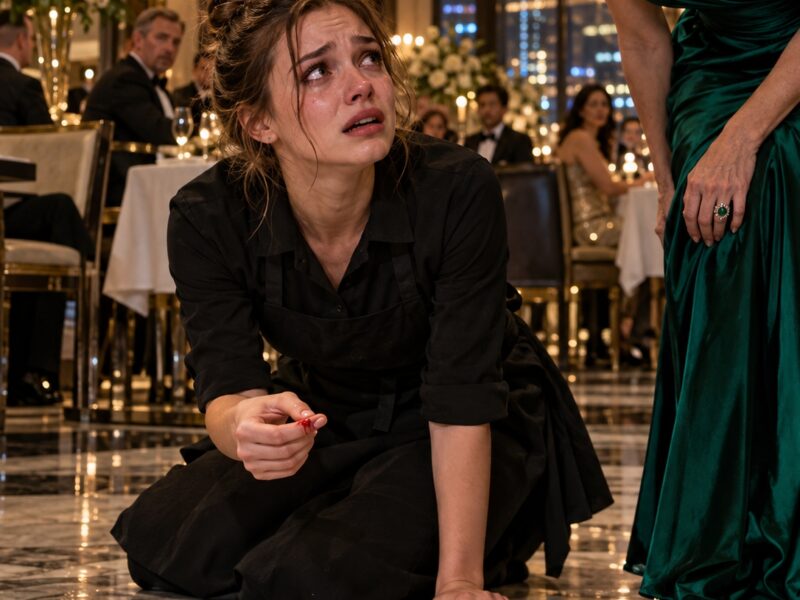
THE BILLIONAIRE’S MOTHER WALKED TOWARD THE TERRIFIED WAITRESS AFTER SHE BROKE A GLASS—THEN SHE TOUCHED HER FACE AND SAID SOMETHING NO ONE EXPECTED

The crystal glass hit the marble floor at 9:17 on a Thursday night.
For Hannah Brooks, the sound was not the delicate chime of expensive glass breaking.
It sounded like a prescription she could no longer afford.
It sounded like the rent notice taped inside her kitchen cabinet.
It sounded like her younger brother coughing behind a closed bedroom door because he thought she was asleep.
And as hundreds of glittering fragments scattered beneath the chandeliers of one of Chicago’s most exclusive restaurants, Hannah looked up and saw Victoria Whitmore walking directly toward her.
Every conversation around them seemed to stop.
Hannah knew the name.
Everyone in Chicago knew the name.
Whitmore.
It was printed on hospital wings, university buildings, technology campuses, charitable foundations, and business magazines. Victoria Whitmore was the elegant widow of one of the most influential technology executives in the Midwest, and her only son, Nathan, had inherited not only a fortune but control of a company valued in the billions.
Women like Victoria did not normally notice women like Hannah.
Not unless something had gone wrong.
And something had gone very wrong.
“Hannah.”
The restaurant supervisor’s voice came sharply from behind her.
She could already hear what was coming.
My office.
Now.
Take off your apron.
We warned you.
She dropped to her knees.
“I’m sorry,” she whispered.
She began gathering the larger pieces of glass with trembling fingers.
Someone laughed softly at one of the nearby tables.
Another guest sighed with irritation.
A man moved his polished Italian shoe away from the spreading champagne as though Hannah herself were the mess threatening to stain him.
Her supervisor appeared beside her.
“I told you tonight was important.”
“I know.”
“You were already behind on table twelve.”
“Mr. Adler couldn’t breathe.”
“That wasn’t your responsibility.”
Hannah looked up.
“He couldn’t breathe.”
The supervisor lowered his voice.
“And now you’ve dropped a tray in the middle of the Whitmore charity dinner.”
“I was bumped.”
“You always have an explanation.”
Hannah stopped reaching for the glass.
Her cheeks burned.
She wanted to defend herself.
She wanted to say that she had worked a double shift yesterday. That she had slept four hours. That she had spent her lunch break arguing with a pharmacy about the price of Caleb’s heart medication.
She wanted to say that she had not asked the wealthy guest behind her to step backward without looking.
She wanted to say that she had not chosen to be tired.
But poor people learned early that explanations often sounded like excuses when spoken to someone who controlled their paycheck.
So Hannah lowered her eyes.
“I’ll clean it up.”
Then a woman’s voice came from above them.
“No.”
Hannah froze.
Victoria Whitmore stood less than three feet away.
She wore a dark emerald evening dress, a thin diamond bracelet, and the calm expression of someone accustomed to rooms becoming quiet when she entered them.
The supervisor immediately straightened.
“Mrs. Whitmore, I apologize. We’ll have this taken care of immediately.”
Victoria did not look at him.
She looked at Hannah.
“Are you hurt?”
Hannah blinked.
“What?”
“Your hand.”
Hannah looked down.
A thin line of blood had appeared along the side of her index finger.
She had not even felt the cut.
“Oh. No. I’m fine.”
“You’re bleeding.”
“It’s nothing.”
Victoria studied her for several seconds.
There was something strange in the older woman’s expression.
Not anger.
Not pity.
Recognition.
That frightened Hannah more than anger would have.
Victoria slowly knelt.
A billionaire’s widow, wearing a dress that probably cost more than Hannah earned in six months, knelt on the restaurant floor beside a waitress surrounded by broken glass.
Several guests openly stared.
“Mrs. Whitmore,” the supervisor said nervously, “please. We can handle this.”
Victoria ignored him.
She reached toward Hannah.
Hannah instinctively pulled back.
But Victoria only brushed a loose strand of brown hair away from Hannah’s damp cheek.
Her touch was gentle.
Almost maternal.
“You’ve been crying,” Victoria said.
Hannah’s stomach tightened.
“No, ma’am.”
Victoria gave the smallest smile.
“You’re not a very convincing liar.”
Hannah looked away.
She had cried in the employee restroom twenty minutes earlier.
Three minutes.
That was all she had allowed herself.
Three minutes after receiving a text from Caleb.
PHARMACY CALLED AGAIN. DON’T WORRY ABOUT IT. I CAN WAIT UNTIL NEXT WEEK.
He could not wait until next week.
And Hannah knew it.
She also knew she had $143 in checking, forty dollars in cash, rent due Monday, and a brother who would rather risk his health than make her feel guilty.
She had washed her face, retied her hair, and returned to the dining room smiling.
Because table seven wanted another bottle of wine.
Because table eleven wanted separate checks.
Because people who paid hundreds of dollars for dinner did not want to know that the woman carrying their plates was wondering which bill she could safely ignore.
Victoria glanced toward the supervisor.
“What is her name?”
“Hannah Brooks.”
Victoria looked back at her.
“Hannah.”
“Yes, ma’am?”
“Why did you leave your section earlier?”
The supervisor inhaled.
“Mrs. Whitmore, as I explained—”
“I asked Hannah.”
Hannah hesitated.
“An older gentleman at table fourteen was having trouble breathing.”
“And?”
“I thought he might be choking at first. Then I realized he wasn’t. His breathing sounded wrong, so I helped him sit upright and asked someone to call 911.”
“Were you trained to do that?”
“No.”
“Then why did you?”
The question confused her.
“Because he needed help.”
Victoria stared at her.
Hannah glanced around the restaurant.
People were still watching.
She suddenly felt exposed.
“Mrs. Whitmore, I really should clean this.”
Victoria stood.
Then she said something that changed the temperature of the room.
“She isn’t being fired.”
The supervisor blinked.
“Excuse me?”
“You were about to fire her.”
His face changed.
“I was going to discuss the incident.”
“You were going to fire her.”
Silence.
Victoria looked toward the broken glass.
“I saw what happened. A guest stepped backward into another server, who collided with her. The accident was not her fault.”
Hannah stared.
Victoria had seen it?
The supervisor forced a professional smile.
“Of course.”
“And earlier tonight,” Victoria continued, “I watched this young woman abandon a room full of impatient people because an elderly man could not breathe.”
“That did cause problems with service.”
Victoria finally looked directly at him.
“Then perhaps your definition of service needs work.”
Nobody laughed.
Nobody moved.
The supervisor’s jaw tightened.
“Yes, Mrs. Whitmore.”
Victoria turned back to Hannah.
“You should clean that cut.”
“I’m okay.”
“That wasn’t a suggestion.”
For reasons Hannah could not explain, she almost smiled.
“Yes, ma’am.”
Victoria started walking away.
Then she stopped.
Without turning around, she said, “And Hannah?”
“Yes?”
“I’d like to speak with you before you leave tonight.”
Hannah’s smile disappeared.
Because kindness from strangers had never made her comfortable.
Especially kindness from powerful strangers.
In Hannah’s experience, everything had a price.
She just didn’t know yet what Victoria Whitmore wanted from her.
And that frightened her almost as much as losing the job.
Three years earlier, Hannah had learned how quickly an ordinary life could disappear.
Her mother died on a gray November morning.
There had been no dramatic final speech.
No gathering around a hospital bed.
No cinematic goodbye.
There had been a phone call.
Then fluorescent lights.
Then a doctor Hannah could barely hear because Caleb was crying beside her.
Their father had already been gone for years.
Not dead.
Gone.
There was a difference.
Dead people could not come back.
People who abandoned you technically could.
That sometimes hurt more.
At twenty-one, Hannah became the person listed under “emergency contact” on every form Caleb filled out.
She became the one who knew which medication had to be taken with food.
She knew which cardiology appointments could be moved and which could not.
She learned how to stretch groceries.
How to negotiate payment plans.
How to tell when an envelope contained something dangerous without opening it.
Red print was bad.
Thick envelopes from hospitals were worse.
Caleb was nineteen now and attending college part-time.
He hated that Hannah had sacrificed so much for him.
Hannah hated that he knew.
Their apartment on Chicago’s South Side was small enough that privacy depended more on politeness than walls.
That night, she returned home shortly after midnight.
The kitchen light was on.
Caleb sat at the table with a textbook open in front of him.
“You’re awake.”
“So are you.”
“I work nights.”
“I study nights.”
“You’re terrible at lying.”
He smiled.
“So are you.”
Hannah dropped her bag onto a chair.
Caleb noticed the bandage around her finger.
“What happened?”
“Nothing.”
“Hannah.”
“A glass broke.”
“At work?”
“Yes.”
“You cut yourself?”
“Barely.”
He watched her.
“Did they fire you?”
“No.”
The answer came too quickly.
Caleb closed the textbook.
“Hannah.”
“They didn’t fire me.”
“Were they going to?”
She opened the refrigerator.
There was half a carton of eggs, mustard, leftover pasta, and a plastic container of soup.
“I’m hungry.”
“You’re changing the subject.”
“I’m making eggs.”
“At midnight?”
“Eggs become illegal after ten?”
Caleb did not laugh.
“Did you get my text?”
Her hand stopped on the refrigerator door.
There it was.
The real conversation.
“Yes.”
“I told you not to worry.”
“And I told you never to tell me not to worry about medication.”
“It’s expensive.”
“So?”
“So I can skip a few days.”
She closed the refrigerator.
“No.”
“I’ve done it before.”
“And you ended up in the ER.”
“That wasn’t because—”
“Caleb.”
He stopped.
Hannah sat across from him.
The anger disappeared from her voice.
“I can figure out money.”
His eyes dropped.
“You always say that.”
“Because I always do.”
“By working sixty hours?”
“If necessary.”
“By not sleeping?”
“I sleep.”
“You fell asleep sitting up last Sunday.”
“That was efficient.”
He almost smiled.
Almost.
Then he reached across the table and touched her bandaged finger.
“I’m supposed to be your brother, Han. Not another bill.”
The sentence went through her.
She swallowed.
“You are not a bill.”
“You know what I mean.”
“No. I don’t want you ever saying that again.”
“Hannah—”
“You’re my family.”
Her voice cracked slightly.
She hated that.
Caleb heard it.
So she stood before he could respond.
“I met Victoria Whitmore tonight.”
He stared.
“The Victoria Whitmore?”
“How many do you know?”
“What happened?”
Hannah began making eggs.
“She watched me break a glass.”
“That sounds promising.”
“She defended me.”
“Why?”
“I don’t know.”
“And?”
“She wants to talk to me.”
Caleb leaned back.
“Maybe she liked you.”
“People like Victoria Whitmore don’t randomly like waitresses.”
“Maybe they do if the waitress is likable.”
Hannah glanced over.
“You need better medication.”
“I’m serious.”
Hannah turned back to the stove.
But as butter melted in the pan, she remembered Victoria’s expression.
Not pity.
Something else.
And she remembered one sentence.
I’d like to speak with you.
Hannah had no idea that Victoria had already begun asking questions about her.
Victoria Whitmore did not believe in coincidences.
Not anymore.
Her husband, Richard, had believed in them.
He used to say life was mostly timing disguised as fate.
Then he died unexpectedly, and Victoria stopped finding the sentence charming.
Loss had changed her family in different ways.
Victoria had become busier.
Nathan had become quieter.
At thirty-one, her son controlled a technology empire, sat on multiple boards, funded medical research, and could negotiate acquisitions worth hundreds of millions without raising his voice.
But Victoria had watched something disappear from him.
Trust.
Nathan had dated.
Of course he had.
There had been women with perfect résumés, polished families, beautiful photographs, and carefully cultivated interests.
One had secretly contacted a magazine before their third date.
Another had casually asked whether Nathan intended to maintain his family’s prenuptial traditions.
A third seemed genuinely kind until Victoria overheard her mocking a housekeeper at a fundraiser.
Nathan stopped dating seriously after that.
He did not become cruel.
That would almost have been easier.
He became indifferent.
And indifference was harder to fight.
Victoria had begun to fear that her son believed everyone eventually wanted something from him.
Then she saw Hannah Brooks.
Not when Hannah broke the glass.
Earlier.
Much earlier.
Victoria had first noticed her near the restaurant’s service entrance.
Hannah was sitting alone during her break with a covered plate on her lap.
Victoria assumed she was eating.
Then a homeless man approached the alley entrance.
Hannah stood.
She spoke to him.
Then handed him the plate.
Her own dinner.
There were no cameras.
No donors.
No applause.
Twenty minutes later, Victoria saw Hannah speaking quietly with an elderly couple.
The woman was embarrassed about something on the check.
Hannah disappeared.
Returned.
The couple smiled.
Later, Victoria learned Hannah had paid for their dessert herself after discovering it was their forty-seventh anniversary.
Then came the medical emergency.
Then the broken glass.
None of those moments alone meant much.
Together, they told Victoria something.
So she asked Belmont’s manager about Hannah.
Then she asked the Whitmore Foundation’s director to quietly perform the same basic background screening they would conduct on any temporary employee.
The answer came two days later.
Hannah Brooks.
Twenty-four.
No criminal history.
No debt beyond ordinary medical and educational obligations.
Mother deceased.
Father absent.
Younger brother with chronic cardiac condition.
Multiple jobs since age nineteen.
Excellent employment references.
Frequently covered shifts.
No social-media obsession with wealth.
No history of approaching donors.
No attempts to contact the Whitmore family.
One detail stopped Victoria.
Six months earlier, Hannah had been offered a position at a private events company.
Better salary.
Better benefits.
She declined.
Why?
Night travel.
It would have left Caleb alone too often.
Victoria closed the file.
Across her office, Nathan was reading something on his tablet.
“You’re staring,” he said.
“I’m thinking.”
“That’s usually more dangerous.”
She smiled.
“You used to be funnier.”
“I used to sleep.”
“You could try doing that again.”
“You could try not investigating waitresses.”
Nathan looked up.
Victoria said nothing.
His eyebrows rose.
“I knew it.”
“Knew what?”
“You have that expression.”
“What expression?”
“The one you get before interfering in someone’s life.”
“I do not interfere.”
“You reorganize reality until people accidentally make the decision you wanted.”
Victoria laughed.
“That sounds much more sophisticated.”
“Who is she?”
“A young woman.”
“No.”
“No?”
“No whatever you’re planning.”
“I haven’t told you what I’m planning.”
“Exactly.”
Victoria leaned back.
“Her name is Hannah Brooks.”
Nathan returned to his tablet.
“Wonderful.”
“She works at Belmont.”
“Mother.”
“She helped Arthur Adler when he had breathing trouble.”
That got Nathan’s attention.
“Arthur?”
“He’s fine.”
Nathan set the tablet down.
“What happened?”
Victoria explained.
When she finished, Nathan’s expression softened for half a second.
Then the wall returned.
“I’m glad she helped him.”
“She did more than that.”
“Of course she did.”
“You haven’t met her.”
“I don’t need to meet her to know where this conversation is going.”
Victoria tilted her head.
“And where is it going?”
“You found someone admirable and now want me to be impressed.”
“I would settle for interested.”
“No.”
“Nathan.”
“Absolutely not.”
“I’m offering her temporary work at the foundation.”
He stared at her.
“You already decided.”
“Yes.”
“Then why are we discussing it?”
“Because you’re my son.”
“That has never prevented you from ignoring my opinion.”
She smiled.
“True.”
Nathan stood.
“Hire whoever you want.”
“I intend to.”
“But don’t manufacture some ridiculous situation where we keep accidentally being in the same room.”
Victoria’s expression became innocent.
“I’m offended.”
“You should be.”
He walked toward the door.
“Nathan?”
He stopped.
Victoria’s voice softened.
“I’m not asking you to marry anyone.”
He looked back.
For a moment, the sarcasm disappeared.
“I know.”
“I just think you’ve spent too long assuming that everyone is the same.”
Nathan studied her.
“And I think you’ve spent too long trying to prove they aren’t.”
Then he left.
Victoria looked at Hannah’s file again.
Perhaps he was right.
Perhaps she was trying to prove something.
But not only to Nathan.
Maybe to herself.
Hannah nearly refused the invitation.
Three times.
The first time was when Victoria called personally.
The second was after Hannah searched photographs of the Whitmore estate online and immediately felt ridiculous.
The third was standing outside the property gates wearing the best clothes she owned.
Her handbag was four years old.
Her shoes had been repaired twice.
The cream blouse she wore had once belonged to her mother.
She almost ordered the rideshare driver to turn around.
Instead, she got out.
The Whitmore estate sat beyond a long tree-lined drive north of the city, elegant rather than ostentatious, which somehow made it more intimidating.
Nothing looked designed to impress.
Everything simply assumed it would.
A housekeeper named Rosa opened the door.
“Ms. Brooks?”
“Hannah is fine.”
“Mrs. Whitmore is expecting you.”
Hannah stepped inside.
The foyer alone was larger than her apartment.
She became painfully aware of every scuff on her shoes.
Victoria appeared before Hannah could decide where to look.
“You came.”
“You invited me.”
“I wasn’t sure you would.”
“Neither was I.”
Victoria smiled.
“Good answer.”
They entered a sitting room overlooking the gardens.
Coffee was waiting.
Hannah remained perched on the edge of the sofa.
Victoria noticed.
“Hannah, I’m not interviewing you for admission into the royal family.”
Hannah flushed.
“Sorry.”
“You apologize frequently.”
“Occupational habit.”
“That’s unfortunate.”
Victoria poured coffee.
“I asked you here because the Whitmore Foundation needs temporary administrative help.”
Hannah blinked.
“You want to hire me?”
“I want to offer you several weeks of work.”
“Why?”
Victoria appreciated the directness.
“You’re organized. Your references are excellent. And you understand people.”
“You learned all that from a broken glass?”
“No.”
That answer unsettled Hannah.
“How much do you know about me?”
“Enough to know you work hard.”
Hannah’s shoulders tightened.
Victoria saw it.
“I’m not trying to invade your privacy.”
“But you checked.”
“Yes.”
“Why?”
Before Victoria could answer, a man entered the room.
“Sorry. I didn’t realize—”
Hannah knew him immediately.
Nathan Whitmore.
Magazine photographs had failed to capture the exhaustion in his face.
He was tall, broad-shouldered, and dressed in a charcoal sweater and dark trousers instead of the expensive suit Hannah expected.
His eyes moved from his mother to Hannah.
Something flickered.
Recognition perhaps.
“Nathan,” Victoria said. “This is Hannah Brooks.”
Hannah stood.
“We’ve never met.”
Nathan shook her hand.
“No. But apparently I know half your employment history.”
“Nathan.”
“What?”
Hannah looked between them.
Nathan released her hand.
“I apologize. That sounded worse than intended.”
“It usually does,” Victoria said.
Hannah almost laughed.
Nathan noticed.
For the first time, the tiredness in his face shifted.
“Mother is offering you a position?”
“Temporary.”
Nathan nodded.
“Then I should warn you.”
Hannah waited.
“My mother uses the word temporary creatively.”
Victoria sighed.
“Ignore him.”
“I’ve tried,” Nathan said. “Thirty-one years. No success.”
This time Hannah did laugh.
It escaped before she could stop it.
Nathan smiled.
A small smile.
But real.
Victoria saw it.
And said absolutely nothing.
That was how it began.
Not with romance.
Not with instant attraction.
With suspicion.
Hannah began at the Whitmore Foundation the following Monday.
She kept her restaurant shifts at first.
She did not trust good fortune enough to quit anything.
Her days became absurd.
Foundation in the morning.
Belmont some evenings.
Hospital paperwork.
Caleb’s classes.
Laundry at midnight.
Coffee everywhere.
But something unexpected happened.
Hannah liked the foundation.
Not because of the building.
Not because of the salary.
Because the work made sense to her.
Families arrived needing rental assistance, medication support, shelter placement, transportation, school supplies.
Hannah understood the embarrassment in their faces.
She understood the way people whispered when discussing money.
She knew why someone might say “I’m fine” while gripping an overdue bill.
Most importantly, she never made them feel small.
One afternoon, an elderly woman named Mrs. Patterson arrived thirty minutes late for an appointment.
The receptionist was frustrated.
Hannah noticed the woman’s wet coat.
“Bus?”
Mrs. Patterson nodded.
“Two of them.”
Hannah brought her coffee.
The next week, she remembered how she took it.
Nathan noticed.
He also noticed Hannah bringing an exhausted employee a sandwich during a long meeting.
He noticed her staying after everyone else left when a storm damaged a shelter on the West Side.
He noticed her answering the phone one evening at 7:42 because she heard it ringing while walking toward the elevator.
He noticed because Nathan noticed everything.
Trust had made him observant.
Distrust had made him forensic.
At first, he assumed Hannah knew he was watching.
Then he realized she did not.
That changed something.
One evening he found her sitting on the floor of a storage room.
Around her were boxes of donated children’s books.
Several were torn.
She was repairing them with clear tape.
Nathan leaned against the doorway.
“You know we can buy new books.”
Hannah looked up.
“I know.”
“Then why are you doing that?”
“Because these are still good.”
He picked up one with a damaged cover.
“The Very Hungry Caterpillar has seen combat.”
“He’ll survive.”
Nathan smiled.
Hannah returned to taping.
“You’re here late,” she said.
“So are you.”
“I asked first.”
“No, you didn’t.”
She looked up.
“You’re annoying.”
“I’ve been told.”
“By your mother?”
“Mostly.”
Silence settled comfortably.
That surprised both of them.
Nathan sat on a box.
“Why did you take this job?”
Hannah continued repairing the book.
“Money.”
The answer surprised him.
She glanced up.
“What?”
“Nothing.”
“You expected something inspirational?”
“Maybe.”
“I needed money.”
“Fair.”
“And I like the work.”
“That sounds more inspirational.”
“Don’t ruin it.”
Nathan laughed quietly.
Then his gaze fell to her hands.
A faint scar remained from the glass at Belmont.
“You still work there?”
“Some nights.”
“You don’t need both jobs.”
“I do.”
Nathan could have asked why.
He did not.
That restraint mattered to Hannah.
Most wealthy people she had encountered treated personal questions as another thing money entitled them to ask.
Nathan simply nodded.
“Want coffee?”
“It’s eight-thirty.”
“That wasn’t my question.”
“Yes.”
They drank terrible office coffee in paper cups.
Nathan told her about his father.
Not everything.
Just enough.
Richard Whitmore had died unexpectedly several years earlier.
Nathan had been forced into leadership before he felt ready.
Thousands of employees suddenly depended on decisions he made while he was still grieving.
“I kept thinking there would be a point where everyone stopped needing something,” he said.
Hannah looked at him over her cup.
“Did they?”
“No.”
“They won’t.”
He laughed once.
“Comforting.”
“I didn’t say it was bad.”
“What do you mean?”
Hannah considered.
“Being needed can crush you if you think it means you’re never allowed to need anyone.”
Nathan stopped smiling.
She immediately regretted saying it.
“Sorry.”
“There it is again.”
“What?”
“You apologize whenever you say something true.”
She looked down.
Nathan watched her.
“And you?”
“What about me?”
“Who are you allowed to need?”
Hannah’s phone rang.
Caleb.
She answered immediately.
“Hey.”
Nathan watched the color drain from her face.
“When?”
A pause.
“Are you sitting down?”
Another pause.
“I’m coming.”
She stood so fast the coffee spilled.
Nathan rose.
“What happened?”
“Nothing.”
“Hannah.”
She grabbed her coat.
“My brother isn’t feeling well.”
“I’ll drive you.”
“No.”
“You look like you’re about to pass out.”
“I said no.”
Her voice was sharper than she intended.
Nathan stopped.
Hannah closed her eyes.
“I’m sorry.”
“Stop apologizing.”
“I have to go.”
Then she left.
Nathan stood alone among the damaged children’s books.
For the first time, he realized how little Hannah had told him about Caleb.
And how carefully she had kept that part of her life away from the Whitmores.
Caleb was sitting on the kitchen floor when Hannah arrived.
That image stayed with her.
Not because he looked dramatically ill.
Because he looked embarrassed.
His back rested against a cabinet.
One hand pressed against his chest.
His face was pale.
“Hannah.”
She dropped beside him.
“What happened?”
“I got dizzy.”
“You called me because you got dizzy?”
“Okay, I may have briefly become acquainted with the floor.”
“Caleb.”
“I’m fine now.”
She touched his forehead.
“Did you take your medication?”
Silence.
Hannah looked at him.
“Caleb.”
“I was stretching it.”
The room seemed to contract.
“How long?”
He looked away.
“How long?”
“Four days.”
Hannah stood.
She walked three steps.
Turned.
“You told me you still had enough.”
“I knew what you’d do.”
“What would I do?”
“This.”
“This what?”
“Destroy yourself fixing it.”
Her anger vanished.
That was worse.
Caleb looked at her.
“You can’t keep doing this.”
“Doing what?”
“Living like my life is the only one that matters.”
“You’re my brother.”
“And you’re my sister.”
His eyes filled.
“I see you, Hannah.”
She could not answer.
“I see the bills you hide. I know you stopped buying lunch. I know you work at Belmont after working at the foundation. I know you pretend you’re not tired when you can barely keep your eyes open.”
“None of that matters.”
“It matters to me.”
“Get your coat.”
“Hannah.”
“We’re going to the hospital.”
“I don’t need—”
“Get your coat.”
Something in her voice ended the argument.
At the hospital, they waited beneath fluorescent lights.
Tests.
Questions.
More tests.
A cardiologist Hannah had never met used words she hated.
Progression.
Instability.
Treatment adjustment.
Possible intervention.
Hannah heard only numbers.
Not medical numbers.
Financial ones.
Every test had a price.
Every night had a price.
Every procedure had a price.
By morning, Caleb was admitted.
Hannah called Belmont.
Then the foundation.
She told them there was a family emergency.
She did not call Victoria.
She did not call Nathan.
For two days, she lived between a plastic hospital chair and vending machines.
On the third afternoon, a billing coordinator handed her preliminary paperwork.
Hannah stared at the amount.
The hallway became blurry.
She sat down.
She told herself not to cry.
Then she heard footsteps.
“Hannah.”
She looked up.
Nathan stood at the end of the hallway.
And for some reason, seeing him destroyed the last piece of control she had.
“What are you doing here?”
“Looking for you.”
“Why?”
“You disappeared.”
“My brother is sick.”
“I know.”
Her expression changed.
“How?”
“Your emergency contact information is on your employee file. My mother knew you had a brother with a heart condition.”
Hannah stood.
“No.”
Nathan stopped.
“What?”
“No.”
She backed away.
“I don’t want this.”
“Hannah—”
“I knew it.”
“Knew what?”
“That eventually this would happen.”
“What would happen?”
She held up the bill.
“This.”
Nathan looked at it but did not take it.
“You think I came because of money?”
“Isn’t that what your family does? Finds problems and fixes them?”
His face tightened.
“That’s unfair.”
“I know.”
“Then why say it?”
“Because I’m scared!”
The words echoed down the hallway.
A nurse glanced toward them.
Hannah lowered her voice.
“I am terrified.”
Nathan said nothing.
“I’m terrified my brother is going to die. I’m terrified I’m going to lose my job because I haven’t shown up. I’m terrified I won’t be able to pay for whatever comes next.”
Her hands shook.
“And I’m terrified that if I accept one dollar from you or your mother, everyone will look at me and think that’s why I was nice to you.”
Nathan’s expression changed.
“Hannah.”
“No.”
“You think I believe that?”
“Maybe not today.”
“I didn’t ask about today.”
She stared at him.
He stepped closer.
“You gave your dinner to a homeless man before you knew my mother was watching.”
Hannah froze.
“You paid for an elderly couple’s dessert.”
“How do you know that?”
“My mother.”
Hannah closed her eyes.
“Of course.”
“You helped Arthur Adler while your supervisor threatened your job.”
“That was different.”
“You repair donated books nobody asked you to repair.”
“Please stop.”
“Why?”
“Because you’re making this harder.”
Nathan’s voice softened.
“Good.”
She looked at him.
“Maybe it should be hard.”
He sat beside the chair she had abandoned.
After several seconds, Hannah sat too.
Neither spoke.
The hospital hummed around them.
A cart squeaked somewhere down the corridor.
An elevator opened.
A child cried behind a distant door.
Finally Hannah whispered, “I can’t lose him.”
Nathan looked straight ahead.
“I know.”
“No, you don’t.”
“I lost my father.”
Hannah closed her eyes.
Immediately she regretted the sentence.
“I’m sorry.”
Nathan gave a tired smile.
“There it is.”
She laughed through tears.
Then covered her face.
“I don’t know what to do.”
Nathan did not promise everything would be fine.
He did not tell her money could solve it.
He did not reach for his phone and summon someone.
He simply sat beside her.
For Hannah, that was the moment something changed.
Because the billionaire did the one thing nobody expected from a man with the power to fix almost anything.
He allowed himself not to fix her.
The next morning, Hannah learned Caleb qualified for treatment through a medical assistance initiative supported by the Whitmore Foundation.
She immediately called Victoria.
“Did you do this?”
Victoria was silent for half a beat.
“I helped make sure his application was reviewed quickly.”
“I can’t accept—”
“Yes, you can.”
“Mrs. Whitmore—”
“Victoria.”
“This feels wrong.”
“Why?”
“Because I work for you.”
“The program existed before you worked for us.”
“That doesn’t matter.”
“It matters very much.”
Hannah stood beside the hospital window.
Below, Chicago moved as if nobody inside the building were waiting for life-changing news.
Victoria continued.
“Hannah, do you think accepting help erases every difficult thing you have done for your brother?”
“No.”
“Do you think people who receive assistance are weak?”
“Of course not.”
“Then why are you the exception?”
Hannah had no answer.
Victoria’s voice softened.
“You have spent years fighting alone. You became so proud of surviving that somewhere along the way you started believing survival only counted if nobody helped you.”
Hannah looked through the glass.
“That isn’t strength.”
Victoria paused.
“That is exhaustion wearing strength’s clothes.”
Hannah cried silently.
“Why me?” she finally whispered.
Victoria understood the question was larger than the hospital program.
Why the restaurant?
Why the job?
Why Nathan?
Why had this woman noticed her?
“I’ll tell you when you’re ready to hear it.”
Hannah almost laughed.
“That sounds ominous.”
“Perhaps I’ve spent too much time around my son.”
For the first time in three days, Hannah smiled.
Caleb’s treatment began.
It was not miraculous.
Recovery was not immediate.
There were difficult weeks.
Medication changes.
Follow-up appointments.
Bad mornings.
Good afternoons.
Bills still existed.
Fear did not vanish simply because assistance arrived.
But Hannah was no longer carrying everything alone.
And that frightened her before it comforted her.
Nathan began visiting Caleb.
The first visit was awkward.
Caleb looked at Nathan, then at Hannah.
“So you’re the billionaire.”
Hannah nearly choked.
“Caleb.”
Nathan sat down.
“Unfortunately.”
Caleb grinned.
“I expected more security.”
“They’re disguised as nurses.”
“Seriously?”
“No.”
Hannah rolled her eyes.
Within twenty minutes, the two men were arguing about basketball.
Within an hour, Hannah realized Nathan had accomplished something she had failed to do for weeks.
He made Caleb feel normal.
Not sick.
Not fragile.
Normal.
Later, as Nathan walked Hannah toward the elevator, she said, “Thank you.”
“For what?”
“You know.”
“I really don’t.”
“For not treating him like a patient.”
Nathan pushed the elevator button.
“He isn’t my patient.”
The doors opened.
Hannah stepped inside.
Nathan remained outside.
Before the doors closed, he said, “Dinner.”
Hannah blinked.
“What?”
“When this is over.”
“What about dinner?”
“You and me.”
She stared.
“Are you asking me out?”
“Badly, apparently.”
Despite everything, she smiled.
“You’re Nathan Whitmore.”
“I’ve been informed.”
“And I’m—”
“If you say waitress, I’m leaving.”
The doors began closing.
Hannah put her hand between them.
They reopened.
Nathan waited.
She studied him.
“I was going to say complicated.”
“So am I.”
She smiled.
“Dinner.”
The doors closed.
Nathan stood there grinning like an idiot.
A nurse passing behind him noticed.
He immediately stopped.
Dating Nathan was nothing like Hannah expected.
There were expensive restaurants, yes.
But Hannah hated them.
Nathan discovered this after their second date.
“You work in one,” he said.
“Exactly. I know what happens behind the kitchen door.”
“What happens?”
“People like you send steak back because the center is one degree too warm.”
“I have never done that.”
“You’ve thought about it.”
“I feel judged.”
“You are.”
Their third date was pizza.
Their fourth was a walk along the lake.
On their fifth, Caleb joined them because Hannah refused to leave him alone after a medication adjustment.
Nathan did not complain.
That mattered.
Everything mattered.
Hannah learned Nathan hated large parties.
Nathan learned Hannah sang badly while cooking.
Hannah learned he still had his father’s last voicemail saved.
Nathan learned Hannah kept her mother’s cream blouse folded separately from everything else.
They learned where the other person hurt.
That was more intimate than learning where they liked to be touched.
Still, there were fractures.
One came at a foundation gala.
Hannah wore a simple navy dress Victoria had helped her choose.
She overheard two women speaking in the restroom.
“That’s her.”
“The waitress?”
“Apparently.”
“Well. That escalated.”
“They’re saying Victoria practically recruited her.”
“For the foundation?”
A pause.
“For Nathan.”
Laughter.
Hannah stood inside a stall, motionless.
The second woman lowered her voice.
“You have to admire the strategy.”
“What strategy?”
“Poor brother. Sick. Sweet waitress. Billionaire boyfriend.”
“You think she planned it?”
“I think nobody accidentally ends up in that family.”
Hannah waited until they left.
Then she stared at herself in the mirror.
The navy dress suddenly felt like a costume.
When Nathan found her on the terrace twenty minutes later, she was holding champagne she had not touched.
“You disappeared.”
“I needed air.”
He studied her.
“What happened?”
“Nothing.”
“Hannah.”
She laughed bitterly.
“You really hate that word.”
“Because you only use it when something happened.”
She looked toward the skyline.
“Did your mother choose me for you?”
Nathan became still.
Hannah saw the answer before he spoke.
“She wanted us to meet.”
“That isn’t what I asked.”
“I don’t know what was in her head.”
“I do.”
“Hannah.”
“She investigated me.”
“She screens everyone who works for the foundation.”
“Before I worked there.”
Nathan had no answer.
Hannah’s chest tightened.
“She saw a poor waitress taking care of her sick brother and decided I had character.”
“That sounds worse when you say it like that.”
“Because it is worse.”
“No.”
“Yes.”
Nathan stepped closer.
“My mother opened a door.”
“And you?”
“I walked through it.”
“That’s supposed to make me feel better?”
“Yes, actually.”
She stared at him.
Nathan’s voice became firmer.
“My mother can arrange meetings. She can manipulate seating charts. She can offer jobs. She cannot make me love anyone.”
Hannah stopped breathing.
The word hung between them.
Nathan seemed surprised he had said it.
But he did not take it back.
Hannah’s eyes filled.
“That’s not fair.”
“What isn’t?”
“You can’t say that while I’m angry.”
“Why?”
“Because now I’m trying to stay angry and you’re making it difficult.”
He almost smiled.
“I can say something worse.”
“Don’t.”
“I love you.”
“Nathan.”
“I love you.”
She looked away.
“Stop.”
“No.”
She laughed despite herself.
He stepped closer.
“Are you still angry?”
“Yes.”
“Good.”
“Good?”
“You should be. My mother interfered.”
“She absolutely did.”
“I’ll confront her.”
“No.”
“No?”
“I’m doing that.”
Nathan looked genuinely concerned.
“That may be the bravest thing you’ve ever done.”
Victoria listened without interrupting.
That somehow made Hannah angrier.
They sat in the same room where Hannah had first been offered the foundation job.
Only now Hannah did not perch on the edge of the sofa.
She sat upright.
“You chose me.”
Victoria folded her hands.
“I noticed you.”
“For Nathan.”
“Eventually.”
“You had me investigated.”
“For employment.”
“Before offering employment.”
“Yes.”
Hannah stared.
Victoria did not hide.
That mattered, even while Hannah was furious.
“Why?”
Victoria looked toward the garden.
“When Richard died, Nathan changed.”
“I know.”
“He began believing kindness was transactional.”
Hannah said nothing.
“I watched women become interested in him for reasons that had very little to do with him.”
“So you went shopping for someone better?”
Victoria flinched.
The reaction surprised Hannah.
“No.”
“That’s what it feels like.”
“Then I owe you an apology.”
Hannah had not expected that.
Victoria continued.
“I had no right to make you feel selected like an object.”
The anger inside Hannah shifted.
“But I want you to understand something.”
Victoria leaned forward.
“I never looked at you and thought, poor girl, perfect wife.”
Hannah waited.
“I looked at you and saw a woman who believed nobody was watching.”
Victoria’s eyes became wet.
“And you were kind anyway.”
The restaurant returned to Hannah.
The homeless man.
The elderly couple.
Mr. Adler.
Broken glass.
“You weren’t performing,” Victoria said. “You had nothing to gain.”
Hannah looked down.
“That is rare.”
“It shouldn’t be.”
“No. But it is.”
Victoria smiled sadly.
“I wanted Nathan to meet you. I won’t lie about that.”
“Why?”
“Because I thought perhaps being around someone like you would remind him that the world had not become entirely transactional.”
“And if we hated each other?”
“I would have been disappointed.”
Hannah laughed.
Victoria smiled.
“But I would have survived.”
Hannah’s expression softened.
“Did you expect us to get married?”
“No.”
A pause.
“I hoped.”
“Victoria.”
“I said I wouldn’t lie.”
They both laughed.
Then Victoria reached across the table.
This time, Hannah did not pull away.
Months passed.
Caleb stabilized.
Hannah stopped working nights at Belmont.
Leaving was harder than she expected.
On her final shift, she stood in the employee locker room holding the black apron she had worn hundreds of times.
It represented exhaustion.
Humiliation.
Tips counted at midnight.
Burned fingers.
Aching feet.
But also survival.
There was dignity in that.
She folded it carefully.
Her supervisor, the same man who had nearly fired her, appeared in the doorway.
“So this is really it.”
“Yes.”
“You know, I was hard on you.”
Hannah looked at him.
“You were.”
He seemed surprised by the answer.
She smiled.
“But I learned a lot here.”
He nodded.
“Good luck, Hannah.”
“Thank you.”
She walked through Belmont one final time as an employee.
Near the center of the dining room, she stopped.
She looked at the marble floor.
The exact place where the glass had broken was impossible to identify.
Of course it was.
Life-changing moments rarely left physical marks.
Only people did.
Six months later, Hannah returned to Belmont.
This time, she entered through the front doors.
She wore a black evening dress.
Her hair was down.
Around her neck was the small silver pendant that had belonged to her mother.
The Whitmore Foundation was hosting a charity dinner.
And Hannah Brooks was attending as its newly appointed director of community outreach.
The title still felt strange.
Not because she believed she did not deserve it.
That had taken time.
But she had learned the difference between humility and making herself smaller.
She had earned the position.
She knew the families.
She understood the programs.
She had ideas Victoria had never considered and the stubbornness required to make people listen.
Across the room, Victoria saw her.
Their eyes met.
Victoria smiled.
Hannah smiled back.
Then she saw Nathan.
He stood near the same table where Victoria had been seated the night everything began.
Nathan excused himself from a conversation and walked toward her.
“You’re late.”
“Seven minutes.”
“I was worried.”
“No, you weren’t.”
“I was devastated.”
“Drama looks terrible on you.”
He took her hand.
“Come with me.”
“Where?”
“You ask too many questions.”
“You’re dating the wrong woman.”
“I’m aware.”
He led her toward a quieter section of the restaurant.
Hannah glanced down.
At the marble.
She stopped.
Nathan noticed.
“What?”
“Nothing.”
He gave her a look.
She smiled.
“Something.”
He waited.
Hannah looked around the room.
A year earlier, she had moved through this space trying not to be seen.
That was the strangest part.
She used to believe invisibility protected her.
If nobody noticed, nobody judged.
If nobody expected anything, she could not disappoint them.
If she kept her head down and worked hard enough, perhaps life would leave her alone.
But life had not left her alone.
It had shattered a glass in the middle of a crowded restaurant.
Nathan squeezed her hand.
“You okay?”
Hannah nodded.
“Yeah.”
Then Victoria approached.
She looked from Hannah to Nathan.
“I remember this spot.”
Hannah laughed softly.
“So do I.”
“I thought you were going to fire me,” Hannah said.
Victoria looked offended.
“I didn’t own the restaurant.”
“You looked powerful enough.”
“That’s better.”
Nathan shook his head.
“You two are impossible.”
Victoria ignored him.
“Hannah?”
“Yes?”
“Do you remember asking me why I chose you?”
Hannah’s smile faded.
“Yes.”
Victoria looked around the glittering room.
“I think you’re finally ready for the whole answer.”
Nathan raised an eyebrow.
“There’s more?”
“There is always more.”
Victoria turned to Hannah.
“I didn’t choose you because you were poor.”
Hannah listened.
“I didn’t choose you because you needed saving.”
Nathan remained silent.
“And I certainly didn’t choose you because my son needed a wife.”
“Mother.”
Victoria waved him off.
“I noticed you because you reminded me of something I had forgotten.”
Hannah’s eyes filled.
“What?”
“That hardship reveals people.”
Victoria’s voice trembled slightly.
“Sometimes it makes them cruel. Sometimes suspicious. Sometimes bitter.”
She glanced toward Nathan.
“And sometimes people suffer without allowing suffering to decide who they become.”
Hannah swallowed.
“You had every reason to become angry at the world.”
Victoria smiled.
“But you were still feeding strangers.”
Hannah looked down.
“You were still paying for an elderly couple’s dessert.”
Her throat tightened.
“You were still running toward a man who couldn’t breathe while everyone else sat there wondering whose responsibility it was.”
Victoria touched Hannah’s cheek.
The same gesture.
The same hand.
But Hannah was no longer trembling.
“That was why I noticed you.”
Hannah covered Victoria’s hand with hers.
“And Nathan?”
Victoria smiled.
“He noticed you for his own reasons.”
Nathan leaned toward Hannah.
“Mostly because you insulted my coffee.”
“It was terrible.”
“It was free.”
“So is rainwater.”
Victoria laughed.
Then walked away.
Nathan watched his mother disappear into the crowd.
“She’s going to take credit for us forever.”
“Probably.”
“I find that troubling.”
“You should.”
Nathan looked at Hannah.
Then his expression became serious.
“I have something for you.”
“Nathan.”
“It isn’t expensive.”
“That sentence means something very different coming from you.”
He reached into his jacket.
Hannah’s heart stopped.
“Nathan.”
He smiled.
“Relax.”
He removed a small object.
Not a ring.
A piece of crystal.
Smooth at the edges.
Mounted inside a tiny clear case.
Hannah stared.
“What is that?”
“A fragment.”
“Of what?”
“The glass.”
She looked at him.
“No.”
“Yes.”
“How?”
“My mother.”
“Of course.”
“She apparently asked someone to keep one piece that night.”
“Why would she do that?”
“Have you met her?”
Hannah laughed, then cried.
Nathan handed it to her.
Inside the case was a tiny engraved date.
The night they had almost never met.
“The worst night of my life,” Hannah whispered.
Nathan shook his head.
“No.”
She looked at him.
“The night you thought everything was breaking.”
He touched her face.
“You just couldn’t see what was beginning.”
A year later, Hannah walked through a garden toward Nathan.
There were no reporters.
No enormous ballroom.
No celebrity guest list.
Victoria had offered.
Hannah had refused.
Nathan had supported Hannah before his mother finished the sentence.
They married beneath white flowers and old oak trees with close friends, family, foundation employees, and people whose lives had intersected with theirs.
Caleb stood beside Nathan.
Healthy enough to tease him through most of the morning.
When Hannah appeared, Caleb’s smile broke.
He cried first.
Victoria cried second.
Nathan tried not to.
Failed.
Hannah walked slowly.
For one moment, she saw everyone who was missing.
Her mother.
Nathan’s father.
Even the father who had disappeared from Hannah’s life occupied a strange empty space in her memory.
Loss did not vanish because happiness arrived.
That was something Hannah finally understood.
A beautiful life did not erase a painful one.
It grew around it.
When Hannah reached Nathan, he took her hands.
“You’re late,” he whispered.
She stared at him.
“Thirty seconds.”
“I was devastated.”
She laughed.
“You need new material.”
“I’m a billionaire. I outsource creativity.”
“You’re impossible.”
“You’re marrying me anyway.”
“Yes.”
That single word carried more than Nathan could know.
Yes to him.
Yes to help.
Yes to being seen.
Yes to a life she had once believed belonged only to other people.
Later, after the ceremony, Victoria found Hannah alone near the edge of the garden.
For a moment, neither woman spoke.
Then Victoria said, “You know, I was right.”
Hannah laughed.
“About what?”
“You.”
“You’re taking credit again.”
“Absolutely.”
Hannah hugged her.
Victoria held her tightly.
“Your mother would be proud.”
Hannah closed her eyes.
Those words still hurt.
But they hurt beautifully now.
“I hope so.”
“I know so.”
When they separated, Victoria wiped her eyes.
“Don’t tell Nathan I cried.”
“He watched you cry through the entire ceremony.”
“Then tell him he imagined it.”
Hannah laughed.
Across the garden, Nathan called her name.
She turned.
And for a second, another room appeared in her memory.
Marble floors.
Crystal chandeliers.
A black waitress uniform.
Blood on her finger.
A supervisor standing over her.
A room full of wealthy strangers watching.
Hannah remembered the girl kneeling among broken glass.
She wanted to reach backward through time and touch that frightened young woman’s shoulder.
She wanted to tell her she was not weak because she was scared.
She was not invisible because people failed to look at her.
She was not worth less because her shoes were worn, her bank account was nearly empty, or her life did not resemble the lives of the people she served.
Most of all, Hannah wanted to tell her something she had taken years to understand.
Kindness was not a transaction.
It did not guarantee reward.
Good people still lost.
Generous people still struggled.
Sometimes nobody noticed what you sacrificed.
Sometimes the person you helped never learned your name.
Sometimes you gave everything you could and still went home frightened about tomorrow.
But that did not make kindness useless.
Because character was what remained when there was no audience.
It was the meal you gave away when you were hungry.
The hand you reached out when helping someone could cost you.
The patience you offered while your own life was falling apart.
The decision not to let pain choose the person you became.
Hannah looked toward Nathan.
Caleb stood beside him laughing.
Victoria joined them.
For years, Hannah had believed survival meant holding everything together with both hands.
Now she understood something different.
Sometimes survival meant knowing when to let someone else take one side of the weight.
She crossed the garden.
Nathan held out his hand.
Hannah took it.
And somewhere in the deepest corner of her memory, she heard crystal strike marble one last time.
Once, that sound had terrified her.
It had sounded like everything she could not afford to lose.
Her job.
Her brother’s medicine.
Her dignity.
Her future.
She had believed the glass breaking meant her life was falling apart.
She knew better now.
Sometimes the moment that feels like an ending is only life making enough noise to force someone to finally look your way.
And sometimes the person who has spent years believing she is invisible turns out to be exactly the person someone else has been searching for all along.









