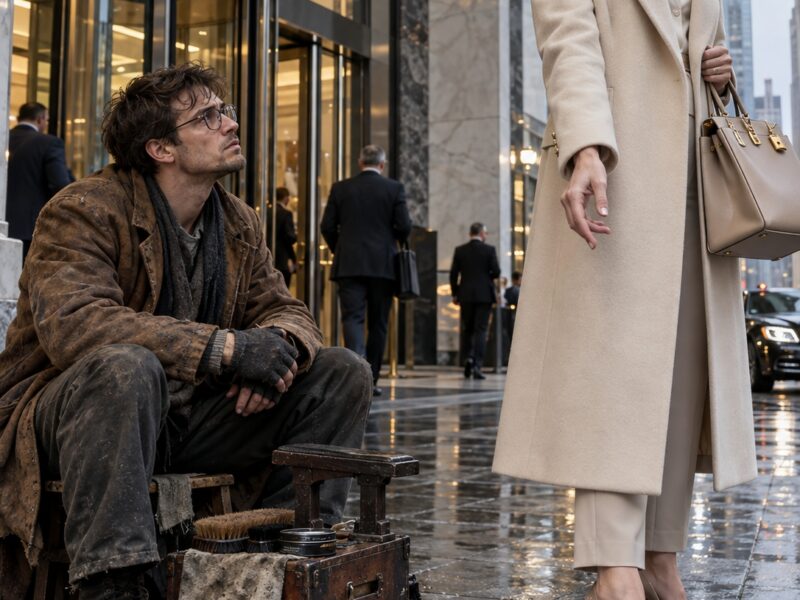
THE BILLIONAIRE’S SON SAT OUTSIDE HIS FATHER’S COMPANY SHINING SHOES—THEN ONE EXECUTIVE THREW MONEY AT HIS FEET AND ORDERED SECURITY TO REMOVE HIM
The five-dollar bill hit the sidewalk before Daniel Mercer had time to reach for it.
It fluttered once beneath the polished heel of Victoria Hale, Executive Vice President of Mercer & Cole Industries, then slid through a thin ribbon of dirty rainwater running along the curb.
Victoria looked down at Daniel.
Not at his face.
At him.
There was a difference.
She saw the frayed brown coat, the faded work pants, the scuffed shoes, the battered wooden shine box sitting between his knees. She saw a man who looked as though five dollars might determine whether he ate dinner.
Then she smiled.
Not kindly.
“Here,” she said. “Take it.”
Daniel stared at the wet bill.
For a second, the traffic on Madison Avenue seemed strangely distant.
A bus sighed at the curb. A horn sounded somewhere behind them. Employees moved through the revolving glass doors of the forty-two-story tower, carrying coffee cups and leather briefcases beneath the silver letters mounted over the entrance:
MERCER & COLE INDUSTRIES.
Daniel slowly lifted his eyes.
“Ma’am?”
Victoria had already started checking her phone.
“Why did you give it to me like that?”
That made her look at him.
Her expression was almost amused.
“Because you’re poor.”
Daniel said nothing.
Victoria slipped her phone into the pocket of her cream-colored coat.
“You cleaned my shoes. I paid you. You should be grateful I gave you anything.”
Daniel looked again at the five-dollar bill lying in the gutter.
He had expected arrogance.
He had expected indifference.
He had even expected people to walk past him as though he were invisible.
He had not expected this.
“So because I’m poor,” he said quietly, “I deserve this?”
Victoria’s smile disappeared.
Something colder replaced it.
“People like you should learn not to make everything complicated.”
Daniel held her gaze.
“People like me?”
Victoria glanced toward the entrance, apparently worried someone important might see her standing there too long.
“You know what I mean.”
Unfortunately for her, Daniel did.
And what Victoria did not know was that the building behind her belonged to Daniel’s father.
What she did not know was that the chair she sat in every Monday morning during executive meetings existed because Daniel’s father had approved her promotion.
What she did not know was that the young man wearing the stained coat had spent Thanksgiving dinners listening to conversations about this company since he was eleven years old.
And what she could not possibly have known was that Daniel Mercer had come there that morning for exactly this reason.
To discover what people did when they believed no one powerful was watching.
Three days earlier, Daniel had been standing in his father’s study when he proposed the idea.
Richard Mercer was sixty-three, silver-haired, broad-shouldered, and still carried himself like the construction foreman he had been before Mercer & Cole became a multibillion-dollar corporation.
He was behind his desk reading quarterly reports when Daniel walked in.
“I want to test the company.”
Richard lowered the papers.
“Test it?”
“Yes.”
“How?”
Daniel closed the door.
“Secretly.”
His father studied him for several seconds.
Daniel had grown up knowing that look. Richard Mercer did not interrupt when something interested him. He became very still.
Daniel walked toward the windows.
Thirty floors below, Chicago moved beneath a gray February sky.
“I’ve spent six months reading employee surveys,” Daniel said. “Customer complaints. Exit interviews. HR reports.”
“And?”
“They don’t match.”
Richard leaned back.
“Explain.”
“Senior leadership says morale is excellent. HR says complaints are down. Managers say the culture is strong.”
“That sounds like good news.”
“It would be.”
Daniel turned.
“If people weren’t quitting.”
Richard’s expression changed slightly.
Daniel placed a folder on the desk.
“Twenty-seven resignations from support staff in four months. Eleven building-services employees. Six administrative assistants. Four reception employees. Security turnover is almost double what it was last year.”
Richard opened the folder.
Daniel continued.
“The people at the top say everything is fine because everyone behaves well around people at the top.”
Richard looked up.
“And you think they’re lying?”
“No.”
Daniel shook his head.
“I think they may not know.”
That answer interested Richard more.
Daniel pulled out one particular report.
“Read this.”
Richard scanned it.
Anonymous employee feedback.
Senior employees regularly demean junior staff.
Contract workers treated as socially inferior.
Complaints dismissed unless senior management is directly involved.
Richard’s jaw tightened.
“This could be one disgruntled employee.”
“It could.”
Daniel placed another page down.
“And this?”
A second complaint.
Then a third.
Then a fourth.
Different departments.
Similar language.
Richard removed his glasses.
“What exactly are you proposing?”
Daniel looked toward the city again.
“I go there as someone nobody thinks matters.”
His father frowned.
“What does that mean?”
“A shoe cleaner.”
Richard actually laughed.
Daniel did not.
The laughter stopped.
“You’re serious.”
“I’ll wear old clothes. Sit outside the main entrance. Shine shoes.”
“A shoe cleaner?”
“Yes.”
Richard stood.
“Daniel, you’re thirty-one years old. You have a graduate degree. You sit on the foundation board. Half the executives in that building have met you.”
“Not recently.”
Richard hesitated.
That was true.
Daniel had deliberately stayed away from Mercer & Cole’s corporate operations.
He had spent the previous four years helping run the Mercer Family Foundation, mostly outside Illinois. His photograph rarely appeared in company publications, and Richard had resisted using his children as marketing material.
Daniel was known by name.
Not necessarily by face.
“I’ll change my hair,” Daniel said. “Grow the beard another few days. Glasses. Old coat.”
“And what exactly are you hoping to prove?”
Daniel thought about that.
“Nothing.”
Richard narrowed his eyes.
“I’m hoping there’s nothing to prove.”
The room went quiet.
Then Daniel added, “But if there is something wrong, I want to see it when they don’t know I’m watching.”
Richard walked toward the window.
His reflection floated against the Chicago skyline.
“This company employs fourteen thousand people.”
“I know.”
“My name is on that building.”
“I know.”
“And you think sitting on a sidewalk with a shoe brush is going to tell you what fourteen thousand people are like?”
“No.”
Daniel paused.
“But it might tell me something about the people who walk through one important door.”
Richard looked at him.
Daniel could see the conflict in his father’s face.
Richard Mercer had built his company from almost nothing.
At twenty-three, he had driven a delivery truck.
At twenty-seven, he had borrowed money against a house he barely owned.
At thirty-five, he nearly lost everything.
He still kept the first pair of work boots he had ever bought in a glass cabinet downstairs—not because they were valuable, but because he said they reminded him never to become impressed with expensive shoes.
And yet companies changed as they grew.
People changed.
Systems hardened.
Titles became walls.
Sometimes founders discovered that the values printed in a lobby were not the values practiced in an elevator.
Richard finally exhaled.
“All right.”
Daniel looked at him.
“You have my permission.”
“Thank you.”
“But one condition.”
“What?”
Richard pointed at him.
“If someone recognizes you, the experiment ends.”
Daniel smiled faintly.
“Fair.”
“And Daniel?”
“Yes?”
“Don’t reveal who you are just because somebody hurts your pride.”
Daniel’s smile faded.
“That’s the whole point.”
Richard nodded.
Then he said something Daniel would remember later.
“People show you their character fastest when they believe you have nothing they need.”
On Monday morning, Daniel arrived at Mercer & Cole before seven.
The transformation was more convincing than even he expected.
His dark hair was hidden beneath an old knit cap. A week of beard shadow changed the shape of his face. He wore glasses with scratched frames, a thrift-store coat two sizes too large, faded pants, and boots marked with salt.
The shine box had belonged to a retired barber Daniel knew through the foundation.
Its corners were chipped.
Its brass footrest was dull.
It looked real because it was real.
Daniel positioned himself near the edge of the plaza, far enough from the doors not to block anyone but close enough for employees to notice him.
For the first twenty minutes, almost nobody did.
That was Daniel’s first lesson.
He had underestimated invisibility.
Hundreds of people passed within fifteen feet of him.
Some looked through him.
Some looked away.
A few noticed him and subtly changed direction.
One man in a navy suit glanced at Daniel, then instinctively touched the pocket containing his wallet.
Daniel almost laughed.
Instead, he lowered his head and polished an already-clean shoe.
At 7:31, his first customer stopped.
A middle-aged man wearing a maintenance uniform.
“How much?”
“Five dollars.”
The man raised one eyebrow.
“Five?”
“Too much?”
“No. Too cheap.”
He sat.
His name badge read MIGUEL SANTOS.
Daniel began brushing salt from his work boots.
Miguel watched him.
“Cold morning.”
“I’ve had warmer.”
“You eat yet?”
Daniel glanced up.
“Not yet.”
Miguel reached into the paper bag he was carrying and took out a wrapped breakfast sandwich.
“Take this.”
Daniel stopped polishing.
“I’m okay.”
“I bought two.”
“You sure?”
Miguel shrugged.
“My doctor says I’m not supposed to eat two anyway.”
Daniel smiled.
“Then I’d be helping your health.”
“Exactly.”
Daniel accepted it.
Miguel paid five dollars.
Into Daniel’s hand.
Then added two more.
“Stay warm.”
“Thank you.”
Miguel walked inside.
Daniel watched him disappear through the revolving doors.
Seven minutes later, a receptionist named Hannah asked for a shine.
She apologized because her shoes were wet.
Daniel nearly smiled at the absurdity of someone apologizing to the person cleaning her shoes because they needed cleaning.
At 8:03, a young analyst stopped.
At 8:17, a courier did.
At 8:26, an executive walked directly past Daniel without looking at him.
At 8:32, Victoria Hale arrived.
Daniel recognized her immediately.
He had seen her photograph in annual reports.
Forty-two.
Wharton MBA.
Executive Vice President of Corporate Operations.
Her performance numbers were exceptional.
Her employee evaluations were immaculate.
Her coat probably cost more than Daniel’s entire disguise.
She walked toward the entrance, then noticed the shine box.
Victoria stopped.
Looked at her shoes.
Then looked at Daniel.
“Hey.”
Daniel raised his head.
“Yes, ma’am?”
“Poor man.”
He almost thought he had misheard.
Victoria extended one foot.
“Clean my shoe quickly.”
Daniel stared at her for half a second.
Then nodded.
“Yes, ma’am.”
He polished the first shoe carefully.
Victoria answered two emails while he worked.
She never asked his name.
When Daniel moved to the second shoe, she sighed.
“Can you hurry?”
“I’m almost finished.”
“I have a meeting.”
Daniel buffed the leather.
“There.”
Victoria inspected it.
Then took out five dollars.
And threw it.
That was when the experiment changed.
Until then, Daniel had felt like an observer.
Afterward, he felt something more complicated.
Anger was part of it.
But mostly, disappointment.
Victoria did not know his name.
She did not know his education.
She did not know his family.
She believed he had no influence over her career, no social standing she respected, no connection she could use.
Therefore, in her mind, dignity had become optional.
Daniel looked at the bill.
“So because I’m poor, I deserve this?”
Victoria’s eyes hardened.
“Don’t expect respect from people like me.”
The words landed harder than the money.
Daniel looked at her.
“Why not?”
Victoria seemed surprised he had asked.
“Because this is a corporate building, not a charity shelter.”
“I’m working.”
“You’re cleaning shoes on a sidewalk.”
“Yes.”
“That’s not what I meant.”
Daniel slowly stood.
He was taller than she expected.
Victoria instinctively stepped back.
Daniel did nothing threatening. He simply looked at her.
“What did you mean?”
She folded her arms.
“People like you should know their place.”
There it was.
Not impatience.
Not a bad morning.
Not a careless insult.
A belief.
Daniel felt something cold settle inside him.
Victoria turned toward the building.
Then stopped.
“And don’t sit this close to the entrance tomorrow. It looks bad.”
“For whom?”
“For us.”
She walked away.
Daniel watched her enter the building.
Only when she disappeared did he bend down and pick up the wet five-dollar bill.
He wiped it on his pants.
Then placed it carefully inside his coat.
He would keep that bill.
Not because he needed evidence.
Because he wanted to remember how easily human dignity could apparently be priced.
By nine, the sidewalk had become busier.
A few employees treated Daniel warmly.
Most ignored him.
Two made jokes.
One woman left a ten-dollar tip and told him his work was excellent.
Another employee refused to sit because, as he told his coworker loudly enough for Daniel to hear, “You never know where these people have been.”
Daniel wrote nothing down.
That would have looked suspicious.
He remembered.
At 10:12, a man in a charcoal suit walked outside.
Daniel recognized him too.
Thomas Reed.
Director of Building Operations.
Thomas controlled security, facilities, vendor access, and front-of-house operations across Mercer & Cole’s Chicago properties.
According to his personnel file, Thomas was disciplined, efficient, and highly respected by senior leadership.
According to anonymous employee complaints, he was something else.
Thomas stopped approximately ten feet from Daniel.
“Are you still sitting here?”
Daniel looked up.
“I’ve been here this morning, yes.”
“You shouldn’t be.”
Daniel glanced around.
“I’m not blocking the entrance.”
“That isn’t the issue.”
“What is?”
Thomas stepped closer.
“You can’t run a business here.”
“I asked security earlier.”
That was true.
A morning guard had told Daniel that the outer plaza was public-access space as long as he remained beyond the marked building boundary.
Thomas’s expression tightened.
“Which guard?”
Daniel did not answer.
Thomas looked toward the doors.
Then back at Daniel.
“You need to leave.”
“Why?”
“Because I’m telling you.”
Daniel almost heard his father’s voice.
Don’t reveal who you are just because somebody hurts your pride.
So Daniel remained seated.
“I’m not bothering anyone.”
Thomas gave a short laugh.
“That isn’t your decision.”
He took out his phone.
Daniel watched him.
“Who are you calling?”
“Security.”
Daniel said nothing.
Thomas turned slightly.
“There’s someone loitering outside the main entrance.”
Daniel looked down at the brushes inside his box.
Loitering.
Interesting word.
He had cleaned eleven pairs of shoes that morning.
He had receipts from the permit kiosk.
But to Thomas, work performed by the wrong-looking person had become loitering.
Two security officers emerged.
One was the same guard Daniel had spoken with earlier.
Marcus Bell.
The second was a younger officer Daniel did not recognize.
Thomas pointed.
“Get him away from the entrance.”
Marcus hesitated.
“Sir, he’s outside the property line.”
Thomas turned slowly.
“Excuse me?”
Marcus swallowed.
“He asked me earlier. I checked. Technically this part of the plaza—”
“I know the property.”
“Yes, sir.”
“Then move him.”
Marcus looked at Daniel.
Daniel saw embarrassment in his eyes.
“Sir,” Marcus said quietly, “are you working here?”
Daniel nodded.
“Yes, sir. I only clean shoes.”
Thomas scoffed.
“Don’t waste your time with him. He’s just a shoe cleaner.”
Daniel looked at Thomas.
“Just?”
Thomas ignored him.
A few employees had slowed near the entrance.
People sensed conflict the way birds sensed weather.
Victoria emerged from the lobby holding a coffee.
When she saw Daniel still there, irritation crossed her face.
“You’re still here?”
Daniel said nothing.
Victoria looked at Thomas.
“I told him this morning he shouldn’t be at the front door.”
Thomas nodded.
“I’m handling it.”
Victoria glanced at Daniel’s shine box.
“Good.”
Daniel watched her.
“Why does it bother you?”
She looked at him.
“What?”
“That I’m here.”
Victoria sighed.
“We have clients coming through this entrance.”
“And?”
“And people like you don’t belong at our front door.”
Our.
Daniel noticed that word.
He had heard it countless times growing up.
Our company.
Our building.
Our reputation.
But never had it sounded quite like that.
“Where do people like me belong?” Daniel asked.
Victoria’s face hardened.
“This is exactly why you need to leave.”
Thomas pointed toward the sidewalk.
“You’re not welcome here. Move your stand.”
Daniel remained seated.
Thomas stepped forward.
“Did you hear me?”
“Yes.”
“Then move.”
Daniel looked at Marcus.
The guard was visibly uncomfortable.
Thomas noticed.
“Marcus.”
“Yes, sir?”
“That’s enough. Get this stand out of here.”
Marcus hesitated again.
Thomas’s voice sharpened.
“Take the stand away. I don’t want it here.”
The younger security officer stepped toward Daniel’s box.
Daniel placed one hand on it.
“Please don’t.”
Thomas laughed.
“You don’t get to dictate terms.”
“I’m asking you not to touch my property.”
“You were asked to leave.”
“By you.”
“That’s all that matters.”
“No,” Daniel said quietly. “It isn’t.”
The small crowd grew.
Victoria looked increasingly annoyed.
“Thomas, just remove him.”
Marcus lowered his voice.
“Mr. Reed, maybe we should call legal before physically removing—”
Thomas spun toward him.
“Do you want to keep your job?”
Marcus went silent.
Daniel felt his stomach tighten.
There.
That was the part no spreadsheet captured.
Fear.
Not dramatic fear.
Ordinary workplace fear.
The kind that made decent people participate in something wrong because rent was due next Friday.
Daniel looked at Marcus.
“It’s okay.”
Marcus frowned.
Daniel slowly removed his hand from the box.
Thomas gestured.
“Take it.”
The younger guard reached down.
Then a voice came from behind the crowd.
“Stop.”
Everything froze.
Daniel knew the voice before he turned.
So did half the employees standing nearby.
Richard Mercer walked through the revolving doors.
No entourage.
No announcement.
Just a dark overcoat, silver hair, and an expression Daniel had rarely seen on his father’s face.
Thomas immediately straightened.
“Mr. Mercer.”
Victoria’s entire posture changed.
“Richard. Good morning.”
Richard did not answer her.
He looked at the younger security officer holding Daniel’s shine box.
“Put that down.”
The officer did.
Immediately.
Richard looked at Marcus.
“Were you ordered to remove this man?”
Marcus swallowed.
“Yes, sir.”
“By whom?”
Thomas stepped forward.
“I did, sir. There was a concern about the entrance and—”
Richard raised one hand.
Thomas stopped talking.
Richard looked at Daniel.
For one dangerous second, Daniel thought his father was about to end the experiment.
Their eyes met.
Daniel gave the smallest shake of his head.
Don’t.
Richard understood.
His jaw tightened.
But he played along.
He looked back at Thomas.
“Who gave you permission to treat him this way?”
Thomas blinked.
“Sir?”
“You heard me.”
“He was operating without authorization.”
Daniel spoke.
“That’s not true.”
Thomas glared at him.
Richard noticed.
“Let him speak.”
Daniel explained where he had positioned himself and that Marcus had verified the public-access boundary.
Richard looked at Marcus.
“Correct?”
Marcus nodded.
“Yes, sir.”
Thomas tried again.
“With respect, Mr. Mercer, that’s not the larger issue. This is the primary corporate entrance. We have a certain image to maintain.”
Richard’s eyes narrowed.
“What image?”
Thomas hesitated.
Victoria intervened.
“I think this is getting blown out of proportion.”
Richard finally looked at her.
“Is it?”
Victoria smiled carefully.
“We’re talking about basic presentation standards.”
Richard’s gaze remained fixed on her.
“Did you speak to this man earlier?”
Victoria glanced at Daniel.
“Briefly.”
“How?”
Her smile weakened.
“I had my shoes cleaned.”
“Anything else?”
“No.”
Daniel said nothing.
Victoria looked at him.
Their eyes met.
For the first time that morning, Daniel saw uncertainty.
Richard saw it too.
“What did you say to him?”
Victoria’s chin lifted.
“I don’t remember every casual conversation I have outside the building.”
Daniel reached into his coat.
He removed the wrinkled five-dollar bill.
Still damp around one corner.
He held it between two fingers.
“I remember.”
Victoria’s face changed.
Only slightly.
But enough.
Richard looked at the bill.
Then at Daniel.
“What happened?”
Daniel could have told him.
He wanted to.
Instead, he looked at his father and said, “Please let me finish.”
Richard stared at him.
The crowd was silent.
Then Richard stepped back.
“All right.”
Victoria frowned.
Thomas looked confused.
Daniel sat down again.
He placed the five-dollar bill inside his coat.
“Thank you.”
Richard turned toward the building.
But before walking inside, he looked at Thomas.
“Nobody touches him.”
Then he looked at Victoria.
“Nobody.”
Richard disappeared through the doors.
The moment he was gone, the entire atmosphere shifted.
Thomas stared at Daniel as if seeing him for the first time.
Victoria stared too.
Neither understood why Richard Mercer had personally intervened for a shoe cleaner.
Daniel lowered his head.
“Anyone need a shine?”
No one answered.
Then Miguel Santos stepped out from the crowd.
The maintenance worker walked toward Daniel.
He sat down.
“Mine got dirty again.”
Daniel looked at the boots.
They were perfectly clean.
Daniel smiled.
“Five dollars.”
Miguel smiled back.
“Deal.”
People slowly dispersed.
But the test was no longer invisible.
Something had changed.
And Victoria knew it.
At noon, Daniel took his shine box two blocks away and ate lunch on a bench.
The sandwich Miguel had given him was long gone.
He bought soup from a corner deli and watched employees come and go.
His phone remained switched off inside his coat.
No messages.
No notes.
No executive privileges.
For eight hours, he wanted to inhabit only one identity.
The man people believed him to be.
Around one, a young woman from the company approached.
Daniel recognized her from earlier.
Reception.
Hannah.
She sat beside him without asking.
“You okay?”
Daniel looked at her.
“Why wouldn’t I be?”
“I saw what happened.”
Daniel stirred his soup.
“Which part?”
Hannah gave a humorless laugh.
“Take your pick.”
Daniel said nothing.
She lowered her voice.
“Victoria does that.”
“Does what?”
“You know.”
“No. Tell me.”
Hannah hesitated.
Daniel waited.
“She decides who matters.”
The sentence was quiet.
Almost ashamed.
“Based on what?”
“Title. Clothes. Who you know. Whether you can do something for her.”
Daniel looked at the building.
“And Thomas?”
Hannah’s mouth tightened.
“Thomas decides who is afraid of him.”
Daniel turned back.
“Have people complained?”
She laughed again, but this time there was no humor at all.
“To whom?”
“HR.”
Hannah looked at him as though he were naïve.
“Thomas plays golf with the regional HR director.”
Daniel felt a knot form in his stomach.
“Victoria?”
“She’s worse.”
“Why?”
“Because she’s smart.”
Hannah stood.
Then she seemed to regret saying anything.
“I should go.”
Daniel looked up.
“Thank you.”
“For what?”
“For sitting down.”
Hannah looked toward the tower.
“You know the weird thing?”
“What?”
“My dad used to shine shoes.”
Daniel said nothing.
“He came here from Ohio with sixty dollars when he was nineteen. Worked in a hotel. Shined shoes at night. Eventually became an electrician.”
She glanced toward the entrance.
“Victoria knows that.”
Daniel watched her leave.
The afternoon brought more small moments.
Some good.
Some ugly.
A junior accountant named Noah paid five dollars and asked Daniel how business was going.
A delivery driver gave him coffee.
A senior manager stepped around him as though avoiding garbage.
At 2:40, Thomas returned.
This time alone.
He stopped beside the shine box.
Daniel continued polishing a customer’s shoe.
Thomas waited until the customer left.
Then he spoke.
“What did you say to Mr. Mercer?”
“Nothing he didn’t ask.”
Thomas studied him.
“You know him?”
Daniel shrugged.
“He knows a lot of people.”
“That isn’t what I asked.”
Daniel cleaned his brush.
Thomas stepped closer.
“Listen carefully. I don’t know what game you’re playing.”
Daniel looked up.
“No game.”
“Then why did Richard Mercer personally defend you?”
“You could ask him.”
Thomas’s jaw tightened.
“You think you’re clever?”
“No.”
“Good.”
Thomas leaned down.
“Because men like you sometimes confuse attention with importance.”
Daniel held his gaze.
“Men like me.”
Thomas realized too late that he had echoed Victoria.
He straightened.
“You know what I mean.”
Daniel almost smiled.
“That seems to be a popular sentence around here.”
Thomas walked away.
Daniel watched him enter the building.
He had learned enough.
But he stayed.
At 4:45, office workers began leaving.
By five thirty, the plaza was crowded again.
Daniel had cleaned thirty-seven pairs of shoes.
He had earned $241, mostly because several ordinary employees tipped generously.
He also had a list in his head.
Not names of enemies.
Moments.
Miguel’s sandwich.
Hannah’s apology for wet shoes.
Marcus’s hesitation.
Victoria’s five-dollar bill.
Thomas threatening Marcus’s job.
Those moments told Daniel more about the company than hundreds of pages of corporate values statements.
At 5:51, Richard appeared again.
This time, he was not alone.
Several executives followed him.
Victoria.
Thomas.
The Chief Human Resources Officer.
The general counsel.
Two vice presidents.
Marcus stood near the doors.
Employees leaving work slowed when they saw the group.
Daniel remained seated.
Richard walked toward him.
“Finished?”
Daniel looked at his watch.
“I think so.”
Richard nodded.
“Then come inside.”
Victoria stared.
Thomas said nothing.
Daniel picked up his shine box.
Richard stopped him.
“No.”
Daniel looked at his father.
Richard turned to Thomas.
“Carry it.”
Thomas’s face went pale.
For the first time all day, Daniel almost felt sorry for him.
Almost.
“Richard,” Victoria said quietly, “what exactly is happening?”
Richard ignored her.
They entered the building.
The lobby was enormous.
White marble floors.
Thirty-foot windows.
A bronze sculpture near reception.
On the wall behind the security desk were the company’s five stated values.
Integrity.
Excellence.
Accountability.
Courage.
Respect.
Daniel stopped.
His eyes rested on the final word.
Respect.
Victoria noticed.
So did Richard.
No one spoke.
They took the elevator to the executive conference floor.
When the doors opened, several department heads were waiting.
Daniel immediately understood.
His father had arranged something.
Richard walked into the main conference room.
Daniel followed.
Thirty people were inside.
Some knew Daniel.
Most did not.
Those who did began whispering.
Victoria noticed.
Her eyes moved from one face to another.
Then to Daniel.
Thomas set the shine box near the wall.
“What is this?” he asked.
Richard removed his coat.
“Sit down.”
Everyone did.
Except Daniel.
He remained near the door in his old coat.
Richard walked to the head of the table.
“I asked all of you here because something happened outside our building today.”
Silence.
Richard looked toward Victoria.
“Before we discuss it, Thomas, I need to ask you one thing.”
Thomas swallowed.
“Yes, sir?”
“Who approved your position here?”
Thomas looked confused.
“Sir?”
“Your appointment. Director of Building Operations.”
Thomas glanced around.
“The executive committee.”
Richard placed a document on the table.
“Do you recognize this signature?”
Thomas looked down.
His face changed.
“Yes.”
“Whose is it?”
“Yours.”
Richard nodded.
“Then you know exactly what that means.”
Thomas said nothing.
“It means,” Richard continued, “that I trusted you.”
He looked around the room.
“When someone receives authority in this company, that authority does not make them more human than the people beneath them on an organizational chart.”
Nobody moved.
“It makes them more responsible.”
Richard turned toward Victoria.
“You told me earlier that what happened outside was being blown out of proportion.”
Victoria sat perfectly still.
“Do you still believe that?”
She glanced at Daniel.
“I believe there may have been misunderstandings.”
Daniel finally spoke.
“What did I misunderstand?”
Every face turned toward him.
Victoria forced a professional smile.
“You were upset.”
“I asked you why you threw money at my feet.”
“I dropped it.”
Daniel reached into his coat.
He placed the five-dollar bill on the conference table.
“No.”
Victoria stared at it.
“You threw it.”
“I don’t remember it that way.”
“I do.”
Victoria’s eyes sharpened.
“Then it’s your word against mine.”
Richard closed his eyes briefly.
Daniel almost wished she had stopped.
Not because he wanted to protect her.
Because he understood what she had just done.
She still believed the man standing near the door had no power.
Even now.
Even after Richard Mercer had defended him.
Even inside the executive conference room.
She still believed status could save her from truth.
Daniel looked at his father.
Richard nodded once.
It was time.
Daniel removed his knit cap.
Then his glasses.
He unbuttoned the oversized coat.
Whispers moved around the room.
Victoria stared.
Thomas frowned.
One of the vice presidents suddenly stood.
“Oh my God.”
Victoria turned toward him.
The man looked at Daniel.
“Daniel?”
The room went silent.
Victoria’s face drained of color.
Thomas looked from Daniel to Richard.
Then back again.
Richard walked around the table.
He stopped beside Daniel.
For a moment, he said nothing.
Then he faced the room.
“Everyone,” he said, “I want you to meet my son.”
Nobody moved.
Richard rested one hand on Daniel’s shoulder.
“Daniel Mercer.”
Victoria’s lips parted.
Thomas sat down slowly.
Daniel looked at them.
The same people who had looked through him on the sidewalk were suddenly studying every detail of his face.
Nothing about him had changed.
Not his intelligence.
Not his character.
Not his worth.
Only what they knew.
And somehow, that changed everything.
Victoria stood.
“Daniel, I—”
He lifted a hand.
“No.”
She stopped.
Daniel looked at her.
“Don’t call me Daniel now.”
Confusion flickered across her face.
“You didn’t ask my name this morning.”
No one spoke.
“You called me ‘poor man.’”
Victoria swallowed.
Daniel stepped closer to the table.
“You threw five dollars at my feet.”
Her eyes dropped toward the bill.
“You told me I should be grateful.”
“Daniel, I didn’t realize—”
“That is exactly the problem.”
His voice was quiet.
It did not need to be loud.
“You didn’t realize who I was.”
Victoria froze.
Daniel continued.
“If you had recognized me this morning, would you have thrown money on the sidewalk?”
“No.”
“Would you have told me people like me should know their place?”
She said nothing.
“Would you have told me not to expect respect from people like you?”
Victoria’s eyes filled with panic.
“I was frustrated.”
“With what?”
No answer.
“My shoes?”
Silence.
“My clothes?”
Nothing.
“Or the fact that you thought I couldn’t hurt you?”
Victoria looked toward Richard.
Daniel saw it.
Everyone did.
She was still looking for power.
Just a different source of it.
Richard did not help her.
Daniel turned toward Thomas.
“You told security to remove me.”
Thomas straightened.
“I was protecting the property.”
“No.”
Daniel shook his head.
“Marcus told you I was outside the property line.”
Thomas glanced toward the guard.
“You threatened his job when he hesitated.”
Thomas’s face tightened.
“I was trying to maintain order.”
“Order?”
Daniel walked toward the wall.
He pointed at the company values.
“Which one?”
Thomas did not answer.
“Integrity?”
Silence.
“Courage?”
Nothing.
“Respect?”
Thomas lowered his eyes.
Daniel looked around the room.
“I wasn’t outside this building for money.”
He paused.
“I was there to see the truth.”
The room remained completely still.
“My father has spent years hearing that this company respects people. That our culture is healthy. That employees feel valued.”
Daniel glanced at Victoria.
“I wanted to know what those values looked like when nobody thought a Mercer was watching.”
Victoria’s face crumpled slightly.
Daniel continued.
“Some of you passed.”
A few people looked up.
“Not because you knew who I was.”
He thought of Miguel.
“Hannah from reception apologized because her shoes were wet.”
A faint murmur moved through the room.
“An analyst asked if I was warm enough.”
He looked toward Marcus.
“A security officer risked angering his superior because he knew removing me was wrong.”
Marcus looked stunned.
“And a maintenance worker gave me half his breakfast before he knew whether I could ever do anything for him.”
Daniel let that settle.
“Those people didn’t pass because they were nice to the owner’s son.”
His eyes returned to Victoria.
“They passed because they were decent to a man they believed was poor.”
Victoria stared at the table.
“And today,” Daniel said, “you failed that test.”
No applause followed.
Daniel was glad.
This was not a victory.
It was an autopsy.
Richard stepped forward.
“I want every employee complaint involving executive conduct from the last eighteen months reopened.”
The HR chief nodded.
“Yes, sir.”
“Independent review.”
“Yes.”
“No internal filtering.”
“Understood.”
Thomas looked alarmed.
“Mr. Mercer—”
Richard turned.
“You’ll cooperate.”
Thomas went silent.
Richard looked at Victoria.
“So will you.”
Victoria slowly nodded.
Daniel looked at his father.
This was further than they had planned.
But perhaps that was the point.
A test meant nothing if the result could be ignored.
The meeting ended twenty minutes later.
People filed out quietly.
Victoria remained.
So did Thomas.
Richard stood by the windows.
Daniel put his old glasses back into his coat pocket.
Victoria approached him.
Her confidence was gone.
“Daniel.”
He looked at her.
“I’m sorry.”
Daniel waited.
She swallowed.
“I was wrong.”
He said nothing.
“I shouldn’t have spoken to you that way.”
“No.”
“I shouldn’t have thrown the money.”
“No.”
Victoria’s voice became smaller.
“I’m embarrassed.”
Daniel studied her.
“Why?”
She looked confused.
“Because of what happened.”
“No.”
Daniel shook his head.
“Why are you embarrassed?”
She struggled for an answer.
“Because everyone knows.”
There it was.
Daniel’s expression softened, but not from sympathy.
“Then you still don’t understand.”
Victoria looked at him.
“You shouldn’t be embarrassed because everyone knows how you treated me.”
He pointed toward the windows.
“You should be embarrassed because you would have treated that man exactly the same way if his name had never been Mercer.”
Victoria looked down.
Daniel picked up the five-dollar bill.
“You thought poverty made respect optional.”
Her eyes filled with tears.
Daniel did not enjoy seeing them.
But he did not rescue her from them either.
“No one is above respect,” he said.
Then he looked toward the lobby far below.
“And no one is beneath it.”
Victoria wiped her cheek.
“What happens now?”
Daniel looked at Richard.
His father remained silent.
The decision, for this moment, was Daniel’s.
He could have demanded her termination.
Part of him wanted to.
He remembered the bill landing in dirty water.
He remembered the contempt in her voice.
People like you should know their place.
But he also remembered why he had come.
Not for revenge.
For truth.
“You can start by apologizing.”
Victoria nodded quickly.
“I already did.”
“Not to me.”
She looked confused.
Daniel continued.
“To Marcus.”
Her eyes moved toward the door.
“To the reception staff you’ve humiliated. To assistants you’ve treated like furniture. To contract workers whose names you never bothered learning.”
Victoria’s face tightened.
“And after that?”
“After that, you cooperate with the review.”
“And my job?”
Daniel looked at her.
“That depends on what the truth says.”
For once, Victoria had nothing to say.
Thomas’s investigation was less complicated.
Within two weeks, the independent review documented repeated intimidation of security personnel, custodial staff, contractors, and junior employees.
Thomas had not committed one spectacular offense.
He had done something more ordinary.
He had created a climate where people learned that disagreeing with him cost them shifts, opportunities, favorable schedules, and sometimes jobs.
That mattered.
His employment ended before the month did.
Victoria’s case was different.
Her record contained no single violation that made a dramatic headline.
Instead, investigators found patterns.
Assistants excluded from meetings after questioning her.
Junior employees mocked for inexpensive clothing.
A temporary receptionist reduced to tears.
A catering worker called “the help” in front of clients.
An intern ordered to use a service elevator because Victoria was bringing investors through the lobby.
Each incident alone had been minimized.
Together, they formed a portrait.
Victoria was removed from executive leadership pending review.
She eventually returned months later in a non-supervisory advisory role after agreeing to a formal conduct program, but the title that had once insulated her was gone.
Daniel insisted on one thing.
No announcement would claim that Victoria had been punished for disrespecting “the owner’s son.”
Because that would destroy the entire lesson.
She had been held accountable for how she treated people.
Period.
The more surprising consequences happened elsewhere.
Marcus Bell received a commendation.
He initially refused it.
“I didn’t do anything.”
Daniel met him in the lobby one afternoon.
“You did.”
Marcus shook his head.
“I still picked up the box.”
“After your boss threatened your job.”
“I should’ve refused.”
Daniel looked at him.
“Do you have kids?”
Marcus nodded.
“Two.”
“Mortgage?”
Marcus laughed.
“Unfortunately.”
“Then courage doesn’t mean pretending fear doesn’t exist.”
Daniel handed him the commendation letter.
“It means hesitating when obedience would be easier.”
Marcus looked at the letter for a long time.
Then accepted it.
Miguel Santos became a minor legend inside the company, much to his embarrassment.
People kept joking that the cheapest breakfast sandwich in Chicago had become the best investment in Mercer & Cole history.
Miguel hated the joke.
One morning, Daniel found him replacing a light fixture in a fourth-floor hallway.
“You know what everybody keeps saying?” Miguel complained.
Daniel smiled.
“What?”
“That I gave you breakfast because somehow I knew.”
“You did know.”
Miguel stared at him.
“What?”
“You knew I was hungry.”
Miguel went quiet.
Daniel smiled.
“That was enough.”
Hannah was invited to participate in the company’s new workplace culture committee.
She initially thought it was a joke.
It wasn’t.
The company changed some policies.
But Daniel quickly discovered policies were the easy part.
Mercer & Cole created an independent employee reporting channel.
Executive conduct complaints no longer passed through direct supervisors.
Contract workers were included in workplace culture surveys.
Security officers received clearer authority to refuse inappropriate orders.
Managers were evaluated partly on anonymous feedback from employees below their level.
But Daniel refused to let his father issue a triumphant press release.
Richard wanted to.
Daniel stopped him.
“Why?”
“Because treating people decently isn’t a marketing campaign.”
Richard looked annoyed.
“It would be good publicity.”
“That’s exactly why we shouldn’t.”
Richard considered that.
Then smiled.
“You’re becoming irritating.”
“I learned from you.”
“Unfortunately.”
The story never reached the newspapers.
Daniel preferred it that way.
Inside Mercer & Cole, however, people talked.
Not about the billionaire’s son pretending to be poor.
That version faded quickly.
What lasted was the question the experiment left behind.
Who are you when the person in front of you cannot help you?
Months passed.
Spring arrived.
Chicago thawed.
One April morning, Daniel returned to the same plaza.
No disguise.
No old coat.
He wore jeans, a navy jacket, and ordinary sneakers.
The shine box was gone.
The city smelled of rain and warm pavement.
Employees streamed through the revolving doors.
Daniel stood near the spot where Victoria had thrown the five-dollar bill.
He could still remember exactly where it landed.
Funny how small objects could hold entire moments.
His father joined him.
Richard carried two coffees.
He handed one over.
“You’re early.”
“So are you.”
“I own the place.”
Daniel smiled.
“That excuse must be convenient.”
Richard looked toward the entrance.
“You know, I’ve been thinking.”
“That sounds dangerous.”
Richard ignored him.
“When I started this company, I knew everyone.”
Daniel sipped his coffee.
“I know.”
“Every driver. Every receptionist. Every warehouse worker.”
Richard watched a group of employees enter.
“Then the company got bigger.”
Daniel waited.
“And one day I realized I knew almost none of them.”
There was regret in his father’s voice.
Daniel looked at him.
“That happens.”
“It shouldn’t.”
Richard was silent for a moment.
“I thought putting values on a wall meant something.”
“It does.”
Richard looked at him.
“Not if nobody lives them.”
Daniel nodded.
A maintenance worker came through the entrance carrying a toolbox.
Miguel.
He spotted them.
“Morning.”
“Morning,” Richard said.
Miguel pointed at Daniel’s shoes.
“Those need work.”
Daniel looked down.
“They’re sneakers.”
“No excuses.”
Richard laughed.
Miguel disappeared inside.
Daniel watched him go.
Then Richard asked, “Did you ever spend the money?”
“What money?”
“The five dollars.”
Daniel smiled.
“No.”
“Why?”
Daniel reached into his wallet.
The bill was still there.
Flattened now.
Dry.
A faint water stain remained along one edge.
Richard stared at it.
“You’ve carried that for months?”
“Yes.”
“That’s a little dramatic.”
“Maybe.”
Richard smiled.
Daniel turned the bill over.
Five dollars.
Such a small amount.
Yet that morning it had represented everything wrong with the way some people measured one another.
Money.
Clothes.
Titles.
Doors they were allowed to enter.
Names worth remembering.
Daniel folded the bill and returned it to his wallet.
He had learned something during those eight hours outside Mercer & Cole.
Poverty did not make a person invisible.
Other people chose not to see them.
There was a difference.
He remembered Victoria’s face when his identity was revealed.
The sudden fear.
The apology.
The desperate realization that the man she had dismissed could affect her career.
That transformation had disturbed Daniel more than the insult itself.
Because nothing about him had changed.
His face was the same.
His voice was the same.
His hands were the same hands that had polished her shoes.
Only his last name had changed in her mind.
And suddenly he deserved dignity.
That was the part Daniel could never forget.
Later that afternoon, he was leaving the building when he noticed someone near the entrance.
An elderly man had set up a small cart selling newspapers, bottled water, and candy.
A security officer was speaking with him.
Daniel slowed.
For a moment, old tension returned.
Then he recognized the officer.
Marcus.
The elderly vendor was fumbling through papers.
“I have the permit somewhere,” he said nervously.
Marcus held up one hand.
“No rush.”
The man kept searching.
“I swear they told me I could stand here.”
“I believe you.”
Marcus looked at the wind pushing across the plaza.
“You cold?”
“A little.”
Marcus disappeared inside.
Thirty seconds later, he returned with a cup of coffee.
He handed it to the man.
“Here.”
The vendor blinked.
“How much?”
Marcus shook his head.
“Nothing.”
Daniel stopped several yards away.
Marcus noticed him.
Their eyes met.
Neither said anything.
Marcus gave the smallest nod.
Daniel returned it.
Then he walked on.
No applause.
No executive meeting.
No revelation.
Nobody discovered the vendor was secretly wealthy.
Nobody learned he was related to the owner.
Nobody pulled off a disguise.
He was simply an old man standing outside a building on a cold afternoon.
And Marcus treated him with dignity anyway.
That, Daniel realized, was the real test.
Not what people did after they learned who he was.
What they did when they never would.
Behind him, the glass tower reflected the afternoon sun.
The words above the entrance still read MERCER & COLE INDUSTRIES.
But Daniel no longer cared very much about the name on the building.
He cared about the people walking beneath it.
Because his father had been right about one thing.
People revealed their character fastest when they believed you had nothing they needed.
And Daniel had discovered something else.
The most dangerous kind of power was not wealth.
It was the quiet belief that another human being was too powerless to deserve your kindness.
He kept walking.
Behind him, Marcus laughed at something the old vendor said.
The sound followed Daniel halfway down the block.
And inside his wallet, beside credit cards carrying a name worth millions, remained a wrinkled five-dollar bill stained by dirty rainwater.
A reminder that respect had never belonged to the richest person in the room.
It belonged to everyone.









