The Bridal Shop Manager Tore My $12,000 Wedding Dress and Demanded $9,000—Then Turned Pale When She Found Out Who My Mother Was!
“Take it off.”
For a second, I thought I had misunderstood her.
The bridal boutique was so quiet I could hear the soft hiss of the air-conditioning above me and the faint scrape of my own shoes against the raised fitting platform.
I stood in front of three floor-to-ceiling mirrors wearing the most beautiful wedding dress I had ever seen.
Ivory silk.
A fitted bodice.
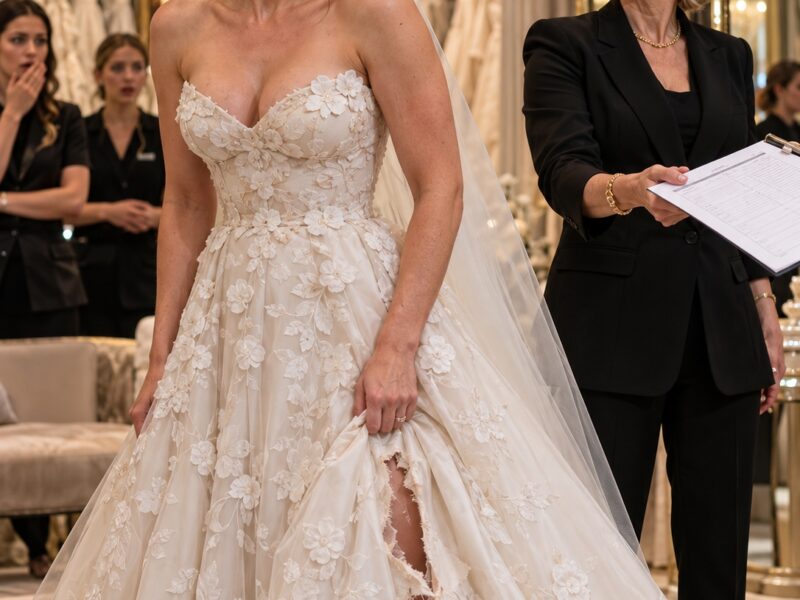
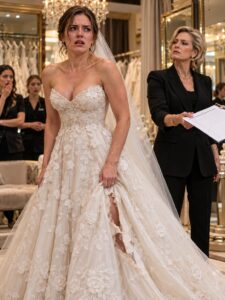
Hand-sewn camellia flowers drifting across the skirt like blossoms caught in a spring wind.
I had been staring at myself for less than a minute.
And for the first time since getting engaged, I could actually see the wedding.
Not the seating chart.
Not the florist invoice.
Not the unanswered messages from relatives.
Not the weather forecast I had checked twenty-seven times.
The wedding.
Me walking toward the man I loved.
My mother sitting in the first row.
A dress I would remember for the rest of my life.
Then the woman behind me said it again.
“Take it off.”
I turned.
She was perhaps fifty, perfectly dressed in a black suit with a narrow gold belt. Her hair was smooth enough to reflect the boutique lights. She had the kind of smile that technically counted as polite because her lips were curved upward, even though nothing about her face suggested kindness.
Her name was Patricia Cole.
Owner and manager of Bellamy Bridal.
One of the most exclusive bridal boutiques in Boston.
I looked at her reflection in the mirror.
“I’d like to buy it.”
Patricia’s smile barely moved.
“That doesn’t mean I’m selling it to you.”
Something inside me went still.
I glanced toward the young alterations assistant standing near the curtain.
Her name tag said NORA.
She looked uncomfortable.
Very uncomfortable.
I turned back to Patricia.
“Then tell me why.”
Patricia folded her hands.
“A dress like this has to be on the right bride.”
There are sentences that hurt immediately.
And there are sentences that take half a second to become insulting because your mind tries to rescue the person who said them.
Maybe she means the dress doesn’t fit my body.
Maybe she means my wedding venue.
Maybe she thinks another silhouette would suit me.
Maybe—
“What makes someone the right bride?” I asked.
Patricia sighed.
Not angrily.
Almost patiently.
That somehow made it worse.
“It’s about the brand’s image.”
Nora looked down.
I didn’t.
I stared at Patricia through the mirror.
“And what about me damages the brand’s image?”
Her expression tightened.
“I didn’t say that.”
“You didn’t have to.”
“I think you’re making this more personal than it needs to be.”
“You’re deciding whether I’m allowed to buy a wedding dress based on whether I look right for the brand. How exactly should I take that?”
She glanced at the dress.
Then at me.
“Surely you understand.”
“No,” I said quietly. “I really don’t.”
She took a step closer.
“Do you know who designed this gown?”
My throat tightened.
Of course I knew.
Everyone in bridal fashion knew.
The label was famous for handmade embroidery, architectural silhouettes, and dresses that somehow managed to feel modern without looking disposable.
But this particular gown was different.
Camellia.
I had recognized it the second I saw the flowers.
“Yes,” I said.
Patricia tilted her head.
“If she were standing here, she wouldn’t want you wearing it either.”
That was the moment the humiliation stopped hurting.
Because suddenly I knew something Patricia didn’t.
Something so absurd that I almost laughed.
Instead, I looked at my reflection.
At the camellias.
At the dress.
And I thought:
Mom, do you?
Three hours earlier, my mother had been sitting behind a desk covered in fabric samples, sketches, invoices and eleven handwritten letters from women she had never met.
Her name was Evelyn Mercer.
And she was the woman who had designed the dress Patricia Cole had just told me I wasn’t worthy to wear.
My mother had built Mercer Bridal from a rented workroom, two sewing machines, and more stubbornness than money.
She never talked about success the way magazines did.
To magazines, she was a celebrated American bridal designer.
To me, she was the woman who still kept safety pins between her lips while fitting hems.
The woman who could tell rayon from silk by touching it in the dark.
The woman who had once missed Thanksgiving dinner because a bride’s zipper broke two hours before the ceremony.
And three weeks before my own wedding, she had looked up from those complaint letters and said:
“Do you remember what we’re supposed to be doing today?”
I had been leaning against the doorframe of her studio with coffee in one hand.
“Saving your company from whatever disaster you’re currently pretending isn’t a disaster?”
She smiled.
“Picking out your wedding dress.”
“I thought you’d forgotten.”
“With three weeks to go?”
She removed her glasses.
“I wouldn’t dare.”
But something in her expression told me the letters mattered.
I walked closer.
“Are those all about Bellamy Bridal?”
She looked down.
“Eleven.”
“Eleven complaints?”
“Customer service pulled them together over the last few days.”
I picked up the first one.
Then another.
The wording changed.
The feeling didn’t.
Women who had confirmed appointments but were told their names weren’t on the schedule.
Women who were allowed only a few minutes in fitting rooms while other brides received champagne and hour-long consultations.
Women told certain gowns weren’t “appropriate.”
Women told they weren’t the “right fit.”
Women charged for alleged damage.
Women made to feel embarrassed for asking questions.
“What does the store say?” I asked.
“Appointment mix-ups. Miscommunication. New employees. Customers misunderstanding sample policies.”
“So there’s an explanation for every complaint.”
“There always is.”
My mother leaned back.
“That doesn’t mean there’s an explanation for the pattern.”
One letter had been written by a woman named Hannah.
I read the final paragraph twice.
When I first stepped onto that platform, I felt like I was really getting married.
By the time I left, I felt like I should never have walked into the store.
I put the page down.
“Let me go.”
My mother looked at me.
“What?”
“I still haven’t chosen my dress. I’ll make an appointment.”
“No.”
“Why?”
“Because you’re my daughter.”
“That’s exactly why.”
She frowned.
I tapped Hannah’s letter.
“They’ve never met me.”
“You’ve been photographed with me.”
“Not enough for some bridal shop manager to recognize me without my last name.”
She remained silent.
So I said the thing I knew would make her listen.
“If this store treats me beautifully, you get your answer.”
“And if they don’t?”
“Then you get a different answer.”
Mom looked at me for a long time.
Finally she picked up her phone.
“I’ll keep contacting the women who complained.”
“Okay.”
“And if anything makes you uncomfortable, you leave.”
“I will.”
She pointed at me.
“Lena.”
“I promise.”
Neither of us knew that by the following morning, those eleven letters would become twelve.
And number twelve would be mine.
I booked the fitting under Lena, leaving off Mercer.
When I entered Bellamy Bridal the following afternoon, nothing looked cruel.
That was the unsettling part.
The boutique was gorgeous.
Champagne-colored walls.
Cream carpeting.
Crystal lights.
Fresh white roses arranged beneath a staircase.
Dresses floated along brass rails under carefully placed spotlights.
Every detail said romance.
Every surface whispered money.
I approached reception.
“Hi. I have a fitting this afternoon. It’s under Lena.”
The receptionist searched the tablet.
Her smile faded.
“I don’t see you.”
“I received a confirmation.”
“Are you sure you have the right store?”
Before I could answer, another employee leaned over.
“She’s here. Two-thirty. Fitting room three.”
The receptionist looked at the screen again.
“Oh.”
Not sorry.
Just disappointed that the excuse had failed.
“Right.”
Then Patricia appeared.
She looked me over before looking at the schedule.
“Just so we’re clear, our gowns begin around twelve thousand dollars.”
“I’ve seen the prices.”
Something flickered in her eyes.
I walked toward the dresses.
And then I saw it.
Camellia.
My mother’s gown.
I stopped.
Nora, the alterations assistant, noticed.
“You like that one?”
I touched one embroidered flower.
“My grandmother had a camellia tree.”
Nora smiled.
“You recognized the flower.”
“Yes.”
What I didn’t tell her was that I’d spent half my childhood under that tree.
Or that my mother had spent years drawing those flowers after Grandma died.
“I want to try this one.”
Patricia followed my gaze.
“That one?”
“Yes.”
She hesitated.
Then:
“Get it for her.”
Nora reached for the gown.
Patricia added, “Five minutes.”
Nora blinked.
“But her appointment—”
“We have other clients.”
Her eyes moved to me.
“Be careful with it. Don’t pull the lace.”
The implication landed exactly where Patricia intended.
Nora helped me into the gown.
She was gentle.
Patient.
Nothing like Patricia.
When the skirt caught near my hip, Nora immediately stopped.
“Hang on.”
She loosened the fabric.
“Let it fall from here.”
I instinctively lifted the lace away from the zipper.
She noticed.
“You sew?”
“A little.”
“You knew exactly where it was catching.”
“My mom taught me when I was young.”
“That explains it.”
While adjusting the hem, she told me she handled repairs and alterations.
“For now,” she added.
“For now?”
Her face brightened.
“Someday I’d like to make a whole gown myself. Choose the fabric, cut everything, sew it, then watch somebody actually get married in it.”
“You’ll be terrified.”
She laughed.
“Probably more than the bride.”
When she stepped back, I looked into the mirror.
Everything disappeared.
The complaints.
The investigation.
Patricia.
Even my mother’s company.
For one selfish, beautiful moment, I was simply a woman about to get married.
Nora saw my face.
“Is this the one?”
I whispered:
“Yes.”
And I meant it.
Then Patricia entered.
Her eyes hardened.
“That’s enough. Go change.”
I turned.
“I’d like to order it.”
“It’s a sample.”
“I know. Order one in my size.”
“You should choose something else.”
“Why?”
She looked at me.
“It isn’t right.”
“The price?”
“No.”
“The size?”
“No.”
“Then what exactly are you judging?”
The room became silent.
Patricia stepped toward the skirt.
She gripped the fabric.
“Take it off.”
Nora moved closer.
“Ms. Cole, I can help her—”
“I said take it off.”
Then Patricia pulled.
There was a sound I will never forget.
Not loud.
Just a tiny rip.
Like paper tearing.
Nora froze.
Patricia froze too.
Then something extraordinary happened.
Her expression changed.
Not to guilt.
To opportunity.
She bent toward the skirt.
“Look what you’ve done.”
My stomach dropped.
“What?”
“You tore it.”
“No. You just—”
“This has to go back to the designer’s workshop.”
She straightened.
“Nine thousand dollars.”
I stared at her.
“For what?”
“The repair.”
“Nine thousand dollars?”
“That’s the estimate.”
Nora stepped forward.
“At least let me inspect it first.”
Patricia didn’t even look at her.
“Get the damage report.”
Nora hesitated.
“Ms. Cole—”
“Now.”
A form appeared.
CUSTOMER-CAUSED DAMAGE.
Patricia placed a pen beside it.
“Sign.”
I didn’t touch it.
“I can’t sign that.”
“Why not?”
“Because I didn’t damage the dress.”
Patricia’s voice dropped.
“You were pulling on the skirt.”
“No, I wasn’t.”
Nora inhaled.
Then she did something that cost her job.
“She wasn’t.”
Patricia turned.
Nora’s hands trembled.
But she continued.
“You pulled the skirt, Ms. Cole. I saw it.”
“Think carefully before you say another word.”
“I am.”
Patricia’s face became cold.
“This is my store.”
Nora swallowed.
“Then deal with me. Don’t make her change her story.”
Patricia removed Nora’s employee badge herself.
“Get your things.”
Nora went pale.
“You’re firing me?”
“I won’t keep an employee who refuses instructions.”
“She told the truth,” I said.
Patricia turned back to me.
“The dress is damaged. Someone has to pay.”
And that was when I realized this wasn’t only about me anymore.
I asked for my clothes.
Then I asked for every charge in writing.
Patricia expected tears.
Maybe an argument.
Maybe fear.
What she didn’t expect was documentation.
“Write down exactly what you’re charging me for.”
Her eyes narrowed.
“And give me a copy.”
She printed the invoice.
“Nine thousand dollars.”
“Sign it.”
“What?”
“Your name. Your signature. You approved the charge, correct?”
For the first time, she hesitated.
Then she signed.
I paid.
Not because she was right.
Because I wanted the receipt.
Nora emerged carrying a small cardboard box.
Her entire job fit inside it.
A mug.
A pincushion.
A measuring tape.
A photograph.
A pair of scissors she’d bought herself.
“I’ll tell people what happened,” she said.
Patricia laughed.
“You do that.”
Outside, Nora’s composure collapsed.
“I can’t believe I did that.”
“You told the truth.”
“I lost my job.”
“You shouldn’t have had to choose.”
She wiped at her eyes angrily.
“Don’t worry about me.”
I pulled out my phone.
“I’m making one call.”
Mom answered immediately.
“How did the fitting go?”
I looked back through Bellamy Bridal’s glass doors.
“Mom.”
Her voice changed.
“What happened?”
“She tore the dress.”
Silence.
“Are you hurt?”
“No.”
“And?”
“A woman stood up for me. The manager fired her.”
“Is she still with you?”
I looked at Nora.
“Yes.”
“Bring her.”
Nora heard enough to shake her head.
“No, really—”
“My mother wants to meet you.”
“Why?”
I looked at the box in her hands.
“Because I think you just lost the wrong job.”
At my mother’s studio, she inspected me before she inspected anything else.
“Does this hurt?”
“No.”
“Here?”
“I’m fine.”
Then my eyes landed on a sketch pinned to the wall.
Camellia.
“I really liked that dress.”
Mom’s face softened.
“I know.”
“I could see myself walking down the aisle in it.”
My voice cracked despite my best effort.
“She told me the woman who made it wouldn’t want me wearing it.”
Something changed in my mother’s eyes.
Not anger exactly.
Something quieter.
More dangerous.
“Did she?”
I nodded.
Mom turned toward Nora.
“Then tomorrow she can hear from the woman who designed it.”
Nora’s eyes widened.
I almost smiled.
“Mom, this is Nora.”
Mom held out her hand.
“Thank you for not leaving my daughter alone in that room.”
Nora looked from her to me.
“You’re Evelyn Mercer?”
“Yes.”
“And Lena is—”
“My daughter.”
Nora sat down without being asked.
Then Mom pointed toward the stack of complaints.
“Put your things down.”
I counted the files.
“Twelve now.”
Mom nodded.
“Eleven before you.”
Then her phone rang.
Hannah.
The woman from letter number seven.
My mother put the call on speaker.
“You wrote to us about Bellamy Bridal.”
“Yes.”
“Is now a good time?”
A pause.
“If this is about who damaged the dress, I’ve already paid.”
Mom looked at me.
“How much?”
Hannah told us.
Not nine thousand.
But enough that she’d spent months saving before her appointment.
“They said your label required the repair.”
“Do you still have the receipt?”
“The receipt, the messages… everything.”
“Send them.”
Hannah sounded confused.
“I thought it was over.”
Mom’s voice softened.
“I’m sorry you’ve had to wait this long.”
Then she said:
“I’m going to Bellamy Bridal tomorrow morning. Would you bring the originals and meet me there?”
Another pause.
“You’ll actually be there?”
“I will.”
When the call ended, Nora was staring at Hannah’s invoice number.
“I think I worked on that dress.”
Mom looked at her.
“You’re sure?”
“No.”
Nora reached for her box.
“But I kept copies of my alteration tickets.”
“Find it.”
Nora nodded.
Mom looked at the list of complaints.
“Bring every record you have.”
Then she looked at me.
“And tomorrow we find out whether Patricia Cole’s worst mistake was insulting my daughter…”
She tapped Hannah’s receipt.
“…or leaving a paper trail.”
The next morning, Patricia greeted my mother with the confidence of someone who still believed the meeting was about damage control.
“Welcome. Your office said someone would be coming.”
Mom extended her hand.
“Evelyn Mercer.”
Patricia’s smile vanished.
“I wasn’t expecting you personally.”
“I thought this deserved my attention.”
Then I stepped through the door.
Patricia stared.
Mom said:
“This is my daughter.”
Patricia’s face drained.
“You’re—”
“Lena Mercer.”
“I didn’t know.”
Mom’s expression didn’t change.
“Didn’t know what?”
“That she was your daughter.”
There it was.
The defense Patricia would keep returning to.
If I’d told her who I was.
If she’d recognized me.
If she’d known who my mother was.
As though cruelty became wrong only when directed at somebody connected to power.
Mom walked toward the Camellia gown.
It was hanging separately.
The tear was still visible.
“She told you she wanted to buy this.”
“Yes, but—”
“Why were you pulling it while she was wearing it?”
“I wanted her to change.”
“Why?”
“I have to protect the brand’s image.”
Mom stared at her.
“My brand?”
Patricia said nothing.
“You tore a gown I designed,” Mom continued. “Then you humiliated my daughter while claiming you were protecting my name.”
“I’d like to apologize.”
Mom gestured toward me.
“She’s right there.”
Patricia looked at me.
“I’m sorry you were upset.”
I almost laughed.
“You’re sorry I was upset?”
“Lena—”
“You told me I wasn’t right for the dress.”
“That isn’t what I meant.”
“Then tell me what you meant.”
Silence.
Patricia turned toward my mother.
“It’s a sample. It can be repaired.”
Mom touched one embroidered blossom.
“Do you recognize this flower?”
Patricia blinked.
“A camellia.”
“My mother’s yard had a tree full of them.”
Mom looked at me.
“Lena used to play underneath it.”
I hadn’t expected my throat to tighten.
Mom ran one finger along the embroidery.
“When I designed this dress, I was thinking about that yard.”
Then she faced Patricia.
“And yesterday you decided for me that my daughter couldn’t wear it.”
Patricia whispered:
“I didn’t know she was your daughter.”
Mom nodded toward the folder I’d brought.
“Neither did these women.”
She placed eleven complaints on the consultation table.
“They didn’t tell you who their mothers were.”
Another file.
“They didn’t tell you who they knew.”
Another.
“They told you one thing.”
Mom looked directly at her.
“They were getting married.”
Patricia crossed her arms.
“In this business, someone is always unhappy.”
“Then you listen.”
“You can’t expect every client—”
“You listen.”
Mom’s voice never rose.
That made everyone else quieter.
“You don’t wait until someone’s mother comes looking for you.”
Then she removed a contract from her bag.
“Do you remember signing this?”
Patricia glanced down.
“Of course.”
“Clause four.”
She didn’t answer.
Mom did.
“Respect for every bride.”
Patricia’s confidence finally cracked.
“I’ll retrain the staff.”
Mom shook her head.
“The staff isn’t the problem.”
“I’ll make changes.”
“You’re the one who needs to change.”
Patricia stared at her.
Mom closed the contract.
“As of today, Bellamy Bridal no longer represents Mercer Bridal.”
Patricia’s mouth opened.
“Half the gowns in this store are yours.”
“Then half the gowns in this store are leaving.”
“Evelyn, you can’t simply—”
“We can check the loan agreements together.”
Nora entered carrying a folder.
Patricia’s face hardened.
“What is she doing here?”
Mom turned.
“Helping me understand your repair process.”
Nora placed the records down.
“These are the alteration tickets I kept.”
Patricia scoffed.
“She was an assistant.”
“She handled repairs,” Mom said.
“I approved her estimates.”
Nora looked at her.
“No. You approved what customers were charged.”
Patricia’s head snapped toward her.
Nora continued.
“Yesterday I asked you to let me inspect the Camellia before making Lena sign anything.”
“You don’t understand how this store operates.”
“I understand you fired me because I wouldn’t say Lena tore it.”
Mom looked at Patricia.
“You fired her for refusing to sign off on a lie?”
“She wouldn’t follow procedure.”
Then Nora removed the copy of my invoice.
“I never quoted nine thousand dollars.”
The room became silent.
Patricia looked at the paper.
Then at me.
“Fine.”
She exhaled sharply.
“You’ll get the nine thousand dollars back.”
She said it as though she were ending an argument.
Mom didn’t move.
“Hannah?”
Patricia frowned.
“What about her?”
The door opened.
Hannah stepped inside holding a folder against her chest.
She looked nervous.
Not triumphant.
Nervous.
That mattered.
Because for Patricia, this was an inconvenience.
For Hannah, walking back into that store meant returning to the place where she’d been made to feel small.
“You charged me too,” Hannah said.
Patricia’s expression hardened.
“Your situation was different.”
“You said I damaged the dress.”
“The seam was torn.”
“I’d been saving for months before I even came here.”
Hannah’s voice shook.
“You told me the repair was required by Mercer Bridal policy. I was scared to argue.”
Nora opened her folder.
“What was the gown number?”
Hannah told her.
Nora searched.
Then stopped.
“I have it.”
Patricia stepped forward.
“What?”
Nora held up an alteration ticket.
“These records match.”
Mom took the page.
Nora pointed to the code.
“This is Hannah’s gown.”
“Yes.”
“It never went to the Mercer workshop.”
Hannah stared at her.
“But they told me—”
“I repaired the seam here.”
Nora looked sick.
“It took less than an afternoon.”
Hannah’s face changed.
“You told me it had to go back to the designer.”
Patricia said nothing.
“You approved the charge,” Hannah continued. “You told me to pay the store.”
Mom looked at the paperwork.
“The workshop never invoiced you.”
“No.”
“The gown never left Boston.”
“No.”
Hannah whispered:
“I already paid.”
Patricia finally said:
“Someone must have explained it incorrectly.”
Nora shook her head.
“Not the staff.”
She placed another document down.
“You.”
Patricia stared at her.
Nora’s hands were no longer trembling.
“You told Hannah the workshop had completed the repair.”
She pointed at her ticket.
“I completed it.”
For perhaps the first time since I had met Patricia Cole, she had nothing to say.
Mom closed the folder.
“Refund Hannah.”
Patricia looked at her.
“And every other customer with a repair charge we can’t substantiate.”
“This could take weeks.”
“Then it takes weeks.”
“You can’t hold me responsible for every misunderstanding.”
“No.”
Mom’s voice remained calm.
“But you are responsible for every invoice you approved.”
Hannah looked at my mother.
“So what happens now?”
Mom turned toward her.
“We see this through.”
Hannah’s eyes filled.
“You mean I don’t have to keep calling?”
“No.”
“Or emailing?”
“No.”
“You’ll actually check?”
“Yes.”
Mom touched the folder.
“You won’t have to chase answers alone anymore.”
And for some reason, that was the moment Hannah cried.
Not when she discovered she’d been lied to.
Not when she learned the dress had never gone to the workshop.
When someone finally told her she could stop fighting to be believed.
Over the following days, Bellamy Bridal’s Mercer inventory was removed.
Every loaned sample was checked.
Receipts were matched against alteration records.
Refunds were processed.
But the thing I remember most happened after the confrontation was over.
Nora was standing in my mother’s studio, holding the same cardboard box she’d carried out of Bellamy Bridal.
Mom walked toward her.
“Nora.”
“Yes?”
“Would you like to work with me?”
Nora blinked.
“What?”
“As an alterations assistant.”
“With Mercer Bridal?”
“Yes.”
Nora laughed once because she apparently couldn’t decide whether Mom was serious.
“I can’t make a whole gown.”
“Not yet.”
“I told Lena I’d like to someday, but I can’t—”
“You can learn.”
Nora looked at the sewing tables.
At the dress forms.
At women who had spent decades doing the work she dreamed about.
“Where would I start?”
Mom smiled.
“With what you know.”
Nora’s eyes filled.
“When?”
“Tomorrow.”
“Tomorrow?”
“Unless you have somewhere better to be.”
Nora shook her head so fast we laughed.
“No.”
Then she whispered:
“Thank you.”
Weeks later, I watched Nora repair the tear in the Camellia.
Her hands moved carefully beneath the work lamp.
“A little higher,” Mom said.
Nora adjusted the stitch.
“There.”
She turned the fabric.
The damage had disappeared.
Not hidden badly.
Not covered.
Repaired.
“You can’t see the tear anymore,” Nora said.
Mom looked at me.
“We’ll see how it fits.”
Before I could answer, Hannah entered the studio.
“My refund came through.”
Another bride behind her smiled.
“Mine too.”
Mom nodded toward a fitting room.
“Good. Now come try this.”
Hannah looked confused.
“What?”
“Your gown.”
Nora helped her into it.
When Hannah stepped onto the platform, she didn’t look at anyone.
Only herself.
Nora adjusted the shoulders.
“Take a few steps.”
Hannah did.
“How does that feel?”
“Fine.”
“Turn around.”
She did.
Then Hannah asked quietly:
“Could I have a little longer in front of the mirror?”
Nora smiled.
“Of course.”
Nobody rushed her.
Nobody told her five minutes.
Nobody decided whether she belonged there.
We simply let her look.
After a while, Mom brought out the Camellia.
My Camellia.
The sample.
Hannah stared.
Mom held it toward her.
“I’m giving you this.”
Hannah blinked.
“What?”
“Wear it on your wedding day.”
“I don’t have to pay anything else?”
“No.”
“But this gown—”
“Is a gift.”
Hannah covered her mouth.
I looked at the flowers on the skirt.
Strangely, I wasn’t disappointed.
I had loved the dress because it reminded me of Grandma.
But maybe memories didn’t become smaller when you gave them away.
Maybe sometimes they became larger.
Mom touched my arm.
“Well. That’s another bride taken care of.”
I smiled.
“Another?”
“You still have one waiting.”
She led me into the back room.
There was a garment bag hanging from a hook.
Old.
Carefully preserved.
Mom unzipped it.
I stopped breathing.
Inside was a wedding gown I’d only seen in photographs.
Simple.
Ivory.
Hand-finished.
Thirty years old.
“You kept it?”
“Of course.”
“This was your first design.”
“My first one that mattered.”
It had been her wedding dress.
The dress she had made before Mercer Bridal existed.
Before magazine covers.
Before luxury boutiques.
Before anyone knew her name.
“Try it on.”
“Mom—”
“Lena.”
I laughed.
“Okay.”
She fitted it herself.
For once, Evelyn Mercer wasn’t the famous designer.
She was just my mother.
She stood behind me with pins between her lips.
“Relax your shoulders.”
“I am relaxed.”
“You’re standing at attention.”
“I’m getting married.”
“Not joining the military.”
I laughed.
She adjusted the waist.
“There.”
I looked at myself.
“That feels more like me.”
Mom smiled at the mirror.
“Because it is.”
I touched the old fabric.
“Did Grandma fit this on you?”
Mom stopped.
Then nodded.
“She sat under the camellia tree.”
I turned slightly.
“You’re serious?”
“I stood right in front of her.”
Suddenly I understood.
The sketches.
The embroidered flowers.
The gown in the boutique.
“So that’s why you designed Camellia.”
Mom looked down at the fabric in her hands.
“Every time I drew that flower, I thought of her.”
Her voice softened.
“And now you’re the one sitting here.”
Three generations existed in that room for a moment.
One of us gone.
One holding the needle.
One about to become a wife.
I stepped toward Mom.
She immediately lifted one hand.
“Don’t hug me yet.”
I laughed through my tears.
“Why?”
“Let me put the needle down.”
That was my mother.
Even during the emotional moment of my life, she was still worried about stabbing me with a sewing needle.
I waited.
She set it safely on the table.
Then I hugged her.
On my wedding morning, Nora arrived early.
She checked every seam twice.
Mom checked everything again because trusting someone didn’t mean she stopped being Evelyn Mercer.
Hannah sent us a photograph from her own wedding a few weeks later.
She was wearing the Camellia.
Standing outside.
Laughing.
The flowers on the skirt catching the light.
For a long time, I stared at that photograph.
I thought about Patricia telling me a dress like that had to be worn by the right bride.
She had been wrong about almost everything.
But perhaps, accidentally, she had been right about one thing.
There was a right bride for the Camellia.
There were many of them.
Women who had saved for months.
Women who entered boutiques carrying hope instead of status.
Women who deserved patience even when nobody important knew their names.
Women who should never have to prove they belonged in a beautiful dress.
Nora eventually began sketching gowns of her own.
Not immediately.
First came hems.
Then sleeves.
Then bodices.
Then complicated repairs Mom deliberately assigned her without admitting they were tests.
Every time Nora finished one successfully, Mom gave her something slightly harder.
One afternoon I saw a sketch on Nora’s table.
A wedding gown.
Her first full design.
At the bottom of the page was a tiny flower.
Not a camellia.
Something new.
Something hers.
I didn’t say anything.
Neither did Mom.
Some dreams grow better when nobody interrupts them.
On my wedding day, Mom stood behind me one last time.
She adjusted the dress she had made thirty years earlier.
The room smelled faintly of hairspray, flowers and coffee.
Outside, people were taking their seats.
Music began somewhere beyond the door.
My hands started shaking.
Mom noticed.
“Nervous?”
“No.”
She raised an eyebrow.
“Terrified.”
“Better.”
She straightened one small fold near my shoulder.
Then stepped back.
For a moment, neither of us spoke.
I thought of Bellamy Bridal.
The mirror.
Patricia’s voice.
Take it off.
I thought about how easily someone can make you question your place in a room.
And how strange it is that the most expensive rooms are sometimes the ones where dignity is treated as though it must be purchased separately.
Mom touched my cheek.
“You ready?”
I looked at the woman who had taught me how to thread a needle, how to question an invoice, how to walk away from people who confused exclusivity with cruelty, and how to stand still long enough for a torn thing to be repaired.
Then I looked at myself.
Not Evelyn Mercer’s daughter.
Not the customer Patricia should have recognized.
Not the woman connected to a famous name.
Just Lena.
A bride.
Exactly as every woman who had walked into that boutique had been.
Exactly as Hannah had been.
Exactly as Patricia should have seen us from the beginning.
I took my mother’s hand.
“We’re ready.”
The door opened.
Music rose.
And as I stepped forward in the first wedding dress my mother had ever designed, I understood something I wished I had understood when I was standing on that boutique platform.
The most important thing about a wedding dress was never whether the bride was worthy of wearing it.
It was whether the people who made it, sold it, altered it, and placed it into her hands remembered that the woman inside it was already worthy before she ever walked through their door.
Thirty years earlier, my grandmother had sat beneath a camellia tree while fitting her daughter’s wedding dress.
Years later, that daughter turned the memory into flowers stitched across another gown.
And somewhere else, on another wedding morning, Hannah was walking toward her future wearing those flowers.
The dress Patricia had tried to use to decide who belonged had become something else entirely.
A reminder.
Beauty means very little when it is used to exclude people.
A name means very little if kindness appears only after someone recognizes it.
And sometimes the smallest tear reveals something much larger underneath.
Nora had repaired the Camellia so perfectly that no one at Hannah’s wedding could see where the fabric had been ripped.
But I knew.
Mom knew.
Nora knew.
Maybe that was why I never wanted to forget where the tear had been.
Because some scars aren’t meant to remain visible.
They only need to remind us of the moment somebody finally stopped pretending nothing had been damaged.
Then the doors opened completely.
Mom squeezed my hand once and let go.
And I walked down the aisle.









