THE BRIDE HE MOCKED BEHIND HER BACK — AND THE SECRET THAT STOPPED HER WEDDING BEFORE THE CAKE WAS CUT
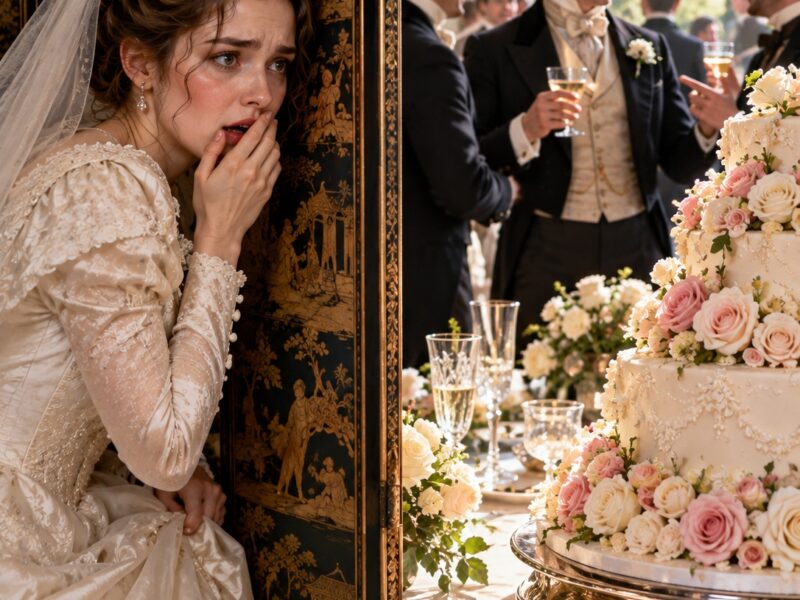
The wedding cake stood four tiers high beneath the June sunlight, decorated with 140 delicate sugar roses.
Twelve of those roses had been made by the bride herself.
By the time the afternoon was over, no one would dare touch the silver knife beside it.
And Grace Toland, the twenty-two-year-old daughter of one of Bristol’s wealthiest shipowners, would discover that the man she had married that morning had been hiding something far worse than his contempt for her.
Three days earlier, Grace had stood in the kitchen of her father’s grand white house in Clifton, watching the cook assemble the cake. Each layer of dark fruitcake had been soaked in brandy, covered with almond paste, and finished with icing so smooth it looked like marble.
Late that evening, after everyone else had gone to bed, Grace had returned to the kitchen in her nightgown. She sat beneath the lamplight, patiently shaping twelve sugar roses by hand.
The cook had told her they were the prettiest of them all.
Now those roses rested among the others in the garden room, where two hundred wedding guests were celebrating her marriage to Charles Fenmore, Viscount Lyall.
Grace had spent the entire morning trying not to make a mistake.
She had stood at the altar of St. Andrew’s in her ivory silk wedding gown, feeling the eyes of Bristol society upon her as she spoke her vows. Her hands had trembled slightly, and although Charles had smiled reassuringly, she had struggled to keep her voice steady.
It was her voice she worried about most.
Grace’s grandfather had worked on the Bristol docks, unloading cargo for a shilling a day. Her father, William Toland, had started his life as a ship’s boy at nine and worked his way through the ranks until he owned eleven merchant vessels. His ships crossed oceans, his warehouses lined the harbor, and his fortune was one of the largest in western England.
But money had never entirely erased the way society looked at the Tolands.
Grace had received every education her father could purchase. She spoke French and Italian, played the piano beautifully, and knew how to manage a household filled with servants.
Yet she still spoke with a Bristol accent.
When she was happy, frightened, or excited, the broad, rolling vowels of her childhood returned. She sometimes added an extra sound to the ends of words. Instead of idea, she said ideal.
In Bristol, nobody thought twice about it.
In fashionable London, people laughed.
At nineteen, Grace had gone to London for a season. She had heard young women imitating her behind their fans. At one dinner, a gentleman had loudly compared her voice to that of a fishwife.
She had returned home after six weeks and refused to go back.
Then Charles Fenmore arrived in Bristol.
He was handsome, fair-haired, charming, and possessed a title that had belonged to his family for generations. His Somerset estate was heavily indebted, but his social standing remained beyond question.
Her father invited him to dinner.
Charles sat beside Grace and listened attentively as she spoke about her music. When her accent slipped through during dessert, she blushed and tried to correct herself.
But Charles gently placed his hand over hers.
“Don’t ever lose it,” he told her. “It’s warm. Like a West Country summer.”
Grace had never forgotten those words.
He visited the following week, and the week after that. By March, he had asked her father for permission to marry her.
William agreed, settling forty thousand pounds upon his daughter.
Everyone understood the arrangement. The Toland fortune would help restore the Fenmore estate, while Grace would become a viscountess.
But Grace believed she was getting something more precious than a title.
She believed she was marrying a man who loved her exactly as she was.
On that last Saturday in June, she believed it completely.
Until a small tear appeared in the hem of her wedding gown.
Her maid, Ellen, noticed the damage while Grace was moving through the garden room. Rather than have the entire wedding party watch a servant repair her dress, Grace slipped behind a tall Chinese folding screen near the open French windows.
Ellen knelt with three pins between her lips.
Grace stood motionless, looking toward the sunlit terrace.
Charles was standing outside with three of his London friends, holding a glass of champagne.
They were laughing.
One of the men, Freddy Gaunt, began imitating William Toland’s speech from the wedding toast. He exaggerated the broad Bristol vowels, repeating the way Grace’s father had welcomed Lord Lyall into the family.
The others burst into laughter.
Grace’s smile faded.
Then she heard her husband’s voice.
“You get used to it,” Charles said. “You have to, for forty thousand pounds.”
Grace felt the blood drain from her face.
Charles continued, mimicking her accent with practiced ease. He repeated words she had spoken during their courtship, turning them into entertainment for his friends.
“I nearly choked on my soup the first night,” he said.
The laughter grew louder.
A man asked how Charles intended to endure being married to her.
Charles answered without hesitation.
He would spend the summer in Somerset. In September, he would return to London alone.
Grace could remain in the country with her piano and her garden.
He had no intention of presenting what he called a Bristol fishwife to fashionable London society.
Her father’s forty thousand pounds would pay his debts and restore his London house.
“Her father thinks he’s bought her a title,” Charles said. “What he’s actually bought is a nice quiet life for me with somebody else paying.”
Behind the screen, Ellen stopped pinning the gown.
Grace stared through the narrow opening at the man who had kissed her before the altar that morning.
Warm like a West Country summer.
Don’t ever lose it.
Every tender word had been carefully chosen.
Every reassurance had been part of a performance.
But before Grace could begin to understand the cruelty of it, Freddy Gaunt asked another question.
“What about Maria?”
Charles fell quiet.
“Maria’s in Brighton,” he said at last. “She’s no trouble.”
Freddy laughed drunkenly.
He had attended a wedding in Brighton three years earlier, he reminded Charles. He had stood beside him in a small church while a curate performed the marriage ceremony.
Maria was not a discarded sweetheart.
She was Charles’s wife.
For a moment, even the other men seemed uncomfortable.
Then Freddy asked what that made Grace.
Charles’s answer came in a low, perfectly calm voice.
“Nothing.”
He explained that Grace had merely gone through a ceremony and believed herself to be a viscountess. The first marriage was known to very few people. The curate had died. Maria had no money and would never dare speak.
And by the time anyone discovered the truth, Charles intended to have spent the settlement.
Grace gripped the edge of the little table behind the screen.
She had entered the church believing she was becoming someone’s wife.
Now she understood that the man waiting to cut their wedding cake had deliberately deceived her into an invalid marriage.
Ellen looked up, horrified.
“Did you hear all of it?” Grace whispered.
Ellen nodded.
“Every word?”
Another nod.
“Good. Finish the hem, please.”
Ellen’s fingers trembled as she secured the last three pins.
Grace picked up her bouquet of white roses, orange blossom, and myrtle. She looked at it for a moment, then walked out from behind the screen.
The garden room was filled with sunlight, laughter, and the sound of silverware against china.
Her father sat at the head of the table, smiling more happily than she had seen him smile since her mother’s death nine years earlier.
When he noticed her, he lifted his champagne glass.
Grace walked toward him.
She knew Charles could see her through the French windows.
She knew Freddy Gaunt had suddenly stopped laughing.
But she did not look at either man.
She stopped beside the enormous cake, placed her bouquet upon the white tablecloth, and leaned toward her father.
She spoke quietly.
William Toland listened to twenty words that changed the afternoon.
Then he set down his champagne and stood.
“Mr. Mayor, would you excuse us? My daughter isn’t feeling well.”
He offered Grace his arm.
Together they walked the length of the garden room.
Charles stepped inside from the terrace, his handsome face arranged into an expression of concern.
“Grace, my dear. Are you unwell?”
She stopped.
For a moment, she studied the man she had believed she loved.
Then she answered in the voice she had spent years trying to suppress.
“No, thank you, my lord. I know exactly what I am. You told Freddy. I heard you.”
Charles went pale.
Grace turned and left on her father’s arm.
Behind them stood the wedding cake, untouched.
Nobody ever made the first cut.
In her father’s study, William locked the door.
“Tell me again,” he said. “All of it. Slowly.”
Grace repeated everything she had heard.
She described the mockery, the plans to abandon her in Somerset, the marriage settlement, and finally the woman named Maria in Brighton.
Ellen confirmed every word.
William sat behind his desk, his weathered hands resting flat on the leather surface.
For a long time, he said nothing.
Then his voice broke.
“I bought the title for you. I thought if you were Lady Lyall, those people would have to respect you.”
He looked at his daughter.
“I was a fool, Gracie.”
Grace moved beside him.
“You believed him, Papa. So did I.”
Her father summoned Joseph Weekes, the family solicitor, and Richard Lane, a young barrister whose late father had served as a surgeon aboard the Toland ships.
Richard listened carefully, taking notes.
When Grace finished, he asked whether Charles had admitted the earlier marriage himself.
She explained that Freddy Gaunt had spoken of the ceremony, its witnesses, and the banns. Charles had not denied the marriage. Instead, he had explained why its existence would never be discovered.
Richard looked at Ellen.
“Did you hear the same conversation?”
“Every word, sir.”
Richard lowered his pencil.
“If this is true, Miss Toland, then you are not married.”
The room fell silent.
He explained that a man already lawfully married could not enter into a valid second marriage while his first wife was alive.
Charles might have committed bigamy.
But they would need proof.
The register from the Brighton church. The identity of Maria Cole. Witnesses who could establish the original ceremony.
Mr. Weekes then remembered something urgent.
The forty-thousand-pound settlement was scheduled to be transferred into Charles’s account on Monday morning.
“Stop it,” William said.
“I shall,” answered the solicitor.
Before they could speak further, someone rattled the door handle.
“Grace?”
Charles’s voice came through the wood.
He demanded that she return to their guests. It was time to cut the cake. People were asking questions.
When William finally opened the door, Charles was standing in the passage with Freddy Gaunt hovering behind him.
Charles insisted that Grace had misunderstood a drunken joke.
There was no Maria, he said. No marriage in Brighton.
“Then you won’t mind if we go there and look,” Grace replied.
A muscle moved in Charles’s jaw.
He told her she was his wife and must return to the celebration. He threatened to use his authority as her husband to compel her obedience.
“If you’re my husband,” Grace answered.
Charles warned that if she pursued the matter, she and her father would become laughingstocks across England.
Grace met his gaze.
“They’ve been laughing at me in London for three years, my lord. I’ve grown used to it.”
Then she added quietly, “You did my voice very well, by the way.”
William stepped forward and placed a firm hand on Charles’s chest.
“Get out of my house.”
That evening, at six o’clock, Grace left Bristol in her father’s traveling carriage.
Ellen sat beside her.
Richard Lane sat opposite, carrying his notebook and the responsibility of finding the truth.
Grace was still wearing her ivory wedding gown.
They traveled east through the night, changing horses at posting inns and stopping briefly in Salisbury.
There Grace finally removed the wedding dress, folded it carefully, and placed it at the bottom of her trunk.
For miles, nobody spoke.
But as they passed Warminster, Richard closed his notebook.
He told Grace that he too had been born in Bristol, in a modest house at Hotwells near the river.
As a boy, he had spoken with the same accent as hers.
William Toland had funded his education at Oxford after promising Richard’s dying father that he would look after him.
At Oxford, privileged young men had mocked the way Richard spoke.
He had spent a year reading aloud alone in his room until every trace of his childhood accent disappeared.
“I’ve never sounded like Hotwells since,” he said.
Then he looked at Grace.
“When you spoke to him in the doorway, in your own voice, I thought it was the bravest thing I’d ever heard.”
Grace watched him for a moment.
“Say it.”
“Say what?”
“Ideal. Say it the way you said it when you were fourteen.”
Richard hesitated.
Then, with the broad warmth of his childhood voice, he said the word.
“Ideal.”
Grace laughed.
It was the first time she had laughed since hearing Charles on the terrace.
And for a moment, in the rattling carriage, Richard laughed with her.
Two days after leaving Bristol, they reached Brighton.
Their first destination was the parish church of St. Nicholas.
The vicar, Mr. Hudson, produced the old marriage register and laid it upon a table in the vestry.
Richard turned the pages until he reached the spring three years earlier.
Then his fingers stopped.
On April 14, a man named Charles Fenmore had married Maria Cole.
The register bore Charles’s signature.
Grace recognized the handwriting immediately.
Beside it was Maria’s name.
And below those names appeared the signature of F. G. Gaunt.
Freddy.
The man who had laughed at her wedding breakfast had witnessed Charles’s first marriage.
Grace stared at the page.
“Then it’s true.”
Richard did not offer empty comfort.
He simply stood beside her while she read it again.
Mr. Hudson helped them locate Maria Cole.
She lived in two small rooms above a milliner’s shop in a narrow Brighton lane. She was twenty-four, thin, dark-haired, and exhausted from years of work.
When Grace addressed her as Mrs. Fenmore, the bonnet Maria was holding fell to the floor.
It took almost an hour before she agreed to talk.
Maria assumed Grace had come to threaten her.
She had read about the splendid wedding in the newspaper. She knew Charles had married a wealthy shipowner’s daughter, and she believed there was nothing she could do.
Charles had courted her when she was nineteen and married her secretly, claiming his father would disinherit him if the marriage became public.
He had stayed with her three months.
Then his father died, Charles inherited the title, and he disappeared.
Maria earned eleven shillings a week making bonnets.
She could not afford a lawyer.
“Who’s going to believe me against a viscount?” she asked bitterly.
Grace looked around the little room.
The scrubbed table. The sewing materials. The tired hands of a woman who had been abandoned while her husband lived comfortably in London.
Then she told Maria exactly what Charles had said on the terrace.
Including the words, “Maria won’t say a word. She hasn’t got a penny.”
Maria was silent for a long time.
When she spoke again, her voice had changed.
“What do you want me to do?”
“Come to court,” Grace replied. “Tell the truth.”
Grace promised that whatever Maria decided, she would help her escape the poverty Charles had left her in. It was not a price for testimony. It was recognition of a wrong that had gone unchallenged for years.
Maria rose, took a key from the ribbon around her neck, and unlocked a tin box.
Inside were her marriage certificate and fourteen letters from Charles.
In nine of those letters, he called her his wife.
Maria placed them on the table.
Together, the two women returned to Bristol.
When they arrived, the wedding cake was gone.
William had sent it to the Bristol Infirmary and an orphan asylum, where its carefully made sugar roses had been enjoyed by children who had never seen anything so grand.
The bouquet remained in a vase upon his study table.
Charles, meanwhile, had begun spreading a different story.
He claimed Grace had suffered a nervous episode during the wedding breakfast and had misunderstood harmless jokes among gentlemen.
In London, some people believed him.
He was handsome, titled, and confident.
She was merely a merchant’s daughter.
Then Freddy Gaunt traveled to Brighton and left two hundred pounds with Maria’s employer, together with a note suggesting that Maria should leave England.
The employer, Mrs. Tupper, refused to cooperate.
She sent the money and the note to Bristol.
Richard delivered them to the authorities.
A warrant was issued.
Charles Fenmore was arrested at his London home while eating breakfast.
By Wednesday, the newspapers were reporting that Viscount Lyall faced a criminal charge of bigamy.
The trial took place in August at the Bristol Assizes.
The courtroom was packed.
Maria testified first.
She described the wedding in Brighton, the three months they lived together, the abandonment, and the letters Charles had written.
The defense barrister, Sergeant Crew, tried to portray her as a dishonest shopgirl seeking money.
Maria stood her ground.
“If I wanted his money,” she asked, “why have I been making bonnets for eleven shillings a week for three years?”
She reminded the court that she had never approached Charles.
Grace had come to find her.
Next came the parish register, the letters, Mrs. Tupper’s account of the attempted payment, and the testimony of Edward Carlo, another witness to the original marriage.
Freddy Gaunt initially claimed he could remember nothing.
Then the prosecutor placed the register before him.
Freddy stared at his own signature.
Finally, he admitted the truth.
He had attended the Brighton wedding.
He had watched Charles marry Maria Cole.
Then Grace was called.
She walked to the witness box wearing a plain dark blue dress.
The courtroom fell quiet.
She described the conversation on the terrace, including the mockery of her father’s speech and her own accent.
She repeated the words without softening or disguising her Bristol voice.
Sergeant Crew questioned whether the excitement of her wedding might have affected her judgment.
Perhaps, he suggested, she had misunderstood the refined speech of London gentlemen.
Someone laughed from the back of the courtroom.
Grace looked directly at the barrister.
“Yes, sir. I speak Bristol. I always have.”
She explained that her grandfather had worked on the docks and had spoken the same way.
“But there’s nothing wrong with my ears, sir.”
She told the court what Charles had said about Maria having no money and never speaking.
Then she looked across at the man she had once trusted.
“He told me never to lose my voice,” Grace said. “I’ve decided to take his advice.”
For a moment, nobody moved.
Then a dockworker in the public gallery began to clap.
The judge called for order.
The jury deliberated for twenty-five minutes.
Charles Fenmore was found guilty of bigamy and sentenced to seven years’ transportation to New South Wales.
The court confirmed that his ceremony with Grace had never constituted a valid marriage.
She remained Miss Grace Toland.
Her settlement was preserved.
Charles was led away without speaking.
Grace did not smile as he passed.
She simply watched him go.
After the trial, Maria did not return to her old life in Brighton.
Grace helped her lease a shop on Park Street in Bristol, provided its initial stock, and arranged the assistance as a loan rather than charity.
Maria repaid it ahead of schedule.
Within a year, her bonnets were sought after by fashionable women throughout Clifton.
She chose to call her business Mrs. Cole, Milliner.
The Fenmore name never appeared over her door.
As for Grace, Bristol remembered her courtroom testimony far longer than it remembered her failed wedding.
She no longer altered her voice for wealthy dinner guests.
She spoke as her father spoke.
As her grandfather had spoken.
And as thousands of ordinary working people throughout the city still spoke.
Richard Lane returned to his work as a barrister.
The publicity surrounding the trial brought him more cases than ever.
Yet whenever he was in Bristol on a Sunday, he visited the Toland household.
William would invite him into the study and discuss ships, cargoes, and the law.
Around nine o’clock, the older man would announce that he was tired and leave Richard and Grace alone beside the fire.
Neither pretended not to understand.
Their conversations grew longer.
They talked about Maria’s shop, Richard’s cases, the river at Hotwells, and the childhood he had spent trying to forget.
One evening Grace asked whether he missed his old accent.
“Every day,” he admitted.
She smiled.
“You know, you can still use it.”
He looked at her for a long moment.
By December, he knew what he wanted to say.
Snow was falling outside the windows when Richard stood beside the fire in William Toland’s study.
Grace’s dried wedding bouquet still rested in a vase by the window.
Richard did not kneel.
He looked at her, visibly nervous, and spoke in the Bristol voice he had hidden for fourteen years.
He told her he had no title, no grand estate, and no fortune.
He had only his work, a modest house, and a promise.
He would never laugh at the way she spoke.
He would always want to hear her voice.
Then he asked her to marry him.
Grace answered without hesitation.
“Yes, Richard.”
The following May, they married at St. Andrew’s.
Grace chose the same church, the same vicar, and the same familiar stained-glass windows.
But the guests were different.
There were wealthy merchants alongside dockworkers, sailors, carters, and their families.
Mrs. Tupper traveled from Brighton.
Edward Carlo attended.
Maria sat in the front pew wearing a beautiful bonnet of her own design, her eyes filled with tears.
William Toland walked Grace to the altar.
When he placed her hand in Richard’s, he warned him affectionately to take good care of his daughter.
Richard answered in his natural Bristol accent.
“Yes, sir.”
Their wedding breakfast was held in the same garden room.
The French windows stood open.
Sunlight fell across the long tables.
And in the center of the room stood another four-tiered wedding cake, decorated with 140 sugar roses.
This time, Grace had made every single rose herself.
She did not hide behind the screen.
She did not watch the terrace with fear.
Instead, she stood before the assembled guests and raised her glass.
She thanked the people who had believed her, helped her, and stood beside her when telling the truth had carried a terrible cost.
Then she looked at Richard.
She thanked the man who had never once asked her to become someone else.
Finally, smiling at the guests, she raised her glass a little higher.
“Ain’t it a lovely ideal?”
The room erupted in warm laughter.
Richard stepped beside her, placed his hand over hers upon the silver cake knife, and together they made the first cut.
And Grace, who had once believed a title would make her worthy of respect, finally understood that she had never needed one.









