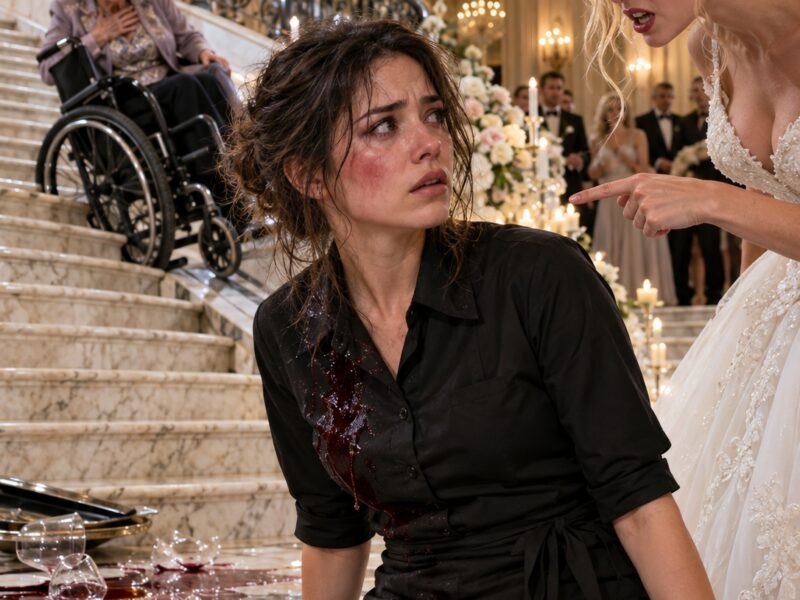
The Bride Slapped a Waitress for Ruining Her $52,000 Dress—Then the Old Woman in the Wheelchair Said, “This Hotel Is Mine.”
The bride slapped me before the wine had finished dripping from her wedding dress.
For half a second, the ballroom went completely silent.
Not quiet.
Silent.
Three hundred people stood beneath crystal chandeliers at The Aldridge, one of the most expensive hotels in the state, watching red wine spread across Paige Ashford’s white silk gown while the side of my face burned beneath the imprint of her hand.
Nobody asked why I had dropped the tray.
Nobody looked toward the staircase behind me.
Nobody seemed to notice the elderly woman shaking in my arms.
Paige did.
And she didn’t care.
“My dress,” she whispered.
Then louder.
“My dress!”
I was still kneeling on the marble floor.
Broken champagne glasses glittered around my knees. Cabernet ran through the grout like thin streams of blood. My left arm was wrapped around the waist of a woman in a faded gray cardigan, while my right hand braced her shoulder.
Her wheelchair lay sideways behind us.
Three feet farther back was the top of a sweeping marble staircase.
If I had been two seconds slower, she would have gone down it.
I looked up at Paige.
“I’m sorry about the dress.”
She stared at me as if I had just confessed to setting the hotel on fire.
“You’re sorry?”
Her mother, Cynthia Ashford, appeared behind her.
Cynthia was the kind of woman who never seemed to walk anywhere. Rooms simply rearranged themselves around her.
Her silver gown probably cost more than my car.
She looked at Paige’s ruined dress.
Then at me.
Then at the old woman.
“What happened?”
“The waitress threw wine on me.”
“I didn’t throw it,” I said. “Her wheelchair—”
“I don’t care about some old woman!”
Paige’s voice cracked through the ballroom.
People heard that.
I know they did.
I saw heads turn.
A man near the cake table lowered his champagne glass.
One of the photographers stopped shooting.
Still, nobody spoke.
I had worked weddings for four years.
I knew that silence.
It was the silence people used when money was behaving badly and everyone else was deciding whether their paycheck, invitation, reputation, or social connection was worth more than their conscience.
Paige looked down at the wine soaking the front of her gown.
Then she looked at my black banquet uniform.
Something changed in her face.
It wasn’t anger anymore.
It was calculation.
She picked up a half-full glass from a nearby table.
“There,” she said.
And poured it over me.
Cold wine ran through my hair, down my cheek and into my collar.
A few people gasped.
Paige gave me a thin smile.
“Now you match my dress.”
Then she turned toward Dennis Pike, the banquet manager.
“Fire her.”
Dennis hesitated.
Only for a second.
“Brooks—”
“Dennis,” I said quietly.
He wouldn’t meet my eyes.
“You’re done.”
The elderly woman in my arms lifted her head.
“That girl just saved my life.”
Her voice wasn’t loud, but something about it carried.
Paige barely glanced at her.
“Nobody asked you.”
That was when I understood something I would remember for the rest of my life.
Paige Ashford wasn’t cruel because she was angry.
She was cruel because she believed there would be no consequence.
Dennis pointed toward the service corridor.
“Security.”
I stared at him.
“You put her wheelchair on the ramp.”
His jaw tightened.
“I said go.”
“I told you the brake was slipping.”
“Brooks.”
“I told you.”
Twenty minutes earlier, I had found the old woman alone near the gallery landing.
She was wearing an old cardigan over a simple blue dress. Her silver hair was pinned loosely at the back of her head. She had no diamonds, no designer purse, no wedding-party flowers.
At a wedding where everyone seemed to be wearing wealth like armor, she looked almost invisible.
That was probably why everyone had treated her that way.
I had been carrying a tray of appetizers when I saw her wheelchair angled strangely beside the service-cart ramp.
“Ma’am,” I said. “You’re too close to the ramp.”
She looked up.
Her eyes were sharp.
Much sharper than I expected.
“Am I?”
“Yes. Let me move you.”
I tested the wheel lock.
It slipped.
I tried it again.
Same thing.
“Sir?”
Dennis was passing behind me.
“The brake on this chair isn’t holding.”
He barely looked.
“Then tell her to sit still.”
I stared at him.
“She is sitting still.”
“Imani, we have a head table waiting for entrées.”
“I need to move her first.”
“I put her there because Mrs. Ashford wanted her out of the photographs.”
The old woman heard him.
Her expression didn’t change.
That somehow made it worse.
“Why?” I asked.
Dennis lowered his voice.
“Because she’s been in every shot and she isn’t on the seating chart.”
I looked at the woman.
“Did anyone ask your name?”
A faint smile touched her mouth.
“No.”
That bothered me more than it should have.
I crouched beside her.
“Can I bring you a plate at least?”
She studied me for a moment.
Then said, “You’re the first person who’s spoken to me all evening.”
Before I could answer, Dennis shouted from across the landing.
“Brooks! Head table. Now.”
I looked at the ramp.
Then at him.
“She shouldn’t be here.”
“I put her there.”
“The brake—”
“Move.”
I set the brake again.
It held.
For that moment.
I leaned close to the woman.
“I’ll be right back.”
I made it maybe thirty feet.
Then I heard someone scream.
I turned.
The wheelchair was moving.
Slowly at first.
Then faster.
The old woman’s hands clamped around the armrests.
Three guests stood beside the staircase.
Nobody moved.
I did.
I don’t remember dropping the tray.
I remember the sound.
Glass exploding against marble.
I remember Paige turning toward me.
I remember red wine flying.
And I remember running straight toward the front of that wheelchair instead of grabbing the handles.
Because when I was twelve years old, I had learned what could happen when you grabbed the handles.
I caught the woman around the torso.
The wheelchair struck my hip.
We went down together.
And the chair stopped less than a body length from the staircase.
That was why Paige’s wedding dress was covered in wine.
That was why she slapped me.
And that was why, less than five minutes later, security escorted me through the back entrance of The Aldridge while three hundred wedding guests returned to dinner.
I had saved a woman’s life.
By midnight, the internet thought I had attacked a bride.
And by Monday morning, nobody in the city would hire me.
But the strangest part was something I didn’t learn until much later.
The old woman I had pulled away from those stairs wasn’t lost.
She wasn’t poor.
And she wasn’t supposed to be invisible.
She had been watching.
Especially when people thought she didn’t matter.
“Imani?”
I stopped halfway through the service corridor.
The voice came from behind me.
A young man in a tuxedo was standing near the ballroom doors.
Grant Calloway.
The groom.
I had served him twice that evening. He had thanked me both times.
At that wedding, basic manners had made him memorable.
His face had gone pale.
But he wasn’t looking at me.
He was staring past me.
At the old woman.
“Nana?”
Everything stopped.
Dennis turned around.
Paige froze.
The old woman looked at Grant.
“They kept telling me you hadn’t arrived,” he said. “I’ve been asking about you all night.”
She smiled sadly.
“Nobody asked my name, Grant.”
He crossed the floor in three strides and crouched in front of her.
“What happened?”
The old woman looked at me.
“A waitress caught me at the top of those stairs.”
Then she looked at Paige.
“And your bride slapped her for it.”
Grant slowly stood.
“Paige?”
Her expression changed instantly.
The rage disappeared.
In its place came something soft, frightened and almost convincing.
“I didn’t know it was her.”
Grant stared at her.
“What does that mean?”
“Grant, please.”
“You didn’t know she was my grandmother?”
“No.”
Ruth Calloway tilted her head.
“Two years engaged, Paige. You never once drove up to the farm.”
Paige’s mouth opened.
Nothing came out.
Ruth looked almost gentle when she asked the question that finally made the room uncomfortable.
“And if I’d been nobody’s grandmother, dear?”
Paige looked at her.
“What?”
“If I belonged to nobody important, what then?”
No one answered.
Ruth nodded once.
As though the silence had answered for them.
Dennis stepped toward Grant.
“Mr. Calloway, there was an unfortunate accident, but Miss Brooks violated—”
“Stop.”
Grant didn’t raise his voice.
Dennis stopped.
Grant looked at the wine in my hair.
Then at Paige.
Then at the wheelchair.
“I want to know exactly what happened.”
“So do I,” Ruth said.
Her eyes moved toward the black glass domes mounted in the ceiling.
Security cameras.
Then she smiled.
And for the first time that night, Dennis Pike looked afraid.
Rosa found me in the employee locker room.
I was changing into jeans with shaking hands.
My cheek had begun swelling.
Rosa had worked banquet service at The Aldridge longer than I had. She was forty-seven, divorced, raising two teenagers, and possessed the rare ability to insult you so lovingly that you thanked her afterward.
She shut the door.
“Dennis is telling everybody you’ll never carry a tray in this city again.”
I pulled my sweatshirt over my head.
“I’d do it again.”
“Imani—”
“Every single time.”
She looked at me.
“He’s keeping your tips.”
I stopped.
“What?”
“The whole month.”
I laughed.
Not because it was funny.
Because rent was due Friday.
My nursing-school deposit was due the following Monday.
And I had exactly $614 in checking.
“Let him keep them,” I said.
“Baby—”
“She’s alive.”
Rosa’s eyes filled.
She turned away before I could see too much.
“Go home.”
I did.
My mother opened the apartment door at 1:14 a.m.
She took one look at my face and said, “Who put a hand on you?”
“A bride, Mama.”
That was all it took.
She pulled me inside.
My mother, Denise Brooks, had spent twenty-nine years working jobs where rich people learned her first name only when they needed something.
Housekeeping.
Hospital laundry.
Home health.
Night reception.
She understood humiliation with an intimacy I wished she didn’t have.
I told her everything.
When I finished, she touched the swelling on my cheek.
“You did right.”
“I lost the job.”
“You did right.”
“Rent’s due Friday.”
“We’ve been broke before.”
“My school deposit—”
“We’ve been broke before.”
I looked down.
“Mama.”
She put her hand under my chin.
“We have never been unkind.”
The next morning, Paige posted the video.
Not the whole video.
Fourteen seconds.
It began with my tray falling.
Red wine exploded across her dress.
Then came Paige’s shocked face.
Then me saying, “I’m sorry.”
That was it.
No wheelchair.
No staircase.
No warning to Dennis.
No slap.
No wine poured over my head.
Her caption described me as an unstable hotel employee who had “deliberately ruined the most important moment of her life.”
By noon, it had half a million views.
By dinner, 1.4 million.
By Monday morning, three million.
People found my name.
They found my social media.
They found my old employer.
One message said I should be arrested.
Another said Paige should sue me for everything I had.
A third said, This is why service workers need to know their place.
My mother read that one.
She quietly put my phone face down.
“The truth is slow, baby,” she said.
I stared at the dark screen.
“How slow?”
She squeezed my hand.
“But it gets there.”
I wanted to believe her.
Then someone knocked.
When I opened the door, Grant Calloway was standing in the hallway.
And beside him, in a different wheelchair, was his grandmother.
Ruth.
“You came all this way?”
Ruth looked around our small apartment.
“I’ve traveled farther for worse reasons.”
My mother immediately offered coffee.
Ruth accepted.
Grant stayed near the door, looking like he hadn’t slept.
Ruth asked me to sit across from her.
“Anybody else would have grabbed the handles.”
My stomach tightened.
“What?”
“When my chair started moving. Most people would have run behind me and grabbed the handles. You didn’t.”
“No.”
“You got in front of me.”
“Yes.”
“Why?”
I looked at my mother.
She already knew.
“When I was twelve, my grandmother used a wheelchair.”
Ruth waited.
“One afternoon her chair started rolling down our porch ramp. I panicked. I grabbed the handles.”
My throat tightened even after all these years.
“The chair stopped.”
Ruth’s eyes stayed on mine.
“But she didn’t.”
I could still hear the sound.
My grandmother hitting the porch boards.
The ambulance doors.
My mother crying in the kitchen when she thought I was asleep.
“She broke her hip,” I said. “She was never really the same afterward.”
“I’m sorry.”
“I took care of her for six years. After school. Weekends. That’s why I started doing home care.”
“And nursing?”
I nodded.
“January. If I can make the deposit.”
Ruth glanced at Grant.
Then back at me.
“So somebody taught you to catch the person.”
“First thing they teach us. Hold the person, not the chair.”
Ruth was quiet.
Then someone knocked again.
A courier.
The envelope was thick, cream-colored and expensive.
My name was printed across the front.
Inside was a demand letter from the Ashford family’s attorney.
Amount due:
$52,000.
One custom bridal gown.
I read the number twice.
My mother took the paper from me.
“What kind of dress costs fifty-two thousand dollars?”
“The kind I can’t afford to look at,” I whispered.
Ruth held out her hand.
I gave her the letter.
She read it once.
Something cold entered her face.
“Don’t pay one cent.”
I almost laughed.
“I don’t have one cent.”
“This Sunday,” she said, folding the letter carefully, “there’s a brunch at The Aldridge.”
My stomach dropped.
“Ma’am, I was fired from that hotel.”
Her eyes met mine.
“Not by me, dear.”
Something about the way she said it made Grant look at her.
But Ruth was already handing the letter back.
“I want you there as my guest.”
“Why?”
“Because sometimes the truth shouldn’t arrive quietly.”
Grant confronted Paige that evening.
By then the video had passed three million views.
“Take it down.”
Paige stood in the dressing room of her mother’s home, scrolling through comments.
“Why?”
“Because it doesn’t show what happened.”
“It shows her dumping wine on me.”
“She caught my grandmother.”
“And I apologized for not understanding that.”
Grant stared.
“No. You apologized for not knowing who Nana was.”
Paige lowered the phone.
“Same difference.”
“No.”
He moved closer.
“It’s not.”
Her eyes hardened.
“You’re my husband now, Grant.”
They had been married less than forty-eight hours.
“Exactly.”
“So decide whose side you’re on.”
Grant looked at the woman he had dated for three years, loved for two, proposed to beneath a maple tree outside Boston and married beneath 18,000 crystal lights.
He had always known Paige could be demanding.
He had called it ambition.
He knew she liked control.
He called it organization.
He knew she could be dismissive with servers, drivers and assistants.
He had told himself she was stressed.
Love, he was beginning to understand, had a dangerous talent for renaming things.
“That chair rolled two feet,” Paige said. “Nobody was in danger.”
“You weren’t even there.”
“And neither were you.”
“No.”
Grant picked up his jacket.
“So I’m going to see what the other cameras caught.”
For the first time, Paige looked scared.
Meanwhile, Cynthia Ashford made three phone calls.
Then seven.
Then twelve.
By Tuesday afternoon, I walked into a restaurant interview downtown.
The manager looked at my résumé.
“Four years banquet service?”
“Yes.”
“Home-care aide on weekends?”
“Yes.”
“You can start Thursday.”
I nearly cried.
“Thank you.”
Then his phone buzzed.
He read something.
His face changed.
He looked at me.
Then at my name.
“I’m sorry.”
My stomach dropped.
“What happened?”
“I can’t hire you.”
“Five seconds ago, you could.”
“I’m sorry.”
By the fourth rejection, I understood.
At the fifth, someone finally told me.
“Your old manager has been calling around.”
Dennis.
But Dennis wasn’t acting alone.
Cynthia had decided that firing me wasn’t enough.
She wanted to make sure I stayed fired.
When one of her friends asked whether that was necessary, Cynthia sipped her martini and said, “A waitress should know her place.”
Paige laughed.
Then she said something worse.
“Honestly, who’s going to believe a waitress over a bride?”
The answer came the next afternoon.
Anyone who watched the whole video.
Grant stood in The Aldridge security office while Helen Mercer, the hotel’s general manager, pulled up Camera Six.
The screen showed the gallery landing.
There was Ruth.
Alone.
Dennis wheeled her toward the service ramp.
Imani appeared.
She tested the brake.
Pointed toward it.
Spoke to Dennis.
He walked away.
Grant leaned closer.
“Can we hear audio?”
“Not from that camera.”
“But you can see her warning him.”
“Yes.”
The video continued.
Imani reset the brake.
Dennis ordered her away.
Eleven seconds passed.
The chair moved.
Three people saw it.
Nobody reacted.
Then Imani turned.
Dropped the tray.
Ran.
Grant watched her get in front of the wheelchair.
Watched her absorb the impact.
Watched his grandmother fall into her arms.
Then Helen paused the video.
“Look.”
She rewound.
The wheelchair’s path led directly toward Paige.
Grant stared.
“If Imani hadn’t stopped Nana…”
Helen finished the thought.
“She may have saved both of them.”
Grant sat back.
“My wife was standing right there.”
“Yes.”
“And Paige posted only the wine.”
“Yes.”
“Why didn’t you release this?”
Helen hesitated.
“Your grandmother asked me not to.”
Grant turned.
“My grandmother?”
“She told me that if you came asking for the footage yourself, I could tell you everything.”
“Everything about what?”
Helen looked at him for a long moment.
Then she folded her hands.
“Mr. Calloway, your grandmother has owned The Aldridge since before you were born.”
Grant laughed.
Helen didn’t.
His smile disappeared.
“What?”
“And thirty-six other hotels.”
Grant stared at the screen.
“Nana lives on a farm.”
“She owns the farm.”
“She told me she sold her little inn years ago.”
“She did.”
Helen smiled faintly.
“She used the money to buy another one.”
Then another.
Then another.
Grant slowly turned toward the ballroom monitors.
“The Aldridge?”
“Her flagship property.”
He looked physically ill.
“Why didn’t she tell me?”
“You’ll have to ask her.”
He did.
That night.
Ruth gave him the simplest answer imaginable.
“I wanted someone to love you before they loved what you might inherit.”
Grant sat opposite her in the old farmhouse kitchen where he had spent childhood summers eating peach pie.
Suddenly every memory looked different.
“You let everyone think you were…”
“Poor?”
“I was going to say retired.”
Ruth smiled.
“You were always polite.”
“Nana.”
Her smile disappeared.
“I wanted you to have a life before money entered the room.”
“And Paige?”
“You chose Paige.”
“You never trusted her?”
“I didn’t know her.”
“You could have met her.”
“I tried.”
Grant remembered every canceled farm visit.
Every time Paige had said the drive was too long.
Every time she had complained about Ruth’s “little place in the country.”
He closed his eyes.
Ruth reached across the table.
“Grant.”
“Why did you sit there for two hours?”
She knew what he meant.
At the wedding.
Alone.
Ignored.
“Because I wanted to see something.”
“What?”
“Who would be kind to an old woman in a thrift-store cardigan.”
Grant swallowed.
“And?”
“One person.”
Imani Brooks.
Ruth told me the truth the following morning.
I thought she was joking.
“You own The Aldridge?”
“Yes.”
“And thirty-six more?”
“Yes.”
I stared at her.
She stirred her tea.
“Fifty-eight years ago, I carried trays in that ballroom.”
I stopped smiling.
“There was a wedding. I spilled one glass.”
Her fingers tightened slightly around the cup.
“The bride slapped me.”
The room suddenly felt smaller.
“They fired you?”
“That night.”
“What did you do?”
“I cried.”
Ruth smiled.
“Then I got angry.”
She told me she worked for years.
Saved everything.
Bought a struggling roadside inn with twelve rooms.
Fixed it.
Sold it.
Bought two more.
Nineteen years after being thrown out of The Aldridge, Ruth Calloway bought the building.
“The first time I walked into that ballroom as the owner,” she said, “I promised myself nobody would ever be treated the way I had been treated.”
Her eyes lowered.
“And then I stayed away too long.”
“You couldn’t have known.”
“Owners are responsible for the culture they allow, even when they aren’t in the room.”
She looked at me.
“I can end this tonight.”
My heart jumped.
“One phone call. Dennis is gone. Your job is restored. The full footage goes online. The Ashfords withdraw their demand.”
I should have said yes.
Instead I remembered Paige’s hand striking my face.
Cynthia calling employers.
Three hundred people watching.
The edited video.
The comments.
I thought about every person who had seen fourteen seconds and decided they knew my character.
“When is the brunch?”
Ruth’s mouth curved slightly.
“Sunday.”
“I want them to see it there.”
“In the ballroom?”
“Where it happened.”
She studied me.
“You’re sure?”
“No.”
That made her smile.
“Good answer.”
I looked toward the window.
“I’m still going.”
The Ashfords heard that The Aldridge’s mysterious owner would personally host the Sunday brunch.
Cynthia was delighted.
“Finally.”
Paige looked up.
“Finally what?”
“An apology.”
“For me?”
“And a refund, if they’re smart.”
The hotel had already received complaints from wedding guests.
Rumors were spreading that more footage existed.
Cynthia dismissed them.
She called Helen.
“I want the seat beside the owner.”
Helen paused.
“I’ll make a note of your request.”
Cynthia hung up smiling.
The next morning, she received another call.
“Mrs. Ashford, Imani Brooks has been added to the guest list.”
“What?”
“As a personal guest.”
“Take her off.”
“I’m afraid I can’t.”
“Who added her?”
“Mrs. Calloway.”
“The grandmother?”
“Yes.”
Cynthia laughed.
“The grandmother doesn’t run that hotel.”
Helen said nothing.
Cynthia mistook silence for agreement.
“The second that waitress walks in, throw her out.”
Then she turned to Paige.
“Wear the white suit.”
“Why?”
“Remind them who the bride is.”
Sunday arrived cold and bright.
I almost didn’t go.
I stood in my bedroom wearing the only navy dress I owned while my mother leaned against the doorway.
“You scared?”
“Yes.”
“Good.”
I looked at her.
“That’s Ruth’s line.”
“Smart woman.”
“I feel like I’m walking back into the place where everybody decided I was nothing.”
My mother straightened my collar.
“No.”
“What?”
“You’re walking back into the place where they showed you who they were.”
That was different.
I held onto it.
At The Aldridge, the same chandeliers were glowing.
The same staircase curved toward the gallery.
The same marble reflected people’s shoes.
For one terrible second, I smelled spilled wine that wasn’t there.
Then Rosa appeared.
Her eyes widened.
“Girl.”
I hugged her.
“You okay?”
“No.”
“Good. Me neither.”
I laughed.
It helped.
Then Dennis saw me.
His face changed.
“Security!”
People turned.
Paige and Cynthia were standing near the head table.
Paige wore white.
Of course she did.
Dennis pointed toward me.
“Get her out.”
A security officer approached.
Then stopped.
Helen stepped between us.
“Miss Brooks is a guest of the owner, Dennis.”
Paige smiled.
“Well, well.”
She walked toward me.
“Did you bring my fifty-two thousand dollars?”
“No.”
I held her gaze.
“I brought the rest of the video.”
Her smile flickered.
Cynthia stepped forward.
“Where is the owner?”
Helen looked toward the ballroom doors.
“She’s arriving now.”
Cynthia immediately straightened.
Paige smoothed her jacket.
The doors opened.
Ruth Calloway rolled into the ballroom.
No cardigan this time.
She wore a tailored navy suit, pearl earrings and the same expression she had worn when nobody knew her name.
Helen moved to the microphone.
But Ruth raised a hand.
She didn’t need an introduction.
“Good afternoon.”
The room quieted.
“My name is Ruth Calloway.”
Cynthia’s smile froze.
“I own this hotel.”
A pause.
“And thirty-six others.”
Nobody moved.
Paige went white.
Cynthia recovered first.
“Mrs. Calloway!”
Her voice became warm enough to melt steel.
“If we had only known.”
Ruth looked at her.
“I believe that is the problem.”
Cynthia’s smile trembled.
“Please. Come sit with us.”
Ruth glanced toward the head table.
Then toward the staircase.
“Oh, I’d hate to ruin your photographs.”
Someone in the room inhaled sharply.
Cynthia stopped smiling.
“Ruth, please. I didn’t know who you were.”
Ruth nodded.
“You didn’t need to know who I was, dear.”
Her voice remained gentle.
“You needed to be kind.”
Then she turned toward the guests.
“Last Saturday, I sat at the top of that staircase for nearly two hours.”
She pointed.
“Hundreds of people passed me.”
Silence.
“One person asked whether I needed food.”
Her eyes found mine.
“One person checked my chair.”
My throat tightened.
“One person noticed the brake was failing.”
Ruth extended her hand.
“Imani. Come sit beside me.”
I walked across the ballroom.
This time, nobody looked through me.
Ruth gestured toward the screens.
“Play Camera Six.”
The footage began.
Dennis went pale.
Paige whispered, “This is ridiculous.”
Nobody listened.
The room watched Dennis move Ruth.
Watched me test the brake.
Watched me warn him.
Watched him order me away.
Then the chair began rolling.
A gasp moved through the ballroom.
The camera angle made everything brutally clear.
The staircase.
Ruth.
Paige.
Me running.
The tray falling.
The wheelchair stopping.
The screen froze.
Grant stood.
“Look where the chair was headed.”
Paige stared at the image.
Directly toward her.
Grant’s voice shook.
“She didn’t just save my grandmother.”
He looked at his wife.
“She stopped that chair before it reached you.”
Paige shook her head.
“That doesn’t excuse what she did to my dress.”
Ruth looked at her.
“Your dress.”
Two words.
That was all.
Yet something in Paige finally seemed to understand how small they sounded.
Grant took a document from the table.
“And after she saved Nana—and possibly you—your lawyer sent her this.”
He read the amount aloud.
“Fifty-two thousand dollars.”
Whispers erupted.
Cynthia stood.
“That gown was destroyed.”
Ruth nodded.
“By my hotel’s negligence.”
She looked at Cynthia.
“So send the bill to me.”
Cynthia blinked.
Ruth continued.
“I’ll pay it the day your daughter apologizes properly.”
Paige crossed her arms.
“Fine.”
She looked at me.
“I’m sorry about your face.”
Ruth’s expression didn’t change.
“That is not an apology.”
Helen stepped forward.
“Our attorneys have reviewed the complete footage. The slap constitutes assault. The edited video, combined with statements made afterward, raises additional legal issues.”
Paige’s confidence vanished.
“What are you saying?”
Ruth looked at me.
“That depends on Miss Brooks.”
Every face turned toward me.
For days, I had imagined revenge.
I had imagined Paige crying.
I had imagined Dennis begging.
I had imagined Cynthia receiving every humiliation she had arranged for me.
But standing there, I realized I didn’t want Paige in handcuffs.
I wanted the lie gone.
“I don’t want her arrested.”
Paige looked surprised.
Cynthia looked relieved.
I wasn’t finished.
“I want the entire video posted.”
The relief disappeared.
“Same account,” I said. “No edits. No explanation that makes her the victim. Just the whole thing.”
Ruth nodded.
“You heard her.”
Then she looked at Dennis.
“Mr. Pike.”
He swallowed.
“Ma’am.”
“Your badge.”
His face collapsed.
“Mrs. Calloway, I can explain.”
“I’m sure you can.”
She held out her hand.
“And the month of tips you withheld from Miss Brooks.”
He stared at me.
“Every dollar,” Ruth said, “before you leave this building.”
“Please.”
“Rosa tells me you said Imani would never carry a tray in this city again.”
Dennis said nothing.
Ruth leaned back in her chair.
“You will never work in one of my hotels again.”
Dennis removed his badge.
For the first time since the wedding, I didn’t feel triumphant.
I felt tired.
Then Ruth looked toward the staircase.
“Fifty-eight years ago, I carried trays in this room.”
The ballroom quieted again.
“A bride slapped me over one spilled glass.”
Paige slowly looked at her.
“I was fired that night.”
Ruth’s eyes moved around the ballroom.
“I promised myself that if I ever owned this room, nobody would be slapped in it again.”
Her voice cracked slightly.
“On my first visit here in ten years, my own grandson’s bride did exactly that.”
Grant closed his eyes.
Paige turned toward him.
“Grant.”
He looked at her.
And I knew before he spoke.
So did she.
“I can’t be married to the woman in that video.”
Her face crumpled.
“It was one bad night.”
Grant shook his head.
“No.”
“Grant—”
“It was eight days.”
“What?”
“The video. The lawyer. Calling employers. Trying to destroy Imani’s career.”
He stepped back.
“That isn’t one bad night.”
Paige began crying.
“You’re choosing a waitress over your wife?”
“No.”
Grant’s answer came quietly.
“I’m choosing to believe what my wife showed me about herself.”
“Everybody makes mistakes.”
“Yes.”
He looked toward me.
“A mistake is spilling a tray.”
Then back at Paige.
“What you did afterward was a series of choices.”
She reached for him.
He moved away.
“Grant, please.”
His eyes filled.
“That’s who you are when you think nobody important is watching.”
For the first time all morning, Paige had no answer.
She turned desperately toward Cynthia.
“Mom. Do something.”
Cynthia grabbed her handbag.
“Come, Paige.”
They started toward the main entrance.
Ruth stopped them.
“Helen?”
“Yes, ma’am?”
“Show the Ashfords out.”
Cynthia stiffened.
Ruth added:
“Use the door they sent Imani through.”
Nobody laughed.
That made it hurt more.
After the ballroom emptied, Ruth handed me an envelope.
I looked at it suspiciously.
“No more legal letters?”
She smiled.
“Open it.”
Inside was a scholarship offer from the Calloway Foundation.
Full tuition.
Nursing school.
Every year until graduation.
I stared at the paper.
“No.”
Ruth blinked.
“No?”
“I can’t accept this.”
“You can.”
“I caught you once.”
“You did more than catch me.”
“I did what anybody should have done.”
Ruth’s eyes softened.
“But they didn’t.”
I looked away.
She touched my hand.
“You earned this at the top of those stairs.”
Tears blurred the page.
She wasn’t finished.
“Until classes start, I want you here.”
I laughed through my tears.
“I thought I was banned.”
“Head of guest care.”
I stared at her.
“What?”
“So nobody gets parked beside a service door because they ruin somebody’s photograph.”
I covered my mouth.
Ruth smiled.
“Yes?”
I nodded.
“Yes.”
Then I remembered someone.
“One condition.”
Ruth raised an eyebrow.
“You negotiate quickly.”
“Let Rosa run the banquet floor.”
Rosa, standing twenty feet away, nearly dropped the stack of glasses in her hands.
“What?”
“She stood up for me when nobody else did.”
Ruth looked at Rosa.
“You start Monday.”
Rosa burst into tears.
That was the moment I finally cried too.
Not when Paige slapped me.
Not when I lost my job.
Not when strangers called me trash.
Not when I received the $52,000 demand.
I cried when something good happened to somebody who had been good to me.
Maybe that told me who I still was.
The full video went online that night.
Four million views came faster than anyone expected.
Then six.
Then nine.
But this time people saw the wheelchair.
They saw Dennis.
They saw Paige.
They saw the slap.
They saw everything.
Paige lost friends.
The Hendersons canceled dinner with her family.
Their country club suspended her membership pending review.
Brands that had reposted wedding photographs quietly removed them.
Grant filed for an annulment nine days after the wedding.
Cynthia called it a public-relations disaster.
Paige called it the destruction of her life.
I called it something else.
Consequences.
But I didn’t enjoy them as much as I thought I would.
One night, my mother found me reading comments.
Thousands of strangers were calling Paige a monster.
Some were crueler to her than she had been to me.
“I don’t want this,” I said.
“What?”
“I wanted people to know the truth. I didn’t want them to hate her.”
Mama sat beside me.
“That’s because you still know the difference.”
“Between what?”
“Justice and appetite.”
I deleted the app.
Rent was paid.
My nursing deposit was paid.
Dennis returned every dollar of my tips.
And for the first time in months, I slept without calculating what I could afford to lose.
Three weeks later, Paige walked into a coffee shop near the hospital where I worked weekends.
I almost didn’t recognize her.
No makeup.
No styled hair.
No mother.
No lawyer.
She stood beside my table.
“Hi, Imani.”
My first instinct was to leave.
Instead I said, “Hi.”
“Can I sit?”
I looked at the empty chair.
“Okay.”
She ordered two coffees.
Her hands shook.
For a while, neither of us spoke.
Then she said it.
“I’m sorry.”
I waited.
She swallowed.
“I mean it this time.”
I looked at her.
“I was horrible to you.”
“Yes.”
She flinched.
I didn’t apologize for agreeing.
“I lost everything.”
Her eyes filled.
“Grant. Friends. My reputation. People I’ve known since childhood won’t answer me.”
I stirred my coffee.
“I deserved it.”
I looked up.
“You deserved consequences.”
She frowned.
“You didn’t deserve to lose everything.”
Her mouth opened.
I continued.
“You needed to learn something.”
A tear rolled down her cheek.
“I don’t know how to fix it.”
“You don’t fix eight days with one coffee.”
“I know.”
“Then start with tomorrow.”
She nodded.
We sat quietly.
Before she left, she said, “Why didn’t you press charges?”
I thought about it.
“Because I didn’t need your life destroyed to prove mine had value.”
She cried harder after that.
I hated seeing it.
Maybe that was the point.
Cruelty had almost taught me to enjoy cruelty.
I didn’t want to learn that lesson.
As she stood, I said, “Paige?”
She turned.
“Everybody drops a tray sometime.”
Her lips trembled.
“The question is what you do after it hits the floor.”
One year later, I stood beneath the chandeliers of The Aldridge again.
This time I wasn’t carrying a tray.
I was wearing nursing-school scrubs beneath a winter coat.
Forty hotel employees sat at tables in front of me.
Housekeepers.
Servers.
Dishwashers.
Front-desk workers.
Maintenance staff.
Forty people beginning school through a new Calloway Foundation program.
Nursing.
Accounting.
Hospitality management.
Culinary school.
Business.
Ruth had named it the Second Tray Scholarship.
I begged her to choose a better name.
She refused.
On the wall near the staircase was a small brass plaque.
I stood reading it when Grant came beside me.
“You really let her put that up?”
“I lost the argument.”
The plaque said:
DROP THE TRAY.
GLASSES CAN BE REPLACED.
PEOPLE CAN’T.
Grant smiled.
“Nana likes drama.”
“Runs in the family.”
He laughed.
He was doing better.
The annulment had gone through.
He didn’t talk about Paige often.
Neither did Ruth.
But that night, Ruth handed me an envelope.
“What’s this?”
“A letter.”
I recognized the handwriting.
Paige.
Four pages.
No attorney.
No excuses.
Just words.
At the bottom she had written:
I spent my whole life learning how to recognize important people. I wish someone had taught me that everyone was one.
I folded it.
Ruth watched me.
“I paid for the dress, by the way.”
I stared at her.
“You did?”
“I said I would.”
“Fifty-two thousand dollars?”
Ruth shrugged.
“I’ve wasted money on worse things.”
I laughed.
Across the ballroom, a new server approached an elderly man sitting alone near the wall.
“Sir, are you all right over here?”
The man nodded.
“Can I bring you a plate?”
Ruth heard it.
So did I.
She looked at me.
“That’s why you got the scholarship.”
I shook my head.
“The catch?”
“No.”
I watched the young server crouch beside the old man so she could speak to him at eye level.
“The catch was one moment.”
Ruth followed my gaze.
Around us, banquet workers moved between tables.
People stopped to help one another.
A manager quietly moved a chair blocking an accessible aisle.
Rosa corrected a server, then helped him instead of humiliating him.
Nobody had to know who owned the hotel.
Nobody had to wonder whether the person they were helping was secretly rich.
That was the whole point.
“This,” I said softly, “is every day.”
Ruth looked toward the staircase where fifty-eight years earlier she had been a frightened waitress nobody defended.
Where one year earlier I had dropped a tray.
Where a wheelchair had rolled toward the edge.
Where a bride had believed a dress mattered more than a stranger.
The staircase hadn’t changed.
The chandeliers hadn’t changed.
The marble hadn’t changed.
People had.
Maybe not all of them.
Maybe not forever.
But enough.
A server passed us carrying a tray of champagne.
Someone bumped his shoulder.
The tray tilted.
Three glasses slipped.
They shattered against the marble.
The young man froze.
Every head near him turned.
For one terrible second, I could see the fear in his face.
The old fear.
The fear that a mistake had just made him less human than everyone around him.
Rosa walked over.
She looked at the broken glass.
Then at him.
“You hurt?”
He blinked.
“No.”
“Good.”
She handed him a towel.
“Then we clean it up.”
That was all.
No screaming.
No slap.
No humiliation.
Just broken glass.
I looked at Ruth.
Her eyes were wet.
Fifty-eight years is a long time to wait for a room to become kinder.
But sometimes a room remembers.
Sometimes a person does too.
And sometimes the most important thing you will ever do begins when everyone else is looking in the wrong direction.
Not because someone important is watching.
Not because there is a camera.
Not because there might be a reward.
But because somebody is falling.
And you are close enough to catch them.









