THE BRIDE VANISHED BEFORE THE WEDDING—THEN THE CLEANING WOMAN DID SOMETHING NO ONE EXPECTED
The music stopped before the bride ever reached the altar.
For three long seconds, nobody inside the Whitmore Estate ballroom seemed to understand what had happened. The string quartet lowered their bows. Two hundred and eighty guests turned toward the towering oak doors at the end of the aisle, expecting them to open at any moment.
They never did.
At the altar stood Daniel Whitmore, thirty-eight years old, self-made millionaire, founder of one of the fastest-growing development companies in the Midwest, wearing a black tuxedo that had been tailored in New York and holding a wedding ring that suddenly felt heavier than every building he had ever owned.
The bride was forty-six minutes late.
Her phone was off.
Her parents had disappeared from the ballroom.
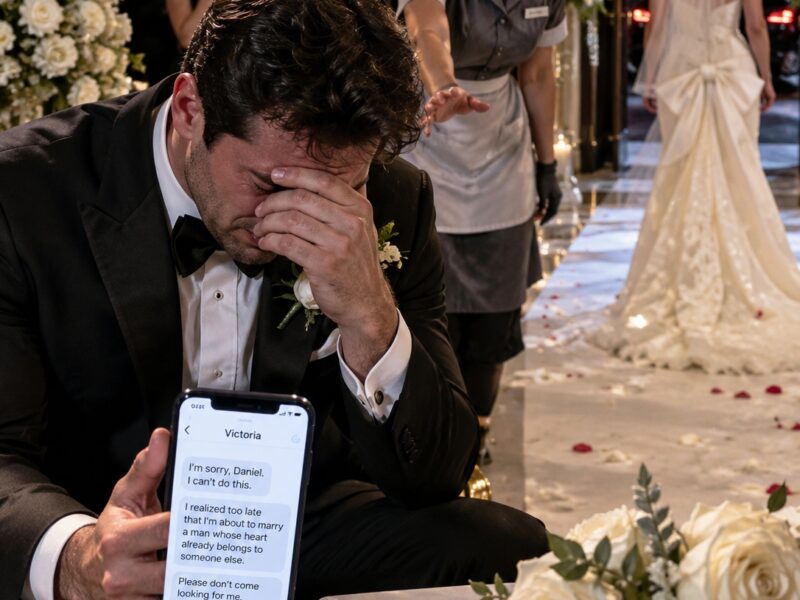
And then Daniel’s phone vibrated.
One message.
Eight lines.
By the time he reached the final sentence, his face had gone completely still.
I’m sorry, Daniel.
I can’t do this.
I realized too late that I’m about to marry a man whose heart already belongs to someone else.
Please don’t come looking for me.
The phone remained in his hand.
For several seconds, Daniel forgot there were hundreds of people staring at him.
Another woman?
There was no other woman.
There had never been another woman.
He looked toward the empty aisle as if Victoria Hail might suddenly appear and explain the cruel joke.
She didn’t.
A champagne flute clinked against a table somewhere behind him. Someone whispered too loudly. Another person shushed them.
Then the whispers began spreading through the ballroom like smoke.
“Did she find out about someone?”
“I heard they were fighting last week.”
“Maybe she caught him with somebody.”
“That’s not what I heard.”
Daniel heard every word.
He had spent almost twenty years learning how not to react when a bank rejected him, when contractors threatened lawsuits, when investors tried to destroy him, when people twice his age told him he would never become anything more than the desperate son of a failed builder.
But nobody had ever taught him how to stand beneath three crystal chandeliers while hundreds of people watched the future he had spent a year building collapse in public.
His best man, Marcus Hale, moved toward him.
“Daniel.”
Daniel didn’t look at him.
“Give me a minute.”
“Everyone’s asking what they should—”
“A minute, Marcus.”
Something in Daniel’s voice stopped him.
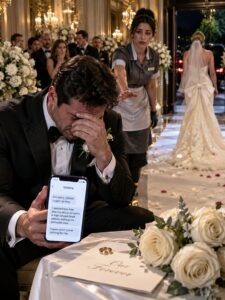
Daniel placed Victoria’s wedding ring on the small white table beside the altar.
It landed with a tiny metallic sound.
That sound hurt more than the whispers.
Near the rear of the ballroom, almost hidden behind an arrangement of white roses, Elena Brooks stood beside a cleaning cart with both hands wrapped around its handle.
Nobody was looking at her.
Nobody ever did.
She wore a gray service uniform, black nonslip shoes, and the small silver pendant her mother had given her when she was sixteen. Her dark hair was pulled into a loose knot that had begun falling apart after fourteen hours of work.
She had been at the estate since five-thirty that morning.
She had polished the marble near the entrance, helped straighten two hundred and eighty chairs, cleaned red wine from a linen tablecloth before anyone noticed the spill, found a missing pearl earring for a bridesmaid, and carried three boxes of champagne glasses into the ballroom because one of the younger servers had injured his wrist.
She had seen wealthy weddings before.
She knew what they looked like when everything went right.
And she knew what rich people looked like when something went wrong.
Usually, they became louder.
Daniel Whitmore became quiet.
That frightened her more.
One by one, guests began leaving their seats.
Some approached Daniel to offer awkward condolences. Others remained at a distance, pretending not to watch while watching everything.
Phones appeared.
Marcus immediately confronted one man near the aisle.
“Put that away.”
“I wasn’t recording.”
“Then you won’t mind putting it away.”
The man lowered his phone.
Daniel didn’t notice.
He was staring at the empty altar.
White roses surrounded him.
Victoria had chosen them because she said they represented new beginnings.
Now they looked like flowers at a funeral.
Elena’s supervisor, Denise, passed behind her carrying a stack of abandoned programs.
“Once the room clears, start with table twelve,” Denise murmured. “Somebody knocked over a bottle.”
Elena nodded.
But she didn’t move.
Daniel had placed both hands against the edge of the altar table.
His shoulders were rigid.
Not shaking.
Not yet.
Elena had seen that posture before.
Her mother had stood exactly like that in a hospital hallway six years earlier when a doctor told them the tumor had returned.
People thought grief always looked like crying.
Sometimes grief looked like somebody holding very still because if they moved even an inch, they knew everything inside them would break.
“Elena.”
She glanced at Denise.
“Table twelve.”
“I know.”
“What are you looking at?”
Elena hesitated.
Denise followed her gaze.
“Oh.”
They watched Daniel.
“Poor man,” Denise whispered.
Elena didn’t answer.
Poor man sounded wrong.
Daniel Whitmore was still a millionaire. Tomorrow he would wake inside a house worth more than Elena would earn in ten lifetimes. He would still own companies and property and cars that cost more than the small apartment she rented for herself and her mother.
But loneliness didn’t care how much a house cost.
Humiliation didn’t check a bank balance before entering.
And right now Daniel Whitmore looked less like a millionaire than a boy who had just realized nobody was coming back for him.
Elena slowly released the cleaning cart.
Denise caught her wrist.
“Don’t.”
Elena looked at her.
“Don’t what?”
“I know that face.”
“What face?”
“The face you get right before you do something that becomes paperwork for me.”
Despite everything, Elena almost smiled.
“I’m just going to talk to him.”
“You are absolutely not going to talk to him.”
“Why?”
“Because that is Daniel Whitmore.”
“He’s also a person.”
“He’s the client.”
“Tonight he’s a person.”
Denise tightened her grip.
“Elena.”
But Elena was already looking across the ballroom again.
Most of Victoria’s family had vanished.
Daniel’s business associates hovered near the exit, uncertain whether staying would be respectful or humiliating. Waiters began silently clearing untouched plates.
And something inside Elena made the decision before her mind could stop it.
She pulled her wrist gently free.
“If I get fired,” she said, “tell my mother I finally did something interesting.”
“Elena.”
She walked away.
Each step toward the altar felt louder than it should have.
A server noticed her.
Then one of the musicians.
Then Marcus.
By the time Elena reached the edge of the dance floor, Daniel finally looked up.
His eyes were bloodshot but dry.
Elena stopped several feet away.
For a moment, neither of them spoke.
Daniel glanced behind her, perhaps assuming she had come to clean something.
“I’m sorry,” he said automatically. “We’ll be out soon.”
The words caught Elena off guard.
He had just been abandoned at the altar, and he was apologizing to the cleaning woman because he thought he was delaying her work.
“No,” she said softly. “That’s not why I’m here.”
Daniel studied her face.
Elena suddenly became aware of everything about herself—the gray uniform, the worn shoes, the rubber cleaning gloves sticking from one pocket.
She almost turned around.
Then she remembered her mother’s hospital hallway.
She lifted her hand.
Daniel looked at it.
Then at her.
“I’m sorry,” he said again. “What?”
“Would you dance with me?”
The ballroom seemed to become even quieter.
Behind her, Denise covered her face with one hand.
Daniel stared.
Elena’s courage nearly disappeared.
She could hear how ridiculous it sounded now.
A cleaner asking a millionaire to dance at his own failed wedding.
“I don’t mean…” She swallowed. “I’m not trying to make fun of you.”
“I didn’t think you were.”
“I just thought maybe standing there isn’t helping.”
Daniel looked toward the altar.
“No,” he said after several seconds. “It isn’t.”
Elena kept her hand extended.
“My mother used to say that when the life you planned disappears, you have two choices. You can spend the whole night staring at the door it left through, or you can move your feet somewhere else.”
Daniel looked at her again.
“Your mother said that?”
“She said a lot of things. Half of them made no sense.”
For the first time that evening, something changed in Daniel’s expression.
Not a smile.
Almost.
Elena glanced at the empty dance floor.
“The room is paid for,” she said. “The flowers are already here. Seems like somebody should use them.”
That did it.
A broken sound escaped Daniel before he could stop it.
Half laugh.
Half breath.
Maybe half grief.
Then, slowly, he placed his hand in hers.
Across the ballroom, Marcus stared as if Daniel had just agreed to jump from the roof.
One of the violinists had been packing his instrument into its case. He paused, looked at Elena, then at Daniel.
Without saying anything, he lifted the violin again.
The cellist understood.
So did the others.
A soft melody drifted through the ballroom.
Daniel stepped onto the dance floor with Elena Brooks.
At first, he barely moved.
He seemed embarrassed by his own body, by the tuxedo, by the attention.
Elena kept a respectful distance.
“You can leave if this feels stupid,” she whispered.
“It does feel stupid.”
“Good.”
He blinked.
“Good?”
“It means you’re feeling something other than what happened ten minutes ago.”
Daniel looked at her.
She shrugged.
“I’m cleaning this floor later anyway. You might as well get footprints on it.”
This time he actually laughed.
It was quiet and painful, but real.
They began moving.
Outside the tall ballroom windows, moonlight rested across Lake Everly. Inside, hundreds of candles still flickered around an altar nobody would use.
Daniel had imagined his first dance with Victoria for months.
He had imagined cameras.
Applause.
Their families watching.
He had never imagined dancing with a woman whose name he didn’t know while the remnants of his wedding were being packed away around them.
Strangely, it felt more honest.
“What is your name?” he asked.
“Elena.”
“Elena…?”
“Brooks.”
“I’m Daniel.”
She gave him a look.
“I figured that part out.”
Another faint smile.
It vanished almost immediately.
Daniel’s eyes moved toward the empty aisle again.
Elena noticed.
“Don’t.”
He looked at her.
“Don’t what?”
“Look there.”
“Why?”
“Because she’s not there.”
The words were gentle.
That made them hurt more.
Daniel looked down.
“I don’t understand what I did.”
Elena could have told him Victoria was cruel.
She could have said he deserved better.
People loved saying things like that because they were easy.
Instead, Elena said, “You may not understand tonight.”
His jaw tightened.
“What if there is nothing to understand?”
“Then someday that will be the answer.”
He looked at her for a long time.
“You don’t know me.”
“No.”
“Then why are you doing this?”
Elena thought about the question.
Because she knew what loneliness looked like.
Because she had watched wealthy guests avoid him the second his humiliation became uncomfortable.
Because her mother had raised her to believe that kindness wasn’t supposed to be reserved for convenient moments.
Because twenty minutes earlier Daniel had helped an elderly dishwasher lift a crate even though nobody important had been watching.
But she didn’t explain any of that.
“Because everyone else walked away.”
The song ended.
The final violin note faded beneath the chandeliers.
For several seconds Daniel and Elena remained still.
Then he released her hand.
“Thank you.”
She nodded.
“You’re welcome.”
“Elena.”
She turned.
Daniel seemed to want to say something else.
Instead he looked at the cleaning cart waiting across the ballroom.
“I hope your supervisor doesn’t fire you.”
Elena glanced toward Denise.
Denise was staring at the ceiling like she had never seen either of them before.
“I’ve survived worse.”
Then Elena Brooks walked away from the man she had just saved from the worst five minutes of his life.
She believed she would never see him again.
She was wrong.
Daniel woke the next morning at 5:17.
For several seconds, he didn’t remember.
Then he saw the tuxedo jacket hanging across the chair.
The unopened wedding gift from Victoria on the dresser.
The ring on his bedside table.
And everything returned.
His house was twenty minutes outside Chicago, an eleven-thousand-square-foot structure of glass, limestone, and steel that had been featured in an architecture magazine three years earlier.
That morning, Daniel hated every inch of it.
Silence traveled through the rooms like another person.
He walked downstairs barefoot.
Two champagne glasses sat beside the kitchen sink from the small gathering the night before the wedding.
Victoria’s glass still carried the faint outline of her lipstick.
Daniel picked it up.
For one ugly second he wanted to throw it through the window.
Instead he placed it gently in the sink.
That frightened him more.
His phone contained seventy-three unread messages.
Marcus.
His sister Claire.
Business partners.
Employees.
People he had not spoken to in five years.
And six messages from numbers he didn’t recognize, which meant reporters had already found him.
No message from Victoria.
Daniel opened her final text again.
A man whose heart already belongs to someone else.
He read the sentence until it stopped looking like English.
Then he called her.
The phone went directly to voicemail.
He called her father.
No answer.
Her mother.
No answer.
Finally Marcus called.
Daniel answered.
“Where are you?”
“Home.”
“You need me to come over?”
“No.”
“You sure?”
“No.”
Marcus exhaled.
“I’m coming.”
“Don’t.”
“Daniel—”
“I said don’t.”
There was silence.
Marcus had known Daniel since college. He was one of the few people who understood that Daniel’s anger was usually quieter than other people’s.
“Okay,” Marcus said. “Then listen. The press knows.”
Daniel closed his eyes.
“How?”
“Somebody leaked the message.”
His eyes opened.
“What?”
“Not a screenshot. Just the content. Two entertainment sites are saying Victoria left because you were involved with another woman.”
Daniel stood motionless in his kitchen.
“I wasn’t.”
“I know.”
“She knows.”
“I know.”
“Then why would she write that?”
Marcus didn’t answer.
Daniel looked across the kitchen at the gray lake beyond the glass wall.
“Marcus.”
“I don’t know.”
But Daniel heard something in his voice.
“What aren’t you telling me?”
“Nothing.”
“Don’t lie to me today.”
A pause.
Then Marcus said, “One of Victoria’s cousins told someone at the reception that her family had been trying to talk her out of the marriage.”
Daniel gripped the edge of the counter.
“Since when?”
“I don’t know.”
“Why?”
“Daniel.”
“Why?”
Marcus sighed.
“Because apparently they didn’t think you were… suitable.”
Daniel almost laughed.
“Suitable?”
“I know how that sounds.”
“No. Explain it.”
“They wanted old money. Political connections. Their circle. You built yours.”
Daniel stared at his own reflection in the glass.
His company employed four thousand people.
He had rebuilt hospitals, housing developments, schools, office towers.
But to the Hails, apparently, he was still the son of a bankrupt contractor from Joliet.
“Who?”
“What?”
“Who did they want her to marry?”
Marcus hesitated.
That hesitation told Daniel everything.
“Marcus.”
“Andrew Sterling.”
Daniel knew the name.
Everyone in Chicago finance knew it.
Sterling’s family owned hotels, investment firms, and enough politicians’ attention to make newspaper editors nervous.
Daniel had met Andrew twice.
Once at a charity gala.
Once at Victoria’s parents’ Christmas party.
He remembered the way Andrew and Victoria had spoken to each other.
Too comfortably.
Daniel’s stomach tightened.
“Was she seeing him?”
“I don’t know.”
“Find out.”
“Daniel, maybe you shouldn’t—”
“Find out.”
Daniel ended the call.
For the next hour he sat alone at his kitchen island, replaying the previous year.
Victoria laughing at dinner.
Victoria choosing flowers.
Victoria standing in his closet and teasing him about his terrible ties.
Victoria telling him she didn’t care that he had grown up poor.
Victoria refusing a prenuptial provision because she said she didn’t want his money.
Victoria sometimes staring at her phone before turning it facedown.
Small moments rearranged themselves in Daniel’s memory.
He hated himself for noticing them now.
At 7:42, his phone rang.
His attorney.
At 8:06, his publicist.
At 8:31, the board chairman.
At 9:15, his sister Claire ignored his instructions and arrived anyway.
She found him still sitting in the kitchen wearing yesterday’s white dress shirt and black suit pants.
Claire dropped her purse on the counter.
“You look terrible.”
“Thank you.”
“Have you eaten?”
“I’m not hungry.”
“That’s not what I asked.”
Daniel rubbed his face.
Claire opened the refrigerator.
“Victoria’s an idiot.”
“Please don’t.”
“I’ve been waiting eighteen months to say that.”
Daniel looked up.
“Eighteen months?”
Claire froze.
The refrigerator door remained open.
Daniel slowly stood.
“What does that mean?”
“Nothing.”
“Claire.”
She shut the door.
“Daniel, yesterday is not the day to—”
“Yesterday already happened.”
His sister looked away.
Daniel felt his pulse rise.
“What did you know?”
“I didn’t know anything.”
“What did you suspect?”
Claire leaned against the counter.
“I thought Victoria loved the version of you that existed when people were watching.”
Daniel’s expression hardened.
“That’s not fair.”
“Maybe.”
“You barely spent time with her.”
“Because every time I did, she asked me whether you were considering buying the lake property, or whether you’d been invited to some foundation board, or whether you knew the governor. She never asked what book you were reading. She never knew Dad’s birthday.”
Daniel stared at her.
Claire’s voice softened.
“You still visit his grave every year on his birthday.”
Victoria had forgotten twice.
Daniel looked toward the window.
“She said my heart belonged to somebody else.”
Claire’s expression changed.
“Daniel.”
“What?”
“Maybe she wasn’t talking about a woman.”
He frowned.
“Then what?”
Claire looked around the enormous house.
Then toward the framed photograph on the kitchen shelf: Daniel at seventeen beside their father in front of the old Whitmore Construction truck.
“The company.”
Daniel said nothing.
Claire continued carefully.
“You built your entire life around saving what Dad lost. Sometimes I think you love that company because it lets you keep proving he didn’t fail.”
Daniel’s face went cold.
“That’s ridiculous.”
“Is it?”
“I was getting married.”
“You were planning a wedding. That’s not automatically the same thing as being emotionally available.”
Daniel stepped away.
Claire immediately regretted the words.
“I’m not defending what she did.”
“It sounds like you are.”
“I’m saying two things can be true. Victoria can have behaved horribly, and you can still have things you need to look at.”
Daniel reached for his coffee, discovered it was cold, and set it down.
“I don’t need a psychological evaluation this morning.”
“No. You need breakfast.”
She turned toward the refrigerator again.
Daniel almost told her to leave.
Then his phone vibrated.
A message from an unfamiliar number.
He opened it.
A photograph appeared.
Victoria.
Andrew Sterling.
Entering a private airport terminal outside Chicago at 11:03 the previous night.
Daniel’s breathing stopped.
Below the photograph was one sentence.
Thought you deserved to know the truth.
For ten seconds, he couldn’t move.
Claire saw his face.
“What is it?”
Daniel handed her the phone.
She looked.
“Oh, God.”
He took it back.
Something inside him became very quiet.
Victoria had left him standing at the altar while implying that he had betrayed her.
Then she had boarded a plane with another man.
It wasn’t simply abandonment.
It was a story she had constructed.
And Daniel suddenly understood why.
If she admitted she had chosen Andrew Sterling over him, she would be the woman who humiliated her fiancé for status.
If she suggested Daniel had another woman, she became the wounded bride who had escaped before making a mistake.
Daniel stared at the photograph.
Claire whispered, “What are you going to do?”
He thought he knew.
Call lawyers.
Destroy the story.
Release the picture.
Let the world tear Victoria apart the way it was tearing him apart.
Then, for no reason he could explain, he remembered a woman in a gray uniform extending her hand across an empty ballroom.
Everyone else walked away.
Daniel locked his phone.
“Nothing today.”
Claire blinked.
“Nothing?”
“Not today.”
“What about tomorrow?”
Daniel looked at the photograph again.
“I don’t know.”
And for perhaps the first time in his adult life, Daniel Whitmore admitted there was something he didn’t know how to fix.
Three days later, Elena Brooks was mopping the marble lobby of the Hawthorne Hotel when her supervisor appeared behind her.
“Office.”
Elena kept mopping.
“Am I fired?”
“If you were fired, I would not walk down six flights of stairs to tell you. I’d call.”
“Comforting.”
“Office.”
Elena followed Denise into a small room behind the service corridor.
Two managers were waiting.
So was the regional director.
Elena stopped.
“Oh.”
Denise folded her arms.
“I told you that dance was going to become paperwork.”
Elena’s stomach dropped.
The regional director stood.
“Ms. Brooks, please sit.”
“I’d rather stand if I’m being terminated.”
“You’re not.”
Elena glanced at Denise.
Denise gave nothing away.
The director opened a folder.
“Whitmore Development has offered Mercer Event Services a three-year facilities and hospitality contract.”
Elena blinked.
“Okay.”
“It is the largest private contract this division has received in nine years.”
“I’m happy for the division.”
The director cleared his throat.
“There is a condition.”
Elena already knew.
Her shoulders stiffened.
“What condition?”
“They requested that you be considered for the vacant guest services supervisor position.”
Silence.
Elena stared at him.
“Considered?”
“They were explicit that you should only receive the role if management believes you are qualified.”
Elena looked at Denise.
Denise finally smiled.
“I told them you’re a pain in my ass.”
Elena ignored her.
“Did Mr. Whitmore ask you to give me the job?”
“No.”
“Did he offer more money if I got it?”
“No.”
“Did he say anything about my personal circumstances?”
The regional director hesitated.
“No.”
Elena narrowed her eyes.
“That’s a strange hesitation.”
“He asked whether the company offered health insurance to supervisors.”
Her face changed.
Her mother’s treatment.
The unpaid bills on the kitchen table.
The pharmacy envelope Elena had hidden inside a drawer because she didn’t want her mother to know she had taken another Saturday shift.
Anger arrived before gratitude.
“I didn’t ask him to do that.”
“We know.”
“I don’t want charity.”
Denise leaned forward.
“Then don’t take charity.”
Elena looked at her.
“Take the promotion you applied for eight months ago and didn’t get because Rick Mason’s nephew somehow became more qualified than you overnight.”
The regional director looked uncomfortable.
Denise didn’t care.
“You’ve trained half this staff,” she continued. “You already do supervisor work whenever somebody calls out. You know every hotel system we use. You speak Spanish. You know banquet setup better than our banquet manager. The only reason this feels like charity is because a rich man finally forced somebody upstairs to look at your résumé.”
Elena crossed her arms.
“I want the interview.”
The director nodded.
“You’ll have one.”
“And if I’m not the strongest candidate, I don’t get it.”
“Agreed.”
“And nobody tells Mr. Whitmore otherwise.”
“Agreed.”
Elena exhaled.
“When?”
“Tomorrow.”
She stood.
Denise grinned.
“Try not to dance with any more clients before then.”
Elena pointed at her.
“Not helping.”
She got the job.
Not because Daniel demanded it.
Because during a fifty-seven-minute interview, Elena identified three scheduling problems, two wasteful vendor contracts, and a guest complaint procedure so outdated that one executive asked why she had not already been promoted.
Daniel found out four days later.
He was in his office when his assistant told him Elena had accepted the position.
He stared at the email longer than necessary.
“Did she earn it?”
His assistant smiled slightly.
“Apparently she made the regional manager look underqualified.”
Daniel leaned back.
“Good.”
He almost sent Elena a note.
Congratulations.
Then deleted it.
He didn’t want to turn one night of kindness into an obligation.
For six weeks, they had no contact.
Daniel went back to work.
Or tried to.
He arrived before seven.
Stayed past nine.
Signed contracts.
Reviewed plans.
Fired one communications consultant who suggested they publicly imply Victoria suffered from “emotional instability.”
He refused every interview request.
When asked about the wedding, his company issued one sentence.
Mr. Whitmore considers the matter personal and wishes Ms. Hail well.
Victoria’s family remained silent.
Andrew Sterling remained silent.
The photograph from the airport eventually surfaced online anyway.
Public opinion shifted.
Daniel didn’t celebrate.
He discovered humiliation did not disappear simply because the crowd chose a new villain.
At night, he still came home to an empty house.
But something else had changed.
Elena’s words followed him.
Everyone else walked away.
Daniel began noticing people he had stopped seeing.
The receptionist who always arrived before him.
The janitor who cleaned the executive floor after midnight.
The delivery driver who knew everyone’s names.
One rainy Tuesday, Daniel entered the parking garage at 9:40 p.m. and noticed Luis Ortega, a maintenance technician, changing a tire beside an old Honda.
“You need a hand?”
Luis looked up, startled.
“Mr. Whitmore?”
“Daniel.”
“I’m okay.”
Daniel removed his jacket.
“That wasn’t the question.”
Together they changed the tire.
While working, Daniel learned Luis had been with Whitmore Development for eleven years.
Eleven.
Daniel didn’t know his name until that night.
The realization stayed with him.
A week later he began visiting job sites without executives accompanying him.
Workers were uncomfortable at first.
Then suspicious.
Then honest.
One woman in accounting told him their bereavement policy was cruel.
A site supervisor explained that hourly workers often avoided using the health plan because deductibles were impossible.
A single father working security admitted he had slept in his car twice because a payroll mistake had taken twelve days to correct.
Daniel listened.
The company he thought he had built perfectly looked different from ground level.
It embarrassed him.
So he started changing it.
Expanded family leave.
Emergency payroll advances.
A worker assistance fund.
Better health coverage for hourly staff.
A direct reporting channel that bypassed department heads.
His executives complained about cost.
Daniel asked them what employee turnover had cost the previous year.
Nobody complained after that.
Three months after the wedding, Daniel walked into a charity planning meeting at the Hawthorne Hotel and saw Elena Brooks standing at the front of the conference room.
She wore a navy blazer instead of gray.
Her hair was down.
For a second, he didn’t recognize her.
Then she looked up.
Their eyes met.
Elena stopped speaking.
Daniel stopped walking.
Everyone else in the room noticed.
Elena recovered first.
“Mr. Whitmore.”
He almost smiled.
“Ms. Brooks.”
The event was a fundraising dinner for families facing catastrophic medical expenses.
Whitmore Development was one of the sponsors.
Elena was coordinating hotel operations.
They shook hands like strangers.
Her grip was firm.
“Congratulations,” Daniel said quietly.
“For what?”
“The promotion.”
She raised one eyebrow.
“I earned it.”
“I heard.”
“Good.”
“Apparently you terrified three executives.”
“Only two.”
Daniel smiled.
That smile unsettled Elena more than she expected.
The meeting continued.
She watched him from the corner of her eye.
He was different from the man at the wedding.
Still controlled.
Still intimidating.
But he listened more.
When a junior coordinator spoke, Daniel didn’t interrupt.
When a catering employee pointed out that the proposed meal service would create delays, Daniel supported changing the schedule even though two donors complained.
After the meeting, Elena was collecting folders when Daniel approached.
“Coffee?”
She looked at him.
“With you?”
“That’s usually how an invitation works.”
“Why?”
Daniel considered lying.
He didn’t.
“Because I’ve wanted to thank you properly for three months.”
“You thanked me that night.”
“Then coffee can be for something else.”
“What?”
“I don’t know yet.”
Elena stared at him.
“You aren’t very good at this, are you?”
“No.”
“You’re a millionaire.”
“Apparently money doesn’t improve conversation.”
“It certainly hasn’t improved that invitation.”
Daniel laughed.
Elena hated how much she liked the sound.
“Twenty minutes,” she said.
They found a small café across the street.
Daniel offered to order.
Elena refused.
“I can buy my own coffee.”
“I didn’t say you couldn’t.”
“You were reaching for your wallet.”
“I thought that was normal.”
“Not when one person owns half the block.”
“I don’t own half the block.”
“How much?”
Daniel paused.
“About thirty percent.”
Elena stared at him.
He smiled.
She shook her head.
“This was a mistake.”
But she sat down.
Twenty minutes became ninety.
Daniel learned Elena had studied hospitality management at community college but dropped out during her mother’s first cancer diagnosis.
Elena learned Daniel’s father, Robert Whitmore, had died from a heart attack when Daniel was seventeen.
“He left debt,” Daniel said. “A lot of it.”
“And you kept the company?”
“Eventually.”
“Why?”
Daniel looked into his coffee.
“Because everybody told me not to.”
Elena smiled.
“That sounds healthy.”
“It wasn’t.”
He told her how his mother had died when he was twelve. How his father worked constantly afterward. How Daniel spent summers carrying lumber and sweeping job sites.
“After he died, there were contractors demanding payment at the house,” Daniel said. “I remember one telling me Dad had been a good man but a terrible businessman.”
“That must have hurt.”
“I decided I’d prove him wrong.”
“Did you?”
Daniel looked out the window.
“I built a company worth almost two billion dollars.”
“That wasn’t my question.”
He turned back.
Elena’s gaze was steady.
No executive spoke to him like that.
No girlfriend ever had.
Daniel found it strangely relieving.
“I don’t know,” he admitted.
Elena nodded.
“Better answer.”
They spoke about Victoria only once.
Elena didn’t ask.
Daniel brought her up.
“She was photographed leaving with another man.”
“I saw.”
“Everybody saw.”
“I try not to read celebrity news.”
“I’m not a celebrity.”
“You abandoned a wedding with two hundred rich people. That’s practically a public service announcement.”
Daniel gave her a look.
Then his expression softened.
“She blamed me.”
Elena knew what he meant.
“The message.”
“You heard it?”
“Everyone heard it eventually.”
“I keep wondering whether some part of it was true.”
Elena leaned back.
“The other woman?”
“No.”
He hesitated.
“My sister thinks Victoria meant my company.”
Elena was silent.
Daniel sighed.
“You can laugh.”
“I’m not laughing.”
“What?”
“I think your sister might know you.”
His face tightened.
“That’s what she said.”
Elena folded her hands.
“You know what I noticed at the wedding?”
“What?”
“You thanked everybody.”
Daniel frowned.
“That’s bad?”
“No. But you thanked people like a man who knows exactly what it feels like not to matter.”
Daniel didn’t speak.
Elena continued.
“People who feel invisible sometimes grow up and make sure nobody else feels that way. Or they grow up and spend the rest of their lives proving they’re too important to ignore.”
“Which am I?”
“Probably both.”
Daniel stared at her.
Most people around him adjusted their opinions according to his expression.
Elena didn’t.
“You’re incredibly direct.”
“You asked.”
“I did.”
“You want me to lie next time?”
“No.”
“Then don’t complain.”
He smiled.
When they left the café, rain had begun.
Daniel’s driver was waiting across the street.
Elena stopped beneath the awning.
“That’s your car?”
“Yes.”
“Of course it is.”
“It’s just a car.”
“It’s longer than my apartment.”
Daniel looked at her.
“Can I take you home?”
“No.”
“Why?”
“Because I take the train.”
“That wasn’t the question.”
Elena smiled despite herself.
“You remembered.”
“I listen occasionally.”
She hesitated.
“My mother worries when I get home late.”
“Then let me drive you.”
After a moment, Elena nodded.
The car took them to a modest apartment building in Oak Park.
As Elena reached for the door, Daniel said, “I enjoyed today.”
“So did I.”
She opened the door.
“Elena.”
She looked back.
Daniel almost asked when he could see her again.
Instead he said, “Good night.”
Something unreadable passed through her eyes.
“Good night, Daniel.”
He watched her enter the building.
Then he noticed the light in a second-floor window come on.
A woman appeared behind the curtain.
Older.
Thin.
Elena’s mother.
She looked down toward the car.
Daniel couldn’t see her expression, but somehow he knew she had been waiting.
Two weeks later, Daniel sent Elena a message.
Dinner?
Elena replied three minutes later.
Is that a business meeting?
No.
Then no.
Daniel stared at the screen.
He called.
She answered.
“You rejected me by text.”
“You invited me by text.”
“Fair.”
“Good night, Daniel.”
“Wait.”
“What?”
“Why no?”
A pause.
“Because I like talking to you.”
“That generally supports dinner.”
“Not in this situation.”
“What situation?”
“The situation where you are Daniel Whitmore.”
He frowned.
“You’ve known my name since the wedding.”
“Exactly.”
“What does that mean?”
“It means I don’t want to become a story people tell about the cleaning woman who caught a millionaire when his bride ran away.”
Daniel went quiet.
Elena’s voice softened.
“I worked too hard to stop being invisible. I’m not becoming somebody’s scandal.”
“You’re not.”
“You can’t promise that.”
“No.”
“And you’re still getting over Victoria.”
“I’m not trying to replace Victoria.”
“Maybe not consciously.”
That hurt because it sounded possible.
Daniel sat back in his office chair.
“So that’s it?”
“No.”
The answer surprised him.
“What does that mean?”
“It means if six months from now you still want to ask me to dinner, ask me.”
“Six months?”
“You’re wealthy. I’m sure you can afford patience.”
Then she hung up.
Daniel stared at the phone.
His assistant entered moments later.
“Problem?”
Daniel looked at him.
“Apparently I have to wait six months.”
His assistant wisely turned around.
Daniel did not wait six months.
He waited seven.
During that time, he and Elena became friends.
Real friends.
Not the polished kind Daniel had collected through business.
Elena texted him when his company appeared in the newspaper for its new employee support program.
Your tie looks terrible.
Daniel responded.
Article says we increased emergency family benefits by 40%.
I noticed the tie first.
He attended the charity events she organized.
She occasionally asked him for advice about vendors.
He occasionally asked her what employees really thought about one of his policies.
She always told him.
Even when he didn’t like the answer.
Especially then.
He met Elena’s mother, Rosa, almost by accident.
Rosa was sixty-two, recovering from another round of treatment, and had the unnerving ability to understand people within thirty seconds.
When Daniel visited the hotel during a community fundraiser, Rosa happened to be volunteering at registration.
Elena introduced them reluctantly.
“Mom, this is Daniel.”
Rosa looked at him for a moment.
“The wedding man.”
Elena closed her eyes.
“Mom.”
Daniel smiled.
“That’s apparently me.”
Rosa shook his hand.
“My daughter came home that night and said she danced with a sad millionaire.”
“Mom.”
“What? You did.”
Daniel looked at Elena.
“A sad millionaire?”
“It was late. I was tired.”
Rosa smiled.
“She didn’t say you were handsome.”
Daniel nodded gravely.
“That is disappointing.”
Elena stared at both of them.
“I regret introducing you.”
Rosa eventually walked away.
Daniel leaned closer.
“Your mother likes me.”
“She likes everybody.”
“She just threatened a volunteer with bodily harm for folding raffle tickets wrong.”
“Fine. She tolerates you.”
It was easy.
That was what frightened Elena.
Daniel did not feel like the arrogant billionaire she had expected.
He showed up when he said he would.
He remembered her mother’s appointment dates.
He never sent money.
Instead, when Rosa’s insurance denied one specialized medication, Daniel gave Elena the number of an independent patient advocate his company used for employees.
The appeal succeeded.
No strings.
No publicity.
Elena began trusting him.
Slowly.
Then Victoria returned.
It happened on a rainy Thursday afternoon.
Daniel was finishing a board meeting when his assistant entered.
“Someone is waiting.”
“Who?”
His assistant hesitated.
“Victoria Hail.”
The room went silent.
Daniel’s board members suddenly discovered fascinating documents in front of them.
Daniel’s expression did not change.
“Where?”
“Your office.”
For one brief second, the ballroom returned.
The empty aisle.
The whispers.
The message.
Then another memory followed it.
Gray uniform.
Extended hand.
Everyone else walked away.
Daniel closed the folder before him.
“We’re done for today.”
He entered his office alone.
Victoria stood beside the windows.
She looked almost exactly as she had eleven months earlier.
Elegant.
Controlled.
Beautiful in the precise, careful way that had once made Daniel feel lucky simply to be chosen by her.
But something had changed.
Or perhaps Daniel had.
Victoria turned.
“Hi.”
Daniel closed the door.
“Victoria.”
Her eyes moved across his face.
“You look different.”
“I cut my hair.”
She almost smiled.
“That’s not what I meant.”
Daniel remained near the door.
“What do you want?”
The directness wounded her.
He saw it.
Once, that would have made him rush to soften the moment.
He didn’t.
Victoria folded her hands.
“I owe you an explanation.”
“You owed me one eleven months ago.”
“I know.”
“You had my number.”
“I was ashamed.”
Daniel laughed once.
The sound was cold.
“You were ashamed?”
“I deserve that.”
“No. I genuinely don’t know what that means.”
Victoria inhaled.
“Andrew and I aren’t together.”
“I didn’t ask.”
“My parents wanted us to be.”
Daniel said nothing.
She continued.
“They had been pushing it for years. You knew our families moved in different circles.”
“We were engaged. I assumed your circle had adjusted.”
“My father never did.”
“And you discovered that forty-six minutes after our wedding was supposed to start?”
“No.”
At least she didn’t lie.
Daniel walked toward his desk.
“When?”
“Months before.”
He stopped.
Victoria’s voice trembled.
“Andrew came back to Chicago four months before the wedding. My father started arranging dinners. Business events. Charity meetings. He kept saying I was making a mistake.”
“And you said nothing.”
“I thought I could handle it.”
“Apparently not.”
“I loved you.”
Daniel turned.
The sentence once would have destroyed him.
Now it simply sounded incomplete.
“But?”
Victoria’s eyes filled.
“But I was scared.”
“Of marrying me?”
“Of what my life would become.”
Daniel almost laughed.
“You were about to marry a millionaire, Victoria. Let’s not pretend you were heading toward hardship.”
“That’s not what I mean.”
“Then explain it.”
She looked toward the city.
“With Andrew, everything was known. The families. The expectations. The people. With you, everything felt…” She searched for the word. “Uncontrolled.”
Daniel stared.
“I built my life from nothing.”
“I know.”
“And that embarrassed you.”
“No.”
“It embarrassed your father.”
“Yes.”
“And his opinion mattered more than mine.”
Victoria looked down.
“That day, my mother came into the bridal suite. She told me my father would cut me off from the family foundation if I went through with the wedding. She told me Andrew still wanted to marry me. She said I was choosing a man who would always love his work more than he loved me.”
Daniel went still.
There it was.
The company.
Claire had been right.
Victoria wiped one tear away.
“I panicked.”
“So you told two hundred and eighty people I had another woman.”
“I never said another woman.”
“You wrote that my heart belonged to someone else.”
“I meant your company.”
“You knew exactly how people would read it.”
Victoria didn’t answer.
Daniel’s voice lowered.
“You knew.”
“I didn’t think the message would leak.”
“That makes it better?”
“No.”
“You made me the reason you ran.”
“I was terrified.”
“So was I.”
Her face crumpled slightly.
Daniel had never said that aloud.
He continued.
“I stood there thinking there was something wrong with me that everyone else understood except me. People photographed me. Reporters called my employees. My sister had to turn off her phone because strangers were sending her theories about what kind of man I was.”
Victoria whispered, “I’m sorry.”
Daniel looked at her.
“I believe you.”
Hope flashed across her face.
Then he finished.
“But sorry doesn’t rebuild trust.”
Victoria stepped closer.
“Daniel, I made the worst mistake of my life.”
“Maybe.”
“I left with Andrew because my parents told me I had nowhere else to go. We flew to New York. By the next morning I knew I had ruined everything.”
“You had eleven months.”
“I thought you hated me.”
“I did for a while.”
“And now?”
Daniel considered the question.
“I don’t.”
Victoria’s eyes filled with hope again.
“Then maybe—”
“I don’t love you either.”
The words landed quietly.
Victoria’s face went still.
Daniel felt sadness.
Real sadness.
Not triumph.
Not revenge.
Just grief for two people who once believed they knew each other.
She whispered, “Is there someone else now?”
Daniel thought of Elena.
Her laugh.
Her refusal to let him buy coffee without an argument.
The way she cared for her mother.
The way she had made him wait because she valued herself too much to become his rebound.
He did not answer.
Victoria saw enough.
“It’s the woman from the wedding.”
Daniel’s eyes narrowed.
“How do you know about her?”
“The video.”
“What video?”
Victoria looked surprised.
“You never saw it?”
Daniel felt cold.
“Victoria.”
“Someone recorded you dancing after I left. It went around online for a few days.”
Daniel had ordered his communications team not to show him anything related to the wedding.
He had never known.
Victoria’s expression changed.
“They called it romantic.”
“It wasn’t.”
“I know.”
“No, you don’t.”
Daniel stepped closer.
“She didn’t walk toward me because I was wealthy or because cameras were watching. She thought nobody was watching. She did it because I was standing alone.”
Victoria’s eyes lowered.
Daniel heard himself and realized what had just happened.
He was defending Elena.
Not from gossip.
From being misunderstood.
And suddenly he knew the truth.
Victoria knew it too.
She picked up her purse.
“She loves you?”
Daniel shook his head.
“I don’t know.”
“Do you love her?”
He couldn’t answer quickly enough.
Victoria smiled through tears.
“That’s what I thought.”
She reached the door.
“Daniel?”
He looked at her.
“For what it’s worth, I think your heart did belong to someone else that day.”
He frowned.
Victoria glanced toward the framed photograph of Daniel’s father on the shelf.
“Just not the woman everyone thought.”
Then she left.
Daniel remained alone.
For the rest of the afternoon, he thought about those words.
He had spent twenty years building things.
Companies.
Buildings.
Reputation.
Security.
He had believed success could make abandonment impossible.
Yet his father had still died.
His mother had still died.
Victoria had still left.
Money had protected him from poverty.
It had never protected him from loss.
That evening, Daniel did something he had avoided for almost a year.
He returned to the estate where his wedding had collapsed.
A charity event was being set up inside the ballroom.
Families dealing with medical debt would be guests that weekend, along with donors and physicians.
Elena was supervising.
Daniel stood in the doorway unnoticed.
The chandeliers were the same.
The lake beyond the windows was the same.
But the flowers were different.
Sunflowers instead of white roses.
Elena stood near the center of the room giving instructions to a team of servers.
“No, table six needs another chair. Mrs. Gardner’s son uses a wheelchair, so leave extra space on the aisle. And somebody please tell catering the Parkers’ little girl has a severe nut allergy. I put it in the notes three times.”
Daniel smiled.
Elena turned.
Saw him.
Her expression immediately changed.
“What are you doing here?”
“Visiting.”
“You don’t visit. You arrive with assistants.”
“I left them downstairs.”
“Growth.”
She walked toward him.
Then she noticed his expression.
“What happened?”
“Victoria came to see me.”
Elena stopped.
“Oh.”
“She wants another chance.”
Something moved across Elena’s face too quickly for him to name.
“What did you say?”
“No.”
Elena looked toward the tables.
“You didn’t have to tell me.”
“I wanted to.”
“Why?”
Daniel glanced around the ballroom.
“Because this is where everything started.”
“For you.”
“For us.”
That made her look at him.
The room seemed quieter.
Daniel nodded toward the dance floor.
“Do you remember what you said that night?”
“I said several regrettable things.”
“You said when the future you planned disappears, you have to move your feet somewhere else.”
“My mother said that.”
“Your mother is very dramatic.”
“You’ve met her.”
“Fair.”
Daniel held out his hand.
Elena stared at it.
“No.”
He blinked.
“No?”
“I’m working.”
“Five minutes.”
“Daniel.”
“You interrupted your job the first time.”
“And almost got fired.”
“You got promoted.”
Her eyes narrowed.
“Do not connect those two events if you value your life.”
He laughed.
Then his expression softened.
“One dance.”
Elena looked around.
Several employees were openly watching.
She sighed.
“Your timing is terrible.”
“I’ve been told.”
She placed her hand in his.
No musicians played this time.
A sound technician noticed and quietly turned on instrumental music through the ballroom speakers.
Elena looked toward him.
The technician immediately pretended to study a cable.
Daniel smiled.
They stepped onto the same floor.
Eleven months earlier, Daniel had barely been able to breathe.
Now Elena was the nervous one.
“You okay?” he asked.
“I’m thinking about the twelve employees watching us.”
“Ignore them.”
“Easy for the billionaire.”
“Millionaire.”
“I looked up the company valuation.”
Daniel laughed.
“That’s invasive.”
“Public information.”
They moved slowly beneath the chandeliers.
After several moments, Daniel said, “I waited seven months.”
Elena looked at him.
“For what?”
“You told me to ask again in six.”
Her breathing changed.
Daniel continued.
“Dinner.”
“Daniel.”
“Not because you rescued me. Not because I’m lonely. Not because Victoria came back.”
“Then why?”
He looked directly at her.
“Because when something happens, good or bad, you’re the person I want to tell.”
Elena stopped moving.
Daniel stopped with her.
Around them, staff quietly found other things to look at.
Elena’s voice became softer.
“You don’t know what dating me would look like.”
“Probably a lot of arguing about coffee.”
“I’m serious.”
“So am I.”
“My mother lives with me.”
“I like your mother.”
“She likes you too much. It’s suspicious.”
“I’ll manage.”
“I don’t belong at your fundraisers.”
“Neither do I.”
She almost smiled.
“Daniel.”
“What?”
“If this goes wrong, I don’t want a promotion. I don’t want money. I don’t want a better apartment. I don’t want anything that makes me wonder whether I stayed because leaving became financially impossible.”
Daniel nodded immediately.
“Okay.”
She searched his face.
“And I don’t want to become a secret because somebody on your board thinks I’m embarrassing.”
Daniel’s jaw tightened.
“If anybody on my board thinks you’re embarrassing, I’ll give them enough free time to reconsider.”
“Don’t fire people for me.”
“I’ll fire them for being stupid.”
She laughed.
Then became serious again.
“And if you’re still in love with Victoria—”
“I’m not.”
“Daniel.”
“I’m not.”
Elena studied him.
“Then ask.”
His heart began beating faster than it had during million-dollar negotiations.
“Elena Brooks, would you have dinner with me?”
She waited long enough to punish him.
Then she smiled.
“Yes.”
Their first real date happened at a small Italian restaurant Elena chose in Oak Park.
Daniel arrived without a driver.
Elena stared at the ordinary sedan he had borrowed from Marcus.
“What is that?”
“A car.”
“Whose?”
“Marcus.”
“You borrowed somebody else’s car because you thought your own car looked too expensive?”
Daniel hesitated.
“Possibly.”
She laughed so hard she had to turn away.
It became one of his favorite memories.
They dated quietly for months.
Not secretly.
Quietly.
There was a difference.
Daniel learned Elena hated expensive flowers because they died too quickly.
She learned Daniel could cook exactly three meals, all involving steak.
He learned she read mystery novels in the bathtub.
She learned he still called his father’s old office number in his head whenever he was stressed, even though the number had been disconnected for twenty-one years.
They fought.
Real fights.
When Daniel tried to arrange a private specialist for Rosa without asking, Elena became furious.
“You don’t get to fix everything because you have money.”
“I was trying to help.”
“You were trying to control the outcome.”
“There’s a difference?”
“Yes.”
He hated hearing it.
Because it was true.
He apologized.
Later, Elena made her own mistake.
When Daniel canceled dinner because an employee had died in a construction accident, she accused him of choosing work again before understanding what had happened.
Daniel became silent.
Then told her the dead employee, Samuel Price, had worked for Whitmore Development for sixteen years and left behind two children.
Elena felt ashamed.
“I’m sorry.”
Daniel looked exhausted.
“So am I.”
She went with him to the family’s house.
Not as his girlfriend.
As someone who understood that grief sometimes needed company more than solutions.
Daniel sat with Samuel’s widow at her kitchen table for two hours.
He didn’t mention compensation until she asked.
On the drive home, Elena rested her hand on his.
Neither spoke.
Their relationship did not become strong because they never hurt each other.
It became strong because neither of them ran when they did.
A year after the failed wedding, Daniel created the Robert Whitmore Foundation.
Its purpose was simple: emergency assistance for workers and families facing medical crises, sudden bereavement, housing emergencies, and unexpected hardship.
Daniel asked Elena to lead the community outreach program.
She refused.
He expected that.
“You haven’t heard the salary.”
“I don’t care.”
“You haven’t heard the job description.”
“I already have a job.”
“You’d be good at it.”
“I know.”
Daniel smiled.
“That’s incredibly modest.”
Elena folded her arms.
“I won’t work directly for you while we’re dating.”
“You’d report to the foundation board.”
“Whose chairman is?”
“Technically me.”
“Exactly.”
“So that’s a no?”
“That’s a no.”
Daniel hired someone else.
Six months later, when he stepped down as chairman and an independent board took control, Elena applied without telling him.
She got the job.
Daniel discovered when he arrived at the foundation’s opening event and saw her name printed beneath Director of Community Programs.
He found her near the stage.
“You applied.”
“I did.”
“You didn’t tell me.”
“You would have interfered.”
“I would have supported you.”
“That’s what I said.”
He stared at her.
Then pulled her into a hug.
“I’m proud of you.”
Elena closed her eyes.
Those four words meant more than any promotion.
Two years after the night of the ruined wedding, Daniel returned to the same ballroom again.
This time there were only thirty-seven guests.
Marcus.
Claire.
Rosa.
Denise.
Several of Daniel’s oldest employees.
A handful of Elena’s closest friends.
No journalists.
No business partners invited for appearance.
No politicians.
No three-hundred-dollar floral arrangements.
Elena had chosen wildflowers.
Daniel stood at the end of the aisle wearing a dark suit.
Not a tuxedo.
He was nervous.
Terrified, actually.
Marcus noticed.
“You’ve negotiated nine-figure acquisitions.”
Daniel adjusted his cuff.
“None of those involved vows.”
“You’ll be fine.”
“You said that last time.”
Marcus winced.
“Fair.”
The doors opened.
Daniel’s breathing stopped.
Elena appeared beside Rosa.
She wore a simple ivory dress with long sleeves and carried a small bouquet of wildflowers.
No veil.
No diamonds except the small ring Daniel had given her.
And around her neck hung the same silver pendant she had worn the night they met.
Daniel saw it immediately.
His eyes filled.
Elena reached the altar.
Rosa kissed her cheek, then looked at Daniel.
“You take care of each other.”
Not take care of her.
Each other.
Daniel nodded.
“We will.”
The ceremony lasted twenty minutes.
When the officiant asked for the rings, Daniel’s hand shook.
Elena whispered, “You okay?”
He laughed quietly.
“Ask me after the aisle.”
She smiled.
They exchanged vows.
Daniel did not promise Elena a perfect life.
He had learned better.
He promised to listen when fixing wasn’t needed.
To stay when leaving would be easier.
To never confuse providing for someone with knowing them.
Elena promised to tell him the truth before resentment turned into silence.
To remind him that his worth was not measured by what he built.
And to dance with him when life fell apart.
When they kissed, Rosa cried.
Claire cried.
Marcus denied crying.
Denise loudly called him a liar.
Later that evening, the tables were moved aside.
Music began.
Daniel and Elena stepped onto the dance floor.
The same chandeliers hung above them.
The same lake shimmered beyond the tall windows.
But Daniel no longer saw an empty aisle when he looked across the room.
He saw Rosa laughing with Claire.
He saw Marcus arguing with Denise over champagne.
He saw employees who had known his father.
He saw people whose names he had once failed to learn and whose families he now knew.
Most importantly, he saw Elena.
“You know,” she whispered as they danced, “I almost didn’t walk over to you that night.”
Daniel smiled.
“Why did you?”
“I still don’t know.”
“That’s disappointing. I was hoping for something profound.”
“I was tired. Maybe my judgment was impaired.”
He laughed.
Then Elena became quiet.
“I think you looked like somebody everybody could see but nobody wanted to look at.”
Daniel’s smile faded.
She continued.
“I knew that feeling.”
He drew her slightly closer.
“You weren’t invisible.”
“I was to most people.”
“Not to me.”
“Eventually.”
He nodded.
“Eventually.”
They moved slowly beneath the light.
After a while, Daniel said, “Do you ever think about what would have happened if Victoria had walked down the aisle?”
Elena looked at him.
“Sometimes.”
“What do you think?”
“I think you would’ve married her.”
“Probably.”
“You would’ve tried very hard to make it work.”
“Yes.”
“And maybe you would have spent years wondering why being successful still felt lonely.”
Daniel looked toward the windows.
“And you?”
Elena smiled.
“I would have finished cleaning the ballroom and gone home.”
The simplicity of that answer struck him.
An entire life had turned because one woman had not walked down an aisle and another woman had walked across a room.
Daniel once believed the worst moment of his life happened beneath those chandeliers.
For years afterward, people who knew the story described it as the night he had been abandoned.
Daniel eventually stopped correcting them.
Because technically, they were right.
Victoria had abandoned the wedding.
His carefully planned future had disappeared in less than an hour.
The life he thought he had earned had collapsed in front of hundreds of people.
But abandonment was not the whole story.
What Daniel lost that night was certainty.
What he gained was sight.
He began seeing the employees who entered buildings through service doors before executives arrived.
He saw how easily power could make ordinary people disappear.
He saw the difference between being admired and being known.
Between rescuing someone and respecting them.
Between choosing somebody because they fit your life and building a life in which both people could remain fully themselves.
Victoria had once accused Daniel of giving his heart to something else.
She had not been entirely wrong.
For years, Daniel’s heart had belonged to proving.
Proving his father had not failed.
Proving poverty had not defined him.
Proving the people who dismissed him had been wrong.
Proving that enough money, enough buildings, enough success could make him impossible to leave.
But love had never asked Daniel to become impossible to leave.
Love asked whether he knew how to stay.
Years later, on difficult nights, Daniel and Elena still returned occasionally to that ballroom.
Sometimes for foundation events.
Sometimes for weddings belonging to other people.
Sometimes merely because they were nearby.
And every time, Daniel remembered the image clearly.
The abandoned flowers.
The silent musicians.
A wedding ring on a white table.
Hundreds of people slowly backing away from a man whose humiliation had become too uncomfortable to witness.
Then one woman walking forward.
Gray uniform.
Worn shoes.
Rough hands.
Silver pendant.
An extended hand.
Elena never believed she saved Daniel that night.
Whenever anyone told the story that way, she corrected them.
“I asked him to dance,” she would say. “That’s all.”
Daniel never argued with her anymore.
He understood what she meant.
People did not always need rescuing.
Sometimes they needed somebody who could stand beside them without demanding they become less broken first.
Sometimes they needed one person willing to cross an uncomfortable room while everybody else searched for the exit.
Sometimes the smallest kindness did not repair the life that had fallen apart.
It simply reminded you that another life was still possible.
And sometimes the person everyone overlooked was the only one in the room who could truly see you.
Daniel had once thought the most important moment of his life would be watching a bride walk toward him.
He had been wrong.
The moment that changed everything came after the bride disappeared.
It came when a woman he had never noticed walked toward him instead.
Not because she wanted his money.
Not because she wanted his name.
Not because she knew what he could give her.
She walked toward him because he was alone.
And years later, whenever Daniel remembered that ruined wedding, he no longer saw the door Victoria never walked through.
He saw Elena crossing the empty ballroom.
He saw her hand reaching toward him.
And he remembered the sentence that had quietly changed the direction of his life.
Everyone else walked away.
She didn’t.









