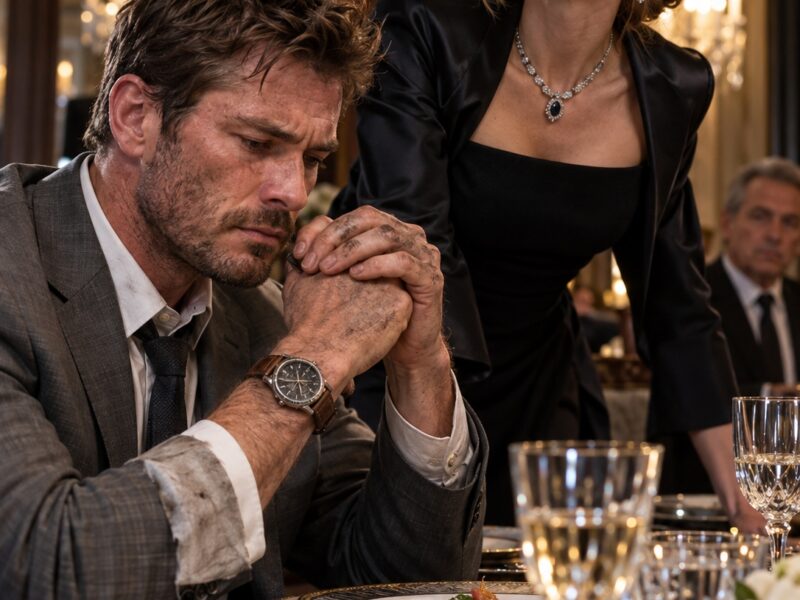
THE CEO ORDERED HIM TO THE STAFF TABLE—THEN HER MOTHER SAW HIS WATCH AND WHISPERED, “YOU FOUND HIM.”
The first time Sloan Carrington looked at Grant Holloway, she decided he did not belong at her table.
It took her less than two seconds.
His gray suit was nine years old. His shoes were polished but scarred at the toes. His hands were rough enough to look almost inappropriate beside crystal glasses, silver flatware, and twelve executives whose watches probably cost more than the pickup truck Grant had parked outside.
So when Sloan saw his name card near the end of the long mahogany table, she assumed someone had made a mistake.
She lifted the card between two fingers.
“Would you move this gentleman to the staff table?” she asked the server.
The room went silent.
Grant looked at her.
Sloan Carrington, thirty-seven, CEO of Carrington Industrial Group, did not look embarrassed.
Neither did Grant.
He simply remained in his chair.
For three long seconds, nobody moved.
Then the room did what expensive rooms often do when something ugly happens politely.
It pretended nothing had happened.
Grant folded his hands beside the folder he had brought with him.
Twenty-two pages.
Measurements.
Photographs.
Load calculations.
And one fact that could stop the largest acquisition in Carrington Industrial’s eighty-year history.
He had not come to embarrass Sloan.
He had not come to ask for money.
He had not even wanted to attend the dinner.
He had come because forty people worked beneath a machine that, eventually, might kill them.
And before the night was over, Sloan Carrington would discover that the man she had tried to seat beside the service door was connected to a secret her family had buried for twenty-nine years.
But the first person to understand that would not be Sloan.
It would be her mother.
And all Evelyn Carrington needed to see was the battered watch on Grant Holloway’s wrist.
Three weeks earlier, Grant had been underneath a production line in Tacoma with a flashlight clenched between his teeth.
That was the kind of place where he made sense.
Not ballrooms.
Not private dining rooms.
Not buildings with marble floors and employees trained to remember the names of people who mattered.
Machines did not care about names.
Steel did not care who your father was.
A load either traveled where the drawings said it traveled or it did not.
Grant trusted that.
People were harder.
At thirty-nine, he owned Holloway Mechanical & Structural, a four-person operation based in an industrial park in Kent, Washington. Their office roof leaked during heavy rain. Their coffee machine had survived two recessions and one electrical fire. Their clients were factory managers, maintenance directors, warehouse owners, and people who called at 2:00 a.m. because something weighing six tons had begun making a noise it was not supposed to make.
Grant liked the work because the work was honest.
If a bearing was failing, it told you.
If a weld was cracked, eventually the crack showed itself.
Human beings could hide failure for decades.
He had learned that later.
At the time, the Tacoma assignment looked routine.
Carrington Industrial Group was preparing to acquire a manufacturing company in a transaction valued at nearly nine hundred million dollars. Grant’s company had been hired as one of several outside contractors to inspect equipment and structural systems.
Nobody expected the small firm from Kent to find anything interesting.
Grant spent six days inside the plant.
On the fourth afternoon, he crawled beneath the main production line and noticed something that bothered him.
The support frame had been modified.
That alone was not unusual.
Industrial equipment lived longer than the engineers who designed it. Machines were upgraded. Loads changed. Reinforcements were added. Drawings disappeared.
But the pattern was wrong.
Grant wiped grease from a steel plate, took three measurements, then took them again.
He climbed out.
Sat on a metal step.
And stared at his notebook.
One of his technicians, Miguel, walked over.
“What?”
Grant didn’t answer immediately.
“Boss?”
Grant tapped the numbers.
“Run the vibration history again.”
“You already ran it.”
“Run it again.”
Miguel studied his face.
“That bad?”
“I don’t know yet.”
But Grant did.
Or at least he knew enough to be afraid of being right.
The production line had originally been designed around one load pattern. Years later, heavier machinery had been installed. Someone had reinforced the structure, but the reinforcement assumed the new loads would travel through the frame in essentially the same way as the old ones.
They did not.
The difference was small during any single cycle.
Over millions of cycles, small became fatal.
Nothing was going to collapse tomorrow.
Probably not next year.
But fatigue was accumulating roughly three times faster than the certification model assumed.
Four years.
Maybe six.
Then somebody could be standing in exactly the wrong place when steel finally remembered every mistake made above it.
Grant requested the certification file.
That was when the problem became something else.
The recalculation had supposedly been performed in 2012 by a licensed engineer.
Grant checked the license number.
The engineer had retired in 2009.
Then Grant found the stress table.
Wrong plant.
Wrong machine.
A header had been partially edited, but an old facility code remained in the bottom corner of one page.
Grant stared at it for a long time.
Someone had not merely made a mistake.
Someone had created paperwork designed to make a mistake look safe.
He wrote the report himself.
Twenty-two pages.
No dramatic language.
No accusations.
Just measurements, photographs, calculations, certification discrepancies, and a recommendation that Carrington pause the acquisition until an independent review could be completed.
He sent it Monday morning.
No response.
He sent it again Thursday.
Nothing.
On Friday, he called.
A young man with an immaculate phone voice told him the matter had been “routed to the appropriate department.”
Grant almost laughed.
Instead he said, “Can you tell me which department?”
“I’m afraid I don’t have that information.”
“Can you tell me who has the report?”
“It’s in the review process.”
“Does anyone in the review process understand that the purchase closes soon?”
A pause.
“I’m sure the relevant team is aware.”
Grant hung up.
He had payroll to make.
Invoices to chase.
A fifteen-year-old daughter named Nora who had a math test and believed cereal qualified as dinner if eaten from a sufficiently large bowl.
He had learned long ago that the world rarely rewarded men for repeatedly knocking on doors that powerful people had chosen to keep closed.
So he stopped knocking.
Then Arthur Bellamy called.
Bellamy was seventy-one and had served on Carrington’s board longer than Grant had been alive.
His first question was technical.
His second was more technical.
His third made Grant sit up.
“If Carrington owns that plant Friday morning,” Bellamy asked, “do we own the problem?”
“Yes.”
“How expensive?”
“The repair? Two to three million, maybe more after inspection.”
“That’s not what I asked.”
Grant understood.
“If someone gets hurt after you knew?”
Bellamy said nothing.
Grant continued.
“Then the repair cost won’t matter.”
Silence.
Finally Bellamy said, “Bring everything Thursday night.”
“To where?”
“The Carrington Grand.”
Grant looked at the phone.
“The hotel?”
“Private board dinner.”
“I’m not a board member.”
“No. You’re the man who crawled under the machine.”
Grant almost refused.
Nora was sitting across the kitchen doing homework.
She looked up.
“What?”
Grant covered the phone.
“Fancy dinner.”
Her eyes narrowed.
“You?”
“Apparently.”
She laughed so hard she dropped her pencil.
Thursday morning, Nora found him standing in front of the bedroom mirror wearing the only suit he owned.
Gray.
Bought for his wife’s funeral nine years earlier.
It had been taken in once at the waist by a tailor who had charged him almost nothing after learning why Grant needed it.
Nora stood behind him and fixed his tie.
“You look like a substitute teacher.”
“Substitute teachers are underrated.”
“You look like one who confiscates phones.”
“I would.”
“I know.”
She tightened the knot.
For half a second, Grant saw her mother in the angle of her face.
It still happened sometimes.
Unexpectedly.
Cruelly.
Then Nora stepped back.
“What’s the dinner about?”
“Work.”
“Important work?”
“Maybe.”
“Rich people?”
“Very.”
“Try not to insult anyone.”
Grant picked up his keys.
“They usually get there first.”
At 6:52 that evening, he parked his pickup between a black Mercedes and a sports car he could not identify.
He remained behind the wheel for a moment.
The Carrington Grand rose above him in glass and limestone, all warm windows and polished brass.
He wanted to go home.
Not because he was intimidated.
Because he already knew how the evening would feel.
Some rooms asked who you were.
Others told you.
Grant went inside anyway.
At 7:00, he entered the private dining room.
Conversation softened.
A dozen people glanced at him.
Suit.
Shoes.
Hands.
Folder.
Then most looked away.
A server approached.
“Are you with catering, sir?”
“No.”
“Oh. My apologies.”
Grant found his place card.
GRANT HOLLOWAY.
It sat near the far end of the main table.
He took his seat.
Arthur Bellamy’s chair remained empty.
At 7:08, Sloan Carrington entered.
Everything about her moved quickly.
Her stride.
Her eyes.
Her decisions.
She was not the caricature Grant expected from business magazines. She was younger in person and visibly tired beneath the precision of her makeup.
She had been CEO for four years.
For four years, she had heard variations of the same sentence.
Of course she got the job. Look at her last name.
She had responded by becoming harder to dismiss than anyone around her.
She worked longer.
Prepared more.
Remembered numbers other executives forgot.
Closed deals her father had considered too risky.
The Tacoma acquisition was supposed to end the conversation forever.
Nine hundred million dollars.
Thousands of jobs.
A transaction large enough that nobody could call Sloan Carrington a daughter playing executive afterward.
It was hers.
Which was why, when she saw Grant, she did not see Grant.
She saw interference.
Bellamy had opposed the acquisition from the beginning.
Now Bellamy’s seat was empty because his flight from Denver had been delayed, and a contractor nobody knew was sitting at Bellamy’s table with a folder on the night before the final vote.
Sloan crossed toward her chief of staff.
“Who invited him?”
Not quietly enough.
Grant heard.
He stood.
“Grant Holloway. Holloway Mechanical & Structural.”
Sloan turned.
“I was asked to present a technical finding before tomorrow’s vote.”
“By whom?”
“Arthur Bellamy.”
Something hardened behind her eyes.
Of course.
Her gaze dropped toward his place card.
Then she made the decision.
“Would you move this gentleman to the staff table?”
The server froze.
Grant sat down again.
“No, thank you.”
Sloan blinked.
“I’m sorry?”
“I’m fine here.”
“That wasn’t a question.”
“Then I suppose we understand each other.”
Several directors suddenly became fascinated by their water glasses.
Sloan stepped closer.
“Mr. Holloway, your company has four employees.”
“Correct.”
“You operate from an industrial park in Kent.”
“Correct.”
“You have no corporate engineering office, no national transaction practice, and, as far as I can determine, no experience with an acquisition remotely this size.”
“Also correct.”
“Then perhaps you can understand why I’m reluctant to delay a nine-hundred-million-dollar transaction because one small contractor arrives the night before closing with concerns.”
Grant looked at her.
“I didn’t ask you to delay anything.”
Her eyebrows lifted.
“No?”
“I asked you to read the report.”
That changed something.
Not much.
But enough.
General counsel Priya Romesh looked toward the folder.
The CFO stopped cutting his food.
Sloan noticed.
“What exactly do you want, Mr. Holloway?”
“I want to be home before ten.”
A director smiled faintly.
Grant continued.
“My daughter has school tomorrow.”
Someone near the center of the table murmured something about Grant being a widower.
Sloan heard it.
Her expression cooled further.
“Everyone at this table has a life outside this room,” she said. “If the intention is to make us feel generous, you should know we are extremely well defended against that.”
Grant stared at her.
He was not angry.
Anger required surprise.
What he felt was exhaustion.
“I don’t need you to like me,” he said. “I need you to read the report.”
Nobody moved.
Priya reached toward the folder.
Sloan took it first.
She placed it beside her plate.
“Legal will review it tomorrow.”
Grant’s eyes dropped to the folder.
“Tomorrow is too late.”
Sloan’s chin rose.
“What is that supposed to mean?”
“The board votes at eight. Once the agreement is signed, Carrington owns the liability. Tonight it’s a correction. Tomorrow it becomes an argument between lawyers.”
Sloan heard something different.
She heard threat.
Her whole professional life had trained her to hear threats before they were spoken plainly.
She looked toward her chief of staff.
“Would you ask hotel security to wait outside?”
Nobody gasped.
Nobody protested.
That was the elegant thing about power.
It did not have to touch you.
A man in a dark jacket appeared near the door.
Grant looked at him.
Then at Sloan.
Then at the report.
He thought of Nora.
He decided he would tell her the dinner had been boring.
He reached for the folder.
“I think we’re done.”
And that was when the doors opened.
An older woman entered wearing a navy dress and a thin gold chain.
Half the room stood.
Sloan’s face changed.
“Mom?”
Evelyn Carrington had not attended a company dinner in nearly three years.
She apologized for being late, greeted two directors, touched Priya’s shoulder, then began walking toward the empty chair beside her daughter.
She passed Grant.
Stopped.
Grant felt it before he understood it.
Her eyes were fixed on his wrist.
His watch.
Scratched steel case.
Old mechanical movement.
Cracked brown strap.
A dark imperfection near the four o’clock marker.
It had belonged to his father.
Evelyn’s wineglass trembled slightly in her hand.
“Where did you get that?”
Grant looked at her.
“My father.”
Sloan exhaled impatiently.
“Mom, please. We’re dealing with a vendor.”
Evelyn did not even glance at her.
“What was your father’s name?”
Grant’s expression closed.
He had already been judged by his clothes, his business, his education, his truck, his daughter, and apparently his chair.
Now this.
But there was something in Evelyn’s face that stopped him from walking away.
“Owen Holloway.”
The color left her face.
Her fingers closed around the back of Grant’s chair.
She studied his jaw.
His hands.
His eyes.
Then she turned toward her daughter.
And in a voice quieter than anything Sloan had said all night, she whispered:
“Sloan… you found him.”
Nobody understood.
That made Sloan furious.
“Found who?”
Evelyn looked toward the security guard.
“You can go.”
The guard looked at Sloan.
For the first time that evening, Sloan hesitated.
Then nodded.
The guard disappeared.
Evelyn faced the table.
“Nobody removes Mr. Holloway from this room.”
Forty minutes earlier, Grant had been ordered toward the service door.
Now Evelyn Carrington had called him Mr. Holloway in front of the entire board.
The recalibration was almost visible.
Directors who had ignored him straightened.
Priya pulled his report toward the center of the table.
Sloan stood.
“Mom. Outside.”
“No.”
“Now.”
“No, Sloan.”
Evelyn’s voice remained calm.
“Our family has spent almost thirty years saying important things outside the room where they should have been said. I’m not doing that anymore.”
Grant stared at her.
“What does my father have to do with this company?”
Evelyn looked at him.
“Did he ever mention Carrington Industrial?”
“No.”
“Never?”
“My father spent twenty years repairing machines. Longview. Spokane. Wherever work was available. He taught me engineering at our kitchen table. He rebuilt lawnmowers for neighbors who couldn’t afford new ones. He complained about politicians, automatic transmissions, and people who borrowed tools without returning them.”
A pause.
“He never mentioned Carrington.”
Evelyn closed her eyes.
“I know.”
Grant opened his report.
“Then whatever this is can wait. This can’t.”
He turned the schematic toward Priya.
Evelyn looked down.
Her breath caught.
The load path had been drawn by hand.
Grant always drew by hand before modeling.
His father had taught him that.
Evelyn whispered, “That’s Owen’s drawing.”
Grant looked up sharply.
“No. It’s mine.”
“I mean the way you draw it.”
Silence.
Grant wanted to leave.
Instead, he stood.
Because machinery was easier than families.
He walked the board through Tacoma.
The altered frame.
The incorrect load distribution.
The accelerated fatigue.
The eleven weeks required for repair.
The two or three million dollars in estimated remediation.
Then he showed them the certification.
“The engineer listed here couldn’t have performed this recalculation.”
“Why?” Priya asked.
“He retired three years before the date on the document.”
Grant turned a page.
“And this stress table is from another facility.”
“How do you know?”
He pointed.
“Facility code.”
Priya leaned closer.
Sloan stopped moving.
Grant continued.
“The physical problem is repairable. The documentation problem is different.”
“How different?” Sloan asked.
Grant met her eyes.
“Different enough that I wouldn’t sign tomorrow.”
Nobody laughed now.
Then Grant showed them the reinforcement pattern.
“This design is older. My father taught me to recognize it when I was eleven.”
Sloan frowned.
“What design?”
“A torque-distributed lattice. Mostly abandoned now.”
Sloan stared at the page.
“My father developed that system.”
Grant said nothing.
“It’s part of Carrington history,” Sloan continued. “It’s one of the designs that built this company.”
Evelyn finally spoke.
“No.”
Sloan turned.
“No?”
“That is not the whole truth.”
Evelyn sat down slowly.
“And I have allowed the lie to stand for twenty-nine years.”
In 1997, Carrington Industrial was not an empire.
It was barely a company.
Sixty employees.
Two major contracts.
A nervous bank.
Malcolm Carrington could sell anything to anyone.
But the engineering that allowed him to make those promises belonged largely to another man.
Owen Holloway.
Grant’s father.
He had been five years younger than Malcolm.
An engineer who disliked meetings, speeches, and almost everything Malcolm loved.
He had also been Malcolm Carrington’s closest friend.
Best man at Evelyn and Malcolm’s wedding.
Co-founder of the company that would become Carrington Industrial.
Grant stood abruptly.
“No.”
Evelyn stopped.
“No what?”
“If this becomes some performance about how much everyone loved my father, I’m leaving.”
“Grant—”
“My father died in a rented house with a leaking roof.”
Sloan watched him.
Grant’s voice remained controlled.
“That happened six years ago. Whatever happened between him and this family, nobody came looking for him when he was alive.”
Evelyn’s eyes filled.
“I did.”
“No.”
“I tried.”
“You didn’t find him.”
“No.”
“Then you didn’t try hard enough.”
That landed.
Evelyn did not defend herself.
Grant reached for his folder.
“I came here because forty people work beneath a bad frame. I did not come here to become somebody’s lost relative.”
“You’re not.”
He stopped.
Evelyn stood.
“I have been looking for you because I have something that does not belong to my family.”
Sloan’s head turned sharply.
“What?”
Evelyn looked at everyone around the table.
“Come upstairs.”
The private library on the fourth floor had dark wood walls and a fireplace that had not been used in decades.
Behind a painting of Seattle Harbor was a safe.
Evelyn opened it.
Inside sat a gray document box.
She placed it on the table.
Then stepped away.
Four things lay inside.
Letters.
Original engineering drawings signed O. Holloway.
The founding agreement for Carrington Engineering.
And a four-page ownership appendix.
Priya put on her reading glasses.
Sloan read over her shoulder.
Grant stayed several feet away.
He had the strange sensation of watching people examine evidence from somebody else’s life.
Then Sloan stopped breathing.
Owen Holloway had owned eighteen percent of Carrington Engineering.
His engineering portfolio had been contributed under separate rights.
There was no buyout.
No surrender.
No documented transfer.
His interest had simply vanished from the corporate history after the company was reorganized.
Sloan read the pages twice.
Then looked at Grant.
The expression on her face was not wonder.
It was suspicion.
“So this is why you’re here.”
Grant almost laughed.
“You cannot possibly believe that.”
“You inspect a plant. You discover a problem. You bypass normal channels and appear at a board dinner arranged by the one director opposing my acquisition. Then your father conveniently turns out to have an unresolved founding claim.”
“I didn’t bypass anything.”
“Tell me which part I have wrong.”
“The part where I knew.”
Sloan stepped closer.
“You expect me to believe you knew nothing?”
“Ninety minutes ago you were trying to move me beside the kitchen.”
“That doesn’t answer my question.”
Grant pointed toward the box.
“I’ve never seen any of that.”
Then he looked at Evelyn.
“And if you’ve had it for twenty years, maybe the better question is why I haven’t.”
The room shifted again.
Because Grant was right.
Evelyn had become the moral center of the evening.
She had stopped his humiliation.
She had recognized Owen.
She had opened the safe.
But opening a box after twenty-nine years was not the same as telling the truth for twenty-nine years.
Evelyn sat.
“Your father did not leave Carrington.”
Grant waited.
“He was pushed out.”
The letters told the rest.
Late 1996.
Carrington was six weeks from insolvency.
Then Malcolm landed a contract large enough to save the company.
Owen reviewed the foundation design for a massive press installation.
It would not hold.
He refused certification.
Malcolm told him they needed the contract.
Owen said the design needed eleven more weeks.
Malcolm said they did not have eleven weeks.
Sixty jobs depended on the company surviving.
The bank was ready to call its credit line.
Malcolm argued that the calculations could be interpreted within tolerance.
Owen wrote back:
A number that cannot survive a question is not worth building anything on top of.
Grant read the sentence twice.
Something cold moved through him.
He had heard those words his entire childhood.
His father used them when Grant bought his first used car.
When he checked homework.
When a transmission leaked.
When Grant once tried to explain away a bad grade.
If your answer can’t survive a question, son, don’t build anything on it.
Grant had never known where the sentence came from.
Or what it had cost.
In February 1997, an internal investigation accused Owen Holloway of financial misconduct, faulty certification, and misrepresentation of testing data.
It looked legitimate.
There were attachments.
Numbers.
Signatures.
Owen lost his voting rights.
By April, his name had disappeared from active certifications.
By June, he left Seattle.
The contract proceeded.
The foundation was quietly reinforced two years later.
Nobody was hurt.
Carrington survived.
Then grew.
Then became the company whose name now covered the building.
Evelyn discovered the truth in 2003.
She had found two versions of the internal investigation.
Same document.
Different numbers.
Four days apart.
She confronted Malcolm in their kitchen.
“What did he say?” Sloan asked.
Evelyn looked at her daughter.
“He said Owen would have destroyed the company over principle.”
Grant’s jaw tightened.
“He said sixty people would have lost their jobs.”
“And you believed him?”
“No.”
“Then what did you do?”
Evelyn looked down.
“Nothing.”
Sloan stared at her mother.
“You knew?”
“I knew enough.”
“For sixteen years before Dad died?”
“Yes.”
“And you said nothing?”
“Yes.”
“Why?”
Evelyn’s voice broke for the first time.
“I told myself I was protecting you.”
Sloan laughed once without humor.
“Me?”
“You were nine.”
“What did a nine-year-old have to do with it?”
“Nothing.”
“Then don’t use me.”
Evelyn closed her eyes.
“I told myself I was protecting the employees. The family. The company. Your future.”
She looked at Grant.
“All of those reasons were real.”
“Then what was the actual reason?” he asked.
Evelyn swallowed.
“Because telling the truth would have destroyed my life.”
Nobody spoke.
“And staying quiet was easier.”
Grant looked away.
That answer hurt more because it was clean.
No excuse.
No grand moral calculation.
Cowardice did not always look like fear.
Sometimes it looked like breakfast with your husband the morning after discovering what he had done.
Malcolm died in 2019.
During his final year, he instructed a lawyer to locate the Holloway family and “settle the matter.”
Owen had moved repeatedly.
He had left professional registries.
He had no public telephone listing.
The lawyer failed to find him.
Owen died months after Malcolm.
Evelyn continued searching privately and badly, unwilling to explain why.
Until a contractor walked into her daughter’s dinner wearing Owen Holloway’s watch.
Sloan paced toward the window.
“So what happens now?”
Priya answered.
“Legally?”
“Yes.”
“Complicated.”
“How complicated?”
“Very.”
Owen’s eighteen percent did not mean Grant suddenly owned eighteen percent of modern Carrington Industrial.
The predecessor entity had been merged, recapitalized, diluted, and reorganized.
Statutes of limitation existed.
Corporate acts had been settled.
The financial claim might take years to resolve.
It might be large.
It might be surprisingly modest.
But the engineering portfolio was another matter.
And the falsified internal records were worse.
Priya removed her glasses.
“We have a disclosure problem.”
Sloan stopped.
“With the acquisition?”
“Yes.”
“How serious?”
“If lenders learn after closing that we possessed an unresolved founding ownership claim tied to possible historical document fabrication?”
Priya did not finish.
She didn’t need to.
The nine-hundred-million-dollar acquisition suddenly had a crack running through it.
Sloan looked at Grant.
“You could destroy this company.”
Grant’s face hardened.
“No.”
“You have no idea what those documents could do.”
“I know exactly what documents can do. I spent twenty days trying to get twenty-two pages read.”
“This company employs eleven thousand people.”
“I know.”
“The acquisition protects another twenty-two hundred jobs.”
“I know.”
“If this blows up tomorrow, people who never met my father will lose pensions, bonuses, jobs, homes.”
Grant looked at her for a long moment.
Then Sloan asked the first question that did not sound like an accusation.
“Tell me what justice looks like when innocent people pay for it.”
Grant’s expression changed.
“I don’t know.”
She seemed surprised.
“You don’t?”
“No.”
“You’re holding the claim.”
“I repair machines, Sloan. I don’t manufacture moral answers.”
It was the first time he had used her first name.
Then he reached across the table.
Past the letters.
Past the ownership appendix.
Past twenty-nine years of Carrington secrets.
He picked up his original report.
Twenty-two pages.
He placed it in front of Sloan.
“You keep asking me about 1997.”
Sloan looked down.
“I came here because of Friday.”
He opened the report.
“This reached your company twenty days ago.”
Priya looked toward Bellamy’s empty chair.
Grant continued.
“It was received. Logged. Routed.”
“And?” Sloan asked.
“And nothing.”
“Maybe nobody understood the urgency.”
Grant looked at her.
“That’s what your father probably told himself too.”
Sloan went still.
Grant tapped the report.
“A structural engineer says the design doesn’t work. Fixing it delays the project eleven weeks. The delay costs money. So the warning gets turned into paperwork until the deadline passes.”
Evelyn stared at him.
Grant pushed the report toward Sloan.
“Same shape.”
He looked around the library.
“Different suits.”
Nobody moved.
“I didn’t come here to take your company.”
His eyes settled on Sloan.
“I came here to find out what you do when the truth costs you money.”
That was when Curtis Vane, chairman of the acquisitions committee, finally spoke.
“We’re being emotional.”
Grant almost smiled.
Vane proposed a practical solution.
Close the transaction.
Address Tacoma afterward.
Send the historical ownership documents to outside counsel.
Keep the matter confidential until the company understood its exposure.
Then Vane looked at Grant.
“There are ways to resolve personal claims efficiently.”
Grant said nothing.
“A mutual release.”
Silence.
“Confidentiality.”
Grant understood.
“How much?” Vane asked.
Sloan looked at him.
“Curtis.”
“I’m asking the question everyone is thinking.”
“No,” Grant said.
Vane leaned back.
“You don’t know the number.”
“I know the paper.”
“What?”
“My father signed things he didn’t fully understand once.”
Grant closed the box.
“I learned from that.”
At 11:40 p.m., the library door opened.
Arthur Bellamy entered still wearing his travel coat.
He looked around.
“What did I miss?”
Nobody laughed.
Within five minutes, Bellamy confirmed that he had invited Grant.
Within ten, he produced something worse.
A routing record.
Twelve days earlier, Carrington legal had received a flagged summary of Grant’s report.
A recommendation for escalation had been drafted.
Then the file had been reclassified.
Sent downward.
Placed outside the pre-closing disclosure schedule.
Sloan stared at the document.
“Who ordered this?”
Bellamy shook his head.
“No one.”
“Someone had to.”
“No.”
Bellamy looked at her.
“That’s the problem.”
Four employees had touched the file.
Each had made a small, defensible decision.
Nobody wrote: Bury this.
Nobody needed to.
Everyone understood what the organization wanted.
The deal needed to close.
So the truth moved downward until it reached someone without enough authority to make the truth expensive.
Sloan sat down.
For the first time all evening, she looked genuinely shaken.
Grant had not ambushed her.
If he wanted to destroy her, he could have sent the report and ownership documents to any major newspaper.
He had not.
He had put on an old suit.
Driven an old truck.
Walked into her room.
And asked her to read.
She had tried to send him to the staff table.
At 12:10 a.m., Sloan Carrington stood.
“I’m suspending the acquisition.”
Curtis Vane swore under his breath.
“Pending an independent structural review of Tacoma and a forensic audit of the certification records.”
“You’ll destroy the financing.”
“We disclose both matters to the lenders before the vote.”
“Sloan.”
She turned toward Vane.
“You asked what number makes tonight disappear.”
Her voice was calm.
“There isn’t one.”
“This could wipe four hundred million dollars from enterprise value.”
“I understand.”
“No, you don’t.”
Sloan looked at Grant.
Then at her mother.
Then at the box her father had hidden his company inside.
“I think I’m beginning to.”
After midnight, everyone left except Grant, Sloan, and Evelyn.
The library felt larger without the board.
Sloan poured water.
Nobody drank it.
Finally she looked at her mother.
“When you came into the dining room and said, ‘You found him’… how did you know?”
“The watch made me stop.”
“But?”
“But I wasn’t certain.”
Grant looked at her.
“When were you certain?”
Evelyn’s eyes moved toward him.
“When you explained the Tacoma load calculations.”
“That doesn’t make sense.”
“You said a number that cannot survive a question is not worth building anything on top of.”
Grant froze.
“Owen wrote that sentence in February 1997.”
Grant sat slowly.
“He used to say it all the time.”
“I know.”
“Homework. Cars. Bills. Everything.”
Evelyn smiled sadly.
“He was always like that.”
Grant looked down at his father’s watch.
“He said it to Nora.”
“Your daughter?”
“Last month.”
For the first time that evening, his voice nearly failed.
“I said it to her.”
The room became very quiet.
A sentence had survived where a reputation had not.
Passed from father to son.
From son to granddaughter.
Without any of them knowing they were carrying evidence.
Evelyn put one hand on the gray box.
“That is what I meant.”
Sloan frowned.
“What?”
“When I said you found him.”
She looked at Grant.
“I was never looking for an heir.”
Grant said nothing.
“I was looking for the one person left who deserved to know that his father had not been what we said he was.”
Her eyes filled.
“A good man was called a thief and a liar because my husband needed his company to survive.”
She looked around the library.
“This room exists because people kept quiet.”
Then back at Grant.
“You were the person we owed the confession to.”
Eight months later, the independent Tacoma review was completed.
Grant had underestimated the damage.
The repairs cost four million dollars.
Fourteen weeks.
The altered certification triggered two referrals to the state licensing board.
The original acquisition agreement collapsed.
For several weeks, business reporters predicted disaster.
They were wrong.
Carrington renegotiated.
The final purchase price was one hundred thirty million dollars lower.
The plant remained open.
The workers kept their jobs.
And nobody ever had to discover what would have happened in year five.
That autumn, Carrington Industrial rewrote its official founding history.
Not with a marketing campaign.
Not with a glossy tribute.
Four pages.
Plain language.
Owen Holloway’s name returned to the record.
Eleven patents filed between 1994 and 1997 were formally connected to his engineering work.
The 1997 internal investigation was withdrawn.
Carrington issued a statement acknowledging that the findings used against him had been fabricated.
A photograph appeared in the company lobby.
Owen Holloway, thirty-one years old.
Coffee cup in one hand.
Squinting at the camera.
Beside him hung a photograph of Malcolm Carrington.
For the first time in nearly three decades, the two men occupied the same wall.
Grant eventually reached a private settlement over his family’s financial interest.
It was fair.
It was meaningful.
It did not transform him into someone else.
He paid off the loan on his shop.
Replaced the leaking skylight.
Hired two more employees.
Put enough money aside that Nora could choose a college without beginning adulthood buried beneath debt.
He kept the truck.
Nora complained.
“You have money now.”
“The truck runs.”
“It makes a noise.”
“I know what the noise is.”
“That is not the same thing as fixing it.”
Grant looked at her.
“Whose side are you on?”
She smiled.
“Mom’s.”
That still hurt.
But differently now.
Sloan remained CEO.
Carrington stock suffered for two quarters.
Then recovered.
She changed the company’s technical escalation procedures.
Any safety finding from any contractor, regardless of company size, had to reach a director within seventy-two hours without management filtering.
Grant’s name did not appear on the rule.
He preferred it that way.
He and Sloan did not become friends.
Life is rarely that neat.
Some injuries do not turn into affection simply because somebody apologizes.
But respect grew between them.
Slowly.
Awkwardly.
The difficult kind.
The kind earned only after it has first been lost.
The following March, Grant received another invitation to the Carrington Grand.
Board dinner.
Same room.
He almost declined.
Nora made him go.
“You need a new suit.”
“No.”
“Dad.”
“No.”
“You literally have money.”
“The old one works.”
“It was purchased when Obama was president.”
“Still works.”
Nora stared at him.
“You are exhausting.”
“Genetics.”
He wore the gray suit.
When Grant entered the dining room, conversation did not stop this time.
People knew him.
That somehow made him more uncomfortable.
Near the head of the table sat a place card.
GRANT HOLLOWAY
INDEPENDENT SAFETY ADVISER
He stood behind the chair.
Sloan approached.
She looked at the card.
Then at him.
“I think we put you in the right place this time.”
Grant pulled out the chair.
“The chair was never the problem.”
Sloan did not answer immediately.
Eight months earlier, she might not have understood.
Now she did.
The problem had never been where Grant sat.
It had been the belief that someone standing across a room could decide, in two seconds, whether he deserved a seat at all.
After dinner, Grant walked alone through the lobby.
He stopped beneath the two photographs.
Malcolm Carrington.
Owen Holloway.
He had imagined this moment several times.
He expected anger.
Maybe satisfaction.
Instead he felt something quieter.
Loss.
His father had lived long enough to know what had been taken from him.
But not long enough to see it returned.
No settlement could repair that.
No photograph could give back the years.
No corporate statement could change the rented houses, the jobs below his ability, or the fact that Owen Holloway had died believing the lie had outlived him.
Grant looked at his father’s photograph.
“You should’ve told me,” he whispered.
The lobby gave him no answer.
Of course it didn’t.
He slipped his hands into his pockets.
His fingers touched the edge of his phone.
A message from Nora waited on the screen.
Did the rich people feed you this time?
Grant smiled.
He typed:
Yes.
Three dots appeared.
Did you embarrass me?
He typed:
Probably.
Her reply came immediately.
Good. Come home.
Grant looked once more at the photograph.
Then at the old watch on his wrist.
It was scratched.
The strap needed replacing.
It lost almost two minutes every month.
He could afford a better one now.
He never bought one.
Because sometimes an object becomes valuable for the opposite reason people expect.
Not because it tells perfect time.
Because it remembers time that everyone else tried to erase.
Grant walked toward the revolving doors.
Behind him, two founders remained on the wall.
One had received the credit.
One had carried the cost.
Outside, his old pickup waited beneath the hotel lights.
And somewhere in Tacoma, forty workers were finishing another shift beneath four million dollars of new steel that existed because one small contractor had refused to let a warning disappear into the right department.
Grant climbed into the truck.
For most of his life, his father had taught him that numbers had to survive questions.
It took Grant thirty-nine years to understand that people should too.
Names.
Companies.
Reputations.
Legacies.
Even families.
Especially families.
Because the most dangerous structures are not always made of steel.
Sometimes they are built from assumptions.
From silence.
From respectable people deciding that one uncomfortable truth can wait until tomorrow.
And sometimes all it takes to bring the entire structure into question is a man in an old gray suit who refuses to move to the staff table.
Not because he thinks he is important.
But because he knows the truth is.
And truth, Grant Holloway had learned, was the one load-bearing member no room could remove forever.









