The CEO Told Him, “Walk Out That Door and Your Career Is Over.” Four Minutes Later, She Learned Who He Really Was.
“Nobody leaves until midnight.”
Three hundred employees stood beneath a twenty-foot Christmas tree while Meredith Whitmore’s voice traveled through the glass atrium.
Nobody argued.
Nobody moved.
Then a man at the last table slowly stood up.
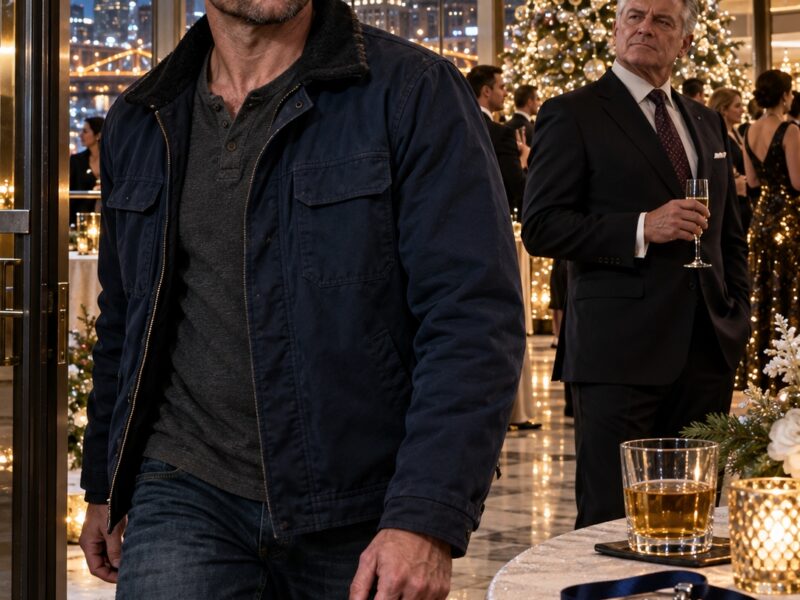
Everett Nolan was wearing a faded navy work jacket that looked painfully ordinary among the tailored suits, silk dresses, polished shoes, and platinum watches surrounding him.
He set his company badge beside an untouched glass of cider.
Meredith stared at him from the stage.
“Mr. Nolan,” she said, “sit down.”
Everett picked up his truck keys.
“No, ma’am.”
A nervous laugh moved through the room.
Meredith’s expression hardened.
Beside her, Sterling Blackwell IV smiled.
Everett started toward the doors.
Meredith lifted the microphone again.
“If you walk out of this building tonight, I will make certain you never work in this industry again.”
Everett stopped.
For one second, everyone expected him to turn around.
He didn’t.
He only looked back at the people standing beneath the silver Christmas lights.
Then he said quietly:
“If I stay, you may not have a company left to fire me from.”
And he walked out.
The doors closed behind him.
Snow blew across the marble floor.
Nine seconds later, the first warning appeared.
NORTHSTAR VALIDATION FAILED.
And somewhere on the fourteenth floor, a man who had been smiling all evening suddenly stopped.
Snow had been falling over Pittsburgh since noon on December 24.
By nine that evening, the bridges over the Allegheny River were disappearing beneath white, and the glass headquarters of Whitmore Aerospace Logistics glowed above the city like an enormous Christmas ornament.
Inside, everything looked expensive enough to make people forget they were still at work.
A spruce nearly twenty feet tall stood beneath the chandelier. Silver ornaments caught the light. Waiters moved through the atrium with cider and champagne. A jazz trio had finished playing almost an hour earlier.
The party was supposed to end at nine.
Nobody had gone home.
The reason was worth $380 million.
Crestline Aviation Partners was preparing the largest investment in Whitmore Aerospace Logistics’ forty-year history.
The documents were almost complete.
The board approvals were in place.
But Crestline’s investment committee authorization expired at midnight.
Three hours.
That was all Whitmore had left.
For Meredith Whitmore, three hours felt like the distance between preserving her father’s legacy and becoming the woman who destroyed it.
She was forty-four, controlled, brilliant, and intimidating enough that senior executives rehearsed bad news before bringing it to her.
Her father had built Whitmore Aerospace Logistics from a single hangar.
Meredith had inherited the name.
She had spent twenty years proving she deserved everything attached to it.
Tonight was supposed to be the proof.
At 9:31 p.m., while executives clustered around the stage, Everett Nolan felt his phone vibrate inside his jacket.
He glanced at the screen.
An automated alert.
He read it once.
Then again.
His coffee went cold in his hand.
Everett was forty-one, broad-shouldered, dark-haired with gray beginning at his temples. He had worked at Whitmore for eleven years, but most executives knew him only as the quiet safety engineer who sometimes appeared in meetings carrying folders nobody wanted to read.
His jacket was even older.
His late wife, Clare, had bought it from an Army surplus store for thirty dollars the winter before she became sick.
Everett had never replaced it.
His daughter Hannah hated that jacket.
She was twenty-two now, a nurse in Denver, and every Christmas she told him the same thing.
“Dad, buy yourself something that wasn’t manufactured during the Cold War.”
And every Christmas Everett answered:
“It still has sleeves.”
Earlier that evening, he had texted her.
Midnight. Same as always.
Her answer came almost immediately.
I’ll be waiting. Porch light?
Everett smiled.
Always on.
It was a phrase Clare had started when Hannah was little.
No matter how late someone came home, the porch light stayed on.
But at 9:31, Everett stopped thinking about Christmas.
The Northstar alert said the backup server was reporting safety confirmations inconsistent with the primary flight-dispatch records.
That should not happen.
More troubling was the second line.
A software update was scheduled to pass its final deployment gate at 10:30.
Everett knew that update.
He had questioned it three days earlier.
Nobody had answered him.
He looked across the atrium and found Graham Mercer.
Graham was standing near the stage holding the crystal plaque he had just received for twenty years of service.
Everett approached him.
“Graham.”
His supervisor smiled.
“You missed my speech.”
“We have a problem.”
The smile disappeared.
Everett showed him the alert.
Graham’s face lost color.
“Not here.”
“The final gate is at ten-thirty.”
Graham glanced toward the stage.
“Everett, tonight is not the night.”
“That’s exactly why tonight is the night.”
“Wait until after the closing.”
Everett stared at him.
“You know I can’t.”
Graham lowered his voice.
“Just wait until midnight.”
Everett looked toward the windows.
Snow was falling harder.
The operations center was near the airport.
Twenty minutes in normal traffic.
Tonight?
Forty if he was lucky.
He looked back at Graham.
“I don’t have until midnight.”
Before Graham could answer, applause rose around them.
Meredith had returned to the stage.
She wore a charcoal suit and a controlled smile.
Sterling Blackwell stood beside her.
Sterling was sixty, elegant and silver-haired, with the polished warmth of a man who remembered everyone’s name only when remembering it was useful.
He chaired the board’s deal committee.
More importantly, three years earlier, he had assembled the votes that made Meredith CEO.
Meredith lifted the microphone.
“We are entering the most important three hours in this company’s history.”
People applauded.
“We are very close. I need every team connected with this transaction available until the closing is complete.”
Sterling leaned toward her microphone.
“Perhaps we should make that simpler.”
His smile widened.
“No one leaves until the CEO says this evening is finished.”
Some executives laughed.
Meredith hesitated.
Only for a second.
Then she looked over the room.
“Nobody leaves until midnight.”
The laughter died.
Everett felt Graham go still beside him.
Sterling had heard them.
Everett realized it when Sterling’s eyes found him.
“Well,” Sterling said into the microphone, “it appears someone disagrees.”
Hundreds of faces turned.
Everett hated rooms like this.
Not because he feared crowds.
Because crowds changed people.
They made reasonable people crueler.
They made frightened people laugh when powerful people laughed.
Sterling pointed toward him.
“Mr. Nolan, isn’t it?”
Everett said nothing.
Meredith frowned.
“Is there a problem?”
Everett could have lied.
He could have said no.
Instead he stepped forward.
“I need to leave.”
Whispers moved across the atrium.
Meredith stared at him.
“For what reason?”
“A safety issue needs to be verified in person.”
“You can verify it after midnight.”
“No, ma’am.”
Sterling chuckled.
“Did you just tell the CEO no?”
Everett looked at him.
“Yes.”
That got another laugh.
Everett reached for his badge.
He unclipped it.
Then placed it on the nearest table.
Beside the badge sat a glass of cider.
Nobody touched either.
“I’m not quitting,” he said. “I’m refusing an instruction that conflicts with my safety responsibility.”
Meredith’s cheeks flushed.
“You’re making a spectacle of yourself.”
“I’m trying very hard not to.”
“Then sit down.”
“I can’t.”
Sterling folded his arms.
“Do you understand what is happening tonight? Three hundred and eighty million dollars depends on this closing.”
Everett nodded.
“That’s another reason I need to go.”
Sterling laughed.
This time several directors joined him.
“A billion-dollar company,” Sterling said, “cannot be steered by a man wearing a thirty-dollar jacket.”
Everett looked down at the worn navy sleeve Clare had once tugged over his wrist in a hospital parking lot.
Then he looked back at Sterling.
“You’re right.”
Sterling smiled.
Everett continued.
“That’s why I’m not trying to steer it.”
He picked up his keys.
“I’m trying to stop one unsafe update.”
Meredith stepped forward.
“If you walk out those doors tonight, Mr. Nolan, I will make certain you never work in this industry again.”
Silence.
Everett thought of Hannah.
Of Clare.
Of eleven years inside this building.
Of his mortgage.
Of the bills that had once arrived faster than he could pay them after his wife died.
Then he thought of the alert.
10:30.
He turned.
And walked.
Nobody stopped him.
The glass doors opened.
Snow blew inside.
Then Everett Nolan disappeared into the Pittsburgh night.
At 9:43, Graham Mercer’s phone lit up.
NORTHSTAR VALIDATION FAILED.
MANUAL REVIEW REQUIRED.
Graham stared at the message.
Sterling saw it too.
For one unguarded instant, fear crossed his face.
Then Meredith’s phone began ringing.
She silenced it.
Sterling immediately turned to human resources.
“Document this as insubordination.”
Laurel Bennett, Whitmore’s general counsel and chief compliance officer, looked up.
“Before we do that, perhaps someone should read the safety alert.”
Sterling barely glanced at her.
“This is not a safety matter. It’s an employee discipline matter.”
“Those aren’t mutually exclusive.”
Meredith rubbed her forehead.
“Suspend Nolan’s administrative access pending review.”
The HR director hesitated.
“All access?”
“Email. Building entry. Network login.”
Laurel’s expression tightened.
Sterling smiled.
“Good.”
What neither Sterling nor Meredith understood was that Everett’s authority to stop a dangerous Northstar deployment did not come from HR.
It came from an independent safety-control protocol established years earlier.
And the credential for that protocol was hanging from Everett’s truck keys.
A small steel token.
The same one nobody in the atrium had noticed.
Everett’s pickup crawled through the snow on Interstate 376.
Visibility was collapsing.
He called the operations center.
Dale Porter answered.
“Operations.”
“Dale, it’s Everett.”
“Thank God.”
Everett tightened his grip on the wheel.
“What happened?”
“Executive office called around nine. Told us to stage Northstar for ten.”
“Who authorized it?”
“They said approval was complete.”
“It isn’t.”
A pause.
“You sure?”
“Stop staging.”
Dale exhaled.
“Final gate still fires at ten-thirty.”
“I know.”
“You have the token?”
Everett touched his keys.
“Yes.”
“Then drive carefully.”
“Dale.”
“Yeah?”
“Preserve every log.”
Silence.
“All of them?”
“Every line.”
Dale understood.
“Got it.”
“And send automatic notice to compliance.”
“Already doing it.”
Everett almost smiled.
Then Dale said:
“There’s something else.”
“What?”
“The approval is under Graham Mercer’s credentials.”
Everett frowned.
“That’s impossible.”
“It’s what the system says.”
Graham had told him minutes earlier that he had never signed the update.
Everett resisted the temptation to guess.
Guessing contaminated investigations.
Facts first.
Names later.
“Freeze the logs,” he said.
“Done.”
“Don’t let anyone touch them.”
Back at headquarters, Laurel received the notification.
She asked IT to print the approval record.
At 10:04, Owen Price hurried into the atrium holding a sheet of paper.
Laurel read it.
Graham Mercer’s credentials had approved the update at 9:14 p.m.
She looked across the room.
“Graham?”
He approached.
“Where were you at 9:14?”
His confusion lasted only a moment.
Then his face changed.
“At 9:14?”
“Yes.”
Graham slowly lifted the crystal plaque in his hand.
“I was standing on that stage.”
Three hundred people had watched him receive it.
Laurel turned to Owen.
“Trace the session.”
Minutes later, Owen returned.
“The approval came from the fourteenth floor.”
Meredith looked up.
“Whose office?”
“Not enough information yet.”
“Which area?”
Owen hesitated.
“The executive suite.”
Sterling laughed.
“A remote authentication error.”
Laurel looked at him.
“Do those happen often?”
“All the time.”
Owen shook his head.
“No, sir.”
The room became very quiet.
At 10:10, Meredith’s phone rang again.
This time she answered.
“Meredith Whitmore.”
A man introduced himself as Russell Vance, Crestline’s independent technical representative.
“I need Everett Nolan.”
Meredith glanced at Sterling.
“Mr. Nolan has left the building.”
“Connect me to him.”
“He is currently under disciplinary review.”
There was a pause.
Then Russell asked:
“You suspended the engineer responsible for verifying Northstar?”
Sterling leaned toward the phone.
“Nolan is a technician.”
Another pause.
Longer.
Then Russell said:
“If that’s what you believe, Mr. Blackwell, I think we have a considerably larger problem.”
Meredith straightened.
Russell explained that Crestline’s $380 million disbursement depended on independent verification of Northstar.
Any unresolved deviation could halt the investment.
Meredith’s mouth went dry.
“Why wasn’t I told?”
“We sent the requirements last week.”
“To whom?”
“Your executive office.”
Laurel was already searching.
Thirty seconds later she found it.
Received.
Logged.
Routed.
Destination:
Office of Sterling Blackwell IV.
Never opened through the official channel.
Meredith slowly looked at him.
Sterling’s face remained calm.
“Administrative oversight.”
At 10:22, Everett’s truck slid into the operations-center parking lot.
He ran inside.
10:24.
Dale met him in the corridor.
10:25.
Tessa Quinn, a young systems technician, was waiting at the console.
10:26.
Everett inserted the steel token.
The screen requested his safety code.
His fingers shook.
He entered it.
AUTHORIZED.
10:27.
He opened the deployment controls.
10:28.
Northstar’s final gate appeared.
10:29.
Everett locked it.
Four minutes remained before automatic deployment.
Nobody spoke.
Everett leaned forward.
“Now show me what they changed.”
Tessa opened the comparison.
Everett read the first section.
Then the second.
His stomach dropped.
The update had altered how Northstar treated incomplete inspection data.
Records missing final verification could still be displayed as safe.
Everett looked at Dale.
“This isn’t cosmetic.”
“No.”
“This changes compliance output.”
“Yes.”
Everett stared at the code.
Northstar could show a compliance rate approaching ninety-eight percent while the true number was substantially lower.
And that number was about to enter Crestline’s due-diligence package.
Three hundred and eighty million dollars.
Based partly on data that could be false.
Everett pulled out his phone.
“Photograph everything.”
Tessa asked, “Do we fix it?”
“No.”
She blinked.
“We don’t touch anything until the evidence is preserved.”
“But we know what’s wrong.”
“We know what appears wrong.”
Everett looked at her.
“That distinction matters.”
They documented every screen.
Opened a formal incident.
Recorded timestamps.
Created witness logs.
Then isolated the update inside a test partition.
Only when it could no longer reach the live dispatch environment did Everett sit down.
His hands were trembling.
He called Laurel.
She answered immediately.
“Everett?”
“Don’t let anyone delete anything tonight.”
“What did you find?”
“A change that can classify incomplete inspection data as verified.”
Laurel closed her eyes.
“Who approved it?”
Everett opened the chain.
“Graham Mercer.”
“We know that signature may be compromised.”
“Two senior engineers.”
“Both left before six.”
Everett scrolled.
Then stopped.
“And the final approval?”
Laurel asked.
Everett stared at the screen.
“Sterling Blackwell.”
Upstairs, Sterling moved first.
He gathered senior leadership in the glass conference room.
“Nolan is manufacturing a crisis.”
Meredith stared at him.
“Why?”
“Leverage.”
“For what?”
Sterling produced a printed email.
Everett had previously requested additional safety staff and a dedicated budget.
Sterling had removed the technical context.
What remained looked almost like an ultimatum.
“He wants money,” Sterling said. “More authority. More people. This is how men like him make themselves indispensable.”
Meredith wanted to believe him.
Because the alternative was terrifying.
The alternative meant the man who had helped put her in the CEO chair might have hidden something from her.
So she called Everett.
No answer.
Sterling smiled.
“See?”
She left a voicemail.
“Mr. Nolan, if you do not return to headquarters and explain your actions before midnight, I will consider terminating your employment.”
At 10:50, Everett heard it.
He called back.
Meredith put him on speaker.
“Why did you abandon the closing?”
“I sent three reports.”
“That doesn’t answer my question.”
“It does. Nobody answered them.”
Sterling leaned toward the phone.
“Do you imagine you’re the only person in this corporation capable of understanding a computer system?”
“No.”
“Then why should three hundred people and a $380 million transaction wait for you?”
Everett’s voice remained level.
“Because I’m the person who checked the data everyone else wanted to assume was correct.”
Sterling’s jaw tightened.
“I will personally see that you’re sued for every dollar this delay costs.”
“If I’m wrong,” Everett said, “the logs will prove it.”
Nobody moved.
“And if I’m right, they’ll prove that too.”
Meredith ordered him back.
Everett refused.
“I don’t need you to respect my title,” he said. “But you don’t have the right to make me abandon my responsibility.”
Meredith hung up.
“Prepare termination papers.”
Laurel stepped forward.
“No.”
Meredith stared at her.
“No?”
“Firing a safety engineer while he is documenting an active incident after he submitted prior warnings will look exactly like retaliation.”
Sterling slammed his palm against the table.
“We have seventy minutes.”
Laurel didn’t look at him.
“Then perhaps we should stop wasting them threatening the only person preserving the evidence.”
Sterling left to take a call.
For the first time all night, Meredith sank into a chair.
Her shoulders dropped.
“My father built this company from one hangar.”
Laurel said nothing.
“A rival fund has been circling us for eighteen months. Sterling got me the votes to become CEO.”
“And?”
Meredith looked toward the snow.
“I cannot be the Whitmore who loses it.”
Laurel sat beside her.
“You may be trying so hard not to lose your father’s company that you’ve stopped asking what kind of company you’re saving.”
That hurt.
Meredith looked at her.
Laurel continued quietly.
“You’re pushing away the one man who was willing to tell you something was wrong.”
Then Laurel found the Northstar contract.
Eleven years old.
She opened the scanned first page.
Her expression changed.
“Meredith.”
“What?”
“You need to see this.”
At the top of the technical agreement was a name.
EVERETT NOLAN — ORIGINAL SYSTEM ARCHITECT.
Meredith stared.
“No.”
Laurel kept reading.
Eleven years earlier, Everett had worked for a small software firm in Columbus, Ohio.
At night, while Clare underwent cancer treatment, he had built much of Northstar on a secondhand laptop in hospital waiting rooms.
The work gave his hands something to do when he could do nothing for his wife.
Northstar could identify dangerous inconsistencies in aviation data before they became larger failures.
Meredith’s father had seen its value.
Whitmore licensed the commercial rights and hired Everett.
Everett had insisted on one unusual contractual safeguard.
Any modification that weakened Northstar’s verification standards required independent certification before deployment.
No exceptions.
Meredith remembered something.
A hangar.
Her father.
A younger man in an inexpensive jacket.
Her father shaking his hand.
“This is the fellow who’s going to keep our planes honest.”
She had been young.
Busy.
Ambitious.
She hadn’t asked his name.
Sterling returned.
“That was eleven years ago.”
Laurel looked at him.
“The clause is still binding.”
“He’s not an executive.”
“No one said he was.”
“He doesn’t have authority over this deal.”
“No. But the deal depends on a system whose certification cannot legally be represented as intact if its safety controls were altered outside the required process.”
Sterling’s face hardened.
Russell Vance appeared by video.
He confirmed it.
Northstar was one of the principal reasons Crestline wanted Whitmore.
If Northstar could not be trusted, the valuation could collapse.
Then Graham Mercer spoke.
His voice shook.
“Sterling asked me to sign the update last week.”
Everyone turned.
Sterling stared at him.
Graham swallowed.
“I refused.”
“Careful,” Sterling said.
Graham looked at him.
For perhaps the first time in years, he didn’t look away.
“Two days later my electronic signature appeared on the approval.”
Meredith stood.
“You knew?”
Graham’s eyes filled with shame.
“I asked him about it.”
“And?”
“He asked how secure I thought my pension was.”
Silence.
Graham looked down.
“I said nothing.”
His fingers tightened around the crystal plaque he had been given for twenty years of loyalty.
“I’m sorry.”
Nobody knew whether he meant Meredith.
Everett.
Or himself.
At 11:20, Russell finished reading Everett’s preliminary report.
He removed his glasses.
Folded them carefully.
Then looked into the camera.
“Crestline is pausing disbursement of the $380 million.”
Sterling exploded.
“You cannot do that based on one technician’s—”
Russell interrupted.
“We are not doing it because Mr. Nolan left a Christmas party.”
He looked directly at Meredith.
“We’re doing it because the integrity of material due-diligence data is now uncertain.”
The deal stopped.
The midnight deadline was dead.
Sterling blamed Everett.
Meredith didn’t.
Not this time.
“The pause is Crestline’s decision,” she said.
Sterling stared at her.
“I put you in that chair.”
Meredith slowly looked toward him.
And for the first time she heard the sentence for what it really was.
Not loyalty.
Ownership.
“You helped assemble votes,” she said.
Sterling leaned closer.
“Without me, you’re nothing.”
Meredith felt something inside her become unexpectedly calm.
“Then perhaps we should find out.”
Laurel began placing emails across the table.
For two months, operations employees had questioned unexplained Northstar changes.
Every inquiry had been routed upward.
Every one had been closed.
The same phrase appeared again and again.
NOT A PRIORITY.
Meredith remembered Everett outside her conference room carrying a folder.
Her assistant asking if she wanted to see him.
“No. Tell him I’m busy.”
Another afternoon.
“Send it through management.”
Another.
“Not today.”
Small decisions.
Tiny dismissals.
Nothing dramatic.
Until suddenly all of them had become tonight.
At 11:40, Meredith called Everett.
His voice sounded exhausted.
“I need you to come back,” she said.
Silence.
Then:
“I’ll attend an audit meeting if you need technical testimony.”
“Everett—”
“But I’m not coming back to be humiliated again.”
Meredith closed her eyes.
“I understand.”
“No,” he said gently. “I don’t think you do yet.”
She said nothing.
“Don’t save my reputation.”
His voice softened.
“Protect the people who are still afraid to tell you the truth.”
The call ended.
Meredith stood.
Then issued the orders she should have issued hours earlier.
All Northstar deployments halted.
All related logs preserved.
Independent audit requested.
No deletion.
No modification.
No retaliation.
Sterling objected.
She ignored him.
At 11:52, Laurel received another message.
Internal audit had found a payment.
$4.8 million.
It had moved through an intermediary firm called Pelum Advisory into an account connected to Sterling Blackwell.
A payment did not prove a crime.
But its contract contained an extraordinary clause.
The consulting fee became payable only if the Whitmore-Crestline transaction closed on or before December 24.
Midnight.
Laurel turned the screen toward Meredith.
Suddenly the entire evening looked different.
Why had Sterling insisted nobody leave?
Why had he dismissed the warnings?
Why had Graham’s credentials been used?
Why had the update needed to deploy tonight?
They still did not have every answer.
But they finally had the right questions.
At 11:59, Everett stood alone near a tall window at the operations center.
Runway lights blinked blue through the snow.
His phone said midnight.
He called Hannah.
She answered from a hospital break room.
“Merry Christmas, Dad.”
Everett smiled.
“Merry Christmas, kid.”
A pause.
“The porch light’s on.”
Her voice changed.
“Something happened.”
“How do you know?”
“Because you sound like you did when Mom was sick and you were pretending you weren’t scared.”
Everett leaned his forehead against the cold glass.
He told her enough.
Not everything.
When he finished, Hannah was quiet.
Then she said:
“Last spring, a doctor ordered a medication dose I thought was wrong.”
Everett lifted his head.
“What?”
“I refused to give it.”
“Hannah—”
“I made them check the chart again.”
“And?”
“The dose was wrong.”
Everett closed his eyes.
“I was terrified,” she whispered. “But I heard you telling me that if you know something is wrong, you don’t get to stay quiet just because someone outranks you.”
Everett’s throat tightened.
He looked at the snow.
“I missed too many Christmases when you were little.”
“No.”
“I worked too much.”
“You paid the bills.”
“I should’ve been there more.”
Hannah was quiet.
Then she said:
“You never missed the Christmas that mattered.”
Everett stopped breathing.
“You were there for Mom’s last one.”
His eyes filled.
“And you’ve been there for every hard thing since.”
After they hung up, Everett remained against the glass.
He let the runway lights blur.
Across Pittsburgh, Meredith Whitmore was discovering why he had walked away.
Laurel reconstructed the timeline on a glass wall.
9:31.
Alert received.
10:30.
Deployment gate.
Forty-minute drive in the storm.
9:42.
Everett left headquarters.
10:26.
Token inserted.
Four minutes to spare.
Laurel capped the marker.
“If he had obeyed you, the update would have deployed before midnight.”
Meredith stared at the numbers.
Her order had almost guaranteed the one authorized engineer could not reach the console in time.
Sterling had suggested the order.
Then he had encouraged her to enforce it.
What she had interpreted as Everett’s arrogance was duty.
What she had called insubordination was urgency.
What she had threatened to destroy his career over might have protected hers.
Laurel showed her something else.
For two years, Everett had proposed whistleblower and safety-reporting training.
Every proposal had been rejected.
Meredith whispered:
“By whom?”
Laurel did not answer immediately.
She didn’t need to.
Meredith sat down.
“I did this.”
“Sterling manipulated several things.”
“No.”
Meredith shook her head.
“He may have manipulated me. But I said the words.”
She looked toward the empty atrium.
“Nobody leaves until midnight.”
For years, she had believed fear created discipline.
Tonight she finally understood that fear created silence.
And silence was exactly what Sterling had needed.
At 12:40 a.m., Sterling invoked the company bylaws and demanded an emergency board meeting.
Nine o’clock Christmas morning.
Before leaving, he buttoned his coat and looked at Meredith.
“By breakfast, you won’t be CEO.”
Meredith stared back.
“Maybe.”
Sterling smiled.
She continued.
“But you won’t decide it alone.”
Christmas morning arrived gray and quiet.
At nine, eleven directors appeared on the conference-room screen.
Sterling spoke first.
He was excellent.
He described Everett as a technical employee who had disrupted a $380 million transaction.
He described Meredith as an emotional CEO who had surrendered control.
Then he moved for her immediate removal.
Two directors nodded.
Meredith spoke next.
She did something Sterling had not expected.
She admitted she had been wrong.
“My order last night was unreasonable.”
Sterling looked up.
“I ignored warnings from employees who were doing exactly what we paid them to do.”
Several directors shifted.
“And I publicly threatened an employee who was fulfilling a safety obligation.”
Sterling interrupted.
“Meredith—”
Board chair Margaret Ellison cut him off.
“You will have your turn.”
Laurel presented the evidence.
The alert.
The logs.
Graham’s compromised credentials.
The executive-suite workstation.
Crestline’s certification requirement.
The payment arrangement.
Russell appeared and explained why Crestline had paused the money.
Then Margaret said:
“I’d like to hear from Mr. Nolan.”
Everett appeared on screen.
No suit.
No tie.
Just a flannel shirt and the exhausted face of a man who had not slept.
One director leaned toward her camera.
“Mr. Nolan, did you intend to damage Whitmore Aerospace Logistics?”
Everett answered immediately.
“If I’d wanted to damage the company, I would have stayed silent.”
Nobody spoke.
He explained what he had found.
Only what he could prove.
He did not accuse Sterling of taking a bribe.
He did not speculate about crimes.
He did not use the moment for revenge.
“A safety process was bypassed,” he said. “The logs show that. Who is legally responsible is for investigators to determine.”
That restraint mattered.
By noon, the board had reached its decision.
Sterling Blackwell was suspended from all executive responsibilities and system access pending independent investigation.
His motion to remove Meredith failed.
But Meredith was ordered to submit a governance-reform plan within thirty days.
Sterling disconnected without saying goodbye.
The little square containing his face disappeared.
Twenty-four hours earlier, he had mocked Everett’s jacket before three hundred people.
Now he no longer had authority to give Everett a single instruction.
Meredith drove to the operations center.
She found Everett washing out a coffee pot.
For several seconds, she simply stood in the doorway.
“I’d like to offer you a new position.”
Everett set the pot down.
“Before we discuss titles, I want to know something.”
“What?”
“What are you going to do for everyone who couldn’t afford to walk out?”
Meredith had prepared an apology.
She had prepared a salary.
A title.
Authority.
She had not prepared for that question.
Three days later, she called an all-hands meeting.
This time there was no stage.
No music.
No chandelier speech.
Meredith stood on the marble floor at the same level as everyone else.
“I treated Everett Nolan unfairly.”
Nobody moved.
“I issued an order that created needless pressure and conflicted with our safety responsibilities.”
Some employees looked stunned.
“I also helped create a culture in which people believed telling leadership something unpleasant could cost them their careers.”
Her voice almost broke.
She steadied it.
“I cannot correct that with an apology.”
So she announced policies.
Independent safety reporting.
Anti-retaliation protections.
Holiday staffing reform.
Transparent overtime.
External auditing.
Every disciplinary record connected to Everett’s incident was withdrawn.
Then Meredith looked toward the back row.
Everett was wearing Clare’s thirty-dollar jacket.
“Everett?”
He walked forward.
The room waited for him to humiliate her.
He didn’t.
“Nobody should have to trade dignity or safety for a paycheck,” he said.
Then he thanked Dale.
Tessa.
Laurel.
And Graham.
Especially Graham.
Because courage, Everett said, did not always mean never being afraid.
Sometimes it meant admitting that fear had made you silent.
Meredith later offered Everett the role of Director of System Safety.
He would report to an independent board committee.
Not to her.
He asked for the offer in writing.
He asked for a real budget.
Real staff.
Formal retaliation protections for his entire team.
Meredith agreed.
Only then did he sign.
The investigation continued.
The audit confirmed Northstar had been isolated before the altered update reached the live environment.
Crestline eventually proceeded under stronger monitoring requirements.
The $380 million investment closed in late February.
Not because Whitmore buried its problem.
Because it fixed it.
Investigators concluded that Sterling had concealed a financial conflict and interfered with the approval process.
Evidence concerning possible violations was referred to the appropriate authorities.
Graham received a formal reprimand for remaining silent.
Then he volunteered to lead the first safety-reporting training session.
One evening, Everett found a card tucked beneath his truck’s windshield wiper.
Meredith’s handwriting filled only one line.
Thank you for walking out of the room the rest of us were too afraid to leave.
He kept the card.
A year passed.
Christmas returned to Pittsburgh.
Snow fell over the same streets.
The same silver spruce stood inside Whitmore’s atrium.
But the company was different.
Safety procedures were audited quarterly.
Employees could report concerns directly to independent oversight.
Holiday work was voluntary first, rotational second, and compensated openly.
Nobody could be trapped inside the building because someone with a microphone had decided their time belonged to the company.
Everett was now Director of System Safety.
He still drove the same truck.
The dashboard was still cracked.
He still drank terrible coffee.
And he still wore Clare’s jacket.
The difference was that people listened when he spoke.
Meredith had changed too.
Not into a gentler person.
She was still demanding.
Still impatient.
Still capable of turning a meeting uncomfortable with one question.
But she no longer confused obedience with loyalty.
She and Everett disagreed constantly.
Sometimes loudly.
Laurel once joked that the company’s new safety culture appeared to consist mainly of Meredith and Everett arguing until one of them found better evidence.
Something else changed too.
Slowly.
Neither of them named it.
Respect became friendship.
Friendship became the quiet awareness that each looked for the other when entering a room.
Every employment decision concerning Everett had already been transferred to the independent committee, deliberately removing Meredith from his compensation and evaluation.
Neither wanted another blurred line of authority.
Then Christmas Eve came again.
At 11:45, Meredith stepped onto the stage.
People became quiet.
Some remembered.
She looked at the clock.
Then smiled.
“Last year, I said something I never want to say again.”
Everett stood near the doors.
Meredith looked across the atrium.
“Nobody leaves until midnight.”
Nervous laughter moved through the crowd.
She waited.
“This year, I only want to say thank you.”
She lowered the microphone.
“Go home whenever you’re ready.”
Then she added:
“The people who love you are waiting.”
Applause filled the glass tower.
Employees began gathering coats.
Everett remained near the same doors he had walked through one year earlier.
Meredith approached him.
“Planning to walk out again?”
Everett checked his watch.
“Probably.”
She laughed.
“This time I won’t stop you.”
“I know.”
They stood in comfortable silence.
Then Meredith said:
“Do you have dinner plans?”
Everett looked at her.
“Is this a business meeting?”
“No.”
“An audit?”
“No.”
“Emergency board session?”
“Absolutely not.”
“A midnight deadline?”
Meredith smiled.
“Never again.”
Everett looked toward the windows.
“I have one call to make at midnight.”
“Hannah?”
“She finally got Christmas off. She’s flying home tomorrow.”
Meredith nodded.
“I’d be happy to wait.”
They stepped outside.
Snow drifted across Liberty Avenue.
There was no limousine.
No orchestra.
No dramatic declaration.
Only two people who, one year earlier, had stood on opposite sides of a glass door.
Now they walked through it together.
At midnight, Everett stopped beneath a streetlamp and called Denver.
Hannah answered.
“Merry Christmas, Dad.”
Everett smiled.
“Merry Christmas, kid.”
He looked toward Meredith.
Then toward the snow.
“The porch light’s on.”
When the call ended, they continued walking.
After half a block, Meredith asked:
“Can I ask you something?”
“You usually do.”
“If you could go back to last Christmas Eve…”
She hesitated.
“…knowing everything that would happen afterward, would you still walk out?”
Everett stopped.
Snow collected on the shoulders of the old navy jacket.
He thought about the humiliation.
The threats.
The investigation.
Graham’s fear.
Meredith’s apology.
Hannah’s voice from a hospital break room.
Clare buying that ridiculous thirty-dollar jacket because she said Pittsburgh winters were no place for male pride.
Then he looked at Meredith.
“Yes.”
She smiled faintly.
“Even knowing how difficult it would be?”
Everett looked back toward the distant glass tower.
A year earlier, three hundred people had watched him put his badge beside a glass of cider and assumed they were witnessing a man destroy his career.
They had been wrong.
He had not walked away from his future.
He had walked away from the one thing that could have made that future meaningless:
betraying what he knew was right.
“Especially knowing,” he said.
Meredith reached for his hand.
This time Everett did not walk ahead of her.
And Meredith did not tell him where to go.
They simply crossed the snowy street together while, high above Pittsburgh, the lights of Whitmore Aerospace Logistics burned behind them.
The building looked almost exactly as it had one year earlier.
But Everett knew buildings were like people.
What mattered was rarely visible from the outside.
A company was not strong because nobody dared to leave the room.
A leader was not respected because nobody dared to say no.
And loyalty was never proven by silence.
Sometimes the person walking toward the door was not abandoning everyone behind him.
Sometimes he was the only one still trying to save them.
And sometimes courage was nothing more glamorous than an ordinary man in a thirty-dollar jacket, holding an old set of truck keys, deciding that the consequences of doing the right thing were still easier to live with than the consequences of knowing he hadn’t.
Everett squeezed Meredith’s hand once.
Then they disappeared around the corner beneath the falling snow.
Behind them, for the first time in a very long time, nobody at Whitmore Aerospace Logistics was afraid to walk out the door.









