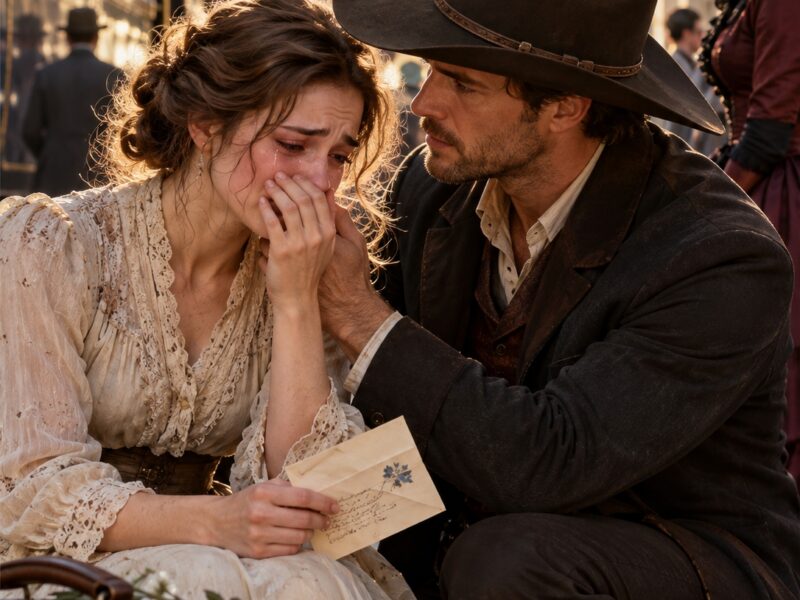
The Cowboy Saw His Mail-Order Bride Crying at the Station—Then He Whispered Four Words That Changed Everything

Dorcas Flynn had traveled nearly two thousand miles to marry a man she had never met.
And she ruined everything before her shoes even touched Texas soil.
At least, that was what she believed.
The train gave one final metallic groan as it rolled into Comal Springs beneath a white-hot afternoon sky. Steam drifted past the platform. Men in dusty hats stepped forward. Women lifted gloved hands against the glare. Somewhere farther down the tracks, a porter shouted something Dorcas couldn’t hear over the violent beating of her own heart.
She sat frozen beside the window.
For three days, she had practiced this moment.
She had practiced smiling.
Not an enormous smile. That might look foolish.
Something modest.
Warm.
Grateful.
The smile of a sensible twenty-seven-year-old woman who had crossed half a continent willingly to become the wife of a thirty-two-year-old rancher she knew only through letters.
She had practiced it in the dark reflection of the train window until her cheeks hurt.
She had promised herself that when Levan Rourke finally saw her, he would see exactly the woman she had described.
Cheerful.
Capable.
Hardworking.
Never complaining.
Easy to please.
No trouble at all.
That last part mattered most.
Dorcas had spent sixteen years learning how important it was to be no trouble at all.
But when the conductor called Comal Springs and the train slowed, something inside her began to collapse.
Suddenly the journey was real.
The letters were real.
The marriage certificate folded carefully inside her traveling case was real.
And somewhere beyond that window stood a stranger who had agreed to make her his wife because he believed the things she had written about herself.
He believed she was brave.
Dorcas wasn’t brave.
He believed she was cheerful.
She was terrified.
He believed she was excited about beginning a new life.
At that moment, she wanted nothing more than to curl into the corner of the railway car and disappear.
Her breathing shortened.
No.
Not here.
She pressed two fingers beneath her eyes.
“Stop.”
The woman sitting across the aisle glanced at her.
Dorcas smiled immediately.
“I’m quite all right.”
The lie came automatically.
Then the train stopped.
The first tear escaped.
Dorcas wiped it away.
Another followed.
By the time she stood, her hands were trembling so badly she nearly dropped her valise.
“Miss?”
The conductor offered his hand.
“I’m fine,” Dorcas whispered.
She smiled at him.
Then she stepped down into the Texas heat with tears streaming openly down her face.
And saw the man who was waiting to marry her.
Levan Rourke stood beyond the edge of the crowd.
Tall.
Broad-shouldered.
Sun-darkened from years outdoors.
His hat was held loosely in one hand, and he wore a clean white shirt beneath a dark vest that looked uncomfortable in the heat.
He wasn’t smiling.
That frightened her more.
His letters had been like that too.
Kind, but spare.
Thoughtful without being sentimental.
He had never wasted six words where three would do.
And now those serious gray eyes were fixed on her.
On her tears.
Dorcas stopped walking.
There it was.
The moment she had feared for two thousand miles.
He knew.
He could see that the woman in the letters didn’t exist.
She imagined him looking at her and calculating the cost of a return ticket.
Her stomach dropped.
She hurried toward him before he could speak.
“I’m terribly sorry.”
His eyebrows moved slightly.
Dorcas kept going.
“It was only the journey. I’m not normally emotional. Truly, I’m not. It was simply very long and I haven’t slept properly, but I’ll be perfectly well once I’ve had—”
“Dorcas.”
She stopped.
His voice was lower than she expected.
She forced the smile harder.
“I’m quite all right.”
Levan stared at her.
Dorcas’s smile trembled.
Something passed across his face.
Not disappointment.
Something worse.
Recognition.
He stepped closer.
Dorcas instinctively straightened her shoulders.
She knew this moment.
She knew what happened when someone noticed weakness.
First came irritation.
Then judgment.
Then punishment.
She had lived the sequence enough times to know it by heart.
Instead, Levan reached for her hand.
Dorcas almost pulled away.
His hands were rough from ranch work, but he held hers carefully, enclosing her trembling fingers between his palms.
Then he leaned toward her.
Close enough that the people moving around them couldn’t hear.
And the stranger Dorcas Flynn had crossed America to marry said four words no one had ever said to her before.
“You can stop pretending.”
Dorcas forgot how to breathe.
Levan didn’t move.
Neither did she.
The platform seemed to disappear around them.
The locomotive.
The voices.
The heat.
Everything.
“What?”
It barely came out.
“You can stop pretending.”
Her lips parted.
She searched his face for mockery.
There was none.
“You’re tired,” he said quietly. “You’re frightened. You’ve traveled farther than you’ve ever traveled before to live with a man you’ve never met.”
His thumb moved once against the back of her hand.
“I’d be more worried if you weren’t frightened.”
A broken sound came from her throat.
She tried to smile again.
Levan shook his head gently.
“No.”
Dorcas froze.
“You don’t owe me that.”
“What?”
“The smile.”
And that was when the dam broke.
Not the little tears she had been ashamed of.
Not the quiet leaking of emotion she had spent the train ride trying to control.
Dorcas Flynn began to sob.
Right there.
On the platform.
In front of strangers.
In front of the man she was supposed to impress.
She covered her mouth in horror.
“I’m sorry.”
Levan didn’t let go.
“I’m so sorry.”
“You haven’t done anything.”
“I don’t know why I’m—”
“You don’t have to know.”
People passed them.
Dorcas could feel them looking.
She couldn’t stop.
Twenty years seemed to be coming out of her body at once.
And Levan Rourke simply stood there holding her hand.
He didn’t hush her.
He didn’t tell her people were watching.
He didn’t tell her to compose herself.
He didn’t look embarrassed.
When the worst of it finally passed, Dorcas stared down at their joined hands.
“You’re not sending me back?”
Levan’s expression changed.
Something like pain entered it.
“Is that what you thought?”
She couldn’t answer.
That was answer enough.
He picked up her valise.
“No, Dorcas.”
Then he looked toward the wagon waiting beyond the station.
“You’re home.”
She should have felt relieved.
Instead, those words terrified her almost as much as the first four.
Because Dorcas Flynn had never had a home where she was allowed to be unhappy.
And she had no idea what such a place would ask of her.
She would learn.
But first, Levan would have to understand exactly what sixteen years of fear had done to the woman he had just brought into his house.
And Dorcas would have to discover why he seemed to understand it before she had told him a single word.
Dorcas had been eleven years old when she learned that tears could make adults angry.
By then, she had already lost enough people to know grief.
She had simply never been allowed to show it.
After she was orphaned, she was placed in service in the household of Mrs. Abigail Thade, a woman who believed discipline and cruelty were often the same thing provided one quoted Scripture afterward.
Mrs. Thade’s house was spotless.
Her silver shone.
Her linens were folded precisely.
Her servants learned quickly.
Especially Dorcas.
The first time Mrs. Thade saw her crying, Dorcas was eleven.
She had received word that the last relative she remembered fondly had died.
Dorcas stood in the pantry wiping her face when Mrs. Thade entered.
“What is this?”
Dorcas turned away.
“Nothing, ma’am.”
“Then why are you crying?”
Dorcas explained.
Mrs. Thade listened.
Then she glanced toward the breakfast room.
“There are people waiting for coffee.”
Dorcas stared at her.
“Yes, ma’am.”
“Do you imagine their morning should be made unpleasant because you have received unpleasant news?”
“No, ma’am.”
“Then wash your face.”
That was the first lesson.
The second came when Dorcas worked through a fever and moved too slowly.
Lazy.
The third came when she flinched after breaking a glass.
Careless.
When she became frightened, she was dramatic.
When she became tired, she was ungrateful.
When she was quiet, she was sullen.
So Dorcas discovered the one version of herself that caused the least trouble.
The smiling version.
She became excellent at being fine.
“Good morning, Dorcas.”
“Good morning, ma’am.”
“Did you sleep?”
“Very well, thank you.”
She hadn’t.
“Are you feeling better?”
“Much better.”
She wasn’t.
“You don’t mind staying late?”
“Of course not.”
She did.
The performance became so effortless that people began praising her for it.
Such a pleasant girl.
Such a cheerful disposition.
Never complains.
Mrs. Thade herself once told a guest, “Dorcas is useful because she has no moods.”
Dorcas had been standing three feet away.
She remembered feeling proud.
That was the cruelest part.
By twenty-seven, she no longer needed Mrs. Thade to punish her for having feelings.
Dorcas did it herself.
Sadness came?
Smile.
Anger?
Bury it.
Fear?
Work harder.
Pain?
Apologize.
Need?
Never mention it.
And if someone asked whether she was all right, there was only one acceptable answer.
Always.
“I’m fine.”
Then one winter evening Dorcas found an advertisement in a newspaper.
A rancher in Texas.
Thirty-two.
Widowed mother deceased, father deceased.
No children.
Seeking a wife of sound character willing to build a quiet life on a working ranch.
Dorcas read it four times.
Then she hid the newspaper beneath her mattress.
For three weeks she told herself the idea was ridiculous.
On the fourth week, she wrote.
Her first letter to Levan Rourke contained almost nothing true about her except her name.
The facts were accurate.
The person wasn’t.
She told him she enjoyed work.
True.
She didn’t tell him she had learned to work because idleness made her feel unsafe.
She said she possessed a cheerful disposition.
Everyone said so.
She didn’t explain that cheerfulness had once been the difference between punishment and peace.
She said she adapted easily.
She didn’t say she had learned to adapt because children without choices become experts at becoming whatever the room requires.
Levan wrote back.
Then she wrote again.
Soon the letters became the secret center of Dorcas’s life.
He told her about drought.
Cattle.
The enormous Texas sky.
A stubborn mare named June.
The pecan tree beside the house.
He told her that his ranch was modest but debt-free.
That he preferred evenings to parties.
That he could cook three meals competently and a fourth badly.
Dorcas laughed aloud when she read that.
Then immediately looked toward the kitchen door to make sure nobody had heard.
Levan never wrote like a man selling himself.
That made her trust him.
But Dorcas was selling herself.
Every letter became brighter.
Warmer.
More relentlessly cheerful.
She believed she had to be.
Why would a man invite a frightened, exhausted servant halfway across America?
He wanted a wife.
A partner.
Someone strong.
So Dorcas gave him the woman she believed he could love.
What she didn’t know was that Levan recognized the lie almost immediately.
Not the facts.
The smile between them.
Because Levan Rourke had once worn one of his own.
His father had believed boys should be harder than the land they worked.
Pain was weakness.
Fear was weakness.
Tears were humiliation.
When Levan was nine, a horse threw him against a fence and fractured his wrist.
He cried.
His father looked down at him and said, “You planning to lie there like a baby, or get up like my son?”
Levan got up.
At twelve, he learned not to cry.
At fourteen, not to complain.
At sixteen, not to show fear.
By twenty, he had become exactly what his father demanded.
A young man whose face revealed nothing.
Then his father died.
And Levan discovered something strange.
The man was gone.
But the rules remained.
Years passed before Levan understood that his father’s voice had moved inside him.
He began the slow, humiliating work of separating strength from numbness.
It changed him.
It also taught him to recognize people who were still hiding.
So when Dorcas’s letters arrived filled with sunshine, Levan noticed what wasn’t there.
No irritation.
No fear.
No disappointment.
No loneliness.
Not even once.
Nobody was that cheerful.
Nobody living an actual human life was that untroubled.
One evening he sat at his kitchen table reading a letter in which Dorcas described a miserable winter as “rather invigorating.”
Levan leaned back.
“You’re scared to death, aren’t you?”
The empty kitchen didn’t answer.
But from that night forward, he read her letters differently.
He began seeing the woman behind them.
Not dishonest.
Afraid.
Working desperately to be acceptable.
By the time Dorcas agreed to come to Texas, Levan wasn’t waiting for the cheerful woman.
He was waiting for the person doing all that work to appear cheerful.
That was why her tears at the station hadn’t disappointed him.
They had relieved him.
For the first time, he could see her.
But seeing Dorcas was one thing.
Convincing Dorcas that being seen was safe would prove much harder.
The first morning at Rourke Ranch, Dorcas woke before sunrise.
Levan found her in the kitchen at five-thirty, fully dressed, making biscuits.
He stopped in the doorway.
“What are you doing?”
Dorcas turned with an immediate smile.
“Breakfast.”
“I can see that.”
“I thought I’d have it ready before you started work.”
He glanced outside.
The sky was still black.
“Dorcas.”
“Yes?”
“What time did you wake up?”
“Not terribly early.”
“What time?”
Her smile tightened.
“Four.”
Levan stared.
“You got here yesterday.”
“I slept wonderfully.”
“You were awake half the night.”
Her hands stopped kneading dough.
“How could you possibly know that?”
“The floorboards.”
Color rose in her face.
“I’m sorry. I didn’t realize I was disturbing you.”
“You weren’t.”
“I’ll walk more quietly tonight.”
Levan sighed.
That was the problem.
Every road led to an apology.
He walked to the table and sat.
“You don’t have to make breakfast tomorrow.”
“But I’m your wife.”
“Yes.”
She waited.
“And?”
Dorcas looked confused.
“And wives keep houses.”
“So do husbands who wake up first.”
She actually laughed.
A small sound.
Then caught herself.
Levan noticed.
He noticed everything.
That was almost unbearable.
Over the following weeks, Dorcas repeatedly tried to become indispensable.
She cleaned rooms that were already clean.
She mended shirts that didn’t need mending.
She prepared elaborate meals after exhausting days.
Whenever Levan suggested she rest, panic flashed behind her eyes.
“I’m fine.”
There it was.
Always.
One evening he found her sitting on the back step, rubbing her temple.
“Headache?”
She dropped her hand.
“No.”
He waited.
“A small one.”
“Go lie down.”
“I still need to finish supper.”
“I can finish it.”
“It’s nothing.”
“Dorcas.”
She smiled.
“I’m perfectly—”
“Don’t.”
The word was sharper than he intended.
Dorcas went still.
Fear appeared instantly.
Levan hated himself for putting it there.
He lowered his voice.
“I’m not angry.”
She nodded too quickly.
“Of course.”
“You think I am.”
“No.”
“Dorcas.”
Her eyes filled.
Then she turned her face away.
Levan sat beside her.
For a while neither spoke.
Finally she whispered, “I don’t know what answer you want.”
His chest tightened.
“The true one.”
“What if you don’t like it?”
There it was.
The question beneath everything.
Levan looked at her.
“Then I don’t like the answer.”
She frowned.
“That’s all?”
“That’s all.”
“You won’t be angry?”
“Not because you have a headache.”
“What if I’m tired?”
“Then you’re tired.”
“What if I’m unhappy?”
“Then you’re unhappy.”
She looked almost frustrated.
“You make it sound very simple.”
“It should’ve been.”
Dorcas turned away.
“But it wasn’t for you.”
Levan went quiet.
She had surprised him.
“No,” he said eventually. “It wasn’t.”
That was the first time Dorcas realized his understanding had a history.
But before she could ask about it, he stood.
“Go rest.”
“What about supper?”
Levan looked toward the kitchen.
“I warned you in my letters. Three good meals and one bad.”
Despite herself, she smiled.
A real smile.
“What are we having?”
“The bad one.”
She laughed.
And this time she didn’t apologize.
It was progress.
But progress is not the same thing as freedom.
Freedom came with a crash.
The serving dish slipped from Dorcas’s hands on a Sunday afternoon.
It was white porcelain with blue flowers.
The best one in the house.
Levan’s aunt had given it to him years earlier.
Dorcas knew that.
She had washed it carefully every time.
But her fingers were wet.
The dish struck the floor.
It shattered.
Dorcas stopped breathing.
For one second she was twenty-seven years old in Texas.
Then she was eleven again.
Her knees hit the floor.
“No. No, no, no.”
She began gathering pieces with bare hands.
Levan heard the crash from the adjoining room.
“Dorcas?”
“I’m sorry.”
He entered.
Dorcas was already shaking.
“I’m so sorry. I’ll replace it.”
“Stop.”
“I can take it from household money—or no, not household money, I’ll earn it somehow—”
“Dorcas.”
“It was careless. I know it was careless.”
She reached for another shard.
Levan caught her wrist.
She flinched.
Not slightly.
Her entire body recoiled.
Levan released her immediately.
The room went silent.
Dorcas stared at him.
Humiliation flooded her face.
“I thought you were going to—”
She stopped.
Levan felt something cold move through him.
“Going to what?”
“Nothing.”
“Dorcas.”
“Nothing.”
But he knew.
The knowledge made his jaw tighten.
Dorcas saw that too.
Now she thought he was angry.
“I’m sorry.”
Levan lowered himself to the floor.
She stared.
He sat among the broken porcelain until they were eye level.
Then he carefully took her hands.
“Look at me.”
She couldn’t.
“Dorcas.”
Slowly, she did.
“Are you hurt?”
“No.”
“Did you cut yourself?”
“No.”
“Then nobody is hurt.”
“The dish—”
“Is a dish.”
“It was your best one.”
Levan looked down.
He picked up one of the larger fragments.
Blue flowers ran across it.
Dorcas watched him.
“My aunt gave me this.”
Her face fell.
“I know.”
“I never liked it.”
Dorcas blinked.
“What?”
“Ugliest dish in Texas.”
For the first time, confusion overpowered fear.
“Levan.”
“I’m serious. I kept it because Aunt Margaret would’ve haunted me otherwise.”
A tiny laugh escaped her.
Then Levan did something she would remember for the rest of her life.
He held her gaze.
And dropped the porcelain fragment.
It struck the floor and broke into three smaller pieces.
Dorcas gasped.
Levan picked up another.
“No!”
She grabbed his wrist.
He stopped.
“See?”
“What are you doing?”
“Breaking a dish.”
“On purpose.”
“Yes.”
“Why?”
“Because I need you to understand something.”
His voice changed.
No humor now.
No teasing.
“Dishes break in this house.”
Dorcas stared at him.
“People have bad days in this house. People get tired. People get scared. People say the wrong thing. Sometimes they cry. Sometimes they’re angry.”
Her mouth trembled.
“And nothing happens.”
He pointed toward the pieces.
“We sweep it up.”
A tear slipped down her cheek.
“No one makes you pay. No one humiliates you. No one decides you have become inconvenient.”
Another tear.
“You are not a servant here.”
Dorcas covered her mouth.
“You are not on trial.”
That one destroyed her.
She bent forward.
Levan caught her.
“You don’t have to earn tomorrow, Dorcas.”
She cried against his chest.
He held her carefully.
“You already belong here.”
The words reached somewhere the four words at the station had only opened.
Dorcas clutched his shirt.
“What if you change your mind?”
Levan closed his eyes.
There was the child inside the woman.
Still waiting to be dismissed.
“Then I’ll tell you.”
She pulled back.
He wiped a tear from her cheek.
“But I’m not going to spend our marriage making you audition for it every morning.”
Something shifted in Dorcas then.
Small.
Structural.
Dangerous to the old life.
For sixteen years, she had believed safety had to be purchased daily through usefulness.
Now a man was telling her she didn’t have to pay.
She wanted desperately to believe him.
And perhaps she would have learned to do so quietly, over time.
But the past wasn’t finished with her.
Three weeks later, a letter arrived.
Dorcas recognized the handwriting before she opened it.
The color drained from her face.
Levan saw it happen.
“Who is it?”
She didn’t answer.
Her hands began shaking.
He took the envelope.
In the upper corner was a name Dorcas had mentioned only twice.
Mrs. Abigail Thade.
Levan looked at his wife.
Dorcas whispered, “She’s coming here.”
And just like that, the woman who had begun learning she was safe disappeared.
The frightened servant returned.
By sunset, Dorcas had cleaned the parlor twice.
By nine, she was polishing silver.
At ten, Levan took the cloth out of her hand.
“It’s clean.”
She took it back.
“It isn’t.”
“It is.”
“She’ll notice.”
“Notice what?”
“Everything.”
Levan watched her.
Her shoulders were rigid.
Her movements quick.
That smile had returned too.
Not the real one.
The other one.
He hated it.
“She doesn’t live here.”
Dorcas kept polishing.
“She’ll only be visiting.”
“Then why are you behaving like she’s inspecting military barracks?”
Dorcas’s hand stopped.
“You don’t understand.”
“I think I do.”
“No.”
She turned toward him.
For once, there was anger in her face.
Levan almost welcomed it.
“You don’t know what she can do.”
“To you?”
“Yes.”
“Now?”
Dorcas opened her mouth.
Nothing came.
Levan stepped closer.
“What can she do to you now?”
Dorcas’s eyes filled.
“Make me feel eleven.”
There it was.
The truth.
Levan took the silver cloth and set it aside.
He didn’t tell her not to be afraid.
He knew better.
Fear doesn’t disappear because somebody orders it to.
Instead, he pulled out a chair.
“Sit.”
Dorcas sat.
Levan sat opposite her.
“Remember the dish?”
She gave him an incredulous look.
“What does that have to do with Mrs. Thade?”
“Everything.”
He leaned forward.
“She taught you a set of rules.”
Dorcas looked down.
“Don’t cry. Don’t complain. Don’t be tired. Don’t need anything. Smile when you’re hurting. Work harder when you’re scared.”
Each sentence landed.
“Those were her rules.”
Dorcas whispered, “Yes.”
“They aren’t ours.”
Her eyes lifted.
“She’s going to walk into this house tomorrow carrying those old rules with her.”
Levan’s voice remained quiet.
“But that doesn’t make them law.”
Dorcas said nothing.
“She taught you that your value was your usefulness. She was wrong.”
Dorcas’s chin trembled.
“She taught you that your feelings were an inconvenience. She was wrong.”
Silence.
“She taught you that if people saw the real you, they’d send you away.”
He reached across the table.
“She was wrong.”
Dorcas stared at their hands.
“What do I do when she comes?”
“Whatever you want.”
“I don’t know what I want.”
“Then start with what you don’t want.”
Dorcas thought.
Slowly, something steadied in her expression.
“I don’t want to smile for her.”
Levan nodded.
“Then don’t.”
“I don’t want to apologize for this house.”
“Don’t.”
“I don’t want to explain why you married me.”
“Good, because I don’t intend to explain it either.”
A faint smile appeared.
Real.
Then vanished.
“What if she insults me?”
Levan leaned back.
“Do you want me to throw her out?”
Dorcas looked startled.
“You would?”
“Gladly.”
For the first time that night, she laughed.
Then she grew serious.
“No.”
“No?”
“I think I need to do this myself.”
Levan studied her.
Pride warmed his face.
“All right.”
“But stay.”
“Where?”
“Near me.”
His answer came immediately.
“Always.”
The next afternoon, a carriage rolled toward Rourke Ranch.
Dorcas saw it through the front window.
Her body remembered Mrs. Thade before her mind could intervene.
Her stomach tightened.
Her palms became damp.
She almost rushed toward the mirror.
Almost checked her hair.
Almost put on the smile.
Then she saw the blue-and-white porcelain fragment Levan had kept on the mantel.
He had placed it there after the accident.
Not as decoration.
As a reminder.
A broken dish was only a broken dish.
Dorcas touched it.
Behind her, Levan said nothing.
The carriage stopped.
Mrs. Thade stepped down.
Dorcas took one breath.
Then another.
And opened the door without smiling.
Mrs. Thade had aged.
That surprised Dorcas.
In memory, cruel people remain enormous.
Reality sometimes shrinks them.
Mrs. Thade entered wearing dark green traveling clothes and the same expression of permanent judgment Dorcas remembered from childhood.
Her gaze swept over the hallway.
Then Dorcas.
“Well.”
One word.
Dorcas felt eleven again.
She almost smiled.
Didn’t.
“Mrs. Thade.”
The older woman’s eyebrows lifted.
“No embrace?”
Dorcas answered calmly.
“We were never people who embraced.”
Levan, standing several feet behind her, lowered his eyes to hide the faintest trace of a smile.
Mrs. Thade noticed him.
“Mr. Rourke.”
“Ma’am.”
She looked between them.
“So this is the grand Texas life.”
Dorcas felt the old reflex.
Explain.
Minimize.
Apologize.
Instead she said, “It’s our life.”
Mrs. Thade’s expression tightened.
They moved into the parlor.
Tea was served.
Mrs. Thade took one sip.
“A little strong.”
Dorcas’s hand tightened around her cup.
“I’m sorry—”
The first half escaped.
She stopped.
Mrs. Thade waited.
Dorcas looked at her.
“If you’d prefer it weaker, there’s hot water.”
Silence.
Levan said nothing.
But Dorcas could feel his presence.
Solid.
Mrs. Thade set down the cup.
“I see marriage has given you confidence.”
“No.”
Dorcas surprised herself with the answer.
Mrs. Thade frowned.
“I think losing my fear did.”
The room changed.
Mrs. Thade stared at her.
Dorcas could hear her heartbeat.
Too loud.
Too fast.
But she didn’t smile.
“You always were sensitive,” Mrs. Thade said.
There it was.
The knife.
Old and polished.
Dorcas recognized it.
Once, that sentence could have ruined her entire week.
Now she examined it almost curiously.
“I was.”
Mrs. Thade blinked.
“I still am.”
No defense.
No apology.
Nothing to attack.
“You used to cry over everything.”
“I cried over things that hurt.”
“Girls in service cannot indulge every emotion.”
Dorcas looked at the woman who had once controlled her entire world.
Suddenly she saw something she had never been allowed to see as a child.
Mrs. Thade was not powerful.
She had merely possessed power over a powerless girl.
There was a difference.
A tremendous one.
Dorcas put down her tea.
“I was eleven.”
Mrs. Thade stiffened.
“You were old enough to understand discipline.”
“I was eleven.”
“Dorcas—”
“My family was dead.”
Mrs. Thade’s face changed.
Dorcas continued.
“I was frightened. I was grieving. I was a child.”
“You were given a respectable position.”
“I was given work.”
The silence became enormous.
“And I worked.”
Dorcas’s voice didn’t rise.
That made it stronger.
“I worked for sixteen years. I did what you asked. I learned your rules. I became so good at following them that eventually I couldn’t tell whether I was happy or simply behaving correctly.”
Mrs. Thade looked toward Levan.
Perhaps expecting intervention.
He remained still.
Dorcas leaned forward.
“You taught me many useful things.”
Mrs. Thade seemed relieved.
Then Dorcas finished.
“And several terrible ones.”
The relief disappeared.
“I will not be spoken to this way.”
Dorcas’s body reacted instantly.
Fear.
Apologize.
Smile.
Fix it.
She could almost hear eleven-year-old Dorcas screaming inside her.
Make her happy.
Make it safe.
Then Dorcas looked toward the mantel.
At the broken piece of porcelain.
And something extraordinary happened.
She let Mrs. Thade be angry.
Nothing happened.
The roof remained above them.
Levan remained beside her.
The ranch remained hers.
Her chair did not vanish beneath her.
Her life did not collapse.
Mrs. Thade was angry.
And Dorcas survived it.
The realization was so powerful she nearly laughed.
Instead she said quietly, “You may leave whenever you wish.”
Mrs. Thade stared at her.
Dorcas stared back.
No smile.
No performance.
No apology.
Mrs. Thade left twenty-three minutes later.
Dorcas stood on the porch watching the carriage disappear.
She didn’t move until it became a speck on the road.
Then Levan stepped beside her.
“You all right?”
The old answer came automatically.
“I’m—”
Dorcas stopped.
Levan waited.
She searched inside herself.
Actually searched.
“I’m shaking.”
“I can see that.”
“I’m angry.”
“All right.”
“And I feel like I’m going to cry.”
“All right.”
She looked at him.
“And I’m happy.”
Levan smiled.
“That’s a crowded afternoon.”
Dorcas laughed through the first tear.
Then another came.
She didn’t wipe them away.
For the first time in her life, Dorcas Flynn cried because she wanted to.
Not because she had lost control.
Because she didn’t need control anymore.
Healing did not make Dorcas cheerful all the time.
That was how she knew it was real.
Some mornings she woke irritated.
Some days the isolation of ranch life frustrated her.
Sometimes Levan annoyed her.
That discovery delighted him.
The first time she openly told him so, he stared at her.
“What?”
Dorcas crossed her arms.
“I said you’re irritating me.”
Levan’s mouth twitched.
“Why are you smiling?”
“I’m proud of you.”
“That makes it worse.”
He laughed.
Dorcas threw a dish towel at him.
Not the good dish.
Never the good dish.
They learned marriage slowly.
Not as a rescue story.
As a practice.
Levan learned that Dorcas needed to hear disagreement without fearing abandonment.
Dorcas learned that Levan’s silences sometimes hid pain rather than anger.
And eventually she began seeing the mask he still wore.
One winter evening, a ranch hand brought news that an old horse named Samson had gone down in the north pasture.
Samson had belonged to Levan’s father.
The horse was nearly thirty.
Levan went outside.
When he returned two hours later, he washed his hands at the basin and said nothing.
Dorcas watched him.
“Samson?”
“Had to put him down.”
“I’m sorry.”
Levan nodded.
“I’m fine.”
Dorcas froze.
He kept washing his hands.
She almost smiled.
Instead she walked over.
“Levan.”
He looked at her.
“You can stop pretending.”
His hands stopped.
For a moment neither moved.
Then Levan looked down.
Dorcas saw his jaw tighten.
“I hated that old horse.”
“No, you didn’t.”
“He bit me twice.”
“You loved him.”
“He was mean.”
“You loved him.”
Levan’s shoulders moved.
Once.
He turned away.
Dorcas understood.
This was the same doorway he had stood beside for her.
Now it was her turn.
She didn’t demand that he talk.
Didn’t tell him real men cried.
Didn’t try to improve the moment.
She simply stayed.
Eventually Levan sat at the kitchen table.
Dorcas sat beside him.
“My father gave him to me when I was twelve,” he said.
She waited.
“He told me if I couldn’t break Samson, he’d find someone who could.”
Another silence.
“I thought everything was a test back then.”
Dorcas reached for his hand.
Levan looked at her.
“So did I.”
His eyes reddened.
He gave a small, embarrassed laugh.
“Look at us.”
“No.”
Dorcas squeezed his hand.
“Look at you.”
That was enough.
Levan bowed his head.
And for perhaps the first time since boyhood, he grieved without hiding from the person beside him.
Dorcas held his hand.
Nothing more.
She understood now that safety wasn’t fixing someone’s pain.
Sometimes safety was simply refusing to punish them for having it.
The healing had begun with Levan seeing through her mask.
Now it moved both ways.
That was when their marriage became something deeper than rescue.
They became witnesses to each other’s true lives.
Comal Springs noticed Dorcas changing.
At first, people had known her as Levan Rourke’s nervous new wife.
Always smiling.
Always volunteering.
Always insisting she needed nothing.
Months later, they met someone different.
Dorcas was still generous.
Still hardworking.
But now she could say no.
She could admit exhaustion.
She could disagree.
Her humor became drier.
Her laughter louder.
And because she was no longer spending every ounce of strength maintaining an acceptable version of herself, she discovered she had enormous reserves left for other people.
She began noticing women she would once have overlooked.
A young mother named Clara who arrived at church every Sunday with three perfectly dressed children and a smile too bright to be true.
A widow named Margaret who kept telling everyone she was “managing beautifully” after her husband died.
A sixteen-year-old girl named Elsie whose father drank too much and who laughed whenever anyone asked about home.
Dorcas knew those smiles.
She had worn every one of them.
She never confronted them publicly.
Never embarrassed them.
She simply made herself available.
One afternoon Clara sat at Dorcas’s kitchen table after insisting for twenty minutes that motherhood was “the greatest joy imaginable.”
Dorcas poured coffee.
Clara smiled.
“I’m blessed.”
“I know.”
“The children are wonderful.”
“I’m sure.”
“And Thomas works very hard.”
Dorcas nodded.
Clara’s smile became desperate.
“I’m very lucky.”
Dorcas slid the sugar bowl toward her.
“You don’t have to convince me.”
Clara’s hand stopped.
Dorcas looked at her.
“And you don’t have to be grateful every minute to love your children.”
Clara’s face collapsed.
“I’m so tired.”
“I know.”
“I sometimes want to leave the house and walk until nobody knows my name.”
Dorcas nodded.
Clara began crying.
“I sound terrible.”
“No.”
“What kind of mother says that?”
“A tired one.”
Clara cried harder.
Dorcas stayed.
And somewhere inside her, the eleven-year-old servant girl understood what was happening.
The grace Levan had given her had not ended with her.
It was moving.
One person to another.
A quiet inheritance.
Soon women began coming to the ranch without quite admitting why.
Sometimes they brought pies.
Sometimes sewing.
Sometimes nothing.
They sat in Dorcas’s kitchen.
And slowly, almost inevitably, the truth appeared.
“My husband hasn’t spoken kindly to me in months.”
“I hate being strong.”
“I’m afraid.”
“I’m lonely.”
“I don’t know who I am anymore.”
Dorcas never offered easy answers.
She offered something rarer.
Permission.
You may be tired here.
You may be angry here.
You may grieve here.
You may tell the truth here.
You do not have to perform.
Levan watched it happen.
One evening, after three women had left the kitchen, he found Dorcas washing cups.
“You’ve built yourself a congregation.”
She smiled.
“No sermons.”
“Just coffee?”
“Mostly.”
“And crying.”
“Sometimes.”
Levan leaned against the counter.
“You know what you’ve done?”
“What?”
“You turned the worst thing that happened to you into a door other people can walk through.”
Dorcas looked down.
“Maybe you did that.”
“No.”
He shook his head.
“I opened one door.”
He looked toward the chairs around their kitchen table.
“You built a house around it.”
Dorcas stared at him.
Then smiled.
No effort.
No calculation.
Just joy.
Levan could tell the difference now.
So could she.
A year after Dorcas arrived in Comal Springs, she asked Levan to marry her again.
He nearly dropped his coffee.
“We’re already married.”
“I know.”
“I distinctly remember signing something.”
Dorcas laughed.
“I’m serious.”
“So am I. Paperwork is expensive.”
She reached across the breakfast table.
“The woman who married you wasn’t entirely me.”
Levan’s humor disappeared.
Dorcas continued.
“She wanted to be me. I think she was trying. But she was still performing.”
He listened.
“I made promises because I thought I had to become whatever kind of wife would keep you from sending me away.”
“Dorcas—”
“I know.”
She smiled.
“I know now.”
Then her eyes filled.
“But I want to make those promises again.”
“Why?”
“Because this time I’m not afraid.”
Levan looked at her for a long moment.
“Then yes.”
So they married again.
Not legally.
Not because paper required it.
Because Dorcas did.
The church in Comal Springs filled beyond capacity.
Clara came with her children.
Margaret came.
Elsie came.
Ranch hands stood awkwardly at the back.
Women Dorcas had sat beside during their worst afternoons filled the pews.
Dorcas wore a simple cream dress.
No veil.
When the doors opened, she stood alone for a moment.
A year earlier, she had stepped from a train convinced one wrong expression could cost her a future.
Now hundreds of eyes were on her.
Dorcas didn’t think about her face.
That was the miracle.
She simply walked.
Levan waited at the altar.
His eyes were already wet.
When she reached him, she whispered, “Are you all right?”
He almost laughed.
“I’m terrified.”
Dorcas squeezed his hand.
“Good.”
“Good?”
“Now I know you’re not pretending.”
The minister cleared his throat.
People laughed.
Levan looked at his wife.
The real one.
Complicated.
Sometimes frightened.
Occasionally furious.
Funny.
Tender.
Stubborn.
Strong in ways that had nothing to do with hiding pain.
Dorcas looked back at the man who had recognized her before she knew how to recognize herself.
They made their vows.
This time Dorcas understood what she was promising.
Not perfection.
Presence.
Not constant happiness.
Truth.
Years passed.
Children came.
And Rourke Ranch became known for something more important than cattle.
In that house, a broken dish was only a broken dish.
When their oldest daughter shattered a bowl at age six, she froze.
Dorcas watched the child’s eyes widen.
For one terrible second, she saw herself.
Eleven years old.
Waiting for judgment.
Her daughter whispered, “Mama?”
Dorcas crouched.
“Did it cut you?”
The girl shook her head.
“Then we’re all right.”
“But the bowl—”
“We’ll sweep it up.”
Levan appeared in the doorway.
He looked at the broken pieces.
“Ugly bowl anyway.”
Dorcas turned.
“Don’t start.”
He grinned.
Their daughter began laughing.
Dorcas did too.
And something ended there.
Not a dish.
A pattern.
A cruelty handed from adult to child until someone finally refused to pass it on.
Dorcas refused.
Her children grew up in a home where sadness did not threaten belonging.
Where anger could be spoken without becoming violence.
Where boys were allowed tears.
Where girls were allowed bad moods.
Where apologies were for harm, not existence.
And where nobody had to smile to earn dinner.
Years later, when their children were old enough to understand, they asked how their parents had met.
Levan always told the story badly.
“Your mother got off a train.”
Dorcas would roll her eyes.
“That’s not a story.”
“Then she cried.”
“Levan.”
“A lot.”
The children laughed.
Then he would become serious.
“And she was the bravest woman I’d ever seen.”
Dorcas always protested.
“I was terrified.”
“I know.”
“Then why call me brave?”
Levan would look at her exactly as he had on that platform.
“Because those aren’t opposites.”
Eventually Dorcas told the children the whole story.
Mrs. Thade.
The smile.
The letters.
The station.
The broken dish.
She told them because she wanted them to recognize hidden pain in others.
“Sometimes,” she said, “the person who says they’re fine the fastest is the person you should sit beside the longest.”
Her youngest son frowned.
“What do we say?”
Dorcas looked toward Levan.
They were older now.
Silver had entered his hair.
Lines surrounded his eyes.
But she could still see the thirty-two-year-old man standing on the platform.
She answered.
“You don’t always have to say anything.”
Then she smiled.
“But if someone has been pretending for a very long time, sometimes four words are enough.”
Near the end of their lives, Dorcas and Levan sat often on the porch in the evening.
The ranch had changed.
So had Comal Springs.
Children had grown.
Friends had died.
New families occupied houses that had once belonged to people they knew.
But the pecan tree still stood beside the house.
One evening, with sunset turning the Texas sky copper, Levan asked Dorcas a question.
“Do you remember the station?”
She looked at him.
“Every day.”
“Every day?”
“Almost.”
He smiled.
“I thought you’d forgotten.”
“How could I?”
Dorcas studied his weathered face.
“You knew.”
“Knew what?”
“That I was pretending.”
“Yes.”
“From the letters?”
“Mostly.”
She shook her head.
“I thought I was convincing.”
“You were.”
“That makes no sense.”
“You would’ve convinced someone who’d never done it himself.”
Dorcas went quiet.
She had known his story for decades.
But something in his voice sounded different.
Levan looked toward the horizon.
“When I told you to stop pretending, I wasn’t only talking to you.”
Dorcas waited.
He swallowed.
“I think I was talking to that boy my father raised.”
Her eyes filled.
“The one who wanted somebody to tell him it was all right to be scared.”
Dorcas reached for his hand.
Levan’s fingers closed around hers.
“I couldn’t give him that.”
His voice broke slightly.
“So I gave it to you.”
Dorcas moved closer.
Levan laughed softly, embarrassed by the tears in his eyes even after all these years.
Some habits left scars.
Dorcas didn’t tell him not to cry.
She didn’t tell him everything was fine.
She didn’t rush to fill the silence.
She simply sat beside him.
Exactly as he had once stood beside her.
Two people who had spent the first parts of their lives believing love required a disguise.
Two people who discovered, almost by accident, that the opposite was true.
The years had taught Dorcas something Mrs. Thade never could.
Being tolerated for the person you pretend to be is not safety.
Being praised for a mask is not love.
And a house where you are welcome only when you’re useful, cheerful, agreeable, strong, or silent is not truly home.
Home was something else.
Home was the place where you could walk through the door with tears on your face and nobody demanded a smile before letting you stay.
Dorcas had crossed two thousand miles believing she was traveling toward a husband.
She hadn’t known she was traveling toward herself.
She had stepped from that train certain her tears had ruined everything.
Instead, they had revealed everything.
The frightened woman.
The exhausted servant.
The orphan who had spent sixteen years earning the right to remain in every room she entered.
Levan had seen all of her before she could hide again.
And rather than turn away, he had taken her trembling hand.
That had been the beginning.
Not because four words magically healed twenty years of hurt.
They didn’t.
Healing had taken hundreds of ordinary mornings.
Hard conversations.
Broken porcelain.
Old fear.
Mrs. Thade sitting in their parlor.
Dorcas learning to say she was angry.
Levan learning to say he was grieving.
Children growing up without inheriting the silence.
Women sitting around a kitchen table discovering that exhaustion did not make them failures.
It had taken a lifetime.
But every lifetime changes direction somewhere.
Dorcas Flynn’s changed on a hot Texas platform.
Years later, after Levan’s hair had gone almost completely white, Dorcas found the old porcelain fragment while cleaning a drawer.
Blue flowers.
Jagged edge.
She carried it outside.
Levan was sitting beneath the pecan tree.
She held it up.
“Remember this?”
He squinted.
“Ugliest dish in Texas.”
She laughed.
“You liar. It wasn’t ugly.”
“It absolutely was.”
“You broke it on purpose.”
“Best thing I ever did with it.”
Dorcas sat beside him.
For a while, they watched the light fade across the pasture.
Then she placed the porcelain fragment in his palm.
“I used to think you saved me.”
Levan looked at her.
“And now?”
Dorcas leaned her head against his shoulder.
“I think you showed me I was allowed to save myself.”
He considered that.
“Sounds more accurate.”
She smiled.
Then Levan turned the broken piece between his fingers.
“You saved me too.”
Dorcas looked up.
He didn’t explain.
He didn’t need to.
She understood.
The sun dropped behind the Texas hills.
Their hands remained joined between them.
And somewhere far behind the woman Dorcas had become stood a frightened twenty-seven-year-old girl stepping down from a train, tears ruining the smile she had practiced for two thousand miles.
She had believed those tears would make a stranger reject her.
She couldn’t possibly have known that the man waiting on the platform had spent his own childhood learning to hide.
She couldn’t have known that he recognized the mask because he had once lived behind one.
She couldn’t have known that the moment she believed had exposed her as unworthy was the first moment another human being had truly seen her.
All she knew was that she was crying.
That he was walking toward her.
That there was nowhere left to hide.
Then Levan Rourke took her trembling hand.
And instead of asking her to smile, he gave her the four words that would echo through their marriage, their children, their home, and eventually through every frightened person who found a safe chair at Dorcas’s kitchen table.
You can stop pretending.









