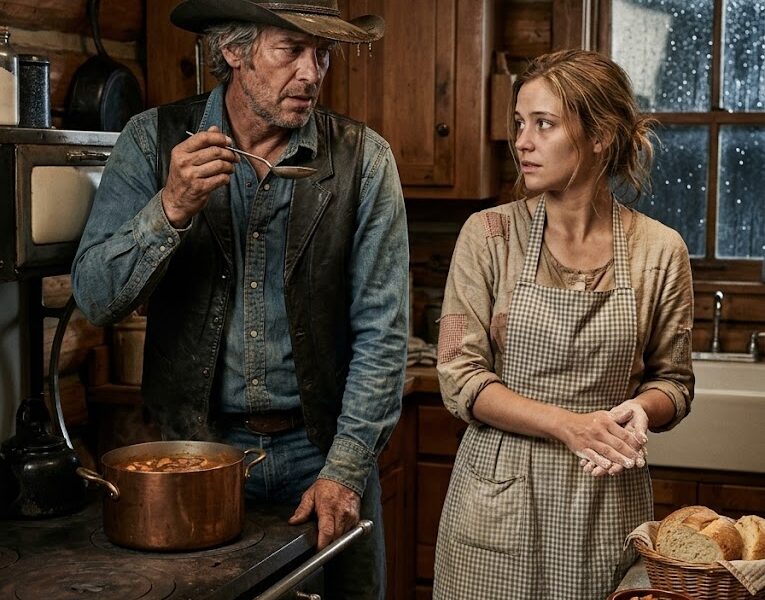
THE COWBOY WARNED THE HOMELESS BRIDE NEVER TO TOUCH HIS KITCHEN—BUT ONE SPOONFUL OF HER STEW EXPOSED A SECRET BURIED FOR FIFTEEN YEARS
The first time Caleb Rusk tasted Mara Hale’s cooking, he nearly dropped his spoon.
The second time he heard her name that night, he reached for his rifle.
And before the storm was over, the hardened Wyoming rancher would discover that the homeless bride he had reluctantly taken into his house was connected to the darkest night of his life.
It began with a pot of beef stew.
A simple meal made by a woman who owned one torn carpetbag, a pair of worn shoes, and a wedding dress she would never wear.
Caleb had given her three instructions.
Stay in the back room.
Touch nothing.
Leave in the morning.
She had broken two of them before sundown.
Now she stood in his kitchen, trembling beneath the light of an oil lamp, while the smell of roasted onions, fresh bread, and slow-cooked beef filled the room.
Outside, thunder shook the Wyoming prairie.
Inside, Caleb stared at the spoon in his hand as though it had betrayed him.
“Who made this?”
His voice was so sharp that Mara flinched.
“I did, sir.”
“I told you not to touch my kitchen.”
“I know.”
“Then why have you?”
Mara glanced toward the scrubbed countertops, the neatly stacked plates, and the golden loaf resting beside the stove.
“Because it needed cleaning.”
Caleb slowly lowered the spoon.
He was forty-two years old, broad-shouldered, weathered by fifteen Wyoming winters, and accustomed to having his instructions followed.
His ranch covered nearly six thousand acres.
His cattle were worth more than most men in Willow Bend would earn in a lifetime.
His reputation was worse than his temper.
People said Caleb Rusk had a heart made of iron and a house that had forgotten how to be a home.
Until that evening, he had never cared enough to disagree.
“Did Mrs. Bell give you permission?” he asked.
Mara clasped her flour-covered hands.
“She showed me where the supplies were.”
“That isn’t what I asked.”
“No, sir.”
He looked around the kitchen.
His old mother’s blue curtains had been washed and hung straight.
The copper pots shone above the stove.
Someone had placed a small jar of prairie asters on the windowsill.
Caleb had not seen flowers in that kitchen for fifteen years.
His jaw tightened.
“And the stew?”
“I thought you might be hungry.”
The answer was so simple that it irritated him more than an excuse would have.
Nobody had asked whether Caleb Rusk was hungry in years.
His ranch hands waited for instructions.
His housekeeper reminded him when supplies ran low.
His neighbors invited him to church suppers because politeness required it.
But nobody looked at him and wondered whether he had eaten.
Not since his mother died.
Not since the winter when everything worth coming home to disappeared.
He took another spoonful despite himself.
Tender beef.
Potatoes.
Onions.
Cracked black pepper.
And something faintly sweet beneath the savory broth.
He closed his eyes.
For one impossible instant, he was twelve years old again, sitting at his mother’s kitchen table while snow battered the windows.
His father was laughing.
His younger brother was stealing bread before supper.
And his mother was saying, A warm meal doesn’t fix a broken world, Caleb. It only reminds a person they’re still allowed to live in it.
Caleb opened his eyes.
The memory vanished.
The room felt colder than before.
“Where did you learn to make this?”
Mara seemed confused.
“My mother taught me.”
“Your mother?”
“Yes.”
“Where?”
“Missouri.”
Caleb looked toward the stove again.
The recipe was almost exact.
Even the herbs.
Even the unusual pinch of dried apple that softened the richness of the beef.
His mother had insisted on adding it.
He had never tasted another stew quite like hers.
Until now.
“You used my winter herbs,” he said.
Mara’s expression fell.
“Mrs. Bell told me they were in the pantry.”
“They’re supposed to last until spring.”
“I didn’t use much.”
“You made enough for six men.”
“I saw your ranch hands coming in from the north pasture. I thought they might like something hot.”
Caleb looked toward the rain-streaked window.
Beyond the yard, the bunkhouse lamps glowed faintly through the storm.
His men had been repairing fences since dawn.
They would be wet, exhausted, and hungry.
He knew that.
He simply had not thought about feeding them.
Mara had.
He turned back toward her.
“You don’t understand something, Miss Hale.”
Her shoulders stiffened.
“I gave you shelter for one night. That was all.”
“I understand.”
“I didn’t hire a cook.”
“No, sir.”
“And I certainly didn’t invite you to rearrange my home.”
Mara swallowed.
Then she slowly untied the apron around her waist.
“I’m sorry.”
He said nothing.
She folded the apron neatly and placed it on the counter.
“I’ll leave.”
Caleb frowned.
“Tomorrow morning.”
“Tonight.”
He looked toward the window.
Rain struck the glass hard enough to rattle it.
“You can’t walk to town in this.”
“I won’t cause any more trouble.”
She crossed the kitchen toward the back door, where her small carpetbag rested beside a pair of boots.
That was when Caleb truly looked at her.
Not as an inconvenience.
Not as a stranger.
As a person.
Her brown dress had been mended so many times that the fabric along its seams had turned pale.
One shoe had a split near the toe.
Her coat was still damp from the rain.
And the carpetbag she reached for was so worn that its leather handle had been secured with twine.
Everything she owned appeared to fit inside it.
“Where exactly do you intend to go?”
Mara stopped.
Her back remained toward him.
For several seconds, she said nothing.
Then she answered so softly that he almost missed it.
“I don’t know.”
Caleb felt something unpleasant tighten beneath his ribs.
He had heard desperate men beg for work.
He had seen families lose farms during droughts.
He had buried neighbors after the worst winter Wyoming had endured in decades.
But there was something different about those three words.
There was no performance in them.
No attempt to soften him.
She genuinely had nowhere to go.
He watched her lift the carpetbag.
As she did, a folded letter slipped from a torn pocket and fell to the floor.
Caleb bent to retrieve it.
Mara turned quickly.
“Please, that’s mine.”
He paused.
Then his eyes caught the signature visible beneath the fold.
Walter Pike.
His expression changed.
“Where did you get this?”
“My fiancé sent it.”
Caleb looked up.
“Your what?”
“My fiancé. Walter Pike. He wrote to me from Willow Bend.”
Caleb stared at the name.
The storm outside suddenly seemed very far away.
“Walter Pike was supposed to marry you?”
Mara nodded.
“He owned the general store. At least, he told me he did.”
Caleb unfolded the paper.
His gaze traveled across the lines.
The handwriting was elegant but uneven, with a distinctive backward curl on certain letters.
He knew that handwriting.
He had seen it on contracts.
On bank drafts.
On letters promising things that had never been delivered.
And on one particular document that had destroyed his family fifteen years earlier.
His hand tightened around the page.
“Miss Hale.”
Something in his voice frightened her.
“Yes?”
“Walter Pike didn’t write this.”
Mara stared.
“How could you know that?”
Caleb did not answer.
His eyes had stopped on a sentence near the bottom.
If you come west, you will never be unwanted again.
The words were familiar.
Too familiar.
He looked toward the dark hallway leading to the locked room at the back of the house.
Then he returned his attention to Mara.
“Who knew you were coming here?”
“Walter.”
“Anyone else?”
She hesitated.
“My brothers knew I was leaving Missouri.”
“Did they know where?”
“I suppose so.”
Caleb felt the first unmistakable movement of dread.
“Did they approve of this marriage?”
Mara’s face lost its color.
“No.”
“Why not?”
Before she could answer, three violent knocks struck the front door.
BANG.
BANG.
BANG.
The sound echoed through the farmhouse.
Mara jerked backward.
Caleb immediately reached for the Winchester leaning beside the stove.
Outside, a man’s voice rose above the thunder.
“MARA HALE!”
The carpetbag slipped from her fingers.
Caleb saw terror spread across her face.
Not surprise.
Not confusion.
Recognition.
The man struck the door again.
“MARA! OPEN THIS DAMN DOOR!”
Caleb stepped between her and the entrance.
“Who is that?”
Mara tried to answer.
Her lips moved, but no sound came.
The voice outside grew louder.
“I KNOW YOU’RE IN THERE!”
Caleb worked the rifle’s lever.
“Miss Hale. Look at me.”
She raised her eyes.
“Who is outside my house?”
Tears spilled down her cheeks.
And when she finally whispered the answer, Caleb felt the blood drain from his face.
“My brother.”
He frowned.
“Your brother?”
Mara shook her head desperately.
“Please don’t let him take me.”
“Why?”
Her next words barely reached him.
“Because the last time I asked him what happened to our father’s money, he put his hands around my throat.”
The door shook again.
Caleb turned toward it.
Then he heard the stranger call something else.
“RUSK! I KNOW YOU’VE GOT HER!”
Caleb went completely still.
The man knew his name.
A moment later, another voice sounded through the storm.
Lower.
Calmer.
And far more frightening.
“Open the door, Caleb. We have business that should’ve stayed buried.”
Caleb knew that voice too.
He hadn’t heard it in fifteen years.
And the last time he had, his younger brother was still alive.
Two days earlier, Maribel Hale had stepped from a stagecoach believing her life was finally about to begin.
She was twenty-eight years old.
Her mother had died when she was fourteen.
Her father had followed twelve years later, leaving behind a modest farm outside Hannibal, Missouri, three grown children, and a lifetime of debts Mara had never known existed.
At least, that was what her brothers told her.
Gideon, the eldest, handled the estate.
Thomas, the younger brother, agreed with everything Gideon said.
Within three months, the farmhouse was sold.
The livestock disappeared.
The furniture was divided.
And Mara was told that nothing remained for her.
She had spent fourteen years cooking, cleaning, washing, nursing sick relatives, and mending clothes without receiving wages.
Her brothers called it helping the family.
When she finally asked whether she was entitled to anything from the sale, Gideon laughed.
“You lived under Father’s roof for free.”
“I worked there.”
“You ate there.”
“So did you.”
He struck the table hard enough to make her jump.
“Don’t start acting like a greedy woman.”
That conversation was the beginning of the end.
The final argument came on a bitter March evening.
Mara found a small account book among her father’s belongings.
Inside were handwritten entries describing payments from a property in Wyoming.
She recognized neither the property nor the name of the man sending money.
The final entry was dated only six months before her father died.
When she showed Gideon the book, his face changed.
“Where did you find that?”
“In Father’s desk.”
“Give it to me.”
“I only wanted to know—”
“Give it here.”
He snatched it from her hands.
Mara stepped back.
“Was there more money?”
Gideon advanced toward her.
“What did you say?”
“Did Father own land somewhere else?”
He grabbed her throat.
Not long.
Not long enough to leave the bruises she feared would show.
But long enough to teach her what would happen if she asked again.
When he released her, she stumbled against the stove.
Gideon leaned close.
“You have no idea what you’re talking about. And if you know what’s good for you, you’ll forget you ever saw that book.”
Two weeks later, Mara left the farm.
For nearly two years she worked wherever she could.
She washed sheets at boardinghouses.
Prepared meals for families who barely acknowledged her.
Sat beside dying strangers.
Slept in cramped attic rooms with water freezing inside the washbasin.
She learned to make herself useful before anyone could decide she was a burden.
Yet loneliness followed her everywhere.
At night, she imagined a modest house with clean windows and a garden.
A husband who spoke kindly.
Children arguing over bread at supper.
Nothing grand.
Nothing extraordinary.
Just a place where she could place her shoes beside the door and know they would still be there in the morning.
Then the letter arrived.
It came through a woman who arranged marriages between eastern women and western men.
The man was Walter Pike, a storekeeper in Willow Bend, Wyoming.
He described himself as thirty-eight, respectable, hardworking, and lonely.
He had inherited his store from an uncle.
He owned a small house.
He was looking for a wife who valued honesty above wealth.
Mara answered carefully.
She told him about her father.
About her work.
About the fact that she possessed no dowry.
His reply came three weeks later.
I have no use for a woman’s money. I want someone who will stand beside me when the days are difficult.
She read the sentence until the folds weakened.
More letters followed.
Walter asked about her childhood.
Her family.
Whether she could cook.
Whether she had ever traveled west.
He seemed especially interested in her father’s relatives and any property the family might have owned.
Mara thought little of it.
A prospective husband would naturally want to know her history.
She answered honestly.
She mentioned the account book only once.
Walter never asked about it again.
His final letter contained enough money for the journey.
And a promise.
If you come west, you will never be unwanted again.
That was the sentence that convinced her.
She boarded the train with a carpetbag, a few belongings, and a cream-colored wedding dress she had sewn from discarded fabric.
She carried no jewelry except her mother’s thin silver ring.
For the first time in years, she allowed herself to hope.
Then she arrived in Willow Bend.
Walter Pike wasn’t there.
The store bearing his name had been sold.
The new owner, Mr. Fenwick, knew little about him.
“He left three weeks ago,” the man said.
“Where did he go?”
“Can’t say.”
“But he wrote that he’d meet me.”
Fenwick’s expression shifted.
“What name did you say?”
“Maribel Hale.”
The man stopped polishing the counter.
For a moment, he looked frightened.
Then he glanced toward the back room.
“I think you’d best leave, miss.”
Mara stared at him.
“Sir, I’ve traveled almost nine hundred miles.”
“I’m sorry.”
“Is he married?”
“No.”
“Has something happened to him?”
Fenwick looked away.
“I don’t know.”
At the boardinghouse, Mara waited.
The first evening, she watched every wagon passing outside.
The second morning, she visited the store again.
By afternoon, she had spent her last money on lodging.
The boardinghouse owner, Mrs. Tully, stood in her doorway with an apologetic expression.
“I can’t keep a room without payment.”
“Just one more night.”
“I’m running a business.”
“I can clean your kitchen.”
“I already have help.”
“I could wash linens.”
“Miss Hale.”
Mara looked down.
Mrs. Tully sighed.
“I’m sorry, dear.”
An hour later, Mara’s carpetbag stood on the porch.
Rain had begun to fall.
She carried her belongings beyond town because she could not bear the curious looks anymore.
At the bend near Miller Creek, she sat beneath a cottonwood and tried not to cry.
She had no money for a return ticket.
No family who wanted her back.
No idea where Walter Pike had gone.
And no reason to believe tomorrow would be kinder than today.
That was where Caleb found her.
He was driving a wagon loaded with fencing supplies when he saw a woman beside the road.
Her dress was soaked.
Her hands were blue with cold.
He almost continued past.
He had spent fifteen years learning that other people’s misfortunes could become obligations.
Obligations became expectations.
Expectations became ways to hurt him.
But as his wagon passed, Mara did something that stopped him.
She stood and moved farther off the road.
Even freezing, exhausted, and abandoned, she was trying not to inconvenience a stranger.
Caleb pulled the horses to a halt.
“Where are you going?”
She looked up.
“I haven’t decided.”
“That’s a poor answer with a storm coming.”
“I know.”
“Where’s your family?”
“I don’t have anyone nearby.”
“Are you hurt?”
“No, sir.”
He examined her shoes.
One sole had almost separated.
“You won’t make it another five miles dressed like that.”
She attempted a small smile.
“I’ll manage.”
Caleb hated those words.
He had heard them from his mother while she was dying.
From his father after the ranch began losing money.
From his younger brother on the last morning they spoke.
Everyone insisted they would manage.
Until they couldn’t.
“My housekeeper twisted her ankle this morning,” he said abruptly.
Mara blinked.
“Sir?”
“She could use help for a night.”
“I can cook.”
“I didn’t ask.”
“I can scrub floors, wash clothing, mend—”
“Woman, are you getting into the wagon or not?”
She stared at him.
Then her eyes filled with tears.
“Yes, sir.”
Caleb looked away.
“Don’t thank me. It’s one night.”
He drove her to Rusk Ranch through a curtain of rain.
Neither spoke much.
Mara watched the immense pastureland roll past.
A white fence surrounded the farmhouse.
Beyond it stood a large barn, a bunkhouse, several outbuildings, and acres of grass disappearing into the darkening hills.
The house itself was beautiful.
Not ostentatious.
Solid.
Two stories of timber and stone with a broad front porch, deep windows, and a chimney built to withstand Wyoming winters.
It was the sort of place she had dreamed about.
Except there was something strangely lifeless about it.
No rocking chair stood on the porch.
No flowers grew beneath the windows.
No smoke curled from the chimney.
The curtains were closed.
The home seemed to be waiting for people who had forgotten to return.
Inside, an elderly woman with silver hair and a swollen ankle sat beside the parlor fire.
“Caleb Rusk,” she exclaimed, “what have you dragged in?”
“A woman who needs shelter.”
The elderly woman’s face softened.
“Well, that’s a first.”
Caleb ignored her.
“Mrs. Bell, this is Miss Hale. She’ll help tonight and leave in the morning.”
Mrs. Bell introduced herself as Agnes.
She had cared for the Rusk household for nearly twenty years.
Her ankle had swollen badly after she slipped near the pantry.
Mara immediately knelt beside her chair.
“May I look?”
Agnes smiled.
“You know anything about sprains?”
“My father was always injuring something. I learned a little.”
Within minutes, Mara had brought cold water, wrapped Agnes’s ankle, and helped elevate her foot.
Caleb watched from the doorway.
The stranger seemed to move through hardship with practiced efficiency.
No wasted gestures.
No complaints.
Agnes looked toward him.
“She’ll need something dry to wear.”
“Find her something.”
“And supper?”
“There’s bread.”
“Hard bread.”
“Then there’s cheese.”
Agnes rolled her eyes.
“You’d feed a starving man fence posts if they were already cut.”
Caleb took off his coat.
“Miss Hale, the spare room is at the back. Don’t go wandering through the house. Don’t touch my belongings. And leave the kitchen alone.”
Mara stood.
“Of course.”
He disappeared into his office.
Agnes waited until his footsteps faded.
Then she leaned close to Mara.
“Don’t take his manners personally, dear.”
Mara gave a sad little smile.
“He’s given me more kindness than I expected today.”
Agnes studied her.
“Has he?”
“He stopped.”
The older woman’s eyes softened.
Then she looked toward the empty kitchen.
“Well, there’s no reason you should sit there freezing.”
Mara followed her gaze.
The counters were dusty.
The shelves disorganized.
A basin contained several days’ worth of dishes.
“Would he be angry if I cleaned a little?”
Agnes considered the question.
“He gets angry when the wind changes direction.”
Mara almost laughed.
Agnes smiled.
“But he won’t starve under my watch. The beef’s in the cold pantry, and the potatoes are beneath the sink.”
Mara hesitated.
“He told me not to touch anything.”
Agnes lifted one eyebrow.
“And if he’s foolish enough to object to supper, he can eat his own hat.”
That was how Mara came to prepare the stew.
At first, she only meant to make a meal.
Then she noticed the unused dishes.
The stained linens.
The neglected flower jar.
The kitchen reminded her painfully of her father’s home after her mother died.
Everything necessary remained.
Nothing comforting did.
So she cleaned.
She washed the counters.
Scrubbed the floor.
Opened the curtains.
Baked bread.
And took a small handful of dried herbs from the pantry.
Agnes had shown her the tin.
“Mrs. Rusk used to keep those,” she said.
“His wife?”
“His mother.”
Mara paused.
“Is she gone?”
“Long gone.”
Something in Agnes’s voice discouraged further questions.
Mara returned to cooking.
As the broth simmered, she added a little dried apple.
Her mother had taught her the trick years before.
She was stirring the pot when Caleb returned.
And the smell of that stew opened a door inside him he had kept locked for fifteen years.
Now, with thunder shaking the roof and two men outside demanding Mara, Caleb stood in the kitchen holding the rifle.
“Stay behind me,” he ordered.
Mara backed toward the stove.
Caleb approached the front door.
He did not open it immediately.
“State your business.”
The first man answered.
“I’m Gideon Hale. I’m here for my sister.”
“She doesn’t want to go with you.”
“That’s family business.”
“Not while you’re standing on my porch.”
A low laugh came from the second man.
“Still giving orders, Caleb?”
Caleb’s fingers tightened around the rifle.
He knew that laugh.
He had heard it across gambling tables, in saloons, and once through the smoke of a burning barn.
“Silas Danner.”
A pause followed.
Then the man answered.
“I wondered whether you’d remember me.”
Caleb leaned his forehead briefly against the doorframe.
Fifteen years.
He had spent fifteen years imagining this moment.
Sometimes he had imagined drawing his gun.
Sometimes he had imagined dragging Silas before a judge.
Mostly he had tried not to think about him at all.
“Get off my land,” Caleb said.
Silas sounded amused.
“That’s no way to greet an old partner.”
“You were never my partner.”
“Your father seemed to think otherwise.”
“My father made mistakes.”
“Didn’t we all?”
Behind Caleb, Mara made a small, frightened sound.
He glanced toward her.
She was staring at the door as though it concealed something monstrous.
Silas spoke again.
“We’ve come for the woman and a few family papers. No need for trouble.”
Caleb looked at the letter in his hand.
“What papers?”
“Things that don’t concern you.”
“Then you’ve driven a long way for nothing.”
Gideon struck the door.
“Mara! Tell this man to let you out!”
Mara flinched.
Caleb raised his voice.
“Touch that door again and you’ll regret it.”
Silence.
Then Silas said quietly, “Be careful, Caleb. You know what happens when Rusk men mistake stubbornness for courage.”
The words struck with deliberate precision.
Caleb opened the door just far enough to see the porch.
Rain streamed from the brim of Gideon Hale’s hat.
He was tall, heavyset, with muddy boots and the hard expression of a man accustomed to frightening weaker people.
Beside him stood Silas Danner.
Age had thinned his hair and deepened the lines around his mouth, but the sharp black eyes were unchanged.
His coat was expensive.
His gloves were clean.
He looked like a prosperous businessman.
Caleb remembered him covered in soot, standing beside a dead horse and swearing that nobody could have survived the fire.
“Get off the porch,” Caleb said.
Silas glanced past him.
“Is she here?”
“You heard my answer.”
“We’re trying to prevent an unfortunate misunderstanding.”
“You mean the misunderstanding where a woman travels halfway across the country for a husband who doesn’t exist?”
Silas’s smile disappeared.
“So she’s shown you the letters.”
Caleb said nothing.
That was answer enough.
Gideon stepped forward.
“Mara belongs with her family.”
Caleb angled the rifle.
“She isn’t a cow you can claim.”
“She’s my sister.”
“Then you ought to have treated her better.”
Gideon’s expression darkened.
“You don’t know what you’re involving yourself in.”
“Neither do you.”
For several seconds, the men stared at each other.
Then Silas raised a hand.
“Not tonight, Gideon.”
He looked directly at Caleb.
“There’s a legal matter to settle. The girl has something that belongs to her father’s estate.”
“Then find yourself an attorney.”
“We have one.”
“Good. Tell him to write.”
Silas’s eyes narrowed.
“You haven’t changed.”
Caleb’s face remained hard.
“You have. Last time I saw you, you were running from a fire.”
The porch fell silent.
Gideon glanced sharply at Silas.
Something passed between them.
It lasted only a second.
But Caleb saw it.
Silas stepped backward into the rain.
“We’ll talk tomorrow.”
“Not on my land.”
Silas smiled without warmth.
“That’s the trouble with land, Caleb. People start believing it belongs to them forever.”
He turned toward the waiting wagon.
Gideon lingered.
His eyes found Mara standing in the hallway.
For one terrible instant, brother and sister faced each other.
“Mara,” he said.
Her hands trembled.
“You know what Father would’ve wanted.”
She said nothing.
Gideon’s expression hardened.
“Don’t make me come back for you.”
Caleb slammed the door.
He stood motionless, listening to the wagon disappear into the rain.
Only when the wheels faded did he lower his rifle.
Mara was crying silently.
Caleb turned toward her.
“What does your brother want?”
“I don’t know.”
“Don’t lie to me.”
She flinched so violently that he regretted his tone.
Caleb exhaled.
“I’m not him.”
Mara wiped her cheeks.
“I know.”
“Then tell me what happened.”
She looked toward the letter.
“My father kept an account book. It mentioned land in Wyoming. My brothers said everything had been sold, but I found payments made after that.”
“What sort of payments?”
“I don’t know. I only saw a few entries.”
“Who sent them?”
She hesitated.
Then spoke a name.
“Silas Danner.”
Caleb closed his eyes.
The room seemed to tilt beneath him.
When he opened them, Mara was watching him.
“Mr. Rusk?”
He crossed to the table and pulled out a chair.
“Sit down.”
“Have I done something wrong?”
“No.”
He looked toward the hallway again.
“Sit down before you fall down.”
She obeyed.
Caleb placed the letter on the table.
For a long time, he stared at it.
Then he asked a question Mara had not expected.
“What was your mother’s maiden name?”
“Eleanor.”
“Her surname.”
“Whitcomb.”
Caleb’s hand went still.
He looked at Mara as though seeing her for the first time.
“Eleanor Whitcomb?”
She nodded.
“You knew her?”
Caleb slowly sat down.
Outside, the storm rolled westward.
Inside, fifteen years of carefully buried memories began forcing their way back into the light.
“I knew your father,” he said.
Mara stared.
“What?”
“And your mother.”
Her breath caught.
Caleb looked toward the faded blue curtains.
“Your mother spent one winter on this ranch.”
Mara’s eyes filled.
“She never told me.”
“She may have had her reasons.”
“What reasons?”
Caleb did not answer immediately.
Instead, he asked, “Did your father ever tell you about a place called Blackwater Crossing?”
Mara searched her memory.
“No.”
“Or a man named Jonah Rusk?”
She shook her head.
“Who was Jonah?”
Caleb looked down at his hands.
“My brother.”
There was something in his voice that made Mara afraid to ask the next question.
But she asked anyway.
“Where is he now?”
Caleb swallowed.
“Buried beneath the cottonwoods north of the house.”
Mara went still.
“And Silas Danner,” Caleb continued, “is the man who put him there.”
Caleb had been twenty-seven when his life broke apart.
His father, Henry Rusk, had built the ranch from a small homestead into one of the most productive cattle operations in southern Wyoming.
He was a proud man.
Hardworking.
Stubborn.
And far too trusting of men who spoke confidently about business.
Silas Danner came to Willow Bend in 1874.
He wore polished boots and carried himself like a man destined for something larger than an ordinary life.
He knew bankers.
He understood land contracts.
He had friends in Cheyenne.
He convinced Henry Rusk that the future belonged to ranchers who controlled water as well as pasture.
The region around Blackwater Crossing held several vital springs and a stretch of river that remained reliable during dry summers.
At the time, the land belonged to a Missouri family named Whitcomb.
Eleanor Whitcomb had inherited a partial interest through her mother.
When Eleanor married Samuel Hale, her husband helped manage the property from a distance.
Samuel wanted to sell.
Eleanor refused.
She believed the land would someday provide security for her children.
Instead, the two families reached a private arrangement.
The Rusks could graze cattle on part of the property and maintain a wagon road in exchange for annual payments.
Nothing complicated.
Nothing dishonest.
At least, that was the intention.
Silas offered to manage the paperwork.
He told Henry that county records were difficult to maintain and property interests frequently overlapped.
He could simplify everything.
Jonah Rusk distrusted him immediately.
Jonah was twenty-three.
Younger than Caleb by four years.
Quicker to laugh.
Quicker to argue.
And far less willing to accept a stranger’s promises.
“He talks like a preacher selling rain,” Jonah once told Caleb.
Caleb laughed.
“Father thinks he knows what he’s doing.”
“Father thinks everyone who shakes his hand means it.”
“Silas has helped us.”
“So did the fellow who sold us lame horses last spring.”
Caleb had dismissed his brother’s concerns.
That was one of the things he would never forgive himself for.
Over time, the payments to the Whitcomb family became irregular.
Silas blamed banking delays.
Then land records began changing.
A portion of Blackwater Crossing appeared under a holding company controlled by Silas.
Samuel Hale’s signature appeared on a transfer neither Jonah nor Eleanor believed he had authorized.
Jonah discovered the irregularities while helping his father reconcile expenses.
He quietly copied several documents.
Then he wrote to Eleanor.
She traveled west with her youngest daughter, Maribel, who was not yet fourteen.
They stayed at Rusk Ranch while the matter was investigated.
Caleb remembered a shy brown-haired girl standing beside his mother’s kitchen table.
She had large, solemn eyes.
She liked the barn cats.
And she always asked permission before touching anything.
He remembered his mother teaching Eleanor how to add dried apple to stew.
He remembered Jonah showing the little girl how to coax a frightened foal toward her with an open palm.
But fifteen years had changed Mara.
Grief had hollowed her cheeks.
Hardship had bent her shoulders.
He had never connected the exhausted woman beside Miller Creek with that quiet child from his youth.
One evening, Jonah found the evidence he had been searching for.
A forged transfer.
A series of falsified payment records.
And a signed agreement giving Silas control over valuable water rights that belonged partly to Eleanor.
Jonah planned to take the documents to the county clerk.
Silas learned about it.
The next night, the north barn burned.
Jonah was inside.
Caleb reached the building before the roof collapsed.
He tried to enter.
The heat drove him back.
He tried again.
His father restrained him.
By morning, Jonah was dead.
Silas claimed the fire was an accident caused by a lantern.
Caleb never believed him.
But the original documents vanished.
The stable boy who might have witnessed the fire left town.
The sheriff found no evidence of arson.
And Henry Rusk, already weakened by illness, begged his surviving son not to destroy the family pursuing a case he could not prove.
A year later, Henry died.
Caleb’s mother followed two winters after that.
The ranch survived.
The family did not.
Blackwater Crossing remained disputed, though the Rusks retained their original acreage.
Silas built a profitable freight business and continued buying land through intermediaries.
Caleb learned to work from sunrise until exhaustion silenced his thoughts.
He stopped attending dances.
Stopped entertaining guests.
Stopped speaking about Jonah.
And eventually, he stopped setting a second plate at the table.
Now the daughter of Eleanor Whitcomb sat in his kitchen.
And Silas Danner had apparently arranged for her to travel west under the promise of marriage.
Mara listened without interrupting.
Only when Caleb finished did she speak.
“My mother told me we’d lived in Wyoming for a winter. She never said why.”
Caleb looked at her.
“She wanted to protect you.”
“From what?”
“Men like Danner.”
Mara stared at the letter.
“Then why would he want me to come back?”
Caleb’s answer was quiet.
“That is what we need to find out.”
She hesitated.
“Do you think Walter Pike ever existed?”
“He existed. I knew him.”
Mara straightened.
“You knew Walter?”
“He ran the general store for eleven years. Drank too much. Played cards badly. Owed money to half the territory.”
“But my letters—”
“Weren’t written by him.”
“How can you be sure?”
Caleb reached into the drawer beneath the table.
He removed a small ledger and turned to the final page.
There was a faded signature near the bottom.
Silas Danner.
He placed it beside Walter’s letter.
Mara compared the handwriting.
The unusual curls.
The narrow spacing.
The way the capital letters leaned.
Her stomach sank.
“They’re the same.”
“Yes.”
She looked up.
“Silas wrote to me?”
“I believe so.”
“Pretending to be a man who wanted to marry me?”
Caleb said nothing.
Mara studied the page again.
Every promise.
Every tender line.
Every carefully chosen word.
The thought that a stranger had written them for some hidden purpose made her feel physically ill.
“He asked about my father.”
Caleb leaned forward.
“What exactly?”
“Whether he had left property. Whether my mother had relatives in Wyoming. Whether I still had anything from her family.”
“Did you tell him?”
“Yes.”
“About the account book?”
Her eyes widened.
“Yes.”
Caleb looked toward the front door.
“And now he’s here.”
Mara folded her arms tightly.
“What does he want from me?”
Caleb answered carefully.
“Something he believes only you can give him.”
Her lips trembled.
“But I don’t have anything.”
He looked toward her battered carpetbag.
“Are you certain?”
By midnight, the storm had weakened.
Agnes joined them in the kitchen, walking slowly with the help of a cane.
She listened to Caleb’s account without speaking.
When he mentioned Eleanor Whitcomb, tears appeared in her eyes.
“I thought that was you,” she told Mara.
Mara looked surprised.
“You recognized me?”
“Not at first. But there was something familiar about your face.”
Agnes smiled sadly.
“You have your mother’s eyes.”
Mara lowered her gaze.
The older woman touched her hand.
“She was a good woman.”
Those words nearly broke Mara.
She had spent years hearing that she was troublesome, demanding, ungrateful, and too difficult to please.
Nobody had spoken about her mother with genuine affection since the funeral.
“Did you know her well?”
Agnes nodded.
“She stayed here almost three months.”
“What was she like?”
“She was stubborn in the gentlest possible way. Your father wanted her to give up the dispute, but Eleanor believed something wrong had been done.”
Mara looked at Caleb.
“Did she ever get her land back?”
“No,” he said.
“Then she lost everything?”
Agnes shook her head.
“Not everything.”
The room went quiet.
Caleb turned.
“What do you mean?”
Agnes hesitated.
“I promised your mother I wouldn’t speak of it unless the right time came.”
Caleb’s expression changed.
“Agnes.”
“She was frightened. Eleanor was frightened too. After Jonah died, neither woman trusted the sheriff or anyone connected to Silas.”
“What did they do?”
Agnes looked toward Mara.
“Your mother left something here.”
Mara stopped breathing.
“What?”
“A packet of papers.”
Caleb rose from his chair.
“Where?”
Agnes’s eyes moved toward the dark hallway.
“Your mother’s sewing room.”
Caleb went still.
That room had remained locked since his mother’s death.
He had preserved it exactly as she left it.
Her sewing machine.
Her quilts.
Her books.
Her unfinished embroidery.
He could not bear to enter.
Agnes had respected his wishes.
For fifteen years.
“What papers?” he asked.
“I never opened them.”
“Why didn’t you tell me?”
Agnes looked at him sadly.
“Because you wouldn’t let anyone speak your mother’s name without leaving the room.”
Caleb felt the truth of that more sharply than an accusation.
For a long moment, nobody spoke.
Then he took the lamp.
“Come with me.”
The three of them walked down the hallway.
Caleb stopped before a narrow oak door.
He removed a brass key from the ring at his belt.
His hand trembled slightly as he fitted it into the lock.
Mara noticed.
She wanted to say something.
Instead, she stood quietly beside him.
The door opened with a soft groan.
The room smelled of cedar, lavender, and old paper.
Moonlight fell across a quilt folded over a rocking chair.
A framed photograph stood on the desk.
Caleb’s mother.
His father.
Jonah.
And Caleb himself, younger and smiling in a way Mara could hardly imagine.
Caleb stared at the photograph.
Then he looked away.
Agnes pointed toward a cabinet beneath the window.
“Your mother kept a blue sewing box.”
Caleb found it.
The box was decorated with painted roses.
Inside were needles, thread, buttons, and several scraps of fabric.
Beneath the lining lay a folded envelope.
His mother’s handwriting covered the front.
For Eleanor Whitcomb or her children, should the truth ever become necessary.
Mara brought a hand to her mouth.
Caleb carefully opened it.
Inside were four pages.
The first was a copy of the original grazing and water-use agreement between Henry Rusk and the Whitcomb family.
The second listed annual payments.
The third contained a sworn statement prepared by Jonah.
It described Silas Danner’s suspected fraud.
The fourth was a letter from Caleb’s mother.
He unfolded it slowly.
The first line made his eyes burn.
My dear Caleb, if you’re reading this, it means the world has finally forced you to open the door you closed after Jonah died.
He stopped.
For several seconds, he could not continue.
Mara stood close enough to see his expression.
“Would you like me to read it?”
Caleb shook his head.
“No.”
He swallowed.
“I need to.”
The letter continued.
I know you believe you failed your brother. You did not. The man responsible for Jonah’s death bears that burden, and no amount of grief will transfer it to you.
Caleb’s vision blurred.
He lowered the paper.
Agnes quietly touched his arm.
He waited until he could see again.
Then he continued.
Jonah copied the documents because he feared the originals would be destroyed. Eleanor and I hid them while the sheriff was investigating. After the fire, we agreed that she should return to Missouri and protect her children. These papers are not enough by themselves to convict Silas, but they may one day help establish the truth.
The final paragraph was written with a slightly unsteady hand.
Do not let grief turn you into someone who has forgotten how to love. Your brother would hate that. So would I.
Caleb folded the letter.
For fifteen years, he had imagined his mother dying disappointed in him.
Now he stood in her room, holding proof that she had understood him better than he understood himself.
Mara quietly wiped her eyes.
Agnes looked toward the remaining documents.
“There’s something else.”
Caleb turned the final page.
A sketch of Blackwater Crossing had been attached to Jonah’s statement.
Near the western boundary stood an old stone pump house.
A handwritten note marked a narrow parcel beside the spring.
Eleanor’s retained share. Not included in the Danner transfer.
Caleb studied it.
Then he looked at Mara.
“Your mother never signed away her entire interest.”
“What does that mean?”
“It means there may still be property legally belonging to your father’s estate.”
Mara stared.
“How much property?”
“A small parcel. But it includes access to the spring.”
“Is that important?”
Caleb looked at the map.
“Very.”
During dry summers, half the surrounding ranches depended on that spring.
Silas had spent years trying to consolidate the adjoining land.
If Mara held a legitimate inherited interest, she might be able to challenge his control.
Caleb finally understood why Silas had invited her west.
Marriage would have made her easier to pressure.
A husband controlled much of a wife’s legal and financial life under the laws and practices of the time, though property rights varied by jurisdiction.
A fraudulent husband—or a real husband serving Silas—could help him obtain her signature or access to her inheritance.
But the man who had been promised to her had vanished.
Something in the scheme had gone wrong.
Caleb examined the documents again.
“We need to get these to someone we trust.”
“Who?”
“Judge Whitaker in Cheyenne.”
Agnes looked concerned.
“Caleb, that journey will take time.”
“I know.”
“And Silas won’t simply wait.”
Caleb folded the papers.
“No. He won’t.”
At that moment, a horse whinnied outside.
Then another.
Caleb looked sharply toward the window.
A moment later, someone shouted from the yard.
“MR. RUSK!”
It was Ben Carter, his foreman.
Caleb hurried toward the stairs.
Ben stood beneath the porch, soaked and breathing hard.
“There’s trouble at the north pasture.”
“What kind?”
Ben looked toward Mara.
Then back at Caleb.
“Someone cut the fence.”
Caleb frowned.
“Could’ve been the storm.”
“No, sir.”
Ben swallowed.
“They cut it clean. And they left something nailed to the gate.”
“What?”
“A woman’s wedding veil.”
Mara gripped the banister.
She knew before Ben said another word.
Her veil.
The one she had packed for a marriage that never happened.
But her carpetbag was still inside the house.
She turned and looked toward the kitchen.
The bag stood open beside the back door.
Someone had entered the farmhouse while they were upstairs.
And beneath the veil, Ben had found a note.
Caleb took it from him.
Only six words were written across the paper.
Bring the girl to Blackwater Crossing.
Caleb did not sleep that night.
Neither did Mara.
Agnes helped her sit near the parlor fire while Ben and two ranch hands searched the property.
No one had been found.
The back window had been forced open.
A muddy boot print remained beneath the sill.
Whoever entered had taken Mara’s wedding veil and nothing else.
The act frightened her more than ordinary theft would have.
It was a message.
A reminder that even inside Caleb’s house, someone believed he could reach her.
Just before dawn, Caleb entered the parlor carrying two cups of coffee.
He offered one to Mara.
She looked up in surprise.
“Thank you.”
He settled into the chair across from her.
For a while, they listened to the fire.
Then Mara asked, “Are you angry with me?”
Caleb frowned.
“Why would I be?”
“Because I brought trouble to your house.”
He looked at her.
“You didn’t bring Silas Danner here. He was causing trouble on this land before you were born.”
She lowered her eyes.
“Still, if you hadn’t found me by the road—”
“You might be dead.”
The words silenced her.
Caleb leaned forward.
“Mara, people like your brother count on you believing everything they do is somehow your responsibility.”
She stared at him.
“You don’t know Gideon.”
“I know his kind.”
“He can be very persuasive.”
“Most bullies can.”
She held the coffee cup between both hands.
“When I was little, Gideon used to be kind to me.”
Caleb waited.
“He carried me across flooded roads. He made toys from scraps of wood. When Mother was sick, he stayed awake with me.”
Her voice softened.
“Sometimes I remember that boy, and I can’t understand where he went.”
Caleb looked toward the fire.
“People can become cruel long before we stop remembering when they were good.”
Mara studied him.
“Is that what happened to you?”
He gave a humorless smile.
“Do you think I’m cruel?”
“You were angry about the kitchen.”
“I was.”
“You frightened me.”
“I know.”
She hesitated.
“But I don’t think you wanted to.”
Caleb said nothing.
Mara looked down at her cup.
“You seem like a man who’s afraid of needing anything.”
The observation unsettled him.
He had spent years convincing himself that self-sufficiency was strength.
He paid his workers fairly.
Maintained his land.
Kept his promises.
Never asked for favors.
Never allowed anyone close enough to become necessary.
He had called it peace.
But sitting across from Mara, watching her warm her fingers around a cup, he wondered whether he had simply made loneliness easier to endure by giving it another name.
“You’ve known me one day,” he said.
“Yes.”
“That’s not enough time to understand a man.”
Mara nodded.
“Maybe not.”
Then she added quietly, “But sometimes it’s enough time to recognize someone who’s hurting.”
Caleb turned away.
He did not trust himself to answer.
By morning, the rain had stopped.
Low clouds covered the prairie.
The ranch hands repaired the damaged fence while Caleb prepared for a trip into Willow Bend.
He intended to speak with the sheriff, examine Walter Pike’s former store, and find out who had arranged the false courtship.
Mara insisted on coming.
“No.”
“Mr. Rusk—”
“No.”
“It’s my life they’re interfering with.”
“And that’s precisely why you should stay here.”
She folded her arms.
“I’ve spent too much of my life being told to stay inside while men decide what happens to me.”
Caleb stopped tightening the saddle.
Mara looked almost startled by her own defiance.
Then she stood straighter.
“You said Silas wants something I may own. If that’s true, I deserve to know what it is.”
Caleb considered her.
He was not accustomed to being challenged, especially by someone who had spent the previous evening apologizing for making supper.
But there was something unmistakable in her expression.
Determination.
Fear remained.
It simply no longer controlled every decision.
“Can you ride?” he asked.
“A little.”
“Then you’ll ride in the wagon.”
She blinked.
“I’m coming?”
“Yes. But you do exactly as I tell you if trouble starts.”
Mara nodded.
“Agreed.”
He climbed into the driver’s seat.
“And don’t get the idea that winning one argument means you’ve won the next.”
For the first time since arriving in Wyoming, she laughed.
It was a small sound.
Almost startled.
But Caleb found himself wanting to hear it again.
They traveled toward Willow Bend beneath a cold gray sky.
The town consisted of two main streets, a church, a schoolhouse, several shops, and a row of businesses facing a muddy public square.
Mara remembered arriving there full of hope.
Now every familiar building seemed to carry a different meaning.
The boardinghouse where she had been turned away.
The telegraph office where she had waited for a message.
The general store where she had learned Walter was gone.
Caleb stopped outside the sheriff’s office.
Sheriff Amos Bellamy was a broad man in his late fifties with thinning hair and a permanent expression of fatigue.
He listened to their account with growing concern.
When Caleb mentioned Silas Danner, the sheriff leaned back.
“You always did have trouble letting that business go.”
Caleb’s jaw tightened.
“My brother is dead.”
“I know that.”
“And Danner knows why.”
“You’ve said as much for fifteen years.”
Mara watched Caleb’s hands curl into fists.
Then she stepped forward.
“Sheriff, a man lured me here under a false promise of marriage. My brother threatened me at Mr. Rusk’s house. And someone broke into that house last night.”
Bellamy looked at her.
“Do you have proof?”
She placed the letters on his desk.
“These.”
He examined them.
“Romantic letters aren’t a crime.”
“They’re fraudulent.”
“You’d need to prove who wrote them.”
Caleb placed Silas’s old ledger beside the correspondence.
Bellamy compared the writing.
His expression changed slightly.
“Interesting.”
“Isn’t it?” Caleb asked.
The sheriff remained silent.
Then he folded the papers.
“I can make inquiries.”
Caleb extended his hand.
“Give those back.”
Bellamy looked offended.
“I wasn’t planning to keep them.”
“I’ve learned not to leave important papers where Silas Danner has friends.”
The sheriff stiffened.
“Watch yourself.”
Caleb took the documents.
“I’ve been watching myself for fifteen years. It hasn’t done much good.”
They left before the argument worsened.
Outside, Mara glanced at him.
“He doesn’t believe us.”
“He doesn’t want to.”
“Why?”
“Because Silas owns half the freight business in this county, pays plenty of taxes, and knows people who can make a sheriff’s life difficult.”
“What about the truth?”
Caleb looked toward the courthouse.
“Truth doesn’t always travel as fast as money.”
They visited the general store next.
Mr. Fenwick stood behind the counter, arranging sacks of flour.
He stiffened when he saw Mara.
Caleb removed his hat.
“We need to talk about Walter Pike.”
Fenwick swallowed.
“I told the lady everything I knew.”
“Then tell me.”
“I bought the store. Walter left.”
“Who witnessed the sale?”
“An attorney.”
“Which attorney?”
Fenwick hesitated.
Caleb leaned closer.
“Don’t make me ask again.”
“Mr. Danner’s attorney. Clarence Voss.”
Mara felt a chill.
Caleb’s expression hardened.
“When was the sale arranged?”
“Late August.”
“And Walter’s debts?”
“Settled.”
“By whom?”
Fenwick looked miserable.
“Mr. Danner.”
Caleb exchanged a glance with Mara.
The pieces were beginning to fit.
Silas had bought Walter’s debts.
Taken control of his business.
Used his identity to lure Mara west.
But one question remained.
Why had Walter disappeared?
Caleb asked it.
Fenwick shook his head.
“I don’t know.”
Then, after glancing toward the empty doorway, he lowered his voice.
“There is something else.”
Mara leaned forward.
“What?”
“Walter came back once. Two nights after the sale.”
Caleb narrowed his eyes.
“Why?”
“He was frightened. He said he’d agreed to something he shouldn’t have.”
“What something?”
Fenwick looked directly at Mara.
“He said a woman was coming west, and he needed to warn her.”
Mara’s breath caught.
“Me?”
“I suppose so.”
“What happened?”
Fenwick swallowed.
“Two men arrived while he was here. They took him outside. I never saw him again.”
“Who were they?” Caleb asked.
Fenwick hesitated.
Then he answered.
“One was Gideon Hale.”
Mara grabbed the edge of the counter.
“My brother?”
Fenwick nodded.
“And the other?”
“I didn’t recognize him.”
Caleb studied the man’s face.
“But you’d recognize him now?”
Fenwick hesitated again.
“Maybe.”
“Describe him.”
“Tall. Dark coat. A scar near his left ear.”
Caleb’s expression changed.
He knew that description.
“Ephraim Cole.”
Fenwick looked startled.
“You know him?”
“He used to work for Silas.”
Caleb felt the old anger rising.
Ephraim Cole had been employed at Rusk Ranch the winter Jonah died.
He had been the stable hand assigned to the north barn.
And he was the man who disappeared immediately after the fire.
Their next stop was the old church.
Mara had noticed its white steeple from the stagecoach.
She had imagined being married there.
Standing beside Walter.
Wearing the dress she had stitched by lamplight.
Now she stood outside its doors while Caleb spoke with the minister.
Reverend Thomas Avery remembered Walter Pike.
“He came here several weeks ago,” the minister said.
“About a marriage?” Mara asked.
The reverend nodded.
“He wanted to know how quickly a ceremony could be performed.”
Caleb frowned.
“Did he give a woman’s name?”
“Yes.”
Mara felt her heartbeat quicken.
“Mine?”
The reverend looked uncomfortable.
“No, miss.”
Silence.
“What name?” Caleb asked.
“Mrs. Lillian Danner.”
Caleb went still.
Mara looked at him.
“Who is that?”
The reverend answered carefully.
“Silas Danner’s widowed sister-in-law.”
Caleb stared toward the stained-glass window.
Lillian Danner had once been married to Silas’s younger brother.
She was wealthy in her own right.
And she controlled several pieces of property Silas had tried unsuccessfully to purchase.
Why would Walter Pike be preparing to marry her while supposedly courting Mara?
Caleb thanked the minister and led Mara outside.
She stopped on the church steps.
“None of it was real.”
He turned.
“What?”
“The letters. The marriage. The house he described.”
Her eyes filled.
“I kept wondering what I’d done wrong.”
Caleb’s face softened.
“Mara—”
“I thought perhaps he had seen me getting off the stagecoach and changed his mind.”
Her voice broke.
“I wondered whether I looked poorer than he’d expected. Whether I was too old. Whether he’d imagined someone prettier.”
Caleb felt a painful tightening in his chest.
She looked down at her hands.
“I spent all that time trying to think what was wrong with me.”
He stepped closer.
“Look at me.”
She shook her head.
“Mara.”
Slowly, she raised her eyes.
“There was nothing wrong with you.”
A tear rolled down her cheek.
He continued.
“You were deceived by people who knew exactly what you wanted.”
She tried to smile.
“That doesn’t make me feel very intelligent.”
“Trusting someone isn’t stupidity.”
“Sometimes it feels like it.”
Caleb looked toward the church.
“Silas has spent most of his life using decent people against themselves. He knows which promises they’ll believe because he knows what they’re missing.”
Mara studied his face.
“What did he promise your father?”
Caleb swallowed.
“A future that would make the ranch secure.”
“And what did he promise you?”
Caleb was silent for a long time.
Then he answered.
“That I could save my family if I stopped asking questions.”
Mara reached toward him.
Her hand hesitated in the space between them.
Then she gently touched his sleeve.
The gesture lasted only a moment.
But Caleb felt it long after she withdrew.
They returned to the ranch shortly before dusk.
Agnes met them at the door.
Her expression was strained.
“Someone came looking for you.”
Caleb stopped.
“Who?”
“A woman.”
“Did she give a name?”
Agnes nodded.
“Lillian Danner.”
Mara and Caleb exchanged a look.
“What did she want?” Caleb asked.
“She wouldn’t say. But she left this.”
Agnes handed him a small envelope.
Inside was a single sheet of paper.
If you want to know why Walter Pike disappeared, come to the old grain mill after sundown. Come alone. Do not tell Sheriff Bellamy.
The note was signed Lillian.
Caleb read it twice.
Then he held it toward the lamp.
The handwriting appeared genuine, though he had not seen Lillian’s writing in years.
Mara studied his expression.
“Is it a trap?”
“Possibly.”
“Then don’t go.”
Caleb folded the paper.
“If Lillian knows where Walter is, she may be our best chance.”
“Why would she help us?”
“That’s what I intend to find out.”
Mara shook her head.
“I don’t like it.”
Neither did Caleb.
But he had spent fifteen years waiting for someone to speak.
Now three separate pieces of his past had returned within two days.
Eleanor’s daughter.
Silas Danner.
And the possibility that Ephraim Cole was still alive.
He could not walk away.
Before leaving, he spoke privately with Ben.
“Keep two men near the house.”
Ben nodded.
“Expecting trouble?”
“Yes.”
“What sort?”
“The kind that doesn’t announce itself.”
Caleb checked his revolver.
Then he turned toward Mara.
“Stay with Agnes.”
Her expression told him she disliked the order.
But this time she nodded.
“Please be careful.”
He paused.
For years, those words had meant nothing to him.
Now he found himself strangely reluctant to leave.
“I will.”
Then he rode into the gathering darkness.
The old grain mill stood three miles outside Willow Bend, beside an abandoned stretch of irrigation canal.
Its waterwheel had stopped turning years earlier.
Broken shutters hung from the windows.
Caleb tethered his horse behind a stand of cottonwoods and approached on foot.
A lantern burned inside.
He stepped through the doorway.
“Lillian?”
A woman emerged from the shadows.
She was in her early forties, dressed in a dark traveling coat.
Her hair was neatly pinned.
Her face carried the guarded exhaustion of someone who had spent too many years measuring every word.
“Caleb.”
He remained near the door.
“Why are you here?”
She glanced toward the windows.
“We don’t have much time.”
“Then talk.”
Lillian drew a folded paper from her coat.
“Walter Pike is alive.”
Caleb stiffened.
“Where?”
“He’s being held at a hunting cabin near Blackwater Crossing.”
“By Silas?”
She nodded.
“Why?”
“Because Walter refused to go through with the marriage scheme.”
Caleb stared.
“What marriage scheme?”
Lillian’s hands trembled.
“Silas planned to use Walter to marry Miss Hale.”
“Why would Walter agree?”
“He owed money. Silas promised to clear the debt, restore his store, and pay him enough to leave the territory afterward.”
Caleb’s jaw tightened.
“And after the wedding?”
“Walter would persuade her to sign away any remaining interest in the Blackwater property. Silas’s attorney had prepared the documents.”
“Would she have known?”
“No.”
Caleb felt cold anger spread through him.
Lillian continued.
“Walter was told her inheritance was worthless. But when he learned Silas intended to take control of a spring and several adjoining parcels through her signature, he wanted out.”
“Then why didn’t he warn her?”
“He tried. Gideon Hale and Ephraim Cole intercepted him.”
Caleb stepped closer.
“You’re certain Cole is alive?”
Lillian nodded.
“He’s been working under another name.”
Caleb felt fifteen years collapse into a single moment.
“Where is he?”
“At the cabin.”
“Why are you telling me this?”
Lillian’s eyes filled.
“Because my husband died believing Silas had ruined him. Because I watched that man take everything he could from every person who trusted him. And because I’m tired of being afraid.”
Caleb studied her.
“Why now?”
She looked away.
“Silas wants the girl brought to Blackwater tomorrow. He plans to force her signature before the county records can be challenged.”
Caleb’s expression hardened.
“He’ll have to get through me.”
Lillian shook her head.
“He knows.”
Something about the way she said it made Caleb uneasy.
She continued.
“That’s why he isn’t trying to take her while you’re watching.”
Caleb felt his stomach tighten.
“What do you mean?”
Lillian looked toward the open doorway.
“Caleb, Silas never expected you to leave her unguarded.”
A branch cracked outside.
Then another.
Caleb reached for his revolver.
Too late.
A rifle barrel appeared in the doorway behind him.
A man stepped from the darkness.
He had a scar near his left ear.
Ephraim Cole.
Older.
Heavier.
But unmistakable.
“Well,” Ephraim said softly, “look who’s finally come looking for the truth.”
Caleb’s hand froze near his holster.
Ephraim smiled.
“Keep that gun where it is.”
Lillian stepped backward.
Her face had gone white.
Caleb looked at her.
“You brought me here.”
Tears filled her eyes.
“They have my son.”
His expression changed.
Lillian whispered, “I’m sorry.”
Then Ephraim raised the rifle.
“Hands where I can see them, Rusk.”
Caleb slowly lifted his hands.
“Where’s Silas?”
Ephraim’s smile widened.
“Taking care of the bride.”
At the ranch, Mara was helping Agnes prepare supper when the first horse screamed.
She looked toward the window.
“What was that?”
Agnes frowned.
“Could be the wind.”
But the wind had stopped.
Then came a shout.
Ben’s voice.
“GET BACK!”
A gunshot cracked through the evening.
Mara dropped the knife in her hand.
Agnes grabbed her arm.
“Cellar. Now.”
Another shot sounded.
Then the crash of breaking glass.
Mara helped Agnes toward the pantry.
They reached the cellar steps just as the kitchen door burst open.
Gideon Hale entered with a revolver.
Two armed men followed.
Mara froze.
Her brother smiled.
“There you are.”
Agnes stepped in front of her.
“You have no right—”
Gideon pointed the gun.
“Move, old woman.”
Mara cried out.
“Don’t hurt her!”
Gideon looked pleased.
“Then do as you’re told.”
Mara’s heart hammered.
“Where is Mr. Rusk?”
“Occupied.”
“What have you done to him?”
Gideon ignored the question.
He took a folded document from his coat.
“You’re going to sign something.”
Mara stared at him.
“What?”
“Papers our father should’ve settled years ago.”
“Then why didn’t you tell me?”
He laughed.
“Because you’ve always asked too many questions.”
Agnes stood rigid beside her.
Mara looked toward the front yard.
Through the shattered window, she could see Ben lying near the water trough.
He was moving.
Alive.
But injured.
She looked back at Gideon.
“If I sign, will you leave?”
“Of course.”
She knew he was lying.
She had known since childhood that Gideon lied most easily when he spoke gently.
“Let Mrs. Bell go.”
“Sign first.”
Mara drew a breath.
Then something changed inside her.
For years, she had survived by obeying.
She softened her voice.
Lowered her eyes.
Apologized before anyone had time to become angry.
It had kept her alive.
But it had never made her free.
Now Gideon stood in the first place she had felt safe in years, threatening an elderly woman who had shown her kindness.
And she understood that giving him what he wanted would not end his cruelty.
It would only teach him that cruelty still worked.
She lifted her chin.
“No.”
Gideon stared.
“What did you say?”
“I won’t sign.”
His face hardened.
“Don’t test me.”
Mara’s hands shook, but she held his gaze.
“You took Father’s farm. You took the money. You let me believe I had nothing.”
“You ungrateful little—”
“And now you’ve followed me across the country to take something else.”
Gideon advanced.
Agnes cried, “Stay away from her!”
He shoved the older woman aside.
Mara lunged forward to catch her.
A gunshot shattered the lamp above the stove.
Glass exploded.
The kitchen plunged into darkness.
One of Gideon’s men cursed.
For a moment, nobody could see.
Then Agnes shouted from the floor.
“MARA! THE PANTRY!”
Mara grabbed the elderly woman’s arm.
They stumbled through the doorway.
Gideon roared behind them.
Mara reached the cellar stairs.
But before she could descend, a rough hand caught the back of her dress.
Fabric tore.
She screamed.
Gideon dragged her backward.
“You think you’re clever?”
Mara kicked desperately.
He tightened his grip.
“After everything this family did for you?”
She twisted and slapped him.
The sound cracked through the darkness.
For one stunned second, Gideon released her.
Then his expression became something Mara had never seen before.
Pure hatred.
He raised his hand.
A voice thundered from the doorway.
“TOUCH HER AGAIN AND YOU’RE A DEAD MAN.”
Ben Carter stood there.
Blood ran down his left sleeve.
His revolver was steady in his right hand.
Gideon’s men turned.
Ben fired into the ceiling.
“Guns down!”
The men hesitated.
Gideon seized Mara and pressed his revolver against her side.
Ben stopped.
“Let her go.”
“Drop your gun.”
Ben’s jaw tightened.
“Gideon—”
“DROP IT!”
Mara could feel her brother trembling.
He was frightened.
For the first time in her life, she understood something that should have been obvious.
The man who had terrified her for years was terrified himself.
Not of her.
Of failing Silas.
Ben slowly lowered his revolver.
Gideon dragged Mara toward the door.
“Tell Rusk where to find us.”
Ben said nothing.
Gideon shoved her into the waiting wagon.
“Blackwater Crossing. Midnight.”
Then he climbed aboard.
The horses lurched forward.
Mara looked back.
Agnes stood in the broken doorway.
Ben leaned against the frame, bleeding.
And the farmhouse disappeared behind the trees.
The place she had begun to think of as shelter was gone.
She was alone with the brother who had once tried to choke the questions out of her.
Only this time, he had brought a gun.
At the grain mill, Caleb heard the distant gunshots.
He moved before Ephraim could stop him.
The first blow from the rifle stock struck his shoulder.
The second caught the side of his head.
He fell against a support beam.
Ephraim aimed the weapon.
“Stay down.”
Caleb tasted blood.
His thoughts raced.
Gunfire from the direction of the ranch.
Mara.
Agnes.
Ben.
Ephraim had arranged the meeting to draw him away.
Caleb looked at Lillian.
“Your son?”
She was crying.
“He’s eight. Silas said he’d kill him if I didn’t bring you.”
“Where is he?”
“I don’t know.”
Ephraim laughed.
“You two done?”
Caleb slowly rose.
“I remember you.”
Ephraim’s smile thinned.
“I’d be disappointed if you didn’t.”
“You were at the barn.”
“Lots of people were.”
“You locked the north door.”
Ephraim’s expression changed.
Caleb had spent fifteen years imagining this confrontation.
He had believed anger would be enough.
That if he ever saw the man again, he would know exactly what to do.
But now all he could think about was Mara.
He had brought her into his house.
Promised protection without saying the words.
And allowed Silas to draw him away.
“I want to know what happened to Jonah,” Caleb said.
Ephraim shrugged.
“Wrong place. Wrong time.”
Caleb’s hands tightened.
“He was twenty-three.”
“Should’ve minded his business.”
The casual cruelty hit harder than any confession.
Caleb looked at the man’s face.
“You killed him.”
Ephraim’s eyes narrowed.
“Silas said the boy had papers. Told me to stop him leaving the barn.”
“How?”
“Locked the door.”
“And the fire?”
Ephraim looked away.
Caleb felt something terrible shift inside him.
“Who started it?”
Silence.
Then Ephraim muttered, “Wasn’t supposed to spread.”
Caleb stared.
“Who started it?”
Ephraim raised the rifle.
“Enough.”
“WHO?”
“Your brother knocked over the lantern trying to get past me!”
Caleb froze.
For fifteen years, he had imagined Silas ordering Jonah burned alive.
The truth was uglier in its carelessness.
Ephraim had trapped Jonah.
A struggle followed.
The lantern fell.
Fire spread through the hay.
And the man responsible had left a young rancher to die rather than unlock the door.
Caleb’s voice dropped.
“You heard him screaming.”
Ephraim said nothing.
“You heard him asking for help.”
“Shut up.”
“And you left him.”
Ephraim stepped closer.
“I said shut up!”
He struck Caleb again.
This time Caleb moved with the blow.
His shoulder slammed into Ephraim’s chest.
The rifle discharged.
The shot tore through the mill wall.
Both men crashed against a stack of rotten grain sacks.
Caleb grabbed the rifle barrel.
Ephraim drove a knee into his ribs.
Pain exploded through his side.
But Caleb did not release his grip.
They struggled across the floor.
A support beam cracked beneath their weight.
Ephraim reached for the revolver at his belt.
Caleb struck his wrist with the rifle stock.
The revolver fell.
Then he slammed Ephraim against the wall.
Once.
Twice.
The man’s legs buckled.
Caleb drew his own revolver and pointed it at Ephraim’s chest.
For a moment, everything stopped.
He could hear Jonah screaming again.
Could smell smoke.
Could remember his brother’s face disappearing behind the flames.
Ephraim stared at the gun.
“Do it.”
Caleb’s breathing was ragged.
“Give me one reason not to.”
Ephraim laughed weakly.
“You’ve wanted this for years.”
Caleb’s finger tightened.
Then a voice came from behind him.
“Caleb.”
Lillian.
He didn’t turn.
“He killed my brother.”
“I know.”
“He let him burn.”
“I know.”
Caleb stared down the barrel.
Ephraim closed his eyes.
And in the silence, Caleb heard his mother’s voice.
Do not let grief turn you into someone who has forgotten how to love.
He slowly lowered the gun.
Then struck Ephraim once across the jaw.
The man collapsed unconscious.
Caleb stepped back.
His hands were shaking.
He had imagined revenge would heal something.
Instead, he felt exhausted.
Lillian approached.
“Are you all right?”
“No.”
He looked toward the broken window.
“But I need to get home.”
The ranch was nearly silent when Caleb returned.
One kitchen window had been shattered.
The back door stood open.
A trail of blood crossed the porch.
He entered with his gun drawn.
“Agnes!”
The elderly woman appeared from the hallway.
She was pale but unharmed.
Caleb exhaled sharply.
“Where’s Mara?”
Agnes’s face crumpled.
“They took her.”
The words struck him harder than the blows at the mill.
“Who?”
“Her brother. Two others.”
“Where?”
“Blackwater Crossing.”
Caleb looked toward Ben, who sat at the table with a bandage around his upper arm.
“Can you ride?”
Ben nodded.
“Give me a horse.”
“You’re hurt.”
“Not badly enough.”
Caleb looked toward the broken glass.
The stew pot still stood on the stove.
Cold now.
The loaf of bread sat beneath a clean cloth.
Mara’s apron lay folded on the counter.
She had tried to make the house warm.
He had promised himself that he would not grow attached.
Now the thought of her alone with Gideon made him feel as if something inside him were tearing apart.
Agnes touched his arm.
“Bring her home.”
He turned.
Home.
Such a small word.
Such a dangerous word.
He looked at the carpetbag beside the back door.
At the worn shoes she had left to dry.
At the flowers in the window.
For the first time in fifteen years, he understood what his mother had tried to tell him.
A house could be full of furniture and still be empty.
A man could own six thousand acres and have nowhere he truly wanted to be.
And a woman he had known for less than two days could remind him what it felt like to have someone worth returning to.
He looked at Agnes.
“I will.”
Then he went to the barn.
Blackwater Crossing lay beneath a narrow ridge where the river curved around a stand of cottonwoods.
An old stone pump house stood beside the spring.
Beyond it, an abandoned hunting cabin had been converted into a storage building.
Mara sat inside with her wrists tied in front of her.
A lantern burned on the table.
Gideon stood near the door.
Silas Danner sat across from her, reading a set of documents.
He looked almost bored.
“Your brother tells me you’ve become difficult.”
Mara stared at him.
“You wrote the letters.”
Silas smiled.
“I wrote some of them.”
“Why?”
“Because Walter Pike was a foolish man who owed me money.”
“He was supposed to marry me.”
“That was the arrangement.”
“You made me believe he cared about me.”
Silas set down the papers.
“My dear girl, men and women have married for practical reasons since the beginning of civilization.”
“You lied.”
“Yes.”
He said it without shame.
Mara felt sick.
Silas leaned forward.
“But we needn’t dwell on unpleasant details. You have an opportunity to settle a family dispute and walk away with enough money to begin a respectable life.”
He pushed a document toward her.
“Sign here.”
Mara looked at it.
The paper contained legal language she struggled to understand.
But she recognized the property name.
Blackwater Crossing.
“What am I signing?”
“A release of any interest you may have inherited from your parents.”
“How much is it worth?”
Silas’s expression shifted.
“That’s complicated.”
“Then explain it.”
He smiled thinly.
“You really have been spending time with Caleb Rusk.”
Mara sat straighter.
“Explain it.”
Silas sighed.
“Your mother held a residual interest in the water rights. The value depends on how the neighboring property is developed.”
“How much?”
“Five hundred dollars.”
Gideon shifted near the door.
Mara looked at him.
“Is that what you sold me for?”
Her brother’s face darkened.
“Watch your mouth.”
Silas raised a hand.
“There’s no need for unpleasantness.”
Mara turned back to him.
“What happens if I don’t sign?”
Silas folded his hands.
“Your brother would be disappointed.”
“And?”
“You’ll remain here until you reconsider.”
“For how long?”
“As long as necessary.”
Mara looked toward the dark window.
“Caleb will come.”
Silas laughed softly.
“I’m counting on it.”
Cold spread through her.
The documents were not the only reason she had been brought here.
Silas wanted Caleb at Blackwater Crossing.
“Why?”
Silas tilted his head.
“Why what?”
“Why do you want him here?”
He studied her for a moment.
Then smiled.
“Because some men never learn when to stop digging up the past.”
Mara’s breathing quickened.
“What did you do to his brother?”
The smile vanished.
“Be careful.”
“You had Jonah Rusk killed.”
Silas slowly stood.
“Your family has caused me enough trouble over the years.”
“My family?”
“Your mother refused to be reasonable. Your father kept records he should have destroyed. Now you arrive and begin asking the same questions.”
Mara remembered her mother sitting at a table in Missouri, writing letters late into the night.
She remembered her father locking certain papers in his desk.
She remembered Gideon growing angry whenever Wyoming was mentioned.
Her parents had known.
They had spent years frightened.
And when they died, Mara had been left with the consequences.
Silas approached.
“Sign the paper, Miss Hale.”
Mara looked at the fountain pen beside the document.
Then at the man who had used her deepest hope as bait.
She thought of the letters.
The wedding dress.
The sleepless nights imagining a husband who would welcome her.
The humiliating hours waiting at the stagecoach station.
All of it had been arranged to make her vulnerable.
She lifted the pen.
Gideon relaxed.
Silas smiled.
“Very sensible.”
Mara looked at the signature line.
Then she asked, “Will you promise not to hurt Caleb?”
Silas’s smile faded.
“That depends on him.”
“Promise me.”
“Sign.”
Mara dipped the pen.
Her hand trembled.
Then she drew a thick line through the signature space.
Silas stared.
Before he could react, she swept the inkwell across the documents.
Black ink spilled over the papers.
Gideon shouted.
Mara jumped backward.
The table overturned.
Silas seized her arm.
“You stupid little fool!”
She struggled.
He struck her across the face.
The room went silent.
Mara stumbled against the wall.
For a moment, she could barely hear.
Silas stood over her, breathing hard.
Then he looked down at the ruined document.
“You have no idea what you’ve done.”
Mara tasted blood.
She lifted her eyes.
“Yes,” she whispered.
“I do.”
Outside, a horse snorted.
Gideon looked toward the door.
Then came a low whistle.
Two notes.
Followed by a pause.
Gideon frowned.
“What was that?”
Silas reached for his revolver.
Another whistle sounded from the darkness.
Mara recognized it.
She had heard Caleb use the same call to summon his ranch horse.
Her heart leapt.
Silas turned toward the window.
Then a voice came from outside.
“DANNER!”
Caleb.
Mara closed her eyes.
Relief nearly brought her to her knees.
Silas smiled.
“Well,” he murmured, “there he is.”
Caleb stood beyond the pump house with his revolver drawn.
Ben had remained farther down the ridge with two ranch hands.
They had approached without lanterns, leaving the horses among the cottonwoods.
Caleb knew the terrain.
He knew the old wagon road.
The shallow ditch behind the cabin.
And the ruined irrigation channel running beneath the pump house.
He had played there as a boy.
Jonah had once fallen into the muddy canal and insisted the river was trying to steal his boots.
The memory passed through Caleb like a knife.
Then he heard movement inside the cabin.
Silas appeared at the doorway.
His revolver rested against Mara’s shoulder.
Caleb stopped breathing.
She stood beside him.
Pale.
Her hair loose.
A red mark visible across one cheek.
But alive.
“Caleb,” she whispered.
Silas tightened his grip.
“Not another word.”
Caleb lifted his revolver slightly.
“Let her go.”
Silas laughed.
“Always so direct.”
“Let her go, and we can settle this.”
“Oh, we’ve been settling things for fifteen years.”
“Then finish it with me.”
Silas looked toward the ridge.
“Where are your men?”
“Far enough away.”
“Good.”
He pushed Mara forward.
She stumbled.
Caleb took an involuntary step.
Silas raised the gun.
“Stay where you are.”
Caleb froze.
“What do you want?”
“The documents your mother hid.”
Caleb’s expression did not change.
Silas smiled.
“I wondered how long it would take you to find them.”
“You knew?”
“I suspected.”
“Then why didn’t you search the house?”
“Your father was an obstacle. Your mother even more so. And afterward, well, you became so unpleasant that visiting hardly seemed worth the effort.”
Caleb’s jaw tightened.
Silas continued.
“I hoped time would solve the problem. Then Samuel Hale died and his sons began sorting through old records. Gideon contacted me about an account book.”
Mara turned sharply toward her brother.
“You called him?”
Gideon avoided her eyes.
Silas nodded.
“Your brother was concerned there might be property complications.”
Mara felt something inside her break.
Gideon had not simply stolen her inheritance.
He had contacted the man her parents feared.
And together they had arranged the marriage scheme.
Silas looked back at Caleb.
“Give me the original papers, and Miss Hale can leave.”
Caleb shook his head.
“No.”
Silas’s smile vanished.
“Don’t be foolish.”
“You’ve had fifteen years to walk away.”
“And you still believe you’re going to stop me?”
“Yes.”
Silas pressed the barrel against Mara.
“Then perhaps she needs to suffer for your stubbornness.”
Caleb felt a terrible surge of fear.
Not the cold, familiar anger he had carried for years.
Something more immediate.
More human.
“Mara,” he said.
She looked at him.
His voice softened.
“Listen to me.”
Silas frowned.
“Don’t speak to her.”
Caleb ignored him.
“I’m sorry about the kitchen.”
Mara stared.
For a moment, she thought she had misheard.
“What?”
“I was wrong.”
Tears filled her eyes.
Caleb continued.
“I had no right to speak to you that way.”
Silas laughed in disbelief.
“What is this?”
Caleb kept his eyes on Mara.
“You made that house feel like home for the first time in fifteen years.”
Her lips trembled.
“And I was too much of a fool to thank you.”
“Caleb—”
“You hear me?”
She nodded, crying now.
“I hear you.”
He drew a slow breath.
“Whatever happens, don’t believe anyone who tells you that you don’t belong anywhere.”
Mara stared at him.
Because those were the words she had crossed the country hoping to hear.
Not from Walter Pike.
Not from a stranger writing false promises.
From someone who had seen her frightened, exhausted, imperfect, and poor.
Someone who knew she had nothing.
And still wanted her safe.
Silas shifted impatiently.
“Enough.”
He raised the revolver.
At that exact moment, Mara saw movement behind the cabin.
Ben Carter.
He was crouching near the old irrigation channel.
She understood what Caleb was doing.
Keeping Silas talking.
Giving Ben time.
Mara drew a breath.
Then she did the bravest thing of her life.
She stepped sideways and drove her elbow into Silas’s ribs.
The revolver discharged.
The shot tore into the doorframe.
Caleb lunged forward.
Silas shoved Mara aside.
She fell hard against the ground.
Caleb struck him.
Both men crashed onto the porch.
Gideon reached for his gun.
A shot rang out from the ridge.
The weapon flew from his hand.
Ben stood among the cottonwoods.
“DON’T MOVE!”
One of Silas’s men rushed from the cabin.
A ranch hand tackled him into the mud.
The night erupted into shouts.
Caleb and Silas struggled across the porch.
Silas was older but vicious.
He drove his knee into Caleb’s injured ribs.
Caleb cried out.
Silas seized a fallen revolver.
Mara saw the movement.
“CALEB!”
He turned.
Silas fired.
The shot struck Caleb high in the shoulder.
He staggered backward.
Mara screamed.
For one horrifying second, the world stopped.
Then Caleb lunged again.
He caught Silas’s wrist.
The revolver fell.
Both men crashed against the porch railing.
Wood splintered.
Silas staggered toward the old stone steps.
Caleb drew back his fist.
He could end it.
One blow.
One hard shove over the broken edge.
Silas would fall onto the stones below.
And fifteen years of hatred would have its answer.
Caleb looked at the man who had destroyed his family.
He saw Jonah trapped inside the barn.
His mother weeping beside a grave.
His father dying with debts he could not explain.
He saw the empty kitchen.
The closed curtains.
The wasted years.
Silas looked up at him.
“Go on.”
Caleb’s fist trembled.
Silas smiled through bloody teeth.
“Do what you’ve wanted to do.”
Caleb stared.
Then he heard Mara behind him.
“Caleb.”
Her voice was weak.
He turned.
She was kneeling in the mud.
One hand pressed against the ground.
Tears streaked her face.
But she was looking at him with something stronger than fear.
Hope.
And Caleb understood.
If he killed Silas now, the man would take one more thing from him.
The future.
Caleb lowered his fist.
Then he dragged Silas to his feet and slammed him against the porch post.
“You’re going to stand trial.”
Silas laughed.
“For what?”
Caleb leaned close.
“For Jonah.”
Then he struck Silas once more.
Not to kill him.
Only hard enough to end the fight.
Silas collapsed.
Caleb stepped backward.
Blood soaked his coat.
Mara rushed toward him.
He reached for her with his uninjured arm.
She caught him as his knees weakened.
“Caleb!”
“I’m all right.”
“You’ve been shot!”
“I’ve been worse.”
She pressed her hand against the wound.
“Don’t you dare say that.”
He gave a faint, pained smile.
“Are you giving me orders now?”
“Yes.”
His smile widened slightly.
“Good.”
Then his eyes closed.
And Mara felt his weight collapse against her.
The next several hours passed in fragments.
Ben and the ranch hands secured Silas, Gideon, and the hired men.
A doctor was summoned from Willow Bend.
Sheriff Bellamy arrived after dawn.
For once, he had very little to say.
The evidence had become impossible to ignore.
A kidnapped woman.
Armed men.
Witnesses.
Forged documents.
A wounded rancher.
And, most importantly, two men willing to testify about Silas Danner’s activities.
Lillian arrived at the cabin with Reverend Avery and her young son.
The boy had been released from confinement by an accomplice who fled after learning Ephraim Cole had been captured.
Lillian told the sheriff everything she knew.
She had retained copies of Silas’s correspondence with his attorney.
One letter explicitly described the plan to obtain Mara’s inherited property through a marriage to Walter Pike.
Another referred to removing anyone who interfered.
Walter himself was found alive in a locked storage shed near the hunting cabin.
He was thin, frightened, and weak from neglect.
When he saw Mara, he began apologizing before anyone asked a question.
“I never wanted to hurt you.”
Mara stared at him.
The man she had imagined marrying looked nothing like the figure she had built from letters.
He was older than his portrait.
Smaller.
And terribly ashamed.
“Did you know about me?”
He nodded.
“Silas said you had no family willing to protect you. He said you’d agree to anything if you thought it meant marriage.”
Mara felt the words sting.
Walter looked down.
“I took his money. I let him use my name. But when I found out what he planned, I tried to stop it.”
“Why didn’t you?”
“They locked me up.”
Mara stood silently.
She had traveled hundreds of miles believing this man loved her.
Now she realized he barely knew her.
The discovery hurt.
But not in the way she expected.
She was no longer grieving the loss of Walter Pike.
She was grieving the woman she had been when she believed his letters.
The woman who had mistaken being chosen for being valued.
Walter whispered, “Can you forgive me?”
Mara considered the question.
Then she answered.
“I don’t know.”
It was the truth.
And for the first time in years, she did not apologize for giving an answer someone might dislike.
Caleb survived the gunshot.
The bullet had passed through his upper shoulder without striking bone, though blood loss and exhaustion kept him in bed for several days.
Dr. Whitcomb, no relation to Mara’s family, ordered rest.
Caleb objected immediately.
“I’ve got cattle to move.”
“You’ve got a hole in your shoulder,” the doctor replied.
“The men can handle it.”
“Then let them.”
“There’s fencing—”
“Mr. Rusk, if you ride a horse before I clear you, I’ll personally tell Mrs. Bell to hide your boots.”
Agnes smiled from the doorway.
“I can do better than that.”
Mara stood beside the bed holding a tray.
Caleb looked from the doctor to Agnes.
“Seems my house has become a meeting place for people who enjoy ordering me around.”
The doctor checked his bandage.
“Someone had to start.”
When he left, Mara placed the tray beside Caleb.
Beef stew.
Fresh bread.
A cup of coffee.
Caleb stared at the food.
Then at her.
“Again?”
She lifted one eyebrow.
“I was told you needed to eat.”
“You’ve been told not to use my kitchen.”
Mara froze.
For one brief instant, the old fear returned.
Then she saw the faint smile at the corner of his mouth.
“You’re teasing me.”
“Am I?”
“Mr. Rusk.”
He sighed.
“Caleb.”
She looked confused.
“What?”
“My name is Caleb. You’ve been living in my house for nearly a week. I reckon you can stop calling me mister.”
Mara smiled.
“All right. Caleb.”
He picked up his spoon.
Tasted the stew.
And closed his eyes.
Mara watched him.
“Is it all right?”
He opened his eyes.
“It’s better than all right.”
She lowered herself into the chair beside his bed.
For several minutes, he ate quietly.
Then he put down the spoon.
“Mara.”
“Yes?”
“I owe you an apology.”
“You already apologized.”
“Not properly.”
She waited.
Caleb looked toward the window.
“When you first came here, I was afraid.”
Mara frowned.
“Of me?”
He nodded.
“Not because I thought you’d steal from me. Not because I thought you’d cause trouble.”
“Then why?”
“Because you reminded me what this house used to be.”
Her expression softened.
“I didn’t mean to.”
“I know.”
He rubbed his thumb along the spoon handle.
“For fifteen years, I kept everything exactly the way it was. The rooms. The furniture. My mother’s things.”
He swallowed.
“I told myself it was out of respect. But I think I was afraid that if anything changed, I’d lose what little I had left of them.”
Mara listened.
“And then you arrived and moved half the kitchen around.”
She laughed softly.
“You were very angry.”
“I was.”
“Your face turned red.”
“It does that.”
“And you threatened to throw me out.”
Caleb looked ashamed.
“I did.”
Mara’s smile faded.
“I believed you.”
The words struck him deeply.
He reached toward her.
Then hesitated.
She placed her hand in his.
Caleb closed his fingers gently around it.
“I won’t do that again.”
Mara looked down at their joined hands.
For years, she had imagined love as something dramatic.
A grand declaration.
A stranger waiting at a station.
A wedding ceremony.
A promise written on beautiful paper.
Now she sat beside a wounded man who struggled to speak about his feelings, holding his rough hand while he apologized for frightening her.
And somehow, this quiet moment felt more real than every romantic letter she had ever received.
“Thank you,” she whispered.
Caleb squeezed her hand.
Then he said something that made her look up sharply.
“There’s something I want to ask you.”
Mara’s heart began to race.
“What?”
He glanced toward the tray.
“Will you pass me another piece of bread?”
She burst into laughter.
Caleb smiled.
And for the first time since Jonah died, laughter filled the Rusk farmhouse without making him feel guilty afterward.
The legal proceedings began the following month.
Ephraim Cole confessed to locking Jonah inside the barn.
His account, combined with Lillian’s documents and testimony from surviving witnesses, gave investigators a basis to reopen the old case.
Silas Danner faced charges relating to fraud, kidnapping, conspiracy, and the events surrounding Jonah’s death.
Gideon Hale was charged for his part in Mara’s abduction and the attempted coercion of her signature.
The legal case took time.
Records had to be gathered from Missouri and Wyoming.
Witnesses had to be questioned.
Old documents required careful examination.
There were delays.
Disagreements.
And attempts by Silas’s attorneys to challenge almost every piece of evidence.
But the case no longer depended on one grieving rancher’s word.
There were people willing to testify.
There were records.
And there was a woman who had refused to sign away her inheritance.
Mara met with an attorney recommended by Judge Whitaker.
He confirmed that her mother’s retained interest at Blackwater Crossing had not been extinguished by the documents Silas relied upon.
The precise boundaries and ownership would require further proceedings.
But the attorney believed Mara had a strong claim.
When he explained the significance, she sat very still.
“So my parents really did leave me something?”
He nodded.
“Your mother tried to preserve it.”
Mara looked down at the papers.
For years, she had believed her family considered her worthless.
She had worked until her hands cracked.
Begged for wages she had earned.
Apologized for needing food.
Now she learned that her mother had fought to protect something for her children long before Mara understood its value.
The attorney continued speaking about property interests and water access.
Mara barely heard him.
She was thinking of her mother.
Of the quiet woman who taught her to cook.
Who brushed her hair beside a fire.
Who told her that kindness mattered most when it cost something.
Mara wished she could ask her why she had never explained the land.
Then she remembered the fear surrounding her parents’ final years.
Maybe her mother had wanted her to grow up without knowing what men were willing to do for money.
Maybe silence had seemed safer.
Whatever the reason, Mara finally possessed something no one could pretend she had imagined.
Proof.
She left the attorney’s office carrying a copy of the agreement.
Caleb waited outside beside the wagon.
He stood carefully, his injured shoulder still stiff.
“Well?”
Mara looked at him.
“I have land.”
He smiled.
“So I hear.”
“And water rights.”
“Yes.”
She glanced toward the papers.
“I don’t know what to do with any of it.”
“You don’t have to decide today.”
She looked toward the hills.
“All those years I thought I had nothing.”
Caleb was quiet.
Then he said, “You had more than those fools could see.”
Mara smiled sadly.
“You always know what to say at the strangest times.”
He shrugged.
“Don’t spread that rumor. It’ll ruin my reputation.”
Winter arrived early that year.
Snow covered the pastures.
The creek froze along its edges.
The ranch hands moved cattle toward sheltered ground and spent long days stacking feed.
Mara remained at Rusk Ranch.
At first, the arrangement was practical.
Agnes still needed help with chores.
Caleb’s shoulder had not fully healed.
And the legal case required Mara to remain in Wyoming.
But weeks passed.
Then months.
And the arrangement quietly became something else.
Mara began waking before sunrise to light the kitchen stove.
Agnes taught her how to preserve fruit for winter and laughed whenever Caleb complained about the shelves being rearranged.
Ben and the ranch hands discovered that coming in from the cold now meant finding hot coffee and a meal waiting.
On Sundays, Mara opened the parlor curtains.
She polished the family photographs.
Placed fresh branches in old vases.
And gradually coaxed the farmhouse back into the world of the living.
Caleb protested occasionally.
But his protests grew less convincing.
One morning, he found a rocking chair on the porch.
He stood looking at it.
Mara emerged carrying a basket of laundry.
“Is something wrong?”
“Where did that come from?”
“The storage shed.”
“Why?”
“Because a porch ought to have somewhere to sit.”
He examined the chair.
“My mother used to sit there.”
Mara stopped.
“Oh.”
For an instant, she looked worried.
“I can put it back.”
Caleb rested his hand on the worn armrest.
The wood was smooth where his mother’s fingers had rubbed it.
He remembered her rocking while she shelled peas.
Reading letters.
Watching Jonah and Caleb race horses across the lower field.
He swallowed.
“No.”
Mara waited.
“Leave it.”
She smiled.
“All right.”
He watched her cross the yard.
Then, after a long moment, he sat in the chair.
It creaked beneath his weight.
The familiar sound brought tears to his eyes.
He remained there until the afternoon sun disappeared behind the ridge.
When Mara came outside with coffee, she found him looking toward the cottonwoods where Jonah was buried.
She set the cup beside him.
“May I sit?”
Caleb nodded.
She lowered herself onto the porch steps.
Neither spoke for several minutes.
Then Caleb said, “I spent fifteen years trying not to remember him.”
Mara looked toward the distant trees.
“Jonah?”
He nodded.
“I thought if I remembered the good parts, I’d have to remember the fire.”
She listened.
“So I stopped thinking about all of it.”
“That must have been lonely.”
Caleb looked at her.
“It was.”
He swallowed.
“And the worst part is, I think I got used to it.”
Mara drew her shawl closer.
“Sometimes loneliness becomes familiar enough that anything different feels frightening.”
He studied her.
“You speaking from experience?”
She smiled faintly.
“Perhaps.”
Caleb looked toward the darkening pasture.
Then he said quietly, “I’m glad you touched my kitchen.”
Mara turned.
“What?”
“I said I’m glad you touched it.”
A smile slowly spread across her face.
“That’s a very different opinion from the one you had that night.”
He nodded.
“I was wrong.”
“You’ve admitted that before.”
“I don’t intend to make a habit of it.”
She laughed.
Caleb watched her.
There were many things about Mara he had come to know.
She sang softly when kneading bread.
She folded dishcloths into perfect squares.
She apologized to animals when she startled them.
She always saved the last slice of pie for someone else.
And she had a stubborn courage that appeared most clearly when she was frightened.
He had begun looking for her when he returned from the fields.
Listening for her footsteps.
Noticing when she wasn’t at the table.
The realization unsettled him.
But not enough to make him retreat.
Not this time.
“Mara.”
“Yes?”
“What are you planning to do with your property?”
She looked toward him.
“I haven’t decided.”
“You could sell it.”
“I know.”
“Or lease it.”
“Perhaps.”
“You could build a house.”
She smiled.
“I could.”
Caleb’s chest tightened.
The thought of her leaving had become unbearable in a way he had not anticipated.
But he would not trap her with gratitude.
He would not offer shelter as though it purchased her loyalty.
She had traveled west because someone promised her a home.
The promise had been false.
If she ever stayed with him, it would have to be because she freely chose to.
“You should do whatever makes you happy,” he said.
Mara studied him.
“What if I don’t know what that is yet?”
“Then take your time.”
She looked toward the snow-covered hills.
“And if I decide to leave?”
The question hurt.
But Caleb answered honestly.
“I’ll help you pack.”
Mara turned toward him.
“And if I decide to stay?”
Caleb met her eyes.
“Then I’ll make room.”
By Christmas, the first hearings in the Danner case had concluded.
Silas remained in custody pending further proceedings.
Gideon had attempted to blame everything on Silas, but the evidence of his own involvement was substantial.
Mara received a letter from Thomas, her other brother.
It contained four pages of explanations.
He claimed Gideon had misled him.
That he had not known the extent of the fraud.
That he hoped she could forgive the family and return home.
Mara read it slowly.
Then folded it.
Caleb was sitting across from her at the kitchen table.
“Bad news?”
She shook her head.
“Just old news.”
He waited.
“My brother wants me to come back.”
Caleb said nothing.
Mara looked toward the fire.
“He says we should forget what happened.”
Caleb studied her.
“What do you want?”
She thought for a long time.
Once, she would have answered immediately.
She would have said that family mattered.
That forgiveness was her duty.
That she should go where she was wanted.
But she had learned something since arriving in Wyoming.
Being wanted and being loved were not always the same thing.
Sometimes people wanted her labor.
Her obedience.
Her inheritance.
Her silence.
That did not mean they loved her.
“I don’t want to go back,” she said.
Caleb nodded.
“Then don’t.”
She looked surprised.
“It’s that simple?”
“Not easy,” he said. “But simple.”
Mara set the letter aside.
“I think I’ll write to Thomas.”
“What will you say?”
“That I hope he makes better choices.”
Caleb nodded.
“And?”
She smiled faintly.
“That he shouldn’t expect me to make them for him.”
Caleb leaned back.
“Sounds fair.”
Mara looked down at the letter.
Then she placed it in the drawer.
For the first time, the thought of disappointing her family did not make her feel guilty.
It made her feel free.
The Christmas Eve supper was Mara’s idea.
Naturally.
Caleb had intended to eat with Agnes and Ben, then retire early.
Mara had other plans.
She invited the ranch hands.
Reverend Avery.
Lillian and her young son.
Mr. Fenwick and his wife.
Even Sheriff Bellamy received an invitation, though Caleb objected until Mara reminded him that Christmas was supposed to encourage peace.
By sunset, the farmhouse glowed with lamplight.
Green branches decorated the mantel.
Fresh bread cooled on the kitchen table.
A goose roasted in the oven.
Someone had brought a fiddle.
Someone else carried homemade preserves.
For the first time in fifteen years, the house was full.
Caleb stood near the doorway watching people gather.
The noise should have bothered him.
The laughter.
The footsteps.
The chairs scraping across the floor.
The children running through the hallway.
Instead, he felt a warmth he could barely explain.
Agnes approached with her cane.
“Your mother would’ve loved this.”
Caleb looked toward the crowded dining room.
“I know.”
Agnes smiled.
“She would’ve loved Mara too.”
He glanced toward the kitchen.
Mara was standing beside the stove, flour dusting her cheek as she argued cheerfully with Ben about whether the bread was ready.
Caleb felt a strange ache.
“Yes,” he said quietly.
“She would have.”
Agnes studied him.
Then she gave his arm a gentle pat.
“You know, Caleb, some doors aren’t meant to stay closed forever.”
He looked at her.
“What are you trying to tell me?”
“Nothing you don’t already know.”
She walked away before he could answer.
Caleb watched Mara carry a platter into the dining room.
She had changed since the night he found her.
Her cheeks held more color.
She walked with her shoulders straight.
She laughed more easily.
And when someone thanked her, she no longer seemed surprised.
But what struck him most was something small.
When Mara moved through the house, she no longer looked as though she expected someone to order her out.
She belonged there.
Not because he had granted permission.
Because she had helped make it a home.
During supper, Caleb rose to make a brief toast.
Every face turned toward him.
He immediately regretted standing.
Public speeches had never been his strength.
“Well,” he began.
Ben grinned.
“Careful, boss. We might get a whole sentence out of you.”
Laughter filled the room.
Caleb shook his head.
“I’m not much for speeches.”
“Then you’re doing fine so far,” Agnes called.
More laughter.
Caleb looked around the table.
At the ranch hands who had stayed through hard winters.
At Agnes, who had refused to abandon the household when grief made him unbearable.
At Lillian and her son, finally free from Silas’s threats.
At Mara.
She watched him with quiet encouragement.
Caleb cleared his throat.
“It’s been a difficult year.”
The room grew still.
“For some of us, difficult isn’t near a strong enough word.”
He looked toward the window.
“But we’re here.”
He lifted his glass.
“And that’s worth being thankful for.”
Everyone raised a glass.
Then Caleb added, almost reluctantly, “And I’m grateful someone finally decided to do something useful with my kitchen.”
The room erupted in laughter.
Mara covered her mouth.
Her cheeks turned pink.
Caleb smiled.
And Agnes wiped a tear from her eye.
Later that evening, after the guests had gone and the dishes were stacked, Mara found Caleb outside beside the barn.
Snow drifted through the darkness.
He stood beneath a lantern, looking toward the pastures.
“It’s cold out here,” she said.
He turned.
“So it is.”
She approached with his coat.
“You forgot this.”
He accepted it.
“Thank you.”
Mara stood beside him.
The ranch lay peaceful beneath the stars.
For several minutes, neither spoke.
Then she said, “I’ve been thinking about Blackwater Crossing.”
Caleb’s chest tightened.
“Oh?”
“The attorney says I could sell my interest to the neighboring ranchers once the claim is settled.”
“You could.”
“Or I could lease it.”
“Yes.”
She looked toward the distant ridge.
“I’ve never owned anything before.”
Caleb remained quiet.
“Not really. Even my clothes were usually things someone else gave me.”
She rubbed her hands together.
“It’s strange to imagine having property of my own.”
“You’ve earned the right to decide what happens to it.”
Mara nodded.
Then she looked up.
“Have you ever thought about what you would do if you didn’t have to be afraid anymore?”
Caleb frowned.
“Afraid of what?”
“Losing people.”
The question caught him off guard.
He looked toward the barn.
“For a long time, I didn’t think there was anyone left to lose.”
Mara stepped closer.
“And now?”
He turned toward her.
Snow caught in her hair.
Her cheeks were pink from the cold.
She wore a green wool dress Agnes had helped alter, and her mother’s silver ring hung from a ribbon beneath her collar.
Caleb had seen beautiful women before.
At dances.
In town.
During the years when his father still talked of grandchildren.
But Mara’s beauty unsettled him because it was bound to things he had come to love without intending to.
Her patience.
Her courage.
Her terrible habit of giving away the best parts of whatever she made.
The way she treated loneliness as something to be understood rather than hidden.
He drew a slow breath.
“Now I think about it more than I care to admit.”
Mara’s eyes softened.
“I’m sorry.”
“Don’t be.”
He stepped closer.
“Mara, when I found you beside the road, I thought I was doing you a favor.”
She smiled faintly.
“You were.”
“I thought I’d let you stay one night. Maybe two.”
“I remember.”
“And then you’d leave.”
She nodded.
Caleb swallowed.
“But you came into my house, made supper, and started moving furniture around.”
Mara laughed.
“You’re never going to forget that, are you?”
“No.”
His smile faded.
“Because somewhere along the way, I started wanting to come home again.”
Mara went still.
Caleb reached for her hand.
“I don’t know how to say things the way men do in those letters.”
Her eyes filled.
“I don’t need letters.”
“Good. Because I’d be terrible at writing them.”
She smiled through tears.
Caleb’s voice grew quiet.
“I can’t promise you a life without hardship.”
“I know.”
“There’ll be bad winters. Droughts. Cattle getting sick. Days when I’m too tired to speak kindly.”
Mara squeezed his hand.
“I know.”
He looked into her eyes.
“But I can promise you’ll never have to wonder whether you’re welcome.”
A tear rolled down her cheek.
Caleb continued.
“And I’ll never use your fear of being alone to make you stay.”
Mara drew a shaky breath.
He reached into his coat pocket.
For a moment, he struggled with something small.
Then he opened his hand.
A silver ring rested in his palm.
It was simple.
Old.
Its surface worn smooth.
“My mother gave this to me before she died,” he said.
Mara stared.
Caleb swallowed.
“She said if I ever found a woman who made this house feel like home again, I should stop being stubborn long enough to tell her.”
Mara laughed through her tears.
“She sounds wise.”
“She was.”
He looked down at the ring.
“I don’t expect an answer tonight. Or tomorrow. You have property of your own, and a future you ought to be free to choose.”
He lifted his eyes.
“But if you decide that future might include an old fool who doesn’t know how to behave in his own kitchen…”
Mara smiled.
Caleb took a breath.
“Maribel Hale, would you consider marrying me?”
For a long moment, she could not speak.
She thought of the stagecoach.
The boardinghouse.
The rain.
The letters.
The wedding dress folded inside her carpetbag.
She thought of how desperately she had wanted someone to choose her.
And then she looked at Caleb.
This man was not promising to rescue her from poverty.
He was not offering a home in exchange for obedience.
He was asking whether she wanted to share the one he already had.
She reached up and touched his face.
“Caleb Rusk.”
He held his breath.
“I’ve spent most of my life being told where to go, what to do, and how much trouble I am.”
His eyes darkened.
She smiled.
“You’re the first man who’s ever asked me what I want.”
Caleb swallowed.
“And what do you want?”
Mara stepped closer.
“You.”
His breath caught.
She laughed softly.
“I want the kitchen. The ridiculous stubborn rancher. Agnes complaining about her ankle. Ben stealing bread before supper.”
Caleb smiled.
“And?”
She touched the ring.
“And I’d very much like to stay.”
He closed his eyes briefly.
Then carefully slipped the ring onto her finger.
It fit.
Almost perfectly.
Mara stared at it.
Then she looked up.
“Yes,” she whispered.
Caleb’s face changed.
A smile spread slowly across features that had forgotten how to make one without restraint.
He drew her gently into his arms.
She rested her forehead against his chest.
For a long time, they stood beneath the lantern while snow fell around them.
Neither needed another promise.
They married in the spring.
The ceremony took place in the little white church at Willow Bend.
Reverend Avery officiated.
Agnes cried openly.
Ben stood beside Caleb and whispered something that made the groom threaten to assign him fence repairs for the rest of his natural life.
Lillian attended with her son.
Several ranch hands filled the back pews.
And Mara wore the cream-colored dress she had sewn in Missouri.
The same dress she had packed for a wedding that never happened.
For a while, she had considered burning it.
Then she realized the dress itself had never betrayed her.
It was only fabric.
Carefully stitched by hopeful hands.
She had made it for a woman who wanted to begin again.
And that woman still deserved her wedding.
When she entered the church, Caleb forgot to breathe.
She wore her mother’s silver ring on a ribbon around her neck.
Her hair was pinned beneath a simple veil.
She carried a small bouquet of prairie flowers.
Nothing expensive.
Nothing grand.
Yet Caleb had never seen anything more beautiful.
When Mara reached him, he took her hands.
“You look…”
She smiled.
“Careful. That almost sounded like a compliment.”
He laughed.
Then leaned close.
“You look like home.”
Her eyes filled instantly.
During the vows, Caleb’s voice trembled.
Mara’s did too.
But neither looked away.
They promised to stand together in hardship.
To speak honestly.
To be faithful.
To build a life with patience and kindness.
The words were simple.
And unlike the promises in Walter Pike’s letters, they were spoken by two people who knew exactly what they meant.
When the ceremony ended, Caleb kissed his bride.
The church erupted in applause.
Mara laughed against his shoulder.
Outside, the Wyoming sky stretched wide and blue.
For the first time in her life, she walked away from a wedding without fear of what waited at the other end of the road.
The years that followed were not perfect.
There were difficult winters.
There were arguments about money.
Caleb remained stubborn.
Mara occasionally rearranged things without telling him.
Agnes continued believing she was the only sensible person in the household.
Ben married a schoolteacher and began bringing his children to the ranch on Sundays.
Lillian rebuilt her life in Cheyenne.
The legal proceedings concerning Silas Danner and the disputed property eventually brought a measure of justice, though they could never restore the years he had stolen.
Ephraim’s confession became part of the record concerning Jonah’s death.
Gideon’s relationship with Mara never recovered.
She eventually answered one of Thomas’s letters, but she did not return to Missouri.
She learned that forgiveness did not require reopening every door.
As for Blackwater Crossing, Mara kept her inherited interest.
Working with Caleb and her attorney, she arranged for its water to be managed fairly and legally.
The spring remained valuable during dry seasons.
Its income helped provide Mara with financial independence and allowed the ranch to improve several neglected buildings.
One of those buildings became a small guesthouse.
Mara insisted on it.
“For travelers who have nowhere to stay,” she explained.
Caleb raised an eyebrow.
“You planning to fill the ranch with strangers?”
“Only the ones who need help.”
“That could be half of Wyoming.”
Mara smiled.
“Then we’d better keep plenty of stew.”
Caleb shook his head.
But he helped build the guesthouse himself.
They called it the Welcome House.
Over the years, it sheltered stranded travelers, widows seeking work, families passing through difficult seasons, and more than one person who arrived carrying everything they owned.
Mara never asked them to explain their worth before offering supper.
She remembered too clearly what it felt like to sit beside a road and hope someone would stop.
Caleb remembered too.
And though he remained a quiet man, he never again ordered a hungry stranger away from his kitchen.
One autumn evening, several years after their wedding, Caleb came home late from checking the northern pasture.
The sun was setting behind the Wyoming hills.
The air smelled of woodsmoke.
Lights glowed from the farmhouse windows.
He tied his horse near the porch and listened.
Inside, he could hear Mara laughing.
Agnes was scolding someone for leaving muddy boots near the door.
A child was asking whether supper was ready.
Caleb smiled.
Their daughter, Eleanor, was four years old.
She had Mara’s eyes.
And, to Caleb’s constant bewilderment, his stubbornness.
Their younger son, Jonah, had recently learned to walk and believed every object in the house existed for him to climb.
Caleb opened the door.
Warmth greeted him.
So did the smell of beef stew.
Mara stood beside the stove with little Eleanor perched on a chair near the counter.
The child was carefully stirring something in a wooden bowl.
Caleb stopped.
His eyes moved toward the pot.
Then toward the child.
“What’s going on here?”
Eleanor beamed.
“I’m helping Mama!”
Caleb folded his arms.
“Are you now?”
“Yes!”
He looked at Mara.
“Didn’t I tell you not to let anyone touch my kitchen?”
Mara slowly turned.
A familiar smile spread across her face.
“You did.”
“And yet here we are.”
“Yes, we are.”
Eleanor looked between them.
“Papa, are you mad?”
Caleb stared at his daughter.
Then he knelt beside her.
“No, sweetheart.”
“Not even a little?”
He smiled.
“Not even a little.”
She threw her arms around his neck.
Caleb lifted her carefully.
Across the kitchen, Mara watched them.
For a moment, she remembered another evening.
Rain beating against the windows.
A carpetbag beside the door.
A rifle leaning against the wall.
And a lonely man furious because someone had dared to make his house feel alive.
Caleb looked up and caught her watching.
“What?”
She shook her head.
“Nothing.”
He narrowed his eyes.
“That look usually means something.”
Mara smiled.
“I was just thinking about the first night we met.”
Caleb groaned.
“Woman, are you ever going to let me forget that kitchen?”
“Never.”
Eleanor giggled.
“Tell the story, Mama!”
Caleb sighed.
“Not again.”
But Mara was already pulling out a chair.
“Once upon a time,” she began, “there was a very grumpy cowboy who lived in a very lonely house.”
Eleanor squealed with delight.
“And one rainy night, he brought home a woman who didn’t have anywhere to go.”
Caleb settled into his chair with Jonah on his knee.
Mara glanced at her husband.
“The cowboy told her not to touch his kitchen.”
Eleanor gasped dramatically.
“Why?”
“Because he was afraid of what might happen if someone made his house feel like a home.”
Caleb watched Mara quietly.
She continued.
“But the woman was hungry, and the cowboy was hungry, and there were other hungry people working outside.”
“So she made stew!” Eleanor cried.
“Yes.”
“And Papa got mad?”
“Very mad.”
Caleb shook his head.
“I don’t recall it happening quite that way.”
Mara laughed.
“Oh, I do.”
She ladled stew into a bowl.
Then placed it in front of him.
Caleb looked down.
The same tender beef.
The same potatoes.
The same herbs.
And the faint sweetness of dried apple.
He took a spoonful.
For an instant, the years folded together.
He saw his mother beside the stove.
Jonah laughing at the table.
His father returning from the fields.
He saw the empty farmhouse after the funerals.
The darkness.
The silence.
The years he had mistaken surviving for living.
Then he looked around.
Mara.
Their children.
Agnes calling from the pantry.
A table full of people who expected him to come home.
His eyes stung.
Mara noticed.
She rested her hand on his shoulder.
“Caleb?”
He looked up.
“You all right?”
He nodded.
Then reached for her hand and kissed her fingers.
“Never better.”
Eleanor looked confused.
“Papa, why are you crying?”
Caleb smiled through his tears.
“Because your mama makes very good stew.”
The child considered that.
Then announced, “I want stew too!”
Everyone laughed.
And Caleb laughed with them.
Later, when the children had gone to bed and the farmhouse settled into the soft quiet of evening, Mara found Caleb standing beside the kitchen window.
Outside, moonlight silvered the pasture.
The cottonwoods swayed gently near Jonah’s grave.
Mara slipped her arms around his waist.
“What are you thinking about?”
Caleb covered her hands with his.
“My mother.”
Mara rested her cheek against his back.
“Good memories?”
He nodded.
“She used to say a warm meal couldn’t fix a broken world.”
Mara smiled.
“But?”
Caleb turned and looked at her.
“But it could remind a person he was still allowed to live in it.”
For a long time, they stood together.
Then Mara whispered, “Do you ever wish you’d passed me by that day?”
Caleb stared at her.
“Never.”
“Even though I broke all your rules?”
“Especially because you broke them.”
She laughed softly.
He drew her closer.
“Mara, I thought I rescued you that day.”
She looked up.
“You did.”
Caleb shook his head.
“No.”
His voice grew thick.
“You gave me back a life I’d stopped believing I deserved.”
Mara touched his cheek.
“And you gave me a place where I never had to wonder if I was wanted.”
Caleb kissed her forehead.
Then he looked around the kitchen.
The flowers on the windowsill.
The bread cooling by the stove.
The little wooden toys scattered beneath the table.
The blue curtains moving gently in the evening breeze.
For fifteen years, he had kept that room untouched, believing the past was the only thing he had left.
Now every corner held evidence of a future he had almost refused.
And he understood something that had taken him half his life to learn.
A home wasn’t made by the land a man owned.
Or the walls he built.
Or the money he kept locked away.
It was made by the people who could enter his life, see everything broken inside it, and still choose to stay.
Mara turned down the lamp.
Caleb took her hand.
Together, they walked toward the hallway.
Behind them, the kitchen remained warm.
And on the stove sat the last of the beef stew.
The same kind of stew that had once made a lonely cowboy remember everything he had lost.
Only now, when he tasted it, he no longer remembered loss first.
He remembered a frightened woman standing in his kitchen with flour on her hands.
A woman who had arrived believing she was unwanted.
A woman who had been told to leave.
And who, by refusing to let a lonely house remain cold, had quietly taught its owner how to live again.
Because sometimes the most important person in your life doesn’t arrive with a grand promise or a perfect plan.
Sometimes she arrives in a torn dress, carrying everything she owns, and asks for nothing more than a safe place to sleep.
And sometimes, if you’re fortunate enough to open the door, she becomes the very reason you never want to close it again.









