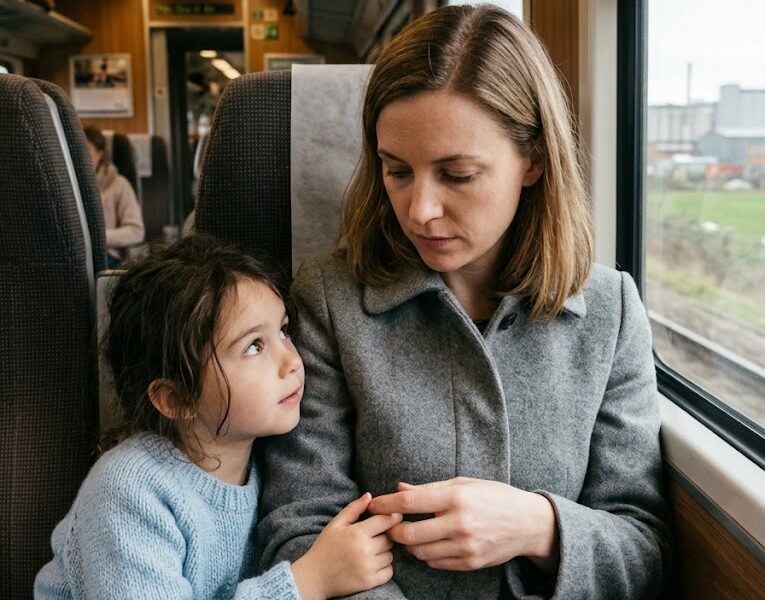
THE DAY MY DIVORCE BECAME FINAL, I DISAPPEARED FROM THE MORETTI FAMILY—FOUR YEARS LATER, MY SON FOUND ME AND ACCUSED MY ADOPTED DAUGHTER OF STEALING HIS MOTHER

The day my divorce became final, my six-year-old son was crying for me.
I knew because the Moretti family’s butler called while I was sitting on a train with a one-way ticket in my coat pocket.
I also knew because I chose not to go back.
“You still have some belongings at the house, Mrs. Moretti,” he said carefully.
“Throw them away.”
There was a pause.
He had served that family long enough to know when silence meant more than words.
“Everything?”
“Everything.”
Outside the train window, the platform slid past in pieces—gray concrete, vending machines, people hugging goodbye, a teenager dragging a red suitcase behind him.
My entire marriage had somehow been reduced to what I carried with me.
A phone.
My ID.
One bank card with barely enough money on it to start over.
And the divorce papers folded inside my purse.
The butler lowered his voice.
“Young Master Leo has been crying for his mother.”
My fingers tightened around the phone.
For one stupid second, my body reacted before my mind did.
My heart jumped.
My throat closed.
I almost asked how long he had been crying.
Almost asked whether he had eaten.
Almost asked if someone had remembered that he hated the crust on his sandwiches and refused to sleep unless the hallway light was left on.
A mother’s habits were cruel that way.
They survived even after the mother herself had been rejected.
Instead, I watched a woman on the platform kiss her little boy’s forehead.
“He’ll have a new mother soon enough,” I said.
The butler went silent.
“The one he always wanted.”
“Mrs. Moretti—”
“My son takes after his father.”
My voice sounded strange to me.
Calm.
Almost amused.
“They even love the same woman.”
I had spent years wondering what was wrong with me.
Why Luca could look through me as though I were furniture in his own house.
Why Leo could run past me to Serena.
Why I could stay awake for three nights beside a feverish child and still somehow be the woman nobody wanted at breakfast.
Why love, when I gave it, always seemed to arrive in the wrong shape.
But something inside me had finally gone quiet.
If Leo didn’t love me, then he didn’t love me.
If Luca never had, then he never had.
There was no dignity in spending the rest of my life begging two people to choose me.
“So be it,” I whispered.
The train doors chimed.
People began boarding.
Before I hung up, I said one final thing.
“Tell Mr. Moretti he can stop worrying.”
“About what?”
I looked down at the pale mark on my ring finger.
“Me.”
The doors started closing.
“I won’t trouble him again as long as I live.”
I ended the call.
Then I removed the SIM card from my phone.
It was ridiculously small.
Years of messages, appointments, photographs, arguments, apologies, birthday reminders, unanswered calls—my entire life with the Morettis seemed somehow connected to that tiny piece of plastic.
I held it between two fingers.
Then dropped it into the trash.
The train began to move.
I did not look back.
That city belonged to Luca Moretti.
From that moment on, it had nothing to do with me.
At least, that was what I believed.
I had forgotten one thing about the Moretti family.
They were very good at finding people.
But I wouldn’t understand how badly I had underestimated that until four years later.
For the moment, all I knew was that I was free.
Or empty.
Sometimes those two feelings are difficult to tell apart.
A little girl sat beside me.
She looked about Leo’s age, maybe slightly younger, with dark hair tied unevenly behind her head and large eyes that seemed permanently prepared for disappointment.
She kept glancing at me.
I ignored her.
Once, I loved children.
After Leo, I wasn’t sure I loved anything.
The little girl’s mother sat on the aisle seat, shouting into her phone.
“You think I care?”
A pause.
“No. You listen to me.”
Half the carriage could hear her.
She cursed.
Hung up.
Called someone else.
Cursed again.
The girl shrank closer to the window.
I put on my headphones.
Not because music was playing.
Because I wanted the world to understand that I was unavailable.
I closed my eyes.
For the first time in years, nobody needed anything from me.
No housekeeper asking where Leo’s school uniform was.
No doctor calling about his allergies.
No Moretti relative quietly correcting the way I held my wineglass at dinner.
No Luca arriving home at midnight smelling like cold air and expensive cologne.
No Serena’s name appearing in conversations that suddenly stopped when I entered the room.
Nothing.
I fell asleep.
I don’t know how long I slept.
What woke me was a small hand tugging at my sleeve.
Once.
Then again.
I opened my eyes.
The girl was staring at me.
“Miss?”
Her voice was barely audible.
I removed one headphone.
“Yes?”
“My mom’s gone.”
I looked toward the aisle.
The seat beside us was empty.
“Bathroom?”
The girl shook her head.
“Can you help me find her?”
Something cold moved through me.
I stood.
The conductor searched the train.
Then another employee came.
Then a police officer who happened to be riding two cars ahead.
They checked the bathrooms.
The café car.
Every carriage.
Nobody found the woman.
Eventually, the conductor checked the station cameras.
Her mother had gotten off at an earlier stop.
Alone.
Worse, she hadn’t left by accident.
According to the employee who reviewed the footage, the woman had stepped onto the platform, looked back repeatedly, and waited until the train doors were nearly closed before walking away.
She had been making sure her daughter didn’t follow.
The moment people understood what had happened, the carriage filled with voices.
“What kind of mother does that?”
“That poor child.”
“Someone should call social services.”
“Heartless.”
They spoke directly in front of her.
As if she were luggage.
The girl sat perfectly still.
That was what bothered me most.
No crying.
No screaming.
No asking why.
She simply folded her hands in her lap and stared at them.
I knew that kind of silence.
It wasn’t courage.
It was what happened when a person learned too early that crying rarely changed the ending.
I crouched in front of her.
“What’s your name?”
She hesitated.
Her answer was so soft I barely heard it.
The officer began asking questions.
Did she know her address?
A phone number?
Grandparents?
Her father’s name?
She knew almost nothing useful.
I watched her answer until something inside my chest began hurting.
Maybe because I saw Leo.
Maybe because I saw myself.
Maybe because there are moments when two abandoned people recognize each other without saying it.
The officer told me authorities would take responsibility for her at the next major stop.
I nodded.
Then I looked at the girl.
She wasn’t looking at the officer.
She was looking at me.
I showed him my identification.
“My name is Ivy Hart.”
He glanced at it.
“I understand.”
“If you need a temporary contact, take my information.”
He looked surprised.
I gave him my hometown address.
“My grandmother’s house is there.”
“Ms. Hart—”
“Until you find her family, I can take care of her.”
He studied me.
Perhaps he saw the swollen skin around my eyes.
Perhaps he saw the divorce papers sticking from my purse.
Perhaps he thought I was insane.
He wouldn’t have been entirely wrong.
That morning I had lost a son.
By evening, I was getting off a train with someone else’s daughter holding my hand.
My hometown station looked almost exactly as I remembered it.
Smaller, somehow.
The old brick walls.
The faded bench outside.
The bakery across the street.
The clock that had been five minutes slow since I was a teenager.
I stood on the platform with my nearly empty bank account, one suitcase, and a child I had met a few hours earlier.
The girl looked up at me.
“Where are we going?”
“Home.”
She frowned.
“Whose home?”
I looked toward the road that led to my grandmother’s house.
For a moment, I had no answer.
Then I tightened my hand around hers.
“Ours, I guess.”
Grandma’s house had been empty long enough for nature to begin reclaiming it.
Weeds reached almost to my knees.
The fence leaned sideways.
Leaves had gathered beneath the porch.
Inside, every room smelled of dust, old wood, and time.
I opened the windows.
The girl followed me from room to room without speaking.
There was still a framed photograph of Grandpa in a drawer.
I cleaned the glass and hung it in the center of the living room.
Then I stood there looking at his face.
Grandpa had died before I married Luca.
Grandma was gone now too.
Everyone who had once made that house feel like home had disappeared.
Except me.
Behind me, the little girl whispered, “Are you sad?”
I turned.
“No.”
She stared at me.
Children can detect lies adults politely ignore.
“You look sad.”
“I’m tired.”
She nodded as if accepting the correction.
That night, she slept in my old childhood bedroom.
I slept on the couch.
Neither of us slept much.
For weeks, I expected someone to come for her.
A father.
An aunt.
A grandmother.
Anyone.
Nobody did.
The authorities investigated.
Calls were made.
Records were checked.
Still nobody arrived.
The girl barely spoke about her old life.
I didn’t force her.
One afternoon, while we were pulling weeds in the backyard, she asked, “Do I have to keep my old name?”
I stopped.
She was holding a weed between her fingers.
“Do you not like it?”
She shrugged.
“I don’t want anything she gave me.”
She didn’t have to explain who she was.
I sat back on my heels.
“What would you like instead?”
“I don’t know.”
I looked around Grandma’s ruined garden.
There had once been roses along the fence.
Peaches near the shed.
Tomatoes growing beside the kitchen window.
Grandma used to say a house without something growing in it was only walls.
I looked at the solemn little girl in front of me.
“Joy.”
Her nose wrinkled.
“What?”
“How about Joy?”
She looked almost offended.
“I don’t smile.”
“Maybe the name can wait for you.”
She thought about that.
Then she nodded.
“Okay.”
So she became Joy.
We cleared the yard together.
I planted vegetables.
Then fruit trees.
Joy followed me everywhere with a watering can almost as big as she was.
We repaired what we could afford to repair.
Ignored what we couldn’t.
Some evenings we ate eggs and rice because that was what remained in the kitchen.
Other evenings I cooked from Grandma’s old recipes.
Joy ate everything without complaint.
That almost made me cry more than if she had been difficult.
Six months later, a judge signed the adoption papers.
The courtroom was small.
There was no Moretti family attorney.
No black cars outside.
No expensive flowers.
No one watching except a clerk and the social worker who had handled Joy’s case.
The judge smiled at her.
“Do you understand what today means?”
Joy nodded.
“You’ll legally be Ms. Hart’s daughter.”
Another nod.
The judge looked at me.
“And you understand that you are accepting full parental responsibility?”
“Yes.”
My voice broke on the word.
The judge pretended not to notice.
When the papers were signed, Joy looked at the document for a long time.
Then she touched her new name with one finger.
Joy Hart.
She looked up.
“That means I have your name?”
“Yes.”
“For always?”
“As long as you want it.”
Her expression became very serious.
“I want it.”
That was the closest she came to smiling that day.
For the first time since leaving the Morettis, I went home and didn’t feel alone.
Joy was not an affectionate child.
She rarely hugged me without warning.
She didn’t climb into my bed after nightmares.
She didn’t say “I love you” every five minutes the way children did in movies.
But she watched.
She remembered.
She noticed.
When I caught the flu, she dragged a stool to the stove and tried to heat soup.
I woke to the sound of a spoon hitting the floor.
I stumbled into the kitchen.
“What are you doing?”
She froze.
The saucepan looked enormous beside her.
“You’re sick.”
“You’re four.”
“I know.”
“You’re not supposed to use the stove.”
Her mouth tightened.
“I was helping.”
I turned off the burner.
Then I crouched beside her.
“You help me by staying safe.”
She stared at the floor.
“I don’t want you to die.”
The words landed harder than they should have.
I touched her cheek.
“I have a fever, Joy. I’m not dying.”
“You don’t know.”
I understood then.
People disappeared from Joy’s world.
That was the rule she had learned.
People could sit beside you on a train.
Then leave at the next station.
People could promise things.
Then vanish.
Love, to Joy, was not warmth.
Love was surveillance.
Making sure I was still there.
I pulled her against me.
For a second, her body remained stiff.
Then her arms wrapped around my neck.
I closed my eyes.
And, against my will, I thought of Leo.
Leo Moretti had never worried about losing anything.
Why would he?
If Leo wanted to ski, the Morettis could arrange an entire private resort.
If he liked a candy, boxes of it appeared at the house.
If he broke a toy, three replacements arrived before dinner.
People called him the Moretti heir before he understood what an heir was.
He was surrounded by guards, drivers, tutors, relatives, servants.
Joy owned three pairs of shoes.
And still, somehow, Joy understood love better.
One night she asked me a question while I was brushing her hair.
“Why did you adopt me?”
I stopped.
She watched me in the mirror.
“Why are you asking?”
“Because I’m just a kid nobody wanted.”
My hand tightened around the brush.
“Who told you that?”
“Nobody.”
“Then don’t say it.”
“But it’s true.”
“No.”
“My old mom left me.”
“That says something about her. Not you.”
Joy lowered her eyes.
“Then why did you want me?”
There were prettier answers available.
I could have told her destiny brought us together.
I could have said I knew immediately she belonged with me.
But Joy had already been lied to enough.
So I told her the truth.
“I was very lonely.”
She turned around.
“So you needed me?”
“Yes.”
“Do you still?”
I smiled.
“Every day.”
She thought about that for a long time.
Then she asked, “Will you stay with me from now on?”
I stroked her hair.
“Yes.”
“Forever?”
I had learned not to promise forever lightly.
But some promises are worth the risk.
“As long as I’m alive.”
Joy nodded hard.
“Okay.”
Then, with the solemnity of someone signing a treaty, she said, “I’ll stay with you forever too.”
Years passed.
Joy started preschool.
Then elementary school.
She became class representative.
Teachers loved her.
Other parents called her mature.
I secretly hated that word.
Children became “mature” because life had demanded something from them too early.
Joy rarely caused trouble.
She did her homework without being told.
Put her dishes in the sink.
Remembered my restaurant schedule better than I did.
She considered most children her age unbearably childish.
So when her teacher called one afternoon and said Joy had gotten into a fight, I genuinely thought she had the wrong child.
“Joy Hart?”
“Yes.”
“My Joy?”
There was an awkward pause.
“Yes, Ms. Hart.”
“What happened?”
“I think it would be better if you came to the school.”
That sentence is designed to terrify parents.
I shut down the kitchen, apologized to two customers waiting for tables, and drove across town.
The teacher was waiting near the entrance.
She looked exhausted.
“Is Joy hurt?”
“No.”
“Did she hurt someone else?”
“Nothing serious.”
“Then what happened?”
“The other student is new.”
I started walking with her.
“Today was his first day.”
“Okay.”
“They had an argument.”
“About what?”
The teacher gave me a strange look.
I stopped.
“What?”
She hesitated.
Then said, “Leo said Joy was trying to take his mother.”
Everything inside me went still.
There are names you can hear after years and feel them physically.
Leo was one of those names.
“What did you say?”
The teacher blinked.
“Joy had a photograph in her pencil case. A picture of the two of you. Leo saw it.”
I couldn’t breathe properly.
“He became upset. He accused Joy of being shameless and said she was trying to steal his mother.”
The hallway seemed to stretch.
The fluorescent lights suddenly sounded too loud.
I stared at the teacher.
“His name.”
“Leo Moretti.”
Four years.
For four years, I had kept my promise.
No calls.
No visits.
No birthday appearances.
No letters hidden inside gifts.
Nothing.
I sent child support every month because Leo was still my son whether he wanted me or not.
But I never interfered.
Never asked what school he attended.
Never asked whether Serena had moved into the house.
Never searched Luca’s name online.
Never allowed myself to know.
I had cut that life away cleanly enough to survive.
And now it had walked into Joy’s classroom.
The teacher touched my arm.
“Ms. Hart?”
“Where are they?”
“In the office.”
I followed her.
At the door she paused.
“There’s something else.”
Of course there was.
“What?”
“Leo’s father is already here.”
My hand stopped on the door handle.
For one second I considered leaving.
Taking Joy.
Driving home.
Packing.
Disappearing again.
But I was not the woman on the train anymore.
And Joy was inside that room.
So I opened the door.
I saw her first.
Joy sat at a table doing homework.
Of course she was.
A fight had apparently occurred, adults were panicking, and Joy had decided multiplication was a better use of her time.
Her pencil moved steadily across the page.
I exhaled.
Then I saw the boy.
He was standing beside the principal’s desk, angry and red-faced.
Older.
Taller.
His hair darker than I remembered.
For one impossible moment I saw him at two years old, asleep against my chest.
Then he turned.
Our eyes met.
The tantrum vanished from his face.
His entire expression transformed.
“Mom!”
He ran.
I had no time to prepare.
Leo hit me with enough force that I had to step backward.
My arms caught him automatically.
Muscle memory.
Motherhood surviving against my permission.
He smelled like clean laundry and expensive shampoo.
For one second, my hands almost closed around him.
Almost.
Then I remembered another room.
Another day.
Another Leo.
I don’t want you to be my mom anymore.
I gently moved him away.
He stared at me.
Confused.
I forced myself to smile.
“Hey, kiddo.”
His eyes were already shining.
“You’ve got the wrong person.”
The room went silent.
Leo’s face changed.
I straightened.
Then I looked past him.
Luca Moretti stood across the room.
Four years had changed him less than I wanted.
His suit was dark.
His expression unreadable.
He had always possessed that unnerving stillness—like every other person in the room was moving too much.
Our eyes met.
My heart did something humiliating.
Then I smiled.
“Hello.”
Luca said nothing.
I walked to Joy.
Closed her notebook.
Put the pencil inside her case.
Slid everything into her backpack.
Joy watched me carefully.
I knew that expression.
She was irritated.
Not because she had fought.
Because Leo had called me his mother.
“Joy,” I said, “go wait for me at the restaurant.”
She glanced at Leo.
Then Luca.
Then me.
“Okay.”
She put on her backpack.
No apology.
No goodbye.
She walked out.
Leo stared after her.
Then turned to me.
“Mom, please don’t be mad.”
I crouched.
He looked terrified.
“I know I was wrong,” he said quickly.
I patted his head.
It was the kind of gesture I might have given a customer’s child.
Leo noticed.
His face fell.
I stood.
Then looked at Luca.
“Mr. Moretti.”
His jaw tightened at the formality.
“Can we talk alone?”
The school had mostly emptied by then.
We stood at the end of a hallway with late-afternoon sunlight pouring through tall windows.
Outside, trees moved in the wind.
For several seconds, neither of us spoke.
There had once been a time when I could identify Luca’s mood by the sound of his footsteps.
Now he felt like a stranger wearing the face of someone I had loved.
He finally broke the silence.
“You wanted to talk.”
“Yes.”
“Then talk.”
I folded my arms.
“What have you been telling Leo about me?”
His brows pulled together.
“What?”
“We’ve been divorced for four years.”
“I know how long we’ve been divorced.”
“For four years, I stayed away.”
His face hardened.
“I never said you didn’t.”
“I never called. Never visited. Never interfered with your family. And every month, the child support went into the account you gave me.”
“You think this is about money?”
“No. I think this is about a child who was young enough to forget me but somehow didn’t.”
Luca said nothing.
I continued.
“Children forget.”
His jaw moved.
“Not everything.”
“Leo barely liked me when I lived with him.”
“That isn’t true.”
I laughed once.
Quietly.
The sound surprised both of us.
“Really?”
Luca looked toward the windows.
That hurt more than if he had argued.
“If nobody had kept talking about me,” I said, “he wouldn’t remember me like this.”
“I didn’t.”
“Then who?”
He was silent.
“Luca.”
“Nona.”
I stared at him.
“Your grandmother?”
“She kept telling him about you.”
“Why?”
“You know Nona.”
Unfortunately, I did.
Luca’s grandmother had been one of the few people in that family who had never treated me as an inconvenience.
Years ago, my grandmother had saved her life.
That old debt was the only reason the Morettis had entered my life at all.
When my grandmother was young, Luca’s grandmother—Nona—had been taken during a conflict involving a rival family.
Grandma had helped bring her home.
The Morettis never forgot debts.
Every Christmas after that, gifts arrived.
Fruit baskets.
Wine.
Flowers.
Money Grandma always tried to return.
The Morettis were the most powerful crime family in their city.
Grandma never spoke proudly of the connection.
Only carefully.
When I got accepted to college there, she worried.
I was eighteen.
Small-town girl.
Big city.
No relatives nearby.
So Grandma made a call she probably regretted for the rest of her life.
She asked the Morettis to look out for me.
The first time I saw Luca, I had just stepped out of the train station carrying too many bags.
A black car waited near the curb.
Two men in suits stood beside it.
And Luca leaned against the rear door, looking at his phone.
I knew immediately which one he was.
Some people are beautiful because of their features.
Luca was beautiful because everything around him seemed to rearrange itself when he entered.
He looked up.
His eyes moved over me once.
“You’re Ivy?”
“Yes.”
He took one of my bags.
That was it.
That was the beginning of the worst decision of my life.
And maybe the best.
Depending on which memory I was trapped inside.
We attended the same college.
We weren’t friends.
Not really.
Sometimes his family sent something for me and Luca delivered it.
Sometimes we passed each other on campus.
He would nod.
I would spend the next twenty minutes pretending my heart wasn’t racing.
Falling for him required no effort.
Expecting him to love me would have been foolish.
So I didn’t.
Or at least I told myself I didn’t.
Then I heard about Serena.
Everyone knew Serena.
She had grown up with Luca.
Beautiful.
Confident.
Perfectly comfortable inside his world.
They loved each other in the exhausting way some people do when they have never learned how to live without conflict.
Together.
Apart.
Together again.
Arguments.
Reconciliations.
Jealousy.
Silence.
I watched from the edge of Luca’s life.
Sometimes it hurt.
But pain is easier when you have no right to complain about it.
By junior year, I had an internship across the city.
The commute was brutal.
One afternoon Luca ran into me near campus.
“How have you been?”
The fact that he asked almost made me stupidly happy.
“Busy.”
“With what?”
“Internship.”
“Where?”
I told him.
“That’s far.”
“Very.”
“How long is your commute?”
“Long enough that I’ve memorized every ad on two subway lines.”
He almost smiled.
A week later, Nona called.
“We have an apartment near your office.”
“I can’t accept that.”
“It’s empty.”
“Nona—”
“Move in.”
Arguing with Nona Moretti was pointless.
So I moved.
Only after I arrived did I realize Luca used the apartment occasionally.
His jackets were in the closet.
His books were on the shelves.
There was coffee he liked in the kitchen.
His presence existed everywhere.
I kept everything I owned inside the guest bedroom.
My toothbrush.
My shoes.
My books.
I tried to move through the apartment without leaving evidence that I existed.
Because by then I understood something dangerous.
I wanted more.
One night, I returned from work late and found Luca asleep on the couch.
Or I thought he was asleep.
He was drunk.
His tie hung loose.
One shoe was on the floor.
I should have gone directly to my room.
Instead, I got a blanket.
I draped it over him.
His eyes opened.
“Ivy.”
I froze.
“Yes?”
He looked at me differently that night.
Maybe because he was drunk.
Maybe because Serena had hurt him.
Maybe because lonely people occasionally reach for whoever is nearest.
I never learned which answer was true.
He caught my wrist.
The room seemed to stop.
I should have pulled away.
I didn’t.
That was the night the line between us disappeared.
And once it disappeared, neither of us ever managed to draw it correctly again.
Years later, standing in the school hallway, I looked at the same man and wondered how two people could share so much history and still have absolutely nothing left to say.
I pushed the memory away.
“Why did Leo transfer here?”
Luca looked at me.
“He insisted.”
My stomach tightened.
“On what?”
“Coming here.”
“To this town?”
“To see you.”
“You expect me to believe a child arranged a school transfer?”
“No.”
“Then who did?”
“I did.”
“Why?”
“He wouldn’t stop asking.”
“You could have said no.”
Luca paused.
“I tried.”
I stared at him.
“You?”
“Yes.”
“You couldn’t say no to a child?”
Something flickered across his face.
“You remember what the family is like with him.”
I did.
Leo was the Moretti heir.
If he wanted something, people rearranged reality until he received it.
I rubbed my forehead.
“This is ridiculous.”
“I know.”
“No, you don’t.”
“Ivy—”
“I left.”
My voice sharpened.
“I did exactly what everyone wanted.”
His eyes narrowed.
“Everyone?”
“You. Serena. Leo.”
“Leo was a child.”
“So was I supposed to stay somewhere my own child told me to leave?”
Luca went quiet.
I regretted the sentence the moment it escaped.
Not because it wasn’t true.
Because truth, once spoken aloud, becomes harder to survive.
I looked away.
“Never mind.”
“Ivy.”
“It’s fine.”
“No, it isn’t.”
I laughed softly.
“Four years late, Luca.”
His face changed.
I could have pushed.
Could have asked why.
Could have demanded an explanation for the years we wasted.
Instead, I looked at the classroom door where Leo waited somewhere beyond it.
“He’ll get tired of this.”
Luca frowned.
“What?”
“Leo.”
I forced a smile.
“Let him stay.”
“You’re okay with that?”
“Once he spends enough time around me, he’ll remember why he didn’t like me.”
Luca stared at me.
I continued before he could interrupt.
“Memories are generous. Maybe he turned me into someone better after I disappeared.”
“Ivy—”
“He’ll realize I’m still exactly who I was.”
My smile widened.
“The irritating mother who says no.”
“I never called you irritating.”
“No. You didn’t have to.”
His expression went cold.
“That’s not fair.”
“No.”
I nodded.
“It probably isn’t.”
That was another thing divorce taught me.
Fairness mattered much less after everything was already broken.
I picked up my purse.
“Let him come to the restaurant.”
Luca looked surprised.
“I’m not promising anything.”
“What does that mean?”
“It means I won’t chase him away.”
“And Joy?”
At her name, I looked at him sharply.
“What about Joy?”
“They fought.”
“They’re children.”
“Leo thinks she took his place.”
“Then Leo needs to learn the world contains things that don’t belong to him.”
Luca’s expression tightened.
“He’s your son.”
“I know.”
“Do you?”
That almost got through my defenses.
Almost.
I stepped closer.
“Be careful.”
His eyes held mine.
“About what?”
“Questioning whether I know who my son is.”
Silence.
Luca looked away first.
That tiny victory felt terrible.
I left the school.
Joy was sitting at our restaurant’s corner table when I arrived.
Her backpack was beside her.
Homework open.
A glass of water untouched.
She didn’t look up.
I put my keys on the counter.
“You hungry?”
“No.”
“Joy.”
“No.”
I washed my hands.
Put on my apron.
Started preparing dinner.
After several minutes, she asked, “Is he really your son?”
The knife stopped against the cutting board.
“Yes.”
She stared at her workbook.
“You never told me.”
“No.”
“Why?”
“I didn’t know how.”
“That’s not true.”
I looked at her.
She finally met my eyes.
“You know how to tell people things.”
Fair point.
“I didn’t want that life following us here.”
“But it did.”
“Yes.”
“Do you love him?”
There it was.
Not anger.
Fear.
The same fear she had carried from that train.
People leave.
Mothers disappear.
Families replace children.
I put down the knife.
“Joy.”
She looked away.
“Look at me.”
Slowly, she did.
“You are my daughter.”
“So is he your kid?”
“Yes.”
“Then who matters more?”
My chest tightened.
“I’m not answering that.”
Her expression hardened.
“Why?”
“Because love isn’t a contest.”
“That’s what adults say when they don’t want to pick.”
I walked around the counter and crouched beside her.
“You want to know whether Leo showing up means I’m going to leave you.”
She said nothing.
“Right?”
Her eyes filled.
She hated crying.
Even now.
Especially now.
I took her hands.
“No.”
“But he’s your real son.”
“You are my real daughter.”
“He has your blood.”
“You have my name.”
“That’s different.”
“Yes.”
I squeezed her fingers.
“It is different.”
She blinked.
I continued.
“You came into my life differently. That doesn’t make you less mine.”
Joy looked at me for a long time.
Then whispered, “He called me shameless.”
“I heard.”
“He said I stole you.”
“You didn’t.”
“I hit him.”
“I also heard that.”
“He deserved it.”
“Probably.”
Her eyes widened.
“But you still can’t hit him.”
“Why not?”
“Because we live in a society.”
For the first time, the corner of her mouth twitched.
There it was.
The almost-smile.
I kissed her forehead.
“You don’t have to fight anyone for me.”
She leaned against my shoulder.
Neither of us heard the door open.
Then a voice behind us said, “I wasn’t fighting for you either.”
Joy immediately pulled away.
Leo stood near the entrance.
Two bodyguards waited outside.
He had apparently heard enough to be offended.
Joy crossed her arms.
“Then why were you yelling?”
“You had my mom’s picture.”
“She’s my mom.”
“She was mine first.”
I closed my eyes.
This was going to be a very long year.
“Leo.”
He looked at me immediately.
That hurt.
Four years earlier, I could call his name five times while he played and get no response.
Now one word stopped him.
“Sit.”
He sat.
Joy looked outraged.
“Both of you.”
She sat too.
I put dinner on the table.
Three bowls.
For several minutes, nobody spoke.
Leo ate.
Then ate faster.
I watched him.
“You like it?”
He nodded.
“What is it?”
He froze.
Joy smirked.
“You don’t even know.”
“I know.”
“What?”
Leo glared at her.
“Food.”
Joy looked at me.
I covered my mouth to hide a smile.
That became our strange routine.
After school, Leo’s bodyguards brought him to the restaurant.
Most days Luca didn’t come.
Leo did homework at a corner table.
Joy ignored him.
Or pretended to.
They argued about pencils.
Chairs.
Who got the last dumpling.
Whether Leo’s private school had been better than their current one.
Whether money could buy intelligence.
Joy told him it obviously couldn’t.
Leo informed her his family could buy the restaurant.
Joy told him she would poison him before signing the contract.
I stopped that conversation immediately.
And yet, beneath the fighting, something shifted.
Leo began watching me.
He watched me serve customers.
Wash dishes.
Carry produce from the delivery truck.
Count the register at night.
Perhaps he had expected to find the woman he remembered.
The Moretti wife.
Silk dresses.
Quiet dinners.
A woman always trying not to embarrass herself in a family where everyone understood rules she had never been taught.
Instead he found me in an apron with flour on my cheek.
He seemed confused by how happy I was.
So was I.
At eighteen, I had dreamed of money.
Career.
A glass office.
I studied computer science because I thought success meant escaping the small town I came from.
Now, almost thirty, I owned a tiny restaurant where I could handle only a handful of tables by myself.
Somehow tourists had discovered us.
Someone posted a video.
Then another.
People started driving in from neighboring towns.
Sometimes there was a line outside.
I should have wanted to expand.
I didn’t.
I wanted enough.
Enough money.
Enough customers.
Enough quiet.
The Moretti world had taught me what happened when nothing was ever enough.
Leo did not understand that yet.
One evening, after closing, he remained at the table.
His bodyguards waited outside.
“Why don’t you come back?”
I was wiping the counter.
“To where?”
“Home.”
“This is home.”
“You know what I mean.”
“Yes.”
“Dad has a bigger house.”
“I know.”
“You’d have people to cook.”
“I like cooking.”
“People could clean.”
“I don’t mind cleaning.”
“A driver.”
“I have a car.”
He became frustrated.
“You wouldn’t have to work.”
I stopped wiping.
“Leo.”
“What?”
“Do you think I’m poor?”
He looked uncomfortable.
“Kind of.”
I laughed.
Actually laughed.
His ears turned red.
“I’m serious.”
“I know.”
“You could have everything.”
I looked around the restaurant.
Wooden tables.
Handwritten specials.
Joy’s backpack behind the counter.
A basket of tomatoes from Grandma’s garden.
“I do.”
He followed my gaze.
His expression made it clear he didn’t understand.
I couldn’t blame him.
Once, neither had I.
He started coming every day.
And every day, another memory returned.
When Leo was a baby, he had loved me.
I know he did.
He wouldn’t sleep unless I held him.
He clung to my shirt.
Followed me from room to room once he learned to walk.
Cried if anyone carried him away.
In the Moretti house, where so many people regarded me as temporary, Leo had been proof that I belonged somewhere.
When the adults’ coldness became unbearable, I went upstairs.
Leo would lift both arms.
“Mommy.”
And suddenly I could breathe again.
Then he grew.
Children do.
He learned words.
Preferences.
Power.
He discovered that everyone around him would say yes.
Everyone except me.
“No more candy.”
“No.”
“Leo, bedtime.”
“No.”
“You cannot throw that.”
“No.”
“Apologize.”
“No!”
I thought I was raising him.
Maybe everyone else thought I was tormenting him.
Serena never said no.
Serena brought gifts.
Serena laughed when he misbehaved.
Serena was beautiful and exciting and belonged naturally beside Luca.
I was the woman taking candy from his hand.
The woman insisting he sleep.
The woman who made him apologize to servants.
Little by little, he stopped reaching for me.
I told myself it was a phase.
Then came the fever.
He burned so hot I was terrified.
For three days and nights, I barely slept.
Doctors came and went.
I stayed.
When he finally opened his eyes and asked for water, I cried in the bathroom where nobody could see me.
Another time, he became obsessed with a toy he had seen somewhere.
It was handmade.
Impossible to buy quickly.
So I made one.
I had no idea what I was doing.
I cut my fingers repeatedly.
The finished thing looked imperfect.
Leo loved it for two days.
Then another toy arrived.
Mine disappeared into a drawer.
I never expected gratitude.
That wasn’t why I did those things.
But I would be lying if I said his eventual disgust didn’t hurt.
Mothers aren’t supposed to admit that.
We’re supposed to love without keeping score.
I did.
But love can be unconditional and still bleed.
Then came the day everything ended.
Luca took Leo out.
Serena went with them.
I wasn’t invited.
That wasn’t unusual.
By then, very little involving Luca and Serena surprised me.
I spent the afternoon alone.
When they returned, I was in the living room.
Leo ran inside first.
Serena followed.
Luca entered last.
Leo looked happy.
I remember that.
I remember thinking at least he had enjoyed himself.
Then he stopped in front of me.
His little face was serious.
“I don’t want you to be my mom anymore.”
I thought I had misheard him.
“What?”
“I want Serena to be my mom.”
The room went silent.
I looked at Serena.
Then Luca.
Neither spoke quickly enough.
Leo continued.
“You don’t deserve to be my mom.”
I could hear my own heartbeat.
“Leo.”
“Get out.”
“Enough,” Luca finally said.
But the word came too late.
Leo pointed toward the door.
“This is my house.”
Something inside me broke so quietly nobody heard it.
Not Serena.
Not Luca.
Not even Leo.
I looked at my son.
The child I had carried.
Fed.
Bathed.
Held through fevers.
The child whose first word had made me cry.
The child I had loved enough to tolerate years of being unwanted.
And suddenly I understood something I should have understood much earlier.
Love does not become noble simply because it is painful.
Sometimes staying is not devotion.
Sometimes it is only refusing to accept that you have already been asked to leave.
I stood.
Leo seemed surprised.
Perhaps he expected an argument.
Perhaps he expected tears.
Perhaps he expected me to beg.
I did none of those things.
I looked at Luca.
He was watching me now.
Finally.
Years of wanting his attention.
And there it was.
At exactly the moment I no longer wanted it.
I removed my wedding ring.
Placed it on the table.
The tiny sound it made against the wood seemed louder than Leo’s shouting.
Serena stopped breathing for a second.
Luca’s face changed.
“Ivy.”
I looked at my son one last time.
Then at the man I had spent years loving.
For once, there was no question left inside me.
No why doesn’t he love me?
No what does Serena have that I don’t?
No how can I make Leo want me again?
Only exhaustion.
And something that felt almost like peace.
Four years later, in my little restaurant, I stood behind the counter watching that same boy finish a bowl of soup.
He looked up.
“Mom?”
The word still hurt.
Not the way it used to.
Different now.
Like touching an old scar and discovering the skin remembers even when the wound is gone.
“Yes?”
Leo hesitated.
“Were you really going to leave forever?”
My hand stopped on the dish towel.
Across the room, Joy looked up from her homework.
Outside, one of the Moretti bodyguards stood beneath the streetlight.
And for reasons I could not explain, I suddenly felt as if Luca were somewhere nearby too.
Waiting.
Watching.
Maybe hoping four years had changed the answer.
I looked at Leo.
There were a hundred things I could have told him.
That children shouldn’t be punished forever for cruel things they said when they were small.
That adults were responsible for the worlds children learned from.
That I had loved him every single day I was gone.
That sometimes I had stood in the grocery store staring at the candy he used to like until my vision blurred.
That every monthly child-support transfer felt like sending money into a grave.
That Joy had never replaced him.
That he had never replaced Joy.
That Serena had never really been the reason I left.
And perhaps even Luca had never been the whole reason.
The truth was simpler.
I had left because one day I finally understood that loving them was destroying me.
I opened my mouth.
Before I could answer, the restaurant door moved.
The bell above it gave one clear chime.
Joy’s pencil stopped.
Leo turned around.
I already knew who had entered before I looked.
Luca Moretti stood just inside the doorway.
He wasn’t wearing the expression I remembered from our marriage.
No impatience.
No coldness.
No distant politeness.
He looked at the three bowls on my table.
At Joy’s backpack beside mine.
At his son sitting in the restaurant he had apparently chosen over a mansion.
Then finally at me.
For the first time since I had known Luca, he looked like a man who had arrived somewhere too late.
Nobody spoke.
The restaurant clock ticked above us.
Joy quietly closed her workbook.
Leo looked between his father and me.
And suddenly I was back in that Moretti living room four years earlier, hearing a little boy tell me he wanted another woman to be his mother.
Only this time, Leo reached across the table.
His fingers closed around my wrist.
Not hard.
Just enough to make sure I couldn’t disappear before he finished what he wanted to say.
“Mom,” he whispered.
His eyes were wet.
“I remember what I said to you.”
My chest tightened.
Luca went completely still.
Joy watched me.
And there, surrounded by the family I had lost and the daughter I had found, I finally understood the cruelest thing about leaving.
Sometimes the people who break your heart realize what they have done.
Sometimes they even come looking for you.
But by the time they find you, the person they hurt no longer exists.
The woman Luca Moretti had married would have given anything to hear her son call her Mom like that.
She would have forgiven almost anything for one tender look from her husband.
She would have walked back into that mansion without asking what it would cost her.
But that woman had boarded a train four years ago with almost nothing.
Somewhere between an abandoned little girl taking her hand, a ruined garden coming back to life, a judge giving Joy her last name, and a tiny restaurant becoming a home, she had disappeared.
I was not her anymore.
Leo’s fingers tightened around my wrist.
Luca took one step toward me.
And Joy quietly slipped her hand into mine beneath the table.
Two children.
Two different kinds of motherhood.
One man I had once loved enough to lose myself for.
And one question none of us yet knew how to answer:
What happens when the family you spent years begging to love you finally comes back—
after you have learned how to live without them?









