THE DAY THEIR REAL DAUGHTER CAME HOME, I LEFT WITH ONE SUITCASE—THEN MY BROTHER OPENED MY EMPTY BEDROOM
The day my parents’ real daughter came home, my mother cried harder than I had ever seen her cry for me.
She stood in the marble foyer of the Whitaker house with both hands pressed to her mouth, staring at the girl she had spent eighteen years searching for.
Behind her, winter sunlight poured through the tall windows and turned everything gold—the staircase, the crystal chandelier, the polished floor, the family portraits lining the walls.
Everything except me.
I stood halfway down the stairs holding one suitcase.
Nobody noticed.
Not at first.
The girl by the front door was named Zoe.
She had round cheeks flushed pink from the cold, soft brown hair tucked behind her ears, and the kind of nervous smile people instinctively wanted to protect. Her coat wasn’t expensive. Her boots had salt stains around the soles. She clutched the strap of a faded canvas bag as though she had walked into a museum and was terrified of touching anything.
My mother stared at her.
Then she whispered, “My baby.”
Those two words nearly knocked the air out of me.
Not because I was jealous.
That was the strange part.
I wasn’t.
For the first time in my life, something finally made sense.
Eighteen years earlier, two families had boarded the same overnight train with two little girls barely old enough to walk.
There had been exhaustion, luggage, blankets, crying children, hurried stops in the dark.
And somewhere in that confusion, two babies went home with the wrong families.
The Whitakers took me.
The Larsons took Zoe.
Years later, my parents discovered that I wasn’t biologically theirs.
They didn’t tell me.
They didn’t send me away.
They simply kept raising me while quietly searching for the daughter they had lost.
That might sound merciful.
It wasn’t.
Because once you understand what happened, you start remembering things differently.
You remember the empty bedroom at the end of the upstairs hallway—the biggest bedroom in the house, always locked when you were little, later kept spotless even though no one slept there.
You remember your mother buying a silver music box and placing it in that room instead of yours.
You remember your father watching other little girls in restaurants with an expression you couldn’t understand.
You remember being eight years old and coming home with a perfect report card.
I had run from the school bus because I couldn’t wait.
I placed the report card beside my mother’s coffee at breakfast.
“Mom.”
She kept reading the newspaper.
“I got first place in my grade.”
A page turned.
I waited.
“Mom?”
“I heard you, Nina.”
That was all.
So I tried harder.
Straight A’s.
Piano competitions.
Debate team.
National academic awards.
Nothing changed.
At thirteen, I decided maybe excellence was the problem.
So I became difficult instead.
I dyed part of my hair blue.
I smoked behind the athletic building even though I hated the taste.
I stayed out until two in the morning with kids I barely liked.
Once, after a fight at school, another girl’s ring split the skin beside my eyebrow.
The principal called home.
My mother arrived forty minutes later.
She didn’t ask whether I was hurt.
She looked at the principal and said, “What does Nina need to do so we can resolve this?”
“I didn’t start it,” I said.
She closed her eyes briefly.
“Nina.”
“But she—”
“Apologize.”
“Mom—”
“I don’t have time for this.”
So I apologized.
The other girl smiled because everyone at school already knew what I hadn’t figured out yet.
Nobody was coming to defend me.
Except Ethan.
Ethan was four years older than me, and for most of my childhood, he was the only person in the Whitaker house who made me believe I belonged there.
When I was seven, he carried me downstairs on his shoulders even after Dad told him to stop.
When I was ten, he sat through an entire piano recital after our parents sent the driver because they were “caught up at dinner.”
When I was fourteen and the police called because of that stupid fight, Ethan got there before our parents did.
He stormed into the station furious.
Then he saw the cut beside my eye.
His anger disappeared.
He crouched in front of me and touched my cheek so gently I nearly cried.
“Does it hurt?”
“No.”
“Liar.”
“I’m fine.”
He sat beside me until they released me.
Outside, he pointed at his hair dramatically.
“See this?”
“What?”
“Gray hairs.”
“You don’t have gray hair.”
“I have thousands. You gave me every one of them.”
I laughed.
He didn’t.
Halfway home, he stopped walking.
When I turned around, his eyes were wet.
“Can you just be okay?” he asked.
I stared at him.
“I’m serious, Nina. I’m begging you. Whatever you’re angry about, whatever Mom and Dad do… don’t destroy yourself because of it.”
That night ended my rebellion.
Not because my parents cared.
Because Ethan did.
For years, that was enough.
Then, six months before Zoe came home, everything changed.
I remember the evening because Ethan wouldn’t look at me.
Dad had called us into his study.
Mother sat beside the fireplace with her hands clasped so tightly her knuckles were white.
I thought somebody was dying.
Instead, Dad said, “We need to tell you something about Nina.”
Something about me.
But he looked at Ethan.
Not me.
He explained the train.
The babies.
The DNA tests.
The private investigators.
The search.
The girl named Zoe.
I sat very still.
Ethan went pale.
“You knew?” I asked.
Mother looked down.
“For how long?”
Silence.
“How long?”
Dad finally answered.
“Several years.”
I laughed.
It came out wrong.
“You’ve known for years that I’m not your daughter?”
“Nina—”
“And nobody thought maybe I should know?”
“We were trying to protect you,” Mother said.
That was the first lie that made me angry.
“Protect me from what?”
No one answered.
I looked at Ethan.
He had always been my safe place.
“Ethan?”
He stared at the carpet.
“Ethan, look at me.”
He did.
And I knew immediately that I had lost him too.
Not because there was hatred in his face.
Something worse.
Guilt.
But I was nineteen and terrified, and terrified people don’t always understand what they’re seeing.
I thought it was rejection.
Over the next six months, Ethan stopped coming into my room.
Stopped texting me stupid memes.
Stopped stealing food off my plate.
Stopped asking where I was going.
If I entered a room, he sometimes found a reason to leave.
I tried everything.
“Ethan, want coffee?”
“No, thanks.”
“Are you watching the game?”
“Maybe later.”
“Did I do something?”
“No.”
“Then why won’t you talk to me?”
“I’m busy, Nina.”
Eventually, I stopped asking.
The person who had taught me that I was worth protecting had joined everyone else in pretending I wasn’t there.
That hurt more than learning my parents weren’t really mine.
Then Zoe was found.
And on the morning she was supposed to arrive, Mrs. Whitaker called me into the study.
I stopped thinking of her as Mom around then.
Not out loud.
Only inside my head.
It was easier.
She stood behind Dad’s desk, although Dad wasn’t home yet.
“You understand this is going to be difficult for everyone.”
I nodded.
“Especially Zoe.”
Another nod.
“She’s lost eighteen years.”
So had I.
I didn’t say it.
Mrs. Whitaker folded her hands.
“We’ll continue supporting you through college if you decide to remain here.”
Remain.
Like a tenant.
“Or?”
She hesitated.
“You can go with the Larsons.”
“My biological parents.”
“Yes.”
“Do they want me?”
The question escaped before I could stop it.
Something flickered across her face.
Perhaps pity.
That somehow hurt more than cruelty.
“They’ve asked to take you home.”
Home.
I almost laughed.
“Okay.”
She blinked.
“Okay?”
“I’ll go.”
“Nina, you don’t need to decide immediately.”
“I just did.”
“Nina—”
“You found your daughter.”
Her mouth tightened.
“And apparently my parents found theirs.”
I walked upstairs.
Nineteen years of my life fit into one suitcase.
That was the strangest discovery of all.
I left the jewelry.
The designer handbags.
The expensive dresses Mrs. Whitaker’s assistant had ordered because nobody knew what I liked.
I left the trophies.
I left the framed school certificates.
I even left the piano music Ethan had once bought me for Christmas.
I packed jeans, sweaters, underwear, socks, toiletries, three books and an old photograph of Ethan holding me on his shoulders when I was six.
Then I stared at the photograph for almost a minute.
I put it back on the shelf.
If he wanted me gone, I wasn’t going to carry a ghost with me.
By the time I came downstairs, Zoe had arrived.
And that was when I saw Mrs. Whitaker cry.
Zoe looked overwhelmed when Mrs. Whitaker embraced her.
Dad came in moments later and froze.
For a second, nobody moved.
Then Zoe whispered, “Dad?”
He crossed the room in three steps.
I had never seen my father move that quickly toward anyone.
He wrapped his arms around her.
His shoulders shook.
I looked away.
That was when I noticed the couple standing near the door.
The Larsons.
My real parents.
My biological mother wore a navy wool coat that had clearly been chosen carefully for the occasion. My father had broad shoulders, rough hands and a tie that looked as though someone else had tied it for him.
They were staring at me.
Not politely.
Not cautiously.
Staring.
As if they were trying to memorize eighteen missing years in a single moment.
My father swallowed.
“That’s our girl.”
Something inside my chest shifted.
I didn’t know what to say.
So I said nothing.
He approached slowly.
“Can I?”
I didn’t understand until he reached for my hand.
I let him take it.
His palm was rough.
Warm.
Unreasonably warm.
My mother touched my shoulder.
“You must be Nina.”
“Yes.”
Her eyes filled instantly.
She smiled anyway.
“I’m Laura.”
Not Mom.
Laura.
She didn’t force the word.
That mattered.
Mrs. Whitaker suggested we show Zoe her room.
Everyone moved upstairs.
I followed because I didn’t know where else to go.
The bedroom at the end of the hallway was open.
For the first time.
Zoe stepped inside.
Her mouth fell open.
The room was beautiful.
Cream walls.
A canopy bed.
A walk-in closet already filled with clothes.
Jewelry covered the vanity.
Photographs of the Whitaker family sat on one shelf beside empty silver frames waiting for pictures of Zoe.
Mrs. Whitaker touched a necklace.
“I’ve been saving these things for you.”
Zoe stared at the closet.
“Wow.”
Then she gave a nervous laugh.
“I really hit the jackpot.”
Nobody laughed.
Mrs. Whitaker’s face crumpled.
“You should have had all of this.”
Zoe’s smile faded.
“I had a good childhood.”
“I know, sweetheart, but you shouldn’t have had to struggle.”
“We didn’t struggle that badly.”
Mrs. Whitaker turned toward Laura.
“What does she do now?”
Zoe answered.
“I work at a bakery.”
Mrs. Whitaker looked horrified.
“A bakery?”
Zoe blinked.
“I like baking.”
“My daughter shouldn’t have to work behind a counter.”
The room changed.
Laura’s hand closed around mine.
Mrs. Whitaker glanced at me.
And there it was.
The resentment I had spent my childhood trying to understand.
You had what belonged to her.
Maybe she never said it aloud.
She didn’t have to.
Laura saw it too.
She stepped between us.
“What are you looking at her like that for?”
Mrs. Whitaker stiffened.
“Excuse me?”
“This was an adult mistake.”
“Laura,” my father murmured.
“No.”
Her voice shook.
“You don’t get to look at my daughter like she stole something.”
Mrs. Whitaker’s expression hardened.
“Your daughter lived in this house with every advantage imaginable.”
“And yours lived with us and was loved every single day.”
“Are you suggesting Nina wasn’t cared for?”
“I’m suggesting I spoke to the nanny.”
Silence.
Laura stepped closer.
“And your housekeeper.”
Mrs. Whitaker went pale.
“I know what they heard. I know how that little girl grew up thinking she had to earn someone looking at her.”
“She had the best schools.”
“Children don’t hug schools when they’re scared.”
My breath caught.
Mrs. Whitaker pointed toward the door.
“I will not be insulted in my own home.”
Laura laughed once.
“You lost your baby because you picked up the wrong child on a train, and somehow you spent eighteen years punishing the child you picked up.”
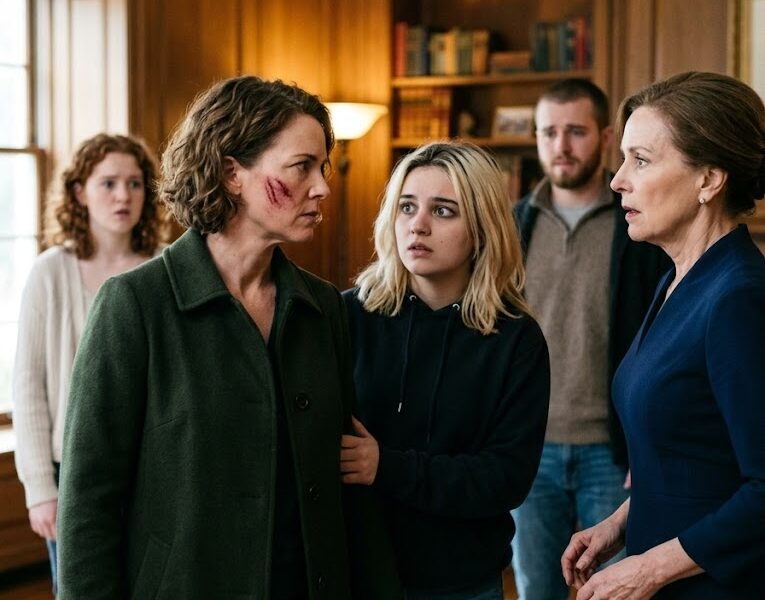
Mrs. Whitaker slapped her.
Everything happened at once.
Dad shouted.
My biological father moved forward.
Zoe screamed.
Laura grabbed Mrs. Whitaker’s sleeve.
Someone knocked over a lamp.
For perhaps fifteen seconds, two respectable middle-aged women became furious mothers clawing at each other in a bedroom filled with expensive jewelry.
Zoe finally pushed between them.
“Stop!”
The room went silent.
Laura’s hair was crooked.
Mrs. Whitaker had three red scratches across her cheek.
Laura grabbed my hand.
“We’re leaving.”
Downstairs, my legs were shaking.
At the front door, Laura leaned close to me.
“I got her good.”
I stared at her.
She whispered, “Couple kicks too.”
My mouth fell open.
“Laura.”
“She’ll be sore tomorrow.”
Then her expression changed.
The humor disappeared.
“Nobody gets to bully you anymore.”
I couldn’t breathe.
“If someone hurts you,” she said, “you tell me.”
She squeezed my hand.
“I’ll deal with them.”
The words were so ordinary.
That was what broke me.
I had spent nineteen years thinking protection was something you earned by being good enough.
Apparently, some mothers simply gave it away.
At the door, I hesitated.
Laura noticed.
“Forget something?”
I looked toward the driveway.
I had hoped Ethan might come back before we left.
Just once.
I asked the nanny, “Is Ethan home?”
“Not yet.”
I waited another ten seconds.
Then twenty.
Laura didn’t rush me.
Finally, I looked down.
“It’s nothing.”
I picked up my suitcase.
“Let’s go.”
The train north took nearly two days.
The irony wasn’t lost on me.
A train had delivered me to the wrong family.
Now another one was carrying me back.
Outside the window, cities became towns, towns became fields, and fields disappeared beneath snow.
Laura kept asking whether I was hungry.
My father—Mark—kept pretending he wasn’t watching me.
Neither asked me to call them Mom or Dad.
That helped.
At some point during the second night, I woke and found Laura asleep across from me.
Her hand was still resting on the edge of my blanket.
As though even unconscious, she was making sure I was there.
I turned toward the window before anyone could see me cry.
We reached northern Minnesota the following afternoon.
The cold hit like a physical object.
Before I could react, something enormous dropped over my head.
I fought my way out of a thick down coat and found a tall young man laughing at me.
He had dark eyes, wind-reddened cheeks and the shoulders of someone who spent more time working outside than inside a gym.
“I’m Jake.”
I stared.
He grinned.
“Your brother.”
He opened his arms.
I took one step backward.
His grin vanished.
“Too soon?”
I nodded.
“Got it.”
He pointed at himself.
“Jake. Brother. No touching without authorization.”
Laura smacked the back of his head.
“Don’t overwhelm her.”
“I’m being welcoming.”
“You’re being an idiot.”
“That’s how I welcome people.”
I laughed.
It escaped before I could stop it.
All three of them looked at me.
I immediately stopped.
Jake pointed triumphantly.
“She likes me.”
“I laughed at you.”
“Even better.”
Outside the station, the snow had turned gray beside the curb.
Jake looked at my boots.
“Those are city boots.”
“They’re boots.”
“They’re decorative suggestions.”
Before I understood what he meant, he lifted me off the ground.
“Jake!”
“Snow emergency.”
“Put me down!”
“Can’t. You’re family now. Liability issue.”
He carried me to an old pickup while I protested.
Mark opened the door.
A cup of hot chocolate waited in the holder.
“For you.”
I wrapped both hands around it.
It was too sweet.
I drank every drop.
During the drive, Laura pointed through the windshield.
“That’s your uncle Peter’s place.”
Two houses later:
“Your aunt Diane.”
Then:
“Your cousin Matt lives there.”
Jake groaned.
“Don’t give her the entire census.”
“I want her to know everyone.”
“She’ll escape before dinner.”
I looked outside.
Half the street seemed connected to them.
For someone who had grown up in a mansion where four people could go an entire evening without speaking, the idea was terrifying.
And strangely wonderful.
When the truck turned onto a narrow road, Laura and Mark suddenly became suspiciously quiet.
Jake covered my eyes.
“No peeking.”
“What are you doing?”
“Kidnapping you.”
“Jake.”
“Fine. Welcoming.”
The truck stopped.
They led me several steps.
“Okay.”
Jake removed his hands.
A little two-story house glowed in front of me.
Christmas lights covered the porch.
Someone had hung a crooked wreath on the door.
An inflatable snowman leaned drunkenly toward the driveway.
Before I could say anything—
Pop.
Pop.
Pop.
Streamers exploded over my head.
People shouted from the porch.
“Welcome home!”
I froze.
There were relatives.
Neighbors.
Children.
Someone held a homemade sign.
Someone else had baked a cake.
They knew my name.
These people who had never met me knew my name.
Laura watched my face anxiously.
“Too much?”
I nodded.
Her smile collapsed.
Then I whispered, “But good too much.”
She covered her mouth.
Inside, she immediately dragged me upstairs.
“We made your room.”
That sentence scared me.
I’d seen what a prepared bedroom could mean.
The door opened.
Flowers.
Everywhere.
Huge roses on the comforter.
Smaller roses on the curtains.
A red plaid cloth over the desk.
Nothing matched.
It looked like a garden center had exploded inside a lumberjack convention.
I stared.
Nobody spoke.
Finally Laura slapped Mark’s arm.
“I told you the roses were too much.”
“You picked the curtains!”
“You picked the comforter.”
“They matched online.”
“They absolutely do not match.”
Mark looked at me helplessly.
“We can change everything.”
I sat on the bed.
The comforter was warm from the dryer.
It smelled like detergent.
Like somebody had washed it that morning because they wanted it ready when I arrived.
I ran my fingers across one ridiculous red rose.
“I like it.”
Laura stopped arguing.
“You don’t have to pretend.”
“I’m not.”
I looked around.
“I really like it.”
She turned away quickly.
Mark suddenly became fascinated by the ceiling.
Jake muttered, “Great. Now everybody’s crying.”
“I’m not crying,” Laura said.
“You are aggressively not crying.”
Downstairs stood a secondhand piano.
One key was slightly yellow.
Mark rubbed the back of his neck.
“The Whitakers said you still play.”
I touched the wood.
“So we found this.”
“It’s used,” Laura added quickly.
“We can get something better later.”
Something better.
I sat down.
Played the first simple piece that came to mind.
When I finished, the three of them applauded so loudly I jumped.
Mark pointed at himself.
“Musical talent. Obviously from me.”
Laura stared at him.
“You couldn’t sing ‘Happy Birthday’ correctly until you were thirty.”
“Genetics can skip the person carrying them.”
Jake wrapped an arm around the back of my chair without touching me.
“Official family statement: she got it from me.”
“You don’t play anything,” Mark said.
“I sang to her when she was a baby.”
Laura snorted.
“You were five.”
“Exactly. Formative years.”
They argued.
Over me.
Not about whose fault I was.
About who got credit for me.
I sat at that scratched piano beneath the yellow kitchen light and felt something terrifying begin to happen.
I wanted to stay.
Back in Chicago, Ethan Whitaker came home after dark.
He knew Zoe had arrived.
He had spent the entire day avoiding the house because he had no idea how to face his biological sister.
Six months earlier, his parents had told him the truth.
They had explained the train.
But there was one detail that had destroyed him.
Ethan had been five years old.
He remembered that trip.
Not clearly.
Fragments.
His mother’s tired voice.
A station announcement.
A sleeping toddler.
And one sentence.
“Keep an eye on your sister for me.”
Then chaos.
For eighteen years, he had forgotten.
When his parents told him Zoe had been switched, the memory returned like a knife.
Keep an eye on your sister.
He became convinced that somehow he had failed her.
So whenever he looked at Nina, he didn’t see an impostor.
He saw the child he had loved.
And the sister he believed he’d lost because he hadn’t been watching closely enough.
Guilt made him stupid.
Instead of explaining, he withdrew.
Every time Nina called him her brother, he thought of Zoe.
Every time he comforted Nina, he wondered who had comforted Zoe.
Every time Nina smiled at him, he remembered another little girl growing up somewhere else.
He thought distance would make things simpler.
Instead, it made him cruel.
When he entered the house that night, he saw the scratches on his mother’s face.
“What happened?”
“That family came.”
“Larsons?”
“They’re gone.”
Ethan looked toward the stairs.
“Where’s Nina?”
Nobody answered.
Zoe sat in the living room.
She smiled uncertainly.
“You must be Ethan.”
He looked at her.
His real sister.
She was nothing like the frightened child he had imagined.
She talked easily.
She told him about Minnesota.
About baking.
About Jake.
About Mark teaching her to drive an old truck.
About Laura staying awake with her whenever she was sick.
The more she spoke, the stranger Ethan felt.
Zoe hadn’t been miserable.
The Larsons didn’t have Whitaker money.
But they had loved her.
He found himself thinking he could help her open a bakery.
She wouldn’t even need to make money.
He could buy the building.
She could bake whatever made her happy.
The thought comforted him.
Until dinner.
Nina’s chair was empty.
He noticed immediately.
“Is Nina eating upstairs?”
His mother didn’t respond.
Ethan assumed Nina was upset.
Of course she was.
He’d take food upstairs later.
He spent dinner listening to Zoe while glancing repeatedly toward the staircase.
When everyone finally went to their rooms, he made a sandwich the way Nina liked it and carried it upstairs.
He knocked.
“Nina?”
Nothing.
“Come on.”
Silence.
He knocked again.
“I brought food.”
The nanny came around the corner.
She stopped when she saw him.
“Mr. Ethan?”
“What?”
Her expression changed.
“Miss Nina left this afternoon.”
The plate tilted in his hand.
“What do you mean left?”
“With the Larsons.”
He stared at her.
“No.”
“I’m sorry?”
“She didn’t leave.”
The nanny said nothing.
Ethan opened Nina’s door.
Darkness.
He switched on the light.
The room looked almost exactly the same.
That was the worst part.
Designer clothes remained in the closet.
Jewelry remained in drawers.
Awards remained on shelves.
She had taken so little that a stranger might not realize anyone had moved out.
Then Ethan saw the empty spaces.
Her toothbrush.
Her favorite sweater.
Three books.
The old duffel bag she’d used for school trips.
Gone.
His eyes landed on the photograph.
Six-year-old Nina on his shoulders.
He picked it up.
She had left that too.
Something inside him collapsed.
He ran downstairs.
“What did you do?”
His mother looked up.
“Ethan?”
“Where is she?”
“We told you. She chose to go.”
“You let her?”
His father lowered his glass.
“She’s nineteen.”
“You let her leave without telling me?”
His mother stood.
“You’ve barely spoken to her in six months.”
The sentence hit perfectly.
Because it was true.
Ethan looked at the scratches on her face.
“What did you say to her?”
“Nothing unreasonable.”
“What did you say?”
“We gave her a choice.”
His stomach turned.
“What choice?”
“Stay here while we support her through graduation, or go live with her biological family.”
Ethan stared at her.
“You made her choose whether she was still part of this family?”
“Don’t twist my words.”
“Did anyone tell her she was still your daughter?”
Silence.
“Mom.”
His voice broke.
“Did you?”
Mrs. Whitaker looked away.
Ethan laughed once.
It sounded almost like a sob.
“Oh my God.”
He took out his phone.
Called Nina.
Straight to voicemail.
Again.
Voicemail.
Again.
Nothing.
He texted.
Nina, call me.
Then:
Please.
Then:
I didn’t know you were leaving.
He stared at the screen.
Finally:
I’m sorry.
No answer came.
In Minnesota, my phone vibrated on the nightstand.
I saw Ethan’s name.
I turned it facedown.
For years, I would have given anything for him to call me.
Now I couldn’t make myself answer.
The next morning, I woke at six because someone was arguing downstairs.
“She likes pancakes.”
“How do you know?”
“Everyone likes pancakes.”
“What if she likes eggs?”
“Make both.”
“Jake, stop eating the bacon!”
“I’m quality control.”
I lay under the ridiculous rose comforter listening.
Nobody knew I was awake.
Nobody was performing for me.
They were simply trying to figure out breakfast.
I covered my mouth with my hand.
That was the morning I finally cried.
Not when I learned I’d been switched.
Not when Mrs. Whitaker gave me a choice.
Not when Ethan stopped speaking to me.
I cried because someone downstairs was worried about whether I preferred pancakes or eggs.
Healing, I learned, can be humiliatingly small.
It happened when Mark scraped ice from my car without mentioning it.
When Laura bought three brands of shampoo because she didn’t know which one I used.
When Jake texted me from twenty feet away:
Mom says stop pretending to study and come eat.
It happened when my aunt handed me an old photograph of myself as a baby.
Jake was sitting beside me in it.
Five years old.
One hand rested protectively on my blanket.
“You used to follow him everywhere,” she said.
I stared at the picture.
“Really?”
“Oh, he was obsessed with you.”
That evening I found Jake repairing a snowblower in the garage.
I held out the photograph.
“You remember me?”
His wrench stopped.
He wiped his hands.
“Some.”
“How much?”
He leaned against the workbench.
“You used to scream if Mom put you down.”
I smiled.
“Sounds charming.”
“You were a nightmare.”
“Thanks.”
“You also followed me around.”
He looked at the photograph.
“Then one day you were gone.”
His voice changed.
I waited.
“Mom and Dad thought they’d somehow lost you. They nearly destroyed themselves over it.”
I looked toward the house.
“Did you?”
Jake smiled without humor.
“I was five.”
“So was Ethan.”
Jake frowned.
I hadn’t meant to say it.
But there it was.
For the first time, I told someone about him.
Everything.
How Ethan had been my real family inside the Whitaker house.
How he changed after learning the truth.
How he stopped looking at me.
When I finished, Jake was quiet.
Then he asked, “You still love him?”
“He’s my brother.”
“Biologically, no.”
I looked at him.
Jake shrugged.
“Family isn’t a DNA contest.”
That sentence stayed with me.
Back in Chicago, Ethan sent messages for three weeks.
I didn’t answer.
He called Laura.
She refused to put me on.
“She needs time.”
“I need to explain.”
“You had six months.”
“I know.”
“Then live with knowing.”
He did.
Zoe noticed.
One evening, she found him sitting in Nina’s empty room.
“Was she your sister?”
Ethan looked up.
Zoe stood in the doorway.
“Yes.”
“Then why did you stop treating her like one?”
He looked down.
“Because I thought loving her meant betraying you.”
Zoe stared at him.
“That’s stupid.”
He almost smiled.
“I know.”
“No, I mean really stupid.”
“I got it.”
“The Larsons never stopped loving me because they found Nina.”
Ethan looked at her.
Zoe folded her arms.
“They cried when I left. Mom packed food for the train like I was going to war. Dad checked the weather six times. Jake threatened to come get me if anybody here treated me badly.”
Ethan swallowed.
“They loved me and wanted Nina back.”
She stepped farther into the room.
“Both things can be true.”
That was the lesson everyone else seemed to understand before the Whitakers did.
Love did not have to be transferred like ownership.
One daughter didn’t need to disappear for another to return.
But damage had already been done.
Months passed.
I enrolled in college closer to the Larsons.
The Whitakers continued paying my tuition because the arrangement had already been made, but I stopped using their money for anything else.
I found a part-time job at the town library.
Laura hated that.
“You don’t need to work.”
“I want to.”
“You’re studying.”
“So?”
She frowned.
I smiled.
“Sound familiar?”
She realized what she’d said about Zoe’s bakery and groaned.
“Fine. Work.”
Jake whispered, “Historic defeat.”
Laura threw a dish towel at him.
I learned ordinary things.
How to shovel snow badly.
How to make Mark’s chili.
How to drive on ice.
How loud a family could be when nobody was angry.
Then one February afternoon, the library receptionist called me.
“Someone’s here for you.”
I walked toward the front desk.
Ethan stood there.
Snow melted on the shoulders of his black coat.
He looked exhausted.
For a second, neither of us spoke.
Every old instinct in me woke at once.
Run to him.
Hug him.
Ask whether he’d eaten.
Tell him everything.
Instead I stopped ten feet away.
“What are you doing here?”
His eyes moved over my face.
“I wanted to see you.”
“You’ve seen me.”
I turned.
“Nina.”
I stopped.
“I was wrong.”
I closed my eyes.
Those were the words I’d wanted six months earlier.
Now they felt late.
“I thought Zoe being gone was my fault,” he said.
I faced him again.
“What?”
He told me about the train.
The memory.
His mother’s instruction.
Keep an eye on your sister.
“I was five,” he said. “But when Mom told me what happened, all I could think was that I lost her.”
“So you punished me.”
“No.”
“That’s what you did.”
He flinched.
“I know.”
“No, Ethan. You don’t.”
My voice shook.
“You were the only person in that house I trusted.”
People nearby had begun looking at us.
I didn’t care.
“When I found out they weren’t my parents, I thought at least I still had you.”
His eyes filled.
“And then you looked through me exactly the way they did.”
“I was ashamed.”
“So was I.”
“I didn’t know how to love you and grieve what happened to Zoe at the same time.”
“You could’ve asked me.”
“I know.”
“You could’ve told me.”
“I know.”
“You could’ve done literally anything except make me feel disposable.”
He lowered his head.
“I know.”
That took some of the anger out of me.
Not because it fixed anything.
Because he didn’t defend himself.
He reached into his coat.
For one wild second I expected the photograph.
Instead he handed me a small wrapped box.
I didn’t take it.
“What is it?”
“Open it later.”
“Ethan—”
“Please.”
I took it.
He left.
Inside was the silver medal from my first statewide piano competition.
I’d thought it was lost.
Under it was a folded note.
You thought nobody saw you.
I did.
Then when you needed me most, I chose my guilt instead of you.
I can’t ask you to forgive that.
But you were my sister before I understood DNA, and you are my sister now.
I should have been brave enough to know the difference between losing one sister and abandoning another.
I sat behind the library desk and cried so hard my coworker quietly put up the CLOSED sign ten minutes early.
I didn’t call Ethan that night.
Or the next.
Forgiveness isn’t a door.
Sometimes it’s a hallway.
Sometimes you stand at one end while the person who hurt you stands at the other, and neither of you knows whether you’ll ever meet in the middle.
But I stopped deleting his messages.
That spring, Zoe opened a small bakery in Chicago.
Ethan helped with the lease.
She refused to let him buy the building.
“I want customers, not charity.”
Mrs. Whitaker hated that.
Zoe did it anyway.
Something else changed too.
Zoe didn’t become the daughter Mrs. Whitaker had imagined.
She didn’t like galas.
She hated designer clothes.
She refused to quit baking.
She called Laura every Sunday.
Sometimes twice.
At first, Mrs. Whitaker couldn’t understand it.
Then, slowly, painfully, she began to.
Blood had returned Zoe to the Whitakers.
It had not erased the Larsons.
And blood had returned me to the Larsons.
It had not erased Ethan.
A year after I left Chicago, Zoe invited both families to the bakery’s anniversary.
I almost didn’t go.
Laura didn’t pressure me.
Neither did Mark.
Jake offered to drive.
“Why?”
“In case you need an extraction.”
“From a bakery?”
“I’m prepared for anything.”
We went.
Mrs. Whitaker stood near the window when I entered.
She looked older.
For the first time, she didn’t walk toward me as though she had a right to.
“Nina.”
“Mrs. Whitaker.”
Her face tightened at the name.
But she accepted it.
“I owe you an apology.”
I said nothing.
She looked around the bakery.
Zoe was laughing with Laura near the kitchen.
Mark and Dad were having an awkward conversation about baseball.
Jake was stealing pastries.
Ethan stood across the room.
Watching me.
Mrs. Whitaker followed my gaze.
“I spent years believing someone had taken my daughter from me,” she said.
Her voice was quiet.
“When the truth was that another little girl had been placed in my arms.”
My throat tightened.
“I thought loving you would mean accepting that Zoe might never come back.”
She swallowed.
“So I kept part of myself away from you.”
I looked at her.
“You kept almost all of it away.”
“I know.”
For once, she didn’t argue.
“I can’t change your childhood.”
“No.”
“I can’t ask you to call me Mom.”
“No.”
Her eyes filled.
“But I am sorry.”
I believed her.
That didn’t mean everything healed.
Some apologies are not bridges.
They’re gravestones.
They mark where something died and acknowledge that it existed.
I nodded.
“Thank you.”
Then I walked away.
Ethan was waiting near the back door.
“Hey.”
“Hey.”
It had been nearly a year since we’d stood together without anger between us.
He nodded toward Jake.
“Your brother looks like he’s about to steal an entire cheesecake.”
“He probably is.”
“I’m calling security.”
“He’s six-four.”
“Never mind.”
I laughed.
Ethan smiled.
There it was.
The old warmth.
Changed.
More careful now.
“Can I ask you something?” he said.
“Depends.”
“Do you still play?”
“Sometimes.”
“Mom said you stopped.”
“Laura says I should play more.”
He noticed the word.
Laura.
Not Mom.
Not yet.
Maybe one day.
Maybe never.
He nodded.
“I kept your sheet music.”
I looked at him.
“Why?”
“Because I hoped you’d want it.”
There were a thousand things we still needed to say.
A thousand wounds that wouldn’t disappear because we stood beside a bakery door sharing an awkward smile.
But healing doesn’t always announce itself.
Sometimes it simply stops feeling impossible.
That Christmas, I stayed in Minnesota.
Zoe came too.
So did Ethan.
The Whitakers didn’t.
Not because they weren’t invited.
Because Mrs. Whitaker finally understood that some reunions needed space.
Snow fell all afternoon.
Mark burned the ham.
Laura blamed the oven.
Jake blamed Mark.
Zoe brought enough pastries to feed half the county.
After dinner, I sat at the secondhand piano.
The yellow key was still yellow.
One note still sounded slightly wrong.
Nobody cared.
I began playing.
Laura leaned against Mark.
Zoe sat cross-legged on the rug.
Jake sang deliberately off-key until everyone yelled at him.
Ethan stood in the doorway.
For a moment, I saw two versions of my life at once.
The mansion in Chicago where I had everything except the certainty that I was wanted.
And this little Minnesota house with mismatched furniture, bad Christmas lights, a broken snowman in the yard and too many people squeezed around one table.
When the song ended, nobody spoke.
Then Mark wiped his eyes.
“That’s my girl.”
Laura immediately said, “She gets it from me.”
Jake groaned.
“Not this again.”
Zoe laughed.
Ethan looked at me.
And this time, he didn’t look away.
Later that night, I stepped outside.
Snow had buried the road.
The house glowed behind me.
Ethan joined me on the porch but kept his distance.
After a while he said, “Do you remember when you were fourteen and I asked you to just be okay?”
I smiled faintly.
“Yeah.”
“I’ve thought about that a lot.”
“So have I.”
He shoved his hands into his pockets.
“Were you?”
“What?”
“Okay?”
I watched snow collect along the porch railing.
For nineteen years, I’d believed being okay meant being wanted by the Whitakers.
Then I believed it meant escaping them.
Later, I thought it meant forgiving Ethan.
I had been wrong every time.
Being okay wasn’t something another person could grant me.
It wasn’t proof that the past hadn’t hurt.
It wasn’t pretending the wrong family hadn’t raised me or that the right family could magically restore eighteen missing years.
It was simpler.
Harder.
It was knowing I no longer had to audition for love.
I looked through the window.
Laura was chasing Jake with a dish towel.
Zoe was laughing.
Mark was attempting to rescue the leftovers.
Someone had turned the Christmas lights on even though half the strand no longer worked.
Then I looked at Ethan.
“Yeah,” I said.
His eyes reddened.
“Finally.”
He nodded.
Neither of us hugged.
We didn’t need to.
Inside, Laura shouted my name.
“Nina! Tell your brother to stop eating tomorrow’s pie!”
Both Ethan and I turned toward the door.
Jake yelled from the kitchen, “Which brother?”
The room erupted.
I laughed so hard I had to hold the railing.
And somewhere inside that laughter was the little girl who had once placed a perfect report card on a breakfast table and waited for someone to look up.
I wished I could go back to her.
Not to change the train.
Not to prevent the mistake.
Not even to make the Whitakers love her differently.
I would only kneel beside her chair and tell her one thing.
Stop trying so hard.
There is nothing wrong with you.
One day, you’ll walk into a little house buried in Minnesota snow.
The curtains won’t match the bedspread.
The piano won’t be new.
Your mother will be too protective.
Your father will cry when you play.
One brother will drive you insane.
Another will spend years learning how to deserve your forgiveness.
And people will argue over who gets to claim your laugh, your stubbornness, your music.
One day, little girl, you will discover that being someone’s daughter was never supposed to feel like winning an audition.
You were supposed to be loved before you proved anything.
I couldn’t tell her that then.
But standing on that porch, with snow falling quietly around me and my family shouting inside, I finally understood it for her.
Ethan opened the door.
Warm light spilled across the snow.
“You coming?”
For most of my life, that question would have frightened me.
Coming where?
To which family?
To whose house?
As whose daughter?
But that night, I didn’t have to ask.
I stepped through the doorway.
“Yeah.”
And for the first time in nineteen years, when the door closed behind me, I didn’t wonder whether I belonged on the other side.
I was already home.









