THE DEALER CAME TO TAKE MY FARM—THEN HIS FATHER CALLED ME FOR HELP
“Your machine is dead, Nia.”
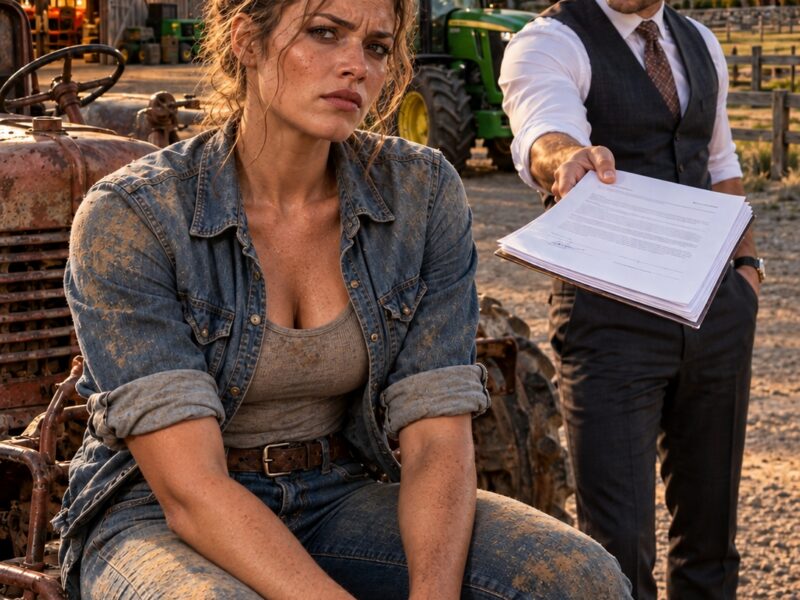
Grant Mercer stood in the middle of my farmyard with a contract in one hand and the keys to a quarter-million-dollar tractor in the other.
Behind him, the loaner idled like money sounded when it was burning.
Clean green paint. Climate-controlled cab. GPS guidance. More horsepower than anything I had running.
Behind me, my grandfather’s thirty-year-old tractor sat motionless over a dark stain of hydraulic fluid.
And somewhere west of Carter Farm, a storm was coming fast enough to destroy nearly everything I had spent the last year building.
Grant glanced at the dead tractor.
Then at me.
“Your harvest contracts are bleeding out,” he said. “You have customers depending on you, equipment debt you can’t ignore, and maybe twenty hours before the weather closes the window.”
He extended the contract.
“Sign it.”
I didn’t take it.
Grant lowered his voice.
“The old tractor story ends here.”
For a moment, all I could hear was the engine of his loaner and the metallic ticking of my grandfather’s tractor cooling in the Montana afternoon.
Then I looked at Grant.
“You didn’t drive all the way out here to help me.”
Something shifted behind his eyes.
Not surprise.
Recognition.
Because we both knew this moment had been coming.
“I drove out here,” he said, “because I knew eventually you’d run out of options.”
He was right about one thing.
I had.
What Grant didn’t understand was that I was finally beginning to realize an option didn’t have to come from him.
And less than twenty-four hours later, he would be the one calling me because his family’s farm was about to lose everything.
But that part came later.
To understand why Grant Mercer believed he owned my choices, you have to understand the land I was standing on.
Carter Farm covered roughly seven hundred twenty acres of hay ground, pasture, and leased fields in rural Montana, with a registered Black Angus herd and enough aging machinery to make every season feel partly like farming and partly like mechanical triage.
My grandfather, Leon Carter, had spent most of his adult life building it.
Not into an empire.
Into something harder.
A farm people respected.
Leon could hear a failing bearing before most men noticed a vibration. He could diagnose fuel starvation by listening to an engine idle. He kept service manuals with grease fingerprints on nearly every page and believed there was no shame in owning old equipment as long as you understood exactly what it could and could not do.
I started following him around the machinery shed before I was tall enough to see over a workbench.
When I was nine, he taught me how to hold a flashlight without shining it into his eyes.
At eleven, he taught me to change filters.
At fourteen, he stopped taking the wrench away when I was doing something wrong.
He just folded his arms and waited until I figured out why it wasn’t working.
That was Leon’s version of education.
“You gonna tell me?” I once asked after fighting with a seized bolt for ten minutes.
“No.”
“Why?”
“Because one day I won’t be standing here.”
At fourteen, I rolled my eyes.
At twenty-eight, I would have given almost anything to hear him say it again.
His favorite tractor was already three decades old by the time I took over the farm.
Its paint had worn through in places. The seat had split along one seam. The cab rattled at road speed, the heater worked when it felt charitable, and Leon knew every noise it made.
He loved that tractor for one reason.
He understood it.
No encrypted diagnostic system.
No remote authorization.
No technician required to tell him whether a sensor had permission to let the engine run.
If something broke, he could find it.
And if he could find it, there was a decent chance he could fix it.
“A farmer who can’t solve problems,” he told me once, tapping the side of the hood, “eventually belongs to whoever can.”
I remembered the sentence.
I just didn’t understand it.
Not then.
After Leon died, Carter Farm became mine in every way that frightened me.
The debt was mine.
The roofs that needed replacing were mine.
The equipment failures were mine.
The cattle were mine when prices dropped and mine when veterinary bills arrived and mine when winter feed cost more than I had budgeted.
So were the looks.
I was twenty-eight, Black, female, and running cattle and hay in a county where almost every equipment meeting, auction, dealership counter, and bank appointment seemed populated by men old enough to remember when my grandfather had been my age.
Most of them weren’t openly cruel.
Sometimes I almost wished they were.
Open cruelty gives you something solid to fight.
Condescension is softer.
A salesman would explain a hydraulic system while looking at whichever man happened to be standing beside me.
At auctions, strangers asked whether I worked for Carter Farm.
Bank officers asked whether my father or uncle would be reviewing large purchases with me.
Once, after I spent twenty minutes discussing acreage, depreciation and projected yield with a salesman, he handed the financing paperwork to Earl Lawson, a retired mechanic who had merely driven me into town.
Earl looked at the papers.
Then at him.
“She’s buying the tractor.”
The salesman laughed nervously.
“Of course. I just assumed—”
“That’s the problem,” Earl said.
I pretended it didn’t bother me.
But pretending something doesn’t hurt and not being hurt by it are different skills.
Slowly, I became obsessed with making Carter Farm look impossible to dismiss.
Better branding.
Cleaner records.
Precision technology.
Newer equipment.
I told myself I was modernizing.
Some of that was true.
But another truth sat underneath it.
I wanted to drive into town in machinery expensive enough that nobody would ask who had approved the purchase.
So when I bought the new John Deere, I told myself it was about efficiency.
Rachel Hayes knew better.
Rachel had been my best friend since we were twelve. She handled bookkeeping better than I did, possessed absolutely no agricultural patience, and had a gift for asking questions at exactly the moment I wanted her not to.
She sat at my kitchen table when I told her the monthly payment.
Her coffee stopped halfway to her mouth.
“That’s per year?”
“Per month.”
She lowered the cup.
“Nia.”
“It increases capacity.”
“Nia.”
“It reduces downtime.”
“Nia.”
“What?”
She looked through the window toward the old machinery shed.
“Are you buying a tractor or buying proof?”
I hated the question enough to know it was good.
“I’m buying equipment.”
“Okay.”
That was Rachel’s most irritating response.
Okay.
Not agreement.
Just a little verbal shelf where she put an argument until reality came back to collect it.
When the new tractor rolled down Carter Farm’s lane, though, I felt vindicated.
Neighbors noticed.
The bank noticed.
The dealership posted a photograph.
For the first time since Leon died, people seemed to look at Carter Farm and see a serious operation instead of a young woman trying to preserve her grandfather’s legacy.
I sat in that immaculate cab and felt something I hadn’t felt in years.
Untouchable.
Three months later, the machine shut itself down in the middle of the most important hay window of the season.
There was no explosion.
No smoke.
No dramatic mechanical failure.
One warning appeared on the display.
Then another.
Power dropped.
The engine died.
I restarted it.
It ran.
Thirty minutes later, it happened again.
I changed the fuel filters.
Checked connections.
Inspected every sensor I could physically access.
Tested what I could test.
Restarted.
Shutdown.
Again.
By noon I was sweating through my shirt despite the air conditioning, and a storm system was predicted within forty-eight hours.
Standing hay doesn’t care what your payment is.
Weather doesn’t care what your warranty says.
I called the dealership.
Grant Mercer answered.
I had met him before. Everybody in agricultural business within fifty miles had.
Grant was the kind of man whose confidence had never been seriously challenged by his surroundings.
He listened while I described the fault.
Then he said, “We’ll need to connect it to proprietary diagnostics.”
“Fine. Send me the codes.”
A pause.
“That’s not really how it works.”
“Then send me the diagnostic software.”
“We can’t.”
“Rent me the equipment.”
“We can’t do that either.”
I stared across hundreds of acres approaching their harvest window.
“When can you send somebody?”
I heard keyboard clicks.
“Five days.”
“Grant.”
“Possibly seven.”
“Rain is coming in forty-eight hours.”
“I understand.”
“No, you understand the forecast. I’m asking whether you understand what seven days costs me.”
Another pause.
“I understand you’re frustrated.”
That sentence nearly did it.
Not the delay.
Not even the locked software.
The word frustrated.
As if I were upset because my phone wouldn’t connect to Bluetooth.
I closed my eyes.
“What are my options?”
“Wait for service.”
That was the entire answer.
I thanked him.
Then I hung up because I knew if I stayed on the phone, I would say something I couldn’t afford to have repeated around town.
A third-party mechanic eventually helped identify the failure through contacts he had in the industry.
A sensor.
That was it.
Not a transmission.
Not an engine.
Not a cracked housing.
An inexpensive electronic sensor.
I could replace the physical part.
What I couldn’t do was properly calibrate the system afterward without manufacturer-controlled software.
I owned the tractor.
I owned the sensor.
I owned the field.
I owned the debt.
But somehow I did not own the ability to tell my own machine that the repair had been completed.
When I confronted Grant about it, he leaned against the dealership counter and gave me the patient smile people use when they’ve decided your anger proves you don’t understand the issue.
“Modern machines aren’t like the equipment your grandfather worked on.”
“I noticed.”
“They’re integrated systems.”
“I know what an integrated system is.”
“I’m just saying, maybe some of that older equipment is more your speed.”
He smiled.
Very slightly.
He probably forgot the sentence before dinner.
I carried it home.
I walked past the expensive tractor sitting dead in my yard.
Then I opened the machinery shed.
Dust hung in the beam of afternoon sunlight.
At the back, beneath a canvas tarp, was Leon’s tractor.
I pulled the cover away.
The paint was faded.
The tires needed attention.
One hydraulic hose had dry cracks.
There was corrosion around the battery terminals and enough dust across the hood to write my name in.
I climbed into the cab.
The smell hit me first.
Old vinyl.
Diesel.
Grease.
Dust.
For one impossible second, I was fourteen again and Leon was outside the cab telling me I was riding the clutch.
I put both hands on the steering wheel.
“You said a farmer who can’t solve problems belongs to whoever can.”
Silence.
I laughed once.
“Fine.”
Then I looked at the dead machine.
“Let’s see if you were right.”
The story reached town before I got the tractor running.
Of course it did.
Small agricultural communities possess communication systems faster than broadband.
A neighbor drove past while the shed doors were open.
Someone saw me ordering parts.
By the end of the week, Carter Farm’s old tractor had become local entertainment.
At the co-op, Tom Whitaker asked loudly enough for three tables to hear whether I planned to replace my truck with a horse next.
Another farmer asked whether the six-figure John Deere had been “too advanced.”
Even Grant repeated the story at the dealership.
Rachel heard about that one.
“You want me to slash his tires?”
“No.”
“One tire?”
“No.”
“Valve stem?”
“Rachel.”
“Fine.”
The jokes weren’t the difficult part.
The tractor was.
Years of sitting had not been kind.
Contaminated fuel.
Worn belts.
Corroded connections.
Damaged wiring.
Leaking seals.
Dry hoses.
I worked after dark because daytime belonged to cattle, fields, invoices and everything else that didn’t pause just because I had decided to resurrect a machine.
Rachel made parts runs.
Earl Lawson came by one evening, leaned against the workbench and watched me fight with a hydraulic fitting.
“You gonna help?” I asked.
“No.”
“You’ve been standing there twenty minutes.”
“Yep.”
“Leon would help.”
“No, he wouldn’t.”
I looked at him.
Earl nodded toward my hands.
“He spent half his life teaching you this. You think he did that so another old man could show up when it got difficult?”
I turned back to the fitting.
“I liked you better before you became philosophical.”
“You liked me better when you were twelve and I brought doughnuts.”
“I still like doughnuts.”
“Fix the tractor.”
So I did.
Not quickly.
Not elegantly.
But piece by piece.
Thursday evening, I climbed into the cab and turned the key.
The starter caught.
The engine coughed.
Stopped.
I tried again.
A violent shudder moved through the chassis.
Then the engine fired.
Black smoke rolled from the stack.
The idle stumbled.
For three seconds I thought it would die.
Then the rhythm steadied.
I froze with one hand still on the key.
Earl was standing outside the shed.
Rachel was beside him.
Nobody cheered.
Maybe because we were all afraid the machine would hear us and change its mind.
After a minute, Rachel whispered, “Is it supposed to sound like that?”
Earl nodded.
“For that tractor?”
He smiled.
“That’s practically music.”
I sat there listening.
And for the first time since Leon died, I cried in the machinery shed.
Not because I thought I had won.
Starting an engine wasn’t winning.
I cried because something he had taught me was still alive in my hands.
Four days later, harvest began.
For the first hour, I listened to every vibration.
Every pitch change.
Every mechanical complaint.
By noon, I stopped listening for disaster and started working.
The tractor held.
Through afternoon.
Through evening.
Into darkness.
Then again the next morning.
Across the county, something else was happening.
Newer machines from multiple manufacturers were throwing fault codes.
Some entered reduced-power modes.
Some required technician authorization.
None of it looked catastrophic.
That was almost the problem.
A machine could appear perfectly intact and still become functionally useless because a computer had decided the operator no longer had permission to continue.
Then Tom Whitaker called.
The same Tom who had made the horse joke.
I saw his name on my phone and almost let it ring.
Almost.
“Nia?”
His voice sounded smaller than I remembered.
“What happened?”
“My tractor’s down.”
I waited.
He cleared his throat.
“I’ve got about a hundred fifty acres cut.”
I looked west.
The clouds were already thickening.
“When’s your technician coming?”
“Tomorrow afternoon.”
The rain was coming overnight.
We both knew what that meant.
He said, “How far behind are you?”
“I’m not.”
Silence.
Then: “Oh.”
I could have enjoyed that moment.
Part of me wanted to.
Instead I asked, “Send me the field location.”
“Nia—”
“Send it.”
I secured the most vulnerable acreage on Carter Farm, fueled Leon’s tractor and drove across the county.
Tom met me beside his field.
He wouldn’t quite look at me.
“You don’t have to do this.”
“I know.”
“I was an ass.”
“I know that too.”
He finally looked up.
“Why are you here?”
I glanced toward the storm.
“Because rain doesn’t care which one of us was right.”
We worked through the night.
The last hay was under cover hours before the weather hit.
Several farms lost quality that night.
Tom didn’t.
Before sunrise, as I prepared to leave, he stopped beside the tractor.
“I owe you.”
“Keep your older equipment maintained.”
He blinked.
“What?”
“You’ve got that old Case sitting behind your south barn.”
“How do you know about that?”
“Everybody knows about that.”
He laughed.
I didn’t.
“I might need it someday.”
At the time, I thought I was joking.
Months later, those words would save my business.
By the annual harvest gathering, the laughter had changed.
People came to me with questions.
Real ones.
What spare parts was I keeping?
How had I diagnosed the fuel issue?
Was older equipment worth maintaining as backup?
Which independent mechanics still worked on legacy machines?
Men who once looked over my shoulder while talking about equipment were suddenly waiting for my answer.
And I hated how much that felt like healing.
Because I realized I had wanted their respect more than I had ever admitted.
That was when Grant Mercer approached me.
He was carrying two drinks and a different smile.
“Nia.”
“Grant.”
“I’ve been following what you’ve done.”
“Everybody has.”
He accepted the hit.
“You made a point.”
“I wasn’t trying to.”
“Maybe that’s why it worked.”
He began talking about resilience.
Tradition.
Independent thinking.
Young farmers.
Then he mentioned a regional sponsorship campaign.
Discounted equipment.
Priority service.
Promotional opportunities.
Money.
Real money.
Enough to take pressure off Carter Farm’s debt.
Enough that I went quiet.
Grant smiled.
“You earned this.”
For one night, I believed him.
Then I read the contract.
Page one looked generous.
Page two looked professional.
Page three looked ordinary.
Page four told the truth.
Sponsored appearances had to use approved equipment.
Technical questions had to be directed through dealership channels.
Unauthorized machinery could not be prominently featured without written permission.
Then came a clause specifically addressing “non-approved legacy equipment.”
Leon’s tractor.
The machine everyone knew me for.
The machine that had made their customers start asking why a thirty-year-old tractor could be repaired in a barn while a new one required authorization.
They didn’t want to celebrate the story.
They wanted to own it.
I called Grant.
“You read page four?” he asked.
“I did.”
“It’s standard brand protection.”
“You want me to stop showing Leon’s tractor.”
“We want consistency.”
“You want me to tell farmers the dealership gave me independence.”
“That’s not what it says.”
“It doesn’t have to.”
“Nia, don’t turn this into something ideological.”
I almost laughed.
“You came to me because people started asking questions.”
“We came to you because your story has value.”
There it was.
Not me.
My story.
Value.
To them.
I returned the contract unsigned.
Grant called the next afternoon.
“You’re really walking away over an old tractor?”
“No.”
“Then what is this?”
“You confused the tractor with why people trusted me.”
“And why do they trust you?”
“Because when my machine stopped, I didn’t.”
Then I hung up.
The following week, I accepted my first custom harvesting job.
Forty acres.
Then eighty.
Then a hundred twenty.
Soon farmers were calling because they wanted an operator who understood what happened when machinery failed.
I didn’t promise nothing would break.
I promised a breakdown wouldn’t automatically end the job.
Earl helped me locate older equipment retiring farmers were willing to sell.
Rachel helped me model the finances.
We built redundancy.
Not glamorous redundancy.
Useful redundancy.
Within months, I had harvest commitments covering thousands of acres.
For the first time, Carter Farm wasn’t merely surviving.
I was building something.
And then, three days before the largest harvest window of my life, Leon’s tractor blew a hydraulic line.
Fluid poured onto the ground.
I stood there watching it spread through the dust.
“No,” I whispered.
Rachel came running from the office.
“What?”
I pointed.
Her face changed.
“How bad?”
I crawled underneath.
Bad.
Our second backup already had a fuel-delivery issue.
A third machine was committed three counties east.
The storm forecast had accelerated.
Thirty-six hours had become twenty.
Customers were depending on me.
Employees were depending on me.
The bank was depending on me to make payments whether the weather cooperated or not.
And suddenly the business I had built around always having another option had no obvious option left.
That was when Grant’s truck appeared.
He stepped out.
Behind him was the loaner.
Perfect.
Powerful.
Ready.
He held out the contract.
“Sign it.”
I stared at him.
“You planned this?”
“I saw the weather.”
“You saw my tractor go down.”
“I heard.”
“Fast.”
“It’s a small county.”
Of course it was.
He handed me the revised agreement.
The essential clause remained.
Use their equipment.
Accept their support.
Become their story.
In exchange, my customers got harvested.
“You proved your point,” Grant said. “Nobody can take that away from you.”
He nodded toward Leon’s dead tractor.
“But this is business now.”
I hated him for how reasonable he sounded.
“The loaner is yours through harvest,” he continued. “Technician support. Additional equipment if we can free it up. The sponsorship money starts immediately.”
I looked at my dead tractor.
Then at the harvest contracts sitting inside its cab.
“Think about the people depending on you.”
That sentence found the exact place where I was weakest.
Because this wasn’t about pride anymore.
If I refused and failed, other farms lost money.
Other families took the hit.
Grant stepped closer.
“Sometimes the smart decision is accepting help.”
I took the contract.
Then I climbed into Leon’s dead tractor and shut the door.
I sat there for nearly twenty minutes.
At first, I thought about money.
The sponsorship could reduce debt.
The loaner could save harvest.
Maybe Grant was right.
Maybe I had turned an old tractor into a symbol because I needed something to fight.
Then I looked at Leon’s worn steering wheel.
And another uncomfortable thought came.
For years, I had believed I needed the newest machine to prove I belonged.
Then I had swung in the opposite direction and started believing the oldest machine proved I was independent.
New tractor.
Old tractor.
Different objects.
Same mistake.
I was still allowing a machine to define me.
Leon had never taught me that old equipment was morally superior.
He had taught me to understand my tools.
He had taught me to maintain options.
I looked at Grant’s contract.
Then at the fields beyond the windshield.
The question wasn’t:
How do I replace Leon’s tractor?
The question was:
How many working tractors are sitting within fifty miles of me right now?
I grabbed my phone.
Grant answered immediately.
“So?”
“I’m sending the loaner back.”
Silence.
“Nia.”
“I’m not signing.”
“You have twenty hours.”
“I know.”
“You don’t have equipment.”
“Not yet.”
I ended the call.
Then I called Rachel.
“Get a county map.”
“Why?”
“We’ve been counting tractors we own.”
“And?”
“I want to count tractors we know.”
By sunset, my kitchen looked like an emergency command center.
Rachel covered the table with maps, notebooks and coffee cups.
I called retired operators.
Earl called independent mechanics.
Tom called farmers.
One farmer had an old Massey Ferguson in a barn.
Another had a Case IH that ran but hadn’t worked a full harvest in years.
A widow still owned two tractors her husband had maintained before his death.
Several customers had backup machines they had never considered lending because nobody had ever asked.
Some needed batteries.
Some needed belts.
One needed a tire.
Several needed nothing.
By midnight, colored marks covered Rachel’s map.
She stared at it.
“Nia.”
“What?”
“You know what this is?”
I looked down.
Dozens of machines.
Different brands.
Different ages.
Different owners.
An entire invisible fleet.
“Options,” I said.
Before sunrise, engines began arriving at Carter Farm.
Tom Whitaker came first.
Two tractors.
He climbed down from one.
“Remember when you told me to keep my old equipment running?”
“I remember.”
“Well.”
He slapped the hood.
“You need it someday.”
Neither of us mentioned the horse joke.
We didn’t need to.
Earl found the final piece for Leon’s tractor behind a closed repair shop.
A dead machine with a compatible hydraulic assembly.
I bought it for parts.
We pulled the component, modified the fittings and worked under shop lights until my fingers cramped.
At 1:47 a.m., Earl tightened the final connection.
“Try it.”
I climbed into the cab.
Turned the key.
The engine started.
I watched the hydraulic pressure.
Stable.
1:58 a.m.
Leon’s tractor was alive again.
Rachel raised both hands.
I shook my head.
“No celebrating.”
Her arms dropped.
“You are deeply unpleasant.”
“We have fields.”
At daylight, the improvised fleet moved.
Old John Deeres.
Case IH.
Massey Ferguson.
Newer customer machines.
Balers.
Trucks.
Trailers.
Nothing matched.
Nothing looked like a dealership advertisement.
It looked better.
It looked like people who intended to finish.
Rachel tracked weather, moisture, locations and transport times from the kitchen.
Earl coordinated repairs.
I moved equipment where it was needed.
When one tractor overheated, another replaced it.
When a baler developed a feed problem, Earl worked on it while the adjacent field kept moving.
When a newer tractor threw an electronic fault, I didn’t stop and make a speech about old machines being better.
I moved another tractor into its place.
That was when I knew I had finally understood Leon.
Independence wasn’t refusing technology.
It was refusing helplessness.
By late afternoon, most of our committed acreage was secure.
I stood beside the service truck drinking warm water when my phone rang.
Grant Mercer.
I almost ignored it.
Then I answered.
“What?”
For the first time since I had known him, Grant sounded uncertain.
“My father has a farm east of town.”
I said nothing.
“Henry Mercer. Nearly two hundred acres still exposed.”
“Call your dealership.”
“We did.”
“Call another technician.”
“Nia.”
That one word told me everything.
No machines available.
No time.
The storm was too close.
Grant inhaled.
“I know I have no standing to ask you for anything.”
I looked across the yard.
Men and women covered in dust.
Machines from four decades.
Everyone exhausted.
Rachel stood beside her laptop watching the radar.
I walked over.
“How long?” I asked.
“Maybe three hours before the heavy line reaches us. Less east.”
I returned to the phone.
“How many acres?”
“Hundred ninety-two.”
I closed my eyes.
Grant said quietly, “He’s going to lose it.”
I thought about the contract.
The dealership counter.
The jokes.
“Maybe those older machines are more your speed.”
I could have said no.
Nobody would have blamed me.
Maybe Grant expected me to.
Instead I asked Rachel, “Can we move east?”
She studied the map.
“Barely.”
I looked at the crews.
Then I told Grant, “Send me the gate coordinates.”
He went silent.
“Nia—”
“Don’t thank me. Open the gates.”
The fleet rolled east.
Old machines and new machines on the same county road.
Farmers who had spent years competing with one another drove in convoy beneath a sky turning darker by the minute.
Henry Mercer stood at his gate when we arrived.
He was older than Grant, heavier through the shoulders, with the still expression of a man who had already calculated his losses.
He looked at the machines.
Then at me.
“You Nia Carter?”
“Yes.”
He nodded once.
“Tell me where you need us.”
No speech.
No pride.
Good.
We went to work.
The wind changed first.
Then the temperature dropped.
Everyone noticed.
Nobody said it.
The final field became a race.
Cut.
Bale.
Load.
Move.
Again.
The western sky turned nearly black.
Twenty minutes.
Maybe less.
The final bales disappeared beneath the equipment shed roof just as the first heavy drops struck the metal.
Then the sky opened.
Rain hammered the roof so hard conversation became pointless.
The crew stood underneath it.
Nobody celebrated.
We just listened.
That sound could have meant loss.
Instead, for once, it meant we had made it.
Henry Mercer found me near the edge of the shed.
For several seconds he watched the rain.
Then he said, “Leon Carter was your grandfather.”
“Yes.”
“Knew him a little.”
I looked over.
“He would’ve been proud of you.”
A year earlier, I would have needed that sentence.
Now it simply warmed something in me.
“I think he’d be happier that I finally stopped trying to impress everybody.”
Henry smiled.
Behind him, Grant stood close enough to hear.
After a moment, he approached.
Rainwater blew beneath the roof and spotted his shirt.
“I was wrong about you,” he said.
Four words.
Once, I would have carried them home like a trophy.
Instead I looked at the machinery parked beyond him.
“You were wrong about more than me.”
He waited.
“The problem was never new tractors.”
I nodded toward Leon’s machine.
“And it was never old tractors.”
“Then what was it?”
“The idea that one company, one computer, one dealership, one broken part gets to decide whether a farmer keeps working.”
Grant looked at the machines.
No answer came.
And for the first time, I didn’t care whether one did.
Months later, Rachel, Earl, Tom and several other farmers sat around my kitchen table.
That county map was back between us.
Only this time we weren’t racing a storm.
We were building something.
The cooperative began with one rule:
No member farm should ever be one breakdown away from helplessness.
We cataloged backup equipment.
Independent mechanics.
Parts.
Service manuals.
Transport capacity.
Emergency harvest crews.
I converted a used truck into a mobile repair unit.
Earl trained two young mechanics.
Farmers who had once guarded information began sharing it because they understood something simple.
Your neighbor having options does not make you weaker.
Sometimes it is exactly what keeps you alive.
The cooperative grew.
Five farms became twelve.
Twelve became twenty-seven.
Carter Farm’s equipment debt started coming down.
The old machinery shed became a real service bay.
And Leon’s tractor?
It kept working.
Not because it was magical.
Not because old was better.
Because we maintained it.
Because we understood it.
Because it had a place.
The following year, at the county harvest gathering, I found a teenage girl walking slowly around it.
She couldn’t have been more than sixteen.
“Ms. Carter?”
“Nia is fine.”
“I’m Kayla.”
She pointed at the tractor.
“Is this really the one everybody laughed at?”
I smiled.
“This is the one.”
She ran her fingers near the faded paint without touching it.
“So it was better than the new tractor?”
There was a time when I would have said yes.
I would have wanted the clean victory.
The old machine defeats the new machine.
The underestimated woman humiliates the arrogant man.
Simple stories feel good.
Real life usually asks more of you.
“No,” I said.
Kayla frowned.
“But it saved your farm.”
“It helped.”
“Then what did it prove?”
I looked across the hall.
Farmers were talking near tables covered in coffee and pie.
Earl was arguing with someone about hydraulic pressure.
Rachel was pretending not to reorganize an event she wasn’t in charge of.
Grant Mercer stood across the room.
He noticed me looking.
He nodded.
Once.
I nodded back.
Then I looked at Kayla.
“It taught me I had spent too much of my life trying to prove people wrong.”
She waited.
“You use a new machine when a new machine makes sense. You use an old one when an old one makes sense. You ask for help when help makes sense. You learn enough to know when somebody is selling you dependence and calling it convenience.”
Kayla smiled slightly.
“And if people think you don’t belong?”
I looked at Leon’s worn steering wheel.
“Never let the machine, the salesman, the banker, or anybody else decide whether you belong behind it.”
Across the room, Grant heard me.
I knew because I saw his expression change.
But then something strange happened.
I forgot about him.
Not dramatically.
Not triumphantly.
I simply turned back to Kayla.
That was how I knew I was finally free.
The next morning, I woke before sunrise.
Montana was still blue with early light when I crossed the yard.
The cattle moved quietly along the fence.
Frost silvered the grass.
I climbed into Leon’s tractor and started the engine.
Behind me sat machines from different manufacturers and different decades.
Beside the shed was our mobile service truck, stocked with belts, filters, fittings, diagnostic tools and enough spare parts to solve the failures we could predict.
There would always be failures we couldn’t.
That was farming.
Maybe that was life.
The sun broke over the ridge as I drove toward the near field.
For years, I had thought I was caught in an argument between old and new.
Tradition and technology.
Independence and progress.
Leon’s world and mine.
But I understood now that I had been asking the wrong question.
Leon had never been trying to teach me to distrust new things.
He had been trying to teach me something about power.
A farm with no options when something goes wrong isn’t truly running itself.
Neither is a person.
I had needed an expensive tractor, one cheap sensor, months of ridicule, a contract I refused to sign, a hydraulic line failing at the worst possible moment and the humiliation of nearly losing everything before I finally understood the lesson he had tried to give me when I was fourteen.
I could almost see him standing beside that workbench again.
Arms folded.
Waiting for me to solve the problem.
“You gonna tell me?” the fourteen-year-old version of me had asked.
“No.”
“Why?”
“Because one day I won’t be standing here.”
Back then, I had thought he meant I needed to know how to fix a tractor.
Driving through the morning light all those years later, I finally understood.
He had meant something much bigger.
The people who love us cannot always leave us solutions.
Sometimes all they can leave us is the ability to find one.
I reached the far end of the field and turned the tractor toward home.
The engine settled into the same low rhythm I remembered from childhood.
The paint was still faded.
The cab still rattled.
The seat still had that old crack running through the vinyl.
I had stopped caring whether anyone found that impressive.
Behind the machinery shed, the cooperative service truck was already pulling out toward another farm.
Someone else had broken down.
Someone else needed an option.
And this time, nobody had to beg a dealership for permission to keep moving.
I watched the truck disappear down the road.
Then I put the tractor back into gear.
The sun climbed over Carter Farm.
And for the first time since my grandfather died, I wasn’t driving his machine because I was trying to preserve his past.
I was driving it because I had finally built my own future.
And somewhere beneath the vibration of that old engine, I could almost hear Leon laughing.
Not because the old tractor had won.
Because I finally understood that it never had to.









