THE DEALER TOLD HER TO SELL THE FARM—SIX DAYS LATER, HE LEARNED WHAT SHE HAD BEEN HIDING
“Sell the land.”
Brent Kesler said it without looking up from the papers on his desk.
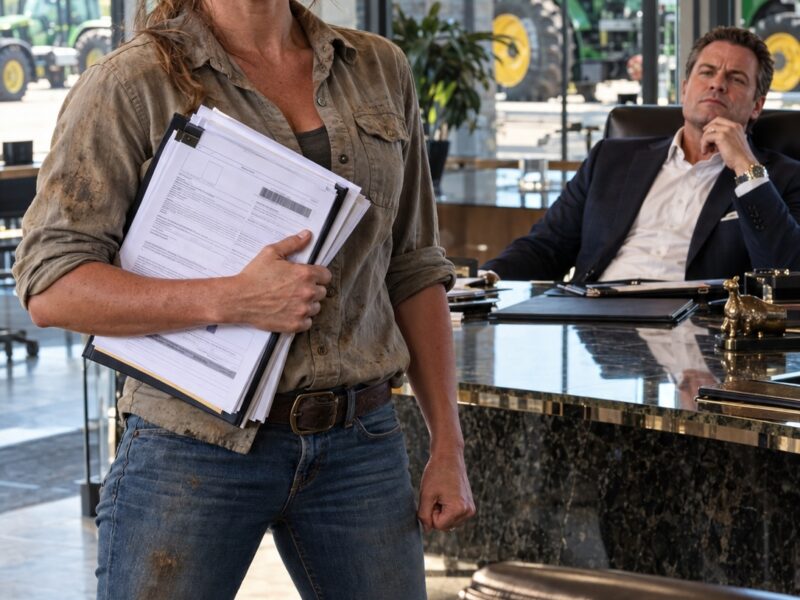
Lenora Vance stood on the other side of the glass-walled office, still wearing the dust-streaked work shirt she had put on before sunrise. Her boots had left pale Kansas dirt across the polished dealership floor. Outside the window, her tractor sat in exactly the same place where it had been unloaded six days earlier.
Six days.
Two thousand acres were waiting.
Rain was coming.
And the man who had charged her to diagnose the machine had apparently decided that humiliation was easier than fixing it.
Lenora stared at him.
“I didn’t ask you whether I should sell my land.”
Brent finally lifted his eyes.
He was somewhere in his late forties, broad through the shoulders, with silver beginning at his temples and the smooth patience of a man who was accustomed to explaining unpleasant realities to people who had fewer options than he did.
“I know what you asked.”
“Then tell me what’s wrong with my tractor.”
A small smile touched his mouth.
“Oh, we know what’s wrong.”
Lenora waited.
Brent leaned back.
“The question is whether you can afford to do anything about it.”
For several seconds, the only sound in the office was the low hum of the air-conditioning.
Lenora looked through the glass again.
Her tractor was dusty now.
Not workshop dusty.
Parking-lot dusty.
There was a difference, and she knew it.
She had known machines since she was twelve years old. She knew what hydraulic oil smelled like after a hose blew under load. She knew the hollow knock of a bearing beginning to fail. She knew how dust settled differently on equipment that had been opened, moved, tested.
Nothing about that tractor looked touched.
That bothered her more than Brent’s smile.
“I paid your inspection fee.”
“And we inspected it.”
“Then give me the report.”
His smile disappeared.
“The way I see it, Lenora, you have one option worth taking.”
He slid a folder across the desk.
She didn’t touch it.
“Trade your old fleet,” he continued. “All of it. We roll the values into a new equipment package. Tractor, support units, financing. You stop patching together machines that should’ve been retired years ago, and we move forward.”
Lenora looked down at the folder.
Numbers were already printed inside.
Trade-in figures.
Monthly payments.
Interest.
Everything prepared before she had agreed to anything.
“You put this together already?”
“I plan ahead.”
“That’s not what I came here for.”
“Then you came here for nothing.”
Something in his voice changed.
Not much.
Just enough.
Brent folded his hands over his stomach.
“I’m not tying up one of my technicians on a machine that belongs in a salvage yard.”
Through the glass wall behind him, Lenora saw a man stop walking.
Colin Ree.
The technician who had checked her tractor in six days earlier.
He was holding a clipboard.
And when Brent said salvage yard, Colin looked directly at Lenora.
For one second, something passed across his face.
Not agreement.
Something closer to anger.
Then he looked down.
Lenora noticed.
Brent didn’t.
That would matter later.
Right now, Lenora picked up the folder, closed it without reading another number, and pushed it back across the desk.
“I want my tractor.”
Brent’s jaw tightened.
“You move it somewhere else, transport is on you.”
“Fine.”
“And the package I offered you expires Friday.”
“Then I guess Friday will be disappointing for both of us.”
She turned toward the door.
“Lenora.”
She stopped.
Brent’s voice softened.
That almost made it worse.
“You’ve got what, nine days before that rain system?”
She slowly looked back.
He smiled again.
“Maybe eight now.”
Lenora said nothing.
“You can be angry with me,” he continued. “But anger doesn’t cut hay.”
“No.”
She opened the door.
“Machines do.”
Then she walked out.
What Brent Kesler did not know was that Lenora Vance was not broke.
Not yet.
He did not know she had spent the spring quietly negotiating a $330,000 agricultural equipment credit line.
He did not know the money remained untouched.
And he definitely did not know that while he was waiting for desperation to bring her back through his door, Lenora was already beginning to wonder whether the broken tractor was actually the smallest problem she had.
Because twenty-seven minutes after she left Kesler Farm Equipment, an email appeared on her phone.
FORMAL ACQUISITION OFFER — VANCE FAMILY PROPERTY.
The sender was Stonebridge Acre Partners.
They had been trying to buy her land for two years.
And somehow, on the exact afternoon her harvest operation was beginning to collapse, they had decided to try again.
Lenora pulled her truck onto the shoulder and read the offer twice.
Then a third time.
The amount was substantial.
The deadline was short.
She looked back toward the road leading to Kesler’s dealership.
There was no evidence connecting the two things.
She knew that.
Her father had taught her something else besides how to keep equipment running:
Never call suspicion proof.
Still, the timing made the skin between her shoulders tighten.
She locked her phone and drove home.
For most people, Vance Fieldworks looked bigger than it really was.
That was because people saw acreage.
Two thousand acres sounded impressive.
But only 460 belonged to Lenora’s family.
The remaining 1,540 acres belonged to neighboring farmers and landowners who hired Vance Fieldworks to cut, ted, rake, bale and move their hay.
The business depended on timing.
Timing depended on equipment.
And equipment depended on money.
The whole operation was less like a company than a chain stretched between moving trucks, aging tractors, fuel invoices, weather forecasts and people willing to work until their hands stopped closing properly.
One broken link could pull everything apart.
Lenora had inherited that chain three years earlier when her father died.
Dale Vance had never been wealthy.
He had been something more dangerous.
Optimistic.
Every year, Dale believed the next season would be the season that finally gave them breathing room.
One good spring.
One dry harvest.
One strong contract.
One year without a transmission failure or medical bill or fuel spike.
Then they would get ahead.
Lenora had heard that promise throughout childhood.
Sometimes she still heard it in his voice.
She had been twelve the first time he let her move a tractor alone.
Her feet barely reached comfortably.
Her mother had stood at the porch yelling that Dale had lost his mind.
Dale had only laughed.
“Farm doesn’t care how old you are,” he told Lenora. “It only cares whether you can do the job.”
Years later, Lenora would understand the cruelty hidden inside that philosophy.
The farm didn’t care if you were tired either.
It didn’t care if you were grieving.
It didn’t care that your father had died three weeks before spring planting and his coffee cup was still sitting beside the sink because nobody had been able to move it.
Grass grew.
Bills arrived.
Engines broke.
Weather moved in.
Life demanded an answer whether you were ready or not.
So Lenora answered.
For three years.
That evening, her younger brother Russell found her sitting at their father’s kitchen table with Stonebridge’s offer open on her laptop.
He read the first page standing up.
Then he pulled out a chair.
Russell was thirty-one, four years younger than Lenora, and almost her opposite.
Where she trusted instinct, he trusted spreadsheets.
Where she saw a machine and heard whether it was running right, Russell wanted service records.
He handled warehousing, transport schedules and logistics because numbers calmed him.
Usually.
Tonight they didn’t.
“How much?” he asked.
Lenora told him.
Russell leaned back.
“That’s serious.”
“So is the land.”
“I didn’t say it wasn’t.”
She studied him.
“You think I should take it?”
He rubbed both hands over his face.
“I think Dad died believing he was one good season away from finally getting ahead.”
Lenora’s expression changed.
“Don’t.”
“I’m not insulting him.”
“It sounds like you are.”
“I loved him too.”
The room went quiet.
Outside, cicadas screamed from the cottonwoods.
Russell lowered his voice.
“I watched that place eat him alive, Lenora.”
She looked toward the dark window.
“He chose it.”
“Did he?”
Her eyes came back to him.
Russell swallowed.
“He borrowed against next season to survive the current one. Then next season came already owing money to the last one. Every year he said the same thing. Just get through this cutting. Just get through this payment. Just get through this winter.”
“That doesn’t mean we sell.”
“I didn’t say sell.”
“You’re sitting here reading an offer from Stonebridge like it’s a life raft.”
“Maybe because I’m not sure whether it’s a life raft or the first chance we’ve had to get off the ship.”
That hurt.
Russell saw it.
Neither apologized.
Finally Lenora closed the laptop.
“We have nine days.”
“To do what?”
“To harvest.”
“With what tractor?”
She looked at him.
“All of them.”
Russell frowned.
That was the moment the idea began.
Not as courage.
Not as revenge.
As arithmetic.
At 11:38 that night, Lenora called Ardan Pike.
Prairie Lantern Machinery sat sixty-seven miles south of Brier Junction and looked nothing like Kesler’s dealership. There were no glass offices, no coffee bar, no immaculate showroom floor.
Ardan sold machinery the way some men traded horses.
He knew who was retiring, who was overleveraged, who had upgraded, who had a tractor sitting behind a shed because nobody wanted to admit they had bought the wrong model.
When Lenora explained what had happened, he didn’t offer sympathy.
He asked one question.
“You need your tractor back, or you need to finish your harvest?”
Lenora paused.
Those were not the same question.
“I need to finish.”
“How many acres?”
“Two thousand.”
“How many reliable tractors do you have?”
“Four.”
Ardan whistled softly.
“When’s the rain?”
“Nine days.”
Another silence.
Then:
“I’ll start calling in the morning.”
Lenora ended the call and stayed at the kitchen table.
She pulled out a yellow legal pad.
At first she tried to rebuild the operation she already had.
That failed on paper almost immediately.
Too many implement changes.
Too much transport.
Too much waiting.
A tractor would cut in one field, return to switch implements, then move somewhere else.
Every transition stole an hour.
Sometimes two.
And the one thing she did not have was time.
At 1:17 a.m., Lenora crossed out everything.
She started again.
This time, instead of asking how to replace one broken tractor, she asked what she would build if the old system had never existed.
Five zones.
Five crews.
Three tractors per crew.
One dedicated to cutting.
One dedicated to tedding and raking.
One dedicated to baling.
No constant implement swaps.
No field waiting for a machine to return from somewhere else.
Everything moving at once.
Lenora stared at the number she had written at the bottom of the page.
15.
She had four.
She needed eleven more.
At 1:42 a.m., Russell came downstairs for water and found her staring at the paper.
“What is that?”
“A way through.”
He picked it up.
His face changed.
“No.”
“Do the math.”
“I don’t need to do the math.”
“Do it.”
“Eleven tractors?”
“Used.”
“Eleven?”
“Working.”
“Lenora, this is not replacing equipment. This is rebuilding the company in a week.”
“Correct.”
“With what money?”
She looked at him.
That was when Russell learned about the $330,000 credit line.
For several seconds, he simply stared.
“You had three hundred and thirty thousand dollars available?”
“Credit. Not money.”
“And you didn’t tell me?”
“I was saving it for after harvest.”
He laughed once, without humor.
“There may not be an after harvest.”
“Exactly.”
Russell looked at the legal pad again.
“What happens if this fails?”
Lenora answered quietly.
“We lose money.”
“That’s not what I asked.”
She held his gaze.
If it failed badly enough, they could lose the business.
If the business failed badly enough, Stonebridge’s offer might stop looking optional.
Neither needed to say it.
Russell put the legal pad down.
“This is insane.”
“Probably.”
“Dad would do it.”
Lenora’s expression hardened.
“That’s exactly why I need to do it differently.”
And for the first time that night, Russell had no answer.
For the next forty-eight hours, Ardan Pike worked his phone like a man trying to assemble an army out of leftovers.
Two tractors came from a dairy operation upgrading its fleet.
Three came from a dealer in Oklahoma who had been sitting on older Massey Fergusons since fall.
Others came from repossession inventory and private sellers.
None were pretty.
Lenora didn’t care.
Paint didn’t harvest grass.
She needed engines, hydraulics, PTOs and tires.
But she refused to sign for a single machine without inspection.
That created another problem.
She needed someone she trusted.
At 6:10 Friday evening, a pickup rolled into Prairie Lantern.
Colin Ree stepped out.
Lenora stared at him.
“You still work for Kesler.”
“Until they fire me.”
“Does Brent know you’re here?”
“No.”
“That seems relevant.”
Colin walked toward the first tractor.
“Do you want these inspected or not?”
She followed him.
For two hours, he said almost nothing unrelated to machinery.
He checked fluids, seals, pressure, hours, service records.
He crawled beneath frames with a flashlight between his teeth.
On the fourth tractor, Lenora finally asked:
“What happened with mine?”
Colin stopped.
Not long.
Half a second.
Then he continued inspecting a hose.
“I wrote the report.”
“I know.”
“You don’t.”
He stood.
Lenora waited.
Colin wiped his hands.
“I identified the failure the first day.”
Everything inside her went still.
“What?”
“Replacement assembly. Straightforward repair.”
“Then why was my tractor sitting there six days later?”
Colin looked toward Ardan’s office.
“I’m not discussing Kesler business while I’m employed there.”
“You just did.”
“No. I told you what I did.”
“That’s the same thing.”
“Not on paper.”
Then he walked to the next machine.
Lenora watched him go.
That sentence stayed with her.
Not on paper.
By Sunday evening, the deal was ready.
Total cost: $615,000.
Lenora traded equipment with residual value for $210,000.
She took $75,000 from company reserves.
And she used every dollar of the $330,000 financing line.
When the signatures were complete, Vance Fieldworks had roughly $28,000 left in operating reserves.
Russell looked at the final numbers.
“Twenty-eight thousand.”
“I can read.”
“For fuel, payroll, repairs, everything.”
“Yes.”
He looked through the window.
Outside, tractors sat in two uneven rows beneath the fading Kansas sky.
Fifteen machines.
The most equipment Vance Fieldworks had ever controlled.
Russell whispered, “This is either the smartest thing you’ve ever done or the last stupid thing we’ll ever be able to afford.”
Lenora picked up the keys.
“Then we better find out quickly.”
Four days before the projected rain, five crews entered five different fields at sunrise.
For the first time in Vance Fieldworks history, the operation did not move like one machine being stretched across an entire county.
It moved like five separate companies.
Cutters dropped grass simultaneously.
Tedders followed.
Balers stayed inside assigned zones.
Trucks rotated between fields and warehouse.
Lenora coordinated from her pickup with two radios, three charging cables, a notebook on the passenger seat and coffee she repeatedly forgot to drink.
The first day was chaos.
The second was organized chaos.
By the third morning, something extraordinary happened.
The system began working.
Lenora stood on a rise above the southern field and watched three tractors moving at different stages across the grass.
For one dangerous moment, she felt relief.
Her father’s voice came back to her.
See? Just needed one good break.
Her phone rang.
Jocelyn Mercer.
Crosswind Feed Supply.
Lenora answered smiling.
The smile lasted nine seconds.
“Lenora,” Jocelyn said, “we have a quality problem.”
The first shipment had been tested.
Moisture readings were inconsistent.
Some bales were within tolerance.
Others were not.
Crosswind was pausing acceptance of the next shipment.
Lenora’s hand tightened around the phone.
“For how long?”
“Until we know what we’re dealing with.”
“I have trucks loading now.”
“Then stop them.”
“Jocelyn—”
“I’m not doing this to you.”
“I know.”
Crosswind had suffered losses the previous season from another supplier’s wet hay. Their buyers were watching moisture specifications closely.
If Lenora’s inventory failed, the price per ton would drop.
If enough failed, Crosswind could reject significant quantities.
And if Crosswind did not pay—
Lenora looked across the field.
Fifteen tractors.
Fuel.
Payroll.
Debt.
Twenty-eight thousand dollars.
Suddenly Brent Kesler’s office did not feel very far away.
She ended the call and radioed the crews.
“Zones Two and Four, hold.”
Static.
Then disbelief.
“Repeat?”
“Hold cutting.”
One foreman answered, “Weather window’s moving, Lenora.”
“I know.”
“We lose today, we may not get those acres.”
“I know.”
“Then why are we stopping?”
Lenora looked at the hay drying under the noon sun.
Because speed without quality was not success.
It was inventory nobody would buy.
“Because we’re checking every field before another bale goes into that warehouse.”
That decision cost almost a day.
Then a hydraulic line failed on one of the newly purchased tractors.
Ardan got a technician there within three hours.
It still cost them most of a morning.
Then the forecast changed.
The storm accelerated.
Eighteen hours disappeared from their window overnight.
And then Brier Junction began talking.
Someone said Lenora had purchased repossessed tractors because no normal lender would finance her.
Someone else said Vance Fieldworks was already insolvent.
By Thursday, one of her contract landowners called.
Gerald Hoffstead.
One hundred twenty acres.
“I’m hearing things,” he said.
“So am I.”
“I need my ground done.”
“It’s scheduled.”
“Before the rain?”
“Yes.”
“You sure?”
Lenora looked at the updated map.
She hated lying.
So she didn’t.
“No.”
Gerald went silent.
“That’s not what I wanted to hear.”
“It’s the truth.”
“I may need somebody else.”
“If you find someone who can guarantee it, I understand.”
That surprised him.
“You’re not going to argue?”
“I don’t have time to sell you confidence I can’t prove.”
Gerald ended the call without promising anything.
Lenora stood beside her truck for a moment after.
Then another vehicle pulled into the field.
Colin.
He got out carrying a folded sheet of paper.
“What happened?” she asked.
He handed it to her.
Photocopy.
Kesler Farm Equipment.
Inspection report.
Her tractor’s serial number was at the top.
Date of inspection: the day she delivered it.
Diagnosis: complete.
Recommended repair: documented.
Replacement assembly: available.
Lenora read it twice.
Then she looked at Colin.
“He knew.”
Colin said nothing.
“Brent knew the first day.”
“My report was filed.”
“He lied to me for six days.”
Colin looked toward the field.
“I’m giving you a copy of a document I wrote.”
“Why now?”
His face tightened.
“Because my name is on it.”
That was all.
It was also enough.
Lenora folded the paper carefully and put it into the inside pocket of her vest.
She now had proof.
Proof that Kesler had delayed a viable repair.
Proof that Brent had pushed her toward a much larger transaction while telling her the old tractor was essentially worthless.
She could call an attorney.
She could call the dealer network.
She could post the report online before dinner.
She could drive straight to Brent’s office and put the document on his desk.
Instead, Lenora looked behind Colin.
Uncut grass moved beneath a strengthening wind.
The sky in the west was changing.
Justice could wait.
Weather wouldn’t.
“Thank you,” she said.
Then she climbed back into her truck.
Twenty-four hours later, Crosswind froze payment on the first delivery pending completion of its quality review.
Three hours after that, Lenora’s fuel supplier called.
They needed settlement before releasing the next scheduled fuel delivery.
Russell found Lenora standing alone in the equipment yard after dark.
Fifteen tractors surrounded her.
Millions of pounds of steel, rubber and machinery.
All of it useless without diesel.
“How bad?” she asked.
Russell handed her the spreadsheet.
She studied it beneath the yard light.
Then she laughed.
Not because anything was funny.
Because sometimes the numbers became so bad that fear ran out of room.
“We did everything,” she whispered.
Russell didn’t answer.
“I found the machines. We built the crews. We got the acreage moving.”
“I know.”
“And it still isn’t enough.”
Russell stared toward the tractors.
“There’s one option.”
Lenora already knew.
“No.”
“Stonebridge gives us a deposit.”
“No.”
“You don’t have to close immediately.”
“No.”
“We use the deposit as bridge capital. Crosswind clears the payment, we figure out the rest afterward.”
“No.”
“Lenora, those tractors do not move tomorrow without fuel.”
She looked at him.
“And once Stonebridge has a deposit attached to our land?”
Russell’s jaw tightened.
“I’m reading the same numbers you are.”
“So am I.”
“I’m not trying to take Dad’s farm away from you.”
“It isn’t Dad’s anymore.”
That silenced both of them.
Lenora’s eyes burned.
She looked toward the farmhouse barely visible beyond the yard.
“It’s ours,” she said. “That’s the whole damn problem.”
Russell lowered his head.
For a while neither spoke.
Finally he said, “Then tell me what you want me to do.”
Lenora looked at the spreadsheet again.
For days, she had been trying to save everything.
Every acre.
Every contract.
Every dollar.
Every promise.
Maybe that was the mistake.
She sat on the tailgate of her truck.
Pulled the field map toward her.
And started crossing things out.
Russell stared.
“What are you doing?”
“Admitting we can’t win the way we planned.”
“That sounds a lot like quitting.”
“No.”
She circled three fields.
Then another.
Then two more.
“This is quitting.”
She tapped the uncircled acreage.
“This is choosing.”
Lenora reorganized the entire harvest.
Fields that could physically be completed before the rain were prioritized.
Fields with moisture conditions that made safe baling impossible were delayed.
The acreage necessary to protect the core Crosswind contract came first.
Then the highest-priority landowner obligations.
Everything else would wait.
Some customers would be angry.
Some revenue would be lost.
But Vance Fieldworks might survive.
Then Lenora spent money she barely had on one more thing.
An independent quality inspector.
“Are you serious?” Russell asked.
“Completely.”
“We’re nearly out of cash.”
“Which is why I need numbers nobody can argue with.”
The inspector spent hours sampling warehouse inventory bale by bale and load by load.
The report arrived the next morning.
Lenora opened it sitting inside her truck.
Most of the inventory passed.
Not all.
But most.
She closed her eyes.
For the first time in days, she allowed herself exactly five seconds.
Then she drove to Crosswind.
Jocelyn Mercer met her in a conference room.
Lenora placed the independent report between them.
She didn’t beg.
She didn’t threaten.
She didn’t pretend the failed hay had passed.
“This inventory clears your specification,” she said, pointing to the first section.
Jocelyn read.
“This portion doesn’t.”
“I know.”
“You’re conceding that?”
“Yes.”
Jocelyn looked up.
Lenora continued.
“Release payment at contract rate on independently verified inventory. Discount the failed portion to the appropriate grade. Everything is separated by load and sampling location.”
Jocelyn studied her.
“Most suppliers come in here and explain why my test is wrong.”
“I don’t need your test to be wrong.”
“What do you need?”
“My good hay paid for.”
Silence.
Jocelyn looked at the report again.
Then at Lenora.
“This gives me something I can take upstairs.”
“That’s why I brought it.”
By late afternoon, Crosswind released payment on the cleared inventory.
Lenora paid the fuel account before she even left the parking lot.
At sunrise the next morning, all five crews moved again.
She called Gerald Hoffstead herself.
“I can’t promise your full acreage before the rain,” she told him.
“So you’re dropping me?”
“No. I’m giving you a revised written schedule and reducing my service charge on anything delayed.”
“You expect me to accept that?”
“No.”
That stopped him.
“I expect you to decide whether documented reality is worth more than somebody else’s promise.”
Gerald stayed.
So did most of the others.
Russell stopped talking about Stonebridge.
Instead, he started answering routing calls at eleven at night.
He checked warehouse temperatures.
Rebuilt transport schedules.
Moved drivers between zones.
Something had changed in him.
He had spent years believing the farm had consumed their father because Dale refused to let go.
Now he was beginning to understand that Lenora was not refusing to let go.
She was learning what to release.
Those were different things.
The crews worked until headlights replaced sunlight.
For four days, Vance Fieldworks ran harder than it ever had.
Then the rain came.
Lenora stood beneath the metal awning outside the equipment shed and watched the first drops strike the dust.
One field remained standing.
Then another.
A few contracts were unfinished.
Revenue had been lost.
But every acre of hay that had already been cut was under cover.
The core Crosswind requirement was protected.
The machines were fueled.
The land was still theirs.
Russell walked up beside her.
Neither spoke for a while.
Finally he asked, “Did we make it?”
Lenora watched rain spread across the yard.
“I don’t know.”
That was the truth.
Survival rarely arrived looking like victory.
Sometimes it looked like debt.
Delayed acreage.
Discounted invoices.
Machines covered in mud.
People too tired to celebrate.
When the weather cleared, Vance Fieldworks went back out.
They finished the remaining ground.
By the time the final load entered Crosswind’s warehouse, all two thousand acres had been harvested.
Not according to the original schedule.
Not at the original margin.
But harvested.
Documented.
Paid.
No family land had been sold.
The profit that year was painfully thin.
The equipment debt would take years to retire.
Most of the emergency cash was gone.
But something else had disappeared too.
The illusion that the company could survive forever by being one breakdown away from disaster.
When the final invoices were settled, Lenora went home.
She showered.
Slept eleven hours.
Then she woke up, made coffee, opened the drawer beside the kitchen table and removed Colin Ree’s photocopied report.
Only then did she deal with Brent Kesler.
She built the file carefully.
Dates.
Invoices.
Inspection fee.
Phone logs.
The original technician’s diagnosis.
The six-day delay.
Brent’s statements.
The equipment package he had tried to sell her.
She did not mention Stonebridge.
She had suspicion.
Not evidence.
And Lenora had no intention of becoming dishonest simply because someone else had been dishonest with her.
She submitted everything to the dealer network’s regional oversight office.
Then she waited.
Six weeks.
No social media campaign.
No angry posts.
No rumors.
Brent called her once.
She didn’t answer.
The review eventually concluded that Kesler Farm Equipment had declined to proceed with a documented viable repair while pressuring a customer toward a higher-margin equipment transaction.
The dealership was ordered to refund inspection fees associated with work it had not properly performed.
Its service operation was placed under formal audit.
Only after the review became final did Lenora post anything publicly.
Her post was short.
No insults.
No accusations beyond what had been established.
She uploaded the documents.
Then she wrote:
People can decide for themselves.
They did.
Over the following months, several local accounts moved their service business away from Kesler.
Some went to Prairie Lantern.
Ardan never bragged about it.
Colin eventually left Kesler too.
The tractor that had started everything was finally repaired.
The repair was almost insultingly ordinary.
Lenora stood beside it the first time the engine turned over again.
Russell leaned against the shop door.
“All that,” he said, “for this.”
Lenora listened to the engine settle into a steady idle.
“No.”
Russell looked at her.
“All that because we built a business where one man could decide whether we lived or died.”
She shut the tractor off.
“We’re not doing that again.”
Three seasons later, the same tractor remained at Vance Fieldworks.
Not as the centerpiece of the operation.
As backup.
That distinction mattered.
Before the first cutting of that summer, Lenora walked into the yard just after sunrise.
Fifteen tractors stood fueled in rows.
Not all were the same machines she had purchased during that desperate week. Some had been replaced. Some rebuilt. Some sold.
But the structure remained.
Five crews.
Redundant capacity.
Two service providers.
A repair-and-fuel emergency reserve funded automatically from every profitable season.
No single point of failure.
Russell stood beside the old tractor checking the morning schedule.
Lenora tossed him the keys.
He caught them.
“You taking on the McAllister acreage?” he asked.
“Maybe.”
“That’s not an answer.”
She picked up the cost sheet.
Three years earlier, she would have looked at the acres first.
Now she looked at reserves.
Crew capacity.
Equipment hours.
Weather.
Risk.
“Only if we can handle it,” she said.
Russell smiled faintly.
“That sounds boring.”
“Boring is underrated.”
“And if they offer good money?”
Lenora looked toward the fields.
Morning light was spreading across the grass.
“Still only if we can handle it.”
Russell nodded.
No argument.
He climbed into the tractor.
Before closing the door, he looked down at her.
“You ever think about what would’ve happened if you’d taken Stonebridge’s offer?”
Lenora considered it.
“Yes.”
“And?”
She looked across the family ground.
There was no triumphant answer.
Selling would not necessarily have destroyed them.
Keeping the land had not magically healed anything either.
Her father was still dead.
The debt was still real.
There were still nights when Lenora woke at 3:00 a.m. thinking about fuel prices, rainfall and payroll.
Survival had not turned farming into a fairy tale.
It had simply made it sustainable enough to remain a choice.
“That would’ve been another life,” she said.
Russell waited.
Lenora touched the tractor’s fender.
“But I wanted this one.”
He closed the door.
One by one, engines began turning over across the yard.
The sound rolled through the morning—deep, uneven at first, then settling into rhythm.
Years earlier, Brent Kesler had looked at one broken tractor and believed he understood Lenora Vance’s situation.
He saw old equipment.
A shrinking weather window.
A woman with land somebody else wanted.
He thought desperation would eventually make the decision for her.
What he never understood was that Lenora had grown up beside a man who spent his entire life saying he was one good season away from safety.
She had loved her father.
She had inherited his land.
His stubbornness.
His willingness to stay when other people would have left.
But she had learned not to inherit his most dangerous belief.
She no longer waited for a good season to save them.
She built the business so a bad one wouldn’t kill them.
Lenora watched the tractors roll toward the road.
Fifteen machines disappeared one after another into the gold morning light, heading toward fields that would never know how close everything had once come to ending.
The old backup tractor went last.
For a few seconds, Lenora could still hear it after it vanished beyond the cottonwoods.
Then there was only wind moving through the grass.
She stood alone in the empty yard, holding a coffee that had already gone cold.
Somewhere in that soundless space, she could almost hear Dale telling her the farm never waited for convenient timing.
He had been right.
Just not about everything.
The farm would always demand something.
Time.
Money.
Sleep.
Sometimes blood.
And if you let it, it would take until there was nothing left except the story of how hard you had worked to keep it.
Lenora finally understood that keeping something alive did not mean sacrificing yourself to it.
Sometimes it meant changing it before it could consume you.
She turned toward the office.
On the wall beside the door hung a framed photocopy of one old inspection report.
Russell had put it there as a joke.
Lenora had never taken it down.
Not because she wanted to remember Brent Kesler.
Because she wanted to remember the woman who had walked out of his office with nine days left, one broken tractor, two thousand acres waiting, and absolutely no idea whether she was about to save her father’s legacy or lose everything trying.
That woman had believed strength meant refusing to surrender anything.
The woman standing in the yard three years later knew better.
Strength was knowing what had to be protected.
What could be lost.
What needed to change.
And which doors you should never again allow another person to lock from the outside.
Lenora stepped inside.
Behind her, the grass bent beneath the Kansas wind.
And miles away, fifteen tractors kept moving.









