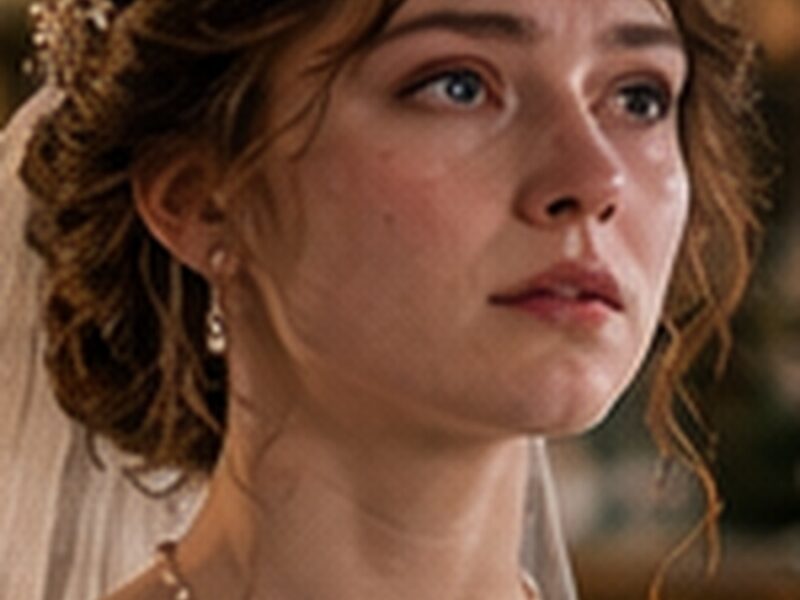
THE DUKE ABANDONED HER AT THE ALTAR FOR A RICHER BRIDE—SEVEN YEARS LATER, HE DISCOVERED THE FORTUNE HE HAD THROWN AWAY
Three hundred guests watched as a young bride received a letter instead of a husband.
The duke had chosen another woman whose fortune could save his ancestral estate.
Seven winters later, he would stand before the bride he had abandoned—and discover that the greatest thing he had ever lost could never be purchased.
Snow fell heavily over the ancient stone church in Yorkshire as three hundred guests waited for the Duke of Blackwood to arrive. Eleanor Whitmore stood before the altar in her ivory wedding gown, unaware that the man she loved had already decided to marry someone else. When the great church doors finally opened, they did not reveal a bridegroom. They revealed a gentleman carrying a sealed letter.
The winter of 1819 had arrived early in the North Riding of Yorkshire. By the middle of December, snow had buried the hills surrounding the market town of Ravenswick, softening its stone walls and narrow lanes until the whole valley seemed wrapped in white linen. On the morning of the wedding, the bells of St. Andrew’s Church rang across the frozen fields, and carriages rolled slowly through the drifts, bringing guests from the finest families in the county.
Inside the church, three hundred people filled the oak pews. Their breath rose in faint clouds despite the braziers burning along the aisle. They had come to witness the marriage of Edmund Blackwood, Duke of Blackwood, to Miss Eleanor Whitmore, a young woman of respectable family but modest means. Many whispered that theirs was a genuine love match, something exceedingly rare among people whose marriages were so often arranged around land, title, and inheritance.
Eleanor stood beside the altar in a gown of ivory silk that had taken months to prepare. Delicate lace edged the collar and sleeves, and tiny pearl buttons ran from her wrists toward her elbows, catching the glow of hundreds of candles. Beyond the tall windows, snowflakes drifted endlessly against the leaded glass.
She was twenty-two years old, and she believed with all her heart that this morning would mark the beginning of the life Edmund had promised her.
They had known each other for years, since the long summers when their families had visited one another. Their affection had grown through letters, walks, and quiet evenings beside the fire. Edmund had told her more than once that he wanted her for herself, not for a dowry, not for a title, and not for anything she could bring to his name.
She had believed him without reservation.
The bells fell silent. The vicar opened his prayer book and glanced toward the great wooden doors. Eleanor folded her gloved hands and waited.
Edmund had always been punctual, but a small delay meant nothing on a morning when snow had made the roads treacherous. She imagined his carriage struggling through the drifts, perhaps halted by a stubborn horse or a fallen branch.
Fifteen minutes passed.
Then thirty.
A low murmur began in the back pews and spread forward like a draft beneath a door. Ladies leaned toward one another behind their fans. Gentlemen checked their pocket watches and exchanged careful looks.
Eleanor kept her eyes on the entrance. Her face remained composed, although her fingers had grown cold inside her gloves.
At last, the doors swung open.
A man stepped in from the swirling snow, his greatcoat white across the shoulders. For one fleeting instant, Eleanor felt relief rise within her.
Then she saw his face.
It was not Edmund.
It was Sir Thomas Redford, the duke’s closest friend.
He walked down the aisle without looking at the guests. His expression was grave, and his boots left dark marks on the stone floor where the snow began to melt. He spoke a few quiet words to the vicar and handed him a sealed note.
Then he turned toward Eleanor.
In his hand was a folded letter.
He did not meet her eyes.
Eleanor recognized Edmund’s handwriting immediately. She took the letter, broke the seal, and began to read.
The message was brief.
Edmund wrote that he could no longer proceed with their marriage. The financial circumstances of his family had changed, and his first duty was to protect the Blackwood estate. He asked her not to attempt to contact him.
There was no explanation of the years they had shared. No acknowledgment of the promises he had made. No hope offered that they might ever see one another again.
Eleanor read the letter twice.
Behind her, three hundred people watched, waiting for her to faint, to weep, or to beg someone to ride after the duke.
She did none of those things.
For several seconds, she remained perfectly still, the paper resting between her gloved fingers. Then she folded the letter neatly, lifted her chin, and stepped down from the altar.
The vicar lowered his prayer book.
Sir Thomas moved aside.
Eleanor gathered the front of her gown and began walking.
Her silk train whispered across the stone as she passed the waiting guests. She could feel their eyes upon her, but she did not turn toward a single one of them.
When the doors opened, bitter wind swept snow across the threshold.
Eleanor stepped outside.
Her white gown almost vanished into the white world beyond.
By the following morning, all of Ravenswick knew that the Duke of Blackwood had abandoned his bride to marry the daughter of a wealthy industrialist.
The woman Edmund had chosen was Lady Levenia Harkort, the only daughter of Frederick Harkort, a man who had accumulated a vast fortune through mills and ironworks across northern England. Her father had recently secured a baronetcy and nearly every advantage his wealth could purchase.
What he wanted most was an illustrious title for his daughter.
Edmund wanted something else.
For years, the Blackwood estate had been quietly sinking beneath debts inherited from his father. Roofs leaked, farms failed, and obligations accumulated faster than any harvest could repay them. His solicitors had warned that Blackwood Manor itself might be lost within two years.
The Harkort fortune was large enough to rescue the entire estate.
Eleanor’s modest dowry could not have repaired a single wing of the house.
So Edmund made his decision through the cold logic of ledgers and inheritance. He told himself that love was a luxury his name could no longer afford. He persuaded himself that sacrificing his own happiness was the noble price of preserving his family’s legacy.
He had not gone to St. Andrew’s to face Eleanor because he did not trust himself to stand before her and say the words aloud.
Instead, he had written the letter, sent his closest friend, and chosen another bride.
Within the month, he signed the marriage settlement with Frederick Harkort.
The newspapers called it a brilliant match.
No one wrote about the young woman who had been left standing in the snow.
Eleanor’s aunt, Lady Beatrice Whitmore, visited her the day after the wedding that never took place. Lady Beatrice was a tall, sharp-eyed widow who had little patience for fools and even less for dukes. She offered Eleanor a room in her own house, somewhere quiet where she could recover while the gossip slowly faded.
Eleanor thanked her with genuine affection but refused.
She understood what that kindness might become. She would be the poor, abandoned niece, pitied at every dinner and whispered about at every dance. Years might pass, yet people would continue to define her by the morning a duke had failed to arrive.
She did not intend to spend the rest of her life as an object of sympathy.
Lady Beatrice studied her for a long moment.
Then she offered something else.
On the edge of Ravenswick stood a small cottage that had belonged to her late husband. It had been empty for years. If Eleanor wished, she could live there.
The cottage sat beside a snowbound lane a short walk from town, and it was in worse condition than either woman cared to admit. The roof leaked in two places. The kitchen chimney smoked whenever the wind turned east, and the upstairs windows rattled through every winter night.
Eleanor accepted it gratefully.
It was cold, crooked, and humble, but it was somewhere she could begin again on her own terms.
Her savings disappeared faster than she had expected.
Coal was expensive in the depths of winter. Bread and candles seemed to cost more every week, and keeping even one room warm required careful planning. Eleanor soon learned to judge the remaining daylight before beginning a task and to save the last pieces of coal for the coldest hours before dawn.
One evening, she opened the trunk at the foot of her bed.
Inside lay her wedding gown.
It was the most valuable thing she owned.
It was also the most painful reminder of the morning Edmund had left her.
She unfolded a small section of ivory silk and ran her fingers across the pearl buttons. She remembered standing beneath the church candles, waiting for footsteps that never came. For a long time, she sat beside the open trunk while the candle on her bedside table burned lower.
Then she made up her mind.
The following day, she carried the gown into Ravenswick and brought it to the shop of Mr. Samuel Fletcher, a merchant who bought and sold secondhand clothing.
Mr. Fletcher examined the silk and lace with an experienced eye. He offered a price far below what the gown had cost to make and explained, not unkindly, that wedding dresses were difficult to sell, especially when the story of the woman who had worn one had already traveled through every parlor in the valley.
Eleanor accepted without argument.
As Mr. Fletcher began wrapping the gown in brown paper, she noticed that one small pearl button at the cuff had come loose.
She hesitated.
“May I keep that button?” she asked.
The merchant looked at her for a moment before nodding. He carefully removed the button and placed it in her palm.
Eleanor closed her fingers around it.
She left the shop with a little money and one tiny piece of the dress she had once believed would begin her future.
The money bought food, firewood, and coal for the first difficult weeks. It was not nearly enough to support her indefinitely, so Eleanor began taking in mending from her neighbors.
A torn coat arrived first. Then a hem that needed letting down. Then an old bodice that had to be altered for a younger sister.
Each small job brought a few coins.
Eleanor worked beside the window during the short winter days and by candlelight long into the evenings. She learned to place her work where the light was strongest, to save every usable scrap of thread, and to judge the quality of a seam by touch when the candle burned too low to see clearly.
She never accepted more work than she could finish, and she always returned every garment on the day she had promised.
Slowly, the women of Ravenswick began recommending her to one another.
A farmer’s wife told a neighbor about the careful repair Eleanor had made to a Sunday dress. A shopkeeper sent a coat whose lining had begun to tear. A few gentlewomen who had heard about her skill appeared at the cottage door carrying garments they had been reluctant to entrust to anyone else.
The orders grew.
And in that cold little cottage, Eleanor began to discover that her own two hands might build the future a duke had refused to give her.
As the weeks passed, she realized that sewing everything by hand was costing her too much time. A simple repair could take an afternoon, while a new garment might occupy her for days. She was beginning to turn customers away, and every customer she lost represented money she could not afford to surrender.
One snowy morning, while running an errand in town, she stopped before the window of a secondhand shop near the market square.
Inside stood an unusual sewing machine.
It was a heavy contraption of iron and wood, an early mechanical device unlike anything she had ever owned. Its wooden casing was scratched and stained, but when the shopkeeper turned the wheel, the mechanism moved smoothly, and the needle rose and fell with a steady rhythm.
Eleanor watched for a long time.
A machine like that might transform her work. It could allow her to complete orders more quickly and accept garments she presently had neither the time nor means to undertake.
That evening, she counted her savings on the kitchen table.
Even after weeks of relentless work, the amount fell short.
There was only one valuable possession left in the cottage.
In a small velvet box beside her bed lay a pair of gold earrings that had belonged to her late mother. They were delicate little teardrops, and Eleanor had treasured them since childhood.
She remembered watching her mother fasten them before church, smiling as she turned her head to catch the light.
They were among the last happy reminders of the years before illness and debt had swallowed her family’s comfort.
For two days, the box remained open beside her bed.
Every time Eleanor looked at the earrings, she remembered her mother’s voice and the warmth of the house where she had grown up. Selling them felt like surrendering one of the final pieces of the girl she had once been.
Yet keeping them meant giving up the clearest opportunity she had been offered to escape a lifetime of small repairs and uncertain wages.
On the third morning, she closed the box, wrapped her shawl around her shoulders, and walked through the snow to the jeweler.
She accepted his price without bargaining because she did not trust herself to speak.
Then she added the money to her savings and went directly to the secondhand shop before she could change her mind.
The sewing machine was delivered to the cottage on a gray morning while snow fell steadily along the lane.
Eleanor wiped away years of dust, oiled the moving parts, and sat down to learn.
The first days were miserable.
The thread snapped repeatedly. Needles broke. Seams wandered crookedly across the fabric and had to be unpicked and sewn again. Some evenings, she worked until her candle burned down to a stub without completing a single garment.
Her shoulders ached, her fingers became raw, and more than once she sat back in exhaustion, wondering whether she had traded her mother’s memory for a heap of iron she would never master.
But Eleanor refused to give up.
She studied the machine with the same patience other women of her upbringing devoted to music or French. She learned how the tension worked, how to guide the cloth, and how to recognize the faint change in sound that warned of a tangled thread.
After several weeks, her seams began running straight and strong.
She could finish in a day what had once taken three.
Larger orders became possible. More elaborate requests no longer frightened her. For the first time since she had left the church, her income grew steady enough that she did not lie awake every night wondering whether she could afford coal for another week.
Eleanor understood exactly what she had paid for that small security.
She had sold the wedding gown that represented the love she had lost and the earrings that represented the love into which she had been born.
In return, she had gained the means to support herself.
She began putting aside a little money each week, saving toward a workroom in town where customers could find her more easily.
And while Eleanor was slowly winning her independence, stitch by stitch, Edmund Blackwood was beginning to understand the true cost of the wealthy marriage he had chosen.
At Blackwood Manor, the winter lay thick across the rooftops and gardens. The great house rose above the snow like a fortress, its towers newly repaired, its windows newly glazed, and its long galleries warm for the first time in a decade.
Inside his study, Edmund sat before the estate ledgers with a roaring fire in the hearth.
Across the desk sat Frederick Harkort, his father-in-law, turning the pages of the repair accounts with thick, careful fingers.
Frederick closed the ledger and announced that from that moment forward, every substantial expense would require his approval before a single shilling could be spent.
Edmund objected immediately.
Blackwood Manor had belonged to his family for generations, he insisted. He would not ask permission to manage his own estate.
Frederick did not raise his voice.
He simply reminded the duke that Harkort money was keeping a roof above his head and tenants on his farms. Without it, there would be no estate left to manage.
Edmund opened his mouth to answer.
Nothing came.
Before the wedding, he had believed that Levenia’s fortune would free him. He had imagined his debts cleared, his creditors silenced, and his dignity restored.
Instead, every important decision now had to be explained to his father-in-law.
Every repair, every plan for the farms, every investment in the land carried the same quiet reminder that Edmund no longer exercised unquestioned authority over the property he called his own.
He was still the Duke of Blackwood.
Servants still bowed, and neighbors still deferred to him.
But the real power had passed into other hands, and Edmund felt it whenever Frederick Harkort’s carriage arrived at the house.
Levenia herself was neither especially cruel nor particularly affectionate toward him. She was a practical woman who had married for a title and received precisely what she had bargained for.
She filled Blackwood Manor with expensive furniture, ordered new silks from London each season, and expected her husband to accompany her wherever society gathered.
Their conversations were polite and brief.
Edmund had saved his ancestral house, but he often found himself standing at the windows of its long gallery, looking across the snow-covered fields, unable to say what he had truly gained.
During those same months, Eleanor finally rented a small room above a draper’s shop on the main street of Ravenswick.
She placed her sewing machine beside the window that caught the strongest light and hung a modest painted sign beside the stairs.
Customers no longer had to struggle along the frozen lane to her cottage.
She began keeping a ledger of her own, a plain brown book in which she recorded every payment received, every yard of cloth purchased, and every order waiting to be completed.
At first, customers came chiefly for alterations and repairs.
Then one by one, they began asking whether she might make something entirely new.
Eleanor approached each gown with the same care she had devoted to her first mended coat. She recorded every measurement and every particular request. If a sleeve fitted poorly or a bodice sat incorrectly, she adjusted the pattern before cutting material for another order.
Every mistake became something she could learn from.
To reduce expenses, she purchased remnants that merchants sold cheaply at the end of a bolt.
Among them, one afternoon, she discovered a small length of deep blue velvet.
It was rich and soft, much too small for an entire gown, but too beautiful to leave behind.
She paid a few pennies for it and folded it carefully into her cupboard.
She had no immediate use for it.
But she believed that one day it would matter.
By the end of her first full year, Eleanor had customers who valued her skill far more than they cared about the humble address of her workroom.
She paid every supplier on time, expanded only when her earnings allowed, and never borrowed against a hoped-for order.
Edmund possessed a magnificent estate yet grew increasingly dependent with every passing month.
Eleanor possessed a single rented room and grew more independent with every garment she completed.
Then, one cold afternoon, a request arrived from one of the most influential families in Yorkshire.
It would become the greatest opportunity of her career.
Lady Adelaide Wexford was a woman whose name opened doors from York to London. She had connections in nearly every great house in the north and a reputation for exacting standards that intimidated dressmakers far more established than Eleanor.
Her daughter, Miss Charlotte Wexford, was to be married at the end of winter.
Lady Adelaide had heard through a cousin of a young seamstress in Ravenswick whose fittings were flawless.
She climbed the narrow stairs to Eleanor’s workroom herself.
Her gaze moved over the single window, the old machine, and the neatly arranged fabrics.
Then she asked whether Eleanor believed herself capable of making a wedding gown.
Eleanor understood immediately what was at stake.
A successful gown for the Wexford wedding could carry her name far beyond Ravenswick. Other noble families would ask who had made it, and their daughters might seek out the same dressmaker.
A failure could close those doors permanently.
She took Charlotte’s measurements with meticulous care, discussed every detail of the design, and ordered fine ivory silk from a reputable supplier in Leeds.
She arranged for the material to arrive well before the final fitting, leaving time for any reasonable delay.
But on the morning the parcel arrived, Eleanor unwrapped it and felt her heart sink.
A large portion of the silk had been ruined.
Long, ugly stains ran through the fabric where dye from another shipment had bled into it during the journey.
Eleanor wrote to the supplier immediately and sent her letter by the fastest coach available.
The reply came two days later.
The merchant apologized sincerely, but the roads were blocked with snow. There was no possibility of delivering replacement silk before the wedding.
Eleanor had seven days to finish the gown.
Lady Adelaide had already made it perfectly clear that the wedding would not be postponed because of a dressmaker’s difficulties.
For a long time, Eleanor stood at her cutting table, spreading the damaged silk beneath the gray winter light.
Some sections could still be used.
Much of it was beyond saving.
She could return the payment and surrender the commission, or she could find a way to finish the gown with the materials she had.
Then she remembered the deep blue velvet folded away in her cupboard.
She took it out and laid it across the undamaged ivory silk.
The contrast was striking.
The velvet was rich and dark against the pale silk, like a winter night pressed against fresh snow.
Eleanor pulled a sheet of paper toward her and began to sketch.
She would create a fitted velvet panel at the waist and run a narrow band of the same fabric along the hem. If every cut was exact, the design would compensate for the shortage of silk while giving the gown an appearance unlike anything fashionable Yorkshire society had seen.
She cut the remaining undamaged silk with extraordinary care, preserving the finest sections for the bodice and the front of the skirt.
She arranged and rearranged each piece until she was certain no stained fabric would appear in the finished garment.
On the fourth day, the bodice was complete.
On the fifth, she assembled the skirt and asked a young assistant from the draper’s shop downstairs to try it on.
As the girl turned and walked across the workroom, the velvet panel pulled crookedly, puckering the silk beside it.
With so little time remaining, many dressmakers would have pressed the fabric flat and hoped no one noticed.
Eleanor unpicked the entire seam.
Then she sewed it again.
She refused to conceal a flaw merely because the deadline was near.
On the sixth day, Lady Adelaide appeared without warning at the top of the stairs.
Her sharp eyes moved immediately toward the cutting table where the ivory silk and deep blue velvet lay side by side.
“What exactly am I looking at?” she asked.
Eleanor did not invent an excuse.
She explained that the original silk had arrived damaged, that no replacement could reach Ravenswick in time, and that she had altered the design in an attempt to save the gown.
Lady Adelaide’s displeasure was immediate.
She demanded to know why she had not been informed as soon as the fabric arrived.
Eleanor accepted responsibility.
She admitted that she had wanted to find a solution before bringing the problem to her client and that she had been wrong not to speak sooner.
Then she asked Lady Adelaide to wait until the following morning and judge the finished gown before making her decision.
Lady Adelaide drew on her gloves.
She left with a stern warning that her daughter must not be disappointed under any circumstances.
After the door closed, Eleanor went back to work.
Outside, snow buried the street and rooftops in silence.
Candlelight flickered over a table covered with thread, needles, and the last scraps of fabric.
Eleanor checked every seam by hand. She adjusted the velvet at the waist until it lay perfectly smooth, then examined the skirt to ensure it would move naturally as Charlotte walked down the aisle.
She allowed herself to overlook nothing.
Not a loose thread.
Not an uneven stitch hidden beneath a fold.
Somewhere past midnight, she thought of another wedding gown and another winter morning.
Then she pushed the memory aside and kept sewing.
By dawn, the gown was finished.
Miss Charlotte Wexford arrived for the fitting with her mother beside her.
Eleanor helped the young woman into the dress and stepped back.
The ivory silk fell softly over Charlotte’s shoulders, while the deep blue velvet drew an elegant line around her waist. The narrow band at the hem caught the light whenever she moved, giving the gown an unusual richness without overwhelming its simple grace.
Charlotte turned slowly before the long mirror.
The dress moved with her as gracefully as water and fitted perfectly from shoulder to hem.
Lady Adelaide crossed the room without a word.
She examined the seams, ran her fingers along the velvet, and lifted the hem to inspect the stitching beneath.
Then she straightened.
“This is not the gown I ordered.”
Eleanor met her gaze.
“No, my lady. It is not.”
For one long moment, nobody spoke.
Lady Adelaide looked toward her daughter.
Charlotte was smiling at her reflection as though she had forgotten anyone else was present.
At last, the older woman’s expression softened.
“This,” she said, “is the gown my daughter should have had from the beginning.”
She told Eleanor that she valued a dressmaker who accepted responsibility and found a solution when a supplier failed far more than one who merely followed instructions.
She promised that at the wedding, everyone would know who had created the design.
Lady Adelaide kept her word.
In the weeks after the wedding, letters began arriving in Ravenswick from every corner of Yorkshire.
Ladies wanted gowns for balls, christenings, and their daughters’ weddings. Some had seen Charlotte’s dress themselves. Others had heard the story from friends who could not stop talking about the unusual combination of ivory silk and deep blue velvet.
Soon, Eleanor had far more requests than her little room above the draper’s shop could accommodate.
She moved to larger premises on the same street, with three tall windows and a separate room for cutting.
Then she hired two experienced seamstresses.
Dorcas Miller was a quiet young woman with an extraordinary gift for embroidery. Her flowers were so fine that they seemed almost to grow from the cloth itself.
Mrs. Agnes Pritchard was older and plainspoken, with an uncanny ability to fit a garment perfectly to almost any figure.
Eleanor learned to divide the work among her employees, supervise orders, and keep careful accounts without allowing the quality of a single garment to decline.
One afternoon, a widow arrived carrying a ceremonial gown that had belonged to her late mother.
A careless dressmaker in another town had damaged its antique lace during an earlier repair. The widow was nearly in tears as she unfolded the garment on Eleanor’s counter.
Eleanor examined the lace carefully.
She removed the clumsy stitches one by one and spent two long evenings restoring the damaged work entirely by hand.
When the widow returned to collect the gown, she held it against her chest and could not speak for several moments.
Eleanor understood then that her work was more than making clothes.
Sometimes she was helping people preserve the things they loved most.
By her third year, Eleanor’s workshop employed six seamstresses. She had dependable suppliers in Leeds and Manchester, loyal customers who returned season after season, and a careful system for tracking every order from the first measurement to the final delivery.
Ladies of the nobility traveled considerable distances to commission her designs.
Yet Eleanor continued examining the most important details of every order herself.
She never expanded beyond what her finances could support, and she refused to allow her name to appear on anything less than excellent work.
That spring, at a gathering in a fashionable London drawing room, Edmund Blackwood found himself standing near Lady Beatrice Whitmore.
He had not spoken to Eleanor’s aunt since the winter of the abandoned wedding.
Lady Beatrice made no effort to soften the encounter.
When another guest asked after her family, she mentioned that her niece’s dressmaking business was flourishing beyond all expectation.
Edmund was startled.
Years earlier, he had heard that Eleanor was taking in mending to survive. The news had troubled him briefly, but he had soon put the uncomfortable thought aside.
He had never imagined that she might build a business whose reputation would reach the nobility itself.
He asked carefully how Miss Whitmore was faring.
Lady Beatrice turned her sharp gaze upon him.
She replied coldly that Eleanor had accomplished a great deal more than he could possibly imagine.
Then she walked away.
Edmund stood with his glass of wine untouched, hearing the chill in her voice long after she had disappeared into the crowd.
In the months that followed, Eleanor’s name seemed to appear everywhere.
At a dinner, one lady praised a gown that fitted so perfectly it seemed to have been made for no other person in the world.
At an assembly, another spoke of a remarkable dressmaker in Yorkshire who could transform the most difficult fabrics into garments of extraordinary beauty.
Her work was discussed in drawing rooms, at the opera, and around card tables.
Always with admiration.
Edmund gradually understood that Eleanor’s success was not a passing curiosity.
It was real.
And it was growing.
Then, at a ball in Mayfair, he noticed a gown unlike any other in the room.
Its shoulders were perfectly balanced, its waist flawlessly fitted, and every detail finished with quiet, exquisite care.
It was not the most expensive gown present.
But Edmund could see that it was among the finest.
He approached the woman wearing it and asked who had made it.
She smiled.
“Miss Eleanor Whitmore of Ravenswick.”
Edmund thanked her and moved away.
He could no longer pretend Eleanor’s work was some small country trade undertaken merely to survive.
The woman he had once believed incapable of helping him protect his inheritance had built an entire career through her own ability.
That night, alone in his study at the London townhouse, Edmund remembered the letter he had written on the eve of their wedding.
At the time, he had been certain that abandoning Eleanor was the only way to save Blackwood Manor.
He had called his decision duty.
He had called it sacrifice.
But the years since had taught him that dependence did not feel like freedom.
While he lived beneath the shadow of the Harkort fortune, explaining important decisions to his father-in-law, Eleanor had risen through her own work.
She owed her success to no wealthy marriage.
For the first time, Edmund allowed himself to admit what he had spent years refusing to face.
He regretted the choice he had made.
Seven years after the wedding that never happened, Edmund learned that Eleanor would be visiting London for a major exhibition of fine dressmaking and textiles.
He resolved to see her.
In the winter of 1826, snow covered the streets of London, softening the soot-darkened rooftops and muffling the clatter of carriage wheels.
Eleanor had come to the capital to participate in an exhibition celebrating luxurious fabrics and exceptional dressmaking.
Merchants, manufacturers, and the most fashionable ladies of the city filled the great hall, moving between displays of silks, laces, and finished garments.
From the moment the doors opened, Eleanor’s work attracted attention.
Merchants leaned close to examine her stitching. Women from influential families asked how soon they might place an order.
Eleanor stood beside her display in an elegantly tailored gown of dove-gray fabric trimmed with deep blue.
She spoke with each visitor easily and directly, with the calm confidence of a woman who understood precisely what her work was worth.
At her ears hung a pair of delicate gold earrings shaped like teardrops.
They were not the original earrings her mother had given her.
Those were long gone.
But when her business had become secure, Eleanor had visited a goldsmith and asked him to make a new pair as close to the originals as his skill allowed.
They reminded her of her mother and the difficult choice that had purchased her first sewing machine.
Now she could wear them without worrying about how she would pay for tomorrow.
She was discussing a length of brocade with a client when she noticed a familiar figure moving through the crowd.
Edmund Blackwood.
Beside him walked Levenia, wrapped in costly silk trimmed with fur.
Seven years had passed.
Edmund looked older than his age. Fine lines marked the corners of his eyes, and the easy confidence he had once carried so naturally seemed to have worn thin.
Levenia looked polished, expensive, and faintly bored.
Edmund stopped before the display.
“Eleanor.”
She turned.
For a single heartbeat, something moved across her face.
Then it was gone.
She inclined her head and greeted him with the formal address owed to a duke, exactly as she would have greeted any stranger of his rank.
The distance in her voice unsettled Edmund more than anger could have done.
He had prepared himself for bitterness.
Perhaps even tears.
He had not prepared himself for courtesy.
He told her that he had heard a great deal about her success and wanted to see her designs for himself.
Eleanor gestured politely toward the display.
“Of course, Your Grace.”
Edmund studied the gowns for some time.
At last, he admitted sincerely that the work was remarkable.
Before Eleanor could respond, Levenia stepped forward and ran a gloved hand along a beautifully finished sleeve.
She announced that she wished to commission a gown.
Eleanor opened her appointment book.
She turned several pages, examining the dates and existing orders.
Then she explained that the earliest opening for a complete gown would be the following June.
Levenia’s expression hardened.
She remarked that surely a duchess would be given precedence.
Eleanor replied evenly that she maintained the same schedule for every client and would not move another woman’s appointment simply because of Levenia’s title.
Levenia drew herself up.
“Do you understand to whom you are speaking?”
Eleanor met her gaze.
“Perfectly, Your Grace.”
Then she called her assistant and suggested that a consultation could be arranged if the duchess still wished to proceed.
She added pleasantly that His Grace would be asked to wait in the carriage while the details of the gown were discussed.
For the first time in seven years, Edmund stood before Eleanor and understood that she no longer needed his approval for anything.
Levenia turned toward her husband, expecting him to intervene.
She wanted him to remind the dressmaker of her place.
Edmund said nothing.
He did not ask Eleanor to change her schedule.
He did not defend his wife’s demand.
Instead, he looked at the woman who had once waited for him before the altar of St. Andrew’s Church.
Seven years earlier, he had believed that Eleanor could not possibly live well without the marriage he had offered her.
Now he stood surrounded by gowns she had created, watching ladies of wealth and rank wait patiently for the privilege of her time.
When Levenia moved away to speak with the assistant, Edmund lowered his voice.
“Eleanor, I owe you an apology.”
She looked at him calmly.
“Yes, Your Grace. You do.”
The simple answer seemed to leave him momentarily uncertain.
He began explaining that he had made the decision he believed necessary to save Blackwood Manor. He had convinced himself there was no other choice.
Eleanor listened without interrupting.
Then she spoke.
“You always had a choice, Edmund. You simply decided I was the easiest thing to sacrifice.”
He lowered his eyes.
For a moment, the noise of the crowded exhibition seemed far away.
At last, he admitted that he had regretted the decision for years.
Eleanor remembered the snow-covered church, the folded letter, and the faces of three hundred guests turned toward her.
She remembered the long walk down the aisle and the cold wind striking her face as she stepped outside alone in her wedding gown.
But she also remembered the crooked cottage with its leaking roof, the old sewing machine with its broken needles, and the nights she had worked until the candle burned to nothing.
She remembered lying awake, wondering whether she could afford coal for another week.
Those years had changed her.
Edmund’s regret could not erase them.
And she would not pretend that it could.
“I once had something real to give you,” she told him quietly. “But you never cared enough to discover what it was.”
Edmund had no answer.
He had measured the value of a marriage by the money a wife might bring to his estate, as though a woman were a sum to be entered into a ledger.
Now, standing before Eleanor, he understood what she had possessed all along.
Perseverance.
Talent.
Dignity.
Courage.
And the ability to build a future from almost nothing.
He had never valued those things properly because they could not be counted in pounds.
“I wish I could undo what happened,” he said.
Eleanor’s expression remained composed.
“There is nothing left you need to give back to me. I have already built the life I need.”
Then she inclined her head politely and turned toward the client waiting beside her display.
Edmund remained where he stood.
He watched Eleanor speak with visitors, arrange appointments, and offer advice with quiet authority.
The woman he had abandoned because he believed she had nothing to offer had built a life that no longer contained a place for him.
At last, Levenia called him toward the carriage.
He looked back once as he reached the doors.
Eleanor did not look after him.
Edmund followed his wife into the cold.
Snow was still falling over the London streets, gathering on the iron railings and drifting against the steps.
The Blackwood carriage waited at the curb, its crest gleaming faintly beneath a thin covering of white.
Edmund climbed inside and sat in silence while Levenia complained about the insolence of tradeswomen.
He hardly heard her.
He understood now that nothing he had said inside the exhibition hall could change the past.
He had saved his ancestral estate through his marriage to Levenia.
But the woman he had once promised to love had built a future that did not require him in any way.
Inside the exhibition, Eleanor did not pause to watch his carriage depart.
She continued speaking with the clients who had been waiting. She showed them fabrics, explained her designs, and wrote new requests into her appointment book in her neat, steady hand.
The encounter with Edmund changed nothing about her work or her plans.
Once, he had been the center of the future she longed for.
She had imagined her entire life arranged around his name and his house.
Now that future belonged entirely to her.
That evening, Eleanor returned to her hotel near the Strand.
The room was quiet, and beyond the window lay a city of snow-covered rooftops glowing faintly beneath the gas lamps.
She removed her gold earrings and placed them gently on the dressing table.
Then she opened her traveling case and took out a small wooden box that she carried wherever she went.
Inside lay a single pearl button.
The one she had kept from her wedding gown.
Beside it rested the very first ledger she had used when she began taking in mending at the cottage beside the snowbound lane.
Eleanor opened the ledger.
The small sums stared up at her from the worn, yellowing pages, written in the careful handwriting of a woman who had once counted every penny.
There were figures that had determined whether she could purchase coal or endure another freezing night.
There were the first orders: a few shillings for a torn coat, a hem let down, or a bodice repaired.
Tiny amounts that had once seemed almost miraculous.
Each had given her another reason to believe she could survive one more week.
Eleanor picked up the pearl button and held it in her palm.
It was all that remained of the gown she had worn while waiting for Edmund at St. Andrew’s.
On that morning, she had believed her life would truly begin the moment she became a duchess.
Instead, she had been left alone.
She had been forced to create a different beginning with nothing but her own hands.
The button no longer represented a love she wished to reclaim.
It reminded her of the distance she had traveled since the day she stepped out of the church into the falling snow.
She placed the ledger beside the button and closed the wooden box.
She did not keep these things because she longed to return to the past.
She kept them because she never wanted to forget that she had once begun with almost nothing.
Her wedding gown had carried her through those first desperate weeks of winter.
Her mother’s earrings had purchased the sewing machine.
The sewing machine had opened the way to a workroom.
The workroom had grown into a respected establishment.
And the establishment had become a name admired across England.
Her patience, discipline, and determination had carried her to the very place where Edmund had stood that afternoon and finally seen her clearly.
Edmund Blackwood had once believed Eleanor possessed no fortune worth choosing.
He had abandoned her to marry a woman whose money could rescue his estate.
Seven years later, he understood that he had surrendered something far more valuable than he had ever recognized.
He had lost a woman capable of building her own future through her hands, her mind, and her strength of character.
But that understanding had come too late.
Eleanor did not need Edmund to return.
She did not need him to recognize her worth.
She had the life she had chosen for herself.
The fortune Edmund Blackwood had failed to recognize was never gold, land, or an inheritance.
It had been Eleanor herself.
And while the duke would spend his remaining years remembering what he had lost, Eleanor had already learned the lesson he had never understood.
Her future had never belonged to him.









