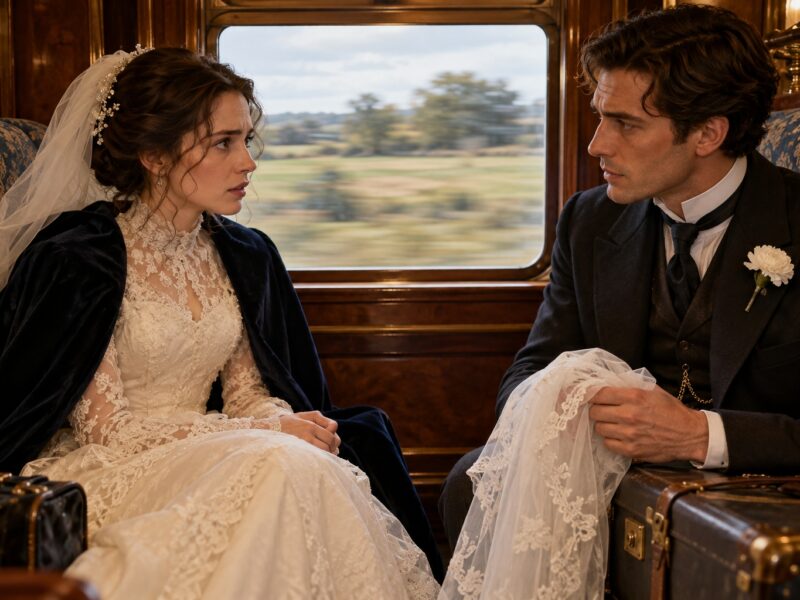
THE DUKE AND HIS BRIDE BOTH RAN AWAY ON THEIR WEDDING MORNING—THEN DISCOVERED THEY HAD BOARDED THE SAME TRAIN
“If you tell my father where I am, I shall scream.”
“Could you wait until we leave the station? My mother is on the platform.”
Anora Bramwell stared at the man sitting opposite her. Until that extraordinary morning in June 1893, she had believed she understood every possible calamity that might befall a bride. She had imagined a lost wedding ring, a fainting bridesmaid, perhaps even a groom who failed to appear. She had never considered finding that groom in a first-class railway carriage, carrying a packed valise and apparently fleeing the very same wedding.
Yet there he was.
Piers, Duke of Westerin, wore the dark morning coat selected for their ceremony. A white carnation had been crushed against his waistcoat, and his normally immaculate collar had shifted slightly out of place. His face was unmistakable: the face Anora had spent eight weeks attempting to imagine across the breakfast table for the remainder of her life.
“Your Grace,” she managed.
“Miss Bramwell.”
Her wedding veil slipped from her shoulder and fell between their feet.
Neither moved to retrieve it.
Outside, a porter slammed a carriage door. A woman called anxiously for a missing hatbox, and somewhere along the platform, two men were arguing about luggage. The ordinary world continued without the smallest acknowledgment that two respectable people had just discovered something capable of ruining their reputations.
The Duke of Westerin and his intended bride were sitting opposite one another on a train scheduled to leave Belwick four hours before their wedding.
Anora looked at the leather valise beside his knee.
“Were you looking for me?”
“No.”
He answered so plainly that she could not even accuse him of attempting gallantry.
He had packed shirts.
She sat down with great care, gathering the expensive white silk around her knees. The simple movement seemed to require all the composure she had spent thirty-one years learning.
Piers, who could address a room filled with impatient gentlemen without once losing his place, found himself unable to produce a single suitable sentence for a woman dressed to become his wife.
The engine released a long whistle.
Anora reached for the carriage door.
Piers rose at the same moment, catching her fallen veil before her boot could crush it. His elbow struck her shoulder, and her traveling bag collided painfully with his knee. By the time they had disentangled themselves, the floor had begun to vibrate.
The train was moving.
Anora looked through the window at the platform sliding away. Piers remained standing with the veil in his hand.
“Well,” she said, her voice dangerously even, “we appear to have improved matters.”
It was the first distinctly unkind thing he had ever heard her say.
To his considerable surprise, it made him feel better.
The train gathered speed. Belwick station disappeared behind a goods shed, taking with it their last opportunity to step down quietly and pretend that nothing had happened.
Anora settled against the upholstery. Her wedding dress spread across the faded seat in a magnificently inappropriate cloud of white silk.
Piers offered the veil.
“Thank you. You may put it anywhere. I have developed a dislike of it.”
He folded it carefully over his valise.
Her hands were trembling. She hid them beneath her traveling cloak before he could notice and offer sympathy. She feared that a single gentle word might destroy the composure she had struggled to preserve since dawn.
She had anticipated her father’s anger and her sister’s bewilderment. She had prepared herself for a painfully courteous expression of disappointment from the man she was abandoning.
She had not prepared to discover that he had been planning precisely the same escape.
At thirty-one, Anora had believed herself beyond the age of discovering entirely new forms of humiliation.
“Where were you going?” she asked.
“Lynmouth.”
She closed her eyes.
“Of course you were.”
“You, too?”
“My sister has taken rooms there. I thought she might let me in.”
“I have a house in Lynmouth.”
“Naturally. It would be terribly inconvenient if you had to ask somebody.”
He accepted the remark without protest.
She almost wished he would argue.
Throughout their engagement, his steady courtesy had seemed one of the strongest foundations upon which a marriage could be built. Now she wondered whether it had been merely a polished surface concealing two people who had never troubled to know one another.
After a moment, he spoke.
“I left a letter.”
“So did I.”
“That is something.”
“Do you think so?”
He considered.
“Mine began by explaining how grateful I was.”
“How unfortunate. Mine did too.”
“I wrote three versions before I found one that did not sound excessively brutal.”
“I wrote three versions before I realized that no arrangement of polite words could disguise what I meant.”
“What did you finally say?”
“That I was unequal to the occasion.”
Piers looked toward the window.
“Were you?”
“Yes.”
“So was I.”
For a moment, neither spoke.
They had not been forced into marriage. That was what made the whole business so painfully difficult.
No cruel guardian had arranged the engagement. No creditor had threatened to destroy either family. Anora’s father possessed more than enough money to support his daughter comfortably, and Piers possessed considerably more.
Two sensible adults had considered a sensible arrangement and agreed upon it.
Their families, delighted by the prospect, had mistaken willingness for happiness.
Anora had liked Piers from the beginning.
She still liked him, although she would rather have bitten her tongue than confess it at that particular moment.
He was attentive without presuming familiarity. He listened when other people spoke. He treated her father respectfully, even when Mr. Bramwell deserved considerably less patience. His letters were thoughtful, orderly, and beautifully punctuated.
At their first dinner together, she had caught the sleeve of her gown against a chair. Piers had freed it without drawing anyone’s attention to her embarrassment.
Such things mattered.
But none of them explained how a woman was supposed to spend the rest of her life married to a man she barely knew.
“What time is it?” she asked.
Piers consulted his watch.
“Ten o’clock.”
“The wedding is at two.”
“Yes.”
“Papa will have found my letter.”
“My secretary will have found mine.”
“You did not give it to your mother?”
“No.”
Anora released a miserable breath.
“I left mine with my maid. Nelly is nineteen. I instructed her not to give it to Papa until eleven, as though delaying the disaster might somehow improve it.”
Piers put away his watch.
“We must send word from the next station.”
“Yes.”
She turned back toward the window.
The freedom she had imagined during the sleepless hours of the previous night had failed to arrive. Instead, she pictured the wedding flowers being arranged, the musicians preparing their instruments, and her sister Rowena wearing the pale blue gown that had required several final alterations.
Most painfully of all, she imagined Nelly sitting outside her father’s room with a letter she would be frightened to deliver.
“I cannot go through with it,” Anora whispered.
Piers became still.
“I am not asking you to.”
“No, but if we return, everyone will ask. They will tell us we are frightened. They will remind us that people are waiting.”
“People are waiting.”
“I know.”
Her voice broke on the final word.
She hated that weakness more than the veil, more than the wedding gown, and almost more than the discovery that Piers had also intended to abandon her.
“I know they are.”
He moved one hand toward the space between them, then stopped.
During eight weeks of engagement, he had taken her hand precisely four times. Every occasion had been supervised, perfectly appropriate, and almost entirely without warmth.
“I cannot marry you today either,” he said.
There it was.
She had wanted the wedding stopped.
She had not wanted to discover that she was a woman her intended husband could not bear to marry.
Piers saw her expression change.
“Anora, I did not mean—”
“You needn’t soften it. I have said exactly the same thing.”
“Yes. But it remains a dreadful thing to hear.”
She looked at him then.
Outside, the train traveled between fields brilliant with early summer green. A farmer waited beside a crossing with his cart. Cows grazed beneath a row of trees, entirely unconcerned with the collapse of two respectable lives.
“Why did you ask me to marry you?”
Piers rubbed his thumb along his watch chain.
“I thought we should suit.”
“Because I am quiet?”
“Among other things.”
“Name one.”
“You are kind to my mother.”
“I am kind to most elderly women. That hardly constitutes a marriage proposal.”
His mouth moved toward a smile, then settled.
“I know that now.”
He remembered their second meeting, when his mother had fallen asleep in her chair. Rather than allow the room to fall awkwardly silent, Anora had continued speaking softly about the garden until the older woman woke.
Piers had watched from the doorway.
After months of being told what his position required, the sight of such unconsidered kindness had loosened something inside him.
He had mistaken gratitude for certainty.
“And why did you accept?” he asked.
Anora looked down at her gloved hands.
She could have spoken of respect or companionship. She could have explained that affection often grew between sensible people, or that a useful marriage was not necessarily an unhappy one.
Instead, she answered with the truth.
“I was tired of being the woman for whom nothing happened.”
He said nothing.
“My sister married. My cousins married. Even the girls I was asked to chaperone began having children. I know there are worse things. I know how fortunate I have been.”
Her fingers tightened around one another.
“But when you asked, everyone was so pleased. Papa cried. I had not seen him cry since my mother died.”
Piers lowered his eyes.
“And you were kind,” she continued. “I thought perhaps I could step into the happiness everyone had already arranged for me.”
“The more they spoke of it,” he said quietly, “the less room there seemed to be for anything else.”
She nodded.
For the first time since their engagement, they were having a conversation neither had rehearsed.
The train began to slow.
Beyond the trees, the next station appeared.
Anora rose before her courage could desert her.
Piers lifted her traveling bag.
“We can send telegrams and hire a carriage back,” he said.
She looked sharply at him.
“To stop the wedding,” he added. “We ought at least to do that ourselves.”
At the door, she hesitated.
“Will you stand beside me when they ask?”
“Yes.”
“Even if your mother cries?”
For a moment, his face looked considerably older than his thirty-eight years.
“Yes,” he said again, though less easily.
The train stopped.
He stepped onto the platform and offered his hand.
For the first time since accepting his proposal, Anora took it because she genuinely wanted his help.
Her skirts caught on the carriage step. He bent to release them, murmuring something beneath his breath.
“What was that?”
“Your dress appears considerably more determined to attend this wedding than either of us.”
Anora laughed.
It was sudden, loud, and wholly inappropriate.
Then she began to cry.
There was nothing graceful about it. She wept beside a stack of empty milk churns while Piers stood holding her bridal veil, looking like a man who would rather face a firing squad than decide how to comfort a distressed woman.
Eventually, he produced a handkerchief.
“It is clean,” he assured her solemnly.
That made everything worse.
She laughed into the linen and cried harder.
A passing porter surveyed the bride, the duke, and the abandoned veil, then quietly decided that the milk churns needed moving elsewhere.
Piers waited.
He did not instruct her to be brave. He did not promise that everything would be easily repaired.
When the tears finally passed, she felt exhausted and cold.
“I am not crying because you will not marry me.”
“I did not think you were.”
“I may be crying a little about that.”
He turned his face away, offering what privacy his presence could provide.
“I am not particularly enjoying being unwanted either,” he admitted.
Anora blew her nose.
“How ridiculous we are.”
“Yes.”
They sent separate telegrams.
Piers informed his household that he was safe, that the wedding must not proceed, and that he was returning to Belwick.
Anora sent a similar message, adding an urgent request that nobody blame Nelly for delivering her letter.
When the clerk asked for payment, she discovered she had brought three pairs of gloves and no purse.
Piers paid without comment.
She found herself absurdly grateful that he had not mentioned it.
Finding a carriage required nearly half an hour. During the wait, Anora watched a sparrow struggle with a length of string beneath a bench. Piers spoke with the stationmaster about horses and roads, recovering his usual competence now that the problem involved transportation rather than marriage.
By the time they reached Belwick, the church bells had not begun to ring.
That small mercy nearly brought her to tears again.
Her father stood waiting in the entrance hall.
Behind him was Rowena, wearing pale blue silk with one cuff still pinned where the dressmaker had been working. Beyond the open drawing-room doors sat Piers’s mother, the Dowager Duchess of Westerin.
Somehow the two households had already combined their fear into a single gathering.
“Where have you been?” Mr. Bramwell demanded.
“On the train.”
“I know that. Why?”
Anora opened her mouth.
Nothing came out.
The familiar carpet stretched beneath her feet. Her father wore the waistcoat she had chosen for him. On the side table stood the silver tray her mother had once brought out every Christmas.
Everywhere she looked, something seemed to demand that she put matters right.
Piers placed her bag on the floor.
“We both left independently,” he explained. “Neither knew the other was going. We happened to meet on the train.”
Mr. Bramwell stared.
“On your wedding morning?”
“Yes.”
Anora stepped forward.
“He was not abandoning me, Papa. I was already abandoning him.”
Rowena made a strangled sound and pressed a hand over her mouth.
Her father struggled to regain his authority.
“You can discuss this after the wedding.”
“No, Papa.”
“You are both upset. There is still time.”
“No.”
The second refusal was stronger.
It seemed to cross the entire hall, striking every familiar object Anora had spent her life being careful not to disturb.
Mr. Bramwell looked at her as though his daughter had suddenly become a stranger.
From the drawing room, the Dowager Duchess called her son’s name.
Piers went to her immediately.
He knelt awkwardly beside her chair and took her hand.
“I am sorry, Mama.”
Eglantine, Dowager Duchess of Westerin, had dressed with particular care that morning. Tiny pearls trembled against her gray hair. Illness during the winter had left her thin and easily tired, although she resented any suggestion that she might require special consideration.
“I went to the station to meet your godfather,” she told him. “I thought I saw you through a carriage window. Then I decided I must have been mistaken.”
Piers lowered his eyes.
“I saw your hat. I hid behind a newspaper.”
She considered him for a long moment.
“Did you quarrel?”
“No.”
“Then what happened?”
He looked toward the doorway, where Anora stood watching.
“I was about to marry a woman I scarcely know. I thought it would become easier if I continued making arrangements. Instead, it became more frightening.”
“Marriage is frightening.”
“I know. But I should still have wanted this one.”
His mother withdrew her hand.
“I had hoped to see you settled.”
“I know, Mama.”
He offered no fresh promise to comfort her.
Anora found herself loving him a little for that honesty, though it was a profoundly inconvenient time to begin.
Mr. Bramwell wanted an explanation suitable for the guests. A sudden illness might do. An urgent family matter would be better. Anything was preferable to announcing that the bride and groom had fled independently and accidentally boarded the same train.
Piers refused to invent an illness.
Anora refused to allow him to accept all the blame.
Eventually, they agreed upon a simple statement: both had reconsidered, and the wedding would not take place.
The words looked painfully small when the butler wrote them down.
Then came the practical consequences.
A message was dispatched to the church. Carriages were sent to intercept arriving guests. Rowena discovered an aunt weeping in a corridor and immediately gave her something useful to do.
The cook, informed that the wedding breakfast had been canceled, declared that somebody would eat the meal even if she had to carry the dishes into the road herself.
Upstairs, Nelly helped Anora remove her wedding dress.
“Did he read the letter too soon, miss?” the girl asked anxiously.
“No. You did exactly what I asked.”
“I was afraid I had spoiled something.”
Anora took her hand.
“You spoiled nothing. I should have spoken to him myself.”
When the gown came away, Anora felt as though her body belonged to her again.
Red marks crossed her waist where the tightly fitted silk had pressed against her skin.
She had once imagined keeping the dress for the rest of her life.
Now she could hardly bear to look at it.
“Put it away, please.”
Nelly’s expression fell.
“Not because of your work,” Anora added. “That was lovely. The dress has merely had a difficult morning.”
Later, as she passed the study, Anora heard her father’s voice.
“She would have made you a good wife.”
“I believe she would,” Piers answered.
“You have made her look a fool.”
There was a pause.
“I should have spoken before today,” Piers admitted.
Anora opened the door.
“So should I, Papa. I will not have him punished merely because you cannot bear to be angry with me.”
Her father turned away.
On his desk lay the printed order of service, their names joined beneath the date.
“I do not know what you want,” he said.
The helplessness in his voice hurt more than his anger.
“Neither do I,” Anora answered. “I thought that meant I ought to accept what was offered.”
Piers left before the guests sat down to eat.
He had his own household to face and his own explanations to make.
At the door, he returned Anora’s bag and folded veil.
“Thank you for coming back,” she said.
“I had help.”
“You could have remained on the train.”
“So could you.”
Without the terrible necessity of becoming his wife that afternoon, she discovered she could look properly at his face.
There was a shallow scar beside one eyebrow, almost concealed by its shape.
She had never noticed it before.
“Did you truly intend to go to Lynmouth?”
“Yes.”
“I hope you do not. Not just yet.”
He waited.
“I think I should like to be the only runaway at my sister’s breakfast table.”
“Of course.”
He hesitated, then gave her the formal bow he had offered after every carefully supervised visit during their engagement.
She almost asked him not to.
Before she could find the words, he was gone.
That evening, Anora found her father in the garden.
He was still wearing his wedding waistcoat and holding a cigar that had long since gone out.
She sat beside him.
“I liked him,” Mr. Bramwell said eventually.
“So did I.”
“You were never to be sold, you know.”
“I know.”
“I would have let you refuse.”
Anora looked at the darkened end of his cigar.
“I did refuse, Papa. It has not been easy for you to let me.”
He flinched.
Then he nodded.
They remained together until the evening became cold.
As Anora rose, her father caught her wrist with the gentleness he had used when she was a child.
“Tell your sister not to keep you at the seaside forever.”
It was not forgiveness for everything.
But it was enough for Anora to bend and kiss his cheek.
Three days later, she left Belwick in an ordinary brown traveling dress.
This time, she was going exactly where she intended.
Rowena met her at Lynmouth station with a fierce embrace and an immediate complaint about the wind.
Her husband, Lucius, had returned to London on business, leaving the sisters rooms overlooking the sea and a sitting room mercifully free of white wedding flowers.
For the first week, Anora slept late, ate more than she expected, and discovered that freedom could be remarkably quiet.
Nobody discussed her prospects.
Nobody proposed marriage.
A boy selling postcards called her madam without knowing whom she had failed to marry.
On the ninth morning, she reached for a second cup at breakfast and realized there was nobody for whom she needed to pour it.
Her hand remained suspended above the table.
She had not wanted that wedding.
It was becoming inconveniently clear that she wanted to know what had happened to the man.
That afternoon, she wrote Piers a note.
It began with an inquiry after his mother’s health and continued with observations about the sea. Near the bottom, she crossed out a sentence so thoroughly that the paper nearly tore.
Rowena found her preparing another copy.
“What did the first one say?”
“Nothing.”
“An unusually violent nothing, judging by the paper.”
Anora laid down her pen.
“I should like to see him.”
“Then say so.”
“He may think I am trying to get him back.”
“Are you?”
“I never had him.”
Rowena sat on the edge of the desk, dislodging three postcards.
“Write the letter you wish to write, Anora. You need not submit it to a committee of imaginary aunts.”
So Anora wrote honestly.
She said she hoped he was well. She described a bakery whose existence ought to be protected against all sensible advice concerning moderation. She added that, should he still wish to visit his house in Lynmouth, she would be pleased to take tea with him.
After posting the letter, she spent two days wishing she could recover it from the bottom of the sea.
His reply arrived on the third morning.
He was well. His mother alternated between being cross with him and worrying that he was not eating enough, which he considered a hopeful sign.
He would visit Lynmouth the following Thursday.
He remembered the bakery from a summer he had spent there as a boy, although he regretted learning that its influence had spread.
Beneath the formal conclusion, he had added one sentence.
I should like to see you, too.
Anora read it three times.
Rowena, observing from across the breakfast table, wisely said nothing.
Piers arrived without flowers.
Anora had not expected them, yet felt unexpectedly relieved at their absence.
He wore a light summer suit and carried his hat as though uncertain what to do with it. The little scar beside his eyebrow was more visible in the strong daylight.
“You look rested,” he said.
“I have been practicing. Almost professionally.”
Rowena served tea and remained throughout the visit.
Anora was grateful for her presence. A third person relieved them of the obligation to turn every ordinary remark into an explanation of their failed wedding.
They discussed the beach, the weather, and a disagreement between Rowena and Lucius over an entirely unnecessary rug.
“Why unnecessary?” Piers asked.
“Because we possess floors already,” Rowena explained.
“Surely the rug is intended to conceal them.”
He spoke so seriously that Rowena began explaining the objection before realizing he was teasing her.
Anora looked at him over her teacup.
“You have concealed a disposition toward mischief.”
“Not particularly successfully. My sisters used to find it intensely irritating.”
Anora knew that he had two married sisters. She knew their children’s ages and where the families lived.
She knew almost nothing about the boy who had grown up beside them.
“What else did you do as a child?”
“Disappoint my dancing master.”
“That is hardly difficult.”
“And learn several tricks with coins.”
She put down her cup.
“I beg your pardon?”
“My youngest sister was ill one summer. I exhausted every conversation I knew, so I learned to entertain her.”
“Show me.”
He glanced toward the doorway.
“Now?”
“Unless you have an engagement to deceive someone more important.”
Piers took a coin from his pocket.
Anora noticed his hands: capable, strong, slightly scarred across the knuckles.
He displayed the coin, closed his fist, tapped it with the other hand, then opened both palms.
The coin slipped from his sleeve and struck the tea tray with a sharp ring.
Anora stared.
“I had rather more practice when I was fifteen,” he said.
Her laughter came before she could decide whether it was kind.
He looked at the fallen coin.
Then he began to laugh as well.
When Rowena returned, both were red-faced and attempting to appear composed.
“What have I missed?”
“Nothing you would pay to see,” Piers assured her.
He remained in Lynmouth for ten days.
His house stood above the western end of the beach, smaller than his other properties, with windows that rattled when the sea wind rose. He had not visited it in years, but for once he had no urgent desire to leave.
Anora and Rowena walked with him in the mornings. Lucius sometimes joined them when he came down from London.
They bought buns at the bakery, where Piers managed to scatter powdered sugar over his coat.
They watched children dig trenches against the advancing tide and endured a band performance in which the loudest instrument appeared determined to defeat all the others.
Slowly, almost without noticing, they began discovering one another.
Anora learned that Piers disliked being asked to speak immediately after a heavy meal. He remembered the names of horses long dead and became unexpectedly stubborn when he believed he had correctly identified a bird.
Piers learned that Anora was not naturally quiet.
She became quiet among people she desperately wanted to please.
With Rowena, or when discussing something that genuinely interested her, she could be lively, impatient, opinionated, and occasionally unfair.
She apologized when she realized she had been unfair.
Sometimes the realization took longer than it should.
One afternoon, they encountered a man demonstrating mechanical toys along the promenade.
A wooden bird pecked at a tin dish while a little dog chased its own tail beside it.
Anora stopped to watch.
The dog became stuck halfway through its pursuit.
“You want it,” Piers observed.
“Certainly not.”
“Why not?”
“Because it is ridiculous.”
He examined the struggling dog.
“That appears to be its principal advantage.”
She bought the toy herself.
The vendor wrapped it in paper, and Anora carried it back to the hotel feeling peculiarly happy.
Nobody suggested it belonged in a nursery she did not possess.
Nobody treated the purchase as a preparation for marriage or motherhood.
It could simply be a ridiculous thing that belonged to her.
That evening, Piers passed beneath the sitting-room window and heard the mechanism rattling.
Anora was complaining that the dog was losing again.
Rowena told her to stop taking sides.
He walked home smiling.
On Sunday, the four of them hired a boat in the sheltered water near the harbor.
Lucius claimed considerable experience with rowing and demonstrated very little of it.
Piers took the oars.
His first stroke splashed water across Anora’s skirt.
She surveyed the wet fabric.
“A remarkably original courtship technique.”
The word remained between them.
Lucius became fascinated by a nearby mooring rope.
Rowena looked toward shore.
Piers kept his hands on the oars, but his ears grew red.
“Is that what this is?” he asked.
Anora had intended a joke.
Or perhaps she had intended a joke she could withdraw if the answer proved embarrassing.
For once, she decided to leave herself no retreat.
“I think it might be.”
The boat turned gently on the water.
A gull gave an objectionable cry somewhere behind them.
“I had hoped so,” Piers said.
It was a small answer, delivered without ceremony.
Yet Anora felt its warmth all the way down to the damp hem against her ankle.
They returned to shore without anyone drowning, although Lucius’s reputation as a sailor suffered permanent damage.
Rowena declared that she needed tea and took her husband away to secure a table.
Anora and Piers followed along the path above the beach.
Where the path narrowed, he took her hand.
She kept holding it after the way widened again.
“Do you wish me to address you as Your Grace?” she asked.
“Not while you are holding my hand.”
“Piers.”
He turned at the sound of his name.
She wished she had tried saying it that way long before.
They stopped beneath a wooden shelter overlooking the water.
Rowena’s blue parasol was moving toward the tearooms in the distance.
“I am going to Italy in September,” Anora said.
Piers blinked at the abrupt change of subject.
“With Rowena and Lucius. We were arranging it before you asked me to marry you. I gave up the journey, but we have begun making arrangements again.”
“For how long?”
“Until January, we think.”
He looked toward the sea.
Four months was a perfectly ordinary journey for people of their means.
It was also four months in which Anora would be somewhere he was not.
“I see.”
“I wanted you to know before this went any further.”
“I am glad you told me.”
The words were correct.
The disappointment beneath them was considerably more interesting.
“Are you?”
“No,” he admitted. “I would rather you stayed. But I do not believe I am entitled to pretend you never mentioned September.”
She smiled.
His gaze dropped briefly to her mouth.
For a moment, neither moved.
There were people walking below them. A boat was entering the harbor. Sand had worked its way into Anora’s shoe, and her skirt remained damp from the rowing expedition.
It was not a secluded garden in a romantic novel.
It was an ordinary afternoon.
“May I kiss you?” Piers asked.
“Yes.”
He moved slowly, giving her time to change her mind.
She did not.
The first touch of his lips was warm and uncertain.
Then Anora stepped closer, tightening her fingers around his hand.
The uncertainty gave way to something that made the voices from the promenade seem suddenly distant.
When they drew apart, she was smiling in a way he had never seen.
“Oh,” she whispered.
He laughed, a little breathlessly.
“I hope that is favorable.”
“It is insufficiently descriptive.”
“Shall I try again?”
“Later,” she said, though she was smiling.
They returned to the tearoom without saying very much.
Rowena took one look at them and ordered another pot.
That night, Anora lay awake listening to the sea.
She had once been engaged to this man without ever imagining the weight of his hand around hers.
Now she could remember almost nothing else.
Across the town, Piers stood by the window of his small house and practiced the coin trick.
Eventually, the coin vanished precisely where it was supposed to vanish.
There was nobody present to admire the achievement.
For the first time that evening, he stopped smiling.
When Anora returned to Belwick in July, her father met the carriage himself.
He asked after Rowena, complained about the expense of seaside lodgings, and carried Anora’s smallest bag indoors despite the footman waiting to take it.
At dinner, he mentioned that he had seen the Duke of Westerin the previous week.
“He looks better.”
“Does he?”
“I thought so.”
Neither looked at the other.
Anora smiled into her soup.
Piers called two days later.
This time, she did not rehearse questions about the garden or prepare suitable conversational topics.
Instead, she showed him the mechanical bird, which had suffered damage during the journey.
He spent twenty minutes on the drawing-room floor attempting to repair the little dog.
Mr. Bramwell entered, surveyed the scene, and raised an eyebrow.
“I hope this is not an indication of how Your Grace manages his estates.”
“It is precisely how I manage them,” Piers replied. “Only the repairs are generally more expensive.”
Her father laughed.
Anora watched his shoulders relax and felt the dangerous pleasure of having made everyone happy.
The visits continued.
Piers brought her a novel with a dreadful ending because he wanted someone to share his indignation.
She persuaded him to attend a small concert, then admitted afterward that she had disliked the second half.
He was so relieved by her honesty that he took her to supper.
They quarreled mildly about ordering another dish and discovered that neither was particularly skilled at surrendering an argument about food.
Sometimes they kissed beside the garden door, listening for footsteps.
Once Mr. Bramwell opened it while Piers still had his hand against Anora’s cheek.
Her father closed it again with deliberate noise and informed the entrance hall that the roses appeared to be flourishing.
Anora had never been happier in her father’s house.
Then other people began to notice.
A cousin wrote to congratulate her on the apparent reconciliation.
A neighbor declared that she had always expected the little interruption in June to prove beneficial.
An aunt informed Anora that nervous brides were often foolish, but a sensible gentleman knew when to persevere.
Anora should have corrected her.
Instead, she allowed the remark to pass.
It was pleasant to be described as temporarily foolish rather than permanently rejected.
Later, walking home, she disliked herself for how pleasant it had been.
In August, the Dowager Duchess invited Anora to luncheon.
Piers mentioned the invitation with carefully studied lightness.
His mother had not withdrawn her courtesy, but she had been slower to release her disappointment. She had asked three times whether Anora intended to remain in Belwick for the rest of the summer.
Three times, Piers had answered yes.
It was true, as far as it went.
He had not mentioned Italy.
Anora arrived wearing a blue dress she knew Eglantine admired.
Piers noticed.
He also noticed the absence of the little pin shaped like a running dog, which Anora had worn almost every day at the seaside.
Luncheon began pleasantly.
The Dowager asked after Rowena, listened to an account of the boating expedition, and even smiled at the description of Lucius’s questionable seamanship.
Anora answered beautifully.
She did not interrupt.
When Eglantine described the excellent work of a local committee, Anora said she would be delighted to assist.
Piers knew she had just accepted an obligation without knowing what it involved.
He had done much the same thing twice that morning.
After luncheon, his mother led them into a smaller drawing room.
On a table lay a box lined with tissue paper.
Inside was a length of old lace, carefully cleaned and folded.
“I had intended to put it away,” Eglantine said. “But perhaps there is no need to trouble anyone.”
Anora looked at the lace.
It had been intended for her wedding dress.
Piers could have spoken.
His mother had not asked an impossible question. He could have explained that he and Anora were spending time together but had made no plans for marriage.
Instead, he watched Anora, afraid that speaking too firmly might make her think he no longer wished to marry her.
“It is very beautiful,” Anora said.
“I wore it myself. It would please me to see it used again.”
“Of course,” Anora answered. “Of course.”
The Dowager closed the box.
Nobody had actually promised anything.
Yet somehow a promise had been made.
During the drive home, Anora sat with her hands folded tightly in her lap.
“You were quiet,” Piers observed.
“I was trying to be pleasant.”
“You needn’t try quite so hard.”
He regretted the words as soon as they escaped.
“Did I embarrass you?”
“No. That is not what I meant.”
“Your mother was kind enough to invite me.”
“I know.”
They completed the journey in uncomfortable silence.
At her gate, he kissed her hand instead of her mouth.
Anora went upstairs and wrote to Rowena that she was considering remaining in England after all.
The letter was thoroughly reasonable.
Travel could be exhausting. Their father would miss both daughters. Perhaps January was too long to remain abroad.
She never once wrote Piers’s name.
Rowena came to Belwick instead of replying.
“I thought this conversation might be quicker in person,” she announced, removing her hat.
Anora stared at the traveling bag beside her.
“You came all this way to interfere?”
“Yes. Lucius was grateful to be excused.”
They sat in Anora’s bedroom, where the large wardrobe still contained the wedding dress.
“Do you want to stay?” Rowena asked.
“I do not know.”
“Do you want to go?”
“Yes.”
“Then there appears to be considerably more information than you were admitting.”
Anora moved toward the window.
“I am not a child, Rowena. People do give things up for one another.”
“Has Piers asked you to?”
“No.”
“Does he know you are considering it?”
“No.”
Rowena waited.
“His mother is older than Papa,” Anora explained. “He has responsibilities here. I cannot expect him to behave exactly as though he had never met me.”
“Four months in Italy will not prevent him from having responsibilities in England.”
“You make it sound easy.”
“I have been married twelve years,” Rowena said. “I know how often a sacrifice is presented afterward as a bill nobody remembers agreeing to pay.”
Anora turned.
Her sister was no longer smiling.
“I wanted to live near the sea once,” Rowena continued. “Before the children. Lucius thought London more practical. So did I, after I had explained it to myself often enough.”
She looked down at her hands.
“Then for years, whenever he was thoughtless, I remembered the house we never took. He could not understand why I became angry over an empty jug or a late arrival. Sometimes I could not understand it either.”
“You never told me.”
“It was not a particularly interesting story. We eventually had to speak about it, with considerably less dignity than I would have preferred.”
Anora sat beside her.
“Are you happy?”
“Yes. But that does not mean I want you to repeat every foolish thing I did on the way.”
Piers came that afternoon.
He brought no damaged toys to repair and no novels over which they might quarrel.
He asked Anora to walk in the garden.
The solemnity of his voice told her what he intended before they reached the end of the path.
He had imagined this conversation differently all morning.
Now he could see her hands clasped tightly together, and his own fear drove him toward the familiar language of duty and suitability.
“I believe we could make one another very comfortable,” he began.
Anora stopped.
Piers heard the sentence a moment after she did.
It was precisely what he had said when he proposed the first time.
For an instant, he might have laughed, apologized, and started again.
Then he saw tears in her eyes, and embarrassment made him defensive.
“That came out badly.”
“Yes.”
“You know I care for you.”
“I thought I did.”
“Anora—”
“I am wearing the blue dress your mother likes. I have agreed to join a committee I know nothing about. I have written Rowena that I may abandon Italy, and you are telling me how comfortable our lives shall be.”
Piers stared.
“You have canceled Italy?”
“Not quite.”
“Why did you not tell me?”
“Because I thought you would be pleased.”
He looked away.
“I would have been.”
His honesty hurt.
“What are we doing?” she asked.
“I thought I was asking you to marry me.”
“Because you want to? Or because everyone has begun putting the wedding lace back on the table?”
“That is unfair.”
“Yes,” she admitted. “It is.”
A bee drifted through the lavender beside them.
Piers watched it settle, rise, and settle again.
He had spent weeks longing to see Anora. He thought of remarks she might enjoy and noticed her absence in rooms she had never entered.
None of those feelings was false.
Neither was the relief he had experienced when his mother brought out the lace and Anora failed to object.
“I did not tell Mama you were leaving,” he confessed.
Anora looked up.
“I meant to. Then she seemed pleased about us, and I thought it could wait until after luncheon. After that, I suppose I would have found something else to wait for.”
She sat on the garden bench.
Piers remained standing, looking as though he expected to be dismissed.
“I do want you,” he said.
She raised her face.
“It is not gratitude this time, or a desire to have matters settled. I think about you when you are not there. I see something ridiculous and resent everyone around me because you are somewhere else.”
Her eyes filled.
“But I also want an easy life,” he continued. “And I am beginning to suspect that whenever something frightens us, we both smile until it becomes impossible.”
Anora moved to one side of the bench.
He sat beside her, leaving a little space between them.
“I thought falling in love would make me less frightened,” she admitted.
Piers turned.
“Has that happened, then?”
“Yes.”
She looked down.
“Inconveniently.”
He reached across the space between them.
This time, he did not stop before taking her hand.
“It has happened to me, too.”
Anora closed her eyes.
He kissed her knuckles.
For some time, neither spoke.
At last she said, “I am still going to Italy.”
“I know.”
“And I am not answering a proposal while I am worrying whether your mother will be upset.”
“I have not managed to make a proposal yet.”
“No. It was rather a poor beginning.”
He laughed unwillingly.
She leaned against him.
The happiness was still there, beneath everything that frightened them.
Perhaps, she thought, it did not have to disappear merely because they began speaking honestly.
They visited his mother together the following afternoon.
Anora had suggested it and spent the entire carriage journey wishing she had proposed something less virtuous.
Eglantine listened to their explanation about Italy without interrupting.
When Piers finished, she looked at Anora.
“Had you intended to tell me yourself?”
“Yes.”
“When?”
Anora felt a familiar answer forming.
At a suitable moment. When the arrangements were settled. When the Dowager felt stronger.
Instead, she said, “I kept hoping Piers would tell you first.”
His mother’s gaze shifted toward her son.
“So did I,” he admitted.
Eglantine sat back.
“I appear to have become a rather frightening person.”
“You were disappointed, Mama,” Piers said. “I did not want to give you something else to be disappointed about.”
“Then you had better find a more effective method than keeping me ignorant.”
Neither could argue with that.
The Dowager picked up a letter from the table beside her chair, then put it down again.
“I am not asking you to abandon your journey, Anora. I had not known there was a journey to abandon.”
“I should have told you.”
“Yes. You should.”
Anora accepted the rebuke.
It was deserved, and somehow easier to bear than the imagined catastrophe that had kept her silent.
Eglantine did not ask whether there would be a wedding.
Instead, she asked about their route.
When Anora described the places she hoped to visit, the older woman began recalling a journey to Italy before Piers was born.
She remembered a staircase, an argument concerning luggage, and a hotel dining room where her husband had accidentally taken another gentleman’s hat.
Piers looked surprised.
“You never told me Father did that.”
“He did a number of things before becoming your father.”
Her dry voice made him laugh.
For a moment, she looked at him with an affection unclouded by disappointment.
Later, when Anora went to fetch her gloves, Piers lingered beside his mother’s chair.
“I cannot promise how this will end,” he said.
Eglantine looked at his hands.
He had clasped them behind his back exactly as he had done when he was a boy waiting to confess broken glass.
“Neither could I when I married your father,” she replied. “We merely had fewer people demanding a satisfactory account of our feelings.”
He bent to kiss her cheek.
She caught his sleeve.
“I should like to be invited to luncheon occasionally when there is no announcement to make.”
“I should like that, too.”
It did not mend every hurt.
But it was a beginning.
Anora departed in September.
Her father came to the station carrying Rowena’s gloves, which Rowena was already wearing, and a parcel of food nobody required.
He complained about the number of trunks, kissed both daughters, and instructed them to write proper letters rather than send pictures of buildings with three words on the back.
Piers stood a little apart until the porter had finished loading.
Anora went to him.
“You have brought a novel.”
“I am practicing remaining where I said I would.”
“Will you write?”
“Yes.”
“Even if nothing has happened?”
“Especially then.”
“You may regret promising.”
She wanted him to kiss her.
She also wanted her father, the porter, three elderly ladies, and a gentleman eating a pear to disappear temporarily.
Neither wish seemed likely to be granted.
So she stepped forward and kissed him herself.
Mr. Bramwell developed an immediate interest in the railway timetable.
Once aboard, Rowena offered Anora a piece of the food parcel.
“Are you crying?”
“No.”
Her sister waited.
“Yes. A little.”
“It is possible to wish to go and still dislike leaving.”
“I had hoped to be simpler than that.”
Rowena handed her a sandwich.
“Then you chose the wrong family.”
The first fortnight abroad was busy enough to make missing Piers only an occasional inconvenience.
By the third week, his absence had become a constant companion.
She thought of him when she saw an ugly ornament in a shop window. She imagined his remarks at the conclusion of a disappointing meal. Halfway through a conversation, she would realize he could have told the story better.
She wrote about all of it.
At first, her letters described admirable things.
Then they began describing the things she actually noticed.
Lucius losing his temper with a trunk. Rowena’s disastrous attempt to bargain over a piece of lace. Her embarrassment at preferring an unremarkable little church to the famous cathedral everyone had insisted she admire.
Piers answered in kind.
A committee meeting had lasted so long that he had begun envying the furniture, which at least was not expected to speak.
His oldest horse had developed a peculiar dislike of one particular gate.
His mother had invited a friend to stay and ordered the housekeeper to remove the most uncomfortable chair from the guest room, leaving Piers to wonder how many previous visitors had suffered in it out of politeness.
He did not turn every letter into a declaration of love.
Once he wrote only two pages, most of them concerning rain.
Anora read those pages in bed and missed him so fiercely that she had to put them down.
In October, they quarreled by post.
Piers proposed visiting in November and named dates without asking which would suit Anora.
She had already accepted another invitation with Rowena and Lucius.
Instead of explaining this, she wrote that his arrangements sounded agreeable.
Then she became irritated when his next letter assumed everything was settled.
She began a sharp reply.
Halfway through, she stopped.
There was something deeply unreasonable about accusing a man of failing to discover an objection she had deliberately concealed.
She tore up the letter and wrote another.
She wanted him to come. Those dates were inconvenient. She had pretended otherwise because she feared he might abandon the visit altogether if she created difficulties.
His answer arrived several days later.
He could come a week afterward.
He apologized for presenting his calendar as though the rest of Europe had been waiting for his convenience.
He added that he would have preferred to discover her annoyance before traveling across the continent to encounter it.
Anora laughed aloud.
It was not a flawless exchange.
But it was followed by a much better visit.
Piers arrived in Florence in November and took rooms at a hotel near those occupied by Rowena and Lucius.
On the first afternoon, Anora found herself strangely shy.
For two months, she had reconstructed him from handwriting.
The living man was taller, warmer, and considerably more distracting than the figure she had imagined.
They walked with Rowena until her sister announced that she had no intention of watching them conduct a third conversation about the weather.
“Lucius is in that shop,” she said. “I shall rescue the proprietor. Do not wander beyond retrieval.”
Piers offered Anora his arm.
“Have I disappointed you?” he asked after Rowena left.
“No. You are simply very quiet.”
“I am trying to remember how I used to speak to you.”
He stopped.
“I have brought no proposal speech.”
“That may help.”
She laughed.
He drew her briefly closer, his fingers pressing against the hand resting on his arm.
By evening, they were themselves again.
More nearly themselves, in fact, than they had ever been during the eight weeks of their first engagement.
They disagreed about where to walk.
They grew tired and admitted it.
They returned to the hotel earlier than planned without treating the change of arrangements as evidence that one had disappointed the other.
On his last evening, they remained after supper with Rowena and Lucius.
Piers attempted the coin trick.
This time, the coin disappeared, remained absent, and reappeared beneath the edge of Lucius’s plate.
Lucius protested that he had been watching the wrong hand.
“That,” Piers said, “is rather the point.”
Anora watched him smile.
She had now seen him tired, irritable, occasionally foolish, and stubborn about matters he later admitted were unimportant.
She had also seen him return to difficult conversations when avoiding them would have been considerably easier.
The sum of these things reassured her far more than his immaculate manners ever had.
Later, at the door, she placed her hand against his coat.
“I shall be home in January.”
“I know.”
She drew a breath.
“I should like you to ask me then.”
Piers became perfectly still.
“You needn’t answer now,” she added quickly. “I have done it again, haven’t I? Arranged the next part without consulting you.”
He kissed her before she could make the matter tidier.
When he stepped back, his face remained very close to hers.
“January,” he said.
The remaining weeks did not become a waiting room.
Anora traveled with her sister, bought a coat wholly unsuitable for an English summer, and stayed awake late one evening arguing with Lucius about a novel neither had finished.
She was not living the wrong life while waiting for a man to arrive and begin the right one.
Still, when January came, she was glad to return home.
Piers called the day after her arrival.
There were no flowers on the drawing-room table.
Her father had gone out after announcing, with conspicuous importance, that he had a great deal of business in town.
The mechanical bird stood on the mantelpiece.
Its little wooden dog remained permanently trapped in pursuit of its own tail.
Anora did not sit.
Neither did Piers.
He had spent the journey rejecting possible speeches.
Everything he imagined sounded either too solemn or insufficiently meaningful.
Now he stood before her and finally recognized the question beneath all the phrases he had practiced.
“I want to be the person you tell,” he began.
Anora waited.
“When you like something. When you hate it. When you have agreed to something foolish and wish you had not.”
He glanced toward the broken toy.
“I want to know why the ridiculous dog has stopped moving, why you are awake at night, and whether you would rather be somewhere else. I cannot promise I shall always enjoy hearing the answer.”
Anora’s eyes filled.
“I should be alarmed if you did.”
He took her hands.
“Will you marry me?”
“Yes.”
He watched her with the seriousness she had once mistaken for distance.
She smiled through her tears.
“Piers.”
“Yes?”
“That is the whole answer.”
He laughed unsteadily and drew her into his arms.
Her father returned twenty minutes later.
He looked at their faces, removed his hat, and sat rather heavily in the nearest chair.
“Before I say anything,” he began, “am I permitted to be pleased?”
Anora went to him.
He held her tightly.
This time, his tears did not feel like an obligation she must spend the rest of her life fulfilling.
They married in May, in the same church where they had failed to marry the previous June.
The guest list was shorter, though not because everyone had become more understanding.
One cousin remained offended by the inconvenience of the canceled journey.
An aunt insisted upon calling the entire episode Anora’s Little Adventure.
Anora disliked the expression and said so.
The aunt changed the subject and attended anyway.
The Dowager offered her wedding lace once more.
This time, Anora chose a small length for her cuffs and asked to keep the rest uncut.
“It is too beautiful to spend entirely upon one morning,” she explained.
Eglantine agreed, after carefully examining precisely how the lace would be used.
There were still arrangements to make.
Piers had work he could not abandon.
Anora wished to spend more time in London than he generally preferred.
They discussed the matter, disagreed, and settled upon a plan they would try for one year.
Neither pretended it was a permanent solution to every disagreement their future might contain.
On the wedding morning, Anora awoke before Nelly came to dress her.
For several minutes, she lay listening to the household begin its work.
She was frightened.
Not of an unwanted husband, or the loss of her freedom, or a life she had never chosen.
She was frightened because she now possessed so much happiness that losing it would hurt.
Then she rose and prepared for her wedding.
At the church door, her father asked whether she was ready.
“Nearly. My glove is caught.”
He helped free it.
Neither treated the small delay as an omen.
Inside, Piers waited, pale and smiling.
When Anora reached him, his hand trembled as it closed around hers.
She felt an answering tremor in her own fingers.
For once, she was glad neither had managed to conceal it.
That afternoon, they took the train to Lynmouth.
Their luggage had been sent ahead.
At first, they sat opposite one another, amused by the familiar arrangement.
Anora wore a traveling dress and a hat that had resisted every attempt to sit straight.
Piers had forgotten to remove his white carnation.
She noticed it.
“You might take that off.”
“Why?”
“People will know.”
“I rather hope so.”
The platform began to move beyond the window.
Anora watched it slide away, remembering the terrible sensation of departure on their previous journey.
She thought of the veil lying across the seat and the discovery that the man she was expected to marry had been just as frightened as she was.
Piers reached into his pocket and produced a coin.
“Have you been practicing?” she asked.
“Relentlessly.”
He displayed it, closed his fist, tapped his knuckles, and opened both hands.
The coin fell to the floor.
Anora bent to retrieve it at precisely the same moment he did.
Their foreheads collided with a small, painful knock.
For a moment, both remained still.
Then Anora began to laugh.
Piers sat back, rubbing his forehead, and watched his wife laugh until she could scarcely breathe.
There would be mornings when neither of them found anything funny.
There would be badly worded letters, careless arrangements, and times when understanding another person seemed less like romance than exhausting work.
But Anora was here, with her crooked hat and her lovely unguarded face, traveling beside a man she had freely chosen.
Piers left the coin where it had fallen and moved to the seat beside her.
This time, when Anora reached for his hand, neither of them was trying to escape.









