The Duke Asked Who Baked His Apple Tart—Then Discovered the Widow Everyone Had Forgotten to Thank
“Who baked this apple tart?”
Twelve dinner guests fell silent.
And in the kitchen beyond the closed door, a young widow stood with flour on her cheek, unaware that one simple question was about to change her life.
The Duke of Heathworld had not intended to embarrass anyone. He had merely taken a second bite of dessert and found himself remembering a woman who had been dead for twenty years.
It was autumn 1822, and the dining room at Bligg House glowed with candlelight. Silver candlesticks stood between polished serving dishes, and the last of the evening’s wine had been poured. Mrs. Harriet Bligg sat at the head of the table, surrounded by twelve guests who had spent most of dinner pretending not to notice how carefully she arranged every opportunity for the duke to admire her daughter.
Jacob, Duke of Heathworld, was thirty-five. After ten years in the army, he had returned to Hampshire to inherit a title he had never wanted and a house that felt emptier than any barracks he had known. Since his return, every ambitious mother in the county had decided that his loneliness was an opportunity.
Mrs. Bligg was among the most determined.
“Why, my daughter baked it, Your Grace,” she announced, setting down her glass with a delighted smile. “Clarissa makes the loveliest apple tart. Don’t you, my love?”
Beside her, nineteen-year-old Clarissa Bligg lowered her eyes.
“Yes, Mama,” she murmured.
The duke looked at the young woman for a moment before returning his attention to the plate.
The pastry was impossibly thin, crisp enough to break beneath his fork. The apples had softened without losing their shape, their sweetness balanced by lemon and brown sugar. Nutmeg lent the filling its warmth, but beneath it was another flavor, delicate and unexpected.
Black pepper.
He remembered a kitchen from his childhood, a copper kettle, and an elderly woman who used to let him sit beside the fire when the rest of the household found him troublesome.
Mrs. Penny, his old nurse, had made apple tart exactly this way.
She had been dead for twenty years.
Jacob took another bite, slower this time.
At the far end of the dining room, the servants’ door stood partially open. Through it, he glimpsed a narrow passage leading toward the kitchen, where a woman in a plain gray dress stood beside a large black stove.
She was perhaps twenty-six, with brown hair escaping its pins and flour scattered across her apron. There was even a little on her cheek. She was watching the dining room with an expression Jacob could not quite understand.
It was neither envy nor resentment.
It was the distant, quiet look of someone who had learned to watch happiness without expecting to be invited into it.
Before he could study her further, the butler closed the door.
Jacob set down his fork.
“It is exceptionally good,” he said.
Mrs. Bligg beamed.
“Thank you, Miss Bligg.”
Clarissa did not look up.
Later, when the ladies retired to their cards and the gentlemen settled into conversation, Jacob excused himself.
“I believe I need some air.”
Mrs. Bligg immediately suggested the terrace, but he was already crossing the hall.
He did not go outside.
Instead, he found the back stairs.
The kitchen was hot, bright, and almost deserted. A thin kitchen maid had fallen asleep on a stool near the fire, her head tilted against the wall. At the sink, the woman in gray was washing a mountain of plates.
Jacob stopped in the doorway.
“Excuse me.”
She turned so quickly that a plate slipped in her wet hands. She caught it against the sink, then stared at him in astonishment.
“Your Grace!”
Her face drained of color. She wiped her hands against her apron and hurried into a curtsy.
“You must have taken the wrong staircase. The drawing room is upstairs.”
“I know where the drawing room is.”
She looked uncertain.
“I came to find the person who baked the apple tart.”
Her hands went still.
From upstairs came the faint sound of laughter. Somewhere in the passage, a clock ticked steadily.
Jacob watched her expression.
“It was you, wasn’t it?”
She glanced toward the stairs.
“Yes, Your Grace.”
“What is your name?”
“Mrs. Fox. Abby Fox. I’m the cook.”
He repeated her name as though it deserved to be remembered.
“Mrs. Fox, that was the finest thing I have eaten in twenty years. Thank you.”
Abby stared at him.
For several seconds, she did not move. Then her eyes filled with tears so suddenly that she turned away, pressing the back of her wrist against her cheek.
Jacob frowned, concerned.
“Have I said something wrong?”
“No, Your Grace. Forgive me.”
She took a breath, but it trembled.
“I have worked in this house for six years. Three meals a day, every day. I’ve cooked for parties, dinners, birthdays, and Christmases. I must have made a thousand tarts.”
Her voice became barely audible.
“No one has ever thanked me before.”
Jacob looked at the stacked plates, the cracked skin around her fingers, and the sleeping maid who was probably too exhausted to stand.
He had spent years among men who understood the value of small kindnesses. A cup of hot tea after a night in the rain. A clean blanket. Someone remembering your name.
Yet here was a woman who had spent six years feeding a household without receiving so much as an ordinary expression of gratitude.
He reached for a dishcloth.
Abby blinked.
“Your Grace, what are you doing?”
“Drying the plates.”
“You cannot!”
“I was a soldier for ten years, Mrs. Fox. I’ve dried worse plates than these.”
She opened her mouth to object, but he had already taken the first dish.
For the first time that evening, Jacob smiled.
“Now tell me something. Who taught you to put black pepper in apple tart?”
Abby’s answer came slowly at first. Her mother had learned the recipe from her grandmother, who had once cooked in a great house near Winchester. It was an old family habit, the smallest amount of pepper added to bring out the warmth of the apples.
As they worked, Jacob asked about her family.
She told him she had married at eighteen.
Her husband’s name had been Sam Fox.
“He was a soldier,” she said. “Tall, with red hair. He laughed at everything, even things no sensible person would find amusing.”
Her mouth softened at the memory.
“He died at Waterloo.”
Jacob’s hand stopped on the plate he was drying.
“I was there.”
Abby turned toward him.
“Then perhaps you saw him.”
It was a terrible, impossible hope, and they both understood it.
Jacob remembered smoke so thick that men disappeared a few yards away. He remembered the wounded calling for water and the faces of men who had been laughing only hours earlier.
He could not give Abby the answer she wanted.
“I saw many brave men that day,” he said quietly. “I am certain your husband was among them.”
She lowered her gaze.
“Thank you.”
After Sam’s death, she explained, there had been no pension large enough to support her and no children to give her a reason to remain in their little rented home. She had found employment with the Bliggs and stayed because she could not afford to leave.
When the last plate was dry, a bell rang overhead.
Abby flinched.
“Please, Your Grace. You must go.”
“Have I kept you from your duties?”
“It isn’t that.”
She twisted the edge of her apron between her fingers.
“If Mrs. Bligg discovers you down here, I could lose my position.”
Jacob understood the warning.
He placed the dishcloth neatly beside the sink.
“Good night, Mrs. Fox.”
“Good night, Your Grace.”
He reached the doorway before she spoke again.
“And thank you.”
He turned.
“For what?”
“For seeing me.”
Jacob carried those words home.
He returned to Bligg House the following week.
Mrs. Bligg received him with unmistakable enthusiasm, and Clarissa was instructed to sit beside him while her mother arranged tea. Jacob remained for a polite half hour, discussing the weather and the coming county fair.
Then he mentioned a wish to see the gardens.
Beyond the kitchen wall, where the autumn herbs still grew, he found Abby cutting rosemary.
She looked up at the sound of footsteps.
“Your Grace?”
“I hoped you might know which of these plants my gardener has been murdering.”
She almost laughed.
Almost.
“You have a gardener?”
“Several. None has managed to explain why my rosemary keeps dying.”
“It probably doesn’t like being fussed over.”
Jacob considered that.
“Neither do I.”
This time she smiled.
He returned the next week, and the week after that.
Their meetings remained brief, always in the garden, always with enough distance between them to satisfy anyone who happened to pass. At first, Abby addressed him with an anxious formality that made every conversation difficult.
Gradually, the formality loosened.
They spoke of the army, of books, and of the peculiar sadness of a house full of people in which one could still feel entirely alone.
Abby loved reading, but books were expensive. When Jacob discovered she had been borrowing worn volumes whenever she could, he brought her one from his library.
She protested.
He told her it had been sitting unread for years and would be far happier in her hands.
The following week, he brought another.
It was during these conversations that he began to understand what her six years at Bligg House had cost her.
Mrs. Bligg paid her half the wages earned by cooks in comparable households. Every broken cup was deducted from her pay. She was allowed only one half day of freedom each month.
Abby spent that precious afternoon walking to a churchyard where a memorial stone bore Sam’s name, although his body rested far away in Belgium.
Jacob never tried to persuade her to stop going.
He understood that grief was not a place from which someone could simply be rescued.
One afternoon, beside the bean poles, they fell silent.
Abby had been describing a passage from one of the books he had lent her. She stopped halfway through a sentence when she realized he was no longer listening to the words.
He was looking at her.
Not at her apron, her roughened hands, or the flour that seemed permanently caught beneath her nails.
At her.
“Abby,” he said.
She looked away.
It was the first time he had used her Christian name.
“Please don’t.”
“Don’t what?”
“Speak to me that way.”
Her fingers tightened around the basket of herbs.
“You are a duke. I am a cook. There is nothing waiting at the end of this road except trouble for me.”
Jacob stepped closer, though he did not touch her.
“What if I made a different road?”
Abby looked up.
For one dangerous moment, hope overcame caution.
Then a voice cracked across the garden.
“Mrs. Fox!”
Mrs. Bligg stood at the gate.
Her face had turned a deep, furious red.
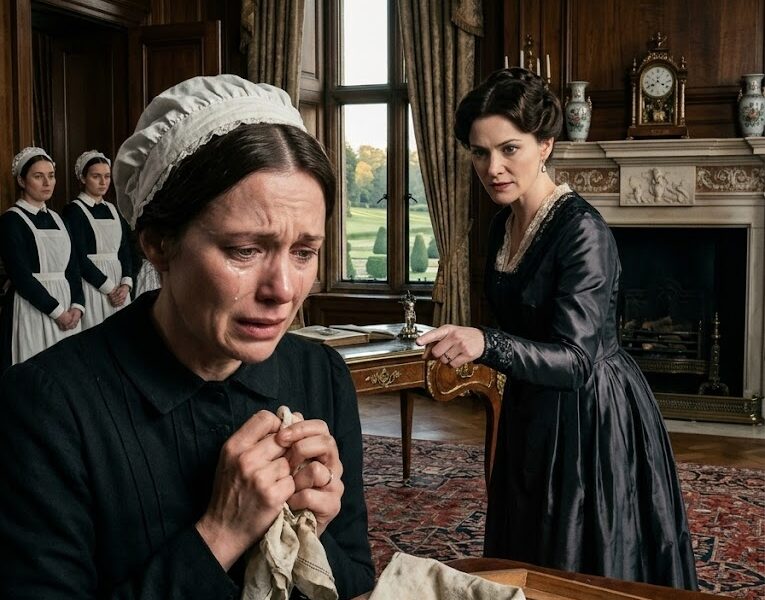
That evening, Abby was dismissed.
Mrs. Bligg personally escorted her to the servants’ entrance, where rain swept across the courtyard. Abby carried one small bag containing her few clothes and the books Jacob had given her.
There was no letter of character.
Without one, finding respectable employment could be nearly impossible.
“You imagined I wouldn’t notice?” Mrs. Bligg demanded. “A common cook making eyes at a duke in my own garden?”
“I have done nothing wrong.”
“You have disgraced this house.”
Abby stood rigid beneath the doorway.
“I have served your family faithfully for six years.”
“And now you shall discover how little that matters.”
Mrs. Bligg leaned closer.
“I will tell every house in Hampshire what sort of woman you are. You will never cook in this county again.”
Abby’s eyes filled, but she refused to lower them.
“I did nothing wrong.”
Mrs. Bligg’s expression hardened.
“You were born wrong.”
Then she shut the door.
Abby stood alone in the rain.
For a while she remained where she was, staring at the wood, as though some part of her still expected the door to open and a reasonable voice to call her back.
It did not.
She picked up her bag and began walking toward Winchester.
Eight miles lay between her and her sister’s home.
By the time she reached the bakery, her shoes were soaked, her dress clung to her skin, and her fingers were so cold she could barely knock.
Her sister Nell opened the door.
One look at Abby was enough.
Nell drew her inside without asking a question.
The next day, Jacob arrived at Bligg House.
Mrs. Bligg greeted him in the hall with a sorrowful expression and a folded letter.
“I am afraid I have unfortunate news, Your Grace.”
Jacob searched her face.
“Mrs. Fox?”
“She left during the night.”
His expression changed.
“Left?”
Mrs. Bligg extended the paper.
“She asked me to give you this.”
Jacob unfolded it.
The letter claimed that Abby had accepted fifty pounds from Mrs. Bligg to leave. It said the money was more than she could ever expect from him and asked him not to seek her out.
It was signed with her name.
Jacob read it twice.
His hand slowly closed around the paper.
For weeks, he had believed that Abby understood him in a way no one else did. He had begun imagining conversations that did not end after a few stolen minutes beside a garden wall.
Now he stood in a familiar hallway with a letter telling him those moments had possessed an entirely different meaning for her.
“I see,” he said.
Mrs. Bligg watched him carefully.
“Such disappointments are painful, Your Grace. Fortunately, one eventually learns who is worthy of one’s affection.”
Jacob made no reply.
He turned and left.
As his carriage disappeared down the drive, Mrs. Bligg permitted herself a small smile.
She had written the letter herself.
Abby had never seen it.
Weeks passed.
In Winchester, Abby rose at four each morning to help her sister Nell and brother-in-law Joe Hart in their bakery.
She prepared dough while the streets were dark, carried trays to the ovens, and worked until evening. The heat left her face flushed and her shoulders aching, but there was comfort in honest labor and in a household where she was treated as family.
She tried not to think of Jacob.
Sometimes, however, she remembered him standing at the sink with a dishcloth in his hands.
Or the expression on his face when she had spoken Sam’s name.
Or the way he had said Abby beside the bean poles.
One evening, after the ovens had cooled, Nell found her sitting alone with the books Jacob had given her.
“You could write to him,” Nell suggested.
Abby ran her thumb along the worn cover.
“And say what? That a cook misses him?”
“You were more than a cook to him.”
Abby gave a tired smile.
“He knows where I am, Nell. I told him about you. I told him where your bakery was.”
She looked at the dark window.
“If he wanted to find me, he would.”
“Perhaps someone has lied to him.”
“Perhaps.”
Abby stood and straightened her apron.
“Or perhaps he has remembered that he is a duke.”
She returned to the worktable.
“Bread doesn’t bake itself.”
At Heathworld, Jacob had not forgotten.
But he had believed the letter.
He withdrew from society, grew quiet at dinner, and spent long evenings in rooms that seemed to hold nothing but memories of his military service and a woman he believed had chosen money over him.
His servants noticed the change.
One remarked privately that His Grace seemed lonelier than when he had first returned from the war.
Jacob stopped ordering dessert.
When his own cook prepared an apple tart, he sent it back untouched. The poor woman burst into tears in the kitchen, believing she had made some terrible mistake.
He never explained.
Autumn deepened.
Then Mrs. Bligg made another plan.
Every year, on the first Saturday of October, a great fair took place on the green at Heathworld. Farmers brought their produce, children ran between stalls decorated with ribbons, and families entered cakes, pies, and preserves into competitions.
Traditionally, the duke judged the baking.
This year, Mrs. Bligg announced that Clarissa would enter her celebrated apple tart.
The same apple tart Jacob had praised so warmly at dinner.
The entire county understood the implication.
If the duke publicly honored Clarissa’s baking, Mrs. Bligg could present it as another sign of his affection.
There was one difficulty.
Clarissa could not bake an apple tart.
Indeed, she could scarcely bake anything.
Mrs. Bligg solved the problem by sending a footman to Winchester with two shillings and a list of ingredients.
He was instructed to visit the finest bakery in town and commission an exceptional tart.
Thin pastry. Apples. Brown sugar. Lemon. Nutmeg.
And a pinch of black pepper.
He was also instructed not to reveal who had placed the order.
The footman arrived at Joe Hart’s bakery.
Behind the counter stood Abby Fox.
She wiped flour from her fingers before accepting his paper.
When she read the ingredients, her heart began to pound.
“Who ordered this?”
“I am not permitted to say, madam.”
“Where is it going?”
“To the fair at Heathworld.”
Abby stared at the list.
For a moment, she considered refusing.
She could almost see Mrs. Bligg smiling beneath her carefully arranged bonnet, taking credit for work she had never performed.
She could imagine Clarissa receiving praise that belonged to another.
But she could also picture Jacob sitting alone at the judging table.
And she remembered the first time he had tasted her tart.
The look on his face had not been pride or appetite.
It had been recognition.
“Come back on Friday,” she said.
“The tart will be ready.”
Saturday arrived beneath a pale October sky.
The green at Heathworld was crowded with families, vendors, musicians, and children carrying ribbons. Twenty-two cakes, pies, and tarts stood on a long white table.
Jacob approached the competition with little enthusiasm.
He tasted each entry politely, offered a few words of encouragement, and moved on.
At the final plate, he stopped.
A card written in Mrs. Bligg’s elegant hand identified the entry.
Apple Tart — Miss Clarissa Bligg.
Jacob looked toward Clarissa.
She stood beside her mother, looking pale. Mrs. Bligg, resplendent in a new green bonnet, held her daughter’s arm with unmistakable excitement.
Jacob cut a small slice.
He tasted it.
The pastry shattered delicately beneath his teeth.
The apples were tender. The lemon was bright. Beneath the nutmeg came that familiar, almost imperceptible warmth.
Black pepper.
He put down his fork.
For several seconds, the people closest to him waited in silence.
Then he looked at Clarissa.
“Miss Bligg, this tart is perfect.”
Mrs. Bligg gave a delighted cry.
“Oh, Your Grace! I knew you would adore it.”
Jacob did not look at her.
“Tell me, Miss Bligg, how much pepper do you use?”
Clarissa opened her mouth.
No sound came.
“And which variety of apples do you prefer? How long do you leave it in the oven?”
Mrs. Bligg’s hand tightened on her daughter’s arm.
Jacob’s voice remained calm.
“Tell me anything about how you made it.”
Clarissa stared at him.
Then she pulled away from her mother.
“I cannot.”
Mrs. Bligg stiffened.
“Clarissa!”
“I cannot lie anymore.”
The young woman’s voice trembled, but she turned toward the gathered crowd.
“I have never baked an apple tart in my life.”
A murmur spread across the green.
“Our cook made the tart you ate at our dinner, Your Grace. Mrs. Fox. She made everything we served.”
Mrs. Bligg reached for her daughter’s sleeve.
“Be silent this instant!”
Clarissa stepped away.
“Mama sent her out in the rain because you were kind to her.”
Jacob went completely still.
Clarissa began to cry.
“And the letter. The one about the fifty pounds. Mama wrote it herself. I saw her do it.”
The crowd fell quiet.
“Mrs. Fox never accepted any money. She never agreed to leave you.”
Jacob looked toward Mrs. Bligg.
The woman who had carefully organized his visits, praised her daughter’s accomplishments, and offered him sympathetic advice was now standing before him without a word to say.
Clarissa wiped her face.
“Mrs. Fox cooked for us for six years. And we never once thanked her.”
Jacob drew a slow breath.
He remembered Abby’s frightened face at the kitchen sink.
He remembered the night she told him nobody had ever thanked her.
Then he remembered the letter he had believed without ever asking her to explain.
“Madam,” he said to Mrs. Bligg.
He did not raise his voice.
“You lied to me. You dismissed a good woman in the rain, denied her a reference, and forged a letter in her name.”
Mrs. Bligg’s mouth opened.
He continued before she could speak.
“I shall see that the truth is known throughout Hampshire. You will no longer be welcome at Heathworld, nor at any table where I am seated.”
The humiliation was complete.
Mrs. Bligg looked around at the neighbors whose approval she had spent years cultivating.
No one came to her defense.
She turned and forced her way through the crowd.
Jacob faced Clarissa.
“Where did this tart come from?”
The young woman swallowed.
“Joe Hart’s bakery, Your Grace. In Winchester, near the cathedral.”
Jacob did not wait for his carriage.
He took the nearest available horse and rode toward Winchester.
By the time he reached the bakery, evening had settled over the streets.
Warm light shone from the windows, and the scent of fresh pastry drifted through the door.
Inside, Abby stood at a wooden counter, rolling dough.
Her sleeves were pushed above her wrists. Flour covered her hands and marked one cheek.
The bell above the entrance rang.
She looked up.
For a long moment, neither spoke.
“Your Grace.”
“Abby.”
Her rolling pin stopped.
Jacob stepped forward.
“You baked the tart.”
She nodded.
“I did.”
“Did you know who ordered it?”
Abby looked down at the dough.
“I knew it must be for Mrs. Bligg.”
“Then why did you make it?”
She swallowed.
“Because I thought you might taste it.”
Her eyes filled.
“Even if you never knew it came from me, I wanted you to have it once more.”
Jacob closed his eyes briefly.
“I knew.”
She looked at him.
“I knew from the first bite.”
He moved toward the counter.
“Abby, I owe you an apology.”
She stood motionless.
“Mrs. Bligg gave me a letter. It said you had accepted fifty pounds to leave and asked me never to find you. I believed it.”
Abby’s hand flew to her mouth.
“I never wrote such a thing.”
“I know that now.”
He told her what Clarissa had confessed before the county. He told her that Mrs. Bligg’s deception had been exposed.
Then his voice grew quieter.
“I should have come to you. I knew where your sister lived. I should have asked you myself instead of letting a piece of paper decide what I believed about you.”
Abby brushed a tear away.
“I thought you had forgotten.”
“Not for a day.”
The ovens crackled behind her.
A faint sound came from the doorway leading into the back rooms, but neither turned.
Jacob reached across the counter and took Abby’s flour-covered hand.
“The first thing I came to say is thank you.”
She gave a small, unsteady laugh.
“You have already thanked me for the tart.”
“Not properly. Not for the years of work no one saw. Not for the kindness you showed me. Not for those afternoons in the garden.”
He looked directly into her eyes.
“And there is something else.”
Abby grew still.
“I would like to spend the rest of my life thanking you.”
She stared at him.
Jacob held her hand a little more firmly.
“Will you marry me?”
For an instant, Abby could only look at him.
Then a laugh escaped her, followed immediately by tears.
“You will grow terribly tired of apple tart.”
“Never.”
She laughed again.
“Yes,” she whispered.
He leaned closer.
“Was that an answer?”
“Yes, Jacob.”
He kissed her beside the warm ovens.
In the doorway, Nell Hart clapped her hands, smiling through tears of her own.
The following spring, Jacob and Abby were married.
There were people in Hampshire who considered the match extraordinary and others who quietly disapproved. Jacob had long since learned how little the opinions of such people mattered.
Abby became Duchess of Heathworld.
She gained a home, a husband, and a place in a world that had once refused to see her.
But she did not stop baking.
She loved the warmth of the ovens, the familiar weight of dough beneath her hands, and the satisfaction of making something good for the people she loved.
Every evening, after supper, Jacob went down to the kitchen.
It did not matter how many guests remained upstairs or how important their conversation might be.
He would find Abby, sometimes reading beside the fire, sometimes helping with a final tray of pastries, and sometimes standing at the worktable with flour on her cheek.
And every evening, he said the same two words.
“Thank you.”
He never missed a single day.









