The Duke Buried His Brother—Then a Stranger Arrived With the Letter He Had Burned Fifteen Years Ago
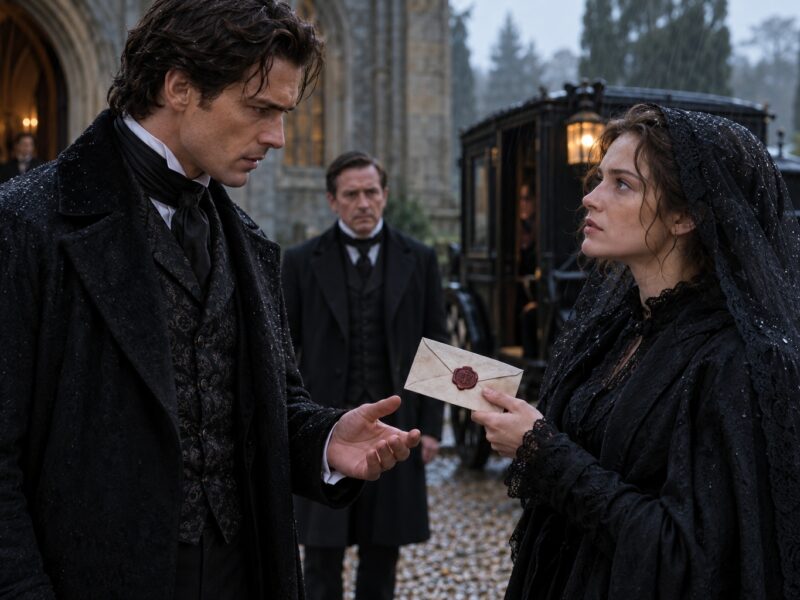
His brother had barely been laid to rest when a stranger approached the Duke of Blackwood with a letter bearing his dead father’s seal.
Fifteen years earlier, Tristan had burned a document carrying that very mark—and believed he had buried the truth with it.
But his brother had kept another copy, and the woman standing before him knew exactly what he had done.
The rain had not stopped since morning.
It settled over the churchyard in a fine, relentless mist, darkening the stones and gathering in the seams of the mourners’ coats. Beyond the ancient chapel, the Blackwood family crypt stood open beneath a canopy of wet branches, its iron gates newly polished for the occasion.
Tristan Blackwood had just watched the coffin of his younger brother Julian disappear into the darkness.
He was still standing near the grave when he heard a woman’s voice behind him.
“Your Grace.”
He turned reluctantly.
“Your brother asked me to give you something when he could no longer speak for himself.”
The stranger wore a plain black gown and a modest mourning veil. There was no jewelry at her throat, no ornament to suggest wealth or rank. Rain clung to the hem of her dress, but she stood so quietly that she seemed not to notice the cold.
Tristan studied her face.
“Who are you?”
“Saraphina Vale.”
“I don’t know you.”
“No,” she said. “But your brother knew me very well.”
Behind them, the last mourners were moving toward their carriages. His solicitor, Gideon Ashford, waited near the chapel gates, watching the conversation with an expression Tristan knew too well.
Concern concealed beneath professional discretion.
“If Julian left you money,” Tristan said, lowering his voice, “you must speak to my solicitor. I will not discuss private family affairs beside a grave.”
“I haven’t come for money.”
“Then what do you want?”
Saraphina reached inside her coat.
She withdrew a small envelope sealed with dark red wax.
Tristan’s attention fell upon the imprint, and something inside him went terribly still.
He recognized the mark.
Not merely the Blackwood crest, which appeared on every official letter sent from the estate, but a particular impression made by his father’s private seal. The same seal had marked a document Tristan had held in his hands fifteen years earlier, on the night his father died.
He had believed that document no longer existed.
“Where did you get that?” he asked.
“Your brother kept it hidden until the week before his death.”
Tristan reached for the envelope.
Saraphina withdrew it before his fingers could touch the wax.
“Before you read it, there is something you must understand.”
He stared at her.
“Julian did not spend his final days trying to destroy you,” she continued. “He spent them trying to discover whether you had ever regretted what you did.”
The rain whispered against the chapel windows.
Tristan felt a sudden pressure beneath his ribs.
“What do you know about that night?”
Saraphina’s expression softened, but her answer did not.
“Enough to know that your father did not die believing you were the son who would simply inherit his name.”
From the carriage, Gideon called for him.
Tristan did not turn.
His eyes remained on the envelope.
For fifteen years, he had lived with a secret that never quite stopped moving beneath the surface of his respectable life. He had built a reputation around duty, discipline, and the obligations of his title. He had allowed people to call him honorable because contradicting them would have required more courage than accepting their admiration.
Now Julian was dead.
And the evidence of his greatest betrayal had returned in the hands of a woman he had never met.
Tristan stepped backward.
“You’ll forgive me if I don’t trust a stranger who arrives at my brother’s funeral carrying a wax seal and a riddle.”
“I haven’t asked for your trust, Your Grace.”
Saraphina slipped the envelope inside her coat.
“Julian made me promise two things. First, that I would wait one week after his burial before allowing you to read it. Second, that I would place it in your hands only if you came to me and asked for it yourself.”
“Then you’ve wasted a long journey.”
“Perhaps.”
She adjusted the edge of her veil.
“I’m staying at the Fox and Hare in the village. I’ll remain there until Sunday. After that, I’ll return to Bristol.”
She turned and walked down the gravel path.
Tristan watched her disappear between the dark yew trees.
Gideon approached, breathing heavily from the walk across the churchyard.
“Your Grace. Who was that woman?”
“Find out.”
“Sir?”
“Where she comes from. How she knew Julian. Who supports her. I want everything you can discover.”
“By when?”
“Tomorrow morning.”
Gideon hesitated.
“If this concerns the family’s private affairs—”
“Tomorrow morning, Gideon.”
The solicitor bowed.
Tristan remained beside the grave long after the last carriage had departed.
He had not cried when Julian died. He had not cried during the service, when the clergyman spoke of forgiveness and eternal rest.
But now, remembering the small red seal, he found himself gripping his gloves so tightly that the leather creaked.
That night, Blackthorn Manor felt impossibly large.
The corridors were quiet except for the occasional movement of a servant carrying coal or closing shutters against the wind. Every portrait seemed to follow Tristan as he climbed the east staircase.
He told himself he needed to walk.
He had spent too many hours sitting through the funeral arrangements, accepting condolences from distant relatives and old acquaintances who had known Julian only through his last name.
But his feet carried him toward the one room he had avoided for fifteen years.
The blue room.
His father had died there.
No one had slept in it since.
Tristan stopped outside the door and placed one hand against the frame.
He could still remember the fireplace.
The smell of burning paper.
The pale corner of a document curling inward as the flames caught it.
He remembered standing close enough to feel the heat against his face, watching the handwriting disappear beneath a widening stain of black.
He had believed that if the paper was destroyed, the obligation it contained would disappear with it.
For fifteen years, he had tried to believe the same thing.
He withdrew his hand.
His fingers were trembling.
Downstairs, he poured himself a glass of brandy in the library. He carried it to the window and stood there until the fire burned low.
He never took a sip.
Gideon arrived at eight the following morning, carrying a folder beneath his arm.
His coat was damp, his expression tired.
“Miss Saraphina Vale,” he began. “Twenty-eight years old. An orphan. She teaches at a girls’ school in Bristol. No debts, no scandal that I could uncover.”
Tristan stood behind his desk.
“And Julian?”
“That is rather more complicated.”
Gideon opened the folder.
“For twelve years, Lord Julian sent twenty pounds every quarter to a Mrs. Clara Whitmore in Redcliffe. Four winters ago, Mrs. Whitmore died. Afterward, those payments were directed to Miss Vale.”
Tristan kept his expression still.
It required almost all his strength.
Julian had complained about money for years. He had grumbled over his allowance, postponed purchases, and refused invitations that might have required new clothes or expensive travel.
Tristan had dismissed it as the ordinary frustration of a younger son.
Now he understood.
Every quarter, while Tristan entertained guests at Blackthorn and maintained the dignity of the Blackwood name, Julian had quietly sent money to Bristol.
Money Tristan should have provided himself.
“Whitmore,” Gideon repeated. “Does the name mean anything to you?”
“No.”
The lie came easily.
That was what frightened him most.
Gideon regarded him for a moment before closing the folder.
“There is something else, Your Grace. The household has begun talking. Mrs. Pell says Miss Vale stood looking toward the east windows before she left the estate.”
Tristan turned away.
“And your cousin Edwin arrived last night,” Gideon added. “He appears to have heard something about the woman at the funeral.”
Edwin Blackwood found Tristan in the entrance hall later that morning.
He was holding his gloves in one hand and wearing the pleasant expression he reserved for conversations that might prove profitable.
“Terrible business, Julian,” he said. “A dreadful loss.”
“Yes.”
“And now this mysterious young woman appearing at the funeral. Rather unfortunate timing.”
“Was there something you needed, Edwin?”
His cousin smiled.
“Only to remind you that people talk. You have no heir of your own, Tristan. Naturally, there are questions about what becomes of Blackthorn after you.”
Tristan said nothing.
“I would hate to see a family scandal encourage unnecessary inquiries among the Lords.”
“Welcome to Blackthorn, Edwin.”
“Thank you, but—”
“Breakfast is served at nine.”
Tristan walked away before his cousin could finish.
By afternoon, he had decided to visit the Fox and Hare.
He went alone, on foot, without the Blackwood carriage or a servant to announce him.
Saraphina’s room was small, with a narrow bed, a washstand, and a window overlooking the village road. She sat beside that window with a basket of mending in her lap.
When Tristan entered, she placed her needle against the cloth.
She did not appear surprised.
“Prove it,” he said.
Saraphina looked at him steadily.
“Prove what, Your Grace?”
“Whatever you believe you know about my family.”
She folded the garment and placed it inside the basket.
“Your father died on December third, in the blue room in the east wing. The window beside his bed never closed properly, so Mrs. Pell wedged a rolled rug beneath it. He asked for the fire to be built up, even when he was too ill to feel the warmth.”
Tristan’s jaw tightened.
Those details had never appeared in any public account of his father’s death.
Saraphina continued.
“Julian left his studies in London because he was sending nearly every shilling of his allowance to a woman and her child in Bristol. He told his tutors he had grown bored with his studies.”
“Stop.”
“He wasn’t bored.”
“I said stop.”
“You asked me to prove it.”
Her voice remained gentle.
Somehow that made the words more difficult to bear.
“The baby was a girl,” she said. “Her mother named her Rosalind.”
Tristan felt the strength leave his knees.
He sat on the edge of the narrow bed.
Rosalind.
He had not spoken the name aloud in years.
Yet he remembered hearing it for the first time, remembered the careful hope with which Clara had told him what she intended to call their daughter.
He had buried the memory beneath estate accounts, Parliamentary obligations, social engagements, and the respectable routines of a life that left little room for shame.
But he had never forgotten it.
“She would be fourteen,” he said.
“Fourteen in March.”
He stared at the floor.
“She has a quick temper,” Saraphina added. “She gets ink on her fingers when she writes. And she has your father’s gray eyes.”
Tristan closed his eyes.
“Clara died of consumption four winters ago,” Saraphina said. “Before she died, she asked me to look after Rosalind.”
He looked up.
“And you agreed?”
“Of course.”
There was no pride in the answer.
No attempt to make him feel smaller.
Saraphina spoke as though caring for an abandoned child had been the simplest decision in the world.
That, more than anything, shamed him.
“Before Clara died,” she continued, “she told me about a promise you made.”
Tristan’s face changed.
“She said that when your father passed away, you would come for her. You would meet her at the village church and stand beside her.”
He could remember the promise.
He could remember making it.
“She waited until dark,” Saraphina said. “Then she went home. And after that, she stopped waiting.”
Outside, a wagon passed along the village road.
For several moments, Tristan could hear nothing else.
He remembered the day of his father’s death with unbearable clarity. The correspondence on his desk, the desperate calculations about the estate, the fear of losing the home his family had held for generations.
And somewhere in the same village, Clara had stood in a church waiting for a man who would not come.
“What does Rosalind want?” he asked.
“Nothing.”
“Money? My name?”
“She has asked me for neither.”
“Then why are you here?”
Saraphina took the envelope from her coat.
“Because Julian asked me to come.”
She looked down at the seal.
“He did not write this to punish you. He wanted you to read it as the man you are now, not the man you were that night.”
Tristan lifted his eyes.
“I promised him I would never use it against you,” she said. “Whatever you decide, this remains between us.”
She paused.
“Even if you burn it again.”
He looked at her sharply.
She knew.
She knew about the fireplace, the destroyed document, the deliberate choice he had concealed from everyone who trusted him.
For the first time since entering the room, Tristan held out his hand without attempting to command her.
“Give it to me.”
Saraphina did not move.
“Is that you asking?”
His voice faltered.
“Yes.”
The word seemed painfully small.
“It’s me asking.”
She placed the envelope in his palm.
The wax was cold beneath his thumb.
He did not open it at the inn.
He carried it back to Blackthorn through the gathering dusk, walking slowly enough that the village lamps were being lit before he reached the estate.
Then he climbed the east staircase.
This time, he opened the door to the blue room.
Dust sheets covered the furniture. The heavy curtains had faded where sunlight had reached their edges. The window beside the bed still refused to latch properly.
Tristan stood in the room for a long moment before lighting a candle.
Then he sat on the edge of his father’s bed and broke the red seal.
The handwriting was unsteady.
But it was unmistakably his father’s.
My dear Tristan,
By the time you read this, I will be beyond argument.
Tristan swallowed and continued.
His father had known.
Julian had told him about Clara Whitmore, the young governess, and the daughter Tristan had refused to acknowledge.
His father had been angry, the letter explained. But that anger had lasted only an hour. The shame that followed had been harder to bear.
The old Duke understood the financial pressure under which Tristan had made his choices.
He understood because his own debts had created much of it.
Tristan read those lines twice.
He had always believed his father would condemn him.
Instead, the man had acknowledged his own responsibility.
Attached to the letter was a codicil to his father’s will, witnessed by Dr. Hargrave and the family butler. It directed that Blackthorn Manor and the accompanying estate interests pass to the child, with a yearly allowance for Clara.
The hereditary title would pass to Tristan as the law required.
But the estate itself was another matter.
Then came the words that made Tristan lower the letter into his lap.
I will not leave you my name as a shield against your own conscience.
He looked toward the fireplace.
His father had written two copies of the codicil.
One had been given to Tristan.
The other had been entrusted to Julian.
I have written two copies because I trust neither of us entirely.
If you keep your word to that young woman, you will need neither.
I do not die believing you are the son who will simply inherit my name.
I die believing you might become the man who earns it.
Tristan could no longer pretend he had misunderstood his father’s wishes.
He remembered the first copy burning in the grate.
He remembered holding the corner of the paper until the heat forced him to release it.
And now he remembered another sound from that night.
A floorboard creaking in the corridor.
He had assumed the old house was settling.
But Julian had been standing outside.
Nineteen years old.
Holding the second copy.
Watching his elder brother destroy the first.
He had said nothing.
For fifteen years, Julian had watched Tristan live with the consequences of that night. He had supported Clara and Rosalind without publicly exposing his brother. He had remained close enough to the family to see whether Tristan might one day acknowledge what he had done.
Tristan had mistaken Julian’s silence for resentment.
He understood now that it had been something more difficult to accept.
His brother had left him a way back.
A door he had refused to open.
Tristan pressed the heel of his hand against his eyes.
He remained in the blue room until the candle had burned almost to its base.
On Saturday evening, he sat alone in the library.
The fire was bright, and his father’s letter lay open across his knee.
He had read it so many times that he no longer needed the page to remember every sentence.
The door opened without a knock.
Edwin entered.
“The potboy at the Fox and Hare is remarkably talkative for a shilling,” he said pleasantly.
Tristan did not rise.
“What do you want?”
Edwin shut the door.
“The woman has something belonging to Julian. Something that could take Blackthorn out of your hands.”
Tristan folded the letter.
“And?”
“Burn it.”
The words hung between them.
Edwin approached the fireplace.
“Burn it now, in front of me. I’ll forget the woman ever appeared. I’ll forget the girl as well. I’ve no wish to inherit a scandal.”
Tristan looked at the flames.
The familiar solution stood before him.
One movement of his hand.
One brief surrender to fear.
He had done it once before, and the world had not ended.
The estate had remained in his possession. His title had remained secure. His acquaintances had continued to bow, his servants had continued to obey, and people had called him an honorable man.
Only his life had grown hollow.
He thought of Clara waiting inside a cold church.
He thought of Julian standing outside the blue room, unable or unwilling to stop his brother.
He thought of a fourteen-year-old girl in Bristol, writing with ink-stained fingers, knowing the identity of a father who had never come to find her.
“And if I refuse?” Tristan asked.
Edwin’s smile faded.
“Then I shall stand before the Lords and tell them that the Duke of Blackwood destroyed his own father’s last wishes.”
The fire snapped.
“Will you enjoy that hearing, Tristan?”
Tristan stood.
He folded the letter carefully and slipped it into his breast pocket.
“Say it, Edwin.”
His cousin stared at him.
“Say all of it,” Tristan continued. “But you will have to tell them that I did it once, and refused to do it twice.”
Edwin’s expression hardened.
For a moment, neither man moved.
Then Edwin retrieved his gloves from the mantelpiece.
He left without closing the door.
Tristan watched him go.
There was no triumph in the silence that followed.
Only the unfamiliar weight of a decision he should have made fifteen years earlier.
He summoned Gideon.
The solicitor arrived with his coat half-buttoned and his hair untidy, plainly expecting another emergency concerning the estate.
Tristan placed the codicil on his desk.
“File this with the court in the morning.”
Gideon unfolded it.
He read in silence.
Then he read it again.
When he raised his head, his face had gone pale.
“Your Grace, this gives away the house.”
“I know.”
“The estate interests as well.”
“Yes.”
“And it will cost you nearly every drawing room in England.”
Tristan regarded him quietly.
“I know what it costs.”
Gideon looked back at the document.
“Then I’ll draft the petition tonight.”
On Sunday morning, frost whitened the courtyard outside the Fox and Hare.
Saraphina stood beside a hired carriage. A trunk rested at her feet, and next to her stood a slender girl wearing a gray coat that was slightly too short in the sleeves.
Her dark hair had been pinned up carelessly. Her chin was lifted with the stubborn dignity of someone determined not to look frightened.
Tristan stopped several feet away.
The girl studied him.
And there they were.
His father’s gray eyes.
Not the resemblance he had imagined in sleepless moments, but something living and immediate, set in the face of a daughter he had never allowed himself to know.
“I told her you might not come,” Saraphina said softly.
Tristan looked at her.
“I nearly didn’t have the courage.”
Then he turned to the girl.
He lowered himself to his knees in the frosted mud.
He did not care that the innkeeper might be watching. He did not care whether the stable boy saw the Duke of Blackwood kneeling before a child in a worn coat.
“Rosalind.”
She held his gaze.
“I’m your father.”
Her expression did not change.
“I knew about you from the day you were born,” he continued. “And I did nothing.”
His throat tightened, but he forced himself to finish.
“There’s no excuse I could give you that’s worth hearing.”
Rosalind’s jaw moved slightly.
“My mother said you were a man who kept his word until you couldn’t.”
Tristan lowered his eyes.
“She was right about the second part.”
He looked up again.
“I’d like to spend what’s left of my life proving the first.”
A stable boy led a horse across the courtyard.
Somewhere behind them, a carriage door closed.
Rosalind remained still.
Tristan waited.
At last she spoke.
“I’m not going to call you anything yet.”
He nodded.
“That’s fair.”
She glanced toward Saraphina, then back at the man kneeling before her.
“But I’ll look at the house.”
Tristan drew a slow breath.
It was more than he had earned.
That afternoon, he went to the family chapel.
He opened the Blackwood register to the page from which a section had been removed fifteen years earlier.
He took up a pen.
And in his own handwriting, he entered the name he had once tried to erase.
Clara Whitmore, beloved of Tristan Blackwood, mother of Rosalind.
He watched the ink settle into the paper.
For years, he had told himself that the family name must be protected from the truth.
Now, at last, he allowed the truth to become part of the family record.
Gideon filed the codicil.
Within the week, arrangements were made for Blackthorn Manor to pass to Rosalind in trust, with Tristan serving as her guardian until she came of age.
The title remained his.
Nearly everything else changed.
Invitations stopped arriving.
Friends who had once praised his judgment found reasons to avoid him in London. Acquaintances who had sought his company at every gathering suddenly discovered obligations elsewhere.
The polite society that had appeared to respect him so deeply revealed how much of that respect had depended upon his position and wealth.
Tristan accepted it.
There were days when the losses stung. There were evenings when the silence of the great house seemed to remind him of all the years he could not recover.
But he no longer attempted to explain himself to people whose approval had required his continued dishonesty.
Edwin never appeared before the Lords.
Once the secret was openly acknowledged, the threat had lost much of its power.
Saraphina remained through the spring to teach Rosalind.
She helped the girl settle into unfamiliar rooms, unfamiliar customs, and the difficult presence of a father she was not yet ready to forgive.
Tristan did not demand affection.
He learned to live with Rosalind’s reserve.
He listened when she spoke, gave her space when she withdrew, and accepted that an apology could not replace fourteen years of absence.
Sometimes she allowed him to sit nearby while she worked at her lessons.
Sometimes she spoke to him about small matters without remembering to guard her voice.
He came to value those moments more than the formal respect he had once received so easily.
When Saraphina finally prepared to return to Bristol, she visited the churchyard before leaving.
She stood beside Julian’s grave and rested one gloved hand against the headstone.
She said nothing.
Perhaps there was nothing left that needed saying.
On the last evening of winter, snow fell quietly over the churchyard.
Tristan walked alone past the chapel and stopped before his brother’s grave.
He stood there for a long time, his hat in his hands.
Julian had been nineteen when he learned the secret.
He had spent the next fifteen years protecting a woman and child his elder brother had abandoned. He had carried the second copy of their father’s final wishes, refusing to destroy Tristan even when Tristan had given him every reason to do so.
And at the end of his life, he had arranged for the truth to be delivered one final time.
Not as revenge.
As a choice.
“You waited fifteen years,” Tristan said softly.
Snow gathered along the edge of the stone.
“I’m sorry it took your death to make me ask.”
The churchyard remained silent.
But for the first time since Julian’s funeral, the silence no longer felt like an accusation.
It felt, at last, like the possibility of forgiveness.









