The Duke Called His Wife the Ugliest Woman in the Room—But Her Silent Goodbye Cost Him Everything
Forty guests heard the Duke call his wife the ugliest woman in the room.
Not one of them laughed.
And by dawn, the woman he had spent seven years humiliating would be gone—leaving behind a letter that exposed how close he was to losing everything.
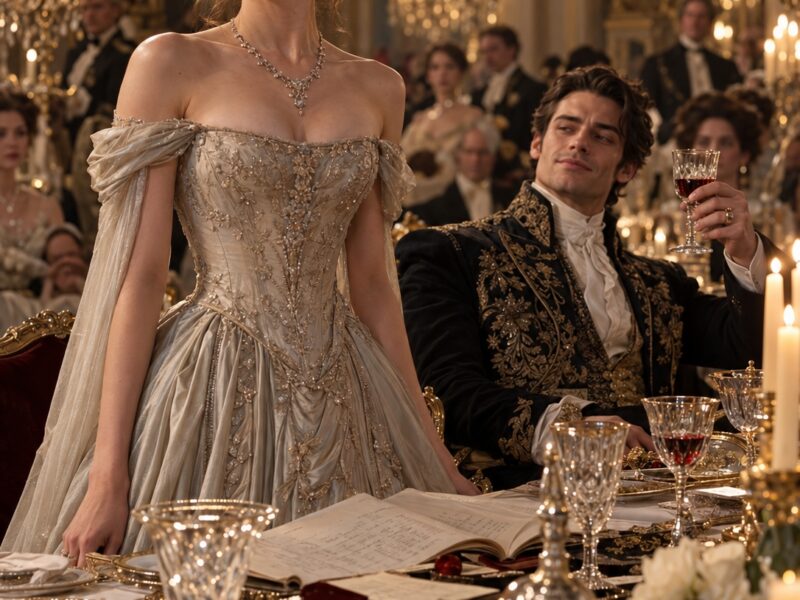
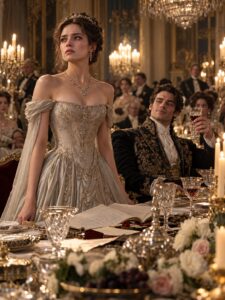
The candles hissed softly above the long dining table at Harkort Hall. Crystal glasses glittered beneath the chandeliers, and silver cutlery lay arranged with the precision expected of one of Yorkshire’s grandest households. The last course had scarcely been served when Edmund Harkort, Duke of Ashborne, raised his wineglass and turned toward his wife.
“Look at her,” he said, wearing the easy, careless smile that had charmed so many people over the years. “The ugliest woman in this room is sitting at the head of my table.”
A faint gasp came from a lady near the far end of the table. One of the younger footmen startled, causing the spoons on his serving tray to rattle against one another. Edmund appeared delighted by the attention.
“Let us be honest, my friends. I married her father. Her face was never part of the bargain.”
The silence that followed was almost unbearable.
Elellanena Witmore sat perfectly still. Beneath the white damask tablecloth, her fingers tightened around the folds of her gown. Heat crept into her cheeks, though she kept her chin lifted and her eyes fixed on the man beside her.
She had spent three days preparing this dinner.
She had personally chosen the flowers, reviewed the seating arrangements, tasted the dishes, and instructed the staff on every detail. She knew which guest preferred fish, which disliked strong spices, and which old acquaintance should not be seated beside a former rival. It had all been done for Edmund, so that the people whose goodwill he needed would leave believing him to be a gracious and capable host.
Now, in front of those very people, he had made her the evening’s entertainment.
Elellanena waited for someone to laugh. There were occasions when guests laughed nervously at Edmund’s sharp remarks, not because they found him amusing, but because they feared offending a duke. That familiar laughter might at least have allowed everyone to pretend he had made a joke.
But no laughter came.
Lord Henry Collins, seated among the most distinguished guests, slowly lowered his fork and studied his plate. He was a wealthy man, a careful man, and the last person Edmund should have wished to offend.
The Duke did not seem to notice his reaction. He leaned back in his chair, looking entirely satisfied.
Elellanena had known that expression for seven years.
When they were alone, Edmund’s cruelty rarely took the form of shouting. He preferred something quieter: a remark about the plainness of her clothes, a smile of contempt when she spoke enthusiastically about a book, or a weary sigh when she offered an opinion on estate matters.
He could make her feel foolish without raising his voice.
At first, she had believed that marriage required patience, that his coldness would soften if she learned his habits and anticipated his wishes. Then she had persuaded herself that his occasional kindness outweighed the long stretches of indifference. Eventually, she had stopped expecting tenderness at all.
She simply tried not to displease him.
And because he was usually charming in company, few people beyond the household had witnessed how thoroughly he had diminished her confidence.
Tonight was different.
He had spoken openly before forty witnesses, and in doing so, he had forced her to confront something she had spent years refusing to name.
He was not embarrassed by his treatment of her.
He was proud of it.
Elellanena looked at him carefully. Beneath the careless smile, she noticed his eyes moving repeatedly toward Lord Henry Collins.
Then she understood.
Edmund wanted to appear powerful before the man whose financial approval mattered most. Humiliating his wife was merely another way of advertising that nothing in his household existed beyond his authority.
The absurdity of it almost made her laugh.
Because there was something Edmund did not understand about his own household.
He did not know the full condition of his finances.
She did.
For years, Elellanena had managed the estate’s accounts, overseen payments to merchants, helped tenants through difficult harvests, and found ways of meeting obligations that Edmund seldom bothered to examine. She knew the debts hidden among the accounting books, the payments approaching their deadlines, and the increasingly fragile arrangements that had kept Harkort Hall functioning.
Lord Henry Collins was not merely an honored dinner guest.
He was the man to whom Edmund owed more money than anyone else.
And the documents that would determine the estate’s future had been maintained almost entirely by the woman Edmund had just publicly insulted.
A strange calm settled over her.
For years, she had tried to find the right words to make her husband understand how deeply he hurt her. She had rehearsed conversations in the privacy of her bedroom, only to abandon them when he greeted her complaints with irritation or ridicule.
Now, with forty people watching, she found that she had nothing left to explain.
She placed her wineglass on the table.
The quiet click against the polished surface seemed remarkably loud.
Then she pushed back her chair and stood.
Edmund looked up, perhaps expecting tears, an apology, or an angry outburst he could later use against her. Instead, she turned toward him and bowed, slowly and elegantly, keeping her back perfectly straight.
She turned toward the assembled guests and bowed again.
No words followed.
She did not accuse him. She did not beg him to retract the insult. She did not give him the satisfaction of watching her lose control.
She merely walked away.
Her silk skirts whispered against the marble floor as she crossed the dining room. Not a single guest attempted to stop her. Behind her, the doors closed with a soft, deliberate sound.
Only then did Edmund’s smile begin to fade.
Upstairs, Elellanena entered her bedroom and stood beside the window.
The gardens lay dark beneath the night sky. From somewhere below came the faint murmur of voices and the occasional clink of glass. The dinner was continuing without her, as she had known it would.
Edmund would not allow his evening to be interrupted by his wife’s distress.
She remained at the window until she heard the bedroom door open.
Margaret, her maid, stepped inside and stopped when she saw Elellanena still dressed for dinner.
“Your Grace?”
Elellanena did not turn.
“Margaret, how quickly can you pack a trunk?”
There was a brief silence.
Then Margaret answered, “Faster than you might suppose, Your Grace.”
Elellanena turned to look at her.
The maid’s face was pale, but there was a small, unmistakable smile at the corners of her mouth.
“I have been ready for years,” Margaret whispered.
For the first time that evening, Elellanena felt the tightness in her chest ease.
Margaret crossed to the cupboard and pulled out an old brown traveling trunk. Dust rose from its lid as she opened it. Without another question, she began gathering the clothes her mistress would need for a journey.
Elellanena went to her dressing table.
The jewelry box stood open beneath the candlelight, filled with expensive things Edmund had given her over the years. There was a diamond necklace, a pair of emerald earrings, and the gold watch he had presented on their wedding day, accompanied by a speech about how fortunate she was to become his wife.
She left them untouched.
Instead, she took her late mother’s pearl brooch, a small silver locket, and a purse containing coins that had belonged to her grandmother. Edmund had never known about those coins. They had been kept apart from the household money, a small private inheritance untouched by his affairs.
She placed the three possessions carefully inside her traveling bag.
Margaret lifted the blue dress Elellanena wore for journeys and began folding it.
“Do you think he will come upstairs?” she asked.
“He will expect me to apologize.”
Margaret’s hands paused.
“He may think you will be too ashamed to face the guests tomorrow.”
“That is what he has expected for seven years.”
Elellanena sat down at her desk and drew out two sheets of writing paper. She dipped her pen into the ink, studying the blank page before beginning.
The first letter was to her aunt Beatrice in Bath.
Of all the people in her family, Aunt Beatrice had been the only one who consistently asked whether she was happy, rather than whether Harkort Hall was splendid or whether the Duke treated her generously.
The letter was brief.
I am coming to you. I shall explain everything when I arrive. Please tell no one.
She folded it and reached for the second sheet.
This letter was for Edmund.
For a long time, she could not write.
She could have filled the page with accusations. There were seven years of lonely evenings, small humiliations, and conversations that had ended with her feeling ashamed for having spoken at all. She could have described the hours she had spent waiting for him to become the husband she had once imagined.
But the longer she held the pen, the more certain she became that she did not want to spend another night asking him to recognize her suffering.
She would write what he needed to know.
Nothing more.
She listed the debts she had uncovered in the accounting books and noted which payments required immediate attention. She explained that three tenant families had fallen behind on their rent and should be given time rather than threatened with eviction.
She named the merchants whose bills were reliable and those who had attempted to overcharge the estate. She explained which servants could be trusted with important responsibilities and which repairs could not safely be postponed.
Finally, she recorded where the safe keys were kept and which documents Lord Henry Collins would expect to examine on Monday.
Her handwriting remained steady throughout.
At the bottom of the page, she wrote only one name.
Elellanena.
No title.
No appeal.
No farewell.
She sealed the letter and placed it on Edmund’s pillow.
Margaret was fastening the trunk when heavy footsteps sounded in the corridor.
Both women froze.
“Elellanena!”
Edmund’s voice carried through the door.
“Come downstairs immediately. You are embarrassing me.”
Margaret quickly extinguished the candle.
Darkness filled the room.
The door handle moved.
Elellanena pressed one hand against her chest, feeling her heart beat hard beneath her palm. For a moment, she feared he would enter, see the trunk, and turn her departure into another contest of wills.
But the door did not open.
The handle became still.
Then the footsteps retreated along the corridor.
Neither woman spoke until the sound had faded.
Margaret drew closer.
“The carriage cannot leave until the household is asleep,” she whispered. “We must wait until four.”
Elellanena nodded.
She sat upon the closed trunk, her hands folded in her lap, and listened to the old house settling around her.
Four hours remained before she could leave the place she had spent seven years trying to call home.
During those hours, she thought about the nineteen-year-old bride who had first arrived at Harkort Hall.
She remembered the excitement of seeing its grand entrance, the nervous pride of becoming its mistress, and the hopeful certainty that she would eventually grow to love the man waiting for her inside.
That girl had believed devotion could create affection.
Elellanena no longer believed it.
Yet she found herself grieving her younger self more deeply than she grieved the marriage.
The great clock eventually struck four.
Margaret rose and lifted one handle of the trunk.
Elellanena took the other.
Together, they slipped into the corridor.
The service staircase was narrow and dim. They moved slowly, stopping whenever the trunk struck a step or the old floorboards creaked beneath their feet. From the kitchen came the faint smell of dying embers and yesterday’s bread.
No servants were moving.
In the great hall, the remains of dinner still lay scattered across the table. Half-empty glasses stood beside crumpled napkins. The silver shone in the faint light, and the flowers Elellanena had chosen so carefully were already beginning to droop.
She glanced at them only once.
Then she and Margaret moved toward the service entrance.
“Your Grace.”
The voice came from the darkness.
Elellanena nearly dropped the trunk.
A lantern rose, illuminating the face of Oliver Bridges, the longtime butler of Harkort Hall. He had served the family since before her marriage, and in all those years she had rarely heard him speak without careful restraint.
For several seconds, they stood staring at one another.
Oliver looked at the trunk.
Then he said quietly, “His Grace is asleep in the library. He drank rather heavily after the guests departed. I do not expect him to wake for some hours.”
Elellanena swallowed.
“Oliver, I can explain—”
“That will not be necessary.”
He lowered the lantern.
“I have watched you keep this estate alive for seven years, Your Grace. When the harvest failed, you found a way to help the tenants. When the roof began leaking, you found a builder. When the accounts became difficult, you sat up half the night until they balanced.”
He stopped briefly, his expression tightening.
“I thought someone would eventually thank you for it.”
Elellanena could not answer.
Oliver crossed to the service door and opened it.
“Samuel is waiting with the carriage at the end of the road. He has been there since midnight.”
She looked at him in astonishment.
“Samuel knew?”
Oliver gave her a sad, gentle smile.
“Everyone who cared knew something had to change.”
The words nearly undid her.
She had lived for so long believing she was alone in recognizing what her marriage had become. Now, standing beside the servants’ entrance with a trunk of ordinary clothes and a few possessions, she realized that the people who had witnessed her daily life had understood more than she imagined.
Oliver stepped aside.
“Go now, Your Grace. The sky will soon begin to lighten.”
Elellanena reached for his hand.
There was little she could say that would not make her cry, so she simply held it between hers for a moment.
Then she and Margaret stepped outside.
The morning air was bitterly cold.
Mist lay over the gardens, and frost silvered the grass along the path. They hurried through the darkness, their breath rising in pale clouds, until they reached the old oak trees at the end of the road.
A carriage waited beneath them.
Samuel, a young servant who had often assisted with errands around the estate, sprang down and took the trunk.
“Quickly, Your Grace,” he said. “The road is clear.”
Margaret climbed inside first.
Elellanena followed, drawing her cloak tightly around her shoulders. Samuel secured the trunk, gathered the reins, and urged the horses forward.
The carriage rolled over the uneven stones.
Through the small window, Elellanena watched Harkort Hall recede into the darkness.
Its tall windows were unlit. Its towers rose against the paleening sky, as imposing as they had been on the day she first saw them.
She had entered those gates as a hopeful nineteen-year-old bride.
Now she was leaving at twenty-six with very little luggage and no certainty about what awaited her.
She expected fear to overwhelm her.
Instead, she felt an unfamiliar lightness.
The house grew smaller as the carriage continued toward the gates.
Then, somewhere behind them, a bell began to ring.
Margaret caught her arm.
“Do you think they have discovered you are gone?”
“Perhaps.”
Elellanena looked back once more.
“But we are already at the gates.”
Samuel urged the horses onward.
The iron gates passed on either side of the carriage, and the first light of dawn spread across the distant hills.
Harkort Hall disappeared gradually into the mist.
Elellanena closed her eyes.
She did not know what Edmund would say when he woke and discovered her absence. Perhaps he would rage. Perhaps he would demand her return. Perhaps he would read the letter on his pillow and finally understand how much of his estate’s survival had depended on her.
For once, those possibilities were no longer hers to manage.
She leaned back against the carriage seat.
For the first time in seven years, there was no one beside her waiting to tell her what she ought to be.
Bath greeted her with pale stone buildings, busy streets, and the comforting noise of a town going about its ordinary business.
Aunt Beatrice was already at the door when the carriage arrived.
Before Elellanena could properly descend, the older woman hurried forward and wrapped her arms around her.
“My dear child,” she whispered. “I have waited a very long time for that letter.”
Those words were enough.
Elellanena rested her forehead against her aunt’s shoulder and allowed herself to be held.
She had prepared explanations for the journey. She had imagined questions about scandal, marriage, duty, and what people might say. But Aunt Beatrice asked none of them while they stood outside the house.
She simply led her niece inside.
Within a week, Elellanena had settled into a small, sunny bedroom overlooking the garden. Her mother’s pearl brooch rested on the dressing table, and a growing stack of books stood beside the bed.
The room was modest compared with her apartments at Harkort Hall.
She loved it.
There was no need to summon servants before opening a window or selecting a book. She could choose when to walk in the garden, when to take tea, and whether to spend an afternoon reading without apologizing for it.
At first, the freedom made her strangely uneasy.
She would hear footsteps in the hallway and instinctively prepare to defend whatever she was doing. Then she would remember that the footsteps belonged to her aunt or Margaret, and that neither would reproach her for the simple act of being comfortable.
After a month, she began to wake without dread.
Her mornings belonged to her.
Meanwhile, in Yorkshire, Edmund was discovering what remained of the life she had managed for him.
The account of the dinner spread through the drawing rooms of England with astonishing speed. Forty people had witnessed his words, and none could dismiss them as a misunderstanding.
Each retelling made the Duke appear less impressive.
By the end of the first week, invitations to Harkort Hall had become scarce. By the second, some of Edmund’s closest acquaintances avoided him in public.
He found this deeply offensive.
He had expected people to be amused by his wit, or at least to consider his marriage a private matter. Instead, they seemed to regard his treatment of his wife as evidence of a character they no longer wished to admire.
His household offered little comfort.
The cook had become unusually quiet. Several servants were openly distressed by the Duchess’s departure, and Oliver Bridges carried out his duties with a formality that made conversation difficult.
Then Lord Henry Collins arrived on Monday morning.
At exactly ten o’clock, his carriage stopped outside Harkort Hall.
He entered carrying a leather briefcase and requested an examination of the accounting books.
Edmund led him toward the room where the financial documents were kept.
Only when he began searching for the necessary papers did he appreciate how little he knew about their arrangement.
There were records of rents, suppliers, repairs, payments, and loans. Some figures referred to transactions from years earlier. Others related to obligations coming due within weeks.
Elellanena had always been able to locate any document he asked for.
He had mistaken that quiet competence for a task requiring no particular skill.
Now, surrounded by papers he did not fully understand, he felt the first stirrings of genuine alarm.
Her letter lay open on his desk.
He had read it the morning after her departure, initially with anger. The precise account of his debts had seemed almost insulting, as though she had chosen to lecture him from a distance.
But now he recognized its value.
Every detail was correct.
Lord Henry studied the financial summary slowly.
He turned one page, then another, his expression growing increasingly severe.
Finally, he raised his eyes.
“Your Grace, your wife has provided a clearer account of your difficulties than you have managed to offer yourself.”
Edmund said nothing.
“It is unfortunate that I did not receive this information sooner.”
Lord Henry closed the papers.
He did not shout or threaten. His calmness was far worse.
He informed Edmund that a substantial portion of the debt must be repaid within thirty days.
Then he gathered his documents and departed.
For a long while, Edmund remained alone in the room.
He stared at Elellanena’s handwriting, at the neat figures and careful explanations that she had left behind despite everything he had done to her.
She had not concealed his financial troubles.
She had told him exactly how serious they were.
And he had ignored her until there was no one left to interpret the accounts for him.
In the weeks that followed, the household began to unravel.
Without Elellanena’s steady attention, tenants grew increasingly doubtful that their concerns would be heard. Small problems that she had once resolved promptly became disputes, and people who had trusted her judgment found little reason to extend the same trust to the Duke.
The cook resigned.
Two maids followed within the same week.
Oliver Bridges remained, though his manner toward Edmund had changed. He continued to carry out his responsibilities, but there was no warmth in his voice when he received an order.
Edmund sold horses and two valuable paintings to meet Lord Henry’s immediate demand.
The estate survived the first reckoning, but only at considerable cost.
And everywhere he turned, he heard some variation of the same sentiment.
The Duchess had held Harkort Hall together.
They had all seen it.
In Bath, Elellanena knew little of these developments.
Aunt Beatrice had introduced her to Mrs. Charlotte Fen, a kindly widow who hosted a Thursday gathering of women interested in literature, education, and charitable work.
Elellanena approached the first meeting with nervousness.
At Harkort Hall, she had learned to measure every sentence for the possibility of offending someone. She was particularly careful around strangers, who might have heard Edmund describe her as dull or foolish.
But Mrs. Fen’s drawing room was unlike the gatherings she remembered.
The women read poetry, discussed books, and spoke with interest about practical ways to help families in need. They disagreed cheerfully, laughed without cruelty, and listened when someone else spoke.
No one asked Elellanena whether her husband approved of her interests.
No one questioned the elegance of her dress or the importance of her family.
Instead, an older woman with silver hair leaned forward and said, “Beatrice tells us you can manage an entire estate through its accounts. Is that true?”
Elellanena hesitated.
Then she gave a small, unexpected laugh.
“Only if the estate was rather badly managed to begin with.”
The room filled with laughter.
Not the nervous laughter she remembered from Edmund’s dinner parties.
This was warm and easy, offered by women who enjoyed her wit rather than wished to diminish her.
Something within Elellanena relaxed.
She began attending the meetings regularly.
By autumn, Mrs. Fen had invited her to assist with a small school for girls whose families could not afford lessons.
Elellanena accepted.
The work was demanding in a different way from managing Harkort Hall. There were limited resources, lessons to organize, books to purchase, and accounts that required close attention.
But every difficulty had a purpose she understood.
In the mornings, she taught the girls to read. In the afternoons, she managed the school’s finances, ensuring that the modest funds available were used carefully.
She discovered she had considerable patience with children.
When a girl struggled to recognize a word, Elellanena did not scold her. She sat beside her and tried again, finding another way to explain until the child understood.
She knew what it felt like to be made ashamed of trying.
She would not allow her pupils to feel that way.
The girls grew fond of her, not because she had once been a duchess in a grand Yorkshire mansion, but because she noticed when they were frightened or discouraged.
She listened.
She remembered their names.
And when they succeeded, she was openly delighted.
One afternoon, as the lamps were being lit, a little girl named Lucy approached her desk.
Elellanena was arranging the day’s papers when she felt a gentle tug on her sleeve.
“Miss Elellanena?”
She looked down.
“Yes, Lucy?”
The child studied her for a moment with solemn attention.
“You have the kindest face I have ever seen.”
Elellanena became very still.
For seven years, her husband had taught her to regard her appearance as something shameful. Even after leaving him, she sometimes heard his remarks in her memory when she caught sight of herself in a mirror.
Yet here was a child looking at her without calculation or cruelty, seeing nothing to mock.
Elellanena’s eyes filled with tears.
“Thank you, Lucy,” she whispered.
She placed a hand gently over the little girl’s.
And long after Lucy had gone home, those words remained with her.
As the months passed, her life acquired a rhythm that no longer revolved around Edmund’s moods.
She walked with her aunt, read in the evenings, and worked at the school. Margaret remained a familiar and trusted presence in the household.
She was no longer surrounded by wealth, but she possessed something she had not known for years: peace.
Then, on a gray afternoon in March, a gentleman arrived at Aunt Beatrice’s house.
Elellanena was closing the school’s accounting book when her aunt appeared in the doorway.
There was an unusual seriousness in Beatrice’s expression.
“My dear, there is someone in the drawing room who wishes to speak with you.”
Elellanena looked up.
“He says he has traveled three days to see you.”
She did not ask his name.
For a moment, she remained seated with one hand resting upon the closed book.
She had imagined this visit often during the first months after her departure. Sometimes she imagined Edmund arriving in anger, demanding that she return. At other times she thought he might send someone else to persuade her that duty required her obedience.
She had never been certain how she would feel when the moment finally came.
Now she discovered that her hands were steady.
She smoothed her simple gray dress, rose from the desk, and walked toward the drawing room.
Edmund stood beside the fireplace.
He looked thinner than she remembered. His coat was creased from travel, and mud marked his boots. The confident expression that had once seemed permanently fixed upon his face was gone.
He turned when she entered.
“Elellanena.”
His voice faltered over her name.
“Thank you for seeing me.”
“Hello, Edmund.”
She remained near the doorway for a moment before moving farther into the room.
He looked around, taking in the modest furniture and the quiet comfort of the house.
“You look well,” he said.
“I am well.”
She considered the words, then added, “Better than I have been in years.”
Edmund lowered his eyes.
There was an awkward silence.
At Harkort Hall, such silences had always frightened her. She had hurried to fill them with apologies or agreeable remarks, hoping to prevent his displeasure.
Now she allowed the silence to remain.
Finally, Edmund spoke.
“The estate is nearly lost.”
His voice was low.
“Lord Henry demanded payment within thirty days. I sold half the horses and two paintings to satisfy him. The servants are leaving, the tenants will scarcely speak to me, and our acquaintances have turned their backs.”
Elellanena listened without interrupting.
He looked at her with an expression she had never seen him wear before.
“I have been a fool.”
The admission seemed to cost him considerable effort.
“I said terrible things to you. I treated you badly, and I was wrong.”
He swallowed.
“Please come home. I will change. I swear that I will.”
For a moment, Elellanena could almost see the woman she had been a year earlier.
That woman would have treasured such words. She might have wept with relief and believed that seven years of patience had finally been rewarded.
She had once imagined this apology a hundred different ways.
But now, hearing it spoken aloud, she felt an unexpected distance from it.
It was as though Edmund had brought an important message to a house where its intended recipient no longer lived.
“Edmund,” she said gently, “I think you are sorry.”
He looked up.
“I truly believe you regret what has happened.”
“Then you will return?”
She shook her head.
“You regret losing your home, your friends, and your money. You regret what your behavior has cost you.”
He opened his mouth, but she continued before he could speak.
“What I do not hear is that you have finally understood me.”
His expression changed.
“I have just told you I was wrong.”
“Yes. But you have spoken of everything you have lost since I left.”
She paused.
“You have not asked what those seven years were like for me.”
Edmund looked away.
The clock on the mantelpiece ticked steadily between them.
Elellanena folded her hands in front of her.
“For seven years, you taught me to believe that I was insignificant. You made me doubt my intelligence, my appearance, and my right to speak. I spent so long trying to become someone you might approve of that I nearly forgot who I was.”
Her voice remained calm.
“Then one evening, you insulted me before forty people. And when I left that room, I discovered something I should have understood much sooner.”
Edmund watched her.
“Your opinion of me was never the truth.”
He stood motionless.
“I will not return to Harkort Hall to be taught otherwise again.”
For a long moment, neither spoke.
Then Edmund lowered his head.
The proud Duke of Ashborne, who had once delighted in making his wife uncomfortable before strangers, could find nothing to say in response to her quiet certainty.
At last, he asked, “Is there anything I can do?”
“Yes.”
He looked at her hopefully.
“Treat your tenants fairly. Pay your debts honestly. And when you encounter someone who is kind or quiet, do not mistake those qualities for weakness.”
Edmund nodded slowly.
It was not the answer he had traveled three days to receive.
But Elellanena had nothing else to offer him.
He turned toward the door.
She did not follow.
A moment later, she heard his footsteps receding through the hall, followed by the soft sound of the front door closing.
The conversation was finished.
Elellanena remained in the drawing room for a while, listening to the ticking clock and the ordinary noises of the house.
She felt sadness for the marriage that might have been, and for the two young people who had entered it with such different understandings of what companionship required.
But she did not feel tempted to call him back.
Before the end of the year, the lawyers completed arrangements for their separation.
Elellanena asked for nothing from Harkort Hall except the books that had belonged to her mother.
They were returned to her.
She placed them on the shelves of her little room in Bath, beside the books she had acquired since leaving.
Life continued.
The school where she taught grew steadily, supported by careful administration and the goodwill of people who believed girls deserved the opportunity to learn.
In time, one school became three.
Then three became ten.
Girls who had once struggled to recognize their letters learned to read confidently. Some later became teachers themselves, passing along the education they had received.
Elellanena devoted her energy to building those opportunities.
She became known for her work, her financial skill, and her conviction that education could change a young woman’s life.
People increasingly spoke of Elellanena Witmore as one of England’s leading advocates for female education.
She no longer needed the title of Duchess to command respect.
Years after the evening at Harkort Hall, she stood upon a small wooden platform before the first graduating class of one of her schools.
It was a bright June morning.
Sunlight streamed through the windows, illuminating rows of young women dressed in white. Their faces shone with anticipation, and the room was filled with the subdued excitement of families waiting to see their daughters honored.
At the back, Aunt Beatrice sat with a handkerchief pressed to her eyes.
Margaret stood beside her, smiling.
Elellanena looked out over the graduates.
She thought of the girls who had arrived unable to read, of the frightened voices that had grown confident, and of the hours spent persuading them that mistakes were part of learning rather than evidence of failure.
Then she thought, briefly, of a grand dining room in Yorkshire.
She remembered forty silent guests.
A Duke’s cruel laughter.
A chair pushed back from a long table.
And the sound of doors closing behind her.
She finished her speech.
For a moment, the room was quiet.
Then Elellanena stepped back and bowed deeply to the graduates, her movements graceful, her back perfectly straight.
It was the same bow she had offered in the dining room at Harkort Hall all those years before.
But its meaning had changed.
That evening, she had bowed to leave a life in which her worth was denied.
Now she bowed to young women whose futures she had helped make possible.
The silence broke.
Applause filled the room, growing louder until it seemed to reach every corner of the hall.
Elellanena straightened and smiled.
For the first time, she did not wonder whether she deserved to stand before them.
She knew.









