The Duke Everyone Called Unwanted Was Given an Eighteen-Year-Old Bride—But on Their Wedding Night, He Made a Promise No One Expected
“She is eighteen, Your Grace. The contract is signed. She will be brought to Heather Bay on Thursday, whether she weeps the entire way or not.”
Theodore Ashcombe, Fifth Duke of Heather, looked across his study at the man who had just spoken of his daughter as though she were a piece of property being delivered to settle an account.
And for the first time since agreeing to the marriage, Theodore wondered whether he had made the worst mistake of his life.
Lord Wraith stood beside the fireplace, one hand resting comfortably on the mantel. His waistcoat was expensive, his boots polished, and his expression carried the satisfaction of a man who had managed to escape financial ruin without surrendering any of his pride.
There was something particularly unpleasant about the way he smiled.
It was not the smile of a father relieved to have secured a good future for his child.
It was the smile of a man who had already spent the money.
Theodore glanced at the marriage agreement lying between them.
He had signed it three days earlier.
Now the ink seemed darker than before.
“I was quite clear about one condition,” Theodore said.
Lord Wraith inclined his head. “Of course, Your Grace.”
“If your daughter does not wish to come, I release her from the arrangement.”
The other man’s smile stiffened.
“I will not take an unwilling bride.”
“My daughter understands her duty.”
“That was not what I asked.”
For a moment, the study was quiet except for the occasional snapping of wood in the fireplace.
Then Lord Wraith gave a dismissive little laugh.
“Verity is a sensible girl. Her mother raised her properly. She knows what is owed to her family.”
Theodore felt his hand tighten around the silver head of his walking cane.
He disliked that word.
Owed.
He had spent enough years among England’s titled families to understand how often duty was used to make cruelty sound respectable.
“And what,” he asked quietly, “is owed to Verity?”
Lord Wraith blinked.
The question appeared genuinely to confuse him.
“She is to become a duchess, Your Grace. Surely that is answer enough.”
Theodore said nothing.
He could have ended the arrangement then.
He had considered doing so more than once since the negotiations began. He could have torn up the agreement, sent Lord Wraith away, and returned to the quiet life he had carefully built around himself.
But he also knew that the man’s debts were real.
And he had heard enough during their negotiations to fear that Lord Wraith would simply offer his daughter elsewhere.
To someone less inclined to ask whether she wanted to be married.
That possibility had been the reason Theodore signed.
It was also the reason he found so little comfort in his decision.
Lord Wraith gathered his gloves.
“Thursday, then. You may be assured she will behave with perfect propriety.”
Theodore watched him leave.
Only when the study door closed did he lower himself into the chair beside the fire.
His left leg had been troubling him since breakfast.
It often did in damp weather.
The stiffness had been with him since a childhood illness, a lingering weakness that no physician had ever managed to cure. He could walk without assistance over short distances, but longer journeys required a cane, and a ballroom floor had always been an especially unforgiving place.
At thirty-six, Theodore had learned to tolerate the discomfort.
What he had never entirely learned to tolerate was the amusement of others.
For years, society had called him the Unwanted Duke.
Not openly, of course.
Never while standing close enough for him to demand an explanation.
But he had heard the phrase through open drawing-room doors, behind gloved hands, and once from a young gentleman who believed Theodore had already left the room.
A duke with a limp.
A duke who rarely smiled.
A duke who did not dance, gamble, flirt, or entertain half of London at his dinner table.
A duke who possessed considerable wealth and an ancient title, yet somehow failed to be the sort of man anyone wished to marry.
At first, the remarks had hurt.
Then they had embarrassed him.
Eventually, he had stopped attending the occasions where they were made.
His estate became his refuge.
Heather Bay was an old house overlooking the northern countryside, built of gray stone, with high windows, endless corridors, and gardens that had been neglected long before Theodore inherited the title.
He preferred its silence to the elaborate unkindness of society.
He had learned to be alone.
Or at least he had learned to behave as though loneliness were a preference.
There was a difference.
And six years earlier, during the last ball he had ever attended, one unexpected act of kindness had made that difference painfully clear.
He remembered it still.
More clearly than he remembered the faces of most people he had known for decades.
He remembered a crowded ballroom.
A small girl.
And a voice that had said something no one had ever thought to say to him before.
Now that girl was eighteen.
And on Thursday, she was coming to Heather Bay as his bride.
Theodore closed his eyes.
He had told himself that he was rescuing her.
But rescue ought to feel different from this.
It ought not to involve a terrified young woman traveling toward a stranger because her father had signed away her future.
Whatever his intentions, he had participated in the bargain.
He could not pretend otherwise.
And if Verity hated him for it, she would have every right.
The carriage arrived shortly after noon on Thursday.
The sky was pale and overcast, and a cold wind moved through Heather Bay’s courtyard, stirring the bare branches of the trees beside the entrance.
Theodore had been waiting on the front steps for nearly twenty minutes.
His steward had offered to receive the young lady on his behalf.
Theodore refused.
He was not about to let his future wife arrive at a strange house and discover that her husband could not be troubled to meet her.
When the carriage stopped, the footman opened its door.
For a moment, no one emerged.
Then a small gloved hand appeared.
A young woman stepped carefully down onto the cobblestones.
Her traveling cloak was dark blue, and the hood framed a pale face that seemed almost too delicate for the severity of the day.
She looked up at the house.
Theodore saw her eyes travel from the stone steps to the towering windows, then higher still to the great gray roof.
There was no wonder in her expression.
Only apprehension.
Then she noticed him.
Her shoulders straightened.
With a visible effort, she lifted her chin, crossed the few steps toward him, and sank into a perfectly executed curtsy.
“Your Grace.”
Her voice was soft.
It did not tremble until the second sentence.
“My father sends his compliments. I have come as agreed.”
Theodore looked at her.
He could see the faint redness around her eyes.
She had been crying in the carriage.
Perhaps all morning.
Perhaps since the day her father informed her she was to be married.
And still she had stepped forward, remembered her manners, and greeted him as though this were an ordinary social call.
Something tightened painfully in Theodore’s chest.
“Miss Wraith,” he said, “welcome to Heather Bay.”
She rose from her curtsy.
He noticed that she kept her hands clasped tightly in front of her.
“You have had a long journey.”
“Yes, Your Grace.”
“And I expect you are cold.”
“A little.”
He looked toward the entrance.
“There is a fire waiting inside. Will you allow me to show you to it?”
She seemed surprised by the question.
“Of course, Your Grace.”
Theodore hesitated.
He wanted to tell her that she had nothing to fear, but he knew how little such words would mean coming from the man she had been ordered to marry.
So he offered what he could.
“Nothing is required of you today, Miss Wraith, except that you become warm and comfortable.”
For an instant, her expression changed.
Not enough to be called relief.
More like confusion.
Then she lowered her eyes.
“Thank you, Your Grace.”
He stepped aside to let her enter first.
As she passed, he noticed the way she kept close to the opposite wall rather than brushing against him.
He did not blame her.
During the next three days, Theodore discovered that Verity Wraith had an extraordinary talent for making herself unobtrusive.
She never complained.
She thanked the servants for everything.
She answered questions politely, never volunteered an opinion, and seemed to believe that her principal responsibility was to avoid causing inconvenience.
At breakfast, she waited for him to begin eating.
In the drawing room, she sat with her hands folded.
When he asked whether she would prefer tea or chocolate, she said whichever he liked best.
Only once did she forget to be careful.
It happened in the conservatory.
Theodore had shown her the glasshouses after noticing how long she stood at the drawing-room window looking toward them.
Inside, sheltered from the winter air, roses and camellias bloomed among glossy leaves.
Verity stopped before a cluster of pale pink flowers.
“Oh.”
It was scarcely more than a breath.
But her face transformed.
For the first time since her arrival, Theodore saw a glimpse of the young woman beneath the frightened manners.
“Do you like them?” he asked.
She nodded.
“Very much.”
“My gardeners have a rather extravagant fondness for keeping flowers alive out of season.”
She glanced at him.
“Do you?”
“Not nearly enough to justify the expense.”
A tiny smile appeared.
It disappeared almost immediately.
But Theodore remembered it.
Later that afternoon, he instructed the head gardener to prepare fresh flowers for Verity’s room.
He did not ask the servants to tell her whose idea it had been.
He simply wanted there to be something beautiful waiting for her.
Their wedding took place three days after her arrival.
It was a small ceremony in the estate chapel.
The marriage license had been purchased, the contract settled, and Lord Wraith had arrived that morning with the air of a man attending a particularly favorable business meeting.
Verity wore ivory silk.
Her hair was arranged neatly beneath a modest veil, and she carried a small bouquet of white flowers.
Theodore stood beside the altar in his finest dark coat.
His cane rested against the pew.
When Verity entered, her father’s arm beneath her gloved hand, Theodore noticed that she was looking straight ahead.
Not at the flowers.
Not at the guests.
Not at him.
She was concentrating on putting one foot in front of the other.
Lord Wraith delivered her to the altar.
There was something unbearable about the satisfaction on his face.
Theodore turned away from him.
When the clergyman began speaking, Theodore looked at Verity’s hands.
They were trembling.
He wanted to stop the ceremony.
To ask once more whether she wished to continue.
But Lord Wraith was standing nearby, and Theodore understood that no answer given under her father’s watchful eye could be entirely free.
He had already secured her safety as best he knew how.
What remained was to give her choices afterward.
He listened to the familiar marriage vows.
And silently made one of his own.
You will never have to earn kindness in this house.
You will never be punished for being afraid.
And whatever becomes of this marriage, I will not make you regret walking through my door.
Verity spoke her vows quietly.
When Theodore placed the ring on her finger, he was careful not to hold her hand longer than necessary.
The ceremony ended.
The guests offered their congratulations.
Lord Wraith spoke at considerable length about family honor and the advantages of a distinguished alliance.
Then he departed, taking with him the satisfaction of a man whose creditors could no longer trouble him.
By evening, Heather Bay had become still again.
And Theodore was married to a young woman who scarcely knew him.
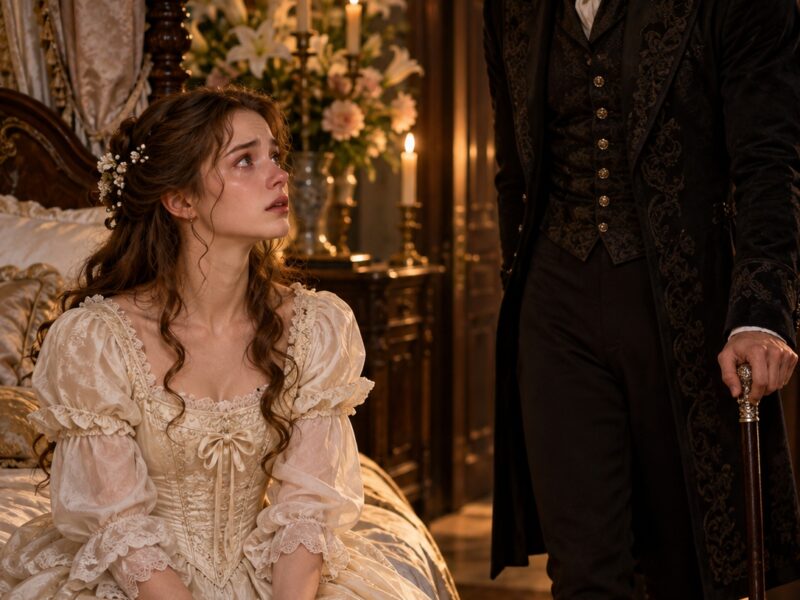
He found Verity in her bedchamber shortly after nine.
He had knocked first.
There had been a pause before she permitted him to enter.
The room was warm.
A fire burned steadily in the hearth, and vases of winter flowers stood along the mantel and near the dressing table.
The housekeeper had prepared everything with particular care.
But Verity seemed to notice none of it.
She sat on the edge of the enormous bed, still wearing her wedding gown.
Her back was perfectly straight.
Her hands were folded tightly in her lap.
When Theodore appeared in the doorway, she rose so abruptly that the fabric of her dress caught beneath her shoe.
She steadied herself.
“Your Grace.”
He stopped.
There was no mistaking the expression on her face.
It was the expression of someone waiting for something dreadful and determined not to disgrace herself when it happened.
“Verity,” he said gently.
She swallowed.
“I know what is expected of me.”
Theodore felt his stomach sink.
“My mother explained everything before I came here.”
He said nothing.
“I am your wife now. I understand my duty.”
Her eyes shone, but she refused to lower them.
“I shall try not to be a coward.”
For several seconds, Theodore could not speak.
He had known she was frightened.
He had not understood until that moment how carefully she had prepared herself to endure him.
He moved slowly into the room.
Her eyes flickered toward his cane, then away.
Theodore drew a chair closer to the fire and sat down.
He positioned a second chair opposite his own, leaving a comfortable distance between them.
“Would you sit with me?”
She stared at him.
“Your Grace?”
“Here. By the fire.”
Her gaze moved toward the bed.
Then back to him.
“You need not remain standing,” he said. “I would like to explain something.”
She hesitated before obeying.
Even then, she perched on the edge of the chair, ready to rise at once.
Theodore rested both hands on his cane.
“First,” he said, “there is nothing you are required to do tonight.”
Her expression remained guarded.
“I beg your pardon?”
“You will sleep here. I shall sleep in my own chamber.”
She looked at him as though she had misunderstood.
“This room is yours. The servants will attend you as they would any mistress of the house. No one will enter without your permission.”
“But—”
“And tomorrow,” he continued, “you may have breakfast whenever you please. You may visit the gardens, use the library, write letters, or remain in your room. You need not ask my permission for any of it.”
Her fingers tightened around one another.
“Have I displeased you?”
The question struck him harder than any insult ever had.
“No.”
“Then I do not understand.”
“I know.”
She looked down.
Theodore waited until she raised her eyes again.
“Verity, I realize you have been taught that kindness generally comes with conditions. But I do not intend to make your life another such bargain.”
She studied him carefully.
“You are my husband.”
“Yes.”
“And you have rights.”
“Whatever the law may permit,” Theodore said, “I have no wish to frighten you into giving me something you do not want to give.”
She blinked.
“Why?”
It was a small word.
But he heard the years behind it.
Why would a man who had paid for a bride refuse to demand what he believed he had purchased?
Why would anyone choose to be gentle when he possessed the power not to be?
Theodore looked into the fire.
He had intended to wait before telling her the truth.
He had imagined giving her weeks, perhaps months, to grow comfortable.
But watching her sit rigidly before him, still dressed for a wedding she had never chosen, he could no longer justify leaving her in ignorance.
“There is something you ought to know about me,” he said.
She remained silent.
“Six years ago, I attended a ball.”
Her brow creased slightly.
“That seems a very long time ago.”
“It feels longer.”
A faint uncertainty crossed her face.
Theodore continued.
“It was the final ball I attended before deciding I had had quite enough of society.”
“Why did you stop going?”
“Because I was not very good at enjoying myself.”
“You do not dance?”
“No.”
She looked quickly toward his leg.
Then seemed ashamed of having done so.
Theodore gave a small, rueful smile.
“My leg was always a disappointment to the dancing masters.”
“I did not mean—”
“There is no need to apologize. It is part of me, and has been since childhood.”
She relaxed a little.
“People were not always kind about it,” he added.
Verity looked up.
He saw something change in her eyes.
Perhaps recognition.
Perhaps only sympathy.
“At that last ball,” he said, “I stood near the edge of the room while everyone else danced.”
He could still remember the candlelight.
The polished floor.
The bright gowns passing in circles.
The laughter that seemed to swell whenever he came within hearing distance.
“One gentleman remarked that I ought to be grateful for my title, because no lady would otherwise tolerate such an inconvenient husband.”
Verity’s lips parted.
“That was cruel.”
“It was.”
“Did you answer him?”
“No. I had become rather skilled at pretending not to hear such things.”
She frowned.
Theodore looked at her.
“And then something happened that I have never forgotten.”
The room seemed very still.
“There was a girl at the ball,” he said. “Only twelve years old, I believe. She had been allowed to watch the dancing for a little while before her governess took her upstairs.”
Verity’s face changed almost imperceptibly.
“She saw me standing alone.”
Theodore paused.
“Instead of staying where she was meant to stay, she crossed the ballroom.”
His voice softened with the memory.
“She came directly toward me, made a very proper curtsy, and said, ‘You look as though no one is going to come and speak to you, Your Grace, so I thought I would.’”
Verity stopped breathing for a moment.
Theodore continued, looking at the flames.
“She told me she thought it unkind of people to make remarks about my leg. And then she said something else.”
He turned toward his wife.
“She told me I had a very kind face.”
Verity stared at him.
Her hands slowly loosened in her lap.
Outside, the wind moved against the windows.
Theodore could hear the soft ticking of the clock above the mantel.
“Her governess came to collect her almost immediately,” he said. “The poor woman looked horrified. I never had the opportunity to thank the child properly.”
Verity’s eyes had filled with tears.
“But I asked her name afterward.”
He stopped.
Because now she knew.
And he could see it.
“Her name,” he said, “was Verity Wraith.”
For a long moment, neither of them spoke.
Then Verity pressed one hand over her mouth.
“Oh.”
Theodore waited.
“I remember,” she whispered.
A tear slipped down her cheek.
“I remember the gentleman by the ballroom wall.”
He nodded.
“My governess was furious with me.”
“I rather suspected she might have been.”
“She said I had disgraced my father.”
Theodore’s expression darkened slightly.
“She told me it was improper for a little girl to approach a gentleman without being introduced.”
Verity gave a small, unsteady laugh.
“And I could not understand why speaking to someone who looked lonely should be such a terrible offense.”
“It wasn’t.”
“She scolded me for nearly an hour.”
“Then she was mistaken for nearly an hour.”
Verity laughed again.
This time the sound came through her tears.
Theodore felt a quiet warmth spread through his chest.
He had imagined this conversation many times.
Never once had he imagined that she would remember him so clearly.
“You were the only person in that room who spoke to me because you wanted to,” he said.
She looked at him.
“Everyone else seemed occupied with deciding whether I was worth their attention. You had already decided that I was.”
“I was only a child.”
“That made it kinder, not less.”
Verity wiped her cheek.
Theodore looked down at his hands.
“For six years, I remembered you. Not because I expected to see you again. Certainly not because I imagined you might one day become my wife.”
He hesitated.
“I remembered you because on a night when I felt particularly ashamed of myself, you treated me as though there was nothing to be ashamed of.”
Verity’s expression grew tender.
Then uncertain again.
“But how did you know it was me?”
“When your father came to see me this winter, he explained that he had a daughter of marriageable age.”
Theodore’s voice hardened.
“He explained his financial difficulties rather thoroughly. He also explained what sort of settlement he required.”
Verity lowered her eyes.
“He told me I should be grateful,” she said quietly.
Theodore watched her.
“He said a man with your title could choose anyone.”
She gave a small shrug.
“And that you were doing us a very great honor.”
“I am sorry he made you feel indebted to me.”
“He said I must not disappoint you.”
Theodore looked away for a moment.
That single sentence told him more about her upbringing than Lord Wraith’s many declarations of paternal affection.
“When he first proposed the marriage,” Theodore said, “I was prepared to refuse.”
Verity looked startled.
“Then I asked your name.”
He met her eyes.
“And he said Verity.”
Theodore took a breath.
“I remembered the girl who crossed a crowded ballroom simply because she could not bear to see someone standing alone.”
Her tears began again.
“I also realized,” he continued, “that your father was determined to arrange a marriage that would settle his debts.”
She looked toward the wedding ring on her finger.
“That is true.”
“I feared that if I refused, he would find someone else.”
Verity did not answer.
But her silence confirmed enough.
“So I agreed to his terms.”
Theodore swallowed.
“I paid what he asked. More than I ought to have allowed him to demand.”
Her eyes widened.
“But not because I wished to own you.”
He leaned forward slightly.
“I wanted you somewhere you would be safe. Somewhere no one would treat your kindness as a weakness to exploit.”
He paused.
“I told myself that if I could bring you here, I might offer you a home. Perhaps, in time, friendship.”
Verity’s gaze searched his face.
“And if you never felt anything for me beyond ordinary affection,” he continued, “I would still consider it the wisest use of my fortune.”
Her lips trembled.
“Because you remembered something I said when I was twelve?”
“Because I remembered the person who said it.”
Theodore glanced at the flowers along the mantel.
“And because I hoped the world had not yet taught her to be ashamed of it.”
Verity followed his gaze.
“The flowers,” she whispered.
“I noticed you liked them.”
“You ordered them for me?”
“Yes.”
“I thought perhaps the housekeeper—”
“The housekeeper arranged them beautifully. I merely made the suggestion.”
She looked back at him.
For the first time that evening, her face was entirely unguarded.
No practiced smile.
No carefully rehearsed gratitude.
Only a young woman trying to understand that the life she had feared might be different from the one waiting for her.
“You were going to leave me alone tonight,” she said.
“Yes.”
“Even if I never knew any of this?”
“Yes.”
“And tomorrow?”
“I hoped we might have breakfast.”
The simplicity of the answer made her smile through her tears.
“And after that?”
“Perhaps you would allow me to show you the rest of the gardens.”
“And after that?”
Theodore’s heart began to beat faster.
“Whatever you wished.”
She looked down at her hands.
Then back at him.
“Why tell me tonight?”
He considered the question carefully.
“Because you were frightened when you came to Heather Bay.”
She said nothing.
“And I have watched you spend three days trying not to show it.”
Her eyes shone.
“I have seen how hard you work to be brave, even when no one is asking it of you.”
Verity gave a small, embarrassed shake of her head.
“I have not been very brave.”
“I disagree.”
“You cannot possibly think—”
“Coming into a strange house, marrying a stranger, and still finding the strength to be courteous to everyone around you? I think that requires considerable courage.”
She looked at him for a long time.
“And I thought,” he added softly, “that someone who had shown me such kindness should not have to spend her wedding night afraid of me.”
The fire shifted in the grate.
Theodore rested his cane against the chair.
“I cannot promise that this arrangement will be easy to explain to the world. I cannot even promise that you will come to like me.”
Verity opened her mouth, but he continued.
“I am not a particularly lively man. My leg hurts in winter. I have dreadful habits of reading too late and forgetting where I leave my spectacles.”
A reluctant smile appeared on her face.
“And I am told,” he added, “that I am impossible to persuade into a ballroom.”
“You sound very troublesome, Your Grace.”
“Appallingly.”
She laughed.
It was a small laugh.
But it seemed to change the room.
Theodore smiled back.
“Still,” he said, “I can promise patience.”
Her smile faded into something gentler.
“I do not know whether affection can be expected to grow from a marriage like ours. Perhaps it can. Perhaps it cannot.”
He looked steadily into her eyes.
“But the choice will always be yours.”
Verity’s breath caught.
“I will wait,” he said. “A year. Ten years. However long it takes for you to decide what sort of place I ought to have in your heart.”
“And if I never decide?”
“Then you will still have my respect.”
Tears spilled over her cheeks.
Theodore made no attempt to approach her.
He had learned long ago that not every silence needed to be filled.
So he waited.
And gradually, Verity began to cry in earnest.
Not the restrained tears of a young lady determined to preserve her dignity.
Not the silent tears he had seen marked beneath her eyes on the day she arrived.
These were different.
She covered her face.
Her shoulders trembled.
Theodore reached for a clean handkerchief and held it out across the space between them.
She accepted it.
“Forgive me,” she whispered.
“There is nothing to forgive.”
“I had imagined such terrible things.”
“I know.”
“I thought you would hate me if I disappointed you.”
“I could not hate you for that.”
“I thought—”
She stopped.
Theodore waited.
Then she lifted her wet face.
“I thought no one would care whether I was unhappy.”
Theodore felt those words settle heavily in his chest.
He wanted to tell her that her father ought to have cared.
That her mother ought to have defended her.
That no young woman should arrive at her wedding believing her feelings were an inconvenience.
But he did not want to turn her pain into an argument about people who were not in the room.
So he simply said, “I care.”
She looked at him.
“And I shall continue to care,” he added, “whether you are happy with me or not.”
Verity stared at him for several seconds.
Then she rose.
Theodore instinctively reached for his cane, thinking she wished him to leave.
But she did not move toward the door.
Instead, she crossed the small space between their chairs.
He watched her approach with a strange ache in his chest.
Six years earlier, a little girl had crossed a crowded ballroom toward a lonely gentleman everyone else had ignored.
Now the same girl, grown into a young woman, was crossing a quiet bedchamber toward him.
Only this time, there was no laughter.
No whispering.
No audience waiting to tell her that kindness was improper.
She stopped before him.
“Your Grace.”
Theodore looked up.
“Yes, Verity?”
She held out her hand.
He hesitated only a moment before placing his own beneath it.
Her fingers closed gently around his.
“You have a very kind face.”
Theodore could not speak.
She smiled through her tears.
“I thought so when I was twelve.”
Her voice trembled.
“And I think so now.”
He lowered his head.
For a man accustomed to hearing what was wrong with him, the words were almost unbearable.
Verity squeezed his hand.
“And I think it is terribly unkind of people to call you unwanted.”
Theodore looked at her.
Her smile grew.
“Because I do not find you unwanted at all.”
Something in him gave way.
Not dramatically.
Not with any grand declaration.
It was simply the quiet collapse of a belief he had carried so long that he had mistaken it for truth.
He lifted her hand and pressed a gentle kiss against her knuckles.
“Thank you,” he whispered.
She looked down at him.
And for the first time since arriving at Heather Bay, there was no fear in her expression.
Only warmth.
And the beginning of trust.
Theodore kept his promise.
He wished her good night.
He made certain she had everything she needed.
And when he reached the doorway, he turned back.
“Verity?”
“Yes?”
“Will you join me for breakfast tomorrow?”
She smiled.
“I should like that very much.”
“Then I shall look forward to it.”
He closed the door softly behind him.
In her room, Verity stood listening to his footsteps fade along the corridor.
She glanced at the bed.
At the flowers.
At the little fire burning steadily in the hearth.
Then she looked at the closed door.
For days, she had dreaded what might happen when that door was shut.
Now it was shut because someone had respected her wishes.
The difference was so enormous that she could scarcely comprehend it.
She undressed with the help of her maid and slipped beneath the warm covers.
Outside, the wind moved around the old walls of Heather Bay.
But she did not lie awake listening for footsteps.
She slept.
Deeply.
Peacefully.
And for the first time in many weeks, she did not wake frightened.
Spring arrived slowly.
At first, it was little more than a change in the quality of the morning light.
Then the snow disappeared from the garden paths.
Small green shoots emerged beneath the bare rosebushes.
And Heather Bay, so long accustomed to winter silence, began to change.
Theodore and Verity established quiet routines.
They breakfasted together whenever possible.
He showed her the library and laughed when she admitted that she preferred novels to the imposing histories lining most of its shelves.
He instructed the librarian to make certain she had whatever books she wished to read.
On mild afternoons, they walked through the conservatories.
Theodore moved slowly because of his leg.
Verity matched his pace without drawing attention to it.
At first, he noticed and felt embarrassed.
Then one afternoon she stopped beside a camellia and said, “You need not hurry, Theodore. I should rather like to look at this.”
It was the first time she had used his Christian name without hesitating.
He remembered it for the rest of the day.
They began to laugh together.
Not constantly.
Not in the exaggerated manner of couples determined to persuade others of their happiness.
But easily, unexpectedly, over small things.
A gardener’s fierce devotion to an unusually temperamental rose.
A ridiculous sentence in one of Verity’s novels.
Theodore’s spectacles, which he once spent half an hour searching for before Verity discovered them resting on top of his head.
She grew less careful about her opinions.
He learned that she disliked overly sweet tea, loved the smell of rain on warm stone, and had been told so often to lower her voice that she sometimes apologized when she laughed.
He asked her not to apologize for it.
Soon he began to hear that laughter in other rooms.
The servants noticed.
The housekeeper began placing fresh flowers in the morning room because the duchess liked to sit there.
The cook discovered that she preferred simple lemon cakes to elaborate desserts.
And Theodore, who had once believed the house entirely adequate as it was, found himself looking for little things that might make her smile.
They did not speak constantly of the unusual beginning of their marriage.
But they did not pretend it had been ordinary, either.
Sometimes Verity grew quiet after receiving a letter from her father.
Theodore never demanded to read it.
Sometimes she asked questions about the contract, the settlement, or the choices she had been denied.
He answered honestly.
He did not ask her to be grateful for what he had paid.
Once, she told him that she wished he had been able to ask her before agreeing.
“I wish so too,” he replied.
She looked surprised.
“You do?”
“Very much.”
“But you feared Father would arrange something worse.”
“I did.”
“And you believed this was the only way to help me.”
“Yes.”
She considered that.
Then said quietly, “I think you were trying to do something kind. But I am glad you understand why I was frightened.”
Theodore took her hand.
“I do.”
The conversation did not undo the past.
But it made room for the truth.
And slowly, Verity came to understand that kindness was not something she had to repay.
It could simply be given.
She also began to see that Theodore’s reserve was not coldness.
He was shy.
Sometimes painfully so.
He listened more readily than he spoke, worried over small mistakes, and possessed a dry humor that emerged when he felt safe enough to use it.
And when his leg troubled him, he tried to conceal his discomfort rather than inconvenience anyone.
Verity grew impatient with that habit.
One evening she found him standing by the library window, plainly exhausted after a long walk.
“Why will you not sit down?” she asked.
“Because I am quite comfortable.”
“You are leaning against the window frame.”
“It is an excellent window frame.”
“Theodore.”
He looked at her.
She pointed toward the chair.
“Sit.”
He obeyed.
Then looked at her with mock solemnity.
“I begin to fear I have married a tyrant.”
“You have married someone with eyes.”
He laughed so hard that she laughed too.
It was on evenings like these that affection took root.
Not all at once.
Not because either of them had been commanded to love.
But because they were slowly becoming known to one another.
And because being known no longer felt dangerous.
Several weeks after their wedding, Verity found Theodore in the conservatory.
The afternoon sunlight fell through the glass ceiling, illuminating the pale roses and casting shifting patterns across the tiled floor.
He was seated on a bench, a book open beside him.
His cane rested within reach.
When he saw her, he smiled.
“There you are.”
“I have been looking for you.”
“Have I done something dreadful?”
“Not yet.”
He closed the book.
“That sounds ominous.”
Verity sat beside him.
For a moment, she studied her hands.
Theodore noticed her silence.
“Is something troubling you?”
“No.”
She glanced toward him.
“Or rather, something is troubling me, but not in the way you mean.”
He waited.
That was one of the things she loved most about him now.
He did not rush to fill her silences.
He gave her time to find her own words.
“I have been thinking about what you said on our wedding night.”
Theodore grew still.
“Which part?”
“That you would wait.”
His expression softened.
“I meant it.”
“I know.”
She reached for his hand.
“And I think that is why I no longer wish you to.”
He looked at her.
Verity smiled nervously.
“I have tried to decide when it happened.”
“When what happened?”
“When I stopped being afraid of you.”
He squeezed her fingers.
“There was no particular moment,” she continued. “Only little things.”
She glanced toward the flowers.
“You remembering which ones I liked. You never entering a room without knocking. You listening when I speak, even when I have nothing particularly sensible to say.”
“You are generally more sensible than I am.”
“You allowed me to disagree with you.”
“Frequently.”
“And you never once made me feel that I must earn my place here.”
Theodore lowered his eyes.
“Verity—”
“No. I wish to finish.”
He smiled.
“Then I shall be quiet.”
She took a breath.
“I came here because my father told me I must.”
Theodore’s smile faded.
“I know.”
“I stayed because I had no idea what else I could do.”
She moved closer.
“But that is not why I am sitting beside you now.”
He looked at her.
“I am here because I want to be.”
For several seconds, Theodore seemed unable to understand what she was telling him.
Verity gave a small laugh.
“You are making this terribly difficult.”
“I beg your pardon.”
“You keep looking as though I am about to announce some disaster.”
“I have spent rather a long time expecting disasters.”
“Then perhaps you should try expecting something else.”
She placed her other hand over his.
“Theodore, I am not merely a little fond of you.”
His breath caught.
“I am very fond of you indeed.”
He did not speak.
Verity leaned closer.
“And I should like us to stop behaving as though I am made of glass.”
A slow, astonished smile appeared on his face.
“You are certain?”
She nodded.
“Quite certain.”
He searched her eyes.
There was no fear there.
No dutiful resignation.
No young woman preparing herself to endure something she believed she owed.
There was only Verity.
The same kindhearted girl who had once crossed a ballroom.
The woman who had come to know him.
And who was now choosing him.
Not his title.
Not his fortune.
Not the protection of his name.
Him.
Theodore lifted her hand to his lips.
“Then you have made me happier than I know how to say.”
Verity smiled.
“You need not say it all at once.”
He laughed softly.
“No?”
“You have told me you can wait a very long time, Your Grace.”
“I have.”
“Then perhaps you can spend some of that time learning to believe me.”
He looked at her for a long moment.
Then he reached out, slowly enough to give her every opportunity to draw away.
She did not.
His hand touched her cheek.
And when they kissed, it was not the completion of a bargain.
It was the beginning of something they had chosen together.
What followed belonged to them alone.
The doors of Heather Bay closed gently upon their happiness.
The county never learned the full story.
Society, having spent years declaring Theodore Ashcombe too dull, too withdrawn, and too physically imperfect to attract a wife, found itself confronted with an inconvenient development.
The Unwanted Duke had acquired one of the happiest marriages anyone could remember.
His young duchess smiled easily.
She spoke warmly of her husband.
And wherever they appeared together, she seemed to seek his company rather than escape it.
At their first large gathering after the wedding, Theodore stood beside a window while several gentlemen discussed the coming season.
He was listening politely.
A little apart from the center of the room.
An old habit.
Across the drawing room, Verity was speaking with a group of ladies.
Someone said something that made her laugh.
Theodore turned instinctively toward the sound.
She caught his eye.
And smiled.
Then she excused herself from the conversation and began walking toward him.
Across the crowded room.
Past the bright gowns.
Past the curious glances.
Past the same sort of people who had once found his loneliness amusing.
Theodore watched her approach.
For a moment, the years seemed to fall away.
He remembered a little girl in a ballroom, determined to speak to a man no one else wanted to approach.
He remembered the frightened young woman standing in Heather Bay’s courtyard.
He remembered a wedding night, a warm fire, and the sound of her voice telling him that he had a kind face.
Now she stood beside him.
She slipped her hand into his.
“Are you enjoying yourself?” she asked.
“Considerably more than I expected.”
“Good.”
She looked around the room.
“Though I think I should rather like to go home soon.”
Theodore smiled.
“So should I.”
She leaned closer.
“Then shall we?”
He offered his arm.
“With pleasure, my dear.”
As they made their way toward the door, Theodore could feel the curious eyes following them.
He knew what the county would say.
He knew they would wonder how a quiet, limping duke had managed to inspire such unmistakable affection.
He also knew they would never understand the answer.
Because they were looking for something grand.
An extraordinary courtship.
A romantic conquest.
Some secret advantage that had turned an unwanted man into a beloved husband.
But there was no secret more complicated than kindness.
A little girl had once noticed a lonely stranger.
Six years later, he had remembered.
And when the world tried to turn her future into a transaction, he had done his imperfect best to offer her something different.
A home.
Patience.
The freedom to choose.
In the end, she had chosen him.
And every time Verity crossed a crowded room to stand at Theodore’s side, he looked at her with the same quiet astonishment.
As though some small, forgotten kindness had returned to him after years of wandering.
As though he still could not quite believe his good fortune.
And perhaps he never would.
For the rest of their lives, the world would remember him as the duke who had somehow won the devotion of a beautiful young duchess.
But Verity knew better.
She knew that the man everyone had called unwanted had never needed to become someone else to be worthy of love.
He had only needed someone to see him clearly.
And she had been doing that since she was twelve years old.









