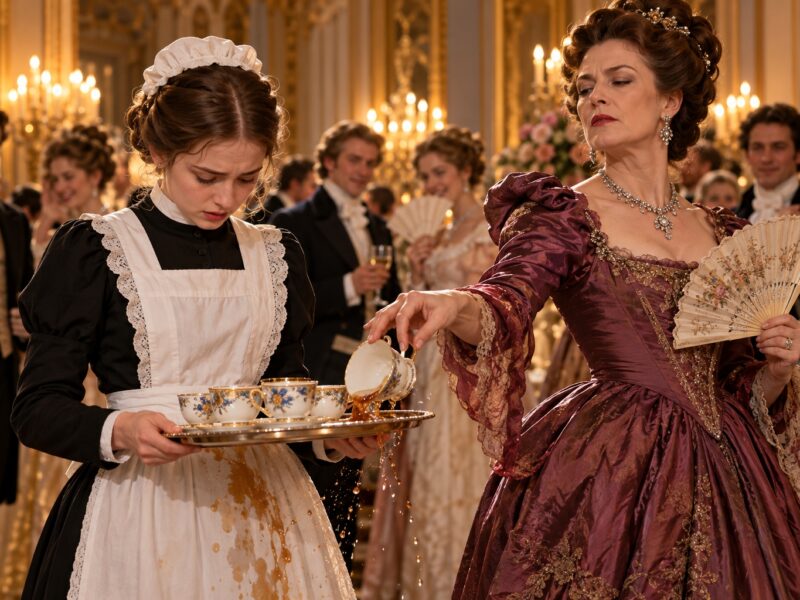
THE DUKE FELL IN LOVE WITH A SERVANT GIRL—BUT WHEN SHE REFUSED HIS CARRIAGE IN THE RAIN, HE MADE A DECISION THAT SHOCKED ALL OF LONDON

A wealthy widow deliberately poured scalding tea over a young servant’s wrist, expecting her to cry before London’s finest society.
Instead, the girl quietly endured the humiliation—and caught the attention of the most powerful duke in the ballroom.
Weeks later, that same duke would be standing in the rain, begging her not to leave him. But loving him could destroy the one person she had spent her life protecting.
PART 1 — THE SERVANT GIRL WHO REFUSED TO BOW
The tea burned Clara Ashford’s wrist before the porcelain cup struck the floor. For one terrible second, the music seemed to fade beneath the sharp sound of breaking china. Then Lady Millicent Hardgrove raised her fan, turned toward the surrounding guests, and announced that the servant girl had ruined her evening.
Clara stood perfectly still. The skin beneath her soaked cuff throbbed, and a narrow stream of tea traveled down her fingers, dripping onto the polished floor. Around her, several ladies exchanged amused glances while a gentleman near the fireplace gave an embarrassed little laugh.
“Oh, do be careful, girl,” Lady Millicent said. “Good servants are becoming almost impossible to find.”
Clara lowered her eyes. She knew what was expected of her. An apology, a trembling voice, perhaps a frantic attempt to gather the broken pieces before anyone stepped on them.
Instead, she placed her silver tray on a nearby table and quietly answered, “I shall have the floor cleaned immediately, my lady.”
Lady Millicent’s smile faltered. She had been hoping for tears.
It was the summer of 1818, and the grand London residence of Lord and Lady Pemberton glittered beneath the light of hundreds of candles. Carriages lined the street outside, delivering titled families, ambitious daughters, wealthy widows, and gentlemen who had come to inspect both the evening’s champagne and its marriage prospects.
Clara had been working since six that morning. She had pressed gowns, arranged flowers, carried linens, and helped supervise the tea service, all while ensuring that Lady Pemberton’s temper remained safely directed elsewhere. By the time the musicians began their second set, her feet were aching and the narrow stays beneath her uniform had become almost unbearable.
She was twenty-three, an educated young woman from a family that had once enjoyed a respectable position in provincial society. Her father’s death, followed by debts and her mother’s expensive illness, had left the family with little security. When Lady Pemberton, a distant connection through her mother’s family, offered employment in London, Clara accepted because wages were more useful than wounded pride.
Her younger sister, Emma, had been luckier. Emma’s godmother had provided her with a small allowance and introductions to respectable families, enough to preserve her prospects of marriage. Clara had never resented the arrangement, but sometimes, while fastening another woman’s diamond necklace, she wondered how two sisters could grow up beneath the same roof and inherit such different futures.
That evening, however, she had no time to wonder about anything.
“Miss Ashford.”
The quiet masculine voice stopped her just as she reached the ballroom’s service entrance.
Clara turned.
A gentleman stood a few feet away, tall and broad-shouldered, dressed in an impeccably tailored black evening coat. His dark hair was neatly arranged, though one rebellious strand had fallen across his forehead. He possessed the restrained confidence of a man who had never needed to raise his voice to make himself heard.
His gray eyes moved briefly to Clara’s injured wrist.
“That must hurt.”
“It is nothing, sir.”
“An interesting description of a burn.”
Clara glanced toward the service door. “I must return to my duties.”
“You have not answered me.”
She looked up despite herself. “I beg your pardon?”
“Does it hurt?”
The directness unsettled her more than the question.
“Yes,” she admitted. “Rather.”
The stranger took a clean linen handkerchief from his pocket and offered it to her.
Clara stared at the folded cloth.
It was fine white linen, the sort that might cost more than several days of her wages.
“I could not possibly take that.”
“You could, Miss…?”
“Ashford. Clara Ashford.”
He nodded slightly. “Then you could, Miss Ashford.”
She accepted the handkerchief with considerable reluctance, pressing it gently against her wrist.
“Thank you, sir.”
He studied her for a moment. “Why did you apologize to that woman?”
Clara hesitated.
“Because I require my employment.”
“She deliberately spilled the tea.”
“Yes.”
“And everyone saw it.”
“Everyone saw what they wished to see.”
Something changed in his expression.
He looked almost startled.
“Did you not feel angry?”
Clara’s fingers tightened around the linen.
“Of course I did.”
“Yet you said nothing.”
She raised her eyes to his.
“Anger is a luxury, sir. I cannot afford to spend mine on people who would enjoy watching me lose it.”
For the first time that evening, the gentleman laughed.
It was not the polished, carefully measured laughter Clara had heard from fashionable men. It came unexpectedly, as though she had reached some hidden part of him that had forgotten how to be amused.
“An extraordinary answer.”
“A practical one.”
“Perhaps those are often the same thing.”
From the other side of the ballroom, a gentleman called, “Sterling! There you are.”
Clara felt the blood leave her face.
The Duke of Sterling.
Adrian Blackwood, seventh Duke of Sterling, was one of the wealthiest noblemen in England. Even Clara, who cared little for the fashionable gossip circulating through Lady Pemberton’s household, knew his name.
There were rumors about his vast estates, his cold manner, and his refusal to marry despite the considerable efforts of ambitious mothers. Some claimed he was incapable of affection. Others said he considered the entire marriage market a tedious business transaction.
And Clara had just spoken to him as though he were an ordinary gentleman.
“Your Grace,” she whispered, dropping into a hurried curtsy.
The duke’s expression changed.
“Please don’t.”
Clara froze.
“Don’t what, Your Grace?”
“Look frightened. You were speaking perfectly well a moment ago.”
“Because I did not know who you were.”
“Then I ought to have kept my identity to myself.”
There was no mockery in his voice.
Clara did not know what to do with that.
“May I return to my duties now, Your Grace?”
For a brief moment, he looked as though he intended to say something else. Then he stepped aside.
“Of course.”
She passed him and entered the service corridor, where the candlelight gave way to narrow walls and the familiar smell of soap, beeswax, and hot food.
Only after the door closed behind her did she realize that she was still holding his handkerchief.
Across the ballroom, Lady Millicent watched the duke standing alone beside the doorway.
She had been acquainted with Adrian Blackwood for nearly two years. Widowed young and comfortably wealthy, she had made no secret of her determination to become the next Duchess of Sterling.
He had always treated her with perfect courtesy.
He had never once looked at her the way he had just looked at a servant girl.
Lady Millicent slowly closed her fan.
“How very peculiar,” she murmured.
The woman beside her followed her gaze.
“What is?”
“His Grace appears to have developed an interest in Lady Pemberton’s maid.”
Within an hour, the observation had crossed the ballroom six times, gathering embellishments with every telling.
By midnight, Clara Ashford had become the subject of a scandal she knew nothing about.
And the Duke of Sterling, who had spent thirty-two years protecting himself from attachments, had begun thinking of excuses to return to a house he had never particularly liked.
Three days later, he found one.
Lord Pemberton was an enthusiastic investor in imported wines, with more confidence than commercial instinct. When Sterling requested a private meeting regarding a shipment of Madeira, his lordship received him with almost embarrassing delight.
They met in the library shortly after noon.
The duke listened politely to a long explanation of shipping expenses, insurance premiums, and the difficulty of finding reliable merchants. Through the open window came the smell of roses warmed by the summer sun.
A movement in the garden caught his attention.
Clara Ashford was cutting flowers beside a stone path.
She wore a plain gray dress with the sleeves turned back. Her hair, almost black in the shade, had been gathered beneath a modest cap. She was speaking to an elderly gardener, smiling at something he had said.
It was the first time Adrian had seen her smile.
He stopped listening to Lord Pemberton’s calculations.
“Your Grace?”
Adrian turned.
“Forgive me. You mentioned the shipping arrangements.”
Lord Pemberton resumed his explanation.
A quarter of an hour later, Adrian requested a glass of Madeira.
When Clara entered carrying the tray, her steps faltered so briefly that only he noticed.
She poured the wine without looking at him.
“Thank you, Miss Ashford.”
Her eyes lifted.
For an instant, there was unmistakable recognition between them.
Then she bowed and withdrew.
Adrian spent the remainder of the visit barely hearing a word his host said.
That evening, Lady Pemberton summoned Clara to her private sitting room.
Her mistress stood beside the mantelpiece, holding an unopened letter.
“I understand His Grace spoke to you at the ball.”
Clara’s stomach tightened.
“Only briefly, my lady.”
“And again today.”
“He thanked me for the wine.”
Lady Pemberton placed the letter on the table.
“You will not encourage him.”
“I have made no attempt to do so.”
“Then continue making none.”
Clara swallowed.
“Yes, my lady.”
Lady Pemberton’s expression remained hard.
“You are an intelligent girl. I should be disappointed to discover that you have confused a gentleman’s passing amusement with a genuine interest.”
Clara stood very still.
Her mistress had intended the words as a warning.
They landed as an insult.
“I understand perfectly, my lady.”
But that night, in her narrow attic room, Clara carefully washed the duke’s handkerchief and folded it beside her few personal possessions.
She told herself she intended to return it.
She did not ask herself why she had already delayed.
Two afternoons later, a letter arrived.
It was addressed not to Lady Pemberton, but directly to Miss Clara Ashford.
The footman who delivered it looked almost as astonished as she felt.
Clara carried the envelope upstairs, locked her door, and broke the seal.
The note was brief.
Miss Ashford,
I am informed that further conversation between us is considered improper. As I am apparently the cause of this concern, I believe you deserve the opportunity to decide the matter for yourself.
I shall be in the garden tomorrow at four, beneath the old oak.
If you do not come, I shall accept your answer and trouble you no further.
Sterling.
Clara read it three times.
Then she held the paper over the candle until the flame caught its edge.
At four the following afternoon, she remained upstairs.
The garden bench beneath the oak stood empty when she finally dared to look.
She told herself she was relieved.
The following morning, however, a small parcel arrived.
Inside lay a worn volume of poetry by Mary Robinson.
A note had been placed between its pages.
You were wise not to come. Forgive me for making your position more difficult. I shall respect your decision.
The book is yours, should you wish to keep it.
A. B.
Clara ran her fingers over the battered leather cover.
She opened the book and discovered that several passages had been marked in pencil. She found herself wondering whether he had chosen them for her or whether they were lines he had loved long before they met.
That evening, she hid the volume beneath her spare petticoats.
She had not answered his letter.
She had not gone to the garden.
Yet something had begun that silence could no longer easily end.
Two weeks later, another parcel arrived.
This one contained a pair of soft gray kid gloves, suitable for a lady rather than a servant.
Lady Pemberton happened to be standing in the entrance hall when the footman carried it inside.
“From whom?”
Clara said nothing.
Her mistress took the accompanying card and read the sender’s name.
The color drained from her face.
“Sterling?”
Clara reached for the parcel.
“Please, my lady. I did not ask for it.”
“You have been corresponding with him.”
“No. He has written. I have not replied.”
“And yet you have allowed this… attention to continue.”
Clara looked at the gloves lying between them.
She thought of the ballroom, the scalding tea, the handkerchief, and the gray eyes that had regarded her as though she possessed a dignity no amount of money could purchase.
“I have not encouraged him,” she said quietly.
Lady Pemberton’s mouth tightened.
“The distinction will matter very little once London begins talking.”
She drew herself upright.
“I will not have my household associated with this disgrace.”
Clara felt the room grow suddenly cold.
“My lady?”
“You are dismissed, Miss Ashford. You will receive a month’s wages and a written character. I expect you to leave tomorrow morning.”
For several seconds, Clara could not speak.
She thought of the wages she sent home, of Emma’s uncertain future, and of the small amount of money she had managed to save.
“Please,” she said at last. “I have done nothing dishonorable.”
Lady Pemberton turned away.
“Then you should have nothing to fear.”
Clara knew better.
She packed her trunk before midnight.
The poetry book went in first.
At dawn, she walked out through the servants’ entrance beneath a sky the color of pewter. The house behind her remained silent, its great windows dark, its occupants still asleep.
She had reached the end of the street when a black carriage drew alongside her.
The window lowered.
Adrian Blackwood looked out.
“Miss Ashford.”
Clara stopped walking.
Rain began to strike the cobblestones.
“Your Grace.”
He glanced at her trunk.
“You’re leaving.”
“Yes.”
“Because of me.”
She did not answer.
The carriage door opened.
“Get in. I’ll take you wherever you need to go.”
Clara stared at him.
Then she lifted her chin.
“No, Your Grace.”
His expression tightened.
“You cannot walk through London carrying that trunk in this weather.”
“I have managed worse.”
“Miss Ashford—”
“You have cost me my position,” she said, her voice trembling despite every effort to steady it. “You have made me an object of gossip. I will not allow you to cost me my dignity as well.”
He stepped down into the rain.
For once, the Duke of Sterling looked entirely without an answer.
Water darkened the shoulders of his expensive coat.
Clara expected him to become angry.
Instead, he said, “You’re right.”
She blinked.
“I beg your pardon?”
“I did not consider what my attention might cost you.” His jaw tightened. “I was accustomed to having my wishes accommodated. It did not occur to me that you would bear the consequences.”
Clara looked at him for a long moment.
The rain grew heavier.
“I never wanted to hurt you,” he said.
“But you did.”
“Yes.”
It was the first time she had heard a gentleman of his station admit wrongdoing without immediately searching for someone else to blame.
Adrian reached into his coat and produced a folded piece of paper.
“My aunt, Lady Ashby, lives in Dorset. She requires a companion and has agreed to interview you for the position. Your employment would be with her, not with me. You are free to decline.”
Clara hesitated before taking the paper.
“Does she know who I am?”
“She knows you have worked for Lady Pemberton and that I believe you deserve fair consideration.”
“And what does she think of your involvement?”
A faint, rueful smile crossed his face.
“She informed me that my judgment appears to have deteriorated considerably.”
Clara almost smiled.
Almost.
Then she looked down at the direction written in his hand.
“Why would you do this?”
“Because I owe you an apology that requires more than words.”
The rain slipped from his hair onto his collar.
“And because,” he added, more softly, “I hope that one day you might allow me to call upon you properly. Not because I am a duke. Because I am a man who would very much like to know you.”
Clara folded the paper.
“I will consider the position.”
“That is all I ask.”
He arranged for the carriage to take her to the coaching office, with the fare to Dorset paid in advance. When she protested, he told her the money could be regarded as restitution for the employment his thoughtlessness had cost her.
Clara accepted only after he assured her that no obligation accompanied it.
As the carriage moved away, she looked back.
Adrian remained in the street, bareheaded in the rain.
For the first time since meeting him, Clara wondered whether the duke’s most surprising quality might not be his power.
It might be his willingness to surrender it.
But far away, in Lady Pemberton’s drawing room, another gentleman was already preparing to use Clara’s reputation as a weapon.
And unlike the duke, Mr. Ellsworth had no intention of accepting the word no.
PART 2 — THE PRICE OF LOVING A DUKE
Lady Ashby’s house stood among the lavender fields of Dorset, an old stone manor with ivy around the windows and a crooked garden wall that had survived more winters than anyone could remember. Clara arrived on a Thursday afternoon beneath a clearing sky, exhausted from travel and uncertain whether the entire arrangement had been a mistake.
The housekeeper led her into a sunlit morning room where a small silver-haired woman sat beside an open window, sorting letters into three untidy piles.
Lady Ashby looked up.
“So. You’re Miss Ashford.”
“Yes, my lady.”
“Sterling tells me you can read French.”
“A little.”
“Can you tolerate bad handwriting?”
“Provided it is not entirely indecipherable.”
Lady Ashby examined her for a moment.
Then she smiled.
“Excellent. Mine is dreadful. Sit down, child. You look as though someone has been making you stand for a week.”
Clara had expected questions about the duke.
None came.
Instead, Lady Ashby asked about her education, her previous duties, and whether she enjoyed reading aloud.
By the end of the afternoon, Clara had been offered a generous wage, a private bedchamber, and employment as a companion rather than a personal maid.
“You are under no obligation to my nephew,” Lady Ashby said as Clara rose to leave. “I have employed you because I believe we shall suit one another. Should he ever become intolerable, you have my permission to tell him so.”
Clara laughed before she could stop herself.
Lady Ashby’s eyes brightened.
“There. Much better. He mentioned you had a smile. I was beginning to think he invented it.”
For the first time in weeks, Clara slept without dreaming of dismissal.
Life in Dorset settled into a gentle rhythm.
There were morning walks through the lavender fields, afternoons spent reading correspondence, and evenings beside the fire while Lady Ashby embroidered badly and complained about the younger generation.
Clara learned that Adrian had lost his mother when he was a boy and his father not long afterward. He had inherited the dukedom at nineteen, surrounded by advisers who expected certainty from someone scarcely old enough to possess it.
“He learned to appear cold,” Lady Ashby told her one evening. “A young duke who shows uncertainty attracts people eager to make decisions for him.”
“That does not excuse arrogance.”
“Certainly not. I’ve spent years telling him so.”
Clara lowered her eyes to her book.
Lady Ashby watched her over the rim of her spectacles.
“He was quite different as a child, you know. Kind, though stubborn. He once refused to leave an injured bird until a groom promised to care for it.”
Clara smiled faintly.
“That sounds rather unlike the gentleman London describes.”
“London generally describes people according to what is most entertaining.”
The remark lingered with Clara.
She had begun to understand that the man beneath the title was more complicated than the rumors suggested.
But she was still uncertain whether affection could survive the unequal distance between them.
Adrian kept his promise not to pursue her without invitation.
He did not visit Dorset.
He sent his aunt ordinary correspondence and never asked Clara to reply.
Occasionally, Lady Ashby mentioned a piece of news about him—a dispute over tenants’ repairs, a visit to Parliament, an argument with a solicitor—and Clara listened while pretending not to be interested.
She had begun to breathe freely again.
In London, however, the gossip grew worse.
Lady Millicent Hardgrove had discovered that the duke’s interest in Clara had not disappeared.
At a musical evening in Grosvenor Square, she told an acquaintance that a former servant from the Pemberton household had been placed conveniently in the home of Sterling’s aunt.
“A most extraordinary arrangement,” she remarked, snapping open her fan. “One can only hope Lady Ashby knows what kind of young woman she has admitted.”
Within days, the story had traveled through half of Mayfair.
Some said Clara was the duke’s secret mistress.
Others insisted he intended to set her up in a fashionable house.
A few claimed Lady Ashby was preparing her to become his bride, a possibility considered so absurd that it produced delighted laughter wherever it was mentioned.
Then Mr. Charles Ellsworth entered the matter.
Ellsworth was a prosperous merchant in his late thirties who had made money in shipping and invested much of it in acquiring the outward appearance of a gentleman. He owned a handsome house in Mayfair, dressed beautifully, and spoke often of his respect for the aristocracy.
He had been courting Clara’s younger sister, Emma, for several months.
Emma, who had grown up with more hope than worldly experience, found his attentions flattering.
Ellsworth, meanwhile, valued the respectable family connections Emma could provide.
The relationship had never been entirely comfortable.
Clara remembered meeting him during a supper party at the Pemberton house.
He had encountered her alone in a corridor while she carried a stack of clean linens.
“So you’re Emma’s elder sister,” he had said.
“Yes, sir.”
“She tells me you’re remarkably well educated.”
“My father believed his daughters should read.”
“An admirable sentiment. Though perhaps an inconvenient one, in your present position.”
Clara had disliked the way he examined her, as though determining what price might persuade her to overlook an insult.
“I have work to attend to, Mr. Ellsworth.”
He stepped aside with an artificial smile.
“Of course. We shall speak another time.”
They never had.
Now, however, Ellsworth believed her supposed scandal offered him an opportunity.
He arrived at Sterling House one evening without an invitation.
Adrian received him in the study, irritated but curious.
“Mr. Ellsworth. To what do I owe this unexpected visit?”
Ellsworth declined the offered refreshments.
“I understand you have taken an interest in a young woman connected with my future family.”
Adrian’s expression cooled.
“You are referring to Miss Ashford.”
“Precisely.”
“Then I suggest you speak with her rather than with me.”
Ellsworth smiled.
“Unfortunately, the matter affects more than the young woman herself. Her sister and I are contemplating marriage.”
“I am aware.”
“And Miss Ashford’s conduct has begun to attract unfavorable attention.”
Adrian set down his glass.
“Her conduct?”
“Surely you understand the difficulty. Society is not kind to young ladies whose relations become objects of scandal.”
There was a deliberate pause.
“If you persist in this attachment, I may have to reconsider my intentions toward Emma.”
Adrian studied him.
The clock on the mantel ticked loudly.
“You intend to abandon a woman you have been courting because her sister received your disapproval?”
“Reputation matters.”
“To you, certainly.”
Ellsworth’s smile thinned.
“Your Grace, I am attempting to prevent an unfortunate situation.”
“No,” Adrian replied. “You are attempting to make me responsible for your willingness to injure an innocent young woman.”
Ellsworth stiffened.
“You misunderstand me.”
“I understand you perfectly.”
Adrian rose.
“If you wish to marry Miss Emma Ashford, you may apply to her family and seek her consent. If you do not, withdraw honorably. But you will not use her future to dictate mine.”
Ellsworth rose as well.
“You cannot protect every person touched by your infatuation.”
“No,” Adrian said quietly. “And that is precisely what concerns me.”
The merchant left with his face burning.
Adrian stood beside the empty fireplace long after the carriage wheels had faded.
Ellsworth’s threat had been cruel.
But it had exposed a truth Adrian could no longer ignore.
His affection for Clara could make her life infinitely more difficult than his own. Society might mock a duke who married beneath his station, but his wealth and title would remain secure.
Clara had no such protection.
He sat at his desk and summoned his secretary.
By morning, he had instructed his solicitor to prepare an independent financial settlement that would protect Clara whether or not they ever married. He also wrote to Lady Ashby, asking for permission to visit Dorset.
The letter was courteous.
For a man accustomed to giving orders, requesting permission was an unfamiliar exercise.
But before his aunt’s reply could reach him, a second letter arrived at the manor.
It was addressed to Clara.
The handwriting belonged to Emma.
Dearest Clara,
Mr. Ellsworth has withdrawn his proposal.
He says the scandal surrounding you has made our connection impossible. Lady Pemberton is furious, and Mother believes that I have lost my last chance of making a respectable marriage.
I know you never intended to hurt me. But I am frightened, Clara.
Please come to London.
Emma.
Clara read the letter beside the morning-room window.
Outside, the lavender trembled in the wind.
Her hands were perfectly steady.
Lady Ashby looked up from her correspondence.
“Bad news?”
Clara handed her the letter.
The older woman read it and sighed.
“That odious man.”
“He has broken his promise to Emma.”
“So it appears.”
“Because of me.”
Lady Ashby folded the letter.
“No. Because he discovered an excuse for behaving badly.”
Clara stared at her.
“You do not know what this means for my sister.”
“I know precisely what it means to have one’s future made dependent upon the goodwill of an unworthy gentleman.”
Lady Ashby’s voice had sharpened.
“My dear, the world frequently tells women they are responsible for the cruelty of men. It is a convenient arrangement for the men.”
Clara looked down.
“I must go to her.”
“Then go. But remember that your sister’s happiness cannot be secured through your misery.”
Clara wanted to believe her.
The next morning, she traveled to London.
Lady Pemberton received her with barely concealed anger.
Emma was not present.
The drawing room smelled of lilies, and the summer sun shone mercilessly on the gold-framed portraits hanging above the fireplace.
“You have disgraced this family,” Lady Pemberton announced.
Clara remained standing.
“I have done nothing improper.”
“You have allowed a duke to make a spectacle of himself over you.”
“I cannot control His Grace’s decisions.”
“You could have discouraged him.”
“I did.”
“Apparently not sufficiently.”
Clara clasped her hands together.
“Where is Emma?”
“With her mother. She has been crying for three days.”
Pain tightened Clara’s chest.
“May I see her?”
“When this matter is resolved.”
Lady Pemberton moved toward the desk.
“Mr. Ellsworth has assured us that he remains willing to marry Emma, provided there is no further connection between your family and Sterling.”
Clara stared at her.
“What does that mean?”
“It means you must leave the duke alone.”
“I have not seen him for weeks.”
“Then it should be easy to continue.”
Clara felt an unpleasant certainty settle inside her.
“That is not all, is it?”
Lady Pemberton did not answer immediately.
“Mr. Ellsworth wishes you to leave London and avoid any further public association with the Ashford family until the marriage is concluded.”
Clara looked at the woman who had once promised her dying mother that she would help protect both daughters.
“You are asking me to disappear.”
“I am asking you to consider your sister.”
“And if I refuse?”
Lady Pemberton’s face hardened.
“I shall ensure you receive no further recommendations from any respectable household in London. You may discover that a woman with your reputation has rather limited choices.”
Clara was silent.
On a small table near the window stood a silver-framed portrait of Emma, taken when she was sixteen.
Her sister looked so young.
For years, Clara had believed that every sacrifice was justified if it helped Emma escape the insecurity that had consumed their family.
Now the price was being named aloud.
“I will leave,” she said.
Lady Pemberton exhaled.
“A sensible decision.”
“But I wish to see Emma first.”
“That would only upset her.”
Clara’s composure cracked.
“She is my sister.”
“And you have already caused her sufficient distress.”
Something in Clara went very still.
She took her gloves from the chair.
“Then please tell her that I love her.”
Lady Pemberton inclined her head.
Clara left without another word.
At the edge of the city, she took a room in a coaching inn and purchased a ticket for Bath.
She had heard that respectable employment could sometimes be found there, helping elderly ladies who visited the Pump Room or serving as a companion during the winter season.
It was not much of a plan.
But it was hers.
The following morning, she stood in the inn courtyard with her trunk beside her.
The horses were being harnessed.
A groom shouted for the last passengers.
Clara tightened the ribbons beneath her bonnet.
Then a carriage came thundering through the gate.
It stopped so abruptly that gravel scattered beneath its wheels.
Adrian stepped down before the coachman could lower the steps.
His coat was rumpled, his boots muddy, and there were shadows beneath his eyes.
“Clara.”
She had never heard him speak her name that way.
Not with curiosity or admiration.
With fear.
He crossed the courtyard.
“I went to Dorset. My aunt told me you had returned to London.”
“Then she should also have told you that I do not wish to be followed.”
“She told me you were trying to protect your sister.”
Clara’s throat tightened.
“Then you understand.”
“I understand that Ellsworth has behaved shamefully.”
“And I understand that Emma will suffer unless I go.”
Adrian moved closer.
“Let me speak to him.”
“No.”
“I can put an end to this.”
“You cannot repair everything with influence.”
“Clara—”
“You have already tried to protect me with your name. Look what happened.”
The words struck him.
For a moment, he appeared almost physically wounded.
Clara looked away.
“I care for you,” she said, so softly he nearly missed it. “More than I ought. But I will not build my happiness on my sister’s ruin.”
A groom called for boarding.
Adrian stood motionless.
Then he said, “Stay because you wish to stay. Not because I have a title. Not because I can offer you a fortune. Stay only if your own heart asks it.”
Clara closed her eyes.
Her heart had been asking for weeks.
But she could still see Emma’s frightened handwriting.
“I cannot.”
Adrian’s hand fell from where it had begun to reach toward hers.
Clara climbed into the coach.
The door closed.
The horses moved forward.
She did not look back.
By the time the coach reached the outskirts of London, she was crying silently into the handkerchief he had given her on the night they first met.
Ten miles later, the coach lurched violently.
There was a crack beneath the floorboards, a shout from the driver, and the sickening sensation of the carriage dropping toward one side.
Passengers screamed.
The horses struggled against their traces.
Clara struck her shoulder against the window and caught herself on the seat.
When the vehicle finally stopped, the driver climbed down and discovered that the rear axle had broken.
There would be no further travel that afternoon.
A farmer offered to take several stranded passengers to a nearby village.
Clara accepted, carrying her trunk through the gathering rain.
She found a room at a small inn beside a church.
By evening, the rain had become steady and cold.
Clara sat beside the window with the poetry book open in her lap.
She could not read a single line.
Instead, she thought of the duke standing in the courtyard, his face changing when she told him she could not stay.
She had done the right thing.
She repeated that truth until it ceased to sound convincing.
Shortly before nightfall, hoofbeats sounded outside.
Clara barely noticed.
Then the horse stumbled.
There was a frightened cry from someone in the yard.
She looked out.
A rider had arrived through the rain, hunched awkwardly in his saddle.
The horse stopped beside the mounting block.
The man tried to dismount.
His right arm hung uselessly against his side.
Clara recognized him the instant he turned his head.
“Adrian!”
She ran toward the door.
By the time she reached the courtyard, the Duke of Sterling had collapsed into the mud.
His coat was torn.
Blood had soaked through the makeshift bandage around his arm.
And when Clara knelt beside him, his first words were not a complaint about the injury.
“I thought I had lost you.”
PART 3 — THE DUKE WHO CHOSE LOVE OVER HIS TITLE
For one terrible moment, Clara thought Adrian was dying.
His face was pale beneath the rain and dirt, his lips almost colorless. When she touched his forehead, his skin felt cold, and his breathing came in uneven bursts that frightened her more than the blood on his sleeve.
“Someone fetch the innkeeper!” she shouted.
Two men hurried from the stable.
Together, they helped Adrian into the inn and carried him upstairs to the largest available bedchamber.
The innkeeper’s wife brought warm water and clean cloths while a stable boy ran to fetch the village surgeon.
Clara remained beside the bed.
Adrian tried to sit up.
“Don’t,” she said sharply.
He looked at her with an expression somewhere between exhaustion and amusement.
“Is that an order?”
“Yes.”
“Then I shall obey.”
She unfastened his ruined coat with trembling fingers.
Beneath it, his shirt was stained with blood, and the swelling around his forearm suggested a serious injury.
“What happened?”
“I took a horse after your coach.”
“Why?”
“I thought that might be obvious.”
“Adrian.”
His expression softened at the sound of his name.
It was the first time she had spoken it without correcting herself.
“The horse shied when a carriage came around a bend,” he said. “I was thrown. The road was slick.”
“And you continued riding?”
“I believed I could reach you.”
Clara stared at him.
“You might have killed yourself.”
“I am beginning to understand that.”
She pressed a cloth against the cut near his temple.
Her hands shook so badly that she had to stop.
Adrian watched her.
“I frightened you.”
“Yes.”
“I’m sorry.”
Her eyes filled.
“You cannot keep doing this.”
“Following coaches?”
“Making me care for you and then behaving as though your life is something you can gamble.”
The words escaped before she could contain them.
Adrian became very still.
Clara looked down.
The surgeon arrived before either could speak again.
He examined the duke’s arm, confirmed a fracture, cleaned the wounds, and fashioned a splint. Adrian endured the treatment with clenched teeth and remarkably little complaint.
Afterward, he was given instructions to rest for at least a fortnight.
Clara listened carefully to every word.
When the surgeon left, she sat beside the narrow bed.
The room smelled of damp wool, vinegar, and the smoky fire burning in the grate.
Outside, rain tapped against the window.
Adrian turned his head toward her.
“You needn’t stay.”
“I know.”
“You could continue to Bath when the coach is repaired.”
“I know that too.”
He looked down at the splint.
“I have spent my life believing that determination was sufficient to secure anything I wanted.”
“That must have been very convenient.”
“It was. Until I met you.”
Clara’s mouth twitched.
Adrian reached for her hand with his uninjured one.
She let him take it.
“I was selfish from the beginning,” he said. “I wanted to see you again, so I arranged to see you. I wanted to send you gifts, so I sent them. I did not consider whether you could safely accept them.”
Clara watched his face.
“I know.”
“I thought I could protect you from any consequences afterward.”
“You cannot protect me from everything.”
“No. I cannot.”
He paused.
“But I can refuse to make you face them alone.”
Clara’s eyes burned.
“Emma…”
“I know.”
“Her marriage—”
“Must be her decision. Not Ellsworth’s bargain with me, and not a price extracted from you.”
Clara withdrew her hand slowly.
“You make it sound simple.”
“It is not simple. But it is right.”
For a long time, they sat without speaking.
Then Adrian asked, “Do you love me?”
Clara looked toward the window.
The question was almost unbearable in its simplicity.
“I have tried very hard not to.”
“That was not quite what I asked.”
She laughed once, though tears were sliding down her face.
“Yes,” she whispered. “I love you.”
Adrian closed his eyes.
For a moment, he seemed unable to speak.
When he opened them again, there was no trace of the detached, formidable duke who had stood beneath a thousand candles at the Pemberton ball.
There was only a frightened man who had heard the answer he scarcely dared hope for.
“Then marry me.”
Clara stared.
“Adrian.”
“Marry me.”
“You are injured.”
“My arm is broken. My judgment is remarkably clear.”
She shook her head.
“You know what London will say.”
“I have an excellent idea.”
“They will laugh at you.”
“Possibly.”
“They will claim you have disgraced your family.”
“Undoubtedly.”
“They will never accept me.”
Adrian was silent for a moment.
“Some will not.”
The honesty of his answer touched her more deeply than any extravagant promise could have.
“I cannot offer you a world without cruelty,” he continued. “But I can offer you a marriage in which you never have to earn the right to be treated with respect.”
Clara looked at him.
He took a slow breath.
“I cannot promise to become a perfect husband. I am proud, impatient, and inclined to believe my judgment superior to everyone else’s.”
“That is a fairly accurate description.”
He smiled.
“But I can promise to listen when you tell me I am wrong.”
She wiped her cheek.
“And what if I tell you frequently?”
“Then I shall become extraordinarily well educated.”
Clara laughed through her tears.
For the first time, the prospect of marrying him seemed not merely frightening, but possible.
Still, she would not answer immediately.
Instead, she leaned forward and kissed his forehead.
“Ask me again when your fever has gone and your arm is healing.”
Adrian closed his eyes.
“Is that a refusal?”
“No.”
“A promise?”
“Not yet.”
He exhaled slowly.
“I shall endeavor to survive the suspense.”
For the next two weeks, Clara remained at the inn.
Lady Ashby arrived on the third day, accompanied by a footman and enough luggage to suggest that she intended to supervise her nephew’s recovery personally.
She walked into the bedchamber, examined Adrian’s splint, and said, “For a man celebrated for his intelligence, you have displayed a remarkable talent for stupidity.”
Adrian smiled weakly.
“Good morning, Aunt.”
“Do not good-morning me. If you ever ride an injured horse through a storm again, I shall have you confined to a nursery.”
Clara turned away to hide her laughter.
Lady Ashby noticed.
“Miss Ashford, I see you have already discovered the necessity of correcting him.”
“He has been a reasonably obedient patient, my lady.”
“Astonishing.”
With Lady Ashby’s help, the situation became more manageable.
Clara was able to retain her position as companion, rather than remain at the inn without a respectable chaperone. Lady Ashby took rooms nearby, supervised the correspondence with Adrian’s household, and made certain that no one could plausibly describe Clara’s presence as clandestine.
The duke continued to recover.
But London was not finished with them.
On the tenth day, Mr. Ellsworth arrived.
Clara was in the inn’s private parlor mending a shirt when the innkeeper announced him.
She rose.
“Mr. Ellsworth.”
He glanced around the room with visible distaste.
“So the rumors are true.”
Clara placed the shirt aside.
“Which rumors?”
“That you have been living under the same roof as the duke.”
“Lady Ashby is here.”
“That will hardly matter to society.”
“It matters to me.”
Ellsworth studied her.
“You have placed your sister in an impossible position.”
Clara felt the familiar stab of guilt.
“Have you spoken with Emma?”
“She is devastated.”
“Then you should not have threatened to abandon her.”
His expression hardened.
“You seem not to understand the value of a respectable marriage.”
“I understand it sufficiently to know that a woman should not enter one under threat.”
Ellsworth stepped closer.
“You are making a dreadful mistake. Sterling will tire of you. Men of his position do not marry women who have waited on tables and carried trays.”
Clara met his eyes.
“Perhaps not.”
He appeared encouraged.
“Then you finally understand.”
“But I would rather remain unmarried all my life than allow you to purchase my silence with Emma’s future.”
Ellsworth’s face reddened.
“You are impertinent.”
“No, Mr. Ellsworth. I am finished being frightened.”
She reached for the bell.
“I believe our conversation is over.”
He did not move.
“Your sister will pay for this.”
Clara’s hand stopped above the bell cord.
Then she looked at him with something colder than anger.
“If you truly intend to punish Emma because I will not obey you, then you have proved you never deserved her.”
The words struck harder than she expected.
For an instant, Ellsworth’s polished composure vanished.
“You will regret this.”
“Perhaps,” Clara said. “But I shall regret betraying myself even more.”
She pulled the bell.
The innkeeper appeared.
“Mr. Ellsworth is leaving.”
The merchant departed without another word.
That evening, Clara told Adrian what had happened.
His face darkened as she spoke.
When she finished, he said, “I should like to have a conversation with that gentleman.”
“No.”
“Clara—”
“I do not wish him frightened by your title. I wish Emma to see what kind of man she has been promised to.”
Adrian looked at her.
Then, slowly, he nodded.
“You’re right.”
She smiled.
“That is becoming a remarkably pleasant phrase to hear.”
He drew her hand to his lips.
“I expect you will hear it again.”
Within another week, Adrian was well enough to travel.
He returned to London accompanied by his aunt, while Clara remained briefly in Dorset to resume her duties and consider the future without an injured man beside her influencing every thought.
Before leaving, he asked her once more to marry him.
This time she answered.
“Yes.”
Adrian did not immediately embrace her.
He looked almost afraid to move.
Then he took both her hands and kissed them.
Clara saw the tremor in his fingers.
She realized how much her answer meant.
And for the first time, she stopped thinking of their attachment as a mistake they had somehow failed to prevent.
It was a choice.
One they were making together.
Adrian’s first appointment upon returning to London was with his solicitor.
He arranged for Clara to receive a substantial marriage settlement, including an income secured independently of his estate’s day-to-day administration. The arrangements were explained to her plainly, with the opportunity to obtain separate advice.
He would not have the woman he loved dependent upon his goodwill for her security.
His second appointment was with Lady Pemberton.
She received him in the same drawing room where she had dismissed Clara.
“Your Grace,” she said, curtsying. “What an unexpected pleasure.”
Adrian remained standing.
“I have come to inform you that Miss Clara Ashford has accepted my proposal of marriage.”
Lady Pemberton gripped the back of a chair.
“Marriage?”
“Yes.”
“Surely you cannot mean—”
“I mean precisely what I have said.”
She sank into her seat.
“But the scandal!”
“There will be gossip.”
“The family will be humiliated.”
“I do not consider marriage to a woman of intelligence, courage, and impeccable character a humiliation.”
Lady Pemberton stared.
“Your Grace, she was employed in my household.”
“I am aware.”
“As a servant.”
“Yes.”
“And you would make her a duchess?”
Adrian regarded her steadily.
“I intend to make her my wife. The title is incidental.”
Lady Pemberton pressed a hand to her chest.
“And what will society say?”
“I imagine society will say a great many things. It generally does.”
There was a long silence.
Then Adrian placed a folded paper on the table.
“This is a copy of the announcement I intend to publish. It makes my intentions clear and expresses my respect for Clara and her family.”
Lady Pemberton read it.
Her expression changed as she saw the carefully chosen words.
“You would publicly defend her?”
“I would publicly acknowledge her.”
He turned toward the door.
“Good day, Lady Pemberton.”
He left her sitting beneath the portraits of ancestors who had married for land, money, and influence.
For the first time in her life, she could not decide whether she had witnessed an act of madness or extraordinary courage.
The engagement announcement appeared three days later.
London erupted.
Lady Millicent Hardgrove declared the match an insult to every noble family in England.
Several fashionable hostesses announced that they would never receive the future duchess.
Some of Adrian’s relations wrote furious letters urging him to reconsider.
He answered politely.
He did not reconsider.
Yet something unexpected happened as the story traveled beyond the drawing rooms.
Not everyone regarded it as a disgrace.
The circumstances of Clara’s dismissal became known, and Lady Millicent’s cruelty at the Pemberton ball was remembered by those who had witnessed it. A few people who had once laughed began to feel uncomfortable about what their amusement had cost an innocent woman.
Other women, particularly those who had endured years of being judged according to their fortunes and family connections, found themselves quietly admiring Clara.
Even among the aristocracy, opinion was divided.
An elderly countess reportedly observed that she had met several duchesses considerably less suited to the position than a young woman who knew how to work.
And Adrian’s aunt made certain everyone understood her position.
Lady Ashby invited Clara to accompany her to a small gathering in Dorset.
When an acquaintance hesitantly referred to the engagement as “unusual,” she replied, “Indeed. My nephew appears to have chosen a wife for her character rather than her income. We must hope the novelty does not spread too far.”
The remark became a favorite piece of gossip.
By the end of the month, the scandal had begun to change shape.
It was becoming a love story.
Emma’s situation also changed.
Clara finally managed to meet her sister at Lady Ashby’s London residence, where they spoke privately for the first time since Ellsworth’s broken proposal.
Emma looked thinner than Clara remembered.
When she entered the room, her hands were trembling.
“Clara.”
Clara rose at once.
“Oh, Emma.”
Her sister crossed the room and embraced her.
For several moments, neither spoke.
Then Emma drew back.
“I’m sorry.”
Clara shook her head.
“You have nothing to apologize for.”
“Yes, I do.”
Emma’s eyes filled.
“I knew what Mr. Ellsworth was asking. I knew he wanted you to go away. And I said nothing because I was frightened he would leave me.”
Clara took her sister’s hands.
“You were under terrible pressure.”
“I was selfish.”
“You were afraid.”
Emma swallowed.
“I thought marrying him would solve everything. Mother believed it would. Lady Pemberton told me I would never have another opportunity.”
“And now?”
Emma looked toward the window.
“Now I realize I was preparing to spend my life with a man who threatened someone I love whenever he failed to get his way.”
Clara’s eyes burned.
“Have you ended the engagement?”
Emma nodded.
“He came yesterday to ask whether I was finally prepared to behave sensibly.”
A small, unexpected smile crossed her face.
“I told him I had decided to.”
Clara waited.
“Then I returned his ring.”
For a moment, Clara simply stared.
Then the sisters began laughing.
The laughter ended in tears.
Clara embraced Emma tightly, feeling years of worry and responsibility loosen their grip.
Her sister had not been ruined.
She had found the courage to choose differently.
The wedding took place in Dorset on a cool autumn morning.
The little parish church was decorated with white roses, rosemary, and bundles of lavender from Lady Ashby’s garden. Sunlight entered through narrow windows, settling in warm patches across the ancient stone floor.
Clara wore a gown of cream silk.
There were no extravagant jewels.
No towering arrangement of feathers.
Only a simple pearl necklace that had belonged to her mother and a bouquet tied with pale ribbon.
Emma stood beside her before the ceremony, straightening the small folds of her veil.
“Are you frightened?” she whispered.
“A little.”
“Of becoming a duchess?”
Clara glanced toward the church door.
“No.”
“Then of what?”
Clara smiled.
“Of how much I love him.”
Emma touched her hand.
“Then I think you will be all right.”
Outside, the church bells began to ring.
Adrian waited beside the altar.
His injured arm had healed sufficiently that he no longer required a sling, though Clara noticed he held it with unusual care.
He wore a dark morning coat and a plain white cravat.
He had faced creditors, political opponents, and powerful landowners without visible fear.
Yet when Clara entered the church, his expression revealed something close to astonishment.
She walked toward him.
The room seemed very quiet.
Clara saw Lady Ashby dabbing her eyes with a handkerchief.
She saw Emma smiling through tears.
She saw the old village church, the flowers, the morning sunlight.
But most clearly, she saw the man who had once stood in a ballroom and asked whether her injured wrist hurt.
He had been the first person that evening to care about her pain.
Now he stood waiting to promise that she would never have to face it alone.
The vicar began the ceremony.
Adrian’s voice was steady when he answered.
“I will.”
Clara looked at him.
She remembered standing in the rain with her trunk, certain that accepting his help would mean losing herself.
She remembered the broken coach, the muddy courtyard, the terrifying sight of him falling from his horse.
And she remembered the moment he had asked what she wanted instead of telling her what she ought to do.
“I will,” she said.
When the ceremony ended, Adrian took her hand.
They walked through the church doors into the pale autumn sunshine.
Guests gathered outside, offering congratulations and scattering flower petals along the path.
Adrian leaned toward her.
“I told you I would see you again, Miss Ashford.”
Clara looked up at him.
“You did, Your Grace.”
“And now?”
She smiled.
“Now you may call me Clara.”
He laughed, openly and without restraint.
Then he grew serious.
“Are you happy?”
Clara glanced at their joined hands.
She thought of the years spent believing that her value depended upon how quietly she could endure other people’s cruelty.
She thought of how many doors had closed because she refused to surrender her dignity.
And she thought of the man beside her, a duke who had learned that love was not something to command, purchase, or pursue without consideration.
“Yes,” she said. “I am.”
Adrian lifted her hand to his lips.
“Then so am I.”
They stepped into the waiting carriage together.
Behind them, the bells continued to ring.
London would remember the marriage as the season’s most extraordinary romance. Society would invent stories about the duke who had sacrificed his pride for a servant girl, and the servant girl who had somehow captured one of England’s most eligible gentlemen.
But Clara knew the truth was simpler.
He had not rescued her from an unworthy life.
She had never been unworthy.
He had merely been brave enough to see what others refused to acknowledge.
And when Adrian Blackwood offered her his heart, he finally understood that loving Clara Ashford did not make him less of a duke.
It made him a better man.









