The Duke Gave His Wife One Hour to Leave—But the House, the Land, and Every Acre Beneath His Feet Belonged to Her

“You have one hour to pack.”
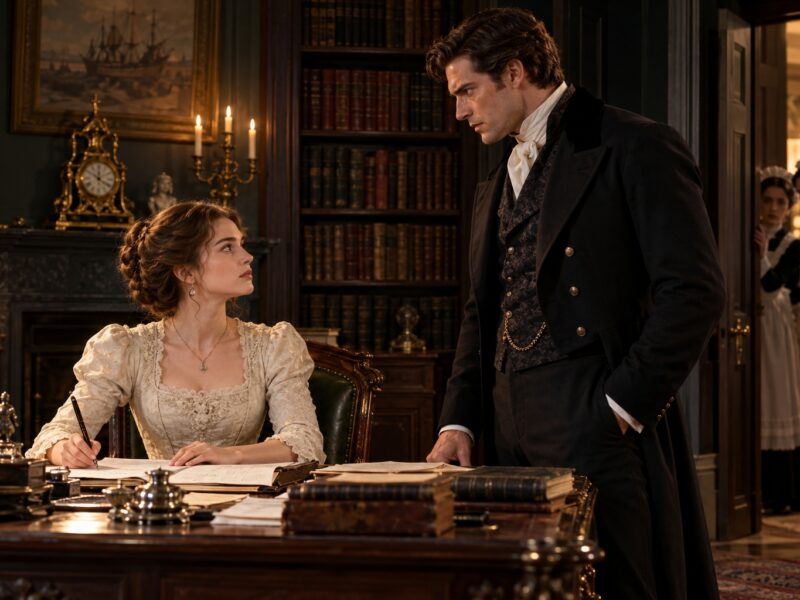
The Duke spoke those words in his wife’s childhood home, standing beside her dead father’s desk, without the slightest suspicion that he was ordering her out of a house he had never owned.
Wilhelmina Fenwick slowly put down her pen. For eleven months, her husband had treated her as a disappointing financial arrangement. Now, as the servants gathered beyond the study door, she looked at the man who believed he controlled her future and quietly repeated, “One hour?”
The Duke of Fenwick stood before the fireplace, his shoulders squared beneath a dark wool coat, his expression as composed as though he had merely instructed a groom to prepare the carriage. At twenty-four, Wilhelmina had already learned that her husband’s calm was often more dangerous than his anger. He rarely raised his voice because he had spent his life assuming that one word from him was enough.
“You may take what belongs to you,” he answered. “Nothing more.”
The fire gave a small, dry crack. Mina, as her father had called her, rested one hand on the open account book before her. Beyond the oak door, she heard the faint rustle of a housemaid’s skirts, followed by the abrupt silence of someone who had realized she was standing too close.
“Have you instructed the servants?” she asked.
“I have told Greaves to bring your smaller trunk.”
“How thoughtful of you to arrange my departure from my own house.”
Something shifted in his face. It was no more than a narrowing of the eyes, a momentary interruption in the certainty with which he had entered the room. Then his expression closed again.
“This is Fenwick land.”
“Is it?”
He looked at her for several seconds. Mina picked up her pen and returned to the drainage accounts, where an unexplained discrepancy of eleven pounds and four shillings had been troubling her since breakfast. She knew exactly how insolent her composure must appear, but she also knew that explaining herself now would give him something he had not earned.
The Duke waited for a protest that never came. Eventually, he turned toward the door.
“I expect you to understand the seriousness of this.”
“I understand it perfectly.”
When the door shut, Mina remained seated. Only then did she notice how tightly her fingers had closed around the pen. The nib had scratched a thin, crooked line through a figure she had already corrected twice.
She drew a careful breath and reached for the blotting paper.
The room smelled of beeswax and cold candle smoke, as it had since she was a child. The desk beneath her hand had belonged to her father, a shipping merchant who had taught her to read a ledger before most girls of her acquaintance were permitted to examine a household bill. She had learned her letters at this very desk, sitting on a cushion while he explained the difference between a number that appeared correct and a number that could be proved.
Forty feet away, inside a locked strongbox, lay the original deed to Cold Harbor Park. It named Vilhelmina Ashby, the woman now known as the Duchess of Fenwick, as the owner of the house, the home farm, the woods, and every acre of the surrounding estate.
Her marriage had never transferred that ownership to her husband.
The Duke did not know that.
And Mina had never told him.
By dinner, the household had produced three different accounts of the confrontation. According to the first, the Duchess had refused to obey and threatened to summon her lawyers. According to the second, she had wept until the Duke withdrew his order. The third claimed that she had announced an intention to depart for London before morning.
None was true.
The only fact upon which everyone agreed was that the Duchess had been given one hour to leave and had not packed a single garment.
The Dowager Duchess of Fenwick received this news with evident satisfaction. She sat at the long dining table beneath a portrait of her late husband, her pearls arranged neatly against the black silk of her gown. Thirty years of commanding servants had taught her to reveal displeasure with a raised eyebrow and approval with an almost imperceptible relaxation of the mouth.
That evening, she seemed positively cheerful.
“You have scarcely touched your soup,” she observed.
“I find I have little appetite.”
“A pity. You may require your strength.”
Mina looked up.
“For the packing, I mean,” the Dowager added, lifting another spoonful. “My son does not make idle statements. It would be wise for you to learn that.”
Mina folded her napkin, aligning its corners with unnecessary care. “I have learned a great deal during my eleven months here. Rather more, I think, than your son imagines.”
The Dowager’s spoon paused above the bowl.
Mina offered no explanation.
During the third week of her marriage, she had discovered that any careless remark at that table would return to her by breakfast, sharpened and stripped of its original meaning. She had learned to say less, to observe more, and to keep her conclusions to herself.
She had also learned how cold a room could become when its fire was deliberately allowed to die.
Her mother-in-law regarded warmth as a privilege, never a necessity. When the Duke traveled, Mina sometimes found the grate in her private sitting room unlit, despite ample coal in the household stores. The Dowager considered such economies prudent. Mina understood the message perfectly.
Her arrival had not brought the magnificent fortune the Fenwicks expected, and the household was determined that she should feel the difference.
Eleven months earlier, her wedding had been conducted with every outward appearance of success. The flowers had been extravagant, the guest list distinguished, and her husband impeccably courteous. He had spoken his vows without hesitation and offered his arm as they left the church.
He had never once addressed her by her given name.
At first, Mina had told herself that affection might come with familiarity. She knew the marriage was practical. The Duke needed capital, and her own advisers had argued that a ducal title offered security and a position beyond the reach of those who still considered a merchant’s daughter socially inferior.
She had not expected devotion.
But she had hoped, quietly and against her better judgment, for kindness.
Instead, within three months, her husband had discovered that the Ashby trust produced only a fraction of the income that gossip had attributed to it. His disappointment was never announced openly. It appeared in shorter conversations, withdrawn invitations, meals conducted in silence, and a new distance in the way he looked at her.
He had married a fortune.
He believed the fortune had failed him.
Mina knew the truth was more complicated. Her father had left her wealth, but not in the convenient form that her husband’s solicitors expected. The income was modest compared with the rumors, while the true value lay in the land itself, held under terms the Duke’s advisers had failed to examine properly.
That omission had become the foundation of their marriage.
She could still remember the winter she turned sixteen, when her father sat in his countinghouse with a letter open beside the candle. Outside, carts rattled over frozen stones, and the air smelled of wet wool, ink, and the tobacco he smoked only after the day’s work was finished.
He had read aloud the legal declaration naming her sole inheritor of Cold Harbor Park.
Her uncle had contested the arrangement. He had failed.
And then her father died of a fever before she could fully understand what his victory meant.
For weeks afterward, the house had been filled with solicitors, relatives, and acquaintances eager to explain what would become of the unfortunate girl. They spoke of her inheritance as though it were an inconvenience that would eventually be resolved by marriage.
One lawyer called her fortunate to have inherited so little trouble.
She had been sixteen years old and standing beside her father’s empty chair when he said it.
She remembered deciding that day never to cry in front of someone who might mistake her grief for helplessness.
By nineteen, she had learned how useful other people’s assumptions could be.
Mr. Redmayne, the second son of a viscount, had called on her three times in a fortnight. He spoke elegantly of books, gardens, and the life he might build with a woman who appreciated both. On his third visit, he had allowed himself to imagine a future in which her home and his title might exist in comfortable harmony.
A fourth visit never occurred.
Someone had informed him that the Ashby trust yielded considerably less than the county believed. He sent a letter expressing regret, and Mina read it once before returning it to its envelope.
It was a curious education, discovering how quickly a gentleman’s attachment could be reduced by a revised estimate of a woman’s income.
Two further suitors cooled in much the same way.
By the time the Duke entered her life, she had become adept at distinguishing between admiration and calculation. His need for money had been no secret, nor had the pride with which he carried a family name burdened by generations of expensive mistakes.
Their engagement was arranged within a season.
His solicitors believed the Ashby lands would pass into his control through the marriage settlement. Hers, accustomed to defending her ownership, had preserved the essential legal protections in the documents.
Mina knew what her husband assumed.
She had allowed him to continue assuming it.
For a long time, she called that prudence. On colder evenings, when he passed her without speaking and the Dowager’s servants treated her as an unwelcome expense, she sometimes wondered whether prudence and fear had grown too similar to distinguish.
Three days after the Duke’s ultimatum, the east-wing roof partially failed.
The first warning came as a sharp crack above the upper corridor. Dust drifted from the plaster, and a housemaid hurried downstairs with the news that a beam had given way. By noon, the estate steward, Mr. Harrow, had summoned roofers and obtained an estimate.
He brought it to the Duke with a face the color of the paper in his hands.
“Four hundred pounds, Your Grace.”
The Duke examined the sheet. “What is available?”
“Perhaps sixty pounds in liquid reserve, sir.”
“Then the work cannot proceed.”
Harrow’s shoulders sank.
At the far end of the morning room, Mina lifted her head from the household accounts. A draft stirred the pages beneath her hand, and she placed a paperweight over them.
“May I see the estimate?”
Harrow glanced at the Duke, who hesitated before nodding.
Mina read every line. She turned the page over, checked the quantities, and read the first column again.
“Your roofer has charged eleven shillings per hundredweight for slate,” she said. “The Medway yards are supplying it for eight shillings and sixpence. He has also allowed for nine men working six days.”
“That is the estimate,” the Duke replied.
“It is an inflated estimate.”
“You cannot possibly know how many men the work requires.”
“I have seen that roof repaired twice. Once when I was a girl, and once after I married you. It requires five men for approximately four days, provided the work is properly organized.”
The Duke stared at her.
“I paid for the repairs both times,” Mina continued. “I should remember.”
Harrow suddenly found the pattern of the carpet fascinating.
Mina returned the estimate to him. “Obtain the current rate sheet from the yard. Send these corrections to the roofer, and if he refuses to revise the charges, request quotations from the other two firms within a day’s cart journey.”
“Yes, Your Grace.”
He departed with an eagerness he made little effort to conceal.
The Duke remained by the fireplace.
“You have examined building accounts before.”
“Every account in this house.”
“Every account?”
“Someone must. Mr. Harrow is honest, but arithmetic is not his strength. Your mother considers ledgers beneath her notice, and you have generally preferred not to examine them unless the balance is particularly alarming.”
He looked toward the open books.
“And you enjoy such work?”
“I was raised in a countinghouse. Figures were among the first things my father taught me to love.”
There was no bitterness in her voice. That seemed to disturb him more than bitterness might have done.
“The roof can be repaired for approximately two hundred and thirty pounds,” she said. “I shall have a corrected estimate ready by Thursday.”
She gathered her papers and left him standing beside the fire.
For the first time since their wedding, the Duke had witnessed her competence without being able to dismiss it as an incidental advantage of her upbringing.
He had expected a woman who brought him money.
He was beginning to understand that he had married a woman who knew how to preserve it.
Several weeks later, he asked to speak with her privately.
It was ten o’clock when they met in the study. Rain tapped against the windows, and the desk between them was illuminated by two candles. Mina had chosen the chair her father used to occupy when conducting business, a small decision that gave her more courage than she cared to admit.
The Duke stood opposite her.
“I will not pretend to an affection I have not earned,” he began. “You did not marry me for it, and I did not offer it.”
“No.”
“We married because my advisers believed your father had left you considerably more than he had, and because yours regarded a duke’s household as a desirable establishment.”
Mina held his gaze. “That is a fair description.”
“Then perhaps we should agree upon what remains.”
He placed both palms on the desk.
“You will not be ordered from this house again. I withdraw the hour I gave you. If you require me to withdraw it before the household, I shall do so.”
“I require it in writing.”
He blinked.
“And I require formal responsibility for the estate accounts,” Mina added. “All of them. Not occasional permission to intervene when Mr. Harrow encounters a difficulty.”
“You ask a great deal for someone with no legal claim to manage the property.”
The words struck an old nerve, but Mina gave no indication of it.
“I ask to be recognized for work you have already relied upon. You may describe it however you please.”
He considered her for a long moment.
“Agreed.”
She had expected resistance. The simplicity of his answer unsettled her.
“In exchange,” he continued, “I ask that you refrain from correcting me in front of the servants.”
Mina folded her hands.
“I shall stop correcting you in front of the servants when you stop being wrong in front of them.”
The silence lasted only a second.
Then something unexpected happened. The corner of his mouth moved, as though a laugh had tried to escape and been caught before it could become audible.
Mina looked down quickly, but not before she saw it.
They settled the terms that evening without pretending they had repaired their marriage. The Duke’s written assurance arrived the following morning, and the household accounts were placed under her direction.
Neither spoke of gratitude.
Yet, after the papers were signed, Mina slept through an entire night without waking to listen for footsteps in the corridor.
The change became visible first to the servants and then to the county.
At a dinner attended by several neighboring families, Mrs. Thistlewood, a woman who considered every social occasion an opportunity to remind others of their origins, remarked upon the Duchess’s aptitude for figures.
“How fortunate,” she said sweetly, “that trade runs so naturally in the blood. Particularly where it is required.”
Conversation faltered.
Mina laid down her spoon.
“Very fortunate indeed. The alternative appears to be managing a household through good breeding and guesswork. I have examined the accounts of three households operating under that principle this quarter.”
Mrs. Thistlewood’s smile remained fixed.
“Two are mortgaged beyond the value of their timber,” Mina continued. “I find my upbringing a considerable comfort.”
She turned toward the footman.
“Might there be a little more fish?”
No one laughed. Several guests suddenly developed an intense interest in their plates.
Across the table, her husband watched her with an expression she could not read.
A fortnight later, his cousin Perival Ashworth-Vane proved equally unfortunate.
Perival had long taken an interest in the future of the Fenwick estates, particularly in the possibility that the Duke’s marriage might produce no heir. He had cultivated the appearance of harmless good humor while asking questions about timber rights, inheritance, and the condition of the family properties.
During an afternoon visit, he observed that a woman so occupied with accounts could scarcely have time to attend to her husband.
Mina looked up from the correspondence she was sorting.
“I find I can manage several responsibilities simultaneously. It is a useful skill when one must attend to the actual condition of an estate while others occupy themselves imagining what they may someday inherit from it.”
Perival’s expression scarcely changed, but he spoke very little afterward.
The Duke said nothing to Mina about either encounter.
She gradually noticed, however, that he no longer looked embarrassed when she spoke of accounts. Sometimes he appeared to be listening with genuine interest.
At Michaelmas, the estate’s annual rent collections revealed a discrepancy of approximately sixty pounds.
Harrow had checked the rolls twice and could find no explanation.
Instead of waiting until Mina encountered the problem herself, the Duke summoned her to the estate office.
She noticed the distinction.
He had begun to ask for her help rather than merely tolerate it.
The rent rolls occupied most of the table. Mina spent two hours comparing them with the home farm yields and the miller’s separate accounts. Harrow hovered nearby, twisting his watch chain around one finger.
At last she placed two sheets side by side.
“The miller has been charging the tenants at the established rate while remitting a reduced portion to the estate. The difference appears to have been retained by him for nearly three years.”
Harrow went pale.
“Forty-one tenants are affected,” Mina said, running her finger down the column. “The entries here indicate how the amount was concealed. This year’s shortage has become too substantial to hide within ordinary adjustments.”
The Duke leaned over the figures.
“You found this in two hours?”
“The books were intended to be read separately. He depended upon no one comparing them.”
She turned the ledger toward him.
The suspicious entries were underlined in her hand.
This time, he did not challenge her.
The miller was dismissed within the week. The accounts were corrected, and restitution was arranged for the affected tenants. News traveled from cottage to cottage, through kitchens and across fields, until families who had scarcely spoken to the young Duchess began referring to her with an affection she had never sought.
Their gratitude was practical. She had noticed something that cost them money, and she had acted.
Mina found that more satisfying than any compliment at a county dinner.
The weeks that followed brought three small changes she could not entirely explain.
First, her chair in the morning room was moved closer to the fireplace, away from the cold draft beneath the east window. No one announced the alteration, but she saw the Duke glance toward it when he entered the room.
Second, the housekeeper began serving her tea without sugar. Mina had never formally complained about the household’s habit of sweetening it, but she had noticed the Duke watching her discreetly set aside untouched cups.
When she asked the housekeeper why the order had changed, the woman replied, “His Grace mentioned your preference.”
The third kindness arrived after midnight.
Mina was examining the timber accounts when the Duke entered the study. She expected him to remark upon the hour or suggest that she leave the work until morning.
Instead, he looked at the candle burning low beside her, crossed to the mantelpiece, and brought another.
He lit it, placed it near her elbow, and left without speaking.
The gesture was almost painfully ordinary.
For several minutes she continued staring at the figures without seeing them.
She had spent years teaching herself that affection was a dangerous assumption. It was easier to trust evidence: signed papers, corrected balances, promises placed in writing. A chair moved nearer the fire could mean anything. A cup of unsweetened tea was scarcely grounds for revising one’s judgment of an entire marriage.
And yet she remembered both.
She remembered the candle most of all.
The letter from London arrived on a Tuesday.
The clerk who delivered it worked for the Ashby family’s solicitors. Mina recognized him immediately. Eight years earlier, the same young man had carried documents concerning her father’s will, standing awkwardly in the entrance hall while she struggled to understand the legal language surrounding her inheritance.
Now he brought a sealed communication addressed to her husband.
The Duke read it once, then a second time.
When he summoned Mina to the study, she knew something was wrong before he spoke.
“Your uncle has renewed his petition.”
Her hands grew cold.
“On what grounds?”
“He argues that your father’s original will was improperly witnessed. He wishes the court to reconsider the terms under which the land is held.”
“He challenged the estate eight years ago,” she said. “He lost.”
“His earlier challenge concerned the trust income.”
The Duke placed the letter on the desk.
“This concerns Cold Harbor itself.”
Mina looked at the seal.
For years, she had known the matter might one day return. Her uncle had never accepted her father’s decision, and the legal protections surrounding the property had been complicated enough to discourage casual examination.
But she had hoped the silence meant he had finally abandoned his ambitions.
The Duke summoned Harrow to locate the estate’s copies of the relevant documents. They examined the marriage settlement, the trust records, and the clauses concerning the land.
At last, her husband raised his eyes from the papers.
“Vilhelmina.”
It was the first time he had said her name since their wedding.
The sound unsettled her more than his earlier anger.
“Why would your uncle contest the land unless it had been left to you separately from the marriage settlement?”
Mina looked at the desk, at the marks in the wood where her father had once rested his pen.
“Because it was.”
The Duke grew still.
“It was never a dowry,” she continued. “It never formed part of the property transferred by our marriage.”
He read the clause again.
“The house?”
“Yes.”
“The home farm and the woods?”
“Yes.”
“All of Cold Harbor Park?”
“All of it.”
He sat back slowly.
“And you have owned it since before we married.”
“I have.”
The ticking of the clock seemed suddenly very loud.
“You allowed me to believe that it was Fenwick property.”
“Yes.”
“You allowed me to stand in this room and order you to leave a house that was never mine to command.”
Mina met his eyes.
“Yes.”
He looked away.
She could have told him why she had remained silent, how the men who had courted her changed their minds when they learned the trust’s income, how her uncle’s lawyers had spoken of her inheritance as though she were incapable of understanding it, how her husband had begun treating her differently when he thought she had brought him less money than promised.
All those facts remained true.
But she also knew she had withheld something essential from their marriage.
She did not disguise that choice.
“I let you believe what you wished to believe,” she said. “You never asked me to explain the ownership, and I was afraid of what might happen when you learned the truth.”
He turned back toward her.
“Afraid of me?”
“Afraid that everything I possessed would become another thing you believed you had purchased.”
For a moment, his expression revealed more pain than anger.
Then he lowered his eyes to the documents.
“I see.”
She could not tell whether he did.
By evening, the household knew. The Dowager was informed privately by her son, who explained the matter in terms that left no room for misunderstanding.
For perhaps the first time in thirty years, she offered no opinion.
Two nights later, Mina was working in the study when her husband came to the door.
“May I speak with you?”
She gestured toward the chair opposite.
He sat, but did not immediately begin.
The candlelight showed lines of weariness around his eyes. She realized that she had spent so much time examining his words for cruelty that she had rarely considered what lay behind his reserve.
“My father gambled away more than money,” he said finally.
Mina set down her pen.
“He used the Fenwick name to obtain what he could no longer afford. He arranged marriages and promises as though people were securities against his losses. Before your father’s fortune entered our family’s calculations, there was another merchant’s daughter. Her family dealt in wool.”
He paused.
“My father used the prospect of that connection to support his debts. She died within the year, and the money was gone almost before it could rescue anything. He called the arrangement a necessity.”
Mina listened without interrupting.
“I watched him bargain with people’s lives, and I watched my mother learn to withhold every kindness because she believed giving anything freely meant losing it.”
The Duke placed his hands flat on the desk.
“I have spent years believing that affection is another form of obligation. Something offered only when the price is acceptable.”
His voice remained steady, but Mina could see the effort it required.
“I married you because I believed your fortune would secure the estate. When I discovered the trust income was less than I expected, I treated you as though you had deceived me deliberately.”
She said nothing.
“I was cruel,” he continued. “And I made that cruelty sound reasonable by calling it disappointment.”
He looked directly at her.
“I do not ask you to forgive me for the hour I gave you in this room. I do not deserve your gratitude for withdrawing an order I never had the right to give.”
Mina felt something tighten beneath her ribs.
“The house belongs to you,” he said. “What you choose to do with it, and whether you wish me to remain in it, must be your decision. I will not contest that.”
There was no bargaining in his expression.
That, more than anything, made her believe him.
For a long while, she watched the candle flame lean toward the draft beneath the door.
“I misjudged you,” she said at last.
He shook his head faintly. “You had reason.”
“Yes. But I continued judging you by the worst thing you had done, even when you began behaving differently.”
She glanced toward the chair nearer the fire.
“I told myself moving it meant nothing. I told myself the tea meant nothing, and the candle meant nothing.”
His eyes followed hers.
“I did not want those things to matter,” she admitted. “It was safer to keep believing you incapable of kindness.”
He remained silent.
“And I was wrong to believe you would immediately use the truth of my ownership against me. You have known it for two days, and you have not once asked what it may gain you.”
“It has shown me what I never had,” he said.
“What is that?”
“A right to decide for you.”
Mina looked down at her hands.
She had imagined this conversation for years, in a hundred different forms. In most, there had been anger and threats, lawyers and letters, perhaps even another order to leave. She had never imagined an apology without a condition attached.
When she finally spoke, her voice was quiet.
“I do not know what our marriage will become.”
“Neither do I.”
“But I should like to discover it without being afraid.”
His answer came after a long moment.
“So should I.”
The dispute with her uncle was resolved within a fortnight.
The Ashby solicitors produced the original, properly witnessed will, preserved among the papers Mina had kept in the strongbox. The petition was dismissed before a second hearing became necessary, and her uncle was left facing the costs of a claim he had no sound basis to pursue.
Her husband deliberately kept his own name and influence out of the proceedings. The documents spoke for themselves, and Mina retained control of every decision concerning the property.
She appreciated that restraint more deeply than she could easily express.
Perival Ashworth-Vane learned that Cold Harbor had never been included in the inheritance he hoped might one day descend through the Fenwick line. The Duke informed him plainly, without accusation or ceremony.
Perival left for London within the month.
No one at Cold Harbor felt particularly inclined to inquire after his plans.
The Dowager’s adjustment was slower.
One morning, she requested the account books.
Mina carried them to her sitting room and placed them on a small table beside the fire. The older woman examined the repaired roof’s expenditure, the corrected drainage accounts, and the recovery of money concealed by the miller’s practices.
“You have done a great deal,” she said at last.
“I have tried to do what was necessary.”
“I did not believe a merchant’s daughter knew how to manage a house.”
Mina considered her for a moment.
“I did not believe a duchess could learn to manage one. We were both mistaken.”
The Dowager looked up sharply.
Then, to Mina’s surprise, she lowered her eyes again.
It was not an apology. Yet the following week, the fire in Mina’s sitting room was lit without complaint, and no servant was instructed to let it burn low merely because the Duke was absent.
The change was modest.
Mina accepted it for what it was.
Some weeks later, she found the Dowager alone in the small parlor, holding an old miniature portrait.
The woman depicted was young, plainly dressed, and almost painfully earnest in expression. Her gown was several years out of fashion, and her hair had been arranged with more care than skill.
“The wool merchant’s daughter?” Mina asked.
The Dowager nodded.
“He never told the boy her name.”
Mina sat down opposite her.
“I made certain of it,” the older woman continued. “I thought it kinder for Alaric to believe his father had merely gambled away the family fortune. I did not wish him to know how other people had suffered for it.”
Mina studied the portrait.
“Perhaps knowing would have helped him understand what he was seeing.”
The Dowager’s fingers tightened slightly around the frame.
“I believed I was protecting him.”
“I know.”
For a long time, neither woman spoke.
Then the Dowager lowered the miniature to her lap.
“It was not protection, was it?”
“Not entirely.”
The older woman looked toward the fire.
“No,” she said. “I suppose it was not.”
Mina did not ask for further confession. She had learned that some people could only begin to change when they were permitted to recognize their mistakes without being forced to perform their shame before an audience.
The Dowager set the portrait on the table with unusual gentleness.
In the months that followed, she became neither affectionate nor easy to please. She remained exacting about the servants, particular about dinner, and capable of expressing disapproval with a single glance.
But she no longer withheld warmth as punishment.
And sometimes, when Mina entered the morning room, the older woman made space for her beside the fire without being asked.
There was one final discovery among the papers recovered from the strongbox.
It was a small ledger bound in worn brown leather, one Mina had brought from her father’s countinghouse after his death. She had carried it with her through eight years of changes and legal disputes without opening it, perhaps because the sight of his handwriting had once been more than she could bear.
One evening, she finally examined it.
Unlike his ordinary ledgers, it contained no accounts of ships, cargoes, or expenses. Instead, he had recorded observations about the people he met: the honesty of a clerk, the difficulties of an apprentice, the quiet generosity of a man whose circumstances gave him little to spare.
Near the end, Mina found an entry dated the week before his death.
It concerned her.
Her father had written that he hoped she would one day meet a man whose careful calculation came not from greed alone, but from having learned too young that affection could be bought, withheld, and lost.
If she did, he hoped she would have the wisdom to recognize the difference between someone who wished to possess her and someone who might eventually learn to love her freely.
At the bottom of the page, he had written one final thought.
What is freely given may cost nothing, and yet be worth everything.
Mina read the sentence twice.
Then she closed the book and sat quietly beside the candle Alaric had left her.
She showed the entry to no one.
It belonged, for that evening, to her and the man who had first taught her that numbers could reveal the truth, but could never contain the whole of it.
Two years later, a winter storm struck Cold Harbor with such violence that three chimneys on a neighboring estate collapsed. Trees fell across the northern road, the river swelled beyond its banks, and the wind battered the east wing throughout the night.
The roof held.
The tenants remarked upon that fact repeatedly, with the satisfaction of people who understood the value of sound work. They knew the Duchess had refused to economize upon the slate, and they told the story so often that even those who had never witnessed the repair spoke as though they had watched her inspect every tile herself.
Inside the house, the fires were kept properly supplied.
The Dowager occupied a chair beside the morning-room hearth most evenings. She still corrected the servants when they brought the wrong cushions and still considered certain visitors insufficiently respectable, but she no longer questioned Mina’s authority over the household.
Harrow continued to manage the estate’s daily business, with considerably greater confidence now that he had learned to bring doubtful calculations directly to the Duchess.
As for Alaric, he had gradually acquired the habit of asking questions before issuing instructions.
One afternoon, Mina sat at her father’s desk, examining the latest figures from the steward. The windows were pale with winter light, and the room smelled of beeswax and burning wood.
Her husband sat nearby, reading.
For some time, neither spoke.
Then Mina, without looking up, said, “You once gave me an hour to pack.”
Alaric lowered his book.
“I did.”
“It was a rather ambitious command.”
“It remains the worst calculation of my life.”
She smiled faintly at the ledger.
“You were wrong about the total.”
“I was wrong about several things that year.”
“Have your methods improved?”
He closed his book and considered her with the seriousness he once reserved for financial negotiations.
“I believe so.”
“In what respect?”
“I no longer try to determine the price of everything I am given.”
She looked up.
“And what do you do instead?”
“I try to deserve it.”
For a moment, the familiar sounds of the house continued around them: a distant door closing, footsteps along the corridor, the faint ticking of the clock above the mantelpiece.
Mina rested her hand on the open ledger.
The man before her was not the man she had married eleven months before that first confrontation, nor had the change come easily. He still had moments of pride and impatience. She still found herself retreating into silence when she felt cornered.
But now they recognized those habits in one another.
Now they knew how to return to the conversation.
Alaric rose, crossed the room, and placed another piece of wood on the fire. He adjusted the screen so that the warmth reached her chair.
She watched him without speaking.
When he turned back, she extended her hand.
He took it.
On the desk beside them lay the accounts of Cold Harbor Park, properly balanced and kept in the name that had always belonged to its owner.
There was nothing left to prove about the house.
And for the first time in their marriage, neither of them felt the need to prove ownership of the other.









