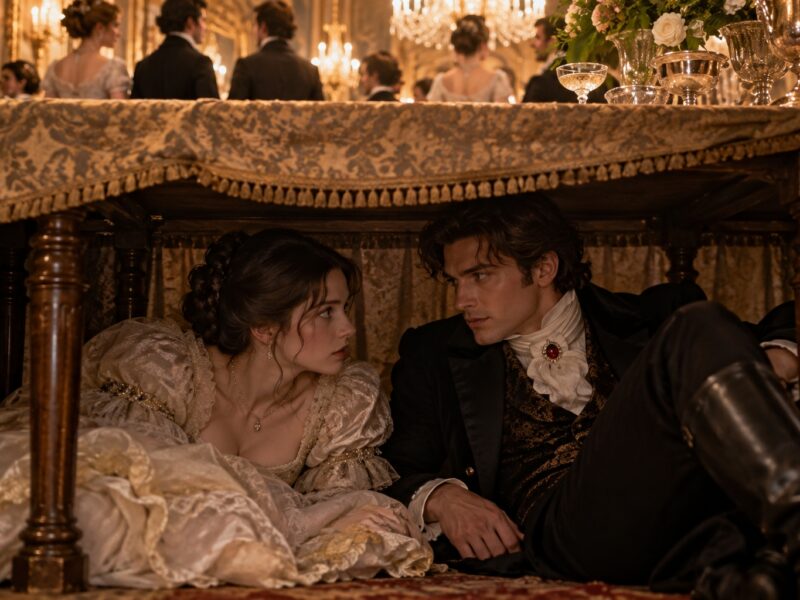
THE DUKE HID BENEATH A BALLROOM TABLE TO ESCAPE MARRIAGE—UNTIL A YOUNG WOMAN CRAWLED IN BESIDE HIM AND CHANGED HIS LIFE FOREVER

He was the wealthiest unmarried duke in London, and every ambitious mother wanted him for her daughter.
She was a gentleman’s daughter with a modest dowry, hiding beneath a table to protect her younger sister.
Neither expected to find the other there—and neither knew that one secret encounter would lead to a scandal capable of destroying them both.
PART 1 — THE STRANGER BENEATH THE TABLE
The first thing Honora Ren noticed beneath the ballroom table was a pair of expensive black boots.
The second was the unmistakable sound of a man laughing quietly in the darkness.
And the third was his voice, deep and amused, saying, “I was here first, Miss Ren. But I suppose I can spare you half the kingdom.”
Honora stopped breathing.
Beyond the heavy damask tablecloth, a hundred of London’s most fashionable people danced beneath the chandeliers of Ashford House. Violins played, champagne glasses chimed, and ambitious mothers maneuvered their daughters toward eligible gentlemen with the determination of soldiers preparing for battle.
But beneath a refreshment table, hidden between polished oak legs and the folds of her pale blue gown, twenty-four-year-old Honora had just discovered that she was not alone.
The man sitting opposite her was Elias Ashworth.
The Duke of Ellingham.
The most sought-after bachelor in England.
And, according to nearly every woman who had ever been introduced to him, one of the most arrogant men in London.
“Your Grace?” she whispered.
“Unfortunately,” he replied.
Honora stared at him, wondering whether she had struck her head while scrambling beneath the table.
Elias Ashworth was supposed to be standing in the center of the ballroom, surrounded by beautiful debutantes and their calculating mothers. Instead, he sat on the carpet with his long legs folded awkwardly beside him, his perfectly tailored evening coat gathering dust.
A ruby glimmered at his throat whenever light slipped beneath the tablecloth.
“You are hiding,” she said.
“A devastating accusation. I had hoped to call it strategic withdrawal.”
“From what?”
“Lady Ashford. Her daughters. Her nieces. And a particularly determined young lady who has asked me three times whether I admire the countryside.”
Honora pressed her lips together.
“She may simply enjoy rural scenery.”
“She has never been outside Mayfair.”
Despite herself, Honora laughed.
It was a small sound, but it surprised them both.
For weeks she had endured the exhausting rituals of the London season, smiling through conversations that treated young women as collections of dowries, accomplishments, and marriageable features. Her father had provided her and her younger sister with respectable educations, but the Ren family possessed neither a great fortune nor a fashionable title.
Honora knew precisely how society measured her worth.
She was old enough to be considered difficult, clever enough to be considered troublesome, and insufficiently wealthy to make either quality fashionable.
Her younger sister, Constance, was different.
At nineteen, Constance was gentle, painfully shy, and still young enough to believe that politeness might protect her from people who wanted to control her life.
That evening, Lady Ashford had begun directing her attention toward Constance, speaking loudly about the virtues of marriage to Lord Pemberton.
The unfortunate lord was an earnest young gentleman with kind eyes and a nervous habit of adjusting his cuffs. Honora had nothing against him personally, but she could see how frightened Constance became whenever her future was discussed without anyone consulting her.
When Lady Ashford approached them again, Honora had spotted the refreshment table and acted without thinking.
And now she found herself sharing a hiding place with a duke.
“May I ask what drove you into exile?” Elias murmured.
“My sister.”
“An unusual threat.”
“Lady Ashford intends to arrange her marriage.”
“Ah.” His expression changed. “A considerably more dangerous matter.”
Honora looked at him carefully.
“Do you find all of this amusing?”
“Only when I am not its intended victim.”
“That must be a luxury.”
His eyes lifted to hers.
She had expected irritation, perhaps one of the cutting remarks for which he was famous. Instead, something thoughtful passed across his face.
“You disapprove of the marriage market, Miss Ren?”
“I disapprove of people being treated as merchandise.”
“A dangerous opinion to express at an English ball.”
“Then it is fortunate we are not technically at the ball.”
He glanced around their cramped hiding place.
“No. I suppose we have established a separate nation beneath the refreshments.”
For a moment they smiled at one another.
Above them, a serving spoon struck a porcelain dish. Someone requested more lemonade, and the table trembled faintly as a footman rearranged the glasses.
Honora drew her knees closer, suddenly conscious of how improper their situation would appear if anyone discovered them.
Elias seemed to read her thoughts.
“You needn’t worry. No one saw me come here.”
“And no one saw me.”
“Then our reputations remain unblemished.”
“That is a rather optimistic conclusion.”
“Optimism is an unfamiliar vice. I thought I might try it.”
She looked away to conceal another smile.
There was something unexpectedly comfortable about speaking to him without the formalities of the ballroom. His title could not give him greater dignity while he sat beneath a table, nor could her modest circumstances make her any less entitled to the carpet.
For once, they were simply two people exhausted by the expectations of others.
“You seem disappointed,” Elias observed.
“Do I?”
“Most ladies are delighted to discover they have the undivided attention of a duke.”
“Most ladies have not discovered him hiding beneath the lemonade.”
His laugh was genuine this time.
It softened his face in a way Honora had never seen.
Then he became quiet.
“They see a dukedom,” he said eventually. “An income, an estate, a name their children might inherit. I cannot entirely blame them. Society has taught them to look for precisely those things.”
Honora studied the shadowed lines of his face.
“And what would you prefer them to see?”
He appeared surprised by the question.
“I am not certain.”
The answer was so unexpected that she forgot to be cautious.
“I see a man hiding beneath a table because he is tired of being told what he ought to want.”
Elias turned toward her.
The light beneath the cloth caught his eyes, and for one brief moment the practiced indifference disappeared.
“That,” he said quietly, “is rather more than most people see.”
The music changed beyond the table.
A waltz began, and the voices surrounding them gradually moved away.
Elias glanced toward the strip of light beneath the cloth.
“I should return before my mother sends a search party.”
“She would hardly look beneath a refreshment table.”
“You underestimate the Duchess of Ellingham.”
He adjusted his cuffs, then hesitated.
“Miss Ren, may I offer one piece of advice?”
“Provided it does not involve marriage.”
“Be careful of Lady Wickham.”
Honora frowned.
“The widow?”
“She notices everything, remembers most of it, and improves upon the remainder.”
“I shall try to avoid her.”
“An excellent ambition.”
He lifted the tablecloth, then paused.
Their eyes met once more.
“I rather enjoyed our conversation.”
“So did I, Your Grace.”
“Even though I am arrogant?”
“Especially because you are arrogant. It makes disagreement much more satisfying.”
He smiled.
Then the cloth fell behind him, and she was alone.
Honora remained beneath the table for another ten minutes, listening to the sounds of the ballroom and trying to understand why her heart refused to settle.
Eventually, she emerged, brushed dust from her skirts, and carefully adjusted her hair.
She had taken only three steps when a thin, unpleasant voice stopped her.
“Well, Miss Ren. How extraordinary.”
Lady Wickham stood beside a marble column, smiling.
Her eyes traveled slowly from Honora’s face to the refreshment table.
“I believe I saw the Duke of Ellingham emerge from that very spot a few moments ago.”
Honora felt the blood drain from her face.
“I was searching for a glove,” she replied.
“How curious. And was His Grace assisting you?”
Before Honora could answer, a familiar voice spoke behind her.
“As a matter of fact, Lady Wickham, I was.”
Elias stepped into view.
His expression was perfectly composed.
“Miss Ren was kind enough to assist me when I became unwell in the heat of the ballroom. I would be most distressed to discover that her generosity had become the subject of idle speculation.”
The widow’s smile faltered.
“Of course, Your Grace. I meant nothing improper.”
“Then we understand each other.”
He turned toward Honora and offered his arm.
“And now, Miss Ren, I believe you promised me a dance.”
She had promised him nothing.
But the eyes of half the ballroom had already turned toward them.
Honora placed her gloved hand upon his sleeve.
“You have made this considerably worse,” she murmured as he led her toward the dance floor.
“Perhaps.”
“Everyone is staring.”
“They usually do.”
“Your Grace—”
“Elias,” he said quietly.
She looked up.
“In private, I think you may call me Elias.”
“You are impossible.”
“So I have been told.”
They joined the quadrille.
Around them, heads turned, fans stopped moving, and whispered conversations began to spread from one corner of the ballroom to the other.
The Duke of Ellingham had danced with Miss Honora Ren.
Not once in recent memory had he singled out a young woman with such unmistakable interest.
Honora felt the entire room making assumptions she had never agreed to encourage.
“You cannot simply decide to court me,” she whispered when the dance brought them close together.
“I am not proposing marriage.”
“You may as well have announced it.”
“Then perhaps we should make use of their misunderstanding.”
Her steps nearly faltered.
“What?”
“A brief, entirely respectable courtship. Public enough to quiet Lady Wickham, convincing enough to discourage our respective tormentors.”
“You are suggesting we deceive London.”
“London has been deceiving itself for centuries.”
“And what becomes of me when you grow bored?”
He looked at her.
For the first time that evening, his amusement faded.
“I would never deliberately endanger your reputation.”
“You have already begun.”
The music ended.
They bowed and curtsied beneath the glittering chandeliers, the ballroom watching in fascinated silence.
Elias leaned closer.
“Allow me to make this right.”
Honora looked at the man whose single dance had changed how London would regard her.
Then she saw Lady Ashford whisper something to Lady Wickham.
Both women turned toward her younger sister.
And Honora understood that the danger was no longer hers alone.
Because the duke had just begun a game that could destroy two sisters—and Honora had no idea how to stop him.
PART 2 — THE COURTSHIP THAT BECAME A TRAP
The white rose arrived the following morning.
It stood alone in a crystal vase, carried to the Ren household by a liveried servant who delivered it with the solemnity of a royal decree.
There was no sentimental note.
Only a small card bearing one word.
Ellingham.
Honora’s mother clasped her hands.
“A white rose! My dear, do you understand what this means?”
“That His Grace possesses a gardener?”
“Honora.”
Her father lowered his newspaper just far enough to examine the flower.
“An expensive method of sending a message without saying anything,” he observed.
Honora loved him for that.
Her mother, however, had already begun planning which gowns might be altered for future engagements.
Within forty-eight hours, all fashionable London knew that the Duke of Ellingham had taken an interest in the eldest Ren daughter.
Invitations arrived that had never previously found their way to Bruton Street.
Women who had barely acknowledged Honora now greeted her with unnatural warmth. Others examined her as if some hidden quality must explain the duke’s extraordinary change of heart.
Elias did nothing to discourage them.
He accompanied her to a bookshop, where he discovered that she preferred history to romantic poetry. He escorted her and her mother through Bond Street and offered to purchase a pair of absurdly expensive gloves.
Honora refused them.
“They cost more than my father’s gardener earns in a month.”
“They are excellent gloves.”
“They had better be capable of digging the entire garden themselves.”
The shopkeeper pretended not to hear.
Elias laughed and left the gloves where they were.
Instead, he purchased a modest volume on English gardens that Honora had examined twice before returning it to the shelf.
When he gave it to her outside the shop, she hesitated.
“I cannot accept extravagant gifts.”
“Then consider it compensation for enduring my company.”
“That is a rather small compensation.”
“Cruel woman.”
She took the book.
That evening, she discovered he had marked a chapter on restoring neglected rose gardens.
She spent several minutes staring at the folded corner before realizing she was smiling.
Their conversations became easier.
Elias spoke of his estates, his fondness for riding before sunrise, and the loneliness of a house containing forty servants but very little companionship.
Honora told him about her father’s library, her mother’s anxieties, and the little garden in Kent where she had spent summers caring for roses.
She discovered that he remembered small things.
He noticed when she was uncomfortable in crowded rooms. He never again purchased anything expensive without asking. When Constance became overwhelmed at a musical evening, Elias quietly arranged for their carriage to be brought forward.
And once, when Honora mentioned that her sister loved drawing, a parcel of fine pencils arrived at Bruton Street addressed directly to Constance.
There was no note from the duke.
Only a message from the stationer explaining that the materials had been ordered for a young lady who deserved to enjoy her talent.
Honora did not know what to make of such kindness.
It would have been simpler if Elias had remained consistently arrogant.
Instead, he was becoming a man she looked forward to seeing.
Then Lady Ashford renewed her campaign.
Constance returned from a morning visit pale and silent. She sat beside the window with her drawing book unopened on her lap.
Honora knelt beside her.
“What happened?”
Constance twisted a ribbon between her fingers.
“Lady Ashford says Lord Pemberton intends to offer for me.”
“Has he spoken to you?”
“No.”
“Then there is nothing to decide.”
“Mama seemed pleased.”
“Mama is easily pleased by titles.”
Constance looked down.
“I do not dislike him, Honora. He has always been kind. But I cannot bear everyone discussing my marriage as though I am not in the room.”
Honora held her sister’s hands.
“Then I shall make them listen.”
The following afternoon, she sent a note to Elias requesting a private conversation in the garden adjoining his gentlemen’s club.
He arrived looking both concerned and faintly amused.
“I had not expected to find myself summoned by you, Miss Ren.”
“Then consider the novelty a gift.”
His amusement vanished when she explained what had happened.
“Pemberton is a decent fellow,” Elias said.
“That does not give anyone the right to choose him for Constance.”
“No.”
“She is frightened. Lady Ashford will not leave her alone.”
Elias paced the gravel path.
After a moment he stopped.
“If our courtship appeared to be approaching a formal engagement, Lady Ashford might hesitate to interfere with your family.”
Honora looked at him.
“You wish to deepen the deception.”
“I wish to prevent your sister from being forced into an arrangement she does not want.”
“And your mother?”
He looked away.
“She would consider herself victorious.”
“Would that trouble you?”
“Less than it troubles me to see Constance distressed.”
The sincerity of his answer unsettled her.
After a long silence, Honora agreed.
Their next public appearance would be a walk in Hyde Park.
It was supposed to settle the rumors and discourage Lady Ashford.
Instead, it nearly ended everything.
The afternoon began beautifully.
Sunlight shimmered across the Serpentine, and fashionable carriages moved slowly along the drive. Honora wore a deep-blue walking dress, while Elias carried his hat in one hand and appeared unusually relaxed.
He purchased roasted chestnuts from a vendor.
She complained that they were bitter.
“Perhaps your expectations are too high,” he observed.
“Perhaps your taste is questionable.”
“Another argument I shall never win.”
“You are learning.”
They walked in companionable silence.
Then Lord Pemberton approached.
He bowed and exchanged the customary greetings, but Honora immediately noticed his nervousness.
“Miss Ren, I wonder whether I might have a word with you.”
“Certainly, my lord.”
“Privately, if you would be so kind.”
Before she could respond, Elias moved closer.
“I believe any matter concerning Miss Ren can be discussed in my presence.”
Honora turned sharply.
“That is for me to decide.”
Pemberton looked embarrassed.
“I meant no disrespect, Your Grace.”
“Then perhaps another occasion would be more suitable.”
Something cold entered Elias’s voice.
Honora recognized it at once.
It was the tone of a man accustomed to having his authority obeyed.
Pemberton bowed stiffly and withdrew.
“Elias,” she said once he was beyond hearing, “you had no right.”
“He intended to make you an offer.”
“You do not know that.”
“I know the look of a man preparing to propose.”
“And if he had?”
Elias’s jaw tightened.
“Then you would have been placed in an impossible position.”
“Because of the ridiculous arrangement you invented?”
His silence confirmed the answer.
Before either could speak again, thunder rolled above the park.
Rain began with a few large drops.
Within moments, the sky opened.
Elias caught Honora’s arm and guided her toward an ornamental summerhouse near the water.
They reached it soaked and breathless.
Rain hammered against the roof, shutting out the park beyond the windows.
Honora removed her ruined bonnet.
“You cannot keep making decisions for me.”
“I was trying to protect you.”
“From a perfectly respectable gentleman who wished to speak to me?”
“From consequences you might not understand.”
She stared at him.
“Do you hear yourself?”
Elias turned away.
His hands rested on the window frame, his shoulders rigid beneath his damp coat.
For several moments he said nothing.
Then, unexpectedly, he spoke.
“My father died when I was eighteen.”
Honora’s anger faltered.
“He left me a title, three estates, and debts large enough to ruin them all.”
Elias looked at the rain.
“Every person who came to advise me wanted something. Creditors wanted payment. Relatives wanted influence. My mother wanted alliances. I discovered very quickly that if I allowed myself to be uncertain, someone else would decide my future.”
His voice had lost its familiar sharpness.
“So I learned to control everything.”
“And everyone?”
He turned.
“Yes,” he admitted. “Sometimes everyone.”
The admission was painfully quiet.
Honora saw the exhaustion beneath his composure.
“The estates improved,” he continued. “Some debts were reduced. People began calling me efficient, decisive, untouchable. I thought that was what a duke ought to be.”
“Was it?”
“No.”
Rain streamed down the windows.
He took a slow breath.
“Then one evening I found a woman beneath a table who looked at me and saw an ordinary man.”
Honora’s throat tightened.
“Elias.”
“I do not know how to be ordinary anymore.”
She stepped toward him.
“Then perhaps you should begin by allowing someone to disagree with you.”
He gave a tired smile.
“You have provided considerable assistance in that endeavor.”
“I am serious.”
“So am I.”
His expression softened.
“I was wrong to speak for you. I owe Lord Pemberton an apology as well.”
Honora looked at him carefully.
“I shall hold you to that.”
“I suspect you will hold me to a great many things.”
He lifted one hand, hesitated, then gently brushed a wet strand of hair away from her cheek.
She could have stepped back.
She did not.
For a moment, the world beyond the rain disappeared.
The proud duke stood before her without the armor of his title, and Honora felt the dangerous beginnings of an affection she had promised herself she would never allow.
When the rain finally stopped, neither spoke of what had passed between them.
But something had changed.
It was no longer entirely possible to pretend.
Three days later, Honora arrived at Ellingham House for tea with the Dowager Duchess.
A servant escorted her to a small sitting room while announcing her arrival.
On her way past the library, she heard raised voices.
“You will marry the girl, Elias.”
Honora stopped.
The Dowager Duchess sounded furious.
“My financial affairs are not your concern, Mother,” Elias replied.
“They become my concern when the family estates are approaching ruin.”
Honora felt cold.
“The Ren girl has a perfectly respectable dowry,” the duchess continued. “Not a great fortune, certainly, but enough to satisfy the most pressing creditors.”
“Mother—”
“You have already secured her affection. Do not waste the opportunity.”
Honora gripped the edge of the door frame.
The duchess’s voice became sharper.
“One year, Elias. Her money could buy us another year.”
Honora waited for him to deny it.
To say that her dowry had nothing to do with his intentions.
Instead, she heard him answer wearily.
“I know what is required of me.”
The words seemed to empty the air from her lungs.
All the laughter, the walks, the gentle touch against her cheek—everything suddenly appeared in a different light.
He had not rescued her from the marriage market.
He had merely found a more charming way to make a purchase.
Honora walked out of Ellingham House without announcing herself.
She returned home, placed his book on her writing desk, and sat beside the window until the sky grew dark.
The next morning, her father entered carrying a letter.
His expression frightened her before he spoke.
“Honora, something has happened.”
The letter had been sent anonymously to several prominent London households.
It described Miss Honora Ren as a calculating fortune hunter who had deliberately trapped the Duke of Ellingham beneath a ballroom table in the hope of forcing him to marry her.
It revealed enough about their hiding place to make the accusation convincing.
By noon, the story had spread throughout Mayfair.
By evening, invitations were being withdrawn.
And before Honora could recover from the humiliation, Elias arrived at Bruton Street holding a copy of the letter.
He stood in her family’s drawing room, his face white with anger.
“Who did you tell?”
Honora stared at him.
“What?”
“Our arrangement. Who else knew?”
She rose slowly.
“You believe I did this?”
“You must have spoken to someone. That ridiculous story could not have appeared without—”
“Stop.”
He fell silent.
Honora’s hands trembled, but her voice did not.
“I heard your mother discussing my dowry.”
His expression changed.
“I heard her explain how my money could save your estates. And I heard you tell her that you understood your duty.”
“Honora, you misunderstood—”
“No. I understood enough.”
She walked toward the door.
“Our arrangement is finished, Your Grace. My family leaves for Kent tomorrow.”
“Please, allow me to explain.”
She turned for the final time.
“I hope you find a woman wealthy enough to save Ellingham.”
Then she left him standing alone.
But as Honora prepared to leave London in disgrace, Elias was about to discover who had written the anonymous letter—and the truth would destroy everything he believed about his own family.
PART 3 — THE DUKE WHO LEARNED TO SURRENDER
Elias remained in the Ren drawing room long after Honora disappeared upstairs.
He held the anonymous letter in his hand.
For the first time in years, he could think of nothing useful to say.
He had spent a decade mastering the art of identifying weaknesses, negotiating difficulties, and controlling disasters before they grew beyond his reach.
Yet one young woman had stood before him, explained exactly how deeply he had hurt her, and walked away.
And he had deserved every word.
That evening, he returned to Ellingham House.
He dismissed his servants, entered his study, and remained there in darkness.
When Lord Pemberton arrived, Elias almost refused to see him.
But his visitor entered without waiting for a formal invitation.
“You have made a spectacular mess of things, Ashworth.”
Elias stared at the cold fireplace.
“I am aware.”
“Are you?”
Pemberton sat opposite him and placed a folded sheet of paper on the desk.
“I have been asking questions about that anonymous letter.”
Elias looked up.
“What have you discovered?”
“The paper was purchased from a stationer in Bond Street.”
“Hardly remarkable.”
“The purchase was made by a maid in your mother’s household.”
Elias went still.
Pemberton continued.
“And your mother’s man of business recently requested information concerning Miss Ren’s settlement and dowry.”
The room seemed to shrink.
“No.”
“I am afraid so.”
Elias looked down at the document.
His mother’s household accounts included a payment to the stationer, and Pemberton had obtained a statement from a clerk willing to identify the purchaser.
It was not conclusive proof of authorship.
But the connection was impossible to ignore.
“My mother,” Elias said.
“She appears to have believed that a scandal would force you to make an offer quickly. Miss Ren would have little chance of refusing without suffering further damage to her reputation.”
Elias closed his eyes.
The strategy was familiar.
Create a crisis.
Limit the alternatives.
Present the desired outcome as the only sensible solution.
He had used similar methods in business negotiations for years.
And now his own mother had applied them to a woman’s life.
Worse, he had helped her by accusing Honora before hearing her defense.
“She was innocent,” Elias said.
Pemberton gave him a long, uncomfortable look.
“Did you truly need me to discover that?”
Elias had no answer.
The other man leaned forward.
“Miss Ren did not ask to become your project, Ashworth. She has been trying to protect her sister from precisely the kind of interference your family has now inflicted upon her.”
Elias looked at him.
“I thought you intended to propose to her.”
“I considered it,” Pemberton admitted. “I admire her very much.”
The admission hurt more than Elias expected.
“But I would never ask a woman to accept me merely because I could make her circumstances easier.”
Elias lowered his head.
Pemberton rose.
“If you care for her, tell her the truth. Not another carefully arranged version of it. The entire truth.”
“And if she refuses to see me?”
“Then you must respect her refusal.”
When the door closed behind him, Elias remained motionless.
He thought about Honora beneath the table, laughing at his arrogance.
He remembered the way she held Constance’s hand when the younger woman became frightened.
He remembered her stubborn refusal to accept expensive gloves, the interest in her eyes when he spoke of neglected gardens, and the silence they had shared while rain battered the summerhouse.
He had told himself that their courtship was a useful arrangement.
Something temporary.
Something he could control.
But the emptiness of the room finally forced him to recognize the truth.
He loved her.
And he had treated the woman he loved as if she were another problem to manage.
The following morning, Elias confronted his mother.
The Dowager Duchess received him in her private sitting room, surrounded by silver-framed portraits and freshly cut flowers.
She looked up from her correspondence.
“You appear tired.”
“Did you arrange for the anonymous letters to be written?”
Her pen stopped.
For a moment, she said nothing.
Then she set it down.
“I did what was necessary.”
Elias felt his stomach turn.
“You tried to destroy an innocent woman’s reputation.”
“I attempted to secure your future.”
“You attempted to force a marriage.”
“Do not be melodramatic. The girl would have become a duchess.”
“And therefore she should have been grateful?”
His mother stood.
“You know what is at stake. The creditors are growing impatient. You cannot continue pretending affection will repair the estate.”
“I have never pretended that.”
“Then why are you behaving like a foolish young man?”
“Because for the first time in ten years, I have met someone who wants nothing from me that I cannot freely give.”
The duchess’s expression hardened.
“Her modest dowry would hardly make her an unsuitable match.”
“It would not save the estate.”
“It would give us time.”
“At her expense.”
His mother turned away.
Elias looked at the woman who had taught him to regard duty as more important than happiness.
He loved her.
But love could no longer excuse what she had done.
“You will write a full confession,” he said. “You will withdraw every accusation against Miss Ren. And you will cease interfering in my marriage.”
“You cannot command your mother.”
“No,” Elias replied. “But I can refuse to allow you to destroy another person’s life.”
His voice was quiet.
“And that is what I intend to do.”
Over the next several days, Elias took practical steps to repair the damage.
He instructed his solicitor to approach the households that had received the anonymous accusations, providing a signed statement that Honora had neither arranged nor engineered their encounter.
He made it clear that their acquaintance had continued with his willing participation.
The Dowager Duchess issued a written acknowledgment that the rumors had originated within her household, although her explanation of her motives remained guarded.
Elias personally visited several influential families and made the same statement.
He did not ask them to forgive him.
He only insisted that Miss Ren’s name be cleared.
But there was one person whose opinion mattered more than all the fashionable households in London.
And she had already left.
A week later, his carriage reached a modest country house near a village in Kent.
The road was muddy after several days of rain.
Elias dismissed his driver at the gate and walked the remaining distance alone.
He found Honora in the garden.
She wore an old brown walking dress and carried a pair of pruning shears. Beside her stood a wooden barrel filled with dead rose branches.
For a moment, he simply watched her.
Here, away from London, she seemed entirely herself.
No jewels, no calculating mothers, no anxious servants arranging her next appearance.
Only a woman standing in her garden beneath a gray autumn sky.
Then she looked up.
The shears stopped moving.
“Your Grace.”
Her voice contained no warmth.
Mr. Ren, who had been working nearby, stepped between them.
“You are not welcome here.”
“I understand, sir.”
“Then why have you come?”
“To tell the truth.”
Honora looked at him without speaking.
Elias removed his hat.
“My mother arranged the anonymous letters. She believed the scandal would compel me to propose quickly and prevent Honora from refusing.”
Mr. Ren’s face darkened.
“You expect us to consider that an apology?”
“No, sir. I expect you to consider it a confession.”
He turned toward Honora.
“I accused you when I should have defended you. I allowed my fear and pride to become more important than your dignity.”
She tightened her grip on the shears.
“You said you understood what I wanted.”
“I thought I did.”
“And yet you never trusted me enough to ask.”
“No.”
The answer hung between them.
Elias swallowed.
“I have spent my adult life believing that if I controlled everything, I could prevent disaster. I treated people as though their choices were obstacles to be overcome. And I treated you that way.”
Honora’s eyes glistened.
“You hurt me.”
“I know.”
“You made me believe I mattered to you.”
Elias took a breath.
“You matter more than anything I have ever tried to protect.”
For the first time, her expression changed.
He continued before courage deserted him.
“I love you, Honora. I have loved you longer than I understood it. But that does not give me any claim upon you.”
Mr. Ren quietly stepped aside.
Elias remained where he stood.
“I will not ask you to marry me today. I will not ask you to forgive me. The harm I caused cannot be repaired by one conversation.”
Honora looked down at the roses.
For several moments, only the wind moved through the bare branches.
“What happened to the letters?” she asked.
“I have issued statements correcting them. My mother has acknowledged her role. I have also instructed my solicitor to provide your father with copies of the correspondence.”
“And your estate?”
“Still in difficulty.”
Her eyes rose.
“You have not found another fortune?”
“No.”
“Then what will you do?”
“Sell an unproductive property, reduce the household expenses, negotiate with the creditors, and endure the consequences of my own decisions.”
A faint expression crossed her face.
“You make it sound unpleasant.”
“It will be.”
“Good.”
He almost smiled.
She noticed.
“Do not mistake me, Elias. I am not amused by your difficulties.”
“I know.”
“But I have no intention of becoming the solution to a financial problem you should have faced years ago.”
“Nor would I ask it of you.”
Honora laid the shears carefully on the edge of the barrel.
Then she stepped closer.
“I am not a prize. I am not an estate, a settlement, or an advantage to be secured.”
“I understand.”
“If you ever wish to stand beside me, you must learn to do so without arranging my life around your wishes.”
“I will try.”
“No,” she replied gently. “You must do more than try.”
He accepted the correction.
“Then I will learn.”
She looked at him for a long moment.
In London, he had always seemed larger than the room around him.
Here, beneath the gray sky, with mud on his boots and uncertainty in his face, he seemed simply human.
And she remembered the man beneath the table.
The one who had laughed because someone finally spoke to him without fear.
“You may call tomorrow,” she said at last.
Elias blinked.
“Tomorrow?”
“At the proper hour. You may accompany me through the garden.”
Hope crossed his face so openly that Honora felt an unexpected ache in her chest.
“May I?”
“Yes. But you must promise not to offer advice about the roses unless I request it.”
“I know nothing about roses.”
“Then we have found an excellent place to begin.”
For the first time since their separation, he smiled.
It was small, almost disbelieving.
But it was real.
And when Elias left the garden, he carried no promise of marriage.
Only the possibility of becoming someone worthy of her trust.
The weeks that followed were unlike any courtship London had ever witnessed.
There were no elaborate bouquets or glittering parties.
Elias arrived with books and occasionally with muddy boots. He learned to listen when Honora explained the differences between climbing roses and hybrid perpetuals.
She learned that the duke sometimes worried so deeply about his responsibilities that he forgot to sleep.
They spoke of money without embarrassment.
They argued.
He apologized when he was wrong.
And when he slipped into the old habit of deciding something on her behalf, she told him so.
Slowly, he stopped.
One afternoon, Constance joined them in the garden.
She carried a sketchbook and appeared unusually cheerful.
“Lord Pemberton has written to me,” she announced.
Honora’s hand paused above a rosebush.
“Has he?”
“He apologized for allowing Lady Ashford to speak on his behalf. He says he would like to visit, but only if I wish it.”
Elias exchanged a glance with Honora.
“And do you?” her sister asked.
Constance smiled shyly.
“I believe I do.”
It was the first time Honora had heard her sister speak of marriage without fear.
She reached over and squeezed Constance’s hand.
“Then you must decide for yourself.”
“I shall.”
Elias watched them, understanding something he had once entirely overlooked.
Love was not the power to determine another person’s future.
It was the willingness to let that person choose it.
Winter approached slowly.
Elias divided his time between Kent and his estates, where he began implementing the financial reforms he had promised.
He sold a distant property that had been draining the family finances, reduced unnecessary expenditures at Ellingham House, and negotiated a longer repayment schedule with the principal creditors.
The work was difficult.
There were disappointments, arguments with advisers, and uncomfortable conversations with tenants whose needs had too often been reduced to figures in ledgers.
For the first time in many years, Elias found himself explaining rather than commanding.
It did not make him less capable.
It made him more honest.
The Dowager Duchess eventually wrote to Honora herself.
The letter was formal, awkward, and painfully restrained.
But it contained an apology.
Honora read it twice before folding it away.
She did not forgive the older woman immediately.
Some injuries required more than an acknowledgment.
Yet the letter marked a beginning.
By early spring, the rose garden in Kent had awakened.
Fresh green shoots pushed through the soil, and the first buds appeared along the climbing branches beside the garden wall.
Elias arrived one bright morning carrying a small parcel.
Honora regarded it suspiciously.
“If those are gloves, I shall refuse them.”
“They are not gloves.”
“Jewelry?”
“No.”
“An extravagant book?”
“Not this time.”
He handed it to her.
Inside lay a pair of ordinary gardening gloves, worn and carefully repaired.
Honora recognized them.
They were hers.
The old pair she had torn while pruning the previous autumn.
“I asked your father’s gardener whether they could be mended,” Elias explained. “He knew someone who could do it properly.”
Honora ran her fingers over the stitching.
“You could have purchased a hundred new pairs.”
“Yes.”
“But you did not.”
“No.”
She looked up.
“Why?”
“Because they were yours.”
Her throat tightened.
Elias reached into his coat pocket.
This time he withdrew a small velvet box.
He held it without opening it.
“I have carried this for three weeks,” he admitted.
Honora stared at him.
“Elias.”
“I have been trying to find the perfect words.”
“And?”
“I have discovered that perfection is an exhausting ambition.”
She smiled faintly.
He opened the box.
Inside was a simple gold ring set with a modest sapphire.
Nothing ostentatious.
Nothing designed to impress an audience.
Only something beautiful, chosen with care.
“Honora Ren,” he said, his voice unsteady, “I cannot promise that I will never make another mistake. I cannot promise that our lives will be easy, or that I shall always know the right thing to say.”
He took her hand.
“But I can promise to listen. To tell you the truth. To face difficulties beside you rather than attempting to control them for you.”
Tears gathered in her eyes.
“I love you,” he continued. “Not because you make my life convenient, but because you make me want to live it differently.”
Honora looked from the ring to his face.
She remembered their first meeting.
A duke crouched beneath a table, hiding from the demands of a world that refused to see him as a man.
She remembered his arrogance, his mistakes, his humiliation, and the slow, difficult courage it had taken him to change.
And she remembered that he had returned when she had every reason to turn him away.
“On one condition,” she whispered.
Elias gave a nervous laugh.
“Only one?”
“You must never describe our marriage as a strategic alliance.”
“I swear it.”
“And if I disagree with you?”
“I shall try to survive the experience.”
She laughed through her tears.
Then she held out her hand.
“Yes, Elias. I will marry you.”
He slipped the ring onto her finger.
For a moment, neither moved.
Then he drew her into his arms, and she rested her forehead against his shoulder while the spring wind stirred the roses around them.
Their wedding was held quietly in Kent.
Constance stood beside her sister, smiling with a happiness that had nothing to do with social approval. Lord Pemberton attended as a friend, and the Dowager Duchess, subdued and sincerely attempting to mend what she had damaged, occupied a seat beside Honora’s parents.
There were no elaborate schemes.
No ambitious mothers maneuvering through a ballroom.
No whispered bargains concerning money or title.
When Honora walked down the aisle, Elias watched her as though he could scarcely believe she had chosen him.
And when they exchanged their vows, he did not promise to protect her from every difficulty in the world.
He promised to face those difficulties with her.
Years later, at a grand London ball, the Duchess of Ellingham would stand beside her husband while their host hurriedly introduced a line of anxious debutantes.
Elias glanced toward a refreshment table.
Honora noticed.
“Do not even think of it,” she murmured.
“I was merely observing that the tablecloth appears long enough.”
“You are a duke. You must behave with dignity.”
He leaned closer.
“My dear, you married me knowing perfectly well that I had very little dignity.”
She slipped her hand into his.
“No,” she said softly. “I married you because you finally learned that dignity had nothing to do with being a duke.”
He kissed her hand.
Then, as the orchestra began another dance, Elias led his wife onto the ballroom floor.
And somewhere among the candlelight and music, the man who had once hidden from marriage understood that the happiest choice of his life had begun the moment a stubborn young woman crawled beneath a table and refused to be impressed by his title.









