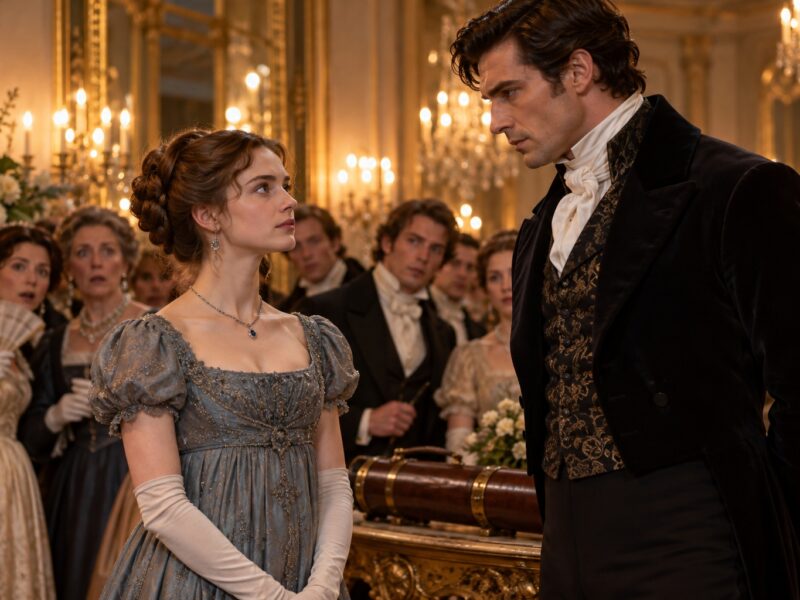
THE DUKE HUMILIATED HER FOR STUDYING THE STARS—UNTIL HE DISCOVERED SHE WAS THE ONE WOMAN WHO COULD CHANGE HIS LIFE
“Stargazing is no pursuit for a wife.”
Forty guests laughed when the Duke of Meavel said those words to Cordelia Ashworth.
But the young woman standing before him had already discovered something that would soon make the most respected astronomers in England question everything they believed they knew about the heavens.
And the duke, who had spent eleven years refusing to look through a telescope, was about to learn why the sight of her carrying one had frightened him so terribly.
The ballroom at Lady Winthorp’s estate glittered beneath a hundred candles. Light traveled over polished silver, crystal glasses, and the jewels resting at the throats of women whose fortunes were large enough to make their opinions seem important. A string quartet played near the eastern wall, though even the musicians had softened their instruments when the Duke of Meavel began to speak.
Cordelia Ashworth stood beside a marble console table in a gown the color of rain clouds. At twenty-three, she had grown accustomed to being considered unusual. A young woman who preferred astronomical tables to dancing, who spoke of celestial distances with the same ease other ladies discussed marriages, was unlikely to escape society’s notice.
She had expected the usual amusement when her interest in astronomy became known that evening. She had even prepared herself for a few condescending remarks. What she had not expected was to become the entertainment of an entire ballroom.
The duke had not shouted. He had spoken in the calm, measured voice of a man whose position made volume unnecessary. Frederick Ashkam, seventh Duke of Meavel, had only needed to turn his head toward Cordelia and offer his judgment as though announcing a fact beyond dispute.
And the room had laughed.
Cordelia noticed that several guests glanced at the duke before allowing themselves to smile. Others laughed immediately, eager to demonstrate their agreement. Her aunt, standing near the far wall, looked stricken.
On the console table behind Cordelia rested the green telescope case that had belonged to her father.
She had brought it because Lady Winthorp had expressed an interest in the instrument. Earlier that evening, a footman had carried it inside with the solemn care ordinarily reserved for a visiting dignitary’s luggage. Cordelia had foolishly wondered whether someone might actually wish to examine it.
Now she understood.
She felt the heat rise beneath the neckline of her gown. Her fingers had gone cold, and the small movements of the crowd suddenly seemed unnaturally distinct. A woman lowered her fan. A gentleman leaned toward his companion. Someone near the doors whispered her name.
Her father had taught her to measure things carefully.
He had shown her how to read a transit instrument before she was old enough to understand why the stars appeared to move. He had insisted that an observation without a margin of error was little better than a confident guess.
Standing beneath Lady Winthorp’s chandeliers, Cordelia measured the damage.
It was considerable.
A duke’s ridicule, delivered before forty witnesses, would become tomorrow’s conversation. By the following week, it would be repeated in drawing rooms she had never entered by people she had never met. Her already uncertain prospects would suffer, and her aunt would have to endure the uncomfortable pity that fashionable society reserved for families it had decided were beyond saving.
Cordelia could do nothing to prevent the story from spreading.
She could, however, decide how it began.
“I collect stars, Your Grace,” she said.
Her voice was steady, though maintaining that steadiness required more effort than anyone watching could have guessed.
“Not husbands. You may set your mind at ease on that particular account.”
For a heartbeat, no one moved.
Then a different murmur passed through the ballroom.
Someone looked delighted. Another guest appeared shocked. Lady Winthorp pressed her lips together, concealing what might have been either disapproval or the first stirrings of a smile.
Cordelia watched the duke.
His expression remained unchanged.
There was no irritation, no amusement, not even the small satisfaction of a man who had made a cruel remark and received an entertaining reply.
His face might have been carved from the same pale stone as the mantel behind him.
Cordelia inclined her head.
Then she turned, retrieved her father’s telescope case, and walked out.
She did not hurry. She would not give them the pleasure of seeing her flee.
Only when the ballroom doors had closed behind her did she realize how badly her hands were trembling.
The carriage ride back to Bath passed almost entirely in silence.
Her aunt sat opposite her, occasionally opening her mouth as though beginning a sentence, then thinking better of it. The older woman had a kind heart, but kindness offered after a public humiliation could sometimes make the humiliation harder to bear.
Cordelia placed the telescope case across her knees.
The worn green covering had begun to separate near one corner. Her father had promised to repair it before his final illness. She ran her thumb along the damaged seam and remembered how confidently he had once told her that the heavens belonged to no particular class of observer.
A man might own a field, a house, or a title.
He could not own the stars.
Her father had died leaving debts, a modest inheritance, and an instrument worth considerably more to his daughter than its market price. Since then, Cordelia had been living under her aunt’s roof, surviving on the small income that remained available to her.
Her circumstances were hardly favorable.
Her reputation was worse.
And by the time their carriage reached the outskirts of Bath, she knew that neither would improve merely because she wished it.
Yet the telescope still belonged to her.
The sky would still be there tomorrow.
For the present, she decided, those would have to be enough.
Three days later, a letter arrived.
The envelope was heavy, its seal marked with crossed compasses over a rising sun. Cordelia examined it at the breakfast table while her aunt watched with the anxious curiosity of someone who had learned that unexpected correspondence rarely brought good news.
Cordelia broke the wax.
The letter was from the Reverend Dr. Josiah Faulk, Astronomer Royal.
For a moment, she could do nothing but stare at the signature.
Eight months earlier, she had submitted a calculation concerning stellar parallax and related astronomical tables to the Royal Society. She had signed the paper with her initials, C. A., knowing that a woman’s full name would be far less likely to receive serious consideration.
She had never received an acknowledgment.
She had assumed the calculation had been discarded.
But Dr. Faulk’s letter stated that her work had been examined and discussed at a meeting of the Society’s fellows.
More astonishingly, it had exposed an error in the printed tables that had remained uncorrected for eleven years.
Three respected gentlemen had allowed the mistake to stand.
Cordelia had found it.
Dr. Faulk wished to meet her.
He also wished to discuss a comet.
Her aunt leaned forward. “Cordelia, my dear, what does it say?”
Cordelia tried to answer.
Instead, she read the letter again, slowly this time, following every line with the care she would have given an unfamiliar calculation.
The astronomer had not praised her feminine intelligence or expressed surprise that a lady should understand mathematics. He had written to her as one person engaged in serious work writing to another.
He had asked questions.
He wanted answers.
And he had signed his name beneath an invitation that might change the course of her life.
Cordelia lowered the letter.
For the first time since her father’s death, she began to cry.
Her aunt rose immediately and came around the table, but Cordelia shook her head, smiling helplessly through her tears.
“Nothing is wrong,” she managed.
She looked once more at the signature.
“For once, Aunt, nothing is wrong at all.”
She had no way of knowing that the duke who had humiliated her and the astronomer who had just recognized her work were already connected by something buried eleven years in the past.
Something that had been waiting in a locked room.
Dr. Faulk arrived at her aunt’s house several days later.
He wore a coat that had ceased to be fashionable nearly a decade earlier. His silver hair was untidy, and dark ink had settled permanently into the creases of his fingers. He appeared entirely indifferent to the modest dimensions of the morning room, the faded upholstery, or the fact that the household could offer him little beyond tea and sincere hospitality.
He settled into the chair Cordelia offered and placed his hat upon his knees.
“Miss Ashworth,” he began, “your predicted date for the comet’s return differs from Laplace’s printed prediction by eleven days.”
Cordelia sat straighter.
“I am aware of the difference, sir.”
“I have examined your calculations three times.”
She waited.
“I cannot find the error.”
“There is no error, Dr. Faulk.”
The old gentleman regarded her for several seconds.
“So I have concluded.”
He said it without ceremony.
Cordelia had imagined that recognition, if it ever arrived, would bring some extraordinary emotion. Instead, she felt a quiet, almost painful relief.
Dr. Faulk continued.
“This places the Society in a rather uncomfortable position. A considerable number of its fellows have supported the published prediction.”
“And the others?”
“They are waiting to see which answer proves correct.”
“An admirable habit for astronomers.”
His mouth moved slightly.
“Indeed. I am afraid it is not always practiced.”
He explained that the Society needed a reliable second observer to verify the comet’s anticipated return. The observer would require suitable instruments, patience, and the willingness to record what appeared in the heavens rather than what distinguished gentlemen wished to see there.
Cordelia listened so intently that she scarcely noticed her aunt holding her teacup motionless.
“I should like you to undertake that observation,” Dr. Faulk said.
“For the Society?”
“For the Society.”
Cordelia glanced toward the notebook resting beside her chair.
“Would my work be submitted under initials?”
“No.”
Her fingers tightened around the fabric of her skirt.
“Then under what name?”
“Your own, Miss Ashworth. Your name will be entered in the record.”
For eight months, she had concealed her identity to ensure that her calculations were read. For three days, she had avoided drawing attention to herself because a duke had made her a figure of ridicule.
Now the Astronomer Royal was asking to place her name beside her work.
“And if that proves embarrassing to the Society?” she asked.
Dr. Faulk folded his hands.
“Then it will be an embarrassment attached to a correct prediction. The gentlemen who have ridiculed you may enjoy the distinction of being wrong.”
Cordelia looked down.
He continued more quietly.
“Arithmetic does not care who performs it, Miss Ashworth. I have always regarded that as one of the finer qualities of the profession.”
She raised her eyes.
It was not pity.
He had not come to save her from disgrace or mend the injury to her reputation. He had come because he believed she had done valuable work, and because he needed someone capable of doing more.
That distinction mattered to her more than any compliment.
“I accept,” she said.
Her aunt drew a sharp breath.
Dr. Faulk nodded once, as though the answer had been both expected and entirely satisfactory.
“Excellent. Then we have an uncommon amount of work to do.”
Far from Bath, in a great house that had belonged to his family for generations, Frederick Ashkam stood before a door he had avoided for eleven years.
The servants called the chamber beyond it the map room.
No maps remained inside.
Instead, it contained an old telescope, a shelf of astronomical tables, and a single chair positioned beside a north-facing window.
The brass of the telescope had been worn smooth by hands that no longer existed. Notes covered the margins of the books, written in a familiar hand that had stopped moving across paper eleven years before.
Frederick’s younger brother had loved that room.
He had spent long nights there, sometimes forgetting dinner, sometimes emerging at dawn with ink on his sleeves and an expression of delighted exhaustion.
Frederick had considered the fascination a waste of time.
There were estates to manage, tenants to consider, and obligations that could not be postponed because a comet might appear in the darkness.
He had told his brother as much.
Often.
Then, one night, his brother had died in the observatory.
And Frederick had stopped entering the room.
Now, however, the image of a young woman holding a green telescope case would not leave him.
He remembered the way Cordelia Ashworth had stood beneath Lady Winthorp’s chandeliers, her face pale but her shoulders straight.
He remembered her reply.
I collect stars, Your Grace. Not husbands.
He had not intended to insult her when he entered the ballroom. In truth, he had scarcely thought about her until he noticed the case.
But then an old memory had risen so suddenly that he had spoken almost before he understood what he was saying.
The words had been cruel.
He knew that.
He had known it the moment he heard the laughter.
And he had done nothing to correct them.
Frederick opened the map room door.
Dust lay over the furniture. The room smelled of old leather, neglected wood, and the faint metallic scent of brass.
He crossed to the chair beside the window.
The worn places on its arms were exactly as he remembered them.
For a long time, he stood with one hand resting on the wood.
He did not sit.
He could not yet bring himself to do that.
But before leaving, he looked toward the telescope.
For the first time in eleven years, he allowed himself to remember that the instrument had once been a source of happiness rather than grief.
Not long afterward, a card bearing the Royal Society’s crest arrived at Ashkam House.
The duke’s secretary explained that Dr. Josiah Faulk was conducting an important observation in the county.
He also mentioned the name of the astronomer assisting him.
Miss Cordelia Ashworth.
Frederick read the card twice.
Then he summoned his steward.
“Is the observatory dome still sound?”
The steward hesitated.
“I believe the mechanism remains in place, Your Grace, although the roof has suffered from neglect.”
“Can it be made weather-tight before November?”
The man blinked.
“Your Grace?”
“I asked whether it can be repaired.”
“Yes, Your Grace. With sufficient work.”
“Then arrange it.”
The steward had served the family for thirty years and believed himself beyond surprise.
That afternoon proved him mistaken.
Meanwhile, Cordelia was discovering that scientific recognition did not necessarily protect a woman from fashionable gossip.
Mrs. Prin, a widow who had volunteered to serve as chaperone during the astronomical observations, possessed a seemingly inexhaustible appetite for other people’s affairs.
She found Cordelia one afternoon in the small garden behind Dr. Faulk’s rented rooms.
“Tell me, Miss Ashworth,” she began, “how did you come to the attention of so distinguished a gentleman?”
“I submitted a calculation to the Royal Society.”
“Under your own name?”
“Under my initials.”
Mrs. Prin raised her eyebrows.
“Why?”
“Because my own name would probably have prevented the paper from being opened.”
The widow considered this.
It was evident that the answer had disturbed some comfortable assumption about the world.
Then she approached the subject she had plainly wished to discuss all along.
“I understand the Duke of Meavel made a rather unfortunate remark concerning you at Lady Winthorp’s gathering.”
“He did.”
“They say you were laughed out of the ballroom.”
Cordelia looked at her calmly.
“Then they have described the matter inaccurately. I walked out myself.”
Mrs. Prin examined her face.
“His Grace is said to have become terribly cold since his brother died.”
“Then it is fortunate that I have no reason to seek his warmth.”
The reply ended the conversation.
Yet that night, Cordelia lay awake remembering the duke’s expression. She had told Mrs. Prin that the matter no longer troubled her, but she still heard the laughter whenever a room became unexpectedly quiet.
She resented that fact almost as much as she resented the insult itself.
She wanted to be indifferent.
She had simply not achieved it yet.
The next development arrived through Dr. Faulk.
“Meavel’s observatory is the finest private dome remaining in this part of the county,” he told her over tea. “Or it was, before it fell into disuse.”
Cordelia looked up from her notes.
“Was?”
“I am informed that the roof has recently been repaired.”
“For what purpose?”
“Our purpose, apparently.”
She stared at him.
Dr. Faulk’s expression suggested that he had anticipated her reaction and found it mildly entertaining.
“The duke has offered the use of his observatory for the November work.”
“The Duke of Meavel?”
“The same.”
Cordelia set down her cup.
“I will not place myself under an obligation to the man who publicly declared me unsuitable for marriage.”
“You would be borrowing an instrument, Miss Ashworth. Nothing more.”
“He would undoubtedly think otherwise.”
“Then allow me to explain the terms.”
Dr. Faulk leaned forward.
“The observation remains yours. The calculations remain yours. Your name will appear in the official record. His Grace has requested no scientific credit and no personal consideration.”
Cordelia said nothing.
“The dome is idle,” Dr. Faulk continued. “He believes it should no longer remain so.”
“Those were his words?”
“Approximately. Dukes have a remarkable talent for conveying very little with very few words.”
Cordelia almost smiled.
Almost.
She looked toward her father’s notebook lying on the table.
The work mattered.
The dome would allow her to perform it under conditions better than anything she could arrange independently. Rejecting that opportunity would satisfy her pride, but it would do nothing for her science.
“I will accept the use of the observatory,” she said at last.
Dr. Faulk inclined his head.
“But I will not pretend that the duke has purchased my gratitude, my good opinion, or my forgiveness.”
“I shall make those conditions perfectly clear.”
“And I will not attend upon him as though he were my benefactor.”
“Of course.”
“I intend to work.”
“I had rather hoped you would.”
Dr. Faulk gathered his papers.
As he reached the door, he paused.
“I confess, Miss Ashworth, that this correspondence has become rather more entertaining than I anticipated.”
Cordelia did smile then.
It was a small beginning.
The first evening she entered the observatory at Ashkam House, the October air was already cold enough to make her fingers ache.
The dome smelled of fresh timber and polished brass. Repairs had been completed with considerable care, although the western section of the rotating mechanism still resisted movement.
Cordelia set her father’s notebook beside the eyepiece.
She opened its worn cover, checked her calculations, and adjusted the telescope.
Then she realized she was not alone.
The Duke of Meavel stood near the base of the instrument.
He wore a dark coat and held his gloves in one hand. There was something almost awkward about his stillness, although Cordelia would once have thought such a description impossible.
“Your Grace.”
“Miss Ashworth.”
They regarded one another.
Neither seemed inclined to begin with pleasantries.
“You have not asked my permission to be here,” Cordelia said.
“It is my observatory.”
“Then I suppose we are both here by right.”
His expression shifted slightly.
“I had not considered it in those terms.”
“No. I believe the ballroom demonstrated that your consideration of other people’s rights can occasionally be incomplete.”
The words struck their mark.
Frederick did not look away.
“You are correct.”
Cordelia had expected defensiveness, perhaps a cutting reply.
His admission was less satisfying than she had imagined.
He glanced toward the great telescope.
“The western section of the dome mechanism sticks. It has been repaired, but not entirely cured. My brother used to curse it in three languages.”
Cordelia rested her hand on the instrument.
“You had a brother?”
“I had.”
There was something final in the way he spoke.
Cordelia understood a closed subject when she heard one. She had been living with her own for years.
She did not ask another question.
Instead, she began working.
Frederick watched as she adjusted the instrument with the unhurried confidence of someone who had repeated the same movements hundreds of times.
She checked her figures twice.
He offered no instruction.
And for the first time in Cordelia’s acquaintance with him, his silence did not feel entirely hostile.
Over the following weeks, an arrangement developed without either of them formally proposing it.
Cordelia came to the dome three evenings out of seven.
Mrs. Prin settled into the small warming room below with her needlework, a fire, and enough curiosity to sustain a lifetime of parish conversations.
The duke appeared irregularly.
Sometimes he remained only a few minutes. On other evenings, he stayed through hours of cold observation while Cordelia recorded positions, adjusted the telescope, and compared what she saw against the predicted tables.
He never interfered.
When he asked questions, they were often remarkably elementary.
Cordelia discovered, somewhat to her annoyance, that she enjoyed answering them.
One evening, as she checked an entry in her father’s notebook, Frederick asked why a comet’s tail appeared to change direction.
“Because it points away from the sun,” she explained.
“Regardless of the comet’s direction of travel?”
“Regardless.”
“I had assumed the tail followed behind it.”
“Many people do.”
She turned from the eyepiece.
“A comet does not behave like a chimney sending smoke into the wind. Sunlight and the solar wind act upon the material released from it. The direction of its tail is governed by the sun, not simply by the direction in which the comet travels.”
Frederick listened.
Not with the vacant politeness Cordelia had endured from gentlemen pretending to admire her work, but with genuine concentration.
He asked another question.
Then another.
She found herself explaining more than she had intended.
At some point, she noticed that he had drawn closer to the notebook, careful not to touch it.
Her father had listened in much the same way when she was young and had brought him a calculation he had not expected her to solve.
The resemblance startled her.
Later, after Frederick had left, she found herself remembering not the duke who had mocked her in a ballroom, but the man who had stood beside a telescope trying to understand why a comet’s tail did not behave as he had imagined.
She did not know what to do with that distinction.
Outside the observatory, however, society had reached its own conclusions.
A young unmarried woman spending several nights each week at a duke’s estate was apparently too irresistible a subject to leave unexplored.
The presence of Mrs. Prin as chaperone did little to restrain speculation.
Some said Cordelia had deliberately attracted the duke’s attention. Others claimed that his interest in astronomy was merely a convenient excuse for an attachment neither party wished to acknowledge.
At her aunt’s house, the rumors arrived almost daily.
“Perhaps,” her aunt suggested one morning, “it would be wiser to reduce the number of evenings you spend there.”
Cordelia looked up from her tea.
“Because people are talking?”
“Because people can be unkind.”
“They were unkind before I went there.”
“That does not mean they cannot become worse.”
Cordelia softened.
She knew her aunt spoke from affection, not disapproval.
“I have already paid the price of their opinion,” she said. “I should prefer to receive something in return for it.”
Her aunt studied her.
“You are not doing this entirely for the comet.”
Cordelia looked toward the window.
For several moments, she considered denying it.
“I began doing it for the comet,” she said.
“And now?”
“Now I have not quite decided.”
Her aunt did not press.
There was enough experience in the older woman’s expression to suggest that she understood more than her niece was prepared to admit.
Neither woman knew that on the nights Cordelia worked beneath the repaired dome, Frederick Ashkam had begun sleeping soundly for the first time in eleven years.
The observatory was no longer entirely a place of death.
There was movement beneath its roof again.
There were footsteps, voices, books opened and closed, and the steady turning of an instrument toward the night sky.
Frederick had not expected the change.
He had certainly not expected it to matter so much.
When the comet finally appeared, it arrived four minutes ahead of Cordelia’s prediction.
And eleven days ahead of Laplace’s published calculation.
Cordelia stood at the eyepiece for several moments before speaking.
Then she reached for her notebook.
Her handwriting remained steady as she entered the time and position.
She checked the observation.
She checked it again.
Then she passed the relevant figures to Dr. Faulk.
The old astronomer examined them with his usual severity.
At last, he raised his eyes.
“Well, Miss Ashworth.”
She waited.
“I believe the gentlemen of the Society are about to have a very uncomfortable December.”
Cordelia laughed.
It came out unexpectedly, as though some tightly held part of her had finally been given permission to loosen.
The work was correct.
Her father had been right to trust her.
And the heavens, which had never cared whether she was a man or a woman, had offered their answer.
Yet the most important conversation of that season occurred not beneath a clear sky, but on a night when fog made observation impossible.
Cordelia descended to the warming room and found Mrs. Prin asleep over her needlework.
Frederick stood at the window.
Beyond the glass, the grounds had disappeared beneath a thick curtain of white.
He did not turn when Cordelia entered.
For a while, they listened to the small sounds of the fire.
Then she asked a question she had kept to herself for months.
“Why did you say it?”
Frederick remained still.
“At the ballroom,” she continued. “I should like the truth, Your Grace. Not whatever explanation might make either of us feel better.”
He lowered his eyes.
“Because of your telescope case.”
Cordelia frowned.
“My case?”
“It was green. The same shade as my brother’s.”
She said nothing.
“My brother loved astronomy,” Frederick continued. “He loved it with a seriousness I did not understand. He spent hours observing the heavens, and the gentlemen of our acquaintance found endless amusement in it.”
The fire shifted behind them.
“They called him eccentric. They laughed at his calculations and asked whether he expected the stars to improve the family fortunes.”
Frederick’s voice remained controlled.
“I laughed sometimes, too.”
Cordelia watched his reflection in the window.
“He endured it rather well, I thought. Better than I would have done. But I never considered what it might have cost him.”
Frederick turned away from the glass.
“Eleven years ago, my brother died in the observatory. He was alone. He had reached for an instrument in the dark.”
Cordelia felt her breath catch.
“Less than an hour before his death,” Frederick said, “I had told him that a grown man ought to find better occupations than counting stars like a child.”
He stopped.
For the first time since Cordelia had met him, silence seemed beyond his control.
“I never apologized.”
Cordelia looked toward the staircase leading to the dome.
She imagined the telescope standing in darkness, the untouched books, the chair waiting beside the window.
“And then,” Frederick continued, “you came into that ballroom carrying a case that looked like his.”
His expression tightened.
“You spoke about collecting stars, and for a moment I was standing in the past again. I knew the room would eventually laugh at you as it had laughed at him.”
“So you laughed first.”
“Yes.”
The admission was quiet.
“I chose the very cruelty I had spent eleven years regretting.”
Cordelia did not move.
“I cannot explain it in a manner that excuses it,” he said. “I saw something that reminded me of my brother, and I behaved exactly as I had behaved when he was alive. I injured you because I could not bear the memory of having injured him.”
The words remained between them.
Cordelia remembered his expression in the ballroom.
She had mistaken it for complete indifference.
Now she understood that the closed face had concealed something far more difficult.
But understanding did not erase what he had done.
“You hurt me,” she said.
“I know.”
“In front of people who needed very little encouragement.”
“I know that as well.”
“And afterward you let me leave believing you despised everything about me.”
Frederick lowered his head.
“Yes.”
She regarded him for a long moment.
Then she said, “Grief and cowardice can look remarkably alike from the outside.”
He met her eyes.
“Which was mine?”
“Both, I think.”
He accepted the judgment.
Cordelia looked back at the sleeping Mrs. Prin.
There was no dramatic declaration to be made. No simple sentence could repair the past or make Frederick’s brother alive again.
But something had changed.
For the first time, the duke had allowed another person to see the sorrow beneath his silence.
“I am not asking you for anything,” Frederick said at last.
Cordelia turned toward him.
“The observatory remains available for your work. Your name remains in the record. Nothing I have offered was intended as a debt you might someday be expected to repay.”
He paused.
“If you wish me to leave, I will.”
“And if I do not?”
“Then I should very much like to hear more about what your father taught you.”
His mouth softened.
“I have eleven years of ignorance to correct, Miss Ashworth. I can think of no better person to instruct me.”
Cordelia looked toward the staircase once more.
Then she moved to the chair beside the fire.
“There is something he taught me about the distinction between an observation and an assumption,” she said.
Frederick took the opposite chair.
“I suspect,” he replied, “that I am very much in need of that lesson.”
The fog remained until morning.
Neither of them seemed especially troubled by it.
Three nights later, another difficulty arrived.
Cordelia’s cousin, Augustine Witmore, appeared at her aunt’s house without warning.
He had managed the remnants of her father’s estate for eight years. During that time, Cordelia had received regular accounts but very little personal attention from him.
Now he arrived carrying a solicitor’s letter and an expression of confident authority.
The remaining income from her father’s estate had been placed in trust until her marriage. Under its terms, her husband would then assume management of the funds.
Augustine had spent years drawing a comfortable fee for administering the trust.
He had recently heard that Cordelia was spending time at the Duke of Meavel’s estate.
And he had concluded that her circumstances required immediate intervention.
“I have arranged a suitable prospect for you,” he announced.
Cordelia sat opposite him in her aunt’s morning room.
“Have you?”
“Mr. Pell is a respectable gentleman of excellent connections.”
“And how old is Mr. Pell?”
Augustine waved a hand.
“Older than you, naturally. A mature husband would be an advantage in your present position.”
Cordelia waited.
“He is willing to overlook the unfortunate talk that has attached itself to your name,” Augustine continued. “I suggest the arrangement be concluded before Christmas.”
Her aunt looked pale.
“You have discussed marriage with this gentleman,” Cordelia said, “without first consulting me?”
“I have taken steps to protect your future.”
“From what?”
Augustine’s expression hardened.
“From your own foolishness, among other things.”
He leaned back.
“You have already done considerable harm to your prospects. I have found a solution, and I advise you to accept it before my patience is exhausted.”
Cordelia listened until he had finished.
Then she folded her hands.
“Cousin Augustine, you have managed my father’s trust for eight years.”
“Yes.”
“You have collected your administrative fee every quarter.”
“As I am entitled to do.”
“And you have consistently failed to undertake certain duties for which those fees were paid.”
His expression changed.
“I beg your pardon?”
“I have examined the accounts.”
She spoke in the same precise tone she used when correcting a calculation.
“I know how much you have taken. I also know which obligations you have neglected. If you would like to discuss the financial terms of my future, I am entirely prepared to do so.”
Augustine’s face flushed.
“You forget yourself.”
“No.”
Cordelia looked directly at him.
“I have remembered the figures.”
He opened his mouth, then closed it.
“If you persist,” she continued, “I shall be pleased to place the accounts before a magistrate and ask for a proper examination of your administration.”
For several seconds, the only sound in the room came from the ticking clock above the mantel.
Augustine’s confidence had deserted him.
He rose.
“There is no need for unpleasantness.”
“Then I am delighted we agree.”
He left within the hour.
He did not return.
Later, people would speculate about his sudden decision to settle in the north, but no one outside the family learned precisely what had passed between him and his cousin.
Cordelia had not needed the duke’s title to defend herself.
She had needed the figures.
And she had known where to find them.
At the Royal Society’s December meeting, Dr. Faulk’s report was read aloud.
It credited Miss Cordelia Ashworth’s observations as decisive in correcting the published astronomical tables. The report also acknowledged the use of the Duke of Meavel’s private observatory.
Cordelia’s calculation had been vindicated.
Her name stood in the official record.
For a brief moment, she allowed herself to think that perhaps the society of Bath would finally discuss her work rather than her personal circumstances.
She was mistaken.
Within a fortnight, drawing rooms from Bath to London were filled with a different story.
The Duke of Meavel had apparently developed a remarkable affection for the young woman he had once humiliated.
There were theories concerning when the attachment had begun.
There were opinions about whether his intentions were honorable.
And there were endless attempts to determine whether Cordelia had managed to turn a scientific opportunity into the most advantageous marriage in the county.
Lady Winthorp, whose ballroom had hosted the original incident, decided to investigate the matter by giving a card party.
Both Cordelia and Frederick received invitations.
Cordelia considered declining.
Then she remembered the way she had walked from that ballroom months earlier, carrying her father’s telescope case while forty people watched.
She had done nothing that required concealment.
She accepted.
The evening of the party, she entered Lady Winthorp’s drawing room wearing a pale silver gown.
The conversation did not stop.
But it altered.
Guests looked toward her with careful expressions, measuring the distance between the woman they had laughed at and the woman whose name now appeared in an important scientific report.
Cordelia greeted her hostess politely.
She spoke to several acquaintances.
She accepted a glass of water.
Then Frederick arrived.
He entered separately and crossed the room toward her.
It took him less than a quarter of an hour to find her.
Lady Winthorp watched from beside the fireplace.
So did nearly everyone else.
“Miss Ashworth,” Frederick said, bowing.
“Your Grace.”
“I understand congratulations are in order.”
“On what account?”
“Your observation. The Society’s tables will carry your correction for years to come.”
Cordelia inclined her head.
“That was rather the purpose of making it correctly.”
A small ripple of amusement passed through the nearest guests.
Frederick did not smile immediately.
He looked at her for a moment.
Then he raised his voice just enough to reach the people standing nearby.
“I owe you an apology.”
The room quieted.
Cordelia stood very still.
Frederick continued.
“Some months ago, in this house, I said that stargazing was no pursuit for a wife.”
No one laughed.
“I have had considerable opportunity to reconsider my opinion.”
Cordelia watched his face.
“And I have discovered that I was wrong in almost every respect.”
“Almost, Your Grace?”
“One particular remains.”
“Which one?”
“That stargazing is no pursuit for an ordinary wife.”
A lady near the window lifted her fan.
Frederick stepped closer.
“I have come to understand that you are not a woman suited to the ordinary expectations society places upon marriage.”
He spoke without haste.
“You are too independent in your judgment, too serious about your work, and far too willing to correct an ignorant man when he deserves it.”
Someone suppressed a laugh.
“I have also come to understand,” Frederick said, “that those are the very qualities I should most regret losing from my life.”
Cordelia’s throat tightened.
“I have never met anyone less interested in my title, Miss Ashworth, or more interested in whether I understand parallax.”
This time, there was genuine amusement in his expression.
“And I find that I would rather spend the remainder of my life being corrected by you than spend another evening being agreed with by people who have never troubled to think.”
Behind Cordelia, something fell to the floor.
Mrs. Prin had dropped her needlework basket.
A few guests turned.
Cordelia did not.
She was looking at Frederick.
There was no mask upon his face now.
No cold distance.
No practiced indifference.
He had spoken before the same society that had witnessed his cruelty, and he had deliberately made his change of heart equally public.
But Cordelia was not a woman who mistook a declaration for the whole of a life.
She had learned too much about figures, obligations, and the difference between promise and proof.
“You should know, Your Grace,” she said, “that I have no dowry worth mentioning.”
“I know.”
“My reputation has been discussed in rooms less charitable than this one.”
“I am aware.”
“And I hold opinions concerning calendar reform that would exhaust a lesser man within fifteen minutes.”
Frederick’s smile deepened.
“Then I shall endeavor not to be a lesser man.”
A quiet laugh escaped her.
She had not intended it.
But once it began, she made no effort to conceal it.
Around them, the room relaxed.
The laughter that followed was nothing like the laughter Cordelia remembered from her humiliation. This time it did not require a victim.
She looked around the drawing room.
The faces were familiar.
The candles were familiar.
Even the faint scent of beeswax and expensive perfume seemed unchanged.
Yet the power those people had once possessed over her felt strangely small.
Her work had been acknowledged.
Her judgment had been trusted.
And the man who had hurt her had found the courage to admit it before the very people who had rewarded his cruelty.
Cordelia did not need to prove anything further to that room.
For the first time in a very long while, she felt entirely free to decide what came next.
Two years later, the observatory at Ashkam House no longer stood empty between comets.
Its brass instruments gleamed with regular use. The dome mechanism had finally been brought into reliable working order, and the shelves carried notebooks filled with careful observations.
Frederick had learned to adjust the telescope himself.
He had also learned that his wife would correct his calculations without the slightest hesitation.
Cordelia Ashkam, Duchess of Meavel, had discovered that marriage need not require the surrender of the work she loved.
Some evenings, her husband joined her beneath the dome.
On others, he left her to her observations and carried a lamp into the old map room, where his brother’s books now stood beside volumes annotated in Cordelia’s hand.
The past had not disappeared.
Frederick still thought of his brother.
There were nights when he stood quietly beside the old chair and remembered a young man who had been too often misunderstood by the people who loved him.
But memory had become something he could approach without shutting every door behind him.
Cordelia had not healed him by forgetting what he had done.
She had helped him find the courage to remember honestly.
On the anniversary of the fogbound evening when Frederick had finally told her the truth, Cordelia entered the observatory and found him standing beside the great telescope.
He wore his coat, just as he had on their first evening there.
For a moment, she watched him checking the instrument.
Then she spoke.
“Stargazing is no pursuit for a wife, Your Grace.”
Frederick turned.
The words might once have carried the weight of a wound.
Now they belonged to something they had survived together.
“No,” he agreed.
He crossed the room and drew her gently against him.
“It is the pursuit of a duchess who has never once been wrong about anything worth knowing.”
Cordelia raised an eyebrow.
“Never?”
“Not when it matters.”
“And the times when it does not?”
“I have wisely learned to keep no record of those.”
She smiled.
Outside, the night stretched cold and clear above the estate.
The stars shone with the same indifferent brilliance they had possessed before either of them was born, before a foolish remark in a ballroom, before a brother’s death, before a young woman had found the courage to send her calculations to strangers.
Frederick reached for the notebook.
Cordelia adjusted the telescope.
And together they returned to the work waiting beneath the heavens.
Not because the world had finally given them permission.
But because, at last, neither of them needed it.









