THE DUKE MARRIED HER FOR £100,000—THEN LAUGHED ABOUT THROWING HER AWAY AFTER SHE GAVE HIM AN HEIR. HE NEVER KNEW SHE OWNED THE DEBT ON HIS ESTATE.
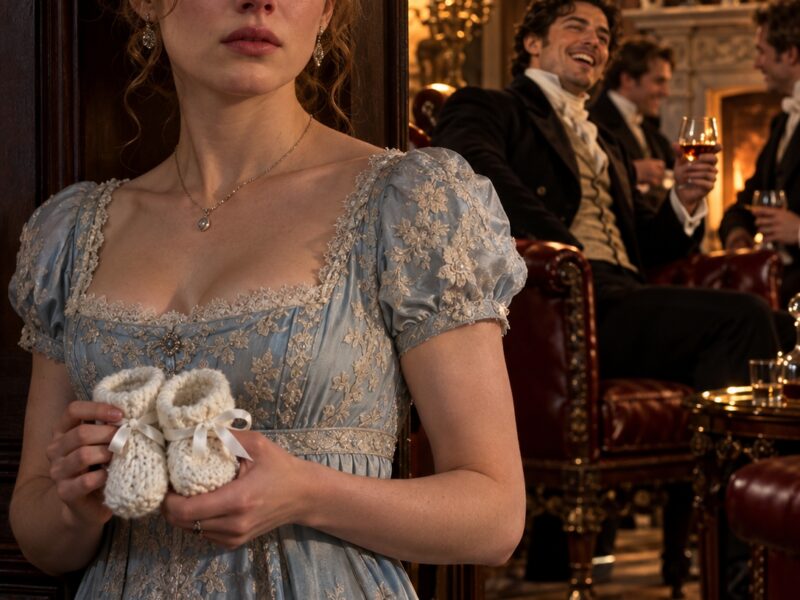
She was holding the tiny white shoes she had knitted for their unborn child.
Behind the library door, her husband was laughing about the day he would send her away.
Five months later, she would stand before two hundred guests and make the Duke of Ashgrove understand exactly whom he had married.
The baby shoes were barely larger than a teacup.
Isabelle Lennox held them in both hands as she descended the broad staircase of Ashgrove Park on a cold October evening in 1818. They were made from soft white lamb’s wool, spun from the finest fleece produced by her father’s Yorkshire mills. She had knitted them two years earlier, long before she had any reason to believe a child would wear them.
She had hidden them beneath tangled embroidery silks in her sewing box, embarrassed by how desperately she wanted to become a mother. At Ashgrove, people already found enough reasons to laugh at the mill owner’s daughter who had married a duke. She had no intention of giving them another.
But that afternoon, Dr. Lother had smiled at her across his desk in Marlborough.
“July, Your Grace,” he had said, removing his spectacles and polishing them carefully. “I should expect the child around the middle of July. Congratulations. His Grace will surely be delighted.”
Isabelle had scarcely heard anything after that.
A child.
After three years of marriage, three years of whispered speculation at dinner parties, sympathetic looks at church, and Aunt Philippa’s pointed questions about whether Yorkshire women had difficulty producing heirs, she was finally expecting a baby.
She had told no one. Not her maid, not the housekeeper, not even the aunt who had treated her as an unwelcome visitor since her wedding day.
She wanted Rafe to know first.
She wanted to watch his face change when he understood that they were going to have a child.
The library door stood partly open. Firelight spilled across the marble floor, and familiar male voices drifted into the hallway.
Isabelle stopped, smoothed her pale blue gown, and pressed the little shoes against her waist.
Then she heard her husband laugh.
Rafe Lennox, sixth Duke of Ashgrove, was thirty-two, handsome, and admired throughout Wiltshire. His dark curls, confident smile, and easy manners had made him irresistible to Isabelle when they first met in London.
Tonight he was stretched comfortably in a red leather chair beside the library fire, a glass of brandy in his hand.
Across from him sat his two oldest friends.
Lord Kit Danvers was already flushed with drink, his fair hair disordered and his glass nearly empty. Sir Harry Monreef, quieter and more observant, sat beside him in a crimson coat.
“Come on, Rafe,” Kit insisted. “Three years married to the mill girl. Tell us you haven’t regretted it.”
“Regretted it?”
Rafe laughed and raised his brandy.
“My dear Kit, I married one hundred thousand pounds. Why on earth would I regret that?”
Isabelle stopped breathing.
“The roof is repaired,” Rafe continued. “The mortgages are being paid. My horses are the finest in Wiltshire.”
“And the girl herself?” Kit asked.
Rafe shrugged.
“Pleasant enough. She keeps out of my way. Performs her duties. Doesn’t trouble me.”
He swallowed more brandy.
“I’ll tolerate her until she gives me an heir. After that, she can return to Yorkshire and count her bobbins. I’ll keep the money and the boy.”
Kit burst into laughter.
Harry lowered his eyes toward his glass.
“And suppose it’s a girl?” Kit asked.
Rafe smiled.
“Then I suppose I’ll have to tolerate her a little longer.”
Their laughter filled the library.
In the darkened doorway, Isabelle stood perfectly still.
She did not cry out. She did not rush inside and demand an explanation. For one terrible moment she imagined throwing the white shoes into the fire and watching the wool curl and blacken.
Instead, she looked down at the tiny objects in her hands.
A few minutes earlier, they had represented everything she hoped her marriage might become.
Now they seemed to belong to another woman’s life.
Sir Harry glanced toward the doorway.
His gaze stopped for a moment, and Isabelle knew he had seen her.
But he said nothing.
Neither did she.
She turned away, climbed the staircase, and returned to her bedroom.
By the time she closed the door, something inside her had changed.
She would not tell Rafe about the baby that night.
Or the next morning.
Or the following week.
And before the Duke of Ashgrove learned that his wife was carrying his child, he would discover that nearly everything he thought he owned depended upon the very woman he had dismissed so casually.
After her maid helped her undress, Isabelle sat alone at her dressing table.
She opened her jewelry box, removed the upper tray, and reached beneath the velvet lining.
Her fingers found a small, flat iron key.
Her father had given it to her on the morning of her wedding, while the organ played at St. George’s, Hanover Square, and their guests waited in the church.
“There’s a box, Belle,” he had whispered. “Greavves has it in Leeds. I hope you’ll never need it.”
She had laughed then.
But he had closed her fingers around the key.
“If that man ever makes you unhappy, write to Greavves. Ask for your box. Then open it.”
For more than three years, the key had remained untouched.
Tonight, Isabelle placed it beside the white shoes and drew a sheet of writing paper toward her.
She dipped her pen into the ink.
Dear Mr. Greavves,
Please send me my father’s box.
Nine days later, a heavy black tin box arrived from Leeds.
Isabelle carried it upstairs herself and locked her bedroom door.
Inside were documents bound with red tape and a letter written in her father’s unmistakable handwriting.
She read the letter.
Then the documents.
Then the letter again.
For the first time since she had overheard her husband’s laughter, Isabelle smiled.
To understand why, one must understand the man who had given her that key.
Josiah Pembury was born in a small cottage near Huddersfield, with a dirt floor and a single window.
His father worked as a handloom weaver. His mother spun wool in the doorway to catch the daylight.
By seven, Josiah was carrying bales of fleece through the steep streets for a penny a day.
By forty, he owned four mills, nine hundred looms, and a warehouse in Leeds so large that visitors compared it to a cathedral.
Pembury cloth traveled to London, Lisbon, and New York. His broadcloth had supplied soldiers during Wellington’s campaigns in Spain. Among Yorkshire merchants, Josiah was respected as a man who understood wool, figures, and human nature better than most men understood their own families.
His wife died when their only daughter was two.
He never remarried.
Instead, he raised Isabelle himself, teaching her everything he knew about the business that had taken him from poverty to extraordinary wealth.
She learned to read from shipping documents and calculate from wage books.
By ten, she could walk beside her father through the weaving sheds, examine a length of cloth, and identify its quality by touch.
The workers adored her.
They called her Little Miss Ledger.
“You have a head for this, Belle,” Josiah often told her. “Better than mine. If you were a boy, I’d leave you the entire business tomorrow.”
“Why can’t you leave it to me anyway?”
Her father had studied her for a long moment.
“Perhaps I will,” he said. “Perhaps I’ll find a way.”
He found that way years later, when a handsome duke entered her life.
In the spring of 1815, Josiah brought his twenty-year-old daughter to London for the social season.
He had little affection for aristocrats. In his opinion, too many of them inherited wealth they lacked the ability to maintain. But Isabelle had never seen London, and her aunt in Kensington had invited them.
So Isabelle attended assemblies, private dinners, and glittering balls beneath chandeliers that appeared brighter than anything she had ever imagined.
She also learned how cruel polite society could be.
Ladies smiled behind their fans at her father’s Yorkshire accent. Gentlemen admired his fortune while pretending to be amused by the hands that had earned it.
Isabelle noticed.
She simply refused to let them see how much it hurt.
At a ball in Berkeley Square, Rafe Lennox asked to be introduced.
He was everything she had imagined a nobleman might be: tall, dark-haired, charming, and attentive.
He danced with her twice.
The following afternoon he arrived in Kensington carrying white violets.
The next day he took her driving through Hyde Park.
He asked about her father’s mills.
More importantly, he seemed to listen.
Isabelle told him about broadcloth, kersey, dyes, shipments, and the peculiar difficulties of the wool trade. He laughed at her jokes and called her the cleverest woman he had ever met.
Within a month, she loved him.
Her father did not trust him.
“He’s charming,” Josiah admitted one evening. “Charming as a cat in a dairy.”
“Papa.”
“I’ve made inquiries, Belle. Ashgrove is mortgaged almost to the chimney pots. Sixty thousand pounds owed to a London bank. His father lost a fortune at cards, and your duke has spent what remained on racehorses.”
“He listens when I talk about the mills.”
“A man who needs money will listen to almost anything.”
Isabelle looked away.
Josiah’s voice softened.
“I won’t forbid it. You’re old enough to make your own choice. But if you marry him, the arrangements will be made on my terms, not his.”
His attorney, Mr. Abel Greavves, arrived from Leeds.
Greavves was a thin, gray-haired man who had served Josiah for thirty years. He rarely smiled and considered vague agreements an invitation to disaster.
He spent three days negotiating with the duke’s London solicitors.
By the end, they had drawn up an exceptionally detailed marriage settlement.
Isabelle possessed a fortune of £100,000.
Under the ordinary rules of marriage in England at that time, a husband’s rights over his wife’s property could be extensive. Josiah refused to risk his daughter’s fortune.
Instead, her money was placed in trust, with Greavves and a Yorkshire banker acting as trustees.
The settlement protected the property for Isabelle’s sole and separate use, notwithstanding her marriage.
Rafe’s lawyers objected.
Rafe himself dismissed their concerns.
“Let the old fellow have his trust,” he said. “She’ll sign the money over. They always do.”
He signed the agreement without seriously examining what it meant.
But Josiah had arranged one more thing.
Two weeks before the wedding, a representative from Leeds visited the London bank that held the mortgages on Ashgrove Park.
The mortgages totaled £60,000.
Josiah purchased them.
The securities were assigned to trustees for Isabelle’s separate benefit, though Rafe never learned whose interests they represented.
His steward continued sending the interest payments to Leeds.
The duke never asked where the money went.
On June 20, 1815, two days after the Battle of Waterloo, Isabelle Pembury married Rafe Lennox at St. George’s, Hanover Square.
During their honeymoon in Brighton, he was affectionate and attentive.
For two weeks, she believed she had found the happiness she wanted.
Then they returned to Ashgrove.
And slowly, almost imperceptibly, her husband disappeared from her life.
He rode after breakfast and returned late in the evening.
Autumn belonged to shooting parties. Winter belonged to hunting. Spring belonged to his racehorses at Newmarket.
When he was home, he treated Isabelle with distant politeness.
She was his duchess in name, but scarcely a wife in practice.
Ashgrove itself was governed by his aunt, Lady Philippa Lennox.
A widow of sixty, Philippa had controlled the household since Rafe’s mother died. She regarded Isabelle’s arrival not as a change of mistress but as an inconvenience to be managed.
On Isabelle’s first evening, the older woman passed her in the corridor and remarked loudly upon the smell of lanolin.
The servants understood where authority remained.
The housekeeper consulted Philippa. The cook prepared her favorite dishes. Even the household accounts were kept away from the new duchess.
When Isabelle asked to examine them, Philippa smiled.
“My dear, surely you’ve spent enough of your life counting things.”
So Isabelle stopped asking.
She read, walked, wrote to Yorkshire, and waited for her husband to notice her.
Four times a year, Mr. Greavves sent a document for her signature.
Each time, Isabelle authorized £1,250 from her trust income to be paid into Rafe’s account.
Five thousand pounds annually.
It helped repair Ashgrove’s roofs, maintain his horses, pay his personal expenses, and sustain the extravagant life he enjoyed.
It even helped cover interest on the mortgages held for Isabelle’s benefit.
Rafe never thanked her.
In March 1817, Josiah Pembury collapsed in his largest weaving shed and died before a physician could reach him.
The workers carried him home on a door removed from its hinges.
Three thousand people attended his funeral.
Isabelle stood among them in the Yorkshire rain.
Her husband did not attend.
His favorite horse was running at Newmarket, and he had decided the race could not be missed.
At her father’s grave, Isabelle remembered the iron key.
Still, she did not use it.
She had loved Rafe for so long that she continued hoping he might become the man who had brought white violets to her aunt’s drawing room.
For another eighteen months, she waited.
Until October 1818.
Until the white baby shoes.
Until the laughter behind the library door.
Now the black tin box stood open on her bed.
Inside were the deeds and mortgage documents proving that the debt secured upon Ashgrove Park was held for her benefit.
There were also papers showing that her father’s mills, warehouse, and looms had been settled upon her separately.
Rafe did not own them.
He had never owned them.
And while Ashgrove itself remained the Lennox estate, its financial future lay heavily in the hands of the trustees acting for his wife.
At the top of the documents rested Josiah’s letter.
My dear Belle,
If you are reading this, then he has made you unhappy, and I am sorry for it.
I’m sorry, too, that I am not there to knock some sense into his head.
But listen to me, lass.
Don’t cry. Don’t run. Running is for people who have nothing.
You have everything you need.
You have always had it.
You’ve only been giving it away because you are kind.
Stop giving it away.
Greavves will do as you instruct. The mills are yours. The money is yours. And the mortgages on that man’s estate are held for you until he repays what is owed.
You know how to count, Belle.
You always did.
Now count what you are worth.
Your loving father,
J. P.
Isabelle sat for a long time with the letter against her knees.
She could return to Yorkshire, take charge of her business, and leave Rafe behind.
But she remembered his words.
He wanted her gone after she had given him an heir.
He wanted her money and the child, while freeing himself from the inconvenience of her presence.
She looked down at the tiny white shoes.
“No,” she whispered.
She would not run merely because her husband had planned to discard her.
She would remain at Ashgrove.
And quietly, carefully, she would stop paying for the life in which she was barely permitted to participate.
Her first letter went to Leeds the following morning.
She instructed Greavves that the next quarterly payment to Rafe was not to be made.
Instead, her funds would pay the servants’ wages and essential household suppliers directly.
Coal, candles, meat, groceries, and necessary maintenance would continue.
Not one servant was to suffer.
Not one fire was to go unlit.
But no additional money would be transferred to her husband’s personal account.
She also requested a full account of interest payments on the estate’s mortgages.
Greavves answered within the week.
His reply was short, precise, and ended with an exclamation mark—an astonishing extravagance for a man who had avoided such punctuation for thirty years.
Madam, your instructions shall be carried out exactly. Your father would be proud. I confess that I am!
Christmas arrived beneath a sky heavy with snow.
Ashgrove filled with guests.
Evergreens decorated the halls, fires burned in every drawing room, and the dining table groaned beneath the weight of roasted meats and expensive wines.
Isabelle sat quietly at dinner in a dark green velvet gown, her cashmere shawl draped loosely around her waist.
She did not drink wine.
At breakfast she ate dry toast and sometimes left when the smell of fish became overwhelming.
No one paid much attention.
For three years, the household had learned to overlook the duchess.
Now that habit protected her secret.
After Twelfth Night, Rafe entered the breakfast room carrying a letter from his London bank.
“Isabelle, the Christmas payment hasn’t arrived.”
She lowered her toast.
“There’s no delay, Rafe.”
He frowned.
“Then what’s happened?”
“I’ve decided not to transfer my money this quarter.”
For a moment, he looked startled.
Then he laughed.
“Your pin money? Keep it, by all means. Buy yourself something pretty.”
He returned to his letter.
“I’ll speak to the housekeeper about the household expenses.”
“That isn’t necessary.”
He looked up.
“I’ve arranged to pay them myself,” Isabelle continued. “The staff, the suppliers, the coal, the candles. Everything essential is covered.”
“By you?”
“Yes.”
He studied her for a moment, apparently unable to understand why his usually compliant wife had suddenly taken an interest in the household finances.
Then he shrugged.
“Do as you wish.”
He returned to his racing papers.
He had never troubled himself to learn that her supposedly insignificant allowance had been supporting nearly everything he enjoyed.
Ashgrove’s rents brought in approximately £4,000 a year.
About £3,000 was needed to service the mortgages.
That left barely £1,000 before the duke’s lavish personal expenses.
He had become accustomed to spending far more.
And now the money that bridged the difference was gone.
Lady Philippa learned of the change before he did.
On January 4, Mrs. Harbottle, the housekeeper, entered the morning room carrying the household ledger.
As she had done for twenty years, she approached Philippa’s chair.
Then she stopped.
With a flush of embarrassment, she turned toward Isabelle.
“Your Grace, Mr. Greavves writes that the accounts are to be presented to you now.”
Isabelle opened the ledger.
She examined the figures and quickly noticed that the household had been charged an extraordinary amount for wax candles.
“Mrs. Harbottle, this seems excessive. Are we receiving the full weight we’re paying for?”
The housekeeper blinked.
No one had ever asked her that question.
“I have wondered, Your Grace.”
“Then weigh the next delivery in front of the supplier. If it’s short, we’ll purchase elsewhere.”
Across the room, Philippa put down her embroidery.
After Mrs. Harbottle left, she approached Isabelle with two bright spots of color in her cheeks.
“I have kept the keys of this house for nineteen years.”
“I know.”
“And you think a letter from a Yorkshire attorney entitles you to take them from me?”
“I don’t want your keys, Aunt Philippa.”
The older woman paused.
“Keep them,” Isabelle continued. “Arrange the dinners. Manage the household as you always have. But the money paying these bills is mine, and I intend to know how it is being spent.”
Philippa opened her mouth to reply.
Before she could speak, Isabelle suddenly turned pale.
She pressed a hand against her lips and hurried out.
Philippa watched her go.
She was not a foolish woman.
She had once been young, married, and desperate to please a husband who wanted a son.
She had noticed Isabelle’s loose shawls, untouched wine, and morning sickness.
That afternoon, she knocked on Isabelle’s sitting room door.
“July?” she asked quietly.
Isabelle looked up from her desk.
There seemed little point in denying it.
“Yes.”
“Does Rafe know?”
“No.”
Philippa closed the door.
“May I ask why?”
For a long moment, Isabelle said nothing.
Then she told her.
About the white shoes.
About the library.
About the men drinking brandy.
And about the husband who intended to tolerate her only until she gave him a son.
Philippa walked to the window.
Outside, bare trees stood against the winter sky.
“My husband said something much like that once,” she admitted. “I heard him through a door. I was twenty-two.”
Isabelle stared at her.
“I never told him I’d heard. I stayed with him for thirty-one years. I became cold and rigid, and I convinced myself that was dignity.”
Her voice trembled slightly.
“I haven’t been kind to you, Isabelle. Perhaps I resented your youth. Perhaps I resented that you still had choices.”
She turned.
Her eyes were wet.
“I won’t tell Rafe. Not one word.”
Then, after a pause, she added, “Wear your gray merino gown at dinner. It hangs straighter than the green velvet. Men may be blind, but Kit Danvers notices everything.”
Isabelle laughed.
It was the first genuine laugh to escape her in months.
While the two women slowly began to understand each other, Rafe was creating a new disaster.
It began with a horse race.
Kit Danvers owned a chestnut mare called Sweet Fury, supposedly bred in Ireland and recently successful in several races.
Rafe owned Corsair, a powerful black colt he considered the finest animal he had ever bred.
One evening, after several glasses of brandy, the men began arguing about which horse was faster.
By the fifth glass, they had agreed to race them.
By the seventh, they had set the stakes at £15,000.
The match would take place on March 10, over the Rowley Mile at Newmarket.
Isabelle learned of the wager from her maid.
Later, passing the library, she heard her husband explaining his plans.
He would borrow against the home farm to cover the stake.
When Corsair won, he would pay off the borrowing and keep his winnings.
Harry Monreef questioned what would happen if Corsair lost.
“He won’t lose,” Rafe replied.
“And if he does?”
Rafe laughed.
“I have a wife with one hundred thousand pounds who does exactly as she’s told.”
Isabelle kept walking.
At the turn of the staircase, she glanced back.
Harry stood in the library doorway, watching her.
For the second time, he knew she had overheard something that should have shamed the men inside.
Again, he said nothing.
In mid-January, Isabelle announced that she intended to visit her father’s mills in Yorkshire.
“Stay as long as you wish,” Rafe replied without looking up.
Kit laughed into his wine.
Philippa fixed him with a stare that silenced him.
Two days later, Isabelle left Ashgrove.
She was entering her fourth month of pregnancy, and hiding her changing figure was becoming increasingly difficult.
In Yorkshire, she could move freely.
The four Pembury mills stood along the river beneath a cold, smoke-colored sky.
The sound of nine hundred looms rose from the valley as her carriage approached.
Sam Booth, her father’s longtime foreman, stood waiting near the gate.
“Little Miss Ledger!” he cried when he recognized her. “Welcome home!”
He had once carried her through the weaving sheds on his shoulders.
Now he looked at her with the same affection that had survived her marriage, her title, and her long absence.
For three weeks, Isabelle returned to the work she understood.
She inspected cloth, studied the wage books, and questioned the foremen.
She discovered that one dyer had been diluting indigo and that a carter had been selling wool from his deliveries.
She addressed both problems.
She also noticed that the women in the spinning room were paid less than the men for comparable work.
She ordered their wages increased.
Several women wept when they heard.
Sam Booth pretended he had dust in his eyes.
On February 1, Isabelle traveled to Leeds.
Mr. Greavves was waiting in his office with tea, a fire, and a letter.
It had come from Rafe’s London solicitor.
The Duke of Ashgrove wanted to raise £15,000 on the security of his home farm.
His lawyer understood that the existing mortgages were held by the trustees of the Calder Settlement and wished to know whether they would advance further funds.
At the bottom, in Rafe’s own handwriting, were a few impatient words.
Kindly reply by return. The matter is urgent.
Isabelle read the letter twice.
“He doesn’t know.”
“No, madam,” Greavves agreed.
“He has no idea who controls the Calder Settlement.”
“His steward has paid the interest for years. His Grace has never inquired further.”
Isabelle placed the letter on the desk.
“He wants the money for a horse race.”
Greavves raised his eyebrows.
It was the closest he came to an open display of astonishment.
“What shall I tell him?”
Isabelle considered the question.
Then she answered.
“Tell him the trustees regret that the estate’s existing liabilities make further advances imprudent.”
She picked up her teacup.
“That is entirely accurate, Mr. Greavves. I’ve examined the accounts.”
The refusal was sent to London.
It bore the trustees’ signatures.
Isabelle’s name did not appear.
When she returned to Ashgrove toward the end of February, the financial strain was beginning to show.
Two hunters had disappeared from the stables.
The trainer at Newmarket was demanding payment.
The wine merchant in Bristol had written about overdue bills.
So had Rafe’s tailor in Savile Row.
Her husband was irritable, though his laughter seemed louder than ever.
At dinner, he raised his glass toward her.
“My wife has returned from Yorkshire, where she’s been counting sheep. Did you manage them all, my dear?”
The guests laughed.
Kit laughed loudest.
Isabelle smiled politely.
Beneath her shawl, she rested one hand over the small curve of her stomach.
Then she felt something.
A tiny flutter.
Her baby had moved.
For the first time, the child she had protected in secrecy made its presence unmistakably known.
Isabelle kept her hand there while the laughter faded.
Two days later, Sir Harry Monreef called.
Rafe had gone to inspect another horse with Kit.
Isabelle was sitting with her sewing box open when the footman announced Harry.
She closed the lid.
He entered looking miserable.
“Your Grace, I owe you an apology.”
She waited.
“I saw you that night in October. Standing outside the library. I knew you had heard us.”
His fingers tightened around his hat.
“I sat there and said nothing. Then I saw you again outside that same room in January, and I failed you a second time.”
“Why are you telling me now?”
“Because I’ve watched you these past months. I believe you’re preparing to do something, although I haven’t the slightest idea what.”
He took a breath.
“And because there’s something else you should know.”
Isabelle gestured for him to continue.
“Kit’s mare. Sweet Fury. She isn’t what Rafe believes.”
Harry explained that the mare had raced successfully at the Curragh in Ireland under another name.
She had won four times before Kit purchased her.
“Kit knows she’s faster than Corsair,” Harry said. “He’s been arranging this wager for months.”
“Does Rafe know?”
“I’ve tried to tell him enough to make him cautious. He won’t listen. Kit owes money throughout London. He needs those winnings.”
Isabelle looked toward the window.
Her husband had ridiculed her, ignored her judgment, and planned to separate her from the child she carried.
She had every reason to let him learn his lesson.
But there was a difference between refusing to support his extravagance and allowing a dishonest man to deceive him without warning.
That evening, Isabelle went to the library.
Rafe was alone, reading a racing calendar.
He looked surprised when she entered.
“Rafe, I need to tell you something about Kit’s mare.”
She explained what Harry had told her.
She described the horse’s earlier races in Ireland and the possibility that Kit had concealed her record deliberately.
Rafe listened.
Then he smiled.
“So you’ve been in Yorkshire counting sheep, and now you’re an expert in Irish racehorses?”
“Please listen.”
“Go to bed, Isabelle. Leave the horses to me.”
She remained standing.
“My father bought and sold horses for forty years. He taught me to examine their legs before their faces.”
Rafe looked down at his calendar.
“And he taught me to examine a man’s debts before believing his promises.”
Rafe did not answer.
Isabelle turned toward the door.
Upstairs, she opened her sewing box and took out the white shoes.
She held them quietly.
She had warned him.
Whatever happened at Newmarket now, she had warned him.
The race took place on March 10 beneath a cold gray sky.
Isabelle remained at Ashgrove.
She sat in her drawing room with a book she could not concentrate on.
Philippa sat opposite her, holding embroidery she scarcely touched.
Neither mentioned horses.
At nine that evening, Harry arrived covered in mud.
He was shown upstairs.
“Three lengths,” he said.
Isabelle closed her book.
“Sweet Fury beat Corsair by three lengths.”
Harry dropped into a chair.
“Rafe is at the Rutland Arms with Kit. Kit is buying champagne for everyone.”
“With Rafe’s money?” Philippa asked.
“He hasn’t been paid yet.”
“When must he pay?”
“Lady Day. March twenty-fifth.”
Fifteen thousand pounds.
In fifteen days.
It was a gambling debt that Rafe’s world would call a debt of honor.
Failure to pay would destroy his reputation among the men whose admiration had mattered to him more than almost anything else.
Philippa put down her embroidery.
“Then I imagine,” she said dryly, “he will finally have to speak to his wife.”
Rafe returned two days later.
He shut himself in the library.
Letters went to bankers, moneylenders, and solicitors.
The answers were unfavorable.
Even a lender prepared to charge ruinous interest wanted security that Rafe could not provide.
Another appeal to the Calder Settlement achieved nothing.
On March 16, Rafe climbed the stairs to Isabelle’s sitting room.
It was the first time in three years he had come there to ask her for help.
His curls were disordered.
He had not shaved.
There were dark shadows beneath his eyes.
“I need fifteen thousand pounds,” he said.
Isabelle sat at her desk.
“I know.”
“By the twenty-fifth. You’ll have to authorize the payment.”
“No.”
He stared.
“Isabelle, if I don’t pay Kit, I’m finished.”
“I warned you about the mare.”
“That has nothing to do with this.”
“It has everything to do with it.”
His face reddened.
“You’re my wife. Everything you own belongs to me.”
Isabelle looked at him calmly.
“Read our marriage settlement, Rafe.”
He did not move.
“You signed it. Every page.”
For a moment, there was silence.
“My money belongs to a trust established for my separate benefit,” she continued. “You received payments because I chose to authorize them. I no longer choose to.”
“You cannot mean to humiliate me.”
“I did not make the wager.”
He stood rigidly before her.
At last, he spoke in a voice she scarcely recognized.
“The spring ball is on Thursday. The entire county will be here.”
“I know.”
“I won’t have people saying I put you out before the ball. But afterward, you’ll pack your things and return to Yorkshire.”
Isabelle felt the familiar ache of an old wound.
He was still trying to discard her.
Still assuming that being a duke gave him authority over everything.
“I’ve tolerated you long enough,” he said.
She folded her hands over the shawl resting in her lap.
“Very well, Rafe.”
“After the ball.”
“After the ball,” she repeated.
The Ashgrove spring ball had been held every March for ninety years.
That year, two hundred guests arrived, drawn as much by curiosity about the duke’s financial difficulties as by the promise of music and champagne.
The ballroom shimmered beneath a thousand candles.
White roses wound around the pillars.
An orchestra played from the gallery, while servants circulated with silver trays.
Rafe welcomed his guests in a black tailcoat and immaculate white cravat.
He smiled constantly.
But his eyes betrayed his fear.
Kit Danvers arrived in an expansive mood, with Sweet Fury’s silver trophy displayed for all to admire.
Harry Monreef stood quietly near one of the pillars.
Lady Philippa, dressed in purple satin, observed the room from a gilded sofa.
At nine o’clock, Mr. Abel Greavves entered through a side door.
He wore an old-fashioned black coat and carried a worn leather case.
Few guests noticed him.
Then Isabelle appeared.
Her pale blue silk gown had a high neckline and delicate lace sleeves.
Her honey-colored hair was braided into a crown.
Across her shoulders lay a long white cashmere shawl, draped loosely over the shape she had concealed throughout the winter.
She was calm.
She took her place beside Rafe, greeted their guests, and spoke with practiced courtesy.
Her husband scarcely acknowledged her.
At midnight, supper was served.
Kit Danvers stood first.
He offered a toast to Rafe, whom he described as the most sporting loser in England.
Uneasy laughter drifted around the room.
Then someone called for the host.
Rafe rose with a champagne glass in his hand.
“My friends,” he began, smiling broadly. “I give you my wife.”
The room turned toward Isabelle.
“My wife, whose father purchased me for one hundred thousand pounds, and who has now decided to keep the change.”
A few guests laughed.
Rafe continued.
“It seems Yorkshire suits her better than Wiltshire. She prefers sheep to society. So I’m pleased to announce that next week she’ll be returning to her looms.”
He raised his glass.
“Long may she count her bobbins.”
Kit burst into laughter.
Someone started to clap.
Then Isabelle stood.
She did not hurry.
She rose from her chair, looked quietly around the crowded room, and lifted the white shawl from her shoulders.
She laid it across the back of her chair.
In the light of a thousand candles, the outline of her pregnancy became unmistakable.
A gasp passed along the supper table.
A woman dropped her fork.
Lady Philippa sat a little straighter.
And Rafe stared at his wife with his champagne glass still raised.
“Isabelle?”
“In October,” she began, her voice steady enough to reach the far wall, “I came downstairs to tell you that I was expecting our child.”
The room fell silent.
“I had knitted a pair of little white shoes. I meant to give them to you.”
Rafe’s mouth opened.
No words emerged.
“You were sitting in the library with Lord Danvers and Sir Harry. You were drinking brandy.”
She looked directly at him.
“I heard you say that you had married one hundred thousand pounds.”
Kit stopped smiling.
“I heard you say you would tolerate me until I gave you an heir. That afterward I could return to Yorkshire while you kept the money and the boy.”
A terrible stillness settled over the guests.
“And when Lord Danvers asked what would happen if the baby were a girl, you said you’d have to tolerate me a little longer.”
Rafe lowered his glass.
“I was standing behind you, Rafe.”
She let the words remain between them.
“You never saw me.”
Two hundred people waited.
“So I didn’t tell you about the child. I stopped giving you my money instead.”
She looked toward the far wall.
“Mr. Greavves, would you come forward, please?”
The small Yorkshire attorney approached with his leather case.
He opened it on the supper table and placed a bundle of documents beside Rafe’s untouched plate.
“The mortgages on Ashgrove Park, Your Grace,” Greavves announced. “Sixty thousand pounds, purchased by the late Mr. Josiah Pembury shortly before your marriage and held by the trustees of the Calder Settlement for the separate benefit of Her Grace.”
Rafe stared at the papers.
“The Calder Settlement?”
“Yes, Your Grace.”
“The letters from Leeds?”
“Indeed.”
Rafe slowly turned toward Isabelle.
“It was you?”
“It was always me, Rafe.”
Her voice softened, but only slightly.
“You simply never asked.”
Then she looked down the table.
“Lord Danvers, I believe Sir Harry has something to say about your mare.”
Harry stepped away from the pillar.
In a quiet, clear voice, he explained what he knew of Sweet Fury’s racing history in Ireland and the circumstances surrounding the wager.
Kit rose so abruptly that his chair overturned.
No one moved to help him.
Within minutes, he had left.
His silver trophy disappeared from the hall with him.
Isabelle turned back to her husband.
“You’ll have your child in July, Rafe. Whether it’s a boy or a girl, I don’t know.”
Her hand settled over her stomach.
“But I am not returning to Yorkshire because you find me inconvenient. Nor will I allow you to pretend that my fortune was ever yours to command.”
She glanced toward the documents.
“The estate remains burdened by mortgages held for my benefit. I intend to protect my child, my property, and the people who depend upon this household.”
She picked up her shawl.
“I’ll tolerate you until the baby comes.”
Rafe did not move.
“After that, we’ll see what you’ve earned.”
Isabelle walked through the ballroom past two hundred silent guests.
No one laughed.
The ball continued, because great social occasions rarely know how to end when disaster arrives.
The orchestra resumed playing.
A few couples danced.
Others whispered until the early hours.
Rafe remained at the supper table beside the papers bound in red tape.
When the last guest departed, he went to the library.
He sat in his old red leather chair beside the fire.
The same chair from October.
By four in the morning, the flames had burned low.
Lady Philippa entered wearing the same purple satin gown.
She stood beside him.
“I knew,” she said.
Rafe did not look up.
“Since January. She told me everything.”
“Why didn’t you tell me?”
“Because your uncle once said much the same thing about me. I heard it through a door.”
He lifted his head.
“I spent thirty-one years pretending not to know what sort of marriage I had,” she continued. “I made myself cold because I thought coldness would protect me.”
Her expression hardened.
“Isabelle refused to make the same mistake.”
Rafe covered his face.
“I said it,” he whispered. “Every word.”
His shoulders shook.
“The worst thing is that I scarcely remember saying it. It was only something to make Kit laugh.”
“And your wife was standing behind you with baby shoes in her hands.”
He closed his eyes.
For a long time, Philippa said nothing.
Then she placed a hand against the back of his chair.
“What matters now is what you do tomorrow. And the day after that. And every day until July.”
She walked toward the door.
“You’ve been tolerated for three years, Rafe, and never noticed. Perhaps now you’ll learn what it feels like.”
At seven the following morning, Rafe knocked on Isabelle’s sitting room door.
She was already awake.
A letter lay half-finished on her desk.
Beside it rested the white knitted baby shoes.
“May I come in?” he asked.
“It’s your house, Rafe.”
“No.”
He swallowed.
“Greavves made that very clear. The debts on it are held for you.”
He stepped inside.
“I’m not here to ask for money. Or forgiveness.”
Isabelle waited.
“I know I have no right to either.”
His eyes moved toward the shoes.
“I came to say I’m sorry. And I know that means very little, because I’ve spent three years proving that my words cannot be trusted.”
Isabelle looked at him for a long moment.
“Sit down, Rafe. You look exhausted.”
He sat opposite her.
She folded her hands.
“I’ve decided what will happen.”
He nodded.
“I’ll take charge of Ashgrove’s finances and management. The household, the farms, the tenants, the accounts. Mr. Greavves will continue holding the mortgages, and the interest will be met from the estate’s income.”
Rafe listened without interrupting.
“You may remain here. I have no intention of sending you away, just as I have no intention of leaving because you command it.”
“What about Kit?”
“A wager obtained through deception is not an honorable debt. Sir Harry will make sure the truth is known.”
She paused.
“But your other creditors are honest people. Your trainer, your wine merchant, your tailor. They must be paid.”
“I haven’t the money.”
“You have valuable horses.”
His expression changed.
“Corsair?”
“That decision is yours.”
He looked toward the window.
Isabelle picked up one of the white shoes.
“And if you want to be a father to this child, you will have to learn what fatherhood requires.”
She turned the small shoe in her fingers.
“You will need to know the child’s habits. Be present when the child is ill, frightened, tired, or difficult. You cannot expect love merely because the child bears your name.”
Rafe stared at the shoe.
“And if you want to be my husband again,” she added, “that will take considerably longer.”
He nodded.
“Thank you.”
For once, there was no charm in his voice.
Only sincerity.
In April, Rafe sold his racehorses.
Eleven of them went to auction at Tattersall’s.
The proceeds paid his trainer, wine merchant, tailor, and other legitimate creditors.
Corsair went last.
Rafe stood beside the sale ring in the rain as the black colt was led before the bidders.
When the hammer fell, he turned away without looking back.
He barely spoke for the rest of the day.
Isabelle heard about the sale from Harry.
That evening, as they sat at dinner, she asked her husband how his day had gone.
It was the first time in five months she had asked.
Rafe told her.
He did not exaggerate his sacrifice or ask to be praised.
He simply told her how much he had loved the horse, and how difficult it had been to let him go.
She listened.
Through April, May, and June, Ashgrove slowly changed.
Rafe stopped traveling to Newmarket.
He stopped disappearing to London whenever the household became tiresome.
Kit Danvers left England to escape his creditors.
Harry continued visiting, though conversations now lasted longer than the brandy.
Each morning, Rafe rode with the land agent to visit the tenant farms.
He learned which fields flooded during heavy rains, which families struggled with their rents, and which buildings needed repairs.
He sat in farmhouse kitchens drinking strong tea and listening to people whose names he had barely known.
At first, the tenants distrusted his sudden attention.
Gradually, they began to speak honestly.
In the evenings, Rafe visited Isabelle’s sitting room.
He asked questions about estate accounts, leases, drainage, and the mills in Yorkshire.
She answered.
Sometimes she teased him for his ignorance.
Sometimes she laughed.
He began to understand how much he had missed by treating her intelligence as something inconvenient.
He never demanded forgiveness.
And she never offered it simply because he behaved better for a few weeks.
On July 14, 1819, a summer thunderstorm rolled across Ashgrove.
Isabelle went into labor.
Rafe spent the night pacing the long gallery while rain lashed the windows.
Philippa sat outside the bedroom with her embroidery and refused to let him enter.
At six in the morning, just as the rain ended, a baby’s cry sounded behind the door.
Rafe stopped walking.
A few minutes later, Dr. Lother emerged, wiping his spectacles.
“A girl, Your Grace. A fine, healthy girl. The duchess is exhausted but doing very well.”
Rafe stood motionless.
Then he entered the bedroom.
Isabelle lay propped against the pillows, pale and tired, her hair loose around her shoulders.
In her arms lay a tiny, red-faced baby with a shock of dark hair.
On the child’s feet were a pair of white knitted shoes.
They were much too large.
Rafe approached the bed.
He looked at the baby.
The little girl opened her gray eyes and stared back with an expression of profound disapproval.
“A girl,” Isabelle said softly.
She watched his face.
“So I suppose you’ll have to tolerate me a little longer.”
Rafe sank to his knees beside the bed.
He lowered his head until his forehead rested near his daughter’s small fist.
And he wept.
“I’ll love her,” he said when he could speak. “For the rest of my life.”
He looked up at Isabelle.
“And I’ll spend the rest of it trying to deserve you both. I don’t know whether I ever will. But I’ll try.”
Isabelle studied him.
Then she reached out and rested her hand gently against his dark hair.
They named the baby Josephine, in honor of Josiah Pembury, the grandfather she would never meet.
Everyone called her Josie.
She inherited her father’s black curls, her mother’s gray eyes, and a determination that soon became legendary throughout Ashgrove.
By two, she could distinguish broadcloth from kersey by touch.
And everyone in the house knew precisely whose daughter she was.
Rafe kept his promises.
He never returned to Newmarket.
He never resumed his friendship with Kit Danvers.
He learned the names of the tenant families, understood the business of the estate, and became a far more attentive father than anyone who had known him in his younger years would have predicted.
In time, the tenants came to respect him.
But Isabelle did not mistake improvement for instant restoration.
It took two years before she trusted her husband again.
One summer evening, they walked together through the park while Josie slept against Rafe’s shoulder.
“Two years,” Isabelle said quietly.
Rafe looked at her.
“Two years before I trusted you again.”
“You counted?”
“Of course.”
He smiled.
It was not the careless smile she had first seen in Berkeley Square.
It was quieter, warmer, and entirely without pretense.
She smiled back.
The iron key remained in the bottom of Isabelle’s jewelry box for the rest of her life, beside the pair of white shoes that Josie had eventually outgrown.
Rafe never asked to hold it.
He had finally learned that some things were not his simply because he wanted them.
Trust could not be demanded.
Love could not be purchased.
And forgiveness could not be inherited with a title.
On Josie’s fourth birthday, Rafe gave Isabelle a small silver frame.
Inside was a sentence written in his own hand.
It hung in her sitting room for the next forty years.
I was tolerated, and I did not deserve it.
I am loved, and I am trying.









