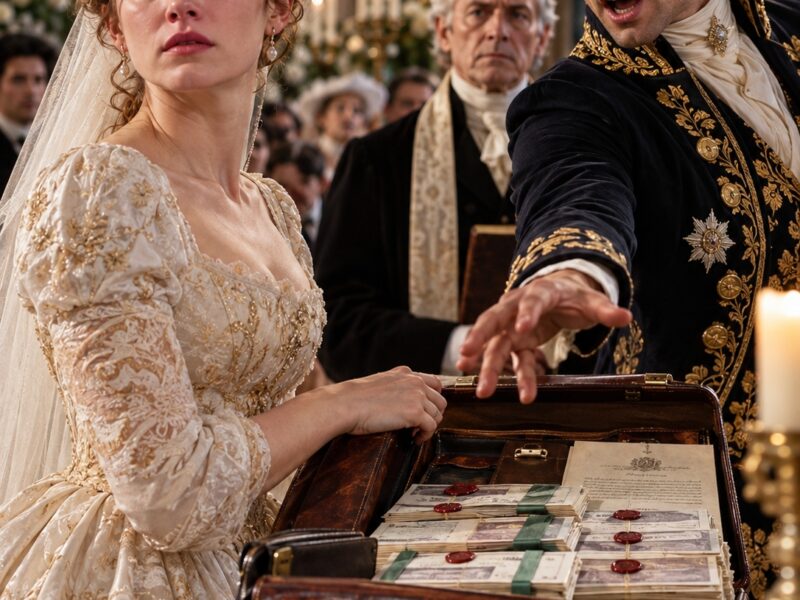
THE DUKE MOCKED HER FATHER AT THE ALTAR—THEN THE BRIDE TOOK BACK £50,000 AND WALKED AWAY

The Duke of Hargate held out his hand for the money before he had even promised to love his bride.
Three hundred guests watched him laugh at her dead father.
And Caroline Mand was about to discover why that father had insisted on one extraordinary sentence in his will.
The eleven bank drafts lay in Mr. Josiah Prior’s hands, their edges perfectly aligned, their seals intact. Together they represented fifty thousand pounds, more money than many of the distinguished families gathered inside St. George’s, Hanover Square, would see in a lifetime. Beside them rested a deed of trust tied with green tape, carefully removed from an old brown leather case.
Caroline stood in her ivory wedding gown, embroidered with tiny golden leaves, and watched the man she was supposed to marry.
Maxwell Stern, Duke of Hargate, was thirty-four years old, handsome, aristocratic, and accustomed to having every obstacle removed from his path. He wore a magnificent navy coat with gold buttons and a silk sash across his chest. He looked every inch a duke, from the flawless arrangement of his collar to the impatience gathering around his mouth.
He had not once looked into Caroline’s eyes since she reached the altar.
Instead, his attention remained fixed on the documents.
“Good God, Prior,” he said, giving a contemptuous little laugh. “What theater. Upon the bride’s own word, as if she had a word to give.”
A few guests chuckled.
Caroline did not move.
The duke turned slightly toward the first pews, apparently pleased to have an audience.
“Her father bought this wedding the way he bought his tea, by the chest at the docks, with a price stamped on the side. I’m the title, that’s the money. The girl is the paper it’s wrapped in.”
More laughter followed.
Then he stretched out his hand.
“Give it here, and let’s be done. And count it first. I wouldn’t put it past a grocer to short me.”
For a moment, Caroline could hear nothing except the faint movement of fabric behind her and the distant rumble of a carriage outside.
She was twenty-six years old. Her father had been dead for two years. And the man standing beside her had just reduced everything her father had built, everything he had loved, and everything she herself represented to a transaction worth fifty thousand pounds.
Yet what surprised Caroline most was that she did not feel the humiliation she had expected.
She felt something colder.
Clarity.
To understand how she came to stand in that church holding the fate of an entire fortune in a single word, one had to return to a house in Russell Square, where the smell of tea had lingered in the curtains for as long as Caroline could remember.
Her father, Henry Mand, had begun his working life at fourteen as a clerk in a London counting house. By thirty, he owned a ship. By fifty, he owned six, along with a warehouse on the Thames at Wapping and a reputation that extended through the English tea trade.
His business was known by its simple black oval trademark: Mand’s Finest.
He had not inherited a title, a country estate, or powerful family connections. Everything he possessed had come from years of watching markets, negotiating contracts, trusting the right people, and learning difficult lessons when he trusted the wrong ones.
He married a vicar’s daughter from Kent, and together they had one child.
Caroline was nine when her mother died.
From then on, it was Caroline and her father in the tall Russell Square house, surrounded by shipping papers, samples of tea, and the curious mixture of affection and business that shaped their private world.
Henry taught his daughter everything a respectable young lady was expected to know. She learned music, manners, and the delicate social art of saying very little when others expected silence.
But he also taught her the things respectable society believed a woman had no reason to understand.
He showed her how to read a bill of lading, how to recognize poor-quality tea by its dry leaves, and how to distinguish a reliable merchant from one who had perfected the appearance of respectability without possessing any of its substance.
Sometimes he brought her to the warehouse.
Sometimes she sat beside him while he worked.
And sometimes, when a particularly difficult transaction troubled him, he would lay his pen down and tell her something he wanted her to remember.
“Money is only a tool, Carrie. Like a hammer, it builds things or it breaks things. The trick is to know which kind of man is holding it.”
Caroline never forgot those words.
She also never imagined how much they would matter.
Henry died suddenly at his warehouse desk one winter afternoon, leaving his daughter a substantial inheritance and a grief that made the enormous Russell Square house feel empty.
Under the terms of his will, trustees would manage the business until Caroline married or turned twenty-seven, whichever came first.
He also left her a marriage portion of £50,000.
It was an extraordinary sum, large enough to attract the attention of families whose ancient titles concealed increasingly desperate financial circumstances.
Within six months, invitations began arriving.
Within a year, so did proposals.
Young men who had previously regarded a merchant’s daughter as socially beneath them suddenly discovered admirable qualities in Caroline. Baronet families with mortgaged estates expressed warm approval of her upbringing. An elderly earl, nearly sixty and suffering from gout, developed a remarkable interest in her future.
Caroline endured the attention politely.
She had never disliked society quite so much as she did after becoming wealthy enough for society to pretend to like her.
Her aunt, who had moved into Russell Square after Henry’s death, assured her that such attention was perfectly natural.
“A young lady with your circumstances must expect to be admired,” she said.
Caroline understood what her aunt meant.
She also understood what the gentlemen were admiring.
Then came the Duke of Hargate.
Maxwell Stern was handsome in a remote, sculpted way. His title was old, his Yorkshire castle older, and his financial difficulties sufficiently notorious that conversations about them usually stopped whenever he entered a room.
It was said that he owed nearly £40,000.
He had spent two years searching for a suitable heiress.
Caroline knew the rumors, though she tried not to think too much about them when he began calling at Russell Square.
He visited on Tuesdays.
He discussed the weather, opera, fashionable acquaintances, and the latest absurdities associated with the Prince Regent.
He never behaved improperly.
He never raised his voice.
He never mentioned her money.
But he also never asked her about the warehouse, the ships, or the childhood she had spent beside her father.
After four months of courtship, he knew almost nothing about her beyond what any guest at a London dinner party might have learned.
Caroline noticed.
She told herself it was courtesy.
When he proposed in June, he did so beside the drawing-room fireplace in two neatly delivered sentences.
Her aunt wept with happiness.
A duchess.
Henry Mand’s daughter was going to become a duchess.
Caroline accepted.
She did not love Maxwell, although she had tried to imagine that affection might grow between them. She was tired of being introduced, studied, and evaluated by people who saw a fortune before they saw a face.
At least a duke, she reasoned, possessed a title and an established position of his own.
Surely he would not need to marry her merely for money.
Three weeks before the wedding, Mr. Josiah Prior summoned her to his office in Lincoln’s Inn.
He had been her father’s solicitor for twenty-five years, and Caroline trusted him with the confidence one develops in people who have remained steady through the worst events of one’s life.
His chambers smelled of old paper, sealing wax, and dust warmed by the afternoon sun.
On his desk lay Henry Mand’s will.
“Your father,” Mr. Prior began, adjusting his spectacles, “insisted upon a provision I have never encountered in forty years of practice.”
Caroline leaned forward.
“What provision?”
The solicitor read the clause aloud.
The trustees were to pay Caroline’s £50,000 marriage portion to her husband on the morning of her wedding, at the church, immediately before the vows.
But only upon Caroline’s own word, given at that place and at that hour.
Without that word, the payment would not be made.
The money would remain hers.
Absolutely.
Caroline listened twice before speaking.
“He wanted me to be able to change my mind?”
“Until the last possible moment,” Mr. Prior replied.
He removed his spectacles.
“Your father said he had seen too many men sign agreements they regretted the moment the ink was dry. He did not want you to discover a bridegroom’s true opinion of you after he had already acquired your fortune.”
Caroline looked down at the document.
She could almost hear her father speaking.
“He said,” Mr. Prior continued, “that if you were going to discover the truth, you ought to discover it at the altar, with the money still in your hands.”
Caroline was silent.
Then she asked, “Does the duke know?”
“His solicitors have examined the will. Whether His Grace has read the provision himself, I cannot say.”
Mr. Prior hesitated.
Caroline knew that hesitation. He had used it whenever her father asked him a question whose answer would be unpleasant.
“There is something else, Miss Mand.”
She looked up.
“The duke’s representatives have asked rather particular questions about the timing of the payment.”
“What sort of questions?”
“They wished to establish whether it would be made in the church, in front of witnesses, before the marriage ceremony began.”
“That is what the will requires.”
“Precisely.”
“Then why were they concerned?”
The solicitor folded his hands.
“I have been informed that several of His Grace’s creditors have received invitations to the wedding.”
Caroline felt an unpleasant tightness beneath her ribs.
“Creditors?”
“And that they expect to be paid at the church door.”
For three weeks afterward, Caroline slept badly.
She lay awake listening to the wheels of late carriages crossing Russell Square and tried to determine whether she was becoming suspicious without justification.
Maxwell had never expressed affection for her.
But many aristocratic marriages were arrangements.
He had never shown interest in her thoughts.
But perhaps he imagined such conversation would be improper.
He had debts.
But he also possessed estates and a title that had endured for generations.
She could not cancel her wedding on the strength of rumors and uneasiness.
Yet she could not forget the clause.
And every time she considered it, her father’s voice returned.
The trick is to know which kind of man is holding it.
At last, Caroline made her decision.
She would go to the church.
She would stand before the duke.
She would listen.
And she would give the solicitor her answer only when she was certain.
On the wedding morning, St. George’s was filled with fashionable London.
The church glittered with silk, lace, jewelry, and the polished confidence of people accustomed to observing other people’s lives as entertainment.
Captain Abel Hart, an old friend of her father’s and the former master of his first ship, escorted Caroline down the aisle.
His white hair was neatly combed, and he leaned slightly on his walking stick.
She wore ivory silk embroidered with gold leaves.
She carried no flowers.
Her attention moved discreetly along the pews until she noticed three unfamiliar men on the groom’s side.
Their coats were respectable but lacked the effortless elegance of the aristocrats surrounding them.
One was heavyset, with graying hair and a gold watch chain. Another had ink stains on his cuffs. The third twisted his hat nervously between his hands.
None seemed interested in the bride.
All three watched Mr. Prior’s brown leather case.
Caroline felt her stomach tighten.
When she reached the altar, Maxwell looked at her briefly.
There was no warmth in his expression.
Beside the old solicitor stood his son, Lawrence Prior, a quiet young lawyer with untidy dark hair and gray eyes behind steel spectacles.
Caroline had met Lawrence several times at Lincoln’s Inn.
He rarely spoke unnecessarily.
But when Mr. Prior had explained her father’s unusual provision, Lawrence had brought the will directly to her so she could read it with her own eyes.
“Your father loved you dearly, Miss Mand,” he had said. “Anyone can see that in this clause.”
Now Lawrence watched her approach.
His expression was not judgmental.
It was worried.
Captain Hart placed her hand in Maxwell’s and stepped aside.
The vicar opened his book.
Before he could begin, Josiah Prior stepped forward.
“Forgive me, Reverend. Before the service begins, I am required by the terms of the late Mr. Henry Mand’s will to perform a duty.”
A murmur passed through the congregation.
The duke frowned.
“Yes, yes. The settlement. Get on with it, Prior.”
Mr. Prior unlocked the leather case.
He removed the eleven bank drafts and the deed of trust, holding the documents carefully.
Then he explained the conditions of Henry Mand’s will.
Turning to Caroline, he asked whether she wished the trustees to pay her marriage portion to the Duke of Hargate.
She drew a breath.
And Maxwell laughed.
He mocked the provision, her father’s profession, and the woman he had come to marry.
He called himself the title and the £50,000 the money.
He described Caroline as nothing more than the wrapping.
Then he demanded the drafts and suggested that her merchant father might have cheated him.
The laughter from the front pews carried farther than he intended.
Caroline watched the heavyset man with the watch chain lean forward.
She understood him now.
The man was not a wedding guest.
He was waiting for payment.
Everything her father had feared had arrived in front of her.
She turned toward Mr. Prior.
“Mr. Prior, you asked whether I wish the trustees to pay my portion to the Duke of Hargate.”
Her voice was steady enough to reach the last pew.
“My answer is no.”
Silence fell.
Outside, a carriage rattled across the square.
“I should like you to put the drafts back into the case,” Caroline continued, “and give it to me.”
Josiah Prior stared at her.
Then he smiled.
It was the most unguarded expression Caroline had ever seen on the old solicitor’s face.
“With the greatest pleasure, Miss Mand.”
He replaced the documents, locked the case, and handed it to her with the little brass key resting on top.
Caroline accepted it.
The old leather smelled faintly of tea.
She held it against her chest, exactly as she remembered her father carrying it when he left for the docks.
Then she turned toward the vicar.
“Thank you, Reverend. I am sorry for the trouble.”
And she began walking down the aisle.
Behind her, the duke remained at the altar, his empty hand extended.
For several seconds he appeared incapable of understanding what had happened.
Then his face reddened.
“Miss Mand! Caroline! Come back here!”
She continued walking.
“Prior! Stop her!”
“I am afraid I cannot, Your Grace,” the solicitor replied. “The will is quite clear. The money is hers.”
Caroline passed the rows of astonished guests without turning her head.
But when she reached the fourth pew, she glanced toward the three unfamiliar men.
The heavyset gentleman was halfway out of his seat.
He was watching Maxwell.
Then he sank back down, produced a small black notebook, and began writing.
Caroline walked out of St. George’s into the bright July sunshine.
Only when the church doors had closed behind her did she realize that she had no idea where to go.
Her aunt’s carriage waited near the square.
Inside, there would be panic, tears, explanations, and the ruin of an elaborate wedding breakfast.
By evening, every drawing room in London would know her name.
She stood on the church steps holding fifty thousand pounds in an old leather case and felt suddenly alone.
“Miss Mand.”
She turned.
Lawrence Prior was coming down the steps, slightly breathless.
“My father has remained to speak with His Grace’s solicitors,” he explained. “He asked me to see you safely home.”
He glanced at the case.
“Or wherever you would prefer to go.”
Caroline looked at him.
Then she gave an answer that surprised even herself.
“Wapping.”
“Wapping?”
“My father’s warehouse.”
Lawrence said nothing.
“I do not want to sit in the drawing room while my aunt cries,” she continued. “I do not want to receive condolences from people who came to watch a duke marry my money. I want to go where my father was.”
Lawrence looked at her for a moment.
Then he raised his arm and hailed a hackney cab.
“Wapping it is.”
The warehouse stood on the Thames, a tall, soot-darkened brick building with its name painted across the facade.
Mand & Company.
Ships crowded the river below.
The air smelled of tar, coal smoke, damp rope, and tea.
Caroline had not entered the building since the week of her father’s funeral.
She walked through the door still wearing her ivory wedding gown.
The clerks looked up from their desks.
Pens stopped moving.
An old employee named Mr. Fenn rose slowly from his stool.
“Miss Caroline?”
“Good afternoon, Mr. Fenn. Is my uncle here?”
Her uncle, Silas Mand, was Henry’s younger brother and one of the trustees responsible for managing the business.
Mr. Fenn explained that Silas was at his home in Clapham.
He came to the warehouse only twice a week.
Caroline looked around the counting house.
The ledgers remained on the shelves where her father had arranged them.
The familiar stools stood beneath the tall windows.
The desk in the corner was still his.
“Mr. Fenn,” she asked, “how is the business?”
The old clerk hesitated.
“It is not my place to say, miss.”
“My father would have wanted you to tell me.”
Mr. Fenn studied her face.
Then he removed a ledger from the shelf and opened it.
“We have lost money every quarter for eighteen months,” he said quietly.
Caroline lowered her eyes to the figures.
Two ships were lying idle at Deptford.
The agent in Canton had not been paid since Christmas.
And Silas had been selling some of the finest tea at auction for less than its proper value.
Caroline turned the pages.
The losses were unmistakable.
Her uncle had repeatedly assured her that business was merely difficult and that she need not concern herself with commercial matters.
Now she saw the consequences.
Behind her, Lawrence stepped closer.
“Mr. Prior,” she said, “the trust holding the business ends when I marry or turn twenty-seven. Is that correct?”
“Yes.”
“And I am not marrying the duke.”
“No.”
“My birthday is September fourteenth.”
“In nine weeks.”
“Then in nine weeks the business becomes mine.”
“Absolutely, Miss Mand. Your uncle’s authority as trustee ends.”
Caroline closed the ledger.
“Mr. Fenn, I shall be here at seven o’clock on Monday morning. I would like every ledger from the day my father died. I also wish to inspect the ships at Deptford.”
Mr. Fenn stared at her.
Then his shoulders straightened.
“Yes, Miss Caroline.”
By Monday, the story had reached the newspapers.
The Morning Post called her the bride whose dowry walked out of church.
Cartoonists portrayed the Duke of Hargate reaching helplessly toward a woman carrying an enormous tea chest stamped £50,000.
Fashionable society divided itself into camps.
Some considered Caroline disgracefully disobedient.
Others, particularly women who had themselves been married for family money, remembered what Maxwell had said at the altar and found little to defend.
The duke’s financial difficulties rapidly became impossible to conceal.
One of the men in the fourth pew was Saul Kesler, a moneylender who held notes worth £23,000 against Maxwell’s Yorkshire estates.
He had attended the wedding because the duke had promised to pay him directly from Caroline’s portion.
When the marriage collapsed, Kesler wasted no time seeking repayment.
By late July, the duke had lost his carriages and horses.
By August, bailiffs appeared at his London house.
And at the end of that month, a letter arrived at Russell Square.
The duke intended to sue Caroline for breach of promise.
He demanded £50,000 in damages.
Her aunt read the solicitor’s letter and turned pale.
“He cannot do this, surely?”
Caroline read it carefully.
Then she folded it.
“I do not know,” she said. “But I know who will.”
Lawrence examined the claim in his father’s office.
“It is intended to frighten you,” he said.
“Can he sue?”
“He can bring an action. Whether he can persuade a jury that he has suffered the loss he alleges is another matter.”
The duke, Lawrence explained, was relying on the fear of public embarrassment.
A costly trial would expose private correspondence, family arrangements, and every insult spoken at the wedding.
Many families would pay a substantial settlement simply to avoid such publicity.
“And if I refuse?” Caroline asked.
“Then we defend you.”
“Can we win?”
Lawrence did not offer the easy reassurance she had come to expect from other men.
“I cannot promise a verdict,” he answered. “But I was standing beside you in that church. I heard what His Grace said. So did hundreds of other people.”
He paused.
“And I suspect we have not yet discovered the whole of his intentions.”
Caroline had already begun investigating the business.
Each morning she arrived at the warehouse at seven.
She sat at her father’s desk until evening, studying ledgers with Mr. Fenn, checking shipments, tracing sales, and questioning decisions that had previously been presented to her as mysteries beyond a woman’s understanding.
She traveled to Deptford and inspected the two idle ships.
Both were sound.
Their former captains were unemployed and resentful.
Caroline found them and offered them their commands again.
She wrote to the Canton agent and promised to pay the outstanding balance by Christmas.
Then, during the second week of September, she discovered something in the third drawer of her uncle’s desk.
Beneath a pile of old receipts lay a folded letter from the Duke of Hargate’s solicitors.
It was dated April eleventh.
Two months before Maxwell proposed to her.
Caroline unfolded it.
The letter discussed a prospective marriage between the duke and Caroline Mand.
It also discussed the Mand business.
The duke, the letter explained, had no desire to involve himself in trade and intended to dispose of the company after the wedding.
If Silas Mand would encourage his niece to accept the proposed match, Maxwell would sell him the entire business afterward.
Ships.
Warehouse.
Stock.
Goodwill.
Everything.
For £5,000.
Caroline read the figure again.
Mr. Fenn estimated that even in its weakened condition the company was worth approximately £60,000.
Beneath the solicitor’s letter lay a draft reply in her uncle’s handwriting.
I shall do all I can. My niece trusts my judgment.
Caroline sat down.
She remembered Silas introducing Maxwell at dinner.
She remembered him praising the duke’s suitability.
She remembered him insisting that her father would have approved and that an aristocratic husband would protect the business better than she ever could.
And she remembered the undervalued tea, the neglected captains, and the mounting losses.
Her uncle had not merely mismanaged the company.
The documents showed that he had been offered a way to acquire it cheaply by encouraging her marriage.
The full shape of the arrangement was now visible.
The duke wanted her portion to satisfy his creditors.
Silas wanted the company at a fraction of its value.
And Caroline was supposed to sign away the future her father had spent forty years creating.
She took the letter and the draft reply.
She placed both in the leather case.
Then she locked it.
On September fourteenth, Caroline turned twenty-seven.
Mr. Josiah Prior and Lawrence came to Wapping with the documents ending the trust.
In front of the clerks, Caroline signed the papers that placed control of the company in her hands.
The warehouse, the ships, the contracts, and the stock were hers.
At eleven o’clock, Silas arrived.
He entered the counting house angrily, speaking about responsibility, experience, and the dangers of allowing a young woman to interfere in serious commercial affairs.
Caroline listened until he finished.
Then she opened the leather case.
She removed the April letter and the draft reply.
And she placed them on the desk.
Silas fell silent.
“Mr. Fenn,” Caroline said, “would you be good enough to see my uncle out? He will not be returning.”
Silas stared at the papers.
His face lost its color.
For a moment he seemed ready to argue.
Then he looked at Caroline.
Whatever he saw in her expression persuaded him to leave without another word.
Mr. Fenn closed the door.
He turned toward her.
And quietly, unexpectedly, the old clerk began to applaud.
One by one, the other clerks joined him.
Caroline stood behind her father’s desk, unable to speak.
The moment was not triumph in the fashionable sense.
It was relief.
The company was no longer slipping away while she waited outside its doors.
But another fight remained.
In October, the Duke of Hargate’s case came before the Court of King’s Bench at Westminster Hall.
The courtroom was crowded with members of the aristocracy, merchants, shipowners, and curious spectators who had followed the scandal for months.
Maxwell’s advocate, the distinguished Sergeant Pell, spoke at length about the dignity of a noble family, the sanctity of promises, and the injury suffered by a gentleman publicly abandoned at the altar.
He carefully avoided discussing the duke’s finances until the end.
Then he asked for £50,000.
Lawrence Prior rose for Caroline’s defense.
He was thirty years old and had none of the public reputation enjoyed by the duke’s representative.
His father had suggested engaging a more senior courtroom advocate.
Caroline had insisted that Lawrence knew the documents, the witnesses, and the events better than anyone.
Lawrence began with the wedding.
The vicar testified to Maxwell’s words.
Then several women seated near the altar confirmed what they had heard.
The duke had compared the bride to wrapping paper.
He had mocked her father’s trade.
He had demanded that the money be counted.
Then Lawrence called Saul Kesler.
The moneylender entered the witness box reluctantly.
“Why were you at the Duke of Hargate’s wedding?” Lawrence asked.
Kesler shifted his weight.
“To be paid.”
“By whom?”
“His Grace.”
“From what funds?”
“The young lady’s portion.”
The courtroom stirred.
Kesler explained that the duke had promised him £23,000 on the church steps after receiving the bank drafts.
He had considered the arrangement secure because Maxwell had assured him that the marriage portion was virtually guaranteed.
Lawrence allowed the answer to settle.
Then he called Silas Mand.
Caroline watched her uncle approach the witness box.
He looked older than he had in September.
Lawrence asked whether Silas had introduced the duke to his niece.
He admitted that he had.
Then Lawrence asked whether Silas had corresponded with the duke’s solicitors before the proposal.
Silas denied remembering any such correspondence.
Caroline unlocked her father’s case.
She handed Lawrence the folded April letter.
He displayed it to the court and read its substance aloud.
The duke’s representatives had offered to sell the Mand business to Silas for £5,000 if Silas encouraged the marriage.
The draft reply lay beneath it.
I shall do all I can. My niece trusts my judgment.
Silas stood motionless.
The judge examined the document.
Then he looked toward Maxwell.
For the first time since entering the courtroom, the duke appeared uncertain.
Lawrence’s closing address was brief.
He reminded the jury that Maxwell demanded compensation because Caroline had refused to marry him.
Yet the evidence showed that the duke had promised her money to his creditors before the ceremony and had arranged a possible sale of her father’s company without her knowledge.
And when Caroline stood at the altar, Maxwell had made his opinion of her publicly unmistakable.
Her father’s will had expressly preserved her right to refuse the transfer before the vows.
She had exercised that right.
Lawrence sat down.
The jury retired.
Eleven minutes later, they returned.
The verdict was for Caroline.
The foreman added that the jurors believed she had acted rightly and that her father would have been proud.
Caroline lowered her eyes.
She had survived the wedding, the scandal, the threats, and the courtroom.
But those words reached somewhere deeper than victory.
Her father had been gone for two years.
For the first time in months, she could imagine him smiling.
The duke departed without approaching her.
His fortunes continued to decline.
His Yorkshire castle was eventually sold.
His London house followed.
By Christmas, he had left England for Naples.
Silas moved to Bath.
Caroline returned to Wapping.
She had ships to prepare, accounts to balance, and people depending upon her.
In December, the two idle vessels sailed again.
Caroline stood on the quay in the bitter wind as the first departed for Canton.
Mr. Fenn stood beside her.
“Your father used to watch every ship leave,” he said.
“I remember.”
“He never missed one. Not even in rain.”
Caroline watched the vessel move down the Thames.
“He brought me here when I was six,” she said. “He lifted me onto his shoulders so I could see.”
Mr. Fenn turned away for a moment.
“He would be standing here now, if he could.”
Caroline said nothing.
She remained until the ship disappeared around the bend.
Then she returned to her desk.
By spring, Mand & Company was profitable again.
The Canton agent had received everything he was owed.
The company’s finest tea was no longer being sold cheaply.
Orders increased.
Caroline hired four additional clerks, and in May she purchased another ship.
She also changed the wording beneath the familiar black oval printed on every chest.
The trademark now carried a second line:
H. Mand & Daughter.
Lawrence Prior continued visiting the warehouse.
There were always legitimate matters to discuss: shipping agreements, contracts, leases, and occasional disputes with buyers.
He came on Thursdays at four o’clock.
Usually, the necessary work took an hour.
Usually, he stayed for two.
Caroline began to anticipate his visits.
Lawrence listened when she spoke.
He challenged her judgment when he disagreed.
Sometimes she discovered he was right.
Sometimes he accepted that she was.
Neither felt compelled to protect the other with flattery.
He understood why she cared about the business, because he had known Henry Mand for years.
He remembered the older man arriving at Lincoln’s Inn with tea dust on his cuffs.
He remembered the Christmas packets of fine tea.
He remembered Henry once spending hours arguing over a contractual provision that would have deprived a ship’s carpenter of three pounds.
Most of all, he remembered how often Henry spoke about Caroline.
One Thursday, Lawrence told her that her father had boasted of her ability to distinguish different varieties of tea by smell when she was only eight.
“My father did not believe him,” Lawrence said.
“It was true.”
“I know. I watched you reject that poor shipment last week without even tasting it.”
Caroline smiled.
Then Lawrence added quietly, “Your father would have been proud of what you have done here.”
She looked down at the ledger.
For several moments, the figures blurred.
In May, while the last light of evening crossed the counting house, Caroline asked Lawrence something that had troubled her for nearly a year.
“When my father insisted on that provision in his will, did you try to persuade him against it?”
Lawrence removed his spectacles.
“No. I was the clerk who wrote it.”
“Here?”
“At this very desk. Your father preferred working in the warehouse.”
Caroline looked around the room.
“He changed the wording several times,” Lawrence continued.
“What did he change?”
“First he wrote that the payment should be made upon his daughter’s consent.”
Lawrence paused.
“He crossed out consent. He said it was a lawyer’s word, something people could obtain through pressure.”
Caroline remained still.
“Then he wrote agreement. But he crossed that out as well.”
“What did he choose?”
“Upon my daughter’s own word.”
Lawrence looked at her.
“He said your word was worth more than any duke’s signature in England.”
Caroline lowered her head.
For years she had believed her father’s greatest gift was the fortune he left behind.
Now she understood that he had given her something even more valuable.
He had made sure the fortune could not speak louder than she did.
A month later, on a Thursday afternoon in June, Lawrence came to Wapping after the clerks had left.
He sat on the familiar high stool beside her desk.
His papers were finished.
Yet he did not rise.
Instead, he removed his spectacles, folded them carefully, and slipped them into his pocket.
Caroline had learned that this meant he was preparing to say something difficult.
“Caroline.”
It was the first time he had addressed her by her Christian name.
She looked up.
Lawrence spoke without elaborate declarations.
He had a modest income, a legal practice shared with his father, and rooms in Gray’s Inn with a troublesome chimney.
He possessed no title or ancestral castle.
He could not offer her an aristocratic position.
Then he looked directly at her.
“But I love you.”
Caroline felt her heart begin to race.
“I think I have loved you since the morning you stood at St. George’s and said no,” he continued. “Perhaps before that. Perhaps from the day you insisted on reading your father’s will for yourself.”
He hesitated.
“I should like to marry you. But there is something I want first.”
“Ask it.”
“I want your father’s clause included in our marriage settlement.”
Caroline stared at him.
“Word for word,” Lawrence said. “At the altar, my father must ask whether you wish to give your portion. And if you say no, it remains yours.”
He held her gaze.
“I do not want your money. I want you to have the same freedom with me that your father gave you with the duke.”
The counting house was quiet.
Outside, the Thames moved past the warehouse windows.
Caroline thought of her father crossing out one word after another until he found the one he trusted.
Her own word.
“Lawrence,” she said softly.
He waited.
“Yes.”
He closed his eyes for a moment.
“With the clause?” he asked.
“With the clause. Every word.”
They married at St. George’s, Hanover Square, on September fourteenth, Caroline’s twenty-eighth birthday.
She chose the church deliberately.
The same vicar officiated.
Captain Hart escorted her down the aisle again.
But this time the pews were filled with people who knew her: clerks, captains, merchants, their wives, old friends, and several ladies who had come to admire the woman society once expected to disappear beneath a ducal title.
Mr. Fenn sat in the third pew wearing a new coat.
He cried openly.
Caroline carried no flowers.
She carried her father’s leather case.
At the altar, Lawrence waited in his best black coat and steel spectacles.
His expression held none of Maxwell’s cold expectation.
He looked almost astonished that she had chosen to come.
Mr. Josiah Prior stepped forward.
Once again, he announced that a duty must be performed before the marriage service.
Caroline opened the case.
Inside lay a single document.
Not eleven bank drafts.
A deed granting Lawrence a one-third share in H. Mand & Daughter.
She had arranged it herself.
Josiah Prior examined the document, visibly surprised.
Then he asked the familiar question.
Did Caroline wish to give her portion to Lawrence Prior?
She looked at the man waiting beside her.
He would have accepted no.
He had made certain of that.
“Yes,” she answered. “On my own word.”
Lawrence studied the document.
Then, quietly, he closed the case.
“Thank you,” he said.
He returned it to her hands.
“Keep it, Caroline. Put it back in the warehouse. I did not come here for the case.”
His voice softened.
“I came for the woman carrying it.”
Then he turned toward the vicar.
“I believe we are ready.”
Caroline and Lawrence worked together for thirty-four years.
She kept her father’s desk.
Lawrence continued his legal practice, visiting Wapping every Thursday at four, long after he no longer needed an excuse to spend time there.
The company expanded to eleven ships, then twenty.
Their family grew.
When their eldest daughter was eight years old, Caroline brought her to the warehouse sampling table.
She tied a silk scarf over the little girl’s eyes and placed three samples of dry tea beneath her nose.
The child identified each with astonishing confidence.
Then she pronounced one of them inferior.
Caroline laughed.
She kissed her daughter and sent the poor-quality tea back to its broker.
Above Henry Mand’s old desk hung a simple wooden frame.
Inside was a yellowing sheet of paper, the third draft of a clause written decades earlier by a young clerk named Lawrence Prior.
Two phrases had been crossed out.
Upon my daughter’s consent.
Upon my daughter’s agreement.
Beneath them remained the words Henry Mand had finally chosen.
Upon my daughter’s own word.
Caroline had entered St. George’s expecting to become a duchess.
Instead, she had walked away with her father’s fortune, rescued his company, discovered the people who had tried to betray her, and eventually married a man who loved her without needing to own what was hers.
The duke had wanted her inheritance.
Her uncle had wanted her business.
Her father had wanted her freedom.
And because he had insisted on those five small words, she had been able to choose the life that followed.









