The Duke Ordered Her to Restore His Dead Mother’s Portrait—Then She Found a Woman His Family Had Erased for 26 Years
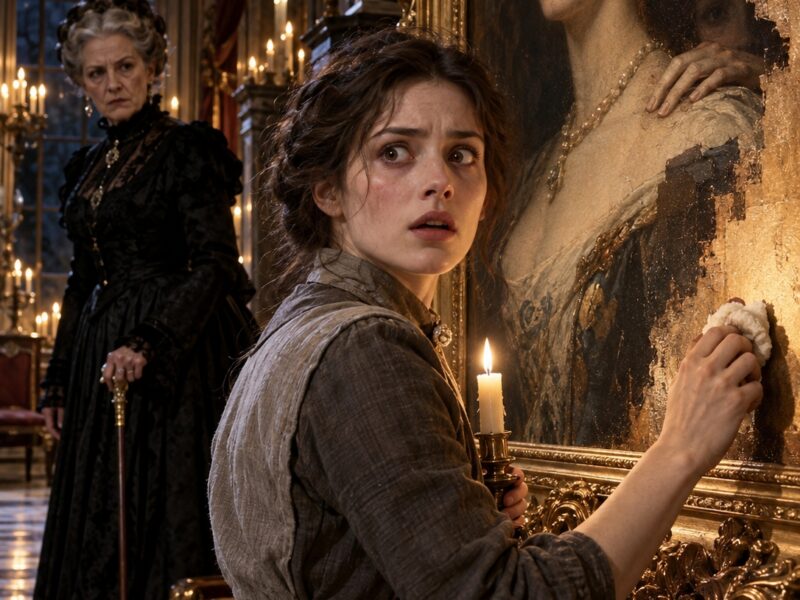
The first thing Eleanor Hayes uncovered was not a face.
It was four fingers.
Four pale, delicate fingers resting on the dead Duchess’s shoulder beneath twenty-six years of brown paint.
Eleanor froze.
The cotton swab slipped from her hand.
For several seconds, she could hear nothing except the winter storm beating against the tall windows of Blackthorne Hall.
Then a man’s voice came from behind her.
“What have you done to my mother?”
Eleanor turned.
Adrien Blackthorne stood in the gallery doorway, snow melting across the shoulders of his black coat.
He was staring at the portrait.
Not at Eleanor.
At those four impossible fingers.
His face had gone white.
“I didn’t do anything,” Eleanor whispered.
Adrien stepped toward her.
“You were hired to restore this portrait.”
“Yes.”
“Not alter it.”
“I haven’t.”
His eyes finally moved to hers.
“Then explain that.”
Eleanor looked back at the canvas.
Lady Catherine Blackthorne had been dead for twenty-six years.
For nearly as long, the official story had remained unchanged: the Duchess had betrayed her husband with the painter commissioned to paint her portrait. The scandal had destroyed the painter’s reputation. The Duchess had fallen ill soon afterward. Her young son had grown up believing his mother had chosen another man over her family.
And now someone else was appearing inside the painting.
Someone who had been deliberately erased.
Eleanor forced herself to breathe.
“This paint is newer than the original layer,” she said. “The pigment is different. The cracking is different. Even the brushwork is wrong.”
Adrien’s jaw tightened.
“What are you saying?”
“That someone painted over another person.”
Silence.
Eleanor lifted the candle closer.
The four fingers seemed almost alive beneath the flame.
“Your mother wasn’t alone when this portrait was painted.”
Adrien stared at them.
Then another voice cut through the gallery.
“You will stop immediately.”
Lady Beatrice Blackthorne stood in the doorway.
Adrien’s aunt was nearly seventy, dressed in black silk, one hand wrapped around the silver head of her cane.
But Eleanor noticed something she had never seen in the old woman before.
Fear.
Not anger.
Not outrage.
Fear.
And in that instant, Eleanor understood something that made her blood run cold.
Lady Beatrice already knew who was beneath the paint.
What Eleanor did not yet understand was that she knew the woman too.
She had known her all her life.
She simply remembered her from a different portrait.
A tiny miniature kept inside a gold locket.
The face of her dead mother.
And that discovery had begun weeks earlier, in a freezing room above a picture framer’s shop in London.
The winter of 1821 had arrived quietly.
Snow settled across Long Acre while Eleanor sat beside a weak fire, wrapped in her father’s old wool cloak, restoring a landscape nobody important remembered.
She was twenty-five and poor enough to count candles before lighting them.
Her fingers were stiff from the cold, but they never shook when she worked.
That was something Henry Hayes had taught her.
Patience before talent.
Observation before assumption.
Truth before beauty.
Her father had once been one of England’s most promising portrait painters.
Eleanor remembered fragments from childhood: expensive carriages outside their rooms, letters sealed with noble crests, ladies arriving in silk, gentlemen discussing commissions over brandy.
Then it had all stopped.
Almost overnight.
No more commissions.
No more aristocratic visitors.
No explanation.
Henry put away his finest brushes and began repairing damaged paintings for dealers who paid late and complained often.
Whenever Eleanor asked what had happened, he gave her the same answer.
“Some doors close, Nell.”
“Why?”
“Because people would rather protect a lie than admit they were wrong.”
She had been too young to understand.
So he taught her instead.
How to clean smoke without disturbing glaze.
How to distinguish original varnish from later varnish.
How to mend torn canvas.
How to recognize the hand of a painter even when his signature was gone.
And, most importantly, how to look.
“A painting remembers,” Henry often told her. “People paint over things. They cut canvases down. They change faces. They hide mistakes.”
Then he would tap her gently between the eyebrows.
“But if you know how to look, Nell, the painting remembers everything.”
Her mother, Rose, had died when Eleanor was four.
Eleanor remembered almost nothing about her.
Only warmth.
A voice humming.
Brown hair near her cheek.
Everything else came from two objects.
The first was a gold locket containing Rose’s miniature.
Soft brown eyes.
A small mole near her mouth.
A quiet smile.
The second was a pearl brooch shaped like forget-me-nots.
Eleanor wore it every day.
Two winters before the letter from Blackthorne arrived, Henry died.
His final hours had been filled with fever.
Eleanor sat beside him, holding his hand while the fire faded.
Near midnight, he suddenly gripped her fingers with surprising strength.
“It’s safe,” he whispered.
“What is?”
“I kept it safe.”
His eyes moved somewhere beyond her.
“Behind her.”
“Behind who, Papa?”
“Rose…”
“Papa?”
But Henry never answered.
He died before morning.
For two years, those words followed Eleanor.
Behind her.
Then Walter Finch climbed the stairs to Eleanor’s room carrying a letter sealed with dark red wax.
“The Duke of Blackthorne requires a restorer.”
Eleanor looked up.
Walter had been Henry’s oldest friend and one of the few dealers willing to give his daughter serious work.
“A Duke?”
“There was a chimney fire at Blackthorne Hall. Smoke damaged a family portrait.”
“And they asked for me?”
Walter polished his spectacles.
“They asked for E. Reed.”
Eleanor stared at him.
E. Reed was the name under which she worked professionally.
Reed had been her mother’s maiden name.
The initial concealed the rest.
Clients who would never trust a twenty-five-year-old woman with an important canvas were surprisingly comfortable trusting a mysterious Mr. E. Reed.
“Walter.”
“Yes?”
“They think I’m a man.”
“A small misunderstanding.”
“You told a Duke I was a man.”
“I allowed him to arrive at an inaccurate conclusion.”
Eleanor almost laughed.
Then Walter told her the fee.
Two hundred guineas.
The room went silent.
That amount could change her life.
She could pay what she owed.
Buy proper materials.
Stop deciding whether food or heat mattered more.
“There is another problem,” Walter said.
“Beyond impersonating a gentleman?”
“Blackthorne Hall.”
Something in his voice changed.
Eleanor noticed.
“What about it?”
Walter looked toward the window.
“Your father knew that family.”
Her heart skipped.
“How?”
“I don’t know enough to tell you.”
“You do know something.”
“I know Henry never wished to speak of them.”
That night Eleanor opened the battered wooden box that had sat beneath her father’s bed for as long as she could remember.
Inside were old letters tied with string.
Some were written by Henry.
Others were in unfamiliar hands.
She had never read them.
Grief had made them feel private.
Now, without understanding why, she packed them beneath her clothes.
Four days later, her coach entered North Yorkshire.
By then the world had become white.
Blackthorne Hall appeared after sunset.
It rose from the snow like something carved from the hillside—gray stone, black windows, towering chimneys.
Eleanor pressed her hand to the coach glass.
It did not look like a home.
It looked like a place where something terrible had happened and everyone had agreed not to mention it.
Mrs. Bennett met her on the steps.
“You’ll be Mr. Reed?”
Eleanor stepped into the candlelight.
“I’m afraid there has been a misunderstanding.”
The housekeeper looked at her.
And dropped the candle nearly an inch.
Wax spilled across her hand.
She did not react.
Her eyes were fixed on Eleanor’s face.
“Mrs. Bennett?”
The older woman swallowed.
“Forgive me.”
“Is something wrong?”
“No.”
But she continued staring.
“You remind me of someone.”
“Who?”
Mrs. Bennett looked suddenly frightened.
“Someone who died a very long time ago.”
She refused to say more.
Inside, Eleanor received an even colder welcome.
Lady Beatrice looked from Eleanor’s worn boots to the old cloak around her shoulders.
“A woman.”
The contempt in her voice needed no explanation.
Walter had apparently arrived earlier to make introductions.
Lady Beatrice turned toward her nephew.
“Send her back.”
Eleanor’s face burned.
“She has traveled four days,” Walter protested.
“She can travel four more.”
“Your aunt,” Eleanor said quietly, “appears to have completed her assessment before seeing my work.”
Lady Beatrice’s eyebrows rose.
The man standing near the window turned.
That was Eleanor’s first real look at Adrien Blackthorne.
He was thirty-five, perhaps thirty-six.
Tall.
Dark-haired.
Gray-eyed.
His face was handsome in a severe way, but there was something closed about him.
As if every emotion had been placed behind a locked door.
He studied Eleanor.
“What would you do,” he asked, “if smoke had penetrated old varnish?”
Lady Beatrice frowned.
“Adrien—”
He raised one hand.
Eleanor answered.
“I would do almost nothing.”
His eyebrow lifted.
“Explain.”
“I would study the painting under daylight, candlelight, and reflected light. I would test the varnish in an area no one notices. Then I would remove the contamination one layer at a time.”
“And if that takes months?”
“Then it takes months.”
“You wouldn’t use a stronger solvent?”
“No.”
“Why?”
“Because a painting is not a tablecloth, Your Grace.”
Walter coughed into his hand.
Adrien’s mouth moved slightly.
Almost a smile.
Eleanor continued.
“You cannot force an old painting to surrender what is covering it. You persuade it.”
Adrien considered her.
“One week.”
Lady Beatrice struck her cane against the floor.
“This is absurd.”
“One week,” Adrien repeated. “If I am dissatisfied, Miss Reed will be paid for her journey and return to London.”
The next morning he took Eleanor to the long gallery.
That was where she met his mother.
Lady Catherine Blackthorne stood inside a large portrait wearing blue silk and sapphires.
Smoke had dulled the entire surface.
But even beneath the damage, Eleanor could see extraordinary workmanship.
Then she noticed something peculiar.
Lady Catherine was not looking toward the viewer.
Her eyes were turned slightly left.
Toward a shapeless brown area beside her shoulder.
“What is she looking at?” Eleanor asked.
Adrien went still.
“I never noticed.”
He stepped closer.
For several moments, neither spoke.
Then he said, “She died when I was nine.”
Eleanor looked at him.
“I remember her voice better than her face.”
His expression remained controlled, but his next words did not.
“Can you give her back to me?”
Something inside Eleanor softened.
“I’ll try.”
That afternoon she began testing the lower corner.
Smoke came away.
Then varnish.
Then, beneath both, a tiny painted bird emerged.
A brown sparrow.
Eleanor stopped breathing.
She knew that bird.
Henry Hayes had painted the same tiny sparrow into the corners of the pictures he loved most.
It was not a public signature.
It was his private mark.
Eleanor leaned closer.
There was no mistake.
Her father had painted the Duchess of Blackthorne.
And he had never told her.
At supper that evening, a young footman named Tom provided the second piece of the mystery.
“That painting’s cursed.”
Mrs. Bennett stiffened at the opposite end of the servants’ table.
Tom did not notice.
“The painter had an affair with the Duchess.”
Eleanor’s spoon stopped halfway to her mouth.
“What?”
“Old story. The Duke caught them. Threw the painter off the estate in the middle of winter. Duchess took ill afterward. Died not long later.”
The spoon slipped from Eleanor’s fingers.
It struck the plate.
Everyone looked at her.
Tom lowered his voice.
“Some say she died of shame.”
“That is enough.”
Mrs. Bennett stood in the doorway.
Her expression was furious.
“Lady Catherine was the finest woman who ever lived beneath this roof. I will not hear her memory dragged through a kitchen by boys born years after her death.”
Tom stared down.
Mrs. Bennett’s eyes moved to Eleanor.
For one long moment, something passed between them.
Recognition.
Warning.
Perhaps pity.
Then she walked away.
That night Eleanor did not sleep.
Her father had painted the portrait.
Her father had been accused of sleeping with Lady Catherine.
Her father’s career had collapsed at exactly the same time.
And Mrs. Bennett had recognized Eleanor the moment she arrived.
By dawn, Eleanor knew what she should do.
Tell Adrien everything.
Instead, she told him nothing.
It was the first lie between them.
And perhaps the most dangerous.
She convinced herself it was temporary.
She needed proof.
If she revealed that she was Henry Hayes’s daughter, Adrien would dismiss her.
Then whatever truth had been buried inside Blackthorne Hall would remain buried.
So she stayed.
And the painting slowly came back to life.
Blue returned to Catherine’s dress.
Pearls appeared beneath soot.
Skin regained warmth.
Every evening Adrien came to the gallery.
At first he merely watched.
Then one night he brought two cups of tea.
Eleanor looked at them.
“Is one poisoned?”
“Only if Mrs. Bennett has finally grown tired of me.”
She smiled despite herself.
Adrien handed her a cup.
“It is the quietest hour in this house.”
“And?”
“I thought you might permit me to share it.”
It became a ritual.
Tea.
Firelight.
Snow beyond the windows.
At first they discussed painting.
Then books.
Then childhood.
Then things neither had intended to reveal.
Eleanor told him about her father without using Henry’s name.
“He made me paint the same apple every morning for a month.”
Adrien looked amused.
“Was he cruel?”
“Terribly.”
“What was the lesson?”
“That I had not actually looked at the apple.”
Adrien laughed softly.
Eleanor had never heard him laugh before.
“He said painters lie when they paint what they expect to see instead of what is really there.”
“What else did he teach you?”
Eleanor looked toward Catherine’s portrait.
“To be honest about ugly things.”
Adrien’s smile faded.
“That sounds difficult.”
“It is.”
“Was he a good man?”
Her chest tightened.
“The best I knew.”
Adrien nodded.
“He sounds honorable.”
The word almost broke her.
Because she knew exactly what would happen if Adrien learned his name.
One evening he asked about her mother.
“I barely remember her,” Eleanor admitted.
“Neither do I.”
“You were nine.”
“Sometimes nine isn’t enough.”
He stared into the fire.
Then he told her something he had apparently never told anyone.
“My mother sang to me every night.”
Eleanor remained silent.
“Scottish songs. Terrible old things about soldiers dying in valleys.”
His mouth almost smiled.
“Then she stopped.”
“Because she became ill?”
“That was what I was told.”
He looked down at his tea.
“For months, I stood outside her door at night.”
Eleanor’s throat tightened.
“I thought if I waited long enough, she might ask for me.”
“She never did?”
“No.”
His answer was barely audible.
“My aunt said my mother did not wish to see me.”
Eleanor looked toward the doorway instinctively.
Adrien continued.
“When she died, my father told me she had betrayed him with the man who painted that portrait.”
The fire cracked.
“I was nine years old when my father taught me that love makes fools of people.”
He looked directly at Eleanor.
“He said love is a door you leave unlocked. Eventually someone walks through it and destroys you.”
Eleanor could barely breathe.
The man sitting beside her had spent twenty-six years hating her father.
And yet she had never felt closer to anyone.
That was when she should have told him.
She opened her mouth.
Then fear closed it again.
A few days later, Adrien mentioned his engagement.
Eleanor thought she had misheard.
“I am to marry Lady Florence Whitmore in the spring.”
Something painful tightened beneath Eleanor’s ribs.
“I see.”
“Our estates border each other.”
“How romantic.”
He looked at her.
“That was sarcasm.”
“Was it?”
“Yes.”
She concentrated on her brushes.
“Do you love her?”
The question escaped before she could stop it.
Adrien was quiet.
“No.”
Eleanor looked up.
“I am not looking for love.”
He said it calmly.
“I want honesty. Stability. A marriage in which neither person humiliates the other.”
He looked toward his mother’s portrait.
“That will be enough.”
But Eleanor understood what he was really saying.
He did not want a marriage.
He wanted protection from betrayal.
Then he told her something else.
“My aunt wanted this painting burned after the fire.”
Eleanor turned.
“What?”
“She said it was beyond saving.”
“But you refused.”
“I wanted my mother’s face.”
Eleanor looked toward the strange brown patch beside Catherine.
Suddenly it bothered her more than ever.
Why would Lady Beatrice want the painting destroyed?
Why did Catherine appear to be looking at empty darkness?
Why would a painter as skilled as Henry Hayes leave such an ugly, lifeless section in the center of his composition?
Two days later, Eleanor tested it.
The brown pigment came away far too easily.
Then she found the fingers.
Adrien found her seconds later.
Lady Beatrice arrived moments after him.
And when Adrien ordered Eleanor to continue uncovering the hidden figure, the old woman lost control.
“No.”
Adrien turned.
“No?”
“That portrait belongs to this family.”
“It belongs to me.”
Lady Beatrice’s face hardened.
“Your father ordered it left as it is.”
“My father is dead.”
“Adrien.”
For the first time, something almost violent entered his voice.
“Someone was removed from my mother’s portrait.”
His aunt’s grip tightened around her cane.
“I intend to know who.”
Eleanor watched Lady Beatrice.
And saw terror.
For six days, Eleanor worked on the hidden figure.
A hand appeared.
Then an arm.
A gray wool sleeve.
Brown hair.
A slender young woman.
As she emerged, the emotional meaning of the entire portrait changed.
Catherine had never been staring sadly into empty darkness.
She had been looking at the woman beside her.
And she was smiling.
Not the formal smile of a Duchess sitting for posterity.
A warm smile.
A private smile.
The expression one person gives another when affection requires no performance.
Adrien stood before it for a long time.
“My mother is smiling.”
Eleanor looked at him.
“I had forgotten.”
He swallowed.
“I had forgotten she smiled like that.”
The following afternoon, Eleanor began cleaning the hidden woman’s face.
Brown eyes appeared.
Then a small mouth.
Then a tiny mole.
Eleanor stopped.
Her heart began pounding.
“No.”
She cleaned another inch.
At the woman’s collar appeared a pearl brooch.
Forget-me-nots.
Eleanor’s fingers flew to her own throat.
She tore open her locket.
Looked at the miniature.
Looked at the canvas.
The same eyes.
The same mouth.
The same mole.
Her knees gave way.
The woman erased from Catherine Blackthorne’s portrait was Rose Reed Hayes.
Her mother.
Adrien found Eleanor sitting on the floor.
He rushed toward her.
“Eleanor?”
It was the first time he had used her Christian name.
“Are you hurt?”
She looked at him through tears.
Everything had ended.
She knew it.
There could be no more waiting.
No more E. Reed.
No more pretending.
“Adrien, I need to tell you who I am.”
The gallery doors opened.
Lady Beatrice entered carrying a bundle of letters.
Eleanor recognized them instantly.
Her father’s letters.
They had been taken from her trunk.
Lady Beatrice smiled.
“Perhaps I should tell him.”
Adrien slowly stood.
“What is this?”
“Ask your restorer her name.”
Eleanor’s blood went cold.
Lady Beatrice held up one of Henry’s letters.
“She is not E. Reed.”
Adrien looked at Eleanor.
“She is Eleanor Hayes.”
Nothing moved.
“The daughter,” Lady Beatrice continued, “of Henry Hayes.”
Adrien’s expression changed.
It was not rage.
That would have been easier.
It was hurt.
Pure, immediate hurt.
Lady Beatrice pressed harder.
“She came into your house under a false name. She concealed her connection to the man accused of destroying your mother. Now, conveniently, she discovers her own mother hidden inside the portrait.”
“That is a lie,” Eleanor said.
Lady Beatrice turned.
“Is your name Eleanor Hayes?”
“Yes.”
“Was Henry Hayes your father?”
“Yes.”
“Did you conceal that from my nephew?”
Eleanor looked at Adrien.
“Yes.”
The word seemed to travel across the gallery like a bullet.
“But I never altered the portrait.”
Adrien said nothing.
“You watched me remove the overpaint,” Eleanor continued. “You know that woman was already there.”
Still nothing.
“I didn’t know my father had painted your mother until I found his mark.”
“You knew.”
His voice was quiet.
“Adrien—”
“You knew who your father was while I sat beside you.”
Eleanor stepped toward him.
“I was afraid.”
“Night after night.”
His voice cracked.
“You listened while I told you about my mother.”
“I wanted to tell you.”
“When?”
“I needed proof.”
“Proof of what?”
“That my father wasn’t the man you believed.”
“And what was I?”
Eleanor stopped.
Adrien’s eyes were shining now.
“Was I evidence too?”
“No.”
“Something to study?”
“No.”
“Another layer to remove?”
“Adrien, please.”
He looked at her as if every vulnerable thing he had shared had become dangerous.
His father’s voice seemed alive inside him again.
Love is an unlocked door.
Someone will walk through it.
Someone always does.
“You will leave tomorrow morning.”
Eleanor’s face went still.
“You’ll be paid in full.”
“Adrien—”
“You will not touch my mother’s portrait again.”
He turned.
“Adrien.”
He stopped.
Not Your Grace.
Just his name.
Broken in the middle.
His shoulders tightened.
For one impossible second, Eleanor believed he might turn around.
He did not.
He walked away.
Lady Beatrice watched him go.
Then she looked at Eleanor.
There was triumph in her eyes.
But beneath it was something else.
Fear.
Still fear.
That night Eleanor packed.
Two dresses.
Her brushes.
Her mother’s locket.
The pearl brooch.
The empty space where Henry’s letters had been.
She did not cry.
Some pain is too large for tears.
Near midnight, someone knocked.
Mrs. Bennett stood outside.
Her eyes were red.
“There is something you must know before you leave.”
Eleanor let her inside.
Mrs. Bennett sat on the bed.
“I knew your mother.”
Eleanor stopped breathing.
“Rose and Lady Catherine were as close as sisters.”
Mrs. Bennett clasped her hands.
“And your father never loved Lady Catherine.”
Eleanor stared at her.
“Not for one day.”
“Then why—”
“Because the entire scandal was a lie.”
The truth came slowly.
Rose had been the village vicar’s daughter.
Catherine had grown up beside her.
When Catherine married the Duke and moved into Blackthorne Hall, she asked Rose to become her companion.
Then Henry Hayes arrived to paint Catherine.
He met Rose.
They fell in love.
Catherine helped them hide it because Rose’s father refused to let his daughter marry a poor painter.
She carried letters between them.
She protected them.
And Lady Beatrice saw everything.
“She wanted your father,” Mrs. Bennett whispered.
Eleanor felt cold.
“Lady Beatrice?”
“She offered him marriage.”
“And he refused.”
“Yes.”
“For my mother.”
Mrs. Bennett nodded.
Lady Beatrice’s humiliation became hatred.
One afternoon she found a love letter from Henry inside Catherine’s desk.
It did not contain Rose’s name.
Lady Beatrice carried it to her brother and claimed Henry was sleeping with Catherine.
The old Duke believed her.
Henry was thrown off the estate.
Rose was sent away.
Catherine was condemned without being allowed to defend herself.
Henry and Rose found each other in London and married.
But Henry’s career never recovered.
“And Catherine?” Eleanor whispered.
Mrs. Bennett’s face crumpled.
“She became ill.”
Consumption.
Month by month, she weakened.
Lady Beatrice took control of the sickroom.
“She told young Adrien that his mother did not want him.”
Eleanor covered her mouth.
“And she told Catherine that Adrien refused to visit.”
“No.”
“I tried to carry a note between them. Lady Beatrice found it. I was dismissed.”
Mrs. Bennett began crying.
“Catherine died believing her son no longer wanted her.”
Eleanor thought of the little boy Adrien had described.
Standing outside his mother’s door.
Waiting.
“And the portrait?”
“Another painter was ordered to finish it.”
Mrs. Bennett’s voice hardened.
“Lady Beatrice made him paint Rose out.”
Eleanor looked toward the floor.
Twenty-six years.
One lie had destroyed Henry’s career.
Separated Rose from her home.
Broken Catherine’s marriage.
Stolen a dying mother from her child.
And taught that child to fear love.
Then Mrs. Bennett said something else.
“The night your father was expelled, Catherine came to the stable.”
Eleanor looked up.
“She gave Henry a packet wrapped in oilcloth.”
“What packet?”
“I never knew.”
Mrs. Bennett hesitated.
“She told him to keep it hidden with the painting.”
Eleanor stopped moving.
Her father’s dying voice returned.
It’s safe, Eleanor.
I kept it safe behind her.
Not behind a woman.
Behind the portrait.
Mrs. Bennett placed an iron key into Eleanor’s hand.
“The gallery.”
Adrien had forbidden her to touch the painting.
By morning she was supposed to be gone.
Eleanor took the key anyway.
Minutes later she crossed the frozen corridors carrying one candle.
The gallery was black.
She unlocked it.
Catherine and Rose stood together inside the portrait.
Two women reunited after twenty-six years beneath a lie.
“Forgive me,” Eleanor whispered.
She turned the enormous canvas around.
Her fingers searched the wooden stretcher.
Nothing.
Then—
A narrow strip of linen.
Hand-sewn.
Her heart stopped.
She knew those stitches.
Henry had repaired the hems of her childhood dresses exactly that way.
Eleanor cut them carefully.
Behind the linen was an oilcloth packet tied with faded blue ribbon.
She pulled it free.
Light flooded the gallery.
“Give that to me.”
Lady Beatrice stood in the doorway.
She carried an oil lamp.
Eleanor pressed the packet against her chest.
“No.”
“I have searched for that for twenty-six years.”
Lady Beatrice stepped forward.
“I had men search Henry Hayes’s rooms after the scandal.”
Her voice began to shake.
“And all this time…”
She laughed.
A terrible sound.
“…it was inside my own house.”
“You destroyed them.”
Eleanor’s voice was barely audible.
Lady Beatrice’s composure finally shattered.
“I offered him everything.”
“Henry?”
“My name. My fortune. Myself.”
Tears filled the old woman’s eyes.
“And he chose her.”
She pointed toward Rose.
“A vicar’s daughter with one decent dress.”
“You ruined his life because he didn’t love you?”
“I loved him!”
“That isn’t love.”
Lady Beatrice flinched.
Eleanor continued.
“You punished everyone because you could not possess one man.”
“Be silent.”
“You stole Catherine’s son.”
“Be silent!”
“You let a dying mother believe her child hated her.”
Lady Beatrice raised the lamp.
“You know nothing!”
Then she threw it.
Eleanor moved without thinking.
The lamp struck her shoulder and shattered.
Oil spread across the floor.
Fire raced toward the portrait.
Eleanor ripped off her shawl.
Flames climbed the dust sheet.
She beat at them.
They rose higher.
So she used her hands.
Bare hands.
Pain exploded through her palms.
But Eleanor stayed between the fire and the canvas.
She had lost her mother.
She had lost her father.
She would not let the last truthful image of them burn.
The gallery doors crashed open.
Adrien ran inside.
He threw his coat over the flames.
Mrs. Bennett followed with water.
Seconds later the fire died.
Adrien grabbed Eleanor.
Then saw her hands.
“Dear God.”
Her skin was blistered and raw.
But Eleanor looked past him.
“The painting.”
“What?”
“Are they safe?”
Adrien stared at her.
Then at the canvas.
“The frame is burned.”
Eleanor stopped breathing.
“But the canvas is whole.”
Her eyes closed.
“They’re safe.”
“Yes.”
“They’re both safe.”
Only then did Eleanor allow herself to collapse against him.
Adrien caught her.
She pulled the oilcloth packet from beneath her dress.
“This belonged to your mother.”
Adrien stared at it.
“My father protected it for twenty-six years.”
He untied the ribbon.
Inside were three documents.
The first was a letter written by Lady Beatrice.
A declaration of love to Henry Hayes.
A proposal of marriage.
The second was Henry’s sworn statement, witnessed by a local curate.
It documented his relationship with Rose.
Catherine’s assistance.
Beatrice’s proposal.
His refusal.
And the accusation that followed.
But the third document silenced everyone.
A sealed letter.
Across the front, in Catherine’s handwriting, were six words:
To my son Adrien, when grown.
Adrien stared at it.
The mother he believed had rejected him had written to him.
And for twenty-six years, the letter had waited behind her portrait.
By dawn, they were gathered in the library.
Mrs. Bennett bandaged Eleanor’s hands.
Lady Beatrice sat opposite them.
Adrien opened his mother’s letter.
At first his face revealed nothing.
Then it changed.
Catherine wrote that she had never betrayed her husband.
That Rose and Henry had loved one another.
That she had tried to help them.
Then she wrote about Adrien.
Her little boy.
Every morning during her illness, she had stood at the window and watched him ride his pony across the snowy grounds.
He thought she did not want him.
She thought he refused to come.
Neither knew they were being lied to.
Catherine wrote that watching him through the glass was the happiest part of her final days.
Adrien stopped reading.
His hands shook.
Then he forced himself onward.
Near the end was one final request.
If he ever met Rose and Henry’s child, Catherine hoped he would show kindness.
They had been the truest friends she had known.
And her final words to her son were simple.
Do not be afraid of love, Adrien. It is not a lie. It is the only true thing there is.
Adrien bowed his head.
For twenty-six years, he had believed his mother stopped loving him.
For twenty-six years, he had built his life around that wound.
Now he learned she had been standing behind glass, watching him.
Waiting for him.
Loving him.
His shoulders began to shake.
Eleanor moved beside him.
Her hands were bandaged.
She could not embrace him.
So she rested her head against his shoulder.
Adrien did not move away.
Across the room, Lady Beatrice whispered, “I was jealous.”
Adrien lifted his head.
“I told myself I was protecting the family.”
“No.”
His voice was calm.
“You destroyed it.”
Lady Beatrice closed her eyes.
“You took the last year of my mother’s life.”
Her face tightened.
“You stood between her door and a nine-year-old boy.”
Adrien’s voice broke.
“And you let us both believe the other had chosen to stay away.”
Lady Beatrice said nothing.
“There is no apology that can return those nights.”
He stood.
“You will leave Blackthorne Hall today.”
She looked up.
“There is a house in Harrogate. You will have servants and an allowance. You will want for nothing.”
His face hardened.
“But you will never live beneath this roof again.”
Lady Beatrice rose slowly.
At the doorway, she looked toward Eleanor’s bandaged hands.
For the first time, the old woman appeared small.
“I am sorry.”
Eleanor did not answer.
Some apologies arrive after forgiveness has ceased to be an obligation.
Lady Beatrice left.
When they were alone, Adrien knelt before Eleanor.
“I was wrong.”
She looked at him.
“You had reasons not to trust me.”
“No.”
He shook his head.
“I had reasons to be hurt. That is not the same thing.”
He touched the edge of her bandage carefully.
“My family turned your father’s name into something shameful. You came here knowing what we believed about him.”
“I should have told you.”
“Yes.”
Eleanor lowered her eyes.
“I wanted you to know me before you hated my name.”
Adrien absorbed that.
Then said quietly, “And I wanted never to love anyone because I believed love always ended in betrayal.”
Their eyes met.
“Perhaps we were both cowards.”
A faint smile touched her mouth.
“Speak for yourself, Your Grace.”
He almost laughed.
Then he asked what she wanted.
Money?
A studio?
A position?
Eleanor looked toward the gallery.
“Let me finish them.”
Adrien understood.
“My mother and yours.”
“Yes.”
He nodded.
“Finish them.”
For nearly two weeks, Eleanor could not hold a brush.
So Adrien became her hands.
Under her direction, the Duke of Blackthorne sat before his mother’s portrait holding cotton swabs like dangerous instruments.
“Gently,” Eleanor warned.
“I am being gentle.”
“You are scrubbing.”
“I am not.”
“You are cleaning a Duchess as though she were a boot.”
Adrien looked offended.
Then Eleanor laughed.
And, unexpectedly, so did he.
The sound filled the gallery.
Mrs. Bennett stopped in the corridor when she heard it.
She had worked in Blackthorne Hall for decades.
She could not remember the last time laughter had come from that room.
As Eleanor healed, so did the portrait.
And perhaps so did something else.
One morning Adrien saddled his horse.
“Where are you going?”
“To see Lady Florence.”
Eleanor’s stomach tightened.
He rode away.
She watched from the gallery window until he disappeared.
Hours passed.
When he returned, the setting sun had turned the snow gold.
He found Eleanor beside the portrait.
“Lady Florence and I have ended our engagement.”
Eleanor’s heart leapt.
Then guilt followed.
“Is she devastated?”
Adrien smiled.
“She cried.”
Eleanor looked down.
“With relief.”
She blinked.
“She has loved a naval officer for three years.”
Eleanor stared.
“Her family was forcing her into our marriage.”
Adrien removed his gloves.
“It seems neither of us was particularly enthusiastic.”
Eleanor laughed softly.
Adrien did not declare his love.
He did not kiss her.
He did not ask her to remain.
And that restraint meant more to Eleanor than any grand gesture could have.
He had spent his life believing love was possession followed by betrayal.
Now he was learning something different.
Love could also mean allowing someone to choose.
The engagement ball went ahead.
But its purpose changed.
The county’s most powerful families arrived expecting an announcement.
Instead, Adrien gathered them in the gallery.
A blue velvet curtain covered Catherine’s portrait.
Walter Finch stood among the guests.
Beside him was the elderly rector who, as a young curate, had witnessed Henry Hayes’s statement.
Eleanor waited at the back.
She wore the best gray dress she owned.
Her burns had healed enough that the bandages were gone.
Rose’s forget-me-not brooch rested at her throat.
Adrien stepped forward.
“A wrong was committed in this house twenty-six years ago.”
Conversation stopped.
“An innocent man lost his reputation.”
Several guests exchanged glances.
“A young woman was erased from a painting as if she had never existed.”
Adrien’s voice remained steady.
“And my mother was accused of betraying her husband.”
The room became utterly silent.
“She died without being allowed to defend herself.”
He placed one hand on the curtain.
“Tonight, I intend to return what was taken from them.”
He pulled.
The velvet fell.
A gasp moved through the gallery.
Lady Catherine stood in blue silk.
Beside her stood Rose in gray wool.
The Duchess was smiling at her friend.
For the first time in twenty-six years, the painting was whole.
“This portrait was painted by Henry Hayes.”
Murmurs began.
Adrien raised his voice.
“A man of extraordinary talent and greater honor, whose name was destroyed beneath this roof.”
Eleanor’s eyes filled.
“The woman beside my mother is Rose Hayes.”
He paused.
“Her dearest friend.”
Then Adrien looked across the room.
“And the woman who restored this painting…”
Every head turned.
“…is their daughter.”
He held out his hand.
“Miss Eleanor Hayes.”
For a second, she could not move.
Walter leaned toward her.
“Go.”
She looked at him.
His eyes were wet.
“Your father would be proud.”
Eleanor walked forward.
Months earlier, noble families would have passed her in a corridor without seeing her.
Now they watched.
Adrien took her hand.
Applause began somewhere near the back.
Then spread.
Eleanor looked toward the little sparrow in the corner of the portrait.
For one impossible moment, she could almost hear Henry.
A painting remembers.
Later, after the final carriage departed, Eleanor returned to the gallery alone.
Adrien found her there.
She was looking at Rose.
“I spent twenty-six years becoming the man my father taught me to be,” he said.
Eleanor turned.
“Was he wrong about everything?”
“Not everything.”
Adrien smiled faintly.
“But he was wrong about the thing that mattered most.”
He looked at Catherine.
“I thought keeping people out made me strong.”
“And did it?”
“It made me alone.”
He stepped closer.
“My mother told me not to be afraid of love.”
Eleanor’s pulse quickened.
“I am still afraid.”
She smiled sadly.
“So am I.”
Adrien took her healed hands.
“Then perhaps fear is not a reason to run.”
“No.”
“It may simply be something two people carry together.”
Eleanor looked down at their hands.
Adrien drew a breath.
“I would rather be afraid beside you than safe without you.”
Her eyes filled.
“Eleanor Hayes…”
He paused.
Not because he was uncertain.
Because after everything his family had taken from hers, he understood the weight of asking.
“Will you marry me?”
Eleanor laughed through her tears.
“I repair paintings for a living.”
“I am aware.”
“People will talk.”
“They already do.”
“I have no fortune.”
“I have enough.”
“I am stubborn.”
“That may be the first completely honest thing you ever told me.”
She hit his arm lightly.
Adrien smiled.
Then his expression softened.
“I love your courage.”
Eleanor became still.
“I love your inconvenient honesty. I love that you see what other people refuse to see.”
His thumb moved gently over the scar on her palm.
“And I love the woman who put her hands into fire to save the last image of two mothers.”
Eleanor looked toward Catherine and Rose.
Then back at him.
“Yes.”
They married in the small stone church in the valley.
Mrs. Bennett cried from the first hymn.
Walter Finch walked Eleanor down the aisle.
When Adrien saw her, something changed in his face so completely that the servants spoke of it for years afterward.
Blackthorne Hall changed too.
Not quickly.
Houses carry grief longer than people expect.
But doors once kept closed began opening.
Rooms were warmed.
Music returned.
Children eventually ran through corridors where silence had once ruled.
One year later, a new portrait appeared in the long gallery.
It showed Adrien and Eleanor with their infant daughter, Margaret Rose, sleeping in Eleanor’s arms.
Eleanor had painted it herself.
At her throat was Rose’s pearl forget-me-not brooch.
In the lower corner of the canvas sat a small brown sparrow.
Henry Hayes’s mark.
Beside it was another.
Smaller.
Painted by Eleanor.
Two sparrows on the same branch.
Father and daughter.
Memory and truth.
The old portrait hung beside it.
Catherine in blue.
Rose in gray.
Still smiling at each other after everything that had tried to separate them.
Sometimes Eleanor would stand between those two paintings late in the afternoon, when winter light turned the gallery windows silver.
She would think about the strange cruelty of what had happened.
A woman had been erased beneath brown paint.
A painter had been erased beneath scandal.
A mother had been erased from her son’s heart by a lie whispered through a closed door.
And yet none of them had disappeared completely.
Truth had survived in ridiculous little places.
A pearl brooch.
A brown sparrow.
A few hidden letters.
Four pale fingers beneath a layer of paint.
And the final words of a dying mother who had refused to let hatred speak for her forever.
Years later, when Margaret Rose was old enough to ask about the two women in the portrait, Eleanor told her everything.
Not the beautiful version.
The true version.
Because that was what Henry Hayes had taught her.
A painter must be honest about what she sees.
Especially when the truth is not beautiful.
Margaret listened solemnly.
Then she pointed toward the two sparrows.
“Why are there two?”
Eleanor smiled.
“One was painted by your grandfather.”
“And the other?”
“By me.”
The child considered this.
Then looked at the older portrait.
“Did Grandfather know you would find it?”
Eleanor’s smile faded.
She thought about Henry’s final night.
His hand tightening around hers.
His failing voice.
I kept it safe behind her.
“No,” Eleanor whispered.
“I don’t think he knew.”
Margaret frowned.
“Then why did he hide it?”
Eleanor looked across the gallery.
Adrien stood near the doorway.
Older now.
Silver beginning at his temples.
But his gray eyes were no longer cold.
He smiled at her.
Eleanor finally understood the answer.
“Because sometimes,” she told her daughter, “you protect the truth even when you may never live long enough to see it believed.”
Outside, snow began falling over Blackthorne Hall.
Softly.
Quietly.
Just as it had twenty-six years before, when a young painter was driven into the darkness carrying a packet that could clear his name.
Henry Hayes had lost his reputation.
Catherine Blackthorne had lost her final year with her son.
Rose had been painted out of history.
Adrien had lost twenty-six years believing his mother had stopped loving him.
None of that could be returned.
Truth does not undo suffering.
It does not give the dead another morning.
It does not place a nine-year-old boy back outside his mother’s door and allow him to open it.
But truth can stop a lie from claiming another generation.
And perhaps that was why Eleanor continued restoring paintings long after she became Duchess of Blackthorne.
Not because old canvases were valuable.
Not because wealthy families paid well.
But because she understood something most people never did.
What is hidden is not always gone.
What is silenced is not always forgotten.
And what has been painted over can sometimes survive for years in darkness, waiting beneath the surface.
Waiting for patient hands.
Waiting for courage.
Waiting for someone willing to look closely enough.
That winter evening, Eleanor stood before the portrait and touched the pearl flowers at her throat.
Catherine smiled toward Rose.
Rose remained beside her.
Neither woman could be erased again.
Adrien came behind Eleanor and slipped his hand into hers.
Their daughter laughed somewhere down the corridor.
Eleanor listened.
Once, Blackthorne Hall had been a house where a little boy stood outside a locked door waiting for a mother who was waiting for him on the other side.
Now the doors were open.
And the house was full of voices.
Eleanor looked once more at the two tiny sparrows resting together in the corner of the newer painting.
Then she extinguished the gallery lamps one by one.
The portraits disappeared gradually into darkness.
But just before the final flame went out, the light caught the old Duchess’s face.
And for one brief second, Catherine Blackthorne seemed almost alive.
Still smiling.
Still looking toward the friend someone had tried to remove from her story.
Still proving, after all those years, that love could be hidden.
It could be slandered.
It could be buried beneath twenty-six years of darkness.
But it could not always be erased.









