
THE DUKE ORDERED HIS WIFE TO EAT WITH THE SERVANTS—THEN THE QUEEN STOOD UP AND SHAMED HIM BEFORE 112 GUESTS
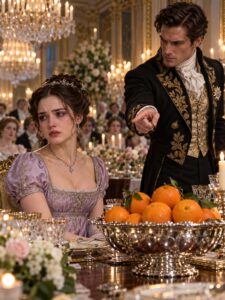
He humiliated his wife in front of 112 aristocrats and ordered her to eat with the servants.
She quietly folded her napkin, walked away, and asked for a piece of bread.
Then the Queen of England rose from her throne-like chair—and did something that would destroy the duke’s reputation forever.
The Duke of Wexley never raised his voice. He had learned long ago that a man of sufficient rank could make an entire room tremble without speaking above a conversational tone.
That evening, beneath the painted ceiling of Wexley Court, he proved it.
“Go and eat with the servants, Helena. It’s where you belong.”
His words traveled effortlessly through the great hall, past the glittering chandeliers and towering arrangements of hothouse flowers, past the silver platters and crystal glasses, until they reached the farthest end of the banquet table.
One hundred and twelve guests heard him.
There were earls and countesses, two bishops, the Lord Chamberlain, and enough distinguished families to fill half the finest drawing rooms in England. At the center of the high table sat Queen Charlotte herself, dressed in deep purple silk, her sharp eyes following every movement.
The queen had arrived that afternoon for a three-day visit. Her presence was the greatest social triumph the Duke of Wexley had ever achieved. He had spent eight months and eleven thousand pounds preparing his house for the honor.
Yet forty minutes into the grand banquet, he had chosen to disgrace his own wife.
Helena Fairfax, Duchess of Wexley, sat eleven places away from her husband, where he had deliberately put her. The place traditionally reserved for the duchess, at his right hand, belonged that evening to Lady Cressa Bane, a beautiful golden-haired widow whose relationship with the duke was the least convincing secret in London society.
Lady Cressa lifted her wineglass to conceal a smile.
Helena noticed.
She noticed the sudden silence, the movement of heads turning toward her, the embarrassed expression of the elderly gentleman seated beside her. She noticed the musicians in the gallery faltering as the duke’s final words hung in the air.
But she did not cry.
At twenty-seven, Helena had learned that tears were seldom useful in the presence of people determined not to care.
She placed her fork beside her plate. Slowly, carefully, she folded her linen napkin into a neat rectangle.
Then she stood.
“Of course, Your Grace.”
Her voice was clear, calm, and perfectly audible.
She walked the length of the hall in her pale lavender gown, which had been altered twice because she could afford no other dress suitable for a royal banquet.
Behind her, nobody spoke.
At the side of the hall, beside the service door, stood a plain wooden table where the upper servants were eating bread and cold meat between their duties. The butler, housekeeper, head footman, and several ladies’ maids stared as the duchess approached.
Helena drew out a stool and sat down.
“Good evening, Mrs. Pell,” she said to the housekeeper. “Would you be kind enough to pass the bread?”
Mrs. Pell’s fingers trembled as she handed it to her.
At the high table, the Duke of Wexley resumed his conversation, satisfied that an unpleasant interruption had been corrected. Lady Cressa laughed softly behind her fan.
Then the queen stood up.
And to understand why Her Majesty crossed that enormous hall instead of leaving it, one must understand the woman her host had spent two years pretending did not exist.
Helena Marsh had grown up in a small, gray vicarage in Somerset, where money was scarce but flowers were abundant.
Her father was a country clergyman whose greatest happiness came from coaxing life out of stubborn soil. Roses climbed the church walls. Peach trees leaned against the warm stones of the vicarage. Strange seeds brought home by traveling sailors sprouted in clay pots along the kitchen windows.
As a little girl, Helena followed him through the garden carrying a basket of tools almost too large for her.
He taught her the names of plants before she could properly read.
“A garden is the only place in the world, Nell,” he used to tell her, “where patience always gets paid.”
When he died, Helena was nineteen.
He left her his books, his knowledge, and very little money.
For six years she worked as a governess, teaching French, drawing, and geography to the children of wealthy families. She lived inside fine houses without belonging to them. She was educated enough to sit among gentlewomen, but too poor to be treated as one.
Her meals were brought to the schoolroom on a tray.
She knew what it was to be invisible long before she became a duchess.
Her last position was in the household of Lady Ramsay, a widowed aristocrat with two young daughters. Lady Ramsay was the sister of Hugo Fairfax, Duke of Wexley.
He visited his sister occasionally. Helena encountered him in the drawing room and passageways, always bowing politely, always stepping aside.
He never once spoke to her.
Then, on a rainy afternoon in March, he summoned her to the library.
Hugo Fairfax was thirty-one, handsome, impeccably dressed, and famously proud. His manners were polished, his voice restrained, and his temper all the more intimidating for its quietness.
Helena stood before the library fireplace while he explained the purpose of the meeting.
His grandmother, the Dowager Duchess of Wexley, had died the previous winter. Disapproving of her grandson’s behavior, she had placed a substantial inheritance into a trust.
Sixty thousand pounds, a London house, and some of the estate’s finest land would become his only if he married before his thirty-second birthday and lived with his wife at Wexley Court for part of each year.
His birthday was approaching in June.
“I require a wife,” he said. “I have no particular desire for one.”
Helena said nothing.
“I want someone quiet and sensible. Someone who will live at Wexley without interfering in my affairs or troubling me with emotional expectations.”
He looked her over as though assessing a piece of furniture.
“You are reasonably well born, despite your circumstances. You conduct yourself properly. You would have a title, a house, and an allowance of two hundred pounds a year.”
He paused.
“In return, I expect you to remain invisible.”
Helena felt the familiar weight of six years spent in schoolrooms, of watching other people’s children grow while her own prospects diminished.
She was twenty-five. She had no parents, no fortune, and no family home to return to.
Then she asked the only question that mattered to her.
“Your Grace, may I ask about the gardens at Wexley Court?”
He frowned.
“The gardens?”
“Your sister says they were once famous. Are they still maintained?”
“I haven’t the faintest idea. I never go into them.”
“If I am to live there quietly,” Helena said, “I should very much like to garden.”
For the first time, he laughed.
“Grow whatever you please. Grow cabbages in the ballroom if it amuses you. Just don’t expect me to hear about it.”
Six weeks later they married in the private chapel at Wexley Court.
The ceremony lasted eleven minutes.
The following morning, the duke returned to London.
Over the next two years, he spent only twenty-one days beneath the same roof as his wife. On perhaps five of those days, they dined together.
He never once walked through the gardens.
On the morning after her wedding, Helena had discovered what remained of the grounds that had once made Wexley Court famous.
The sight nearly broke her heart.
The great walled rose garden was buried beneath thorns. Flower beds had disappeared under nettles and bindweed. The fountain stood dry, its stone basin green with moss.
The orangery, once celebrated for producing fresh citrus fruit in an English winter, had broken windows and empty wooden tubs.
Inside several of those tubs stood the gray, twisted remains of trees that had apparently died long ago.
Only one gardener remained from the twenty who had served the old duchess.
His name was Amos Reed.
He was elderly, stooped, and deeply suspicious of the young woman who appeared at his garden gate in a plain dark gown.
“Mr. Reed,” she said, “I understand you remember these gardens as they were.”
“Fifty-one years I’ve worked here, Your Grace.”
“Then I would like you to teach me.”
He stared at her.
“What for?”
“Because I mean to restore them.”
The old man’s gaze traveled to her hands. They were brown and capable, with a fresh scratch across one knuckle where she had already pulled aside a bramble.
“It’ll take years.”
Helena smiled faintly.
“I have years, Mr. Reed. I have been instructed to live here quietly.”
For the first time, the gardener’s expression softened.
The following morning, Helena was outside before sunrise.
She wore an old brown dress and thick leather gloves. Amos brought his shears, and together they began cutting through the wilderness.
Some days the work appeared endless.
There were beds so overgrown that even Amos could no longer remember their boundaries. Thorns tore Helena’s gloves. Her shoulders ached from sawing branches. In the evening she returned to the house so exhausted she sometimes fell asleep before finishing supper.
But each morning she went back.
Gradually, the garden began revealing what it had hidden.
Beneath tangled brambles she discovered old rosebushes that had survived for decades without care. Some were rare varieties brought from France, Persia, and China by the Dowager Duchess herself.
Helena took cuttings, rooted them carefully, and tended them through the cold months using the methods her father had taught her.
She hired three village boys and paid them from her own allowance. Amos instructed them, and Helena worked beside them.
The fountain was cleaned and repaired.
The first morning water rose again from its stone center, Helena stood alone watching it sparkle in the sunshine.
She cried a little then.
Not because she was unhappy, but because something abandoned had been made beautiful again.
The orangery presented a harder challenge.
Its glass had to be replaced a few panes at a time. The heating stove required repair. Every surviving wooden tub contained what appeared to be the dead remains of an orange tree.
Amos believed there was nothing worth saving.
Then one spring morning, Helena noticed something green at the base of the last stump.
A shoot.
Tiny, pale, almost hidden in the darkness of the old wood.
She crouched beside it, hardly daring to breathe.
It was alive.
For a year she nursed the surviving growth, protecting it from cold, watching its leaves, experimenting with cuttings and grafts using the techniques her father had once shown her.
By the second summer, eleven young orange trees stood in the great wooden tubs.
Their glossy leaves caught the sunlight through the restored glass. Their small white flowers filled the building with a fragrance so delicate that the village boys sometimes came inside simply to enjoy it.
All eleven had grown from the one surviving shoot.
And the duke knew nothing.
He had told Helena that he did not wish to hear about the gardens.
She had obeyed him.
Then, in the spring of their second year of marriage, a letter arrived from Windsor Castle.
It came from the queen’s private secretary.
Queen Charlotte had heard from the Bishop of Salisbury that the famous gardens of Wexley Court had been restored. Rare roses, believed lost for decades, had reappeared. The orangery was flourishing.
Her Majesty, a devoted gardener herself, wished to visit in June.
She would remain for three days.
The duke read the letter three times at his breakfast table in Grosvenor Square.
He had no idea what it meant.
Four days later, he arrived at Wexley Court without warning.
He passed Helena in the entrance hall without greeting her and went directly through the garden doors.
From the drawing room window, she watched him stop at the top of the terrace steps.
Before him lay long flower borders bright with blue, white, and gold. The lime avenue had been neatly clipped. Beyond the red brick walls, hundreds of rosebuds were beginning to open.
The fountain sent a silver stream into the air.
The duke stood motionless.
Then he descended the steps.
He was absent for nearly an hour.
When he returned, he went not to Helena, but to Amos Reed.
“Who has done all this?”
“Her Grace, Your Grace.”
The duke stared at him.
“Your wife,” Amos repeated. “With her own hands.”
He told the duke about the roses, the broken glass, the fountain, and the orange trees grown from a shoot everyone had believed dead.
“I’ve worked here for more than fifty years,” he said. “I’ve never seen anyone accomplish what she has. Not even the old duchess.”
The duke said nothing.
That evening, he summoned Helena to the library.
“The queen is coming in June,” he announced.
“I know. Your sister wrote to me.”
“This visit is of immense importance. The Prince Regent’s circle will be watching. Every distinguished family in the county will be here.”
Helena waited.
“I shall show Her Majesty the gardens myself.”
A small silence followed.
“You will attend, naturally. But you are not to discuss the restoration. If the queen asks, the gardens were restored under my direction.”
Helena stared at him.
“Under your direction?”
“Precisely.”
“You hadn’t set foot in them for two years, Hugo.”
His face hardened.
“Do you imagine what London would say if it learned that my wife had been digging in the dirt with village laborers? Cutting brambles in an old gown?”
He looked at her hands with unmistakable distaste.
“My wife, the gardener. I should become a laughingstock.”
Helena clasped her fingers together.
“I see.”
“You will keep silent. Otherwise I shall send you to the hunting lodge in Northumberland. You may amuse yourself with whatever grows there.”
He turned away.
“Lady Cressa Bane will act as hostess during the visit. She knows how to manage such occasions. You do not.”
Helena stood for a moment longer.
Then she bowed her head.
“Yes, Your Grace.”
She left the library and went down to the orangery.
The glass reflected the stars. The young orange trees stood in their tubs, surrounded by the sweet fragrance of their blossoms.
She rested her fingers against one of the leaves.
She had spent two years making something live.
Now her husband wanted the world to believe it had been his achievement.
And the queen was coming to see it.
Queen Charlotte arrived on a brilliant June afternoon, accompanied by a procession of carriages and riders in scarlet and gold.
She was a small, upright woman in her sixties, with penetrating eyes and the bearing of someone who had spent half a century being obeyed.
The duke welcomed her beside Lady Cressa, who wore silver silk.
Helena stood a little behind them in her altered lavender gown.
Her husband introduced her briefly and moved on.
That afternoon, he escorted the royal party through the gardens.
He performed beautifully.
For three weeks he had studied the names of roses and the history of the orangery. He spoke confidently of his grandmother’s designs, the restoration of the fountain, and the revival of the old flower beds.
Lady Cressa smiled at his explanations.
Helena walked at the back of the procession.
The queen listened more than she spoke.
She stopped to examine individual blooms and leaned close to study the leaves. She moved through the garden with the attention of someone who knew that plants could reveal the truth more reliably than people.
Then, beside the old south wall, she halted.
Before her grew a tall, arching rose covered with crimson flowers, each one marked by a golden center.
“Duke,” she said, “what is this rose?”
“A French variety, ma’am. One of my grandmother’s.”
The queen shook her head.
“It is not French.”
She touched a petal gently.
“It came from China. I saw a drawing of it sent from Canton forty years ago. I had been told there was no living specimen left in England.”
The duke’s smile tightened.
“Indeed, ma’am.”
“Where did you find it?”
He hesitated.
Helena stood several paces behind them, her gloved hands motionless.
She remembered the thorns along the south wall. The three days it had taken to reach the buried stems. The small, stubborn leaves she had discovered growing in the darkness.
The duke answered.
“It has always been here, ma’am. Since my grandmother’s time.”
Queen Charlotte looked at him.
It was a long, courteous look.
“I see.”
She walked on.
Helena followed, but the uneasiness remained.
That evening, the banquet began at eight o’clock.
The great hall glowed beneath four hundred candles. Every table was laid with magnificent silver, crystal, white linen, and flowers cut from the estate’s gardens.
The duke had planned every detail.
Including where his wife would sit.
Helena found her place card at the far end of the high table, well away from the queen and her husband.
Lady Cressa was seated at his right hand.
For forty minutes the evening proceeded exactly as he intended.
Then the servants brought dessert.
At the center of every table they placed an enormous silver dish filled with golden oranges, freshly picked from the restored orangery.
A murmur of admiration traveled through the room.
Queen Charlotte lifted one of the oranges and examined it.
“Your grandmother’s trees,” she said. “I was told they had died in the great frost.”
“They did, ma’am,” the duke answered smoothly. “I had new trees brought from Portugal. The finest stock from Lisbon.”
The queen turned the orange in her hand.
“These are not Portuguese oranges.”
The duke remained smiling.
“They are the same bitter oranges your grandmother cultivated,” she continued. “I recognize the distinctive marking on the leaf.”
She raised the fruit slightly.
“How do you explain that?”
“My gardeners must have confused the stock, ma’am. I’m afraid I leave such details to them.”
“Do you?”
The question was soft.
But Helena heard it clearly.
She had sat quietly through the entire meal. She had agreed not to contradict her husband. She understood what disobedience might cost her.
Then she looked at the orange in the queen’s hand.
She remembered her father teaching her how to graft peach trees. She remembered that tiny green shoot hidden beneath dead wood.
She remembered the months of careful work, when everyone else had said the tree was beyond saving.
And she spoke.
“Forgive me, Your Majesty. Those oranges did not come from Portugal.”
The duke turned slowly.
Helena continued, her voice quiet but steady.
“They came from one of the old trees.”
Every face at the high table turned toward her.
“The other trees died in the frost, but one had a living shoot at its roots. I found it two springs ago and made cuttings. Then I grafted them onto sweet stock, using the method my father taught me.”
She swallowed.
“Every orange served this evening came from that one shoot.”
The queen studied her.
“You did this yourself?”
“Yes, ma’am.”
The duke’s expression became perfectly still.
Lady Cressa stopped smiling.
A terrible silence spread outward from the high table.
Helena had told the truth. Nothing more.
But to the Duke of Wexley, it was unforgivable.
He set down his glass.
“You have embarrassed me enough for one evening, Helena.”
His voice carried through the entire room.
“Go and eat with the servants. It’s where you belong.”
For a moment, Helena could feel the blood rushing to her face.
She knew he expected tears, pleading, or an apology.
She gave him none.
She folded her napkin, rose from her seat, and walked toward the service door.
The people she passed would remember that walk for the rest of their lives.
She did not hurry.
She did not hide her face.
When she reached the servants’ table, she sat down and politely asked Mrs. Pell for bread.
At the high table, her husband turned away as though the matter were settled.
Then Queen Charlotte rose.
One hundred and twelve chairs scraped across the stone floor.
Every guest stood. So did the duke.
He believed the queen intended to leave.
“Your Majesty,” he said with a bow, “I apologize for my wife’s conduct. She sometimes forgets herself.”
The queen did not answer.
She stepped away from the high table and began walking through the hall.
Her purple skirts swept across the stone. Her ladies-in-waiting followed, visibly bewildered.
The queen passed the long tables, the glittering jewelry, and the rows of important people standing respectfully beside their chairs.
She did not stop until she reached the service door.
Helena rose from her stool, a piece of bread still in her hand.
“Sit down, my dear,” said the queen.
Helena stared.
“Please.”
She sat.
Queen Charlotte gathered her skirts and settled herself on the rough wooden bench beside her.
For one extraordinary moment, nobody moved.
The Queen of England had chosen to sit at the servants’ table.
She turned to the head footman.
“Would you kindly bring my plate and glass?”
The young man bowed so quickly he nearly dropped his tray.
“And the oranges, please,” the queen added.
The footman hurried away.
Queen Charlotte turned toward Helena.
“Now, my dear, tell me about the crimson rose beside the south wall.”
Helena looked at her.
“The rose, ma’am?”
“I asked your husband where it came from. He told me it had always been there.”
The queen’s expression was calm.
“I did not believe him.”
Helena glanced toward the distant high table, where her husband remained standing.
Then she began to speak.
She told the queen about the brambles, the old wall, and the small crimson flowers hidden beneath eight feet of thorns.
She told her about the three days of cutting and clearing, and the fragile plant she had discovered beneath the overgrowth.
“I didn’t know what it was,” Helena admitted. “I’d never seen anything like it. I only knew it was alive.”
The queen listened.
Then she said quietly, “It is called the Crimson China.”
Helena’s hands became still.
“A sea captain brought one specimen to England in the year of my coronation. It was given to your husband’s grandmother. I was told the plant had died decades ago.”
She looked directly at Helena.
“It is the only surviving specimen I know of in Europe. And you saved it.”
Helena could not find an answer.
The footman returned carrying the queen’s plate, wineglass, and a silver dish of oranges.
Queen Charlotte picked up one of the fruits.
Then, for the first time since leaving her seat, she looked directly toward the duke.
“Duke of Wexley.”
Her voice was neither harsh nor loud.
It did not need to be.
“You told me the gardens were restored under your direction. You also informed me that these trees came from Portugal.”
The duke stood rigidly beneath the chandeliers.
“I have now met the person who restored the gardens.”
The queen laid the orange beside her plate.
“I find I would much rather dine with her than with you.”
The silence afterward was almost unbearable.
Then the queen addressed the hall.
“Please sit, everyone. Wherever you like.”
The Bishop of Salisbury moved first.
He collected his plate and glass and carried them toward the wooden table.
“I have wished to meet the person responsible for these gardens for eight months,” he told Helena. “Nobody would tell me who it was.”
He took a stool opposite Mrs. Pell.
Then Lady Ramsay stood.
The duke’s sister crossed the room, carrying her dinner plate, and sat beside Helena.
“I’m ashamed of him,” she whispered. “I have been ashamed for two years. I should have said something sooner.”
After that, other guests began moving.
Two countesses followed the bishop. The Lord Chamberlain came next, along with the queen’s ladies-in-waiting and several noblemen.
More plates appeared. More stools were brought from the servants’ hall.
When the first table became crowded, the footmen carried in a second, then a third.
Soon forty people were sitting around the plain wooden tables, sharing bread, passing oranges, and talking animatedly with the queen.
The housekeeper sat among aristocrats.
Ladies’ maids found themselves beside countesses.
And at the grand high table, beneath the magnificent ceiling and four hundred candles, only the duke and Lady Cressa remained.
She looked at the empty chairs.
Then she looked toward the servants’ tables, where laughter had begun to rise.
Finally, she turned to Hugo.
“I believe I have a headache,” she said coldly.
She closed her fan and left.
For the next hour and a quarter, the Duke of Wexley stood alone at the head of his magnificent banquet table.
He could not sit without appearing defeated. He could not join the queen without asking his wife for a place.
So he remained standing.
And Helena never once looked back at him.
The queen stayed at Wexley Court for the full three days.
But she spent almost every waking hour in the gardens with Helena.
They walked beside the fountain, through the rose beds, beneath the lime trees, and into the glass-roofed orangery.
The queen asked about soil, grafting, winter protection, and the revival of old plants.
For the first time since her father’s death, Helena found herself speaking to someone who truly wanted to know what she knew.
By the second day, she sometimes forgot to be nervous.
The queen was no longer simply a monarch questioning a duchess. She was an experienced gardener discussing plants with another experienced gardener.
The duke found himself excluded from those conversations.
No one explicitly forbade his presence. Yet whenever he approached, the discussion became formal and quiet until he withdrew.
On the third morning, the queen and Helena sat together among the eleven orange trees.
“My dear,” Queen Charlotte began, “I have a garden at Frogmore.”
Helena nodded.
“It is my own place. Somewhere I can go when I wish for quiet.”
She rested her hands upon her walking stick.
“My head gardener is retiring at Michaelmas. He has served me faithfully, but I do not believe he would have discovered that Chinese rose beneath eight feet of brambles.”
Helena listened, puzzled.
“Nor would he have thought to search for life in those old orange tubs.”
The queen smiled.
“I should like you to take his place.”
Helena stared.
“Not as a domestic servant,” the queen continued, “but as keeper of my garden. You would have a house at Frogmore and a salary of four hundred pounds a year, paid in your own name.”
Helena could hardly breathe.
A house.
A salary.
Work that belonged to her.
A life in which her knowledge had value.
“There is one difficulty,” the queen said. “I am told that a married woman cannot accept such an appointment without her husband’s consent.”
A faintly mischievous expression appeared in her eyes.
“I have never cared much for being told what I cannot do. But I wished to ask you first.”
Helena thought of her schoolroom trays. The empty rooms at Wexley. The order to remain invisible.
Then she thought of the queen sitting beside her at the servants’ table.
“Yes, ma’am,” she whispered. “If he will allow it.”
The queen rose with the help of her stick.
“I believe you will find that he does.”
But the duke did not intend to allow it.
That evening, after the royal carriages had departed, he summoned Helena to the library.
He stood beside the fireplace holding a glass of brandy.
“You will not take that position.”
Helena remained near the door.
“The Duchess of Wexley will not work for wages in another person’s garden,” he said. “Not even the queen’s.”
“I have given Her Majesty my answer.”
“Then you will withdraw it.”
Helena looked at him steadily.
He was pale and tired, but his anger was familiar.
“You humiliated me in my own house,” he continued. “Before the Queen of England.”
“No, Hugo.”
The duke stiffened.
“You did that yourself. I told her where the oranges came from.”
His fingers tightened around the glass.
“You will remain at Wexley, or I shall send you to Northumberland. Those are your choices.”
For a long moment, Helena watched the fire moving behind him.
Then she asked something he had never expected.
“Hugo, have you read your grandmother’s will?”
He stared.
“Of course I have.”
“So have I. Your sister showed it to me after the banquet.”
She spoke carefully, almost gently.
“The inheritance depends on your marriage and on your living under the same roof as your wife at Wexley Court for part of every year.”
“Yes.”
“Every year, Hugo. For the rest of your life.”
He said nothing.
“If the condition is not met, the money and property pass to Lady Ramsay’s daughters.”
The duke went very still.
“If you send me to Northumberland, you cannot fulfill the condition. And if I accept the position at Frogmore without an arrangement between us, you face the same difficulty.”
Helena folded her hands.
“I think we had better come to an arrangement.”
Two weeks later, the agreement was ready.
Lady Ramsay’s solicitor had examined the will and prepared the necessary documents, with Helena closely involved in every clause.
She would accept the queen’s appointment at Michaelmas, with her husband’s written consent.
She would live at Frogmore in the house provided for the position.
Her four-hundred-pound salary would be paid into an account in her own name, beyond the duke’s control.
Every June, during the first two weeks when the roses bloomed, she would return to Wexley Court and reside beneath the same roof as her husband.
The arrangement was intended to satisfy the terms of his grandmother’s will.
But Helena had insisted on more.
The gardens at Wexley Court would be placed under her authority.
She would decide what was planted, what was removed, and how they were maintained.
Amos Reed would receive a cottage and a pension for life. Eight undergardeners would be employed and paid by the estate.
And the duke would relinquish all control over the grounds.
Helena read the final clause aloud.
“In the gardens of Wexley Court, His Grace shall be a guest.”
The duke stared at those words.
His face seemed to age as he held the paper.
Eventually he picked up the pen and signed.
Helena folded the document.
As she reached the door, his voice stopped her.
“How long did it take you?”
She turned.
“The rose garden,” he said.
“Two years.”
He looked down at the desk.
“Every morning,” she added.
He did not reply.
Within a week, London had heard the story.
By July, caricaturists were drawing the Duke of Wexley standing at an empty banquet table while the queen enjoyed supper with his wife and the servants.
The most famous cartoon showed a grand table draped in cobwebs, with a solitary aristocrat at its head.
Its caption read: The Duke Dines Alone.
The name followed Hugo Fairfax for the remainder of his life.
Lady Cressa Bane stopped visiting him. That autumn, she married a wealthy banker and went to live in Bath.
The queen’s household quietly stopped extending invitations to the duke. No formal punishment was announced. He simply found himself unwelcome where he had once expected to be admired.
He returned to London.
He retained his fortune.
But wealth did not appear to make him happy.
At Michaelmas, Helena arrived at Frogmore with a trunk and a lifetime’s worth of memories.
Her new home was a modest redbrick cottage near the kitchen garden, with roses around the door and a small walled garden behind it.
The autumn sun shone over the lake.
For a long time, Helena stood on the threshold without moving.
It was the first home she had ever been able to think of as her own.
Then she stepped inside.
She remained at Frogmore for twenty-six years.
Every morning she went into the gardens in her old brown dress and leather gloves. She restored neglected plants, cultivated rare varieties, and transformed neglected corners into places of extraordinary beauty.
Queen Charlotte visited regularly.
They walked together beneath the trees, argued affectionately about roses, and discussed gardening with a freedom neither found elsewhere.
Over time, they became friends.
In Helena’s first spring at Frogmore, she brought cuttings from the rare Crimson China rose at Wexley.
The following spring, she sent three healthy young plants to Kew.
Botanists proposed naming the rescued variety in honor of the queen.
Charlotte refused.
In her own handwriting, she insisted that it should bear the name of the Duchess of Wexley.
After all, Helena had been the one to uncover it beneath the brambles.
The queen had only recognized what she had saved.
Every June, Helena returned to Wexley Court.
Her agreement required her to spend two weeks there, and she kept her promises.
For the first few years, she and Hugo occupied opposite wings of the house. They dined together in silence and passed one another with the distant politeness of strangers.
He did not enter the gardens.
They were hers.
Then, during the sixth June after their arrangement, Helena was kneeling beside a rose bed when she noticed a figure standing at the garden gate.
It was Hugo.
He was forty now, with gray at his temples and a tiredness in his face that had not been there before.
He stood outside the wall, his hands at his sides.
For a moment they looked at one another.
Then he spoke.
“May I come in?”
Helena slowly straightened.
In all their years of marriage, he had ordered her, dismissed her, and decided things for her.
He had never truly asked.
“You may.”
Hugo opened the gate.
He walked beside the flower beds, studying the roses as though seeing them for the first time.
At the south wall, he stopped before the arching bush with crimson flowers and golden centers.
“This is the one,” he said. “The rose the queen asked about.”
“Yes.”
“The Duchess of Wexley’s rose. I saw it in the Kew catalog.”
He was quiet.
“I told Her Majesty it had always been there.”
Helena did not answer.
After a while he asked, “Where did you actually find it?”
She pointed toward the base of the wall.
“Under the brambles. Eight feet of them.”
“How long did it take?”
“Three days to cut it free.”
She looked at the flowers.
“I didn’t know what it was. Only that it was alive.”
Hugo stood beside her in the evening sunlight.
Then he asked, “May I pick one?”
Helena regarded him carefully.
She remembered the banquet, the servants’ table, and the two years when he had treated her as though she did not exist.
She remembered the person she had become after leaving his control.
“No, Hugo,” she said, without cruelty. “You may look. You may not pick.”
He considered her answer.
Then he nodded.
“That seems right.”
He remained beside her for a little while, looking at the rose.
When the light began to fade, he wished her good night and returned to the house.
The following June, he came to the garden gate again.
He asked permission to enter.
Helena allowed him.
They walked among the roses and spoke about the old French varieties and the flowers that had survived decades of neglect.
He asked questions.
She answered them.
He listened.
He never picked a rose.
She never offered.
Helena did not call it forgiveness.
It was something smaller and perhaps more meaningful: a man learning, late in life, to ask before entering a place that did not belong to him.
Seven years after Helena began working at Frogmore, Queen Charlotte died.
Among the things she left Helena was a single silver dish.
It was the same dish that had held the oranges at the banquet at Wexley Court, the one the queen had quietly arranged to have sent to Windsor.
An inscription had been engraved beneath it.
To the keeper of my garden, who found what everyone else said was dead and kept looking.
Helena placed the dish on the table in her cottage.
In summer she filled it with roses.
In winter she filled it with oranges.
And along the south wall of her garden at Frogmore, near the stone bench where the queen had once rested with her walking stick, a tall rosebush grew.
Its flowers were crimson, with small golden hearts.
It had come from a cutting of a cutting of the rose Helena had found buried beneath eight feet of thorns at Wexley Court.
Years earlier, in a hall filled with the most powerful people in England, her husband had ordered her to sit with the servants because he believed it was where she belonged.
She had obeyed him.
And it was there, at a plain wooden table, that the Queen of England had chosen to sit beside her.
Helena had never needed the grandest chair in the room.
She had only needed someone to recognize the life she had patiently brought into bloom.









