THE DUKE ORDERED HIS WIFE TO GIVE HER SEAT TO HIS MISTRESS—THEN THE QUEEN OF ENGLAND STOOD UP
He humiliated his wife before London’s most powerful families.
He expected her to disappear quietly while his mistress took her place.
But the Queen of England recognized something around the young duchess’s neck—and stood up.
“Give your seat to my mistress.”
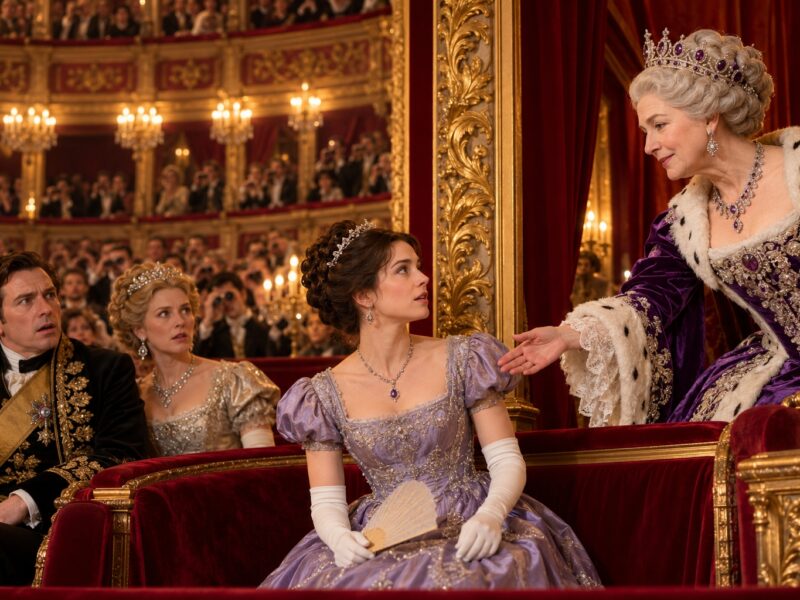
The Duke of Thornbury spoke loudly enough for the neighboring opera boxes to hear him. He didn’t whisper, hesitate, or even turn to look at his wife. He simply gestured toward the beautiful blonde woman standing behind them, as though the young duchess occupying the seat beside him were an inconvenient piece of furniture.
For one terrible moment, Amelia Ashcombe, Duchess of Thornbury, could not move. Around her, the magnificent King’s Theatre in London’s Haymarket seemed to grow unnaturally quiet. Hundreds of aristocrats had gathered beneath the glittering chandeliers, and now their attention was turning toward one small box beside the royal enclosure.
It was an April evening, and every seat in the theater was occupied. Five tiers of ornate boxes climbed toward a painted ceiling, their crimson velvet curtains edged with gold. Thousands of candles illuminated diamonds, jeweled hair ornaments, polished military decorations, and the faces of people who believed themselves important enough to judge everyone else.
Among them were dukes and duchesses, ambassadors, officers recently returned from Spain, and the most influential families in England. In the royal box sat Queen Charlotte herself, dressed in purple velvet, with an amethyst crown resting upon her silver hair.
Immediately beside her box sat Julian Ashcombe, Duke of Thornbury, thirty-two years old and one of the wealthiest noblemen in the country. His dark hair, handsome face, and embroidered black coat made him a striking figure. The gold sash across his chest announced his rank long before anyone heard his name.
Beside him sat his wife.
Amelia was twenty-five, slender and dark-haired, wearing a lavender silk gown embroidered with silver thread and tiny crystals. White gloves covered her hands. A diamond tiara rested in her carefully arranged hair, and a small amethyst pendant hung from a thin gold chain at her throat.
For two years, she had occupied that chair as Duchess of Thornbury.
Now her husband had ordered her out of it.
Mrs. Arabella Fox stood behind them in a shimmering silver gown. Her golden hair had been arranged to perfection, and diamonds glittered against her pale skin. She was a widow, famous for her beauty and her expensive tastes.
She was also the duke’s mistress.
Everyone knew it.
The duke wanted everyone to know it.
Arabella smiled as she gathered her skirts, already preparing to take Amelia’s place. The woman in lavender sat motionless for another heartbeat, her fingers tightening around the ivory ribs of her fan.
Somewhere in the neighboring box, a gentleman laughed.
“Well,” a woman whispered, not nearly softly enough, “at least she knows her place now.”
Arabella leaned close enough for Amelia alone to hear.
“Go on, little church mouse. Run home.”
Amelia did not answer. Her face had gone white, but she refused to give the spectators the tears they were waiting for.
Slowly, she stood.
She picked up her fan, turned away from her husband, and took one step toward the door at the back of the box.
Then something extraordinary happened.
Queen Charlotte stood up.
The movement was so unexpected that people throughout the theater began rising halfway from their seats, uncertain whether protocol required them to follow. Conversations stopped. Opera glasses swung toward the royal box.
A queen did not stand for an ordinary person.
Yet Queen Charlotte had risen for Amelia.
She moved toward the gilded pillar separating the two boxes, ignoring the astonished duke entirely. Her eyes were fixed upon the young woman in lavender.
“My dear,” she said in her unmistakable German-accented English, “come here.”
Amelia stopped.
“Your Majesty?”
“You will sit with me.”
For a moment, the duchess seemed incapable of understanding the words.
The queen held out her hand.
“Come, child. Take my chair. I have been sitting all evening, and I would like to stand for a while.”
Every face in the theater was turned toward them.
Amelia stepped through the narrow passage beside the gilded pillar. The queen placed a hand upon her shoulder and guided her into the magnificent crimson-velvet chair that had belonged to the Queen of England only moments earlier.
In the neighboring box, Julian Ashcombe sat with his mouth slightly open.
Arabella Fox had finally obtained the seat she wanted.
And not a single person was looking at her.
They were looking at the young woman sitting in the queen’s chair.
To understand why Queen Charlotte would perform such an extraordinary act for a duchess she had not spoken to in years, one must return to a modest chapel in Chelsea, where forty orphaned children once sang a hymn that changed Amelia’s life.
Amelia Hart had not been born into wealth. She grew up in a narrow brick house beside the Thames, the daughter of Reverend Thomas Hart, a chaplain and music master at the Royal Military Asylum in Chelsea.
The asylum was a home and school for children whose fathers had died serving the British army. Some had lost their parents in Egypt, others in Flanders, the West Indies, or Spain. Many had mothers who had died afterward, overcome by illness, poverty, or grief.
The children wore little red coats. They were taught to read, write, and become useful members of society. Boys might eventually serve as military drummers, while girls were often trained for domestic employment.
Reverend Hart believed they deserved something more.
He believed they deserved beauty.
Every afternoon, the chapel filled with the voices of children learning to sing. He taught them hymns, harmony, and the discipline of listening to one another. Music, he believed, could give children who had lost nearly everything a sense of belonging.
Amelia began helping him when she was ten.
By fifteen, she could play the organ, piano, and harp with remarkable skill. She copied music for the choir, corrected mistakes, and began composing simple hymns that even the youngest children could remember.
Her father watched her work with quiet pride.
“You hear things other people don’t,” he told her one evening.
Amelia looked up from a sheet of music.
“Is that a good thing, Papa?”
“It is a gift. But gifts must be used, even when the world tells you there is no place for them.”
She never forgot those words.
Her mother had brought a gilded harp from Wales, and Amelia often played it in the evenings beside an upstairs window. People walking along the river sometimes stopped to listen, unaware that the beautiful music came from a teenage girl in a modest clergyman’s home.
Amelia could hear a melody once and reproduce it. She could imagine several voices moving together and write their parts before the sound had faded from her mind.
But she lived in a world with narrow expectations for women.
A young lady might perform a pleasant piece in a drawing room. She might sing at an evening gathering or entertain her family after dinner.
Composing serious music for public performance was another matter.
Amelia understood that publishers, theater managers, and society itself were unlikely to welcome a woman’s name on the title page of a major composition.
So she wrote for the children.
Their voices were enough for her.
Then, during the winter when Amelia was nineteen, Reverend Thomas Hart became ill with a fever. Three days later, he was dead.
The small house seemed impossibly quiet after his death. Amelia found herself staring at the empty chair beside the fireplace, waiting to hear him ask whether the children had mastered their latest hymn.
He never would again.
The asylum’s governors allowed her to remain as a music teacher. They paid her twenty pounds annually, half her father’s salary, and gave her two small rooms above the schoolhouse.
It was not much, but Amelia had nowhere else to go.
She continued teaching.
That spring, Queen Charlotte visited the asylum.
The queen supported numerous charitable institutions and was accustomed to inspecting hospitals, schools, and orphanages. Usually such visits followed a predictable pattern: a formal welcome, a brief tour, a few gracious words, and departure.
But the governors had arranged a performance in the chapel.
The children would sing a new hymn called The Soldier’s Child.
Amelia had composed it in memory of her father.
Forty children stood beneath the chapel windows in their red coats while the queen sat in the front pew. When Mr. Hart’s old organ began playing, their voices rose together, tentative at first, then stronger.
The melody was simple.
Its power came from what it carried: the loneliness of children waiting for fathers who would never return, and the quiet hope that someone might still care for them.
Halfway through the hymn, Queen Charlotte reached for her handkerchief.
When the final note faded, the chapel remained silent.
Then the queen turned toward the governor.
“Who wrote that music?”
The governor looked confused.
He had assumed it was an old hymn.
After several whispered exchanges, Amelia was brought forward.
She wore a plain gray dress. There were traces of black ink on her fingers from the music she had been copying that morning. She curtsied so deeply she nearly lost her balance.
The queen studied her.
“You wrote this?”
“Yes, Your Majesty.”
“For these children?”
“For them, and for my father. He died in January. He taught them to sing, and I wanted them to remember him.”
The queen’s expression softened.
She spoke of her own love of music, of the king’s affection for Handel and the harpsichord before his illness, and of the comfort music could give a troubled household.
Then she looked directly at Amelia.
“You have a remarkable gift, child. Do you know that?”
Amelia lowered her eyes.
“I am only a music teacher, Your Majesty.”
“No,” the queen replied. “You are a composer. Do not let anyone tell you otherwise.”
She reached toward the small amethyst pendant pinned to her gown.
The jewel hung from a fine gold chain. It had been given to Charlotte by her mother in Mecklenburg before she sailed to England to marry the king.
For thirty years, she had treasured it.
Now she unfastened the pendant and placed it in Amelia’s ink-stained hand.
“For the music,” she said. “So that you will remember a queen heard it.”
Ten minutes later, Queen Charlotte departed.
Amelia remained in the empty chapel, holding the pendant as though it were something too fragile to touch.
From that day forward, she wore it against her skin.
She never imagined she would see the queen again.
A year later, Julian Ashcombe arrived at the asylum with his mother, the Dowager Duchess of Thornbury.
The dowager duchess was a formidable woman with sharp gray eyes and a reputation for demanding unquestioning obedience. She supported several charities and expected her son to accompany her on occasional visits.
Julian had little interest in orphanages.
He spent most of the afternoon looking bored.
Then he heard music coming from the chapel.
Amelia was practicing at the organ, unaware that anyone had entered. When she finished and turned, a tall, dark-haired gentleman in an elegant coat stood watching from the aisle.
“That was beautiful,” he said.
She rose awkwardly.
“Thank you, sir.”
“Who are you?”
He returned four times that summer.
He brought flowers, books, and expensive sheet music from Bond Street. He found sonatas from Vienna that Amelia could never have purchased with her small salary. Sometimes he sat in the chapel for an hour, listening while she played.
He told her she had the hands of an angel.
Amelia had never known a man like him.
He was handsome, charming, and attentive. He listened when she spoke of her father. He smiled when she described the children. He seemed to find her devotion to music admirable rather than strange.
In August, he asked her to marry him.
Amelia stared at him in disbelief.
“Why would you want to marry me?”
Julian smiled.
“Because you’re good, Amelia. Quiet, kind, and honest. I am tired of the other sort of woman. I want someone I can trust.”
She believed him.
She was twenty, alone, and loved for what she thought was the first time.
What Amelia did not know was that Julian had maintained a relationship with Arabella Fox for three years while Arabella was still married to an elderly colonel.
The colonel had died that spring.
Society expected Julian to marry his widowed mistress.
His mother had forbidden it.
She considered Arabella’s reputation disgraceful and refused to see her become Duchess of Thornbury. She threatened to withhold the substantial allowance she controlled unless Julian married a respectable woman before Christmas.
Julian had therefore looked for someone suitable.
A clergyman’s daughter seemed perfect.
Poor, grateful, respectable, and unlikely to challenge him.
He had not chosen Amelia because he loved her.
He had chosen her because she could conceal the truth.
They married in October at St. George’s, Hanover Square.
The dowager duchess was satisfied. Society expressed brief surprise, then moved on to its next amusement.
Arabella continued living in her pretty house on Keren Street.
Julian continued paying for it.
Nothing important changed for him.
Everything changed for Amelia.
Thornbury House stood on Grosvenor Square, an imposing residence of pale stone with forty rooms, an enormous ballroom, and corridors that seemed to grow colder the farther one walked from the main staircase.
There was also a magnificent music room.
On Amelia’s first morning as duchess, she discovered a fine Broadwood pianoforte that had scarcely been touched in twenty years. Its keys were slightly stiff, but its tone remained beautiful.
She sat down and played for an hour.
At noon, Julian appeared in the doorway.
“I could hear you from my study.”
Amelia immediately stopped.
“I’m sorry. Was it too loud?”
“It was too much.”
He entered and gently closed the instrument’s lid.
“You’re a duchess now, Amelia. Duchesses don’t spend their mornings practicing scales like governesses. Play something pleasant after dinner if we have guests. Nothing more.”
Amelia looked at the closed instrument.
“And my harp? It arrives from Chelsea tomorrow.”
“I’ve arranged for it to go into the attic.”
She searched his face for amusement.
There was none.
That was how her marriage began to disappear.
Not through one great act of cruelty, but through dozens of small things quietly taken away.
Amelia was discouraged from visiting the asylum. A duchess did not teach orphans. She could make donations from her personal allowance, but Julian considered it beneath her position to return to the chapel.
Her friends from Chelsea were unwelcome at Thornbury House.
Her music became an embarrassment.
One evening, Julian discovered her writing at a small desk in her sitting room.
He picked up the sheets.
“What’s this?”
“Something I’ve been working on.”
He examined the notes for a moment, then walked to the fireplace and dropped the pages into the flames.
“Julian!”
“I married a quiet wife, Amelia. Not a scribbler.”
She watched the paper curl and blacken.
There were hours of work on those pages.
He left the room before they finished burning.
Soon afterward, Julian began disappearing three evenings each week. He claimed to be dining at his club, attending the House of Lords, or visiting friends.
Amelia wanted to believe him.
Then she noticed the bills.
Flowers delivered to Keren Street. Carriage horses she had never seen. A pearl necklace she had not received.
The servants whispered.
Eventually Bethan, the Welsh maid who had accompanied Amelia from Chelsea, told her the truth.
“Mrs. Fox, Your Grace,” she said quietly beside the dressing table. “Mrs. Arabella Fox. Everyone downstairs knows.”
Amelia looked at her reflection.
For several seconds, she said nothing.
Then she nodded.
“Thank you, Bethan. You were right to tell me.”
She did not cry until she was alone.
That night, she lay awake beneath the embroidered canopy of a bed large enough for two people, listening to the sounds of a house in which she had never felt welcome.
She thought of her father.
He had taught her that when a person could not change a circumstance, she could still choose how to bear it.
For a while, Amelia mistook endurance for peace.
She managed the household, treated the servants kindly, and sat beside her husband at dinner without allowing anyone to see her distress.
But she also began composing again.
At first, the melodies existed only in her mind. She carried them through long dinners, tedious visits, and church services. When Julian went to Keren Street, she wrote them down by candlelight.
Bethan hid the finished pages in her sewing basket and delivered them to Mr. Price, the music master who had succeeded Amelia’s father at the asylum.
The children learned her compositions.
Amelia could not hear them, but knowing they were singing was enough to keep something alive inside her.
When the dowager duchess died that first winter, she left Julian forty thousand pounds, a house in Richmond, and her jewels.
Once the money was his, Julian no longer bothered to conceal his relationship with Arabella.
He took her driving through Hyde Park. He escorted her to Vauxhall Gardens and the races at Epsom. He appeared beside her in open carriages while his wife remained at home.
London talked.
But the gossip did not condemn Julian.
Men of his rank were accustomed to escaping judgment for such behavior.
Instead, people pitied and mocked Amelia.
The dull little duchess.
The clergyman’s daughter.
The wife who should have known what she was marrying.
Julian heard the whispers and began to enjoy them.
Arabella, however, was no longer satisfied.
She had jewels, servants, expensive clothes, and a handsome duke at her disposal. But she still lacked the one thing his wife possessed.
Recognition.
She wanted to sit beside Julian in the best places, before the very people who had once refused to receive her.
Most of all, she wanted the Thornbury box at the King’s Theatre.
It stood beside the royal box, one of the most prestigious positions in London.
She had watched Amelia sit there a dozen times.
And each time, resentment had grown.
One evening in Keren Street, Arabella approached Julian.
“Take me to the opera.”
“You’ve been to the opera many times.”
“In your box.”
He looked up.
“Arabella.”
“In her seat. I want everyone to see.”
Julian gave a brief laugh, then stopped when he realized she was serious.
“It would cause a scandal.”
“You’re a duke. Aren’t you always telling me you’re above scandal?”
He considered the prospect.
Part of him understood the damage it would cause.
Another part imagined Amelia’s quiet obedience and Arabella’s delighted face.
He agreed.
He did not warn his wife.
On the evening of the performance, Amelia chose her favorite lavender gown because its color complemented her amethyst pendant. Bethan arranged her hair and fastened the small diamond tiara the dowager duchess had left her.
Julian barely looked at her during the carriage ride.
The opera was Mozart’s The Marriage of Figaro, which Amelia adored. She had seen it only once before, from an inexpensive gallery seat when she was fifteen.
For the first twenty minutes, she allowed herself to forget her unhappy marriage.
She listened to the overture with her eyes half closed, feeling the familiar movement of harmony and rhythm restore a part of herself she had feared was gone.
She scarcely noticed Queen Charlotte sitting behind the gilded pillar beside her.
The queen rarely attended the opera now. The king’s illness kept her occupied at Windsor, and public appearances had become difficult.
But she had known Mozart as a child.
He had played for her at Buckingham House when he was only eight years old, and she had never forgotten the astonishing little musician.
For Mozart, she had come.
When the first act ended, Arabella entered.
Then came the duke’s command.
“Give your seat to my mistress.”
Amelia rose, her ivory fan cracking beneath the pressure of her gloved fingers.
She heard the laughter.
She heard Arabella call her a little church mouse.
But she did not see the queen’s expression change.
Charlotte had witnessed everything.
As Amelia turned toward the door, the chandelier light struck the small amethyst pendant at her throat.
The queen recognized it immediately.
She had worn that jewel for thirty years.
She had given it away only once.
Suddenly, she remembered a cold chapel in Chelsea, forty children in red coats, and a shy girl with ink-stained hands who had written a hymn for her dead father.
Queen Charlotte looked again at Amelia’s face.
She was older now, thinner, and painfully tired.
But unmistakably the same young woman.
So the queen stood.
“My dear, come here.”
And Amelia, who had been ordered to surrender her place to her husband’s mistress, was seated in the chair of the Queen of England.
Charlotte remained standing beside her through the entire interval. When a lady-in-waiting attempted to bring another chair, she waved it away.
“I am perfectly comfortable.”
Then she leaned toward Amelia.
“The chapel in Chelsea. The Soldier’s Child.”
Amelia’s eyes filled.
“Yes, Your Majesty.”
“I thought so.”
The queen glanced at the pendant.
“You still wear it.”
“Every day, Your Majesty.”
“Good.”
Only then did Queen Charlotte look toward the neighboring box.
Julian was half out of his chair, red-faced and bewildered.
The queen regarded him for a long moment.
She did not speak.
She simply turned her back on him.
By noon the following day, all of London would know what had happened.
Amelia remained beside Queen Charlotte for the rest of the opera. She remembered little of the performance except the music and the steady presence of the older woman beside her.
When the countess sang of the love her husband had squandered, Charlotte glanced toward Amelia without speaking.
The duchess understood.
After the final curtain, the queen announced that her carriage would take Amelia home.
“Your Majesty, I couldn’t possibly—”
“You can, and you will. I do not think you should return with your husband tonight.”
She paused.
“Or with her.”
Amelia looked into the Thornbury box.
It was empty.
Julian and Arabella had slipped away during the third act.
A black-and-gold royal carriage, drawn by four gray horses, carried Amelia through London. Footmen in scarlet accompanied her to the steps of Thornbury House.
Half the street watched from its windows.
Inside, Julian was waiting.
He had been drinking, just enough to make his cheeks flushed and his voice louder than usual.
“Do you know what you’ve done?”
Amelia removed her gloves slowly.
“I stood when you told me to. I was leaving when the queen asked me to sit beside her. I did not think it wise to refuse Her Majesty.”
“You made me a laughingstock!”
“No, Julian.”
She looked directly into his eyes.
“You did that yourself. I only stood up.”
He moved toward her so abruptly that she stiffened.
For the first time in their marriage, she wondered whether he might strike her.
He stopped.
Then he turned, walked into his study, and slammed the door.
Upstairs, Bethan waited with tears in her eyes.
“Your Grace, is it true? The queen?”
Amelia sat on the edge of the bed, still wearing her lavender gown.
“Yes,” she said.
Then, for the first time in two years, she began to laugh.
Not because the humiliation had been painless.
Not because she had suddenly forgotten what Julian had done.
She laughed because, for one astonishing evening, the man who had tried to erase her had discovered that she was not invisible.
London was merciless.
By the next afternoon, the story had spread through drawing rooms in Mayfair, clubs on St. James’s Street, coffeehouses, and print shops.
Newspapers published thinly disguised accounts of a certain duke who had ordered his duchess to give up her seat to a lady of his particular acquaintance.
Soon a caricature appeared in a Strand print-shop window.
It depicted a ridiculous red-faced duke and his golden-haired companion sitting alone in an opera box while the entire audience admired the queen and the young duchess beside her.
The caption read: The Best Seat in the House.
Arabella purchased every copy.
The printer made more.
For two weeks, she remained inside her house on Keren Street.
Julian continued visiting his club, but the atmosphere had changed. Conversations stopped when he entered. Invitations that would once have arrived automatically were suddenly unavailable.
His title remained the same.
His influence did not.
Then, five days after the opera, an envelope arrived at Thornbury House.
The paper was thick and cream-colored. A red wax seal bore the royal arms.
It was addressed not to Julian but to his wife.
Amelia opened it at breakfast.
Queen Charlotte requested the pleasure of her company at Frogmore House, Windsor, the following Thursday at two o’clock.
Her Majesty would be pleased if the duchess brought her music.
Amelia read the invitation twice.
Across the table, Julian watched her.
“Well?”
“The queen has invited me to Frogmore.”
“You will write and say you’re ill.”
Amelia looked up.
“I will not lie to the queen.”
“You’ll do as I tell you. You are my wife.”
His fingers tightened around his cup.
“I won’t have you going to Windsor to tell tales about me. And I certainly won’t have you making a spectacle of yourself playing hymns like a servant girl.”
Amelia folded the letter.
“The woman you’re describing is the Queen of England, Julian. And she did not invite you. She invited me.”
He stood so abruptly that his chair fell backward.
“You will not go. If you leave this house on Thursday, don’t expect to return.”
The breakfast room fell silent.
Amelia took another sip of tea.
“Then I suppose,” she answered quietly, “I shall have to find out.”
On Thursday morning, a royal carriage stopped outside Thornbury House.
Four gray horses stood before the entrance. An officer of the household cavalry waited alongside.
Julian watched from his study window.
He could forbid his wife to leave in theory.
But he could not order the queen’s escort to return without her.
At eleven o’clock, Amelia walked out wearing a plain blue traveling dress. Bethan followed with her music case.
Behind them, two footmen carried a tall object wrapped in a sheet.
Julian watched as the object was secured to the carriage.
It was Amelia’s mother’s harp.
Bethan had taken it down from the attic before dawn.
For the first time since her marriage, the instrument was leaving Thornbury House.
And this time it was traveling to Windsor in a royal carriage.
Frogmore House was unlike the imposing public spaces Amelia associated with royalty.
It stood in the gardens beneath Windsor Castle, beside a peaceful lake. There were books, flowers, paintings, and rooms that reflected the queen’s personal tastes rather than the demands of official ceremony.
Charlotte received Amelia in a green sitting room overlooking the water.
She wore a simple gray silk dress and a white lace cap. A small dog rested in her lap.
“Sit,” she instructed. “No, not over there. Here, beside me.”
Amelia obeyed.
“You have brought your music?”
“Yes, Your Majesty. And my harp.”
The queen smiled.
“Then play for me.”
Amelia began with The Soldier’s Child.
Charlotte closed her eyes.
Then came the music Amelia had written secretly during the two years of her marriage: slow airs, a harp sonata, a psalm setting for children’s voices, and a lullaby composed for a child she did not have.
For an hour and a half, the queen listened.
When a lady-in-waiting appeared to announce tea, Charlotte raised one finger without opening her eyes.
The door quietly closed.
At last, Amelia lowered her hands.
The room remained silent.
“How long have you been composing like this?” the queen asked.
“Since I was fifteen.”
“And how much of it has been heard?”
“Some pieces by the children at the asylum. No one else.”
“Does your husband know?”
Amelia hesitated.
“He burned the first pages I wrote after we married. He knows nothing of the rest.”
The queen looked down at the dog in her lap.
For a while, she said nothing.
Then she spoke of arriving in England at seventeen, unable to speak English and having met her husband only on their wedding day.
She remembered being told that a queen should not have independent opinions, friends, or interests.
“She must sit and smile and produce children,” Charlotte said. “I had fifteen children.”
A faint smile crossed her face.
“But I also founded a school, encouraged the arts, planted gardens, and supported music. Men at court believed they could tell me what a queen should be.”
She leaned forward.
“Do you know why they could not stop me?”
Amelia shook her head.
“Because I did not ask their permission.”
Then Queen Charlotte made an extraordinary proposal.
A position had become vacant among her women of the bedchamber.
The role carried three hundred pounds annually, rooms at Windsor, and a duty to attend the queen for three months of each year.
Charlotte wanted Amelia to take it.
But she had another request.
A royal birthday concert would soon take place at Windsor. The queen wished to commission new music by an English composer.
She wanted Amelia to write it.
Amelia sat speechless.
“Your Majesty, I am married. My husband—”
“Your husband may refuse to allow you to accept a position in my household,” the queen replied. “That is his right.”
She paused.
“And then everyone in England will know that the Duke of Thornbury refused the Queen of England.”
The older woman’s eyes sparkled.
“I do not think he will refuse. Do you?”
Amelia looked at the music resting beside her.
For two years, she had been taught that her greatest duty was to become smaller.
Now the queen was offering her a life large enough to contain everything she loved.
She accepted.
That evening, Amelia returned to Grosvenor Square with her harp secured behind the carriage.
She entered Julian’s study without knocking and laid the royal letter of appointment upon his desk.
He read it twice.
For a long moment, he did not speak.
He understood exactly what public refusal would cost him.
He did not oppose the appointment.
But he was far from finished.
Three days later, Julian appeared at breakfast carrying a letter from Mr. Pocock, the family’s solicitor.
He placed it beside Amelia’s plate.
“You will receive three hundred pounds a year from the queen,” he observed.
“Yes.”
“I have taken legal advice. As my wife, your earnings belong to me. Every penny.”
He smiled.
“So you may go to Windsor and work for your supper, my dear. But I shall receive the supper.”
Amelia read the lawyer’s explanation carefully.
Under the rules governing married women’s property, Julian possessed extensive rights over her earnings.
Her salary could become another means of controlling her.
She folded the letter.
“Thank you, Julian. That’s useful to know.”
He watched her, expecting anger.
She offered none.
A month later, he discovered why.
At Windsor, the queen’s treasurer was a careful elderly Scotsman named Mr. Craig. He worked among enormous ledgers in a small room that always seemed too cold.
On her second day at Frogmore, Amelia visited him.
“Mr. Craig, when my salary is paid, I would like it sent somewhere else.”
He looked over his spectacles.
“Somewhere else, Your Grace?”
“To the Royal Military Asylum in Chelsea. As a charitable gift for music.”
She explained her plan.
The money would establish the Hart Fund in memory of her father. It would purchase instruments, support another music teacher, and provide small sums to gifted children leaving the institution.
“If it is paid directly to the asylum,” Amelia said, “it is never paid to me. And if it is never mine, it cannot become my husband’s.”
Mr. Craig stared at her.
Then he removed his spectacles and polished them.
“Your Grace,” he said, “I have kept accounts for Her Majesty for nineteen years, and that may be the cleverest proposal anyone has made in this room.”
When the queen heard, she laughed so hard that she had to set down her teacup.
The first quarterly payment of seventy-five pounds went to Chelsea in June.
The asylum purchased twelve violins and a secondhand organ.
The governors sent Amelia a letter of thanks and arranged for notice of the gift to appear in The Times.
Julian read it at his club.
He left his breakfast unfinished.
Life at Windsor was demanding.
Amelia spent long hours attending the queen, standing through official ceremonies and formal receptions. Some of the other ladies looked down on her background. They had heard the gossip about the clergyman’s daughter who had somehow risen into royal favor.
But she had something she had not possessed at Thornbury House.
Space to work.
The queen gave her a small music room in the Round Tower at Windsor Castle. Its window overlooked the Thames Valley. It contained a pianoforte said to have belonged to Handel himself.
Amelia placed her mother’s harp beside it.
Every morning, before the queen rose, she composed.
For the birthday concert, she wrote an ode in four sections, combining orchestral music with choral passages inspired by her years teaching at Chelsea.
Then she asked Queen Charlotte for one more favor.
She wanted forty children from the Royal Military Asylum to sing it.
Not a professional choir.
The orphans.
“Children from Chelsea?” the queen repeated. “Before the Prince Regent and the peers of England?”
“Yes, Your Majesty.”
“There will be talk.”
Amelia smiled faintly.
“There is already talk, Your Majesty.”
Charlotte considered her.
“Then let them talk about something worth hearing.”
Twice weekly, Amelia traveled to Chelsea to rehearse the children.
Mr. Price, the elderly music master who had succeeded her father, helped organize the rehearsals. He was sixty-three, white-haired, and walked with difficulty because of an old injury sustained during the American War.
His wife had been beside him for forty years.
The children adored him.
Amelia worked beside him for hours, correcting timing, explaining difficult passages, and encouraging the younger singers.
It was the happiest she had been in years.
But happiness made her careless about one thing.
She forgot that Arabella Fox still wanted revenge.
Arabella had emerged from her self-imposed isolation to find London increasingly hostile.
Shopkeepers who once extended generous credit now wanted payment. Society ladies avoided her. The insulting caricature remained in a Strand shop window.
She blamed Amelia for everything.
Through her maid, Suki, who had formed an attachment to a groom from the Thornbury stables, Arabella learned that the duchess regularly visited Chelsea.
She spent hours at the asylum with a male music master.
Arabella did not ask his age.
She did not ask whether anyone else was present.
She wanted a scandal.
So she wrote an anonymous letter to the Morning Post.
The letter suggested that a duchess recently favored by the royal household was conducting suspicious private meetings with a gentleman at an institution in Chelsea.
It implied that the woman was not as virtuous as she appeared.
And it suggested the queen might reconsider the company she kept.
The newspaper printed it.
Julian read the article on Monday afternoon.
For the first time in weeks, he smiled.
On Tuesday, he traveled to Windsor and requested an audience with Lord Ardan, the queen’s Lord Chamberlain.
He expressed grave concern for his wife’s reputation.
He claimed to be acting out of marital duty.
“I have tried to protect her,” he declared, “but Her Majesty must not be deceived. I ask that my wife be released from her appointment and returned to my care.”
Lord Ardan took the newspaper to Queen Charlotte.
She read it once.
Then she summoned Amelia.
Amelia entered the green sitting room with her heart pounding. Bethan had already shown her the accusation, and she understood what it threatened.
The queen held up the newspaper.
“Is it true?”
Amelia might have wept. She might have defended her years of faithfulness or spoken of Julian’s public relationship with Arabella.
Instead, she answered with facts.
“Your Majesty, I rehearse the children at the asylum chapel on Tuesdays and Fridays, from two until five. Mr. Price is present, together with forty orphans. The doors remain closed because the chapel is cold in April.”
She paused.
“If Your Majesty wishes to see for herself, we rehearse again on Friday.”
The queen studied her.
“I would.”
On Friday, shortly before two, a plain black carriage stopped outside the chapel in Chelsea.
An elderly woman wearing a gray cloak and bonnet stepped down, supported by a single lady-in-waiting.
They entered quietly and sat in the back pew.
No one noticed them.
At the front of the chapel, Amelia stood with her sleeves pushed up, conducting forty children in red coats. She used a rolled sheet of music to mark the beat.
Mr. Price played the organ, his injured leg stretched awkwardly beside the bench.
A small boy repeatedly sang a moment too early.
Amelia stopped the rehearsal, smiled, and tapped the rhythm against her palm until he understood.
Then they began again.
The music rose through the chapel.
Four sections, carefully arranged.
Forty young voices, clear and earnest.
In the last section, the melody of The Soldier’s Child returned, woven into the new composition.
At the back of the chapel, Queen Charlotte covered her mouth with one hand.
When the children finished, a little girl turned around.
Her eyes widened.
“It’s the queen!”
Chaos followed.
Forty children dropped into bows and curtsies. Several nearly fell over. Mr. Price attempted to rise on his injured leg, and Amelia turned with the music still in her hand.
She stared at the queen.
Charlotte walked slowly down the aisle.
She greeted Mr. Price, spoke to each of the children, and asked about their families. She gave the little boy who had struggled with the timing a silver sixpence and told him he had a splendid voice.
Then she faced Amelia.
“So,” she said, “this is your secret lover.”
Amelia looked at Mr. Price, sixty-three years old, white-haired, tearful, and leaning against the organ.
She began to laugh.
The queen laughed with her.
On Monday, the Morning Post published an extensive apology.
The original accusation was declared false and malicious. The duchess’s visits to Chelsea had been conducted in service of the queen and the orphaned children.
The newspaper confirmed that Queen Charlotte herself had attended a rehearsal and witnessed the truth.
But there was more.
Lord Ardan had asked the editor for the original letter.
Concerned about offending the queen, the editor surrendered it.
The accusation was written in Arabella Fox’s handwriting, upon pale pink paper bearing her Keren Street address.
Within days, London knew the identity of its author.
It also knew that Julian had carried his mistress’s false accusation directly to the royal household.
A short letter arrived for him from Lord Ardan.
Her Majesty had no further need to discuss the Duchess of Thornbury’s conduct with her husband, now or in the future.
Julian read it standing in the entrance hall.
Then he went upstairs to Amelia’s empty sitting room.
He stood beside the desk where he had once found her music and thrown it into the fire.
After a long while, he left the house.
For the first time, he visited Arabella in daylight.
She was seated in her drawing room, wearing a pink morning gown.
When she saw his expression, she put down her coffee.
“Julian, darling, I can explain.”
He dropped a folded newspaper upon the table.
Beneath it lay a copy of her original accusation.
“You wrote this.”
“I wrote the truth.”
“You accused my wife of having a lover. A sixty-three-year-old music master with an injured leg and a wife of forty years. You accused her of meeting him secretly in a chapel filled with forty children.”
Arabella’s face paled beneath her rouge.
“I did it for you. For us.”
“You lied.”
“She made fools of us at the opera! Everyone laughed at me. Do you know what it’s like to have all of London laugh at you?”
Julian looked at her.
“I do now.”
His gaze moved around the room.
The silk curtains, the expensive clock, the painting above the fireplace, and the jewels at her throat had all been purchased with his money.
He thought of the years he had spent maintaining this house.
For the first time, he wondered what he had actually bought.
“I took your accusation to Windsor,” he said. “I told the queen’s household that my wife was unfaithful. I trusted your word.”
Arabella rose.
“And who told Amelia to give me her seat? You did, Julian. You wanted everyone to watch. Don’t pretend you didn’t enjoy humiliating her.”
He opened his mouth.
Nothing came out.
Because Arabella was right.
He left without another word.
He never returned to Keren Street.
Arabella understood the situation before anyone needed to explain it.
Her relationship with the duke had protected her from the consequences of her behavior. Now that protection was gone.
Creditors appeared. Invitations stopped. Other wealthy gentlemen she had cultivated no longer wished to be associated with her.
She sold her pearls, her carriage horses, and the diamond necklace she had worn to the opera.
Then she left London.
One morning in May, Arabella boarded a coach with Suki and three trunks and crossed to France.
She left behind unpaid bills and a short note for Julian, wishing him well and explaining that she could hardly remain with a man the queen would not receive.
Julian discovered the note when the landlord contacted him about the rent.
Then Mr. Pocock examined the accounts.
The discoveries were worse than Julian had expected.
Arabella had accumulated enormous expenses at dressmakers and jewelers. She had sold pieces he believed she still owned. Gambling debts had been incurred in his name.
Much of the forty thousand pounds inherited from his mother had disappeared.
Julian remained rich in land and property, but his financial position was badly damaged.
His social prospects were worse.
The doors that once opened automatically to the Duke of Thornbury had begun to close.
And there was one particular honor he wanted more than any other.
The Order of the Garter.
His father and grandfather had both belonged to it. The distinction was among the highest honors available in the kingdom, and Julian had long expected to receive it.
When Lord Melbury died that spring, a vacancy opened.
Before the opera, people had assumed Julian would be selected.
Now the Prince Regent had not announced a successor.
Rumor suggested he had sought his mother’s advice.
Julian understood what he had to do.
He went to see his wife.
It was a warm afternoon near the end of May.
He brought white roses from the gardens at Thornbury, knowing they were Amelia’s favorite. He wore his best coat and had taken unusual care with his appearance.
Amelia received him in her music room at Windsor.
Her mother’s harp stood beside the window, polished and restrung. Sheets of music covered the tables. Sunlight fell upon the keyboard of the old pianoforte.
Julian looked around.
“So this is where you’ve been hiding.”
“I haven’t been hiding,” Amelia replied. “I’ve been working.”
He placed the roses upon the piano.
“I came to say I was wrong.”
She waited.
“About the opera. About Arabella. About everything. I was a fool.”
Amelia said nothing.
“Arabella has gone to France.”
“I know.”
“I want you to come home.”
He moved a little closer.
“I’ll do better. I swear it. You may keep your harp in the drawing room. You may write music. Visit Chelsea whenever you please.”
He paused.
“And perhaps, once things have settled, you might say something to Her Majesty about me. Let her know that matters have changed.”
The charming smile returned.
“Just a word, Amelia. She listens to you.”
Amelia looked at him for a long time.
“The Garter.”
His expression changed.
“You’ve come about the Garter,” she said.
“That’s hardly fair.”
“Lord Melbury died in March. The Prince Regent has not chosen his successor, and you’ve heard he consulted the queen.”
Julian said nothing.
“You didn’t come because you were sorry. You came because you need me to sit in a chair again. Only this time, you want me to sit there for you.”
He stepped back.
Amelia picked up the white roses.
“You once told me to give my seat to your mistress.”
She extended the flowers toward him.
“I did. And I found a better one. I am not giving it up for you.”
He did not take them.
After a moment, she placed them on the windowsill.
“Will you come to the concert?” she asked.
He stared.
“What?”
“Her Majesty’s birthday concert. You have been invited, like the other peers. I thought you might wish to hear what I’ve written.”
She paused.
“It will be the first time you’ve heard my music all the way through without throwing it into the fire.”
Julian left without answering.
The birthday concert took place in St. George’s Hall at Windsor Castle.
The enormous chamber glittered beneath its painted ceiling. Silver candleholders illuminated the heraldic shields of generations of Knights of the Garter. Rows of gilded chairs faced a raised platform where musicians were preparing their instruments.
Nearly every important peer in England had received an invitation.
Many came because they wished to hear the music.
Others came because they remembered the story at the opera and wanted to witness what the Duchess of Thornbury might do next.
Julian came, too.
When he gave his name, a footman in scarlet led him down the hall, past row after row of distinguished guests.
All the way to the front.
He was shown to a gilded chair near the queen’s throne.
Julian sat slowly.
He glanced at the prominent figures around him.
The seat was one of the most prestigious in the hall.
For the first time in months, hope stirred.
Perhaps Amelia had spoken to the queen.
Perhaps forgiveness had already been granted.
Perhaps the Order of the Garter was still possible.
Behind the platform, in a paneled room filled with instrument cases, Amelia struggled to steady her breathing.
Forty children in red coats waited along the walls.
Mr. Price sat upon a stool, reviewing the score.
Bethan adjusted a loose curl in Amelia’s hair.
“You’re shaking, Your Grace.”
“I know.”
“The children sang beautifully on Friday.”
“It’s not the children I’m afraid of.”
Amelia looked at her gloved hands.
“For ten years, I wrote music nobody heard outside the chapel. That was safe. If no one heard it, no one could say it was worthless.”
Her voice trembled.
“Tonight, the whole of England will hear it with my name on it.”
A small boy tugged at her sleeve.
It was Tom, the child who always sang too early.
“Your Grace?”
“Yes, Tom?”
“My father died at Talavera.”
Amelia knelt until their faces were level.
“Do you think he’ll hear us?” he whispered.
She took his small hand.
“I think if anyone can sing loudly enough for him to hear, it’s you.”
Tom smiled.
“Just remember to wait for Mr. Price’s hand this time,” she added.
He nodded solemnly.
And Amelia’s hands stopped shaking.
The trumpets sounded.
The great doors opened.
Queen Charlotte entered on the arm of the Prince Regent, wearing purple velvet and the amethyst crown.
Every guest rose.
She walked slowly down the hall, acknowledging bows and curtsies.
Then she stopped before Julian.
Her gaze moved from his face to the nearby royal chair.
“Your Grace,” she said clearly, “I believe you are sitting in the Duchess’s seat.”
Julian froze.
“The Duchess composed tonight’s music,” the queen continued pleasantly. “She will sit beside me so that I may tell her how much I enjoy it.”
The entire hall grew silent.
“And therefore,” Charlotte said, “I must ask you to give your seat to your wife.”
Julian slowly stood.
His face turned scarlet.
There was only one empty chair remaining, near the doors at the very back of the hall.
Every peer watched him walk toward it.
Past the royal dukes.
Past the ambassadors.
Past the people who had once competed for his friendship.
He sat alone beside the exit.
Then Amelia entered from a side door wearing lavender silk, her diamond tiara, and the small amethyst pendant.
She curtsied.
The queen took her hand and led her to the chair Julian had just surrendered.
Only when Amelia was seated did Charlotte take her own place.
The concert began.
Handel was performed. A singer presented an aria by Mozart.
Then forty children in red coats filed onto the platform, arranged from smallest to tallest.
Mr. Price limped to the conductor’s stand.
He raised his hands.
The children began to sing.
Their voices filled St. George’s Hall with the story of soldiers who never returned from war, the children they left behind, and a woman who chose to care for them.
They sang of a young German princess who had crossed the sea at seventeen to marry a king and make England her home.
And in the final movement, they sang a melody Amelia had written years before.
The Soldier’s Child.
The same hymn Queen Charlotte had heard in Chelsea.
The same music that had brought a grieving young teacher before a queen.
When the last note faded, the hall remained completely still.
No one applauded.
For several seconds, even the sound of breathing seemed absent.
Then the Prince Regent rose.
He took out his handkerchief, blew his nose loudly, and began clapping.
The entire audience stood.
Applause rolled through the hall.
The children stared at Mr. Price.
Mr. Price looked toward Amelia.
At a nod from the queen, Amelia rose and stepped forward.
She curtsied.
For the first time in her life, a great audience was applauding music publicly credited to her.
On every gilded chair lay a printed program.
And on the second page, beneath the title of the birthday ode, stood the words:
Music by Her Grace, the Duchess of Thornbury.
At the back of the hall, Julian held the program.
He read her name again.
And again.
For years, he had treated her talent as something shameful.
Now he sat in the last row while the most powerful people in England stood to honor it.
Later, at supper, the Prince Regent made an announcement.
The vacant place in the Order of the Garter would go to the Earl of Asheford, a decorated soldier who had lost an arm at Salamanca.
The earl had recently given one thousand pounds to the Royal Military Asylum after reading about the Duchess of Thornbury’s music fund.
The guests applauded.
Nobody turned toward Julian.
By the time anyone thought to look for him, he had gone.
He returned to Grosvenor Square, to a house with forty rooms and a silence that no longer felt like privilege.
He sold the property in Richmond to settle debts associated with Arabella. He relinquished his opera box and spent much of the following year at Thornbury, away from the gossip of London.
In autumn, he wrote to Amelia.
He asked her to come home.
She replied that same day.
She would remain in the queen’s service as long as Her Majesty wished.
She would not seek a divorce.
She wanted neither his estates nor his fortune.
In public, she would remain Duchess of Thornbury. In private, she intended to live as the woman she had been before their marriage.
A composer.
And if Julian ever wished to hear her music, he knew where to find her.
But he would have to sit at the back.
Julian kept that letter for the rest of his life.
One year after the night of the opera, the King’s Theatre opened its spring season with a new work.
It was not an opera, for the world was not yet ready to welcome a woman composer in that role at such a prestigious theater.
Instead, between the acts of the evening’s main performance, the orchestra presented a suite for harp and strings.
Its composer was the Duchess of Thornbury.
Her name appeared on playbills across London.
That evening, the theater was full again.
Dukes and duchesses crowded the boxes. Ambassadors and military officers occupied the finest seats. The chandeliers illuminated crimson velvet and gold.
In the royal box sat Queen Charlotte.
Beside her sat Amelia.
The harp suite filled the theater with music at once tender and assured, its melodies carrying traces of the chapel in Chelsea and the quiet strength of a woman who had survived years of humiliation.
When the final movement ended, the audience rose.
The applause was tremendous.
Queen Charlotte turned toward Amelia.
“You should stand, my dear. They are applauding you.”
Amelia rose.
Then she turned toward the queen and extended her hand.
“Your Majesty,” she said, “you once stood for me. Let me stand for you now.”
She smiled.
“Will you take my chair?”
Charlotte looked at her for a long moment.
Then she laughed, accepted Amelia’s hand, and sat down in the same chair she had once given her.
In the neighboring box, separated from the royal enclosure by a single gilded pillar, Julian Ashcombe sat alone.
He had purchased his old box for one evening.
He wore a black coat.
There was no Garter star upon his chest.
The chair beside him was empty.
He scarcely looked at the stage.
Instead, he watched his wife as the entire theater applauded her.
Amelia never looked back.
For years, Julian had believed that his title gave him the power to decide where his wife belonged.
He had ordered her out of a chair, expecting her to vanish from view.
But in surrendering the seat he thought he controlled, Amelia had found something no duke could give her and no husband could take away.
Her own voice.
And this time, the whole world was listening.









