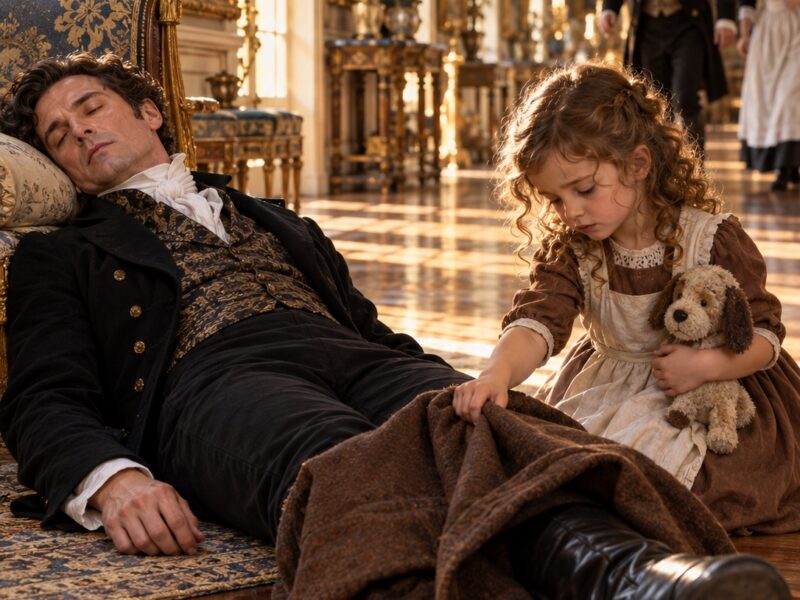
The Duke Pretended to Be Unconscious Every Afternoon—Until a Housemaid’s Five-Year-Old Daughter Covered His Feet and Uncovered a Secret That Could Destroy His Family
For eleven weeks, the Duke of Calvern lay perfectly still while everyone believed he was unconscious.
Then a five-year-old housemaid’s daughter slipped into his gallery, removed her own little coat, and spread it over his feet.
He heard every word she said. But what the child would eventually reveal about a trusted servant, a forged signature, and a woman he had failed to save would change his life forever.
In the spring of 1816, Ashenden Court stood two miles from the village of Little Maro, Wiltshire, behind sweeping lawns and rows of ancient trees. Its master owned more than eleven thousand acres, employed forty-one servants, and possessed nearly every comfort a gentleman of his station could desire. He was forty-one years old, had not raised his voice in nine years, and had forgotten what it felt like to be happy.
The fourth Duke of Calvern had learned to endure his unhappiness quietly.
Every afternoon, from three until four, he lay on a daybed in the long gallery with his eyes closed and his hands folded over his chest. The household believed these hours were necessary for his health. His physician had ordered complete repose after a frightening collapse in March, and no one dared disturb him.
What nobody knew was that the Duke remained awake throughout those hours.
The arrangement had begun on March 9, when he collapsed between the fourth and fifth windows of the gallery with a letter still in his hand. He recovered consciousness before the footman summoned help, but when he heard footsteps approaching, he could not bring himself to open his eyes.
It was not a calculated deception. He simply lacked the strength to face another conversation.
His cheek rested against the cold oak floor as the housekeeper, Mrs. Quillett, appeared in the doorway and began to weep. She had served the family for twenty-two years, and in her distress she called out the name of the Duke’s dead mother.
Then another voice entered the gallery.
“Say nothing of the Barrow End papers until we know whether he wakes.”
The speaker was Silas Netherby, the estate’s land agent.
The Duke recognized his measured voice immediately. Netherby had served the family for nineteen years and was considered one of the most capable men in Wiltshire. He was meticulous with accounts, courteous to tenants, and trusted with matters the Duke seldom had the patience to examine personally.
But what papers could possibly require secrecy while their owner lay unconscious?
The Duke remained motionless.
For the first time in years, no one asked him to sign a document, settle a dispute, inspect a drainage plan, or make a decision. He lay there listening to other people move around him, and the absence of responsibility felt almost merciful.
That evening, Dr. Avery Partardau arrived from Devizes. After examining him, the physician described the collapse as a slight attack of an apoplectic kind and prescribed one uninterrupted hour of rest each afternoon.
The Duke accepted the instruction without objection.
Soon the entire household treated the long gallery as sacred ground between three and four. Servants avoided the passage, correspondence was held until later, and even the housekeeper lowered her voice near its doors.
The Duke found himself surrounded by silence.
And from that silence, he began to hear things he had never noticed before.
He learned which footman was stealing candles and which tenant feared asking for repairs to a leaking roof. He discovered that the butler disliked the condition of the village road and that Mrs. Folly, the cook, believed he was dying of a broken heart.
That last observation irritated him.
It was also, he privately admitted, closer to the truth than anything his physician had said.
Three years and seven weeks earlier, his wife Arabella had died in the blue room at the end of the west passage.
She had been thirty-four.
On February 9, 1813, the Duke had been twenty-two miles away in Devizes, attending a hearing concerning drainage on the Maro River. News of her death reached him while the hearing was still in progress.
Eleven men were present. He read the first line of the message, folded the paper, and returned it to his pocket.
Then he remained seated until the proceedings ended.
He told himself he was a duke, that duty required composure, and that nothing he did could alter what had already happened. Only when the hearing concluded did he begin the journey home.
He arrived at ten minutes past ten that night.
Arabella had been dead for six hours.
A nurse had covered her face with a gray wool blanket, folded in three, with one corner carefully darned.
Standing at the foot of her bed, still holding his hat, the Duke was asked whether he wished to see his wife.
He said no.
He never understood why that single word had come so easily.
He had loved Arabella. She had been the only person who teased him openly, challenged his solemn opinions, and laughed when his dignity became ridiculous. Yet at the final moment, when all that remained was the opportunity to look upon her face, he had refused.
He left the room without lifting the blanket.
For more than three years, it remained folded on the chair beside her bed. The room was kept shut, its furnishings covered, and the servants drew lots to decide who would dust its doorway.
The Duke never entered it again.
He also never spoke the word February inside his own house.
At the other end of Ashenden Court’s grand household lived a woman who possessed almost nothing.
Hester Bray was twenty-nine, widowed, and employed as a housemaid for fourteen pounds a year.
Her possessions amounted to two serviceable gowns, a shawl, a kettle, a tin of tea, a Bible recording her marriage, and her dead husband’s coat.
She rose before dawn, laid fires throughout the house, carried water up two flights of stairs, and generally ate her breakfast while standing. At seven each evening, she walked home to a small estate cottage at the end of Crickham Lane.
Its roof leaked.
In heavy rain, a bowl beneath the ceiling filled twice before morning, and a damp stain spread over the plaster in a shape her daughter insisted resembled the county of Kent.
Hester never complained.
Since losing her husband, she had adopted one rule that governed nearly everything she did: she would ask the estate for nothing.
Not coal. Not money. Not repairs. Not favors.
Her husband, Walter Bray, had been a carter who died when a wagon overturned at Crickham Ford on October 14, 1813. Hester was left with their little daughter Prudence, whom everyone called Pru.
The child was five in the spring of 1816.
She had serious gray eyes, a habit of considering every instruction literally, and a stuffed flannel dog with one ear. Mrs. Folly had named the dog Bishop after a clergyman she once cooked for, and Pru considered the name entirely appropriate.
According to Pru, Bishop disliked rain, beeswax, steep stairs, and anyone who questioned his judgment.
The kitchen staff adored her.
When the Duke’s afternoon rest began, Hester sometimes brought Pru to Ashenden Court because there was no one available to watch her at home. Mrs. Folly kept her occupied in the kitchen, teaching her letters from old advertisements and feeding her bread and honey.
But Hester gave her daughter three strict instructions.
She must never go beyond the green baize door.
She must never speak to His Grace.
And she must never enter the blue room at the end of the west passage.
Pru repeated each rule carefully.
For several weeks, she obeyed them all.
Then, on May 2, a brass button came loose from her brown coat while she was standing on the servants’ staircase.
It struck a step, bounced, and rolled upward toward the forbidden door.
Pru watched it disappear beneath the green baize.
She stood for several moments, consulting Bishop about the situation.
She knew she was not permitted to go upstairs. On the other hand, the button belonged to her coat, and her mother worked too hard to replace things carelessly.
Bishop, she decided, would certainly argue that property must be recovered.
So she pushed the door open with her shoulder.
The passage beyond was long, warm, and unusually quiet. Golden afternoon light poured through tall windows, illuminating the dust above the polished floorboards.
Pru found her button beneath a marble statue of a girl missing both arms.
Then she noticed the man on the daybed.
He lay perfectly motionless, his eyes closed, his hands folded on his chest. His boots remained on his feet, and there was no blanket covering him.
Pru approached cautiously.
She knew what it meant when a person lay still.
She had once watched four men carry her father into their kitchen. She remembered very little of his face from that day, but she remembered a gentleman removing his coat and placing it over Walter Bray’s body.
The man had straightened the coat twice with both hands.
Pru had never forgotten the gesture.
Now she looked around the gallery for something to cover the motionless gentleman.
There was nothing.
After a moment, she removed her own brown coat.
It had two buttons left.
She spread it across the Duke’s boots and smoothed the fabric twice with her little hands.
“It won’t reach,” she explained softly. “It is for your feet. Feet are the coldest.”
She considered his head.
“Bishop says you ought to have a pillow. But he says that about everybody.”
Then she put the recovered button into her pocket, gathered Bishop beneath her arm, and returned to the kitchen.
The entire visit had lasted only a few minutes.
The Duke had not moved.
Yet as he lay there with a child’s coat covering the toes of his boots, he became aware of a feeling he had not experienced for years.
Someone had noticed he was cold.
Someone who wanted nothing from him.
When Mrs. Quillett entered the gallery shortly before four, she discovered the coat and went pale. She removed it hurriedly, certain that a terrible breach of household discipline had occurred.
By six that evening, Hester Bray had been summoned to the library.
She entered expecting dismissal.
“It was my child, Your Grace,” she said before he could question her. “She went upstairs after a button. It was entirely my fault. I shall leave at the quarter day, or tonight if that better suits the house. I shall not ask for a reference.”
The Duke sat behind his enormous desk, looking down at the blotter.
“Where is the coat?”
“Mrs. Quillett has it, Your Grace. I shall remove it.”
“It wants a button.”
“I have the button, Your Grace.”
“She kept it?”
“Yes.”
He was silent for so long that Hester wondered whether he had heard her.
Then he asked, “Does your daughter come tomorrow?”
“She comes most days, since there is no one at the cottage. But I assure you—”
“That is not what I asked.”
Hester stopped.
The Duke turned a pen between his fingers.
“I should like her to come upstairs tomorrow at three.”
She stared at him.
He raised his eyes.
“I am asking, Mrs. Bray. It is not an instruction. You may refuse, and nothing will follow from your refusal.”
“Why?”
The question escaped before Hester could stop it.
A housemaid earning fourteen pounds a year did not ordinarily demand explanations from a duke.
But he did not appear offended.
“Because,” he said quietly, “the hour is long.”
Something in his face made it impossible for Hester to answer immediately.
She thought of the little girl waiting downstairs, of the leaking cottage, and of the years during which she had taught herself never to want anything from the great house.
Then she drew a breath.
“There will be conditions, Your Grace.”
He nodded.
“One hour only. Three until four, and not a minute beyond. She is not to be given money or anything she might sell. If she receives sweets, I shall be told how many.”
“Agreed.”
“If she is sent for, I am told before she is moved.”
“Agreed.”
“And no decision concerning my daughter will ever be made without me. Not a small decision. Not a kind one. Not ever.”
The Duke laid down his pen.
“Agreed. All four.”
Hester returned to the linen room and sat alone between two shelves of folded sheets. For several minutes she covered her face with her hands.
Then she rose and finished her work.
The following afternoon, Pru entered the long gallery carrying Bishop beneath one arm.
The Duke lay as before, apparently unconscious.
But a brown blanket now covered his legs.
Beside the daybed stood a small footstool, precisely the right height for a five-year-old child.
Pru climbed onto it.
“Your blanket is too short as well,” she informed him. “But it is better than a coat.”
For the next hour, she talked.
She explained the legal difficulty of the runaway button, including Bishop’s opinion that her mother’s rule had not accounted for lost property. She described the kitchen cat’s five kittens and announced that one would be called Prudence.
She asked the Duke whether he liked custard, then supplied the answer herself.
“Of course you do. Everybody does.”
The Duke nearly laughed.
He had to clench his jaw to prevent it.
At four, the clock sounded.
“That is the hour,” Pru announced.
She climbed down, collected Bishop, and departed.
The next day she returned.
And the next.
Soon the Duke began measuring his days by the sound of small footsteps approaching the gallery.
Pru told him about the kittens, the mulberry tree, the letters she was learning, and the coins she kept for buying a ribbon. She told him that her mother’s cottage roof leaked and that the bowl beneath the stain shaped like Kent sometimes filled twice in a single night.
She explained that her mother emptied it in the darkness rather than waste a candle.
The Duke listened.
In June, repairs began on the cottages along Crickham Lane, starting with the Bray cottage roof.
The estate books recorded the work as general maintenance.
Two shillings were added to the weekly wages of every housemaid, rather than giving one woman an increase that might invite speculation.
A pair of properly sized shoes appeared at the kitchen door for Pru.
Hester studied them for a long time before allowing her daughter to wear them.
She had resolved never to accept charity.
But she could not permit her pride to become a reason for her child to walk barefoot over gravel.
That evening she opened her Bible, turned to the page recording her marriage, and wrote down the shoes beneath a careful record of the barley sugar Pru had received.
She recorded every gift because she intended never to forget what had been given.
Meanwhile, another man at Ashenden Court was keeping records of his own.
Silas Netherby had served two Dukes of Calvern. He knew the history of nearly every field, tenant, boundary, and drainage ditch on the estate.
He was also nursing an old grievance.
In 1805, the previous duke had visited the flooded land at Barrow End with him. Standing ankle-deep in muddy water, he had declared that any man capable of draining the property deserved to possess it.
Netherby took the remark seriously.
He arranged two miles of stone drainage and hundreds of yards of oak culvert, spending £311 of his own money when estate funds ran short.
But the promise was never written down.
The older duke died, and his successor inherited Barrow End without knowing what his father had said.
The property remained in the estate accounts.
Netherby received neither land nor repayment.
For years, he concealed his resentment beneath excellent service.
He attended funerals, remembered tenants’ children, and treated the poor with an attentiveness that made him universally respected.
He also began taking steps toward claiming what he believed was rightfully his.
At first, they were small.
A payment to a registry clerk.
Money to a writing clerk.
A favor purchased from a carrier.
Later came forged documents, false witnesses, and sheets of paper covered with painstaking attempts to reproduce another man’s signature.
In a hidden drawer behind a wooden panel in his stable office, Netherby kept a ruled ledger recording every payment.
He believed the Duke was too distracted by grief to notice.
He might have been right.
Except for a five-year-old girl learning her alphabet.
One July afternoon, Pru stopped at the open door of Netherby’s office while delivering a laundry book.
The agent greeted her warmly and offered her a lump of sugar.
He asked how the gentleman upstairs was feeling.
“He sleeps all afternoon,” Pru answered. “He never wakes.”
Netherby smiled.
“That is a great pity.”
Pru noticed a sheet of writing on his desk.
A name appeared repeatedly, arranged in two neat columns.
She could not read all the letters, but she recognized the first one.
That afternoon she mentioned the discovery to the Duke.
“The sheep man is learning to write your name,” she announced.
The Duke remained motionless.
Pru continued cheerfully.
“He writes it very long. He puts the front part on as well.”
Then she began talking about the kittens.
But the Duke was no longer listening to the kittens.
Four months earlier, while lying on the gallery floor, he had heard Netherby order the servants to conceal the Barrow End papers.
Now a child had seen the agent repeatedly practicing his name.
The Duke had signed leases, deeds, bonds, and settlements for twenty-two years.
He always signed in the same fashion.
One word.
Calvern.
Never his Christian names.
Never an elaborate flourish.
Never anything resembling the long name Pru had seen.
The implication was unmistakable.
Someone was learning to forge a signature the Duke himself never used.
He wanted to march directly into Netherby’s office and confront him.
Instead, he remained still.
He understood what a confrontation without evidence would accomplish. Netherby could destroy the papers, deny the accusation, and portray his employer as a grieving widower whose illness had disturbed his judgment.
The accusation would rest upon the observations of a servant’s child.
The Duke needed something stronger.
He sent three confidential letters.
The first went to his solicitor, Augustus Toiver, requesting a complete record of documents affecting Barrow End since 1810.
The second went to a bank in Bath, asking whether anyone had sought an advance secured upon Calvern property.
The third went to Jonas Quint, a handwriting examiner whose work had been used by banks and courts.
The letters traveled by trusted messengers rather than through the village post, where Netherby possessed family connections.
The Duke waited.
And while he waited, the little girl continued visiting him.
On July 30, Pru arrived carrying several coins.
She arranged them carefully on her footstool, announcing which would purchase ribbons and which belonged to Bishop.
Then she mentioned the blue room.
“There is a blanket on the chair,” she said. “It is folded in three, and the corner is mended.”
The Duke felt his chest tighten.
Pru moved a farthing with her finger.
“A lady died in there.”
The gallery remained silent.
“Why did you not look at her face?”
The Duke kept his eyes closed.
It took every ounce of his composure to maintain the slow, steady breathing of a sleeping man.
He could still see the letter arriving in Devizes. He remembered eleven men sitting around a table, waiting for him to finish reading.
He remembered folding the message.
He remembered choosing to remain seated.
For years, he had told himself there was no reason to hurry because Arabella was already gone.
But there had been a reason.
He could have reached her sooner.
He might not have changed what happened, but he could have been present afterward. He could have lifted the blanket and said goodbye.
Instead, he had allowed his title to become an excuse for cowardice.
Pru waited several seconds.
Then she nodded to herself.
“Bishop says perhaps you could not reach.”
She returned to her coins.
The Duke lay perfectly still until four.
On August 11, during a day of heavy rain, he asked Hester to meet him in the small parlor.
A tea tray waited between two mismatched cups.
To Hester’s discomfort, he poured her tea himself.
“Your daughter asked me something,” he said. “I have not answered any of her questions. But there is one I should like to answer to someone.”
He told her about Arabella.
He described the hearing, the letter, the six hours, and the blanket over his wife’s face.
He did not ask Hester to comfort him.
She did not offer empty reassurance.
Instead, she placed her cup carefully upon its saucer.
“My husband was carried into our kitchen on October fourteenth, 1813,” she said.
The Duke looked up.
“I saw everything. I have sometimes wished I could have turned away. I should have been ashamed of wishing it, but I have wished it nevertheless.”
Rain struck the windows.
“Your grief lives in a house with forty servants,” Hester continued. “Mine lives in a cottage with a bowl beneath the ceiling. I used to think that made yours lighter.”
She paused.
“I was wrong.”
The Duke looked at the tea tray.
“It is not the same,” she said. “But I think it may be the same weight carried in a better room.”
He was silent.
Then he whispered, “Her name was Arabella.”
“My husband was Walter Bray. He was a carter. He could not read.”
A faint smile crossed Hester’s face and vanished.
“He was the only person who ever thought I was clever.”
For a long while neither spoke.
Downstairs, Pru was explaining to Bishop why the mulberry tree was an excellent place to bury kittens.
Outside, the rain continued.
And in the quiet parlor, two people who had spent years protecting their grief from the world allowed another person to see it.
Nine days later, Pru encountered a stranger on Crickham Lane.
He wore a respectable brown coat and sat on the stile near the bottom of the lane.
He knew her name.
He asked about Bishop, spoke pleasantly of a niece her age, and inquired whether the Duke had begun talking during his afternoon sleep.
Pru replied that the gentleman never woke and never spoke.
The stranger gave her a penny.
She carried it straight home and placed it in her mother’s hand.
Hester sat down.
She had been in service since she was eleven. She knew that a stranger who questioned a small child about her employer’s habits was not necessarily being friendly.
The following morning she informed the butler, Mr. Ambrose Lisk.
Lisk told the Duke.
Within two days, men employed for reasons other than gardening appeared near the lower shrubbery. A stable boy was instructed to walk along Crickham Lane each afternoon, whether he had an errand or not.
When Hester discovered the arrangement, she went directly to the library.
“You made a decision concerning my daughter without telling me.”
The Duke stood behind his desk.
After a moment he nodded.
“You are right. I broke my promise.”
He explained the precautions.
Hester listened.
“Keep the men there,” she said.
By September, the danger had become harder to dismiss.
Someone was seen watching the cottage.
A carriage waited for hours at the lane.
One night, an unknown person tried the cottage door, only to discover the new bolt installed during the roof repairs.
Meanwhile, Toiver’s investigation uncovered a deed dated October 14, 1813.
According to its terms, the Duke had conveyed valuable farms at Barrow End to Marcus Netherby, the agent’s nephew, for five thousand pounds.
The document bore a signature.
Marcus Reed Calvern.
The Duke stared at it.
He had never signed that name.
He had never authorized the conveyance.
And he had certainly not signed away his land on October 14, 1813.
The handwriting examiner was sent the document immediately.
Netherby, unaware of the Duke’s discoveries, was becoming desperate.
The bank at Bath had refused to advance money on the deed while the Duke remained alive, competent, and capable of disputing the transaction.
If the Duke died or became permanently incapacitated, matters might be different.
Netherby had already committed himself too deeply to retreat.
Then a second opportunity appeared.
For years he had harbored a personal interest in Hester Bray. He had proposed marriage twice, and twice she had refused him.
She had told no one.
She lived in an estate cottage without a lease and knew how easily a powerful agent could ruin a servant’s employment.
Netherby interpreted her silence as weakness.
He began trying to discredit her.
On September 24, Arabella’s cashmere shawl was discovered inside Hester’s work basket.
The accusation of theft spread through the servants’ quarters within minutes.
Hester stood before the Duke in the library, pale but composed.
“I did not take it,” she said.
The Duke called for the household inventory and the laundry register.
The records showed that the press in the blue room had been opened two days earlier, with Netherby present.
The Duke closed the investigation.
Then, in front of the household, he personally returned Arabella’s shawl to its proper place.
He stood for a long time inside the blue room.
It was his first return since his wife’s death.
Two nights later, a message arrived claiming that Pru had been taken to Crickham Ford by dangerous men.
The note instructed the Duke to come alone.
Within minutes, he had taken his pistols from their case and ordered his horse saddled.
Hester intercepted him in the hall.
“My daughter is asleep in the kitchen,” she said.
He stopped.
“Then whoever is at the ford—”
“There is no child at the ford.”
Hester looked at the pistols.
“There may be three men waiting, one of them the magistrate’s son. They want to see you threatening an unarmed man on a public road.”
The Duke said nothing.
“If you behave violently, they can use that violence to question your judgment. And then Netherby’s paper becomes worth something at the bank.”
“Stand aside, Mrs. Bray.”
“No.”
The word hung between them.
She was a housemaid standing in front of one of the wealthiest men in Wiltshire.
But she did not move.
“Your Grace,” she said, “you know what this is. You knew before you took those pistols from their case.”
He looked at her.
Then he put the weapons away and handed the key to Lisk.
“You are right,” he said quietly. “I will not go.”
That night, he wrote letters until two in the morning.
By September 30, the legal and financial avenues Netherby expected to use were being quietly closed against him.
But Netherby still had one plan remaining.
And it involved separating Hester from her daughter.
On October 7, Hester received a letter apparently written by her sister Annis, who worked near Taunton.
Annis had suffered a terrible fall, the letter claimed. Her hip was broken, and she might not recover.
She was asking for Hester.
For the first time in three years, Hester requested leave from the estate.
She asked for four days.
The Duke granted the request immediately and offered a carriage.
Before leaving, she insisted that Pru remain inside Ashenden Court under Mrs. Folly’s supervision.
“If anything is decided concerning her while I am away,” she warned, “it is not decided.”
“Nothing will be decided,” the Duke promised.
Hester departed that evening.
What she did not know was that the Duke had already received the first report from Jonas Quint.
The handwriting on her sister’s letter bore the same peculiar characteristics as the forged Barrow End deed.
Both had been written by the same hand.
The Duke knew the letter was false.
He also knew its purpose was to remove Hester from the house.
Yet he allowed her to leave because he believed the danger at Ashenden Court was greater than anything awaiting her in Taunton.
It was a decision he understood she might never forgive.
The following morning, Dr. Partardau visited the estate.
At one o’clock, Lisk gathered the household and announced that the Duke had suffered another attack.
His Grace was unconscious.
He had not spoken.
He had been moved to the blue room because it was quiet and well ventilated.
The servants were instructed not to disturb him.
Word reached Netherby almost immediately.
Inside the blue room, the Duke lay with his eyes closed while the household prepared for another long vigil.
The gray blanket remained on the chair beside the bed.
Three nights passed.
Solicitor Toiver arrived from Bath.
Jonas Quint arrived with documents, magnifying lenses, and examples of paper from English mills.
Dr. Partardau continued his visits.
Meanwhile, Netherby made inquiries about the Duke’s condition.
He was told the same thing each time.
His Grace remained insensible.
On the rainy night of October 11, Pru woke in the kitchen and found the house strangely quiet.
She carried Bishop down the west passage.
The blue room door stood slightly open.
Inside, the Duke lay motionless beneath a sheet.
The air had turned cold after sunset.
Pru saw the gray blanket on the chair.
It was large and heavy, and she had to unfold it on the floor before she could lift it onto the bed.
She climbed onto the chair, dragged the blanket across the Duke, and straightened it twice with both hands.
Then she sat beside him.
“Mama has gone to Taunton,” she said softly. “Aunt Annis fell down. Mama said four days.”
The Duke listened.
Pru rubbed her nose with her wrist.
“The sheep man came into the kitchen yesterday. He said when Mama comes back, I am to call him Papa.”
Beneath the blanket, the Duke’s fingers tightened.
“I told him I already have a papa. He is in the churchyard, under the second yew.”
Pru paused.
“He showed me a paper with your name. It had a ribbon on it. He said when you are dead, he will have the farms and the house and everyone.”
The Duke remained still.
“But he wrote your name wrong,” she added. “He writes it long. I have seen yours on letters. You only write one word.”
She patted the blanket.
Then her voice softened.
“Mrs. Folly says you had a lady, but she went away. And you have no boy or girl. When you go into a room, everybody leaves.”
Pru considered this carefully.
“I have Mama. I had Papa. I have Bishop.”
She looked at the motionless face beside her.
“I think everybody ought to belong to somebody.”
The Duke heard the rain beating against the window.
For months he had listened to the child’s cheerful accounts of kittens, sweets, broken buttons, and leaking ceilings. He had never answered her because speaking would mean abandoning the little refuge he had created inside his silence.
Now she laid her small hand over the gray blanket.
“So you are not nobody’s anymore,” she told him. “I have decided.”
Then she leaned closer.
“You are not asleep. I am your somebody now.”
Nine words.
The Duke opened his eyes.
“I am not asleep,” he said.
Pru stared at him with astonished interest.
“Since when?”
“Since the second of May.”
She considered this.
“The button?”
“Yes.”
“And you never said anything?”
“No.”
“That was very rude.”
The Duke almost smiled.
“It was. I apologize.”
She accepted the apology.
Then she asked whether he had heard everything about the kittens.
“All five,” he replied. “And the one beneath the mulberry tree. And the coins you kept in your shoe.”
He looked toward the blanket.
“And the question you asked me about Arabella.”
Pru grew quiet.
“Why did you not look at her?”
The Duke took a long breath.
“Because I arrived six hours late. And I was a coward for one minute.”
He looked at her.
“Somehow that minute never ended.”
Pru nodded as though the explanation were perfectly reasonable.
Then she straightened the blanket again.
“It reaches now.”
The Duke covered his eyes with one hand.
For several moments, neither spoke.
It was the first time Pru had ever sat quietly beside him.
At last he asked two questions.
He wanted to know where Netherby had placed the ribboned document.
Pru remembered precisely.
Inside the left breast pocket of his coat.
She also remembered a brass seal with a mushroom-shaped handle, which Netherby used to press impressions into red wax.
The Duke thanked her.
Then he carried her back to the kitchen, instructed Mrs. Folly to keep her there, and quietly summoned Lisk, Toiver, and two trusted grooms.
He returned to the blue room shortly after midnight.
At twenty-six minutes past twelve, the garden door opened.
Two men entered the passage wearing stockings over their feet to silence their steps.
One carried a shaded lantern.
The other was Silas Netherby.
They approached the Duke’s bed.
Netherby placed a ribboned document on the counterpane.
His accomplice, Peter Dalmore, the writing clerk, hesitated.
“He is asleep.”
“He is insensible,” Netherby corrected. “There is a difference in law.”
He instructed Dalmore to witness the Duke’s signature on a document supposedly completing the earlier conveyance.
Dalmore’s hands trembled.
Netherby uncorked the ink.
Then he lifted the Duke’s right hand, intending to guide the pen across the paper.
The hand closed firmly around his wrist.
“That is my hand you are holding, Mr. Netherby,” said the Duke.
His eyes opened.
“And it is not insensible.”
The lantern fell.
Dalmore stumbled backward and fled into the passage, where he encountered Lisk and two waiting grooms.
Netherby remained beside the bed with the pen in his hand.
For nineteen years, he had been accustomed to speaking for the Duke, deciding what deserved his attention and what could remain beneath the surface of the estate’s accounts.
Now he faced his employer across the bed where Arabella had died.
“You will want to strike me,” Netherby said.
“No.”
“Then you have more restraint than I deserve.”
The Duke stood.
Netherby began speaking of Barrow End, the drains, the money he had spent, and the promise the previous duke had made.
He had waited eleven years, he said. Eleven years in which neither father nor son had acknowledged what he had done.
The Duke listened.
“I know.”
Netherby stared at him.
“I did not know until September,” the Duke said. “Then I investigated. Mr. Toiver has already arranged payment.”
He explained that the original £311, together with interest, amounted to roughly £482 and several shillings.
The money had been deposited for Netherby.
He could draw it.
Netherby looked bewildered.
“You were owed money,” said the Duke. “You were never owed my name.”
Then he instructed Lisk to escort the agent to the steward’s room, where he would remain under supervision until he could be taken before the magistrate.
Nothing violent was to happen to him.
Nothing outside the law.
As Netherby put on his coat, the brass seal slipped from his left pocket and rolled across the stone floor.
A small voice emerged from the darkness at the top of the kitchen stairs.
“That is his stamp!”
Pru stood there holding Bishop.
“He kept it with the paper. In the left pocket.”
The Duke looked up.
“Thank you, Prudence. Go to bed.”
“I am going,” she answered.
And this time she did.
Hester returned from Taunton on October 12.
She had found her sister completely unharmed, walking about the dairy with two sound legs and no knowledge of the letter.
The journey home had given Hester ample time to understand what had happened.
When she reached Ashenden Court, she went first to the kitchen, held Pru on her lap, and listened to the entire account.
Then she entered the library still wearing her bonnet.
“You knew the letter was false.”
The Duke did not deny it.
“I knew before you left.”
“And you allowed me to go?”
“Yes.”
“Why?”
“Because I believed you would be safer away from Ashenden Court. If I had told you, you would have insisted on remaining.”
Hester’s expression hardened.
“You made a decision about me without me.”
“I did.”
“You broke your promise.”
“I did.”
He met her eyes.
“I shall not pretend otherwise.”
Hester was silent for a long time.
Then she told him something she had concealed.
Netherby had proposed marriage twice.
She had refused him twice.
She had been afraid to complain because he controlled much of the estate’s daily administration, including the cottage in which she and her child lived.
“If I had told you,” she said, “you might have found his papers sooner.”
The Duke shook his head.
“You will not bear that responsibility alone.”
“I kept silent.”
“Because the arrangement of this house gave him power over you. My father created part of that arrangement. I permitted the rest to continue.”
He hesitated.
“We are responsible for that.”
It was the first time either of them had spoken of their separate troubles as something they might face together.
The hearings began in Devizes on October 15.
Toiver presented the forged conveyance, the attempted second signature, the hidden ledger of payments, and the hundreds of practice sheets discovered in Netherby’s office.
Jonas Quint examined the signatures before the magistrates.
He showed that the Duke’s genuine signature always consisted of one word.
The forged document contained Christian names the Duke never used.
More importantly, the letters revealed repeated pen lifts characteristic of a writer laboriously copying another hand.
The same peculiar movements appeared in the forged letter supposedly written by Hester’s sister.
Then Quint held the Barrow End deed against the light.
Its paper bore a watermark dating its manufacture to 1815.
The deed itself was dated 1813.
The room fell silent.
No one could have signed a document two years before the paper on which it was written existed.
Witnesses were questioned.
Dalmore confessed his involvement.
The carrier admitted signing a document in Netherby’s office without ever seeing the Duke.
But the most unexpected testimony came from Dr. Partardau.
He had arrived in court without warning.
When the date October 14, 1813, was mentioned again, he rose and asked permission to speak.
On that afternoon, he explained, a wagon had overturned at Crickham Ford.
The injured carter was Walter Bray.
The physician had been summoned to the Bray cottage and found the man beyond saving.
Walter died shortly before five.
And the Duke of Calvern had been there.
He had gone down from Ashenden Court when news reached the estate that a tenant lay dying.
He had summoned the doctor, paid his fee, and remained at the cottage long after Walter’s death, helping where he could.
The Duke had instructed the physician not to mention his presence.
“He took off his coat,” Partardau recalled, “and laid it over the dead man.”
Hester sat motionless.
The physician continued.
“He straightened it with both hands. There was a woman in the doorway holding a little child.”
Hester slowly turned toward the Duke.
He was staring at the table.
For three years she had remembered an unknown gentleman placing his coat over Walter’s body.
For three years, her daughter had remembered that same act.
And for months Pru had been repeating it, first with her little brown coat and later with Arabella’s gray blanket.
The man who had covered her father was the same man she had tried to keep warm in the gallery.
Hester pressed her fingers against her lips.
The Duke did not look at her.
For once, there was nothing he could say that would improve upon the truth.
Netherby was committed for trial.
The Duke declined to press the most severe charges available, which could have carried a capital sentence.
He did not forgive Netherby.
He believed the man deserved punishment.
But he also recognized that the original injustice had begun with an unpaid debt and a careless promise made by his own father.
Netherby was convicted the following March and sentenced to two years.
Afterward, he went to Liverpool, where he worked in a small counting house for his nephew.
He never returned to Wiltshire.
Before the legal proceedings ended, the magistrate asked whether Pru could explain what she had seen.
The Duke approached Hester rather than making arrangements himself.
Her permission was not assumed.
She agreed only after establishing four conditions.
Her daughter would speak in a private room, not before a crowded court. Hester would hold her hand. Questions would not be repeated in a manner that made the child doubt herself. And nobody would ever tell Pru that she had sent a man to prison.
“She told the truth about a brass stamp,” Hester said. “That is all.”
The arrangements were accepted.
Pru spent nine minutes with the magistrate, her mother, and Bishop, who sat on the table.
The magistrate emerged satisfied and visibly moved.
By winter, the scandal had faded.
But changes continued at Ashenden Court.
The blue room remained open.
The curtains were drawn back.
A fire was lit.
The gray blanket was unfolded and used again, and when its mended corner began to fray, Hester repaired it with an imperfect line of gray wool.
Pru moved into a little room nearby, with her mother’s approval.
The Duke no longer pretended to sleep.
At first, he continued resting between three and four out of habit. Then the hour gradually became a time for tea in the small parlor.
There were still two mismatched cups.
Sometimes a third appeared, along with a saucer reserved for Bishop.
In February, the Duke visited Arabella’s grave.
Later, Pru asked to accompany him.
He told her about his wife, her laughter, and how she had disliked one particular yew tree near the churchyard.
“Was she somebody’s?” Pru asked.
“She was mine,” he answered. “And I was hers.”
He looked toward the grave.
“I shall always wish I had come home sooner.”
Pru thought about that.
Then she announced that she would place flowers on Arabella’s grave and her father’s grave, half and half.
Arabella, being a duchess, could have the longest stems.
Walter, she explained, preferred little flowers.
The Duke made no objection.
In March, he laughed aloud at breakfast for the first time in more than four years.
Pru had presented a lengthy argument against porridge, only to contradict herself in the final part.
The Duke put down his newspaper and laughed until his eyes watered.
Mr. Lisk quietly set down the coffee pot.
Then he left the room and stood in the passage for several moments.
By the following spring, society had begun to speculate about the Duke’s attachment to Hester Bray.
His elderly aunt, Lady Honoria Vesey, arrived to speak with him.
She was practical rather than cruel.
Hester was a former carter’s widow and a housemaid earning fourteen pounds a year. The Duke owned great estates, held a hereditary title, and was expected to marry within his rank.
The marriage would provoke gossip.
And Pru, Lady Honoria warned, might suffer the most when she grew older.
The Duke did not dismiss her concerns.
“I believe everything you have said,” he replied.
His aunt waited.
“But I spent years surrounded by people who treated me with perfect courtesy. Not one of them knew how to reach me.”
He looked toward the gallery.
“Then a five-year-old child took off her own coat because she thought my feet were cold.”
He paused.
“I cannot spend the rest of my life governing myself by the opinions of people who would never have thought to do that.”
Lady Honoria remained quiet for some time.
Eventually she agreed to attend the wedding, if there was one.
She later sent Pru a gray wool cloak with a red lining and a note explaining that its corner was new, not mended.
Pru immediately noticed the difference.
On June 8, 1817, the Duke walked down Crickham Lane without a servant.
He wore an ordinary hat and carried no papers.
Hester met him at the old kitchen table.
The roof had been repaired. The bowl was gone, though the stain resembling Kent remained on the ceiling.
The Duke sat opposite her.
Before making his proposal, he told her what it was not.
It was not gratitude for saving him from Netherby.
It was not a reward for her daughter’s kindness.
And it was not an offer of rescue.
Hester had kept herself and her child alive through years of grief and hardship without requiring a duke to save her.
He knew that.
He also knew that a woman living in an estate cottage could never freely accept or refuse a powerful employer’s proposal unless her independence was secured first.
So he had instructed Toiver to prepare a settlement.
The cottage would be hers for life at a nominal rent.
She would receive an annual income of sixty pounds, whether she married him or never spoke to him again.
Pru’s education would be provided for.
The arrangements had already been placed beyond the Duke’s personal power to revoke.
Hester listened without interrupting.
When he finished, she folded her hands on the table.
“Then say what you came to say.”
The Duke looked at her.
“I would like to marry you.”
He drew a slow breath.
“Not because I need someone to agree with me. I have had people agreeing with me all my life.”
A faint smile touched his mouth.
“I would like to marry you because you tell me no when I need to hear it. Because you see what I would rather conceal. And because, when you come into a room, I no longer want everybody to leave.”
Hester looked down at her hands.
“Terms,” she said.
The Duke nodded.
“Terms.”
She would keep Walter’s coat.
His name would remain in her Bible and would be spoken aloud in their home.
Their daughter would never be expected to forget her father or surrender the memories that belonged to her.
No decision concerning the family would be made without those affected having a voice.
And Hester would remain free to leave.
Not because she intended to go, she explained, but because freedom was what made staying meaningful.
The Duke agreed.
Hester was quiet for several moments.
Then she turned her hand palm upward on the table.
“Yes,” she said.
He placed his hand in hers.
The following afternoon, they told Pru.
They chose the blue room because she liked the blanket and believed important things should be discussed near it.
Hester explained that they wanted her permission, too.
Pru listened solemnly.
“Will he be my papa?”
The Duke answered carefully.
“No. Your papa was Walter Bray. Nobody will take his place.”
Pru looked at him.
“Then what will you be?”
“I should like to be someone who stays,” he said. “Every day. Even when there is nothing special to do.”
Pru considered the matter.
Then she decided he could remain Duke, because she was accustomed to calling him that.
Bishop agreed.
They married on September 4, 1817, in the church at Little Maro.
Fourteen people attended.
Hester wore gray.
Pru walked before them carrying Bishop and a small bunch of flowers.
On the way into church, she left some upon Walter’s grave.
On the way out, she placed the others near Arabella.
She continued that practice for many years.
That evening, Mr. Lisk approached the blue room with a tray.
The door stood open.
Inside, a fire burned gently.
Pru had fallen asleep on the bed with Bishop tucked beneath her chin. The old gray blanket covered her from the chest down.
Hester sat beside the bed with her shoes removed.
And on the floor, leaning against the bedframe, sat the Duke of Calvern.
Across his knees lay Walter Bray’s old coat.
He was holding it quietly, with his eyes open.
Lisk did not disturb them.
He placed the tray outside and went away.
In the years that followed, Walter’s coat hung on the third peg in the kitchen, low enough for a child to reach.
In 1823, a four-year-old boy named Walter, the Duke and Hester’s son, took it down and asked whom it belonged to.
He was told about the carter who had died before he was born, the little girl who remembered a coat, and the gentleman who had once believed grief was something best endured alone.
The coat was never framed or locked away.
It was still used when someone needed warmth.
And between three and four every afternoon, Ashenden Court was no longer silent.
There were children in the gallery, footsteps across the polished floorboards, questions from Pru, and arguments about Bishop’s dignity.
The Duke no longer needed to pretend he was unconscious.
The great curtains remained open.
The blue room door was never shut again.
And the gray blanket with its badly mended corner was no longer folded on an empty chair.
Someone was always using it.









