THE DUKE RETURNED AFTER FIVE YEARS TO ERASE HIS MARRIAGE—BUT THE LITTLE BOY WHO OPENED THE DOOR HAD HIS EXACT EYES
He came with annulment papers and five hundred pounds to make his wife disappear.
He had not seen her in five years—and had never asked whether she was alive.
But when a little boy opened the rose-covered door, the Duke of Carrington saw his own face staring back at him.
The carriage arrived at four o’clock on a warm June afternoon, when the sunlight over Somerset had turned the color of honey. It was a magnificent black carriage bearing a ducal crest, drawn by four gray horses and driven by a coachman in dark green livery. Along the narrow country lane, wild roses leaned over the hedges and brushed against the wheels as though trying to slow its approach.
At the end of the lane stood a beautiful house built of honey-colored stone. Tall windows reflected the afternoon sky, and a deep green door sat beneath an archway heavy with climbing roses. Pink blossoms surrounded the windows, white roses filled the garden beds, and their fragrance hung so thickly in the summer air that even the coachman paused to admire them.
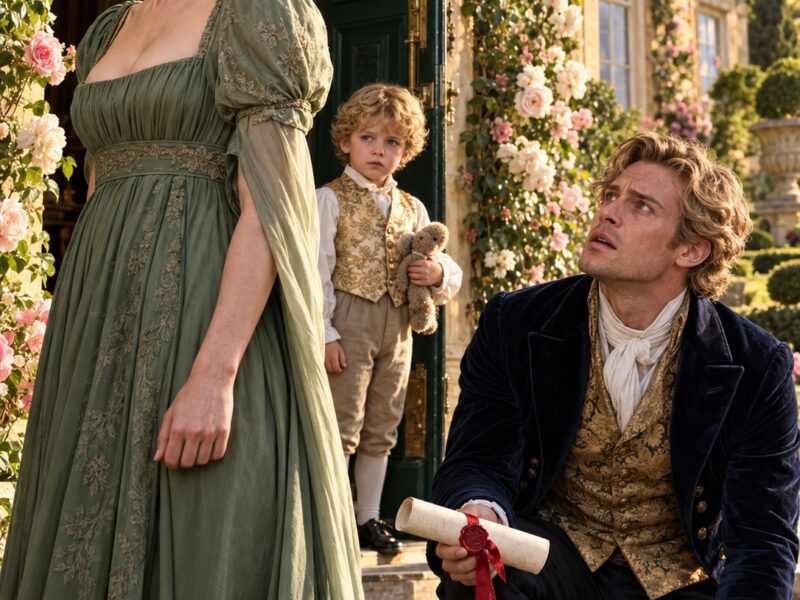
Sebastian Vale, Duke of Carrington, stepped down from the carriage. He was a handsome man in his early thirties, with wavy ash-blond hair, gray-blue eyes, and the careful elegance of someone who had never needed to think about the price of his clothes. His navy velvet coat was beautifully cut, his waistcoat was woven with gold, and in one gloved hand he carried a roll of legal papers bound with red ribbon.
He had come to end his marriage.
Five years had passed since he had last seen his wife. During those years, Sebastian had not written her a single letter, visited her once, or troubled himself to learn how she lived. Until his solicitor mentioned it, he had not even known that she had moved from the miserable cottage where he had abandoned her.
His intentions were simple. He would present the documents, offer five hundred pounds in exchange for her cooperation, and return to London before the end of the week. He had already spent far too much time thinking about a marriage he had never considered real.
He walked between the rose bushes and knocked on the green door.
Footsteps sounded inside. The latch turned, and the door swung open.
But the person standing there was not his wife.
It was a little boy.
The child appeared to be about five years old, dressed in a cream shirt with a ruffled collar and a small gold-brocade waistcoat. Golden curls tumbled across his forehead, and his expression held the open curiosity of a child who had never been taught to fear strangers. He looked up at Sebastian with clear gray-blue eyes.
The Duke stopped breathing for a moment.
He knew those eyes.
He had seen them in his shaving mirror every morning of his adult life. He knew the shape of that brow, the stubborn little chin, and the pale golden hair that appeared in portraits of Carrington men going back generations. They belonged to his father, his grandfather, and now, impossibly, to a small boy standing in the doorway of a house in Somerset.
“Good afternoon,” the child said politely. “Have you come to buy roses? Mama sells them, but the shop is around the side.”
Sebastian opened his mouth, but no words came.
Then a woman appeared behind the boy.
She was twenty-seven, with dark brown hair arranged in a neat braid, thoughtful gray eyes, and a sage-green silk gown embroidered at the sleeves. She held herself with a quiet confidence that Sebastian did not recognize. There was no trace of the frightened twenty-two-year-old girl who had stood before him on their wedding day.
She rested one hand on the child’s shoulder.
“Hello, Sebastian.”
He stared at her.
“Rosamund.”
Her gaze moved briefly to the red-ribboned documents in his hand. Something hardened in her expression, but she showed no surprise.
“Kit, this gentleman and I need to speak. Please go and help Mr. Farweather in the glasshouse.”
The boy remained where he was.
Sebastian was still staring at him, unable to turn away from those familiar eyes. Slowly, the Duke of Carrington lowered himself onto one knee, something he had scarcely done before anyone except his king.
Now he was face-to-face with the child.
The resemblance was even more extraordinary at close range.
“What’s your name?” Sebastian whispered.
“Christopher,” the little boy answered. “But everyone calls me Kit.”
He tilted his head.
“Why are you looking at me like that?”
The papers slipped from Sebastian’s fingers and landed on the gravel. The red ribbon loosened, but he did not reach for them.
Behind the child, Rosamund stood perfectly still.
And for the first time in five years, the Duke of Carrington understood that he had walked into something his title, his money, and his carefully prepared documents could not control.
To understand how that little boy came to be standing in that doorway, the story begins long before the Duke’s carriage reached Somerset.
It begins in a walled rose garden in Kent, with a gardener’s daughter who had dirt beneath her fingernails and a lonely boy who was never supposed to love anything that could not be bought.
Rosamund Bell had been born in the head gardener’s cottage at Carrington Park, the ancestral estate of the Dukes of Carrington.
Her father, Thomas Bell, had entered service on the estate when he was twelve. By the time Rosamund was born, he supervised forty men and cared for twelve acres of ornamental grounds, kitchen gardens, glasshouses, and orchards. But the part of the estate he loved most was the great walled rose garden south of the mansion.
There were more than three hundred varieties growing within its old brick walls. French roses with crowded petals, fragrant Damasks brought from the East, moss roses, musk roses, and delicate China roses collected by travelers who had crossed oceans. Thomas knew every variety by its shape, scent, and temperament.
Rosamund grew up among them.
She learned to walk on the gravel paths between the beds. Her earliest reading lessons came from the small lead labels her father placed beside each bush. By eight, she could take cuttings, and by twelve, she could graft a cultivated rose onto a wild rootstock with the care and precision of a trained gardener.
At sixteen, she was experimenting with new varieties. Using a fine brush, she carried pollen from one flower to another, marked the stems, and waited patiently to discover what would bloom.
“You’ve got the gift, Rosie,” her father often told her. “Plants seem to like you. And that’s not something anyone can teach.”
Her mother had died when Rosamund was young. After that, her father was everything to her: parent, teacher, protector, and friend. Their cottage was modest, but there were roses in jars during the summer and seed catalogs scattered beside the fire in winter.
Sometimes, another child wandered into their garden.
Sebastian Vale was the only son of the Duke of Carrington, four years older than Rosamund and heir to one of the grandest names in Kent. He had fine clothes, expensive tutors, beautiful horses, and every advantage that wealth could provide. What he did not have was an affectionate home.
His mother, Augusta, considered tenderness a weakness. His father was even colder, treating his son less as a child than as a future custodian of the family title. Sebastian learned early that mistakes brought punishment and emotions were best hidden.
The rose garden became his refuge.
He would sit on the stone bench beside the sundial and watch Rosamund work. Sometimes he asked questions about the flowers. Sometimes he laughed because she spoke to the plants as though they were stubborn people who needed encouragement.
One afternoon, when Sebastian was fifteen and Rosamund eleven, he helped her carry heavy watering cans through the garden. By the time they finished, mud had splashed across his expensive coat and soaked into his shoes. Rosamund thanked him, laughing at the sight of a future duke looking like a gardener’s apprentice.
That evening, his father had him whipped for disgracing himself.
Sebastian did not return to the rose garden.
He was sent away to Eton, then Oxford, and afterward joined the fashionable circles of London society. Nine years passed without Rosamund seeing him again.
By the time he returned, the boy who had once helped her carry water seemed to have disappeared.
And Rosamund’s world was about to collapse.
She was twenty-two when her father died in March after a fever that had begun as an ordinary cold. She buried him in the village churchyard beneath a white rose that she had grown from a cutting when she was ten.
After the funeral, the estate’s new head gardener informed her that she could not remain in the cottage. It belonged to Carrington Park, not to her family, and he intended to use it for another employee.
She had one month to leave.
A week after Thomas Bell’s death, the old Duke of Carrington died as well.
His passing made Sebastian the new Duke at twenty-six.
It also brought a will that shook the family.
The old Duke had never trusted his son with money. Sebastian had a reputation for extravagance, gambling, and spending far beyond what good judgment allowed. Although the title and entailed estate would pass to him automatically, the family’s substantial ready fortune was another matter.
The will contained a condition.
Unless Sebastian married within six months of his father’s death, more than eighty thousand pounds would pass to his uncle.
Sebastian was furious.
He had no intention of marrying, least of all to satisfy a demand made by a father who had treated him harshly throughout his life. Yet he despised the thought of his uncle receiving the money even more.
So he devised a solution that would satisfy the legal requirement while humiliating the family that had tried to control him.
One gray April morning, he walked into the walled rose garden.
Rosamund was there, packing her father’s seed packets into a wooden box. She had found the possibility of employment as a governess in Yorkshire, although the thought of leaving the only home she had known filled her with quiet dread.
Sebastian stopped beside the old sundial.
“Rosamund Bell.”
She looked up in astonishment.
“Lord Carrington.”
“Duke now,” he corrected with a careless smile. “Though I wish it had happened under different circumstances.”
She offered her condolences. He nodded impatiently, then delivered the question that would change both their lives.
“Will you marry me?”
Rosamund stared at him.
She thought he was teasing her.
But Sebastian explained the terms without embarrassment. He needed a wife before October to secure his inheritance. His father’s will did not require the bride to come from a distinguished family. A legal marriage to the head gardener’s daughter would satisfy the condition perfectly.
“My mother will be horrified,” he said. “My uncle will be furious. And you will have a roof over your head for the rest of your life. Surely that’s better than going to Yorkshire to teach someone else’s children.”
Rosamund held the box of seeds against her chest.
There was no love in his proposal. He made no attempt to pretend otherwise. Yet she remembered a boy who had once carried watering cans for her, a boy who had come to the garden because the grand house had never been kind to him.
Perhaps that boy still existed somewhere beneath the Duke’s polished indifference.
“Yes,” she said at last.
Sebastian smiled.
He believed he had solved his problem.
Rosamund believed that perhaps two lonely people could build something better than the lives they had been given.
Only one of them understood the marriage as an arrangement with no future.
They were married on a rainy Saturday in May in the chapel at Carrington Park.
Two footmen served as witnesses. The Dowager Duchess, Augusta, refused to attend.
She had imagined her son marrying Lady Charlotte Brandon, Lady Mary Ashworth, or another young woman whose ancestry could be traced through generations of titled families. When she learned that the Duke intended to marry the gardener’s daughter, she smashed a valuable porcelain vase and refused to speak to him for a week.
Sebastian found his mother’s outrage amusing.
Rosamund did not.
She stood in the cold chapel wearing the finest gray dress she owned, promising herself to a man who smiled as though he had won a private argument.
After the ceremony, she followed him into the great house, climbing the staircase beneath portraits of seven dead dukes.
That night, something unexpected happened.
Sebastian was kind.
He asked about her father and listened as she spoke of the years they had spent among the roses. He told her stories about Eton, about the loneliness he had experienced there, and about how much he had hated being sent away. For several hours, the sharpness left his voice.
He even laughed at something she said, then looked almost surprised that he had done so.
Lying beside him in the darkness, Rosamund felt the fragile beginning of hope.
Perhaps their marriage would not remain an arrangement. Perhaps the boy she remembered had merely been hiding beneath years of disappointment and pride.
By morning, that hope was gone.
When Rosamund awoke, Sebastian was no longer beside her.
She found him in the breakfast room, dressed for travel and reading a letter. His trunks were already waiting in the entrance hall.
“I’ve accepted a position,” he informed her.
She stopped in the doorway.
“A position?”
“At the embassy in Constantinople. Secretary to the ambassador.”
“How long will you be away?”
“Several years, I expect.”
She stared at him.
“When did you accept it?”
“Last week.”
“Before our wedding?”
He folded the letter.
“Yes.”
The room seemed suddenly colder.
“And what am I supposed to do?”
Sebastian looked at her as though she had asked something unreasonable.
“Let me be perfectly clear, Rosamund. This marriage is a signature, not a life. I needed a wife on paper to secure my inheritance. Now I have one.”
She could barely move.
“There is a cottage on family land near a village in Somerset called Ashcombe,” he continued. “You may live there. My mother’s man of business will arrange an allowance of fifty pounds a year. It is considerably more than your father earned.”
Rosamund looked down at the wedding ring on her finger.
“And if I need to write to you?”
“Don’t.”
The single word struck harder than an angry speech.
“If anything truly important happens, write to Mr. Sneed. He will pass it to my mother, and she can decide whether it is worth troubling me.”
Sebastian pulled on his gloves.
“Goodbye, Rosamund. Try to be happy. I’m sure you’ll grow some very nice roses.”
Then he left.
She heard the carriage wheels cross the gravel outside, move down the long drive, pass the lake and deer park, and finally disappear beyond the estate gates.
Rosamund remained alone in the breakfast room.
She had been a duchess for barely a day.
And the husband who had married her had already decided that she would have no place in his life.
Before the afternoon was over, she had packed her single trunk and her father’s box of seeds.
Then she asked a footman how she might travel to Somerset.
The cottage at Ashcombe was worse than anything Sebastian had described.
It stood at the end of a muddy lane near a small village in the Mendip Hills. The thatched roof was rotting, several windows were cracked, and rain leaked through the ceiling of the back bedroom. No one had lived there for nine years.
The garden had become a wilderness.
Nettles and brambles grew taller than Rosamund’s shoulders. Weeds crowded the walls, and the path to the door had nearly disappeared beneath tangled growth.
The village women came to look at her.
Some were curious about the new Duchess of Carrington living in such an abandoned place. Others whispered about why a young nobleman’s wife had arrived without her husband, servants, or a household worthy of her title.
Rosamund had no answers for them.
For the first week, she sat in the cottage’s only dry room, surrounded by her belongings, listening to the wind move through the broken windows.
She was twenty-two, recently orphaned, married to a man who did not want her, and living in a house that hardly seemed fit for habitation.
On the eighth morning, she borrowed a scythe.
She went outside and began cutting down the nettles.
It was exhausting work. Her hands blistered, thorns tore at her sleeves, and the garden seemed to grow larger with every patch she cleared.
Then she found something beneath the brambles.
Roses.
Old, twisted bushes had been growing along the south wall for decades. Their branches were thick and woody, and most were nearly dead from neglect. But among the tangled stems, Rosamund spotted a single living shoot.
At its tip was one small bud.
She knelt in the damp grass and studied it.
For reasons she could not explain, the sight of that stubborn little bud brought tears to her eyes.
A week later, it opened.
The flower was pale pink, with the crowded petals of an old Damask rose. Its fragrance was extraordinary—deep, warm, and rich enough to reach her from the cottage doorway.
Rosamund had grown up among three hundred varieties of roses, but she had never encountered one quite like it.
She took cuttings that afternoon.
And slowly, the abandoned garden began to become hers.
In August, another discovery changed her life.
Rosamund was pregnant.
She sat outside the cottage as evening settled over the hills, her hands resting quietly in her lap.
One wedding night.
One night with a husband who had already decided to leave her.
That was all it had taken.
She was frightened. She had fifty pounds a year, a leaking roof, and no family to help her raise a child. Yet when she looked toward the rose bushes growing beneath the windows, she realized that she did not regret the baby.
The following morning, she wrote to Sebastian.
She followed his instructions exactly, addressing her correspondence to Mr. Sneed at his office in Lincoln’s Inn.
Inside the envelope was a sealed letter.
Sebastian,
I am with child. I believe the baby will arrive in February. I am not asking you for anything. I only thought you should know.
Rosamund.
In September, Mr. Sneed replied.
He confirmed that her letter had been passed to the Dowager Duchess, who would forward it to Constantinople in due course.
Rosamund waited.
No answer came.
On February 2, during a fierce snowstorm, she gave birth in the back bedroom of the cottage.
The village midwife, Mrs. Dove, attended her. The fire smoked because the logs were wet, and wind slipped through the damaged window frames. But by morning, Rosamund held a healthy little boy wrapped against her chest.
He had pale golden hair and a furious cry.
When he finally opened his eyes, she saw their gray-blue color.
His father’s eyes.
Rosamund wept then, for the first time since Sebastian’s departure.
She named the baby Christopher after her grandfather, another gardener who had worked with roses all his life. But within a month, the villagers were calling him Kit.
Once more, she wrote to Mr. Sneed.
She told him that the Duke had a son.
This time, there was no reply at all.
Eventually, Rosamund stopped writing.
She had a child to feed, a house to repair, and no reason to believe her husband would ever care about either of them.
But the old rose growing against her cottage wall was beginning to change everything.
One spring morning, an elderly gardener named Ned Farweather stopped at her gate.
Ned was seventy, with stooped shoulders, weathered hands, and a lifetime’s knowledge of gardens. He had once worked at Rosebrook Manor in the neighboring valley, but its owner had gone bankrupt, leaving the property empty and its staff unemployed.
For three years, Ned had been without steady work.
He saw Rosamund kneeling beside the cottage wall, taking cuttings while baby Kit slept in a basket nearby.
“That’s the Ashcombe Damask,” he said.
Rosamund looked up.
“You know it?”
“Used to be famous around here. Haven’t seen one flower in twenty years. Thought the last of them had died.”
He moved closer to the gate.
“Old Mrs. Lacy used to make rosewater from it. Sold the finest rosewater in Somerset at Wells market.”
Rosamund looked back at the flower.
“Has anyone tried to grow it elsewhere?”
“Plenty. Never succeeded. That rose won’t take to any root but its own.”
“Then I’ll grow it on its own roots.”
Ned laughed.
But after watching her work for several minutes, his laughter faded.
He opened the gate, picked up a trowel, and began helping.
From that morning onward, Ned Farweather became part of Rosamund’s household.
Together, they began building something neither could have imagined.
During the first year, Rosamund sold rooted cuttings of the Ashcombe Damask at Wells market. She wrapped each little plant in damp moss and brown paper and charged a penny apiece.
Ned built a cold frame from discarded windowpanes, while Mrs. Dove minded Kit on market mornings.
Rosamund earned eleven pounds.
She spent every penny repairing the roof.
The following year, she began making rosewater.
She found an old copper still in a Bath junk shop, and Ned repaired it. Before dawn, she collected petals while their fragrance was strongest, then carried them into the cottage kitchen for distillation.
Steam filled the room. The windows clouded. The whole house smelled of roses.
She poured the rosewater into little blue glass bottles and sold them in Wells, then in Bath, where fashionable ladies came to take the waters.
Customers returned.
Soon they began asking for more.
In the third year, a distinguished gentleman entered the small shop she had rented on Milsom Street in Bath.
His name was Mr. Peyton, a perfumer representing Pemberton and Sons of Jermyn Street in London, a firm with generations of experience supplying fragrances to royalty.
He opened one bottle, breathed in its fragrance, and stood still.
“Where does this come from?”
“A garden in the Mendips,” Rosamund answered.
He examined the bottle again.
For twenty years, he explained, he had been searching for a rose that possessed precisely this fragrance: rich and old-fashioned, with notes of honey and spice.
“And can it be cultivated elsewhere?” he asked.
“I’ve tried,” she said. “It prefers its own soil.”
Mr. Peyton looked at her.
“Then I should like to purchase everything your garden produces.”
He meant it.
From then on, Pemberton and Sons purchased all the rose oil Rosamund could produce.
The process was painstaking. Thousands of flowers were needed for a single ounce of precious aromatic oil. But the price Mr. Peyton paid for one ounce exceeded the annual allowance Sebastian had given his wife.
Rosamund reinvested her earnings.
The fourth year brought another achievement.
She crossed the old Ashcombe Damask with a China rose that Ned had kept alive in the abandoned glasshouse at Rosebrook Manor.
Using the techniques her father had taught her, she carefully transferred the pollen, cultivated the seeds, and waited for the seedlings to flower.
One plant proved extraordinary.
Its blossoms were blush pink at the center and faded to white around the edges. It retained the beautiful fragrance of the Damask rose, but unlike its parent, it flowered repeatedly throughout the summer.
Rosamund entered the new variety in a horticultural exhibition in London under the name R. Bell.
It won a silver medal.
No one at the exhibition knew that the brilliant rose breeder was the Duchess of Carrington.
She named her new rose Kit.
In the fifth year, Rosamund bought Rosebrook Manor.
The great house in the neighboring valley had stood empty for years. Its windows were boarded up, its gardens overgrown, and the bank that held the property wanted to dispose of it.
Rosamund purchased the manor and its forty acres using money she had earned from her roses.
She repaired the roof, reglazed the windows, and planted climbing roses over the stone walls. The old orangery became a distillery, and the stable yard was converted into a thriving nursery employing twenty men.
A small shop opened near the side gate.
Customers traveled from neighboring counties to buy the rare Ashcombe Damask and the remarkable new rose called Kit.
Rosebrook became beautiful.
It became prosperous.
Most importantly, it became home.
But Rosamund understood something that kept her awake on certain nights.
As a married woman under the laws of her time, she could not assume that the property and business she had created were beyond her husband’s legal reach.
If Sebastian returned and asserted his marital rights, he might claim the manor, its forty acres, her earnings, and everything she had worked to build.
Yet he had never answered her letters.
He had never asked about the child.
She could not imagine why he would suddenly appear after so many years.
And so she continued working, raising Kit among the roses just as her father had raised her.
The boy inherited his mother’s gentle curiosity and his father’s golden hair and gray-blue eyes. He followed Ned through the nursery, asked endless questions, and learned the names of dozens of roses before he could read properly.
By four, Kit began asking about his father.
One evening, sitting beside his mother in the walled garden, he looked up from counting rosebuds.
“Mama, where does my father live?”
“A long way away,” Rosamund answered. “In a country called Turkey, across the sea.”
“Why doesn’t he live with us?”
She looked toward the flowers and remembered the breakfast room at Carrington Park.
This marriage is a signature, not a life.
“Because he chose to go away before you were born.”
Kit was quiet for a moment.
“Is he a bad man?”
Rosamund thought carefully.
“I don’t know, my love. I remember when he was a good boy.”
Kit accepted the answer, as children sometimes do when adults cannot offer anything better.
That winter, Rosamund found an old piece of gold brocade at the bottom of her trunk. It had been left over from the waistcoat Sebastian wore at their wedding.
A servant had given it to her on the morning after the ceremony, thinking she might appreciate a keepsake.
She had carried it with her for five years.
Now she used the fabric to sew a little waistcoat for Kit.
He adored it.
He wore it every Sunday.
And he was wearing it on the afternoon the black carriage came up the lane.
Five years in Constantinople had changed Sebastian Vale.
They had not made him wiser.
His diplomatic career had been disappointing. He had been too proud to learn the language properly, too impatient to understand the people around him, and too careless in his duties to earn the ambassador’s confidence.
After his first year, he was rarely entrusted with anything important.
He filled his empty hours with drinking, gambling, and speculative investments.
One particularly charming merchant persuaded him to invest heavily in a scheme involving Turkish tobacco. The promised profits were extraordinary, and Sebastian believed he had finally found a way to increase the fortune he had married to protect.
Instead, the venture collapsed.
The merchant vanished, taking most of Sebastian’s remaining money with him.
By the time the Duke returned to England in May, the eighty thousand pounds he had fought to keep had dwindled to a fraction of its original value.
He still possessed his title and Carrington Park, but the estate was deteriorating. Parts of the great house needed urgent repair, creditors were demanding payment, and the roof of the east wing was failing.
Augusta, the Dowager Duchess, was waiting for him with a solution.
She summoned Sebastian into the drawing room and presented the name of Lady Honoria Blackwood.
Sir Josiah Blackwood was an extremely wealthy banker, and Honoria was his only daughter. Her marriage portion would be two hundred thousand pounds, with the prospect of considerably more when her father died.
“Sir Josiah wants a duke for his daughter,” Augusta informed him. “He has made that perfectly clear.”
Sebastian looked at her.
“I’m already married, Mother.”
Augusta did not blink.
“Mr. Sneed has investigated the matter. Your marriage can be annulled on the grounds that it was never consummated. You departed for Constantinople the morning after the ceremony. Everyone knows it.”
Sebastian’s expression tightened.
“The marriage was consummated.”
“Who can prove that?”
He said nothing.
Augusta continued calmly.
“The girl is a gardener’s daughter living in a cottage on fifty pounds a year. Offer her five hundred pounds, and she will swear to whatever is necessary.”
She handed him the documents Mr. Sneed had prepared.
They were tied with red ribbon.
For a moment, Sebastian remembered his wedding night. He remembered Rosamund speaking softly about her father and the surprising comfort of telling someone how miserable his own childhood had been.
He knew the petition was false.
He knew exactly what he was being asked to do.
But he was nearly bankrupt, frightened of public disgrace, and still accustomed to obeying his mother.
“Where is Rosamund now?” he asked.
“She appears to have left the cottage,” Augusta replied. “She lives at a place called Rosebrook. Presumably as a housekeeper or gardener’s assistant.”
Her smile was thin.
“Like father, like daughter.”
And so Sebastian took the papers and traveled to Somerset.
He expected a poor woman grateful for five hundred pounds.
Instead, a little boy with his own face opened the door of a flourishing manor surrounded by roses.
Now, standing on the garden path with that child before him, Sebastian understood how completely he had misunderstood the life he had abandoned.
Rosamund sent Kit to find Ned in the glasshouse.
The boy looked back three times before disappearing around the corner.
When they were alone, Sebastian rose unsteadily from his knees.
“He’s mine.”
It was not a question.
Rosamund met his eyes.
“He was born on February second, nine months after our wedding night. In a cottage with a leaking roof, during a snowstorm, with a midwife beside me and a fire that would barely burn.”
Sebastian’s face drained of color.
“I didn’t know.”
“I wrote to you.”
She spoke without raising her voice.
“I wrote in August when I discovered I was pregnant. And I wrote again in February after he was born. I followed your instructions exactly, Sebastian. I sent both letters through Mr. Sneed.”
He stared at her.
“I never received them.”
“Then your mother has some explaining to do.”
A silence settled between them.
Then Rosamund bent down and picked up the papers he had dropped.
She broke the wax seal with her thumbnail, unrolled the pages, and read.
Sebastian watched her expression change.
At last, she laughed.
It was not a joyful sound.
“An annulment,” she said. “On the grounds that our marriage was never consummated.”
She looked toward the corner where Kit had disappeared.
“You came here to ask me to swear in a court of law that you never touched me. And the proof that you did is playing in my garden.”
Sebastian could not answer.
“How much were you going to offer me?”
He lowered his eyes.
“Five hundred pounds.”
Rosamund glanced around at the manor she had restored, the gardens, and the buildings where her workers were preparing the precious oils sold to London’s finest perfumers.
“Sebastian, I earned five hundred pounds last month.”
She returned the documents.
“Take these back to your mother. Then decide what kind of man you want your son to know.”
He looked toward the house.
“May I come back?”
She remained quiet.
“To see him,” Sebastian added.
For a long time, Rosamund studied the face of the man she had once hoped to love.
“Tomorrow,” she said finally. “At four o’clock.”
She glanced at the documents.
“Without those.”
Sebastian spent the night at the Bell and Crown inn in Ashcombe.
He lay awake beneath the low beams of a small upstairs room, staring into the darkness. He kept seeing a boy’s face and hearing a small voice ask why he was looking at him so strangely.
He had gone to Somerset intending to erase his wife.
Instead, he had discovered that she had built a life more meaningful than anything he had accomplished in five years.
He had also found a son.
A son who had never known his father.
The annulment papers lay on a chair beside the window.
Sebastian knew that he had signed a lie.
And he began, perhaps for the first time, to understand the difference between being ashamed of his circumstances and being ashamed of himself.
At four the following afternoon, he returned to Rosebrook.
There was no carriage, no coachman, and no red-ribboned document.
Kit was waiting at the gate.
His golden curls had been brushed neatly, though they were already springing loose again. He wore his beloved brocade waistcoat and stood with his hands clasped in front of him.
“Mama says you’re my father.”
Sebastian swallowed.
“I am.”
“Mama says you lived in Turkey.”
“I did. But I’ve come home now.”
Kit considered this seriously.
“Mama says you chose to go away before I was born.”
Sebastian felt the words settle heavily in his chest.
He could have explained that he had not known about Kit. He could have blamed his mother or the letters that had never reached him.
But he understood that neither explanation would change what he had done to Rosamund.
“Your mama is right,” he said. “I chose to leave. And it was the worst decision I ever made.”
Kit looked at him.
Then his expression brightened.
“Would you like to see my rose?”
Before Sebastian could answer, the boy took his hand.
It was such a simple gesture, but it stopped the Duke for an instant. No child had taken his hand with such unguarded trust since he himself had been very young.
Kit led him through the gardens.
They passed nursery workers potting cuttings, neat beds of flowering roses, and the orangery where great copper stills stood amid the fragrance of distilled petals.
The boy explained everything.
He told Sebastian which plants disliked too much water, which ones needed morning sunshine, and which cuttings Ned believed would flourish.
Finally, they reached a rose bush covered in flowers with pink centers and pale outer petals.
“This is me,” Kit announced proudly.
Sebastian looked at him.
“Your rose?”
“Mama made it. It’s called Kit. It won a medal in London, and it flowers all summer.”
He leaned forward.
“Smell it.”
Sebastian bent toward the blossom.
The scent rose around him, rich and warm.
For a moment, he was fifteen again, sitting beside the sundial at Carrington Park, listening to a dark-haired girl explain why roses needed patience.
When he straightened, his eyes were wet.
Kit frowned.
“Why are you crying?”
“Hay fever,” Sebastian answered.
The boy looked doubtful but decided not to argue.
For the next hour, he showed his father everything he loved.
At the gate, Sebastian finally noticed the boy’s waistcoat.
He recognized the gold brocade.
He remembered wearing that very pattern on his wedding day, standing beside Rosamund while he treated their vows as a joke against his dead father.
Rosamund watched from the doorway.
She said nothing.
But Sebastian understood the meaning of the fabric.
She had kept a remnant of a marriage he had tried to erase, and she had turned it into something their son wore with pride.
The next morning, Sebastian returned to Carrington Park.
He went directly to his mother’s private sitting room.
“Did you receive letters from Rosamund five years ago?”
Augusta looked up from her writing desk.
“Good morning, Sebastian. I assume the girl refused to sign.”
“Answer the question.”
She set down her pen.
“Two letters,” she said. “One in August. One in February.”
Sebastian waited.
“I read them. Then I burned them.”
He stared at her.
“She was carrying my child.”
“She was carrying a gardener’s grandchild,” Augusta replied coldly. “I was not going to allow you to ruin your future over a foolish marriage.”
“He’s my son.”
“Then the situation is inconvenient.”
Sebastian took a step backward.
His mother opened a drawer and withdrew another sheet of paper.
“Mr. Sneed has considered the matter. We can still proceed. A former groom is willing to testify that Rosamund had a sweetheart among the gardeners before you married. The child could be anyone’s.”
“That’s a lie.”
“It’s a legal argument.”
Sebastian looked at her in disbelief.
Augusta continued.
“And if the annulment fails, there is another solution. Mr. Sneed informs me that your wife has developed a profitable business. As her husband, you can claim her income and property.”
She smiled with satisfaction.
“Either way, Sebastian, you win.”
He looked at the woman who had controlled his childhood, arranged his affairs, concealed his son’s existence, and now regarded the destruction of a child’s future as an acceptable legal convenience.
“Get out of my sight,” he said.
Then he left the room.
He walked through the great house and out into the neglected gardens, continuing until he reached the walled rose garden where Rosamund’s father had once worked.
It was almost unrecognizable.
The estate had dismissed its last head gardener to save money, and no one had replaced him. Bindweed twisted through the surviving roses, black spot marked the leaves, and the labels that Thomas Bell had so carefully maintained had disappeared.
The stone bench beside the sundial was covered in moss.
Sebastian sat down.
For the first time, he saw the damage his indifference had caused—not only to his wife and son, but to the places and people he had inherited a responsibility to protect.
He put his head in his hands.
But while Sebastian sat among the ruined roses, his mother was already taking action.
Mr. Sneed had prepared two copies of the annulment petition.
Sebastian had signed both before leaving for Somerset.
He had brought one copy home, but the other remained in the solicitor’s office.
Without informing him, Mr. Sneed filed that second petition in Sebastian’s name.
Then he wrote to Rosamund’s perfumer and her bank, demanding that all future income from Rosebrook be redirected to his office on the grounds that the Duke was legally entitled to his wife’s property.
A notice was also prepared requiring Rosamund to appear before the court.
The contradiction was extraordinary.
On one day, Sebastian’s representative claimed that Rosamund had never truly been his wife.
On the next, the same representative claimed her money because she was his wife.
Mr. Sneed believed the distinction would be overlooked.
He had never met the man who would represent Rosamund.
And he had gravely underestimated the gardener’s daughter.
Three letters arrived at Rosebrook on the same morning.
Rosamund opened them at the breakfast table while Kit ate his porridge and Ned read the newspaper beside the window.
The first was a formal citation requiring her to answer the annulment petition.
The second came from Mr. Peyton, who apologized for the confusion surrounding the sudden demand that future payments be sent to Mr. Sneed.
The third was from her bank in Bath.
Her accounts had been frozen while the Duke’s claim was considered.
Rosamund read all three letters twice.
Then she began to smile.
“Ned, would you look at these?”
The old gardener put on his spectacles.
He read the documents slowly.
His brow furrowed.
Then his eyebrows rose.
“Well, Mrs. Bell, I’m no lawyer,” he said. “But it looks to me as though His Grace swore on Tuesday that you’re not his wife, then claimed your money on Wednesday because you are.”
Rosamund nodded.
“That is precisely how it appears to me.”
By noon, she was in Bath, sitting across from Mr. Edwin Hail, the solicitor who had handled her purchase of Rosebrook Manor.
Mr. Hail was a careful young professional with ink stains on his cuffs and a great respect for the woman who had transformed an abandoned property into a thriving business.
He read the documents.
Then he read them again.
Finally, he removed his spectacles, polished them, and leaned back in his chair.
“Your Grace,” he said, “in eleven years of practice, I’ve never seen a solicitor undermine his own client’s case quite so thoroughly.”
Rosamund leaned forward.
“Can we win?”
Mr. Hail almost laughed.
“You have a five-year-old son who looks remarkably like the Duke. You have his baptismal record. You have the midwife who delivered him nine months after the wedding. And now you have letters asserting two entirely incompatible positions about the same marriage.”
He reached for a clean sheet of paper.
“But there’s something else I want.”
“What?”
“The letters you wrote to your husband.”
“I no longer have them. Mr. Sneed sent them to the Dowager Duchess.”
“Precisely. And men like Mr. Sneed maintain correspondence books. Every letter received and dispatched is ordinarily recorded by a clerk.”
He smiled.
“If your letters passed through his office, their entries should still exist. And we can ask the court to compel him to produce those records.”
Rosamund looked down at the documents in her lap.
For five years, she had believed her letters had disappeared without consequence.
Now those missing pages might become the strongest evidence of what had been done to her.
Mr. Hail began preparing her case.
Meanwhile, Augusta had turned her attention to London society.
Sir Josiah Blackwood hosted a grand dinner at his Berkeley Square residence, inviting forty distinguished guests. Augusta had assured him privately that the annulment would soon be granted, clearing the way for Sebastian to marry his daughter Honoria.
At the end of dinner, Sir Josiah stood and raised his glass.
He hinted that his family expected a happy announcement involving his only daughter and a certain duke.
Everyone understood.
Everyone except Sebastian, who had not even known the dinner was taking place.
He remained at Carrington Park in Kent, avoiding society, refusing invitations, and spending his days clearing weeds from the neglected rose garden.
His mother had gone to London, but he had not asked why.
For three weeks, he worked with his bare hands, pulling bindweed away from the remaining bushes, cutting back dead wood, and trying to restore order to the place where Rosamund’s father had spent his life.
He did not know how to repair his marriage.
He did not know how to become a father.
But he knew what it meant to leave something precious untended until it nearly died.
One Sunday evening, a letter arrived from Lord Ferris, an old acquaintance from Eton.
Sebastian opened it while eating cold mutton alone in the library.
The message was brief and alarming.
Lord Ferris reported that Sir Josiah was telling London that Sebastian would marry Honoria by Christmas. More seriously, Mr. Sneed had filed an annulment petition in the Duke’s name, and rumors were circulating that Rosamund’s son was illegitimate.
The hearing was scheduled for ten o’clock the next morning.
Sebastian read the letter twice.
Then he stood so abruptly that his chair overturned.
He went directly to the stables, saddled his fastest horse, and rode into the darkness.
He changed horses along the way and pushed through the night toward London.
All he could see was Kit’s face.
All he could hear was his son’s quiet accusation.
Mama says you chose to go away.
Sebastian had already done that once.
This time, he was determined to arrive before the consequences of his cowardice became permanent.
Rosamund was in London as well.
Mr. Hail had advised her not to bring Kit near the courtroom, and she had agreed that the child should remain with Mrs. Dove at their lodgings.
But she wanted him close enough that she could tell him herself what happened, rather than allowing strangers to shape the story of his birth.
On the evening before the hearing, Kit climbed into bed beside her.
“Mama?”
“Yes, my love?”
“Is my father a bad man?”
Rosamund looked into the darkness.
She remembered Sebastian as a lonely boy beside the sundial. She remembered the man who had abandoned her, the Duke who had come with annulment papers, and the father who had knelt in the garden to speak gently to his son.
She did not know which of those men would appear in court.
“I don’t know yet,” she answered.
She placed an arm around him.
“I think tomorrow we’ll find out.”
Doctor’s Commons stood in the shadow of St. Paul’s Cathedral, its dark wood-paneled rooms filled with advocates, clerks, and centuries of legal history.
On ordinary mornings, its hearings attracted little public interest.
But this case was different.
A duke had petitioned to annul his marriage to a gardener’s daughter. That woman had apparently become wealthy through her own work. There was a five-year-old child, and rumors suggested that the Duke intended to marry a banker’s daughter as soon as the marriage was declared void.
By ten o’clock, the public benches were crowded.
Augusta sat in the front row wearing black silk, her back straight and her expression cold. Mr. Sneed sat beside her, looking carefully composed.
Behind them were Sir Josiah Blackwood and his nineteen-year-old daughter, Lady Honoria.
Honoria appeared deeply uncomfortable with the spectacle.
The presiding judge, Sir Harcourt Pell, entered and took his seat.
The Duke was absent.
Mr. Sneed’s advocate, Dr. Frobisher, rose to present the petition.
He explained that Sebastian Vale had married Rosamund Bell five years earlier and departed for Constantinople the following morning. He asserted that the marriage had never been consummated and therefore should be declared void.
Sir Harcourt glanced at the papers.
“And the child?”
Dr. Frobisher hesitated.
“There is a child, sir. However, we have evidence that he is not the Duke’s.”
A murmur ran through the courtroom.
The advocate called Joseph Pike, a former groom at Carrington Park.
Pike was a shabby man with a red nose and an uneasy manner. Under oath, he claimed that Rosamund had been romantically involved with one of the undergardeners before her marriage.
He said he had seen them kissing behind the orangery.
The crowd stirred.
Then Rosamund’s advocate, Dr. Wilmot, stood for cross-examination.
“What was the gardener’s name, Mr. Pike?”
Pike shifted his weight.
“I cannot rightly remember, sir.”
“What color was his hair?”
“Brown, I think.”
“And when were you dismissed from Carrington Park?”
Pike looked down.
“Six years ago.”
Dr. Wilmot paused.
“Six years ago. A full year before the marriage in question.”
He allowed the silence to settle.
“So you were no longer employed at Carrington when you claim to have witnessed this incident.”
Pike said nothing.
“Thank you, Mr. Pike. That will be all.”
The former groom hurried back to his seat.
Someone in the public gallery laughed.
Then Dr. Wilmot began presenting Rosamund’s evidence.
Mrs. Dove was called.
Wearing her Sunday bonnet, the midwife testified that she had delivered Rosamund’s healthy baby boy on February 2, approximately nine months after the marriage.
The baptismal record was produced.
In the column identifying the child’s father, the parish register contained the name Sebastian Vale, Duke of Carrington.
Then came Mr. Sneed’s correspondence book.
The court had ordered its production.
Dr. Wilmot read the entries aloud.
One recorded the receipt of a sealed letter from Rosamund in August, addressed to her husband and forwarded to the Dowager Duchess.
Another recorded the receipt of a second letter in February, also forwarded to Augusta.
The courtroom fell quiet.
People turned toward the woman in black silk.
Augusta did not move.
Finally, Dr. Wilmot placed two more letters before the judge.
“On Tuesday, Mr. Sneed filed this petition claiming that my client was never truly the Duke’s wife.”
He held up the next document.
“On Wednesday, he wrote to her bank and principal customer demanding her money, on the grounds that the Duke was her lawful husband.”
The advocate looked toward Dr. Frobisher.
“I would be grateful if my learned friend could explain which of these positions his client intends to maintain.”
The room erupted.
Some guests laughed. Others gasped. A woman dropped her fan, and the judge struck his desk repeatedly for silence.
Mr. Sneed had gone pale.
Dr. Frobisher rose, red-faced, desperately attempting to construct an explanation.
Then the doors at the back of the courtroom opened.
A man entered with mud on his boots, dust on his coat, and ash-blond hair that had clearly not been brushed since the previous evening.
Sebastian Vale walked down the center aisle.
He passed the staring spectators, Sir Josiah Blackwood, Mr. Sneed, and finally his mother.
He stopped before the judge.
“Sir Harcourt, I am the Duke of Carrington. I understand there is a petition before this court in my name.”
The judge regarded him sternly.
“Indeed there is, Your Grace.”
“I wish to withdraw it.”
“On what grounds?”
Sebastian took a breath.
“On the grounds that every word of it is a lie.”
The courtroom became silent.
Rosamund stared at her husband.
Sebastian turned so the room could hear him.
“I married Rosamund Bell five years ago to secure my father’s inheritance. I treated our marriage as a joke. I sent her to a cottage with a leaking roof and gave her fifty pounds a year.”
His voice was steady, though his hands trembled.
“I told her not to write. She wrote anyway, twice, because she was carrying my child.”
He looked toward Augusta.
“Those letters were burned before I ever received them.”
Augusta’s expression remained fixed, but the hands clasped in her lap had tightened until her knuckles were white.
Sebastian faced the judge again.
“Our marriage was consummated on our wedding night. I knew that when I signed the petition.”
A murmur spread through the benches.
“I signed it because I was nearly bankrupt and because I believed my mother’s assurance that a court would accept a duke’s word over that of a gardener’s daughter.”
He paused.
“The boy is my son. His name is Christopher. He is five years old, has my eyes, and knows more about roses than I ever will.”
Rosamund lowered her gaze.
Sebastian continued.
“And the woman sitting in this court is my wife. She is worth more than every person in this room, myself included.”
For a moment, no one spoke.
“I withdraw the petition. And I ask that the record reflect that it was false.”
Sir Harcourt studied him.
Then he gave his decision.
The petition was dismissed.
He also indicated that Mr. Sneed’s conduct and the witness’s testimony would be referred for professional scrutiny.
The proceedings ended.
Sir Josiah Blackwood rose immediately.
His face had turned dark with anger.
He faced Augusta.
“You assured me this was a formality. You told me my daughter would be a duchess by Christmas. You never told me there was a child—or that you had burned letters sent to your son.”
He offered his arm to Honoria.
“We are leaving.”
As they passed Sebastian, Honoria gave him a small, unmistakably grateful smile.
She had never wanted to marry a man who belonged to someone else.
Within minutes, the gallery began to empty.
Augusta remained seated in the front row.
No one approached her.
Sebastian stopped beside his mother.
“You have made a fool of yourself before all of London,” she said bitterly.
“Yes,” he answered. “I have.”
He looked down at her.
“I should have done it five years ago.”
Augusta turned away.
Sebastian did not raise his voice.
“You burned the letters that would have told me about my son. You arranged for a man to accuse my wife falsely. And you were prepared to let a child grow up believing his father never wanted him.”
His words were quiet, but final.
“I will see that you have a house and that your debts are paid. But you will never set foot in Rosebrook. And you will not speak to my son unless his mother invites you.”
For the first time, Augusta had no reply.
Across the aisle, Rosamund watched the man who had once declared that their marriage was only a signature.
He approached her slowly.
“I’m sorry,” he said.
She looked up.
“For all of it,” he continued. “I don’t expect you to forgive me.”
“Good,” Rosamund answered. “Because I don’t. Not yet.”
Sebastian nodded.
She glanced toward the door.
“Mr. Hail is waiting outside. He has a document for you to read.”
Her voice softened only slightly.
“Read every word this time, Sebastian.”
The document was a deed of settlement.
Mr. Hail had prepared it in Bath, uncertain whether the Duke would ever agree to sign.
Its terms were clear.
Rosebrook Manor, the forty acres surrounding it, the gardens, nursery, distillery, and all income generated by Rosamund’s business would be placed in trust for her sole benefit during her lifetime and afterward for her son Christopher.
The trustees would be Mr. Hail and Mr. Pemberton.
The arrangement was intended to protect the property from Sebastian’s debts, interference, and claims.
Sebastian sat at a table outside the courtroom.
He read the entire document.
It took him twenty minutes.
Rosamund watched without speaking.
When he reached the final page, he picked up the pen and signed his name.
He returned the deed.
“It was always yours,” he said.
Rosamund studied the signature.
For the first time in five years, Sebastian had given her something without trying to gain anything in return.
She folded the document and placed it inside her reticule.
“Kit asks about you every day,” she said quietly.
Sebastian looked up.
“May I visit him?”
“On Sundays.”
“What time?”
“Four o’clock.”
He nodded.
“For now,” she added. “After that, we’ll see.”
And so the Duke of Carrington began coming to Rosebrook every Sunday.
At first, he was awkward with Kit.
He knew nothing about children’s games or how to occupy a five-year-old boy. He spoke too formally, asked strange questions, and sometimes appeared uncertain what to do with his hands.
Kit did not mind.
He took his father’s hand and led him straight to the nursery.
One Sunday, he handed Sebastian a trowel.
“We’re potting cuttings today.”
The Duke looked at the little plants and the damp earth.
“Are we?”
“Yes. Ned says we mustn’t leave the roots uncovered.”
Sebastian removed his gloves.
He knelt beside his son and began filling pots with compost.
Before long, mud covered his sleeves and knees.
Ned watched with unconcealed amusement.
“Your coat’s ruined,” Kit announced delightedly.
Sebastian looked down at the expensive fabric.
“So it is.”
He smiled.
And suddenly he remembered being fifteen, carrying watering cans for Rosamund, and returning home to his father’s punishment.
For most of his life, he had remembered that afternoon as a warning.
Now he saw it differently.
He would gladly have ruined a hundred coats to recover the years he had missed with his son.
His life began changing in quieter ways.
He sold his London house to pay his debts. He let portions of Carrington Park and reduced his personal expenses, keeping only what he needed to maintain the estate.
He stopped gambling.
He no longer spent his evenings at fashionable clubs.
People in London began describing the Duke of Carrington as dull.
Sebastian found that he did not care.
Augusta moved to a fine house in Bath’s Royal Crescent, where she lived for eleven more years. She never visited Rosebrook, and no one there invited her.
Rosamund, meanwhile, continued running her business.
Her roses flourished. Her workers remained employed. Her son grew happy and strong.
She had not surrendered the life she had created, nor had she confused Sebastian’s remorse with a right to be forgiven.
He had been allowed to return, but only within the boundaries she had chosen.
That autumn, Sebastian approached her in Rosebrook’s walled garden.
Kit was in the glasshouse with Ned, and the air carried the first coolness of the approaching winter.
“The rose garden at Carrington Park,” Sebastian began.
Rosamund looked at him.
“Your father’s garden,” he continued. “It’s nearly ruined. I let it die.”
She said nothing.
“I want to bring it back. If you’ll tell me how. Perhaps lend me some cuttings.”
Rosamund studied him.
For years, the thought of her father’s garden had hurt her too much to bear.
She remembered the old lead labels, the gravel paths, and Thomas Bell kneeling patiently beside a new graft.
At last, she spoke.
“My father kept a book. Every variety, where it came from, what soil it needed, how to prune it. I still have it.”
Sebastian waited.
“You may borrow it. And I’ll send Ned for a week to help you begin.”
“Thank you.”
“I’m not doing this for you.”
“I know.”
She held his gaze.
“I’m doing it for my father’s roses.”
Sebastian nodded.
“That’s why I asked.”
During the winter, the walled garden at Carrington Park was cleared.
Ned supervised the work and corrected Sebastian constantly. The Duke learned to prepare soil, prune damaged branches, transplant cuttings, and recognize the diseases that had destroyed so many valuable plants.
He worked in rain, cold, and mud.
In spring, he brought one small rose bush from Rosebrook.
Its flowers were blush pink with pale edges, and it had been bred by the daughter of the gardener whose life’s work he was restoring.
Sebastian planted it beside the stone bench and sundial.
Kit held the watering can.
The rose flowered all summer.
A year after the black carriage had first traveled up the lane to Rosebrook Manor, Sebastian stood at the garden gate on another warm June evening.
The roses were blooming.
Kit leaned against the gate, wearing his little brocade waistcoat. Rosamund stood in the doorway in sage-green silk, surrounded by the flowers that had given her family a future.
“Will you come back next Sunday?” Kit asked.
Sebastian looked past him toward Rosamund.
“If your mother believes I’ve earned it.”
Kit turned eagerly.
“Has he, Mama?”
Rosamund looked at her husband.
She remembered the man who had arrived intending to erase their marriage. She remembered him kneeling before their son, admitting his wrongdoing in a crowded courtroom, and signing away claims he could have tried to enforce.
She saw the mud beneath his fingernails.
She saw how carefully he waited for her answer.
“He came back after five years to end our marriage, Kit,” she said.
Sebastian lowered his eyes.
“It may take him five more years to learn how to begin one.”
There was a small smile on her face.
“But yes. He’s earned next Sunday.”
Kit grinned.
Sebastian bowed his head, accepting the answer without asking for more.
Then he walked down the lane between the flowering hedges.
Behind him, a little boy with gray-blue eyes waved until his father disappeared around the bend.
There was no grand declaration of love.
No sudden forgiveness.
No promise that all the years of hurt could be erased.
There was only a woman who had learned her own worth, a child who had found his father, and a man finally beginning to understand that love was not something he could inherit, command, or purchase.
It was something he would have to earn.
One Sunday at a time.









