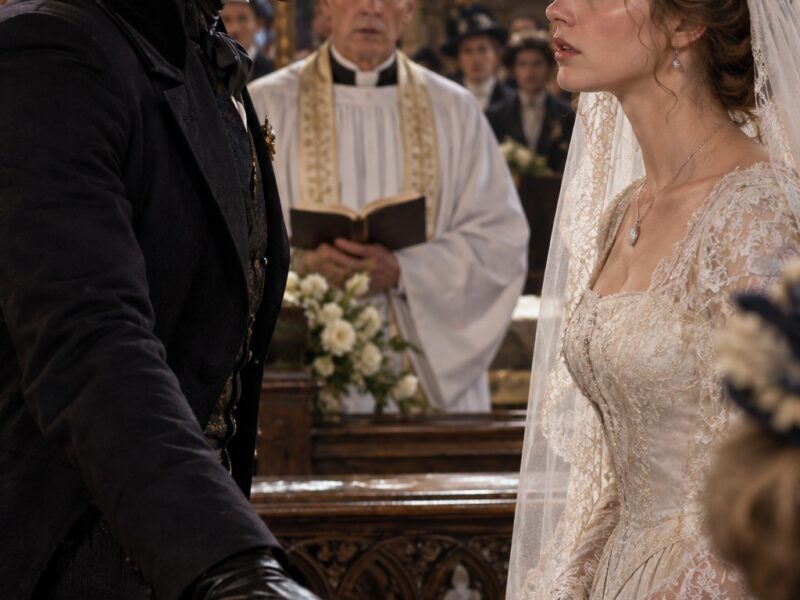
THE DUKE STOPPED HIS WEDDING WHEN HE SAW HIS DEAD WIFE’S FACE—BUT THE SILVER PENDANT REVEALED A TERRIBLE FAMILY SECRET
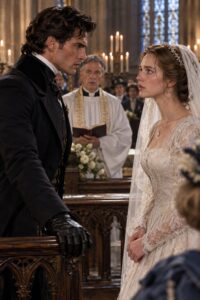
“Stop the ceremony!”
Duke Evander Whitmore’s voice struck the chapel walls just as the priest opened his prayer book. Two hundred guests turned toward the altar, where the duke stood staring at his bride with the expression of a man who had just seen someone rise from the grave.
Lady Arabella Finch had been smiling only moments earlier.
Now she stood motionless in her ivory satin wedding gown, her veil resting against her shoulders, unable to understand why the man she was about to marry had suddenly gone pale.
“Your Grace?” the priest asked.
Evander scarcely heard him.
He was looking at Arabella’s face.
Those gray-green eyes. The delicate curve of her mouth. The small pale mark beside her left temple.
Three years earlier, he had kissed a woman with that very face for the last time.
Her name had been Isolda.
She had been his wife.
He had sat beside her bed in the east wing of Whitmore Hall while the family physician told him there was nothing more to be done. He had felt her fingers grow cold in his hands. He had watched the undertaker prepare her body, followed her coffin to the chapel churchyard, and stood beneath the ancient yew tree as the earth swallowed the woman he loved.
For three years, he had lived with the certainty that she was gone.
Yet the woman standing before him looked exactly like her.
“Remove your veil,” he whispered.
Arabella’s fingers moved uncertainly toward the lace. “It’s already been lifted, my lord.”
“Tell me your name.”
A restless murmur traveled through the pews.
“Arabella Finch,” she answered. “You know who I am.”
Evander took a step backward.
“No. That’s the name you were given. I’m asking who you really are.”
Her father, Lord Cedric Finch, rose abruptly from the front pew.
“Your Grace, this is an outrageous insult to my daughter.”
But Evander was no longer looking at Arabella’s face.
Something had caught the light beneath the lace at her throat.
A small silver pendant.
He knew that pendant.
He had fastened it around Isolda’s neck on the morning of their wedding. Years later, he had watched the undertaker remove it before her burial.
He had believed it was placed among her personal possessions.
“How did you get that necklace?” he demanded.
Arabella touched it instinctively.
“It belonged to my mother.”
“Your mother?”
“She died when I was born.” Her voice trembled. “Why are you asking me these things?”
Evander turned toward the chapel doors, where his solicitor, Theodore Blackwell, stood among the astonished guests.
“Close the chapel.”
The order silenced the room.
“Nobody leaves until I understand what has happened.”
Arabella stared at him, her eyes filling.
“Your Grace, I swear I’ve never met your wife.”
For a moment, Evander could not speak.
Then he looked again at the pendant and the face that had haunted his dreams.
“Then someone has spent three years teaching me to mourn a woman without telling me who she truly was.”
The chapel doors closed with a heavy, final sound.
The wedding was over.
And somewhere inside Whitmore Hall, among the papers of a woman buried three years before, lay a truth that would destroy everything Arabella believed about her family.
The silence after the doors shut felt almost physical.
Two hundred guests sat motionless in their expensive silks. The scent of flowers and candle wax hung in the air, painfully ordinary beside the extraordinary thing that had just happened.
“That poor girl,” someone whispered.
“Look at her face,” another woman murmured. “The resemblance is dreadful.”
Arabella heard both remarks.
She also felt her father’s fingers close around her elbow.
“We’re leaving,” he said quietly. “Before this becomes any worse.”
For twenty-six years, Arabella had known that tone. It was the voice that ended disagreements at the dinner table, dismissed inconvenient questions, and reminded her that a daughter’s duty was obedience.
She nearly followed him.
Then she looked back at Evander.
He had not moved from the altar. His gloved hand still gripped the carved rail, his shoulders stiff beneath his formal coat.
He did not look furious.
He looked devastated.
And her father, who should have been demanding an explanation for the humiliation of his only daughter, seemed interested in one thing alone.
Getting her away.
Arabella looked down at the hand holding her arm.
“Let go, Papa.”
Cedric’s grip tightened for an instant.
“Arabella.”
“Please. Let go.”
He released her.
She turned toward the duke, feeling the weight of every pair of eyes in the chapel.
“Your Grace, what did you mean when you said someone taught you to mourn the wrong woman?”
Evander slowly lifted his head.
“I buried my wife three years ago. Until this morning, I believed I had made peace with her death.” He swallowed. “When you walked toward me, I thought I was looking at her again.”
Arabella said nothing.
“I am not accusing you of anything,” he continued. “I believe you are as confused as I am.”
“Then why stop the wedding?”
“Because I could not stand before God and marry you while pretending I had not recognized her face.”
His answer was painful, but there was something in its plainness that Arabella trusted.
Evander glanced toward the chapel doors.
“Come to Whitmore Hall this evening. See her portrait. Ask whatever questions you wish. You have my word that you will be safe under my roof.”
Cedric gave a short, humorless laugh.
“Your word? From the gentleman who has just publicly humiliated my daughter?”
“From a gentleman who wants the truth,” Evander replied. “You are welcome to accompany her, Lord Finch.”
For the first time that morning, Cedric seemed unable to produce an immediate answer.
He looked at Evander, then at Arabella.
Finally, he straightened his cuffs.
“I shall be at Finch House. Arabella, when you have finished playing detective, you know where to find me.”
He left without kissing her cheek.
Arabella watched him go.
Then she turned toward the man who had nearly become her husband.
“I should like to see the portrait.”
Whitmore Hall was quieter than she expected.
The great house smelled of beeswax, old timber, and the cold stone of rooms too large to warm properly. Servants appeared in doorways and vanished again, their expressions controlled until they saw Arabella’s face.
Mrs. Pell, the housekeeper, was carrying a candle snuffer when Arabella entered.
The woman stopped so abruptly that the snuffer slipped from her fingers and struck the floor.
She did not bend to retrieve it.
For several seconds, she simply stared.
Evander noticed.
“Mrs. Pell?”
The housekeeper lowered her eyes.
“Forgive me, Your Grace.”
But her hands continued trembling.
Supper was served in the small dining room. Neither Evander nor Arabella ate much. A silver clock marked the minutes while their untouched plates grew cold.
At last, Evander rose.
“Come with me.”
He led her through the long gallery, past generations of Whitmore ancestors whose painted eyes seemed to follow them through the candlelight.
At the far end hung a portrait of a young woman wearing dark blue.
Evander stopped.
Arabella stepped closer.
The woman in the painting had a composed, almost severe expression. Yet something about the softness around her mouth suggested that she might smile if someone said the right thing.
Her eyes were gray-green.
Beside her left temple was a small, pale mark.
Arabella raised her fingers to the identical spot on her own face.
She had seen her reflection thousands of times.
Never had it felt so unfamiliar.
“My nurse used to say I was born with this mark,” she whispered. “She called it a kiss from the angels.”
Evander closed his eyes.
“Isolda said those exact words.”
Arabella turned toward him.
“She did?”
“She told me they were the only thing she knew about her birth. She believed she’d been orphaned in Yorkshire.”
He looked at the portrait.
“I never thought to question it.”
They sat together on a narrow bench beneath the painting.
For a long while, Evander studied his hands.
“During the final month of her life, Isolda changed. She barely slept. She wrote letters every day and sometimes burned the answers before I could see them.”
“To whom?”
“I didn’t know. She wouldn’t tell me.”
He rubbed a thumb across his knuckles.
“She began asking questions about my mother. About things that had happened before I was old enough to remember.”
“What sort of things?”
“Old friendships. Family arrangements. People who had stayed here years before our marriage.”
“And what did you tell her?”
Evander’s mouth tightened.
“I told her to leave the dead alone.”
The words remained between them.
“The evening before I traveled to London, we quarreled. She said she’d discovered something important and would tell me when I returned. She warned me I wouldn’t like it.”
“What did you say?”
“That it could wait.”
Arabella watched him lower his eyes.
“When I came home, the curtains were drawn. The servants were whispering. Dr. Hail told me she had died of lung fever.”
“Had she been ill?”
“She had been perfectly well at breakfast the day I left.”
The gallery seemed to grow colder.
“Did she say anything before she died?” Arabella asked.
Evander stared toward the darkened windows.
“One word.”
“What was it?”
“Nursery.”
He looked ashamed.
“I thought she was delirious. I locked the nursery afterward. I could not bear to enter it again.”
Arabella glanced toward the staircase.
“Does the key still exist?”
“Yes.”
“Then perhaps we should open that room.”
They went upstairs at dawn.
The corridor on the top floor was narrow and dim. A faded runner covered the boards, and dust lay along the baseboards where the servants’ brushes seldom reached.
Evander carried the key himself.
The lock resisted him.
He tried again, turning the rusted metal with both hands until something inside gave way.
The door opened with a long scrape.
Inside stood a rocking horse with one glass eye, a small chest beneath the window, and a cradle covered in dust.
Evander remained in the doorway.
Arabella entered.
The room smelled of closed windows and old cloth. She moved toward the cradle, brushing her fingers along its faded lining.
Then she noticed the stitching.
Most of the thread was old and gray.
But one short section had been sewn with thread that was brighter and noticeably newer.
Someone had opened the seam.
And someone had carefully sewn it shut again.
“Your Grace?”
Evander crossed the threshold.
“Look here.”
Arabella worked a fingernail beneath one of the stitches. The thread loosened, then broke.
She pulled the lining apart.
Inside was a folded letter sealed with the Whitmore crest.
Across the front, in the careful handwriting of an elderly woman, were four words.
For my son Evander.
Evander took the letter.
He recognized the handwriting immediately.
“My mother.”
His voice barely carried.
She had died years before Isolda.
He broke the seal with unsteady fingers.
For a moment, he read silently. Then, perhaps because Arabella deserved to hear every word, he began again aloud.
“My dear Evander,
“If you are reading this, Isolda has found the proof, or I have failed her.
“Isolda is not the Yorkshire orphan I told you she was. She is the daughter of Catherine Finch, my dearest friend.
“In the spring of 1825, Catherine gave birth to twin girls.
“Her husband, Cedric, was already drowning in debt. Catherine’s fortune had been secured for her daughters, but if one child died, her portion would pass to Cedric.
“Catherine was gravely ill after the birth. She feared what her husband might do to obtain control of the money.
“She begged me to take one of her daughters away.
“I took Isolda that very night.
“Cedric declared that one of the twins had died at birth. The parish register was altered, and the surviving daughter was raised as his only child.
“Catherine died three days later believing both her girls were safe.
“I raised Isolda as my ward and later welcomed her marriage to you, believing the protection of your name would keep her beyond Cedric’s reach.
“I never found the courage to tell either of you.
“If harm ever comes to her, look first to Cedric Finch.
“Forgive an old woman who mistook secrecy for protection.
“Your loving mother.”
When Evander finished, the letter trembled in his hands.
Arabella stared at the cradle.
She could hear the faint tapping of a branch against the window.
“My sister,” she whispered.
Evander looked at her.
“Isolda was my sister.”
She pressed her fingertips against her lips, as though the simple movement might keep her from losing control.
“For twenty-six years, I had a sister. She was alive. She lived in this house. And nobody ever thought I deserved to know her.”
Evander reached toward her, then stopped.
There was no comfort he could honestly offer.
Arabella looked down at the pendant against her wedding gown.
Her mother had owned it.
Then Isolda.
And finally, through circumstances she had never questioned, it had come to her.
She remembered Cedric giving it to her, telling her only that it was something her mother would have wanted her to wear.
She had thanked him.
The memory now made her stomach turn.
Evander looked again at the letter.
“Isolda must have discovered part of this. That explains the letters to the parishes.”
“She was trying to prove who she was.”
“And someone knew.”
They were still in the nursery when Theodore Blackwell arrived shortly before noon.
The solicitor’s boots were muddy, his coat damp from travel. He carried a leather case so heavy that he set it on the floor with both hands.
“The parish register from 1825 has been tampered with,” he announced. “The entire page was removed with a blade.”
Evander’s jaw hardened.
“Then there is no record?”
“There is another copy.”
Blackwell opened his case.
“The bishop’s office retained its own register.”
He spread a certified document across the dusty nursery floor.
There, recorded together, were the baptisms of two daughters born to Cedric and Catherine Finch.
Isolda Catherine.
Arabella Catherine.
Twin sisters.
Evander read the names twice.
Arabella crouched beside him.
She traced the space beneath her own name without touching the ink.
For the first time, there was written proof that a part of her life had been deliberately erased.
Blackwell cleared his throat.
“There is more, Your Grace.”
Evander stood.
“Go on.”
“I spoke with the undertaker, Mr. Pruitt. He admits that someone from Lord Finch’s household paid him ten pounds for Lady Isolda’s pendant the day before her burial.”
Arabella went still.
“Papa bought it?”
“That appears to be the case.”
“And the physician?” Evander asked.
“Dr. Hail left for Bath the morning after the funeral. He has not returned.”
Evander looked toward the window.
Blackwell hesitated.
“My clerk passed Finch House this morning. Servants were carrying wooden crates into the courtyard. There was smoke coming from the study chimney.”
Arabella rose.
“He’s burning his ledgers.”
Evander moved toward the door.
“I’ll send for the constables.”
“And by the time they arrive with a magistrate’s authority,” Arabella said, “the papers will be ash.”
He stopped.
She looked at the baptism record lying on the floor.
“He won’t confess anything to you. You’re the husband of the woman he feared.”
“Arabella—”
“But I’m his daughter.”
Her voice steadied.
“The daughter he raised while pretending my sister had died. If there’s anything he might still say aloud, he’ll say it to me.”
Evander studied her.
“You don’t know what he may do.”
“No,” she answered. “I don’t.”
For an instant, he seemed about to refuse.
Then his expression changed.
Not because her face reminded him of Isolda’s.
Because the woman standing before him had made up her mind, and he had no right to take that decision away from her.
“We’ll be nearby,” he said. “Blackwell and I. The moment you want us, say so.”
Arabella nodded.
She folded the baptism copy and placed it carefully inside her reticule.
Then she left the nursery.
Finch House smelled of smoke.
Arabella had known the building all her life. She knew which stair creaked near the landing, where the afternoon sun fell in the drawing room, and how the servants used to hurry when they heard her father’s footsteps.
That morning, everything felt foreign.
She found Cedric in his study.
He was kneeling before the hearth, his sleeves rolled up, feeding papers into the flames.
The room was hot.
Ash drifted across the carpet.
He looked up when she entered.
“You shouldn’t be here.”
Arabella closed the door behind her.
“Mother’s name was Catherine.”
His hand stopped above the fire.
“She gave birth to twins.”
Cedric stared at her.
Arabella touched the pendant.
“Whose neck was this on before mine?”
“It belonged to your mother.”
“And after her?”
He looked back toward the hearth.
“Papa. Where is my sister buried?”
“There is no sister.”
Arabella heard the familiar certainty in his voice.
All her life, it had been enough to make her doubt herself.
Not now.
She stepped closer and saw a thick ledger lying near his knee, its cover stamped with the words Ashcombe Trust.
One corner was curling from the heat.
She moved before he could stop her.
Her fingers closed around the leather and pulled it from the edge of the grate.
Pain shot through her hand.
She gasped, but held on.
Cedric seized her wrist.
“Give me that.”
“No.”
“Arabella, you don’t understand.”
“You put her necklace around my neck,” she said through clenched teeth. “You watched me wear it. You knew who she was.”
He tightened his grip.
“Give me the book.”
She stared directly at him.
“Did you know she had your eyes?”
Something in his face broke.
He released her wrist.
For a moment, he looked much older than the father she remembered.
“I looked at two children with Catherine’s face,” he said hoarsely. “And all I saw was a fortune I couldn’t afford to divide.”
Arabella stood motionless.
Cedric sank backward beside the hearth.
“The debts were already there when they were born. I had borrowed against everything. The estate, the rents, the next harvest. Your mother thought her settlement would protect the girls.”
His mouth twisted.
“She didn’t understand what would happen to me if I lost control of half of it.”
“So you had one daughter declared dead.”
He did not deny it.
Arabella looked at the ledger in her burned hand.
“And when Isolda found out?”
Cedric covered his face.
“She wrote to me.”
“What did she say?”
“She said she had proof. That she would go to a magistrate if I didn’t acknowledge her.”
Arabella felt her heartbeat in her throat.
“She wanted what was hers.”
“She would have taken half of everything.”
“It was never yours to keep.”
He looked up at her.
“You don’t understand what it means to watch your whole life disappear.”
Arabella thought of the nursery at Whitmore Hall.
Of the portrait at the end of the gallery.
Of a young woman who had written letters and waited for answers that never came.
“Tell me what happened to my sister.”
Cedric’s eyes filled.
For one unbearable moment, he seemed almost eager to be relieved of the secret.
“The duke was in London,” he whispered.
Arabella did not move.
“I went to Whitmore Hall. I brought a bottle. I told Isolda I wanted to make peace.”
His voice faltered.
“She was so pleased to see me. She thought I had come because I finally wanted to know her.”
Arabella’s fingers tightened around the ledger.
“What did you do?”
Cedric stared at the fire.
“I put laudanum in her glass.”
The room seemed to lose its air.
“I poured it myself,” he said. “She looked at me with your eyes, Arabella. And she thanked me for coming.”
Arabella felt the pain in her burned hand, but it seemed distant now.
Her father was crying.
Not loudly.
Not with the helpless grief of an innocent man.
He wept with the exhaustion of someone who had spent years defending a terrible choice and could no longer bear to hear himself explain it.
“You killed her,” Arabella said.
Cedric lowered his head.
“You killed my sister.”
The study door opened.
Evander stood on the threshold.
His face was white.
Behind him stood Theodore Blackwell.
And behind the solicitor waited two constables.
For several seconds, nobody spoke.
Cedric looked from Evander to the men in the doorway.
Then he turned toward Arabella.
“You tricked me.”
Her burned hand trembled against her skirt.
“No, Papa.”
She swallowed.
“I asked you a question. You answered it.”
Cedric Finch was tried that summer.
Dr. Hail returned from Bath when it became clear that his own involvement could no longer be concealed. In court, he admitted what he had falsely certified and described the payment he had received for doing so.
The undertaker’s testimony, the altered parish records, the recovered trust papers, and Cedric’s confession formed a case he could not escape.
The jury deliberated for less than an hour.
The court imposed the sentence the law demanded.
Arabella did not attend.
She did not want her final memory of her father to be his face in the courtroom.
She had already heard enough in the study.
The Ashcombe fortune was restored to its rightful inheritance.
But money could not restore the twenty-six years stolen from two sisters, or return one of them to the husband who had loved her.
During the search of Finch House, constables discovered a large portrait wrapped in bedsheets in an attic storeroom.
Arabella unwrapped it herself.
The canvas showed a young woman with gray-green eyes, standing beside a man holding two small girls dressed in matching white.
Catherine Finch.
Her mother.
And the children were Isolda and Arabella.
For the first time in her life, Arabella saw the face of the woman who had brought her into the world.
She stood before the portrait for a long time.
She had imagined her mother countless times as a child, assembling a face from fragments of other women, wondering whether she had inherited her smile or the shape of her hands.
Now the answer was before her.
She had inherited her mother’s eyes.
So had Isolda.
Arabella reached toward the painted little girls.
They were standing close together, their tiny shoulders almost touching.
She could not remember that moment.
But someone had loved them enough to preserve it.
And someone else had hidden it from her.
That autumn, Evander ordered Isolda’s gravestone to be recut.
The mason worked beneath the old yew tree where the duke had stood in grief three years earlier.
Arabella came to the churchyard on the afternoon the work was finished.
Her injured hand was still bandaged. The autumn air was cold enough that she kept it tucked inside her coat pocket.
Evander stood beside the stone.
The inscription now bore the name Isolda had been denied in life.
Isolda Catherine Ashcombe.
Beloved Wife and Sister.
Arabella read the words slowly.
They would never give her a memory of her sister laughing, or a conversation over breakfast, or the chance to tell Isolda that she was not alone.
But the name was true.
And truth, Arabella had learned, was sometimes the only thing the living could still give the dead.
They remained beside the grave after the mason departed.
At last, Evander spoke.
“There’s something I should like to ask you. Though I may have no right.”
Arabella turned toward him.
“Ask.”
“Stay at Whitmore Hall.”
She looked at him in surprise.
“Not as my bride,” he said quickly. “I wouldn’t ask that of you. But as someone who belongs to this family.”
Arabella studied his face.
Once, in the chapel, she had mistaken his grief for rejection.
Now she understood that he had been confronted with a love he thought buried.
She also understood something else.
Every time he looked at her, some part of him would search for Isolda.
She could not blame him for it.
But neither could she live inside another woman’s memory.
“Every morning,” she said softly, “you’d look at me and see her.”
Evander lowered his eyes.
“And I’d know it,” she continued. “I don’t want to spend my life being someone’s ghost.”
He nodded once.
Arabella looked toward Isolda’s stone.
“I want to be somebody’s Arabella.”
For a long moment, Evander said nothing.
Then something in his expression eased.
Not happiness, exactly.
Perhaps the beginning of acceptance.
“You deserve that,” he said.
Before she left, he placed the silver pendant in her hand.
Arabella looked down at it.
“It belonged to Isolda,” she said.
“And to your mother before her.”
He closed her fingers gently around the silver.
“It belongs to both of you.”
Arabella returned to Ashcombe Lodge, her mother’s house.
The fortune that had once divided her family now gave her the freedom to decide where she wished to live and who she wished to become.
She had Catherine’s portrait hung above the fireplace.
On quiet evenings, she sometimes stood before it and studied the two little girls in their white dresses.
She thought of Isolda’s courage in searching for the truth, even when the people around her insisted that certain questions should never be asked.
She thought of Evander, who had loved her sister without knowing the full story of her life.
And she thought of the father whose secrets had left them all with wounds no verdict could entirely heal.
One morning, as sunlight fell across the sitting room, Arabella stopped before the mirror.
The small silver pendant rested against her throat.
She looked at the pale mark beside her temple, the gray-green eyes, and the familiar curve of her mouth.
For years, she had wondered why she felt so little connection to the woman her father had told her she resembled.
Now she knew.
She had carried the faces of her mother and sister all along.
But she was not merely a reflection of either one.
She was Arabella.
And for the first time in twenty-six years, she knew whose face she was looking at when she saw herself in the mirror.









