THE DUKE TURNED PALE WHEN HE SAW THE PENNILESS WIDOW—BUT THE SECRET BEHIND HIS SILENCE WAS ONLY THE BEGINNING
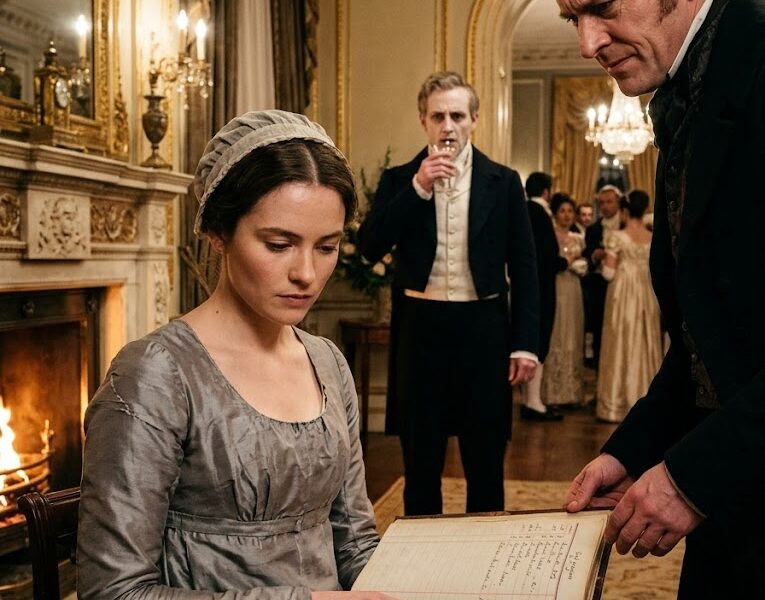
The Duke of Rothwell went white the moment he saw Margaret Aldus across the ballroom.
He looked at her as though a woman buried four years earlier had suddenly returned from the grave.
And Margaret, who had never met him, had no idea that his reaction was about to expose everything another man had spent years keeping hidden.
The orchestra continued playing for several seconds before anyone noticed that the Duke had stopped speaking.
Julian Ferrand, Duke of Rothwell, stood twelve feet from Margaret with a glass suspended near his lips. The gentleman beside him was still talking, unaware that his companion had ceased listening. Candlelight caught the crystal in Julian’s hand, but his face had lost every trace of color.
Margaret noticed because everyone else soon did.
She had attended enough assemblies to understand how quickly an ordinary room could become a court of judgment. A silence, a misplaced glance, a woman standing too close to the wrong gentleman—any one of them could become entertainment for people who had exhausted more legitimate subjects.
And Margaret had supplied those people with quite enough entertainment already.
At twenty-six, she had been a widow for eleven months. Her gown had been altered twice from one of the gray dresses she had worn during mourning, its seams carefully let out and reset by a seamstress who understood that there would be no money for another. The cuffs concealed repairs she had made herself.
She had hoped no one would notice.
But women such as Lady Ashworth noticed everything that might be useful in humiliating another woman.
Margaret had expected the usual examination of her circumstances. She had expected murmured sympathy that felt remarkably similar to contempt. She had even prepared herself for questions about her late husband’s debts, although the people who asked them were seldom interested in the answers.
She had not prepared herself to be stared at by a duke as though her very existence were impossible.
“Your Grace?”
Mrs. Penhallow, the evening’s hostess, touched Julian’s sleeve.
“Are you quite well?”
He did not answer.
His eyes remained fixed on Margaret, and something about his expression unsettled her more than open hostility would have done. It was not admiration. Nor was it the detached curiosity of a wealthy gentleman noticing a woman in reduced circumstances.
It was recognition.
Impossible recognition.
Behind Margaret, a familiar voice slipped through the music.
“That is Henry Aldus’s widow. One wonders what a duke could possibly find interesting about her.”
Josiah Crayle.
Her late husband’s cousin spoke softly enough to preserve the appearance of discretion, but loudly enough to make certain the remark reached its intended audience.
Margaret did not turn.
She had learned that turning toward Josiah’s voice seldom improved anything.
Since Henry’s death, Josiah had controlled the household accounts, managed the income attached to her widow’s settlement, and supervised the correspondence that arrived at Barrow Hall. He had acquired those powers through provisions in Henry’s will, written during a time when no one had thought to question the cousin who so generously offered his assistance.
He also controlled how much coal reached her rooms.
Margaret understood that last detail better than anyone.
She lowered her teacup onto its saucer with deliberate care.
Across the room, the Duke finally moved.
He came toward her without the practiced ease fashionable society seemed to expect from men of his rank. His steps were measured, almost reluctant, and he stopped farther away than etiquette required.
For an instant, neither spoke.
Then Julian bowed.
“Forgive me. I mistook you for someone.”
His voice was calm, but the hand holding his glass had tightened around the stem.
“Evidently, Your Grace.”
Margaret inclined her head.
“I am told I occasionally have that effect upon strangers. Though rarely upon dukes.”
A brief change passed through his expression.
It might have been surprise. It might even have been the beginning of a smile.
“Your name?” he asked.
“Margaret Aldus. Widow of Henry Aldus, formerly of Barrow Fen.”
She allowed him a moment to place the information.
“You will find nothing remarkable in either name, sir.”
Julian said nothing.
In a ballroom, three seconds could become an eternity.
“No,” he answered at last, almost to himself. “I don’t suppose I would.”
He bowed again and withdrew.
Margaret remained standing beside the tea table, aware of conversations resuming around her in cautious fragments.
It was not the silence of people who had dismissed her.
It was worse.
For the first time in nearly a year, she had become interesting.
And somewhere beyond the gathering crowd, Josiah Crayle was watching her with an expression she knew far too well.
He was calculating what it might cost him.
Mrs. Penhallow reached Margaret before the next set of dances ended.
“My dear, you must tell me what happened.”
The hostess settled beside her with the determined warmth of a woman who had already decided that friendship entitled her to an explanation.
“I fear I have nothing worth telling.”
“Nothing? The Duke of Rothwell looked as though he had seen a ghost.”
“Perhaps he had an unpleasant memory.”
“Of you?”
“Of someone I apparently resemble.”
Mrs. Penhallow leaned closer.
“But you have never met him?”
“Not before this evening.”
The hostess’s eyes brightened.
“Oh, Margaret. That makes it considerably more interesting.”
Margaret gave her a polite smile and reached for her tea.
She had heard of the Duke of Rothwell, of course.
Julian Ferrand was thirty-three, wealthy, reserved, and rarely seen at social gatherings. Four years earlier, his wife had died, after which he had withdrawn almost completely from society.
People called him cold.
Some called him proud.
Others preferred the more romantic explanation that he had loved his duchess so completely that he could not bear another woman’s company.
Margaret had never devoted much attention to any of these theories.
Her own life had provided sufficient evidence that society rarely understood the people it discussed.
Until that evening, she had assumed the Duke’s tragedy belonged entirely to him.
Now she was no longer certain where his story ended and hers began.
The morning room at Barrow Hall was cold even when the fire had been lit.
Margaret had learned to position her chair where the weak daylight fell across the writing desk. The windows rattled whenever the wind crossed the moor, and the old stone walls seemed to hold winter long after the calendar declared that spring had arrived.
Josiah called it economy.
He used the word often.
When Henry had first fallen ill, Josiah had begun visiting daily, carrying household statements and offering assurances that everything was being handled.
Margaret remembered one particular afternoon that December.
Henry had been upstairs with a fever. The physician’s account remained unpaid, and Margaret had asked whether another basket of coal might be sent to the sickroom.
Josiah sat comfortably beside the drawing-room fire.
“You must understand that an estate cannot be managed on sentiment, Margaret.”
“He is freezing.”
“His room has already received its allowance.”
“He is ill.”
“And that is precisely why someone must remain practical.”
She had been too frightened for Henry to argue.
When Josiah promised to see what could be done, she had thanked him.
It was the memory of that gratitude that continued to hurt.
Not the cold.
Not even the humiliation.
She had thanked a man for controlling necessities that should never have depended upon his permission.
After Henry’s death, Josiah’s authority had become more complete. Letters arrived late, if they arrived at all. Household expenses were reduced while the figures in the estate accounts mysteriously remained unchanged.
He explained each irregularity with such patient concern that challenging him became almost embarrassing.
“You are grieving, cousin. You cannot be expected to understand every financial complication.”
So Margaret had stopped challenging him aloud.
Instead, she began keeping records.
Beneath a loose board in the drawer of her writing desk lay a small ledger, covered in worn brown leather. Inside were dates, sums, deliveries, receipts, and observations recorded in an increasingly precise hand.
She knew the coal ordered for the household.
She knew the coal actually delivered.
She knew which physician’s accounts remained outstanding, although Josiah had assured her they were settled.
And she knew that several figures in the estate books could not possibly be correct.
She had no intention of telling him how much she knew.
Not until she could prove it.
The Duke’s first letter arrived four days after the assembly.
Or rather, it had arrived on the first morning and reached Margaret four days later.
Josiah placed it beside her breakfast plate.
“A communication from Rothwell.”
Margaret looked at the seal.
“You have opened it?”
“Naturally not.”
His expression conveyed polite injury.
“I merely thought it prudent to consider what such attention might mean for a lady in your circumstances.”
The note was short.
Julian requested permission to call upon her.
Nothing more.
“A duke does not pursue an acquaintance with a widow without some object in mind,” Josiah observed.
“No,” Margaret said, folding the paper. “I imagine men seldom pursue anything without an object in mind.”
He studied her.
“You would do well to remember how much your present comfort depends upon discretion.”
Margaret set down her knife.
“My comfort, cousin, has seldom been as troublesome as you imagine.”
She wrote her reply that afternoon.
It was brief, courteous, and entirely in her own hand.
She would receive His Grace on Thursday.
Rather than entrust the letter to Josiah’s arrangements, she gave it to a housemaid and asked that it be posted directly.
The young woman glanced toward the passage.
Margaret understood her hesitation.
“I shall take responsibility.”
The maid slipped the letter into her apron.
It was a small act.
But Margaret had begun to understand how much freedom could be contained in something as ordinary as posting one’s own correspondence.
Julian arrived without a carriage.
Margaret had expected a polished equipage, liveried servants, and the small ceremony that usually accompanied a nobleman’s visit.
Instead, he entered the morning room with damp boots and his hat held awkwardly between both hands.
The fire was weak.
Margaret noticed his glance toward it and prepared herself for the expression of pity that usually followed.
But he said nothing about the room.
“I owe you an explanation for my behavior at the assembly.”
“You owe me nothing, Your Grace.”
“I behaved discourteously.”
“You were surprised.”
“More than surprised.”
He placed his hat on the edge of a table.
“My wife died four years ago.”
Margaret kept her hands folded in her lap.
“I had heard. I am sorry.”
“You resemble her.”
The words settled into the room with unexpected weight.
“For one moment,” he continued, “I believed something quite impossible.”
Margaret understood.
The whiteness of his face.
The distance he had maintained.
The peculiar way he had looked at her, not as a stranger, but as the answer to a question that should never have existed.
“I see.”
Julian looked uncomfortable.
“I should have told you at once.”
“Perhaps.”
She studied him carefully.
“But I am not your wife, Your Grace.”
“No.”
“And whatever comfort my appearance may provide, I would prefer not to be mistaken for a memory.”
His expression changed.
“I did not come here to turn you into one.”
“Then why did you come?”
For the first time since entering the room, he seemed relieved by her bluntness.
“Because I remembered something else about that evening.”
“What was that?”
“The way you set down your cup.”
Margaret frowned.
“My cup?”
“You knew the room was watching. You knew they had already begun talking about you. Yet you did not retreat, apologize, or attempt to make yourself smaller.”
She had never considered the gesture remarkable.
She had simply been determined not to give Josiah the satisfaction of seeing her hands shake.
Julian continued quietly.
“I found myself wondering what sort of woman learns that kind of composure.”
Margaret looked toward the window.
Beyond the glass, the moor stretched beneath a low gray sky.
“Usually, Your Grace, the sort who has learned there is little profit in displaying distress before people who enjoy causing it.”
He accepted the answer without attempting to soften it.
After a pause, he asked whether he might call again.
“Not as a courtship,” he added. “I would not presume upon so brief an acquaintance.”
“Then in what capacity?”
“As someone who would like to know you.”
Margaret considered him.
An acquaintance with a duke could make her situation easier.
It could also make it considerably worse.
Josiah would not surrender control merely because another man had noticed her.
And society would hardly allow an impoverished widow and a wealthy widower to become friends without supplying its own explanations.
“If we are to be acquainted,” she said, “I have conditions.”
Julian’s eyes warmed slightly.
“I should prefer to hear them.”
“No calls before ten. My mornings are occupied.”
“Agreed.”
“No discussions of your late wife unless I choose to raise the subject.”
“Agreed.”
“And no interference in my arrangements with Mr. Crayle.”
That last condition gave him pause.
“Even if I consider those arrangements unreasonable?”
“Particularly then.”
He looked at her for a long moment.
“Very well.”
“You appear doubtful.”
“Only of my own patience.”
“Patience is a remarkably inexpensive virtue, Your Grace.”
For the first time, Julian almost smiled.
Margaret found herself wishing he had done so completely.
The realization annoyed her.
He returned the following Thursday.
And the Thursday after that.
Their conversations began with ordinary matters: the weather, the condition of the roads, the difficulties of maintaining older buildings, and the curious incompetence of men who had inherited responsibility without ever acquiring discipline.
Julian listened more than he spoke.
Margaret soon discovered that his silences were not always refusals to engage. Sometimes he was considering an answer. Sometimes he preferred to let a remark remain exactly as it had been made, without correcting or claiming it.
She had known very few men who could resist correcting her.
During his third visit, he noticed the candle guttering beside her account books.
“Do you always work in this light?”
“When the daylight fails.”
“You must find it tiresome.”
“I find mistakes more tiresome.”
The following morning, a new lamp arrived.
It was sturdy, simple, and fitted with a shade that directed the light precisely where she needed it.
There was no elaborate presentation.
No declaration of generosity.
Julian did not mention it when he returned.
Margaret thanked him anyway.
“For the lamp.”
“I thought it might be useful.”
“It is.”
“Then I am glad.”
He went on discussing the drainage problem affecting the lower fields, leaving her with the unfamiliar pleasure of receiving a kindness that carried no invisible account to be settled.
Josiah noticed the visits, of course.
A coal delivery was delayed.
A letter from Margaret’s sister remained missing for another week.
When she asked after it, Josiah sighed.
“I am trying to protect you from becoming the subject of unfortunate speculation.”
“How thoughtful.”
“You cannot understand the consequences of encouraging a man in Rothwell’s position.”
Margaret kept writing.
“I suspect I understand consequences quite well.”
“Margaret.”
She looked up.
Josiah’s voice softened.
“I would hate to see you humiliated again.”
She smiled faintly.
“Then it is fortunate that you take so much trouble to anticipate my humiliation before I do.”
He left believing he had made his position clear.
Margaret opened her private ledger.
Beside that week’s date, she recorded the delayed coal delivery and the missing letter.
She was beginning to see that Josiah’s punishments were also evidence.
At the next assembly, Lady Ashworth found an opportunity to exercise her considerable talent for cruelty.
“How remarkable,” she observed to the women nearest her, “that some widows recover their spirits so swiftly once a title begins calling.”
The conversation stopped.
Margaret was standing close enough to hear every word.
She turned.
“Indeed, Lady Ashworth.”
The older woman’s expression sharpened.
Margaret continued with perfect politeness.
“I recovered mine when I ceased asking permission to possess them.”
Someone near the windows coughed into a handkerchief.
Lady Ashworth opened her mouth.
No suitable answer emerged.
Margaret excused herself to inspect the tea.
Across the room, Julian had witnessed the exchange.
Old Hobbes, the longtime Rothwell retainer, leaned slightly toward him.
“Mrs. Aldus has a better head on her shoulders than half the men at your club, Your Grace.”
Julian watched Margaret pour tea for an elderly guest who had been left unattended.
“Yes,” he said. “I am beginning to think so.”
Hobbes had served three dukes.
He knew his employer well enough to recognize the difference between interest and affection.
He also knew that Julian would resent having the distinction pointed out.
So he kept his thoughts to himself.
For once.
The next sign of change came from Mrs. Wren, Margaret’s housekeeper.
For eleven months she had regarded every gentleman who approached Barrow Hall with the suspicion of a woman who had seen too many promises made and too few honored.
She had approved of the Duke no more readily than anyone else.
Then, during his fourth visit, Julian spent almost forty minutes in the kitchen discussing a drainage problem with the cook.
He had entered to ask about the damp wall near the scullery. The conversation had expanded to the condition of the pipes, the boy who carried water, and the difficulties of keeping the kitchen warm.
He never went into the good parlor.
After he left, Mrs. Wren appeared in Margaret’s room with an expression of faint disbelief.
“He asked after Thomas’s cough.”
“Did he?”
“And he remembered the child’s name.”
Margaret looked up.
“That was considerate.”
“He asked the boy himself, my lady. Not me. The boy.”
Mrs. Wren seemed unable to decide whether the Duke’s conduct was commendable or a minor violation of the natural order.
Margaret smiled.
“I imagine Thomas appreciated it.”
“He did.”
The housekeeper hesitated.
“And His Grace said the kitchen drains ought to be repaired before winter.”
“Did he offer to arrange it?”
“No, ma’am. He asked whether the estate already had someone responsible.”
That distinction mattered.
Julian had noticed the problem without assuming that noticing gave him the right to take charge.
Margaret found herself thinking of it long after Mrs. Wren had gone.
There were other courtesies.
Coal arrived at the village parsonage, where the elderly vicar had endured winters on an inadequate allowance.
A carriage appeared on a particularly wet morning when Margaret needed to travel into the village.
A chair was moved closer to the fire before she had thought to ask.
Each gesture was modest.
None demanded gratitude.
And somewhere in those weeks, Margaret realized she had stopped preparing herself to be hurt whenever Julian entered the room.
She could not identify when it happened.
That, perhaps, was the most unsettling part.
By the fifth week of their acquaintance, the gossip had become bolder.
Lord Penhallow’s nephew, a young gentleman whose confidence considerably exceeded his judgment, suggested during a card game that Rothwell’s interest in Margaret might conceal some arrangement involving the Aldus family.
He was careful not to make a direct accusation.
Men of his sort rarely were.
Margaret heard of the remark before the evening ended.
She did not ask Julian to defend her.
The following night, she entered the card room and took a seat opposite the young man.
“Mrs. Aldus,” he said, surprised. “You play whist?”
“Occasionally.”
His smile suggested that he expected an easy victory.
An hour later, the smile had disappeared.
Margaret played with such calm precision that he lost three successive hands while the other gentlemen at the table grew increasingly reluctant to meet her eyes.
“You play a rather hard game,” he remarked.
“I play an honest one, my lord.”
She counted her winnings.
“I find the distinction is often lost upon gentlemen who have had little practice with either.”
The gentleman opposite her flushed.
Margaret rose.
“Please convey my regards to your uncle.”
She left before anyone could discover an appropriate reply.
The following morning, Julian heard the story from Hobbes.
For the first time in years, the old retainer saw his employer smile without attempting to conceal it.
During Margaret’s third visit to Rothwell’s townhouse, she noticed a ring.
It lay on a side table beside a stack of household ledgers, an ordinary little band of old workmanship that seemed oddly out of place among the Duke’s possessions.
There was no large jewel.
No fashionable setting.
Nothing that would have impressed the women who measured affection by the extravagance of its display.
Margaret noticed it only because it had been placed among papers someone had evidently been examining.
She wondered whether it had belonged to the late Duchess.
Then she looked away.
Julian had respected her privacy.
She could do no less for his.
But she remembered the ring.
And later, when she thought of that visit, she remembered the curious way it had been left in plain sight, as though its owner could neither put it away nor decide what to do with it.
The first decisive discovery came on a morning when the household was unusually quiet.
Margaret had been examining the provision in Henry’s will that permitted Josiah to administer certain outstanding debts against her jointure.
The clause had troubled her for months.
Its language seemed unusually favorable to the man appointed to manage the estate. More disturbing still, the date on the document fell only three weeks before Henry’s death.
She remembered those final weeks.
Henry had been too weak to sit comfortably without assistance. Holding a pen had become difficult. Even brief conversations exhausted him.
Yet Josiah claimed Henry had reviewed and approved the clause without hesitation.
Margaret spread three sets of correspondence across her desk.
Then she opened the private ledger.
The numbers had bothered her separately.
Now, placed together, they told a different story.
Four percent of the estate’s rental income had been diverted through Josiah’s management.
The household accounts showed expenses that did not correspond to actual deliveries.
Coal had been charged at twice the quantity received.
And the physician’s bill from Henry’s last illness, which Josiah had reported as paid, had remained outstanding for months.
Margaret sat still.
Outside, a cart rolled over the gravel.
Somewhere downstairs, Mrs. Wren gave an instruction to the kitchen maid.
Nothing in the house had changed.
Yet Margaret understood that the ordinary life she had endured for years had been built upon an accounting fiction.
The money had existed.
Not all of it, perhaps.
But enough.
Enough for heat.
Enough to settle the physician’s account.
Enough that Henry’s last winter need not have been governed by the humiliations Josiah had called necessity.
She ran her finger down the figures again.
Then once more.
She had spent years suspecting negligence.
What lay before her suggested something worse.
Margaret did not go to Julian first.
She went to her solicitor.
The man examined the documents in silence, occasionally raising an eyebrow or asking her to repeat a date.
When he finished, he removed his spectacles.
“Mrs. Aldus, where did you obtain these figures?”
“From the estate records.”
“And these additional accounts?”
“My own.”
“You have maintained independent records?”
“For some time.”
He turned another page.
“These are exceptionally thorough.”
“I had reason to be thorough.”
He studied the disputed clause.
“This requires closer examination.”
“I expected as much.”
“The signatures and circumstances may be challenged, but we must proceed carefully.”
Margaret nodded.
She had not spent years assembling evidence merely to exchange caution for impatience.
Only after the solicitor had examined the materials did she agree to show them to Julian.
They met in a room smelling of beeswax and the ashes of a fire that had been permitted to die while Margaret worked.
Julian listened as she explained the figures.
The diverted rents.
The inflated household charges.
The unpaid medical account.
The timing of the disputed clause.
She showed him the receipts, then the correspondence, then the private ledger that reconciled the numbers Josiah’s own books had failed to explain.
“Approximately eleven hundred pounds,” she said. “And that does not account for every discrepancy.”
Julian looked at the pages.
“All this while he controlled your correspondence?”
“Yes.”
“And your household expenses?”
“Yes.”
He lifted his eyes.
“How did you manage it?”
Margaret rested one hand on the worn leather cover.
“It was the only book in that house in which I was permitted to tell the truth.”
Julian said nothing.
She had grown accustomed to his silences, but this one felt different.
He was not looking at her as he had in the ballroom.
There was no confusion in his expression.
No ghost.
No impossible resemblance.
He was looking at Margaret Aldus.
And he seemed astonished by what he had failed to understand about her.
“I should like to help,” he said.
“You already have.”
“I have done very little.”
“You have listened without interrupting.”
His gaze remained on hers.
“That should not be remarkable.”
“No,” Margaret agreed. “It should not.”
Josiah Crayle arrived expecting a negotiation.
He found Margaret seated beside her solicitor, with the disputed accounts arranged in orderly stacks.
Julian was present, but he did not sit at the head of the table.
That place belonged to Margaret.
Josiah paused in the doorway.
“What is the meaning of this?”
“Good morning, cousin.”
He looked from her to the solicitor.
“Margaret, if you have some concern about the accounts, surely we can discuss it privately.”
“I have spent several years attempting to discuss them privately.”
His smile tightened.
“I hardly think this theatrical arrangement necessary.”
“Then you will be pleased to learn that I have no interest in theater.”
She indicated the chair opposite her.
“Please sit.”
For the next hour, Josiah listened while the solicitor presented the evidence.
The diverted rents.
The inconsistent delivery records.
The unpaid bills.
The disputed provision signed during Henry’s final illness.
At first, Josiah attempted to explain.
Then he interrupted.
Then he insisted that every decision had been taken for the protection of the estate.
But the numbers did not change.
When the solicitor reached the apothecary’s records, Josiah stopped speaking.
Margaret remembered the cold room where Henry had lain ill.
She remembered waiting for medicine.
She remembered Josiah beside the fire, explaining why economy mattered more than discomfort.
And she remembered thanking him.
“You have benefited from my management,” Josiah said finally.
The words emerged with the weary indignation of a man who still believed gratitude was owed to him.
Margaret looked at him.
“You have done nothing I did not eventually record.”
He opened his mouth.
She continued.
“The difference is that I now have the figures to prove it.”
A long silence followed.
Josiah glanced toward Julian, perhaps hoping that a man of higher rank would intervene.
Julian did not move.
This was Margaret’s account to settle.
And she had no intention of surrendering the pen.
“Good afternoon, cousin,” she said.
Josiah stood.
For one moment, he appeared ready to offer another explanation.
Then he looked at the documents.
He left without another word.
It was the first time in years that Margaret had heard him finish a conversation without arranging it to his advantage.
She expected to feel triumphant.
Instead, she felt tired.
The room looked exactly as it had that morning.
The windows needed cleaning.
The fire required another log.
Someone had left a teacup beside the solicitor’s papers.
Justice, she discovered, did not always arrive with a grand emotion.
Sometimes it resembled an account finally brought into balance.
Three days later, Julian asked Margaret to join him in the library at Rothwell.
The afternoon was cold.
The fire had settled into low embers, and the windows reflected the darkening sky.
Julian remained standing as she entered.
Something in his manner made her pause.
“I owe you the truth,” he said.
Margaret lowered herself into a chair.
“About what?”
“About the woman you resembled.”
She waited.
“Isabelle died four years ago. In childbirth.”
His voice was steady.
Too steady, Margaret thought, for words that had remained unspoken so long.
“I was not with her.”
She looked at him carefully.
Julian kept his eyes on the fireplace.
“There was a disagreement with my steward that evening. A debt. A matter so insignificant that I cannot now understand why it seemed worth an argument.”
His fingers tightened around the back of a chair.
“By the time I reached her, it was too late.”
Margaret did not speak.
She understood enough about regret to know that interruption would offer him little kindness.
“For four years I have allowed people to believe that grief made me distant.”
He gave a brief, humorless smile.
“It is a convenient explanation.”
“And the truth?”
“I was afraid.”
He finally turned toward her.
“Afraid of wanting anything enough that I might fail it again.”
The admission seemed to cost him more than any of the polished speeches he had delivered in society.
“When I saw you at the assembly, I thought for one moment that I was looking at Isabelle. But that was not why I returned.”
Margaret folded her hands.
“I know.”
“Do you?”
“I think I am beginning to.”
Julian came closer, though he did not sit.
“I watched you confront a man who had controlled every ordinary part of your life. I watched you refuse to let your circumstances define what you were allowed to say or do.”
He stopped.
“And I realized I had spent four years calling my own fear prudence.”
Margaret felt her throat tighten.
“I would rather you knew the truth and refused me,” he said, “than have me remain silent merely because silence is safer.”
She looked down at her hands.
No man had ever spoken to her quite like this.
Not because Julian’s confession was grand.
It was not.
There were no promises of everlasting happiness, no elaborate declarations that a title could make her life complete.
There was only a man admitting what he had feared.
“I misjudged you,” she said.
Julian remained still.
“At the assembly, I thought your silence meant pity. When you began visiting, I believed your kindness was merely courtesy.”
She raised her eyes.
“I did not understand what it cost you to care again.”
He took a slow breath.
“And now?”
Margaret hesitated.
The title that had separated them since their first encounter suddenly seemed unnecessary.
“Now, Julian, I believe we have both been mistaken about quite a few things.”
He exhaled.
She had never heard such relief contained in so small a sound.
The legal consequences of Josiah’s conduct followed with less ceremony than society might have wished.
The trustees received the evidence.
The disputed jointure clause was set aside on grounds of fraud.
The diverted rents were reclaimed with interest, and Josiah lost control of the arrangements through which he had exercised authority over Margaret’s life.
He withdrew to a modest property in the north.
Hobbes later reported that the former trustee had become remarkably attentive to his own household expenses.
Margaret found the news mildly satisfying.
She did not inquire further.
There were other changes worth attending to.
Letters reached her unopened.
Coal arrived when ordered.
Bills could be examined without asking permission.
She no longer had to calculate whether every small comfort would eventually become another argument about her dependence.
Yet freedom was not immediately comfortable.
For the first fortnight, Margaret still listened for footsteps outside the morning room whenever she opened her correspondence.
She still hesitated before requesting another log for the fire.
She still found herself reaching for the private ledger with the furtive caution that had once been necessary.
Old habits survived longer than the men who had created them.
Julian understood this more readily than she expected.
He called less frequently after Josiah’s departure.
When she eventually asked why, he answered without evasion.
“I do not want you to confuse your relief with an obligation to me.”
Margaret looked at him.
“You believe I might?”
“I know how easily gratitude can become something a person feels compelled to repay.”
She studied him for a moment.
“Then you may be reassured, Your Grace.”
“How?”
“You are considerably more pleasant than relief.”
He raised an eyebrow.
“Am I?”
“Relief has never once brought me a useful lamp.”
Julian laughed.
The sound was brief, surprised, and so unfamiliar that even he seemed startled by it.
From the doorway, Hobbes quietly withdrew.
Later that evening, he informed Mrs. Wren that he had heard something he had not heard in four years.
The Duke laughing without sorrow following immediately afterward.
As the season drew toward its end, Margaret began to understand that the terms she had set for their acquaintance no longer described it accurately.
They had agreed to meet on Thursdays.
They had agreed to avoid subjects that belonged to the dead unless she raised them.
They had agreed that Julian would not interfere in her affairs.
Those arrangements had protected something important in the beginning.
Now, Margaret found herself wishing to see him on days when no arrangement existed.
She wrote a letter.
There was a certain satisfaction in sealing it herself, knowing that it would leave the house unopened and reach its destination without anyone judging whether she ought to have sent it.
She invited Julian to call on a different afternoon.
The note offered no explanation.
He arrived within the hour of receiving it.
“You have changed our arrangement,” he observed when she met him in the morning room.
“I have.”
“May I ask why?”
“I wished to discover whether you would notice.”
His mouth moved slightly.
“I noticed.”
“And?”
“I have discovered that I notice rather more about you than I originally intended.”
Margaret looked away before he could see how much pleasure the admission gave her.
Outside, the wind moved across the moor.
Inside, the morning room was warm.
For once, neither seemed in a hurry to end the visit.
The final Penhallow assembly of the season was held in the same ballroom where Julian had first seen Margaret.
The chandeliers shone against polished wood and pale silk. The orchestra played beneath the gallery. Guests moved through the room with the same practiced smiles and carefully measured greetings.
But the atmosphere surrounding Margaret had changed.
People who had once spoken of her with pity now approached her with conspicuous respect.
Those who had questioned her judgment seemed remarkably reluctant to mention their own.
Lady Ashworth attempted one final remark about widows who found titled protectors at convenient moments.
No one laughed.
The silence that followed was not the anxious silence of people awaiting a scandal.
It was the silence of an audience that had grown tired of the performance.
Margaret felt little desire to claim victory.
She had already recovered the things that mattered.
Then she saw Julian crossing the room.
He approached as he had on the first evening, his movements deliberate and his expression serious.
But this time he did not stop at a cautious distance.
He came close enough that the gentlemen nearby discreetly ended their conversation.
“I once told you,” Julian said, “that I had mistaken you for someone.”
Margaret regarded him calmly.
“You did.”
“I believe I have spent the season correcting that error.”
“Have you, Your Grace?”
“With considerable effort.”
“And what conclusion have you reached?”
He looked directly at her.
“That whatever I thought I saw that first evening, I have come to know exactly who stands before me.”
The room seemed to grow still around them.
Margaret remembered the worn gray gown.
The cup she had placed carefully upon its saucer.
The voice behind her suggesting that no duke could possibly have an honorable interest in a woman like her.
She remembered the cold house.
The hidden ledger.
The man who had taught her to mistake control for generosity.
And she looked at Julian, who had never once asked her to become smaller in order to make his affection easier to offer.
“Then I accept your correction,” she said.
His expression softened.
“On one condition.”
“Name it.”
“That whatever account we keep from this day forward shall be equal and honest on both sides.”
Julian bowed his head.
“Gladly.”
Then, with the first unmistakable warmth Margaret had ever seen on his face in a ballroom, he added, “Although I suspect you will keep the better records.”
“I generally do.”
He smiled.
And this time, she did not trouble to conceal her own.
Two years later, the October wind still crossed the moor above Barrow Fen.
The heather bent beneath the rain, and the old stone houses continued to resist the damp with varying degrees of success.
Margaret Ferrand, Duchess of Rothwell, sat at her desk in the estate office with several tenant accounts arranged before her.
She had assumed responsibility for the rents during the first year of her marriage, at Julian’s encouragement.
The figures were accurate.
The payments arrived promptly.
And every tenant knew where an error could be brought for correction.
Her old brown ledger remained in a drawer beside the desk.
The drawer no longer had a lock.
She had considered putting the book away permanently, but something in her resisted the idea.
It was not a record of misery alone.
It was a record of the woman she had been when no one else believed she was capable of defending herself.
Mrs. Wren still supervised the household.
Hobbes had retired to a cottage on the estate, though retirement apparently meant little more than providing his opinions without the inconvenience of formal employment.
Julian continued to remember the names of the servants’ children.
And Margaret continued to correct figures with the same quiet determination that had once brought Josiah Crayle’s carefully arranged accounts apart.
One afternoon, Julian appeared in her office carrying a small box.
He placed it on the desk.
Margaret glanced at it.
“Is that what I think it is?”
“Possibly.”
She opened the box.
Inside lay the plain ring she had noticed years before at his townhouse.
“I wondered when you would remember where you had put it.”
Julian drew up a chair.
“It was Isabelle’s.”
Margaret lifted her eyes.
“I thought so.”
“For years, I could not decide whether to keep it or bury it with the things I could not bear to remember.”
He paused.
“I should like you to have it.”
Margaret said nothing.
“Not because I wish you to take her place,” Julian continued. “And not because it belongs to the past.”
He looked at the ring.
“Because it is mine to give now. To the woman I chose when I was finally able to see clearly.”
Margaret removed it from the box.
It was modest and worn smooth in places.
She turned it over once, then laid it beside her own wedding band on the desk.
Both caught the afternoon light.
Neither was particularly grand.
She found that she liked them all the better for it.
“You went white when you first saw me,” she said softly.
Julian nodded.
“I did.”
“Because you believed I was a ghost come to collect a debt.”
He looked down.
“Something like that.”
Margaret reached for his hand.
“I was never a debt, Julian.”
“I know.”
“And I never wanted you to repay anything.”
His fingers closed gently around hers.
“No,” he said. “You only wished to be seen as yourself.”
“It took us both some time.”
“More than I would care to admit.”
She smiled.
“But we managed it.”
Julian looked at her with the quiet certainty she had come to recognize.
“Yes. We did.”
Outside, the moor remained indifferent to dukes and duchesses, debts and fortunes, marriages and the memories that survived them.
Margaret closed the ledger.
There was still work to be done before supper. A tenant’s account required correction, and Mrs. Wren had requested an answer concerning repairs to the western kitchen wall.
Ordinary matters.
Necessary matters.
The sort of concerns that belonged to a life in which decisions could be made freely.
She placed her pen beside the two rings and rose to join her husband.
The office was warm.
The drawer stood unlocked.
And for the first time in her life, Margaret had no need to hide the hand in which she held her own future.









