THE DUKE WAS ORDERED TO MARRY AN EARL’S DAUGHTER—BUT THE WOMAN HE LOVED WAS THE CLERK WHO DARED TO DEFY HIM
“If I marry her, Harold, I lose everything.”
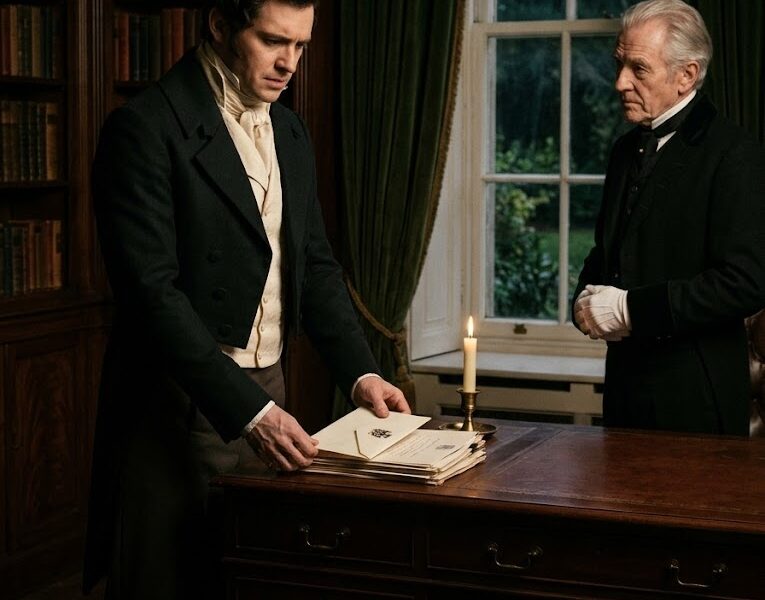
The Duke of Ashford had faced powerful men without flinching, but that night, alone in his study, he could barely keep his hands from trembling.
And the woman who had brought him to this moment was not the noble bride his family had chosen. She was a merchant’s daughter who worked among his dusty estate ledgers—and had no idea that the most important decision of his life was being made because of her.
The candle had burned almost to its socket. Its uneven flame cast restless shadows across the oak-paneled walls, illuminating the portraits of generations of Ashford men who had worn the same title and expected their descendants to preserve it at any cost.
Edmund Ashford stood behind his desk, gripping its carved edge. His knuckles had gone pale, though he hardly noticed. Across the room, Harold, his butler of thirty years, remained beside a silver tray that had sat untouched for nearly an hour.
“The title, the estate, my mother’s blessing,” Edmund continued, his voice low. “All of it could be gone in a single season.”
Harold did not answer immediately. He had served three generations of the family, and he knew the difference between a man considering his options and a man desperately searching for permission to do what he already wanted.
“Then why does your hand shake when you say her name, sir?”
Edmund lifted his eyes.
For a moment, he looked almost offended. Harold rarely permitted himself such directness. Yet there was no insolence in the older man’s expression, only a weary understanding that made Edmund feel more exposed than any accusation could have.
He turned toward the window.
Beyond the glass, the garden stretched beneath a thin sliver of moon. The hedges were dark, the paths deserted, and somewhere beyond the outer grounds stood a modest cottage where Clara Whitfield was probably preparing for bed, entirely unaware of the turmoil she had created inside Ashford House.
Three months earlier, Edmund had barely known her name.
Clara had arrived to manage the estate records after the previous clerk fell ill. Her father’s shipping business had suffered two disastrous seasons, and the salary offered by Ashford House was enough to keep her family from slipping into genuine hardship. She had accepted the position with gratitude, though she had never intended to be grateful for the company of the man who employed her.
Their first real encounter had occurred over a miscalculated column of expenses.
Two visiting lords had been seated in the record room with Edmund when Clara discovered the mistake. Without hesitation, she pointed it out, slid the ledger toward him, and explained precisely where his arithmetic had failed.
Edmund had felt the humiliation rise in his face.
He was accustomed to deference. Men twice Clara’s age had been known to agree with him even when they privately believed he was wrong. Yet here stood a young woman with ink on her fingertips, calmly informing him that his figures were incorrect.
He had been furious.
By the following week, however, he found himself inventing reasons to return to the record room.
At first, he told himself that he was taking a proper interest in the estate’s finances. Soon, he discovered that he could walk past Clara’s desk three times in an afternoon without asking a single question worth answering.
She was intelligent, practical, and entirely unimpressed by the advantages of his birth. When she spoke to him, she did so with the courtesy his position required, but without the nervousness that usually accompanied it.
And she laughed.
Not often. Not to please him. But when something genuinely amused her, the sound escaped before she could restrain it, warm and sudden and wonderfully free of calculation.
Edmund had begun to wait for it.
His family, of course, had other intentions.
Lady Beatrice Carlile, the daughter of an earl, had been considered his future wife since he was scarcely old enough to understand what marriage meant. The arrangement promised valuable land, strengthened alliances, and the approval of the same circle of families to which the Ashfords had belonged for generations.
His late father had regarded the match as a duty.
His mother regarded it as inevitable.
Clara Whitfield could offer none of those advantages.
Her family were respectable merchants, but respectability was not equality in the eyes of the aristocracy. Every ballroom in London would remind her of the difference. Every invitation would be examined, every mistake repeated, and every silence interpreted as proof that she did not belong.
“She would be torn apart,” Edmund said quietly.
Harold regarded him from across the room.
“By whom, sir?”
“Everyone. At every ball, every dinner, every drawing room. They would whisper about her, about her family, about us. She would never be permitted to forget what she was before she married me.”
“And you believe staying away protects her from that?”
Edmund turned.
The question had been asked without accusation, but it struck a place he had been trying desperately to avoid.
“I believe,” he said slowly, “that wanting her is the most dangerous thing I have ever felt.”
Harold approached the desk and finally set down the tray.
“I watched your father deny himself many things in the name of duty, sir. I watched what it did to him by the end. I cannot watch the same thing happen to you without saying something.”
Edmund’s jaw tightened.
His father had been a formidable man, disciplined and exacting, with a manner that made affection feel like an indulgence best enjoyed elsewhere. Even as a boy, Edmund had understood that earning his approval required obedience rather than happiness.
He had spent most of his adult life attempting to meet that standard.
Now he thought of Clara tapping her pen against a ledger while considering a difficult calculation. He remembered the sunlight touching her hair beside the record-room window and the way she could disagree with him without once raising her voice.
Then he looked around at the study, at the paintings, the furniture, the walls that had outlived generations of men.
“I cannot lose this house, Harold. Not for anyone.”
“Then do not lose her either.”
Harold’s voice softened.
“Find a way to keep both, sir. Otherwise, you may spend the remainder of your life wondering which one truly mattered.”
Edmund had no answer.
Outside, the garden remained motionless. The candle burned lower, and the man who had inherited everything stood in the middle of his own house, unable to decide whether he possessed anything that truly belonged to him.
Clara Whitfield knew nothing of that conversation.
What she knew was that the record room had begun to feel strangely small whenever the duke entered it.
She had started noticing details she would once have considered entirely unimportant: the way Edmund rubbed the back of his neck when the numbers refused to balance, the slight impatience in his expression when visitors interrupted his work, and the unexpected softness of his voice when he asked about her family.
She tried not to attach meaning to any of it.
Her father had taught her that fortunes could disappear more quickly than anyone imagined. Two poor shipping seasons had been enough to turn a comfortable household into one where every expense had to be carefully considered. Clara understood the value of steady employment, and she had no intention of risking it over a gentleman’s passing curiosity.
Especially not a duke’s.
One afternoon, she pushed a ledger across the desk toward him.
“You have added this column incorrectly again.”
Edmund looked down at the page.
“Again?”
“Third time this month.”
“I am a duke, Miss Whitfield, not an accountant.”
“Then perhaps the duke should leave the accounting to someone qualified.”
For a heartbeat, he stared at her.
Then he laughed.
It was not the polite, restrained sound she had heard him make in company. This was genuine laughter, warm enough to change his entire face. He leaned back in his chair, shaking his head as though she had managed something no one else would have dared attempt.
Clara smiled despite herself.
She liked that she could make him laugh. The knowledge frightened her more than she wished to admit, because admiration was one thing, and tenderness was another.
Men like Edmund Ashford did not marry women like Clara Whitfield.
She knew the stories. A gentleman might admire a clever woman, enjoy her conversation, and seek her company, only to marry someone whose name and fortune suited his family’s expectations.
The clever woman was then expected to understand.
Nevertheless, Edmund continued finding reasons to visit her.
He asked about her father’s business and listened when she answered. He wanted to know what she thought of the estate’s management, which places she hoped someday to visit, and what she remembered most fondly about her childhood.
Clara answered honestly, sometimes more honestly than she intended.
She reminded herself afterward that a duke’s curiosity was not a promise.
One rainy afternoon, while examining old estate correspondence, she discovered a silver pocket watch tucked inside a drawer.
The case was worn smooth around its edges. On the back, an old engraving had faded beneath years of handling. When she opened it, the hands were motionless, fixed at twenty minutes past three.
She held it carefully in her palm.
“That belonged to my father.”
Edmund stood in the doorway.
Clara startled and looked up.
“I am sorry, Your Grace. It was among the letters.”
“You have done nothing wrong.”
He stepped into the room, studying the small watch in her hands.
“He stopped wearing it the year before he died. I never asked why.”
Clara looked down at the still hands.
“Perhaps it stopped mattering to him. Whatever it once meant.”
Edmund was silent.
“Or perhaps,” he said, “it mattered too much, and he could not bear to keep it running.”
She lifted her eyes.
Something in his expression had changed. The familiar reserve had fallen away, leaving a sadness she did not entirely understand. He looked at her as though he had meant to speak of a pocket watch and found himself thinking of something else entirely.
The rain touched the windows with a quiet persistence.
Clara could hear the distant ticking of the clock in the corridor. The old watch between her fingers remained silent.
“I should finish these ledgers before the light fades,” she said.
Edmund did not move.
For one impossible moment, she wondered whether he might come closer.
Instead, he nodded.
“Of course, Miss Whitfield.”
His footsteps retreated down the corridor.
Clara placed the watch gently on the desk, but she could not immediately return to her figures. She stared at the closed silver case, thinking of the way his eyes had rested on her face.
She had the unsettling feeling that something had nearly happened.
Something neither of them would have known how to explain afterward.
She did not speak of the encounter again, and neither did Edmund. Yet when he entered the record room during the following days, their conversations carried a different kind of silence.
It was not uncomfortable.
That made it more dangerous.
Spring gave way to early summer.
The Ashford estate filled with its customary social obligations: dinners, garden parties, formal visits, and the endless procession of acquaintances whose presence Edmund had once accepted without question.
Lady Beatrice Carlile arrived frequently with her mother.
She was everything an aristocratic bride was expected to be, and Edmund knew that the arrangement between their families was becoming increasingly difficult to postpone.
In public, he performed his duties with impeccable courtesy.
He offered Beatrice the appropriate compliments, escorted her when required, and smiled whenever the conversation turned toward a future that everyone seemed to have settled on his behalf.
In private, he searched for Clara.
He began walking the garden path near her cottage in the evenings. The first time, he told himself that he needed exercise. The second time, he noticed which window still held a light. By the third, he had stopped trying to examine his reasons too closely.
Clara developed habits of her own.
She remained in the record room longer than necessary, checking figures that required no further attention. Whenever she heard footsteps in the corridor, she looked up before she could stop herself.
Sometimes the footsteps passed.
Sometimes the door opened.
Neither of them mentioned the pocket watch.
Then came the garden party arranged for Lady Beatrice’s visiting family.
The grounds were decorated for the occasion, with servants carrying refreshments between the house and the terraces. Music drifted from the open drawing-room windows, while guests wandered among the flower beds in clusters of silk, lace, and carefully rehearsed conversation.
Clara had no place among them.
Her work should have been finished for the day, but an updated account was needed in the study. She carried the ledger through a side corridor, intending to deliver it quickly and leave without attracting notice.
Instead, she found Edmund alone on the terrace.
He stood beside the stone balustrade, looking out into the darkening garden. The music behind him was soft, and his posture suggested that he was listening to none of it.
“You are missing your own party,” Clara said.
He turned.
For a moment, his expression brightened with such unmistakable relief that she wished she had not noticed.
“I am avoiding a conversation I do not wish to have.”
Clara approached the small table beside him and set down the ledger.
“The one about Lady Beatrice?”
Edmund looked at her.
There were several things he might have said. He could have denied it, changed the subject, or reminded her that his private affairs were not the concern of an estate clerk.
Instead, he remained silent.
The sounds of the party floated through the open doors. Someone laughed. A glass chimed against another.
“Clara.”
She felt her chest tighten.
He had never said her first name that way.
Not as an employer giving instructions, nor as a gentleman offering a courtesy. He spoke it softly, almost unwillingly, as though the name had escaped before he could stop it.
“Your Grace,” she replied.
He stepped closer.
“I should not be standing here with you.”
She kept her hands resting on the edge of the table.
“Then perhaps you should return to your guests.”
“My family expects an engagement announcement by autumn. Everyone expects it.”
Clara lowered her gaze.
“Then there is very little to discuss.”
“I do not want to go back inside.”
The simplicity of the admission was devastating.
She looked up.
He was close enough now that she could see the uncertainty beneath his composure. For the first time, he did not look like a man with the power to command an entire estate. He looked like someone who had reached the edge of a decision and was afraid of what might happen if he stepped forward.
“Edmund,” she whispered.
He moved his hand toward hers.
His fingertips brushed the back of her fingers where they rested on the table.
It was the smallest touch imaginable, hardly enough to be called an embrace or even an act of affection. Yet Clara felt it through her entire body.
She did not pull away.
For one suspended moment, the distance between them seemed to vanish.
Then a burst of laughter erupted from inside the house.
Edmund withdrew his hand.
The movement was so sudden that it hurt more than she would have expected. He took a step back, his face closing into the careful expression she had seen him wear in front of strangers.
“Forgive me,” he said. “I should return before I am missed.”
Clara could not find a reply.
He walked toward the open doors, toward the candlelight and the music, toward Lady Beatrice Carlile and a future that seemed already prepared for him.
Within moments, he was speaking to his guests again.
Clara watched him greet Beatrice with a composed smile.
Then she looked at the hand he had touched.
She pressed it briefly against her chest, trying to calm the rapid beat of her heart.
She had known from the beginning how dangerous this could become.
Knowing had not protected her.
On Tuesday morning, a letter arrived bearing the Carlile family crest.
Edmund read it twice.
Lord Carlile had grown tired of waiting. He demanded a formal announcement of the engagement within the month. If the Ashfords refused, he would withdraw his daughter’s hand and regard the family as unworthy of the alliance.
Edmund should have been relieved by the possibility of release.
Instead, the letter seemed to close a door.
An hour later, his mother entered the study.
The Dowager Duchess read the letter without sitting down. When she finished, she raised her eyes to her son with the same look his father had used whenever disobedience threatened to become public.
“You will send word to Lord Carlile today.”
Edmund stood beside the desk.
“Mother—”
“This family cannot survive another scandal. Not after everything your father built.”
“I have not agreed to marry Lady Beatrice.”
“You have known for years what is expected.”
“And if I do not wish to marry her?”
His mother folded the letter.
Her expression hardened.
“Then you will lose this house, this title, and everything attached to the Ashford name.”
Edmund said nothing.
She moved closer, searching his face.
“Is that truly what you want? To throw away two hundred years of family history for a passing infatuation with a clerk?”
The word struck him harder than he expected.
A clerk.
He had known Clara as a woman of intelligence, courage, tenderness, and quiet dignity. His mother had reduced her to a position in the household, as though that single fact could explain everything worth knowing about her.
Yet Edmund did not defend her.
He stood there, trapped between anger and an old, deeply rooted fear of disappointing the people whose approval had shaped his entire life.
Later that afternoon, he went to Clara’s cottage.
He had not planned the conversation. He only knew that the engagement deadline was approaching, and he could no longer bear the thought of Clara hearing the news from someone else.
She opened the door as the light began to fade.
Surprise crossed her face.
“Your Grace?”
Edmund removed his hat.
“I have to announce my engagement to Lady Beatrice. Within the month.”
The words came out too quickly.
Clara remained perfectly still.
Only her fingers betrayed her, tightening around the edge of the door until her knuckles whitened.
“I see.”
Her voice was steady.
“You do not owe me an explanation, Your Grace.”
“Clara—”
“We both knew what this was.”
He stared at her.
“A passing distraction,” she continued. “Nothing more.”
“That is not true, and you know it.”
She drew a breath.
“Then what is true?”
For the first time since he had known her, her composure began to crack.
“That you came here to tell me you are marrying someone else? That I should be grateful you were kind enough to inform me yourself?”
He flinched.
Clara looked away, struggling to regain control of her voice.
“I never asked you to choose me, Edmund.”
Hearing his name from her lips should have comforted him. Instead, it made everything worse.
“I never asked for any of this.”
He opened his mouth.
Nothing came.
He had imagined that she might understand the position in which he had been placed. He had imagined that she might forgive him, perhaps even reassure him that he was doing what duty required.
Standing before her, he finally understood how cruel those expectations had been.
He had wanted her affection while offering her no security.
He had wanted her understanding while refusing to confront his own fear.
There was nothing he could say that would not sound like an excuse.
“Goodbye, Your Grace.”
Clara closed the door.
The latch clicked softly.
Edmund remained on the step for several moments, staring at the wood as though it might open again.
It did not.
The evening air had grown cool. Somewhere along the path, leaves stirred in a faint breeze.
He had come to explain himself.
Instead, Clara had made him see himself more clearly than he had ever wished.
He walked back to Ashford House without once looking behind him.
Summer settled over the estate in warm, golden afternoons.
The gardens were beautiful. The drawing rooms remained full. The servants continued their duties, the tenants paid their rents, and the routines of an old aristocratic household moved forward as though nothing essential had changed.
For Edmund, everything had.
The engagement announcement was drafted three times.
He tore it apart three times.
His mother became increasingly impatient. Lord Carlile’s letters grew sharper. Invitations arrived, appointments were arranged, and every conversation seemed to bring him back to the same decision.
He answered politely.
He performed the expected courtesies.
He felt almost nothing.
Clara had not returned to the record room since the evening at her cottage door. Within the week, Edmund had hired a replacement clerk, whose work was perfectly satisfactory and whose presence reminded him daily of the person who was missing.
The ledgers were completed.
The accounts balanced.
The room had never seemed so empty.
Sometimes, passing the corridor, he caught himself slowing near the door.
He remembered Clara sitting beside the window, frowning over a column of figures, her pen tapping lightly against the paper. He remembered the way she had said his title when she was amused and the way she had said it on the night she closed her door.
The difference was unbearable.
One evening, Harold found him in the study, standing in almost the same place where their earlier conversation had taken place.
The butler entered with a tray.
As before, Edmund showed no interest in it.
“You look like a man who is already lost, sir.”
Edmund gave a tired, humorless smile.
“I have lost.”
Harold waited.
“I sent her away to protect this house. And now the house means nothing to me.”
The words surprised Edmund even as he spoke them.
Until that moment, he had imagined that the pain would diminish if he waited long enough. That familiar habits would restore the comfortable certainty of his position. That duty would eventually feel like a worthy consolation.
Instead, each passing day had made the emptiness more precise.
Harold set down the tray.
“Perhaps it was never the house that needed protecting, sir.”
Edmund turned.
“Perhaps it was your fear of becoming a man unworthy of your father’s name, even if living up to that name meant never being happy.”
“Harold.”
The warning was quiet.
The butler did not retreat.
Thirty years of service had earned him the right to speak plainly, and he seemed determined to use it.
“Your father once denied himself the woman he loved.”
Edmund went still.
“What?”
“It was long before your mother. I was young then, barely more than a boy in this house, but I remember.”
Edmund searched his face.
His father had spoken at length about duty, reputation, property, and obligation. He had never once mentioned loving another woman.
“He spent the rest of his life performing contentment,” Harold continued.
The study seemed suddenly colder.
“I watched it hollow him out, year after year. By the end, there was scarcely anything left behind his eyes.”
Edmund lowered himself slowly into the chair beside his desk.
“You never told me.”
“It was not my place.”
Harold paused.
“Until now.”
For a long moment, neither man spoke.
Edmund remembered his father’s silence at family dinners. The tired expression that sometimes settled over his face when he believed no one was watching. The way he had spoken of happiness as though it were a frivolous distraction from the real business of living.
As a child, Edmund had mistaken that severity for strength.
Now he wondered how much of it had been grief.
His eyes moved toward the drawer where the silver pocket watch had been placed.
The hands were still fixed at twenty minutes past three.
He remembered Clara holding it beneath the gray light of the record-room window.
Perhaps it stopped mattering to him.
Or perhaps it mattered too much.
Edmund had spoken those words without fully understanding why they hurt.
Now he understood.
He thought of his father, of a life lived according to expectations, of years passing in a house that offered every comfort except the one thing its owner had truly wanted.
Then he thought of Clara’s face when he had told her he would marry someone else.
He had called his decision duty.
But he had not protected her, and he had not found peace.
He had merely chosen the familiar pain of obedience over the unfamiliar possibility of happiness.
“I will not do it,” he said.
Harold looked at him.
Edmund rose.
The decision did not remove his fear. He could still imagine his mother’s fury, Lord Carlile’s contempt, and the scandal that might follow. He knew how uncertain his future could become.
But for the first time, that uncertainty seemed less terrible than the certainty of continuing as he had been.
“I will not spend the rest of my life becoming him.”
He left the study without another word.
Harold watched him go.
There was no grand declaration, no applause, no triumphant music. Only the fading sound of Edmund’s footsteps and the quiet satisfaction of an old servant who had finally spoken a truth he had carried for years.
That night, Edmund rode to Clara’s cottage.
The summer air was warm against his face. The path was familiar, though he had never traveled it with such a clear understanding of what he intended to say.
He had spoken before noblemen, negotiated matters affecting hundreds of tenants, and endured conversations in which a wrong word might cost a family its reputation.
None of it had frightened him as much as this.
He dismounted and approached her door.
For a moment, he stood with his hand raised.
He remembered the soft click of the latch when she had said goodbye. He remembered walking away and knowing, even then, that he had made a terrible mistake.
He knocked.
Clara opened the door.
She was plainly dressed, with none of the careful formality she wore at Ashford House. Surprise crossed her face when she saw him standing there.
“Your Grace?”
Edmund struggled to steady his breathing.
He had thought of a hundred ways to begin. Every carefully chosen phrase vanished the moment he saw her.
“I am done pretending I can live without you.”
Clara stared at him.
He continued before fear could close his throat.
“I do not care what it costs. The house, the title, my mother’s approval—all of it.”
His voice grew unsteady.
“I would rather lose everything and keep you than keep everything and lose you.”
Clara did not answer.
Her eyes filled with tears, but she made no move toward him.
He could see her searching his face, measuring this moment against the pain of their last meeting. She had every reason to doubt him. He had already allowed his fear to wound her once, and nothing he said could erase that.
Edmund stood still.
For once, he did not ask her to understand. He did not offer an explanation of what his family expected or what society might think.
He had finally come to her with a choice rather than an excuse.
Clara looked down at his hand.
It was the same hand that had brushed hers on the terrace before withdrawing at the sound of other people’s laughter.
Slowly, carefully, she stepped forward.
Her fingers closed around his.
Edmund looked at her.
She was crying now, quietly, but she did not let go.
Neither spoke for a long moment.
There was no certainty about what would follow. Edmund’s mother had not given her blessing. The Carlile family had not accepted his decision. The world beyond the cottage would still have its judgments, and the Ashford name still carried the weight of two hundred years.
But Clara was holding his hand.
And this time, when Edmund felt the old instinct to withdraw, he stayed.
For the first time since his father’s death, he was no longer simply inheriting another man’s life.
He was choosing his own.









