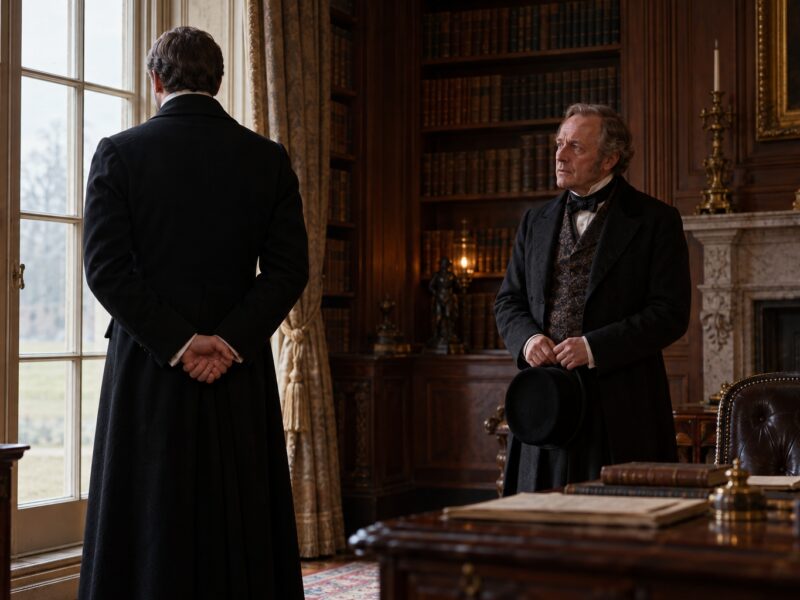
The Duke’s Mother Had Refused Food for Nine Months—Until a Maid’s Five-Year-Old Daughter Walked Into a Dinner for 22 Guests Carrying a Bent Spoon
For nine months, the Duke of Hastley’s mother had barely eaten, and the entire household believed she was slowly dying of grief.
Then a five-year-old servant’s daughter broke the strictest rule in the mansion and entered a room that had been sealed since a little boy’s death.
What she discovered behind that green door would expose a terrible betrayal, bring a powerful man before the law, and change the lives of two grieving families forever.
On November 23, 1815, a bitter wind swept across the grounds of Hastley Court in Hampshire, rattling the bare branches of the ancient elms and driving the last dead leaves against the windows.
The mansion stood above eleven thousand acres of farmland, woodland, tenant cottages, and carefully maintained roads. Its long galleries were lined with portraits of men who had inherited power without ever needing to ask permission to exercise it.
Edmund Carrow, the fourth Duke of Hastley, was forty-four years old.
He owned eleven thousand four hundred acres, employed forty-one servants, held responsibilities across three parishes, and served as a magistrate in the eastern division of the county.
He had never needed to shout to make himself obeyed.
Indeed, in nineteen years, few of his servants could remember him raising his voice at all.
They feared him nevertheless.
His orders were delivered quietly, without explanation, and were expected to be carried out without discussion. The household had learned that silence was often more dangerous than anger.
Since the previous April, three instructions had governed the small dining parlor at the end of the kitchen passage.
The green door was never to be opened.
The room behind it was never to be cleaned, aired, or disturbed.
And the table inside was never to be cleared.
Those orders had been given at seven o’clock on the morning of April 15, by a father who had not slept and whose six-year-old son had died the night before.
For seven months, nobody had dared question them.
Not even the Duke’s wife.
At the far end of the west wing lived his mother, the seventy-three-year-old Dowager Duchess of Hastley.
She had not eaten a proper meal since the morning following her grandson’s death.
Each evening, a tray went up to her rooms at five.
Each evening, the tray returned almost untouched.
The servants had stopped asking whether she wanted something different. The physician had stopped pretending that another tonic would help.
The old duchess simply sat beside her window, watching the avenue that led toward the south gate.
Sometimes, late at night, she believed she could hear carriage wheels approaching.
She always turned toward the sound.
And every time, the road was empty.
Far below those elegant rooms, in a kitchen passage that smelled of coal smoke, wet stone, and boiled vegetables, a little girl sat on the third step of the servants’ staircase.
Her name was Nell Senate.
She was five years and four months old.
Her dress had been made from an old gown belonging to her mother. Her boots were worn through at the toes, and she kept a small pewter spoon tucked into the pocket of her skirt.
The handle was badly flattened.
A wagon wheel had once passed over it.
Nell carried that spoon almost everywhere because it was one of the few things her father had left behind.
Corporal James Senate of the 52nd Regiment of Foot had died at Waterloo on June 18, 1815.
His belongings had reached his widow in August.
One shirt.
One razor.
A pay warrant for one pound, eleven shillings, and fourpence.
And the bent spoon.
Nell’s mother, Ruth, was thirty-one years old. She worked from five in the morning until eight at night, scrubbing the stone passages, carrying coal, and blacking nine fireplaces.
Her yearly wage was eight pounds, supplemented by the food scraps the kitchen allowed her to take home.
She and Nell lived in the last cottage on Fairyfield Lane.
There was nobody there to watch the child while Ruth worked, so Nell came with her mother and waited on the servants’ staircase.
Every morning Ruth repeated the same three rules.
Nell must never go above the kitchen stairs.
She must never speak to the family unless spoken to first.
And she must never enter the room behind the green door.
Nell knew the rules perfectly.
She also considered the third one especially unreasonable.
“What is behind it, Mama?”
“Nothing that concerns us.”
“But what is it?”
“Nell.”
“Yes, Mama.”
The child would lower her eyes, smooth her little skirt, and promise not to ask again.
By the following morning, she would have another question.
Ruth understood that curiosity could be dangerous in a house where a servant might lose her position for a mistake nobody would remember the next day.
She could not afford to lose hers.
Eight pounds a year was scarcely enough to live on.
Without it, there would be no firewood, no flour, and no roof over her daughter’s head.
So when Nell asked about the green door, Ruth told her firmly that some doors were not meant for people in their position.
Nell listened.
But she did not believe it.
On that same November afternoon, Dr. Mowbray stood in the Duke’s library holding his hat between both hands.
He had served the family for twenty-two years.
He had attended the Dowager Duchess sixty-one times since April, and he had exhausted every treatment he trusted.
“She has lost two stone and four pounds,” he told Edmund.
The Duke stood at the window, looking across the lawn.
“Does she still take tea?”
“Occasionally.”
“And broth?”
“She took one spoonful on Tuesday and was afterward sick. I am not convinced the broth caused it.”
“What do you require, Doctor?”
“Nothing that can be purchased.”
Edmund’s shoulders stiffened.
“Then tell me what cannot.”
Dr. Mowbray laid his hat upon his knee.
“Your mother must eat at a table. With company. At the hour she was accustomed to dining.”
“Her tray is taken up at five.”
“And brought down at six, untouched. Hollis has the food thrown into the pig pail so that Your Grace need not see it.”
Edmund turned.
“Who ordered that?”
“Nobody.”
The physician looked directly at him.
“Sometimes a household learns to arrange itself around what its master refuses to discuss.”
The clock on the mantelpiece struck the quarter hour.
Dr. Mowbray spoke more quietly.
“Go upstairs. Sit beside her. Let her eat with you.”
“No.”
“Your Grace, she is seventy-three.”
“I have answered you.”
“Yes,” the physician said. “A refusal dressed as an answer.”
Edmund returned his gaze to the window.
Dr. Mowbray waited another moment before collecting his hat.
He had buried his own wife. He knew the peculiar stillness of a person who had decided that feeling nothing was the only way to survive.
But he also knew that grief could become a habit so deeply rooted that a person eventually mistook it for duty.
Outside the library, he encountered Georgiana, Duchess of Hastley.
At thirty-eight, Georgiana maintained the household with the precision of a military commander. Every linen cupboard, dinner service, and servant’s schedule fell under her supervision.
She had once been the mother of a little boy named Thomas.
Now she was the mother of none.
She had returned to receiving callers in October and playing cards in September, not because her grief had lessened, but because she could not endure another day in which nothing appeared to have a purpose.
“Doctor, will my mother-in-law be well enough to join us for the county dinner?”
“I cannot promise that, Your Grace.”
“The Lord Lieutenant is attending. So is the bishop’s chaplain. There will be twenty-two places.”
“She may be brought downstairs if she is carried.”
“Then she shall be carried.”
Georgiana continued toward the linen room, her keys striking softly against her skirt.
That evening, the old duchess’s tray went upstairs at five.
At six, it came down.
Untouched.
At eleven, Edmund crossed the kitchen passage in his stocking feet.
It was a walk he had made more than a hundred times since April.
He stopped at the green door.
Placed his palm flat against the painted wood.
And stood there until the cold began to creep through his clothes.
Then he returned upstairs without opening it.
He did not visit his mother.
And he did not sleep.
The following afternoon, Mrs. Gorse, the cook, was occupied with preparations for the county dinner.
Nineteen pounds of minced meat required seasoning, the copper pans needed polishing, and the stillroom shelves had to be checked.
She sent Ruth to the brewhouse with four buckets.
Nell remained on the staircase with a crust of bread and a one-eared kitchen cat named Sergeant.
Sergeant was an independent creature who respected neither rank nor domestic arrangements.
Every afternoon, shortly before five, he sat outside the green door with his tail curled around his paws.
For nine days, Nell watched him.
On the tenth, she finally spoke.
“You are not allowed in there either.”
Sergeant blinked.
“But you want to go.”
The cat continued watching the door.
Nell considered this evidence that her own curiosity was reasonable.
At four o’clock, the passage emptied.
Mrs. Gorse had gone to count her lemons. The kitchen maids were busy with the evening preparations, and Ruth remained outside.
Nell climbed down from her step.
Her small boots made almost no noise on the stone.
She walked toward the green door, pausing once to listen.
Nothing moved beyond it.
She put her ear against the wood.
Still nothing.
After a moment, she reached for the handle with both hands.
The latch lifted.
The door opened.
Sergeant slipped inside before her.
The room smelled of dust, old wood, and cold ashes.
Heavy curtains covered the windows. Only a narrow stripe of fading afternoon light reached across the carpet.
Four chairs surrounded a small dining table.
Two places had been laid.
The cloth had once been white.
The plates were covered in a fine layer of dust.
At the far place stood a small china plate with a blue rim and a tiny chip near one edge.
It was the sort of plate made for a child.
Beside it stood an empty glass with a dead fly at the bottom.
Nell looked around in confusion.
This was not a frightening room.
It was simply a room nobody had bothered to clean.
And that seemed to her a much more serious problem.
She pulled her sleeve over her right hand and wiped the dust from the little plate.
Once.
Twice.
A third time, until the blue rim appeared clearly.
Then she breathed upon the glass, cleaned it, and shook the dead fly onto the floor.
The place setting was still incomplete.
There was no spoon.
Nell reached into her pocket and took out the pewter spoon her father had carried at Waterloo.
She set it carefully beside the child’s plate.
Then she stepped backward to examine her work.
“That is better,” she whispered.
“What are you doing?”
The voice came from the darkness beside the window.
Nell turned.
A tall man sat in a chair, his hands resting on his knees.
She had not noticed him.
Edmund Carrow, fourth Duke of Hastley, had been sitting there since the clock struck four.
He looked at the little girl standing beside his dead son’s plate.
The sleeve of her dress was gray with dust.
His eyes moved toward the spoon.
“Who told you to come in here?”
“Nobody, sir.”
“Do you know whose house this is?”
“Yes. The Duke’s.”
“Do you know who I am?”
Nell studied him carefully.
“You are the gentleman who walks in the passage at night without his boots.”
Edmund stared.
“How do you know that?”
“I saw you twice.”
“Why were you watching?”
“I was awake.”
There was no apology in her voice, only the simple explanation of a child who had been asked a question.
The Duke looked again at the table.
“Why have you put your spoon there?”
“Because there was not one.”
“Why should there be?”
Nell frowned.
“Because someone is supposed to sit in that place.”
A silence followed.
Edmund looked at the plate.
For seven months, he had kept the room exactly as it had been on the morning after Thomas died.
Nobody had moved the chairs.
Nobody had cleared the dishes.
Not even Georgiana had been permitted to put away their son’s little plate.
And now a servant’s child had wiped it clean and given it a spoon.
From behind them came a faint sound.
Hollis, the butler, had stopped in the doorway.
He had served the Hastley family for thirty-four years. He remembered Edmund as a solemn nine-year-old boy and had watched him grow into a man who controlled every emotion with the same discipline he brought to his estate.
Hollis saw the cleaned plate.
Then the bent spoon.
Then his master’s face.
He remained perfectly still.
“Go back to the stairs,” Edmund finally said.
Nell nodded.
“Shall I take my spoon?”
“No.”
She hesitated.
“I shall want it tomorrow.”
Edmund’s expression changed almost imperceptibly.
“Why?”
“It belonged to my father.”
“Your father?”
“Yes, sir. He died in the war.”
Nell smoothed her dress.
“A wheel went over the spoon. That is why it is bent.”
The Duke looked at the flattened handle.
“Go along.”
Nell walked past Hollis, and Sergeant followed her.
The green door remained open.
For two more hours, Edmund sat in the gathering darkness, looking at the small clean plate and the spoon beside it.
For the first time since April, he allowed himself to remember his son’s hands reaching for that plate.
And when the clock struck six, he found he could rise from the chair.
At nine the following morning, Ruth Senate was summoned to the library.
She entered with her hands clasped tightly before her.
Her apron had been removed, but the red marks left by the scrubbing water remained around her fingers.
She knew why she had been called.
She also knew what would happen to a widow who lost her position just before Christmas.
But she would not plead for herself at the expense of her daughter.
“It was my girl, Your Grace,” she began. “I left her while I went to the brewhouse. She knew the rules, and I failed to keep her where she could obey them.”
Edmund said nothing.
“I shall take my wages to Saturday and go. I will not trouble you for a character.”
“Sit down, Mrs. Senate.”
“I would rather stand.”
“Sit down.”
She looked at the chair.
“If I sit, Your Grace, I fear I shall find it harder to leave this room. I should prefer to do so upon my own feet.”
Edmund studied her properly for the first time.
He had passed her in the corridors dozens of times.
Until now, she had been little more than a pair of hands keeping his floors clean.
“Nothing was broken,” he said.
“Something was touched.”
“Yes.”
“And everyone in the house knows what touching that room means.”
“The house,” Edmund said slowly, “has made several decisions on my behalf without being asked.”
Ruth did not answer.
It was not a statement with which a prudent servant could agree.
“Your daughter cleaned a plate.”
“She has watched me clean nine grates every morning. She copies what she sees.”
“She left a spoon.”
“She will want that back.”
Edmund looked up.
“Will she?”
“Every day until she has it. And if she sees you, she will ask you herself.”
“Why?”
“Because she is not frightened of you, Your Grace. I cannot account for it, and I have no means of correcting it.”
For a long moment, the Duke remained silent.
Then he asked a question that surprised them both.
“Would you permit her to return?”
Ruth stared.
“To that room?”
“Yes.”
“Why?”
Edmund looked down at his hands.
“Because yesterday, at four o’clock, I was sitting in a chair I could not bring myself to leave.”
He raised his eyes.
“At six, I was able to stand.”
Ruth felt a sharp movement of pity that she immediately suppressed.
Pity could be a dangerous thing when offered to someone with the power to decide whether she and her child ate.
“That is not a reason I can explain to my daughter.”
“It is the only true reason I possess.”
The fire settled in the grate.
Ruth looked toward the windows, gathering her courage.
“If I agree, there must be conditions.”
“Name them.”
“One hour only. Four until five. When the clock strikes five, she comes back to me.”
Edmund nodded.
“Second, I must be told beforehand. If I say she cannot come, I will not be asked to explain.”
“Agreed.”
“And third…”
She stopped.
“Go on, Mrs. Senate.”
“Nothing is to be decided about her without me. Not her clothes. Not her schooling. Not her place in this house. Not even a kindness.”
Edmund’s brows drew together.
“If anyone decides her future over my head, however generously, I will take her away from this parish. You will not know where we have gone.”
“Those are severe terms.”
Ruth held his gaze.
“They are the only property I own.”
The Duke looked at her reddened hands.
Then at his own, pale and unmarked.
“I accept all three.”
He stood and extended his hand.
“Will you shake on it?”
Ruth hesitated before taking it.
She had spent most of her life being told what gentlemen required.
It was an unfamiliar experience to hear one ask.
That afternoon, Hollis opened the green door at four.
He had ordered a fire laid in the grate, although no instruction had explicitly permitted it.
He had decided that warming a freezing room was not an alteration.
It was a repair.
Nell entered and immediately approved.
“Much better. It was cold as a larder.”
She collected her spoon from beside the little plate.
“I am taking this home at five.”
“As agreed,” said the Duke.
She slipped it into her pocket.
“Will you sit in the dark again?”
“I had intended to.”
“But you cannot see anything in the dark.”
“That is precisely its attraction.”
Nell thought about this.
She decided adults were strange.
Then she pointed to the blue-rimmed plate.
“Whose is that?”
Edmund was silent.
For months, his wife had tried to speak of their son.
His mother had tried.
The physician, the rector, and the family solicitor had all tried.
He had found a way to refuse every one of them.
Now a five-year-old girl waited beside the table.
“It belonged to my son.”
“Where is he?”
Edmund stared into the fire.
“He died on April fourteenth.”
Nell nodded.
“My father died on June eighteenth.”
She pulled out the bent spoon and turned it between her fingers.
For a moment, the two of them sat quietly with the dates.
Then Nell looked at the empty table.
“Have you anything to eat? I have only had a crust.”
The Duke reached for the bell.
When Hollis appeared, Edmund ordered bread, honey, and weak tea in two cups.
The butler bowed.
He made it halfway down the corridor before stopping beside the brewhouse door.
For the first time in seven months, someone had ordered food for the little parlor.
And for the first time in seven months, it was meant to be eaten.
Their meetings continued for twenty-six days.
Every afternoon between four and five, Nell came into the room and changed one small thing.
On the second day, she complained about the uneven curtains.
On the fourth, she wound the clock.
On the sixth, she removed the cover from an unused chair, folded it neatly, and placed it on the floor.
On the eighth, she brought three frost-damaged chrysanthemums in a jar.
“Those belong to Her Grace,” Edmund told her.
“They were going brown.”
“That does not make them yours.”
“No,” Nell admitted. “But now they are flowers on a table instead of dead flowers outside.”
The Duke considered the distinction.
The jar remained.
On the eleventh day, Nell discovered an old tin of barley sugar in a drawer.
The sweets had been purchased in Winchester just three days before Thomas died.
Edmund had bought them because someone had told him that a boy of six would eat almost anything if sugar were involved.
The tin had remained unopened.
Nell held it up.
“May I have one?”
Edmund looked at it for a long time.
“Yes.”
She took two.
One she put into her mouth.
The other she placed in his palm.
“That one is yours.”
He held it throughout the hour.
He did not eat it.
When Nell left, he slipped it into his waistcoat pocket.
Hollis discovered it there four days later while preparing the coat for brushing.
He said nothing.
The servants were beginning to understand that not every silence in Hastley Court meant the same thing.
On the fourteenth afternoon, Nell and the Duke were discussing Sergeant.
Nell insisted the cat was employed by the household because he caught mice and received food in exchange.
Edmund argued that employment required the consent of both parties.
“In that case,” Nell said, “perhaps Mama is not employed either.”
The Duke paused.
“That is a discussion I decline to continue.”
“You always say that when I am winning.”
Edmund laughed.
It was only a short sound.
But Hollis, passing outside with a coal scuttle, stopped so abruptly that some of the coal shifted against its rim.
He entered without knocking.
“Forgive me, Your Grace.”
“What is it, Hollis?”
The old butler swallowed.
“That is the first time I have heard you laugh in two years.”
Edmund looked away.
“Put the coal on the fire.”
“Certainly, Your Grace.”
That evening, Hollis wrote the date and hour in a small notebook he carried.
At sixty-one, he had begun recording good things, simply because he wanted something worth remembering.
After the butler left, Nell returned to the subject of meals.
“Why does nobody bring the old lady down for dinner?”
Edmund stiffened.
“My mother has her tray at five.”
“But she does not eat it.”
“She is unwell.”
“Mrs. Gorse puts the food in the pig pail. She says a word I am not allowed to repeat.”
“Then you must not repeat it.”
“I was not going to.”
Nell swung her feet beneath the chair.
“Is your mother being punished?”
“No.”
“Then why must she eat alone?”
Edmund looked at her.
“When I eat alone, it is because Mama is working,” Nell explained. “When Mama is home, we eat together. Even when there is only bread.”
“Your grandmother used to eat in this room,” he said eventually.
“With your boy?”
“Yes.”
“At this table?”
“Yes.”
Nell looked around.
“So she is upstairs, and you are down here, and neither of you comes to this room together.”
“That is so.”
The child frowned.
“That is very silly.”
Edmund followed her gaze toward the two plates.
“Yes,” he said quietly.
“It is.”
In the west wing, the Dowager Duchess remained beside her window, watching the empty avenue.
She had once presided over magnificent Christmas gatherings and taught generations of servants how to curtsy correctly.
Now she possessed beautiful gowns she never wore, miniature portraits she could scarcely bear to look at, and an annual income she had almost no desire to spend.
But wealth could not return the little boy she had held against her chest on the night of April 14.
And nothing could remove the memory of the carriage overturning into the dark water.
She heard that crash again every night.
Sometimes she heard her grandson calling.
Sometimes she heard no voice at all.
She was beginning to fear the silence more.
On December 2, Georgiana discovered her husband’s meetings with the servant’s daughter.
She came down the kitchen passage shortly before five, carrying the keys that seemed never to leave her hands.
She stopped in the doorway.
The fire was burning.
A chair had been uncovered.
Dead chrysanthemums stood on the table.
And a child in a mended dress sat in the Dowager Duchess’s accustomed chair.
“Edmund.”
The Duke stood.
Nell remained seated because nobody had spoken to her.
“May I speak with you in the morning room?” Georgiana asked.
“You may speak here.”
“I would prefer not to discuss family matters in front of the kitchen.”
“Then you should speak quickly. I have promised this child she will return to her mother at five.”
Georgiana stepped inside.
Her eyes fell on the little plate with the blue rim.
“That is Thomas’s plate.”
“Yes.”
“It has been moved.”
“It has been cleaned.”
“By her?”
“Yes.”
Georgiana stared at the plate.
Her fingers tightened around her keys.
“In May, I asked whether we might put that plate away.”
Edmund said nothing.
“You told me that nothing in this room could be touched. I respected your wishes. I passed this door twice a day for seven months without opening it.”
Her voice remained perfectly controlled.
“And now a servant’s child has been permitted to wipe it with her sleeve.”
“Georgiana—”
“No.”
She looked directly at him.
“I understand now. The order was not meant to preserve this room.”
Her mouth trembled once.
“It was meant to keep me out.”
The clock struck five.
Nell climbed down from her chair.
She pulled the bent spoon from her pocket and held it where Georgiana could see it.
“This was my father’s. A wheel went over it.”
Georgiana stared at her.
“Your father?”
“He died at Waterloo,” Edmund answered.
“And her mother?”
“Scrubs the passages.”
Georgiana’s face hardened again.
“Then you will understand why this must end before the county dinner. There will be twenty-two guests here. I will not have a kitchen child wandering through the family’s rooms.”
“I have given my word.”
Georgiana looked at her husband for a long moment.
“Then perhaps you might try giving your word to me for once.”
She turned and left.
The keys at her waist were the only sound in the corridor.
Edmund remained beside the table.
For the first time, he understood that his refusal to move Thomas’s plate had not preserved his wife’s memories.
It had denied her the right to mourn in the room where their son had once been happiest.
But understanding something and knowing how to repair it were not the same.
Outside, the frost deepened over the estate.
And eleven miles away, a man named Josiah Pelum was beginning to fear that the Duke had finally started asking questions.
Josiah Pelum had served as land agent to the Hastley estate for nineteen years.
He was fifty-two, respectable, generous to the parish school, and known to lend his carriage to people who could not afford one.
He had paid for repairs to the church roof without allowing his name to be announced.
He had also carried the previous Duke’s coffin.
Nobody in Little Martin thought him capable of anything dishonorable.
But behind the paneling beside his office fireplace was a narrow concealed compartment.
Inside it, Pelum kept a long account book bound in gray paper.
The official estate ledgers recorded rents, repairs, timber, and the maintenance of roads.
This book recorded transactions that were never meant to appear in those ledgers.
On the evening of December 4, Pelum locked his office door and removed it.
He turned to the entry for March 29.
Then he unfolded a letter he had received that morning.
The clerk of the Turnpike Trust had written to inform him that the Duke of Hastley had requested the March minutes and the surveyor’s original road plan.
Pelum read the letter twice.
He held it over the fire until it burned.
Then he returned the gray book to its hiding place and pressed the panel shut.
At supper, he was particularly kind to his wife.
She remarked upon his good humor.
He told her only that business was improving.
Two days later, Ruth took Nell to Winchester on a carrier’s cart.
The child’s boots had worn through completely, and Ruth had saved two shillings and ninepence toward a replacement pair.
They were walking near Jewry Street when a well-dressed gentleman stopped in front of them.
He wore a brown coat and carried himself with the ease of a man accustomed to being welcomed everywhere.
“You must be Nell.”
Nell nodded.
“Yes, sir.”
“Nell Senate, from Fairyfield Lane.”
Ruth immediately placed a hand on her daughter’s shoulder.
“Who are you?”
The gentleman smiled.
“No one of consequence.”
He touched the brim of his hat.
Then he looked at the child.
“Keep that little spoon safe, my dear.”
He walked away before Ruth could ask another question.
She stood motionless among the passing shoppers.
Very few people outside Hastley Court knew her daughter’s name.
Fewer still knew anything about the spoon.
And Ruth was certain she had never spoken to that gentleman before.
When they returned home, she checked the cottage door twice before going to bed.
Nell did not understand why.
But she slept with the spoon beneath her pillow that night.
On December 8, the Duke visited the Turnpike Trust office at Ferrybridge.
He examined the minutes from March and asked to see the surveyor’s first plan for a proposed new road.
The clerk could not produce it.
“Mr. Pelum took it away for comparison.”
“When?”
“In April, Your Grace.”
“Before or after the accident?”
The clerk swallowed.
“After.”
Edmund studied the papers.
“Who paid the surveyor?”
“The trust, sir. Forty pounds.”
“And who else paid him?”
The clerk said nothing.
Edmund closed the minute book.
He thanked the young man and left.
That afternoon, Nell arrived in the little parlor with a long account of her new boots, a complaint about the price of winter apples, and an observation about Mr. Pelum’s house.
“Mama used to take washing there.”
Edmund looked up.
“Did she?”
“He gave me sugar mice.”
“That was kind.”
“He has a wall with a door that has no handle.”
Edmund remained still.
“A cupboard?”
“No. A piece of the wall beside the fireplace. You push it, and it opens.”
“What is behind it?”
“A place for a long book. He puts it in and closes the wall again.”
Nell looked pleased with her explanation.
“It is probably to keep the mice away.”
Edmund leaned forward.
“When did you see this?”
“Twice. Once in summer. Once when it was raining and Mama took back some sheets.”
“Did he know you saw?”
“No. I was behind the door taking my boots off.”
“Have you told anyone?”
“I am telling you.”
Edmund breathed slowly.
“Then do not tell anybody else. Not your mother. Not Mrs. Gorse. Not even Sergeant.”
“Why?”
“Because I am asking you.”
Nell considered this.
“Very well.”
And with that, she returned to her observations about boots.
But Edmund said very little during the remainder of their hour.
That evening, he summoned Hollis.
“Who was on duty at the south gate on April fourteenth?”
“Nobody, Your Grace.”
“Nobody?”
“The carriage did not return by the south gate. It came by the hollow road.”
“Because the ferry turnpike gate was shut.”
“Yes, Your Grace.”
Edmund gripped the back of his chair.
“Why has no one told me that?”
Hollis lowered his eyes.
“Because Your Grace ended the inquest after two days and forbade anyone to disturb the room. We understood that the matter was not to be spoken of.”
The Duke slowly released the chair.
He had spent months blaming his mother for taking Thomas to the horse fair.
Now, for the first time, he began to wonder whether he had condemned her without learning everything that had happened.
And somewhere in Josiah Pelum’s office, the missing answers remained hidden inside a wall.
On December 12, Ruth stayed late to finish scrubbing the passage outside the stillroom.
The house had grown quiet. Most of the servants had eaten, and Nell was already asleep at the cottage under the care of Mrs. Gorse’s niece.
Ruth was wringing out her cloth when Edmund appeared at the kitchen doorway.
He carried a folder beneath one arm.
“Mrs. Senate. May I have a word?”
She straightened.
“Of course, Your Grace.”
He looked at the long kitchen table, its surface scarred by years of knives and hot pans.
Then he sat on the bench.
Ruth stared at him.
No Duke of Hastley had ever sat at that table within living memory.
“Please,” he said, indicating the opposite bench.
This time, she sat.
He opened the folder.
There were turnpike minutes, a surveyor’s drawing, an account for gravel, and several handwritten notes.
But the Duke did not begin with the road.
“Your husband,” he said.
“James.”
Edmund looked up.
“Tell me about his death.”
Ruth folded her hands.
“He died on June eighteenth. In the afternoon, they told me.”
“How?”
“A man from his regiment wrote that James was carrying water to wounded soldiers. The artillery teams were coming through, and a wheel went over his hand.”
She paused.
“He put his injured hand in his pocket and kept carrying water.”
The Duke glanced at the papers.
“And the spoon?”
“It was in that pocket. That was how the handle came to be bent.”
“When did you learn he had died?”
“August nineteenth.”
Edmund’s face changed.
“More than nine weeks afterward.”
“Nine weeks and four days.”
Ruth looked at the candle.
“Nine weeks and four days in which I was cooking supper for a man who had already been buried.”
She spoke without tears.
Edmund thought that made the words more terrible.
“I was told of Thomas’s death that same night,” he said. “The accident happened three miles from here. I rode out with a lantern and arrived before the carriage wheel had been brought out of the water.”
Ruth nodded.
“Then you know something I do not, and I know something you do not.”
“Yes.”
“And I do not propose that we compare them.”
Edmund raised his eyes.
“My grief is not smaller because I heard of it by post,” she continued. “And yours is not larger because you have eleven thousand acres.”
For a moment, she wondered whether she had said too much.
But the Duke remained still.
“Grief a man can afford to keep private is the same size as grief carried through Winchester market on a Thursday,” Ruth said. “Only quieter.”
“Who taught you to speak like that?”
“Seven months of scrubbing your floors while everybody whispered about your mother.”
A faint smile moved across Edmund’s face.
Then it disappeared.
He laid both hands on the table.
And he told her what had happened on April 14.
Thomas Carrow, Earl of Martin, had been six years and five months old.
He was an eager, restless little boy who loved horses and had begged his grandmother to take him to the spring fair at Ferrybridge.
The Dowager Duchess had agreed.
She had not asked Edmund’s permission because she knew he would refuse. He considered the fair unsuitable for a young heir and disliked having the boy out after dark.
They departed at two in the afternoon.
Thomas had been delighted by the great Suffolk Punch horses, the crowded stalls, and the bright ribbons tied to the harnesses.
His grandmother indulged him.
They stayed longer than intended.
By the time they left, it was a quarter past eight.
The child had fallen asleep beneath a rug with his head against her shoulder.
At eighteen minutes before ten, their carriage reached the ferry turnpike gate.
It was chained.
Abel Hoy, the gatekeeper, emerged carrying a lantern.
He told the coachman that the gate was closed for the night and that the carriage must take another route.
The coachman protested.
Hoy refused to open it.
He said timber was blocking the road.
The horses had to be turned in a narrow space between the hedges.
The only alternative route was the hollow road, a poorly maintained track beside a deep stretch of water.
The turnpike trust had neglected repairs there since 1813.
Near the willow trees, the road bent sharply above a low parapet.
A hole had formed beside the turn earlier that year.
In the darkness, the carriage’s near wheel struck it.
The vehicle lurched.
The horses stumbled.
And the carriage overturned into the water.
The coachman and a passing carter pulled the Dowager Duchess out shortly after ten.
Thomas could not be found in time.
When Edmund reached the scene, men were still struggling to move the carriage.
His mother had been taken home.
Her hair was wet.
Her gown was torn.
And she was still clutching the little rug in which Thomas had been sleeping.
“In the hall,” Edmund said, looking at Ruth, “she asked whether I could forgive her.”
“What did you say?”
“Nothing.”
He stared into the candle flame.
“Not one word.”
Ruth did not interrupt.
“I had the little parlor sealed the following morning. I ended the inquest after two days. I ordered the ferry gate kept shut, so that no other family would be turned away and sent along that road.”
He swallowed.
“I have not eaten with my mother since. I have not even gone upstairs to speak to her.”
“Does she know about the hole?”
“She knows she persuaded Thomas to go to the fair.”
“That was not what I asked.”
“No.”
Ruth stared at him.
“Then she has been feeding herself that guilt instead of her supper.”
Edmund’s expression tightened.
“You make it sound simple.”
“It is not simple.”
She looked down at her hands.
“But a woman cannot forgive herself for something when the people she loves have made her believe there is nothing to forgive.”
The Duke lowered his head.
For months, he had imagined that silence spared everyone another painful conversation.
Now he understood that silence had become a punishment.
And his mother had been enduring it alone.
Outside the kitchen windows, frost whitened the courtyard.
The candle burned low between the two adults.
Neither spoke again for some time.
The dinner for twenty-two guests had originally been arranged for November 30.
Georgiana postponed it until December 14.
Then a severe frost damaged the road used by several guests, forcing another postponement to December 28.
Each delay increased her determination that the evening, when it finally occurred, would be flawless.
“The house must look like a home,” she told Hollis. “Not a hospital.”
Meanwhile, the atmosphere along Fairyfield Lane was changing.
On December 16, Ruth returned from work after dark and saw two men standing outside her cottage gate.
One was smoking.
Neither spoke.
She passed them without looking directly at their faces.
The next morning, she found footprints inside the gate and discovered that nine turnips had disappeared from her patch.
The theft itself scarcely troubled her.
A hungry person might steal vegetables.
What frightened her was that nothing else had been touched.
Two days later, an unexpected parcel arrived at the cottage.
Inside lay a pair of sturdy children’s boots, beautifully made, with proper nailed soles.
There was no note.
Ruth examined the wrapping and discovered a bill marked Winchester, December 16.
The Duke’s name appeared upon it.
She took the boots to the library.
Edmund looked up from his papers.
“Mrs. Senate?”
She placed the parcel on his desk.
“Our third condition, Your Grace.”
He looked at the boots.
“Something has happened?”
“You were not to make decisions about my daughter without speaking to me.”
“Hollis purchases things for the household.”
“These were purchased in your name.”
“Then he must have used it.”
Ruth looked at him steadily.
“Mr. Hollis is a truthful man, Your Grace.”
Edmund said nothing.
“And you are a duke. I know which of you can afford to lie to me.”
He almost smiled.
“Her boots have holes.”
“They have.”
“It is December.”
“I am aware.”
He glanced at the parcel again.
Then, after a moment, he asked, “May she have them?”
Ruth’s expression softened.
“That is the first time you have asked me about something small.”
“I am discovering small requests are often more difficult than large ones.”
“She may have the boots.”
“Thank you.”
“But there must be no more parcels unless I agree beforehand.”
“Very well.”
Nell loved the boots.
She walked the kitchen passage nine times, delighted by the sharp sound the soles made on the stone.
“They are loud, Mama!”
“They certainly are.”
“They sound important.”
Mrs. Gorse laughed.
The Duke stood in the open doorway of the little parlor and listened.
Those footsteps were the first cheerful noise he could remember in that corridor.
He had not realized how thoroughly sorrow had silenced the house.
But the men near Ruth’s gate were not forgotten.
And the stranger in Winchester had not been an accident.
By December 21, Edmund was close enough to the truth that someone decided he had to be stopped.
That evening, a folded note arrived without a seal.
The handwriting was crude, the letters large.
The message stated that the ferry gate had been shut for money.
The Duke was instructed to come alone to the gate at one in the morning if he wished to learn who had paid.
He was warned to tell nobody.
Edmund read it twice.
Then he went to the gun room.
He removed a pistol from a locked case and loaded it with steady hands.
Shortly before midnight, he crossed the stable yard carrying a lantern.
Ruth appeared in the doorway.
She had remained late to help Mrs. Gorse with the next morning’s bread and had heard him open the gun cabinet.
She saw the outline of the weapon beneath his coat.
“Your Grace.”
“Stand aside, Mrs. Senate.”
“No.”
Edmund stopped.
“I have no time for this.”
“Then you will have to make time.”
“I have received information about the gate.”
She looked at the pistol.
“And you intend to ride there alone?”
“Yes.”
“At one in the morning?”
“Stand aside.”
Ruth pressed her back against the doorway.
“If you insist, dismiss me tomorrow. Tonight I am not moving.”
Edmund stared at her.
“You have no understanding of what is at stake.”
“I understand enough.”
“There is a man who knows why that gate was shut.”
“There is a man who wants the Duke of Hastley found at a public turnpike in the middle of the night with a loaded pistol.”
Edmund did not answer.
“And there may be two witnesses hidden in the hedge, ready to swear that you threatened someone. By Friday, you could lose your place as magistrate and trustee.”
She gestured toward the dark road.
“Then who will bring the evidence before a court?”
The lantern hissed.
Edmund’s jaw tightened.
“You do not know who is behind this.”
“No.”
Ruth stepped closer.
“But I know what that letter is.”
He waited.
“It is not an invitation to learn the truth. It is a trap built to make you lose the power to expose it.”
For a long time, neither moved.
Eleven miles away, at the ferry gate, two men waited behind a hedge while a third held a horse in the darkness.
But Edmund never arrived.
At last, he turned toward Ruth.
“You are right.”
She held his gaze.
“Say it again.”
The faintest trace of surprise appeared in his face.
Then he nodded.
“You are right. If I ride out tonight, I may lose the only means I possess of reaching that man.”
He drew the pistol from his coat and offered it to her.
Ruth accepted it awkwardly, holding the heavy weapon as though it were a gardening tool.
Edmund almost laughed.
“Wake Hollis,” he instructed. “Send for Mr. Finch in Winchester and for Dr. Mowbray. Tell the grooms to speak of this to nobody.”
“And the letter?”
“It goes with the other papers.”
“Where?”
“To a court.”
Ruth looked down at the pistol.
For the first time since her husband’s death, she felt something other than fear when she thought about what might happen next.
Not confidence.
Not yet.
But the possibility that a powerful man might choose justice over anger.
The investigation began on December 22.
Mr. Finch, a solicitor from Winchester, arrived at Hastley Court with three clerks and a fresh set of account papers.
The Duke acted in his capacity as a trustee of the Martin and Ferrybridge Turnpike Trust, requesting the original road survey, gatekeeper instructions, and financial records from 1813 onward.
It was deliberate.
A duke might be accused of pursuing a private grievance.
A trustee examining irregular public accounts possessed a different kind of authority.
The surveyor, Mr. Bedau, was summoned on December 23.
For forty minutes, he attempted to explain why his original proposed route had been shifted four hundred and sixty yards.
Then Mr. Finch placed a property conveyance before him.
Eleven acres of land along the altered road had been sold the previous year to a woman named Hannah Crowe.
The purchase had been made before the road’s new course became public knowledge.
“Are you acquainted with Mrs. Josiah Pelum?” Finch asked.
The surveyor went pale.
“Hannah Crowe,” the solicitor continued, “was her maiden name.”
The surveyor covered his mouth.
He had nothing further to say.
On Christmas Eve, the rector of Little Martin came forward.
Mr. Dalrymple admitted that he had witnessed the conveyance, believing it to be a straightforward transaction between neighbors.
The supposed purchaser had not been present when he witnessed it.
Mr. Pelum had taken the document away to obtain the signature.
The rector had thought about that irregularity many times afterward.
But he had never challenged a respectable man he considered a friend.
Christmas Day passed without further questioning.
The Duke ordered that everyone in the household, including the clerks, should have a proper dinner.
The investigation resumed on December 26.
Abel Hoy, the ferry gatekeeper, was summoned to the trust office.
He answered little.
He was shown no incriminating document.
Afterward he returned to his gate, where he spent the evening staring at the chain he had handled for so many years.
On December 27, the situation changed.
Josiah Pelum understood that his records were being examined.
A clerk had already appeared at his office.
His secret account book could not remain hidden.
Shortly before four, Pelum drove his gig toward a meeting with a carrier named Rook.
He gave the man two gold sovereigns and an address in Portsmouth.
He intended to leave the county.
But first, he wanted something that might prevent the Duke from proceeding against him.
He wanted Nell Senate.
At four o’clock, Nell was sitting with Edmund in the little parlor, describing a troublesome goose belonging to Mrs. Gorse.
The Duke listened as though the goose’s behavior were a question of considerable public importance.
At five, the clock struck.
Nell climbed down from her chair.
“Goodbye, Your Grace.”
“Goodbye, Nell.”
She went down the corridor as usual.
Her mother was working in the brewhouse.
Earlier, Nell had placed her father’s spoon on the ledge beside the scullery window while washing her hands.
Now the spoon was gone.
At ten minutes past five, a gentleman appeared near the yard arch.
Nell recognized him.
Mr. Pelum had given her sugar mice when she was younger.
He smiled.
“I found this in the lane, my dear.”
He held up the bent pewter spoon.
Nell frowned.
“I left that by the window.”
“Perhaps somebody moved it. Come and show me where you lost it.”
She hesitated.
The man had her father’s spoon.
It was the one possession she could not bear to lose.
She followed him.
By twenty-five minutes past five, Ruth came out of the brewhouse.
The yard was empty.
She looked toward the kitchen stair.
No Nell.
She checked the scullery.
No Nell.
“Mrs. Gorse, where is my daughter?”
The cook looked up.
“She came down at five.”
A scullery maid mentioned seeing the child near the arch with a gentleman.
Ruth felt the blood leave her face.
She went to the window ledge.
The spoon was gone.
Then she ran.
She climbed the back stairs two at a time and entered the Duke’s library without knocking.
Edmund stood as she appeared.
“Mrs. Senate?”
“Someone has taken her.”
His expression changed.
“There was a gentleman in the yard. Her spoon is missing. He has taken her.”
Edmund turned immediately.
“Hollis. Three men to the south gate. Three to Fairyfield Lane. Three to the hollow road. No carriage passes without being stopped.”
Hollis hurried out.
Edmund turned back to Ruth.
“Listen to me.”
She stood trembling.
“Nine days ago, I ordered the turnpike gates to be manned throughout Christmas week. The order was signed by two trustees.”
Ruth stared at him.
“There are seven gates between here and Portsmouth. Each is watched.”
“And the hollow road?”
“I ordered it repaired in October.”
Ruth gripped the edge of the desk.
“He may take another way.”
“We shall search every road.”
He reached for his coat.
“I will bring her home.”
Ruth stepped toward him.
“Your Grace.”
He stopped.
“She is all I have.”
The Duke looked at the woman whose husband had died far away, leaving only a spoon and a child.
“I know,” he said.
Then he went out.
At six o’clock, a gig stood before the ferry gate.
The road was blocked.
Abel Hoy, who had spent eleven years accepting money to open and close that gate dishonestly, recognized the gentleman holding the reins.
Josiah Pelum.
Beside him sat a little girl whose boots did not reach the floor.
Nell was frightened, although she was trying not to show it.
She had asked for her spoon several times.
Mr. Pelum had stopped smiling.
“Open the gate, Hoy.”
The gatekeeper looked at the child.
“Can’t, sir.”
“What?”
“The gate is broken.”
“Then mend it.”
“Not tonight.”
Pelum climbed down from the gig.
“Do you know who I am?”
“Yes, sir.”
“Then open it.”
Hoy looked again at Nell.
He thought of another child in another carriage, turned away from that gate on a dark April night.
He thought of the funeral.
Of the little coffin.
Of the old duchess who no longer came to church.
And he thought of the money he had accepted.
“Sorry, sir,” he said.
He removed the chain from the gate, carried it into the tollhouse, and put it away in a drawer.
Then he returned to the road.
“Broken till morning.”
Pelum’s face hardened.
“I shall have you dismissed by Tuesday.”
Hoy did not answer.
The sound of approaching horses came from the lane.
The Duke appeared with four men behind him.
Pelum turned.
As he moved, a long gray book slipped from the deep pocket of his coat.
It struck the frozen road and rolled against the wheel of his gig.
Nell pointed.
“That is the book from the wall.”
Every man stopped.
The girl pointed again.
“He puts it beside the fireplace, in the wall with the door that has no handle.”
For several seconds, nobody moved toward the book.
Then Mr. Finch’s young clerk dismounted.
He picked it up carefully.
“This must be sealed and witnessed,” he said. “It should not be opened here.”
The Duke nodded.
“See that it is done.”
Ruth arrived shortly afterward on a borrowed horse.
She barely noticed Pelum.
She scarcely heard the men speaking.
She knelt on the frozen road and took her daughter’s face between her hands.
“Nell.”
The child began to cry.
It was the first time she had cried since leaving the house.
“I knew he had not found the spoon in the lane,” she whispered.
Ruth pulled her close.
“Then why did you go?”
Nell’s small shoulders shook.
“Because he had Papa’s spoon.”
Ruth held her so tightly the child could scarcely breathe.
“You must never do that again.”
“I know, Mama.”
Ruth shut her eyes.
She had imagined every terrible possibility during the ride.
Now her daughter was alive, warm beneath her coat, and still wearing the new boots that had seemed such an unnecessary luxury.
Edmund stood a little distance away.
He did not interrupt them.
The spoon was found in Pelum’s coat pocket.
It was listed among the evidence and later returned to Nell by order of the court.
When the magistrate asked how she knew it was hers, she gave the same answer she always gave.
“Because a wheel went over it.”
The gray account book was opened in the Hastley library on December 28.
Present were the Duke, two other turnpike trustees, Mr. Finch, the rector, and Hollis.
The book contained eleven years of private payments.
There were sums paid to the surveyor for altering the road line.
Payments to a trust clerk for changes to the official minutes.
Proceeds from estate timber sold without permission.
Records of land purchased under Mrs. Pelum’s maiden name.
And regular payments to Abel Hoy for opening the turnpike after hours without recording the traffic.
Then Mr. Finch reached the entry dated March 29, 1815.
Three shillings had been paid to Hoy, with instructions relating to the gate’s closure at nine on a Friday night.
April 14 had also been a Friday.
Mr. Finch read the line aloud.
The Duke stood at the window.
He said nothing.
“Read the other Fridays,” he instructed.
There were nine such entries over the preceding year.
The payments were not an isolated mistake.
They were part of a scheme that had allowed Pelum’s timber wagons to pass without the proper tolls or inspections.
The gate had not been closed because the road was unsafe.
It had been closed because Pelum wanted to control when other people could use it.
And on April 14, that corrupt arrangement had forced Thomas and his grandmother onto the neglected hollow road.
The Duke closed his eyes.
All those months, he had blamed his mother for an accident whose true cause he had refused to investigate.
He had silenced his household.
He had ended the inquest prematurely.
He had punished the one person who had already suffered enough.
And the man responsible had continued collecting rents, attending church, and receiving the respect of the parish.
On the afternoon of December 28, Abel Hoy was questioned again.
This time, the gray book was in official hands.
The gatekeeper covered his face.
He admitted taking regular payments for eleven years.
He admitted that Pelum’s wagons had been allowed through without tickets.
And he admitted that he had turned away the carriage carrying Thomas.
“If I had opened that gate,” Hoy said, “the little lord would be alive.”
Mr. Finch answered carefully.
“That is not a judgment you alone are entitled to make.”
Hoy looked at him.
“Perhaps not, sir.”
He stared down at his hands.
“But I make it every night at ten.”
The hearing took place in Winchester on January 18, 1816.
The courtroom was crowded.
Many of those present had donated to the same parish school as Josiah Pelum.
Some had attended church beside him for decades.
They knew him as a respectable neighbor.
They were about to learn how thoroughly respectability could conceal dishonesty.
Pelum was accused of forgery, fraud involving a public trust, unauthorized sale of estate timber, and taking Nell from Hastley Court without her mother’s permission.
The death of Thomas was central to understanding the consequences of the corrupt gate arrangements, but Pelum was not charged with murder.
His counsel defended him at length.
The gray account book was produced.
Former clerks identified the handwriting.
The surveyor testified.
The rector admitted the irregular circumstances surrounding the conveyance.
Abel Hoy spoke of the payments.
Edmund remained in the courtroom for six hours.
When called, he gave evidence for eleven minutes.
He spoke quietly and without embellishment.
Near the end, the chairman asked whether he wished to add anything.
The Duke stood.
“Only that I ordered the ferry gate chained after my son’s death.”
The room fell silent.
“I gave that instruction in anger. Had I instead asked the gatekeeper why the carriage was turned away, these matters might have been brought before the court many months earlier.”
He paused.
“The condition of the hollow road was the responsibility of the trust.”
He looked toward the magistrates.
“And I was a trustee.”
The judgment dismantled the fraudulent conveyance.
The eleven acres were returned to the trust.
The altered road plan was invalidated, and a new survey was ordered.
Restitution was sought for the timber and other losses.
Pelum lost his estate position, church office, and public standing.
He was sentenced to two years’ imprisonment for the forgery.
But there was no celebration at Hastley Court.
Hollis would later say that the house was quieter after the hearing than it had been after either funeral he remembered.
The truth had come to light.
The guilty man had been punished.
Thomas was still dead.
And his grandmother remained upstairs, almost nine months after the accident, barely able to swallow a mouthful of food.
The Duke returned home after dark.
At eleven, he walked down the kitchen passage.
This time, he wore his boots.
The green door stood open, and a fire burned inside.
Hollis had begun laying it every day.
On the table were two plates and a jar containing three dried chrysanthemums.
Edmund stopped beside the little plate with the chipped blue rim.
He touched the back of the chair where Thomas had once sat.
Then he turned away.
Instead of returning to his library, he climbed the stairs to the west wing.
He had not climbed those stairs to his mother’s rooms since April 15.
At her door, he knocked.
The maid admitted him.
The Dowager Duchess was seated beside the window, staring toward the south gate.
“Edmund?”
He remained standing.
“Mother, there was a hole in the hollow road.”
She turned toward him.
“It had been there since February. The trust had neglected the road, and I had not read the reports.”
He continued, carefully explaining the payments, the gatekeeper, the falsified records, and Pelum’s scheme.
“The gate was closed for money,” he said.
The old woman stared at him.
“You were turned away because a dishonest man wished to move his wagons without paying tolls.”
Her hands began to tremble.
“And there was a hole in the road that I ought to have seen repaired.”
For a long time, she said nothing.
Then she looked toward the window.
“You have not spoken to me since April.”
“No.”
“I asked you whether you could forgive me.”
“I remember.”
“You gave me no answer.”
Edmund swallowed.
“I have come to tell you that I was wrong.”
She looked at him again.
“I spent nine months punishing you for something you could not have known. I thought that if you had not taken him to the fair, he would still be here.”
He paused.
“But I was responsible for that road. I had the means to learn what happened, and I chose not to ask.”
The Dowager Duchess’s face crumpled.
“Edmund, I was holding him.”
“I know.”
“His head was beneath my chin.”
She pressed her hand to her chest.
“I had the rug around him. I remember holding him when the horses stumbled.”
Tears ran down her face.
“When they pulled me from the water, I still had the rug.”
Edmund crossed the room.
He knelt beside her chair.
“I know, Mother.”
Her hands moved toward his.
“Then you understand that you did not need to punish me.”
He looked at her.
“No.”
She began to cry harder.
“I had punished myself already.”
Edmund took her hand.
They remained together for a long time.
Outside the door, the maid stood in the corridor with her apron pressed to her mouth.
No one brought a supper tray.
No one suggested that the Dowager Duchess ought to eat.
There were still wounds between them that no conversation could immediately heal.
But after nine months, the old woman was no longer alone with her grief.
The long-postponed county dinner finally took place on February 2.
Twenty-two places were laid in the great dining room.
The Lord Lieutenant attended.
So did the bishop’s chaplain, the rector, two colonels, the magistrates, and their wives.
Fourteen candles stood upon the table, and forty more illuminated the room.
There were nineteen dishes, including turbot and saddle of mutton.
Georgiana had inspected every arrangement herself.
She had moved the dinner repeatedly, determined that the county should see Hastley Court functioning once again as a proper great house.
At twenty minutes past five, the Dowager Duchess entered on her son’s arm.
She wore gray silk.
Her hair had been dressed with particular care by a maid who had wept while arranging it.
Edmund seated his mother beside him.
The servants brought the first course.
A plate was placed in front of her.
She looked down at it.
Her hands remained in her lap.
The conversation continued around her.
Guests discussed the road survey, estate rents, and the coming spring.
Five minutes passed.
Then ten.
The old woman did not touch her food.
Georgiana saw it.
She continued speaking to the Lord Lieutenant, but her fingers tightened around the stem of her glass.
She knew what the guests would say afterward.
The Dowager Duchess had been brought downstairs before the entire county and still would not eat.
Georgiana felt the familiar urge to order something done.
Another dish.
A physician.
A different chair.
Anything that might restore control.
But in the small dining parlor, four rooms away, Nell Senate was discovering an entirely different problem.
She had come as usual, carrying a little tray prepared with her mother’s permission.
There was bread.
A small dish of honey.
A chipped cup containing weak tea.
And her father’s pewter spoon.
The room was empty.
Nell looked at the chairs.
She knew the Duke sometimes had other business.
But the old lady was supposed to eat at five.
Someone ought to have told her where to find her.
Nell went into the passage.
A footman hurried past carrying a heavy soup tureen.
“Where is the old lady?”
“In the great dining room,” he answered distractedly.
He continued on his way.
Nell looked toward the service staircase.
Her mother had always forbidden her to go upstairs.
But the old lady’s supper was already late.
She balanced the tray against her chest and began climbing.
The stairs seemed much longer than she expected.
The cup rattled slightly.
She tightened her grip.
At the top, she passed through the service corridor, crossed the hall, and approached the dining room doors.
Inside, the county’s most important guests were seated beneath the glittering chandeliers.
Nell walked in.
Conversation faltered.
The Lord Lieutenant stopped with his fork halfway to his mouth.
Hollis, standing beside the sideboard, carefully set down a decanter.
Georgiana turned.
And there, moving steadily along the wall in a dress made from her mother’s old gown, was a five-year-old girl carrying a supper tray.
The sound of her new boots was remarkably loud upon the polished floor.
Nell came around the chairs to the Duke’s left.
She stopped beside the Dowager Duchess.
Then she placed the tray on the white tablecloth.
She moved the untouched dinner plate aside with both hands.
“It is past five,” she told the old woman. “You are late.”
The room fell completely silent.
Nell arranged the bread, honey, and tea.
“Here is your supper.”
She picked up the bent spoon.
Then she placed it in the Dowager Duchess’s hand and carefully closed the old woman’s fingers around it.
“You must eat,” Nell said. “I carried it all the way upstairs.”
Georgiana rose halfway from her chair.
“Hollis, take that child out.”
The butler did not move.
“Mr. Hollis.”
He bowed slightly.
“I beg Your Grace’s pardon.”
And remained where he stood.
Edmund rested both hands flat on the table.
He said nothing.
He watched the little girl beside his mother.
Nell looked at the bread.
“Shall I cut it for you?”
The Dowager Duchess lowered her eyes to the spoon.
Then she looked at the child.
“What is your name?”
“Nell. My mama cleans the passages.”
The old woman glanced at the flattened handle.
“Where did you get this spoon?”
“It belonged to Papa.”
“What happened to it?”
“A wheel went over it.”
The Dowager Duchess’s breath caught.
She remembered the water.
The carriage wheel.
The rug she had held against her chest.
For a moment, she could not speak.
Then she whispered, “Yes.”
Nell watched her.
“Did it hurt him?” the old woman asked.
“His hand was hurt. But he kept carrying water to the soldiers.”
Nell looked at the honey.
“Mama says he would have liked honey that day. There was none.”
The Dowager Duchess lowered her eyes.
“Did you love him very much?”
“Yes.”
Nell’s expression grew serious.
“He cannot come home anymore. But I have his spoon, and Mama and I say his name on Sundays.”
The old woman’s hand trembled.
Nell waited.
Then the Dowager Duchess reached for the bread.
She spread honey across it with the flattened pewter spoon.
And she took a bite.
No one moved.
She chewed slowly.
Swallowed.
Then took another.
Edmund looked down at the table, his face hidden from most of the guests.
Georgiana remained utterly still.
The old woman ate the entire slice.
Then she drank the weak tea from the chipped cup.
The bishop’s chaplain suddenly began speaking rather loudly to the rector about a dispute involving a church chancel.
One of the colonels joined the conversation.
Others followed.
Within a minute, twenty-one guests had discovered something to discuss with their neighbors.
They understood that they had witnessed something that ought not be turned into gossip.
The Dowager Duchess finished her tea.
Then she placed her free hand on the back of Nell’s neck and kept it there.
Georgiana watched.
She had spent nine months trying to restore her household through rules, schedules, and perfectly arranged dinners.
A child who owned almost nothing had just accomplished what the finest physicians and all the wealth of Hastley Court could not.
And the child had done it without asking for anything.
Georgiana slowly stood.
For one brief moment, Edmund looked at her with unmistakable apprehension.
She saw it.
The realization hurt.
She turned to Hollis.
“Bring a chair for the child.”
The butler straightened.
“And a place setting. Fetch the small blue-rimmed plate from the parlor. Ask Mrs. Gorse to send up whatever she has that a girl of five would enjoy.”
Hollis bowed.
“At once, Your Grace.”
He turned and began issuing instructions so briskly that two footmen nearly collided at the door.
Georgiana sat again.
Her hand was trembling on her glass.
She said nothing about it.
A little later, Nell was seated beside the Dowager Duchess.
Thomas’s small plate stood in front of her.
It had been washed.
It had been carried upstairs on a silver salver.
And now it held cold chicken, bread sauce, and three potatoes.
Nell ate everything.
Then she looked toward Hollis.
“Is there pudding?”
The butler’s face softened.
“There most certainly is.”
Ruth arrived at the dining room doorway several minutes later, pale with alarm.
Hollis met her before she could enter.
“Mrs. Senate, may I ask you to look before saying anything?”
She stared at him.
He stepped aside.
And Ruth saw her daughter sitting at the Duke’s table.
The old duchess rested a hand against Nell’s neck.
The Duke was listening to a conversation with his face partly hidden behind one hand.
Georgiana sat at the head of the table.
And between all those elegant people was Ruth’s little girl, eating from a dead child’s plate as naturally as though someone had been expecting her.
Ruth gripped the doorframe.
She did not know whether to laugh or cry.
Hollis stood beside her.
For thirty-four years he had helped maintain the distinctions separating the family from its servants.
Now he looked at the child in the chair.
And for once, he was glad that an order had been broken.
February brought changes too small to be described as a revolution.
But they reached almost every room of Hastley Court.
On February 9, the green door was removed from its hinges.
A new door was hung in its place, without the old dark-green paint.
The room was swept, aired, and cleaned.
The curtains were washed, although the stripe of sun damage never disappeared.
The Dowager Duchess began eating there every day at five.
Nell joined her whenever Ruth permitted it.
The little plate with the blue rim returned to ordinary use.
On February 14, Dr. Mowbray weighed the old duchess and discovered that she had gained five pounds.
He wrote a brief entry in his medical notebook.
He showed it to nobody.
On February 19, Georgiana came down to the small parlor carrying a sewing box.
She sat in the fourth chair.
“I understand you are learning to hem,” she told Nell.
“I can already hem.”
“Show me.”
Nell produced a piece of cloth.
Georgiana examined the stitches.
“This is not hemming. It is tacking. Whoever taught you should be thoroughly ashamed.”
Nell looked up.
“My mama taught me.”
There was a pause.
Georgiana put the cloth down.
“Then your mother may join us on Tuesday, and we shall all be ashamed together.”
From the following week, Ruth, Georgiana, and Nell sewed in the parlor three afternoons a week.
By March, Edmund was sometimes present as well.
He had no talent for sewing and was assigned the task of holding things.
Nell considered this an appropriate use of his abilities.
Sergeant the cat took possession of the Dowager Duchess’s lap.
When the Duke suggested that the animal was becoming lazy, Nell declared that he was now employed as a companion.
Edmund attempted to dispute the definition.
He lost.
The room that had once been sealed against the world gradually became the busiest place in the house.
But for Ruth, another concern remained.
Her daughter was becoming attached to people whose position in society gave them enormous power over her future.
The affection was real.
So was the inequality.
Ruth had seen enough of the world to know that gratitude could be turned into obligation, and that a generous offer could become a chain if the recipient had no means of refusing.
Edmund understood her fear better than he once would have.
So on March 11, he invited Ruth into the small parlor.
Georgiana and the Dowager Duchess were waiting.
Mr. Finch had prepared a legal document.
Edmund placed it on the table and turned it toward Ruth.
“The cottage on Fairyfield Lane, and the two acres behind it, are to belong to you for your lifetime,” he said.
Ruth looked up sharply.
“After you, they pass to Nell.”
He continued before she could protest.
“It will not depend upon your employment. If you leave our service tomorrow, the cottage remains yours.”
She looked at the document again.
“My own?”
“In your own name.”
The Dowager Duchess leaned forward.
“There will also be one hundred pounds a year, secured upon the Fairyfield rents. It is provided from my own income.”
Ruth’s hands tightened in her lap.
Georgiana added, “Nell’s schooling will be paid in advance. She may attend the day school in Little Martin and later study in Winchester if she wishes.”
Ruth looked from one face to another.
“Why?”
Edmund had expected the question.
“It is not payment.”
She remained silent.
“If it were payment, I could have given you money in December and considered the matter finished.”
He looked at her red hands.
“And it is not a rescue. You were raising your daughter and keeping your home on eight pounds a year. I possessed eleven thousand acres and could not bring myself to open a door.”
The Dowager Duchess lowered her eyes.
Edmund continued.
“We do not need you to save us now. My mother is eating. The room is open. Pelum has been brought before the law.”
His voice softened.
“That is precisely why we are making this offer today. You must be free to refuse it.”
Georgiana spoke.
“Help that creates a debt is not help, Mrs. Senate.”
Ruth read the document again.
Two lines had already been crossed out in Georgiana’s handwriting.
They had been provisions giving the family unnecessary authority over the arrangement.
“You would be free to leave,” Georgiana said. “We hope you remain, but we have taken care that you need not.”
Ruth set the paper on the table.
“Then I have three conditions.”
Edmund almost smiled.
“I suspected you might.”
“First, I keep working. Not scrubbing passages, if there is a place for me in the stillroom. But proper work, with wages and responsibilities.”
“Agreed.”
“I will not become an ornament kept here to make the house feel generous.”
“Understood.”
“Second, my daughter’s name remains Senate. On every school paper, every document, and in this house.”
Edmund nodded.
“Her father was James Senate. Nobody is to tell her she is fortunate to have been given another name.”
“Agreed.”
“Third…”
Ruth looked down.
“You must ask Nell whether she wants this arrangement.”
“We intend to.”
“Not in front of me. She may tell you what she thinks I want to hear.”
Georgiana watched her closely.
“If she says no,” Ruth continued, “you will burn the paper. And nobody will ever make her feel ashamed for refusing.”
Edmund looked at her.
“Those are hard conditions.”
Ruth raised her chin.
“They were once the only property I owned.”
“They are not your only property now,” he said.
“Then they are the property I intend to keep.”
Edmund extended his hand.
“Agreed. All three.”
Ruth shook it.
Then she left the room with Mrs. Gorse on an invented errand concerning yeast.
Nell remained on the carpet, playing with Sergeant.
The Duke sat down on the floor beside her.
It was an awkward business for a man of forty-five, and he had to adjust his knees twice.
Nell watched with interest.
“Are you stuck?”
“Not yet.”
“Would you like a chair?”
“No. I wish to ask you something.”
“Is it about pudding?”
“No.”
“Then go on.”
Edmund folded his hands.
“Your mother is to have the cottage for her own, and some money every year. Your schooling will be provided for. That is settled whatever you say.”
Nell listened.
“Her Grace, the Duchess, and I would also like to make you a promise.”
“What sort?”
“That we will be people you may depend upon. People who choose to have you in their lives, every day.”
Nell tilted her head.
“Like family?”
“Yes.”
He paused.
“But not in place of your father.”
Her expression grew serious.
“His name was James Senate,” Edmund said. “He was a corporal of the 52nd Regiment. He carried water to wounded soldiers even after his hand was injured.”
Nell looked down at her spoon.
“Your name is his name. Nobody here will ask you to change it, or forget him.”
Edmund waited until she looked at him again.
“We would like you to have a place at our table for as long as you wish. Whether you are cheerful or cross, clever or foolish, grown up or still small.”
“Even if I break something?”
“Even then.”
“What if it is a very expensive thing?”
“Then we shall discuss it.”
Nell considered that satisfactory.
“But you must not say yes merely to please me,” Edmund continued. “You may refuse, and nothing will change about your visits.”
Nell turned the pewter spoon over twice in her hands.
Then she asked, “Will Papa’s name still be said on Sundays?”
“Every Sunday.”
“And his name will be in the church?”
“Yes. Your mother has chosen the words for a memorial.”
Nell thought for another moment.
“Then yes.”
Edmund’s face softened.
“Yes?”
“Yes.”
She stood.
“May I put you in the picture now?”
“What picture?”
Nell went to the little desk beside the window.
Inside lay a sheet of paper.
Three figures had been drawn upon it, all with round heads and joined hands.
Above them, in uneven capital letters, Nell had written:
MOTHER.
ME.
FATHER.
She took up a pencil.
Beside the three figures, she drew three more.
One tall.
One wearing a long gown.
One smaller and older.
Then she joined their hands to the others.
Edmund looked at the drawing.
He could not speak.
Nell examined her work.
“There. Now nobody is left out.”
The drawing was framed the following month.
It hung in the Duke’s library among estate maps, legal documents, and the sworn copy of Pelum’s gray account book.
Visitors occasionally asked what it represented.
Edmund never offered an elaborate explanation.
He simply looked at the six joined figures and smiled.
On April 14, 1816, exactly one year after Thomas’s death, nineteen people gathered in the church at Little Martin.
There were no grand carriages crowding the gate.
Only two stood outside.
On the north wall, beneath a window low enough for Nell to read, a memorial had been placed for Corporal James Senate of the 52nd Regiment of Foot.
Ruth had chosen the words.
He carried water to other men.
Beside it, at the same height, stood another tablet.
It bore the name of Thomas Carrow, Earl of Martin, who had died at six years and five months old.
The tablet had been carved the previous June and had remained in a workshop for ten months because nobody at Hastley Court had been able to decide where it belonged.
Now the two memorials stood side by side.
One for a soldier who had died helping strangers.
One for a little boy who had died beneath the weight of a family’s grief.
The rector spoke for eleven minutes.
He did not mention Pelum.
He did not mention the court proceedings.
He spoke of remembrance, responsibility, and the names that must continue to be spoken after those who carried them were gone.
Abel Hoy stood quietly near the font.
He had requested permission to attend, and Edmund had granted it.
He left before the service ended.
Afterward, the family gathered in the vestry.
The deed transferring Ruth’s cottage and land was signed upon a table with one unsteady leg.
The Duke signed.
Georgiana signed.
The Dowager Duchess signed, holding the pen carefully in both hands.
Then Ruth wrote her own name.
Slowly.
Clearly.
She had practiced for nine days on a slate in the kitchen.
Mrs. Gorse stood against the wall and cried throughout.
Hollis offered his handkerchief.
“It is the smoke from the stove,” she insisted.
“Of course, Mrs. Gorse.”
“The chimney was dreadful this morning.”
“Quite so.”
Neither mentioned that the stove had gone out hours earlier.
That afternoon, as the family walked through the churchyard, Nell took the Dowager Duchess’s hand.
“May I ask something?”
“Certainly.”
“Does a wheel going over something always mean that somebody dies?”
The old woman stopped.
For a moment, she looked at the child’s small face.
Then at the spoon protruding from her pocket.
“No, my dear.”
She knelt slightly so their eyes were level.
“Sometimes it only means that something has been bent.”
Nell looked down at the spoon.
“And it is still useful?”
“Very useful.”
The child nodded.
They walked on together.
The churchyard gate stood open.
And by the end of spring, the ferry gate would stand open as well.
The corrupted road scheme was undone.
A new surveyor restored the planned route.
The hollow road was repaired, and the low parapet near the willows was rebuilt to a safer height.
Edmund twice refused proposals to place a memorial beside the accident site.
He preferred that the road be properly maintained.
There were already two names in the church that must never be forgotten.
Ruth’s cottage was now legally her own.
She took her work in the stillroom and continued receiving proper wages.
Sometimes, in the evening, she sat upon her doorstep and listened to coaches passing along the repaired road.
She had never expected to own anything larger than something she could carry.
Now she owned the house behind her and the land beneath her feet.
She once confessed that the most surprising part was how much she enjoyed knowing that nobody could take it away.
By July, the Dowager Duchess had gained nine pounds.
One morning, Edmund discovered her standing in the stillroom with Nell, sharing bread and honey before luncheon.
Both had been told to wait.
Neither seemed troubled by the instruction.
In August, the old duchess returned to the Ferrybridge horse fair.
She went at her own request.
The family watched her carriage depart.
She returned before eight that evening, declared that the Suffolk Punch horses were not as impressive as she remembered, and announced that she had purchased a pony.
It was fourteen years old and blind in one eye.
Nell named it Mr. Finch.
The solicitor was never told.
Hollis informed almost everyone else.
The little dining parlor remained in daily use.
Sometimes two people sat there.
Sometimes three.
Often four.
Its new door was almost always open.
The Duke occasionally complained about the noise in the kitchen passage.
Georgiana observed that he walked down it nine times one afternoon without any obvious purpose.
He did not deny it.
Thomas’s blue-rimmed plate was used regularly.
It was washed with the other dishes and once put away in the wrong cupboard.
Georgiana found it and quietly returned it to its proper place.
She no longer wished to hide it.
Nell eventually decided that her father’s spoon should be kept in the table drawer with the others.
She made the announcement at dinner.
“A spoon that stays under a pillow is a sad thing,” she explained. “Papa used his every day. He would not want it hidden away.”
The Dowager Duchess agreed.
So did Georgiana.
Edmund asked whether this was another policy upon which he had no vote.
Nell informed him that it was.
The bent spoon went into the drawer.
It was used for honey.
For tea.
For porridge.
It was never lost again.
The Dowager Duchess lived nine more years.
She ate her dinner at five in the little parlor for every one of them.
The blue-rimmed plate remained on the table.
The pewter spoon remained in the drawer.
And the family continued saying the names of Thomas and James aloud.
On Sundays.
On birthdays.
And sometimes in the middle of perfectly ordinary afternoons.
Nobody pretended those two lives had not ended.
Nobody tried to replace them.
The grief remained, but it no longer required the living to stop living.
Years later, people in Hampshire still remembered the strange dinner at Hastley Court, when a little servant girl had walked before twenty-two distinguished guests carrying bread, honey, and a damaged spoon.
Some remembered the old duchess taking her first bite.
Others remembered the Duke sitting silently while a child broke every rule his household had once enforced.
But Hollis, who had spent thirty-four years observing the family, remembered something much smaller.
He remembered the morning the green door was taken off its hinges.
For a few minutes, the carpenter left the opening empty while fetching the replacement.
Sunlight came through the corridor.
The kitchen was noisy.
Someone laughed.
And the Duke of Hastley stood where the old door had been, looking into the room where his son had once eaten supper.
Hollis asked whether the new door should be fitted immediately.
Edmund looked at the table.
Then at the small plate.
Then at the pewter spoon lying beside it.
“Yes,” he said. “But see that it opens easily.”
It was a simple instruction.
One that would have meant nothing to anyone who had not known the house before Nell Senate came to live within it.
For nine months, Edmund had believed that keeping a room closed was the only way to preserve the memory of his son.
A child had taught him otherwise by doing something so ordinary that she never considered it remarkable.
She had cleaned a plate.
Placed a spoon beside it.
And made room for someone to come back to the table.
Nothing that had been lost was forgotten.
And nothing that came afterward took its place.
The family simply learned that there could still be room for another chair.









