The Factory Manager Laughed at the Woman in Muddy Boots—Then She Showed Him What His Company’s “Waste” Had Built
Grant Whitmore laughed for almost thirty seconds.
Not a nervous laugh.
Not the polite little chuckle people use when they are trying to soften bad news.
He laughed the way powerful men sometimes laugh when they believe the outcome of a conversation has already been decided.
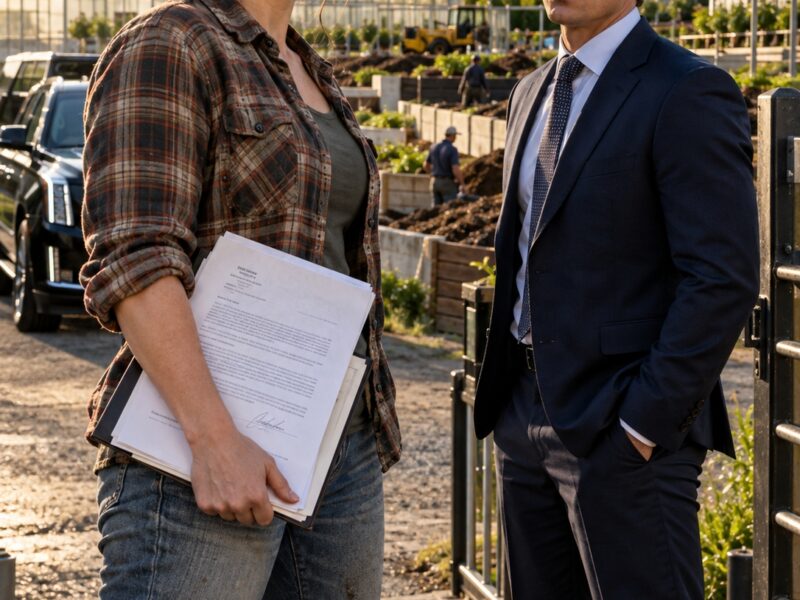
He stood outside the gate of the Callaway farm in Bledsoe County, Tennessee, wearing polished shoes that had never been introduced to red clay, a pressed charcoal jacket, and the expression of a man who had allotted fifteen minutes to a problem he expected to erase before lunch.
Inside his breast pocket was a legal letter.
Sixty days.
That was what it gave her.
Sixty days before Blue Ridge Timber ended an arrangement that had existed for twenty years.
Sixty days before the sawdust deliveries stopped.
And, depending on how aggressively the company’s attorneys chose to interpret the situation, possibly sixty days before Blue Ridge Timber began asking whether some of the material already delivered to the Callaway property still legally belonged to the company.
Grant looked at the woman standing on the other side of the gate.
Mud-caked rubber boots.
Faded flannel shirt.
Dark hair pulled back with no apparent concern for whether it looked professional.
No attorney.
No business suit.
No visible panic.
That last part bothered him slightly, though he had not yet admitted it to himself.
“Let me get this straight,” he said, smiling as though he were trying to help her understand the absurdity of her position. “You asked me to drive out here because you think I can’t stop the sawdust deliveries because the sawdust is valuable?”
Norah Callaway watched him.
She didn’t interrupt.
She didn’t defend herself.
She simply waited for his laughter to die.
It took longer than he probably intended.
Then she said, quietly:
“I didn’t call you here about the sawdust.”
Grant’s smile remained, but something behind it changed.
Norah placed one hand on the gate.
“I called you here to show you what I built.”
She pushed it open.
And for the first time that morning, Grant Whitmore stopped laughing.
What he did not know was that the woman in muddy boots had been preparing for this conversation since she was eleven years old.
She just hadn’t known his name yet.
Nor had she known that the man who would eventually arrive at her gate would carry a legal letter written by the same company whose garbage had helped save her family’s land.
To understand that, you had to go back nineteen years.
Back before the greenhouses.
Before the county contracts.
Before the mushroom operation.
Before employees depended on Callaway Land and Soil for their paychecks.
Before state inspectors walked the property with clipboards and left impressed.
Back to 1998, when the Callaway farm was not a success story.
It was forty-two acres slowly dying.
And Norah Callaway was an eleven-year-old girl who had already learned what it felt like to watch something you loved disappear one small piece at a time.
Her father, Earl Callaway, had died two winters earlier.
He was fifty-one.
A heart attack.
No warning that mattered afterward.
One day he was repairing equipment and arguing with an engine that refused to cooperate.
Then there was a funeral.
Neighbors brought casseroles nobody wanted to eat.
Men stood in the yard speaking quietly.
Her mother, Loretta, moved through the farmhouse with a face Norah barely recognized.
And after everyone left, the mortgage remained.
So did the broken tractor.
So did the exhausted soil.
So did the bills.
Grief, Norah discovered, did not stop the electric company from mailing envelopes.
It did not repair irrigation lines.
It did not care that a widow had never planned to run a farm alone.
Loretta was forty-six when Earl died.
She took bookkeeping work at a hardware supply company in town and continued running what remained of the farm.
She woke before daylight.
She came home tired.
She worked until dark.
She rarely complained.
Norah sometimes thought that was worse.
Complaining would have given the pain somewhere to go.
Loretta simply carried it.
Norah was nine when her father died, and that became one of the defining facts of her childhood—not merely that she had lost him, but that afterward she had watched her mother lift a weight too heavy for one person while being too young to take much of it away.
Helplessness settled inside her.
Over time, it hardened into something else.
A need to fix things.
She just didn’t know what yet.
Then Blue Ridge Timber came knocking.
The mill sat roughly two miles west of the farm.
It processed enough timber to create mountains of sawdust, and by 1997 it had more than it could conveniently sell or haul away.
A foreman approached Loretta with an offer.
The mill would pay her forty dollars a month if its trucks could dump excess sawdust along the north fence line.
Forty dollars.
It sounded almost insulting if you said it quickly.
But when money was tight enough, forty dollars became groceries.
Or part of the electric bill.
Or the difference between making a payment on Tuesday and explaining why it would arrive Friday.
Loretta said yes.
Every Tuesday and Friday, trucks began backing through the fence.
Pale yellow sawdust.
Ash-white sawdust.
Cedar.
Pine.
Load after load.
The piles grew.
And so did the opinions.
Roy Bradock, who raised cattle south of the Callaway property, mentioned the mess more than once.
Other neighbors stared when they drove past.
Children at school eventually found a name for Norah.
Sawdust Girl.
At first, the piles looked exactly like what everyone said they were.
Industrial waste.
An embarrassment.
Proof that the Callaway farm had fallen far enough that a factory was now paying to use part of it as a dumping ground.
Then, one cold October morning, Norah put her hand inside one of the piles.
And everything changed.
She had been walking the fence because she often walked when she needed to think.
The oldest pile towered over her.
Its surface was cool.
But near the bottom, the sawdust had darkened under months of compression and moisture.
Norah crouched.
She pushed her hand inside.
Then froze.
Warm.
Not slightly warm.
Hot enough that she pulled her hand out and stared at her palm.
The October air was cold.
The pile was shaded.
There was no sunlight trapped inside it.
No machine underneath it.
No external source of heat at all.
Yet something inside that pile was producing warmth.
The next morning, she checked again.
Still warm.
The morning after that?
Still warm.
She returned again and again.
The temperature persisted like a pulse.
Nobody else seemed interested.
That fascinated her almost as much as the heat itself.
How could something everyone called garbage be doing something no one could explain?
Norah went to the Bledsoe County Public Library.
She began reading.
Soil science.
Composting.
Microbial decomposition.
Carbon-to-nitrogen ratios.
Humic acids.
Thermophilic bacteria.
Words far larger than anything the other seventh graders were discussing at lunch.
She copied definitions into a green spiral notebook and rewrote them in language she understood.
Then she returned to the piles.
Measured.
Observed.
Compared.
Recorded.
Pile one: warm after rain.
Pile two: cooler, newer material.
Pile three: visible steam on cold mornings.
She was twelve years old and unknowingly conducting field research on the same land everyone else considered an embarrassment.
Then she made a mistake.
A bad one.
And that mistake nearly convinced her she had misunderstood everything.
Norah had read that decomposed wood material could improve soil.
One of the Callaway vegetable beds was struggling, so she convinced Loretta to let her spread some of the oldest, darkest sawdust around two rows of sweet potatoes.
For a few weeks, she waited.
The plants emerged.
Then they turned pale.
By June, their leaves were yellow.
Growth stalled.
The sweet potatoes were dying.
Norah stood in the field looking at the damage and understood something brutal:
She had done it.
She had made the soil worse.
Loretta walked between the rows.
She said nothing.
That silence hurt more than anger would have.
Norah pulled the failing plants herself.
She dug the material out with her hands.
That night she opened her notebook and traced the failure backward.
The sawdust had not decomposed enough.
It was still carbon-heavy.
As microorganisms broke it down, they consumed nitrogen from the surrounding soil.
Norah had not fed the plants.
She had accidentally starved them.
She wrote:
Sweet potato trial failed.
Then underneath:
Need nitrogen amendment at pile level. Not soil level.
It was one of the most important things she ever wrote.
Because Norah learned something at twelve that many adults spend their lives avoiding.
Being wrong was not the same thing as being finished.
Failure was information if you were willing to look at it without protecting your pride.
The next problem was nitrogen.
And directly south of their property, Roy Bradock owned cattle.
Norah walked to his fence.
Roy looked at the twelve-year-old girl standing there and waited.
“I want your manure,” she said.
He stared at her.
Norah explained the arrangement.
She would trade vegetables for permission to collect manure twice a month.
“What for?”
“To fix the ratio in the compost piles.”
Roy studied her as though deciding whether she was joking.
She wasn’t.
Finally he said, “Fine.”
Then he walked away.
Norah did not need enthusiasm.
She needed manure.
That was enough.
The piles changed.
Slowly.
Almost invisibly.
She mixed sawdust with manure, kitchen scraps and grass clippings.
She learned moisture.
She learned temperature.
She learned when material needed turning.
She learned that transformation was less about possessing the right ingredient than creating the right conditions.
But the rest of Bledsoe County saw something different.
By 2002, eleven large mounds stretched along the Callaway fence.
People slowed when they drove past.
At school, Sawdust Girl became a joke that refused to die.
Tilda Farnsworth, Norah’s childhood friend, stopped visiting.
No fight.
No dramatic betrayal.
She simply stopped coming.
Sometimes rejection is cruelest when nobody gives you a scene to fight against.
Then a girl named Shelby made a joke in the lunch line about the Callaway farm smelling like a hamster cage.
People laughed.
Norah took her tray to a corner table.
She ate alone.
But something strange had begun happening inside her.
The laughter was losing its authority.
Because Norah knew something the other kids didn’t.
The northwest corner of the farm was changing.
The soil there had once been pale, thin and unable to hold water.
Now it was darker.
Grass grew thicker.
Rain soaked in instead of immediately running away.
The changes were tiny.
Nobody driving past at forty miles an hour would have noticed them.
Norah noticed because she had been looking at the same ground for years.
She began photographing it.
Same location.
Same angle.
Season after season.
Then one evening in October 2002, Loretta finally asked the question she had been holding back.
“Is there a plan?”
They were sitting at the kitchen table.
Bills lay nearby.
The mortgage still existed.
The farm still wasn’t producing enough.
Eleven sawdust piles lined the fence.
Loretta did not sound angry.
That made the question harder.
Norah disappeared upstairs.
She returned with her notebook and five photographs.
She laid them across the table.
Same field.
Different years.
Loretta leaned closer.
The change was not spectacular.
But once you saw it, you could not unsee it.
Darker soil.
Denser grass.
Less erosion.
More life.
“It’s not ready yet,” Norah said.
Loretta looked at the photographs.
“But it’s working.”
Her mother remained silent for a long time.
Then she stood, filled the kettle and put it on the stove.
She never asked Norah to stop again.
Three years later, Norah carried her notebooks into an agricultural extension office in Knoxville.
She was eighteen.
No college degree.
No institutional affiliation.
No laboratory.
Just years of notes, photographs, observations and questions.
Dr. Harriet Voss had agreed to give her forty-five minutes.
Forty-five minutes became longer.
Voss studied the notebook.
Asked about temperature.
Inputs.
Moisture.
Seasonal patterns.
Baseline conditions.
Finally she looked across the table.
“How much land?”
“Forty-two acres.”
“How much has changed?”
“About eighteen.”
“And the rest?”
Norah thought carefully.
“Six years. Maybe seven.”
Dr. Voss studied her.
Then nodded.
“That’s probably right.”
Norah said nothing.
“If you keep doing what you’re doing.”
Nine words.
That was all.
Norah drove home through the Tennessee darkness with those words sitting beside her like a passenger.
When she reached the farm, she did not go inside immediately.
She sat in Earl’s old truck.
The farmhouse was dark.
The sawdust mounds were shadows along the fence.
For years, Norah had known what she observed.
Now someone who had spent decades studying Appalachian soil had looked at her records and told her the structure beneath her conclusions was sound.
For the first time since her father’s death, she felt something that was not hope.
Hope could be fragile.
This was heavier.
Quieter.
Certainty.
She went inside carrying the notebook.
But she was nowhere near finished.
The following spring, a cardboard box arrived containing red wigglers.
Earthworms.
Loretta looked at them.
Then at Norah.
Norah had already built six beds from scrap lumber.
Finished compost went in.
The worms went in.
Months later, something different came out.
Vermicast.
Dark.
Fine.
Nutrient-rich.
Norah tested it on controlled plots.
Treated sections beside untreated sections.
By autumn, the difference was visible.
The soil held moisture longer.
Vegetables grew more densely.
And then something happened Norah had not expected.
Roy Bradock drove onto the property.
The same man whose family had spent years looking across the fence at the sawdust piles.
He stood near the gate with his hands in his pockets.
His south pasture had suffered through drought.
The grass wasn’t recovering.
He avoided looking directly at her.
“I need compost.”
Norah didn’t smile.
She didn’t mention the jokes.
She didn’t ask for an apology.
She calculated her costs.
Labor.
Inputs.
Time.
Equipment.
Margin.
Then she gave him a price.
Roy nodded.
“Friday.”
He left.
Norah watched his truck disappear.
Years earlier, Roy Bradock had given a twelve-year-old girl manure because she wanted to experiment with garbage.
Now he was buying the finished product.
No apology.
No reconciliation speech.
Just a transaction.
Oddly, Norah preferred it.
An apology would have asked her to participate in Roy’s change.
A receipt required nothing.
The farm kept evolving.
In 2007, Norah found a fifty-cent mushroom cultivation guide at a community sale.
She bought it.
Read it twice.
Then again.
Sawdust could grow shiitake mushrooms.
That sentence alone changed another part of the Callaway operation.
She converted part of Earl’s old equipment shed.
Twelve experimental blocks.
Controlled humidity.
Careful temperatures.
When Loretta discovered rows of strange bags hanging inside the building, she stared.
“How long?”
“September, probably.”
“What are you going to do with them?”
“Sell them.”
“To who?”
Norah paused.
“I don’t know yet.”
Loretta waited.
“But I’ll know by September.”
The first harvest produced roughly two kilograms.
Norah took the mushrooms to the farmers market.
Forty minutes later, every bag was gone.
Three customers asked whether she would return the next week.
A restaurant owner handed her a business card.
Norah drove home with forty-seven dollars and a question much larger than forty-seven dollars.
Could this become another system?
The answer, eventually, was yes.
But not before another door slammed shut.
In 2009, Norah applied to First Appalachian Bank for $28,000.
She wanted to build a greenhouse.
She brought years of farm records.
Mushroom revenue.
Soil reports.
Business projections.
The loan officer, Terrence Hobbs, listened with the professional face of someone who had possibly reached his conclusion before she finished speaking.
Collateral?
Weak.
Credit history?
Limited.
Mushroom operation?
“Non-traditional.”
The rejection arrived in February.
Norah read it at the kitchen table.
Insufficient collateral documentation.
Limited credit history.
Professional language had a way of making judgment sound mathematical.
She sat outside in the cold without a jacket.
Not crying.
Not raging.
Just allowing the no to be what it was.
Then she went inside.
Made coffee.
And started looking for another route.
She found a beginning-farmer program.
Sold mushroom inventory.
Found greenhouse framing available on a payment plan.
Bought one section.
Then another.
Then another.
She and Loretta dug anchor trenches by hand.
By October 2009, the first poly tunnel stood along the southern edge of the Callaway farm.
In January, while neighboring fields froze, Norah harvested lettuce, kale, spinach and herbs for restaurant customers.
She never sent a photograph to Terrence Hobbs.
She considered it once.
Then dismissed the thought.
The greenhouse had not been built to make a banker regret saying no.
It had been built because she needed a greenhouse.
That distinction mattered.
Then came 2012.
Drought.
First a dry May.
Then June.
Then July became merciless.
The creek shrank.
Open fields suffered.
Norah lost roughly a third of her outdoor vegetable production.
Then mold appeared in the mushroom shed.
Trichoderma.
Two contaminated shiitake blocks.
She destroyed them before the contamination could spread.
Hundreds of dollars lost.
Months of growth erased.
That evening Loretta stood in the doorway while Norah disinfected equipment.
“If you wanted to sell part of the north acreage,” Loretta said carefully, “people would pay for it now.”
Norah stopped.
The north acreage.
The first soil she had healed.
The evidence.
The place where everything began.
“No.”
Loretta waited.
“I’m not selling it.”
“What are you going to do?”
“Shift part of the operation to oyster mushrooms. Fix the ventilation before fall.”
“How much?”
“About two hundred dollars.”
Loretta nodded.
“I’ll get it Thursday.”
Then she went inside.
Norah kept cleaning.
There was no inspirational speech.
No promise that everything would work out.
There were only facts.
The drought was real.
The contamination was real.
The money problem was real.
But facts did not tell her what to do.
They merely described the conditions.
What came next was still a choice.
Two years later, the phone rang.
Bledsoe County Environmental Management wanted to talk.
Norah initially assumed there had been a complaint.
Instead, Warren Gettys wanted a meeting.
The county needed somewhere to divert organic waste from restaurants, grocery stores and school food programs.
He toured the Callaway operation.
Studied her logs.
Asked about processing capacity.
Pathogen reduction.
Output quality.
Then he explained the volume.
Seventeen restaurants.
Two grocery locations.
Four elementary schools.
Norah calculated while he spoke.
The county would pay a tipping fee for every ton processed and an additional fee for confirmed landfill diversion.
For the first time, the Callaway operation had the possibility of predictable revenue that did not depend on rain, crop prices or restaurant demand.
“I’d need two additional processing bays,” Norah said.
“How long?”
“Four months.”
The county proposed three years.
Renewable.
Norah signed the letter of intent.
By fall 2014, the contract was active.
Money began arriving on schedule.
That changed everything.
Not because Norah suddenly became rich.
Because stability bought attention.
And attention was the resource she had always used best.
A second greenhouse followed.
Then a third.
The mushroom operation expanded from shiitake into oyster and lion’s mane.
Two employees became more.
By 2016, Callaway Land and Soil LLC employed eleven full-time workers and four seasonal workers.
The business Norah had once hidden inside an equipment shed now had customers waiting for product.
Then she ordered formal soil testing.
Twelve sampling locations.
The report arrived.
Norah opened it.
The northwest corner—the same exhausted ground where she had started experimenting as a child—measured 7.2 percent organic matter.
The agricultural average in Bledsoe County was approximately 1.8 percent.
She stared at the number.
Then placed the report into a binder.
She did not frame it.
She did not post it online.
She didn’t send it to anyone who had laughed at her.
She simply kept it.
Because somewhere inside her, Norah understood that one day somebody would arrive who needed to see the whole record.
That person arrived the following spring.
His name was Grant Whitmore.
Thirty-four.
MBA.
Atlanta regional office.
New manager at Blue Ridge Timber.
His assignment was straightforward:
Cut operational costs by fifteen percent.
Grant audited everything.
Vendors.
Contracts.
Recurring expenses.
Unused revenue streams.
Then he found an old handwritten note.
Callaway property.
Sawdust disposal.
$40/month to landowner.
No modern contract.
No formal liability structure.
No meaningful review in twenty years.
Grant stared at it.
Blue Ridge Timber was giving material away.
Worse, it was paying someone to take material that could potentially be sold.
To him, the conclusion was obvious.
Terminate the arrangement.
He asked legal to draft a sixty-day notice.
Then he added something else.
Language concerning the accumulated material.
Possible industrial-waste compliance issues.
Potential recovery rights.
The letter landed on Norah’s kitchen table in April 2017.
Loretta watched her read it.
Norah reached the bottom.
Then read it again.
Outside the window stood three greenhouses.
Beyond them, processing bays.
Fields.
Employees.
Nearly two decades of work.
And now the company whose sawdust had become one of the raw materials beneath everything was threatening to classify part of that history as a liability.
Loretta finally asked, “What are you going to do?”
Norah folded the letter.
“Call him.”
Grant expected panic.
He got a meeting invitation.
That unsettled him more than panic would have.
Before the meeting, Grant did more research.
Callaway Land and Soil LLC.
Agricultural production.
Organic material processing.
Revenue bracket beginning above a quarter million dollars.
Interesting.
But not enough to change his conclusion.
Then he made what he considered a clever move.
He contacted Warren Gettys at the county environmental office.
Grant did not formally accuse Norah of violating anything.
He was too careful for that.
He simply raised questions.
“Regulatory standing.”
“Accumulation thresholds.”
“Industrial material.”
Words designed to make government offices curious.
He expected pressure.
He expected inspectors to find something.
He expected Norah to arrive at their meeting weakened.
What he did not know was that Warren Gettys knew the Callaway operation.
And Gettys did take the inquiry seriously.
Very seriously.
He sent an inspection team.
Senior environmental inspector Ronda Caulfield arrived with technicians.
They spent four hours on the property.
They reviewed the bays.
Temperature records.
Inputs.
Outputs.
County contracts.
Operating procedures.
They took samples.
Norah answered every question.
Then waited.
The laboratory results came back.
The Callaway operation met every applicable state standard.
Not barely.
Comfortably.
Ronda Caulfield expedited certification paperwork.
Eleven days before Grant Whitmore arrived at Norah’s gate, the state certificate came in the mail.
Norah read it twice.
Then slipped it into the same binder as the soil report.
She told Loretta.
Her mother looked at the certificate.
Nodded once.
Handed it back.
And now Grant Whitmore stood at the gate laughing.
“You actually think I can’t stop the sawdust deliveries because it’s valuable?”
Norah waited.
“I didn’t call you here about the sawdust.”
She opened the gate.
“I called you here to show you what I built.”
Grant stepped inside.
The first thing he saw was the greenhouses.
Three large poly tunnels.
Workers harvesting greens.
Irrigation lines.
Established systems.
Not hobby structures.
Not improvised plastic stretched over backyard frames.
Commercial infrastructure.
His smile disappeared.
Norah kept walking.
Grant followed.
She did not explain unless he asked.
That made the silence worse.
They reached the composting area.
Six processing bays.
Different decomposition stages.
Intake records.
Turning schedules.
Temperature logs.
Monthly output figures.
Grant stopped in front of the documentation.
“Where does the material come from?”
“Seventeen restaurants. Two grocery locations. School food-service programs.”
He looked at her.
“The county pays you?”
“Per ton.”
He calculated.
Then recalculated.
Norah continued walking.
The mushroom barn came next.
Separate humidity zones.
Shiitake.
Oyster.
Lion’s mane.
Harvest numbers written on a board.
Nine names on the waiting list.
Grant stood looking at the board.
The legal letter remained inside his jacket.
They moved toward the fields.
Thirty-six acres in active production.
Dark soil.
Loose structure.
The contrast with neighboring ground was visible.
Norah finally opened the binder.
She handed it to him.
Grant looked at the first report.
2016 soil analysis.
Northwest corner:
7.2 percent organic matter.
County agricultural average:
1.8 percent.
He turned the page.
Historical estimates.
Photographs.
Dates.
Notes.
Numbers climbing across years.
A record of land changing one season at a time.
Grant stopped turning pages.
“How long have you been doing this?”
Norah looked toward the north boundary.
“Nineteen years.”
For the first time that morning, he seemed unsure what to say.
Norah reached into the binder.
There was one document left.
She held it out.
Grant took it.
Tennessee certified organic waste processing facility.
He read the date.
Eleven days earlier.
Then the inspector’s signature.
Then the state seal.
Silence.
Norah watched his face.
“You sent the inspection team,” she said.
Grant looked up.
It was not a question.
Norah nodded toward the certificate in his hands.
“They gave me that.”
Nothing in her voice sounded triumphant.
That somehow made it land harder.
Grant looked around.
Greenhouses.
Processing bays.
Mushroom production.
Fields.
Employees.
Then back at the certificate.
He had tried to create regulatory pressure.
Instead, he had helped give her operation state certification.
The legal letter in his jacket suddenly felt much heavier.
Grant had arrived expecting an informal dumping arrangement on a struggling rural property.
He had found a business generating more than $800,000 annually, with additional contracts under negotiation.
He had scheduled fifteen minutes.
He had already been there two hours.
And the question inside his head was changing.
Not:
How do we shut this down?
But:
What exactly have we been giving away for twenty years?
Grant made two calls before leaving.
The first went to Blue Ridge Timber’s legal department.
“Hold the letter.”
A pause.
“Yes. All of it.”
Another pause.
“I’ll explain when I get back.”
The second call went to his regional director.
That conversation took longer.
Norah stood near the gate while he spoke.
She could not hear every word.
She didn’t need to.
His posture told enough of the story.
The man who had arrived carrying a conclusion was leaving carrying questions.
And Norah knew from experience that questions could be far more powerful than conclusions.
That afternoon, Grant sat behind his desk at Blue Ridge Timber with Norah’s numbers in front of him.
He started calculating again.
But differently.
Blue Ridge Timber operated a reforestation nursery.
The company bought growing medium from North Carolina.
Shipping costs were high.
Quality varied.
Callaway Land and Soil was twelve minutes away.
And its compost tested better.
Grant leaned back.
Three problems had been sitting beside one another for years.
The mill needed somewhere for its sawdust to go.
Norah needed consistent carbon-rich material.
Blue Ridge Timber’s nursery needed better soil amendment.
Nobody had connected them because everybody had been asking the wrong question.
They had asked:
How do we get rid of the waste?
Norah had asked:
What does the waste become under the right conditions?
He called her that afternoon.
“I’d like to discuss continuing the relationship.”
Norah was quiet for a moment.
“What kind of relationship?”
“A formal one.”
“I’m listening.”
“I need two weeks to put something together with regional.”
“Take your time.”
Grant almost laughed again.
But for an entirely different reason.
She had waited nineteen years.
Two weeks meant nothing to her.
Five months later, in September 2017, Norah Callaway sat inside a conference room at Blue Ridge Timber.
Grant sat across from her.
There was no legal threat on the table now.
There was a partnership agreement.
Blue Ridge Timber would supply designated grades of sawdust according to species and moisture content.
No more informal dumping.
No more forty-dollar handshake arrangement.
Documented deliveries.
Structured material standards.
In exchange, Callaway Land and Soil would give Blue Ridge Timber priority purchasing rights for finished compost used in its reforestation nursery.
The mill supplied the material.
The farm transformed it.
The nursery bought it back.
Waste became input.
Input became soil.
Soil grew trees.
The circuit closed.
Grant signed.
Norah signed.
Then they stood.
He extended his hand.
She shook it.
Neither mentioned the day at the gate.
Neither mentioned his laughter.
Neither mentioned the compliance call.
They didn’t need to.
The agreement sitting between them said everything that mattered.
Norah drove home in Earl’s old 1993 truck.
The paint had faded almost beyond recognition.
More than 260,000 miles.
Someone had once asked why she didn’t replace it.
Her answer had been simple.
“This truck remembers when nobody believed in what we were doing.”
That afternoon, it carried the signed Blue Ridge agreement home.
Loretta was outside tending flowers when Norah pulled into the driveway.
Norah got out.
Held up the agreement.
Loretta looked at it.
Then at her daughter.
She didn’t run over.
Didn’t cry.
Didn’t ask to read it.
She set down her garden tool, wiped her hands on her pants and walked inside.
Norah followed.
Loretta filled the kettle.
Put it on the stove.
Then stood at the window looking over the farm.
Norah sat at the same kitchen table where, fifteen years earlier, she had laid out five photographs and said:
It’s not ready yet. But it’s working.
The kettle began to heat.
Neither woman spoke.
There are victories that need champagne.
There are victories that need applause.
And there are victories too old, too expensive and too deeply rooted for either.
Sometimes you just boil water beside the person who stayed when nobody else understood what you were building.
But the farm was not finished.
Norah bought another forty-acre parcel in 2018.
The soil was depleted.
Compacted.
Organic matter below two percent.
Twenty years earlier, that would have frightened her.
Now it looked familiar.
She knew where to begin.
Compost.
Vermicast.
Cover crops.
Time.
The second property improved faster because Norah was no longer discovering the system.
She was applying one she understood.
A larger mushroom facility followed.
Then additional greenhouses.
Cold storage.
A refrigerated distribution vehicle.
Customers in Chattanooga.
More employees.
More families depending on wages generated by land that once could barely support the woman who owned it.
That part affected Norah more than she expected.
Money was measurable.
Payroll was different.
A paycheck meant somebody else’s mortgage.
Somebody else’s groceries.
Somebody else’s child.
The same ground that had once frightened Loretta because she did not know whether it could keep one family alive was now helping support many.
Norah never found a clean word for what that meant.
So she kept working.
In 2021, a community college professor contacted her.
He wanted students to visit the farm.
Sustainable soil management.
Commercial-scale composting.
Real systems instead of textbook diagrams.
Norah agreed to one group.
Eight students arrived.
She walked them through the property.
Carbon-to-nitrogen ratios.
Microbial activity.
Water retention.
Soil organic matter.
The same concepts she had once copied into a notebook because she did not understand them.
On the second day, Norah noticed one student taking notes.
Not casually.
Temperature.
Moisture.
Color.
Small, careful handwriting.
She recognized that kind of attention.
At the end of the session, she took him to the north fence.
The sawdust mountains were gone.
Spruce trees stood there now.
Their lower branches had grown together.
The soil beneath them was dark.
“This is where it started,” Norah said.
The student looked down.
“There?”
“Right there.”
She pointed.
“In 1998, the soil here had less than two percent organic matter. Rain wouldn’t stay in it.”
He looked from the ground to the trees.
Then toward the greenhouses.
“How long did all this take?”
Norah knew the mathematical answer.
But she understood he was asking something else.
He was asking how long you should keep believing when nobody around you sees what you see.
He was asking how long you keep working before results become proof.
He was asking when patience stops being foolishness and becomes vision.
Norah looked at the soil.
“Longer than everyone around me thought it would.”
She paused.
“About as long as I expected.”
The program expanded.
More students came.
Then another institution.
Then another.
In 2023, Norah was invited to speak at the Tennessee Soil Health Conference in Nashville.
Four hundred people filled the room.
Farmers.
Scientists.
Extension officers.
Agricultural representatives.
Norah stood in front of them without the green notebook she had once carried everywhere.
She didn’t need it anymore.
The notebook had become forty acres.
Then eighty.
It had become greenhouses.
Mushroom facilities.
County contracts.
Employees.
Soil reports.
Trees.
She spoke for forty minutes.
At the end, a soil scientist asked whether the Callaway model could really be replicated elsewhere.
Perhaps, he suggested, the success depended on conditions unique to her property.
Norah considered the question.
“The conditions on our property weren’t favorable,” she said.
The room quieted.
“Our soil was depleted. The land was losing money. The material available to us was considered waste.”
She paused.
“None of those conditions are unique to East Tennessee.”
People listened.
“What made it work was that someone was willing to look at the situation long enough to understand it.”
Another pause.
“That’s not a geographic condition.”
The applause lasted longer than she expected.
Norah drove home in Earl’s old truck.
Nearly 287,000 miles now.
The engine still started.
The heater still worked.
She drove without the radio.
Outside Nashville, the roads narrowed.
Cities became towns.
Towns became fields.
The Tennessee hills rose around her.
Then Blue Ridge Timber appeared.
The mill was still there.
For a few seconds she could see it through the trees.
Then it disappeared behind her.
A little farther down the road, the Callaway property came into view.
The spruce windbreak stood tall along the northern boundary.
Norah turned into the driveway.
Late-afternoon light covered the farm in amber.
Loretta was sitting on the porch.
Seventy-three now.
Reading.
She looked up when Earl’s truck came in.
Norah climbed out.
For a moment she simply stood there.
Three greenhouses.
Processing bays.
Fields.
The north windbreak.
Twenty-five years of decisions visible from one gravel driveway.
Her father had died believing this land was something his family had to fight to keep.
Her mother had spent years preventing it from disappearing.
Norah had spent most of her life discovering what it was capable of becoming.
Loretta closed her book.
She stood slowly.
Then walked past Norah.
No question about Nashville.
No question about the applause.
She headed toward the greenhouses.
Norah followed.
They entered the first tunnel.
Warm air.
Rows of green.
Drip lines.
The quiet hum of systems functioning as they should.
They passed into the second.
Then the third.
Near the middle, Loretta stopped.
Her hand moved lightly over the edge of a growing bed.
She looked down the long rows.
For decades, Loretta had carried a private fear she almost never spoke aloud.
What would happen to this land after her?
After Earl?
After all the debt?
After all the bad years?
Would the farm finally disappear?
Would somebody divide it?
Sell it?
Build something over the fields because the ground had become more valuable as property than as soil?
At some point, without realizing exactly when, Loretta had stopped worrying.
Standing inside that greenhouse, she seemed to understand that fully.
She looked at Norah.
No speech.
Just one long look.
Then she turned and walked toward the farmhouse.
Norah remained.
The greenhouse was quiet.
Outside, March light was fading.
And memories began returning without invitation.
The yellow sweet-potato leaves.
Shelby’s laughter in the lunch line.
Tilda slowly disappearing from her life.
Five photographs spread across a kitchen table.
Dr. Harriet Voss saying, That’s probably right.
Roy Bradock asking to buy compost.
Forty-seven dollars from the first mushroom harvest.
The bank rejection.
The drought.
The mold.
Loretta saying, I’ll get it Thursday.
Warren Gettys walking through the processing bays.
The state certificate.
Grant Whitmore laughing at the gate.
Then not laughing.
Norah stepped outside.
The evening air was cooler than the greenhouse.
Without consciously deciding to, she walked toward the north fence.
The spruce trees were shadows now.
She stopped where the oldest sawdust pile had once stood.
Nothing marked the spot.
No plaque.
No sign.
No photograph.
Just soil.
Dark.
Loose.
Alive.
If someone arrived there now, they would never know that an eleven-year-old girl once knelt on that ground and pushed her hand into something everyone else had dismissed.
They would never know she felt heat.
They would never know that the heat frightened and fascinated her enough to return the next morning.
Or that she returned again.
And again.
And again.
There was a version of Norah Callaway’s story people preferred because it was easier to tell.
A factory dumped waste on a poor farm.
A clever girl discovered the waste was valuable.
She built a successful business.
Years later, an arrogant manager tried to take it away.
She proved him wrong.
He stopped laughing.
It was a good story.
It was also incomplete.
Because Grant Whitmore was never the real enemy.
Neither was Roy Bradock.
Neither were the children who called her Sawdust Girl.
Neither was the banker who rejected her.
The real enemy had always been the conclusion people reached too quickly.
Waste.
Failure.
Bad soil.
Strange girl.
Unprofitable farm.
Non-traditional business.
Compliance problem.
Things were named before they were understood.
Then the names became cages.
Norah’s gift was not that she could see treasure where everyone else saw garbage.
That would have been too simple.
She saw questions where other people saw conclusions.
When the sweet potatoes died, she did not say the idea had failed.
She asked why.
When the bank said no, she did not decide the greenhouse was impossible.
She asked what other route existed.
When drought damaged the fields, she asked what survived.
When mold destroyed mushroom blocks, she asked what species would resist it.
When Grant Whitmore threatened the sawdust arrangement, she did not ask how to defeat him.
She opened the gate.
Come look.
That had always been her answer.
Look longer.
Look closer.
Measure again.
Wait.
Adjust the conditions.
See what happens.
Grant Whitmore eventually understood that.
He had come to the Callaway farm with a legal letter folded into thirds.
He had expected fifteen minutes.
He spent hours walking through the consequences of decisions made before he was old enough to manage anything.
Months later, he signed an agreement he had never intended to propose.
The letter was never delivered.
And Grant Whitmore never laughed about the sawdust again.
Norah crouched beneath the spruce trees.
She pressed her fingers into the soil.
The surface held the cold of the March evening.
A few inches lower, the earth was warmer.
Not hot.
Nothing dramatic.
Just warmth held below the surface.
For a second she was eleven again.
Her father’s death still fresh enough that she sometimes expected to hear his boots outside.
Her mother still learning how to keep the mortgage paid.
Forty dollars from Blue Ridge Timber still important enough to matter.
A mountain of sawdust still nothing but an embarrassment to everyone driving past.
And a child with one hand buried in it, wondering why something supposedly useless was warm.
Norah smiled.
Not because she had proved everyone wrong.
That had stopped mattering years ago.
She smiled because the question had been worth asking.
Behind her, the kitchen light came on.
Loretta would be inside.
There would probably be tea.
There would be schedules to review tomorrow.
Employees arriving before sunrise.
Mushroom blocks to check.
Compost temperatures to record.
Deliveries.
Invoices.
Students coming later in the month.
Nothing had reached a perfect ending.
Land never does.
Soil does not become healthy and remain healthy because somebody once saved it.
Businesses do not become secure and stay secure because one contract was signed.
People do not heal once and remain healed.
Everything living requires conditions.
Attention.
Adjustment.
Time.
Norah stood.
Mud clung to the bottoms of her boots.
She looked once more toward the place where the sawdust mountains had been.
Then she turned toward the farmhouse.
Twenty-five years earlier, everybody else had looked at those piles and seen the end of something.
The end of a respectable farm.
The evidence of poverty.
Waste.
Norah had put her hand inside one.
And felt a beginning.
She walked back through the dusk toward the kitchen light, leaving the spruce trees behind her and tomorrow’s work waiting ahead.
Under her boots, the soil was dark.
Deep.
Alive.
And just beneath the cold surface, it was still holding warmth.









