THE FIVE-YEAR-OLD ASKED TO BORROW THE MAFIA BOSS’S DOG FOR ONE NIGHT—BY MORNING, HE KNEW SOMEONE INSIDE HIS OWN FAMILY WANTED HIM DEAD
“Mister Dante… can I borrow your dog for one night?”
Dante Moretti had ordered men killed for asking him for less.
But at 10:47 on a rain-heavy October night, the person standing in the doorway of his study was five years old, wearing pajamas covered in tiny blue planets, two mismatched wool socks, and the expression of someone trying very hard not to cry.
Dante slowly lowered the file in his hands.
Beside his half-finished espresso sat a Beretta.
The child noticed it.
Her eyes paused on the gun for perhaps half a second.
Then she looked beyond it.
Across the study, beside the dying fireplace, Bruno lifted his enormous black head.
Sixty-five kilos of Cane Corso.
Eighteen years old.
Gray around the muzzle.
Silent enough that some visitors to the Moretti estate had mistaken him for a sculpture until his eyes moved.
Dante studied the girl.
“Sophie.”
She nodded.
He knew who she was, technically.
Sophie Vasquez. Elena’s daughter.
Elena Vasquez had worked in his mother’s household for three years, first in the kitchens, then wherever Senora Moretti decided she was needed. She was quiet, efficient, and unusually talented at moving through a room full of dangerous men without appearing to hear a single dangerous word.
Dante had probably spoken directly to her daughter three times.
Maybe four.
Tonight, the girl had somehow climbed two floors and entered the private study of a man most grown adults waited to be invited into.
“How did you get up here?”
“The back stairs.”
“Those stairs aren’t for children.”
“I know.”
“And your mother?”
“She’s polishing the crystal for the big night.”
The big night.
The Moretti family’s sixty-fifth anniversary dinner was three nights away. Forty of the most powerful men connected to the families would gather under Dante’s roof.
Elena and the rest of the household staff had been working until after midnight for nearly a week.
Dante leaned back slightly.
“So why do you need Bruno?”
Sophie squeezed the star-shaped pillow against her chest.
“Because I’m scared to sleep alone.”
Something in the way she said it changed the room.
Not childish whining.
Not imagination performed for attention.
Fear.
Contained fear.
Dante glanced at Bruno.
The dog was staring at Sophie.
That was unusual.
Bruno ignored nearly everyone.
Senators had crossed that carpet without earning a lifted ear. Priests, ambassadors, lawyers, killers, politicians, women in diamonds, men who controlled ports—Bruno had watched them all with the bored patience of an animal who had already decided humanity was overrated.
Now his amber eyes were fixed on a child wearing one gray sock and one striped one.
“Why are you afraid?”
Sophie hesitated.
“Because somebody knocks.”
Dante’s fingers stopped against the leather armrest.
“Who?”
“I don’t know.”
“When?”
“At night.”
“How many times?”
She swallowed.
“Three.”
Dante waited.
Sophie lifted one small hand from her pillow and tapped three times against its worn fabric.
Knock.
Knock.
Knock.
“Then I open the door,” she whispered, “and nobody’s there.”
The fire cracked behind him.
Dante felt something cold move along the base of his spine.
“How long has this been happening?”
“Almost every night.”
“How many nights?”
Sophie looked toward the ceiling as she counted.
“Six.”
Six nights.
Dante said nothing.
He had survived long enough because he respected patterns.
Three knocks could be a child’s imagination.
Six consecutive nights were a pattern.
Still, he did not frighten her.
He looked toward Bruno.
“Take him.”
Sophie’s eyes widened.
“Really?”
“Really.”
She entered carefully, crossing the Persian carpet as though someone might change his mind if she made too much noise.
She reached Bruno and placed one tiny hand against his collar.
“Come on.”
Bruno rose.
Just like that.
Dante almost smiled.
He had seen grown men call Bruno three times before the animal bothered turning his head.
At the doorway, Sophie stopped.
“Thank you, Mr. Dante.”
“You’re welcome.”
She took another step, then looked back.
“He looks lonely, too.”
The words landed harder than they should have.
Before Dante could answer, Sophie disappeared into the corridor with Bruno padding beside her.
The study became quiet again.
Too quiet.
Dante looked at the empty place beside the fireplace.
For seven years, he had occupied his father’s chair.
For seven years, men had called him boss.
For seven years, nobody had accused him of being lonely.
Then a five-year-old girl had walked into his study and diagnosed him in less than five minutes.
He reached for the file.
He never opened it.
Because somewhere beneath the rain, somewhere inside the Moretti estate, something had begun moving.
And Sophie Vasquez had heard it before anyone else.
The Moretti estate stood in Oyster Bay like a piece of old Italy dropped onto the edge of Long Island.
Four stories of pale stone.
Arched windows.
Formal gardens.
A greenhouse behind clipped boxwood hedges.
A boathouse on the Sound.
An iron gate on Bayville Avenue watched day and night by armed men who rarely put both hands inside their coat pockets.
People slowed their cars to look.
Then they remembered whose house it was and accelerated.
Dante had lived there almost his entire life.
He knew which stair complained in winter.
Which French window swelled after heavy rain.
Which chimney pulled badly in an east wind.
Which floorboard outside his mother’s old bedroom had been replaced after he dropped a brass candlestick on it when he was nine.
He believed he knew the house.
That belief would not survive the night.
Two floors below, Elena Vasquez was rearranging cases of Barolo in the cellar beneath a yellow utility bulb.
At thirty-four, she had learned to work through exhaustion.
Widowhood taught that.
Motherhood perfected it.
Her hands were red from rinsing crystal. Her lower back ached. Lemon polish had worked itself into the cracks around her fingernails.
She looked at the clock.
Almost eleven.
Sophie would be asleep in the staff cottage across the garden.
At least Elena hoped she would.
Her daughter had been afraid at night lately.
Elena had blamed October wind, tree branches, an old building settling in cold weather.
Children invented monsters when adults were too tired to explain noises.
That was what she had told herself.
She returned to the wine.
Footsteps descended the cellar stairs.
Elena recognized them without looking.
Vincenzo Moretti.
Dante’s uncle.
Sixty-one years old.
Silver-haired, immaculate, courteous.
The younger brother of Dante’s murdered father.
The only man in the house Dante still called family instead of associate.
Vincenzo selected a bottle of Amarone and walked toward the rear cellar door.
He did not acknowledge Elena.
He rarely did.
The door opened.
Cold wet air entered.
Then Vincenzo disappeared into the garden.
Elena glanced at the clock.
Eleven.
She registered it without knowing why.
Vincenzo.
Garden.
Alone.
Late.
Then she returned to the Barolo.
Across the lawn, Sophie climbed into her mother’s bed.
Bruno jumped up beside her and settled his enormous body across her legs.
Sophie put her lips close to his ear.
“If you hear the knocking, you’ll bark, right?”
A low vibration rolled through Bruno’s chest.
Sophie smiled.
Outside the cottage window, beyond two rows of pines, a figure moved along the gravel.
A man.
Long coat.
Hood raised.
He stayed exactly where the estate’s cameras could not see him.
He did not approach the cottage.
He did not knock.
He simply passed through the darkness as if he already knew where every blind spot was.
At 12:40, Elena finally crossed the wet lawn.
She unlocked the cottage.
Hung up her apron.
Turned toward the bed.
And froze.
Her daughter was asleep with her face pressed into the neck of the most feared dog on the property.
Elena covered her mouth.
Bruno opened one amber eye.
For a moment, woman and animal watched each other.
Then Elena sat beside Sophie.
She brushed hair from her daughter’s forehead.
“Mama,” Sophie murmured without fully waking.
“Yes, baby.”
“Mr. Dante lent me his dog.”
Elena’s hand stopped.
“He did what?”
“He said yes.”
Cold moved through Elena’s body.
She did not want Dante Moretti’s kindness.
She did not want his attention.
Most of all, she did not want Sophie becoming important to anyone in that family.
Three years earlier, Elena’s husband Miguel had died outside a bakery on Court Street in Brooklyn.
Two men had fired into the wrong car.
Wrong car.
Wrong man.
Wrong afternoon.
That was the phrase everyone had used.
As though changing one word could return a husband to his wife.
Miguel had been alive when the first person called 911.
He was dead before the ambulance turned the corner.
Sophie had been one year and eleven months old.
At the funeral, Senora Moretti had approached Elena in black gloves and pearls.
“A child needs a roof,” she had said. “I’m not offering charity. I’m offering work. And quiet.”
Elena had accepted.
Not because she trusted the Morettis.
Because she understood what happened to widows without money.
For three years she had polished their silver, washed their crystal, carried trays past rooms where men lowered their voices when she entered.
She never asked whose feud had killed Miguel.
She never asked who had paid the funeral expenses.
She never asked why Senora Moretti herself had attended.
She had wanted only one thing.
Sophie would grow up somewhere she never heard gunfire.
Now her daughter was sleeping beside Dante Moretti’s dog.
And for the first time since Miguel’s death, Sophie was sleeping without flinching.
Elena bowed her head.
The tears came silently.
She hated herself for them.
She hated Dante for the kindness.
She hated Bruno for making her daughter feel safe.
Most of all, she hated the small part of herself that was grateful.
Then Bruno’s head lifted.
His ears turned forward.
Elena did not notice.
She had fallen asleep in the chair beside the bed by 2:11 a.m.
Sophie woke first.
Knock.
Knock.
Knock.
Her eyes opened.
But this time she did not hide beneath the blanket.
Bruno was already standing.
A sound rolled through him, low enough that Sophie felt it more than heard it.
He was not looking at the cottage door.
He was staring at the small window facing the covered servants’ walkway.
Then he moved.
The old interior lock shattered under his shoulder.
Bruno vanished into the corridor.
Sophie grabbed her star pillow and followed.
By the time Dante heard Bruno bark, he was still awake in his study.
He had been staring at the anniversary seating chart without reading it.
Then the sound came from somewhere deep inside the house.
One bark.
Dante stood instantly.
Bruno did not bark.
Not at strangers.
Not at deliveries.
Not even the night Dante’s father came home in a coffin.
He took the Beretta.
Safety off.
Downstairs.
At the far end of the servants’ corridor, Bruno stood before a decorative walnut wall carved with climbing vines.
Sophie stood behind him.
“What happened?”
She pointed.
“Bruno thinks there’s something in the wall.”
Dante stared.
He had passed that panel thousands of times.
It was decorative.
Nothing more.
Bruno scratched once.
His claw left a pale line across the wood.
Dante crouched.
He followed the carving with his fingertips.
One brass pin sat slightly lower than the others.
He pressed it.
Click.
A seam opened.
Cold air breathed out of the wall.
Dante stopped breathing.
Sophie whispered, “Is there a monster?”
He stared into the darkness.
“No.”
He almost wished there were.
“Stay here.”
Dante entered alone.
The passage was narrow and brick-lined, older than the house above it.
Six steps inside, he lowered his phone light toward the floor.
Footprints.
Fresh.
Four different sizes.
One heavy.
One light.
Two between.
This was not one trespasser.
It was a route.
A network.
People were entering his home through a passage he did not know existed.
Then memory returned.
Old estate plans.
Prohibition.
A service tunnel from the house beneath the rose garden to the boathouse.
His father had sealed it in 1996.
Dante remembered hearing the story once.
Someone had opened it again.
Someone inside the Moretti estate.
He returned to the corridor and locked the hidden panel from within.
Sophie sat exactly where he had left her.
Bruno stood between her and the darkness.
Dante lifted the girl into his arms.
She was so light it startled him.
He carried her upstairs.
In his mother’s old drawing room, he wrapped a cashmere blanket around her and called Tommy Richi—the only man in the house he trusted enough to summon without explanation.
Then Sophie asked quietly, “Was there a monster?”
Dante crouched until they were eye level.
“No.”
“What was it?”
He considered lying.
Instead he said, “A grown-up who lies.”
Sophie’s fingers stopped picking at the seam of her pillow.
“I know a grown-up who lies.”
Dante became very still.
“Who?”
“I don’t know his real name.”
“When did you see him?”
“Six days ago.”
Dante lowered himself onto one knee.
“Sophie. Tell me everything.”
She had been playing hide-and-seek alone behind the greenhouse.
Behind the greenhouse stood a white rose bush planted by Dante’s mother the year he was born.
Sophie had crawled beneath it.
Two men arrived.
One was Uncle Vince.
Dante’s face did not change.
“How do you know?”
“He smells like the brown cigars. And he has the shiny lighter with the V.”
Dante felt his pulse once in his throat.
“And the other man?”
“Black coat. Scratchy voice.”
“Did Uncle Vince say his name?”
Sophie frowned in concentration.
“Cavalero.”
The room seemed to contract.
Frank Cavalero.
The man Dante’s father had spent twenty years fighting.
The man connected to the murder that had placed Dante in his father’s chair.
“What did they say?”
“The scratchy man said the boy was soft.”
Dante’s hand closed.
“The boy?”
“Yes.”
“What else?”
“He said… ‘We take the roof at the sixth toast.’”
Dante’s heart went cold.
At every Moretti anniversary dinner, the sixth toast belonged to the head of the family.
Dante.
Sophie continued.
“And then he said the shipment stays yours.”
“What happened after that?”
“He gave Uncle Vince an envelope.”
Dante closed his eyes for half a second.
Money.
Payment.
“What did the other man look like?”
“He had a scar.”
“Where?”
Sophie drew a line from her thumb toward her forearm.
Dante knew the scar.
Rocco Delaney.
Cavalero’s shooter.
A photograph from an old police file flashed through his memory.
Then Sophie looked worried.
“Did I do something bad?”
Dante stared at her.
A five-year-old had accidentally witnessed the sale of his life.
His uncle had betrayed him.
The tunnel explained how Cavalero’s men intended to enter.
The sixth toast told him when.
And Sophie’s existence meant one more terrible thing.
Vincenzo knew there had been a child beneath those roses.
Dante touched the top of her head gently.
“No, sweetheart.”
His voice became dangerously quiet.
“You did something very brave.”
She relaxed.
Dante looked at Bruno.
“From tonight on, Bruno stays with you.”
Sophie smiled.
“He’s my dog now?”
“He’s your friend.”
At 4:30 that morning, Dante knocked on Elena’s cottage door.
She opened it three inches with the chain attached.
A paring knife was in her hand.
“Where is my daughter?”
“Upstairs. My mother’s old room. Bruno is with her. Tommy is outside.”
Elena opened the door.
Dante told her everything.
The tunnel.
The footprints.
Vincenzo.
Cavalero.
The sixth toast.
The scarred man.
The envelope.
By the time he finished, Elena’s face had lost its color.
“I’m taking Sophie out of here.”
“No.”
Her eyes hardened.
“You don’t tell me no about my daughter.”
“If you leave now, they’ll know she talked.”
“I have family in Tampa.”
“They’ll follow you.”
“Let them try.”
“They won’t stop with you.”
That silenced her.
Dante leaned toward the table.
“They know she saw them. If she disappears the morning before the anniversary, they will understand why. They will find her because they have to.”
Elena’s voice cracked.
“So you want to use my child as bait?”
“No.”
“Then what?”
“Myself.”
Dante held her stare.
“For three days, Sophie stays inside this house. I change every guard. I control every door. Bruno never leaves her. And they come for me believing I know nothing.”
“Words are cheap in this house.”
He accepted the insult.
Then he said, “Take Bruno’s collar off.”
“What?”
“Read the inside.”
Elena found the engraving beneath the worn leather.
FOR THE ONE WHO GUARDS WHAT MATTERS.
“My father had it made for my tenth birthday,” Dante said.
Elena looked at Bruno.
“He’s eighteen?”
“Yes.”
“And you’re lending him to Sophie?”
“No.”
Dante looked toward the staircase where the dog waited.
“I’m giving him to her.”
Elena stared at him.
Something changed.
Not trust.
Not yet.
But the certainty that Dante Moretti was incapable of sacrifice had developed its first crack.
“Three nights,” she said.
“Three nights.”
By sunrise, the Moretti estate looked exactly as it always had.
That was the frightening part.
Flowers arrived.
Silver was polished.
Wine was cataloged.
Waiters were measured for jackets.
Behind locked doors, Dante prepared a trap.
He told Tommy everything except Sophie’s name.
“The witness is five,” Dante said.
Tommy crossed himself.
“God.”
“She sleeps on the third floor. Her mother stays with her. Bruno stays with them. Nobody goes upstairs unless I say so.”
“And Vincenzo?”
“He believes the sixth toast is still his.”
Tommy watched him.
“You’re going to let him walk into it?”
“I’m going to let him choose every step.”
Dante replaced the anniversary security detail one man at a time.
Anyone who resisted replacement was quietly removed from the estate.
Tommy inspected the tunnel.
Fresh footprints had appeared again.
Someone had entered during daylight.
They were rehearsing.
Meanwhile, Dante ate breakfast across from his uncle.
Vincenzo smoked a Havana cigar.
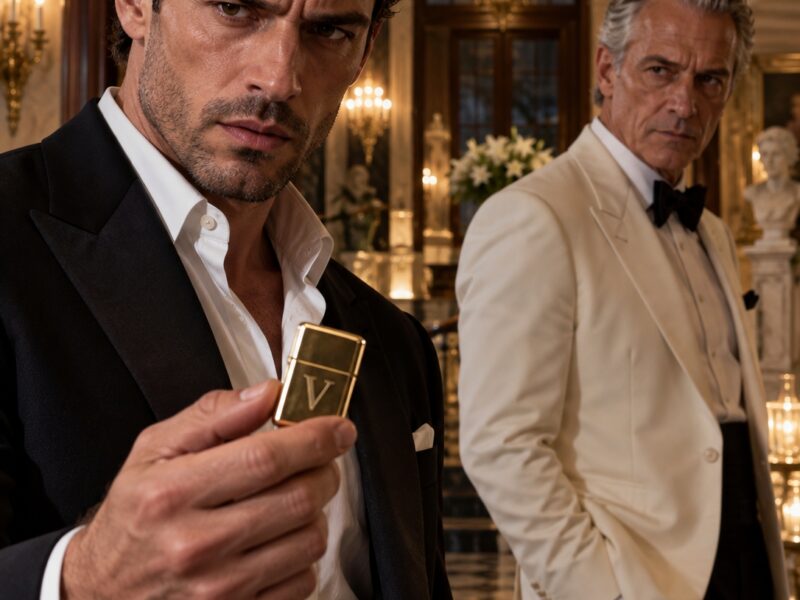
He lit it with a gold lighter engraved with a single V.
Exactly as Sophie had described.
Dante buttered his bread.
“You’re quiet,” Vincenzo said.
“Nervous about the toast.”
“The sixth?”
“Yes.”
Vincenzo smiled.
Dante added casually, “My father said something about the sixth toast the week before he died.”
For the smallest fraction of a second, Vincenzo’s expression failed.
Then the smile returned.
That fraction was enough.
Later, Bruno entered the breakfast room.
He walked directly to Vincenzo.
Stopped.
Stared.
Three seconds.
Then left.
Vincenzo laughed.
“Old dog’s losing his mind.”
Dante folded his napkin.
“Bruno never loses anything.”
Upstairs, Sophie slowly turned the queen’s room into her own little country.
She drew pictures.
Named a spider Señor Gilberto.
Built a fort from velvet cushions.
At night, Dante visited carrying an old book.
“What’s that?” Sophie asked.
“The Velveteen Rabbit.”
“Are you good at reading?”
“No.”
She considered him.
“Okay. Bruno first, then you.”
Bruno climbed onto the bed.
Dante sat carefully beside them.
He began reading.
His voice was rough.
Sophie corrected one of his pronunciations.
He repeated it properly.
“Better,” she murmured.
Outside the room, Elena stood unseen in the corridor listening.
And that frightened her more than the tunnel.
Because Dante’s voice was changing as he read.
It was losing the authority.
The calculation.
The hardness.
For a few minutes he sounded like a man who had once been a boy.
Elena understood something dangerous.
She was beginning to trust him.
Trust had already cost her one husband.
She stayed in the corridor anyway.
The following day, Vincenzo entered the kitchen.
“Where’s your little girl?”
Elena continued arranging decanters.
“Fever. I sent her to my sister in Queens.”
“When?”
“Six this morning.”
“Which driver?”
“Tommy arranged it.”
Silence.
“Ah,” Vincenzo said.
Then he smiled.
“Tell her Uncle Vince misses her.”
Minutes later, Vincenzo walked into the garden and called Cavalero from a second phone.
“The child is gone. They’re hiding her. The boy knows.”
Cavalero answered immediately.
“Then we move tonight.”
Vincenzo turned his back toward the house.
He never saw the listening device Tommy’s men had planted.
Dante heard everything.
Including the final instruction.
“If the girl is on the third floor,” Cavalero said, “take the west stair. The dog can’t hear you there.”
Dante removed the earpiece.
The clock read 7:07 p.m.
Guests arrived at eight.
He called Tommy.
“They’re coming tonight.”
A pause.
“Change everything.”
By 9:47, the first family boss entered the ballroom.
Forty guests eventually filled the room.
White peonies.
Crystal.
Vivaldi.
Black tuxedos.
Pearls.
Old money.
Older grudges.
Nobody knew that beneath their feet four armed men were moving through a tunnel toward a trap.
Nobody knew that upstairs a widow sat beside her sleeping daughter with a paring knife within reach.
Nobody knew Dante carried his father’s Colt beneath his tuxedo.
The first toast came.
“To the founders.”
Glasses lifted.
The second.
“To the families.”
The third.
“To the departed.”
Across the ballroom, Dante and Vincenzo looked directly at each other.
The fourth.
“To peace.”
The fifth.
“To the next generation.”
Then came the sixth.
Vincenzo set down his glass.
He pretended to receive a phone call.
“One minute, nephew.”
“Of course, Uncle.”
Vincenzo left through the north door.
At the same moment, Rocco Delaney entered the hidden tunnel with three shooters.
Sixty steps.
Turn.
Slope.
Door.
They pushed through.
Lights exploded on.
Four guns were waiting.
Tommy stood in the center.
“Hands.”
Rocco froze.
Tommy saw the scar running from thumb to forearm.
Exactly where Sophie had said it would be.
“Rocco Delaney.”
No shots were fired.
Ninety seconds later, all four men were restrained.
Tommy touched his earpiece.
“Rocco secured.”
In the ballroom, Dante smiled at a guest.
Then Tommy added, “Vince is going upstairs.”
Dante lifted his champagne flute.
“Signori.”
The room quieted.
“The sixth toast was always my father’s favorite.”
He smiled.
“Tonight, I dedicate it to the ones who watch while we sleep. To the ones who stand at doors we do not see. To the ones we forget to thank.”
His throat tightened.
“To the ones who guard what matters.”
Forty glasses rose.
Dante drank.
Then he placed his flute down.
“Excuse me.”
Upstairs, the queen’s room door began to open.
Bruno stood.
Elena rose.
Vincenzo entered wearing a white dinner jacket.
The smile was gone.
A suppressed pistol was in his hand.
He looked toward the bathroom door.
Bruno positioned himself between Vincenzo and it.
“Elena,” Vincenzo said softly. “Move.”
“No.”
“I don’t want to hurt you.”
“Only my daughter?”
His face did not change.
“Move.”
Elena raised her hands.
“You’ll have to shoot me first.”
Vincenzo lifted the pistol.
“Then I will.”
Bruno moved.
Sixty-five kilos of muscle crossed the room.
His jaws closed around Vincenzo’s wrist.
The pistol fired.
A muffled crack.
The bullet punched into the ceiling.
Vincenzo screamed.
Bruno dragged him to the floor.
The gun slid across the parquet.
Elena grabbed it.
She pointed it at the man who had come to murder her child.
Her hands shook violently.
For three years she had imagined what she would do if she ever stood face-to-face with the kind of man who had taken Miguel.
Now she knew.
She wanted to pull the trigger.
Then Dante appeared.
“Elena.”
“He tried to kill her.”
“I know.”
Tears ran down her face.
“Give me the gun.”
“He tried to kill my baby.”
“And you stopped him.”
Dante stepped closer.
“Don’t let him decide who you become next.”
Elena stared at Vincenzo.
Then at the weapon.
Slowly, she handed it to Dante.
He engaged the safety.
Set it aside.
And did not fire.
He crouched beside his uncle.
Vincenzo was pale with pain.
“Nephew…”
Dante looked into the face of the man who had carried him on his shoulders as a child.
“My father said something the week before he died.”
Vincenzo’s breathing changed.
“He told me, ‘Watch Vince at the sixth toast.’”
The color disappeared from Vincenzo’s face.
“For twenty years,” Dante whispered, “I thought he meant your temper.”
Behind the bathroom door, Sophie sat on cold marble tile with her star pillow pressed against her chest.
Her eyes were closed.
She was counting.
“Forty-two… forty-three…”
She skipped seven.
Just as she had warned him she might.
She kept counting.
Five minutes later, Dante returned to the ballroom.
Vincenzo came with him.
Tommy held his ruined arm.
The entire room fell silent.
Dante accepted another champagne flute.
“I promised you a sixth toast.”
He turned toward Vincenzo.
“My uncle served this family for forty-one years.”
Nobody moved.
“He was my father’s brother.”
A pause.
“He carried me through the vineyard when I was three.”
Another pause.
“Tonight, he tried to sell my life to Frank Cavalero.”
Dante placed a manila envelope on the table.
Twenty thousand dollars.
The down payment.
White rose pollen still clung faintly to one corner.
Vincenzo tried to speak.
“Dante—”
“Uncle.”
Dante’s voice barely rose.
“Be quiet.”
Vincenzo obeyed.
Dante looked around the ballroom.
“You may recognize this house as it stands tonight. Or you may leave. But understand that leaving is also an answer.”
Nobody moved.
Then Boss Santini stood.
He raised his glass.
“To the house of Moretti.”
He looked toward the staircase.
“And to the one who guards what matters.”
Every face turned.
Bruno was descending the marble stairs.
Slowly.
White plaster dust clung to the black fur on his chest.
He crossed the ballroom.
Stopped beside Dante.
Sat.
Leaned against his leg.
Santini drank.
Then Genevese.
Then another.
And another.
Until forty glasses tilted.
Three thousand miles away, Frank Cavalero had lost his war without hearing a single gunshot.
Dante looked at Tommy.
“Take my uncle.”
Vincenzo’s face tightened.
He knew what that meant.
Then Dante added quietly, “Not death.”
Tommy looked at him.
Dante’s expression remained calm.
“He lives. Alone. No phone. No visitors. Somewhere cold enough that winter lasts longer than memory.”
Tommy nodded.
For Vincenzo, the mercy was worse than the bullet.
By midnight, the last guest had left.
The estate became a house again.
Dante climbed to the third floor.
His bow tie hung loose.
His father’s Colt remained unfired.
Inside the queen’s room, Elena sat on the floor.
Sophie slept curled in her lap.
Bruno lay across their feet.
Dante sat beside Elena against the wall.
Neither spoke for several minutes.
Finally Elena asked, “Is it over?”
“Tonight is.”
“And tomorrow?”
“There will be other nights.”
She looked down at Sophie.
“I lost her father to your world.”
“I know.”
“I will not lose her.”
“I know.”
“What do you propose?”
Dante looked at his hands.
“I start leaving.”
Elena turned toward him.
“This life?”
“Yes.”
“You can’t simply walk away.”
“No.”
“How long?”
“Years.”
He breathed slowly.
“Maybe the rest of my life.”
Elena studied him.
“And you think that fixes anything?”
“No.”
That answer surprised her.
Dante continued.
“But Sophie will not grow up in a house with tunnels beneath the roses.”
Elena looked toward her sleeping daughter.
“That’s a promise you cannot keep alone.”
Dante turned.
“Then help me keep it.”
Their eyes met.
“I make no promises tonight,” Elena said.
“I’m asking for none.”
Sophie shifted.
“Bruno’s snoring,” she murmured.
A strange sound escaped Elena.
Almost laughter.
Dante smiled.
Outside, October wind moved through the hedges.
Morning arrived pale and clean.
Before sunrise, masons filled the tunnel with concrete.
The entrance beneath the white rose bush disappeared forever.
At 8:15, Sophie walked into the garden wearing a yellow coat two sizes too large and the same mismatched socks.
Bruno walked beside her.
Elena watched from the terrace.
For the first time since Miguel’s death, she allowed Sophie to cross the lawn without holding her wrist.
Dante appeared with two coffees.
He handed one to Elena.
She accepted it.
Their fingertips touched.
Neither pretended not to notice.
Sophie ran back from the roses holding something in her palm.
“A petal!”
One white rose petal.
Wet with morning.
Then Dante crouched.
“Sophie.”
“Yes?”
“What if Bruno wasn’t borrowed anymore?”
Her eyes widened.
“What?”
“What if he belonged to you?”
Sophie looked immediately at her mother.
Elena looked at Dante.
Then at Bruno.
Then at the white petal in her own fingers.
She nodded.
Sophie dropped to her knees and wrapped both arms around Bruno.
The old dog stood perfectly still.
Then something happened Dante had not seen in six years.
Bruno wagged his tail.
A full, slow circle.
That night, nobody knocked.
At 2:11 a.m., Sophie slept.
There was only wind against the window.
Dante sat downstairs with three documents.
The first began the transfer of his authority to Tommy over three years.
The second placed the estate into a trust that could never be sold, with income benefiting Senora Moretti and Sophie Marisol Vasquez.
The third was handwritten.
Six pages.
Addressed to Sophie.
TO BE OPENED ON YOUR EIGHTEENTH BIRTHDAY.
In it, Dante wrote the truth.
The tunnel.
The sixth toast.
Vincenzo.
Her mother.
Bruno.
The little girl counting inside the bathroom while powerful men downstairs decided which way history would turn.
He hid the letter inside his childhood copy of The Velveteen Rabbit.
Then came two knocks at the study door.
Not three.
“Come in.”
Elena entered carrying coffee.
“Sophie asked me something.”
“What?”
“She wanted to know whether Mr. Dante has anyone who reads to him.”
Dante smiled tiredly.
“What did you tell her?”
Elena watched the fire.
“I said maybe I’ll start.”
Dante said nothing.
Neither did she.
Sometimes silence stopped meaning danger.
At the door, Elena paused.
“Thank you for staying tonight,” Dante said.
“I didn’t stay for you.”
“I know.”
She waited.
Then she said, “Maybe tomorrow I stay for a little of you, too.”
She left before he could answer.
Outside, the first snow of the season began falling.
Six months later, the white roses bloomed again.
Sophie was six.
She attended a small school in Locust Valley.
Her socks still never matched.
Bruno walked her to the gate every morning and remained there until the school van disappeared onto Bayville Avenue.
Elena no longer wore a servant’s uniform.
A brass plate on her second-floor office read:
MORETTI FAMILY TRUST DIRECTOR.
The trust supported widows and children of men who had once worked for the family.
Dante had surrendered nearly half his operations.
He lost businesses.
Territory.
Money.
Men who had once called him boss stopped calling.
He kept the vineyards.
Two restaurants.
A marina.
And his promise.
One signature at a time.
One evening, the three of them ate roast chicken in the small dining room overlooking the garden.
Bruno lay beneath the table chewing an enormous rubber bone.
Sophie was complaining about a boy at school named Theo.
“He hides my pencils.”
“What did you do?” Dante asked.
“I hid his eraser.”
“Sophie,” Elena said.
“He gave my pencils back.”
“And?”
“I gave his eraser back.”
Dante raised an eyebrow.
“So now?”
“We’re friends.”
“How does that work?”
Sophie shrugged.
“We share the mitten box.”
Elena laughed.
Later, Sophie put down her fork.
“Mr. Dante?”
“Yes, little one?”
“Do you remember what you told me the first night?”
Dante’s smile faded slightly.
“About monsters?”
“You said a grown-up who lies is worse than a monster.”
“I remember.”
Sophie rested her chin in her hand.
“Are you a grown-up who lies?”
The room became quiet.
Elena stopped moving.
Dante could have laughed.
He could have dodged.
He could have given the kind of answer men like him had perfected over generations.
Instead, he looked directly into Sophie’s eyes.
“I used to be.”
She waited.
“I’m learning not to be.”
Sophie considered this with enormous seriousness.
Then she nodded.
“That’s okay.”
Dante exhaled.
“Bruno is teaching you.”
Elena laughed first.
Then Sophie.
Then Dante.
Even Bruno lifted his head as though he wanted credit.
Elena reached across the table.
Her hand covered Dante’s.
Only two heartbeats.
Then she withdrew it.
But she had reached first.
Later, Dante remained alone at the table while Elena and Sophie carried plates into the kitchen.
He heard Sophie arguing that Bruno deserved vanilla pudding.
Elena said dogs did not eat pudding.
Sophie proposed half a spoonful.
Bruno made a low sound that apparently constituted legal representation.
Dante smiled.
On his thirty-eighth birthday, he had eaten alone in a private Manhattan dining room.
The Bordeaux had cost more than a used car.
The silver had gleamed.
The napkins had been folded into swans.
He remembered looking around that beautiful empty room and believing he possessed everything a man could want.
He understood now how poor he had been.
Because wealth was not a house behind iron gates.
Power was not forty men lifting glasses when you lifted yours.
Safety was not a pistol beside an espresso cup.
And family was not necessarily the blood that carried you on its shoulders when you were three.
Sometimes family was a widow drying dishes in the next room.
A little girl negotiating pudding for an elderly dog.
Two socks that refused to match.
A children’s book hidden inside a safe.
A white rose growing above six feet of concrete.
A woman’s hand reaching first.
And an old dog breathing peacefully beneath the table.
The Moretti house still had secrets.
Some houses always would.
But there were no tunnels beneath the roses anymore.
There were no footsteps moving through the walls.
And at 2:11 in the morning, no one knocked three times.
For the first time in thirty-eight years, Dante Moretti lived in a house quiet enough to hear the small sounds that mattered.
And slowly, night after night, he learned how to sleep inside it.









