The Five-Year-Old Behind My Toilet Whispered, “Your Girlfriend Is the Bad Guy”—Three Days Later, I Learned Who Was Really Trying to Kill Me

“Shh, Uncle Dante. I’m spying on a bad guy.”
The whisper came from behind the white porcelain toilet in Dante Moretti’s private bathroom.
For one long second, Dante did not move.
Blood was drying beneath the cuff of his left sleeve. Rainwater darkened the shoulders of his charcoal suit. The meeting with the Vitelli family had ended an hour earlier than planned, mostly because Dante had stood up and walked out thirty seconds before a bullet shattered the window behind the chair where he had been sitting.
His driver had taken the long route back through Chicago.
The rain had turned the city into broken glass.
All Dante wanted now was silence, hot water, and the twelve-year-old Macallan waiting above the sink.
He had not expected a child.
Especially not one hiding behind his toilet.
Dante kept one hand on the brass door handle.
The marble beneath his wet shoes reflected the low amber sconces. Rain tapped patiently against the frosted window above the bathtub.
Then a small blonde head rose from behind the toilet.
“Shh,” the girl repeated, more urgently. “You’re going to scare him away.”
She wore pink pajamas printed with white rabbits and a plastic detective hat two sizes too large. A red plastic magnifying glass hung from a shoelace around her neck.
Dante recognized her.
Sophie Rossi.
Five years old.
Daughter of Elena Rossi, the widowed housekeeper Raphael had hired nine months earlier.
Dante knew nearly everything that happened inside his house.
He knew which guard smoked behind the east garage after midnight. He knew which maid sent half her paycheck to a son in Arizona. He knew which cook secretly fed expensive steak scraps to the neighborhood stray.
Yet somehow, Sophie Rossi had infiltrated the second floor and established surveillance behind his toilet.
He closed the bathroom door.
“Who,” he asked quietly, “am I scaring away?”
“A bad guy.”
Her eyes became enormous.
“A very bad one.”
“How long have you been watching this bad guy?”
“Three days.”
She raised three fingers.
Then four.
She frowned, lowered one, and returned to three.
Dante almost smiled.
Almost.
He crossed the marble floor and crouched until they were eye level.
At thirty-five, Dante Moretti had negotiated with killers, judges, union bosses, politicians, federal informants, and men who smiled while deciding whether to murder his entire family.
None of them had ever looked as serious as Sophie Rossi did at that moment.
“Tell me about your bad guy.”
Sophie leaned closer.
Her breath smelled faintly of warm milk.
“Promise you won’t laugh?”
“I promise.”
She glanced toward the door.
Then the window.
Then, strangely, the ceiling.
Finally, she whispered:
“It’s your girlfriend.”
Dante’s expression did not change.
But something beneath it did.
“My girlfriend?”
“Isabella.”
“The pretty one with the red lipstick?”
Sophie nodded.
“That one. She’s the bad guy.”
Outside, the rain grew heavier.
Dante rested one forearm across his knee.
“Sophie, Isabella brings you chocolate sometimes.”
“The orange kind.”
“And you like chocolate.”
“I don’t eat hers.”
“Why?”
“Mommy says never eat candy from someone you don’t trust.”
Dante studied her.
“And you don’t trust Isabella?”
“No.”
She said it without drama.
Not accusation.
Not fear.
Just certainty.
The way a child might say the sky was blue or broccoli was terrible.
Dante looked down at the blood on his cuff.
He had entered the bathroom intending to wash another man’s blood from his shirt.
Instead, he was kneeling beside a five-year-old detective being warned about the woman who slept in his bed.
“Tell me what you saw.”
Sophie’s face brightened with professional importance.
“She comes in here.”
“Here?”
She tapped the toilet.
“This bathroom?”
“Yes.”
“When?”
“When you’re gone. Mostly at night. One time morning.”
“How many times?”
Sophie began counting.
“Six.”
She frowned.
“Maybe seven. I forgot one.”
The cold marble pressed through Dante’s trousers.
“And what does she do?”
“She brings an envelope.”
“What kind?”
“Skinny.”
Sophie held her thumb and forefinger close together.
“White sometimes. Brown sometimes.”
“And then?”
“She leaves.”
“With the envelope?”
Sophie slowly shook her head.
“Without it.”
The rain filled the silence.
Dante had built his life around information.
Information bought loyalty.
Information exposed betrayal.
Information kept bullets out of your back.
And in Dante’s experience, children were often better witnesses than adults because they had not yet learned which details they were supposed to ignore.
“Sometimes grown-ups do things that look strange to children,” he said gently.
Sophie’s expression did not change.
“She hides it.”
The words landed differently.
“Where?”
Sophie lifted one small finger.
And pointed behind the toilet.
Dante looked at the porcelain.
Only for a second.
But it was one second too long.
He stood.
“Come on, Detective.”
“Am I in trouble?”
“No.”
“Is Mommy?”
“No.”
“Is Isabella?”
Dante held out his hand.
“Let’s not solve the whole case tonight.”
Sophie considered that answer carefully.
Then placed her tiny hand inside his.
He did not look behind the toilet again.
Not yet.
The kitchen downstairs was warm and smelled of lemon soap.
Elena Rossi stood at the sink drying a copper pot when Dante appeared in the doorway holding her daughter’s hand.
The pot slipped.
It struck the steel basin with a violent clang.
“Mr. Moretti.”
Her face drained of color.
Then she saw Sophie.
“Oh, God.”
Elena crossed the kitchen in three steps and dropped to her knees.
“Sophie, what did I tell you? You were supposed to be asleep.”
She looked up at Dante.
“I’m sorry. I’m so sorry. I checked on her an hour ago. I swear she was in bed. I’ll make sure this never happens again.”
“Elena.”
“I understand if you—”
“Elena.”
She stopped.
Her hands trembled on Sophie’s shoulders.
“No one is in trouble.”
Elena stared at him.
“Not you. Not Sophie.”
He crouched again.
Elena was perhaps thirty-one. Dark hair pulled into a tired knot. Shadows beneath her eyes. A widow learning how to survive in a house where survival required invisibility.
“I don’t want Sophie in my private rooms again,” Dante said. “Bedroom, bathroom, office. Can you make sure she understands?”
“Yes. Of course.”
“She’s five,” Dante added. “Five-year-olds explore.”
Elena blinked rapidly.
“She watches a detective cartoon. Ever since my husband died, she… she wants to solve things. She hides under furniture. She watches people. I keep telling her this isn’t our house. We have to be invisible here.”
Dante looked at Sophie.
The oversized hat.
The plastic magnifying glass.
The solemn eyes.
“Keep her close tomorrow.”
Elena frowned.
“Tomorrow?”
“Just tomorrow.”
She did not understand.
Dante already understood enough for all three of them.
He did not sleep that night.
He lay in the center of a bed built for two while the rain faded sometime after midnight.
The silence afterward was worse.
A skinny envelope.
She comes in with it.
She leaves without it.
Six times.
Maybe seven.
He tried to dismantle the story logically.
Children lied.
They lied about cookies.
Broken lamps.
Brushed teeth.
Who started the fight.
But children rarely invented operational patterns.
A lover repeatedly entering a private bathroom while he was gone.
An envelope carried in.
No envelope carried out.
A hiding place behind the toilet.
Those were observations.
And observations had weight.
Dante closed his eyes.
He saw Isabella Ki as she had looked thirteen months earlier at the Palmer House ballroom.
Dark green silk.
Red lipstick.
Perfume like crushed violets.
She had arrived on Marcus Carrera’s arm.
That memory returned now with a detail Dante had never considered important.
Marcus’s hand on Isabella’s elbow.
Comfortable.
Familiar.
“Dante,” Marcus had said that evening, “meet Isabella Ki. She works at the Raldi Gallery on Michigan. You said you were looking for someone who actually understands Italian painters.”
She had been exactly what Dante wanted.
That should have bothered him.
Instead, it had impressed him.
Isabella was twenty-eight, Milan-born, Florence-educated, and able to recognize a convincing nineteenth-century forgery from across a room.
She spoke four languages.
She understood when silence was more valuable than conversation.
Most importantly, she never asked about Dante’s business.
In his world, that felt like elegance.
At four in the morning, it began to feel like training.
By seven, suspicion had grown roots.
Marcus was already in the breakfast room when Dante entered at 7:15.
He stood beside the window with black coffee and a tablet containing the morning security brief.
His silver watch flashed in the winter light.
“You look like hell,” Marcus said.
“The Vitelli meeting ran long.”
“How long?”
“Long enough that I walked out.”
Marcus’s expression hardened.
“You should’ve called me.”
“I wanted the drive.”
Dante poured espresso and stirred it with a silver spoon.
Then he lied to the man who had been his closest friend since they were twelve.
“I need the plane tonight.”
Marcus looked up.
“Detroit?”
“Castellano meeting. Wheels up at six. I may stay through tomorrow.”
“I’ll have Nico put a second car behind you.”
“One car.”
Marcus paused.
“I want it quiet,” Dante said. “Tell the house I won’t be back before eight tomorrow night. Staff can stand down.”
“All of them?”
“All.”
Marcus studied him for half a heartbeat.
Then nodded.
“Done.”
Isabella appeared shortly after eight wearing cream wool and the gold cross her mother had given her for First Communion.
She kissed the corner of Dante’s mouth.
“You’re leaving?”
“Detroit.”
“One night?”
“Maybe two.”
Her fingers rested on his lapel.
“Then I’ll miss you.”
“Miss me quietly.”
She smiled.
“I always do.”
Dante kissed her forehead.
At ten, his car passed through the iron gates.
Two miles later, it pulled behind a sheet-metal warehouse.
Dante changed vehicles.
Raphael Vargas was waiting.
They drove to a brownstone on the North Side that almost no one knew Dante owned.
Behind two steel doors and a biometric lock sat four monitors connected to the Moretti estate security system.
Dante sat down.
And waited.
One hour.
Two.
Three.
Nothing.
Elena took Sophie into the frozen garden.
Kitchen staff moved between rooms.
Marcus left for a downtown lunch.
At 3:47 p.m., Isabella appeared on the main staircase.
Dante leaned forward.
Cream coat.
Small handbag.
Gold cross.
She moved calmly along the second-floor hallway.
Reached his bathroom.
Looked left.
Right.
Then upward.
She entered.
Four minutes and twelve seconds later, she emerged.
Her hands were empty.
Dante stood.
Raphael said nothing.
Neither man needed to.
Sophie Rossi had just become the most credible intelligence source in Chicago.
Dante returned through the service entrance.
Isabella was in the east sunroom with wine and a Caravaggio biography.
He climbed the back staircase silently.
Inside his bathroom, he locked the door.
Then searched.
Cabinets.
Drawers.
Towels.
Closet.
Tub.
Drain.
Nothing.
Finally, he turned toward the toilet.
Sophie’s finger appeared in his memory.
Behind it.
Dante Moretti, in a suit worth more than Elena Rossi made in several months, lowered himself onto his knees.
He turned on his phone flashlight.
The beam moved beneath the tank.
Porcelain.
Pipe.
Shadow.
Then something matte.
Square.
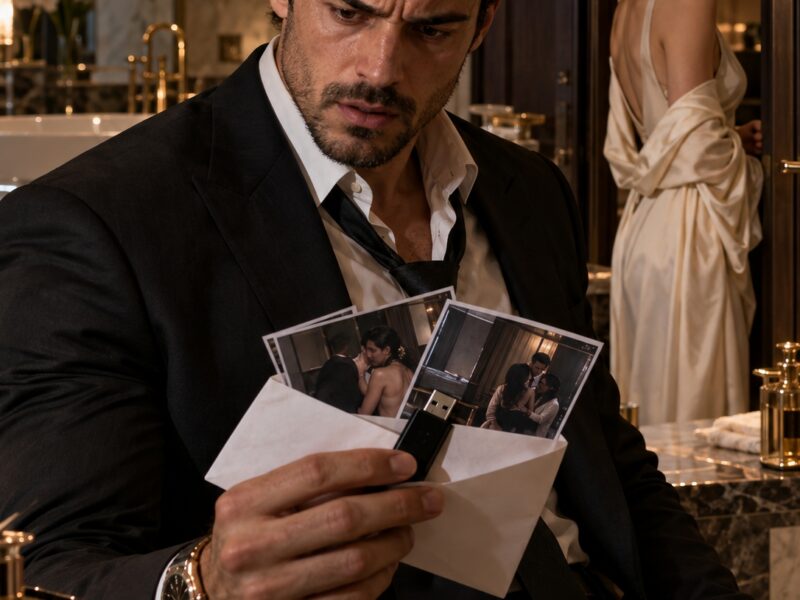
An envelope.
Four strips of beige surgical tape held it beneath the tank.
Dante peeled them away.
The envelope dropped into his palm.
Inside was a black solid-state drive with the serial number scratched away.
And six photographs.
He pulled out the first.
Then stopped breathing.
It showed him.
Two weeks earlier.
Stepping from a black sedan outside the shipping office at the Calumet terminal.
Shot with a long lens.
From surveillance distance.
Dante slid it back.
He did not need the other five.
The angle told him enough.
This was not gossip.
It was preparation.
At the brownstone, Raphael produced an air-gapped laptop.
Dante inserted the drive.
One folder appeared.
Inside was everything required to dismantle his organization.
Thirty-one lieutenants.
Home addresses.
Daily routes.
Children’s schools.
Safe houses.
Meeting locations.
Shipping schedules.
A thirty-eight-minute Port Authority vulnerability.
And then—
Two six-digit access codes.
Pier 22.
The armory.
Four hundred weapons.
Dante sat down.
“Someone’s hitting Tuesday’s shipment,” he said.
Raphael remained behind him.
“And the armory the same night.”
Dante removed the drive.
“The question isn’t whether Isabella is carrying information.”
He looked at the black screen.
“The question is who she’s carrying it to.”
His first impulse was simple.
Return home.
Take the wineglass from Isabella’s hand.
Ask one question.
If she lied, kill her.
But Dante had survived too long to confuse anger with strategy.
The first bullet was rarely useful.
The useful bullet came after the pattern was complete.
Isabella was carrying the envelope.
Someone else was reading it.
Kill the carrier, and the reader found another courier.
Find the reader—
And the war might end before anyone knew it had begun.
“We put it back,” Dante said.
Raphael’s eyes narrowed slightly.
“Tonight?”
“Exactly where we found it.”
Then they would watch.
At 9:47, they returned.
The envelope went beneath the toilet again.
Same position.
Same tape.
Same angle.
Raphael installed a pinhole camera and directional microphone behind the medicine cabinet.
“Who knows?” Raphael asked.
“You.”
“Anyone else?”
“No.”
Raphael nodded.
“That is a short list.”
“It has always been a short list.”
The following morning, Dante found Sophie sitting on the third stair from the bottom, eating toast with both hands.
“Good morning, little girl.”
She looked up.
“Hi.”
“Are you supposed to be here?”
“Mommy said stairs are allowed.”
“Reasonable.”
Dante sat two steps above her.
“Sophie?”
She kept chewing.
“Can I ask you something about the bad-guy case?”
Her eyes lit instantly.
“You’re asking the detective?”
“I’m asking the detective.”
She brushed crumbs from her pajamas and lifted the plastic magnifying glass.
Dante lowered his voice.
“The envelopes Isabella hides. Has anyone ever come to get them?”
Sophie thought.
“One time.”
Dante’s body went still.
“A man?”
She nodded.
“What did he look like?”
“Big.”
“How big?”
“Bigger than you.”
Dante almost objected.
“Not fat-big,” Sophie clarified. “Shoulders-big.”
“What else?”
She frowned.
“A silver watch.”
Dante’s fingers remained motionless on his knee.
“Which wrist?”
Sophie tapped her left wrist.
“Big shiny one. Face like a plate.”
Dante stopped hearing the house.
He saw only a silver watch beneath ballroom chandeliers.
A silver watch beside black coffee.
A silver watch that had belonged to a dead father.
Marcus Carrera wore it every day.
“Did you see his face?”
“No. I was behind the big plant.”
“Of course you were.”
“He came through the back. Went upstairs. Came down with the envelope in his coat.”
Dante thanked her.
Then remained on the stairs after Sophie had returned to her toast.
Twenty-three years.
That was how long Marcus had been beside him.
At twelve, Marcus had pulled an older boy off Dante in a Catholic school courtyard.
At nineteen, he had sat six hours outside the hospital room where Dante’s mother died.
At twenty-four, he had taken a bullet in Cicero meant for Dante.
At twenty-nine, he had pulled Dante unconscious from burning wreckage in black Florida water.
Friend.
Brother.
Head of security.
The man who knew where Dante slept because he had spent half his life making sure Dante woke up.
And the man who had introduced Isabella.
Dante went to the brownstone.
Raphael played the footage.
Isabella entered at 3:51.
She knelt.
Deposited the envelope.
Left.
Two hours and six minutes later, the service door opened.
A tall man entered.
Black overcoat.
Broad shoulders.
He climbed the back staircase.
Entered Dante’s bathroom.
One minute and forty-four seconds later, he emerged with the envelope.
As he opened the service door, the camera caught his wrist.
Silver.
Heavy.
Face like a plate.
Raphael froze the image.
Dante stared at it.
His oldest friend had not merely betrayed him.
Marcus had designed the door through which betrayal entered his house.
At eleven that morning, Dante poured himself three fingers of Macallan.
He had not touched whiskey in five years.
He drank it standing.
Then he went upstairs to Isabella.
She was reading in the sunroom.
Her smile warmed when she saw him.
“You’re home early.”
“Meeting canceled.”
“Lucky me.”
“Come downstairs.”
Something moved in her eyes.
Not enough for most men.
Enough for Dante.
In the library, he locked the double doors.
The click of the brass key sounded final.
“Dante?”
He placed a folder on the desk.
Six photographs.
The black drive.
A surveillance still of Isabella kneeling behind his toilet.
She approached.
Looked down.
And became pale.
Dante waited for outrage.
Denial.
Explanation.
Instead, Isabella’s knees weakened.
She sat.
A full minute passed.
Then she looked up.
And Dante saw something he had never seen in her before.
Not guilt.
Not fear of him.
Despair.
The private, exhausted despair of someone who had been drowning where no one could see.
“He has my sister.”
Dante did not sit.
“Who?”
Isabella swallowed.
“Marcus.”
The room seemed to tilt.
“Her name is Lucia,” Isabella whispered. “She’s twenty-two.”
And then the story came out.
Lucia had landed at O’Hare six months earlier.
She called Isabella from the taxi stand.
At 3:41 p.m., the line went silent.
The next morning, Isabella received a photograph.
Lucia tied to a chair.
A newspaper proving the date.
The Vitelli crest stamped on the back.
No demand followed.
Not for three weeks.
Then Marcus walked into Isabella’s gallery.
He bought a landscape nobody wanted.
Paid cash.
While Isabella wrapped it, he placed another photograph on the counter.
Lucia alive.
Clean clothes.
Hot food.
“He said he had taken her away from Vitelli,” Isabella said. “He said she was safe.”
“And the price?”
“The envelopes.”
Dante’s jaw tightened.
“Whatever he wanted. Whenever he wanted. I left them behind your toilet. If I missed one delivery, Lucia went back to Vitelli.”
Her voice thinned.
“If I told you, he said she would go back in pieces.”
Dante stared at the woman he had almost killed.
“How long?”
“Four months.”
“How much have you given him?”
“Everything he asked for.”
“Everything?”
“No.”
That answer changed the room again.
Isabella looked at him.
“I copied it.”
Dante remained silent.
“Every drive. Every document. Every conversation I could record. There’s another drive hidden in the gallery.”
“Why?”
“I was waiting.”
“For what?”
“A mistake.”
“Whose?”
“His. Mine. Yours.”
Her eyes filled but the tears did not fall.
“I was waiting for one day when staying alive might mean something again.”
For the first time in thirteen months, Dante understood that he had never truly known Isabella.
Not because she had hidden herself well.
Because he had mistaken composure for peace.
“Get the drive.”
She returned two hours later with groceries.
Bread.
Tomatoes.
And beneath them, a second black drive.
The newest audio file contained Marcus’s voice.
“Tuesday night. Thirty-eight minutes. Your people take the dock. My people take the armory. Moretti rides to the port himself.”
Another man answered.
Older.
Heavy Sicilian accent.
Vitelli.
Then Marcus again.
“One car. Two men. We take him on the service road behind the warehouse.”
Dante stopped the recording.
Now he could see the entire shape.
Vitelli had tried to kill him.
Marcus had made the attempt possible.
Pier 22 would be emptied.
Dante would die at the port.
Vitelli would take the North Side.
Marcus would inherit the South.
A city divided over the body of a man who had trusted the wrong brother.
Dante looked at Isabella.
“Tonight, you put another envelope behind my toilet.”
She stared at him.
“Exactly like before.”
“Yes.”
“You smile when you see Marcus.”
“Yes.”
“You kiss me at breakfast.”
Her eyes flickered.
“Yes.”
“You pour wine at dinner.”
“Yes.”
“And when the ambush begins, you stay inside this house.”
“Dante—”
“Your sister comes home.”
Silence.
“I give you my word.”
Isabella closed her eyes.
When she opened them, something inside her had stopped running.
“I know.”
The next warning came from Elena.
She appeared at the library door pale and shaking.
“It’s Sophie.”
Dante stood immediately.
“Is she hurt?”
“No. She saw someone.”
That was worse.
A man had been standing near the staff-wing door that morning.
Watching Sophie.
Short black hair.
Small beard.
Long coat.
Shiny shoes.
Not Marcus.
A Vitelli man.
The conspiracy had moved inside Dante’s walls.
And Sophie had become a loose end.
That night, Dante sent Elena and Sophie away.
At the service gate, Sophie refused to enter the car.
“My case isn’t closed.”
“Sophie.”
“The bad guy is still here.”
“I know.”
“Detectives don’t leave before the case is closed.”
“Who told you that?”
“The cartoon.”
Dante crouched on the freezing gravel.
He lifted the plastic magnifying glass from around her neck.
Sophie looked horrified.
“Detective Rossi, I’m confiscating your badge.”
Her lip trembled.
“Not forever. Three days. Maybe four.”
“Why?”
“Because the chief detective does not enter the field during the final phase of a dangerous investigation.”
She blinked.
“That’s a rule?”
“In real cases.”
“Promise?”
“On my word.”
She studied him.
Then carefully placed her oversized detective hat on his head.
“If I can’t go, you have to wear this.”
Elena made a sound somewhere between laughter and crying.
Dante did not remove it.
He slipped Sophie’s scratched plastic magnifying glass into his inside pocket.
Directly over his heart.
Then he watched their taillights disappear into the winter dark.
The trap took shape that night.
Dante created a false shipping manifest.
Real enough to survive scrutiny.
Wrong enough to kill the plan.
Warehouse on 21st and Blue Island.
Four a.m.
Thirty-eight-minute vulnerability.
False access codes.
False container number.
False target.
Every lie wrapped inside details Marcus already believed.
The following afternoon, Isabella deposited the envelope.
Two hours later, Marcus collected it.
By midnight, twenty-eight loyal Moretti men surrounded the warehouse.
At 3:52 a.m., nine Vitelli men arrived in two SUVs.
They carried the stolen codes.
They approached the warehouse.
They never reached the door.
Raphael’s voice came through Dante’s earpiece.
“The net is closed.”
But Dante was not at the warehouse.
He was beneath his own house.
In the wine cellar.
Marcus stood six feet away between two stone pillars.
His silver watch gleamed beneath the yellow light.
“You dragged me down here at four in the morning for what?”
“A conversation.”
“I was asleep.”
“No,” Dante said. “You weren’t.”
Marcus looked at him.
Dante placed a black speaker on a wine barrel.
“Twenty-three years,” Dante said.
“What?”
“I’m going to ask you one question after twenty-three years.”
Marcus’s jaw hardened.
“Where were you on the fourteenth between five and seven?”
“Rush Street. Giordano’s. Castellano’s consigliere. Vince. Two of their men.”
“After?”
“Home.”
“You didn’t come into the main house?”
“No.”
“You didn’t use the service entrance at 6:01?”
Marcus did not blink.
“You didn’t walk upstairs wearing a black overcoat?”
The mask held.
Dante pressed play.
Marcus’s own voice filled the cellar.
“Tuesday night. Thirty-eight minutes. Your people take the dock. My people take the armory. Moretti rides to the port himself…”
Then Vitelli.
Then Marcus again.
“And the woman?”
“She’s finished the same night. Sister goes back. No loose ends.”
Dante stopped the recording.
The cellar became silent.
Marcus’s hand moved.
“Don’t.”
“Dante—”
“Don’t.”
Marcus drew anyway.
The first shot passed Dante’s ear and tore stone from the pillar.
Dante moved.
The second struck the ceiling.
He drove his boot into Marcus’s knee.
Marcus staggered but stayed upright.
Then twenty-three years of friendship collapsed into ten seconds of violence.
An elbow across Dante’s jaw.
Dante’s forehead into Marcus’s nose.
Blood across stone.
A pistol spinning beneath a wine rack.
Dante’s gun knocked from his hand.
They crashed against an oak barrel.
Marcus caught Dante by the throat.
His fingers tightened.
Dante saw the silver watch inches from his face.
The same watch Sophie had noticed from behind a plant.
Then the cellar door burst open.
Raphael came down the stairs with a shotgun.
The pump slid back.
Marcus froze.
Raphael pressed the barrel against the base of his skull.
Marcus released Dante.
Slowly, he sank onto the stone floor.
Blood dripped from his nose.
Dante stood over the man who had saved his life more than once.
“Why?”
Marcus laughed.
One short, broken sound.
“Twenty-three years, Dante.”
“Why?”
“I spent twenty-three years one step behind your right shoulder.”
Dante said nothing.
“I pulled you out of the water. Took the bullet in Cicero. Buried men for you. And every time the table was set, there was one chair at the head.”
Marcus looked up.
“And one chair to the right.”
His voice became quieter.
“My name was carved into that second chair.”
“You never asked.”
“I asked every day.”
“No. You waited for me to read your mind.”
“You should have.”
There it was.
Not money.
Not entirely.
Not power.
Not entirely.
Resentment left unspoken until another man discovered how to weaponize it.
“Vitelli heard me,” Marcus said. “He offered the South Side. The yards. Pilsen distribution. My own crew. My own name.”
“And Lucia?”
Marcus wiped blood from his mouth.
“That was my idea.”
Something in Dante went cold.
“Where is she?”
“The Vitellis took her at O’Hare. Three days later I bought her from them.”
“You bought her?”
“A hundred thousand dollars and a promise. Vitelli thought I was being sentimental.”
Marcus smiled without humor.
“I was buying leverage.”
Dante crouched.
“Where?”
“Farmhouse off Route 31. Outside Elgin. Gray barn, red roof. Two men. Rotation at six.”
Dante stood.
“Raphael.”
“I have him.”
“Second basement. Gatehouse.”
Marcus looked up.
“Dante.”
Dante stopped.
“I would’ve made it quick.”
Dante looked at the man who had once restarted his heart with his bare hands.
“I know.”
Then he walked away.
Before sunrise, three cars were moving toward Elgin.
The farmhouse stood beyond a field of dead winter grass.
Dante’s men entered at 5:52.
One guard slept.
The other was making coffee.
Eight minutes later, the building belonged to Dante.
Lucia Ki was upstairs.
Twenty-two years old.
Fifteen pounds lighter.
Hair hacked short with kitchen scissors.
Oversized cardigan.
Cheap jeans.
When the door opened, one of Dante’s men spoke her name in Italian.
“Lucia. Your sister sent us.”
She sat on the edge of the bed.
Then cried silently for ninety seconds.
After six months of captivity, she walked outside on her own feet.
Isabella was waiting at the Moretti estate when the car arrived at 9:14.
She ran down the front steps without a coat.
Lucia stepped from the back seat.
For several seconds, neither sister moved.
Then Isabella crossed the gravel.
Her hands went to Lucia’s face.
Hair.
Shoulders.
Cheeks.
As if touch could prove what sight could not.
Lucia pressed her forehead against Isabella’s collarbone.
The sound she made was small.
It broke something in everyone who heard it.
Dante watched from the steps.
He did not go closer.
Some reunions belonged only to the people who had survived the separation.
An hour later, Isabella stood at the library window.
Lucia was upstairs taking a hot bath.
“You can stay,” Dante said.
“I know.”
“You can stay here as long as you want.”
“I know.”
“Or I can send both of you anywhere. New documents. Money. A home no one in Chicago knows.”
Isabella turned.
“Milan.”
Dante waited.
“She has a professor there. He was waiting for her thesis. I have a cousin. There’s a gallery that’s asked me to return for two years.”
“Then Milan.”
Isabella crossed the room.
Stopped one step away.
“Dante.”
“Isabella.”
“I did love you.”
He looked at her.
“On the days I was allowed to.”
He nodded.
“I know.”
Her fingers touched his lapel.
Directly over the plastic magnifying glass still inside his pocket.
Then she walked upstairs to her sister.
Dante did not ask her to stay again.
Love demanded many things.
Captivity should never be one of them.
By noon, Raphael stood in the library.
“Second in command,” Dante said.
Raphael looked at him.
“Effective immediately.”
A slow nod.
No celebration.
Men like Raphael understood that promotions in their world usually meant someone else had died, betrayed you, or both.
Later that afternoon, Dante drove to the safe house where Elena and Sophie were staying.
He had slept perhaps ninety minutes.
His jaw was bruised.
There was dried blood near his collar.
Inside his coat pocket was a scratched plastic magnifying glass.
In his hand was an oversized detective hat.
The door opened before the second chime.
Sophie appeared.
Pink rabbit pajamas.
Blue cardigan.
Bare feet.
She looked up at him.
“Uncle Dante.”
“Little girl.”
“Did you solve it?”
Dante crouched.
His knees had become strangely accustomed to the position.
“Detective Rossi.”
Her eyes widened.
“The case is closed.”
“All of it?”
“All of it.”
“The bad guy?”
“The man with the silver watch is somewhere he can’t hurt you.”
“And Isabella?”
Dante considered his words.
“The pretty lady with the red lipstick wasn’t the bad guy.”
“I told you she was.”
“You were wrong about that part.”
Sophie frowned.
“She was helping someone she loved. She was scared.”
“Oh.”
“Her sister came home.”
Sophie’s face softened.
“And the envelopes?”
“Gone.”
“The bathroom?”
“Just a bathroom again.”
She seemed pleased by this.
Dante took out the magnifying glass.
“By the authority vested in me by absolutely nobody, I am promoting you.”
“To what?”
“Chief Detective.”
Her mouth fell open.
“Chief?”
“Of the whole operation.”
“The whole thing?”
“The whole thing.”
He carefully placed the shoelace around her neck.
Then settled the detective hat on her head.
It immediately slipped over one ear.
Sophie straightened it.
Dante extended his hand.
“If the Chief Detective allows it, I’d be honored to serve as her assistant.”
Sophie narrowed her eyes.
“On one condition.”
Dante almost smiled.
“What condition?”
“You have to listen when I tell you something.”
That landed harder than she knew.
“I will.”
“Even if I’m little?”
“Especially then.”
She held out her hand.
Dante took it.
Her entire hand barely filled his palm.
“I have a condition too,” he said.
“What?”
“You are never hiding behind my toilet again.”
Sophie thought.
Long and seriously.
Then nodded.
“Deal.”
Behind her, Elena stood in the doorway with both hands covering her mouth.
Dante rose.
“Elena.”
“Mr. Moretti.”
“I want you back at the house.”
Her expression changed.
“As head of staff. Triple your salary. Apartment in the east wing.”
“Sir—”
“And Sophie’s school fees through university. Wherever she gets in.”
Elena began crying before he finished.
She stepped forward.
For one second, she hugged him.
Not like an employee.
Not like someone afraid of Dante Moretti.
Like family.
Then she stepped back and nodded.
Dante drove home after sunset.
Chicago passed outside the car window in streaks of gold and white.
For years, he had believed danger announced itself through violence.
A gunshot.
A threatening call.
A car following too closely.
A stranger standing where he did not belong.
He had been wrong.
The greatest danger of his life had worn his oldest friend’s watch.
The woman he nearly killed had been trying to save her sister.
And the person who saw the truth first had been a five-year-old girl in rabbit pajamas hiding behind a toilet because she watched too many detective cartoons.
When Dante reached the estate, the house felt different.
Not safer.
He no longer believed in safe houses.
But quieter.
More honest.
He climbed the stairs.
Passed the library.
Passed the room where Isabella had slept.
Then stopped outside his bathroom.
For several seconds, he simply stood there.
Finally, he opened the door.
Amber light washed across the marble.
The sink was clean.
The tub was empty.
The toilet was just a toilet.
Dante walked inside.
He crouched one last time and looked behind it.
Nothing.
No tape.
No envelope.
No stolen secrets.
Only porcelain, plumbing, and shadow.
He straightened.
In the mirror, he saw a man with a bruise along his jaw and exhaustion beneath his eyes.
A man who commanded hundreds of others.
A man who had survived ambushes, bullets, betrayals, and the kind of loyalty that rotted quietly into hatred.
Yet none of that was what he thought about.
He thought about Sophie standing in the gravel.
The detective doesn’t leave until the case is closed.
He thought about Isabella saying she had loved him on the days she was allowed to.
He thought about Marcus saying he had spent twenty-three years sitting in the chair to Dante’s right.
Then he thought about a small hand disappearing inside his palm.
Dante switched off the bathroom light.
Before closing the door, he looked once more at the empty space behind the toilet.
For most of his life, he had paid fortunes for information.
He had threatened men for it.
Rewarded men for it.
Killed over it.
And the truth that saved his life had cost him nothing.
It had arrived in a whisper.
From the smallest person in his house.
“Shh, Uncle Dante.”
And for once in his life, Dante Moretti had been wise enough to listen.









