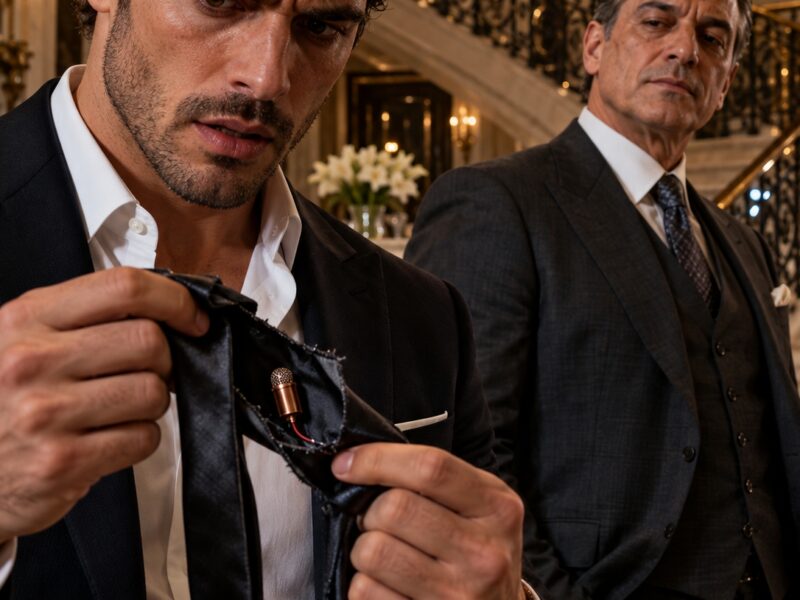
The Four-Year-Old Who Cut the Mafia Boss’s Tie—And Exposed the Man Who Had Betrayed Him for Ten Years

“There’s a bug hiding in your tie.”
The voice came from somewhere below Dante Moretti’s elbow.
Small.
Clear.
Completely unafraid.
By the time he looked down, the scissors had already closed.
The sound was almost nothing—a soft metallic snip swallowed by the enormous marble foyer of the Moretti house on East 74th Street.
Then the lower half of Dante’s black silk tie slid from his chest and landed between his polished shoes.
Four men reached for guns.
Marco Bellini was the fastest.
He had stood beside Dante or his father nearly every weekday morning for fifteen years, and his pistol was out before the severed silk touched the floor.
Three other men followed.
Four weapons.
Four safeties released.
Four black barrels pointed toward a little blonde girl in a lemon-colored dress.
Dante raised one hand.
That was all.
The guns disappeared.
The little girl did not cry.
She did not seem to understand that four grown men had nearly turned the grand entrance hall into a killing room because she had attacked the most feared man in the house with preschool safety scissors.
She was four years old.
Her brown buckle shoes did not match.
The scissors in her right hand had rounded blue tips and a plastic dolphin molded into the grip.
In her left hand, she held the severed piece of Dante’s tie like a prize.
“There’s a bug,” she repeated patiently.
Then she lifted the silk closer to his face.
“Hiding in your tie.”
Dante Moretti was thirty-five years old.
He had buried his father.
He had survived two assassination attempts.
He had personally killed four men, though he never spoke about any of them.
He controlled docks, warehouses, trucking routes, restaurants, construction contracts, and enough frightened men that people lowered their voices when they said his name.
But for the next three seconds, Dante felt something he had not felt in years.
Fear.
Not of the scissors.
Not of the child.
Of the possibility that she was right.
Because at nine o’clock that morning, the heads of five families were supposed to meet above a restaurant on Mott Street.
The meeting had taken eleven months to arrange.
Chicago had sent people.
Philadelphia had driven through the night.
Old grudges had been temporarily folded away.
Promises had been made.
Dante himself had chosen the chair at the north end of the round oak table.
And three days earlier, he had chosen this exact tie.
He slowly lowered himself into a crouch.
The four-year-old watched him with calm blue eyes.
“May I see it?”
She studied him.
Then she handed him the silk with both hands.
Dante turned it over.
Nothing.
He ran his thumb along the inner lining.
Then he saw the stitch.
One thread was darker than the others.
Almost perfect.
Almost.
He slipped a fingernail beneath it and pulled.
The lining opened.
Something copper-colored caught the chandelier light.
Dante stopped breathing.
It was smaller than his fingernail.
Flat.
Rectangular.
A tiny mesh grille sat along one edge.
Two hair-thin wires disappeared into the silk.
Someone had opened the seam with surgical patience, placed the device inside, then closed the fabric so carefully that a grown man dressing in front of a mirror would never have noticed.
But a child had.
Because children looked at things adults had trained themselves not to see.
Dante stared at the device.
Audio.
Possibly GPS.
Possibly both.
He had seen equipment like it twice before.
Both times, it had been removed from dead men.
Footsteps suddenly rushed down the service corridor.
A woman appeared around the corner and stopped so abruptly her shoes squeaked against the marble.
Elena Castellanos.
Twenty-nine.
Gray dress.
Gray apron.
Dark hair pulled so tightly back that it sharpened the worry already carved into her face.
Her eyes found the scissors.
Then the guns.
Then Dante crouching in front of her daughter.
“Lily.”
The name broke out of her.
She rushed forward, pulled the child behind her legs and began apologizing in English before panic pushed her into Spanish.
“Mr. Moretti, I am so sorry. I am so sorry. I’ll take her. We’ll leave today. Please, she didn’t understand—”
“Elena.”
She froze.
It may have been the first time Dante had ever used her first name.
He remained crouched.
In one hand was the ruined tie.
In the other was the tiny device someone had planted close enough to his throat to hear him breathe.
Then Dante did something Marco Bellini had almost never seen him do.
He smiled at a child.
It was a small smile.
Awkward, almost.
But real.
“Lily,” Dante said.
The girl peeked around her mother’s hip.
“That’s a good name.”
Elena stared.
Dante held up the device.
“Where did you see this?”
Lily pointed toward the front door.
Not at Dante.
Past him.
At the city outside.
“In the shop.”
Dante’s smile disappeared.
“What shop?”
“The tie shop.”
His eyes narrowed.
“What did you see?”
“The man hid it in the collar.”
She paused.
“He thought I was coloring.”
Marco looked at Dante.
Dante turned his head slightly.
“Cancel it.”
Marco already had his phone out.
“The meeting?”
“All of it.”
Marco walked away.
Dante remained on the marble.
And while Marco quietly canceled the most important meeting New York’s underworld had attempted in two years, Dante looked at the frightened housekeeper and her daughter and realized something that embarrassed him more than it should have.
Elena had worked in his home for eleven months.
He had signed her employment file.
He knew she had been widowed.
He knew her husband had died in a dock accident.
He knew she did laundry on Mondays and Thursdays.
Yet until that morning, he had barely known her name.
He had not known Lily’s at all.
The people closest to the floor, he realized, often saw what the people sitting at the head of the table missed.
And someone had just tried to teach him that lesson with a microphone sewn into silk.
By 8:40, the device sat beneath a folded linen napkin inside a crystal ashtray in Dante’s study.
He had changed into a dark blue cotton tie.
At 8:43, Marco opened the door.
“Victor.”
Dante adjusted the knot.
“Give me thirty seconds.”
Victor Romano entered the front sitting room as though he owned part of the building.
In some ways, he did.
He was fifty-one, immaculate in charcoal wool, carrying a hat in his left hand and wearing the silver watch Dante’s father had given him decades earlier.
Victor had served Dante’s father.
Then he had stood beside Dante after the funeral.
Ten years.
Ten years of funerals, negotiations, betrayals, weddings, hospital rooms, Christmas dinners, whispered warnings and late-night phone calls.
Victor was not family by blood.
But Dante had trusted him in almost every way that mattered more.
“You canceled,” Victor said.
“I canceled.”
“Chicago flew in last night.”
“I know.”
“Philadelphia drove six hours.”
“I know.”
Victor lowered his voice.
“Why?”
“Fever.”
Victor studied him.
“You don’t look sick.”
“I took something.”
A tiny silence opened between them.
“When are we moving it?”
“Thursday.”
Victor nodded.
Then his gaze drifted upward.
“That’s a different tie.”
Dante’s fingers remained on the knot.
In the mirror behind Victor, Dante watched the older man’s face.
Not his mouth.
His eyes.
“Coffee,” Dante said. “Spilled it.”
Victor smiled.
His eyes did not.
He tapped one finger against the brim of his hat.
Twice.
Then he left.
Dante waited until the front door closed.
Only then did he return to the study.
He lifted the napkin.
The copper device was still warm.
For the first time, suspicion had a face.
And Dante hated himself for recognizing it.
Marco returned at 9:15 carrying a black notebook.
“The ties came from Falcone on Mulberry.”
“Giuseppe?”
“The old man himself.”
Dante nodded.
Falcone’s father had dressed Dante’s grandfather.
His grandfather had dressed Morettis before that.
Three generations of trust.
“Order?”
“Placed two weeks ago. Three ties. Same silk. Same cut.”
“Who ordered them?”
Marco hesitated.
That hesitation answered the question before his mouth did.
“Victor.”
Dante stared at him.
Marco immediately added, “That doesn’t mean anything by itself. Victor has handled your tailor orders for years.”
“I know.”
“The box was delivered Friday. Elena signed for it.”
“Who knew which tie I’d wear today?”
Marco opened the notebook.
“You. Me. Elena, because she presses them. Victor, because he keeps your weekly schedule. Falcone, because he made them.”
“Four.”
“Four.”
Neither man said what mattered.
One of those four was standing in the room.
And Marco Bellini had not bugged Dante’s tie.
Small footsteps passed outside the study.
Lily walked down the hall carrying a white sock stuffed with crayons.
She was humming.
She did not look at them.
Dante watched her disappear.
Then he said, “Bring me the little one.”
At ten o’clock, Lily entered the library carrying a battered shoe box.
Dante was sitting cross-legged on the Persian rug.
A three-thousand-dollar suit.
Italian leather shoes.
A criminal empire.
And there he sat on the floor because he had discovered that children spoke differently when adults stopped towering over them.
Lily sat opposite him.
“The man in the shop,” Dante said. “Can you tell me about him?”
She opened the shoe box.
Inside were drawings.
Dozens.
Construction paper.
Newsprint.
Envelopes.
Receipts.
A child’s portable archive of the world.
She selected one.
Dante unfolded it.
A tailor stood behind a counter.
Round glasses.
Brown vest.
Yellow measuring tape.
On the table was a black tie.
Near the collar, Lily had drawn a small copper oval.
Six legs.
Beside it, an arrow.
Dante’s throat tightened.
“He looked around three times,” Lily said.
She held up one finger.
“One.”
A second.
“Two.”
A third.
“Three.”
“Did you see his face?”
“No.”
“Anything else?”
She searched through the box.
Then she produced another drawing.
An arm.
A white coffee cup.
And along the inside of the forearm, from wrist almost to elbow, a long dark red line curved like a worm.
“He had this.”
Dante stared.
“A scar?”
“Like a worm.”
Something inside him went cold.
Marco left for Mulberry Street before eleven.
Giuseppe Falcone confessed within minutes.
Not because Marco threatened him.
Because the old tailor had been waiting to confess for ten days.
A man calling himself Enzo had gone to Falcone’s daughter’s apartment in Astoria.
He had shown her a video of her three-year-old son playing in a park.
Then he had placed eight thousand dollars on the kitchen table.
No shouting.
No beating.
No theatrical threat.
Only a simple explanation.
Put the device into the second black tie.
Deliver it Friday.
Tell anyone, and the next man at the playground would not be carrying a phone.
“Describe him,” Marco said.
Falcone swallowed.
“About sixty. Thin. Bad teeth.”
“Anything else?”
The old tailor looked down.
“He drank espresso while I sewed.”
Marco waited.
“He rolled his sleeve up.”
Falcone touched his own forearm.
“A scar. Here. Long. Curved.”
“Like what?”
Falcone looked at him.
“Like a worm.”
By three o’clock, they had a name.
Enzo Barbi.
Fifty-eight.
Knife scar on right forearm.
Known Gallo associate.
Collections.
Intimidation.
Errands.
Third-tier.
Disposable.
Perfect.
Marco put the file in front of Dante.
“The Gallos.”
Dante did not touch it.
“They’ve wanted Red Hook for six years,” Marco continued. “Franco has been talking about us getting weak since summer.”
“Too easy.”
Marco frowned.
“Boss?”
Dante stood and walked toward the window.
A bare pear tree stood in the November garden.
One sparrow rested on a branch.
“Everything we found points to the Gallos.”
“Because it is the Gallos.”
“Maybe.”
Marco waited.
Dante turned.
“A frightened tailor gives us Enzo in ninety seconds. A four-year-old remembers a scar distinctive enough to identify him. Enzo’s record practically has GALLO stamped across the front.”
“You think it’s planted?”
“I think someone wants us angry.”
Marco’s expression hardened.
“Then we go to Franco.”
“No.”
“We take him tonight. Six men.”
“No.”
“Dante—”
“When a road is covered in red carpet, Marco, don’t walk down it.”
Marco stopped.
“Ask who rolled it out.”
Silence.
Dante stepped closer.
“Someone wants me in the Bronx tonight. Someone wants six of our men with me. Someone wants blood between us and the Gallos before tomorrow morning.”
Marco’s face changed.
“And tomorrow?”
“The families meet without me.”
“Because you’re dead.”
“Or because I’m at war.”
For several seconds, only the clock spoke.
Then Marco said, “What do we do?”
Dante looked toward the study.
“We let the bug listen.”
That afternoon, Dante stood behind the glass of the sunroom and watched Victor Romano talking to Paulie Ricci on the garden path.
Victor laughed.
Paulie laughed.
Victor touched the younger man’s shoulder like an uncle.
Nothing about the scene looked dangerous.
That was what frightened Dante.
And suddenly, from two years earlier, he remembered Sophia.
His wife had left quietly.
No affair.
No screaming.
No broken plates.
She had packed one suitcase and taken her mother’s rosary.
On the kitchen island, she had left one sentence.
You confuse loyalty with proximity.
For two years, Dante had thought it was a wife’s final cruelty.
Standing in the sunroom watching Victor laugh with a man he might already have marked for death, Dante finally understood.
Ten years beside a man did not prove loyalty.
It proved ten years of proximity.
Nothing more.
At six that evening, Yuna Park arrived carrying an aluminum case.
She examined the device in the basement.
Eleven minutes passed before she spoke.
“Audio and GPS.”
“Live?”
“Dual live stream. Nothing stored locally.”
“Range?”
“Half a mile to a relay. The relay uploads through cellular.”
“Can you find it?”
Yuna opened her laptop.
“I already did.”
Three signal lines converged on a building in Chelsea.
A limousine garage on West 22nd Street.
Marco leaned over the screen.
Then he looked at Dante.
“Victor lives three buildings away.”
No one spoke.
Finally Marco said, “We take the garage tonight.”
“No.”
“Dante.”
“No.”
“Then what?”
Dante picked up the copper device.
“We give it exactly what it came for.”
At seven, the microphone returned to Dante’s breast pocket.
He entered the library.
Marco was waiting.
Their conversation sounded casual.
It was theater.
Dante announced that the family meeting had been moved.
Warehouse 7.
Red Hook.
Nine o’clock Thursday night.
One entrance.
Minimal security.
Victor would not be told.
The bug listened to every word.
When they finished, Dante left the room.
Neither man noticed the small face pressed to the crack beside the library door.
Lily had heard everything.
She did not understand murder.
She did not understand betrayal.
But she understood secrets.
That night, she entered the library in rabbit slippers.
Dante sat alone.
“What are you going to do with the bug?”
He looked at her.
“It listens to things it shouldn’t hear.”
She nodded.
“So I’m going to let it hear something it should.”
“Like when I listen at Mama’s door?”
Dante almost smiled.
“Yes.”
“Mama doesn’t know I listen.”
“I’m sure she doesn’t.”
“The bug doesn’t know you know?”
“No.”
Lily considered this.
Then nodded solemnly.
For reasons Dante could not explain, he laughed.
A real laugh.
Brief.
Rusty.
Unexpected.
Lily opened her hand.
A half-eaten red lollipop rested inside a pink napkin.
“For you.”
Dante accepted it.
He placed it in his breast pocket.
Beside the device someone had planted to kill him.
Thursday arrived cold.
At 2:40, Marco entered the study carrying photographs.
A gray rental van had appeared near Red Hook.
Five men.
Long bags.
One of them was Nikki Carbone.
Franco Gallo’s personal gunman.
The trap was real.
But there was more.
At 1:45, Victor had made a thirty-eight-second call to a burner phone activated on the same day the ties had been ordered.
Yuna recovered the audio.
Dante put in the earbuds.
Victor’s voice came first.
“Nine sharp. He’ll come alone.”
Then a woman answered.
Calm.
Controlled.
“Tell Franco not to leave anyone standing.”
Victor said, “And then you sit in his chair.”
The woman replied, “That’s the script.”
Dante’s face became motionless.
The call continued.
Dante would die at the warehouse.
Victor would arrive afterward.
He would pretend to avenge him.
The other families would accept Victor at the north end of the table.
The Moretti dynasty would end before breakfast.
Then Victor said the woman’s name.
“Isabella.”
Yuna turned the laptop.
Marriage record.
Isabella Maria Romano.
Victor’s sister.
Married to Franco Vincent Gallo.
Dante stared at the screen.
Ten years.
Victor had stood beside him for ten years.
And Victor’s blood had been sleeping beside the enemy the entire time.
Marco waited.
Finally Dante said, “Set up two meetings tonight.”
“Two?”
“One where they expect us.”
Dante looked toward the window.
“And one where they don’t.”
Before nightfall, Elena asked to see him.
She stood in his study.
“I want to take Lily away.”
Dante said nothing.
“I don’t know what’s happening here,” Elena continued. “And I don’t want to know. But I know when the quiet in a house changes.”
Her voice shook.
“Children get hurt when the quiet changes.”
Dante lowered his eyes.
“My daughter already cut one thing she had no business cutting. I would like to leave before something cuts her back.”
“You’re right.”
Elena blinked.
Dante stood.
“Monday morning, a car will take you somewhere no one associates with me. You stay seven days.”
“And then?”
“You go anywhere you want.”
She frowned.
“With what money?”
“Enough.”
“How much is enough?”
Dante looked at her.
“Enough that if Lily wants to become a doctor, she becomes a doctor. Enough that if she wants a house, she buys one. Enough that she never has to look at a price tag before deciding whether she deserves something.”
Elena’s eyes filled.
“You promise?”
“I don’t promise often.”
Dante paused.
“But I don’t break the ones I make.”
At 7:40, two cars left East 74th Street.
One traveled toward Red Hook.
The other toward Bay Ridge.
The Red Hook car carried men dressed like Dante.
It also carried tailor’s dummies padded to his measurements.
The Bay Ridge car carried Dante himself.
At Our Lady of Sorrows, four family heads entered separately.
None had been told the location by telephone.
Each had received a handwritten message.
Our Lady of Sorrows. Nine. Alone.
Meanwhile, Warehouse 7 waited in darkness.
Four dummies stood inside wearing Moretti coats.
One held a battery-powered cigarette ember that rose and fell every eleven seconds.
Twelve of Marco’s men waited above and behind them.
At 8:58, the door opened.
Nikki Carbone entered with four armed men.
Six seconds later, he fired.
One dummy fell.
He shot another.
Its wooden head rolled across the concrete.
Carbone froze.
The lights exploded on.
“Hands on the floor.”
Twelve voices.
Four directions.
Nobody died.
That had been Dante’s order.
At 9:15, the loading door opened again.
Victor Romano entered.
He had four men behind him.
He had the expression of a loyal lieutenant arriving too late to save his boss.
Then he saw the Gallos alive on the floor.
He saw Marco’s men.
And finally he saw Dante.
Alive.
Dark blue tie.
Empty hands.
Victor stopped.
For a moment, neither man moved.
Ten years stood between them.
Dante walked to the folding table.
He placed four objects on it.
The severed black silk tie.
The copper listening device.
Lily’s drawing.
A digital recorder.
Victor stared at them.
He looked longest at the crayon drawing.
“Ten years,” he whispered.
Dante said nothing.
Victor lifted his eyes.
“Ten years, Dante. And you tear it all open because of a four-year-old’s drawing?”
Dante’s expression barely changed.
“I didn’t tear anything open.”
His voice was quiet.
“You did.”
Victor’s jaw tightened.
Dante touched the drawing with one finger.
“She only saw it.”
Twenty seconds passed.
No one filled them.
Victor did not apologize.
Perhaps apology required regret.
He simply lowered his head.
By midnight, the four family heads had heard the recording.
By two in the morning, they had made their decision.
Victor Romano was not executed.
Dante refused.
Instead, Victor was removed from New York and sent back to the Calabrian town his grandfather had left generations earlier.
He would never return.
His wife and children were untouched.
That was Dante’s condition.
Isabella was returned to the Gallo family.
Franco Gallo surrendered three Brooklyn waterfront piers.
Pier 7.
Pier 9.
Pier 12.
Not one bullet had been fired at Dante.
Not one body had been dropped into the harbor.
When Marco drove him home Friday night, the pear tree had lost two branches to the wind.
In the study, Marco said, “Your father would’ve been proud.”
Dante looked at him.
“My father would’ve shot Victor twice and put him in the river.”
Marco said nothing.
Dante removed his coat.
“I’m not my father.”
Then he walked down the marble hall.
At the kitchen doorway, he stopped.
Lily was sitting at the staff table.
Red crayon in hand.
Drawing on the back of an envelope.
She did not notice him.
Dante watched her for several seconds.
Then he walked away.
Three months later, on a cold Saturday morning in February, Dante parked a plain sedan in Park Slope.
He walked toward a brownstone with a dark green door.
Two pots of winter pansies stood outside.
He had bought the house in cash.
When he gave Elena the deed, he had refused to call it a gift.
Instead, he had placed a note inside the envelope.
Three words.
Wages owed, overdue.
Lily had started preschool on Union Street.
Her shoes matched now.
Her teacher said she was quiet.
Patient.
Observant.
And that she drew more than any child the teacher had taught in nineteen years.
Dante visited once a month.
He brought books.
Birds.
Maps.
Fairy tales.
That Saturday, Elena opened the door wearing a coffee-colored sweater.
She no longer called him sir.
“Dante.”
She still said the name carefully.
Lily was at the kitchen table.
When she saw him, she climbed down.
“Mr. Dante.”
She approached with both hands behind her back.
“I made something.”
She gave him a drawing.
Dante took it carefully.
Three people stood beneath a yellow sun.
A woman in a coffee-colored sweater.
A little blonde girl in a lemon dress.
And a tall man wearing a dark suit and a blue tie.
The girl in the picture held blue safety scissors.
Dante stared at the tall figure.
“Lily?”
“Yes?”
“Who is this?”
She leaned over.
Tapped the man with one finger.
“The man who got saved when there was a bug in his tie.”
Something moved behind Dante’s ribs.
He crouched.
Just as he had that first morning.
Just as he had when a four-year-old girl had stood between four guns and a secret powerful men had missed.
He brought himself to her eye level.
“Thank you.”
Lily nodded once.
Then she returned to her crayons.
Dante remained there for another moment, holding the picture.
For most of his life, he had believed empires fell because enemies became stronger.
He knew better now.
Empires rarely began collapsing at the gates.
They began inside the walls.
With familiar footsteps.
Familiar voices.
A man who had stood beside you so long that you stopped asking why he was there.
Sophia had understood that years earlier.
You confuse loyalty with proximity.
Dante finally understood the difference.
Loyalty was not the number of years someone stood beside you.
It was what they chose to do in the quiet moment when betrayal would be easier.
And sometimes truth did not arrive carrying a gun.
Sometimes it did not come from an informant, a soldier, a lawyer, or a man with thirty years of experience.
Sometimes truth was three feet tall.
Sometimes it wore mismatched brown shoes.
Sometimes it carried crayons in an old sock and rabbit slippers down a hallway at night.
And sometimes, when every powerful adult in the room had learned not to look too closely, truth simply raised a pair of blue preschool scissors and said—
“There’s a bug hiding in your tie.”









